Publisher’s version / Version de l'éditeur:
Vous avez des questions? Nous pouvons vous aider. Pour communiquer directement avec un auteur, consultez la première page de la revue dans laquelle son article a été publié afin de trouver ses coordonnées. Si vous n’arrivez pas à les repérer, communiquez avec nous à [email protected].
Questions? Contact the NRC Publications Archive team at
[email protected]. If you wish to email the authors directly, please see the first page of the publication for their contact information.
https://publications-cnrc.canada.ca/fra/droits
L’accès à ce site Web et l’utilisation de son contenu sont assujettis aux conditions présentées dans le site
LISEZ CES CONDITIONS ATTENTIVEMENT AVANT D’UTILISER CE SITE WEB.
Accreditation and Quality Assurance, 23, 6, pp. 371-377, 2018-10-12
READ THESE TERMS AND CONDITIONS CAREFULLY BEFORE USING THIS WEBSITE. https://nrc-publications.canada.ca/eng/copyright
NRC Publications Archive Record / Notice des Archives des publications du CNRC :
https://nrc-publications.canada.ca/eng/view/object/?id=517c1d2b-5df5-41c4-9c09-187c4e8e6498 https://publications-cnrc.canada.ca/fra/voir/objet/?id=517c1d2b-5df5-41c4-9c09-187c4e8e6498
NRC Publications Archive
Archives des publications du CNRC
This publication could be one of several versions: author’s original, accepted manuscript or the publisher’s version. / La version de cette publication peut être l’une des suivantes : la version prépublication de l’auteur, la version acceptée du manuscrit ou la version de l’éditeur.
For the publisher’s version, please access the DOI link below./ Pour consulter la version de l’éditeur, utilisez le lien DOI ci-dessous.
https://doi.org/10.1007/s00769-018-1349-1
Access and use of this website and the material on it are subject to the Terms and Conditions set forth at
Cooperation in publicly funded reference material production
Emteborg, Håkan; Florian, Doris; Choquette, Steven; Ellison, Stephen L. R.;
Fernandes-Whaley, Maria; Mackay, Lindsey; McCarron, Pearse; Panne,
Ulrich; Sander, Sylvia G.; Kim, Sook-Kyung; Held, Andrea; Linsinger,
Thomas; Trapmann, Stefanie
Håkan Emteborg · Doris Florian · Steven Choquette · Stephen L. R. Ellison · Maria Fernandes‑Whaley · Lindsey Mackay5 · Pearse McCarron6 · Ulrich Panne7 · Sylvia G. Sander8 · Sook‑Kyung Kim9 · Andrea Held1 ·
Thomas Linsinger1 · Stefanie Trapmann1
Received: 20 July 2018 / Accepted: 23 September 2018 / Published online: 12 October 2018 © The Author(s) 2018
Introduction
The meeting was organised by the European Commis-sion’s Joint Research Centre and held at the JRC-Geel site on 22–23 February 2018. It was a follow-up of a similar meeting held in 2009. The objective of the meeting was to exchange information about ongoing publicly funded refer-ence material (RM) production, identify areas of interest for future speciic RMs, including certiied reference material (CRM) developments, investigate potential areas of collabo-ration, and to identify areas which may be of a lower impor-tance in the future for a speciic RM producer. The beneit of exchanging such information is to avoid duplication of eforts in RM production, make better use of public funds by potentially matching competencies, and to address problems that are common to publicly funded RM producers. Attend-ees included representatives of the following organisations: Bundesanstalt für Materialforschung und –prüfung (BAM),
Germany; IAEA Environment Laboratories, Monaco; the Joint Research Centre (JRC), Belgium (formerly IRMM); the Korea Research Institute of Standards and Science (KRISS), South Korea; LGC, UK, the National Institute of Standards and Technology (NIST), USA; the National Measurement Institute of Australia (NMIA), Australia; the National Metrology Institute of South Africa (NMISA), South Africa; and the National Research Council Canada (NRCC), Can-ada. National Metrology Institute of Japan (NMIJ), Japan, and National Institute of Metrology (NIM), China, were invited but declined or were unable to attend. The remaining nine attendees participated physically or via videoconfer-ence. The full group of eleven RM producers corresponds to the major publicly funded RM producers according to the activity reports of the International Standards Organisation’s committee on reference materials (ISO-REMCO).
In preparation for the meeting, each participating organi-sation provided a list of current and planned projects. Dur-ing the meetDur-ing itself, each institution presented its main ields of activity and ofered additional information on its RM programme as required. Discussions not only addressed detailed technical questions but also dealt with questions on policy and legal status.
Additional meetings like this can help to assist in the overall prioritisation of RM production internationally. This meeting report discusses the drivers and approaches taken by publicly funded RM producers and analyses the areas of RM development currently being covered. A view of cur-rent areas of activity of the publicly funded RM producers is provided, and a summary of some future trends is given.
Deinitions
In the following text, the terms RM and CRM will be used extensively to describe the main product(s) of RM produc-ers, together with relevant RM documentation, e.g. RM reports and certiicates that accompany CRMs [1]. The * Håkan Emteborg
1 European Commission Joint Research Centre (JRC), Geel, Belgium
2 National Institute of Standards and Technology (NIST), Gaithersburg, USA
3 LGC, Teddington, UK
4
National Metrology Institute of South Africa (NMISA), Pretoria, South Africa
5 National Measurement Institute of Australia (NMIA), Lindield, Australia
6
National Research Council Canada (NRCC), Halifax, Canada 7 Bundesanstalt für Materialforschung und –prüfung (BAM),
Berlin, Germany 8
International Atomic Energy Agency (IAEA) Environment Laboratories, Monaco City, Monaco
372 A ccr edita tion and Q ualit y Assur anc e (2018) 23:371–377
1 3
Table 1 Ongoing RM development activities in the area of food and feed reference materials, matrices are given per row and target properties per column
A = NMIA; B = BAM; C = NRC; J = JRC; K = KRISS; L = LGC; N = NIST; S = NMISA; U = IAEA
PAH polycyclic aromatic hydrocarbons, GMO genetically modiied organism materials Vita-mins Ele-ments Proxi-mates Fatty acids Amino acids DNA sequence DNA Cell count Pesti-cides
PAHs Nitrate Drugs Radio-nuclides Myco-toxins Algal toxins Species identi-ication GMO Cap-saicin SO2 Ethanol content Solution J J C S, C C Plant N, K N, B, S, K N N J N, K L C K, U N, S, C, K, J J K Animal tissues K L, J L N J S, J, C K, U C, U Water L C Drink L L Pro-cessed food feed L, J L U Infant for-mula K K K S Tablet N N
value of the speciied property, its associated uncertainty and a statement of metrological traceability” [2]. RM is the superordinate term, while CRM is a subordinate having a certiied value and making it suitable for trueness checks. Metrological traceability is deined as a property of a meas-urement result whereby the result can be related to a refer-ence through a documented unbroken chain of calibrations, each contributing to the measurement uncertainty [3]. For the remainder of this report, the publicly funded RM produc-ers will simply be denoted “public RM producproduc-ers”.
Rationale for public funding of RM
production
The public RM producers present at this meeting have a diverse history, some dating back to the middle of the nine-teenth century and others formed in the late twentieth cen-tury. Legal status also varies widely, from wholly private company under government contract, through various gov-ernment-owned company structures, to institutes which are formally part of the national or international civil service or government structure. These diferent structures place dif-fering constraints on each organisation. In general, the pub-licly funded RM producers have been asked by their relevant authorities to develop and supply analytical laboratories with RMs (usually certiied reference materials—CRMs) in gase-ous, solid, or liquid form, thereby providing quality assur-ance tools for diferent measurement purposes. Depending on the country and the legislative context, this authorisation is more or less formalised. Some are cited in national legisla-tion or in nalegisla-tional or internalegisla-tional standards for implementa-tion or validaimplementa-tion of speciic measurement processes. In this way, the public sector enables provision of crucial RMs by funding their public RM producers to support industry or to ensure consumer safety through legislation. Citation in legislation provides a general basis for public funding and sometimes confers a speciic responsibility. For example, National Metrology Institutes have speciic responsibilities to provide and maintain national measurement standards, in order to underpin legislation requiring metrological trace-ability to national measurement standards. In other cases, the institute is named in government policy statements, rather than a speciic statute.
However, legislation and policy do not usually specify the
Ongoing RM de v elopment activities in t he ar ea of healt h-r elated (clinical) r ef er ence mater ials, matr ices ar e giv en per r o w and t ar g et pr oper
ties per column
B = B AM; C = NR C; J = JR C; K = KRISS; L = L GC; N = NIS T ; S = NMIS A; U = IAEA DN A cop y conc DN A mass conc DN A seq uence Pr o teom-ics T o tal cell count Pr o teins Labelled pro teins Enzymes Gl y cans Hor mones F atty acids Elements V it amins Dr ugs N, A N N N N N N N e com-pounds C J C, A L, A rine N A A um/ plasma K N N N L N, K L L y sate K
her human luids
374 A ccr edita tion and Q ualit y Assur anc e (2018) 23:371–377
1 3
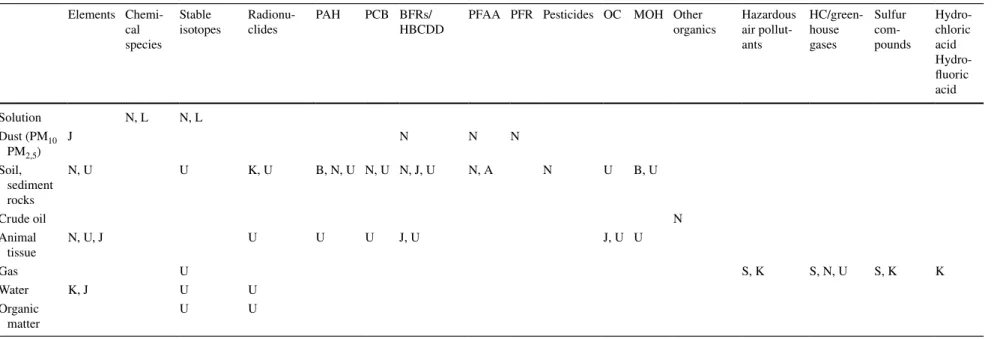
Table 3 Ongoing RM development activities in the area of environmental reference materials, matrices are given per row and target properties per column
A = NMIA; B = BAM; C = NRC; J = JRC; K = KRISS; L = LGC; N = NIST; S = NMISA; U = IAEA
PAH polycyclic aromatic hydrocarbons, PCB polychlorinated bisphenyls, BFR brominated lame retardants, HCBDD hexabromocyclododecane, PFAA perluoroalkyl acids, PFR phosphorus
lame retardants, OC organic carbon, MOH mineral oil hydrocarbons, HC Hydrocarbons Elements Chemi-cal species Stable isotopes Radionu-clides PAH PCB BFRs/ HBCDD
PFAA PFR Pesticides OC MOH Other
organics Hazardous air pollut-ants HC/green-house gases Sulfur com-pounds Hydro-chloric acid Hydro-luoric acid Solution N, L N, L Dust (PM10 PM2,5) J N N N Soil, sediment rocks N, U U K, U B, N, U N, U N, J, U N, A N U B, U Crude oil N Animal tissue N, U, J U U U J, U J, U U Gas U S, K S, N, U S, K K Water K, J U U Organic matter U U
realistic sales income. This is often true of certiied matrix reference materials, (which frequently incur high production costs) and whose annual sales volume may be low as they see most use in occasional, but crucial, validation studies. It can also be true of apparently simpler materials when pro-duction cost is high and use is moderate. An example is the production of calibration materials for sports doping, which must be produced to the highest international standards to ensure international acceptance, yet whose development and production cost cannot be met in full by the limited num-ber of agencies performing monitoring in this area. In yet other cases, there may be a unique technical requirement; for example, metrological traceability of property values in commercially available calibrants may require calibration against CRMs produced by public RM producers, where eforts have been invested in establishing traceability to the SI. In other instances, public agencies may be better able to handle special licensing or control requirements; for exam-ple pure calibrants of illicit drugs and/or doping substances. For the reference material producers present at the meeting, however, a common consideration is that publicly funded RM production is not generally undertaken where it would compete with technically sound, commercially viable activ-ity by commercial producers. Accreditation to ISO 17034, with metrological traceability to relevant standards where appropriate, can help to demonstrate technical validity in commercial production [1].
The public and commercial RM producers complement each other in providing crucial tools to measurement labora-tories that need to fulil a very wide variety of measurement
A key reason for holding a public RM producers’ meeting in the irst place is to identify overlapping interests in order to make better use of limited public funds and technical com-petence related to the human resources. It is usually better that two diferent types of CRM exist than that two closely similar CRMs are produced, unless there is sound justii-cation for duplijustii-cation. Exchanging information on legisla-tive drivers can help to reduce unnecessary duplication. For example, many of the analytes related to food safety have broadly similar legislative limits in diferent jurisdictions. By exchanging information on legislative requirements, pub-licly funded producers can ensure that an RM produced by one producer is suitable for use in a broad range of jurisdic-tions, reducing the call on public funds worldwide. Con-versely, a laboratory located anywhere in the world and car-rying out measurements for the implementation of speciic legislation can use any reference material as long as it is cer-tiied for the (legally) relevant property in a similar matrix at suitable concentration. Consequently, since development of high-quality CRMs requires investment of money, time, and human resources; duplication should be avoided.
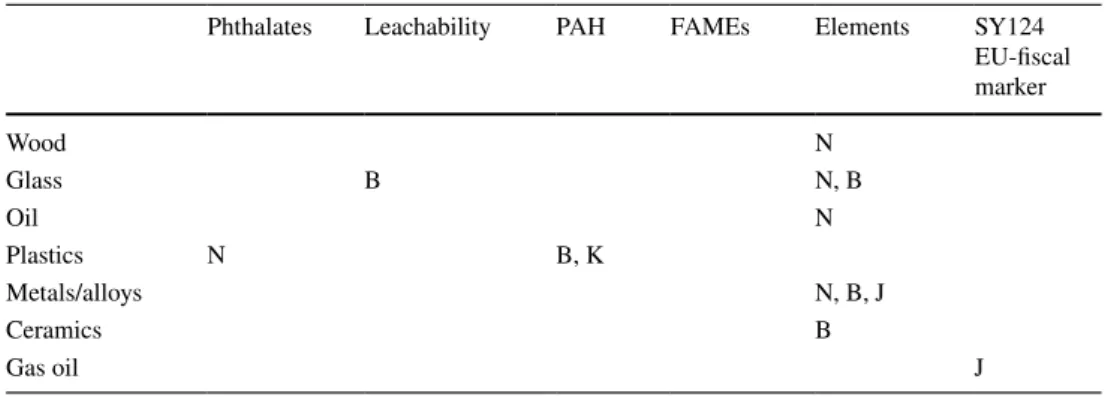
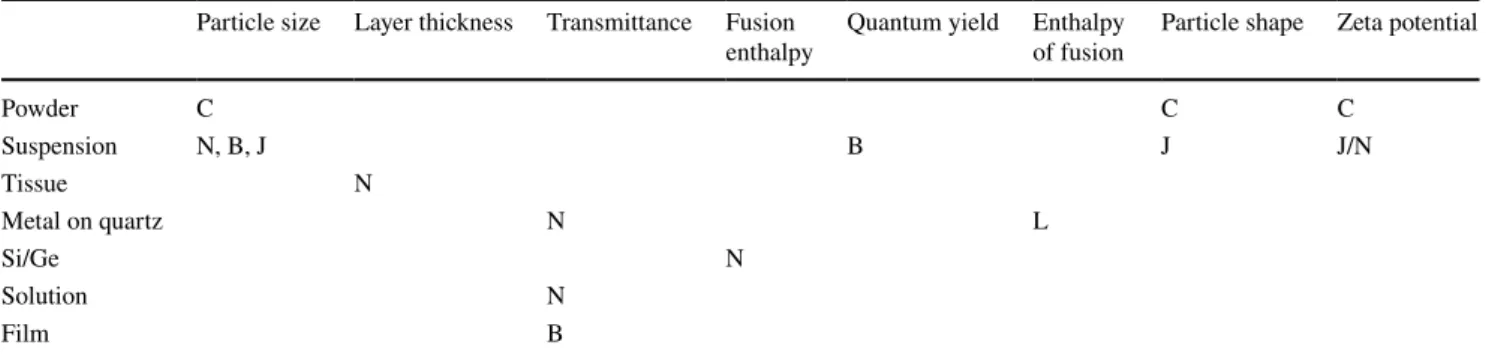
Tables 1, 2, 3, 4 and 5 provide schematic overviews of the current activities of the publicly funded RM producers rep-resented at the meeting. The tables specify the matrices per row and the properties intended to be certiied per column. This compilation only shows new materials under produc-tion at the diferent centres and is not an exhaustive list of all of the CRMs available from these RM producers. The letter in each box represents the diferent public RM producers as explained in the footnote of each table. Generally, only
Table 4 Ongoing RM development activities in the area of industrial reference materials, matrices are given per row and target properties per column
A = NMIA; B = BAM; C = NRC; J = JRC; K = KRISS; L = LGC; N = NIST; S = NMISA; U = IAEA
Phthalates Leachability PAH FAMEs Elements SY124
EU-iscal marker Wood N Glass B N, B Oil N Plastics N B, K Metals/alloys N, B, J Ceramics B Gas oil J
376 Accreditation and Quality Assurance (2018) 23:371–377
1 3
one or two producers are targeting similar matrix and to-be-certiied property combinations, with some exceptions. This efectively shows that the public RM producers already complement each other in many respects. In some cases, identiication of two producers refers to projects that are performed in collaboration, e.g. NIST and the JRC are col-laborating on producing an RM suspension of nanomaterials to be certiied for their zeta potential. In other ields, certain overlaps exist where it can be a question of replacement of legacy materials (i.e. trace elements in food) or areas where multiple target parameters exist in combination with many diferent commodities (e.g. mycotoxins). This particular area can also be of interest for targeted production of RMs where certain commodities are not consumed (or analysed) on a global level (although the area in general is already covered). However, for both of these areas, apparent overlaps are gen-erated by the broad categories (“elements in food”), in some cases simply due to shipping and biosecurity problems (e.g. for alatoxins).
Most public RM producers are focussing on speciic cate-gories of materials, e.g. algal biotoxins, genetically modiied organism (GMO) materials, certiied gas mixtures, steels and alloys, environmental CRMs or CRMs for nutritional supple-ments. In that respect, many of the producers will continue to reine and develop new materials that are typical for their areas of competence.
The current portfolio of RMs from the public RM produc-ers present at this meeting can be found on their respective websites [4–12].
For all producers, new challenges are arising in areas of (C)RMs for species identiication based on DNA sequenc-ing, nanoparticles embedded in food or cosmetics, micro-plastics in food and environment, reference data for compar-ing algorithms and bioinformatics data, materials for ine atmospheric dust, RMs for allergens and clinical reference materials related to an ageing population. New requirements also pose challenges; most of the publicly funded producers
present see challenges in addressing issues of commutability for clinical reference materials.
Follow‑up
It was agreed among the public RM producers at this meet-ing that a yearly follow-up will be organised through vide-oconferencing given the large geographical spread of partici-pants. About every third year, a face-to-face meeting should be organised. Exchange of scientists was another possibil-ity that was discussed. Additionally, the producers agreed to communicate between themselves on an ongoing basis regarding RMs that they are not intending to replace. The latter aspect is important for two reasons; irstly abandoning replacement of legacy materials liberates resources for new developments to resolve a complex problem that requires substantial investment in R&D at the outset. Secondly, the discontinuation of a speciic RM may cause problems for particular measurement communities. In that respect, it is also of value for RM producers to inform laboratories in advance of RM depletion that similar CRMs from another RM producer may cover the need. The COMAR database is an online tool to search for suitable CRMs/RMs covering a large number of producers [13].
Acknowledgements The IAEA is grateful to the Government of the Principality of Monaco for the support provided to its Environment Laboratories.
Open Access This article is distributed under the terms of the Crea-tive Commons Attribution 4.0 International License (http://creat iveco mmons .org/licen ses/by/4.0/), which permits unrestricted use, distribu-tion, and reproduction in any medium, provided you give appropriate credit to the original author(s) and the source, provide a link to the Creative Commons license, and indicate if changes were made. Table 5 Ongoing RM development activities in the area of physical property reference materials, matrices are given per row and target proper-ties per column
A = NMIA; B = BAM; C = NRC; J = JRC; K = KRISS; L = LGC; N = NIST; S = NMISA; U = IAEA Particle size Layer thickness Transmittance Fusion
enthalpy
Quantum yield Enthalpy of fusion
Particle shape Zeta potential
Powder C C C Suspension N, B, J B J J/N Tissue N Metal on quartz N L Si/Ge N Solution N Film B
ISO, Geneva
4. http://www.kriss .re.kr/eng/rnd/rnd03 _2.html. Accessed 20 July 2018
5. https ://www.nist.gov/srm. Accessed 20 July 2018 6. www.nrc.ca/crm. Accessed 20 July 2018
teria ls/Pages /defau lt.aspx. Accessed 20 July 2018
13. https ://www.comar .bam.de/home/login .php. Accessed 20 July 2018