HAL Id: hal-03000545
https://hal.archives-ouvertes.fr/hal-03000545
Preprint submitted on 12 Nov 2020
HAL is a multi-disciplinary open access
archive for the deposit and dissemination of sci-entific research documents, whether they are pub-lished or not. The documents may come from teaching and research institutions in France or abroad, or from public or private research centers.
L’archive ouverte pluridisciplinaire HAL, est destinée au dépôt et à la diffusion de documents scientifiques de niveau recherche, publiés ou non, émanant des établissements d’enseignement et de recherche français ou étrangers, des laboratoires publics ou privés.
Density of C –4 -critical signed graphs
Reza Naserasr, Lan Pham, Zhouningxin Wang
To cite this version:
Reza Naserasr, Lan Pham, Zhouningxin Wang. Density of C –4 -critical signed graphs. 2020. �hal-03000545�
Density of C
−4-critical signed graphs
Reza Naserasr, Lan Anh Pham, and Zhouningxin Wang
Universit´
e de Paris, IRIF, CNRS, F-75013 Paris, France.
Email addresses: {reza, wangzhou4, lananh}@irif.fr.
November 11, 2020
Abstract
A signed bipartite (simple) graph (G, σ) is said to be C−4-critical if it admits no
homomorphism to C−4 (a negative 4-cycle) but every proper subgraph of it does.
In this work, first of all we show that the notion of 4-coloring of graphs and signed graphs is captured, through simple graph operations, by the notion of homomor-phism to C−4. In particular, the 4-color theorem is equivalent to: Given a planar
graph G, the signed bipartite graph obtained from G by replacing each edge with a negative path of length 2 maps to C−4.
We prove that, except for one particular signed bipartite graph on 7 vertices and 9 edges, any C−4-critical signed graph on n vertices must have at least d4n3 e
edges, and that this bound or d4n3 e + 1 is attained for each value of n ≥ 9. As an application, we conclude that all signed bipartite planar graphs of negative girth at least 8 map to C−4. Furthermore, we show that there exists an example of a
signed bipartite planar graph of girth 6 which does not map to C−4, showing that
8 is the best possible and disproving a conjecture of Naserasr, Rollova and Sopena, in extension of the above mentioned restatement of the 4CT.
1
Introduction
A homomorphism of a graph G to a graph H is a mapping of the vertices of G to the vertices of H such that adjacencies are preserved. The theory of graph homomorphism is a natural extension of the notion of proper coloring where a proper k-coloring (of a graph G) can be viewed as a homomorphism (of G) to Kk.
One of the key notions in the study of proper coloring is the concept of k-critical graphs, which is defined to be a graph of chromatic number k all whose proper subgraphs are (k − 1)-colorable. An extension of the notion to homomorphism was proposed in 1980’s by Catlin [3], but the concept was not drawn much attention until recently. Given a graph H, a graph G is said to be H-critical, if G does not admit a homomorphism to H but every proper subgraph of it does.
Next to the complete graphs, the most studied graphs in the theory of ho-momorphism are odd cycles. It is a folklore fact that the C2k+1-coloring problem
G, let T2k−10 (G) be obtained from G by subdividing each edge into path of length 2k − 1. Then T2k−10 (G) admits a homomorphism to C2k+1 if and only if G is properly
(2k + 1)-colorable (see [7]).
One of the key directions of the study of k-critical graphs is to bound below the number of edges as a function of k and n (the number of vertices). Kostochka and Yancy gave a nearly tight lower bound in [10], almost settling a conjecture of Gallai. Observing that being a 4-critical graph is the same as being C3-critical, it
follows from the special case presented in [9] that any C3-critical graph on n vertices
has at least d5n−23 e edges. Their approach is extended to the study of C5-critical
graphs in [6] and to C7-critical graphs in [17]. In [6], it is proved that any C5-critical
graph on n vertices has at least 5n−24 edges and they conjecture that the bound can be improved to 14n−911 . Similarly, in [17], it is proved that any C7-critical graph
on n vertices has at least 17n−215 edges and they conjecture that the bound can be improved to 27n−2023 .
In this work, based on recent development of the theory of homomorphisms of signed graphs, we show that by replacing odd cycles with negative cycles, we can fill the parity gap in this study. Then focusing on C−4-critical signed graphs, we
show that any such a signed graph on n vertices must have at least d4n3 e edges with a sole exception of a signed bipartite graph on 7 vertices which has only 9 edges.
In the next section, we present the necessary terminology, and the relation be-tween coloring of graphs and homomorphisms of signed graphs to negative cycles. In Section 3, we prove our main result which is on the minimum number of edges of C−4-critical signed graphs. In Section 4 we introduce some techniques to build
C−4-critical signed graphs of low edge-density, using which we conclude tightness of
our bound. Then in Section 5, we consider applications to planar case and relation to a bipartite analogue of Jaeger-Zhang conjecture, and discuss further direction of study.
2
Signed graphs and homomorphisms
A signed graph (G, σ) is a graph together with an assignment, called signature, σ of signs (i.e. + or −) to the edges of G. When the signature is not of high importance, we may write ˆG in place of (G, σ). When all edges are positive (resp. negative) we write (G, +) (respectively (G, −)). For drawing a signed graph, we use solid or blue lines to represent positive edges and dashed or red lines to represent negative edges. For underlying graphs (with no signature) we use gray color. Given a signed graph (H, σ0), it is said to be an (induced) subgraph of (G, σ) if H is an (induced) subgraph of G and σ0 is a signature on H such that for every e ∈ E(H): σ0(e) = σ(e). For simplicity, we may write (H, σ) in place of (H, σ0).
A switching of a signed graph (G, σ) at a vertex x is to switch the signs of all the edges incident to x. A switching of (G, σ) is a collection of switchings at each of the elements of a given set X of vertices. That is equivalent to switching the signs of all edges in the edge-cut (X, V \ X). Two signatures σ1 and σ2 on a graph G are
said to be equivalent if one can be obtained from the other by a switching, in which case we say (G, σ1) is switching equivalent to (G, σ2).
The sign of a structure in (G, σ) is the product of the signs of the edges in the given structure, counting multiplicity. The sign of some structures, such as a cycle or a closed walk, is invariant under a switching, while for some other structures, such as a path, the sign of it may change (e.g., if a switching is done in one of
the two ends of a path). Thus we may relax or restrict our use accordingly. For example, when speaking of sign of a cycle, we may refer to any equivalent signature, but when speaking of sign of a path, we are restricted to the signature in hand.
In particular, any signed graph on Cl with an even number of negative edges
will simply referred to as C+l and when there are an odd number of negative edges
it will be denoted by C−l. As C−4 is the primary subject of this work, we will use
the labeling of Figure 1 when referring to this signed graph on its own, but as a subgraph of another signed graph it will have an induced labeling.
u4
u3
u2
u1
Figure 1: C−4
One of the preliminary facts in the study of signed graphs is that two signatures on a graph G are equivalent if and only if they induce a same set of negative cycles (see [19]). Thus, when a class of switching equivalent signed graphs on a graph G is to be considered, one may refer to a partition of cycles, or, more generally, closed walks, of G into two sets of positive and negative (see [15] for more). Thus we have two natural definitions of homomorphisms of signed graphs.
A (switching) homomorphism of a signed graph (G, σ) to a signed graph (H, π), is a mapping of V (G) and E(G) respectively to V (H) and E(H) that preserves the adjacencies, the incidences and the signs of closed walks. When there exists a homomorphism of (G, σ) to (H, π), we may write (G, σ) → (H, π). We may also, equivalently, say (G, σ) is (H, π)-colorable.
An edge-sign preserving homomorphism of a signed graph (G, σ) to a signed graph (H, π), is a mapping of V (G) and E(G) respectively to V (H) and E(H) that preserves the adjacencies, the incidences and the signs of edges. When there exists an edge-sign preserving homomorphism of (G, σ) to (H, π), we may write (G, σ)−→ (H, π).s.p.
We note that an edge-sign preserving homomorphism is equivalent to what is known as the homomorphism of 2-edge-colored graphs in the literature.
The two notions of homomorphisms are connected through the following obser-vation:
Observation 2.1. Given signed graphs (G, σ) and (H, π), we have (G, σ) → (H, π) if and only if there exists an equivalent signature σ0 of σ such that (G, σ0)−→ (H, π).s.p. While closely related, the two notions are also fundamentally different. In par-ticular, for our main target C−4, while deciding if a signed graph (G, σ) admits a
homomorphism to it is an NP-complete problem [5], the analogue edge-sign preserv-ing problem becomes polynomial time through a duality presented in Theorem 3.1. In practice, we will take the condition of Observation 2.1 as the definition. Thus a homomorphism φ of (G, σ) to (H, π) consists of three parts: φ1 : V (G) → {+, −},
which decides for each vertex v whether a switching is done at v, φ2 : V (G) → V (H)
which decides to which vertex of H the vertex v is mapped to, and φ3 : E(G) →
E(H) which decides the image of each edge. However, as we will consider only simple graphs in this work, φ3 is induced by φ2 and, therefore, the mapping φ is
composed of φ1 and φ2, i.e. φ = (φ1, φ2). We note that since switching at X is the
same as switching at V \ X, the two mappings (φ1, φ2) and (−φ1, φ2) are identical.
Each of the notions leads to a corresponding notion of isomorphism that is a homomorphism φ where φ2 and φ3 are one-to-one and onto. This, furthermore,
leads to two notions of automorphism. Thus, for example, the signed graph C−4, as
a 2-edge-colored graph, has only one non-trivial automorphism which is u1 ↔ u4,
u2 ↔ u3. Whereas, it is both vertex-transitive and edge-transitive with respect
to the notion of (switching) homomorphism. It would be clear from the context which notion of isomorphism or automorphism we refer to. Following this notion of isomorphism, if (G1, σ1) is a subgraph of (G, σ0) where σ0 is equivalent to σ, then
we may refer to (G1, σ1) as a subgraph of (G, σ) as well.
Given a signed graph (G, σ) and an element ij ∈ Z22, we define gij(G, σ) to be
the length of a shortest closed walk W whose number of negative edges modulo 2 is i and whose length modulo 2 is j. When there exists no such a closed walk, we define gij(G, σ) = ∞. By the definition of homomorphisms of signed graphs, we
have the following no-homomorphism lemma.
Lemma 2.2. [The no-homomorphism lemma] If (G, σ) → (H, π), then gij(G, σ) ≥ gij(H, π)
for each ij ∈ Z22.
We note that, algorithmically, it is not difficult to determine gij(G, σ), we refer
to [15] and [4] for more on this.
We may now define the main notion of study in this work.
2.1
(H, π)-critical signed graphs
Given a signed graph (H, π), a signed graph (G, σ) is said to be (H, π)-critical if the followings are satisfied:
• gij(G, σ) ≥ gij(H, π) for ij ∈ Z22, (condition of no-homomorphism lemma),
• (G, σ) 6→ (H, π),
• (G0, σ) → (H, π) for every proper subgraph G0 of G.
The notion captures and extends the notion of k-critical graphs as follows: a graph G is k-critical if the signed graph (G, −) is (Kk−1, −)-critical, here the
con-dition of no-homomorphism lemma implies that G has no loop. The notion of H-critical graph is also captured by viewing H as the signed graph (H, −) but with a minor revision. If G is an H-critical graph in the sense of [3] and it has an odd cycle C2k+1, where odd-girth(H) > 2k + 1, then G is the odd cycle C2k+1. Our first
condition then eliminates these trivial cases.
For the particular case when (H, π) = C−l, we identify two cases based on the
parity of l:
• l = 2k + 1. In this case, in order for (G, σ) to satisfy the conditions of no-homomorphism lemma, in particular, we must have (G, −) switching equiva-lent to (G, σ). After a switching of (G, σ) to (G, −) and C−l to (C2k+1, −), the
problem is reduced to the study of C2k+1-critical graphs (of odd-girth at least
• l = 2k. In this case, in order for (G, σ) to satisfy the conditions of no-homomorphism lemma, G must, in particular, be bipartite. This is the case of main interest in this work.
We note that in the first case, to determine if (G, σ) is switching equivalent to (G, −) can be done in polynomial time and quite efficiently, but to determine if G → C2k+1 is an NP-complete problem. In contrast, in the second case, to find an
equivalent signature under which we can map (G, σ) to C−l is the hard part, and
given a fixed signature, we can determine, in polynomial time, if there exists an edge-sign preserving homomorphism (see Theorem 3.1).
2.2
k-coloring and C
−l-coloring
Given a signed graph (G, σ), we define Tl(G, σ) to be the signed graph (Gl, π) where
Glis obtained from G by subdividing each edge so to become a path of length l and
π is an assignment of signs on the edges of Gl so that the sign of the u − v path,
corresponding to the edge uv ∈ E(G), is the same as −σ(uv).
The following lemma then shows the importance of the study of C−l-coloring.
Lemma 2.3. A graph G is k-colorable if and only if Tk−2(G, +) is C−k-colorable.
Proof. We consider two cases based on the parity of k. If k is an odd number, then in Tk−2(G, +) a cycle is negative if and only if it is of an odd length. Thus, this
signed graph is switching equivalent to (Gk−2, +). Then, the problem of mapping
Tk−2(G, +) to C−k is reduced to a graph homomorphism problem of mapping Gk−2
to Ck. The equivalence then can be easily checked and we refer to [7] for a proof.
We now assume that k = 2l is an even number, in which case Tk−2(G, +) is a
signed bipartite graph.
We first show that if Tk−2(G, +) → C−k, then G is k-colorable. Since this can
be done independently on each connected component of G, we may assume G is connected. Observe that, as a signed graph equipped with switching, C−k is both
vertex-transitive and edge-transitive. Let x1, x2, . . . x2l be the vertices of C−k in
the cyclic order. Then X1 = {x1, x3, . . . x2l−1} and X2 = {x2, x4, . . . x2l} is the
bipartition of the underlying 2l-cycle. Let φ be a homomorphism of Tk−2(G, +)
to C−k. Observe that as G, and, therefore, Tk−2(G, +) is connected, the mapping
φ preserves the bipartition of Tk−2(G, +). Thus we may assume, without loss of
generality, that the vertices of Tk−2(G, +) which correspond to the vertices of G
map to the vertices in X1. Furthermore, recall that the homomorphism φ consists of
two components φ1: V (Tk−2(G, +)) → {+, −}, and φ2 : V (Tk−2(G, +)) → X1∪ X2.
Thus restriction of φ onto V (G) is a mapping to the set {+, −} × X1 which is of
order 2l. We claim that φ is a proper coloring of G. That is simply because if φ maps two adjacent vertices to a same element of {+, −} × X1, the negative (k −
2)-path that is connecting them in Tk−2(G, +) is mapped to a negative closed walks of
length at most k − 2, but that contradicts the no-homomorphism lemma.
The converse then is easier. Assume χ(G) ≤ 2l and let ψ be a 2l-coloring of G where {+, −} × X1 is the color set. We claim that ψ can be extended as a
homomorphism of Tk−2(G, +) to C−k. For any edge uv in G, noting that ψ(u) = ψ(v)
is not possible because ψ is a proper coloring, we consider two possibilities:
• (ψ1(u), ψ2(u)) = (−ψ1(v), ψ2(v)). The mapping ψ then has applied a switching
path. After identifying its end points the resulting positive even cycle can be mapped to just an edge of any sign.
• ψ2(u) 6= ψ2(v). Then ψ2(u) and ψ2(v) split C−k into two paths of even length,
one positive and one negative, each of which is of length at most k − 2. The u − v path then can be mapped to the path of the same sign where the sign is taken after applying possible switching by ψ1 at its end points.
Corollary 2.4. A graph G is 4-colorable if and only if T2(G, +) maps to C−4.
In particular, the four-color theorem can be restated as:
Theorem 2.5. [The 4CT theorem restated] For any planar graph G, the signed bipartite planar graph T2(G, +) maps to C−4.
Observing that, for a graph G, the shortest (negative) cycle in T2(G, +) is of
length at least 6, (corresponding to a triangle of G), and introducing the bipartite analogue of Jaeger-Zhang conjecture, Naserasr, Rollova and Sopena [14] conjectured that any signed bipartite planar graph whose shortest negative girth is 6 maps to C−4. In section 5, we disprove this conjecture. However, as an application of our
work we prove that if the condition on negative girth is increased to 8, then the result holds.
3
C
−4-critical signed graphs
It follows from Corollary 2.4 that the C−4-coloring problem is an NP-complete
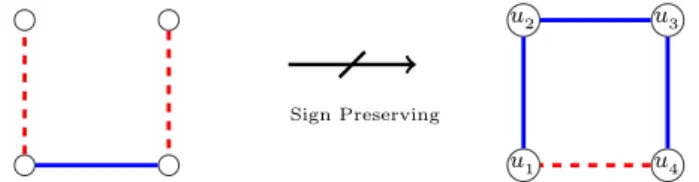
prob-lem (see [1], and [2], for more on this subject). However, when edge-sign preserving homomorphisms are considered, we have a simple duality theorem, given in [4], based on Figure 2, that makes it rather easy to determine the existence of an edge-sign preserving homomorphism to C−4. This duality notion will be used in our
proofs. Sign Preserving u4 u3 u2 u1
Figure 2: C−4 and its edge-sign preserving dual
Theorem 3.1. [4] Given a signed bipartite graph (G, σ), we have (G, σ)−→ Cs.p. −4 if
and only if (P3, π) s.p.
6−→ (G, σ) where (P3, π) is the signed path of length 3 given in Figure 2.
Combined with Observation 2.1, this theorem says that in order to map a signed bipartite graph (G, σ) to C−4 it is necessary and sufficient to find a switching σ0 of
σ where no positive edge is incident with a negative edge at each end of it.
It can be easily verified that any signed bipartite graph with at most two vertices on one of the two parts maps to C−4. Thus the first example of C−4-critical signed
graph must have at least six vertices. Let Γ be the signed graph obtained from K4
by subdividing two parallel edges, each once, with a signature assigned in such a way that each triangle of the K4 become a negative 4-cycle. It can easily be verified
that Γ is an example of a C−4-critical signed graph on six vertices, in fact, up to
switching, it is the only C−4-critical signed graph on six vertices. We further note
that Γ has 8 = 43 × 6 edges.
An example of higher interest, which is also a signed graph on a subdivision of K4, is the signed graph ˆW of Figure 3 which is depicted in two different ways. This
signed graph is proved in [4] to have smallest maximum average degree among all signed bipartite graphs that does not map to C−4, that is an average degree of 187.
Using the extended notion of critical signed graphs we introduced here, we will prove ˆ
W to be the sole exception among the signed bipartite graphs of average degree less than 83. v1 v2 v3 v4 v5 v6 v0 x1 x2 x3 x4 y1 y2 y3
Figure 3: C−4-critical signed graph ˆW depicted in two ways
We give two different proofs for the fact that ˆW does not map to C−4. Each
proof takes advantage of one of the presentations in Figure 3, and leads to different development of ideas.
Proposition 3.2. The signed graph ˆW of Figure 3 does not map to C−4. Moreover,
up to a switching equivalence, this is the only signature on this graph with this property.
Proof. Based on the presentation on the left side, if ˆW maps to C−4, then the outer
6-cycle, as it is a negative cycle, must map surjectively to C−4, but then v0 must
be identified with one of v2, v4, v6, thus creating a negative cycle of length 2 and,
therefore, contradicting the no-homomorphism lemma.
The equivalence class of signatures on this graph is determined by the signs of its three facial 4-cycles as depicted in the left side of the figure. If one of these facial 4-cycles is positive, then degree 2 vertex on this face can be mapped to v0, after a
switching if needed. The resulting image then easily maps to C−4.
An alternative proof. Based on the presentation on the right side, observe that each pair among y1, y2, y3 is connected by a positive 2-path (through x1) and
by a negative 2-path. Thus identifying any two of them would create C−2. In other
words, in any homomorphic image of ˆW which is a signed simple graph, the vertices y1, y2 and y3 must have distinct images.
Automorphisms of ˆW split its vertices to three orbits: {v0}, {v1, v3, v5} and
{v2, v4, v6} and split its edges to two orbits: those incident to v0 and those on
the outer 6-cycle. We need to consider two signed graphs obtained from ˆW by subdividing one of its edges twice and then assigning a signature on the edges of this path so that the sign of the path is the same as the sign of the edge it has
replaced. Since there are two orbits of the edges on ˆW , essentially we have only two signed graphs obtained in this way. Presentations of these two signed graphs, each after a switching, are given in Figures 4 and 5. The signed graph of Figure 4, Ω1, is obtained from ˆW by subdividing the edge x1y3 twice (where all three edges
are assigned positive signs) and then switching at the vertex set {x2, x3, y3}. The
signed graph of Figure 5, Ω2, is obtained from ˆW by subdividing the edge x4y1
twice (where all three edges are assigned positive signs) and then switching at the vertex set {x2, x4, y2}. x1 x2 x3 x4 x0 y1 y2 y3 y0 Figure 4: Ω1 x0 x1 x2 x3 x4 y0 y1 y2 y3 Figure 5: Ω2
It is easily observed that each of the two signed graphs with the signature pre-sented in the Figures 4 and 5 satisfies the conditions of Theorem 3.1, and, therefore, each of them maps to C−4. In the next two lemmas, we show that one cannot make
either of these two signed graphs C−4-critical by only adding a vertex of degree 2.
Lemma 3.3. Let Ω1 be the signed graph of Figure 4. If we add a vertex v to one
part of Ω1 and connect it with two vertices in the other part (with any signature),
the resulting signed graph admits a homomorphism to C−4.
Proof. Let Ω1 be the signed bipartite graph of Figure 4 consisting of a bipartition
(X, Y ) where X = {x0, x1, x2, x3, x4} and Y = {y0, y1, y2, y3}.
If the two edges incident to the new vertex v are of a same sign, by switching at that new vertex, if needed, we consider them both positive. The result is a signature satisfying Theorem 3.1, which implies that Ω1 maps to C−4. So we assume that the
two edges incident to v are of different signs and consider two possibilities depending on to which part the vertex v belongs to:
Case 1. v is added to the X part.
If v is adjacent to y3, then, by switching at v, if necessary, we assume that vy3
is negative. If the other edge, which is positive, is vy2, then we switch at x2. In all
the cases (when v is adjacent to y3), we find a signature satisfying the conditions
of Theorem 3.1. If v is not adjacent to y3 but v is adjacent to y2, then we consider
vy2 to be negative and we are done. If v is adjacent to both of y0 and y1, then we
take vy1 as a negative edge and we are done after a switching at x2.
Case 2. v is added to the Y part.
If v is adjacent to one of x2 and x0 (or both), we switch at one of x2 and x0.
Then by a switching at v (if needed) we have both edges incident to v of positive sign. Otherwise we may switch at v such that the negative edge at v is either vx4
or vx1. If the former happens, then we switch at x0, else we switch at x2. In all
cases, we find a signature satisfying the condition of Theorem 3.1.
Lemma 3.4. Let Ω2 be the signed graph of Figure 5. If we add a vertex v to one
part of Ω2 and connect it with two vertices in the other part (with any signature), the
resulting signed graph either contains ˆW and maps to it or admits a homomorphism to C−4.
Proof. Let Ω2 be the signed bipartite graph of Figure 5 consisting of a bipartition
(X, Y ) where X = {x0, x1, x2, x3, x4} and Y = {y0, y1, y2, y3}.
As in the previous lemma, we can assume that considering the two edges incident with v, one is negative and the other is positive. Again, we consider two cases depending on to which part v belongs to.
Case 1. v is added to the X part.
If v is adjacent to y2, then, by a switching at v if needed, we may assume vy2 is
negative. Then the only possible problem against Theorem 3.1 is by vy0, which can
be taken care of by switching at y0. Else, if v is adjacent to y0, then by considering
vy0 as the negative edge incident to v, and then by switching at y0, the resulting
signed graph satisfies the condition of Theorem 3.1. Finally, if v is adjacent to both y1 and y3, then the subgraph induced by x1, x2, x3, y1, y2, y3 and v is isomorphic to
ˆ
W . It is then easy to map the remaining vertices to ˆW . Case 2. v is added to the Y part.
If v is adjacent to x1, then we choose vx1 to be negative. The only obstacle
against Theorem 3.1 then can come from the vx4 edge, but we can switch at y0 to
resolve this issue. Else, if v is adjacent to x4, then we choose vx4 to be negative,
then we already have a signature satisfying conditions of Theorem 3.1. Finally, if v is adjacent to both x2 and x3, then the subgraph induced by x1, x2, x3, y1, y2, y3
and v is isomorphic to ˆW . It is then easy to map the remaining vertices to ˆW . Some general structural properties of a C−4-critical signed graph are as follows.
Lemma 3.5. Every C−4-critical signed graph is 2-connected.
Proof. This is an easy consequence of the fact that C−4 is vertex transitive and we
leave the details as an exercise.
We say a path P of length k in ˆG is a k-thread if all of its k − 1 internal vertices are of degree 2 in G. It is easily observed that the maximum length of a thread in an (H, π)-critical graph is bounded by a function of (H, π). For C−4-critical signed
graphs, we have:
Lemma 3.6. A C−4-critical signed graph ˆG does not contain a 3-thread.
Proof. Assume to the contrary that G has a 3-thread P = x0x1x2x3. Recall that
a C−4-critical signed graph is bipartite. As x0 and x3 are connected by a path of
length 3, they are in different parts of G. Since ˆG is C−4-critical, the signed graph
ˆ
G0 = ˆG − {x1, x2} maps to C−4. Let ϕ be such a mapping. Observe that, by
Lemma 3.5, ˆG0 is connected, thus ϕ preserves the bipartition of G0. In particular
ϕ(x0) and ϕ(x3) are in two different parts of C−4 and thus adjacent. We note that
ϕ has possibly applied switchings on some vertices of G0, working with the resulting signature obtained from the same switching on ˆG, we let ˆP be the signed graph induced on P . If ˆP has a same sign as the edge ϕ(x0)ϕ(x3), then ϕ can be extended
by mapping ˆP to this edge as well. Otherwise, ϕ can be extended by mapping ˆP to the rest of the C−4 (that is C−4− ϕ(x0)ϕ(x3)).
In this lemma, length 3 for a forbidden thread is the best one can do. We have already seen examples of C−4-critical signed graphs with vertices of degree 2
that correspond to 2-threads. However, we may still apply some restriction on such threads:
Observation 3.7. Given a C−4-critical signed graph, a vertex of degree 2 cannot be
on a C+4.
We are now ready to state and prove our main result on the structure of C−4
-critical signed graphs.
3.1
Edge-density of C
−4-critical signed graphs
We will use the notion of potential developed in [9] and then further used in [6] and [17] to prove the following.
Theorem 3.8. If ˆG is a C−4-critical signed graph which is not isomorphic to ˆW ,
then
|E(G)| ≥ 4|V (G)|
3 .
Thus the natural potential function of graphs we may work with is: p(G) = 4|V (G)| − 3|E(G)|.
We note that potential of a signed graph is the potential of its underlying graph. Observation 3.9. We have p(K1) = 4, p(K2) = 5, p(P3) = 6 and p(C4) = 4. Thus
any signed bipartite graph on at most 4 vertices has potential at least 4.
In the rest of this section, we let ˆG = (G, σ) be a minimum counterexample to Theorem 3.8. That is to say, ˆG is a C−4-critical signed graph which is not
isomorphic to ˆW , it satisfies p( ˆG) ≥ 1, and that for any signed graph ˆH, ˆH 6= ˆW , with |V ( ˆH)| < |V ( ˆG)| satisfying p( ˆH) ≥ 1, ˆH admits a homomorphism to C−4.
Given a signed graph ˆH, we denote a signed graph obtained from ˆH by adding a new vertex and joining it to two vertices of ˆH (of arbitrary choices of signs) by P2( ˆH). In the following lemma, we list the plausible potential of the subgraphs of
the minimum counterexample ˆG.
Lemma 3.10. Let ˆG = (G, σ) be a minimum counterexample of Theorem 3.8 and let ˆH be a subgraph of ˆG. Then
1. p( ˆH) ≥ 1 if ˆG = ˆH; 2. p( ˆH) ≥ 3 if ˆG = P2( ˆH);
3. p( ˆH) ≥ 4 otherwise.
Proof. The first claim is our assumption on ˆG. If ˆG = P2( ˆH), then p( ˆG) = p( ˆH) +
4 × 1 − 3 × 2, and then, since p( ˆG) ≥ 1, we have p( ˆH) ≥ 3. We now prove that for any other subgraph of ˆG, p( ˆH) ≥ 4.
Suppose to the contrary that ˆG contains a proper subgraph ˆH which does not satisfy ˆG = P2( ˆH), and satisfies p( ˆH) ≤ 3. Among all such subgraphs, let ˆH be
chosen so that |V ( ˆH)| + |E( ˆH)| is maximized. As adding an edge to a graph only decreases the potential, the assumption of the maximality implies that ˆH is an induced subgraph of ˆG.
By Observation 3.9, |V ( ˆH)| ≥ 5. As ˆG is C−4-critical and ˆH is a proper subgraph,
there is a homomorphism ϕ of ˆH to C−4. Since C−4 is vertex transitive, we may
assume that ϕ preserves the bipartition of ˆH induced by bipartition of ˆG, this is automatic if H is connected, but important if H is not connected.
Observe that the mapping ϕ may have applied switching on some vertices of ˆH. Applying switching on the same set of vertices of ˆG, we get a switching equivalent signed graph. For simplicity, and without loss of generality, we may assume that ˆG was given with this signature already. In other words, we may assume, without loss of generality, that ϕ1(x) = + for every vertex x of ˆH (recall that ϕ = (ϕ1, ϕ2)).
Define ˆG1 to be a signed (multi)graph obtained from ˆG by first identifying
vertices of ˆH which are mapped to a same vertex of C−4under ϕ, and then identifying
all parallel edges of a same sign. Observe that ˆG1is a homomorphic image of ˆG and
that ϕ( ˆH) is (isomorphic to) the image of ˆH in this mapping. As in the mapping of ˆG to ˆG1, the bipartition is preserved, ˆG1 is bipartite. Since homomorphism is
an associative relation, and since ˆG 6→ C−4, we have ˆG1 6→ C−4. This can only be
for one of the two reasons: Either ˆG1 contains a C−2, or ˆG1 contains a C−4-critical
subgraph. We consider the two cases separately: Case 1. ˆG1 contains a C−2.
It implies that ˆG contains a negative path ˆP of length 2 with both endpoints in ˆ
H and with its internal vertex in V ( ˆG) \ V ( ˆH). We have that
p( ˆH + ˆP ) = p( ˆH) + 4 × 1 − 3 × 2 = p( ˆH) − 2 < p( ˆH). (1) Recall that ˆH is a maximum proper subgraph satisfying that ˆG 6= P2( ˆH) and
p( ˆH) ≤ 3. Noting that ˆH ( ˆH + ˆP and ˆH + ˆP is a subgraph of ˆG, and by the maximality of ˆH, there are two possibilities: either ˆH + ˆP is not a proper subgraph of ˆG, i.e., ˆG = ˆH + ˆP , or ˆG = P2( ˆH + ˆP ). The former case is impossible as
ˆ
G 6= P2( ˆH). So ˆG = P2( ˆH + ˆP ) and then
p( ˆH + ˆP ) = p( ˆG) − 4 × 1 + 3 × 2 ≥ 1 − 4 + 6 = 3 ≥ p( ˆH), (2) which is in contradiction with (1).
Case 2. ˆG1 contains a C−4-critical subgraph ˆG2.
We classify the vertices of ˆG2into two parts: vertices that are also vertices of ˆG,
that is A = V ( ˆG2) \ ϕ( ˆH), and vertices that are the image of vertices of ˆH under
the mapping ϕ : ˆH → C−4, let X1 be this set of vertices. The subgraph induced
by X1 will be denoted by ˆX, in other words ˆX = ϕ( ˆH) ∩ ˆG2. Observe that since
ˆ
G2 6→ C−4 and ϕ( ˆH) ⊂ C−4, A 6= ∅.
Since |V ( ˆH)| ≥ 5, and ϕ is a mapping of ˆH to C−4, at least two vertices are
identified and, therefore, |V ( ˆG2)| ≤ |V ( ˆG1)| < |V ( ˆG)|. As ˆG is a minimum
coun-terexample, we have either p( ˆG2) ≤ 0 or ˆG2 = ˆW . Since p( ˆW ) = 1, in all cases we
have p( ˆG2) ≤ 1.
We now define a subgraph ˆG3 of ˆG as follows: Vertices of ˆG3 are those vertices
of ˆG that are either also a vertex of ˆG2 or a vertex of ˆH. In other words, V ( ˆG3) =
{V ( ˆG2) ∪ V ( ˆH)} \ V ( ˆX). To give the edge set of ˆG3, we first choose a set E0 of the
edges of ˆG as follows: If a vertex u ∈ V ( ˆG2) \ X1 is adjacent to a vertex v ∈ X1,
then we choose a vertex v0 ∈ V ( ˆH) such that first of all ϕ(v0) = v, second of all uv0 ∈ E(G). From the construction of ˆG1, it is clear that there is such a vertex v0.
We note that, there might be more choices for v0, among which we select exactly one at random, and then let uv0be an edge in E0. The edge set of ˆG3 is then defined
to be the set of edges of ˆG that are either induced by A, or by V (H) or edges in E0, with induced signature from the fixed signature of ˆG that was modified by ϕ. In other words, E( ˆG3) = E( ˆG2− ˆX) + E( ˆH) + E0. Since each connection between
the vertices of ˆX and ˆG2− ˆX has a unique corresponding edge in E0, it follows that
Since ˆG and ˆG2 are both C−4-critical signed graphs, ˆG2 is not a subgraph of ˆG,
that is to say ˆX 6= ∅. As ˆX is a subgraph of C−4, by Observation 3.9, p( ˆX) ≥ 4.
Then we obtain that
p( ˆG3) = p( ˆG2) − p( ˆX) + p( ˆH) ≤ 1 − 4 + p( ˆH) = p( ˆH) − 3 < p( ˆH). (3)
Since ˆG3 is a subgraph of ˆG and ˆH ( ˆG3 (because A 6= ∅), by the maximality of
ˆ
H, either ˆG = ˆG3 or ˆG = P2( ˆG3). If ˆG = ˆG3, then p( ˆG3) ≥ 1; if ˆG = P2( ˆG3), then
p( ˆG3) ≥ 3. But
p( ˆH) = p( ˆX) + p( ˆG3) − p( ˆG2) ≥ 4 + 1 − 1 = 4, (4)
contradicting that p( ˆH) ≤ 3.
Towards proving our claim, next we show that the underlying graph G of the minimum counterexample ˆG does not contain two 4-cycles sharing edges.
x1 x2 x3 x4 x0 Figure 6: Θ1 x1 x2 x4 x5 x3 x6 Figure 7: Θ2
Claim 3.11. Given a minimum counterexample ˆG to Theorem 3.8, the underlying graph G does not contain the graph Θ1 of Figure 6 as a subgraph.
Proof. By contradiction, assume Θ1 is a subgraph of G and let x0, x1, . . . , x4 be the
labeling of its vertices in G as well. Observe that p(Θ1) = 2. Thus, by Lemma 3.10,
G = (Θ1, σ) for some signature σ. Noting that there are three 4-cycles in Θ1, of
which at least one must be a positive 4-cycle. By Observation 3.7 and as d(x0) =
d(x1) = d(x3) = 2, no signature on Θ1 would result in a C−4-critical signed graph.
Claim 3.12. Given a minimum counterexample ˆG to Theorem 3.8, the underlying graph G does not contain the graph Θ2 of Figure 7 as a subgraph.
Proof. By contradiction, assume Θ2 is a subgraph of G and let x1, x2, . . . , x6 be
its vertices in G as well. Observe that p(Θ2) = 3, thus, by Lemma 3.10, either
G has only six vertices, or it has seven vertices and G = P2(Θ2). By Lemma 3.6,
no signature on Θ2 would result in a C−4-critical signed graph. Adding another
edge, then we will have a graph on 43 × 6 = 8 edges, thus this cannot form a counterexample. We note that after adding an edge one may assign a signature to get the only C−4-critical signed graph on six vertices Γ.
Thus we must have G = P2(Θ2). Let w be the added vertex. Then up to
symmetries of Θ2, we have two choices for the two neighbors of w: I. w is adjacent
to x1 and x5, the resulting graph Θ02 is illustrated in Figure 8. II. w is adjacent to
x1 x2 x4 x5 x3 x6 w Figure 8: Θ02 w x1 x2 x4 x5 x3 x6 Figure 9: Θ002
Case I. Note that Θ02 is the same as the underlying graph of ˆW of Proposi-tion 3.2. In that proposiProposi-tion we have shown that, up to switching, only one signa-ture can make Θ02 a C−4-critical signed graph. However, we have assumed in the
statement of our Theorem that ˆG is not switching equivalent to ˆW .
Case II. We claim that no signature on Θ002 can make it a C−4-critical signed
graph. That is because, otherwise, of the three 4-cycles induced by x1, x2, x3, x6, w
at least one would be a positive 4-cycle, thus contradicting Observation 3.7. In the next Lemma, we imply further structure on the neighborhood of a 2-thread.
Lemma 3.13. Let vv1u be a 2-thread in ˆG. Suppose that v is a 3-vertex and let
v2, v3 be the other two neighbors of v. Then the path v2vv3 must be contained in a
negative 4-cycle in ˆG.
Proof. Suppose to the contrary that the path v2vv3 is not contained in a negative
4-cycle. If needed, by switching at v2 or v3, we may assume that both vv2 and vv3
are of a positive sign. Then by identifying v2 and v3 to a new vertex v0, we get a
homomorphic image ˆG1 of ˆG. Observe that by our assumption, ˆG1does not contain
a C−2. As ˆG does not map to C−4, its homomorphic image, ˆG1, does not map either.
Since gij( ˆG1) ≥ gij(C−4), there must be a C−4-critical subgraph ˆG2 of ˆG1. Observe
that, by Lemmas 3.6 and 3.5, none of the vertices v and v1 is a vertex of ˆG2. On
the other hand, v0 ∈ V ( ˆG2), as otherwise ˆG2 is a proper subgraph of ˆG which does
not map to C−4, contradicting the fact that ˆG is C−4-critical.
Since ˆG is a minimum counterexample to the Theorem, and that |V ( ˆG2)| <
|V ( ˆG)|, we have either p( ˆG2) ≤ 0 or ˆG2= ˆW in which case p( ˆG2) = 1.
Let ˆG3 be the signed graph obtained from ˆG2 by splitting v0 back to v2 and v3,
adding the vertex v and adding the positive edges vv2 and vv3 back. Note that ˆG3
is a subgraph of ˆG. We observe that
p( ˆG3) = p( ˆG2) + 4 × 2 − 3 × 2 = p( ˆG2) + 2 ≤ 3. (5)
Furthermore, the equality is only possible if ˆG2 = ˆW . As v1 6∈ V ( ˆG3), we know
that ˆG3 6= ˆG. By Lemma 3.10, we must have p( ˆG3) = 3 and that ˆG = P2( ˆG3). And
since equality in (5) must hold, we also have ˆG2 = ˆW .
As ˆG2= ˆW , vertices of ˆG2 are of degree 2 or 3, and, thus, the splitting operation
on v0, that we considered in order to build ˆG3, is the same as subdividing one of its
edges twice. As there are only two types of edges in ˆW , the subdivided result, ˆG3,
is one of the two graphs: either Ω1 of Figure 4, or Ω2 of Figure 5. However, we have
already seen in Lemma 3.3 and Lemma 3.4 that neither P2(Ω1) nor P2(Ω2) can be
By combining Lemma 3.13 with Claims 3.11 and 3.12, we have our main forbid-den configuration as follow:
Corollary 3.14. A vertex of degree 3 in the minimum counterexample ˆG does not have two neighbors of degree 2.
We are now ready to employ the discharging technique to prove Theorem 3.8. Proof. (Of Theorem 3.8) Applying discharging technique, we assign an initial charge of c(v) = d(v) to each vertex of G. Observe that the total charge is 2|E(G)|. We apply the following discharging rule:
“Every 2-vertex receives a charge of 13 from each of its neighbors.”
After this procedure, since there is no 3-thread in G, each 2-vertex v receives a total of 23 from its two neighbors and thus c0(v) = 2 + 23 = 83. Each 3-vertex u has at most one neighbor of degree 2, so c0(u) ≥ 3 −13 = 83. Each vertex w of degree at least 4 has charge c0(w) ≥ d(w) −d(w)3 = 2d(w)3 ≥ 8
3. Thus the total charge is at least 8|V (G)|
3 . That contradicts the assumption that p( ˆG) = 4|V (G)| − 3|E(G)| ≥ 1.
Applying this result in terms of maximum average degree of the (underlying) graph, denoted mad(G), we have the following.
Corollary 3.15. Given a signed bipartite (simple) graph ˆG, if mad(G) < 8
3 and ˆG does not contain ˆW as a subgraph (with no equivalent signature), then ˆG → C−4.
4
Constructions of (sparse) C
−4-critical signed
graphs
We have already seen that if χ(G) ≥ k + 1, then Tk−2(G) does not map to C−k. It is
easy to verify that, furthermore, if G is (k +1)-critical, then Tk−2(G) is a C−k-critical
signed graph.
We may extend this construction through an extension of notion of proper col-oring of graphs to proper colcol-oring of signed graphs introduced by Zaslavsky in [18]. More precisely:
Definition 4.1. Given the set Xk= {±1, ±2, . . . , ±k}, a signed multigraph (G, σ)
is said to be Xk-colorable if there exists an assignment c : V (G) → Xk such that for
each edge xy of G,
c(x) 6= σ(xy)c(y).
Using this notion, Lemma 2.3 can be extended to the following theorem. A proof of this theorem is also obtained by revising the proof of Lemma 2.3 given in Section 2.2 and we leave the details to the reader.
Theorem 4.2. A signed multigraph ˆG admits an Xk-coloring if and only if Tk−2( ˆG) →
C−2k.
Given a graph G, let ˜G be the signed multigraph obtained from G by replacing each edge of G with a pair of edges: one of the positive sign, another of the negative sign. It is easily observed that:
Observation 4.3. A graph G is k-colorable if and only if the signed multigraph ˜G is Xk-colorable.
Combining Theorem 4.2 and Observation 4.3, we have the following.
Theorem 4.4. Given a graph G, we have χ(G) ≤ k if and only if Tk−2( ˜G) → C−2k.
Moreover, G is (k + 1)-critical if and only if Tk−2( ˜G) is C−2k-critical.
This theorem further emphasizes on the importance of the study of C−2k-critical
graphs, and, more generally, the homomorphisms of signed bipartite graphs. The operation T2k−10 applied on graphs (as defined in the introduction) connects (2k +1)-coloring problem of graphs to C2k+1-coloring problem of graphs. Thus only odd
values of the chromatic number are captured by C2k+1-coloring problem. The
oper-ation Tk−2, when applied on signed multigraphs ˜G, connects the k-coloring problem
of G to C−2k-coloring problem of signed graphs. Thus C−2k-coloring problem
cap-tures k-coloring problem for all the values of k. We note that T2( ˜G) is the same as
S(G) defined in [14] and refer to this reference for more on the importance of the homomorphisms of signed bipartite graphs.
By Theorem 4.4 and noting that odd cycles are the only 3-critical graphs, we have T2( ˜C2k+1) as an example of C−4-critical signed graph for each value of k. See
Figures 10 and 11 for T2( ˜C3) and T2( ˜C5). The signed bipartite graph ˆG2k+1 =
T2( ˜C2k+1) has 6k + 3 vertices and 8k + 4 edges. Thus T2( ˜C2k+1) is an example of
C−4-critical signed graphs for which the bound of Theorem 3.8 is tight.
Let ˆG02k+1be the signed (bipartite) graph obtained from ˆG2k+1by identifying two
vertices of degree 2 which are at distance two and their common neighbor is adjacent to both with positive edges, see Figure 12 for an illustration of ˆG05. Observe that ˆG03 contains ˆW as a proper subgraph and, thus, is not C−4-critical. For k ≥ 2, ˆG02k+1
does not maps to C−4because it is a homomorphic image of ˆG2k+1. Moreover, it has
average degree of 8|V (G
0 2k+1)|+2
3|V (G02k+1)| , it does not contain ˆW as a subgraph and any proper
subgraph of it has average degree strictly less than 83. Thus, by Corollary 3.15, it is a C−4-critical signed graph for which the bound of Theorem 3.8 is tight. Further
identification of vertices of degree 2 would lead to other examples for which the bound of Theorem 3.8 is either tight or nearly tight.
Figure 10: T2( ˜C3) Figure 11: T2( ˜C5) Figure 12: ˆG05
Another method of building C−4-critical signed graphs is as follows. Let ˆG1 and
ˆ
G2 be two C−4-critical signed graphs each with a vertex of degree 2. Suppose u is a
vertex of degree 2 in ˆG1 with u1 and u2 as its neighbors, and v is a vertex of degree
2 in ˆG2 with v1 and v2 as its neighbors. As ˆG1 is a C−4-critical signed graph, ˆG1− u
maps to C−4. But any such a mapping must map u1 and u2 to a same vertex of C−4
and must have applied a switching on ˆG1− u so that with the same switching on
ˆ
G1, the path u1uu2is negative. We consider ˆG1with this signature and do the same
ˆ
G2 by deleting u and v, and adding a positive edge u1v1 and a negative edge u2v2.
We leave it to the reader to verify that the result is a C−4-critical signed graph.
In Figure 13, we have depicted the signed graph obtained from this operation on two disjoint copies of ˆW . We note that this is an example of a C−4-critical signed
graph on 12 vertices for which the bound of Theorem 3.8 is tight. One may note that, furthermore, the same technique can be applied to build a new C−2k-critical
signed graph from two C−2k-critical signed graphs each having a vertex of degree
2. Moreover, towards building a C−2k-critical signed graph of lower edge-density,
instead of connecting uivi directly, one may use paths of length k − 1, one of the
positive sign, one of the negative sign.
Figure 13: F ( ˆW , ˆW ) Figure 14: H(Γ, Γ)
Analogue of Haj´os construction. The Haj´os construction of k-critical graphs can be adapted to build C−4-critical signed graphs from two given C−4-critical signed
graphs. The general case for will be addressed in a forthcoming work. Let ˆG1 be
a C−4-critical signed graph and let u1v1 be a positive edge of ˆG1. Then ˆG1− x1y1
admits a homomorphism φ to C−4. Since C−4is vertex transitive, and since (−φ1, φ2)
is the same as (φ1, φ2), we may consider only the mappings for which φ1(x1) = +
(referring the labeling of Figure 1). Then we must have φ1(y1) = − as otherwise,
φ is also a mapping of ˆG1 to C−4. Furthermore, for any other edges e, if we take
a mapping φ0 of ˆG − e satisfying φ0(x1) = (+, u2), then we must have φ(y1) = +.
Similarly, consider a C−4-critical signed graph ˆG2 with a negative edge x2y2. Then
by a similar argument, for any mapping ψ of ˆG2− x2y2 for which ψ(x2) = (+, u2),
we must have ψ(y2) = +.
We now build a new C−4-critical signed graph ˆH = H( ˆG1, ˆG2) as follows: Hˆ
is obtained from vertex disjoints copies of ˆG1 and ˆG2 by identifying x1 with x2 to
get a vertex x and y1 with y2 to get a vertex y. We observe that if there exists a
homomorphism ϕ of ˆH to C−4, then, by symmetries, we may assume ϕ(x) = (+, u2).
Then the restriction on ˆG1 implies ϕ1(y) = − and the restriction on ˆG2 implies
ϕ1(y) = +, a contradiction, implying that ˆH does not map to C−4. Removing an
edge from one part of ˆH then leads in mappings of the two different parts that can be merged together, which shows that ˆH is C−4-critical. An example of this
construction, using two disjoint copies of the unique C−4-critical signed graph Γ on
six vertices (see Section 3) is given in Figure 14.
The signed graph H( ˆG1, ˆG1) has |V ( ˆG1)| + |V ( ˆG1)| − 2 vertices. Using the
techniques mentioned above one can easily build C−4-critical signed graphs of orders
9, 10, 11, 12. Then applying Haj´os construction to a previously built C−4-critical
signed graph and Γ (on 6 vertices), one can build a C−4-critical signed graphs on
any number n of vertices for n ≥ 9.
Given positive integers k and n (n ≥ k + 2), let f (n, k) be the minimum number of edges of a k-critical graph on n vertices. We refer to [10] for almost precise value of f (n, k) and for historical background on the study of this function. We similarly may define g(n, k) to be the minimum number of edges of a C−k-critical signed graph
on n vertices. As noted above, g(n, 4) is well-defined for n ≥ 9. It can be similarly shown that g(n, k) is well-defined for n ≥ Nk where Nk is an integer depending on
k only.
Lemma 2.3 and Theorem 4.4 imply the following relations between f (n, k) and g(n, k).
• By Lemma 2.3,
g(n + (k − 3)f (n, k), k) ≤ (k − 2)f (n, k). (6) • By Theorem 4.4,
g(n + 2(l − 1)f (n, l), 2l) ≤ 2(l − 1)f (n, l). (7) Authors of [6] and [17] suggest that for k = 5 and k = 7 the inequality (6) is almost tight. Our work here shows that for C−4-critical signed graphs the inequality
of (7) provides a tight bound. For k = 6, the two inequalities provide similar bounds where the only difference is in the constant (in the favor of inequality of (6)). For other values of k = 2l the inequality of (6) provides a better bound than (7) and it is tempting to suggest that (6) gives a nearly tight bound for g(n, k) for k ≥ 5. A point of hesitation here is that, while the notion of k-critical graphs is widely studied and the value and behavior of f (n, k) are almost determined, the notion of critical signed graphs, aside from its relation to (2k + 1)-critical graphs (with no sign), is a new notion and hardly anything is known about it. More precisely, we may define an Xk-critical signed graph to be a signed graph which does not admit
an Xk-coloring but every proper subgraph of it does. What can then be said about
the minimum number of edges of an Xk-critical signed graph? Constructions other
than ˜G may provide better bounds on g(n, 2k) by Theorem 4.2.
5
Application to signed bipartite planar graphs
Introducing a bipartite analogue of Jaeger-Zhang conjecture, it was conjectured in [14] that every signed bipartite planar graph, whose shortest negative cycles are of length at least 4k − 2, maps to C−2k. In support of the conjecture, the claim is
proved, in [4], for a weaker condition when a shortest negative cycle is of length at least 8k − 2. Here we use the folding Lemma of [13] to prove that every signed bipartite planar graph whose shortest negative cycle is of length at least 8 maps to C−4 and we show that this bound is tight, thus disproving the exact claim of the
conjecture for the case k = 2.
Lemma 5.1. [13] Given a signed bipartite planar graph (G, σ) with an embedding on the plane, if the length of shortest negative cycles of (G, σ) is at least 2k and a face F of it is not a negative cycle of length 2k, then there is a homomorphic image of (G, σ) which identifies two vertices at distance 2 of F and such that its shortest negative cycles are also of length at least 2k.
Observe that this identification preserves both planarity and bipartiteness. Thus, repeatedly applying the lemma, we get a homomorphic image where all faces are negative cycles of length 2k. Taking k = 4, starting from a signed bipartite planar graph whose shortest negative cycles are of length at least 8, we get a homomorphic image ˆG with a planar embedding where all faces are (negative) 8-cycles. Applying
the Euler formula on this graph, we have |E(G)| ≤ 43(|V (G)| − 2). By taking ˆG to be a smallest signed bipartite planar graph which does not map to C−4 and whose
shortest negative cycle is of length 8, we conclude that on the one hand ˆG must be C−4-critical, and thus, by Theorem 3.8, has at least 43|V (G)| edges, but on the other
hand, by the argument above, it has at most 43(|V (G)|−2) edges. This contradiction is a proof that:
Theorem 5.2. Any signed bipartite planar graph whose shortest negative cycle is of length at least 8 maps to C−4.
We now claim that the condition of shortest negative cycles being of length at least 8 in this theorem is tight.
For this, it would be enough to build a signed planar (simple) graph (G, σ) which is not {±1, ±2}-colorable. Then, by Theorem 4.2, T2(G, σ) is a signed bipartite
planar graph which does not map to C−4. Furthermore, that G is simple implies
that T2(G, σ) has no cycle of length smaller than 6.
That every signed planar graph is {±1, ±2}-colorable was conjectured in [11]. This conjecture was disproved in [8], we refer to [12] for a direct proof. Thus we have:
Theorem 5.3. There exists a bipartite planar graph G of girth 6 with a signature σ such that (G, σ) 6→ C−4.
Smallest examples built in this way, which we have so far, has 150 vertices. How-ever, such examples have extra property that vertices on one part of the (bipartite) graph are all of degree 2. Perhaps simpler examples can be built which do not satisfy this property.
It is proved in [5] that C−4-coloring problem even when restricted to the class of
signed (bipartite) planar graphs remains an NP-complete problem. Thus, one does not expect to find an efficient classification of signed bipartite planar graphs which map to C−4. However, some strong sufficient conditions could be provided. One
such a condition is a based on the restatement of the four-color theorem given in Theorem 2.5. Another is Theorem 5.2 of this work that shows no negative cycle of length 2, 4, 6 is a sufficient condition. As a generalization of Theorem 2.5 (the four-color theorem) which also captures essential cases of Theorem 5.2, we may propose the following:
Conjecture 5.4. Let G be a bipartite planar graph of girth at least 6. Let σ be a signature on G such that in (G, σ) all 6-cycles are of a same sign. Then (G, σ) → C−4.
We note that, while one may use Lemma 5.1 to reduce facial 4-cycles of a signed graph which is the subject of Theorem 5.2, there could be separating 4-cycles in a signed bipartite planar graph to which this theorem may apply. Therefore, the conjecture does not capture all cases to which Theorem 5.2 applies.
As a final remark, we would like to point out that some of the results in this work can be restated using the language of the circular coloring of signed graphs which is recently developed in [16].
Acknowledgment. This work is supported by the ANR (France) project HOSI-GRA (ANR-17-CE40-0022). It has also received funding from the European Union’s Horizon 2020 research and innovation program under the Marie Sklodowska-Curie grant agreement No 754362.
References
[1] Brewster, R. C., Foucaud, F., Hell, P., and Naserasr, R. The com-plexity of signed graph and edge-coloured graph homomorphisms. Discrete Math. 340, 2 (2017), 223–235.
[2] Brewster, R. C., and Siggers, M. A complexity dichotomy for signed H-colouring. Discrete Math. 341, 10 (2018), 2768–2773.
[3] Catlin, P. A. Graph homomorphisms into the five-cycle. J. Combin. Theory Ser. B 45, 2 (1988), 199–211.
[4] Charpentier, C., Naserasr, R., and Sopena, E. Homomorphisms of sparse signed graphs. Electron. J. Combin. 27, 3 (2020), Research Paper 6, 28. [5] Dross, F., Foucaud, F., Mitsou, V., Ochem, P., and Pierron, T. Complexity of planar signed graph homomorphisms to cycles. Discrete Appl. Math. 284 (2020), 166–178.
[6] Dvoˇr´ak, Z., and Postle, L. Density of 5/2-critical graphs. Combinatorica 37, 5 (2017), 863–886.
[7] Hell, P., and Neˇsetˇril, J. On the complexity of H-coloring. J. Combin. Theory Ser. B 48, 1 (1990), 92–110.
[8] Kardoˇs, F., and Narboni, J. On the 4-color theorem for signed graphs. European J. Combin. 91 (2021), 103215.
[9] Kostochka, A., and Yancey, M. Ore’s conjecture for k = 4 and Gr¨otzsch’s theorem. Combinatorica 34, 3 (2014), 323–329.
[10] Kostochka, A., and Yancey, M. Ore’s conjecture on color-critical graphs is almost true. J. Combin. Theory Ser. B 109 (2014), 73–101.
[11] M´aˇcajov´a, E., Raspaud, A., and ˇSkoviera, M. The chromatic number of a signed graph. Electron. J. Combin. 23, 1 (2016), Paper 1.14, 10.
[12] Naserasr, R., and Pham, L. A. Complex chromatic number of signed planar simple graphs. Submitted .
[13] Naserasr, R., Rollov´a, E., and Sopena, E. Homomorphisms of planar signed graphs to signed projective cubes. Discrete Math. Theor. Comput. Sci. 15, 3 (2013), 1–11.
[14] Naserasr, R., Rollov´a, E., and Sopena, E. Homomorphisms of signed graphs. J. Graph Theory 79, 3 (2015), 178–212.
[15] Naserasr, R., Sopena, E., and Zaslavsky, T. Homomorphisms of signed graphs: An update. European J. Combin. 91 (2021), 103222.
[16] Naserasr, R., Wang, Z., and Zhu, X. Circular chromatic number of signed graphs, 2020.
[17] Postle, L., and Smith-Roberge, E. On the density of C7-critical graphs,
2019.
[18] Zaslavsky, T. Signed graph coloring. Discrete Math. 39, 2 (1982), 215–228. [19] Zaslavsky, T. Signed graphs. Discrete Appl. Math. 4, 1 (1982), 47–74.