
ORIGINAL INVESTIGATION
Green tea extract enhances parieto-frontal connectivity
during working memory processing
André Schmidt&Felix Hammann&Bettina Wölnerhanssen&
Anne Christin Meyer-Gerspach&Jürgen Drewe&
Christoph Beglinger&Stefan Borgwardt
Received: 7 January 2014 / Accepted: 26 February 2014 / Published online: 19 March 2014 # The Author(s) 2014. This article is published with open access at Springerlink.com
Abstract
Rationale It has been proposed that green tea extract may have a beneficial impact on cognitive functioning, suggesting promising clinical implications. However, the neural mecha-nisms underlying this putative cognitive enhancing effect of green tea extract still remain unknown.
Objectives This study investigates whether the intake of green tea extract modulates effective brain connectivity during working memory processing and whether connectivity param-eters are related to task performance.
Material and methods Using a double-blind, counterbalanced, within-subject design, 12 healthy volunteers received a milk whey-based soft drink containing 27.5 g of green tea extract or a milk whey-based soft drink without green tea as control sub-stance while undergoing functional magnetic resonance imaging. Working memory effect on effective connectivity between fron-tal and pariefron-tal brain regions was evaluated using dynamic causal modeling.
Results Green tea extract increased the working memory in-duced modulation of connectivity from the right superior parietal lobule to the middle frontal gyrus. Notably, the
magnitude of green tea induced increase in parieto-frontal connectivity positively correlated with improvement in task performance.
Conclusions Our findings provide first evidence for the puta-tive beneficial effect of green tea on cogniputa-tive functioning, in particular, on working memory processing at the neural sys-tem level by suggesting changes in short-term plasticity of parieto-frontal brain connections. Modeling effective connec-tivity among frontal and parietal brain regions during working memory processing might help to assess the efficacy of green tea for the treatment of cognitive impairments in psychiatric disorders such as dementia.
Keywords Cognition . Working memory . Green tea extract . Brain activity . Effective connectivity . Dynamic causal modeling
Introduction
Recent research indicates that green tea extract or its main ingredients has a beneficial impact on cognitive functioning in humans. For instance, it has been demonstrated that the con-sumption of green tea improved memory and attention in subjects with mild cognitive impairments (Park et al. 2011) and that the consumption of flavonoid-rich foods such as green tea reduced beta-amyloid-mediated cognitive impair-ments in Alzheimer transgenic mice, suggesting a potential therapeutic utility in dementia (Rezai-Zadeh et al. 2008; Williams and Spencer2012). Furthermore, higher consump-tion of green tea has also been associated with a lower prev-alence of cognitive impairments in older adults (Kuriyama et al.2006). Comparable results were obtained in another study investigating the association between green tea consumption and cognition in 2,501 people aged over 55 years by showing that the intake of green tea was significantly related to a lower
A. Schmidt
:
S. Borgwardt (*)Department of Psychiatry (UPK), University of Basel, Wilhelm Klein Str. 27, 4012 Basel, Switzerland
e-mail: [email protected]
A. Schmidt
:
S. BorgwardtMedical Image Analysis Center, Schanzenstrasse 55, 4031 Basel, Switzerland
F. Hammann
:
B. Wölnerhanssen:
A. C. Meyer-Gerspach:
J. Drewe
:
C. BeglingerDepartment of Gastroenterology, University Hospital Basel, 4031 Basel, Switzerland
S. Borgwardt
Department of Psychosis Studies, Institute of Psychiatry, King’s
prevalence of cognitive impairments (Ng et al.2008). In addi-tion to preventing cognitive decline, green tea consumpaddi-tion might even lead to better cognitive performances in community-living older adults (Feng et al.2010), which may indicate a cognitive enhancing effect in healthy subjects.
More recently, a study used functional magnetic resonance imaging (fMRI) to investigate whether this beneficial impact of green tea on cognition could be related to altered brain activity in regions crucially engaged during higher-order cog-nitive functioning (Borgwardt et al.2012). They demonstrated relatively increased brain activation in fronto-parietal regions, most pronounced in the right frontal cortex after the adminis-tration of green tea extract during working memory (WM) processing as assessed by the N-back task (Borgwardt et al. 2012). These data suggest that green tea extract may modulate brain activity in key areas for mediating WM processing in the human brain such as the dorsolateral prefrontal cortex (Goldman-Rakic1996). However, successful WM processing during the N-back task requires a functional coupling of parietal and frontal brain regions as shown by functional (Owen et al.2005; Rottschy et al.2012) and effective con-nectivity studies (Deserno et al.2012; Ma et al.2011). It has been suggested that effective connectivity from the parietal cortex to the frontal cortex may contribute to the encoding of incoming stimuli (Ma et al.2011), while the connections from the frontal to the parietal cortex likely mediate the updating of rules (e.g., 2-back condition; Gazzaley et al.2004; Sauseng et al. 2005). Therefore, it is conceivable that the increased frontal activity during WM processing after green tea admin-istration (Borgwardt et al. 2012) may have resulted from a change in functional coupling connectivity from the parietal to the frontal cortex.
We thus explored in the current study whether the ad-ministration of green tea extract changed brain connectivity between the frontal and parietal cortex during WM process-ing. In particular, we applied dynamic causal modeling (DCM; Friston et al. 2003) to fMRI data from 12 healthy subjects receiving green tea extract and a control beverage while performing a N-back WM task. DCM can explicitly evaluate the directional modulation effects of contextual experimental conditions (e.g. the 2-back condition) on ef-fective connectivity and has been successfully used to de-tect pharmacological manipulations from fMRI data (Grefkes et al. 2010; Schmidt et al. 2013b). Furthermore, we tested whether the effect of green tea on the WM-induced modulation of connectivity was related to its effect on the task performance. Given the important functional coupling between parietal and frontal brain regions during the N-back task (Owen et al. 2005; Rottschy et al. 2012), and that the intake of green tea extract increases prefrontal activity (Borgwardt et al.2012), we hypothesized that green tea extract would enhance effective connectivity from the parietal to the frontal cortex.
Material and methods Participants
In total, 12 healthy right-handed male completed the study (mean age 24.1 years; standard deviation 2.6). All participants were nonsmokers. Participants were told to abstain from any substance use for the duration of the study, and from the intake of alcohol, caffeine, green tea products, and citrus juices for 24 and 12 h before each study day, respectively. At the start of the study, a urine sample was collected for screening for amphet-amines, benzodiazepines, cocaine, methamphetamine, opi-ates, and THC using immunometric assay kits. None of the participants were tested positive on any of the sessions. Par-ticipants were carefully screened using a semistructured clin-ical interview to exclude psychiatric or physclin-ical illness or a family history of psychiatric illness. The local State Ethical Committee (Ethikkommission Beider Basel) approved the study and all participants gave their informed written consent after the study procedure had been explained to them in detail. The study was registered with clinicaltrials.gov (identifier: NCT01615289).
Experimental design
A double-blind, vehicle-controlled, and within-subject design with randomized order of substance administra-tion using an established protocol was conducted over four sessions (Bhattacharyya et al.2012; Borgwardt et al. 2008). Participants received either 250 or 500 ml milk whey-based soft drink containing 13.75 and 27.5 g of green tea extract, respectively (Rivella, Rothrist, Switzer-land), or a milk whey-based soft drink without green tea extract as control condition. Each participant was scanned four times with a 1-week interval between scans. Before each scanning session, participants swallowed a feeding tube for application of the test solutions. The doses of 250 (that were diluted to 500 ml to control for volume effects) and 500 ml were selected to produce an effect on regional brain functioning without provoking any toxic, psychiatric or physical symptoms, which might have confounded interpretation of the fMRI data and caused difficulties for participants to tolerate the procedure. As the intragastric administration bypassed the sensory systems, volunteers were prevented from guessing which treatment they were being given. An intravenous line was inserted in the nondominant arm of each participant at the start of the testing session to monitor substance whole-blood levels. All participants were physically examined before testing and their heart rate and blood pressure were assessed in 5-min intervals throughout the 1-h session.
Composition of test drinks
Rivella is a commercially available carbonated soft drink on the basis of milk whey. In 1999, a new flavor with a 0.05 % addition of standardized green tea extract was introduced. The control drink is most similar to the drink of interest, apart from the green tea extract, differs primarily in its lower carbohy-drate content (2.5 g/100 ml difference). In detail, the test drink contains the following ingredients: water, milk whey 35 %, lactic acid, carbon dioxide, calcium cyclamate, acesulfame K, and the following minerals: sodium 130 mg/l, potassium 450 mg/l, magnesium 35 mg/l, calcium 165 mg/l, and chloride 330 mg/l. Additionally, it contains the following ingredients: green tea extract 0.05 %, ascorbic acid 120 mg/l, pyridoxine 30 mg/l, and fructose 25 g/l. Green tea extract is prepared from the dried green leaves of Camellia sinensis with a drug:extract ratio of 5.5:1, 47.5–52.5 % m/m polyphenols [high-pressure liquid chromatography (HPLC)], 5.0–10.0 % m/m caffeine (HPLC), 0.3–1.2 % m/m theobromine (HPLC), and 1.0– 3.0 % m/m theanine (HPLC). One gram of extract corre-sponds to 5.5 g of green tea leaves. To equalize carbohydrate, the control treatments were supplemented with 6.25 or 12.5 g of sucrose for 250 and 500 ml, respectively. To additionally blind volunteers to treatments, 250 ml treatments and controls were diluted to 500 ml with 250 ml of uncarbonated spring mineral water. This preparatory step also ensures equivalent rates of gastric emptying. Treatments were heated to room temperature and freed from carbon dioxide by stirring. fMRI paradigm: N-back task
A rapid, mixed trial, event-related fMRI design was used with jittered interstimulus intervals incorporating random event presentation to optimize statistical efficiency (Ettinger et al. 2011). During the N-back task (Broome et al. 2009), all subjects saw series of letters with an interstimulus interval of 2 s. Each stimulus was presented for 1 s. During a baseline (0-back) condition, subjects were required to press the button with the right hand when the letter„X” appeared. During 1-back and 2-1-back conditions, participants were instructed to press the button if the currently presented letter was the same as that presented 1 (1-back condition) or 2 trials beforehand (2-back condition). The three conditions were presented in ten alternating 30 s blocks (2×1-back, 3×2-back and 5×0-back) matched for the number of target letters per block (i.e., 2 or 3), in a pseudo-random order.
Image acquisition and analysis
fMRI was performed on a 3T scanner (Siemens Magnetom Verio, Siemens Healthcare, Erlangen, Germany) using an echo planar sequence with a repetition time of 2.5 s, echo time of 28 ms, matrix 76×76, 126 volumes and 38 slices with
0.5 mm interslice gap, providing a resolution of 3×3×3 mm3, and a field of view 228×228 mm2. We analyzed fMRI data using SPM8 (http://www.fil.ion.ucl.ac.uk/spm/). All volumes were realigned to correct for head movements, mean adjusted by proportional scaling, normalized into standard stereotactic space (Montreal Neurological Institute), and smoothed using a 8 mm full-width at half-maximum Gaussian kernel. We con-volved the onset times for each condition (0-back, 1-back, and 2-back) with a canonical haemodynamic response function. Serial correlations were removed using a first-order autoregressive model and a high-pass filter (128 s) was ap-plied to remove low-frequency noise. Six movement parame-ters were also entered as nuisance covariates to control for movement. We focused our analysis on the 2-back >0-back contrast (main effect of task) to capture the highest possible WM load during the back task according to previous N-back fMRI studies (Deserno et al.2012; Schmidt et al.2013b). Differences in local brain activity between the different treatment conditions have previously been reported (Borgwardt et al. 2012); here, we extended this study by conducting an effective connectivity analysis using DCM (Friston et al. 2003), which was restricted to the bilateral superior parietal lobule (SPL) and middle frontal gyrus (MFG). As this previous analysis revealed significant differ-ences in fronto-parietal activity especially between the 500 ml doses (Borgwardt et al.2012), we restricted our connectivity analysis to these two conditions only. The selection of our ROIs were based on the following evidences: (a) the previ-ously published 2-back >0-back contrast of this data (Fig.1a; Borgwardt et al.2012), (b) the previous functional connectiv-ity studies emphasizing the importance of fronto-parietal cou-pling for WM (Gazzaley et al.2004; Sauseng et al.2005), and (c) the previous DCM studies of WM (Deserno et al.2012; Schmidt et al.2013b). The treatment-specific fronto-parietal network was detected using an anatomical mask taken from the Automated Talairach atlas in the WFU Pick Atlas toolbox (Tzourio-Mazoyer et al.2002) consisting of the bilateral SPL and MFG. Statistical significance was assessed at the cluster level using the nonstationary random field theory (Hayasaka et al. 2004). The first step of this cluster-level inference strategy consisted of identifying spatially contiguous voxels at a threshold of p<0.001, without correction (cluster-forming threshold; Petersson et al.1999). Finally, a familywise error (FWE)-corrected cluster-extent threshold of p<0.05 was de-fined to infer statistical significance.
Effective connectivity analysis: DCM
DCM10 (revision number 4290) as implemented in SPM8 was used to analyze effective fronto-parietal connectivity during WM processing. In DCM for fMRI, the dynamics of the neural states underlying regional BOLD response are modeled by a bilinear differential equation that describes
how the neural states change as a function of endogenous interregional connections, modulatory effects on these con-nections, and driving inputs (Friston et al.2003; Stephan et al. 2007). The endogenous connections represent coupling strengths in the absence of inputs to the system (task-independent), while the modulatory effects represent context-specific and additive changes in coupling (task-induced alterations in connectivity). The modeled neuronal dynamics is then related to the measured blood oxygen level-dependent (BOLD) signal using a hemodynamic forward
model (Stephan et al. 2007). Here, we explicitly examined how the coupling strengths between frontal and parietal re-gions are changed by the 2-back condition (modulatory effect).
Model design and time series extraction
Across all models tested, we assumed the same network layout of connections between right and left SPL and MFG. Specifically, SPL and MFG were reciprocally connected
Fig. 1 a Local maxima with the bilateral superior parietal lobule and middle frontal gyri induced by the main effect of task (2-back >0-back contrast) after the administration of green extract or the of the control substance (FWE cluster level corrected at p<0.05). b Model space tested in this study. 1 right SPL, 2 left SPL, 3 right MFG, and 4 left MFG. In particular, we contrasted models in which the 2-back WM condition was allowed to modulate, within both hemispheres: (F1) the parieto-frontal connections, (F2) the fronto-parietal connections, or (F3) both. These
three intrahemispheric options were crossed with four possibilities which interhemispheric connections might be modulated by the 2-back WM
condition, i.e., (a) none (first column of Fig.1b), (b) the interhemispheric
connections between parietal areas (second column of Fig.1b), (c) the
interhemispheric connections between frontal areas (third column of
Fig.1b), or (d) both (fourth column of Fig.1b). As a result, our model
space consisted of 12 alternative models, each of which was fitted to the data from each individual subject
within both hemispheres, with additional interhemispheric connections between all regions. Similar to a recent DCM study of WM (Ma et al. 2011), the visual input (driving) entered the SPL bilaterally (Baizer et al. 1991; Nakashita et al.2008). Starting from this basic layout, a factorial struc-tured model space was derived by considering where the modulatory effect of the 2-back WM condition might be expressed within both hemispheres (for a graphical summary of the model design see Fig.1b). Subject-specific regional time series from the SPL and MFG were extracted from spherical volumes of interest with 12 mm in diameter that were centered on the condition maxima of the 2-back >0-back contrast within the anatomical mask taken from the Automat-ed Talairach atlas in the WFU Pick Atlas toolbox (Tzourio-Mazoyer et al. 2002) using the first eigenvariate of voxels above a subject-specific F-threshold of p<0.001 uncorrected. When a subject had no voxel above threshold at the group maxima (Fig.1a, Table 1), we selected the nearest supra-threshold voxel within the mask. One subject revealed no activated voxels under these criteria and was therefore exclud-ed from the connectivity analysis.
Bayesian model selection and Bayesian model averaging Bayesian model selection (BMS) was used to determine the most plausible neurophysiological network given the data as expressed by a series of competing DCMs. BMS rests on comparing the (log) evidence of a predefined set of models (the model space). The model evidence is the probability of observing the empirical data, given a model, and represents a principled measure of model quality, derived from probability theory (Penny et al.2004). We used a random-effects BMS approach for group studies, which is capable of quantifying the degree of heterogeneity in a population while being ex-tremely robust to potential outliers (Stephan et al.2009b). This method considers the model as a random variable and estimates the parameters of a Dirichlet distribution, which describes the probabilities of all models considered. One common way to summarize the results of random effects BMS is to report the exceedance probability (EP) of each model, i.e., the probability that this model is more likely than any other of the models tested, given the group data (Stephan et al.2009b). Given that different models may be found to be optimal across treatments and statistical comparison of model parameter estimates is only valid if those estimates stem from
the same model, Bayesian model averaging (BMA) has been recommended as standard approach for clinical DCM studies (Seghier et al. 2010; Stephan et al. 2010). BMA averages posterior parameter estimates over models, weighted by the posterior model probabilities (Penny et al. 2010). Thus, models with a low posterior probability contribute little to the estimation of the marginal posterior.
Statistic of DCM parameters
Following BMA, we used the resulting posterior means from the averaged DCM for examining between-treatment differ-ences. In this paper, we focused on WM-induced changes in connectivity. Thus, we tested for group differences in the modulatory effects only. We then used a paired t test, testing which of the connectivity parameters differed across the 500 ml treatments.
Statistics of WM performances
Beyond previous analyses of reaction times and number of errors (Borgwardt et al.2012), WM performances were ob-jectively quantified using signal detection theory using the formula d′ = z(Hits)−z(FA), where FA reflects false alarms (Macmillan and Creelman1991). Hit and false alarm rates of zero or one were adjusted as previously described (Macmillan and Kaplan1985). Paired t test was used to assess between-treatment differences in WM performances.
Results
Working memory performance
There was a strong trend toward a significantly improved task performance as expressed by the sensitivity index d′ after consumption of green tea extract [mean (SD): 3.23 (0.42)] compared with the control drink [mean (SD): 2.84 (0.45); t(11)=2.041; p=0.066; Fig.2].
Bayesian model selection
We first used Bayesian model selection (BMS) to compare the model evidence for the three families of models with either bidirectional, forward, or backward modulation of prefrontal–
Table 1 MNI coordinates (x, y, z) of the treatment maxima during working memory processing
Left MFG Right MFG Left SPL Right SPL
Green tea extract (−50, 22, 34) (cluster size: 1199) (52, 26, 34) (cluster size: 740) (−30, −62, 48) (cluster size: 895) (32, −58, 54) (cluster size: 910)
Sham condition (−36, 4, 64) (cluster size: 220) (26, 14, 50) (cluster size: 215) (−34, −54, 56) (cluster size: 255) (28, −60, 50) (cluster size: 188)
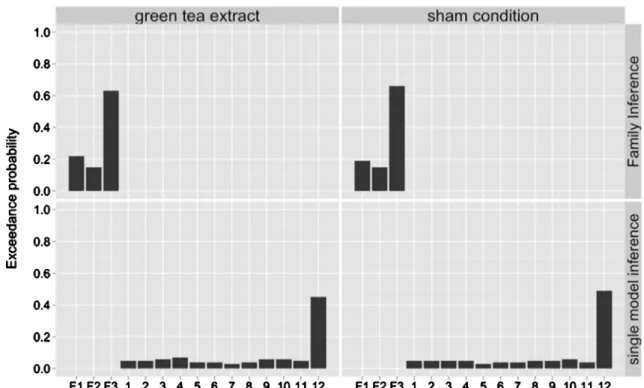
parietal connections. BMS revealed that the family with WM-induced modulation of both forward and backward modula-tion of prefrontal–parietal connecmodula-tions (F1) was superior to the other families in the green tea (EP 63 %) and control condition (EP 66 %). Single model inference showed that model 12 emerged as the most likely model in the green tea (EP 45 %) and control condition (EP 49 %). These BMS results across both treatment conditions are summarized in Fig.3.
Effective connectivity results
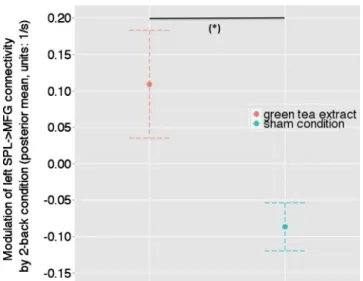
Statistical analysis of treatment differences in connection strengths concerned the posterior means of coupling esti-mates, following BMA over all 12 models. Thus, in our analysis of effective connectivity, we were able to test for between-treatment differences in eight parameters describing the modulation of fronto-parietal connections, within and across hemispheres, induced by the 2-back WM condition. Paired t test results for all connection are summarized in Table2. A significantly increased WM-induced modulation of connectivity from the right SPL to the right MFG was found in the green tea condition compared with the control beverage [t(10)=2.53; p=0.030; not corrected for multiple comparisons; Fig.4].
Importantly, we found a significant positive correlation between the effect of green tea on task performance and right SPL→right MFG connectivity (r=0.637, p=0.035; Fig.5).
Discussion
In the present study we investigated the neural mechanisms underlying the putative beneficial impact on green tea extract
on cognitive functioning. In particular, we explored by apply-ing DCM to fMRI data whether green tea extract altered the WM-induced modulation of interregional effective connectiv-ity between the parietal and frontal cortex. The main findings are that green tea extract increased the WM-induced modula-tion of connectivity from the right superior parietal lobule to the middle frontal gyrus. Furthermore, this effect of green tea on parieto-frontal connectivity positively correlated with its effect on task performance, suggesting a neural mechanism for the positive effect of green tea consumption on cognitive functioning at the system network level. Our finding of creased parieto-frontal coupling during WM processing in-duced by green tea might also explain the recently reported increase in prefrontal brain activity after green tea administra-tion (Borgwardt et al. 2012). Thus, these studies together indicate that green tea extract might modulate WM processing by increasing prefrontal brain activity as a result of enhanced bottom-up connectivity from the parietal cortex.
Comparing competing models against the same data, we found that the family of models considering a bidirectional WM-induced modulation of connectivity between the parietal and frontal cortex had fitted the data of all participants best irrespective of treatments. This result supports previous func-tional connectivity studies emphasizing the importance of fronto-parietal connections for WM (Owen et al. 2005; Rottschy et al. 2012). The N-back task requires different cognitive processes including a continuous encoding of in-coming visual letters and rule updating. Connections from the parietal to the frontal cortex (bottom-up) may contribute to the encoding of incoming stimuli (Ma et al. 2011), while the connections from the frontal to the parietal cortex (top–down) likely mediate the updating of rules (Gazzaley et al. 2004; Sauseng et al.2005). Under this perspective, we may specu-late that our result of enhanced parieto-frontal connectivity induced by green tea intake may indicate an improvement in stimuli encoding during the N-back task.
Plasticity-dependent mechanism underlying the effect of green tea on cognitive functioning
Green tea mainly consists of polyphenols, particularly cate-chins such as (−)-epigallocatechin gallate (EGCG), caffeine, and theanine, as well a lot of additional ingredients. In the following, we show that these different substances share an overlap in activity of at least one biochemical pathway, the N-methyl-D-aspartate receptor (NMDAR) pathway, suggesting a plasticity-dependent mechanism that may link the cognitive effects of green tea from the micro- to the macro-level.
Studies in rodents support the idea of improved WM after green tea administration via catechin-induced promotion of antioxidative activity (Kaur et al.2008). In accordance, pre-vious studies proposed that EGCG mediates its protective effect on cognitive functioning through antioxidant and
iron-Fig. 2 Mean of sensitivity indexes (d′) ± SE during working memory
processing for both treatment conditions. (Asterisk) indicates a between-treatment difference at p=0.066
chelating properties and modulation of cell-signaling and cell survival pathways (Mandel and Youdim2004; Weinreb et al. 2004). In other words, EGCG appears to reduce oxidative stress (OS)-induced neurotoxicity as expressed by the gener-ation of reactive oxygen species (ROS) genergener-ation. ROS generation is critically mediated by NMDAR-dependent flow of Ca2+ions into neurons (Lafon-Cazal et al.1993; Schanne et al. 1979). Treatment with green tea catechins as potent natural antioxidants completely normalized the response to activation of NMDAR by bath application of NMDA in the mouse brain, suggesting the involvement of OS in abnormal NMDAR-induced plasticity (Chepkova et al.2013). Further-more, EGCG promotes neural plasticity in the mouse
hippocampus (Xie et al. 2008) and a facilitation of Ca2+ -dependent glutamate release in rats (Chou et al. 2007). In Alzheimer disease, oligomeric Aβ attenuates NMDAR-mediated Ca2+ influx associated with an increase in ROS production (He et al. 2011). Furthermore, amyloid protein impairs synaptic plasticity by modulating an NMDA-type glutamate receptor-dependent signaling pathway (Shankar et al.2007; Snyder et al.2005). Specifically, amyloid-b (Ab) protein dimers isolated directly from Alzheimer’s brains dis-rupt synaptic plasticity and memory via inhibition of long-term potentiation and an enhancement of long-long-term depres-sion (Shankar et al.2008), both of which are critically medi-ated by NMDARs (Bliss and Collingridge1993; Malenka and
Fig. 3 Bayesian model selection (BMS) results on family level (upper column) and single model level (lower column) over both treatment conditions
separately. BMS results are reported in terms of exceedance probabilities
Table 2 Pairedt test results for
the between-treatment compari-son of connectivity estimates (modulatory effects of 2-back WM condition)
*
Difference does not survive Bonferroni correction for multiple comparisons Paired differences mean Standard deviation Standard error mean t Value Significance (two-tailed)
Left to right parietal connectivity 0.00 0.37 0.11 0.02 p=0.987
Left parieto-frontal connectivity −0.01 0.22 0.07 −0.09 p=0.923
Right to left parietal connectivity 0.14 0.50 0.15 0.96 p=0.360
Right parieto-frontal connectivity 0.20 0.26 0.08 2.53 p=0.030*
Left fronto-parietal connectivity −0.05 0.37 0.11 −0.45 p=0.665
Left to right frontal connectivity −0.22 0.56 0.17 −1.31 p=0.219
Right fronto-parietal connectivity −0.08 0.51 0.15 −0.54 p=0.598
Nicoll 1993; Paoletti et al. 2013). Remarkably, EGCG de-creases Aβ levels and plaques in mice, reduced Aβ mediated cognitive impairment and modulates tau pathology in Alzheimer transgenic mice (Lee et al. 2009; Rezai-Zadeh et al.2005,2008), as well as prevents Aβ-induced mitochon-drial dysfunction, impairment of NMDA Ca2+influx and ROS production (He et al. 2011). In addition to tea catechins, theanine, which is an amino acid uniquely found in tea leaf, may also possess neuroprotective effect (Nathan et al.2006), probably by its antagonistic effect on ionotropic glutamate receptor subtypes, such as NMDARs (Kakuda2011). More-over, the beneficial effects of caffeine on stress-induced mem-ory disturbance are mimicked by antagonists of adenosine
A2a receptors, likely mediated by its ability to control gluta-matergic transmission, especially NMDAR-dependent plas-ticity (Cunha and Agostinho 2010). Taken together, these studies suggest that green tea extract or its ingredients coun-teracts the OS-induced impairments in cognitive functioning via its effect on NMDAR-dependent synaptic plasticity.
In this study, we examined, at the network connectivity level, whether green tea intake altered the short-term plasticity of interregional connections between the frontal and the pari-etal cortex during WM processing by using DCM. DCM is a generic Bayesian system identification technique that allows inferring on NMDA-dependent synaptic plasticity by comput-ing the dynamics of interactcomput-ing neural macro-systems (Friston et al. 2003; Stephan et al. 2006, 2009a). Previous studies demonstrated the sensitivity of DCM for NMDAR stimulation (Moran et al.2011) and that blocking of the NMDAR leaded to altered synaptic plasticity of the bottom-up connectivity from left primary auditory cortex to superior temporal gyrus during an auditory oddball task (Schmidt et al. 2013a). Thus, we propose that our result of an enhanced parieto-frontal connec-tivity during WM processing induced by green tea intake might reflect a green tea-induced modulation of NMDAR-dependent synaptic plasticity, suggesting a mechanism at the network level for the cognitive effect of green tea consumption. Limitations
There are some limitations to be considered in the present study. In contrast to the imaging results, we observed no significant effect of green tea consumption on task perfor-mances. However, we found a strong trend toward improved performance, suggesting that our study sample was too small to achieve differences on behavioural parameters. This suits with evidence that fMRI data on small subject numbers are relatively robust (Friston et al.1999), while behavioral index-es are typically underpowered and could be confounded by many personal attributes that cannot be clearly assigned to the cognition required for adequate task performance (Wilkinson and Halligan2004). A further caveat is that there is a differ-ence between using a soft drink containing green tea and a pure green tea extract. Oral ingestion of pure green tea extract would have avoided any cross effects or effects of other components as caffeine that may be involved in the positive effect of green tea extract on cognitive performance.
Conclusions
The present study shows that green tea extract enhances functional connectivity from the parietal to the frontal cortex during WM processing in healthy controls. Interestingly, this effect on effective connectivity was related to the green tea induced improvement in cognitive performance. Our findings
Fig. 4 The modulatory effect of the 2-back WM condition on the connection from the right SPL to the right MFG in the sham condition and after the administration of green tea extract. The y axis denotes the average over all subjects and all 12 DCMs (using BMA) with regard to the posterior mean (1/s) of the modulatory effect; this encodes changes in connection strength induced by the 2-back WM condition. Significant between-treatment differences at (asterisk) p<0.05. Error bars represent standard deviations derived from Bayesian parameter averages
Fig. 5 Significant positive correlation between the effect of green tea on
task performance and SPL→MFG connectivity (green tea minus control
substance; r=0.64, p<0.05). That is, the stronger the increase in SPL→ MFG connectivity induced by green tea, the higher the improvement in the task performance compared with the control drink
provide first insights into the neural effect of green tea on WM processing at the neural network level, suggesting a mecha-nism on short-term plasticity of interregional brain connec-tions. Our findings further suggest that the assessment of effective connectivity among frontal and parietal brain regions during working memory processing may provide a promising tool to assess the efficacy of green tea or other compounds for the treatment of cognitive impairments in psychiatric disor-ders such as dementia.
Acknowledgments This study was supported by grants from the
Rivella. All authors have agreed to its submission in this form and we do not have any conflict of interests that might be interpreted as influenc-ing its content. The sponsor of the study had no role in study design, collection, analysis, interpretation of data, writing of this report, and in the decision to submit the paper for publication. We would like to acknowl-edge the infrastructural support of the Medical Image Analysis Centre, University Hospital Basel.
Open Access This article is distributed under the terms of the Creative Commons Attribution License which permits any use, distribution, and reproduction in any medium, provided the original author(s) and the source are credited.
References
Baizer JS, Ungerleider LG, Desimone R (1991) Organization of visual inputs to the inferior temporal and posterior parietal cortex in
ma-caques. J Neurosci 11:168–190
Bhattacharyya S, Crippa JA, Allen P, Martin-Santos R, Borgwardt S,
Fusar-Poli P, Rubia K, Kambeitz J, O’Carroll C, Seal ML,
Giampietro V, Brammer M, Zuardi AW, Atakan Z, McGuire PK
(2012) Induction of psychosis byΔ9-tetrahydrocannabinol reflects
modulation of prefrontal and striatal function during attentional
salience processing. Arch Gen Psychiatry 69:27–36
Bliss TV, Collingridge GL (1993) A synaptic model of memory:
long-term potentiation in the hippocampus. Nature 361:31–39
Borgwardt SJ, Allen P, Bhattacharyya S, Fusar-Poli P, Crippa JA, Seal
ML, Fraccaro V, Atakan Z, Martin-Santos R, O’Carroll C, Rubia K,
McGuire PK (2008) Neural basis of Delta-9-tetrahydrocannabinol and cannabidiol: effects during response inhibition. Biol Psychiatry
64:966–973
Borgwardt S, Hammann F, Scheffler K, Kreuter M, Drewe J, Beglinger C (2012) Neural effects of green tea extract on dorsolateral prefrontal
cortex. Eur J Clin Nutr 66:1187–1192
Broome MR, Matthiasson P, Fusar-Poli P, Woolley JB, Johns LC, Tabraham P, Bramon E, Valmaggia L, Williams SC, Brammer MJ, Chitnis X, McGuire PK (2009) Neural correlates of executive
func-tion and working memory in the ‘at-risk mental state’. Br J
Psychiatry 194:25–33
Chepkova AN, Sergeeva OA, Haas HL (2013) Alterations of corticostriatal plasticity by ammonium and rescue by green tea polyphenols. Arch Biochem Biophys
Chou CW, Huang WJ, Tien LT, Wang SJ (2007) (−)-Epigallocatechin
gallate, the most active polyphenolic catechin in green tea,
presyn-aptically facilitates Ca2+-dependent glutamate release via activation
of protein kinase C in rat cerebral cortex. Synapse 61:889–902
Cunha RA, Agostinho PM (2010) Chronic caffeine consumption pre-vents memory disturbance in different animal models of memory
decline. J Alzheimers Dis 20(Suppl 1):S95–S116
Deserno L, Sterzer P, Wüstenberg T, Heinz A, Schlagenhauf F (2012)
Reduced prefrontal–parietal effective connectivity and working
memory deficits in schizophrenia. J Neurosci 32:12–20
Ettinger U, Williams SC, Fannon D, Premkumar P, Kuipers E, Möller HJ, Kumari V (2011) Functional magnetic resonance imaging of a parametric working memory task in schizophrenia: relationship with p e r f o r m a n c e a n d e ff e c t s o f a n t i p s y c h o t i c t r e a t m e n t .
Psychopharmacology (Berl) 216:17–27
Feng L, Gwee X, Kua EH, Ng TP (2010) Cognitive function and tea consumption in community dwelling older Chinese in Singapore. J
Nutr Health Aging 14:433–438
Friston KJ, Holmes AP, Worsley KJ (1999) How many subjects constitute
a study? Neuroimage 10:1–5
Friston KJ, Harrison L, Penny W (2003) Dynamic causal modelling.
Neuroimage 19:1273–1302
Gazzaley A, Rissman J, D’Esposito M (2004) Functional connectivity
during working memory maintenance. Cogn Affect Behav Neurosci
4:580–599
Goldman-Rakic PS (1996) The prefrontal landscape: implications of func-tional architecture for understanding human mentation and the central executive. Philos Trans R Soc Lond B Biol Sci 351:1445–1453 Grefkes C, Wang LE, Eickhoff SB, Fink GR (2010) Noradrenergic
modulation of cortical networks engaged in visuomotor processing. Cereb Cortex 20:783–797
Hayasaka S, Phan KL, Liberzon I, Worsley KJ, Nichols TE (2004) Nonstationary cluster-size inference with random field and permu-tation methods. Neuroimage 22:676–687
He Y, Cui J, Lee JC, Ding S, Chalimoniuk M, Simonyi A, Sun AY, Gu Z, Weisman GA, Wood WG, Sun GY (2011) Prolonged exposure of cortical neurons to oligomeric amyloid-β impairs NMDA receptor function via NADPH oxidase-mediated ROS production: protective effect of green tea (−)-epigallocatechin-3-gallate. ASN Neuro 3:e00050 Kakuda T (2011) Neuroprotective effects of theanine and its preventive
effects on cognitive dysfunction. Pharmacol Res 64:162–168 Kaur T, Pathak CM, Pandhi P, Khanduja KL (2008) Effects of green tea
extract on learning, memory, behavior and acetylcholinesterase ac-tivity in young and old male rats. Brain Cogn 67:25–30
Kuriyama S, Hozawa A, Ohmori K, Shimazu T, Matsui T, Ebihara S, Awata S, Nagatomi R, Arai H, Tsuji I (2006) Green tea consumption and cognitive function: a cross-sectional study from the Tsurugaya
Project 1. Am J Clin Nutr 83:355–361
Lafon-Cazal M, Pietri S, Culcasi M, Bockaert J (1993) NMDA-dependent superoxide production and neurotoxicity. Nature 364:
535–537
Lee JW, Lee YK, Ban JO, Ha TY, Yun YP, Han SB, Oh KW, Hong JT
(2009) Green tea (−)-epigallocatechin-3-gallate inhibits
beta-amyloid-induced cognitive dysfunction through modification of secretase activity via inhibition of ERK and NF-kappaB pathways
in mice. J Nutr 139:1987–1993
Ma L, Steinberg JL, Hasan KM, Narayana PA, Kramer LA, Moeller FG (2011) Working memory load modulation of parieto-frontal connec-tions: evidence from dynamic causal modeling. Hum Brain Mapp
Macmillan N, Creelman C (1991) Detection theory: a user’s guide.
Cambridge University Press, Cambridge
Macmillan NA, Kaplan HL (1985) Detection theory analysis of group data: estimating sensitivity from average hit and false-alarm rates.
Psychol Bull 98:185–199
Malenka RC, Nicoll RA (1993) NMDA-receptor-dependent synaptic plasticity: multiple forms and mechanisms. Trends Neurosci 16:
521–527
Mandel S, Youdim MB (2004) Catechin polyphenols: neurodegeneration and neuroprotection in neurodegenerative diseases. Free Radic Biol
Med 37:304–317
Moran RJ, Symmonds M, Stephan KE, Friston KJ, Dolan RJ (2011) An in vivo assay of synaptic function mediating human cognition. Curr
Nakashita S, Saito DN, Kochiyama T, Honda M, Tanabe HC, Sadato N (2008) Tactile-visual integration in the posterior parietal cortex: a functional magnetic resonance imaging study. Brain Res Bull 75:
513–525
Nathan PJ, Lu K, Gray M, Oliver C (2006) The neuropharmacology ofL
-theanine(N-ethyl-L-glutamine): a possible neuroprotective and
cog-nitive enhancing agent. J Herb Pharmacother 6:21–30
Ng TP, Feng L, Niti M, Kua EH, Yap KB (2008) Tea consumption and cognitive impairment and decline in older Chinese adults. Am J Clin
Nutr 88:224–231
Owen AM, McMillan KM, Laird AR, Bullmore E (2005) N-back work-ing memory paradigm: a meta-analysis of normative functional
neuroimaging studies. Hum Brain Mapp 25:46–59
Paoletti P, Bellone C, Zhou Q (2013) NMDA receptor subunit diversity: impact on receptor properties, synaptic plasticity and disease. Nat
Rev Neurosci 14:383–400
Park SK, Jung IC, Lee WK, Lee YS, Park HK, Go HJ, Kim K, Lim NK, Hong JT, Ly SY, Rho SS (2011) A combination of green tea extract and l-theanine improves memory and attention in subjects with mild cognitive impairment: a double-blind placebo-controlled study. J Med Food 14:334–343
Penny WD, Stephan KE, Mechelli A, Friston KJ (2004) Comparing dynamic causal models. Neuroimage 22:1157–1172
Penny WD, Stephan KE, Daunizeau J, Rosa MJ, Friston KJ, Schofield TM, Leff AP (2010) Comparing families of dynamic causal models. PLoS Comput Biol 6:e1000709
Petersson KM, Nichols TE, Poline JB, Holmes AP (1999) Statistical limitations in functional neuroimaging: I. Non-inferential methods and statistical models. Philos Trans R Soc Lond B Biol Sci 354: 1239–1260
Rezai-Zadeh K, Shytle D, Sun N, Mori T, Hou H, Jeanniton D, Ehrhart J, Townsend K, Zeng J, Morgan D, Hardy J, Town T, Tan J (2005) Green tea epigallocatechin-3-gallate (EGCG) modulates amyloid precursor protein cleavage and reduces cerebral amyloidosis in Alzheimer transgenic mice. J Neurosci 25:8807–8814
Rezai-Zadeh K, Arendash GW, Hou H, Fernandez F, Jensen M, Runfeldt M, Shytle RD, Tan J (2008) Green tea epigallocatechin-3-gallate (EGCG) reduces beta-amyloid mediated cognitive impairment and modulates tau pathology in Alzheimer transgenic mice. Brain Res 1214:177–187
Rottschy C, Langner R, Dogan I, Reetz K, Laird AR, Schulz JB, Fox PT, Eickhoff SB (2012) Modelling neural correlates of working
memo-ry: a coordinate-based meta-analysis. Neuroimage 60:830–846
Sauseng P, Klimesch W, Schabus M, Doppelmayr M (2005) Fronto-parietal EEG coherence in theta and upper alpha reflect central executive functions of working memory. Int J Psychophysiol 57:
97–103
Schanne FA, Kane AB, Young EE, Farber JL (1979) Calcium depen-dence of toxic cell death: a final common pathway. Science 206:
700–702
Schmidt A, Diaconescu AO, Kometer M, Friston KJ, Stephan KE, Vollenweider FX (2013a) Modeling ketamine effects on synaptic
plasticity during the mismatch negativity. Cereb Cortex 23:2394–2406
Schmidt A, Smieskova R, Aston J, Simon A, Allen P, Fusar-Poli P, McGuire PK, Riecher-Rössler A, Stephan KE, Borgwardt S (2013b) Brain connectivity abnormalities predating the onset of psychosis: correlation with the effect of medication. JAMA
Psychiatry 70:903–912
Seghier ML, Zeidman P, Neufeld NH, Leff AP, Price CJ (2010) Identifying abnormal connectivity in patients using dynamic causal modeling of FMRI responses. Front Syst Neurosci 4
Shankar GM, Bloodgood BL, Townsend M, Walsh DM, Selkoe DJ, Sabatini BL (2007) Natural oligomers of the Alzheimer amyloid-beta protein induce reversible synapse loss by modulating an NMDA-type glutamate receptor-dependent signaling pathway. J
Neurosci 27:2866–2875
Shankar GM, Li S, Mehta TH, Garcia-Munoz A, Shepardson NE, Smith I, Brett FM, Farrell MA, Rowan MJ, Lemere CA, Regan CM, Walsh DM, Sabatini BL, Selkoe DJ (2008) Amyloid-beta protein dimers
isolated directly from Alzheimer’s brains impair synaptic plasticity
and memory. Nat Med 14:837–842
Snyder EM, Nong Y, Almeida CG, Paul S, Moran T, Choi EY, Nairn AC, Salter MW, Lombroso PJ, Gouras GK, Greengard P (2005) Regulation of NMDA receptor trafficking by amyloid-beta. Nat
Neurosci 8:1051–1058
Stephan K, Baldeweg T, Friston K (2006) Synaptic plasticity and dysconnection in schizophrenia. Biol Psychiatry 59:929–939 Stephan KE, Weiskopf N, Drysdale PM, Robinson PA, Friston KJ (2007)
Comparing hemodynamic models with DCM. Neuroimage 38:387– 401
Stephan KE, Friston KJ, Frith CD (2009a) Dysconnection in schizophre-nia: from abnormal synaptic plasticity to failures of self-monitoring. Schizophr Bull 35:509–527
Stephan KE, Penny WD, Daunizeau J, Moran RJ, Friston KJ (2009b) Bayesian model selection for group studies. Neuroimage 46:1004– 1017
Stephan KE, Penny WD, Moran RJ, den Ouden HE, Daunizeau J, Friston KJ (2010) Ten simple rules for dynamic causal modeling. Neuroimage 49:3099–3109
Tzourio-Mazoyer N, Landeau B, Papathanassiou D, Crivello F, Etard O, Delcroix N, Mazoyer B, Joliot M (2002) Automated anatomical labeling of activations in SPM using a macroscopic anatomical parcellation of the MNI MRI single-subject brain. Neuroimage 15:
273–289
Weinreb O, Mandel S, Amit T, Youdim MB (2004) Neurological
mech-anisms of green tea polyphenols in Alzheimer’s and Parkinson’s
diseases. J Nutr Biochem 15:506–516
Wilkinson D, Halligan P (2004) The relevance of behavioural measures
for functional-imaging studies of cognition. Nat Rev Neurosci 5:67–
73
Williams RJ, Spencer JP (2012) Flavonoids, cognition, and dementia: actions, mechanisms, and potential therapeutic utility for Alzheimer
disease. Free Radic Biol Med 52:35–45
Xie W, Ramakrishna N, Wieraszko A, Hwang YW (2008) Promotion of
neuronal plasticity by (−)-epigallocatechin-3-gallate. Neurochem

![Angular analysis of the B[superscript 0] → K[superscript *0]e[superscript +]e[superscript −] decay in the low-q[superscript 2] region](data:image/gif;base64,R0lGODlhAQABAIAAAP///wAAACH5BAEAAAAALAAAAAABAAEAAAICRAEAOw==)