
Coulomb Drag in Quantum Hall Systems Near
by
Nurit Baytch
A.B. Physics Harvard College, 2002Submitted to the Department of Physics
in partial fulfillment of the requirements for the degree of Master of Science in Physics
at the
MASSACHUSETTS INSTITUTE OF TECHNOLOGY
February 2006
©
Massachusetts Institute of Technology 2006. All rights reserved.
Author
...
, ...
Department of Physics
/
February 3, 2006
Certified
by... ...
Steven Simon
Director of Theoretical and Semiconductor Physics
Lucent Technologies, Bell Labs
Thesis Supervisor
Certified by ... . . . ... ... . .
...
....
e e- I:Patrick Lee
William and Emma Rogers Professor of PhysicsThesis Supervisor
Accepted
by ... _..
...
Thom
.Greytak
Associate Department Head fo' Education
MASSACHUSETTS INS~~~~~~mITE MASSACHUSETTiS INT i tE
OF TECHNOLOGY
MAR
i7
2006
Coulomb Drag in Quantum Hall Systems Near v= 1/2
by
Nurit Baytch
Submitted to the Department of Physics
on February 3, 2006, in partial fulfillment of the requirements for the degree of
Master of Science in Physics
Abstract
We use the composite fermion approach for theoretical studies of the Coulomb drag between two parallel layers of two-dimensional electron gases in the quantum Hall regime near Landau level filling fraction v = 1/2. Within the composite fermion approach, we use Boltzmann transport theory to determine the polarizability of the composite fermions. While this approach works at filling fraction v = 1/2, a straight-forward expansion of the solution of the Boltzmann equation around v = 1/2 results in spurious divergences that stem from inaccuracies in the expansion at long wave-length. We then attempt to find expressions for the polarizability that are more accurate in this long wavelength limit. The excitation spectrum of the system in the absence of scattering consists of a discrete spectrum of 6 function poles. We introduce tools to deal with such expressions, but we find that we cannot yield any exact results from this approach due to complications in determining the location of poles and the resulting residues.
Thesis Supervisor: Steven Simon
Title: Director of Theoretical and Semiconductor Physics, Lucent Technologies, Bell Labs
Thesis Supervisor: Patrick Lee
Contents
1 Background Information
1.1 Introduction.
1.2 The Quantum Hall Effect ... 1.3 The Composite Fermion Approach ... 1.4 The Random Phase Approximation ...
1.5 Calculating the conductivities from the Boltzmann equation
2 Attempts to calculate PD
2.1 The approach of Ussishkin and Stern ...
2.1.1 Analysis.
2.2 Higher Level Approximations ...
2.2.1 Preliminaries: Bessel Functions, Part I .... 2.2.2 ax, approximations.
2.2.3 uay approximations.
2.2.4 Resolving the approximations ayy and 'yy,large
2.2.5 Analysis.
3 Theoretical Approaches
3.1 Theoretical Approaches .
3.1.1 Preliminaries: Bessel Functions, Part II .... 3.1.2 The calculations of Simon-Halperin ...
3.1.3 A new expression for H ...
3.1.4 The retardation fIret and Im(Ilret) .
7 7 8 9 . . . 11 .. 16 23 23 28 29 30 32 34 35 37 37 39 40 41
3.1.5 Estimating Sums of S-functions ... 42 3.1.6 An Alternate Approach. ... . 45
Chapter 1
Background Information
1.1 Introduction
Bilayer systems comprised of two dimensional electron gases (2DEG) at close prox-imity (separated by distances on the order of 100 A) have been shown in various experiments to exhibit interesting phenomena, including Coulomb drag. In Coulomb drag experiments, two 2DEGs are arranged close together and interact via Coulomb forces. A current 2 is driven in layer 2 from which momentum is transfered to layer 1 due to electron-electron interactions. The current in layer 1 is kept at zero by applying a voltage 1/. The ratio PD - -V1/I2 is called the Coulomb drag (or transresistivity)
and can be written as [2, 3, 4]:
PD = 1 h )2 i hdw q2 U, (q, w) 2Imll(q, w)Imi 2(q, w)
2(2-) 2eTni2Tr
2 (27r)2 sinh2 r
(1.1)
where T is the temperature, ni is the density in layer i, Uc is the screened inter-layer Coulomb interaction, and Hi (q, w) is the density-density response function in layer i. The Coulomb drag is due to scattering between the electrons in the two layers, which results from the screened inter-layer Coulomb interaction. The scattering events transfer momentum hq and energy hw between the layers with the restriction that
ha < kBT, as enforced by the sinh- 2 r, term.
2kBT
2DEGs in the quantum Hall regime (strong magnetic field and low temperature) at filling factor v near 1/2 by extending the results of Ussishkin-Stern [1]. The composite fermion picture was originally developed to explain the fractional quantum hall effect
(FQHE), in which the Hall (transverse) resistance of a current-carrying 2DEG subject to a uniform magnetic field (applied perpendicular to the sample) has plateaus where its value is quantized at RH = 2h/ve 2.
1.2 The Quantum Hall Effect
To understand the FQHE, consider the Hamiltonian for a system of interacting elec-trons:
H =
2m
Vj + -A(rj)l +
E
r r
+
U(rj)
+ gB
S
(1.2)
J 2M Z j<k j
where mb is the band mass of the electron, -e is the charge of the electron, and c is the speed of light. The last term is the Zeeman energy which we can neglect in the GaAs heterostructures we are considering. We will assume spinless (or rather spin-polarized) electrons for the rest of this discussion. U is the disorder potential, but we will assume there is no disorder. The first term is the integer quantum hall effect (IQHE) Hamiltonian: the kinetic energy of noninteracting electrons in the presence of a constant external magnetic field B = V x A. The single-electron Hamiltonian
H = 21 (P + A)2 gives rise to quantized energy levels called the Landau levels:
1
En = (n + )hw,C (1.3)
2
where n is the Landau level index and
eB
ac -eB (1.4)
mbC
Each Landau level has a degeneracy of B/o states per unit area where the flux quantum 0 is defined as 2hic/e. The number of filled Landau levels, called the
filling fraction, is the electron density ne divided by the degeneracy:
v = ne27rhc/eB = nqo/B (1.5)
The IQHE occurs when the filling factor v is an integer, i.e. the lowest v Landau levels are filled, and at sufficiently low temperatures and high magnetic fields, the energy gap hc >> kBT. Hence, the electrons in the occupied Landau levels cannot move to the higher unoccupied Landau levels by absorbing a thermal phonon and thus RH
remains constant and the longitudinal resistance falls to zero. However, such a simple explanation does not suffice to explain the FQHE, which occurs at certain fractional
values of v.
1.3 The Composite Fermion Approach
At the very high magnetic fields at which the FQHE is observed, the level spacing is so large that all the electrons are confined to the lowest Landau level, so the kinetic energy is a constant that we can neglect. So the problem of describing the FQHE is reduced to solving the following Hamiltonian in the lowest Landau level:
1
H
=
_
(1.6)Hj<k - rk
(1.6)
This Hamiltonian illustrates the strongly correlated nature of the FQHE system. De-spite the apparent simplicity of the Hamiltonian, the systematic solution of the ground state of a FQHE system of 1011 electrons per square centimeter is an intractable prob-lem. Nonetheless, we can make progress on the problem by employing Chern-Simons theory. Suppose V)(rl,..., rN) is an eigenfunction of H, with rj the position of the
jth electron. Let us consider the transformed wavefunction
where q = 2m and 0(rj - rk) is the angle formed by the vector rj- rk with the x-axis. Note that if ¢ obeys Fermi statistics, then
Ics
does as well since Q is an even integer. If 'L is a solution of the Schrodinger equation Hi, = Eb, then ¢cs is an eigenfunction of the Chern-Simons Hamiltonian:1
[J
±e2
Hs
Vj
+
A(r)-A(rj)
r
+-
(1.8)
Hcs
- ~72m*
m [ c]
jkrj rkwith the Chern-Simons vector potential
A
(r)
iVy
x (rj-
I2(rrk)
rk)(1.9)
iOOI·1-,·i
~·
..i]
-r·-
2·s~
rj-rk2
k=
l"
The corresponding Chern-Simons magnetic field Bcs is then given by
Bcs = V x Acs(r) = o6(r - ri) = ¢on(r) (1.10)
where n(r) -= i 6(r - ri) is the electron density.
Intuitively, the Chern-Simons transformation can be seen as attaching to each electron an infinitely thin, massless solenoid carrying = 2m flux quanta antiparallel to B, thereby transforming it into a composite fermion. Please note that the Chern-Simons field is a fictitious, unobservable field introduced in order to simplify the problem at hand. The next step is to make a mean field approximation to HCS, in which we assume the electron density is uniform and replace the position-dependent Chern-Simons field Bcs by its average value (Bcs) = no. Hence, the composite fermions feel a reduced mean field:
AB = B - (Bcs) = B - n o = B-2mn
o
(1.11)
im* is an effective mass. At the mean field level, we have m* = mb, which is not correct because we expect that the effective mass should be renormalized by interactions. We estimate the value of the effective mass following [5]. Assuming that the electron interaction energy is much less than the spacing between Landau levels, we can neglect Landau level mixing so all energies of interaction must then be proportional to the electron-electron interaction energy scale e2(47rne)1/2/e. From
dimensional analysis, we see that the effective mass should have the form in' = h2(47ie) e, where C is a dimensionless constant estimated as 0.3.[5] With = 12.6 (for GaAs), a field of B = 10T and
Note that AB = O at filling fraction v = B
=
2m* Thus, at v = 2' the systemcan be identified as quasiparticles in zero magnetic field (within the mean field ap-proximation). Thus, the system is a Fermi liquid rather than a quantum Hall state. At filling fraction slightly away from 1/2, the applied magnetic field and the Chern-Simons flux do not exactly cancel, so the composite fermions experience a nonzero
effective magnetic field:
AB = B - (Bcs) = B - 2neo
(1.12)
Then we have for the mean field Hamiltonian:
Ho = 2* drt (r) V + cAA(r) cs (r) (1.13)
where AA is a mean field vector potential which satisfies V x (AA) = AB. This mean-field Hamiltonian describes fermions in a magnetic field AB, so the energy levels are simply the Landau levels as in the IQHE, but here they are the energy levels for the Chern-Simons wavefunctions of the composite fermions. Recall that the IQHE occurs at filling fractions v = nqo/B, so for p no/AB, we have an IQHE of composite fermions. For arbitrary m, we have for the filling fraction:
n n1
io
p
-B B/ 2m
+
AB 2m +2mp
+ 1Most of the filling fractions observed in experiments are given by the form above.
1.4 The Random Phase Approximation
To make further progress on calculating physical quantities that characterize a com-posite fermion system, such as the Hall conductivity, we will employ the random phase approximation (RPA), which moves beyond the mean field approximation and takes into account interactions between composite fermions, such as the change in the Chern-Simons vector potential that results from the movement of composite fermions
and thus the flux quanta they carry. We start with a heuristic derivation of the RPA: Consider the Chern-Simons magnetic field 5Bcs = ~o an due to an excess density
n, carrying Chern-Simons flux of rn. a We deduce from Maxwell's equations that
Ecs = v x Bcs, giving:
~C~~v
6Ecs =- x ro 6n2 (1.15) C
Noting that j = -nev, we have for the Chern-Simons electric field:
-2hc 2i-rh
ECS
=--
Xe
nez = 27h(i x j) (1.16)nleC e 2
We then define the composite fermion resistivity tensor as follows [6]:
Ecs =-Pcsj
(1.17)
where
PCs - 0 1 o2
= 2 1 (1.18)
The resistivity matrix, defined such that E = pj, is given by
P = PCF + PCS (1.19)
where PCF = cCF, and UcF is defined by
j = acF(E + Ecs(j)) (1.20)
aCF is the composite fermion conductivity that characterizes the response of the composite fermions to both the physical electric field E and the self-consistently induced Chern-Simons electric field ECF. This is the essential element of the RPA: We treat the composite fermions as free fermions subject to the total electric field, i.e. the physical field and the self-consistently induced Chern-Simons field.
response function K., (q, w) defined as follows:
jp(q,w)
K,
/(q,w)AevX(q,w)(1.21)
c
where Aee xt is an external perturbing potential (Ao is the scalar electrostatic potential,
and A, and Ay are the components of the magnetic vector potential) with frequency w and wavevector q. j is the induced change in the particle density (u = 0) or current ( = x, y). Following [5], we choose q ll, and we work in the Coulomb gauge so that A = A1S, and the longitudinal part of A is zero (i.e. A = 0). Thus, the
longitudinal part of j is simply (w/q)jo. Therefore, we can regard K,, as a 2 x 2 matrix in which the indices take on the values 0 and 1 where the index 0 denotes the time component and 1 the transverse or -direction.
We now consider the effect of the Coulomb interaction. We define the response to the field internally induced by the Coulomb interaction as follows:
j,(q,
w)= --V'
(q, w)AV
in(q,
w)
(1.22)
C where V= V(q)
O
(1.23) and 27e2 v(q) = (1.24) Eqis the Fourier transform of the Coulomb potential
e2 (1.25)
v(rj -
rk) =-
EIrj
-
rk
(1.25)
j<k
We define the total physical vector potential that includes both the external po-tential and that induced by the Coulomb interaction:
The polarizability HI, which gives the density and current response to the total physical
field (i.e. what is measured experimentally) is defined as follows:
(1.27)
j (q, w)=
e ii(qq,
w)Atotal-physical(q, w)C
Combining equations 1.21, 1.22, 1.26, and 1.27, writing Atotal -physical as I-lj, and so
on, we have:
K- 1= -1 + V
We now define the Chern-Simons interaction matrix C such that
j(q, = --C w)A (q, )
C
where ACS-ind is the induced Chern-Simons vector potential. In order to find an
expression for C, it is convenient to introduce a conversion matrix [6]:
T e q
1
(1.30)0
in order to convert between the vector potential A = (Ao, Av) and the electric field
E = VAo- A/t = (Ex, Ey) = (-iqAo, -iwA1), as well as the tensor j = (Jo, Jy)
and j = (jx, jy). Hence
E = -iZ T-1A (1.31)
j = -i/-iwTj
(1.32)
Recalling that j= -PcsEcs, we have for C:
C T-11 T-1-I PCS1 2hq1 - oq
iq
0
(1.33)Note that this conversion also allows us to rewrite equation 1.27 as:
j = oJEtotal-physical (1.34)
(1.28)
which in turn implies that:
(-xx
-. 2RO° iq2 e2 (7 - -rl a,, n, (1.35) (1.36)
Consider the response function K that gives the current and density response to
the total field Attal = Aext + ACS-ind + Av-ind. '
v v v
(1.37)
Combining equations 1.21, 1.22, 1.29, and 1.37, we have:
(1.38)
We then find:
(1.39)
The RPA consists of approximating k-1 by K°, the response of non-interacting
mean field composite fermions, for which we will later derive an expression. So, finally
we obtain [5]:
I
-1= (K
0)
-1+ C-
1 (1.40)It follows that the density-density response function for a given layer i is:
1oo(i) (q,w) = K0 o00(i) (q,w) 8i7rh o 1 - KO)(/)(q,w) -q (1.41) -( 4 (i) (q,w) 4qh) where
A(i)(q,w) = KO)o(i)(q,w)K ()(q,w) + (Ol(i)(q,W)) 2
11I) (1.42)
The RPA response functions K° are related to components of the CF conductivity
tensor r as follows [5]:
J (q, w) = e k4, (q, w) Atu (q!W
1 iq2 [ 1 1
x(qw) we2 Koo(i, (q,w) (q,O)
%~
(q,)ie2
[/
-K01 (i
) (q,
0)
5(i) ... Kl(i ) (q,O) ;
[() qw ie2
= :(i) Kl(i)(q,w). (1.43)
We set [KO0(d)(q,)]1- 0 and the Landau diamagnetism Kl(i)(q,O) =-24
rn*
.[1]
We add the diamagnetic term by hand because the Boltzmann equation, which we will use to calculate the conductivity, does not correctly describe the Landau
diamag-netic contribution to the transverse static response. We then determine the response
functions K,(q,w) from the conductivities, allowing us to arrive at an expression for
1.5 Calculating the conductivities from the
Boltz-mann equation
We can calculate the components of the conductivity tensor by solving the Boltzmann transport equation for the CF distribution function as follows. Consider the distribu-tion funcdistribu-tion f(r, p, t) in phase space for quasiparticles at posidistribu-tion r with momentum p. We determine the time rate of change of this distribution function by means of the Boltzmann equation, which essentially is the statement of conservation of particle number in phase space:
df Of
--
+
OpV+
Vf(1.44)
f
(df)i-f
I
The right hand side is the collision term which we will estimate using the relaxation time approximation, i.e. we will assume that the distribution of quasiparticles emerg-ing from collisions in an interval dt is dt/T multiplied by the equilibrium distribution function f, where 1/T is the probability per unit time that a quasiparticle composite fermion experiences a collision. Recall that at B1/2 the composite fermions
experi-ence zero effective magnetic field, so we regard the distribution function at B1/2 as
the equilibrium distribution function, and AB B - B1/2 the [uniform] magnetic
field applied to the system. A weak electric field E at wavevector q 1ik and frequency
w is applied such that the response of system is linear and all perturbations are
proportional to ei(qx-wt) i.e. 6f(p, r, t) = f(p, q, )ei(qx-wt). So we have:
Of/at
+ [v
V + e(E + vx AB/c)
·
p] f-[f
- f(P)]/T, (1.45)where v _ p/m*.
To solve the Boltzmann equation, we take
f(p, r, t) = f(p)
+ 6f(p,
r, t) = f0(p) + S6f(p, q, )ei(qx-wt)(1.46)
where f is first order in the external fields E and AB. In accordance with the uncertainty principle, there exists an uncertainty hq in the momentum p, and hw in the energy Ep. We can ignore the uncertainty principle if we are in a semiclassi-cal regime in which the energy levels are closely spaced relative to the other energy scales in the system, i.e. the fluctuations of the Fermi surface are small relative to the characteristic width of the Fermi surface, which is kBT for the energy, kBT/VF
for the momentum. This translates into low effective magnetic field and long wave-length: hw < kBT and hqvF < kBT. In the semiclassical regime, we can regard the quasiparticles as localized wave packets subject to an effective magnetic field AB.
The linearized, Fourier transformed Boltzmann equation is then:
i(q v-
--i/T)6(f + (v x
AB)
Vp(6f) =-eE
Vpf
°-
(v x AB) Vpf
°(1.47)
We choose AB along the z axis with q and v restricted to the y plane in this two-dimensional electron gas. This gives us:
-- (v x B).
C Vp(6f) e= A C rn*v(S(f)
where 0 is the angle p - mv makes with the x axis, and Wc* -= AB
Since f is the equilibrium distribution, it is only a function of the energy Ep, so
we have:
Vpf
°=
VpEp E =v OE
PDEOP (1.49)
Furthermore, for a degenerate Fermi liquid at zero temperature, the equilibrium dis-tribution is the Fermi-Dirac disdis-tribution at zero temperature (i.e. a step function),
so we have:
af
°
-- -6(E
- EF)
(1.50)where EF is the Fermi energy and Ep = p2/2m*. Note that (Ep - EF) restricts p
to the Fermi surface. So we have for the last term in equation 1.47:
-(v x AB) Vf
= (v xAB) v(Ep
- EF) = 0 (1.51)The Boltzmann equation then simplifies to:
(-(W /T
- qF COS
) + c a
6f
= -eVFE
.fi(0)
where fi(O) = (cos 0, sin 0).
We have the relations
j(q, aw) = (q, w)E(q, w)
and
(Ep- EF) restricts p to the Fermi surface, enforcing that we integrate over the Fermi
*0a(f)
DO0 (1.48) (1.52) e j(q, ) m 2m7r2 (1.53) dp p f(p qa) (1.54) L Lsurface such that:
(1.55) j = _ PFI 2
df(0)6f (0)
Once we solve equation 1.52 for f, we can find the conductivities from equations
1.53 and 1.55 [7]: n=0 ( F)2C n=O (V 00oo yy = iN Z: n=O
(W
zz
= -N : - hkv n=O J2 (kVF /WC ) ((W i/)/wC)
2- n2) (w + i/T)[Jn'(kvl/Fl )]2w*(l
+6o')
((W + /T)/W) 2 - 2)/' )2
J
(
kVF
/W,/
)
J'
( k
VF
/ )
FWc (1 + 6O) ((W + i/T)/W*)2 - n2)where N _ 3nce2/m*w. However, these expressions are not easily analytically inte-grated, so a more tractable form for the conductivities was approximated by ignoring scattering (i.e. setting T - c) and expanding equation 1.52 in powers of AB, or equivalently powers of w, by expanding the distribution function as follows:
6f = f
+ fl
2
+ ...
where f2 is second-order in AB. We can then solve equation 1.52 iteratively:
fo(0) =
f
() =
-ievFE.
fi(0)
w - qVF COS 0 iW d fo () w - qVF COS 0 iWf d f (0)c d lv iJ Z \) W - qVF COS 0 (1.56) (1.57) (1.58) (1.59) (1.60) (1.61) (1.62) f2\V =we thus have
[Ex cos 0 + Ey sin 0] fo (0) :-eVF ,(w - qvF cos 0)
fl (0)
f2 (0)
(1.63)
(1.64)
* [Ew sin 0 + Ey (qvF - w cos 0)]
= -eVFWc
(w - qvF cos )3
*2 [Ew(w cosO + qv,(cos 2 - 2))]
(w - qvF cos )5
+
(1.65)
[E' sin 0( 2 _ 3q2 + 2qvF CoS )]
(w - qvF cos 0)5 (1.66)
Expanding ill powers of we*, we have
c-xx = 0(0) + (2) + -xyY 7xy (1.67) (1.68) (1.69)
= (o) + (2)
YY YY+
.
. . = _(1) + (7(3) + . . _ xy xyWe then integrate the fi using equation 1.55 to obtain the conductivities, with 6-v and R - VIF/W*, where R is the radius of the cyclotron orbit exhibited by the
quasiparticles under the influence of AB:
F 1 L- pF (27wh)2m -ei cos 0
I
(2-).mF
dO sin 0 dO sin 0 --(w
w - qtF COS 0) -ei sin 0 (w - qvF cos 0) -ew*w sin 0C (w - qvF cos 0)3 47rh q qR (62 - 1)3/2 5(0)xx 5-(0) YY [I1 _j -7 -1 -p2 0(1)I
-epF yx (27rh)2m ikFe2 q27rh ikFe2 q27rh e2 kFi ]
1
1 - -(1.70) (1.71) (1.72) 1 6 .... -I I II~ · I d I- epF
dOCosO
ei2[W(W cos + qvF(COS 20 - 2))] (2rh)2mJ (w - qvF COS 0) ike2 i 6 1 5 1 qx 1 q27rh[ -52)5 (1 2(qR)2(
1- 52)] e(2p2 (27h)2M f 7A -i A kFe2 1 q27rh 2(qR)2 [7 L-eiwC2 sill 0(wC 2 - 3q22vF~F WVFVV+ 2w9qVF COS 0) 1
(0L) - qVF COS 0)5
1 1
4 (1 62)5
(-
62)3j
Using these results for the conductivities, we can find an expression for the density-density response function 1.41. For 6 < 1 and qR > 1,
oo0 0 =
q3 (d7)
dr/ - - 7SihwgkF (1 +
(2kFR)-1 + (qR)-2)
(1.77)
where ad is the compressibility of the v = deid 2 state, which is defined as
dn
d -
oo(q --
0, w - 0) 8h3m*2 87rh2iWe will use this expression for Ioo to calculate PD in the next section.
rr(2) cxx tr(2) YY (1.73) (1.74) (1.75) (1.76) (1.78) J .,., >, . . . J U - IIl V
Chapter 2
Attempts to calculate
PD
2.1 The approach of Ussishkin and Stern
We follow the approach of Ussishkin and Stern[l] to calculate the Coulomb drag for v slightly away from 1/2. Ussishkin and Stern calculate PD for = 1/2, i.e. zero effective magnetic field for the composite fermions, and we attempt to perturb this calculation with a small magnetic field AB. Note that we consider the case of two identical layers (I(1i) = HI(2) = ).
The integrand for PD involves (the square of) the expression U,,(q,w)lImII. As
in equation (12) of [1], we may re-write this as follows:
Iu,,(q,w)jImI
= -Im(I1- )(-
1+
Ub)(U- + Vb-Ub) (2.1)where Vb(q) 2re2 and Ub(q)
= 2e 2e-qd are Fourier components of the bare Coulomb
Eq Eq
potentials for intralayer and interlayer interactions, respectively, and e is the dielectric constant. Our first simplification is to make the following approximations:
Ub + Vb 2Vb(2.2) -Vb- Ub qdVb.
and then take highest order terms, and for the the Ub term in the numerator, we keep only the leading term [i.e. Vb].
Let 3 = (dl/du) - 1. A simple computation shows that
ImI-l = -8rhwkFq-
3( + (2kFR)-'
+ (qR)
- )Applying all our approximations so far, we find that I-l + Vb + Ub) 2 equals
( +
4re2
) 2(
8hkFrwq3 4hrww q3R 3hkF7rw q5R2 2and (H-1 + Vb- Ub) 12 equals
(
3
±2d
Ce2)
+
8hkFTrw 4h7rwq3R - q5R2 (2.5)
As in [1], T is defined to satisfy the following equations:
o =re nd
To
=
E(1±+c),
C 27re2d C 27-re2nd2T
0=
-C + n/. Thus 27rde2 + = 2To/n. CIn the unperturbed calculation of [1], one made the approximations:
(2.6) (2.7) I(II-1 + V + Ub)2 4e 2 ) 2 27rde2)2 C /8hkFw' 2 + 3, (2.8)
To make these approximations one needs to compare various terms and decide which terms can be omitted. To do this we use the fact that q kF(T/To)1 / 3 and
w - T is the region where most of the weight of the integral takes place. [1l
Let us keep the first approximation, and continue to keep all the terms of the
(2.3)
(2.4)
_- 13
I(rI- +
Vb Ub)12second expression. Thus 27de2) 2 c +(q) 2 ( 8hkF' r)
q
Where 1i(q) = 1 + (2kFR)-1 + (qR)- 2.Recall that dq = 2qdq. Thus the first integral we need to consider is:
/
c °° 647r2h2 2k2q-6 (q)2. (27re2/qe)2 2Tq3dq
(4re2/qe)2 (4T2/n2+ (8hkF7rw/q3)27(q)2) (2w7)2
We can extract the constants to get
27n 2h2w2k2 0 F
q r(q)2dq
q6T2 + (4nhkF7w)27(q)2 '
Let r= 1 + (2kFR)- 1. Then r/(q) = r + (qR)- 2. Let us therefore expand the above
integrand in rT(q) around r. Suppressing the constant factor 2-n 2h2kw 2 temporarily, we find that the integral equals
T + q3r72dq q6To2 + (4nhkFrww)2r,2 2rq3 q6To2 + (4nhkF7rw) 2r72 2(4nhkF7)2 213q3 )dq. (q6T2 + (4nhkF7)2r12)2 2rq7To2 w2dq (q6T2 + (4nhkF1T)' 2T12)2
Now make the substitution q = (4nhkF7rw;rl/To)l/3z. Then the integral becomes:
f
° (4nhkF 7r7w/To) z3(4n4hkFTr7w/To) 12 1/3dz( 6 + 1)(4nhkFr7) 2r72
1 - ° ° 2rz7(4nhkF7rrlw/To) 7/3T2(4nhkF7rwLw/To) 1/3dz
+R2 (z6 + 1)2(4nhkFITw)4rl4)
Simplifying, and adding back in the constant 27n2h2k2w2, this becomes: r/4/3 (4nhkFww N 4/3 o z3dz 8w tTo }
oZ6
+ 1 T -1/3 4n7hF) 2/3 7R T (2.9) (2.10) (2.11) q21 Jo q2R2Jo
q6TO2 + (4nhkF7)2rq3r2d q 2 R21 (2.12) (2.13) z7dz (z6 + 1)2 (2.14)i(fi-
+ v
- ub)2 13·Evaluating the integrals, this equals: 243 (4nhkFTw 4/3 2-1/3 (4nhFW 2/3 (2.15) 24 V3_ To 18v/-R2 V To J We must consider Ihi 1 I h i /oo 8r2 e2 Tn2
J
sinh2(wh/2T) (2.16)applied to this expression. Make the change of variables w = 2T/h. y.
Up to the constant h/(872n2e2) this is
4/3 8n7kFTN 4/ 3 f 0Y 4/3 o 21 -
-1/3
8n7kFT
2/3 O y2/312/3 To , sinh2y 9/3R 2 T 0 sinh2 (2.17)
The first term (with 1 = 1) is exactly the integral that occurs in [1]. Thus the second integral is the new term we are seeking due to the presence of the additional field. Unfortunately, however, this second integral is divergent. The essential reason for this is that all our approximations are valid only for qR > 0. This applies to the expansion of r(q) around qr but also to the initial derivation of equation 1.77. One potential remedy to this approach is to work with our approximation to lI only in some fixed region (say qR > 0) and introduce a cut-off point in the integral. One problem with this approach is that breaking up the q-integral in this way would prevent us from a closed form evaluation of these integrals. Another more significant issue is choosing where to make the exact value of the cut, since the answer may be sensitive to this choice. We will however try and regularize the divergence in the second integral by this method. Since (k 0)1/3 q/kF one may regard the small Rq
domain as being the small w domain. Then we may work with our new approximation to II in the large w domain w > and cut off the divergent integral otherwise. This will enable us to utilize our exact calculations above, but we will see there is some
issue with the choice of . Since the first integral converges we leave it as is. We
replace the second integral with
00 y2/3
In order to suppress any dependence on some parameter , we assume that is not too close to zero. Note that the integral
i*
Y1
4/3 cosh2 y
is very small if e is not too small, since cosh grows very quickly. Thus we may replace the integral above by
J
foG y2/3 1
I sinh2 y y4/3 cosh2 y
On the other hand, this integral does converge when 0, and since the integrand is small at zero we may also estimate
[00 y2/3 y2/3 1
sinh2 y sinh2 y y4/3 cosh2 y
The form of the latter integral is chosen to have these properties: 1. The integrand decreases exponentially quickly as y gets larger, 2. The integrand function f(y) satisfies f(y) - y-4/3 - 0 as y -- 0.
However, this is still an arbitrary choice as we could have replaced cosh2 y by cosh3 y,
for example. One issue to be worried about is what c really is. The (qR)- 2 perturba-tion makes its main contribuperturba-tion to the integral when y > 1, or when w > 2T/h.
Returning to our integral, we note that kF = 4, --V / r, VI~- ·so n = k2/4-r. Thus/'/l lU
h 2h
(2.18)
87r2n2e2 e2k4F
and the integral becomes
2h e2k4F 1 4/3 12vr3 2k2kFT 4/3 sinh 4/3
To J
J sinh2 y 259-1/3 2k3 T 93R 2 VTo)
2/3 00 y2/3 sinh2y 1 ) y4/3 cosh 2Y 'e2
6c
kToJ
Recall that 0 Y4/3 y2h-l/
32TA
2/3 Jo sinh2y 9 f3R2kF2 Toj Ax ys-O
sinh2 y oc y2/3 1sinh2 y y4/3 cosh2y
(2.19)
2
(s)((s
-
1).
2s-1
Then our integral equals
h r(7)(()7 4/3
T
4/3e2 3 3 To h T )2/3
1 q-1/322/3
(kFR)2 18
I
y2/3 1sinh2y y4/3 cosh2 y
(2.20)
Note that since
4/3
- 1 =
3kFR
1 +
12kFR
we may approximate (letting - 1/3
-1) PD as
a 181
0o
h 2T) 2/3 1 PD e T O) (kFR)2 y2/3 1 sinh2 !y y4/3 cosh22.1.1
Analysis
The approach of this section seems to mirror and at least reproduce the results of Ussishkin-Stern. The main problem is the introduction of a "cut-off" at which to cut off the divergent integral. Even though our final answer does not directly depend on , the choices we have made in regularizing our integral are in the end arbitrary and thus not mathematically rigorous. In particular, different choices could lead to arbitrarily different values of the constant a. All of these issues relate to the approximation of II given by equation 1.77. If this approximation is not sufficiently well behaved for qR << 1 it will always cause problems in computing PD. Thus we are led to try and find a more sensitive approximation to II for small qR. Although this leads to the analysis of the next few sections, this is the only approach which yields with
a closed form solution that we can compute.
2.2 Higher Level Approximations
In the previous section, we saw that our expression for II (equation 1.77) based on the conductivities we approximated led to divergent integrals due to the breakdown of our approximation for small qR. Thus we return to the exact solutions for the conductivities and compare them with our previous computations. We recover our approximations for cr,,, but return different results for the other two expressions.
2.2.1 Preliminaries: Bessel Functions, Part I
The exact conductivities derived in Chapter 1 by solving the linearized Boltzmann
equation were summed in equations (B 15), (B 16), and (B18) of [8] in the limit T - oo.
For example, we have (B15):
ipe2 2r
1
_______ Jr(X)Ar(X)
(2.22)7rh X2 -2 + 2sin(wr)J'(X)J-r(X) (2.22)
where r- /c, X = 2qp/kF = qR, w* = e() and p = 2n. When the parameter X is sufficiently small, one can expand with respect to X to obtain an approximation of a. The key identities one requires are
F(z + 1) = zF(z), F(z)F(1 - z) = csc(7rz). (2.23)
One also needs to know the expansion of the Bessel function. By definition, one has
XM x2 X4 (X
JM(X) = 2Al(M + 1) 2(2M + 2) 2 4(2M + 2)(2M + 4) +
(2.24)
These three facts together imply that
Jr(X)Jr(X)
sin(r)
(
1
+
2
3X+ 41)
(X6))(2.25)
r
Substituting this into the defining formula for a,, then gives
_ ipe
2r
XX - 27th r2 - 1 ' 4(r2
3rX2
- 1)(r2 - 4) When X tends to zero we see that the leading term is
ipe2 r 9C x 27wh r2 - 1
and thus some algebra shows that
07:(
2 - (*) 2) -ipe2ww * ipe2w e(AB) 27rh 27rh m*c e2 ipwe(AB) m* 2'rhc e2 ie.w (AB) m* 2i7hc 27rnhc e2niiw e(AB) m* and thuse2n
- i2
~xa
xm* ()
2 -W, o( x
0)
(2.28)which is equation (B20) of [8]. The other terms in (B20) can be derived in a similar manner. We call this the approximation to a,, in the small X and thus small q regime, and denote this approximation by crxx,small.
2.2.2
xx approximations
The graphs in this section are drawn with respect to X, which is a variable. dimensionless (2.26) (2.27) -e
+0 (X4) .
1
0.
oJ
-Z -1 1 2 J 4
Figure 2-1: y = Oxx/0xx,small evaluated at X = qR = 10-', r - 1
This graph gives the ratio axx/ax,xsmall in the region - log10(X) [-2, 4]. Thus
for X = qR < 1 we see that axx,sman is a very good approximation to a. This gives a numerical confirmation of equation (B20) of [8]. Note that for this graph r was chosen to be approximately 1, but the approximation continues to hold for other values of the Bessel function parameter r = w/w.
On the other hand, ax derived at the end of Chapter 1 gives the aproximation
m* iw 2 (1 8
-
27h
2 2 - 8(qR)2+
0(6))
(2.29)This is supposed to be valid for 6 small. Since 6 = w/qvF, this is the large q-regime.
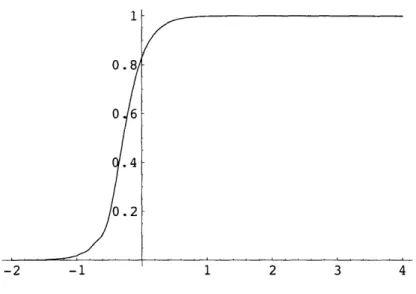
1 0.8 0.6 0.4 0. -b -4 -2 Z 4
Figure 2-2: y = xx/xx,large evaluated at X = qR = IOx, r 1
This graph gives the ratio axx/Cxx,large in the large qR regime, namely in the region log1O(X) E [-6, 5]. We see when qR > 1, xx,large gives a very good approximation
to Cxx.
2.2.3
oyy approximations
We may perform the above approximations with ayy instead of acx. We note that
Oyy,small - xx,small
This follows from the fact that the diagonal enteries in equation (B20) of [8] are equal.
yy,small-1
0.8
1 2 3 4
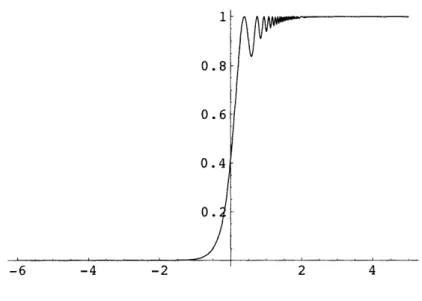
Figure 2-3: y = yy/yysmall evaluated at X = qr = 10- , r 1
This graph, logarithmic in the region log10(X) E [-1, 4] shows that for qR < 1,
the approximation ayy uyy,small is good. In the large qR-regime, we have the approximation derived at the end of Chapter 1, which is
m* VFe2 (1 +
m*2wh2 q +8(qR) 2
21Fe~~~~~~~~~~~~~~~~~~~~
(2.30)
If we graph j(yy/0yy,large, however, we get the following:
-0.
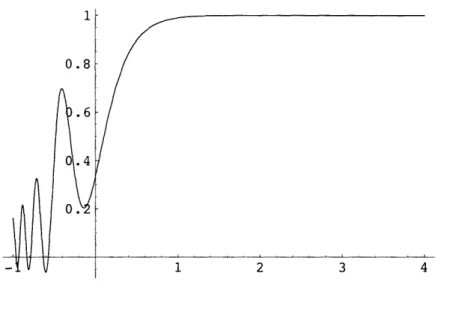
Figure 2-4: y = yy/yy,large evaluated at X = qR = 10x, x C [0, 10], r 1
1
.jIE
Even though the magnitude is roughly correct (it appears symmetric around 1) there are wild oscillations, even across the x-axis. The expression uyy,large is always
positive and monotonically decreasing: as a function of q it is essentially c/q. The Bessel function terms in yy,, however, are wildly oscillating. This phenomenon did not arise in ax. The reason is that in the large q-regime, the dominating term in the exact formula for oar (equation 2.22) comes from the constant -1/2, not from the Bessel functions! One possibility is that the results derived are right on average, (i.e. by smoothing out the oscillations, as seems to be correct) but do not actually give a good approximation to ayY? We follow up on this in the next section. Note that a similar phenomenon happens when comparing ax, and
xy,jarge-2.2.4 Resolving the approximations
acy
and
yy,largeNote that the approximations aoy and ayy,large in the last section were different but
similar on average. To push this analysis further, we replace the value of r by r + i, for various real constants , and take absolute values. For a particular value of r we draw the graphs for r + i and r + 3i, and we find the following:
1.2 1 0.8 0.6 0.4 0.2 2 4 6 8 10
Figure 2-5: y = layy/yy,large evaluated at X = qR = 10, x [0,10], r -1 + i
-
1 0.8 0.6 0.4 0.2 2 4 b B I0
Figure 2-6: y = l(yy/uCyy,largell evaluated at X = qR = 10X, x E [0, 10], r - 1 + 3i
Thus it appears that our approximation ayy,large is accurate only after replacing r by r + iE and taking e > 1. We note that e is analogous to the scattering term 1/T that appears in our exact results for the conductivities derived in Chapter 1. Thus, we can view the addition of the imaginary correction as the addition of scattering. This implies that the straightforward expansion of the Boltzmann equation (obtained in equation 2.30) ends up giving the wrong result; it essentially produces a dampened version of cryy rather than the oscillating behavior. On the other hand, it does appear to give the correct answer after dampening all oscillating terms.
2.2.5 Analysis
In the first section we found that our approximations broke down at q = 0 and introduced divergences into the relevant integrals. This required choosing a "cut-off" at which to switch between our new approximation and the approximation of
Ussishkin-Stern. In order to gain more insight into the nature of this cut-off, we studied in this section some of the local terms more explicitly using their description in terms of Bessel functions. However, it turned out that these explicit expressions varied considerably from the approximations in section one, and thus we could not infer anything about our previous analysis. On closer inspection, the approximation
equation 2.30 obtained by expansion of the Boltzmann equation only produces the correct answer on average, and does not capture the analytic nature of ay,, but rather a damped variant where r is replaced by r + ie and > . It is not clear to what extent this affects the analysis of the first section since the dampened form of ay, may still be sufficient to compute PD. One possibility is to work from the beginning using only the exact formulas of Simon-Halperin, which is our approach in the next section.
Chapter 3
Theoretical Approaches
3.1 Theoretical Approaches
If we use exact formulas in our integral for all relevant terms, then we (see below,
equation 3.18) find that the expression for II is totally real. Initially this seems to be a serious problem as our integral calls for taking the imaginary part of II. To account
for this we use the standard technique of instead considering the retardation IUret of
H, where a real parameter x is replaced by x + ie for some infinitesimally small e. This has the effect of introducting a functions, as we now explain. The function 1/x
is totally real for real values of x. Consider the retardation (1/X)ret. We find that
(I)
=
=
-(X
(
i)/(x
2
+
2).
(3.1)
ret X e
Thus taking imaginary parts we find that
Im ret 2 + e2(3.2)
The expression -e/(x 2 +e2 ) converges to zero as - 0 except at x = 0. This suggests
this function we compute that
0o Edx
j
2 + 2 7T. (3.3)Thus the retarded version of Im 1/x is equal to -6(x)/7r. We write this in the form
Im( (). (3.4)
Since we will encounter functions with many poles, we will study integrals that consist of the sum of many delta functions integrated against some other functions. We try to develop a framework for studying such integrals. First, however, we recap some more facts about Bessel functions.
3.1.1 Preliminaries: Bessel Functions, Part II
We return again to formal analysis of Bessel functions in order to apply some exact formulas of Simon-Halperin.
Consider the following differential equation:
d2Y dY
dX
2
+
+ (X
2- n
2)Y
=
0.
(3.5)
For generic positive values of n, there is a unique power series solution at X = 0. Let us posit a power series solution of the form
00
X
E
akXk
(3.6)
k=O
for some rational number r with a0 =f 0. The differential equation above leads (by
equating coefficients) to many equations, the first of which is ao(r2- n2) = 0. When
r = n, the subsequent equations become
and
ak(k2 + 2nk) + ak-2 = O.
It follows that ak = 0 for k odd and that
-ak-2
a2k = 4k2 + 4nk'
Determining a2k leads to the well known series expansion of the Bessel function (up to a constant). The traditional value of a0 gives the following expression for J (X):
Jn(X)
_ n o (-l)kX2k
2nFr(n + 1) Z22kk!F(n + k + 1)'
k==O
(3.7)
Note that to deduce this expression, we use the fact that
r(n + k)(k- 1)!
4k2+ 4nk
= k
2+ nk =
22
The Bessel functions J(X) also has an asymptotic expansion for X >> 0. This can be obtained by applying the method of stationary phase. The result is the approximation
J (X )
-
-
cos
2n +
4I
(3.8)3.1.2 The calculations of Simon-Halperin
Recall the following from (B15), (B16) and (B18) of Simon-Halperin [8].
ipe2 2r 7= h X2 (-1 + i( 2sin(wr) Jr (X) J-r (X), .~ , ,, [Jr(x)r(x)]'. y/ = 7rth 2X sin(Trr) ipe2 7r
yy =
-e
sin
+
Jl+r
(X)Jl-r
(X)-Let us estimate these expressions for X > by using the asymptotic formula 3.8.
One finds that
ipe2r
XX, -hX 2
pe2r cos(2X)
XY 7rhX2 sin(rr)
ipe2 cos(rr) - sin(2X)
7thX sin(rr)
(3.9)
(3.10)
(3.11)
To derive these equations, one uses the sums to products identity for cos(a) cos(b) and equation 3.8.
3.1.3
A new expression for H
In this section we use our approximations for axx, axy and oyy to derive a theoretical expression for I using Bessel functions. Recall r = wlw* and X = qR. We have
q2 ipw cos(2qR)
Ko(q, w)=
XY
hR
2q sin(
~i~ o/< (3.12)
This expression does not involve any complex quantities and thus is real. We also have the following two expressions for the coefficients K given in equation 1.43:
Ki (q, ) - K1 1(q, 0) K 0 (q, ) 1 - Kl (q, 0) =
-w
ie2 Y we2_-1
iq2 (3.13) (3.14)We also impose the following equation:
_q2
K1 (q, 0) =
247m* (3.15)
This expression also does not involve any complex expressions and is thus real. The expression for cyy is purely imaginary, and thus iyy is also real.
K1l(q,w) is real function. We set K-X(q, 0) = 0. Thus
iq2
Koo(q,Lw) = 2xx
be
It follows that
is real. Let
A - Koo00K1 1 K21. (3.17)
Since Kol is purely imaginary, its square is real. Also, Koo and K1l are real, as we
have noted. Thus A is real. Finally, let
I = K 2 (3.18)
1- _q 4)iq~01-
The numerator is real, as is the denominator (K0 1 is purely imaginary, so iKo0 1 is
real). Thus II is real. Therefore, to be able to interpret Im(II) we must form the retardation of H by examining is poles.
3.1.4
The retardation
fIret and
Im(Ilret)Since II is totally real, the expression Im(II) only makes sense if we interpret it to be Im(Ilret), where Ilret is the retardation of II. Explicitly this means that we replace
u by w + i for some arbitrary small e. As we found in our brief calculation above, Im(l/)ret turns out to be -6(z)/1r. For a general function f(z) which is real for
z c R but may have simple poles, we therefore can interpret Im(f(z)) to be
1
Im(f(z)ret) =-- E
6(z--y)
residue(f,- ). (3.19)7F
f(,)=oo
Here the residue of f at -y is defined in the usual way as the expression:
residue(f,
y)
= lim(z - y)f(z) (3.20)z---/
If we wish to understand the retardation of some function, we must therefore understand the location of the poles, and the residue of the function at those poles. Answering these two questions will allow us to construct a meaningful expression. By "meaningful" here we mean an expression that it makes sense to integrate, and thus -functions are acceptable. Explicitly, we wish to apply this procedure to the
integrand arising in PD. However, we begin with a more theoretical discussion of how to integrate sums of many d-functions at once.
3.1.5
Estimating Sums of 3-functions
Although integrating a single 6-function is easy, it may (and will) be the case that the function we encounter has many poles, not all of which can be determined explicitly. Thus it will be useful to consider a general technique for integrating sums of delta-functions integrated against other expressions. This general formalism is the subject of this section which we will apply to our particular example later.
We begin with an example. Suppose we consider the function
1000
K(q) = (q - n). (3.21)
n=l
If f(q) is any continuous function, then by the standard property of delta functions
we see that
1000
I
K(q)f(q)dq=
f(n)
(3.22)
n=l
On the other hand, suppose that the function f(q) is relatively flat (ie. has small derivative). Then we may approximate
100 0 1000
0
(q)dq f(n). (3.23)n=l
Together, we obtain the approximation
K(q)If (q)dq f (q)dq (3.24) In other words, as far as the integral is concerned, the function K(q) behaves as if it is a step function from 0 to 1000, even though the function K(q) itself does not behave in this way. The reason such an approximation may be useful is as follows. Our integral expression for PD involves the quantity Im(II). We interpret this to mean Im(Iret),
which is a sum involving many 6-functions. Since we only care about the impact of these -functions inside an integral, it may be possible to replace the complicated sums of 5-functions by a simple continuous function like the step function encountered above. To prepare for this situation, we will generalize the example above. Consider a continuous auxiliary function g(q), and define a distribution K(q) by considering the following sum:
K(q) := b(q --)g() (3.25)
YnES
where
an
ranges over a set of points S contained in an interval Q. If Q = (0, 1000], S is the set of integers in this range, and g(q) is the constant function, we recover the situation described above. In practice, the points y, will be the poles of II and the function g will estimate the residue of this function at its poles, and the range Q will be the interval in which the poles occur. The idea is to approximate the operatorf K(q) for "well behaved" test functions.
Since we have the standard relation
6(q - 7)f(q)dq = f(),
it follows that
f(q)
K
(q)dq
=
f(n)g(n).
(3.26)
On the other hand, consider the integral
J
f(q)g(q)dq. (3.27)Suppose we try to compute the integral of equation 3.27 by using a Riemann sum. We can estimate the integral by
1C f(n)g (), (3.28)
where C is a constant defined as the "density" of poles in Q, i.e. #S/Area(Q).
Comparing equation 3.26 and 3.28 we are led to the approximation:
If(q)K(q)dq=
1 f(q)g(q)dq.Therefore, despite that K(q) is a sum of functions and g(q)/C is continuous, we may replace K(q) by g(q)/C, as long as we restrict ourselves to functions that occur in integrals. We write this as
K(q) g(q)/C
(3.30)As an example, suppose that Q = (0, AM] for some large integer AM, that g(x) = 1, and that S is the set of integers in Q. Then C = 1, and our approximation 3.29 is
JM
l
M
f (q)dq
_ Z f (n).
n=l
(3.31)
Of course this is a better approximation for some functions f(n) than others. general, we assume that the derivative of g and f are not so large.
Suppose now we consider the alternating sum of delta functions
K(q) := Z 6(q- Y)g(7n)((-1_)n
,2Y E S
In
(3.32)
To estimate the integral
K(q)f (q)dq
we must approximate the sum
e
f(n 2n)g9(Y2n) - f(2n-I)g(Y2n-1)
(3.33)If we assume that the test function f has a smaller derivative than g, we may ap-proximate this by
1
y
fg'(%)d%
-1
2 JJ
f (q)g'(q)dq.
(3.34)We write this for future reference as
/ K(q)f(q)dq = -
f (q)g'(q)dq
(3.35)
and as above we also write
1
K(q) 9'(q) (3.36)
2
Note that the constant C does not occur in this formula. As an example, let Q = (0, M], let y, = n/N for 0 < n < NMl, and let g(x) = x. Then we are approximating
~M
NM
n (-1)'n
(
f(q)dq=f=
-2 N N N
For example, if f(q) = 1, then the LHS is equal to M/2, while the right hand side is equal to
NM -I
M
1
2N 2 2N'
which, for large N. is in agreement with M/2.
3.1.6 An Alternate Approach
We apply the techniques of the last section to approximate Im(IIret), as given by the formulas from equations 3.9, 3.10, 3.11 and equation 3.18.
The expression for 1/II can be written as follows:
4rh2 87r hkFW cot(7rTr()) q3 + 8irhw csc(-a r(w)) q2 * cos (2Rq) -87m2csc(7r(L))2 2 * cos (2Rq)2 - 87rhkFW CSC(7r(W)) . sin q3
What are the dominating terms in our expression for l/H? Including the constant
there are five terms, which we label T1, T2, T3, T4 and T5. All trigonometric terms 1 /TT_
1/11 -
3m*
3m*
have roughly equal order. Thus, we may estimate
q4 m*W /
T3/T2 k F T4/T2 = T5/T 2 1 (3.38)
kF hkFq I;Fq
Since q << kF and < 1, it follows that T2 and T5 are the dominating terms, and
possibly T1. Numerical calculations suggest that the main weight of the integral takes
place in the region where T5, T2 >> T1. This is a "middle" region of Rq where the
Bessel function approximations (which are valid for large Rq) are still valid. In this range we may estimate
1/II 87rhkFW cot(7rr(w)) _ 8whkF csc(rr()) sin (2R). (
This expression naturally simplifies to the following:
1/l87hkFw csc(7r(w))
hkFcsc(r()) (cos(7rr(w)) - sin(2Rq)). (3.40)
The next step is to substitute this function into equation 2.1, substitute w + i for
w, and attempt to determine the poles and residues of the resulting expression in
order to re-write it as a sum of d-functions. The effect of these substitutions is a complicated expression, however, for which it is hard to determine the poles. Some numerical analysis and some simplifications suggest that the methods of the previous section may lead to an expression that can be integrated, but all our attempts so far have resulted in expressions too complicated to integrate (numerically or otherwise), so we omit them here.
3.1.7 Analysis
Although the approach of this section theoretically might work, practically it becomes too difficult to explicitly determine the location of all the poles and their residues. If an accurate description of the poles and residues could be determined, then our techniques of simplifying large sums of d-functions could be applied to the estimation of the integrand of PD, and then hopefully to PD itself. However, attempts to use
various formulas obtained in this way have not succeeded. One relevant issue is that it is not clear if the methods will apply rigorously to our particular example. A second issue is that the numerical integrals that arise are still too complicated to produce good data with Mathematica. One possible future direction is to test the accuracy of our approximations of the poles of various expressions that we encounter. Another approach is to work numerically with a fixed (but small) e > 0 rather than the retarded form with c arbitrarily small, and perform numerical computations; this would have the effect of smoothing away the -functions. Although we have not managed to successfully carry out these steps, they are worthy of further consideration.
Bibliography
[1] I. Ussishkin and A. Stern, Phys Rev B 56, 4013 (1997). [2] A.-P. Jauho and H. Smith, Phys Rev B 47, 4420 (1993). [3] L. Zheng and A.H. MacDonald, Phys Rev B 48, 8203 (1993). [4] A. Kamenev and Y. Oreg, Phys Rev B 52, 7516 (1995).
[5] B.I. Halperin, P.A. Lee, and N. Read, Phys Rev B 47, 7312 (1993).
[6] S. H. Simon, in Composite Fermions: A Unified View of the Quantum Hall
Regime, edited by O. Heinonen (World Scientific, River Edge, NJ, 1998).
[7] P. M. Platzman and P. A. Wolff, Waves and Interactions in Solid State Plasmas
(Academic Press, New York, 1973).
![Figure 2-5: y = layy/yy,large evaluated at X = qR = 10, x [0,10], r -1 + i](https://thumb-eu.123doks.com/thumbv2/123doknet/14505720.528759/34.940.245.688.746.1030/figure-layy-yy-large-evaluated-at-x-qr.webp)
