People’s Democratic Republic of Algeria Ministry of Higher Education and Scientific Research
8 MAI 1945 UNIVERSITY / GUELMA ةملاق /54 يام80 ةعماج FACULTY OF LETTERS AND LANGUAGES تاغللاو بادلآا ةيلك DEPARTMENT OF LETTERS & ENGLISH LANGUAGE ةيزيلجنلإا ةغللاو بادلآا مسق
A Dissertation Submitted to the Department of Letters and English Language in Partial Fulfillment of the Requirements for the Master’s Degree in Anglophone Language,
Literatures, and Civilizations. Board of Examiners
Chair: Prof. Dr. ZEMITTI Asma (University of 8 Mai 1945/Guelma)
Supervisor: Mrs. ZIAYA Rima (University of 8 Mai 1945/Guelma)
Examiner: Mrs. Amiar (University of 8 Mai 1945/Guelma)
Students: Supervisor:
ABED Leila Mrs. ZIAYA Rima
BENRAZEK Nerdjis
September 2016
US Policy towards Minority Languages: The Ebonics
Controversy in the Educational System as a Case
Acknowledgments
In the name of Allah, all Praise be to Almighty Allah, Lord of all the worlds, most Beneficent, ever-Merciful. Peace and prayers be upon His Prophet and Messenger
Mohammad. First and foremost, an everlasting gratitude to Allah for giving us strength and patience to complete this dissertation.
It is a pleasure to have an opportunity to express our gratitude to our advisor Mrs. ZIAYA Rima for her tireless encouragement and inspiration. We cannot thank her enough for her continued assistance and support. We will always be appreciative of her commitment, and patience.
We owe a special debt of gratitude for our teacher, Professors. TOULGUI Ladi who was always our guide. We are deeply grateful for him for making it possible to carry out this work in the English Department.
We want to express our gratitude to the members of jury, and to everyone who helped us to accomplish this work. Endless thank to our parents, brothers, and sisters for their endurance, and for the psychological support they provided us with.
in the Educational System as a case”. The title refers to the plans, strategies, and practices applied by the different American legislative, political, and social actors in addressing languages other than the dominant English from the past to present and the debates raised upon it. What is definitively the most ambiguous and unknown notion for the majority of Algerian students is the so called “Ebonics”. It is a term coined by the scholar Robert L. Williams as an attempt to give a clear definition and a better stature for the language spoken by many African Americans. This research paper is to shed light on the debate on Ebonics whether it is a separate linguistic system or just a dialect of English providing each side arguments for more objectivity. When Ebonics is related to the education of African
Americans, it received and still a lot of criticism and refusal and few of praise and acceptance. So, the focus here is to reveal the various factors if it is ideological, political, or social that led to the increasing rejection of languages other than English, more precisely African American Vernacular English without forgetting landmark legislative decisions either to encourage or to reduce maintenance bilingual programs. The role of media is very important as well in
managing and directing such heated discussions which, in turn, to be covered in this dissertation.
' ' ˸ "
."
.
' '
' ' .
.
.
.
.
Introduction………...1 Chapter One: History of Us Legislative Policy towards Minority
Languages………..6
1.1 The United States: A Nation of Immigrants, a Nation of Languages……….7 1.2. Language- minorities in the American Constitution and Supreme Courts….9 1.3. The Legal History of Bilingual Education in America………12 1.4. Programs for Language-Minority Children……….16 1.5. The First Federal Recognition of Language-Minorities Rights: The
Bilingual Education Act from 1965 to 1994……….19 1.6. The English Only Movement legislation ………23 1.7. The Maintenance of Racial Disparities within the US……….25
Chapter Two: Disputes over the Historical and Linguistic Origins of Ebonics ………..30
2.I. The Story of African Americans along with their Home Speech
„Ebonics‟………..31 2.I.1. The Exceptional Historical Status of African Immigrants in the United States………..31 2.I.2. The African American Educational Development………...35 2.I.3. The Emergence of Ebonics Debate ………...40 2.I.3.1. Martin Luther King Junir School ChildrenV. Ann Arbor School
District Board………..41 2.I.3.2. Theories of the Origins of African Vernacular English…………..42 2.II. Ebonics in the Linguistic Community. ………...45 2.II.1. Language V. Dialect……….45 2.II.2. Linguistic Disputes over Ebonics: legitimate Language vs. Dialect…...46
2.II.4. The Oakland Unified School District‟s Resolution………..55
Chapter Three: The US ResponsivePolicy towards Ebonics Recognition Within its Bilingual Education Programs ………60
3.1. Media Misrepresentation to the OSB Resolution……….61 3.2. Educators, Scholars, and Linguists‟ Reactions to the OSB Resolution…...65 3.3. The Undertaken Legislative Policy towards Ebonics and the Bilingual Education in the US………...71 3.3.1. The Different Statutory Responses………..71 3.3.2. No Child Left Behind (NCLB) Act……….75 3.4. A future Vision about the Bilingual Education and Language-Minorities in US………..80
Conclusion ……….83 Bibliography ………..
87
AAE
African American English
AAL
African American Language
AAVE
African American Vernacular English
ACS
American Community Survey
AYP
Adequate Yearly Progress
BE
Black English
BEA
Bilingual Education Act
ELL
English Language Learner
EO
English Only
ESEA
Elementary and Secondary Education Act
IDEA
Individual with Disabilities Education Act
LEP
Limited English Proficient
LESA
Limited English Speaking Ability
LSA
Linguistic Society of America
NAACP
National Association for the Advancement of colored People
NCLB
No Child Left Behind
NEP
No English Proficiency
OBEMLA
Office of Bilingual Education and Language Minority
Affairs
OELALEAA
Office of English Language Acquisition, Language
OUSD
Oakland Unified School District
SD
Standard English
SEP
Standard English Proficiency
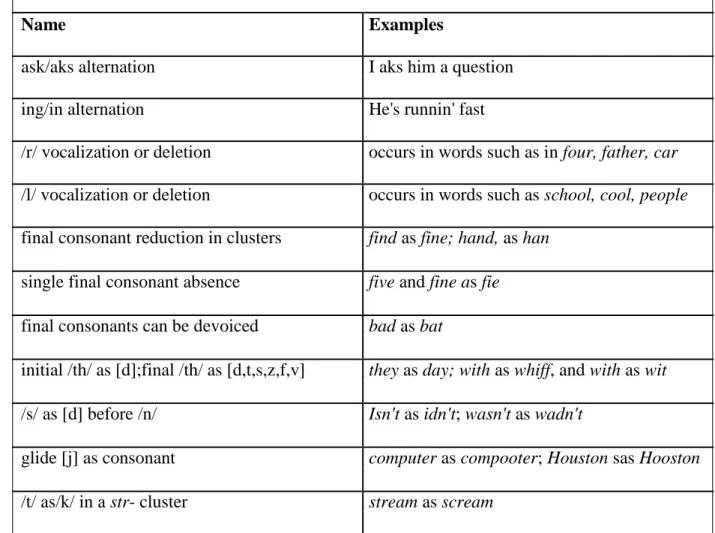
Table 1:Consonantal variation in AAVE…………...51
Table 2:Vowel Variation in African American Vernacular English/
Ebonics...52
Introduction
Among a large number of controversial issues in the United States of America, the policy followed by successive US administrations to deal with language minorities in educational settings will be the focus of this research paper. The fact that America is a home of hundreds of languages, besides the dominant Standard English, makes it very normal to insert special bilingual programs into schools to accomplish certain goals including assisting and facilitating the acquirement of Standard English for limited or non-English speaking children. However, even after giving such an excuse or purpose in order to inject particular speech languages into schools, it is used to be and still undesirable like it is the case for African Americans‟ home speech. This case is going to be studied and highlighted throughout this dissertation under the label “Ebonics” or “African American Vernacular English”; both terms are to be utilized interchangeably.
As a contribution will be added to previous related works, this research paper will attempt to come out with an explication to the US language policies in dealing with language
minorities in general and with Ebonics, the spoken language by a large number of African Americans, in details. In this regard, Richard Ruíz introduces three orientations in language policy or planning; language as problem, language as right, and language as resource. So, after reviewing the American policies toward language minorities in education and basically towards Ebonics as part of bilingual education, a conclusion will be attained about which of and how this orientations/ approaches played a role in deciding the status of Ebonics at societal, legislative spheres and more precisely at the educational level as one of language minorities.
This study emphasizes bilingual education from the past to present and how it was and still a controversial issue in terms of its nature, purposes, and how it should be implemented. English only supporters are the ones to oppose strongly the maintenance of bilingualism in American society and so bilingual education. This debate will be seen clearly through the
important dimension. That is, a new division of views escalates on the legitimacy and correctness of Ebonics in addition to the first debate over English only vs. bilingual education. In other words, activists seeking bilingual education programs for African Americans speaking Ebonics are obliged to persuade their opponents, the American main stream, by their claim that Ebonics is a different language rather than a dialect of Standard English.
On the way to a well understanding and reading of this topic then coming out with a fair, reasonable, and helpful conclusions, going step by step in gathering related data for the study is more than necessary. Accordingly, a historical general idea involves and stresses the development of US strategies that addresses languages other than Standard English (SE) within the Educational system will be given. The most important legislations whether in favor or against bilingualism and bilingual education are also to be highlighted along with the different reactions on it. But before that, the study encompasses essentials and details on how much the American society is diverse linguistically, how many non-English speaking people are there, as basics should be learned.
African Americans are known by a unique and painful story which it has with no doubts an impact on the status of their home speech. This minority from African descents is mostly used to achieve its basic human rights by hard and after long fights, the same thing is happening with the expressed claims for bilingual education. The persons who started and suggested this matter found themselves under harsh attacks and criticism for the reason that their supposed different language, for the opponents, is just a dialect of English which has no place in this intended educational program. So, throughout this dissertation an attempt to be made to discover the origins of this debate, main points of disagreements, and the real and logical standing of this human speech. Debates on Ebonics were only present at academic
level between scholars. But after a resolution was declared loudly by Oakland, California School Board in 1996 embraces the view that Ebonics is different from English, the dispute is no more academic since all American people start to give their opinions, largely negative, on this subject.
A number of questions are to be the guide of this dissertation‟s development, among them the subsequent to be highly investigated: is there any difference in views, whether societal or legal, concerning languages other than English and so bilingual education between the past and the present? If yes, how it changed and why? Moreover, what are the types of bilingual programs which are, increasingly getting to be, preferred by the public along with policy makers? More importantly, even though bilingual education programs are strongly supported to help limited and non-English speaking children to improve their American Standard English, why it is refused for the African American minority which has difficulties in this concern? Is it because of their historical and socioeconomic statuses? Or, is it the way and the words used by African Americans to express their demand? If the latter is true, what are the real aims behind requiring bilingual education for African American children? It is also worthy to know why the American main stream finds it hard to believe the accuracy and legitimacy of Ebonics? Is there any hope of a delightful future for Ebonics?
This research is divided into three chapters. The first is entitled “US Legislative policy towards minority languages within the Educational Frame: Historical Background”; its aim is to investigate major transformations in the American educational policies addressing
minorities. The second chapter is called “Disputes over the Historical and Linguistic Origins of Ebonics”. This chapter, in turn, is partitioned into two sections; the first is named “the Story of African Americans along with their Home language”, while the second is labeled “Ebonics in the Linguistic Community”. “The US Responsive Policy about Ebonics
stresses the way the different actors at political, legislative, executive, academic, and public American spheres tackles the Ebonics issue.
Scholars‟ have diverged upon this subject between refusal and acceptance. This division of attitudes is clearly seen through numerous writings and researches done in this concern. Detractors of bilingual education for Ebonics speakers do not believe that Ebonics is very divergent from Standard English and thus opposing the integration of any English vernacular into schools. Advocates, on the other hand, are with celebrating and maintaining minority languages, linguistic diversity, and thus supporting its entrance within the
educational plans. Their main and declared goal is to assist limited English proficient
learners, including African Americans, to enhance their levels in Standard English and then to pave the way for them into better academic achievements.
John H. McWhorter is one of research scholars who criticized the confidence that Ebonics is a language different from English. In his “Wasting Energy on an Illusion”, McWhorter emphasized his belief in African American vernacular English as a Dialect of Standard English like the various English dialects spoken in the United States. Briefly, after making his stand stronger through illustrations, McWhorter concluded that asking translation from an English dialect, which all American children own one, into Standard English gives an
impression of the stupidity of African American children among their peers on earth.
On the other side, Ernie Smith explains the contrary in an article labeled “What Is Black English? What Is Ebonics?” In which, he states that Ebonics stature should be based on its different grammatical patterns not on lexicon like it was the case for Standard English which was classified as a Germanic language while most of its vocabulary is from Romance or Latin language family. Smith finally stresses that African American children are actually limited English proficient (LEP) students who are denied their right, because of their race, for bilingual education as a good way to tackle their LEP needs.
The research will be based on the qualitative method since the nature of the topic demands a detailed exploration and deep investigation to reveal the stands of those who are concerned with this issue: politicians, linguists, law experts, activists, etc. The argumentative method is also used in this dissertation in order to justify the legitimacy of African American Vernacular English is not accepted until now. Discourse analysis is also followed so as to interpret and analyze political laws, speeches . . . etc. Besides, as the study takes
African-Americans‟ language as a case study, the historical method is given an important place in the context as well. Furthermore, the MLA style will be used in this research
Chapter One:
US Legislative policy towards minority languages within the Educational
Frame: Historical Background
Throughout the history of the United States, multilingual societies have coexisted together. Among the diverse array of languages spoken throughout the country, in addition to the Native American languages, there were a multitude number of other languages that
immigrants from all over the world brought to the country. At the top, English regarded as the most spoken language, besides to German, Dutch, Polish, Yiddish, Spanish, Chinese,
Japanese, French, and African languages.
As a result of this ethno-linguistic diversity, language-based controversies have often come to the forefront of the political debates in the United States. For many ethnic minorities, assimilation to the mainstream culture was a hard task for them, especially when it comes to abandon their cultural and linguistic heritage. This distinctiveness has exhibited many barriers to those minorities at different levels mainly at the educational one, because the language of instruction which was commonly implemented in classroom programs was English. Actually, before the 19th century, the issue of language instruction in public schools was not a focal point in the US political debates since it was in the hands of local educational agencies, but after the Civil Rights Movement a great attention has been driven upon this issue.
The chapter stresses many points regarding the US language policy towards minority languages within its educational system. Firstly, a brief overview about America‟s ethnic and linguistic diversity will be provided. Then, the chapter will go further through history to explain the constitutional grounds upon which programs regarding language-minorities were set. This will be followed by a discussion of the bilingual education history stressing the role of the federal and state governments on developing programs assisting minority-language
students, and clarifying the impact of the English-Only movement on the bilingual education. At the end, light will be shed on the prevalent discriminatory feature of the US public schools towards minority students in the recent decades.
1.1. The United States: a Nation of Immigrants, a Nation of Languages
The US has always been ethnolinguistically diverse. Besides to the indigenous Native American groups who spoke over 300 languages and the English settlers, German and Spanish population entered America. The makeup of non-English European immigrants was one-quarter of the whole population; two-fifths of the population spoke German in
Pennsylvania. Moreover, an unknown but a significant portion of the new nation‟s settlers spoke an American-Indian or African languages, assuming that perhaps one-third or more of the whole population spoke a language other than English (Rumbaut and Massey 1). Based on this statistical ground, what becomes apparent is that the US is not a monolingual nation; however, its linguistic composition is distinctively very rich.
Invasion played a great role in creating language diversity in America, but immigration was the primarily driven force to make the United States a polyglot nation. In 1840s and 1850s, Germans and Celts entered America in a large numbers, followed by Scandinavians in the 1870s and 1880s, and then by Slavs, Jews, and Italians from the 1880s to the first mid of the 20th century. The census of 1910 counted a whole population of 29 million; 10 million immigrants spoke a mother tongue other than English or Celtic, including 2.8 million German speakers, 1.4 million Italian speakers, 1.1 million Yiddish speakers, 944.000 Polish speakers, 683.000 Swedish speakers, 529.000 French speakers, 403.000 Norwegian speakers, and 258.000 Spanish speakers (Rumbaut and Massey 1). Language diversity in America was centrally driven by the waves of immigration coming from different world countries.
As the mass immigration declined during the following decades, so did the linguistic diversity. Over the second half of the 20th century, the rate of the foreign born population fell
dramatically to reach a nadir of 4.7 % in 1970, when the Census Bureau stopped asking for statistics on mother tongues. English, at that era, kept to be the most spoken language by the immigrants; over 1.7 million speakers came mainly from Canada, the UK and Ireland,
followed by Spanish, with approximately 1.7 million speakers, then German with 1.2 million, Italian with 1 million, and with less than 500.000 speakers for Yiddish, Polish, and French. . . By 1980, for the first time, Spanish surpassed English as the most spoken language by
immigrants, and the number of non-English spoken languages has increased as well (Portes and Rumbaut 6). Though the foreign born population has decreased during the second half of the 20th century, but the number of non-English spoken languages has decreased. This shows how ethnic minorities preserved their linguistic heritage.
Fix and Passel, experts on immigration to the United States and the demography of racial and ethnic groups, estimated that the numbers of immigrants who came to the US reached a climax point during the 1990s. They also pointed out that the English Language Learner (ELL) population increased by 52 % in the 1990s. Furthermore, they expected that the immigration influx would keep in the same level, if not increase, during the 2000s. The US demographic diversity was and still changing in a drastic way. The numbers of immigrants that came from Latin America and Asia in the second half of the 20th century superseded the number of the European immigrants came to America in the early 20th century. By the year of 2000, more than a quarter of the US population was composed of ethnic minorities…. (qtd. in Nieto 1). In fact, this change in the US demographic diversity was due to the US restrictive policies imposed on immigrants in a given periods.
In parallel with the rise of immigration in recent decades, the rate of the speaking only English at home has smoothly fallen, dropped from 89.1 % in 1980 to 79.7 % in 2010, while non-English speaking portion subsequently rose from 11 percent to 20.3 %. In fact, the number of persons, 5 years or older, speaking a language other than English at home
increased from 23.1million to 59.5 million; two thirds of the increase caused by the growing number of the Spanish speaking people at home who made up 12.6 % of the total population. Immigration from Latin America has caused the most increase. In fact, nearly 60 million of non- English language speakers are immigrant. Just 2.6 % out of 230 million persons who spoke only English language at home in 2010 were born outside the United States, and 49 among the Spanish speakers were of foreign born (Portes and Rumbaut 6). To sum up, the rise of immigration during the last decades of the 20th century has lead to the rose of non-English speaking portion, which mostly caused by the growing number of the Spanish speaking population.
World migration to the United States has caused the development of a nation with great ethno-linguistic diversity. Immigrants who came to America preserved their unique culture, mainly their languages. This ethno-linguistic distinctiveness leads to the emergence of many ethnic-related problems; one crucial, long lasting problem was that of language. Since the foundation of America, and because of its legislative policy towards language-minorities, language-based disputes emerged and lasted for long. This urged the US federal and states governments to reexamine their policies towards those language-minorities, in order to preserve their language rights. A vision into the American Constitution is needed so that the status of language-minorities would be clarified.
1.2. Language-Minorities in the American Constitution and Supreme Courts
The anti-immigrants emotions that prevailed the United States during the World War eras pushed the proponents of the minority rights, minority-languages rights, to take
advantage of all available means which may give their claims legitimacy. In this concern, the most effectively employed weapon in front of the different restrictions was the American constitution, particularly the fourteenth amendment section 1 ratified in 1868 after the Civil War:
All persons born or naturalized in the United States, and subject to the jurisdiction thereof, are citizens of the United States and of the state wherein they reside. No state shall make or enforce any law which shall abridge the privileges or
immunities of citizens of the United States; nor shall any state deprive any person of life, liberty, or property, without due process of law; nor deny to any person within its jurisdiction the equal protection of the laws ( Legal Information Institute). The fourteenth amendment section 1 contains two main clauses that played a significant role in courts to consider the restrictive laws passed by certain states against languages other than English to be unconstitutional. The clauses are: The Due Process and Equal Protection Clauses; Del Valle clarified that: “The Due Process and Equal Protection Clauses appear to be limited to functional process: the Due Process as a guarantee of fair procedure” (23). That is, no state has the right to prevent any person from life, liberty, or property without passing through equitable legal steps. For the Equal Protection Clause, it ensures for all citizens a similar processing in courts and also while deciding or enacting laws. There is another clause, “the forgotten clause”, called the Privileges or Immunities Clause; but since it is limited to just certain rights such as the right “to assemble and petition”, the reliance on this latter was not as it was on the previous mentioned ones (Del Valle 24). Historically, the utilization of the Due Process and Equal Protection Clauses helped many language-minorities to judicially cancel a number of restrictive laws against minority-languages.
By the end of the First World War, many states have passed restrictive legislations that limited the use of languages other than English in public and private schools. In Nebraska, a parochial school teacher called Robert Meyer was condemned and fined because of the instructions that he gave to his students using the German language. At first, Meyer lost the case in the Nebraska Supreme Court which considered: “the teaching of German to children of immigrants was detrimental to national safety and in conflict with national self-interest”
(Wiley and Lee 8). In 1923, the US Supreme Court took another important decision that declared the Nebraska statute to be unconstitutional, since it violated the Due Process Clause of the fourteenth Amendment. Moreover, the decision included that; during peacetime, teaching foreign languages did not represent any menace to the national security, and thus no one can infringe the right of parents or teachers to teach their children and students the language they want (Wiley and Lee 8). Meyer v. Nebraska case was a realistic epitome
showed the ability of the fourteenth amendment to provide some protection to languages other than English in the US schools.
The US Supreme Court witnessed many language-minority related litigations after Meyer case. In 1925, the governor of Hawaii Farrington introduced a legislation to limit the functioning of foreign language schools in the region, and of course the law was enacted as the “Foreign Language School Act of the territory of Hawaii” (Del Valle 41). Because of the huge number of Asian population that came especially from Japan, china and Korea, a considerable number of foreign language schools were open for non-English speaking students living there. The majority of these private schools, more than 140, were Japanese. Handed down in 1927 concerning the case of Farrington v. Tokushige, the US Supreme Court unanimously concluded that the territory of Hawaii‟s law violates the Due Process Clause of the fifth and fourteenth Amendment. Wiley and Lee clarified the importance of this case:
“Tokushige has significance for heritage and community-based education today because these communities are often the prime movers in promoting languages other than English” (8). In other words, this case became a landmark in defending the right of local communities to decide about the education of their children.
While the first mentioned cases took advantage from the activation of the Due Process Clause of the Fourteenth Amendment, there were other injustice legislations illegalized through the employment of the other important clause of the same Amendment. The Equal
Protection Clause was the basis on which the US Supreme Court unanimously ruled a
landmark decision in which the Plessey doctrine (1896) of “separate but equal” was outlawed. Before the 1954 Brown v. Board of Education of Topeka court decision, race-base segregation in public schools was a constitutional educational policy. But after the historical declaration written by Chief Justice Earl Warren in which he stated that this segregation violated the Equal Protection of the laws, this racial based separation in the American schools became unconstitutional. More precisely, Contreras and Valverde states the effects of the brown case on the educational policy towards minority communities: “The Court‟s decision in
Brown created not just desegregation strategies . . . but also instructional approaches such as title 1 programs… and bilingual and multicultural education” (470). Thus, this Court ruling landmark played a remarkable role in the gradual improving of the educational context for minority groups in the US.
Although the Fourteenth Amendment was ratified in 1868, it took long decades before touching its implementation on the ground. The controversy while interpreting what was written in the American Constitution played a significant role for this delay; the Brown case showed clearly that what was considered before the Supreme Court decision in 1954 as something constitutional was seen unconstitutional and illegal after. Meyer, Tokushige, and Brown Court rulings were the cornerstone that helped to a certain degree minority-language communities to possess an important legal weapon to defend their claims. The road is still long since pro- minority groups‟ rights are asked to fight until passing clear and direct legislations at states and federal levels through which they guarantee the total protection of minority languages in public and private schools.
1.3. The Legal History of Bilingual Education in America
In the United States, bilingualism was always a common characteristic. As it is frequently assumed, masses of immigrants descend from various origins and places around the world alongside with the multi-ethnicity of the Native Americans represent the primary component of the American population. This fact entails that “English is not an indigenous language in North America, nor has the United States been in anyway linguistically homogeneous before, during or since its founding” (Wiley and Lee 2). Consequently, bilingual education was something prevalent during 18th and 19th centuries (Malakoff and Hakuta 1).
Before the end of 19th century, the education policy was managed and determined mainly by local actors; as Malakoff and Hakuta state “The school was supported entirely by the
community, teachers were often recruited from community, and the language of instruction was frequently the language of the community” (1). The status of the different languages in
America within schools was subject to the merits and the major languages spoken in a given community. For instance, there were both Spanish and English schools in New Mexico and California while French schools in Louisiana, in addition to German language schools in the mid-west (1). The acceptance and tolerance concerning minority languages existed in this period was incarnated and transformed into laws at both federal and state levels.
At the state level, Ohio was the first to legalize bilingual education in its schools in 1839. This step was a positive response upon the demands raised by parents of German origins calling for German-English instruction for their children. Afterward, in 1847, Louisiana passed a law permitted French and English instructions in its schools; the same thing was done in New Mexico for Spanish to be officially a language of instruction in 1870. By the end of 19th century, bilingual education was approved in a considerable number of states, thus many minority languages were a medium of instruction like Norwegian, Italian, Czech, Polish, and Cherokee (“History of Bilingual Education”).
However, in 1864, the enacted laws were not that encouraging since the first federal regulation passed in relation to bilingual education was restrictive, and prevented Native Americans from being taught in their own languages(“History of Bilingual
Education/ESL…”). Such compelling legislations have not stopped at that point but “In the 1880s, the US government implemented an aggressive policy of coercive linguistic and cultural assimilation through its boarding school program that forcibly separated Indian children from their parents and communities”( Wiley and Lee 6). This law had been executed until 1934 when it was repealed by the Bureau of Indian Affairs (“History of Bilingual
Education/ESL…”). Native Americans were not the only minority group which experienced oppressive plans against their native language.
By early 20th century, the German minority group was the dominant one in the United States. Therefore, at least 600,000 primary students were instructed, either partly or entirely, using the German language (qtd. in Loos et al. 3). A wave of anti-immigrant minority languages sentiment especially against the German minority prevailed the country, and it was strengthened with the participation of the United States in World War I and with the large number of immigrants entered the American territory at that time. Before, during, and even after the war, the Americanization movement played a decisive role in the decline of German along with other minority languages in schools. The latter led to a large number of states (34 states) to pass restrictive laws that prohibited teaching in German and languages other than English (Wiley and Lee 7). As a result of these coercive decisions, bilingual education was dismantled throughout the country until 1960‟s, when new regulations would be adapted.
Until 1960‟s, there were several reactions upon the aggressive legislations against language-minorities and in favor of English language. Thus, “by the early 1920s, several legal challenges had been raised to the U.S. Supreme Court against these restrictions” (qtd. in Wiley and Lee 7). The most prominent case was that of Meyer v. Nebraska (1923), in which
the Supreme Court has taken a landmark decision illegalized the Nebraska law, since it represented an infringement of the fourteenth Amendment of the constitution that guarantees Due Process (Del Valle 37). Despite the several positive court decisions illegalizing the restrictive laws in many states, the Americanization movement continued its campaign against all the threats on the American identity of the country. Unfortunately, foreign languages or immigrant languages were the first target.
Under the pressure of the Civil Rights Movement in 1960s, the American policy makers were obliged to assume numerous legislative reforms concerning minorities. The educational sector, particularly regarding language-minority students was one of the areas to be revised. The year of 1968 witnessed the enactment of the Bilingual Education Act (BEA). According to Wiley and Lee, this was the first step of the U.S. federal government to pay attention to the linguistic needs of language minority students (9). The BEA gave funding to many bilingual programs for Limited English Speaking Ability (LESA) students and, more importantly, “it encouraged instruction in a language other than English as well as cultural awareness”
(Stewner 1). The Bilingual Education Act which also called Title VII was amended several times to serve the variable needs.
Along with the federal recognition to the establishment of bilingual education, attacks over language-minorities had never been stopped. The emergence of several organizations defending English-only policies had led many states to adapt this orientation and pass restrictions on the bilingual education in public schools as it was the case in California, Arizona and Massachusetts (Wiley and Lee 10). During the first decade of the 21st century, Bush administration came with new policies for education, and it was introduced under the No Child Left Behind Act (NCLB). This Act marked the beginning of a new policy toward language-minority students especially when all the references to bilingualism were deleted as Wiley and Lee argues: “The very term „bilingual‟ has disappeared completely from federal
educational law and the broader educational policy discourse in the United States” (11). The sole focus of this new federal legislation is English and how to develop the English
proficiency for the Limited English Proficient (LEP) students through appropriating funds to states. Legislation for limited English proficient students is found under Title III of (NCLB). The multilingual nature of the American population gave rise to many disputes concerning language-related issues. Consequently, throughout the American history the way and the goals behind the implementation of the bilingual education programs were controversial subjects.
This was noticed from the changed legislations, either at federal or state levels; moreover, there were times when federal laws stated something in this concern while state
enactments contained the opposite.
1.4. Programs for Language-Minority Children
Bilingual Education is mainly defined as the use of two languages in teaching academic content. However, the application of such type of education is generally characterized by its divergence, depending on the goal planned by each state or school district as well as the concerned population for whom the program is designed. Therefore, the United States‟ schools, mainly after the authorization of the bilingual Education Act in 1968, have
witnessed diverse bilingual program models for language-minority students. Some models focus on maintaining the two languages, others aim solely at improving students‟ proficiency in English.
As the American population‟s composition is plenty of diverse origins, cultures, social status, and spoken languages, it is not wondrous to find this difference while implementing a bilingual education. There are two main models of bilingual education in the United States; Del Valle describes well the map of “dual language” programs when she stated: “Bilingual
education programs can be seen on a continuum with maintenance or developmental programs, with the richest use of the native language at one end of the spectrum, and
“structured immersion” classes (barely “bilingual”) at the other end” (220). Starting with structured immersion programs, ending with the maintenance programs, and depending on the context, this is how the dual language education took its path into application.
According to Dicker, the major purpose of structured immersion programs is “mono-lingualism in English”. To come out with this result, minority-language children are put in separate classes where all instruction is in English. Those limited English proficient (LEP) students are to be transferred into “mainstream classes”, after a planned period of time (116).
This form of bilingual education gives no consideration or any value to the native languages, as the main goal, for social and political factors, is to make those minority-language children assimilate totally in the mainstream.
Transitional bilingual programs have the same goal as structured immersion programs but there is a slight difference in the way of implementation. Before stating the followed approach in such programs, it is worth to mention that this form of bilingual education represented the most prevalent one in the last decades (Cummins 1). In their first years, non-English speaking students and limited English proficient (LEP) students are used to have content area courses in their native language alongside with the study of English as a second language. After the targeted students acquire the necessary English proficiency, they are automatically
mainstreamed into content area classes with English-only pupils (Del Valle 221). Depending on the time spent by the learner, this model is categorized into two types of programs; Early-exit and Late-exit programs. In the first type, the transition to the mainstream program occurs by grade 2 or 3, while with the second type it takes place the whole elementary school before moving to a total content area courses in English (Cummins 8). The role of
Transitional bilingual education is to serve as bridge for language-minority students to move from home language to English, and then to assimilate into the mainstream of the majority society. Both mentioned programs, structured immersion and Transitional bilingual
education, are to be classified, according to May, under the subtractive category since their main destination is to elevate learning in the predominant language among the LEP
students (qtd. in “Successful Bilingual and Immersion…”; Roberts 373).
Another category of bilingual programs targeting language-minority children, but differs from the previous ones in terms of purpose includes: Maintenance bilingual education and Enrichment bilingual education. Dicker described this category as “a rarer breed” (117), due to its limited spread and implementation in the American public schools. The objective behind
exposing non-English speaking students as well as LEP students to such kind of program is to maintain the minority language, in order to facilitate “the acquisition of literacy in an L2, on the basis of the developmental interdependence principle”(qtd. in “Successful Bilingual and
Immersion…”). That is, if the student is highly proficient in the first language (home
language), it will be easier for him/her to master the second language. Maintenance bilingual education and Enrichment bilingual education both share the intent to preserve bilingualism and biliteracy so; they are strongly additive. However, the latter model is more ambitious in a way that makes the goal not limited to linguistics. The real aim then is to reach pluralism and independent cultural groups (qtd. in “Successful Bilingual and Immersion…”).
It is clearly noticed that bilingual education in theory, in major situations, does not exist on the ground in the United States of America; of course, because the most implemented bilingual programs are those subtractive models which aim at mono-lingualism for minority children. Historical, social, and political factors play a greater role in deciding about the most accepted language related legislations in educations and thus it is similar for the bilingual education programs. The Bilingual Education Act of 1968 gave each school district the right to implement innovative programs in teaching English to LEP students, what made this Act to be very critical and decisive concerning the emergence of various bilingual education
1.5. The First Federal Recognition of Language-Minorities Rights: The Bilingual Education Act from 1965 to 1994
Before 1960s, the education of language-minority groups received harsh reactions from many opposing groups, mainly from the proponents of the Americanization movement1. However, the Civil Rights Movement and the War on Poverty stipulated the political conditions for the development of the Elementary and Secondary Education Act (ESEA) (Crawford, “Reauthorization of the Elementary…” 1). During the Civil Rights Era, when the nation‟s main interest turned to the educational issues of minority groups coming from impoverished families, and of language-minority children, the bilingual education became a focal point (Del Valle 225). The status of language-minorities within the US public school systems had undergone a positive shift during and after the civil rights movement.
In 1964, President Lyndon Johnson set forth a new commission concerned with the educational issues referred to as “the Gardner Commission”, which was under the leadership of John W. Gardner. The central concern of the commission was to create a new ways of thinking for the federal education support (Thomas and Brady 52). The idea of the educational assistance was proposed to President Johnson‟s War on Poverty agenda2. In particular way, the commission suggested that “federal education aid” should be managed according to certain conditions, including poor children‟s education (qtd. in Tohmas and Brandy 52).Title VI of the Civil Rights Act, passed by the US Congress in 1964, set a
“minimum standard prohibiting any segregation on the basis of race, color, or national origin” in the programs receiving federal financial support (Wiese and García 3).
In 1965, the Bilingual Education Act (BEA) was passed into law by Congress as a part of President Johnson‟s Great Society program3 (Crawford 1; Del Valle 226). The central goal of the legislation was “to equalize education opportunities and assure that every child can develop to his or her inherent mental capacities” (Alford 483). Title I was the largest funded
section of the legislation, and its main aim was “to provide financial assistance to the local educational agencies serving areas with high concentrations of children coming from low-income families to expand and improve their educational programs by various means” (qtd. in Kirts and Jung 6). The Bilingual Education Act of 1965 aimed at equalizing education
opportunities among all minority and dominant groups, and to provide assistance to local schools, ensuring the education of the impoverished children.
Despite that the general idea of the ESEA was largely accepted, its expanding federal role in education received some unfavorable opponents. One of the most discontent opponents was the National Education Association, which strongly disagreed with the expenditure of federal dollars on private schools (qtd. in Thomas and Brady 3). The drafters of the ESEA stated explicitly their position towards the federal national control over education, explaining that the federal government could not “exercise any direction, supervision, or control over curriculum, program of instruction, administration, or personnel, or over the selection of any instructional materials in any educational institution or school system” (qtd. in Thomas and Brady 3). The task of federal government in the legislation of ESEA was restricted to funding, and it did not interfere in the school instructional programs designed for the bilingual learners.
Senator Robert F. Kennedy doubted that private schools would know how to manage the federal funds to achieve the targeted goal of ESEA. He assumed that the failure of children was linked to “disinterested an inefficient” school leader (Mclaughlin 3). Kennedy conditioned the allocation of Title I monies upon making an “evaluation mechanism” which might keep schools responsive to the appliance of the program. He declared that his support to the ESEA was conditioned upon the addition of “reporting requirement” and to guarantee that school leaders would be responsive to their constituents, and to make children‟s academic achievement the measure of success in judging ESEA. These “reporting requirement” were to ensure that parents, who were previously disconnected and uninformed, would know the new
developments made by the program. Besides, Kennedy hoped that reporting provisions of ESEA would help impeding local educational institutions from controlling information about the effectiveness of the program. He hoped that these reporting requirements would force education agencies to emphasize their attention on the needs of disadvantage children and to enable parent stakeholders to “negotiate from a position of strength” (Mclaughlin 24).
The bilingual Education Act of 1965 or ESEA encouraged innovative programs designed to support the education of language minority students coming from families of low-income, but it did not require developing education programs regarding the use of the student‟s native language as an instructional language in addition to the English one. In 1968, the US
Congress passed a significant legislation authorizing local schools to provide bilingual
education programs for students with “Limited English Proficient” (LEP), and it was Title VII of the Elementary and Secondary Education Act which turned the federal attention to the educational issues of impoverished students (Del Valle 226). Although the 1968 act offered services to student of poor background, provision to the act in 1974 ensured that bilingual education programs touched all students of limited English proficiency. Furthermore, while the provision of 1974 made students with limited listening and speaking skills eligible for the program, the modification made to the act in 1978 ensured that students of limited proficiency in other skills, writing and reading were also accepted in the programs of special services (qtd. in loos et al. 20). The BEA of 1965 was extended to embrace other programs dedicated not only to the impoverished students, but to all students with limited English proficiency.
An amendment to the act in 1978 made the students of English-language speaking eligible to the program (qtd. in loos et al. 20). This amendment did not only gave the opportunity to the students of native-English speaking acquiring a foreign language, but it also stressed that “non-native speakers” can preserve their native language. Most significantly, was the integration of “language-minority students and language-majority students” in the same
programs to avoid any practice of segregation and discrimination (Ovando and Combs 66). As it is concerned with the students of native-English speaking, bilingual education programs designed primarily to the students with Limited English Proficiency, became inclusive and responsive to all the students regardless of their speaking language and social status.
Title VII witnessed many changes from 1968 to 1994. In 1994, the new modifications stressed a new set of principles for the supporting of minority students, emphasizing the positive impact of the bilingual education on cognitive and social development, and its positive influence on the US economy. The new act of 1994 also heightened the need “to provide minority students with an equal opportunity to learn the challenging content and high level skills that school reform efforts advocate for all students (Ovando and Combs 68).The Title VII hence resulted in significant funding of the educational instruction of language-minority students but, at the same time it ensured the integrity of the educational content and environment of language minority students. The Title VII was eliminated in 2002, and replaced by No Child Left Behind Act (Loos et all. 21).
The Bilingual Education Act was reauthorized in 1994 and replaced by the Improving America‟s School Act. The legislation‟s central goal was to “develop bilingual skills and multilingual understanding” (qtd.in Crawford 19). The outcome of this expanding legislative law was the enhancement and establishment of developmental bilingual education, which included “two-way” bilingual programs. These programs continued to provide services for both mainstream and language-minority students. Both groups benefited from the programs to develop their skills and to acquire a second language (qtd. in Neito 4). Improving America‟s School Act of 1994 was the strongest reauthorization of the Title VII in
promoting bilingualism for English Language Learners (ELLs).
Since the Civil Rights Era, the education of language minority students has witnessed many changes in favor to the bilingual education, but the admission of those programs was
highly critical, and many opponents show their disagreement, supporting the English-Only laws. Thus many acts after the Title VII of the Elementary and secondary education Act emerged to articulate new restrictive language policies.
1.6. The English Only Movement Legislation
Since 1981, 22 states have passed laws recognizing the significance of English language to their social and civic life. In one hand, these laws are labeled “Official English” laws mainly by their proponents, who argue that “private bilingualism and minority languages usage is not being targeted”. In other hand, they are called “English-Only” laws, usually by their opponents who demonstrate that the hidden target is the minority languages. This legislation can be considered as an attempt to merely acknowledge the power of English in the country, or it may have a greater impact on restricting the languages in which the government can operate. In one way or another, disputes over language minority use, and the degree of the government‟s support of those languages have received a little attention (Del Valle 55).
The English Only (EO) movement was established in 1983 by the US English organization (loos et al. 10). It was the movement that attempted to make English the official language at the national and state level (Bosiak 1). Senator S.I. Hayakawa, one of the US English
organization founders and a major proponent of the EO movement, stated in 1982 his view of the great influence bilingualism may have on the US and the threat it may pose to the unity of the country (qtd. in loos et al. 10).
Since 1982, the immigrants‟ numbers has continued to increase, accordingly, the number of non-English languages, spoken in the US, has also witnessed a dramatic rise, the 2000 US census reported a total of 322 languages. English-Only movement supporters held the idea that not only the “mutual linguistic intelligibility” would be ensued, but the cultural equity as well provided that English were to be declared as the official Language (Kramsch 74). In his book Language and Culture, Kramsch states that, by declaring English as the official
language, US English seeks to enhance American citizens‟ educational, economic and social status (75). For the proponents, English was seen as a means of the US unification and the language which might lead to the educational, social, and economic advancement of people.
For opponents, Official English was synonymous with English-Only; a “mean-spirited” attempt to coerce Anglo-conformity4 by terminating essential services in other languages. The amendment posed a threat to civil rights, educational opportunities and free speech, even in the private sector. It was an insult to the heritage of cultural minorities, including groups whose roots in this country go deeper than English speakers; Mexican Americans, Puerto Ricans, and American Indians. Worst of all, the English-Only movement served to justify racist and nativist biases under the cover of American patriotism (Crawford 3).
Opponents reject the idea that national unity can be reached through language use restriction policies (Boisak 3). James Crawford, the director of the Institute for Language and Education Policy, and his subcommittee presented a testimony regarding proposals to declare English as the official language. They believe that such English only legislation is „ill-advised‟: “harmful to individuals, to the nation, and to the goal of language learning” (Crawford, “Official
English Legislation…” 1).
At the national level, since Senator Hayakawa first introduced his amendment, attempts to make English the official English of the US has been introduced in every congress season. In 1996, proponents succeeded in passing bills in the House of Representatives and in the Senate in 2006 and 2007. But each time the legislation failed to be taken up by the other chamber
(“The History of U.S. Language…” 9). The English-Only movement, emerged in 1980s, came as reaction to the increased bilingual education programs implemented in the US public schools. It criticized the use of languages other than English in the school instructional programs, which in accordance to their regard saw the bilingual education as a menace to the US conformity.
1.7. The Maintenance of Racial Disparities within the U.S. Public Schools.
The Fourteenth Amendment with its Equal Protection and Due Process clauses sought to protect minority-language rights. Then, the landmark decision in Brown v. Board of
Education stood for the proposition that the federal government had to prohibit states and municipalities form denying equal educational opportunity to a historically oppressed racial minority, Blacks. This legislation had an impact on the educational improvement of other language-minority groups. Furthermore, the Civil Rights Movement has resulted in the legislation of several acts assisting the educational status of language-minority groups. Since 1960s, language-minority status witnessed positive shifts in the US federal and states legislative policies, therein; the bilingual education was reapproved and expanded to the 1970s. However, despite these significant policy initiatives that supported the maintenance and use of languages other than English in education and civic life, federal and state
governments did not seriously address the educational needs of minority students and other historically stigmatized groups unless forced to do so under the political pressure brought by such groups (Wright and Ricento 286). The changes in the US educational policies towards language-minorities did not guarantee an equal education for those minority groups, however; deficiencies were remarkable in those legislative policies reflecting in negative outcomes in the minority students‟ academic advancement.
Despite this progress since the 1960s, racial inequity remained a prevalent flaw in the United States‟ public school systems. This inequity is manifested in different ways: “continued racial isolation in American schools; the massive inequity in resources between majority-minority schools and majority White schools; and the unequal treatment of racial majority-minority students within schools, regardless of degree of desegregation”. These factors operate to weaken the economic social and political power and opportunities of racial minorities in the US,
throughout the American history (“Discrimination in Education”). The US educational efforts seemed to support the education of minority groups, but those programs were difficult to be implemented, that is because of negative tendency towards minority racial groups.
About educational inequities, Darling-Hammond, President of the Learning Policy Institute states:
Americans often forget that since the late of 1960s most African-American, Latinos, and Native American students attended a totally segregating schools receiving federal funds very low than those serving whites and were eliminated from many higher institutions outright. The end of the legal discrimination pursued by attempts to equalize funds expenditure since 1970 has resulted in a positive change in students‟ achievement . . . . Nevertheless, the education of minorities continued to be separate and unequal. Two-thirds of minority students still attend schools that are
predominated by minority students”. (2)
In support to that, a new Civil Rights report published by the University of California, Los Angeles, reveals that 44 percent of the US schools are of colored race, and minorities are rapidly developing as the majority of public school students in the United States. The two largest minority groups, Latinos and Blacks today, attend schools which are more racial than during the Civil Rights movement, forty years ago. In the two minority groups, two of every five students attend “intensely” discriminatory schools. . . (Orfield 1). Data in hands prove the overrepresentation of race in the US public schools which continue to draw a line of color between minority groups and whites.
Low academic achievements of minority groups is not merely the result of the separation policy adopted by public schools in the US neither it is merely the result of unequal federal funding to theses schools. But, it is also the consequence of the enactment of English-Only legislation in many states. Mei-Yu states that “the legislation of English-Only laws in many
states does not only threaten the academic advancement of many language-minority children, but it also denies these children from many social advantages due to the use of their mother tongue”. Wong-Filmore and Gibson have declared that the costs of losing a mother tongue for language-minority children are often extensive and severe (qtd. in Mei-Yu).
Between 1990 and 2013, Limited English Proficient (LEP) population increased 80 % form approximately 14 million to 25.1 million. This growth came mainly from the increase in the immigrant LEP population. The most intensive growth was during 1990s as the LEP population increased 52 %. The growth rate later decreased in the 2000s and since that time, the number of the LEP population has fixed. Over the past two decades, the LEP portion of the total US population has grown from nearly 6 % in 1990 to 8.5 % in 2013 (Zong and Batalova). This indicated that the US is not a monolingual nation as many scholars and politicians believe, but rather is multilingual nation and imposition of English-Only laws does not serve this ethno-linguistic diversity.
Research done by Cummins, of the Ontario Institute for studies in education at the University of Toronto, supports a basic principle of bilingual education: to ensure that children‟s academic and linguistic performance in second language is maximized, their first language skills must be developed. Cummins‟s Developmental Interdependence theory and Thresholds theory suggest that the growth in a second language is based on the development of the first language, and children must acquire a certain academic level of proficiency in both the native and second languages to accrue the benefits of bilingualism (“Bilingual
Education-Need…”).Because of the tremendous increase in the LEP population, and the need to protect language-minority rights, US public schools can no longer ignore the need for adjusting instructional programs to better serve these groups.
Throughout the history of language-minorities in the United States, the sector of education undergoes many shifts in attempt to equalize education opportunities between whites and
minority groups. However, there were always flaws in the legislative policies taken by the federal and state governments in that concern. A notable deficiency is that these legislations did not gave much attention to the students‟ native languages, and focused more on
assimilating those students programs instructed mainly in English language. Furthermore, several researches have proved that separation between whites and colored groups still exist at large scale.
Throughout the US educational history of minority groups, African Americans have an exceptional education conditions; African American students receive an unequal education opportunity, attending special classes within the US public schools which reflects the high rate in their academic failure and dropouts. Jordan states:
throughout the Civil Rights Project of Harvard University5, research studies have been conducted to describe the degree to which African-American and other minority children are “disabled” and receive a special education programs in restrictive
educational environments. Many of those research studies were gathered and presented in the book Racial Inequity in Special Education, providing a bad picture of the continuing overrepresentation and discrimination of African American children within special education classrooms in the US public schools. (1)
In support to that, Office of Special Education Programs (OSEP) prepares the Annual Report to Congress on the Implementation of Individual with Disabilities Education Act (IDEA). The Annual Report includes data from the US Department of Education, providing the number of students receiving special education and the extent of students‟ cultural background diversity.
The Annual Report of 2000 has shown that overrepresentation of African Americans in special education was considered a challenge to provide equal education for all children in America. Data presented in 1998-1999 school year, indicates that African American students were, first, 2.9 times as likely as white students to be labeled “mentally retard”. Second, they
were 1.9 times as likely to be labeled “emotionally disturbed”. Third, they were 1.3 times as likely to be labeled as having “learning disabilities” (“Addressing Over-Representation …”
5). By virtue of these data, measures indicating the troubled educational status of African American students are clear, but the causes that stand behind this exclusive educational status of this minority still unexplained.
Many research studies have been conducted to investigate the causes lead to the underachievement among African American students. It has been noted that specific characteristics to African American students help shaping teachers‟ expectations. For instance, one proof shows that kindergarten teachers have low expectation of the academic capacities of African American students who use their dialect or spoke “Black English”, and raise their expectation of African American students who use “Standard English”. Besides, teachers show consistent patterns of behaviors towards students for whom they have low expectations . . . . These negative expectations and behaviors have been proved to
skeptically affect African American students academic achievement (Jones-Wilson et. all 3). Indeed, students of color, especially African American students are less likely to be enrolled in programs for the gifted and talented students, and are disproportionately placed in special education programs. Thus, as it has been noticed, the cultural background,
socioeconomic status, schools instructions, and teachers‟ expectation, all together contribute in persisting unequal, highly-frequent low academic results of African American students comparing them to their white counterparts. Another crucial factor was their historical status as they were slaves since their arrival into America. The African Americans struggle for their rights especially the educational ones still continue till the present days.
Endnotes
1. Americanization movement. In the early 20th century, activities that were designed to prepare foreign-born residents of the United States for full participation in citizenship. It aimed not only at the achievement of naturalization but also at an understanding of and commitment to principles of American life and work (britannica.com).
2. War on Poverty. The term "war on poverty" generally refers to a set of initiatives proposed by Johnson's administration, passed by Congress, and implemented by his Cabinet agencies. As Johnson put it in his 1964 State of the Union address
announcing the effort, "Our aim is not only to relieve the symptoms of poverty, but to cure it and, above all, to prevent it." (The Washington Post).
3. Great Society program. Lyndon B. Johnson enacted nearly 200 pieces of
legislation known as the Great Society, an unprecedented and bold set of programs aimed at improving Americans' everyday lives (The Washington Post).
4. Anglo-conformity. Anglo-conformity is one of the theories of assimilation involving the position and idea that immigrants should learn English, adapt to numerous norms, values and institutions as a way of conformity to integral Anglo-American society and the wider Anglo-Saxon majority (ukessays.com).
5. The Civil Rights Project of Harvard University. A report issued in June 1999 by The Civil Rights Project at Harvard University and researchers at Harvard Graduate School of Education finds that students in U.S. public schools are becoming more segregated by race and class (civilrights.org).
Chapter Two
Disputes over the Historical and Linguistic Origins of Ebonics
Over its history, the coasts of the United States witnessed the arrival of immigrants numbered by millions from all over the world. Beyond the coming of any immigrant there was a narrative, either full of hope and ambition or full of pain and subjugation. The latter type of narrative was common for millions of immigrants of African descents, particularly those who arrived before the American Civil War, who were brought to this land against their will. Their unique story influenced negatively the lives of African slaves and their
descendants for centuries and at all levels; whether it was cultural, social including education, legal, economic, or political. Among the affected aspects was the African American culture, more precisely the language of communication in addition to the most paramount factor in a person‟s success in any society, education.
This chapter sheds light on the hardships that confronted the African American minority in the United States. Giving at first place an overview on the conditions that characterized African slaves journey from their native lands until landing the new world and establishing their own community with its special culture and language. Subsequently, the focus goes to the struggle of this minority group to gain some privileges towards a normal status that makes them enjoy their constitutional rights as American citizens who deserve an equal quality of educational circumstances without any racial based proceedings. Through the fight for their claimed rights aiming at improving the education of black children, African American elites contributed to the emergence of many debates and the most prominent one is that of Ebonics, which is to be tackled in this section in terms of its historical and linguistic origins.