HAL Id: hal-01198368
https://hal.archives-ouvertes.fr/hal-01198368
Submitted on 11 Sep 2015
HAL is a multi-disciplinary open access
archive for the deposit and dissemination of
sci-entific research documents, whether they are
pub-lished or not. The documents may come from
teaching and research institutions in France or
abroad, or from public or private research centers.
L’archive ouverte pluridisciplinaire HAL, est
destinée au dépôt et à la diffusion de documents
scientifiques de niveau recherche, publiés ou non,
émanant des établissements d’enseignement et de
recherche français ou étrangers, des laboratoires
publics ou privés.
Turbulence attenuation by large neutrally buoyant
particles
M Cisse, E.-W Saw, Mathieu Gibert, E Bodenschatz, J Bec
To cite this version:
M Cisse, E.-W Saw, Mathieu Gibert, E Bodenschatz, J Bec. Turbulence attenuation by large
neu-trally buoyant particles. Physics of Fluids, American Institute of Physics, 2015, 27 (6), pp.061702.
�10.1063/1.4922241�. �hal-01198368�
Turbulence attenuation by large neutrally buoyant particles
M. Cisse, E.-W. Saw, M. Gibert, E. Bodenschatz, and J. BecCitation: Physics of Fluids 27, 061702 (2015); doi: 10.1063/1.4922241
View online: http://dx.doi.org/10.1063/1.4922241
View Table of Contents: http://scitation.aip.org/content/aip/journal/pof2/27/6?ver=pdfcov
Published by the AIP Publishing
Articles you may be interested in
The motion of a neutrally buoyant particle of an elliptic shape in two dimensional shear flow: A numerical study
Phys. Fluids 27, 083303 (2015); 10.1063/1.4928917
A stochastic perturbation method to generate inflow turbulence in large-eddy simulation models: Application to neutrally stratified atmospheric boundary layers
Phys. Fluids 27, 035102 (2015); 10.1063/1.4913572
Turbulent flow in rib-roughened channel under the effect of Coriolis and rotational buoyancy forces
Phys. Fluids 26, 045111 (2014); 10.1063/1.4871019
Numerical studies of the effects of large neutrally buoyant particles on the flow instability and transition to turbulence in pipe flow
Phys. Fluids 25, 043305 (2013); 10.1063/1.4802040
Ideal stochastic forcing for the motion of particles in large-eddy simulation extracted from direct numerical simulation of turbulent channel flow
PHYSICS OF FLUIDS 27, 061702 (2015)
Turbulence attenuation by large neutrally
buoyant particles
M. Cisse,1E.-W. Saw,1M. Gibert,2E. Bodenschatz,3,4,5and J. Bec1
1Laboratoire Lagrange, Université Côte d’Azur, CNRS, OCA, Nice, France 2Université Grenoble Alpes, CNRS, Inst. NEEL, F-38042 Grenoble, France 3Max Planck Institute for Dynamics and Self-Organization, Göttingen, Germany 4Institute for Nonlinear Dynamics, University of Göttingen, Göttingen, Germany 5Laboratory of Atomic and Solid-State Physics and Sibley School of Mechanical
and Aerospace Engineering, Cornell University, Ithaca, New York 14853, USA
(Received 4 January 2015; accepted 3 April 2015; published online 8 June 2015)
Turbulence modulation by inertial-range-size, neutrally buoyant particles is investi-gated experimentally in a von Kármán flow. Increasing the particle volume fraction Φv, maintaining constant impellers Reynolds number attenuates the fluid turbu-lence. The inertial-range energy transfer rate decreases as ∝ Φ2/3v , suggesting that only particles located on a surface affect the flow. Small-scale turbulent prop-erties, such as structure functions or acceleration distribution, are unchanged. Fi-nally, measurements hint at the existence of a transition between two different regimes occurring when the average distance between large particles is of the order of the thickness of their boundary layers. C 2015 AIP Publishing LLC. [http://dx.doi.org/10.1063/1.4922241]
Introducing impurities in a developed turbulent flow has drastic effects on energy transfer and dissipation. A minute amount of polymers causes for instance drag reduction.1In such visco-elastic
fluids, the coupling between the local flow and the polymers stretching can be modeled to quantify the exchanges between kinetic and elastic energies and to interpret drag reduction as a suppression of large velocity gradients.2The mechanisms at play in suspensions of finite-size spherical particles are
much more intricate, and turbulence can be enhanced or suppressed.3In wall flows, transition to
turbu-lence can be either hindered or facilitated depending on the size and volume fraction of particles.4,5
In the case of developed turbulence, depending on the size of impurities, on their density ratio, and volume fraction, both turbulent kinetic energy and dissipation rate can either increase or decrease.6,7
There is no thorough understanding of turbulence modulation by finite-size particles. It is only in the asymptotics of very small and very dilute particles that one can satisfactorily model the energy budget between the fluid and the dispersed phase. Away from these limits, either finite-size effects preclude an explicit formulation of the forces exerted on the particles or large concentrations require the understanding of possible collective effects.
Finite-size effects are usually accounted for in terms of Faxén corrections to the Stokes equation governing point-particle dynamics.8,9However, it was observed10that this approximation works only
for particles with diameters below ≈4η, where η designates the turbulent Kolmogorov dissipative scale. The finiteness of the particle Reynolds number becomes important at larger sizes and explicit models would require solving the full nonlinear Navier–Stokes equation with the proper boundary conditions at the particle surface. A first step in tackling finite-size effects consisted in characterizing the statistics of various dynamical quantities, such as velocity, acceleration, rotation rate, for large neutrally buoyant particles in developed turbulent flows.11,12One of the main findings is that average
particle dynamical properties can be predicted from usual turbulent dimensional analysis at scales of the order of the particle diameter. More recently, much effort has been devoted to the characterization of the fluid flow in the vicinity of a single particle.13–15In particular, it was found that it is surrounded
by a boundary layer whose average thickness is of the order of its diameter. At larger distances, the influence of the particle onto the carrier fluid is negligible. Also, kinetic energy dissipation is 1070-6631/2015/27(6)/061702/7/$30.00 27, 061702-1 © 2015 AIP Publishing LLC
061702-2 Cisse et al. Phys. Fluids 27, 061702 (2015)
strongly increased at the particle surface (in its viscous boundary sublayer) and weakly diminished in its wake.14,16
All these observations for neutrally spherical particles were obtained in the limit where they are very dilute, so that individual disturbances of the carrier never pile up nor interfere. At higher concentrations, large particles interact together through either collisions or perturbations of the carrier flow. This “four-way coupling” occurs when particles are at distances less than the thickness of their boundary layer. In principle, if the particles are uniformly distributed in the flow with a volume fraction Φv≪1, the effects of two-particles interactions are expected to be ∝ Φ2vand are thus negligible compared to single-particle contributions which are ∝ Φv. Several works indicate that such a naïve picture cannot be true. First, neutrally buoyant particles seem to distribute in a nonuniform manner; they cluster near walls17,18or correlate with the large scales of the carrier flow.19
It is thus probable that local particle density has strong fluctuations. Second, large particles that approach very close to each other might spend some time together. This is suggested for instance in the simulations of Ref.20and could be due to strong dissipative mechanisms occurring when particles meet. This effect could lead to the creation of particle clumps, as for instance observed for heavy small-size elastic particles.21Such collective phenomena, if exist, might be crucial in the
understanding of turbulence modulation by finite-size particles.
We present here experimental results on the influence of finite-size, neutrally buoyant particles on a turbulent von Kármán flow. We find that the most noticeable effects induced by the dispersed phase is a continuous decrease of the turbulent kinetic energy and of the average inertial-range transfer rate when increasing the particle volume fraction while keeping constant the rotation speed of the impellers. We also obtain evidence that the small-scale turbulent properties of the fluid flow are unchanged by the presence of the particles. In particular, our results show surprisingly that in the presence of particles, second-order statistics of velocity increments match those of unladen flows. Finally, our results support the existence of a transition between two different regimes which occurs when the average distance between large particles is of the order of the thickness of their boundary layers.
We consider a von Kármán water flow maintained in a developed turbulent state (with Rλ≈300) by two impellers of diameter d = 28 cm that counter-rotate at a constant torque (±3%) for a given particle load Φv. Specifically, we adjust the input power of the motors at the beginning of each experiment in order to assert the same rotational frequency of the impellers for all measure-ments ( fimp=0.79 Hz ± 1.5%). The enclosure has an octagonal cylindrical shape with dimensions 40 × 38 × 38 cm. The flow field is analyzed by tracking the temporal evolution of fluorescent tracer particles (D ≈ 107 µm) using three cameras (Phantom V10, manufactured by Vision Research Inc., USA) at 2900 fps. The measurement volume of approximate diameter 8 cm in the center of the tank is illuminated by a 100 W laser beam. We use the weighted averaging algorithm for two-dimensional tracer finding and a “three-frames minimum acceleration” for tracking their three-dimensional trajec-tories.22The finite-size particles are super-absorbent polymer spheres whose optical index and mass
density match those of water. These particles have diameters of the order of Dp≈90η ≈ L/9 ≈ 1 cm, where η and L are the dissipative and integral length scales of the flow without particles. They were first used in similar conditions in Refs.15 and23where it is demonstrated that the forces (shear and pressure) applied by the fluid onto them did not imply any deformation. Therefore, these gel-particle can be considered as solid for the purpose of this study. The Reynolds number associated to their motion, using their typical size and the velocity fluctuations of the flow Rep= Dpurms/ν, is of the order 800. Two thin grids situated at 10 cm from the impellers prevent particles from colliding with them. This setup has been already used in Refs.15 and23 and more details can be found therein. We study here the fluid flow characteristics varying the volume fraction of large particles from Φv=0% to 10%. Each time the particle load is changed, the power of the impellers is adjusted to maintain constant their rotation frequency, and thus the associated Reynolds number at Re = d2fimp/ν ≈ 62 000. The various setups are summarized in TableI.
We start by considering the effect of the large particles on the intensity of turbulent fluctu-ations. The Eulerian mean velocity profile ⟨u(x)⟩ is obtained for the different values of Φv by binning positions and averaging velocities over all movies. We then define velocity fluctuations as instantaneous deviations of the tracers velocity from this average field. Figure1(a)represents the
061702-3 Cisse et al. Phys. Fluids 27, 061702 (2015)
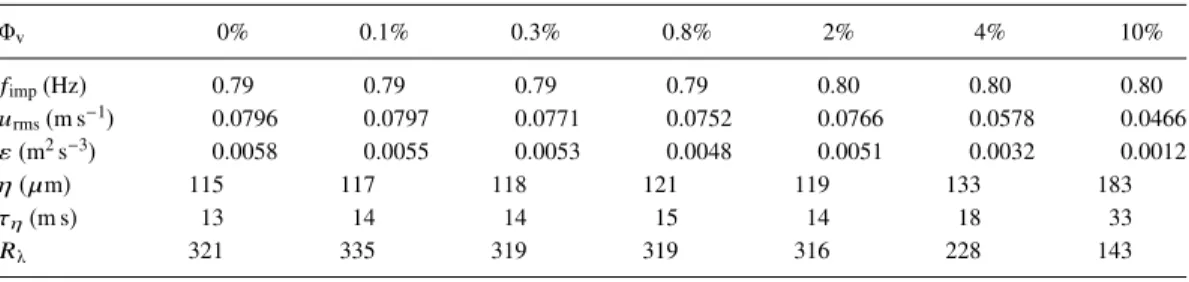
TABLE I. Characteristics of the various experiments. Φvvolume fraction of large particles; fimpaverage impeller frequency;
urms root-mean squared velocity; ε energy transfer rate (measured from second-order structure function; see text); η =
ν3/4/ε1/4Kolmogorov dissipative scale; τη= ν1/2/ε1/2associated turnover time; R
λTaylor-microscale Reynolds number.
Φv 0% 0.1% 0.3% 0.8% 2% 4% 10% fimp(Hz) 0.79 0.79 0.79 0.79 0.80 0.80 0.80 urms(m s−1) 0.0796 0.0797 0.0771 0.0752 0.0766 0.0578 0.0466 ε (m2s−3) 0.0058 0.0055 0.0053 0.0048 0.0051 0.0032 0.0012 η (µm) 115 117 118 121 119 133 183 τη(m s) 13 14 14 15 14 18 33 Rλ 321 335 319 319 316 228 143 variance u2
rmsof the axial (along the axis of symmetry) and transverse components of these turbulent velocity fluctuations as a function of the volume fraction of large particles. One clearly observes that the turbulent kinetic energy decreases when the particle load increases, as already observed in a different turbulent flow.7Data show anisotropy, which persists for all Φ
v: the root-mean square values of axial velocity components are around 60%-70% of the transverse ones. Measurements are in good agreement with u2
rms(Φv) ≈ u2rms(0)(1 − 3.75 Φ2/3v ). For transverse components, one point, corresponding to Φv≈2% clearly deviates from this form. As we will see later, this could be due to difficulties in estimating the mean flow in that case. The fitting form predicts that urms=0 for Φv& 14%. This could correspond to a critical volume fraction above which turbulence is completely extinguished by the particles.
The kinetic energy transfer rate ε follows a similar trend. Figure1(b)shows that the discrepancy ∆ε = 1 − ε(Φv)/ε(0) is also proportional to Φ2/3v . Even at small volume fractions, the attenuation of turbulence does not show a linear behavior ∝ Φv(proportional to the total number Npof particles) that is expected if the effect of particles consists in the superposition of individual perturbations. The particles interact with the flow only through their surface Sp= πD2p. If their individual effects were independent from each other and homogeneously distributed in the domain, the attenuation would be ∝ NpSp∝ Φv. A growth of the perturbation slower than Npindicates that only a fraction of particles have important impacts on the flow. Furthermore, the observed law ∝ Φ2/3v ∝ Np2/3Sp suggests that these active particles are located on a surface rather than in the full volume. Several heuristic scenario can lead to such a law. First, we can imagine that particles form a given number of aggregates where all fluid flow perturbations occur in the boundary layers of the outer edge. We did not detect such aggregates in the observation volume but cannot exclude that they are in regions of the flow that we do not monitor (e.g., close to the grids near the impellers). Recent work found that particles are likely to cluster far from the center of the von Kármán flow.19A more likely scenario
FIG. 1. (a) Variance of the turbulent velocity fluctuations u2
rms=⟨(ui−⟨ui⟩)2⟩ as a function of the particle volume fraction;
the dashed lines are u2
rms(Φv) = urms2 (0)(1 − 3.75 Φ2/3v ). (b) Discrepancy of the energy transfer rate ∆ε = 1 − ε(Φv)/ε(0) as a function of Φv; the dashed line is ∆ε = 3.75 Φ2/3v . The rate ε is estimated from compensated second-order longitudinal
061702-4 Cisse et al. Phys. Fluids 27, 061702 (2015)
relies on a kind of shielding effect where the kinetic energy is prevented from reaching the center of the flow by the particles situated at the periphery. A full discrimination between these possibilities requires systematically scanning the entire experiment in order to measure the inhomogeneities in both particle distribution and fluid turbulence characteristics.
We next move to small-scale turbulent properties. A striking result is that they seem unaffected by the presence of the particles once scaled with the corresponding transfer rate ε, large-scale kinetic energy content u2
rms, and associated Reynolds number Rλ. Figure2(a)shows the second-order longitudinal Eulerian structure function for the various particle loadings. All curves collapse in the inertial and sub-inertial ranges once represented in dissipative-scale units. In particular, there are no noticeable effects (up to noise) at separations of the order of the particles diameter for Φvup to 10%. These results seem to contradict the kinetic energy spectra obtained in numerical simulations20,24
that display an enhancement of the energy contained at scales smaller than the particle size and a depletion at larger scales. These spectra are obtained from a Fourier transform of the full domain encompassing both the fluid and the particles. There are still questions whether such effects on the spectrum are inherent to the perturbed fluid flow or come from the particle velocity field. In our case, the use of Lagrangian tracers to perform Eulerian measurements isolates the fluid statistics from such pitfalls and suggests that there are no intrinsic modifications of the distribution of turbulent velocity increments by the large particles.
Statistics along tracer trajectories seem also rather insensitive to the presence of large particles. Figure2(b)shows measurements of the Lagrangian structure functions Splag=⟨[ui(t + τ) − ui(t)]p⟩, where uiare components of the tracer velocity and the average is over the ensemble of trajectories. One observes that for p = 2, the collapse is not as good as for Eulerian statistics. However, Lagrangian structure functions are known to display very intermittent properties and the observed discrepancies are comparable to those obtained when comparing unladen flows at different Reynolds numbers.25
We see from TableIthat our Reynolds number decreases when the particle volume fraction increases: Rλ varies by more than a factor two when Φv goes from 0% to 10%. This lack of universality is not present when considering only the scaling properties through the logarithmic derivatives of the Lagrangian structure functions. For that reason, we follow Ref.25by showing in the inset of Fig.2(b)the quantity (d log S4lag)/(d log S2lag). Results from different volume fractions collapse to the same universal curve.
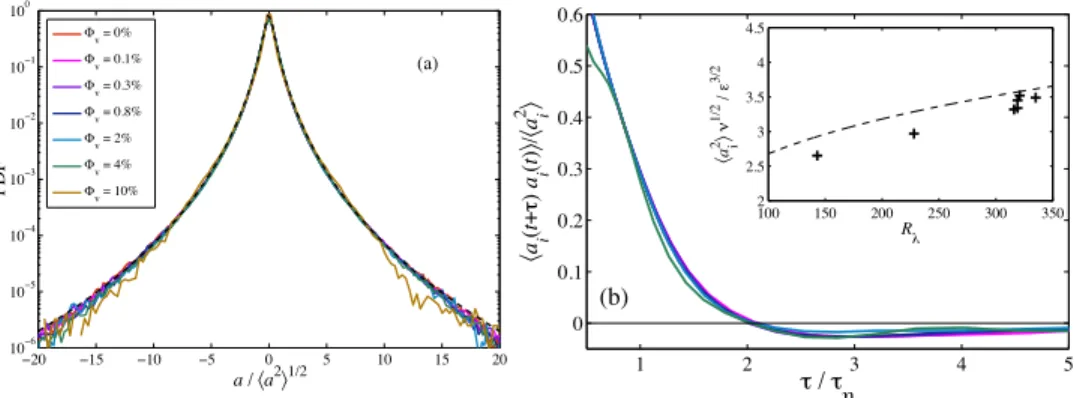
Acceleration statistics seem also not affected by large particles. Figure3(a)shows the probability densities of the acceleration components ai normalized by their respective second-order moments. Up to possible slight variations in the tails that could correspond to the change in Reynolds number at varying the fraction of large particles, the different curves seem to collapse reasonably well. It is known that the moments of these distributions do not reflect the actual value of the acceleration variance because of data filtering. To measure ⟨a2
i⟩, we follow the method of Voth et al.26 consist-ing in extrapolatconsist-ing the variance when decreasconsist-ing the filter size to zero. The resultconsist-ing values of
FIG. 2. (a) Second-order Eulerian longitudinal structure functions S2(r ) in dissipative-range units for the various values of Φv; the solid line is ∝ r2/3; the two dashed lines show the range 54 . Dp/η . 88 obtained from the maximal and minimal
061702-5 Cisse et al. Phys. Fluids 27, 061702 (2015)
FIG. 3. (a) Normalized probability distributions of acceleration components for various values of Φv; black dashed line:
log-normal acceleration amplitude.27 (b) Temporal autocorrelation of the acceleration components. Inset: Normalized
variance of the acceleration as a function of the Reynolds number Rλ; symbols: various experiments, dashed line: fit proposed
by Hill.28
a0=⟨ai2⟩ν1/2/ε3/2are shown in the inset of Fig.3(b)as a function of the Reynolds number of the flow. One clearly observes that the decrease of a0when Φvincreases relates to the change in Reynolds number. Finally, the acceleration autocorrelations represented in the main panel of Fig.3(b)are not much affected by the particle presence. The slight variations are again due to the change in Reynolds number induced by the particles.
All the quantities considered above are either reduced as Φ2/3
v or not affected by the large particles. They relate to the turbulent fluctuations from which we have removed the mean flow. We actually find that the mean flow itself is strongly affected by the large-particle load. To quantify its variations as a function of the particle volume fraction, we have computed its kinetic energy E(Φv) = |⟨u(x)⟩|2d3x. Figure4(a)shows that E(Φv) remains almost constant up to Φv≈3% where it suddenly drops down. Above this critical value, the mean flow is in a different state that contains approximately twice less energy. When assuming that the particles are uniformly distributed in the domain, one can estimate that this transition occurs roughly when the typical distance between them becomes less than their diameter. Above this critical value, all particles necessarily feel the presence of their neighbors through the flow modifications. This apparently has a drastic impact on the average motions as can be seen when comparing Figs.4(b)and4(c). They represent the variations of the energy and of the (x, z) components of the mean flow in the same slice of the measurement volume for Φv=0.8% (b) and 4% (c). Not only is the energy content strongly modified but also
FIG. 4. (a) Mean-flow kinetic energy E(Φv) contained in the measurement volume. (b) and (c) Slices of the mean flow in a central part of the measurement volume for Φv=0.8% and 4%, respectively (impellers rotate along x axis). Colored background: squared velocity modulus (normalized to its mean; increasing values from white to black), arrows: (x, z) components.
061702-6 Cisse et al. Phys. Fluids 27, 061702 (2015)
the fine structures and the directions of the mean flow. Panel (b) is representative of all volume fractions below 0.8% while panel (c) is also representative of Φv=10%. For Φv=2%, the mean flow obtained when time-averaging is very different from these two states. We however suspect it to be nonstationary because several movies show extremely strong deviations from the mean. Unfortunately, our experiment was conceived to focus on small-scale turbulent properties and not designed to accurately measure large scale variations. A better understanding of what is happening for this volume fraction requires revisiting our setup in order to focus on the large scales. This would also allow us a more accurate study of a possible phase transition for Φvof the order of a few percents.
To conclude, let us stress again our main findings on the modification of a turbulent von Kármán flow by finite-size neutrally buoyant spherical particles. The most surprising result is that inertial-range and small-scale turbulent features are unchanged in the presence of particles for volume fractions up to Φv=10%. There is no signature of the particle size and its associated timescale neither on the scaling properties of the fluid turbulent velocity fluctuations nor on the statistics of the acceleration. The only noticeable effects are on global quantities. In our specific setup and when the impeller rotation rate is maintained, the turbulent kinetic energy and the inertial-range transfer rate of the bulk flow are continuously decreasing when the particle volume fraction is increased. However, our setup does not monitor the energy injection rate. We are thus unable to discriminate between a decrease of the power needed to maintain the impellers rotation speed (i.e., a sort of drag reduction) and a redistribution of the energy dissipation to the regions closer to the impellers (outside of our observation volume). A better understanding would require a more accurate handling of the impeller torque and thorough measurements of the fluid velocity in the full experimental domain. Such measures could clarify the possible phase transition at Φv≈3%. In particular, they would allow us to draw differences between what is due to the specificities of von Kármán inhomogeneous flow and a possible universal change at such volume fractions in the coupling between the turbulent flow and the particles.
This research has received funding from the ERC under the European Community’s 7th Frame-work Program (FP7/2007-2013 Grant Agreement No. 240579) and from the Agence Nationale de la Recherche (Programme Blanc No. ANR-12-BS09-011-04).
1C. M. White and M. G. Mungal, “Mechanics and prediction of turbulent drag reduction with polymer additives,”Annu. Rev.
Fluid Mech.40, 235–256 (2008).
2P. Perlekar, D. Mitra, and R. Pandit, “Manifestations of drag reduction by polymer additives in decaying, homogeneous,
isotropic turbulence,”Phys. Rev. Lett.97, 264501-1–264501-4 (2006).
3S. Balachandar and J. K. Eaton, “Turbulent dispersed multiphase flow,”Annu. Rev. Fluid Mech.42, 111–133 (2010). 4J.-P. Matas, J. F. Morris, and E. Guazzelli, “Transition to turbulence in particulate pipe flow,”Phys. Rev. Lett.90, 014501
(2003).
5V. Loisel, M. Abbas, O. Masbernat, and E. Climent, “The effect of neutrally buoyant finite-size particles on channel flows
in the laminar-turbulent transition regime,”Phys. Fluids25, 123304 (2013).
6F. Lucci, A. Ferrante, and S. Elghobashi, “Modulation of isotropic turbulence by particles of Taylor length-scale size,”J.
Fluid Mech.650, 5–55 (2010).
7G. Bellani, M. L. Byron, A. G. Collignon, C. R. Meyer, and E. A. Variano, “Shape effects on turbulent modulation by large
nearly neutrally buoyant particles,”J. Fluid Mech.712, 41–60 (2012).
8R. Gatignol, “The Faxén formulae for a rigid sphere in an unsteady non-uniform Stokes flow,” J. Méc. Théor. Appl. 1,
143–160 (1983).
9M. Maxey and J. Riley, “Equation of motion for a small rigid sphere in a nonuniform flow,”Phys. Fluids26, 883–889 (1983). 10H. Homann and J. Bec, “Finite-size effects in the dynamics of neutrally buoyant particles in turbulent flow,”J. Fluid Mech.
651, 81 (2010).
11N. Qureshi, M. Bourgoin, C. Baudet, A. Cartellier, and Y. Gagne, “Turbulent transport of material particles: An experimental
study of finite size effects,”Phys. Rev. Lett.99, 184502 (2007).
12H. Xu and E. Bodenschatz, “Motion of inertial particles with sizes larger than Kolmogorov scales in turbulent flows,”Physica
D237, 2095–2100 (2008).
13G. Bellani and E. A. Variano, “Slip velocity of large neutrally buoyant particles in turbulent flows,”New J. Phys.14, 125009
(2012).
14M. Cisse, H. Homann, and J. Bec, “Slipping motion of large neutrally buoyant particles in turbulence,”J. Fluid Mech.735,
R1 (2013).
15S. Klein, M. Gibert, A. Bérut, and E. Bodenschatz, “Simultaneous 3D measurement of the translation and rotation of
finite-size particles and the flow field in a fully developed turbulent water flow,”Meas. Sci. Technol.24, 024006 (2013).
16T. Tanaka and J. K. Eaton, “Sub-Kolmogorov resolution particle image velocimetry measurements of particle-laden forced
061702-7 Cisse et al. Phys. Fluids 27, 061702 (2015)
17B. Chun and A. Ladd, “Inertial migration of neutrally buoyant particles in a square duct: An investigation of multiple
equilibrium positions,”Phys. Fluids18, 031704 (2006).
18A. G. Kidanemariam, C. Chan-Braun, T. Doychev, and M. Uhlmann, “Direct numerical simulation of horizontal open
channel flow with finite-size, heavy particles at low solid volume fraction,”New J. Phys.15, 025031 (2013).
19N. Machicoane, R. Zimmermann, L. Fiabane, M. Bourgoin, J.-F. Pinton, and R. Volk, “Large sphere motion in a
nonhomo-geneous turbulent flow,”New J. Phys.16, 013053 (2014).
20A. Ten Cate, J. Dersksen, L. Portela, and H. van den Akker, “Fully resolved simulations of colliding monodisperse spheres
in forced isotropic turbulence,”J. Fluid Mech.519, 233–271 (2004).
21J. Bec, S. Musacchio, and S. S. Ray, “Sticky elastic collisions,”Phys. Rev. E87, 063013 (2013).
22N. T. Ouellette, H. Xu, and E. Bodenschatz, “A quantitative study of three-dimensional Lagrangian particle tracking
algo-rithms,”Exp. Fluids40, 301–313 (2006).
23S. Klein, “Dynamics of large particles in turbulence,” Diplomarbeit, Georg-August-Universität, Göttingen, 2012. 24K. Yeo, S. Dong, E. Climent, and M. Maxey, “Modulation of homogeneous turbulence seeded with finite size bubbles or
particles,”Int. J. Multiphase Flow36, 221–233 (2010).
25L. Biferale, E. Bodenschatz, M. Cencini, A. S. Lanotte, N. T. Ouellette, F. Toschi, and H. Xu, “Lagrangian structure functions
in turbulence: A quantitative comparison between experiment and direct numerical simulation,”Phys. Fluids20, 065103 (2008).
26G. Voth, A. La Porta, A. Crawford, and E. Bodenschatz, “Measurement of particle accelerations in fully developed
turbu-lence,”J. Fluid Mech.469, 121–160 (2002).
27N. Mordant, A. M. Crawford, and E. Bodenschatz, “Three-dimensional structure of the Lagrangian acceleration in turbulent
flows,”Phys. Rev. Lett.93, 214501 (2004).