HAL Id: hal-02797931
https://hal.inrae.fr/hal-02797931
Submitted on 5 Jun 2020
HAL is a multi-disciplinary open access
archive for the deposit and dissemination of sci-entific research documents, whether they are pub-lished or not. The documents may come from teaching and research institutions in France or abroad, or from public or private research centers.
L’archive ouverte pluridisciplinaire HAL, est destinée au dépôt et à la diffusion de documents scientifiques de niveau recherche, publiés ou non, émanant des établissements d’enseignement et de recherche français ou étrangers, des laboratoires publics ou privés.
Advances in modeling interactions between soils and
trees
Laurent Saint-André, Julien Sainte-Marie, Sophie Leguédois, Bruno Ferry,
Francois Lafolie, Claire Marsden, Grégory van der Heijden, Jean-Daniel
Bontemps, Arnaud Legout
To cite this version:
Laurent Saint-André, Julien Sainte-Marie, Sophie Leguédois, Bruno Ferry, Francois Lafolie, et al.. Advances in modeling interactions between soils and trees. 2014, pp.1-11. �10.4267/2042/56267�. �hal-02797931�
1
ADVANCES IN MODELING INTERACTIONS BETWEEN SOILS AND TREES
SAINT-‐ANDRE, L., SAINTE-‐MARIE, J., LEGUEDOIS, S., FERRY, B., LAFOLIE, F., MARSDEN, C., van
der HEIJDEN, G., DUFRENE, E., BONTEMPS, J-‐D., LEGOUT, A.
This paper is the English translation of: «Les avancées de la recherche dans le domaine de la
modélisation des interactions sol-‐arbre », by. SAINT-‐ANDRE, L., SAINTE-‐MARIE, J., LEGUEDOIS, S.,
FERRY, B., LAFOLIE, F., MARSDEN, C.,
van der
HEIJDEN, G., DUFRENE, E., BONTEMPS, J-‐D., LEGOUT, A. Revue forestière française, 4-‐2014. http://documents.irevues.inist.fr/handle/2042/4752© AgroParisTech, 2014.
ABSTRACT
Models used for decision-‐making in forestry policy, planning and management are not yet able to produce a simultaneous evaluation of the effect of global climate change and management on the various ecological and productive functions provided by forest ecosystems. This paper gives an overview of models developed for dendrometry, ecophysiology and soil sciences and considers how the concepts used in these three disciplines can be combined to create decision-‐making tools for forest management. These new tools should (i) be sufficiently comprehensive to provide answers to management issues at the ecosystem scale, (ii) distinguish between generic and site-‐dependent processes and parameters, (iii) make it possible to define and simulate a range of innovative management scenarios in an uncertain environment, with increasingly strong constraints and (iv) be well documented and referenced to ensure that they will be used and will continue to be used.
1. INTRODUCTION
Forest ecosystems are, by their very nature, highly variable.
• Vertical variation: the interaction with the environment extends from the parent rock to the atmosphere.
• Horizontal variation: the spatial variability of the topography, the soil properties, the type of forest management and the previous soil use and management means that the structure and functioning of an ecosystem can vary significantly within a limited area.
• Temporal variation: rotations can vary from under ten years (typically eucalyptus or acacia forests in tropical environments), through several decades (beech and conifers in temperate and tropical environments) to several hundreds of years (oak and sequoia). These rotations may be affected by abrupt or gradual changes or by long-‐term natural or human forcing, resulting in dynamics, the scale and progression of which are not immediately evident.
Studying the functioning of forest ecosystems is, therefore, highly complex given the diversity of temporal and spatial scales that must be taken into account as well as the interactions and feedbacks between processes.
These ecosystems are subject to two opposing societal forces. On the one hand, there is increasing pressure on forests to meet the requirements for timber, wood industry (in particular pulp) and fuel (possibly including stumps and harvesting residues). On the other hand, forests are expected to play a vital role in environmental management and sustainable development (Brundtland, 1987 and subsequent international conferences), based on the general principle that they should be able to satisfy our present needs without compromising their ability to satisfy the needs of future generations. In addition to these demands of society, there is the environmental context, in which forest ecosystems are subject to global and regional environmental changes (in particular climate change and atmospheric deposition) in the long term as well as to a growing number of increasingly severe events (drought, storms, etc) which have affected, or will affect, their production (eg: changes in productivity, Badeau et al., 1995; Bontemps et al., 2012; Charru et al., 2014), composition (Lenoir
2
Questions arising from forest policies and forest management issues fall into two main groups that have led to disjointed modeling approaches (Fontès et al., 2010). These questions and associated modeling approaches are described below.
(i) Economic. What type of silviculture strategy should be adopted to achieve a given aim? How much wood is required and what quality of wood? What species, hybrids, clones and substitutes should be planted? How is it possible, in the long term, to maintain the forest cover, the associated carbon sink and timber production? How will the biomass be used (timber, wood industry or fuel)? The initial response to answer these questions was to set up a large number of silviculture trials (eg: the trials run by GIS Coop, the French scientific interest group for forest growth data) and monitor permanent experimental plots, which has made it possible to build dendrometric growth models with a focus on simulating the overall effects of environmental forcing (Seynave et al., 2005, 2008, Bontemps et Bouriaud, 2014).
(ii) Environmental. What effect do the species and type of forest management have on soil fertility and organic matter in the soils and their dynamics? What effect does environmental change have on the soil-‐plant interactions? These questions have led to setting up a large number of trials and experimental sites to study biogeochemical cycles (material and energy fluxes) which in particular have made it possible to build ecophysiological-‐ or biogeochemical-‐based models of forest ecosystem functioning which simulate the processes that underlie the interactions between plants and their environment.
The demand by society for both sustainable production and the preservation of the environment requires these issues to be taken into account in modeling approaches. This presupposes:
-‐ On the one hand, an understanding of the biogeochemical processes regulating the dynamics of forest ecosystems at various scales to suggest possible management strategies that could be used to maintain forest functions and services in a context of global climate and land use change;
-‐ On the other hand, the need to develop methods and tools which account for the simultaneous changes in plants and the soil under the effect of global climate change and management practices (type of amendment, selection of species, type of forest), where the combination of plants, soils and forest management practices affects, for example, the quantity and quality of the water in the forest hydrological system.
Many of these are models in the form of schematic representations (often in mathematical form) of the functioning of ecosystems. They can be used, in particular, to interpolate the functioning of ecosystems between two scenarios calibrated using data that is available and, therefore, extend the range of conditions covered by decision-‐making tools.
This paper sets out:
-‐ To provide an overview of soil-‐plant models that are being developed for dendrometry, ecophysiology and soil sciences;
-‐ To show how the concepts used in these three disciplines can be combined to create decision-‐ making tools that can be used to address forestry policy and management issues
-‐ To identify the barriers that must be overcome within the next ten years to produce tools that will provide simultaneous evaluation of the effects of global changes, in climate, land use and atmospheric deposition, and of the effects of management practices on the various functions of a forest (for example, maintaining the cover and soil protection, supplying wood, quantity and quality of the water, maintaining soil chemical, physical and biological functions, carbon sink (growing stock and wood products as a substitute for other materials with a high embodied energy).
3
This paper does not cover species distribution models (eg: environmental niche models, habitat distribution models) or theoretical ecology models (migration models, recruitment models, gap models, etc) related to biological diversity in forests. It is concerned only with interactions between the soil and the trees, i.e. with the growth and structure of forests and with changes in soil properties and functions.
2. A MULTIDISCIPLINARY APPROACH REQUIRED
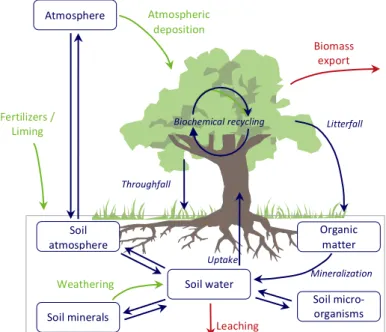
Forest ecosystems can be modeled using material and energy fluxess and/or using the dynamics of the constituent populations (trees, micro-‐ and macro-‐organisms in the soil). They are usually found on nutrient-‐poor soils, which are propitious for agriculture, often sensitive, and are subject to varying degrees of human pressure (ranging from strict nature reserves to intensively managed industrial plantations). Studying and modeling biogeochemical cycles in a forest ecosystem (figure 1) enables the characterization of the carbon, water and nutrient fluxes, provides an understanding of the organo-‐mineral interactions in the forest and helps to predict the detrimental effects that might be caused by management methods or changes in the environment, such as a reduction (or increase) in atmospheric pollution, or by disturbances with a strong effect on the composition of the ecosystem.
Figure 1: General description of the biogeochemical fluxes to be taken into account by models of forest
dynamics. The processes represented may be of biological or physical and chemical origin. The green arrows show the main nutrient element inputs, the red arrows show exports and blue arrows show the fluxess.
Studying and modeling the population dynamics is a means of identifying the processes of competition and interaction between trees and between species in relation to the availability of water and nutrient resources, and of predicting the best strategies for managing forests in the context of global change (climate, atmospheric deposition, land use). These models can be built by observing the general behavior of the system (phenomenological or empirical models), or based on the processes identified (mechanistic models).
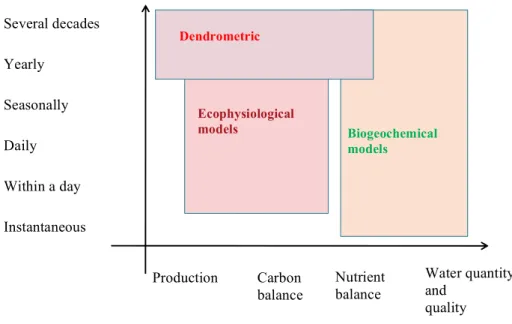
Three main types of approaches are then used to understand and model the functioning of the forest ecosystems in their environment (figure 2):
-‐ Dendrometric models are generally empirical, based to a great extent on the growth and structure of the stands, dealing mainly with forestry issues: quantification of the various wood products, carbon sequestration, export of nutrient elements;
Litterfall Organic matter Soil micro-‐ organisms Soil minerals Atmosphere Soil water Weathering Atmospheric deposition Throughfall Biochemical recycling Mineralization Uptake Biomass export Leaching Fertilizers / Liming Soil atmosphere
4
-‐ Ecophysiological models are generally mechanistic and based mainly on water and carbon fluxes, dealing mainly with climatic effects and quantification of carbon and water fluxes in the ecosystem
-‐ Biogeochemical models are also generally mechanistic, dealing with very broad issues ranging from pedogenesis to nutrient element fluxes in the soil and in the ecosystems.
These three approaches are all based on observation (natural dynamics of the ecosystem) and experimentation (manipulation of ecosystems to test hypotheses). They are in general deterministic (i.e. the same conditions give the same results) even though some may be stochastic to a certain degree (i.e. randomization of variables). There is no hard division between empirical and mechanistic models and ecophysiological and biogeochemical models may incorporate purely empirical sub-‐ models, in particular for the allocation of carbon between the trees and various compartments. On the other hand, dendrometric models can be based on stable mechanisms and therefore have a solid, generic foundation (such as Eichhorn’s rule expanded by Assmann and Langsaeter – Dhôte 1999, a dendrometric model for even-‐aged single species stands). This division between “empirical” and “mechanistic” is, therefore, not clear-‐cut: the lines are blurred.
Figure 2: The three main approaches for modeling forest ecosystems classified according to timescales covered
and main functions modeled
Having established this general framework, it is clear that a multidisciplinary approach (dendrometry, plant ecophysiology and soil sciences) is essential for modeling the complexity and diversity of interactions between soils and plants. The following examples illustrate this approach where the concepts of these three disciplines can be combined to create decision-‐making tools for forest managers to select forest management strategies, test the production potential of different species in a context of climate change and evaluate the effects of the forest management on the soils. It should be noted that not all the models presented apply to forest ecosystems. However, they must be included in this overview to be able to evaluate the progress that might be made in this field.
3. OVERVIEW OF SOIL AND PLANT MODELS BEING DEVELOPED
3.1 Soil mechanics models and geomorphological models
These models are mainly used to simulate soil physical properties or geomorphological properties such as the effect of erosion on the soil depth (eg: EPIC), the stability of slopes (eg: Root Bundle Model) and clay migration during pedogenesis (eg: SoilGen). Some of these models also include
Production Water quantity
and quality Instantaneous Within a day Daily Seasonally Yearly Several decades Carbon balance Dendrometric models Ecophysiological models Biogeochemical models Nutrient balance
5
biogeochemical processes such as the nutrient concentration in the soil solution (EPIC) or changes in the organic carbon content profile (SoilGen). The timescales of these models may be very long (more than a hundred years). When vegetation is included, it is either represented roughly (input of a fixed succession of plants) or by only considering feedback in terms of water and nutrient balances. Physical soil changes caused by the plants are never taken into account. These models have never been used for forest environments but, if adapted, could be applied to forest management problems such as erosion and stability of slopes.
3.2 Biogeochemical models focusing on the soil
These models (eg: Phreeqc, Visual3P, Chess, Whamm, Min3p, SAFE) are mainly used to study and simulate the chemical composition, chemical reactivity and reactive transport in porous environments, including soil. Their applications concern the evaluation of changes in soil fertility and pollution contamination dynamics. These models describe, in varying degrees of detail, each chemical reaction regulating bioavailability in nutrient and trace elements in soils: N, P, K, Ca, Mg, P and heavy metals. In general, and in particular for forest ecosystems, interactions with plants are only represented implicitly (no mechanistic modeling of uptake). There are some exceptions when hypotheses are made about uptake and are introduced as inputs into the biogeochemical model.
3.3 Biogeochemical models at ecosystem scale
These models (eg: ForNBM, ForSAFE, Witch-‐Aspect, Pastis, NuCM) provide a comprehensive representation of biogeochemical cycles (biological, geochemical and biochemical) coupled with models of plant dynamics (trees, crops). The fluxes concerned are usually water, carbon and nitrogen, sometimes taking account of cation exchange (NuCM, ForSAFE, ForNBM). The uptake by the plants is represented explicitly, as is plant growth, using functions which depend on the bioavailability of nutrient elements.
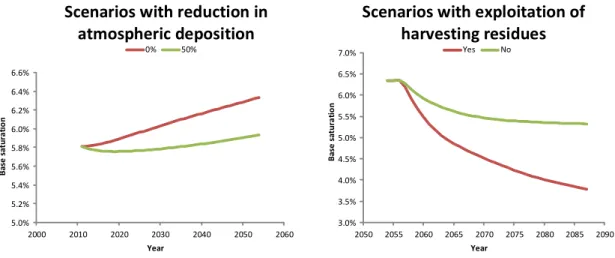
Van der Heijden et al. (2011) used NuCM, for example, to simulate the consequences on tree growth of reduced atmospheric deposition and increased export of nutrients by the exploitation of harvesting residues. They showed that the natural recovery of the ecosystem after a reduction in atmospheric deposition is slow (Figure 3 – left, simulations 2005-‐2055). There are two reasons for this. On the one hand, there is the progressive desorption of sulfates stored in the soil profile during past periods of high levels of deposition (desorption of anions causes acidification as the anions migrate, taking with them nutrient cations, for example). On the other, there is the chemical poverty of the substrate which limits the restoration of the exchangeable cation pools by degradation of the soil minerals, as well as having insufficient capacity to counteract the acidification of the soil effectively by neutralizing the anions released. In the scenario with no reduction in atmospheric deposition and an increase in the export of harvesting residues when the trees are felled in 2055, the NuCM model predicts a further reduction in the chemical fertility of the soil (Figure 3 – right, simulations after 2055). As the simulation did not take full account of the effect of harvesting residues from thinning after 2055 (the first 30 years of the next rotation), this reduction is probably overestimated. A better representation of the interaction between the soil and plants would make the simulation more accurate but the trend will be similar as this site is particularly poor in minerals.
6
Figure 3: Change in base saturation of the cationic exchange capacity of the soil of plot RENECOFOR SP57
(Abies alba Miller) simulated by the NuCM model for two atmospheric deposition reduction scenarios over 50 years (0% and 50%) and two management scenarios for exploiting the harvesting residues when the trees are felled (2055).
ForSAFE is another example, based more on the processes that involve the aerial parts of the trees. This is a one-‐dimensional model, where the ecosystem is represented by a vertical soil profile and an average tree. It simulates the change over time of nutrient pools and fluxes and energy fluxes in the ecosystem as a function of climatic, forest management practices and atmospheric deposition scenarios. ForSAFE couples four earlier models: PnET (photosynthesis, evapotranspiration, biomass growth), PULSE (water flow in the forest ecosystem), DECOMP (decomposition of soil organic matter) and SAFE (soil chemistry, weathering, drainage and uptake).
3.4 Root growth models
These are models such as Rootmap, Spacsys and those being developed by the AMAP joint research unit, dealing mainly with roots. They are used to understand the growth and root architecture as a function of the soil properties to assess the stability of the trees, the resistance of the soil to erosion and the uptake of nutrients. Some models include soil-‐plant interactions using variables such as temperature, mechanical properties, water availability and, more rarely, nutrient availability. These models are usually based on the concept of soil horizons but some can be very detailed with a meticulous three dimensional representation of the soil. However, they do not include feedback from the plant affecting the soil properties. In these models, therefore, root growth does not change the soil characteristics whereas it has been shown that roots can affect the structure of the horizons with, for example, the formation of macropores or aggregates (Angers and Caron, 1998). Incorporating feedback may be useful for extending these models to simulate the changes in soils and trees simultaneously under the influence of global change.
3.5 Ecophysiological based “plant” models
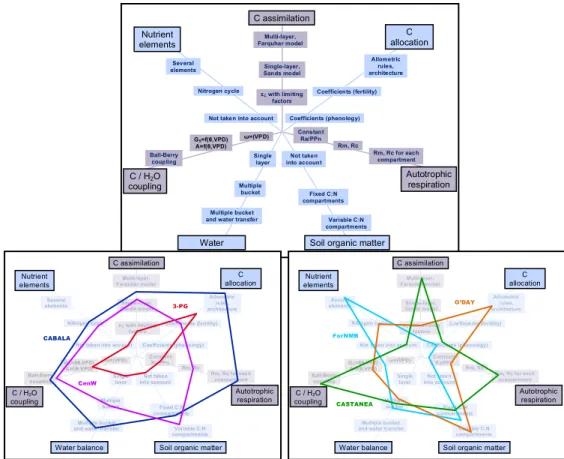
Models such as Castanea, PNeT, G’Day, Cabala, Graeco and Orchidée usually incorporate the nitrogen cycle as well as the carbon and water cycles (Figure 4). They take account of the effect of nitrogen on photosynthesis, leaf index and maintenance respiration, by a fairly detailed representation of the main processes and feedback between them, sometimes with a very large number of parameters. In these models, the processes describing the interactions between the canopy and the atmosphere are usually more detailed than the underground soil / microorganism / root interaction processes or the mechanisms for competition and biomass allocation between trees. The main differences between these models are in their exhaustiveness and level of detail of the photosynthesis and stomatic conductance processes which are key to modeling the interactions between water and carbon fluxes.
5.0% 5.2% 5.4% 5.6% 5.8% 6.0% 6.2% 6.4% 6.6% 2000 2010 2020 2030 2040 2050 2060 Ba se sa tu ra tio n Year
Scenarios with reduction in
atmospheric deposition
0% 50% 3.0% 3.5% 4.0% 4.5% 5.0% 5.5% 6.0% 6.5% 7.0% 2050 2055 2060 2065 2070 2075 2080 2085 2090 YearScenarios with exploitation of
harvesting residues
Yes No Ba se sa tu ra tio n7
These mechanistic growth models are linked to models of changes in soil organic matter, which are usually derived from Century or RothC. They are used to simulate soil carbon sequestration and changes in nitrogen availability during successive rotations. However, the fluxes of other nutrients are not represented. The effect of phosphorus or potassium availability on growth is taken into account at best empirically, using a locally calibrated “site factor” covering various soil fertility parameters.
One advantage of these models for decision-‐making is that they are sensitive to climatic variations and atmospheric CO2 concentrations and can be used to simulate the effects of these on the growth
of trees. However, at the moment they are unable to simulate the effect of fertilization other than nitrogen or to simulate biomass allocation between trees in the same stand in response to forest management practices. Moreover, they often have a large number of parameters, some of which must be calibrated locally, which makes them difficult to use in practice even though they have been applied, for example, in Brazil (the 3-‐PG model is being used to manage eucalyptus plantations, as described by Almeida et al. 2010).
Figure 4: Position of various ecophysiological“plant” models using a star diagram where each point represents
an ecosystem functioning process.
3.6 Dendrometric “plant” models
These models (eg: E-‐Dendro, Fagacée and PP3) include competition between trees. They have been specially designed for forestry to provide decision-‐making tools for exploitation (what strategy should be adopted to obtain a given quantity and/or a given quality of wood?). They require a minimum of measurements (inventories of diameter and height are sufficient) and have a broad base of data for calibration, including forestry trials, permanent forests and forest inventories. This makes them highly robust but, on the other hand, these metrics are general and are the result of aggregated processes which only translate the underlying ecophysiological processes in terms of the phenomena observed and do not explain the mechanisms.
Several elements
Nitrogen cycle Coefficients (fertility)
Coefficients (phenology) Not taken into account
Single layer
Multiple bucket
Multiple bucket
and water transfer Variable C:N
compartments Fixed C:N compartments Not taken into account Allometric rules, architecture Multi-layer, Farquhar model Single-layer, Sands model εC with limiting factors Ball-Berry coupling GS=f(θ,VPD) A=f(θ,VPD) ω=(VPD) Constant Ra/PPn Rm, Rc Rm, Rc for each compartment Nutrient elements C assimilation C allocation C / H2O coupling Autotrophic respiration Water
balance Soil organic matter
Several elements
Nitrogen cycle Coefficients (fertility)
Coefficients (phenology) Not taken into account
Single layer Multiple bucket Multiple bucket
and water transfer Variable C:N
compartments Fixed C:N compartments Not taken into account Allometric rules, architecture Multi-layer, Farquhar model Single-layer, Sands model εC with limiting factors Ball-Berry coupling GS=f(θ,VPD) A=f(θ,VPD) ω=(VPD) Constant Ra/PPn Rm, Rc Rm, Rc for each compartment Nutrient elements C assimilation C allocation C / H2O coupling Autotrophic respiration
Water balance Soil organic matter
Several elements
Nitrogen cycle Coefficients (fertility)
Coefficients (phenology) Not taken into account
Single layer Multiple
bucket Multiple bucket
and water transfer Variable C:N
compartments Fixed C:N compartments Not taken into account Allometric rules, architecture Multi-layer, Farquhar model Single-layer, Sands model εC with limiting factors Ball-Berry coupling GS=f(θ,VPD) A=f(θ,VPD) ω=(VPD) Constant Ra/PPn Rm, Rc Rm, Rc for each compartment Nutrient elements C assimilation C allocation C / H2O coupling Autotrophic respiration
Water balance Soil organic matter CABALA 3-PG CenW G’DAY ForNMB CASTANEA
8
They have two main limitations.
• The fertility index, which is a fundamental part of dendrometric growth models for single-‐ species even-‐aged stands, is considered to be constant over a rotation. However, doubt on this assumption has been raised by studies by dendrologists (Becker, 1994; Badeau, 1996) and biometrists (Dhôte and Hervé, 2000; Bontemps et al., 2009, 2010; Charru et al., 2010) who have shown that the planting date affects the site index curve. Two populations established at different times (eg: 1900 and 2000) do not necessarily produce the same quantity of wood at the same age (eg: at 100 years of age). Dendrometric models can detect these changes and reproduce them but are not yet able to simulate them under different climatic scenarios or different atmospheric deposition scenarios.
• The effect of climate, in these models, is intentionally smoothed out by the large number of measurements, and growth predictions do not reflect seasonal differences or long term changes in temperature, precipitation or CO2 concentrations (as for the fertility index).
However, to simulate biogeochemical cycles, it is essential to predict the water flows in the soil correctly and evaluate the uptake of water by the plants. Conversely, knowing the water balance can make it possible to adjust the predicted growth rate and, therefore, predict, for example, the decline of a stand.
4. SUMMARY AND OUTLOOK
Each approach has strengths and weaknesses.
• Ecophysiological models provide good water/carbon coupling, are well able to simulate the effects of climate change and study the functioning of ecosystems in depth, but they are less able to take account of the effect of the environment (such as nutrient deficiency) and forest management on the allocation of the biomass between trees and within each individual tree. • Dendrometric models designed to help forest management take explicit account of competition between trees and management practices and can be used to simulate the export of nutrient elements, for different forest management scenarios. They can also detect the effects of global climate changes in the past but cannot yet simulate explicitly the water or nutrient fluxes (and, therefore, nutrient deficiency mechanisms for example).
• Biogeochemical soil-‐plant models are usually based on a mechanistic approach making it possible to simulate loss of soil minerals, mineralization of organic matter, exchanges between liquid and solid phases and soil solution chemistry but they are less able to take account of the effects of microbial biodiversity, plant requirements, uptake and allocation between the various tree compartments.
One of the challenges is to be able to build new decision-‐making tools combining the concepts of the dendrometry, ecophysiology and soil sciences disciplines. Table 1 classifies the main development challenges for producing such tools. These developments may be based on modeling platforms that can couple different process-‐based models (eg: Sol Virtuel) or on techniques for exploring, analyzing and simplifying complex models. Work has already begun on developing this approach of combining concepts: recent examples include dendrometric models (Sainte-‐Marie, et al. 2013, see this issue), ecophysiological models and biogeochemical models. New, innovative models are also being developed based on a quantitative theoretical approach. These consider the structure and dynamics of stands (productivity and diversity) resulting from aggregated ecological processes, such as the exploitation of environmental resources by the ecosystem, the consumption and dynamics of these resources, mortality and perturbation phenomena, competition/synergy between the constituent species in the ecosystem in exploiting these resources.
These new tools should (i) be sufficiently comprehensive to deal with management issues and be easy to calibrate or adapt to real conditions, (ii) distinguish between generic and site-‐dependent
9
processes and parameters, (iii) be available in platforms such as Capsis to simulate a variety of scenarios from the model input data (climate, atmospheric deposition, management practices, etc.), and (iv) be well documented to ensure that each model will be used and will continue to be used (underlying hypotheses, calibration, validation).
Plant
Soil
Type of model
O
b
je
ct
r
ep
re
se
nt
e
d
Interactions
Soil
Plant
. Carbon . Water . Nutrients . Physical properties . Carbon . Water . Nutrients. Environment should be non-static . Model response curves to nutrient and water availability
. Uptake of nutrients and water . Regulation of growth and production of litter . Plant actions (e.g.: nitrification)
. Make the processes (eg. allocation, resource dynamics etc.) more explicit and incorporate them into dendrometric models
. Interactions between soil biology and geochemistry, incorporation into simplified approaches Système Agro-forestier Café -Erythrine
10
Laurent SAINT-‐ANDRE
Inra, UR 1138Unité Biogéochimie des Ecosystèmes Forestiers F-‐54280 CHAMPENOUX st-‐[email protected]
Julien SAINTE-‐MARIE
Inra, UR 1138,Unité Biogéochimie des Ecosystèmes Forestiers
F-‐54280 CHAMPENOUX
Julien.Sainte-‐Marie@univ-‐lorraine.fr
Gregory van der HEIJDEN
Inra, UR 1138Unité Biogéochimie des Ecosystèmes Forestiers F-‐54280 CHAMPENOUX [email protected]
Sophie LEGUEDOIS
Inra, LES UMR 1120 F-‐54518 VANDOEUVRE-‐LÈS-‐NANCY sophie.leguedois@univ-‐lorraine.frBruno FERRY
AgroParisTechUMR 1092 Laboratoire d'Etude des Ressources Forêt-‐ Bois F-‐54042 NANCY CEDEX [email protected]
François LAFOLIE
Inra, UMR1114Environnement Méditerranéen et Modélisation des Agro-‐Hydrosystèmes F-‐84914 AVIGNON [email protected]
Claire MARSDEN
Montpellier SupAgroUMR1222 Ecologie Fonctionnelle & Biogéochimie des Sols F-‐34060 MONTPELLIER [email protected]
Eric DUFRENE
Cnrs, UMR 8079Laboratoire Ecologie Systématique et Evolution F-‐ 91405 ORSAY
[email protected]‐psud.fr
Jean-‐Daniel BONTEMPS
AgroParisTechUMR 1092 Laboratoire d'Etude des Ressources Forêt-‐Bois F-‐54042 NANCY CEDEX
LEGOUT Arnaud
Inra, UR 1138Unité Biogéochimie des Ecosystèmes Forestiers F-‐54280 CHAMPENOUX [email protected]
BIBLIOGRAPHY
ALMEIDA, J.C.R., LACLAU, J.P., GONCALVES, J.L.D., RANGER, J., SAINT-‐ANDRÉ, L. 2010. A positive growth response to NaCl applications in Eucalyptus plantations established on K-‐deficient soils. Forest Ecology and Management 259(9) 1786:1795
ANGERS, D. A. ET CARON, J. 1998. Plant-‐induced changes in soil structure: Processes and feedbacks.
Biogeochemistry, 42 : 55-‐72
BADEAU, V., BECKER, M., BERT, D., DUPOUEY, J.L., LEBOURGEOIS, F., PICARD, J.F. 1996. Long-‐term growth trends of trees: ten year of dendrochronological studies in France. In "Growth trends in European forests", Ed. Spiecker et al. p 167-‐181.
BADEAU, V., DUPOUEY, J.L., BECKER, M., PICARD, J.F. 1995. Long-‐term growth trends of Fagus sylvatica L in northeastern France. A comparison between high and low density stands. Acta
Oecologica-‐International Journal Of Ecology. 16(5) : 571-‐583
BECKER, M., NIEMINEN, T.M., GÉRÉMIA, F. 1994. Short-‐term variations and long-‐term changes in oak productivity in northeastern France. The role of climate and atmospheric CO2. Ann. For. Sci. 51 : 477-‐ 492
BERTRAND, R; LENOIR, J; PIEDALLU, C; RIOFRIO-‐DILLON, G; DE RUFFRAY, P; VIDAL, C; PIERRAT, JC; GEGOUT, JC. 2011. Changes in plant community composition lag behind climate warming in
11 lowland forests. Nature 479 (7374) : 517-‐520
BONTEMPS, JD; HERVE, JC; DHÔTE, JF. 2009. Long-‐Term Changes in Forest Productivity: A Consistent Assessment in Even-‐Aged Stands. Forest Science 55(6) : 549-‐564
BONTEMPS, J.D., HERVE, J.C. DHÔTE, J.F. 2010. Dominant radial and height growth reveal comparable historical variations for common beech in north-‐eastern France. Forest Ecology
and Management 259(8) : 1455-‐1463
BONTEMPS, J.-‐D., HERVÉ, J.-‐C., DUPLAT, P., DHÔTE, J.-‐F. 2012. Shifts in the height-‐related competitiveness of tree species following recent climate warming and implications for tree community composition: the case of common beech and sessile oak as predominant broadleaved species in Europe. Oikos
BONTEMPS, J-‐D., BOURIAUD, O. 2014. Predictive approaches to forest site productivity: recent trends, challenges and future perspectives. Forestry : 1-‐20.
BRUNDTLAND, G.H. 1987. Our common future. Report of the World Commission on Environment and Development. United Nations. 247P. http://conspect.nl/pdf/Our_Common_Future-‐ Brundtland_Report_1987.pdf
CHARRU, M., SEYNAVE, I., MORNEAU, F., BONTEMPS, J.D. 2010. Recent changes in forest productivity: An analysis of national forest inventory data for common beech (Fagus sylvatica L.) in north-‐eastern France. Forest Ecology and Management 260(5) : 864-‐874 CHARRU, M., SEYNAVE, I., HERVÉ, J-‐C., 2014. Spatial patterns of historical growth changes in Norway
spruce across western European mountains and the key effect of climate warming. Trees-‐
Structure And Function 28(1): 205-‐221
DHÔTE, J.F., 1999. Compétition entre classes sociales chez le chêne sessile et le hêtre. Rev. For. Fr. LI(2) : 309-‐325
DHÔTE, J.F., HERVÉ, J.C. 2000. Productivity changes in four Sessile Oak forests since 1930: a stand-‐ level approach. Ann. For. Sci. 57(7) : 651-‐680
FONTÈS, L., BONTEMPS, J.D., BUGMANN, H. et al.. 2010 Models for supporting forest management in a changing environment. Forest Systems 19(SI) : 8-‐29
HOULLIER, F., BOUCHON, J., BIROT, Y. 1991. Modélisation de la dynamique des peuplements forestiers : état et perspectives. Rev. For. Fr. XLIII(2) : 87-‐108.
LENOIR, J., GÉGOUT, J.C., MARQUET, P.A. DE RUFFRAY, P., BRISSE, H., 2008. A significant upward shift in plant species optimum elevation during the 20th century. Science 320(5884) : 1768-‐1771 LENOIR, J., GÉGOUT, J.C., PIERRAT, J.C., BONTEMPS, J.D., DHÔTE, J.F., 2009. Differences between tree
species seedling and adult altitudinal distribution in mountain forests during the recent warm period (1986-‐2006). Ecogeography 32(5) : 765-‐777
SEYNAVE, I., GÉGOUT J.C., HERVÉ, J.C., DHÔTE, J.F., DRAPIER, J., BRUNO, E., DUMÉ, G. , 2005. Picea
abies Karst. site index prediction by environmental factors and understorey vegetation: a
two-‐scale approach based on survey databases. Can. J. For. Res. 35(7) : 1669–1678
SEYNAVE I., GÉGOUT J-‐C., HERVÉ J-‐C., DHÔTE, J.F.,2008. Is the spatial distribution of European beech (Fagus sylvatica L.) limited by its potential height growth? Journal of Biogeography. 35(10) : 1851-‐1862.
VAN DER HEIJDEN, G., LEGOUT, A., NICOLAS, M., ULRICH, E., JOHNSON, D.W., DAMBRINE, E., , 2011. Long-‐term sustainability of forest ecosystems on sandstone in the Vosges Mountains (France) facing atmospheric deposition and silvicultural change. Forest Ecology and