Dynamic nuclear polarization with a rigid biradical
The MIT Faculty has made this article openly available.
Please share
how this access benefits you. Your story matters.
Citation
Matsuki, Yoh et al. “Dynamic Nuclear Polarization with a Rigid
Biradical.” Angewandte Chemie International Edition 48.27 (2009):
4996–5000. Web.
As Published
http://dx.doi.org/10.1002/anie.200805940
Publisher
John Wiley & Sons, Inc.
Version
Author's final manuscript
Citable link
http://hdl.handle.net/1721.1/74234
Terms of Use
Creative Commons Attribution-Noncommercial-Share Alike 3.0
Dynamic Nuclear Polarization with a Water-soluble Rigid
Biradical
Journal: Journal of the American Chemical Society Manuscript ID: ja-2011-12054e.R2
Manuscript Type: Communication Date Submitted by the
Author: n/a
Complete List of Authors: Kiesewetter, Matthew; Stanford U, Chemistry Corzilius, Bjoern; MIT, Francis Bitter Magnet Lab Smith, Albert; MIT, Francis Bitter Magnet Lab
Griffin, Robert; Massachusetts Institute of Technology, Chemistry Swager, Timothy; Mass. Inst. of Tech., Chemistry; Massachusetts Institute of Technology, Department of Chemistry 18-597
Dynamic Nuclear Polarization with a Water-soluble Rigid Biradical
Matthew K. Kiesewetter,† Björn Corzilius, †‡ Albert A. Smith, †‡ Robert G. Griffin,* †‡ Timothy M. Swager*†
†
Department of Chemistry, Massachusetts Institute of Technology, Cambridge, Massachusetts 02139
‡
Francis Bitter Magnet Laboratory, Massachusetts Institute of Technology, Cambridge, Massachusetts 02139
Supporting Information Placeholder
ABSTRACT: A new biradical polarizing agent, bTbtk-py,
for dynamic nuclear polarization (DNP) experiments in aque-ous media is reported. The synthesis is discussed in light of the requirements of the optimum, theoretical, biradical system. To date, the DNP NMR signal enhancement resulting from bTbtk-py is the largest of any biradical in the ideal glyc-erol/water solvent matrix, ε = 230. EPR and X-ray crystallog-raphy are used to characterize the molecule and suggest ap-proaches for further optimizing the biradical distance and rela-tive orientation.
Dynamic nuclear polarization (DNP) 1-3 allows for the
in-trinsically large spin polarization of electrons to be transferred to nuclei for detection in an NMR experiment with a theoreti-cal signal enhancement of 2-3 orders of magnitude over the Boltzmann population of the nuclear spins. In a typical DNP experiment, the electron paramagnetic resonance (EPR) spec-trum of a paramagnetic molecule is irradiated with micro-waves resulting in the transfer of spin polarization to sur-rounding nuclei. The particular appeal of DNP lies in its abil-ity to facilitate structural measurements (internuclear distances and torsion angles) that are limited by signal-to-noise in mul-tidimensional biomolecular magic angle spinning (MAS) ex-periments4,5. In these situations, optimal NMR signal
en-hancements are usually observed from experiments conducted at cryogenic temperatures6,7. Thus, glassy solvents,
particu-larly those that form a glass regardless of cooling rate, are required to ensure a homogeneous dispersion of polarizing agent and to prevent cold denaturation of proteins 8,9.
The proper instrumentation (microwave sources, low tem-perature MAS probes, etc.)7,10-12 is essential to the successful
implementation of DNP. However, an equally important as-pect of the methodology is the development of polarizing agents from which large signal enhancements, ε, are observed. Currently, the most efficient high field in situ DNP mecha-nism, the cross effect (CE), arises from the interaction of three spins, two electrons and one nucleus 13-21. Irradiation of the
EPR spectrum results in a spin “flip-flop” process between the electrons that leads to transfer of polarization to the nucleus. The process is most efficient when the difference in the Lar-mor frequencies of the electrons matches that of the nucleus, ω0S1-ω0S2≈ω0I, where ω0S and ω0I are the Larmor frequencies of
the electron spin S or nuclear spin I, respectively. Although
monomeric nitroxide radicals were among the early cross ef-fect DNP agents18,19,22, tethering the radicals resulted in larger
signal enhancements with lower paramagnet concentration20.
In particular, because the low temperature EPR spectra of ni-troxide radicals are anisotropic, the construction of discrete biradical systems permits control of the relative orientation of the g-tensors of the radicals and their separation, hence further augmenting ε.
Simulation of field dependent EPR spectra of the biradical TOTAPOL suggests that its nitroxide moieties are, somewhat serendipitously, of near-optimal orientation for DNP23.
In-deed, no other biradical that is soluble in glycerol/water (60/40) has been reported to yield a higher ε. DNP from the highly crystalline bTbk in DMSO/water mixtures did yield a larger ε than TOTAPOL24. However, this spiro-cyclic
biradi-cal is insoluble in glycerol/water mixtures and only sparingly soluble in DMSO/water. This limits the applicability of bTbk as a polarizing agent because glycerol/water serves as a cryo-protectant and is the solvent of choice for DNP of proteins. The near-ideal geometry and experimental results with bTbk and the reported synthesis of 125 stimulated us to investigate
water soluble analogues of bTbk.
Starting from the modified TEMPone structure, 1,and draw-ing upon previous research26, the bis-thioketal was made in
moderate yield, Scheme 1. The fully oxidized biradical 3 was generated in a two stage oxidation using potassium peroxy-monosulfate as the oxidant. The low pH of the first oxidation step acts as a protecting group for the amines27, which are subsequently oxidized under basic conditions using dimethyl dioxirane generated in situ from the oxidation of acetone28,29.
Biradical 3, however, is effectively insoluble in glycerol/water mixtures (solubility <0.1 mM). Accordingly, we decided to pursue a mixed sulfur oxidation state biradical with the knowledge that a mixture of species should enhance solubility. The partial oxidation of 2 was performed by the reaction with
m-chloroperoxybenzoic acid (m-CPBA). The resulting
mix-ture, bTbtk-py, an extension of the established naming system short for bis-TEMPO-bis-thioketal-tetra-tetrahydropyran24,
was characterized by NMR (the reduced form having N-OH groups), CHN analysis and electrospray ionization high reso-lution mass spectrometry (HRMS-ESI), and it was found to be a biradical possessing a mixture of sulfur oxidation states, 0-5 S=O bonds. The X-band EPR spectrum is typical for a nitrox-ide radical; the broad 1:1:1 triplet due to hyperfine coupling to a nitrogen, aiso(14N)= 41.8 MHz, is consistent with a biradical
featuring a short, rigid tether with a weak electron-electron
J-Page 1 of 5 Journal of the American Chemical Society
1 2 3 4 5 6 7 8 9 10 11 12 13 14 15 16 17 18 19 20 21 22 23 24 25 26 27 28 29 30 31 32 33 34 35 36 37 38 39 40 41 42 43 44 45 46 47 48 49 50 51 52 53 54 55 56 57 58 59 60
coupling (exchange integral), J<10·a(14N) 23,30. The biradical
exhibited excellent solubility in the desired 60/40 glyc-erol/water mixture (10.9 mM in glycglyc-erol/water (60/40); 3.0 mM in D2O).
Scheme 1. Synthesis of bTbtk-py.
The DNP-enhanced 13C-CPMAS NMR of 13C-urea (1M in
60/40 glycerol/water) showed ε= 230 versus thermal polariza-tion. Experimentally, 13C-urea and bTbtk-py in the glassy
glycerol/water matrix is continuously irradiated with micro-waves under cryogenic (T ≈ 82 K) MAS conditions to polarize the 1H’s, and this polarization is transferred to 13C for
detec-tion via a cross-polarizadetec-tion step. In the absence of micro-waves, the thermal equilibrium polarization develops. In ei-ther event, the signal intensity as measured after a presatura-tion sequence versus recovery time shows a mono-exponential polarization build up, Figure 1. The enhancement, ε, is given by the ratio of signal intensity with the microwaves on versus microwaves off. Interrogated under identical conditions, TOTAPOL shows a lower enhancement factor, ε=191. The direct comparison with an external standard, TOTAPOL in this case, is crucial in order to determine the relative perform-ance of different polarizing agents. Absolute enhperform-ancements are greatly influenced by instrumental (e.g. rotor size, micro-wave coupling to the sample) and experimental (e.g. MAS frequency, sample temperature, optimum magnetic field) pa-rameters, thus impeding comparison between studies per-formed under varying conditions. The DNP enhancement derived from bTbtk-py constitutes the largest signal enhance-ment observed so far for any biradical in a biologically rele-vant glycerol/water mixture under given conditions31-34.
Another metric of the efficiency of a polarizing agent is giv-en by measuring ε as a function of microwave power and ex-trapolating the enhancement to infinite power, ε∞ in Figure 2.
This factor, ε∞, is independent of microwave power, Pmw, and
the saturation parameter, a, which depend on microwave transmission efficiency and EPR relaxation properties23,24.
However, care must be taken to control sample temperature and rotor size.
Figure 1. DNP enhanced polarization was measured under
mi-crowave irradiation using a gyrotron beam current of 34 mA, which corresponds to ~12 W microwave power. (Upper) 13 C-NMR (CPMAS) of 1M urea-13C in 60/30/10 glycerol-d
8/D2O/H2O (v/v/v) with 10 mM of the appropriate biradical acquired with and without microwave irradiation. (Lower) Build-up curves were recorded at the respective field yielding the maximum enhance-ment for each radical (i.e. 4.982 T for bTbtk-py, 4.980 T for TOTAPOL; see Figure 3) and subsequently scaled in order to normalize the off signal intensities at t = ∞. Proton longitudinal relaxation time constants were determined as T1I = 3.9 s for bTbtk-py and T1I = 4.5 s for TOTAPOL. Note that aside from the radical used and the magnetic field strength, the experimental conditions are the same for each trace.
Figure 2. Power dependence of the steady-state DNP
enhance-ment ε∞ for bTbtk-py and TOTAPOL given by: 1/ε = 1/ε∞(1+1/aP). The experiments with the two polarizing agents were carried out at the field position giving the optimal enhance-ment for each. Otherwise, the experienhance-mental conditions were iden-tical (see supporting information).
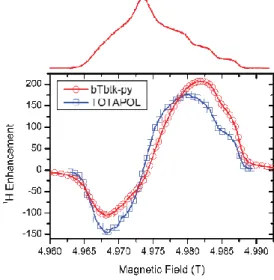
The enhancement field profile of a polarizing agent shows the NMR signal intensity as a function of magnetic field and, hence, the electron Larmor frequency and provides the field for optimum enhancement. The breadth and intensity of the enhancement profile of bTbtk-py versus TOTAPOL (Figure 3) suggest that the nitroxide moieties have slightly different
rela-ACS Paragon Plus Environment 1 2 3 4 5 6 7 8 9 10 11 12 13 14 15 16 17 18 19 20 21 22 23 24 25 26 27 28 29 30 31 32 33 34 35 36 37 38 39 40 41 42 43 44 45 46 47 48 49 50 51 52 53 54 55 56 57 58 59 60
tive orientation and electron-electron coupling in the two bi-radicals. Nevertheless, the shape of the enhancement profile for bTbtk-py is qualitatively similar to that of all nitroxide biradicals whose electron-electron dipolar coupling (~20 MHz) is small relative to the g-anisotropy and a(14N) 20,23,24,
yet the different ε, vis-à-vis that of TOTAPOL, corroborates the observation that enhancement is extremely sensitive to electron-electron distance and relative orientation. Further, the inhomogeneous line shape of the EPR spectrum and the field profile, shown in Figure 3, is consistent with bTbtk-py sup-porting the cross-effect DNP mechanism.
Figure 3. (upper) EPR spectrum of bTbtk-py measured by echo
detection at 140 GHz and T=80 K and (lower) field enhancement profiles of bTbtk-py and TOTAPOL (see supporting information). The enhancement profile was recorded by directly observing the 1H polarization under
~8 W of microwave power using a Bloch decay and scaling the obtained data with respect to the maximum enhancement determined by cross-polarization to 13C. TOTAPOL field profile adapted from Hu, et al. 23
This study indicates that bTbtk-py is superior to TOTAPOL as a DNP biradical polarizing agent by a factor of (ε bTbtk-py/εTOTAPOL=) 1.20±0.02. However, previous studies in
non-ideal solvents have determined this ratio is larger for bTbk, εbTbk/εTOTAPOL= 1.41±0.09. The difference in these numbers
belies the similar architecture of the two spiro-biradicals. Therefore, suggesting why bTbtk-py ‘underperforms’ in ε may guide the development of the next generation of biradicals for DNP.
Differences in NO-NO distance change the dipolar coupling between the two electrons, with larger distances leading to smaller couplings. The dipolar coupling, in conjunction with the J-coupling, leads to the state mixing that is critical for effi-cient cross effect.21 Note that in the case of TOTAPOL, bTbk,
and bTbtk-py the dipolar coupling is the dominant contributor to state mixing. Therefore, the structural differences in bTbk and bTbtk-py, including the NO-NO distance, were examined by measuring the electron-electron dipole coupling with dou-ble electron-electron resonance (DEER). The DEER-measured inter-electron distances (r) were determined to be rbTbk= 11.82±0.06 Å and rbTbtk-py= 13.19±0.11 Å. The
meas-ured rbTbk agrees quite well with the average NO-NO distance
measured from the crystal structure, 11.8 Å; the dihedral angle between the NO vectors, 82º, was also measured. While bTbtk-py would not crystallize in our hands, the fully oxidized
form, 3, proved highly crystalline, and an X-ray structure was obtained, Figure 4. The average NO-NO distance was meas-ured, 13.33 Å, along with the NO dihedral angle, 77º. In bTbtk-py, the twist-boat conformation of the nitroxide moie-ties may be acting synergistically with the increased (vis-à-vis bTbk) ketal ring size to produce the larger NO-NO distance and smaller NO dihedral angle. Insofar as structure deter-mines DNP enhancement, the non-ideal NO-NO relationships might be improved by removing the THP moieties or sulfone bridges. Certainly, the lower DNP enhancement of bTbtk-py relative to bTbk suggests avenues for the further exploration of the bTxk structure space.
Figure 4. Two views of the X-ray crystal structure of 3.
In summary, the reported biradical, bTbtk-py, yields the largest enhancement, ε = 230, to date of any biradical in the ideal glycerol/water solvent matrix. The spiro-cycle structure is highly crystalline in its fully oxidized form (3), but a par-tially oxidized mixture of species is soluble in the desired me-dium. The 13C-NMR signal enhancement has been shown to
depend with extreme sensitivity upon the modulation of the electron-electron distance and relative orientation of the NO moieties of the biradical. This extreme sensitivity suggests that additional synthetic fine tuning of the linkers separating nitroxide radicals can produce superior DNP polarizing agents.
ASSOCIATED CONTENT
Supporting Information. Experimental details, DEER spectra,
crystallographic details and a CIF file. This material is available free of charge via the Internet at http://pubs.acs.org.
AUTHOR INFORMATION
Corresponding Author
* Timothy Swager: [email protected]; Robert Griffin:
Author Contributions
The manuscript was written through contributions of all authors.
ACKNOWLEDGMENT
This research was supported by the National Institutes of Health (GM095843 to TMS and EB002804 and EB002026 to RGG). BC was partially supported by the Deutsche Forschungsgemeinschaft (research fellowship CO802/1-1). MK would like to thank the National Institute of Biomedical Imaging and Bioengineering for a NRSA Fellowship (F32EB012937).
REFERENCES
(1) Slichter, C. P. Phys. Chem. Chem. Phys. 2010, 12, 5741. (2) Overhauser, A. W. Phys. Rev. 1953, 92, 411-415.
(3) Carver, T. R.; Slichter, C. P. Physical Review 1953, 92, 212-213.
(4) Sun, B. Q.; Rienstra, C. M.; Costa, P. R.; Williamson, J. R.; Griffin, R. G. J. Am. Chem. Soc. 1997, 119, 8540-8546.
Page 3 of 5 Journal of the American Chemical Society
1 2 3 4 5 6 7 8 9 10 11 12 13 14 15 16 17 18 19 20 21 22 23 24 25 26 27 28 29 30 31 32 33 34 35 36 37 38 39 40 41 42 43 44 45 46 47 48 49 50 51 52 53 54 55 56 57 58 59 60
(5) Rienstra, C. M.; Hohwy, M.; Hong, M.; Griffin, R. G. J Am
Chem Soc 2000, 122, 10979-10990.
(6) Gerfen, G. J.; Becerra, L. R.; Hall, D. A.; Griffin, R. G.; Temkin, R. J.; Singel, D. J. J. Chem. Phys. 1995, 102, 9494-9497.
(7) Barnes, A. B.; Mak-Jurkauskas, M. L.; Matsuki, Y.; Bajaj, V. S.; Wel, P. C. A. v. d.; DeRocher, R.; Bryant, J.; Sirigiri, J. R.; Temkin, R. J.; Lugtenburg, J.; Herzfeld, J.; Griffin, R. G. Jour. Magnetic Resonance 2009, 198, 261–270. (8) Baudot, A.; Alger, L.; Boutron, P. Cryobiology 2000, 40,
151-158.
(9) Iijima, T. Cryobiology 1998, 36, 165.
(10) Bajaj, V. S.; Farrar, C. T.; Hornstein, M. K.; Mastovsky, I.; Vieregg, J.; Bryant, J.; Elena, B.; Kreischer, K. E.; Temkin, R. J.; Griffin, R. G. J. Mag. Res. 2003, 160, 85-90. (11) Becerra, L. R.; Gerfen, G. J.; Bellew, B. F.; Bryant, J. A.;
Hall, D. A.; Inati, S. J.; Weber, R. T.; Un, S.; Prisner, T. F.; McDermott, A. E.; Fishbein, K. W.; Kreischer, K. E.; Temkin, R. J.; Singel, D. J.; Griffin, R. G. J. Magn. Reson. Ser. A 1995, 117, 28-40.
(12) Joye, C. D.; Griffin, R. G.; Hornstein, M. K.; Hu, K. N.; Kreischer, K. E.; Rosay, M.; Shapiro, M. A.; Sirigiri, J. R.; Temkin, R. J.; Woskov, P. P. Ieee T Plasma Sci 2006, 34, 518-523.
(13) Kessenikh, A. V.; Luschikov, V. L.; Manenkov, A. A.; Taran, Y. V. Soviet Physics Solid State 1963, 5, 321-329. (14) Kessenikh, A. V.; Manenkov, A. A. Soviet Physics- Solid
State 1963, 5, 835-837.
(15) Kessenikh, A. V.; Manenkov, A. A.; Pyatnitskii, G. I. Soviet Physics Solid State 1964, 6, 641-643.
(16) Hwang, C. F.; Hill, D. A. Phys. Rev. Letters 1967, 19, 1011-1013.
(17) Hwang, C. F.; Hill, D. A. Phys. Rev. Letters 1967, 18, 110-112.
(18) Wollan, D. S. Phys. Rev. B 1976, 13, 3671-3685. (19) Wollan, D. S. Physical Review B 1976, 13, 3686-3696. (20) Hu, K. N.; Yu, H. H.; Swager, T. M.; Griffin, R. G. J. Am.
Chem. Soc. 2004, 126, 10844-10845.
(21) Hu, K.-N.; Debelouchina, G. T.; Smith, A. A.; Griffin, R. G. J. Chem. Physics 2011, 134, 125105.
(22) Farrar, C. T.; Hall, D. A.; Gerfen, G. J.; Inati, S. J.; Griffin, R. G. J. Chem. Phys. 2001, 114, 4922-4933.
(23) Hu, K.-N.; Song, C.; Yu, H.-h.; Swager, T. M.; Griffin, R. G. J. Chem. Phys. 2008, 128, 052321.
(24) Matsuki, Y.; Maly, T.; Ouari, O.; Lyubenova, S.; Herzfeld, J.; Prisner, T.; Tordo, P.; Griffin, R. G. Angewandte Chemie 2009, 48, 4996-5000.
(25) Sakai, K.; Yamada, K.-i.; Yamasaki, T.; Kinoshita, Y.; Mito, F.; Utsumi, H. Tetrahedron 2010, 66, 2311-2315. (26) Dane, E. L.; Corzilius, B.; Rizzato, E.; Stocker, P.; Maly,
T.; Smith, A. A.; Griffin, R. G.; Ouari, O.; Tordo, P.; Swager, T. M. J. Org. Chem. 2012.
(27) Trost, B. M.; Curran, D. P. Tetrahedron 1981, 22, 1287-1290.
(28) Murray, R. W.; Jeyaraman, R. J. Org. Chem. 1985, 50, 2847-2853.
(29) Murray, R. W.; Singh, M. Tetrahedron 1988, 29, 4677-4680.
(30) Song, C.; Hu, K.-N.; Joo, C.-G.; Swager, T. M.; Griffin, R. G. J. Am Chem. Soc 2006, 128, 11385-90.
(31) Bajaj, V. S.; Mak-Jurkauskas, M. L.; Belenky, M.; Herzfeld, J.; Griffin, R. G. Proc. Nat’l. Acad. Sci. 2009, 106, 9244-49.
(32) Bayro, M. J.; Debelouchina, G. T.; Eddy, M. T.; Birkett, N. R.; MacPhee, C. E.; Rosay, M.; Maas, W. E.; Dobson, C. M.; Griffin, R. G. J. Am. Chem. Soc. 2011, 133, 13967– 13974.
(33) Mak-Jurkauskas, M. L.; Bajaj, V. S.; Hornstein, M. K.; Belenky, M.; Griffin, R. G.; Herzfeld, J. Proc. Nat’l. Acad. Sci. 2008, 105, 883-888.
(34) van der Wel, P. C. A.; Hu, K. N.; Lewandowski, J.; Griffin, R. G. J Am Chem Soc 2006, 128, 10840-10846.
ACS Paragon Plus Environment 1 2 3 4 5 6 7 8 9 10 11 12 13 14 15 16 17 18 19 20 21 22 23 24 25 26 27 28 29 30 31 32 33 34 35 36 37 38 39 40 41 42 43 44 45 46 47 48 49 50 51 52 53 54 55 56 57 58 59 60
Page 5 of 5 Journal of the American Chemical Society 1 2 3 4 5 6 7 8 9 10 11 12 13 14 15 16 17 18 19 20 21 22 23 24 25 26 27 28 29 30 31 32 33 34 35 36 37 38 39 40 41 42 43 44 45 46 47 48 49 50 51 52 53 54 55 56 57 58 59 60