Columnar Liquid Crystallinity and Mechanochromism
in Cationic Platinum(II) Complexes
The MIT Faculty has made this article openly available.
Please share
how this access benefits you. Your story matters.
Citation
Krikorian, Markrete et al. “Columnar Liquid Crystallinity and
Mechanochromism in Cationic Platinum(II) Complexes.” Journal of
the American Chemical Society 136, 8 (February2014): 2952–2955 ©
2014 American Chemical Society
As Published
http://dx.doi.org/10.1021/ja4114352
Publisher
American Chemical Society (ACS)
Version
Author's final manuscript
Citable link
http://hdl.handle.net/1721.1/114711
Terms of Use
Article is made available in accordance with the publisher's
policy and may be subject to US copyright law. Please refer to the
publisher's site for terms of use.
Columnar Liquid Crystallinity and Mechanochromism in
Cati-onic Platinum(II) Complexes
Markrete Krikorian,
†,§Shuang Liu,
†,§and Timothy M. Swager*
,††Department of Chemistry, Massachusetts Institute of Technology, Cambridge 02139, United States Supporting Information Placeholder
ABSTRACT: Cationic square planar Pt(II) complexes
are reported with high degrees of intermolecular as-sociation. These complexes display thermotropic columnar liquid crystalline behavior in spite of having only a single side chain. Crystals undergo mecha-nochromic transformations that can be reversed with solvent.
The directed assembly of molecules offers opportuni-ties for the design of advanced materials using an ex-panding diversity of molecular shapes, intermolecular potentials, and dispersive forces.1 A widely successful application of molecular assembly has been the use of liquid crystalline molecules in the displays of common electronics (ie. LCDs).2 Although the success of liquid crystal technology in displays is unquestioned, its use in the creation of optimized high-performance electronic materials is largely unrealized.3 Natural candidate struc-tures for these applications are planar organometallic complexes that can assemble into columnar phases generating extended intermetallic interactions.4 As part of our ongoing interest in developing metal organic electronically active materials,5 we designed novel cati-onic square planar platinum complexes and explored their intermolecular associations. We report herein that these compounds display environmentally sensitive Pt...Pt intermolecular interactions, which facilitate the formation of thermotropic columnar liquid crystalline phases as well as unique mechanochromic behavior in the crystal phase.
A common design principle for columnar thermo-tropic liquid crystals is to position side chains at loca-tions such that in the melt these chains fill the space surrounding the columns.6 Implementation of this prin-ciple often requires multiple long alkyl chains attached to a single core7; however, in materials having comple-mentary shapes, dynamic correlations between nearest neighbor mesogens can also facilitate liquid crystallini-ty.8,9 Here, we have found that Pt...Pt interactions can
act as the dominant attractive force in the formation of columnar hexagonal liquid crystals, resulting in discotic liquid crystalline compounds with only one short (– C6H13) alkyl chain. These Pt(II) complexes are one of only a few mesogens with a single side chain to exhibit robust liquid crystal formation.10 Furthermore, reports of thermotropic columnar liquid crystals with less than three side chains are rare.7
The series of cationic platinum complexes 3 were
prepared from Pt(II) precursor
Pt(2-pheyl-pyridine)Cl(Et2S)1 1 1 and pyridyl triazole ligand 2 (Scheme 1). Ligand 2 is readily prepared from an azide and alkyne and allowed for modulation of the single side chain. The synthesis of the cationic Pt(II) complex-es was facilitated by silver salts, where the Ag(I) assist-ed in ligand exchange and also allowassist-ed for isolation of series 3 with varying counteranions. We hypothesized that the degree of coordination and hydrogen bonding properties of these ions would affect the intermolecular Pt…Pt interactions. To further characterize the behavior of the Pt(II) core, we performed 2D NMR analysis on 3aSbF6. We found that all 3a compounds exist as a mixture of stereoisomers and ROESY analysis (see Fig-ure S1 as an example) revealed that the dominant iso-mers are those shown in Scheme 1 with the C–Pt bond trans to the triazole nitrogen. The stereoisomer com-position is dynamic and can vary with solvent (Figures S2–20). At 25 °C, the stereoisomer ratios (trans:cis) for 3aSbF6 were found to be 1:0.17, 1:0.42 and 1:0.91 when dissolved in CH2Cl2, acetone, and DMSO, respectively. 3bSbF6 82% 1:0.15 N Pt Cl S + N N N R N N N N N Pt R N AgX CH2Cl2, RT, 2-5 h X -+ N N N N Pt C6H13 N BF4 -+ N N N N Pt C6H13 N PF6 -+ N N N N Pt C6H13 N TfO -+ N N N N Pt R N SbF6 -+ 3aSbF6 92% 1:0.17 3aPF6 96% 1:0.23 3aBF4 94% 1:0.22 3aOTf 91% 1:0.38 1 2a; R=C6H12 2b; R=C12H25 3a; R=C6H12 3b; R=C12H25 1 2 3 4 5 6 7 8 9 10 11 12 13 14 15 16 17 18 19 20 21 22 23 24 25 26 27 28 29 30 31 32 33 34 35 36 37 38 39 40 41 42 43 44 45 46 47 48 49 50 51 52 53 54 55 56 57 58 59
We were able to grow X-ray quality crystals of 3aBF4 and the resulting structure is shown in Figure 1A. 3aBF4’s space group is P21/c. The crystal struc-ture shows that the cationic Pt(II) complexes favor an alternating dimer packing (Figure 1B), with a Pt...Pt dis-tance of 3.64 Å. The BF4- counteranions reside be-tween columns of Pt(II) cations, and exhibit hydrogen bonding interactions with four different aryl protons from adjacent molecules (Figures S22–24, Tables S1– 3). Notably, the square planar structure is distorted with a 25˚ torsion angle between the different ligand planes suggesting that these compounds have enhanced con-formational flexibility thereby enhancing the dispersive forces compared to other more planar organometallic complexes,12 an important aspect for metallomeso-gens.
Figure 1. Single crystal X-ray structure of 3aBF4. (A) Crystal structure packing (B) Representation of stack-ing orientation by the green and orange colors repre-senting a set of ligands on the molecule and dotted lines representing Pt…Pt interactions.
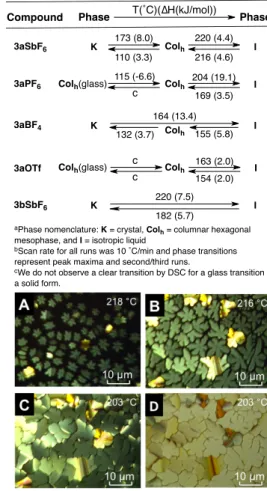
Differential scanning calorimetry (DSC) revealed traces suggested liquid crystalline behaviour in several of the compounds. Specifically, series 3a displayed low enthalpy clearing transitions and modest supercool-ing.13 Through DSC analysis, we were able to gain in-sight on the role of the counteranion (Table 1). The clearing temperatures decrease in the order of 3aSbF6 (219 °C) > 3aPF6 (203 °C) > 3aBF4 (164 °C) = 3aOTf (164 °C). This trend corresponds well with the solubili-ties of the compounds with 3aOTf being qualitatively the most soluble suggesting that the strength of the intermolecular interactions is responsible for this trend as the counteranion is bulkier and allows for weaker intermolecular interactions.14 Aside from the clearing transition temperatures, we observed significant differ-ences in the DSC traces of the series 3a with each counteranion. Compound 3aSbF6 exhibits the most classic behavior containing well defined transitions. In other cases DSC traces displayed similar clearing tem-peratures and small enthalpy transitions with cooling suggesting liquid crystallinity. In all cases our character-ization of phases as liquid crystalline is based on a combined analysis of DSC, POM, and XRD data.
Using the DSC isotropic temperatures as a guide, we observed that the series 3a exhibited birefringence and surface textures characteristic of liquid crystals via
polarized optical microscopy. We found that all com-pounds (3a) displayed temperature dependent surface anisotropy and classic textures of hexagonal columnar phases (Colh) (Figure 2). These textures include six-fold symmetry of the domains and rectilinear defects. As with the DSC traces, the 3aSbF6 complex displayed the most robust liquid crystalline behavior.
Table 1. Phase transitions of complexes 3.ab
Figure 2. Polarized optical microscopy images of the Colh phase of 3aSbF6. (A–C) 90° polarized (D) non-polarized generated by cooling from isotropic phase (2 °C/min) between glass substrates.
In agreement with the microscopy data above, var-iable temperature X-ray diffractograms show patterns characteristic of a Colh phase (Figure 3). Most notably, the dominant low angle features have a 1:1/√3:1/2 ratio in their d-spacing.15The peak at 25.0° corresponds to diffuse scattering centered at 3.6 Å, which is consistent with the intermolecular spacing between neighboring platinum complexes within each column. This corre-lates well with the Pt...Pt distance in the crystal structure of 3.64 Å. We also see other diffuse wide angle scatter-ing that is likely from the loose orderscatter-ing of the aryl-ligands along the column’s axis. The weak, broad na-ture of this peak is consistent with the presence of only a single alkyl chain. Additionally, the value a that is ge-ometrically derived from the packing (Figure S44) can approximate the inter-columnar distance (13.3 Å), which is in agreement with the single crystal structure (13.6 Å). X-ray diffraction studies on all four complexes
173 (8.0) 110 (3.3) K Colh 220 (4.4) 216 (4.6) I 115 (-6.6) 204 (19.1) I 132 (3.7) K Col h 155 (5.8) I K 3aSbF6 3aPF6 3aBF4 3aOTf 3bSbF6 164 (13.4) 169 (3.5) 182 (5.7) 220 (7.5) I
Compound Phase T(˚C)(∆H(kJ/mol)) Phase
aPhase nomenclature: K = crystal, Col
h = columnar hexagonal mesophase, and I = isotropic liquid
bScan rate for all runs was 10 ˚C/min and phase transitions represent peak maxima and second/third runs.
cWe do not observe a clear transition by DSC for a glass transition to a solid form.
Colh(glass) Colh
c
163 (2.0)
I
154 (2.0)
Colh(glass) Colh
c c 1 2 3 4 5 6 7 8 9 10 11 12 13 14 15 16 17 18 19 20 21 22 23 24 25 26 27 28 29 30 31 32 33 34 35 36 37 38 39 40 41 42 43 44 45 46 47 48 49 50 51 52 53 54 55 56 57 58 59 60
show columnar spacings in the mesophase that are largely unaffected by the counteranions indicating that all compounds (3a) are liquid crystalline.
Figure 3. X-ray diffractogram of 3aOTf at 170 °C. The distances (in Å) are above the peaks and hk plane designations are in parentheses.
Given that robust liquid crystalline behavior was ob-served with a short –C6H13 chain, we were interested to see if a longer chain would enhance the liquid crystallin-ity. Complex 3bSbF6 with a –C12H25 alkyl chain was prepared in a manner analogous to 3aSbF6 (Scheme 1). Upon analysis of the DSC, polarized optical micros-copy, and X-ray diffraction, we found that the –C12H25 chain drastically decreased the compound’s liquid crys-tallinity, which is rare but not unprecedented.16 Further effects of the contribution of the ligand and alkyl side chains on liquid crystallinity remain to be explored.
This series 3a exhibits solid-state phosphores-cence17 as well as distinct color and luminescence changes upon heating or processing (Figure S48–49). We predicted that, as with the liquid crystalline behav-ior, these unique photophysical properties are due to the permutable Pt...Pt intermolecular interactions.18 Supporting this hypothesis, the 3aSbF6 complex dis-played both the most robust liquid crystallinity and the most drastic optical changes. Figure 4 shows the
mechanochromic response of 3aSbF6. The yellow
form (polymorph A) represents 3aSbF6 recrystallized from CH2Cl2/hexanes, which can be readily converted into an orange-red form (polymorph B) by grinding with a pestle. The yellow form can be recovered by the addi-tion of CH2Cl2 or heat (Figure 4A, Figure S50, Video S1). 3aSbF6 in its ground red polymorph B can be transformed to yellow polymorph A upon initial heating and then back to polymorph B after complete melting, which is retained with cooling. Additionally, direct for-mation of the red polymorph B can be achieved by rap-id precipitation from acetone.
Figure 4. Reversible Mechanochromism of 3aSbF6. (A) Yellow crystals of 3aSbF6 (upper left) were ground; the yellow emission was restored with a drop of CH2Cl2
(lower left). All images were obtained under UV radiation (365 nm). (B) Solid-state emission spectra of yellow crystals (green), ground solid (red), and solid annealed with CH2Cl2 after grinding (orange) (λex = 400 nm).
More quantitative photophysical characterization revealed that 3aSbF6 is more emissive in the solid than in solution state. The yellow crystals of polymorph A exhibited broad and featureless emission (λem = 565 nm) in the range of 480–700 nm (Figure 4B). This turn-on of luminescence in the solid state is introduced by the self-assembly of 3aSbF6 and is attributed to the excited triplet metal-metal-to-ligand charge transfer (3MMLCT) states. The solid-state quantum yield of 3aSbF6 reached up to 86%, which is on par with the best solid-state Pt(II) emitters reported.19 The red-colored polymorph B displayed bright red emission from 550–800 nm. We propose this emission is a com-bination of the trans and cis isomers, which exhibit dif-ferent emission maxima at 635 and 660 nm due to ag-gregation in the solid state (see features in the red “grind” trace in Figure 4B). The reversibility is confirmed by the spectral overlap of the initial crystals and CH2Cl2 -annealed sample (Figure 4B green and orange dashed traces). 3aSbF6 is not visibly emissive in its liquid crys-talline state, presumably as a result of thermally activat-ed non-radiative pathways.
To further probe the Pt...Pt intermolecular interac-tions of 3aSbF6, we doped this complex into different polymer matrixes (6-8 % w/w relative to the polymer). Films of polystyrene (PS), polyethylene oxide (PEO), poly(methyl methacrylate) (PMMA) and poly(4-vinylpyridine) (P4VP) were prepared by spin-coating a solution of the polymer and 3aSbF6. The photolumi-nescence spectra and images of the resulting films are depicted in Figure 5. 3aSbF6 exhibits red emission in both PS and PEO, which are inert hosts. The
compo-sites with PMMA display 3aSbF6-dependent
respons-es, varying from yellow to orange as the concentration
of the Pt complex increases. The PMMA/3aSbF6 films
also contain a small 490 nm emission shoulder, which matches the monomer emission of 3aSbF6 observed in fluid solutions, suggesting incomplete aggregation. In contrast with the other polymer matrixes, the P4VP films exhibit primarily green emission (λem = 481 nm) and well-defined vibrational splitting patterns indicating
the presence of monomeric 3aSbF6.
Figure 5. Polymer-doped 3aSbF6 films. (A) Solid-state emission spectra of 3aSbF6 in polymer matrixes:
1 2 3 4 5 6 7 8 9 10 11 12 13 14 15 16 17 18 19 20 21 22 23 24 25 26 27 28 29 30 31 32 33 34 35 36 37 38 39 40 41 42 43 44 45 46 47 48 49 50 51 52 53 54 55 56 57 58 59
PS (red), PEO (magenta), PMMA (orange), and P4VP (green); (B) film color contrasts observed under UV ra-diation (365 nm).
The lack of aggregation in this latter composite can be attributed to the pyridyl groups of P4VP coordinating to the metal centers, thereby impeding intermolecular interactions. These results are consistent with our hy-pothesis that the unique properties of the series 3a are dependent on changes in the Pt...Pt interactions, which are readily affected by the degree of aggregation.
In summary, we have found that platinum com-plexes with cationic cores encourage strong intermo-lecular associations, which promote liquid crystalline and mechanochromic behavior. Despite not possessing multiple alkyl side chains, complexes of the 3a series formed discotic liquid crystals with columnar hexagonal packing. We attribute the liquid crystallinity to significant intermolecular Pt...Pt interactions and enhanced disper-sive forces due to distortions from square planarity. In the crystal form, we identified two distinct polymorphs of 3aSbF6, which can be interconverted by mechanical force, melting, or solvent exposure. We expect that other cationic organometallic structures will display similarly strong intermolecular interactions and that this approach will have utility in creating other materials that are mechanically, thermally, and chemically responsive. ASSOCIATED CONTENT
Supporting Information. Details of experimental procedures. Additional characterization data. This ma-terial is available free of charge via the Internet at http://pubs.acs.org.
AUTHOR INFORMATION Corresponding Author [email protected] Author Contributions
§M.K. and S.L. contributed equally to this work. Funding Sources
This work was supported by the National Science Foundation DMR-1005810 and the Department of De-fense NDSEG Fellowship Program 2291100. No com-peting financial interests have been declared.
ACKNOWLEDGEMENTS
The authors thank Peter Mueller for his help solving the single crystal X-ray structure, Ellen Sletten for her help editing the man-uscript, Phil Reusswig for his direction in using the integrating sphere setup, Baltasar Bonillo Fernandez for his help with the video, Dorthe Ravnsbaek for her assistance with powder diffrac-tion data analysis, and Lionel Moh for his help with DSC meas-urements.
REFERENCES
(1) (a) Tao, F. Pure Appl. Chem. 2008, 80, 45. (b) Huang, Y.; Duan, X.; Wei, Q.; Lieber, C. M. Science 2001, 291, 630. (c) Yao, H.-B.; Fang, H.-Y.; Wang, X.-H.; Yu, S.-H. Chem. Soc. Rev.
2011, 40, 3764. (c) Chakrabarty, R.; Mukherjee, P. S.; Stang, P. J. Chem. Rev. 2011, 1, 6810.
(2) Liquid Crystal Displays: Fundamental Physics and
Technol-ogy; Chen, R. H.; Wiley-VCH: Hoboken, 2011.
(3) (a) Fleischmann, E.-K.; Zentel, R. Angew. Chem. Int. Ed. 2013, 52, 8810. (b) Nelson, J. Science 2001, 293, 1059. (c) Schmidt-Mende, L.; Fechtenkötter, A.; Müllen, K.; Moons, E.; Friend, R. H.; MacKenzie, J. D. Science 2001, 293, 1119. (d) van de Craats, A. M.; Warman, J. M.; Fechtenkötter, A.; Brand, J. D.; Harbison, M. A.; Müllen, K. Adv. Mater. 1999, 11, 1469. (e) Xiao, S.; Myers, M.; Miao, Q.; Sanaur, S.; Pang, K.; Stei-gerwald, M. L.; Nuckolls, C. Angew. Chem. Int. Ed. 2005, 44, 7390.
(4) (a) Sun, Y.; Ye, K.; Zhang, H.; Zhang, J.; Zhao, L.; Li, B.; Yang, G.; Yang, B. Angew. Chem. Int. Ed. 2006, 45, 5610. (b) Wang, Y.; Lai, S.-W.; Che, C.-M. Angew. Chem. Int. Ed. 2006,
45, 5610.
(5) (a) Trzaska, S. T.; Swager, T. M. Chem. Mater. 1998, 10, 438. (b) Venkatesan, K.; Kouwer, P. H. J.; Yagi, S.; Müller, P.; Swager, T. M. J. Mater. Chem. 2008, 18, 400. (c) Wong, W.-Y.; He, Z.; So, S.-K.; Tong, K.-L.; Lin, Z. Organometallics 2005, 24, 4079. (d) Yang, X.; Huang, Z.; Dang, J.; Ho, C.-L.; Zhou, G.; Wong, W.-Y. Chem. Commun. 2013, 49, 4406.
(6) Organic Molecular Solids: Properties and Applications; Jones, W., Ed.; CRC Press: Boca Raton, 1997.
(7) Metallomesogens: Synthesis, Properties, and Applications; Serrano, J. L., Ed.; Wiley-VCH: Hoboken, 1996.
(8) (a) Liao, C.-T.; Chen, H.; Hsu, F.; Poloek, A.; Yeh, H.-H.; Chi, Y.; Wang, K.-W.; Lai, C.-H.-H.; Lee, G.-H.-H.; Shih, C.-W.; Chou, P.-T. Chem. Eur. J. 2011, 17, 546. (b) Spencer, M; San-toro, A.; Freeman, G. R.; Díez, A.; Murray, P. R.; Torroba, J.; Whitwood, A. C.; Yellowlees, L. J.; Williams, J. A. G.; Bruce, D. W. Dalton Trans. 2012, 41, 14244. (c) Santoro, A.; Wegrzyn, M.; Whitwood, A. C.; Donnio, B.; Bruce, D. W. J. Am. Chem. Soc. 2010, 132, 10689. (d) Liquid Crystals II; Mingos, D. M. P., Ed.; Springer-Verlag: New York, 1999.
(9) (a) An alternative approach to promote liquid crystallinity in-cludes the use of weak coordination polymer instead of space-filling side chains. (b) Serrette, A. G.; Swager, T. M. Angew.
Chemie Int. Ed. 1994, 33, 2342.
(10) (a) Barberá, J.; Rakitin, O. A.; Ros, M. B.; Torroba, T.
An-gew. Chemie Int. Ed. 1998, 37, 296. (b) Basurto, S.; García, S.;
Neo, A. G.; Torroba, T.; Marcos, C. F.; Miguel, D.; Barberá, J.; Ros, M. B.; de la Fuente, M. R. Chemistry 2005, 11, 5362. (c) Pucci, D.; Aiello, I.; Aprea, A.; Bellusci, A.; Crispini, A.; Ghedini, M. Chem. Commun. 2009, 1550.
(11) (a) Thomas, S. W.; Venkatesan, K.; Müller, P.; Swager, T. M. J. Am. Chem. Soc. 2006, 128, 16641. (b) Liu, S.; Müller, P.; Takase, M. K.; Swager, T. M. Inorg. Chem. 2011, 50, 7598.
(12) Bhattacharjee, C. R.; Das, G.; Mondal, P. Eur. J. Inorg.
Chem. 2011, 5390.
(13) Liquid Crystals: Experimental Study of Physical Properties
and Phase Transitions; Kumar, S., Ed.; Cambridge University
Press: New York, 2001.
(14) (a) Starkulla, G.; Kaller, M.; Frey, W.; Axenov, K. V.; Laschat, S. Liquid Crystals 2011, 38, 1515. (b) Binnemans, K.
Chem. Rev. 2005, 105, 4148.
(15) Handbook of Liquid Crystals: Fundamentals, Vol. 1; De-mus, D.; Goodby, J.; Gray, G. W.; Spiess, H.-W.; Vill, V.; Ed.; Wiley-VCH: Hoboken, 1998.
(16)Kim, S. J; Kang, S. H.; Park, K.-M.; Kim, H.; Zin, W.-C.;
Choi, M.-G.; Kim, K. Chem. Mater. 1998, 10, 1889.
(17) These compounds exhibit phosphorescent emission in so-lution under Ar atmosphere. For a general reference on the emis-sive properties of this class of materials see: Highly Efficient
OLEDs with Phosphorescent Materials; Yersin, H.; Wiley-VCH:
Hoboken, 2008. 1 2 3 4 5 6 7 8 9 10 11 12 13 14 15 16 17 18 19 20 21 22 23 24 25 26 27 28 29 30 31 32 33 34 35 36 37 38 39 40 41 42 43 44 45 46 47 48 49 50 51 52 53 54 55 56 57 58 59 60
(18) (a) Ohta, K.; Hasebe, H.; Moriya, M.; Fujimoto, T.; Yama-moto, I. J. Mater. Chem. 1991, 1, 831. (b) McMillin, D. R.; Moore, J. J. Coord. Chem. Rev. 2002, 229, 113. (b) Ni, J.; Zhang, X.; Qiu, N.; Wu, Y.-H.; Zhang, L.-Y.; Zhang, J.; Chen, Z.-N. Inorg. Chem. 2011, 50, 9090. (c) Abe, T.; Itakura, T.; Ikeda, N.; Shinozaki, K. Dalt. Trans. 2009, 711. (d) Zhang, X.; Wang, J.-Y.; Ni, J.; Zhang, L.-J.-Y.; Chen, Z.-N. Inorg. Chem. 2012, 51,
5569. (e) Kozhevnikov, V. N.; Donnio, B.; Bruce, D. W. Angew.
Chem. Int. Ed. 2008, 47, 6286.
(19) (a) Mydlak, M.; Mauro, M.; Polo, F.; Felicetti, M.; Leon-hardt, J.; Diener, G.; De Cola, L.; Strassert, C. A. Chem. Mater. 2011, 23, 3659. (b) Strassert, C. A.; Chien, C.-H.; Galvez Lopez, M. D.; Kourkoulos, D.; Hertel, D.; Meerholz, K.; De Cola, L.
An-gew. Chem. Int. Ed. 2011, 50, 946.
1 2 3 4 5 6 7 8 9 10 11 12 13 14 15 16 17 18 19 20 21 22 23 24 25 26 27 28 29 30 31 32 33 34 35 36 37 38 39 40 41 42 43 44 45 46 47 48 49 50 51 52 53 54 55 56 57 58 59
6
TOC Graphic
ACS Paragon Plus Environment 1 2 3 4 5 6 7 8 9 10 11 12 13 14 15 16 17 18 19 20 21 22 23 24 25 26 27 28 29 30 31 32 33 34 35 36 37 38 39 40 41 42 43 44 45 46 47 48 49 50 51 52 53 54 55 56 57 58 59 60