Publisher’s version / Version de l'éditeur:
Physical Review B, 26, 1, pp. 420-422, 1982-07-01
READ THESE TERMS AND CONDITIONS CAREFULLY BEFORE USING THIS WEBSITE. https://nrc-publications.canada.ca/eng/copyright
Vous avez des questions? Nous pouvons vous aider. Pour communiquer directement avec un auteur, consultez la
première page de la revue dans laquelle son article a été publié afin de trouver ses coordonnées. Si vous n’arrivez pas à les repérer, communiquez avec nous à [email protected].
Questions? Contact the NRC Publications Archive team at
[email protected]. If you wish to email the authors directly, please see the first page of the publication for their contact information.
NRC Publications Archive
Archives des publications du CNRC
This publication could be one of several versions: author’s original, accepted manuscript or the publisher’s version. / La version de cette publication peut être l’une des suivantes : la version prépublication de l’auteur, la version acceptée du manuscrit ou la version de l’éditeur.
For the publisher’s version, please access the DOI link below./ Pour consulter la version de l’éditeur, utilisez le lien DOI ci-dessous.
https://doi.org/10.1103/PhysRevB.26.420
Access and use of this website and the material on it are subject to the Terms and Conditions set forth at
Search for the Anderson transition in ruby
Jessop, P. E.; Szabo, A.
https://publications-cnrc.canada.ca/fra/droits
L’accès à ce site Web et l’utilisation de son contenu sont assujettis aux conditions présentées dans le site LISEZ CES CONDITIONS ATTENTIVEMENT AVANT D’UTILISER CE SITE WEB.
NRC Publications Record / Notice d'Archives des publications de CNRC:
https://nrc-publications.canada.ca/eng/view/object/?id=bbe17b07-4f1e-4047-a7d2-764da329c2df
https://publications-cnrc.canada.ca/fra/voir/objet/?id=bbe17b07-4f1e-4047-a7d2-764da329c2df
PHYSICAL REVIEWB VOLUME 26, NUMBER 1
Brief
Reports
1JULY 1982
BriefReports are short papers which report on completed research which, while meeting the usual Physical Review standards of
are included in BriefReports.
)
3
BriefReport may be no longer than 3~/~ printed pages and must beaccompanied by an abstract. The same publication schedule asforregular articles isfollowed, and pageproofs aresent to authors.Search for
the Anderson
transition
in
rubyP.
E.
Jessop'
andA.
SzaboDivision ofElectrical Engineering, National Research Council ofCanada, Ottawa, Canada E1AOR8
(Received 17 February 1982)
A new diagnostic to detect the occurrence ofan Anderson transition, using photon echoes, is
proposed and experimentally tested for the R&line in ruby. Asearch for mobility edges in
sam-ples up to0.1wt.% Cr203 concentration was unsuccessful.
I.
INTRODUCTIONThe concept
of
the Anderson transition (AT) and mobility edges associated with inhomogeneously broadened optical transitions incrystals"
is, atpresent, ahighly controversial topic both
experimen-tally and theoretically. In inorganic systems,
observa-tion
of
an AT has been reported fortwo systems'4;however, further work' with one
of
them (ruby) found no compelling evidence for a mobility edge.Controversy also exists for organic systems with Ahlgren and Kopelman favoring a percolation model
toexplain their observed critical concentration
behavior
of
energy transfer versus the AT model ad-vanced by Klafter and Jortner, 7 along with theexperi-mental support reported by Smith etal.
'
So far, the only diagnostic used in attempts to ob-serve the ATin optical solids has been based on energy-transfer effects on trap excitation or grating
decay.9 The expectation is that the transfer proper-ties and, hence, trap excitation or grating decay will
undergo a sudden change at the
AT.
Since theinter-pretation
of
energy-transfer behavior for AT diagnos-tics seems to be in doubt, we propose and describenew experiments which attempt to identify the AT
using another technique.
Specifically, we consider the possibility that a change in homogeneous linewidth or coherence time
T2 will occur as the system switches from alocalized
toan extended state. Now, in the original idealized problem considered by Anderson, ' zero bath
tem-perature was assumed and, hence, as argued by Hol-stein etal.,
'
no change in T2 is expected for anAT.
On the other hand, for real systems at finite tempera-ture this may no longer betrue. We suggest that T2
might be different for a spatially extended state,
which can be scattered by defects, compared toa lo-calized state. Indeed, recent photon-echo
experi-ments"
with a 100% stoichiometric system are con-sistent with this idea in that a coherence time, anor-der
of
magnitude shorter, was observed comparedwith aweakly doped (localized) crystal.
II.
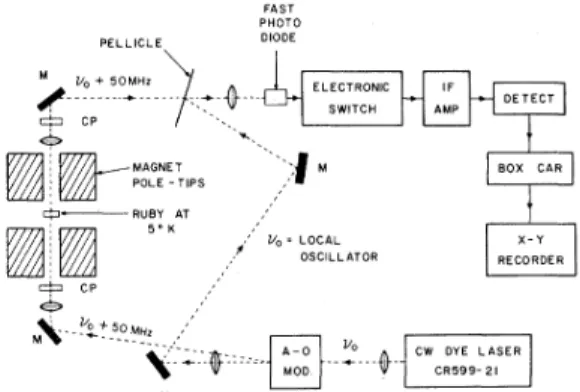
EXPERIMENTAL FAST PHOTO DIODE l/p+50MHz CP ELECTRONIC IF I DETECT SWITCH AMP~
MAGNET M BOX CARRUBY AT 5oK V'p =LOCAL OSCILLATOR MX / / P+5OM A—0 Pp CW DYELASER MOD. CR599-21
FIG.1. Schematic ofexperimental apparatus used for photon-echo studies in ruby with heterodyne detection.
Since coherent transient methods provide about two-orders-of-magnitude-higher-resolution
capabili-ty'2
((10
kHz) than frequency domain methods,'3'~
we used photon echoes to sensitively probe for possi-ble small changes in T2associated with an
AT.
OurS/N
was such that a change in homogeneouslinewidth
of
20kHz could have been detected outof
a total
of
660kHz for0.
1%ruby.A new photon-echo technique, shown in Fig.
1,
was used. A single frequency (1-MHz linewidth) scanning cw dye laser is tuned to the Cr'+
4A2(
—
—
)
E(
)[R
t(
—
—)—
]
—
transition at693.
4nm. The laser power into the 1-mm-thick sample is
30mW, focused to adiameter
of
-0.
05 mm. Thelaser beam is gated by an acousto-optic modulator
26
BRIEF
REPORTS 421(AOM) to provide two pulses, each 200 nsec long.
The undeflected zero-order beam bypasses the sam-ple and a portion
of
it is wave-front matched to the echo signal to allow heterodyne detection. The beatfrequency is 50 MHz, which is the AOM operation
frequency. This technique has a number
of
advan-tages over methods which use (a) Stark shifting, '5(b) nonseparated signal and local oscillator beams
with AOM shifting,
"'6
or(c)
direct detection."
These are as follows:(1)
No coating is required onthe sample as it is for Stark shifting.
(2)
Optical pumpingof
the ground-state levels (and consequentreduction
of
signal,"
)
due to the local oscillator, is eliminated.(3)
No spurious power-dependent local oscillator effects can occur."
(4)
The large beatfre-quency
of
50MHz allows observationof
shorter de-cays versus method(b),
which is limited to beatfre-quencies
(5
MHz becauseof
wave-front matchingconsiderations.
(5)
No expensive and slow repetitionrate optical switch isrequired as in
(c);
the switching is now in the electronics. There is one disadvantageto the method which may markedly reduce the
sensi-tivity. This is that the optical wave front, after
pass-ing through the cryostat windows and sample, must
not be excessively deformed compared to the refer-ence beam. Also, fluctuations due to turbulence in air paths and in the cryostat can be
of
concern, sincewhat Fig. 1 depicts is, in essence, a Mach-Zehnder
interferometer.
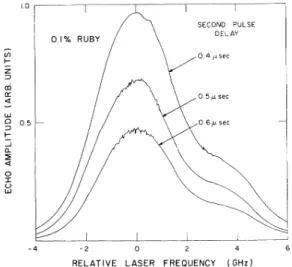
Experimental scans showing the dependence
of
photon echo amplitude (intensity)'~' on position within the R~(
—
2)
inhomogeneously broadened lineare shown in Fig.
2.
Circularly polarized light was used to allow discrimination from the nearbyR ~(+
z)
line. No sharp breaks in the photon-echotQ tL IJJ O.S I-0 O Z O UJ
RELATIVE LASER FREQUENCY (GHz)
FIG.2. Photon-echo signal in ruby vs laser tuning over
4 1
—
1the inhomogeneous A2(
—
2)E(
—
2)line in afield of1ko
along the e3 axis with the pulse separation as parameter.The sample temperature is
-5
K.signals corresponding to the suggestion
of
a mobility edge were observed. The feature on the high-frequency sideof
the line is due to the"Cr
isotope.Analysis
of
the data shows that for frequencies up to 46Hz
on either sideof
line center, T2 was indepen-dentof
frequency,480+
40 nsec for0.
1%ruby and2000+200
nsec for0.
03%.
These values are in good agreement with previous measurements. ''
I
III. DISCUSSION
Although our concentration range is lower than that studied by
Koo,
Walker, and Geschwind(KWG),
4our inhomogeneous linewidths(2
—
5GHz)are smaller than theirs (24
—
78 GHz) so that we are covering a similar spectral density range, and there-fore the results should be comparable. We estimatefrom our
S/N
that a breakof
5%in echo amplitude could have been seen at the spectral density where a break in the transfer rate was seen by KWG. Theecho amplitude equation A
=Aoexp(
—
2r~/T2),
where t~ is the pulse separation, gives the linewidth
sensitivity
of
20kHz mentioned earlier. Thecon-clusion isthat the change in linewidth due to an AT
is less than 20kHz or, alternatively, the
"breaks"
seen by KWG are not due to anAT.
In viewof
re-cent energy-transfer studies, ' the latter possibilityseems more likely.
An important factor which needs further
considera-tion in AT theoretical studies is the effect
of
homo-geneous broadening. Criticism
of
Anderson's theory regarding the neglectof
this factor has been made byZiman. Anderson's opinion ' is that inclusion
of
homogeneous broadening would modify but notdes-troy the
AT.
However,if
the homogeneousline-width is comparable to the interaction Vresponsible
for the AT
(e.
g., phonon broadening at higher tem-peratures), then itis reasonable to expect that an ATwill not occur.
"
For
ruby, a fundamentalcontribu-tion to Cr3+homogeneous broadening arises from the
Cr-Al interaction via Al-Al nuclear-spin flips,
'
and it isof
interest to compare this with V.The range dependence
of
the exchange interaction used by Lyo is'V
=
Voexp(
-0.
724r)
where Vo=
111
cm and the ion spacing ris in A. Toestimate V,we use the ensemble averagenearest-neighbor spacing' r
=
(0.
17/n) '~3, where n isthe Cr density.
For
our0.
1'/o sample this givesV
—
10 MHz. This may be compared with themea-sured Cr-Al homogeneous width
of
65MHz from hole-burningstudies"
in zero field (dilute sample) and&90
kHz for a fieldof
1 kG along thec
axis as measured by photon echoes.24Since the experiments
were performed in a magnetic field
of
1ko,
thecon-clusion isthat the Cr-Al homogeneous width was not
ap-422
BRIEF
REPORTS 26 parent, however, that a magnetic field may beneces-sary in AT studies
of
ruby to reduce the Cr-Alhomo-geneous linewidth relative to the exchange interac-tion. An extension
of
current work to higher con-centrations seems desirable, especially in viewof
arecent upward estimate by Huber
of
the critical con-centration to-10%
from the valueof
—
0.
3%es-timated earlier by Lyo. However, complications will
arise because
of
the rapidly decreasing coherencetimes due to Cr-Cr spin flipping.
'
In conclusion, an attempt to observe an Anderson
transition mobility edge in ruby using a photon-echo
measure
of
homogeneous linewidth has beenunsuc-cessful. While this by itself is not conclusive, recent
energy-transfer studies' also argue against the oc-currence
of
an AT in ruby for concentrations&1%.
ACKNOWLEDGMENTS
One
of
the authors(A.S.)
wishes to acknowledge stimulating discussions with Professor M.D.
Fayerand Professor
D.
Huber.~Present address: Department ofPhysics, McMaster University, Hamilton, Ontario, Canada L85 4M1. ~S.K.Lyo, Phys. Rev. B 3, 3331(1971).
2Forarecent review, seeT.Holstein, S.K.Lyo, and R. Or-bach, Comments Solid State Phys. 8, 119 (1978), C.Hsu and R. C.Powell, Phys. Rev.Lett. 35,734(1975).
4J.Koo, L.R.Walker, and S.Geschwind, Phys. Rev. Lett. 35, 1669(1975).
5S. Chu, H.M.Gibbs, S.L.McCall, and A.Passner,
J.
Opt.Soc.Am. 70, 633 (1980).
6SeeD. C.Ahlgren and R.Kopelman,
J.
Chem. Phys. 73,1005(1980),and references therein.
~See
J.
Klafter andJ.
Jortner,J.
Chem. Phys. 75, 1004(1980),and references therein,
D. D.Smith, R.D.Mead, and A. H.Zewail, Chem. Phys.
Lett. 50, 358(1977).
P.F,Liao, L.M.Humphrey, D.M. Bloom, and S.
Geschwind, Phys. Rev.B 20, 4145 (1979),
'OP. W.Anderson, Phys. Rev. 109,1492(1958).
R.M.Shelby and R.M.Macfarlane, Phys. Rev.Lett. 45, 1098(1980).
' R. G.De Voe, A.Szabo, S.C.Rand, and R. G.Brewer,
Phys. Rev.Lett, 42, 1560(1979).
A. Szabo, Phys. Rev. Lett. 27, 323(1971).
' P.E.Jessop, T.Muramoto, and A.Szabo, Phys. Rev.B
21,926(1980).
A.Szabo and M.Kroll, Opt, Lett. 2, 10(1978). R.M.Macfarlane, R.M.Shelby, and R.L.Shoemaker,
Phys. Rev.Lett. 43, 1726(1979).
I. D.Abella, N.A.Kurnit, and S. R.Hartman, Phys. Rev. 141, 391(1966).
S.Meth, Ph.D.thesis (Columbia University, 1977)
(unpublished), p.57.
' P.E.Jessop and A.Szabo, Phys. Rev.Lett. 45, 1712
(1980); S.Chu, H.M.Gibbs, S. L.McCall, and A. Pass-ner, ibid. 45, 1715(1980).
Private communication to P.W, Anderson by
J.
M.Zimanas noted in Ref.21.
P. W.Anderson, Comments Solid State Phys. 2, 193
(1970).
R.Orbach, in Optical Properties ofIonsin Solids, edited by
B.Di Bartolo and D.Pacheco (Plenum, New York, 1975),
p.396.
23R.G.De Voe, A.Wokaun, S. C.Rand, and R.G.Brewer, Phys. Rev. B23, 3125(1981).
P.
F.
Liao and S. R.Hartmann, Opt. Commun. 8, 310(1973),
25D. Huber (unpublished).