Chemotherapy efficiency increase via shock wave interaction
with biological membranes: a molecular dynamics study
The MIT Faculty has made this article openly available.
Please share
how this access benefits you. Your story matters.
Citation
Espinosa, Silvia, Nikolaos Asproulis, and Dimitris Drikakis.
“Chemotherapy Efficiency Increase via Shock Wave Interaction with
Biological Membranes: a Molecular Dynamics Study.” Microfluid
Nanofluid 16, no. 4 (April 2014): 613–622.
As Published
http://dx.doi.org/10.1007/s10404-013-1258-x
Publisher
Springer-Verlag
Version
Author's final manuscript
Citable link
http://hdl.handle.net/1721.1/87765
Terms of Use
Article is made available in accordance with the publisher's
policy and may be subject to US copyright law. Please refer to the
publisher's site for terms of use.
Microfluidics and Nanofluidics manuscript No. (will be inserted by the editor)
Chemotherapy efficiency increase via shock wave interaction
with biological membranes: a molecular dynamics study
Silvia Espinosa · Nikolaos Asproulis · Dimitris Drikakis
Received: date / Accepted: date
Abstract Application of ultrasound to biological tis-sues has been identified as a promising cancer treatment technique relying on temporal enhancement of biologi-cal membrane permeability via shock wave impact. In the present study the effects of ultrasonic waves on a 1,2-dipalmitoyl-sn-phosphatidylcholine (DPPC) biolog-ical membrane are examined through molecular dynam-ics simulations. Molecular dynamdynam-ics (MD) methods tra-ditionally employ periodic boundary conditions which, however, restrict the total simulation time to the time required for the shock wave crossing the domain, thus limiting the evaluation of the effects of shock waves on the diffusion properties of the membrane. A novel method that allows capturing both the initial shock wave transit as well as the subsequent longer-time-scale diffusion phenomena has been successfully developed, validated and verified via convergence studies. Numer-ical simulations have been carried out with ultrasonic impulses varying from 0.0 mP a· s to 0.6 mP a · s lead-ing to the conclusion that for impulses ≥ 0.45 mP a · s no self-recovery of the bilayer is observed and, hence, ultrasound could be applied to the destruction of local-ized tumor cells. However, for impulses≤ 0.3 mP a · s an increase of the transversal diffusivity of the lipids, indicating a consequent enhancement of drug absorp-tion across the membrane, is initially observed followed by a progressive recovery of the initial values, thereby
S. Espinosa?
Plasma Science and Fusion Center, Massachusetts Institute of Technology, Cambridge MA 02139, USA.
S. Espinosa · N. Asproulis · D. Drikakis
Department of Engineering Physics, Cranfield University, MK43 0AL, UK.
E-mail: [email protected], [email protected]
suggesting the advantageous effects of ultrasound on enhancing the chemotherapy efficiency.
Keywords molecular dynamics· impulse · boundary conditions· shock wave · cancer · biological membrane
1 Introduction
Every year more than 8 million people around the globe die from cancer and more than 12 million are diagnosed for the first time, making cancer one of the leading causes of death in the western world [1]. Therefore, ef-forts across the scientific community have been devoted to establishing new methods as well as improving the potency and efficacy of existing ones.
The treatment of cancerous tissue with high inten-sity focused ultrasound (HIFU) relies on destruction of cells through conversion of mechanical energy into heat (coagulative necrosis) [2] and through mechanical dam-age induced by acoustic cavitation (formation and im-plosion of microscopic gas bubbles that generate liquid jets toward the cell membrane) [3]. The latter could be utilized not only to eliminate localized cancer tu-mor cells [2, 4] but also in conjunction with chemother-apy in order to temporally increase the chemotherapic agents absorption across the membrane [5]. The basic composition and structure of a biological membrane is often described by the fluid mosaic model [6], where the membrane is considered as a two dimensional fluid along the cell surface composed mainly of a phospho-lipid bilayer with embedded protein channels that al-low the drug to actively penetrate into the cell. As the shock wave, following Ganzenm¨uller’s definition [2], im-pacts the membrane, the lateral diffusion of the lipids and protein channels is enhanced and, hence, the
prob-Table 1 Main characteristics of the topologies after solva-tion. AL is the area per lipid.
System Lipids Atoms Height (nm) AL(nm2)
s72 72 40,020 17.51 0.6247
s128 128 73,307 17.51 0.6400
s256 256 146,227 17.51 0.6400
s72s 72 39,096 17.00 0.6247
s72b 72 41,152 18.00 0.6247
ability of the drug to be trapped by these channels is consequently increased.
By utilizing coarse graining techniques (CG), Gan-zenm¨uller [2] concluded that, for gel phase DPPC [7], there is a critical shock wave velocity beyond which no self-recovery of the membrane is observed leading to cell disruption. The corresponding impulse (Eq. 2) was proved to be the most influential variable [8] and its critical value was estimated in the range (0.39, 0.52) mP a· s (Eq. 3).
Koshiyama [5] used MD to model the interaction of shock waves with biological membranes, specifically with the DPPC in crystalline phase that corresponds to the majority of body cells in nature [7], for im-pulses I∈ (0, 100) mP a·s. However, the use of periodic boundary conditions (PBC) restricted the total simu-lation time to the time required for the shock impulse to travel through the computational domain and reach the opposite side of the simulation box [5], thus leading to a large disparity between these values and the time required for studying diffusion mechanisms [7].
The aim of the present study is to investigate the re-sponse of a DPPC membrane in crystalline phase sub-jected to ultrasonic shocks and examine if there is a critical impulse value for which the membrane can no longer recover, in view of the ultrasound cancer treat-ment. In order to study long time scales of diffusion phenomena a method that allows to expand the total MD simulation time has been developed.
2 Scientific computing methods
MD employs the Newton equation of motions for each particle i
mir¨i=−
∂Vi
∂ri
, (1)
where mi is the mass of the atom i; ri the position of
the mass points; and Vistands for the potential energy,
which is a sum of semi-empirical analytical functions that model the real interatomic forces.
Periodic box zmax zbox z x(y) x(y) z z zmin xbox zmax z zvacuum
zmax+ zvacuumzmax+ 1.5 z2zminvacuum zmax+ 1.5 zvacuum
+0.5 zvacuum
LU W vU W
vU W
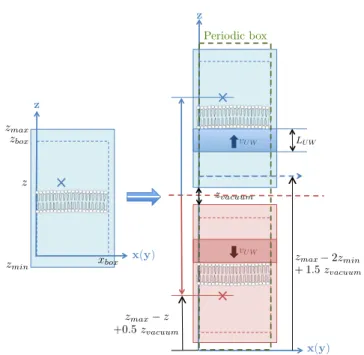
Fig. 1 Schematic of the initial configuration of shock wave simulation. The new system (right) is composed of the origi-nal system after minimization and equilibration (left) and its symmetric one. The average velocity vU W is added to the
thermal velocity of the water molecules in a volume LU WA,
resulting in two shock waves travelling to opposite directions away from the center of the box. The addition of a vacuum, whose size is exaggerated on the schematic, is necessary for avoiding overlapping between water molecules.
2.1 Lipid bilayer/water system
The investigation has been carried out for a DPPC membrane [7], when fixing temperature and/or pres-sure, at temperature 323.15 K and pressure of 1 atm [5, 9–12] corresponding to the crystalline phase [7]. The temperature coupling methods analyzed are the Berend-sen [13], velocity rescaling [14] and Nos´e-Hoover [15, 16] thermostats. The Berendsen algorithm mimics weak coupling with first-order kinetics to an external heat bath, suppressing the fluctuations of kinetic energy [13]. The velocity rescaling method affects the external heat flow by scaling the velocities [14]. Finally, the Nos´e-Hoover thermostat extends the system Hamiltonian by introducing a friction term and a thermal reservoir in the equations of motion [15, 16]. The pressure coupling methods under study are the Berendsen [13] and Parrinello-Rahman [17] barostats. The latter allows variations not only in the volume of the domain as the former, but also in its shape.
The CHARMM 36 force field (FF) [10] and TIPS3P model [18] has been employed for lipids and water, re-spectively, along with the Particle Mesh Ewald (PME) [20] algorithm with cubic interpolation and no con-straints, with a time step equal to 1 fs for stability purposes [18]. The CHARMM 36 FF allows the
all-Chemotherapy efficiency increase via shock wave interaction with biological membranes 3
Fig. 2 Effect of the number of lipids on the specific poten-tial energy during the energy minimization. Steepest descent algorithm with initial step size of 0.01 nm.
atom simulations of membrane and membrane-protein systems without surface tension [21] effects; the latter were found to be negligible by Tieleman [22]. The cut-off parameter for the van der Waals and Coulombic interactions is 1.0 nm [5]. The center of mass is con-trolled every time step separately for water and lipid molecules in order to avoid any spurious displacements of the system. Other variables, such as temperature, are also controlled separately between the lipids and the water molecules aiming to avoid any undesirable heat up of the lipids while the water is cooled down [18].
Furthermore, the leap frog integrator (LFI) is uti-lized for all ensembles used except for NVE, where LFI is used with the Velocity Verlet and Shift techniques for proper energy conservation [18]. Due to the high ve-locities arising from the application of the shock wave, the neighbor list is updated every time step instead of every 5 time steps, as in the equilibration phase. The neighbor list search cut-off distance is increased from 1.0 to 2.0 nm in the NVE simulation.
Initial topologies with 72 (named as s72 [10]), 128 and 256 (named as s128 and s256 [23]) lipids have been employed and placed parallel to the x-y plane in the centre of the periodic box. The molecular system is sol-vated until reaching a total height varying from 17 nm to 18 nm [5]. The main characteristics of the topologies following solvation are outlined in Table 1. According to [10], the cross section is kept squared for maintain-ing consistency between the numerical solution and the underlying physical phenomena.
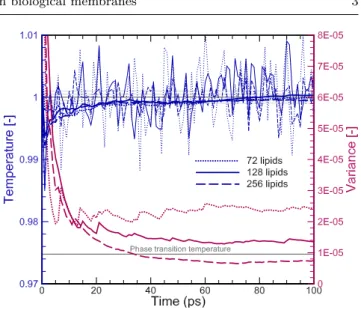
Fig. 3 Effect of the number of lipids on the temperature, its cumulative mean, represented in heavy solid line, and vari-ance during the NVT equilibration. V-rescale temperature coupling method with period τT = 0.1ps and sampling
pe-riod τsamp= 1000f s.
2.2 Shock waves modeling
The jet stream generated from the ultrasound is mod-eled through a rise in the momentum of the water mole-cules that lie within the upper layers of the simulation box that are under the effect of the ultrasonic wave. The amount of momentum transferred into the system is determined by the impulse [8]:
I = Z t+
0
p(t)dt , (2)
where t+ is the positive phase duration of a half cycle
of the shock wave and p is the pressure near the cells in water. Medical ultrasound has an oscillatory nature in the MHz range, and thus its characteristic time is three orders of magnitude longer than the total simulation time. Hence, an average velocity vU W is added to the
thermal velocity due to the ultrasonic wave: vU W = I× AU W mwater· NU W = M MwaterI× A Nav NU W , (3)
where A is the transversal area of the computational box, M Mwater = 0.0180154molkg is the molecular mass
of water for the TIPS3P model, Nav is the Avogadro
number and NU W number of water molecules in the
water slab dictated by the thickness of the UW impact, LU W. The latter is taken as 4nm as in [5], being a
con-servative decision since the impulses considered are one order of magnitude smaller than Koshiyama’s. The ul-trasound region is in contact with the zone occupied by the lipids, as in [5]. The impulses employed here are 0.3, 0.45 and 0.6 mP a·s corresponding to 74.92, 112.39 and 149.85 ms, respectively.
τ τ τ τ
Fig. 4 Effect of sampling period on the temperature cumu-lative mean and variance during the NVT equilibration, rep-resented by solid and dotted lines, respectively. The tempera-ture is plotted for τsamp= 100f s and 1000f s. The V-rescale
temperature coupling method with period τT = 0.1ps is used.
2.3 Boundary conditions
During minimization and equilibration, PBC with min-imum image convection are employed in all three direc-tions. During and after the shock wave impact, a new method that allows capturing both the initial shock transit as well as the subsequent longer-time-scale has been developed. The method is based on surrounding the original system by symmetric ones along the di-rection of the shock propagation. This is equivalent to utilizing PBC within a system composed of the original system and its symmetric one [24], as illustrated in Fig. 1. In the new system, two shock waves travel to oppo-site directions away from the centre of the box towards the lower and upper boundaries along the z-axis. Once the shock waves arrive at the end of the domain, due to the presence of PBC, the two waves collide and the majority of their momentum is canceled out [24].
The addition of a vacuum between the normal and the symmetric system (Fig. 1) is necessary for avoiding overlapping between water molecules. A vacuum of the same characteristics is added at the periodic boundary, so as for the method to be robust in conjunction with any MD solver. The size of the vacuum region has been selected to be of the order of a water molecule diameter (0.05 nm).
2.4 Non-dimensionalization and further analysis The potential energy per unit of mass, pe, is given by: pe = P E
mbox
, pe (%) = pe− pefinal
peinitial− pefinal · 100
(4)
Fig. 5 Effect of the temperature coupling method on the temperature, its cumulative mean and variance, represented by grey, blue and purple lines, respectively, during the NVT equilibration. τT = 0.1ps.
τ τ τ
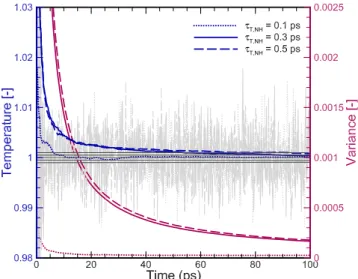
Fig. 6 Effect of the temperature coupling period on the tem-perature, its cumulative mean and variance, represented by grey, blue and purple respectively, during the NVT equilibra-tion.
where P E is the potential energy and mbox=
NL· MML+ NW · MMW
Nav
(5) N is the number of molecules, M W is the molecular mass and the subscripts L and W stand for lipid and water, respectively. The dimensionless temperature and pressure are obtained by dividing the dimensional val-ues by the reference ones.
The mass and electron density profiles are calcu-lated by dividing the periodic box in 500 slabs in the longitudinal direction and counting the particles of in-terest in each region [18]. The thickness of the mem-brane is calculated as the distance between the two
Chemotherapy efficiency increase via shock wave interaction with biological membranes 5
Fig. 7 Effect of the periodic box system height on the tem-perature, its cumulative mean and variance, represented by grey, blue and purple, respectively, during the NVT equili-bration. τT = 0.3ps.
peaks in the electron density profiles, as per experi-mental measurements [7]. The position of the peaks of the electron density profiles coincide with those of the phosphate electron density profiles [11], therefore when applying the shock wave the latter are utilized.
The deuterium order parameter, SCD, is defined as:
−SCD= 2 3Sxx+ 1 3Syy, Sij= 1 2h3 cos θicos θj−δiji (6) where the brackets denote an ensemble average, θiis the
angle between the i th molecular axis and the bilayer normal, and δij is the Kronecker’s delta. For the Cn
methylene group, the Cn−1−Cn+1direction is taken as
z and the Cn−1−Cn−Cn+1plane is the yz [7]. The order
parameters are a measure of the spatial restriction of the motion of a CH vector. The change of length can be characterized by the averaged instantaneous deuterium order parameter [5], because the chain length becomes smaller as the disorder of chain bend angles increases.
The lateral self-diffusion coefficient of the lipids (Dxy)L
can be estimated from the slope of the averaged mean-square displacement (MSD) of the center of mass x(t) of single lipids by using the Einstein relation [25]:
(Dxy)L=1 4t→∞lim 1 tM SD =1 4t→∞lim 1 th|x(t0)− x(t0+ t)| 2 i (7)
Larger slopes of the MSD implies a higher diffusion co-efficient. The MSD scales proportionally to the square root of time for the single-file diffusion (SFD); linearly with time for the Fickian diffusion; and proportionally to the square of time for the ballistic diffusion charac-terized by a higher degree of co-ordination [26].
β β β β
Fig. 8 Effects of the isothermal compressibility and the pres-sure coupling method on the cumulative mean and variance pressure represented by solid and dotted line respectively. τT = 0.3ps and τP = 0.1ps.
τ τ
τ τ
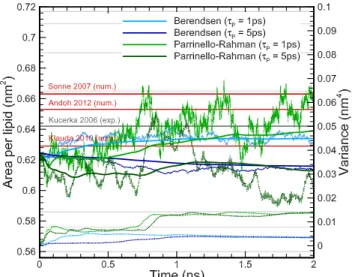
Fig. 9 Effects of the pressure coupling method and period on the area per lipid, cumulative mean and variance, represented by light dotted, thick solid and thick dotted lines, during the NPT equilibration. The validation has been carried out against experimental [9] and numerical results [10–12].
2.5 Other computational details
The double-precision GROMACS 4.5.5 [18] molecular solver has been employed in conjunction with the FTTW 3.3.2 [19] C subroutine library. The simulations have been carried out utilizing Cranfield University’s HPC cluster Astral. The system uses the Intel 2012 XE Clus-ter Suite for compilation (FORTRAN, C, C++) and Message Passing Interface (MPI). The measured maxi-mum performance achieved is 19.9 TFlops, though the theoretical peak processor performance is 22.5 TFlops.
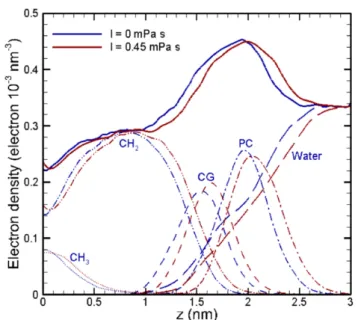
Fig. 11 Effects of the ensemble on the electron density pro-files and membrane thickness. Validation has been obtained against an experimental structural model (SDP) [27] and nu-merical results from Klauda [10] and Andoh [11]; z = 0nm corresponds to the centre of the membrane. Groups descrip-tion can be found in [10].
3 Results and discussion 3.1 Minimization
Fig. 2 shows the specific potential energy during the minimization stage, for the systems s72, s128 and s256. The attractive sign demonstrates physical consistency and the potential energy values are in accordance with previously published data [18]. The results show that the higher the number of lipids is, the smaller the spe-cific potential energy of the converged system becomes; this is due to the fact that the effect of the PBC is diminished when increasing the lipids. The differences are in any case negligible (∆e < 0.7%).
3.2 Equilibration
In the equilibration process, consisting of a 100 ps of NVT followed by a 2 ns of NPT, different systems are simulated aiming at verifying the effects of several pa-rameters such as number of lipids (equivalent to the parallel box size); sampling period, coupling method; characteristic coupling period; isothermal compressibil-ity and perpendicular box size [7, 18]; and validate the results (target pressure and temperature and area per lipid) against available experimental data [9–11]. NVT stage:
In Fig. 3 the effects of the number of lipids on the tem-perature as a function of time are presented along with
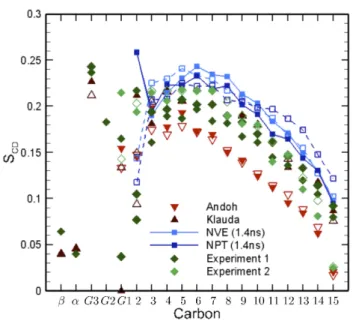
Fig. 12 Effects of the ensemble on the deuterium order pa-rameters, SCD. Validation has been obtained against nuclear
magnetic resonance: experiment 1 [28–30] and experiment 2 [28, 31]; and numerical results from Klauda [10] and An-doh [11]. Open and closed symbols correspond to sn-1 and sn-2 chains, respectively.
the cumulative time average value and the correspond-ing variance. As the number of lipids increases the ar-tifacts induced by the PBC diminish, thus leading to slightly decreased difference (less than 0.01%) between average and target temperature values. The associated computational cost increases by 27% for the 128 lipid case over the 72 lipids and 120% when 256 lipids are employed. Hence, it can be concluded that the 72 lipid case can sufficiently capture the dynamics of the sys-tem and provide results independent of the box size, an observation that has also been made by Klauda [10]. Therefore, for computational efficiency the s72 case is utilized for the rest of the study.
Fig. 4 shows the effect of the sampling period on the temperature mean and variance. As the sampling period decreases, movements with higher characteristic frequency occur and the root mean squared deviation (RMSD) also increases approaching that obtained when all the time steps are sampled. According to Hess [18], for lipid systems the scales of interest are captured with a sampling period τsamp≤ 200 fs, which is also utilized
throughout the present study.
The temperature effects of the coupling method for the three approaches considered are shown in Fig. 5. For a given temperature coupling period (τT = 0.1 ps), the
Nos´e-Hoover method reaches a relative error lower than 0.1%, which is more than 16 times faster compared to the other cases (Fig. 5). Moreover, even though it pro-duces an oscillatory relaxation, the variance is smaller
Chemotherapy efficiency increase via shock wave interaction with biological membranes 7
(a) t = 0 fs (b) t = 50 fs (c) t = 100 fs
(d) t = 150 fs (e) t = 200 fs (f) t = 250 fs
(g) t = 300 fs (h) t = 350 fs (i) t = 400 fs
(j) t = 450 fs (k) t = 500 fs (l) t = 550 fs
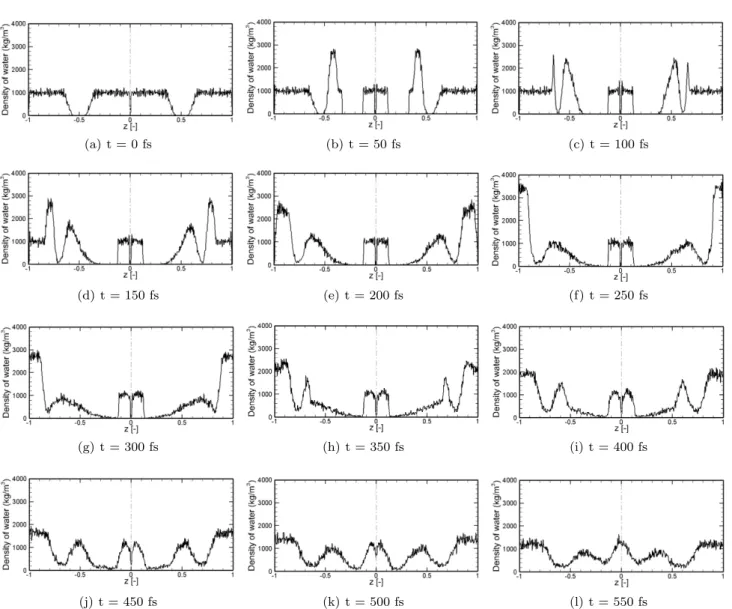
Fig. 10 Water density profiles for I = 0.3 mP a · s and the NVE ensemble for time step 0.01 fs. The system is made of the original system (left) and the symmetric system (right). The hydrophobic region of the membrane in each subdomain corresponds to the region which has less than a 3% water density at t = 0 fs when compared to pure water.
than 25% compared to the ones obtained by the alter-native methods. The relative error is more than two or-ders of magnitude smaller compared to other cases and, therefore, this is the coupling method used throughout the present study. Fig. 6 shows the effect of the temper-ature coupling period; it can be noticed that the relative error diminishes as the coupling period decreases until it reaches a plateau for τT,N H = 0.3ps.
Fig. 7 shows the effect of the perpendicular box size on the temperature cumulative mean and variance. It is noticed that in the range of system height under study, 17-18nm, the effects are negligible, i.e. ∆e < 0.0001%. NPT stage:
Fig. 8 and 9 show the effect of isothermal compressibil-ity, pressure coupling method, and coupling period on
the values of pressure and area per lipid respectively. It is observed that the pressure coupling method does not affect significantly the relative error (∆e≤ 0.5%), however, the RMSD obtained with Berendsen is 10% lower on average due to the fact that the exponential relation is much faster than the oscillatory one when the initial pressure value is relative far from the target one. Regarding the pressure coupling period (Fig. 9), the relative error obtained with τP = 1ps is 4 times
smaller than that obtained with τP = 5ps.
The pressure coupling method allows calibration via the isothermal compressibility of the membrane (Fig. 8) and the isothermal compressibility of pure water has been employed leading to minimum error for the Berendsen method and τP = 1ps. This is physically
Fig. 13 Effect of the shock wave impulse on the mean squared displacement (MSD) of the lipid bilayer.
been increased so as to implement the shock wave and, hence, the system is closer to pure water than to a mem-brane with an embedded protein.
As a conclusion, larger sampling periods (τT = 0.3
or 0.5 ps and τP = 5 ps) tend to significantly
overes-timate pressure and result in an underesoveres-timated area per lipid, while smaller coupling periods (τT = 0.1 ps
and τP = 1 ps) tend to slightly underestimate
pres-sure, thus resulting in a more accurate area per lipid. The effect of the temperature coupling period is more important. When utilizing the Berendsen pressure cou-pling method with τT,N H = 0.1 ps and τP = 1 ps, an
error lower than 1.25% is achieved, suggesting an im-provement in the computationally accuracy compared to the most relevant published papers [10–12] (Fig. 9).
4 Shock wave
4.1 Before the shock reaches the end of the domain The verification of the ultrasound cancer treatment in short time scales was carried out by Koshiyama [5], who concluded that the number of lipids used in the simula-tion model does not significantly affect the results. Al-though only a qualitative comparison with Koshiyama’s result is possible, due to the difference between the im-pulse values used in the present study and Koshiyama’s, the most relevant effects associated with the collapse and rebound of bilayers and the water penetration into the hydrophobic region are observed in both studies (Fig. 10).
Fig. 14 Extreme increase of the thickness of the membrane at t ≈ 1.1ns (Fig. 13), which is a clearly evidence of the membrane descohesion.
Fig. 10 shows the evolution in time of the water density profiles for I = 0.3 mP a· s when utilizing the NVE ensemble. The shock wave produces a high den-sity water that induces the shrinkage of the hydrophobic region. Initially, the upper layer is pushed downwards, while the lower layer remains intact (Fig. 10b). The minimum thickness is reached when the excess of mo-mentum is transferred to the lower layer, which is also pushed downwards (Fig. 10c). At that time, the force pushing the upper layer down becomes weaker, and the rebound stage sets in. The rebound stage is more im-portant for water penetration than the collapse stage, as it was also observed by Koshiyama [5] (Fig. 10d-f).
When the two shock waves reach the boundary, the majority of the momentum is canceled out; following that, two shock waves of reduced intensity and speed propagate towards the axis of symmetry (Fig. 10g-l). The efficiency of the method is defined as the fraction of impulse that it is canceled out, which can be estimated as follows: Efficiency = I1− I2 I1 · 100 ≈ NW,1vNs,1− NW,2vs,2 W,1vs,1 · 100 ≈ 98% (8)
For the present study, the efficiency of the double shocks method is around 98%, improving those of pre-vious studies in solids [24].
Chemotherapy efficiency increase via shock wave interaction with biological membranes 9
4.2 After the shock reaches the end of the domain
During the NVE integration, the time step employed should be of the order of 0.01fs. Therefore, for simu-lating a few tens of nanosecond, 109 time steps are
re-quired corresponding roughly to 14 years of simulations based on the available computing resources, the size of the problem and the scalability of the solver used. Ac-cording to Zhao [24], once the shock is canceled out, the simulation could be continued by using any of the commonly used ensembles. The effect of the ensemble on the results is estimated by studying the case that corresponds to I = 0 mP a· s, where experimental data for validation are available.
In Fig. 11 and 12, the results in the long-time scales are verified and validated in terms of electron density profile, thickness, diffusion coefficients and deuterium order parameters through comparisons with available experimental and numerical data [10, 11, 27–31]. From the analysis carried out, it is concluded that the NPT ensemble is the recommended choice due to the follow-ing reasons:
– The computational performance is ten times faster than the one obtained from the NVE ensemble. – It is quantitatively closer to the experimental and
numerical results, achieving excellent accuracy (er-ror < 1%) on the prediction of the membrane thick-ness, which is crucial for understanding whether or not the membrane will be disintegrated.
– As the volume is not fixed, spurious effects such as the occurrence of small densities in the centre of the box are avoided and the membrane behavior obtained corresponds to the physical one.
Finally, the effect of the impulse on the long-time scales has been investigated by selecting values closer to the critical value estimated in [2]. Following the plementation of the shock, NPT simulations with im-pulses 0.3 and 0.45 mP a·s and time steps of 1 fs and 0.5 fs respectively are carried out, increasing the pressure coupling period to 5 ps for stability.
Fig. 13 and Fig. 14 show the mean square displace-ment of the lipids in the membrane as function of time and the electron density profiles for different shock im-pulses. For impulses ≥ 0.45mP a · s no self-recovery of the bilayer is observed, whereas for impulses≤ 0.3mP a· s, the increase of the transversal diffusivity of the lipids (ballistic motion) and consequent enhancement of drug absorption across the membrane is followed by a pro-gressive recovery of the initial values.
5 Concluding remarks
The short- and long-time scale effects of ultrasonic shock waves through DPPC lipid bilayers were investigated using MD. In respect of the long-time scale effects, a new method that utilizes symmetrical systems has been developed, validated and verified. The new method ex-hibits an efficiency better than other MD transmitting boundary conditions previously utilized for solids [24]. From the analysis of the long-time scales, it can be concluded that for impulses≥ 0.45mP a · s no self-recovery of the bilayer is observed. However, for im-pulses ≤ 0.3mP a · s, an increase of the transversal diffusivity of the lipids (ballistic motion), and conse-quent enhancement of drug absorption across the mem-brane, is noticed followed by a progressive recovery of the initial equilibrium values. Therefore, if the ultra-sound method is utilized for HIFU applications, atten-tion should be drawn to cases where I ≥ 0.45mP a · s, whereas if the purpose of the cancer treatment is to increasing the efficiency of chemotherapy, attention should focus on the range I ≤ 0.3mP a·s. Furthermore, the research project proves numerically the efficacy of the ultrasound technique to cancer treatment.
The analysis of the response of more complex mem-brane models that include embedded proteins will fur-ther contribute to a better understanding of the mech-anisms involved as well as optimizing the drug delivery and absorption. Furthermore, the success of the method developed has opened up the possibility of reaching time scales of medical interest that could be explored in future studies.
References
1. World Health Organization. World Health Statistics 2009. Number ISBN 97892 4 156381. World Health Organization, 2009.
2. Ganzenm¨uller GC, Hiermaier S, Steinhauser MO (2011) Shock-wave induced damage in lipid bilayers: a dissipative particle dynamics simulation study. Soft Matter 7:4307-4317. doi: 10.1039/C0SM01296C
3. Vogel A, Busch S, Parlitz U (1996) Shock wave emis-sion and cavitation bubble generation by picosecond and nanosecond optical breakdown in water. J Acoust Soc Am 100(1):148-165. doi:10.1121/1.415878
4. Br´u A, Casero D (2006) The effect of pressure on the growth of tumour cell colonies. J Theor Biol 243:171-180. doi:10.1016/j.jtbi.2006.05.020
5. Koshiyama K, Kodama T, Yano T, Fijikawa S (2006) Structural change in lipid bilayers and water penetra-tion induced by shock waves: molecular dynamics sim-ulations. Biophys J 91(6):2198-2205. doi: 10.1529/bio-physj.105.077677
6. Singer SJ, Nicholson GL (1972) The fluid mosaic model of the structure of cell membranes. Science 175(4023):720-731. doi:10.1126/science.175.4023.720
7. Tieleman DP, Marrink SJ, Berendsen HJC (1997) A com-puter perspective of membranes: molecular dynamics stud-ies of lipid bilayer systems. Biochim Biophys Acta 1331:235-270. doi:10.1016/S0304-4157(97)00008-7
8. Kodama T, Hamblin MR, Doukas AG (2000) Cyto-plasmic molecular delivery with shock waves: importance of impulse. Biophys J 79:1821-1832. doi: 10.1016/S0006-3495(00)76432-0
9. Kucerka N, Tristram-Nagle S, Nagle JF (2006) Closer look at structure of fully hydrated fully hydrated fluid phase DPPC bilayers. Biophys J 90(11): L83L85. doi: 10.1529/biophysj.106.086017
10. Klauda JB, Venable RM, Freites JA, Connor JW, Tobias DJ, Mondragon-Ramirez C, Vorobyov I, MacKerell AD, Pastor RW (2010) Update of the CHARMM all-atom ad-ditive force field for lipids: validation on six lipid types. J Phys Chem B 114(23):78307843. doi: 10.1021/jp101759q 11. Andoh Y, Ito T, Okazaki S (2012) An application of
im-proved force field to fully hydrated DPPC and POPC bi-layers in a tensionless NPT ensemble: a test of CHARMM 27-based new force field by H¨ogberg et al. Molecular simu-lation 38(5):414418. doi: 10.1080/08927022.2010.548385 12. Sonne J, Jensen MO, Hansen FY, Hemmingsen L, Peter
GH (2007) Reparametrization of all-atom dipalmitoylphos-phatidylcholine lipid parameters enables simulation. Bio-phys J 92(12):4157-4167. doi: 10.1529/bioBio-physj.106.087130 13. Berendsen HJC, Postma JPM, van Gunsteren WF, Di-Nola A, Haak JR (1984) Molecular dynamics with cou-pling to an external bath. J Chem Phys 81(8):3684-3690. doi:10.1063/1.448118
14. Bussi G, Donadio D, Parrinello M (2007) Canonical sam-pling through velocity rescaling. J Chem Phys 126(1):014-101. doi:10.1063/1.2408420
15. Nos´e S (1984) A molecular dynamics method for simula-tions in the canonical ensemble. Mol Phys 31(3):1695-1697. doi:10.1080/00268978400101201
16. Hoover WG (1985) Canonical dynamics: Equilibrium phase-space distributions. Phys Rev A 31(3):1695-1697. doi:10.1103/PhysRevA.31.1695
17. Parrinello M, Rahman A (1981) Polymorphic transitions in single crystals: A new molecular dynamics method. J Appl Phys 52(12):7182-7190. doi:10.1063/1.328693 18. Hess B, Kutzner C, Spoel D, Lindahl E (2008)
GRO-MACS 4: Algorithms for highly efficient, load-balanced, and scalable molecular simulation. J Chem Theory Com-put 4(3):435-447. doi: 10.1021/ct700301q
19. Frigo M and Johnson SG (2005) The design and imple-mentation of FFTW3. Proceedings of the IEEE, 93(2):216-231. doi:10.1109/JPROC.2004.840301
20. Ewald PP (1921) Die Berechnung optischer und eletro-statischer Gitterpotentiale. Ann Phys 369(3): 253-287. 21. Freites JA, OConnor JW, Tobias DJ,
Mondragon-Ramirez C, Vorobyov I, MacKerell AD, Klauda JB, Venable RM and Pastor JW (2010) Update of the CHARMM all-atom additive force field for lipids: Validation on six lipid types. J Chem Phys B, 114:7830-7843.
22. Tieleman DP, Berendsen HJC. (1996) Molecular dynam-ics simulations of a fully hydrated dipalmitoylphosphatidyl-choline bilayer with different macroscopic boundary con-ditions and parameters. J Chem Phys 105(11):4871-4880. doi:10.1063/1.472323
23. Jo S, Kim T, Im W (2007) Automated builder and database of protein/membrane complexes for molec-ular dynamics simulations. PLoS ONE 2(9):e880. doi:10.1371/journal.pone.0000880
24. Zhao S, Germann TC, Strachan A (2006) Atom-istic simulations of shock-induced alloying reactions in
Ni/Al nanolaminates. J Chem Phys 125(16):164707-164714. doi:10.1063/1.2359438
25. Bockmann RA, Hac A, Heimburg T, Grubmuller H (2003) Effect of sodium chloride on a lipid bilayer. Biophys J 85(3):1647-1655. doi:10.1016/S0006-3495(03)74594-9 26. Striolo A (2006) The mechanism of water diffusion
in narrow carbon nanotubes. Nano Lett, 6(4):633639. doi:10.1021/nl052254u
27. Kucerka N, Nagle JF, Sachs JN, Feller SE, Pencer J, Jackson A, Katsaras J (2008) Lipid bilayer struc-ture determined by the simultaneous analysis of neutron and X-ray scattering data. Biophys J 95(5):2356-2367. doi:10.1529/biophysj.108.132662
28. Seelig A, Seelig J (1975) Bilayers of dipalmitoyl-3-sn-phosphatidylcholine. Conformational differences between the fatty acyl chains. Biochim Biophys Acta, 406(1). doi:10.1016/0005-2736(75)90037-1
29. Seelig A, Seelig J (1974) Dynamic structure of fatty acyl chains in a phospholipid bilayer measured by deu-terium magnetic resonance. Biochemistry 13(23):4839-4845. doi:10.1021/bi00720a024
30. Klauda JB, Eldho NV, Gawrisch K, Brooks BR, Pastor RW (2008) Collective and noncollective models of NMR relaxation in lipid vesicles and multilayers. J Phys Chem J 112(19):5924-5929. doi:10.1021/jp075641w
31. Douliez JP, Leonard A, Dufourc EJ (1995) Restatement of order parameters in biomembranes - calculation of C-C bond order parameters from C-D quadrupolar splittings. Biophys J 68(5):1727-1739.