AUGUST 1988
LIDS-P-1806
COMPUTER AIDED PETRI NET DESIGN
FOR DECISION-MAKING ORGANIZATIONS *
I. M. Kyratzoglou
Alexander H. Levis
Laboratory for Information and Decision Systems
Massachusetts Institute of Technology
Cambridge, MA 02139
ABSTRACT
A Computer Aided Petri Net Design System is developed for creating decision-making
organizational architectures of arbitrary complexity and for computing the structural
attributes describing the organization. The Design System has four modes of operation: a
Graphics Editor mode, used for the interactive generation of the Petri Net structure of the
organization; a text Editor Mode, used to store, modify and retrieve attributes assigned to
the Petri Net primitives; a Structural Analysis mode, used to generate the structural
properties of the organization, such as the incidence matrix, the interconnection matrix and
the information flow paths; and a Hardcopy mode, used to generate graphic images on
output devices. In addition, a set of auxiliary functions handle the file manipulation,
user-software interface, command interpretation and grammar-rule enforcing tasks of the
System.
*This
work was carried out at the MIT Laboratory for Information and Decision Systems with
support provided by the Basic Research Group of the Technical Panel on C3 of the Joint Directors
of Laboratories through the Office of Naval Research under Contract no. N00014-85-K-0782.
To appear in the Proceedings of the Winter Simulation Conference, San Diego, CA, December
COMPUTER AIDED PETRI NET DESIGN FOR DECISION-MAKIN(G OR(;ANIZATIONS
loannis M. Kyratzoglou Alexander H. Levis
ABSTRACT the sequence of events, interactions between organization members,
protocols that govern these interactions and to compute measures of A Computer Aided Petri Net Design System is developed for performance and effectiveness. The Timed Petri Net formulation creating decision-making organizational architectures of arbitrary has been used (Grevet, 1988) to implement the discrete event complexity and for computing the structural attributes describing simulation of decision-making processes that require coordination. the organization. The Design System has four modes of operation: The execution of a net is carried out through the activation of A Graphics Editor mode, used for the interactive generation of the events that take place at discrete instants in time. A methodology Petri Net structure of the organization; A Text Editor mode, used to was developed (Andreadakis, 1988) to design distributed DMOs store, modify and retrieve attributes assigned to the Petri Net and to analyze their performance and effectiveness given a mission. primitives; A Structural Analysis mode, used to generate the
structural properties of the organization, such as the incidence A design approach to model, analyze and evaluate a DMO is to matrix, the interconnection matrix and the information flow paths: create a generic structure and then develop organizational and a Hardcopy mode, used to generate graphic images on output architectures from it. Operational specifications may suggest devices. In addition a set of auxiliary functions handle the file alternative configurations. This method enables the designer to manipulation, user-software interface, command interpretation and consider many configurations of similar generic structures. It also grammar-nule enforcing tasks of the System. enables the classification of each model according to specific structural, data flow or organizational properties, performance, etc.
INTRODUCTION The Computer Aided Petri Net Design System was developed
(Kyratzoglou, 1987) to provide fast and interactive design of DMO In the context of decision-making organizations a decision- architectures. The System provides a set of Petri Net representation maker is a trained person who can administer a decision by tools which assist the designer to generate DMO models, and a set considering the available information. A decision-making of analytical tools that assign attributes to Petri Net elements and organization (DMO) is formed when a single decision-maker does compute structural properties of the Net. It allows the designer to not have the capacity or proficiency to administer a decision. A stucture the design process. The System may be used as the front DMO is a team of trained decision-makers who are coordinated for end for simulation.
information processing and sharing, and who are organized
according to their skills and authority. Each decision-making This paper reviews the basic concepts and definition of Petri process may be partitioned into subprocesses. Each subprocess Net Theory. Then, it describes the operational modes of the Petri may be processed by a team member. A distributed decision- Net Design System and their basic features and capabilities. The making organization (DDMO) is formed when each team member conceptual phases undertaken in developing a Petri Net design are reaches a decentralized decision in his own area of expertise. also described. The application of the conceptual approach for the Decision aids and databases may be introduced to improve the generation of the Petri Net representation of an organization is effectiveness of the organization. presented, in which two 3-person DMOs (one parallel and one
hierarchical) are modeled. The Petri Net representation has been used (Tabak and Levis,
1985) to model DMOs. A model of Timed Petri Nets was
introduced in which processing times were assumed deterministic THEORETICAL CONCEPTS (Ramchandani, 1974). The Timed Petri Nets were used for
modeling time critical DMOs (Hillion, 1986). This method of Petri Nets are bipartite directed multigraphs (Peterson, 1981). representation is sufficient to capture time delays, information flow They consist of two types of nodes: places indicated by circles and and processing, resource contraints, precedence relationships and representing signals or conditions; and transitions indicated by bars
and representing activities or processes. Places must be connected to transitions only, and transitions must be connected to places by a
connector. A connector indicated by an arrow represents the t1 t2
directed relationship between the place and the corresponding I I transition. Each node or connector may have specific inscriptions I J
I
a
associated with it related to the physical component it represents. Ia For example, a transition may represent a set of processing
algorithms modeling a specific organizational activity. For an tI t2
activity to take place certain conditions must hold true. The places may represent that set of conditions. Conditions are evaluated according to the incoming information. The information carrier is
represented symbolically by a token and is deposited in places. A Figure 2: A Superplace Representation transition is enabled and it can fire, if all places input to the
transition are marked by tokens. Firing times are assigned to each To characterize the structure of a Petri Net, linear algebra of the transitions of the net.of the transitions of the net.
representations are introduced. A structural representation is the A variant of the transition, the switch, indicated by a rectangle incidence matrix, which provides description of the flow relations with rounded comers is used to represent a decision structure between nodes. For a Petri Net with m places and n transitions, the (Tabak and Levis, 1985). The switch models a set of decision rules incidence matrix C is an mxn matrix, whose elements are defined and tests according to a control law based on the transmitted by the relation,
information, see Figure 1. A decision strategy is chosen based on I - if p is input place to transition the decision rule selected. Once a decision strategy is selected a C.= +1 if pi is an output place to transition t path is enabled, while the rest are disabled. 0 no link between pi and tj
The following definitions are useful:
Definition I: A Petri Net is connected if there exists A supemode is a node that represents a subnet. It might be a a path from any node to any other node.
superplace or a supertransition. The use of supernodes enables the Definition 2: A directed circuit is a directed path from any node to itself.
Definition 3: A directed elementary circuit is a directed circuit in which no node appears more than once.
Definition 4: A Marked graph is a connected Petri Net, in which each place has exactly one input and one output transition.
Definition 5: An n-dimensional non-negative integer vector X is called an S-invariant if and only if XT*C=O, (Memmi and Roucairol, 1979).
Definition 6: The set of places whose corresponding components in X are strictly positive is called the support of X and is denoted by < X >.
Definition 7: The support of an invariant is said to be minimal if and only if it does not contain the support of
p----
1-0 another invariant but itself and the empty set.Definition 8: The S-component associated with < X > is the unique subnet whose set of places is < X > and whose set of transitions consists of all transitions connected to the places of < X > (Sifakis, 1978).
Definition 9: The S-component is said to be minimal Figure 1: A Switch and its Supertransition Representation if it corresponds to an S-invariant whose support is
minimal. generation of a coarsened version of the Petri Net. It may be viewed
as a Petri Net reduction technique. Figure 1, shows a refined and a The above definitions in determining the information flow coarsened version of the Petri Net model of the switch. The refined paths of a Marked graph. Information flow or simple paths are the version contains a switch with three settings. The coarsened paths that emanate from the source node and terminate at the sink version shows the supertransition. Any Petri Net may collapse to a node of a Petri Net. The information flow path indicates the supemode. Figure 2 shows a superplace representation. sequential execution of events. The directed elementary circuits of
-2-a M-2-arked gr-2-aph -2-are ex-2-actly the minim-2-al S components of the Marked graph (Hillion, 1986). The Alaiwan and Toudic algorithm (Alaiwan and Toudic, 1985) is used to identify the directed elementary circuits. There maybe more than one flow paths active at the same time. The set of concurrently active paths comprises a
complete path. The number of complete paths N for a Petri Net (m with n switches is N=Ii" l ki , where k is the number of branches of
switch i. A feedback loop may be used to connect the sink and the
source.
Two examples illustrate the graphical design of DMOs. The
single interacting DM is modeled as a 4-stage decision process | u using Petri Nets (Levis, 1984). As the information is received, it is
being processed at the first stage for situation assessment (SA). In
the second stage there is information fusion (IF) of the SA output Figure : Petri Net Design System Chart with SAs and responses of other DMs. At the fourth stage, all data
arbitrary organizational architectures. Depending on the specific processing has to be translated into a subset of responses (response
mode of operation one can create, manipulate and display graphics selection, RS). The range of responses may be restricted by the
images interactively, store information represented by graphics command interpretation (CI) stage that precedes the RS stage. Each
primitives and produce specific structural properties of the Petri stage (representing an activity) is modeled as a transition, while the
Net. The Functional Level consists of four modes of operation, the conditions that must be fulfilled for an activity to take place are
Graphics Editor, the Text Editor, the Structural Analysis and the
modeled by places. The Petri Net of a single interacting DM is Hardcopy mode
shown in Figure 3.
The Graphics Editor is used for the interactive generation of the Petri Net structure of the organization. Its purpose is to furnish the
_t tS designer with a set of graphics tools for developing and modifying
0
2 3 Petri Net structures. The unique features of the editor is the--- |
~ ~~---_
interactive development, modification and synthesis of Petri Net P6 ( P7 P' _ structures. One can decompose a large structure into simpler ones, create or resolve supemodes and generate the family tree of an Figure 3: A Single Interacting Decisionmaker organizational architecture by implementing different switchsettings. The designer could be greatly assisted if he had at his disposal a
design system that could help model and analyze complex While on Graphics Editor mode one can interactively create on organizational structures. The use of such a system will increase the screen a Petri Net structure using the place, transition, switch the design quality and reduce design time. The architecture of such and connector symbols from the Graphics Commands Menu. In a System is described next. parallel with the graphical design, the underlying data structure is formed. With every graphic element placed on the screen, using the combination of the mouse and keyboard, a set of descriptive SOFTWARE SYSTEM ARCHITECTURE
information attributes is created and saved in a special formated The Petri Net Design System chart is shown in Figure 4 and it record. The final structure is stored in a data file containing the text is divided into three levels, the Top Command Level, the codes and attributes of the graphic symbols . The file is stored in Functional Level and the Low Level. the file library. Subsequent re-editing and modification of the existing structure implies to access the file from the file library, The Top Command Level provides the interactive interface extract, manipulate and restore the contents of records. Record and between the user and the System's available modes. A graphics file manipulation give the designer extra tools when developing a command interpreter evaluates graphics commands and enables the model. A number of operations are available while in Graphics
requested mode of operation. Editor mode.
delete command. He can define a set of generic structures, used as example, if connector number k, connects the i'th place with j'th building blocks of a much larger structure. The building blocks can transition, then element (ij) of the matrix has a value -k. The be developed, analyzed and stored. The final structure is construction of the algorithm is simple. The algorithm checks to constructed by retrieving the files, and inserting their contents, find what nodes the two ends of the connector are connected, using the insert command, at a user-specified location and provided that valid connections exist. The incidence matrix is synthesizing the blocks. The composite Petri Net model may be generated by changing every positive element of the defined as a single unit. Regions of the structure may be specified interconnection matrix to +1 and every negative one to -1. and copied, using the copy command, to another location. The
designer can bound a region of the Petri Net structure and define it The minimal supports of S-invariants are generated using the as a supemode using the coarsen command. The bounded region Alaiwan and Tudic algorithm and implemented using the s-inv collapses into a standard element (superplace or supertransition) command. The algorithm operates on the incidence matrix of a with special features. This method permits the existence of different special type of Petri Nets called Marked graphs. The minimal aggregation levels. The reverse operation of unfolding the structure supports matrix is used to determine the information flow paths. can be performed, using the refine command. If the structure has a The paths may be displayed upon user request. A numeric file is switch, one can implement different switch settings and generate created and stored in the file library with the identification numbers the family tree of an organization by using the switch command. of the elements in the path.
To display the contents of other graphic files the show command
The Hardcopy mode is used to produce a hardcopy of the can be accesed. On line help is available by invoking the help
graphic image of the organizational architecture and its information command. The designer may exit the graphics editing session and
flow paths on a standard output device such as the printer and
save the graphic edits using the exit command or delete the edits
plotter. with quit command.
The Low Level consists of a set of functions performing The Text Editor is used to store, modify and retrieve attributes auxiliary tasks such as the File Server and Grammar-Rule Checker. represented by places, transitions, switches and connectors. The The File Server consists of a set of utility functions provided to Editor works only with text files that contain specific text editing manage the data in files and the files themselves. File management and formatting capabilities. Four text files are used to store includes file request, verification, manipulation and processing. A information about each element of a Petri Net structure. Each file library exists to store the latest version of the files.
record of a file may contain information relative to capacity,
algorithms, probabilities, logical or mathematical expressions, The Grammar-Rule algorithms check for the proper graphical comments, existence of subnets etc. Each record consists of data construction and enforce the constraints during analysis of fields, where the attribute is stored. Each attribute entry is identified organizational architectures. The Grammar-Rule algorithms are by its type code and data. Different data fields are separeted by a observed during a session and alert the user of any implications semicolon. For example, the third record of the place text file may with a message. The algorithms check for valid connections, for a look like C: 2; T: comments, denoting that the current token connected Petri Net, for graphics elements overlap, for elements or content of the place with identification number three is two. The T subnets placed outside of window boundaries, for existence of self stands for text and following that are comments. Each element has loops and enforce the Marked graph constraint when the minimal its own list of type codes. In some cases the information stored in supports matrix is computed.
text files is used for syntactical purposes. In other cases, for
A design methodology is proposed and two examples, simulation or performance evaluation.
demostrating the capabilities of the Petri Net Design System are The Structural Analysis mode is used to provide a set of presented next.
descriptive tools for the analysis of the Petri Net structure. The
Structural Analysis mode generates the interconnection matrix, the DESIGN METHODOLOGY incidence matrix, computes the minimal supports matrix of
S-invariants and displays graphically the information flow paths of a The interactive organizational design process involves four Marked graph. The interconnection matrix is an algebraic phases. The first phase involves the conceptual and graphic design representation of the interconnectivity of the nodes and is computed stages. A set of generic structures is identified from the by invoking the matrix command. A Petri Net with M places, N organizational model and constructed graphically by invoking the transitions and L switches has an Mx(N+L) matrix representation. Graphics Editor. These structures are used as building blocks for The nonzero elements indicate the connectors number. For composing the overall architecture. For example in the case of
-4-developing a DDMO architecture, two, three or four stage Petri Net receives information about threats in the central region from the models, may be constructed, stored in files and recalled during the other two decisionmakers. He then processes the data and allocates design. This automates the repetitive operations. Structural the threats in the central region to either one of the decisionmakers, decomposition is used to resolve an existing architecture into its depending on the trajectory of the threat. In the parallel constituent components. Then the notion of graphical abstraction is organization the airspace has been divided into three sectors, with introduced for representing a subnet as a single entity. A subnet, each decisionmaker assigned to one sector. Each decisionmaker under certain conditions, may be defined as a supemode. In such a can observe and engage threats in his own sector. However, threats case, supemodes replace subnets in the graphical structure, thus may move between sectors, therefore there is a need for creating a coarsened version of the organizational model. One can communications and information sharing between decisionmakers. undo the operation to produce the refined version. Switch settings
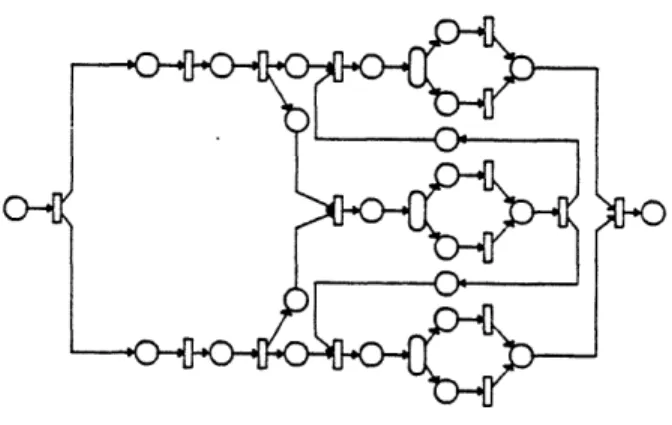
may be set, enabling the creation of a child structure. The Design In the first session, the hierachical organization, Figure 5, is System has its own metafiles to store the graphics structure of the constructed. Al supernodes are identified and overall structure is
organization. simplified. Next the Analysis mode is invoked to identify the
structural properties of the net and the flow paths. Similarly the The second phase involves the construction of an alphanumeric parallel organization is constructed.
data structure for the organizational model by invoking the Text Editor. The data structure contains attributes which correspond to
Hierarchical Organization. The designer invokes the representations of places, transitions, switches, connector or
Graphics Editor from the Top Command Level. The Hierarchical supernodes in the graphics image. Attributes may include
architecture is created using two generic architectures. Both processing algorithms and delays for transitions, token capacity for
places, functional relations and probabilities for connectors, file names for subnets, comments, codes, etc.
The third phase involves the creation of an analytical data structure of the organizational model by enabling the Analysis mode. Data processing algorithms access the metafile, process its contents and generate the incidence matrix. The incidence matrix serves as an input to an algorithm which produces a matrix containing the minimal supports of S-invariants in the case of an Event graph. The minimal support matrix is used to determine the information flow paths of a Petri Net.
The fourth phase involves the production of a hard copy of the Petri Net graphical image of the organization as well as the information flow paths, by enabling the Hardcopy mode.
APPLICATIONS
Figure 5: Hierarchical Organization
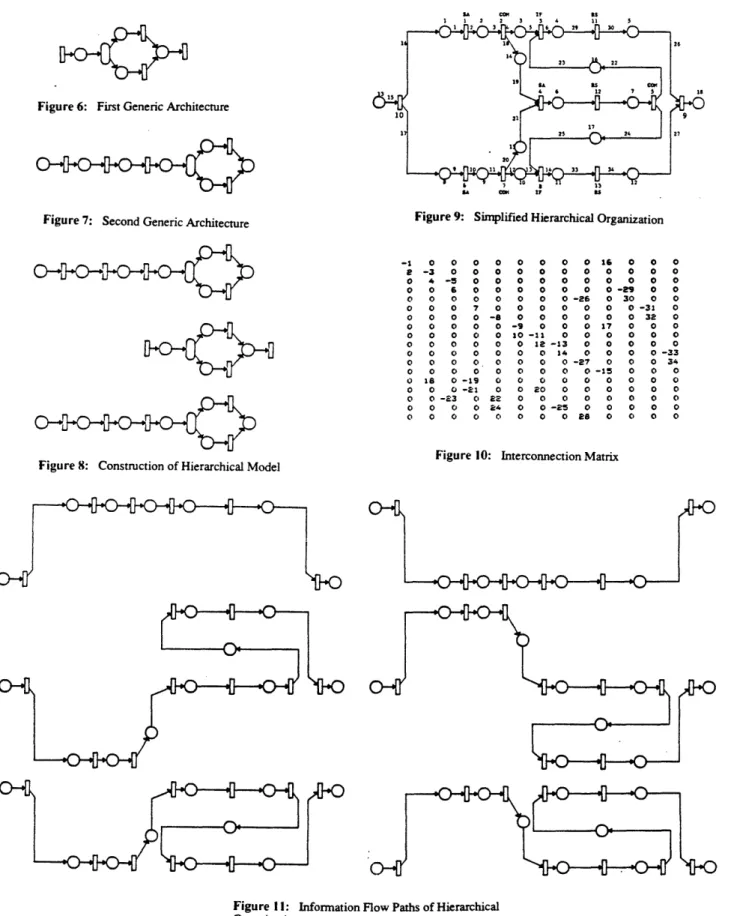
Two examples are presented to illustrate some of the graphical architectures are used as building blocks to compose the and analytical capabilities of the Design System. Two Petri Nets organization's frame. The first generic architecture, is the Petri Net each representing three decisionmakers of a DMO, one with representation of the four stage DM, see Figure 6. The RS stage is hierarchical and the other with parallel structure ares constructed. modeled by a 2-decision switch. The second generic architecture is The background information is introduced briefly and then the the Petri Net representation of a two stage DM, see Figure 7. The construction of the organization is shown according to the design two generic architectures are merged to create a single structure, methodology presented earlier. Both decisionmaking organizations see Figure 8. Elements are selected from the Graphics Commands implement an air defence task (Andreadakis and Levis, 1987). In Menu to complete the structure, Figure 5. The RS stage of each of the hierarchical organization, the airspace is divided into two the three DMs is a switch with two switch settings and can be sectors and each sector is assigned to one decisionmaker. A center modeled as a supemode using the coarsen command. The designer region is defined that straddles the two sectors and a supervisor is specifies the boundaries of the candidate supemode. The introduced, which does not observe the airspace directly, but aggregated structure is shown in Figure 9.
Figure 6: First Generic Architecture (} P
10 ) 31 I n 9
W. 1 as
Figure 7: Second Generic Architecture Figure 9: Simplified Hierarchical Organization
-1 0 0 0 0 0 0 0 0 16 0 0 0 I -3 0 0 0 03 0 0 0 0 0 0 0 0 4 -5 0 0 0 0 0 0 0 0 0 0 C_ ' "*O~O 0 6 0 0 0 0 0 0 0-29 0 0 0 0 0 0 0 0 0 0-26 0 30 0 0 0 0 0 7 0 0 0 0 0- 0 0-31 0 0 0 0 0 -0 0 0 0 0 0 0 32 0 0 0 0- O 0 -9 0 0 0 17 0 0 0 0 0 3 0 2 O - 11 0 0 0 0 0 0 0 0 0 0 0 0 0 0 -27 0 0 0 34 0 0 0 0 0 0 0 0 0 -15 0 0 0
Figure 8: Construction of Hierarchical Model 0 0 o o o 0 20 o o 0 o o0 0 o 0
c- 3c--1c+~ 0 0 0 0 a o 0 o 08 0 0 0 0
r
n
n
.
O O1O 0e O O O O O
Figure 10: Interconnection Matx Figure 8: Construction of Hierarchical Model
Figure I 1: Information Flow Paths of Hierarchical Organization
-6-Next, the Analysis mode is invoked. The interconection matrix CONCLUSIONS is generated by invoking the matrix command and is shown in
Figure 10. The coarsened Petri Net representation of the The Petri Net Software System is used for the graphical and hierarchical organization is an marked graph and the minimal analytical description of DMO architectures. The System has four
supports are computed, using the s-inv command. Then, the modes of operation: A Graphics Editor, a Text Editor, a Structural
information flow paths can be displayed upon user's request, see Analysis and a Hardcopy mode. The Graphics Editor mode
Figure 11. capabilities enable the construction and modification of
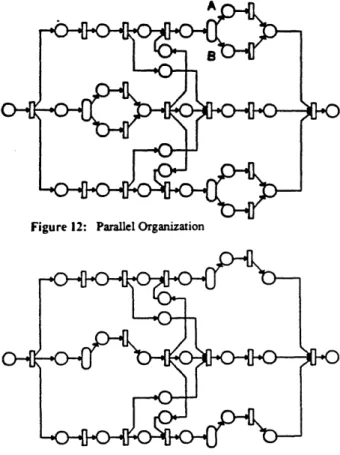
organizational architectures. In Graphics mode the designer may Parallel Organization. The Petri Net representation of the coarsen or refine a structure, may merge generic architectures to parallel organization is constructed in a similar fashion. The same form an aggregate structure, may copy subnets and may generate generic architectures used in the construction of the hierarchical the family tree of an organization by implementing different organization are used. The Petri Net shown in Figure 12 has combinations of switch settings. The Text Editor mode provides decision switches. It has three switches with two switch settings attribute management. The Structural Analysis mode provides the each. In the hierarchical case, the decision switch and its possible tools for analysis. The Hardcopy mode produces output on a printer paths were modeled as a supemode. In the parallel case a switch or plotter. The System may be used as the front end in a
setting is selected and a particular decision strategy is implemented, simulation. by invoking the switch command. The selection of switch setting is
done by the System if the proper information (probability assigned to each connector) is stored in the connector attribute text file. If the
probability of instantiating path A is greater than the probability of This work was carried out at the Laboratory for Information instantiating path B, then path A is selected. If such information and Decision Systems, Massachusetts Institute of Technology, with does not exist, then the settings are selected by the designer. The support by the Basic Research Group of the Technical Panel on C3 structure created after all settings are set is stored in a file and is of the Joint Directors of Laboratories through the office of Naval
shown Figure 13. Research under contract No. N00014-85-K-0782.
REFERENCES
Alaiwan, H. and J.M. Toudic (1985). Recherche des Semi-Flots, des Verrous et des Trappes dans les Reseaux de Petri. Technique et Science Informatiques, 1985, 4(1), 103-112. Dunod, France.
Andreadakis, S.K. (1988). Analysis and Synthesis of Decision-Making Organizations. PhD thesis, MIT, 1988. Laboratory for Information and Decision Systems, Cambridge, MA. Andreadakis A.K and A.H. Levis (1987). Accuracy and Timeliness
in Decision-Making Organizations. Technical Report LIDS-P-1650, MIT, 1987. Laboratory for Figure 12: Parallel Organization Information and Decision Systems, Cambridge, MA.
Grevet, J.L. (1988). Decision Aiding and Coordination in Decision-Making Organizations. Master's thesis, MIT, 1988. Laboratory for Information and Decision Systems, Cambridge, MA.
Hillion, H.P. (1986). Performance Evaluations of Decision Making Organizations Using Time Petri Nets. Master's thesis, MIT, 1986. Laboratory for Information and Decision Systems, Cambridge, MA.
Kyratzoglou, M.I. (1987). Computer Aided Design for Petri Nets. Master's thesis, MIT, 1987. Laboratory for Information and Decision Systems, Cambridge, MA.
Levis A.H. (1984). Information Processing and Decisionmaking Organizations: A Mathematical Description. Large Scale Systems, 1984, 7, 151-163.
Memmi, G. and G. Roucairol (1979). Lecture Notes in Computer Science. Volume 84: Linear Algebra in Net Theory. In Net Theory and Application, Hamburg, FRG: Springer Verlag,
1979.
Peterson, J.L. (1981). Petri Net Theory and the Modeling of Systems. Englewood Cliffs, New Jersey:Prentice Hall, 1981. Ramchandani, C. (1974). Analysis of Asynchronous Concurrent
Systems by Timed Petri Nets. PhD thesis, MIT, 1974. Laboratory for Computer Science, Cambridge, MA.
Sifakis, J. (1978). Lecture Notes in Computer Science. Volume 64: Structural Properties of Petri Nets. In Mathematical Foundations of Computer Science, Berlin, FRG: Springer Verlag, 1978.
Tabak, D. and A.H. Levis (1985). Petri Net Representation of Decision Models. IEEE Transactions on Systems, Man and Cybernetics, 1985, SMC-15(6), 812-818.