HAL Id: inria-00336641
https://hal.inria.fr/inria-00336641
Submitted on 4 Nov 2008
HAL is a multi-disciplinary open access
archive for the deposit and dissemination of
sci-entific research documents, whether they are
pub-lished or not. The documents may come from
teaching and research institutions in France or
abroad, or from public or private research centers.
L’archive ouverte pluridisciplinaire HAL, est
destinée au dépôt et à la diffusion de documents
scientifiques de niveau recherche, publiés ou non,
émanant des établissements d’enseignement et de
recherche français ou étrangers, des laboratoires
publics ou privés.
Modelling Attacker’s Knowledge for Cascade
Cryptographic Protocols
Nazim Benaissa
To cite this version:
Nazim Benaissa. Modelling Attacker’s Knowledge for Cascade Cryptographic Protocols. First
Inter-national Conference on Abstract State Machines, B and Z - ABZ 2008, Sep 2008, London, United
Kingdom. pp.251-264, �10.1007/978-3-540-87603-8_20�. �inria-00336641�
Modelling Attacker’s Knowledge
for Cascade Cryptographic Protocols
Nazim Bena¨ıssa⋆
Universit´e Henri Poincar´e Nancy 1 [email protected]
LORIA BP 239
54506 Vandœuvre-l`es-Nancy France
Abstract. We address the proof-based development of cryptographic protocols satisfying security properties. Communication channels are sup-posed to be unsafe. Analysing cryptographic protocols requires precise modelling of the attacker’s knowledge. In this paper we use the event B modelling language to model the knowledge of the attacker for a class of cryptographic protocols called cascade protocols. The attacker’s be-haviour conforms to the Dolev-Yao model. In the Dolev-Yao model, the attacker has full control of the communication channel, and the crypto-graphic primitives are supposed to be perfect.
key-words:cryptography, model for attacker, formal methods
1
Introduction
Proving properties such as secrecy or authentication on cryptographic protocols is a crucial point. A protocol satisfies a secrecy property if it is able to prevent the attacker from learning the content of a secret message intended for other users. By authentication we mean that an attacker can not mislead other honest agents about his identity. To be able to prove such properties on a protocol, we must be able to model the knowledge of the attacker. One popular model of attacker’s behaviour is the Dolev-Yao model [6]; this model is an informal description of all possible behaviours of the attacker as described in section 2. In this paper we present an event B [1, 2, 4] model of the attacker for a class of cryptographic protocols called cascade protocols and we prove the secrecy property on it. Our work is based on that of Dolev-Yao [6] where they gave a characterization of secure cascade protocols, but proofs in their work were done by hand.
Proving properties on cryptographic protocols such as secrecy is known to be undecidable. However research involving formal methods for the analysis of security protocols has been carried out. Theorem provers or model checkers are
⋆This work was supported by grant No. ANR-06-SETI-015-03 awarded by the Agence
usually used for proving. For model checking, one famous example is Lowe’s ap-proach [7] using the process calculus CSP and the model checker FDR. Lowe discovered the famous bug in Needham-Schroeder’s protocol. Model checking is efficient for discovering an attack if there is one, but it can not guarantee that a protocol is reliable. Many other works are based on theorem proving: Paul-son [10] used an inductive approach to prove safety properties on protocols. He defined protocols as sets of traces and used the theorem prover Isabelle [9]. Other approaches, like Bolignano [3], combines theorem proving and model checking taking general formal method based techniques as a framework.
We summarize the organisation of the paper: in section 2, we present the Dolev-Yao attacker model. We then present the class of cascade protocols and the characterisation of secure protocols with respect to the secrecy property. The event B model of the attacker is given in section 3 of the paper.
2
The Dolev-Yao Model
In Dolev-Yao’s model, cryptographic primitives are assumed to be black boxes satisfying given properties. The most important property is that the only way to obtain the plaintext M from the cipher text K(M ), where K is an encryption key, is to know the reverse key of K. In the Dolev Yao model, the attacker has full control of communication channels. He can intercept and remove any message from the channel, split unencrypted messages and decrypt parts of the message if he has the appropriate key. The attacker can also generate an infinite number of messages. All agents can be involved in an unlimited number of protocol instances, and interleaving of protocol instances have to be considered.
2.1 The Dolev-Yao Model for Cascade Protocols
Cascade protocols are a simple class of public protocols in which the agents in-volved in the protocol can apply several layers of encryption or decryption of messages. The encryption-decryption is made by using only public key opera-tors. Dolev-Yao developed a model specifying the syntax of this class of protocols. Let S be a set of symbols, we use S∗to denote the set of all finite sequences
over S. Let E and D be respectively the set of encryptions and decryption keys of all the agents. If X is an agent, then his encryption key Ex and decryption
key Dx are two functions mapping from {0, 1}∗ into {0, 1}∗. These functions
satisfy the basic properties of the public key protocols: ExDx= DxEx= id, the
identity function. Dxis known only by the agent himself while Exis public and
available in a key server.
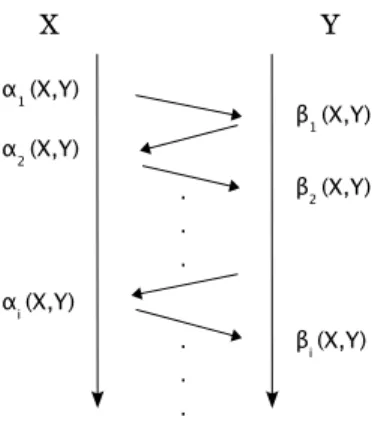
Here is a short description of the Dolev-Yao model for cascade protocols (see [6] for detailed information). As shown in figure 1, a two party cascade protocol in the Dolev-Yao model is specified by a series of finite strings:
– βi(X, Y ) ∈ {Ey, Dy, Ex}∗, 1 ≤ i ≤ t′ with t′= t or t − 1 X Y α 1 (X,Y) α2 (X,Y) β2 (X,Y) β1 (X,Y) . . . α i (X,Y) β i (X,Y) . . .
Fig. 1.A cascade protocol between two agents X,Y
When an agent X wishes to transmit a plaintext message M to another agent Y, the exchanged message has the following form: Nk(X, Y )M , where 1 ≤ k ≤
t + t′ and:
– N1(X, Y ) = α1(X, Y ),
– N2j(X, Y ) = βj(X, Y )N2j−1(X, Y ), 1 ≤ j ≤ t′,
– N2i+1(X, Y ) = αi+1(X, Y )N2i(X, Y ), 1 ≤ i ≤ t − 1.
An attacker Z is supposed to be able to intercept any exchanged message between two agents X and Y, a cipher message Nk(X, Y )M with (k = 1, 2....),
and will try to obtain the plaintext message M by applying different operators from one of three following categories:
1. E ∪ {Dz}, E is known by all agents, and Dz is the attacker decryption key.
2. βi(X, Y ) f or all X 6= Y and i ≥ 1, even if the attacker does not know
βi(X, Y )’s value, he can start a transmission with any agent Y claiming
himself to be agent X. He can then send any message Msg to Y in the (2i−1)st message and wait for Y ’s answer. He will then get βi(X, Y ) applied
to his message Msg.
3. αi(X, Y ) f or all X 6= Y and i ≥ 2, in this case the attacker does not know
the value of αi(X, Y ) but he may wait for X sending a message to Y , he can
intercept Y ’s reply and prevent it from reaching X. He can then send any message to X claiming himself to be Y with his own message Msg and wait for the reply from X with αi(A, B) applied to Msg.
As a result, the attacker will try to obtain the plaintext Message M from a cipher message Nk(X, Y )M with (k = 1, 2....) by applying operators from these
three categories even if the he does not know the value of αi(X, Y ) or βi(X, Y )
2.2 Secure Cascade Protocols in the Dolev-Yao Model
We give here two definitions from the Dolev-Yao model followed by the charac-terization of secure cascade protocol:
Definition 1. Let π ∈ (E ∪ D)∗ be a string andA be a user name. We say that
π has the balancing property with respect to A if the following statement holds:
if DA∈ symb(π) then EA∈ symb(π)1
Definition 2. LetX,Y be two distinct user names. A two party cascade protocol
is a balanced cascade protocol if
1. for everyi ≥ 2, αi(X, Y ) has the balancing property with respect to X, and
2. for everyj ≥ 1, βj(X, Y ) has the balancing property with respect to Y .
And the main result of the Dolev-Yao model is the following theorem. Theorem 1. LetX,Y be two distinct user names. A two-party cascade protocol
is secure if and only if
1. symb(α1(X, Y )) ∩ {Ex, Ey} 6= ∅, and
2. the protocol is balanced.
After presenting the Dolev-Yao attacker model and the cascade protocols, we give in the next section an event B model of the attacker and prove on this model that if a cascade protocol is balanced then the secrecy property holds on this protocol.
3
Modelling the Attacker
First we give the static part of the model, the basic carrier sets are the following - Msg: Set of all possible messages exchanged in the system.
- agent: Set of all agents including attackers.
We also define the set of encryption and decryption keys, respectively E and D. Two total injective functions EA, DA associate keys to their owners. Obviously, two different agents can not have the same encryption or decryption keys.
SETS M sg agent AXIOMS axm1 : D ⊆ M sg → M sg axm2 : DA ∈ agent D axm3 : E ⊆ M sg → M sg axm4 : EA ∈ agent E
The attacker is an agent among others, he has his own encryption and decryption key: axm5 : Z ∈ agent axm6 : Dz ∈ D axm7 : DA(Z) = Dz axm8 : Ez ∈ E axm9 : EA(Z) = Ez
Cryptographic primitive are supposed to be perfect and only the decryption key of an agent can be used to decrypt a message encrypted with his encryption key, this is modeled by the use of sequences and the reduction operation over the sequences.
3.1 Key Sequences
In cascade protocols, agents may apply more than one key on a message they received. A possible modelling of encryptions where several keys are applied is the use of function composition. If X and Y are two agents, (DA(X ); EA(Y ))(Msg) is an encryption with two keys DA(X ) and EA(Y ). The problem with using function composition is that it has no memory, and it is therefore not possible to write properties on the structure of an encryption with more than one key. Thus, we use sequences to model an encryption where several layers of keys are used. For example, if X and Y are two agents, [EA(X ), DA(Y ), EA(X )] is an encryption sequence where EA(X ) is first applied, and is followed by DA(Y ) and EA(X ).
When an encryption key of an agent is immediately followed by a decryption key of the same agent in a sequence, this sequence can be reduced to a shorter sequence where both keys are removed. For example, if X and Y are two agents, [EA(X ), DA(X ), EA(Y )] can be reduced to [EA(Y )]. Formally, we model the reduction relation as the smallest relation that satisfies:
axm10 : reduction ∈ (N 7→ D ∪ E) ↔ (N 7→ D ∪ E) axm11 : ∀seq1, seq2, i, j, k, A·
A∈ agent∧
i .. j⊆ N ∧ k ∈ i .. j ∧ k + 1 ∈ i .. j∧ seq1 ∈ i .. j → D ∪ E∧
seq1(k) = DA(A) ∧ seq1(k + 1) = EA(A)∧ seq2 ∈ i .. j − 2 → D ∪ E∧
seq2 = i .. j − 2 ⊳ (seq1 ⊳− {l 7→ m|l ∈ k .. j − 2 ∧ m = seq1(l + 2)}) ⇒
seq1 7→ seq2 ∈ reduction
In the previous axiom, we considered the case of a decryption key followed by an encryption key. We added a similar axiom for the case where an encryption key is followed by a decryption key.
To guaranty that reductions are made only between the encryption and de-cryption key of the same agent, the injectivity of the functions DA and EA is not sufficient and it is necessary to be sure that an encryption key of an agent is not used as a decryption key of another agent.
axm12 : ran(EA) ∩ ran(DA) = ∅
We emphasize that since we use the reduction relation, it is not necessary to have the following property on agents keys:
axm13 : ∀A·A ∈ agent ⇒ (DA(A); EA(A)) = id(M sg)
It may be possible to apply several reductions iteratively over a sequence. Thus, the reduction relation needs to be applied iteratively. We use a relation Rep similar to the one used by Cansell and M´ery in [5]. Rep behaves like a repeat-until loop, it captures the idea of repeating a relation on a set as long as it is possible to apply the relation. A pair (seq1 , seq2 ) is in Rep if either seq1 /∈ dom(reduction) and seq1 = seq2 or seq1 ∈ dom(reduction) and there is a path over reduction leading to seq2 /∈ dom(reduction). Formally, Rep is the smallest relation that satisfies:
axm14 : N otDOM AIN = id(N 7→ D ∪ E) \ id(dom(reduction)) axm15 : Rep ∈ (N 7→ D ∪ E) ↔ (N 7→ D ∪ E)
axm16 : Rep = N otDOM AIN ∪ (reduction; Rep)
When no more reductions are possible, we say that the sequence is in the normal
form. Formally, the normal form is modeled as follows:
axm17 : N orm ∈ ((N 7→ D ∪ E) → (N 7→ D ∪ E)) axm18 : N orm ⊆ Rep
If the normal form of a sequence seq equals the empty set, it means that the composition of all encryption and decryption keys contained in the sequence equals the identity function and we can obtain the plain text M from seqM .
seq Ai and seq Bj are two sets containing sequences of encryption or de-cryption keys. If X and Y are two agents involved in a protocol run, seq Ai contains all sequences of keys applied in each step of the protocol by agent X, seq Bj contains those applied by Y. Each sequence contained in one of these sets matches with an αi(X, Y ) or βj(X, Y ) defined in the Dolev-Yao model.
axm19 : seq Ai ⊆ N 7→ D ∪ E axm20 : seq Bj ⊆ N 7→ D ∪ E axm21 : ∀seq·seq ∈ (seq Ai ∪ seq Bj)
⇒ (
∃X, Y ·X ∈ agent ∧ Y ∈ agent ∧ X6= Y ∧
ran(seq) ⊆ {DA(X), EA(X), EA(Y )} )
The protocol has to be balanced (see definition 2), thus for each sequence from the sets seq Ai and seq Bj the following axioms holds:
axm22 : ∀X, seq·X ∈ agent ∧ seq ∈ seq Ai ∧
DA(X) ∈ ran(seq) ⇒ EA(X) ∈ ran(seq) axm23 : ∀Y, seq·Y ∈ agent ∧ seq ∈ seq Bj ∧
DA(Y ) ∈ ran(seq) ⇒ EA(Y ) ∈ ran(seq)
We emphasize the particular case of the first step of the protocol that is not concerned by the previous axiom22. We define a set seq A1 containing the se-quences corresponding to the first step of the protocol. It is not mandatory for sequences from this set to satisfy the balancing property, but they should at least contain one encryption key as stated in the Dolev-Yao characterization of secure protocols (see theorem 1):
axm24 : seq A1 ⊆ N 7→ D ∪ E axm25 : ∀seq·seq ∈ seq A1
⇒ (
∃X, Y ·X ∈ agent ∧ Y ∈ agent ∧ X6= Y ∧
ran(seq) ⊆ {DA(X), EA(X), EA(Y )} ∧ ran(seq) ∩ {EA(X), EA(Y )} 6= ∅ )
3.2 Variables
We use a variable seq Atk to model the structure of the messages that the at-tacker can obtain through applying his own keys or applying different sequences from the sets seq Ai and seq Bj. We also use a variable size containing the size of the sequence seq Atk and a variable a1 that memorizes the size of the sequence from the set seq A1 used in the first step of the current protocol instance.
VARIABLES seq Atk size a1 INVARIANTS inv1 : size ∈ N1 inv2 : a1 ∈ N1
inv3 : seq Atk ∈ 1 .. size → D ∪ E
We emphasize that the variable seq Atk does not contain the plain text message M , but only the sequence of public key operators that may be applied by the attacker. Thus, in order to prove that the protocol satisfies the secrecy property, we must prove that the normal form of the sequence seq Atk is never equal to the empty set. If the normal form of a sequence equals the empty set, it means that the composition of all encryption and decryption keys contained in the sequence equals the identity function and the attacker can obtain the plaintext M .
thm2 : N orm(seq Atk) 6= ∅
3.3 Events
The attacker can intercept any message exchanged between two agents. When a honest agent initiates a transaction with another agent, he first applies to the plain text message M a sequence from the set seq A1 (first step of the protocol). The two agents apply then alternately sequences from seq Ai and seq Bj. Mes-sages exchanged between agents have the form ”(seq Ai ∪ seq Bj)∗seq A1 M ”,
M is the plaintext message. After intercepting the cipher message ”(seq Ai ∪ seq Bj)∗seq A1 M ”, the attacker applies different sequences from the set seq Ai ∪
seq Bj ∪ E ∪ {Dz}. Accordingly, there is no need to model explicit message
interception by the attacker, it is enough to initialize the variable seq Atk with a sequence from the set seq A1 and add events that model the concatenation of seq Atk with all possible sequences:
- Initialization of seq Atk with a sequence from seq A1.
- Event Attack seq Ai: concatenation of seq Atk with a sequence from seq Ai. - Event Attack seq Bj: concatenation of seq Atk with a sequence from seq Bj. - Event Attack E: concatenation of seq Atk with a sequence from E.
- Event Attack Dz: concatenation of seq Atk with Dz.
These concatenations are done by some honest agent before the message is in-tercepted or by the attacker himself after intercepting the cipher message.
In order to write the appropriate events, we need to have tools that let us manipulate sequences such as concatenation or subsequences. In our model we use a modified form of the relation match introduced by Jean Raymond Abrial in the Earley algorithm model. We modified this relation to adapt it to our case study:
axm26 : match ∈ (N 7→ D ∪ E) ↔ (N 7→ D ∪ E) axm27 : ∅ 7→ ∅ ∈ match
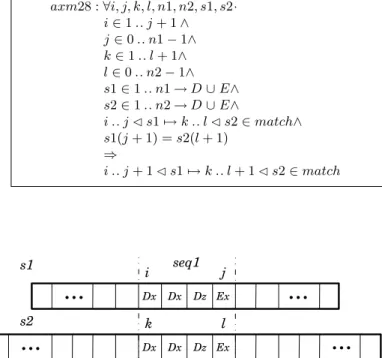
Unlike the equality, two sequences seq1 ∈ i..j → D ∪ E and seq2 : k ..l → D ∪ E may match if the order of the keys in the two sequences is the same even if their respective domains i..j and k..l are different (see example in figure 2).
axm28 : ∀i, j, k, l, n1, n2, s1, s2· i∈ 1 .. j + 1 ∧ j∈ 0 .. n1 − 1∧ k∈ 1 .. l + 1∧ l∈ 0 .. n2 − 1∧ s1 ∈ 1 .. n1 → D ∪ E∧ s2 ∈ 1 .. n2 → D ∪ E∧ i .. j ⊳ s1 7→ k .. l ⊳ s2 ∈ match∧ s1(j + 1) = s2(l + 1) ⇒ i .. j+ 1 ⊳ s1 7→ k .. l + 1 ⊳ s2 ∈ match k l seq1
...
...
i j...
seq2...
Dx Dx Dz Ex Dx Dx Dz Ex s1 s2Fig. 2.The match relation
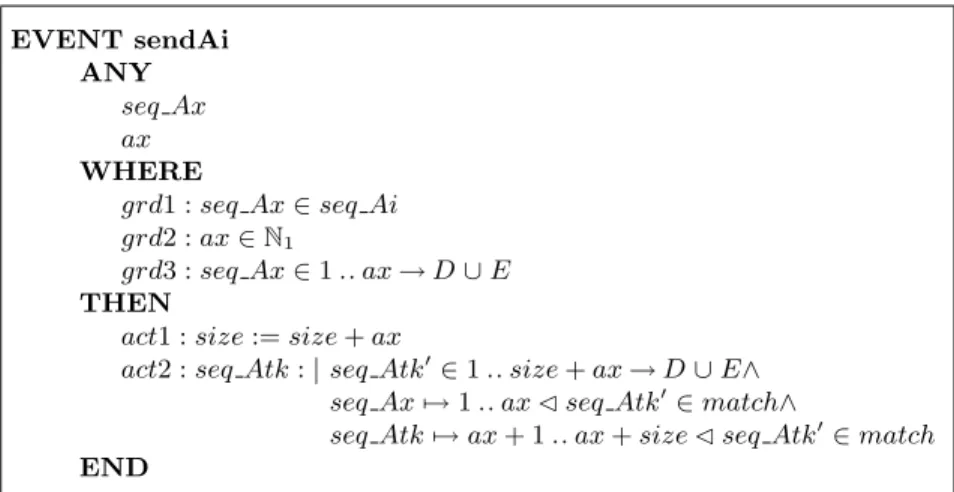
We also add a fixed point axiom saying that match is the smallest relation satisfying the axiom 28. Using match is convenient to express relations between sequences. For instance, to express the fact that a sequence seq1 is a subsequence of seq2 , it suffices to say that there are some i, j such that seq1 7→ i .. j ⊳ seq2 ∈ match. To express the fact that a sequence seq ∈ i..j → D ∪ E is the result of the concatenation of two sequences seq1 and seq2 , it suffices to say that there is some k such that seq1 7→ i..k ⊳seq ∈ match and seq2 7→ k +1..j ⊳seq ∈ match. Events have been added to the model to express all the attacker’s options. The following event shows the case of a sequence randomly chosen from the set seq Ai. This sequence is concatenated with the attacker sequence seq Atk, the variable size is also increased.
EVENT sendAi ANY seq Ax ax WHERE grd1 : seq Ax ∈ seq Ai grd2 : ax ∈ N1 grd3 : seq Ax ∈ 1 .. ax → D ∪ E THEN
act1 : size := size + ax
act2 : seq Atk : | seq Atk′∈ 1 .. size + ax → D ∪ E∧
seq Ax7→ 1 .. ax ⊳ seq Atk′∈ match∧
seq Atk7→ ax + 1 .. ax + size ⊳ seq Atk′∈ match
END
Similar events are added to express all the other possibilities of the Dolev-Yao model. Since the attacker sequence is initialized with a sequence from the set seq A1, it will have two parts (as shown in figure 3). A part 1..size−a1⊳seq Atk that matches with a sequence from (seq Ai ∪ seq Bj ∪ E ∪ {Dz})∗, and a
part (size − a1) + 1 .. size ⊳ seq Atk that matches with a sequence from seq A1. It’s important to distinguish these two parts since, unlike sequences from the set seq Ai ∪ seq Bj, sequences from the set seq A1 do not satisfy the balancing
property.
...
...
1 size-a1
(size-a1)+1..size seq_Atk (matches with a sequence from seq_A1) 1..size-a1 seq_Atk
size
Fig. 3.The two parts of the attacker sequence
3.4 Invariant and Proofs
Proofs of the B model are inspired from the proofs given by Dolev and Yao in their model, but proofs of their models were done by hand and parts of their proofs were stated without being formally proved. Before introducing the main invariant of our model we first give definitions of some important properties over sequences that are necessary to state the invariant. A N orm(A)(seq) is the
normal form with respect to one agent A of a sequence seq, it is obtained by removing all possible subsequences [EA(A), DA(A)] or [DA(A), EA(A)].
axm29 : A N orm ∈ agent → ((N 7→ D ∪ E) → (N 7→ D ∪ E))
For example,
A Norm(X )([DA(Y ), EA(Y ), EA(X ), DA(X )]) = [DA(Y ), EA(Y )] We modeled A N orm similarly to N orm using a reduction relation where only keys from the appropriate agent are reduced.
In order to prove that the normal form of the attacker sequence never equals the empty set, we need to prove first that the sequence N orm(1 .. size − a1 ⊳ seq Atk) has the balancing property with respect to all agents except the attacker himself. We recall that it is not mandatory to have the balancing property for sequences from the set seq A1, this is why this property does not hold for the whole attacker sequence.
thm3 : ∀A·A ∈ agent ∧ A 6= Z∧
DA(A) ∈ ran(N orm(1 .. size − a1 ⊳ seq Atk)) ⇒
EA(A) ∈ ran(N orm(1 .. size − a1 ⊳ seq Atk))
But unfortunately this property is not an inductive invariant but only a theorem. As a counter example, let us consider the case where N orm(1 .. size − a1 ⊳ seq Atk) equals:
[DA(A), DA(Z ), EA(A), EA(Z ), DA(X ), EA(Y ), DA(A), DA(Y ), EA(X )] This sequence satisfies the balancing property. If the previous event sendAi is triggered with the local variable seq Ax = [DA(A), EA(Z ), EA(A)] (this se-quence satisfies the axioms 19 and 21), the new value of N orm(1 .. size − a1⊳seq Atk) will be: [EA(Z ), DA(X ), EA(Y ), DA(A), DA(Y ), EA(X )]. The new value does not satisfy the balancing property anymore. Thus we introduce a new property called A Balanced property of a sequence with respect to an agent A:
axm30 : A Balanced ∈ agent → P(N 7→ D ∪ E) axm31 : ∀A, seq, i, j ·seq ∈ i .. j → D ∪ E∧
i .. j⊆ N ∧ j ≥ i∧ (seq(i) ∈ D \ {DA(A)}∧ seq(j) ∈ D \ {DA(A)}∧
ran((A N orm(A))(i + 1 .. j − 1 ⊳ seq)) ∩ D ⊆ {DA(A)}∧ DA(A) ∈ ran((A N orm(A))(i + 1 .. j − 1 ⊳ seq))⇒
EA(A) ∈ ran((A N orm(A))(i + 1 .. j − 1 ⊳ seq))) ⇒
Intuitively, for an agent A, a sequence is A Balanced(A) means that if the first and last symbols of this sequence are decryption keys and if the A N orm(A) of this sequence contains only A decryption key in its range it should also contain A encryption key.
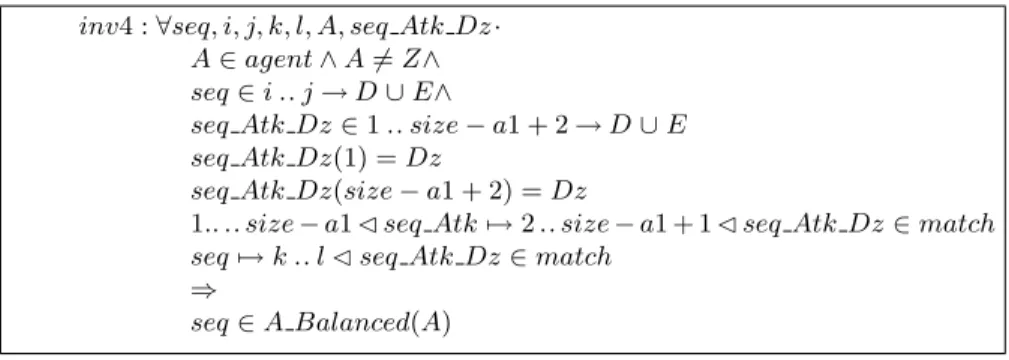
The main invariant of our model states that each subsequence of the sequence Dz(1 .. size − a1 ⊳ seq Atk) Dzhas the A Balanced property with respect to all
agents except the attacker.
inv4 : ∀seq, i, j, k, l, A, seq Atk Dz· A∈ agent ∧ A 6= Z∧ seq∈ i .. j → D ∪ E∧
seq Atk Dz∈ 1 .. size − a1 + 2 → D ∪ E seq Atk Dz(1) = Dz
seq Atk Dz(size − a1 + 2) = Dz
1.. .. size − a1 ⊳ seq Atk 7→ 2 .. size − a1 + 1 ⊳ seq Atk Dz ∈ match seq7→ k .. l ⊳ seq Atk Dz ∈ match
⇒
seq∈ A Balanced(A)
Let us consider the case of the event sendAi shown before. In this event, we concatenate a sequence from the set seq Ai to the sequence seq Atk to obtain seq Atk′ . We have then to prove that any subsequence seq of D
z (1 .. size −
a1 ⊳ seq Atk) Dz (there are some k, l such that seq 7→ k .. l ⊳ (Dz (1 .. size −
a1 ⊳ seq Atk′) D
z) ∈ match ) is A Balanced (see figure 4).
...
...
...
k l
1 ax+1
seq_Ax 1..size-a1 seq_Atk seq
Dz Dz
Fig. 4.A Balanced property has to be proved on seq
To achieve the proof, all possible cases of k..l values have to be considered (especially the values of k and l compared to the value of ax + 1), this is made easier by the use of the match relation. For each case it is necessary to prove that the concatenation of a sequence that has the balancing property with respect to an agent A with a sequence that has the A Balanced property with respect to A results on a sequence that has the A Balanced property with respect to A, since this has to be done with all events of the model, it was interesting to prove the following theorem:
thm4 : ∀seq, i, j, k, n, A·
A∈ agent ∧ seq ∈ 1 .. n → D ∪ E∧ i .. j⊆ 1 .. n ∧ k ∈ i .. j∧
A N orm(A)(i .. k ⊳ seq) = i .. k ⊳ seq∧
(DA(A) ∈ ran(i .. k ⊳ seq) ⇒ EA(A) ∈ ran(i .. k ⊳ seq))∧ (DA(A) ∈ ran(A N orm(A)(k + 1 .. j ⊳ seq))⇒
EA(A) ∈ ran(A N orm(A)(k + 1 .. j ⊳ seq))) ⇒
(DA(A) ∈ ran(A N orm(A)(i .. j ⊳ seq))⇒
EA(A) ∈ ran(A N orm(A)(i .. j ⊳ seq)))
The last step of our modelling is to prove theorem 2, that states that seq Atk never equals the empty set, from the theorem 3 that states that the sequence N orm(1 .. size − a1 ⊳ seq Atk) has the balancing property with respect to all agents other than the attacker. To prove this result, we do a proof by case on the structure of seq = size − a1 + 1 .. size ⊳ seq Atk (the part of the attacker sequence that matches with the first step of the protocol). According to axiom 23, there are two agents X,Y such that ran(seq) ⊆ {DA(X ), EA(X ), EA(Y )} and ran(seq) ∩ {EA(X ), EA(Y )} 6= ∅. We give here a sketch of the proof: By contradiction, suppose that the normal form of seq Atk equals the empty set, two case are possible:
1. EA(Y ) ∈ ran(seq): since DA(Y ) /∈ ran(seq), the only way to obtain the empty set in the normal form of the whole sequence seq Atk is that the re-minder part N orm(1 .. size − a1 ⊳ seq Atk) contains DA(Y ) but not EA(Y ). This is impossible because of the balancing property of this part of the at-tacker sequence.
2. The other case is done in a similar way.
Proving these invariants and theorems requires intensive use of operators over sequences. The axiom defining the relation match given before is not convenient in our case, that’s why we introduced several theorems over this relation such as identity, reflexivity and transitivity properties to make proofs easier. Here follows an example of one of these theorems:
thm5 : ∀seq1, seq2, k, i1, i2, j1, j2· seq1 ∈ i1 .. j1 → D ∪ E∧ seq2 ∈ i2 .. j2 → D ∪ E∧ k∈ 0 .. j1 − i1∧
seq1 6= ∅ ∧ seq2 6= ∅∧ seq1 7→ seq2 ∈ match ⇒
seq1(i1 + k) = seq2(i2 + k)
To prove this theorem we used induction over the size of the sequence. These theorems are not specific to this model, thus they can be reused later in similar
protocol models. We used the Rodin platform [8] for modelling and proving our attacker model. 10 theorems were proved interactively on the match relation. 25 proofs generated by the prover for the invariants of the model, 13 were done automatically. Interactive proofs were not difficult except proofs of the main invariant 4 of the model that were long because of the high number of the cases that had to be considered.
4
Conclusion
We have written in this paper a B model of the attacker for a class of cryp-tographic protocols. Events of our model take into account all the options the attacker can perform in the Dolev-Yao model. Unlike the original Dolev-Yao’s model for cascade protocols, proofs were mechanized. Accordingly, all constraints on the attacker’s model have to be stated explicitly, and some of the constraints were added later during the proving process. Proofs of our model were made easier by the use of the match relation and by the theorems we have proved over this relation. These theorems can be reused in future developments. The next step will be modelling attackers for more complex classes of protocols and to study how attacker models can be integrated into the complete protocol model. Acknowledgements Thanks are due to Jean Raymond Abrial for his advice on modelling cryptographic protocols. We also thank Dominique Cansell and Dominique M´ery for their help and suggestions.
References
1. J.-R. Abrial. The B book - Assigning Programs to Meanings. Cambridge University Press, 1996.
2. Dines Bjørner and Martin C. Henson, editors. Logics of Specification Languages. EATCS Textbook in Computer Science. Springer, 2007.
3. Dominique Bolignano. Integrating proof-based and model-checking techniques for the formal verification of cryptographic protocols. In CAV, pages 77–87, 1998. 4. Dominique Cansell and Dominique M´ery. The event-B Modelling Method: Concepts
and Case Studies, pages 33–140. Springer, 2007. See [2].
5. Dominique Cansell and Dominique M´ery. Incremental parametric development of greedy algorithms. Electr. Notes Theor. Comput. Sci., 185:47–62, 2007.
6. D. Dolev and A. Yao. On the security of public key protocols. Information Theory,
IEEE Transactions on, 29(2):198–208, Mar 1983.
7. Gavin Lowe. Breaking and fixing the needham-schroeder public-key protocol using fdr. In TACAS, pages 147–166, 1996.
8. Christophe Metayer, Jean-Raymond Abrial, and Laurent Voisin. Event-B language. RODIN Project Deliverable D7, May 2005.
9. Lawrence C. Paulson. Isabelle - A Generic Theorem Prover (with a contribution
by T. Nipkow), volume 828 of Lecture Notes in Computer Science. Springer, 1994.
10. Lawrence C. Paulson. The inductive approach to verifying cryptographic protocols.