HAL Id: tel-03125757
https://tel.archives-ouvertes.fr/tel-03125757
Submitted on 29 Jan 2021
HAL is a multi-disciplinary open access
archive for the deposit and dissemination of
sci-entific research documents, whether they are
pub-lished or not. The documents may come from
teaching and research institutions in France or
abroad, or from public or private research centers.
L’archive ouverte pluridisciplinaire HAL, est
destinée au dépôt et à la diffusion de documents
scientifiques de niveau recherche, publiés ou non,
émanant des établissements d’enseignement et de
recherche français ou étrangers, des laboratoires
publics ou privés.
Privacy and Security in a B2B environment : Focus on
Supplier Impersonation Fraud Detection using Data
Analysis
Rémi Canillas
To cite this version:
Rémi Canillas. Privacy and Security in a B2B environment : Focus on Supplier Impersonation Fraud
Detection using Data Analysis. Cryptography and Security [cs.CR]. Université de Lyon, 2020. English.
�NNT : 2020LYSEI118�. �tel-03125757�
N°d’ordre NNT : 2020LYSEI118
THÈSE de DOCTORAT DE L’UNIVERSITE DE LYON
opérée au sein de l’INSA de Lyon
Ecole DoctoraleN° 512
InfoMaths
Spécialité de doctorat : Informatique
Soutenue publiquement le 04/12/2020, par :
Rémi CANILLAS
Privacy and Security in a B2B environment:
Focus on Supplier Impersonation Fraud
Detection using Data
Analysis.
Devant le jury composé de :
RONCANCIO, Claudia Professeur ENSIMAG Rapporteure
GIANINI, Gabriele Associate Professor UNIMI Rapporteur
BOUCHENAK, Sara Professeur INSA-LYON Examinatrice, Présidente
CIMATO, Stelvio Associate Professor UNIMI Examinateur
AL BOUNA, Béchara Professeur Antonine UniversityExaminateur
BRUNIE, Lionel Professeur INSA-LYON Directeur de thèse HASAN, Omar Maître de conférence INSA-LYON Co-directeur
ii
Département FEDORA – INSA Lyon - Ecoles Doctorales – Quinquennal 2016-2020
SIGLE ECOLE DOCTORALE NOM ET COORDONNEES DU RESPONSABLE
CHIMIE CHIMIE DE LYON
http://www.edchimie-lyon.fr
Sec. : Renée EL MELHEM Bât. Blaise PASCAL, 3e étage
INSA : R. GOURDON
M. Stéphane DANIELE
Institut de recherches sur la catalyse et l’environnement de Lyon IRCELYON-UMR 5256
Équipe CDFA
2 Avenue Albert EINSTEIN 69 626 Villeurbanne CEDEX [email protected] E.E.A. ÉLECTRONIQUE, ÉLECTROTECHNIQUE, AUTOMATIQUE http://edeea.ec-lyon.fr Sec. : M.C. HAVGOUDOUKIAN [email protected] M. Gérard SCORLETTI École Centrale de Lyon
36 Avenue Guy DE COLLONGUE 69 134 Écully
Tél : 04.72.18.60.97 Fax 04.78.43.37.17
E2M2 ÉVOLUTION, ÉCOSYSTÈME, MICROBIOLOGIE, MODÉLISATION
http://e2m2.universite-lyon.fr
Sec. : Sylvie ROBERJOT Bât. Atrium, UCB Lyon 1 Tél : 04.72.44.83.62 INSA : H. CHARLES
M. Philippe NORMAND
UMR 5557 Lab. d’Ecologie Microbienne Université Claude Bernard Lyon 1 Bâtiment Mendel 43, boulevard du 11 Novembre 1918 69 622 Villeurbanne CEDEX [email protected] EDISS INTERDISCIPLINAIRE SCIENCES-SANTÉ http://www.ediss-lyon.fr
Sec. : Sylvie ROBERJOT Bât. Atrium, UCB Lyon 1 Tél : 04.72.44.83.62 INSA : M. LAGARDE
Mme Sylvie RICARD-BLUM
Institut de Chimie et Biochimie Moléculaires et Supramoléculaires (ICBMS) - UMR 5246 CNRS - Université Lyon 1
Bâtiment Curien - 3ème étage Nord 43 Boulevard du 11 novembre 1918 69622 Villeurbanne Cedex Tel : +33(0)4 72 44 82 32 [email protected] INFOMATHS INFORMATIQUE ET MATHÉMATIQUES http://edinfomaths.universite-lyon.fr
Sec. : Renée EL MELHEM Bât. Blaise PASCAL, 3e étage Tél : 04.72.43.80.46
M. Hamamache KHEDDOUCI Bât. Nautibus
43, Boulevard du 11 novembre 1918 69 622 Villeurbanne Cedex France Tel : 04.72.44.83.69
Matériaux MATÉRIAUX DE LYON
http://ed34.universite-lyon.fr
Sec. : Stéphanie CAUVIN Tél : 04.72.43.71.70 Bât. Direction [email protected] M. Jean-Yves BUFFIÈRE INSA de Lyon MATEIS - Bât. Saint-Exupéry 7 Avenue Jean CAPELLE 69 621 Villeurbanne CEDEX
Tél : 04.72.43.71.70 Fax : 04.72.43.85.28
MEGA MÉCANIQUE, ÉNERGÉTIQUE, GÉNIE CIVIL, ACOUSTIQUE
http://edmega.universite-lyon.fr
Sec. : Stéphanie CAUVIN Tél : 04.72.43.71.70 Bât. Direction [email protected] M. Jocelyn BONJOUR INSA de Lyon Laboratoire CETHIL Bâtiment Sadi-Carnot 9, rue de la Physique 69 621 Villeurbanne CEDEX [email protected] ScSo ScSo* http://ed483.univ-lyon2.fr
Sec. : Véronique GUICHARD INSA : J.Y. TOUSSAINT Tél : 04.78.69.72.76 [email protected] M. Christian MONTES Université Lyon 2 86 Rue Pasteur 69 365 Lyon CEDEX 07 [email protected]
Acknowledgment
The author of this thesis would like to thank
Foremost, the steady rock that was always here for me during this time of my life: Charlotte. Thank you so much for being so wonderful.
I would also like to thank my family (and her) for all their love and support. Thank you Mom, Dad, and Lilian, you are everything I have ever needed in a family and even more. Thank you Monique for all these wonderful times at Mérey, where I cannot wait to be back. Thank you Olivier and Alexis for the Sunday lunches and car rides. Thank you Raphaëlle and Clémentine for accepting me as if I was part of the family !
While I was away during the last moments of this thesis, I fondly remember the people that shared an office with me at the lab. So thank you Tarek Awwad, Mo-hamed Maouche, Rania Talbi, Paul Lachat, Christine Solnon, Frédérique Biennier, Sara Bouchenak, and Mohand-Saïd Hacid, for your insights, discussions, and support. Special thank goes to Romain Deville, that taught me much about the magic of soft-ware engineering and system administration. And he is also one hell of a climbing buddy, along with Julien !
I would also like to thank the members and colleagues at SiS-id, for keeping up with my ideas that must have sounded pretty crazy at the time. So thank you Laurent Sarrat, without you none of it would have been possible ! Also many thanks to Rémi Demont, François Agier, Kévin Lainte, Ezaline Descombes, Camille Godart, Sandy Hasni for working with me for the best part of three years. I would also like to thank my new colleagues at Prismea for their understanding and support in the last moments of this thesis: Stéphanie, Dorian, thank you so much !
Also, my regards go to the member of Lampray: Papachef, Yzalium, Mamy & Caiu (and Souricette), for all the creative times we shared, and being such good listen-ers to the never-ending flow of complaints that a good PhD thesis requires. Similarly, many thanks to Sarah Beaulieu for introducing me to the fantastic world of screen-writing and narration. Music & screen-writing helped me go through the darkest hours of my thesis.
Also a special note for all the people from #ligloo. Thank you for being so far away spatially, but close enough to offer me support. Caiu, Orangeade, clementinator, tiki, Sa8th, Emeraude, Blyste, PoissonRouge, Shaac, keep being so wholesome, and see you soon IRL !
Finally, last but not least, I would like to thank my PhD supervisors: Professor Lionel Brunie and Doctor Omar Hasan. Thank you for showing me what academic research was really about, and for all the other valuable lessons that you imparted to me, that helped me shape my perceptions and my goals for the future.
The wonderful people that impacted my life during this thesis are so numerous to be listed integrally, so, to all of you, from the bottom of my heart, thank you !
Extended Abstract
Supplier Impersonation Fraud (SIF) is a special type of fraud occurring in a Business-to-Business context, occurring when a company supplying goods and services to an-other company is impersonated by a fraudster in order to trigger a payment to an illegitimate bank account owned by the fraudster. While this type of fraud has been a threat for numerous years, the democratization of digitized B2B transactions and the increase of interconnection between companies through the wide adoption of the Internet have made the task of detecting and leveraging SIF harder and harder. Tra-ditionally, fraud detection has been handled by a team of investigators, or automated expert systems. However, if the current trend in business digitalization holds, the num-ber of transactions to investigate will soon exceed the capacity of human-based fraud detection. Thus, the need for automated fraud detection systems arises. Early auto-mated fraud detection systems are expert systems, based on a set of rules hard-coded by human developers using expert knowledge. Such systems, while mitigating the issues of the number of frauds, are unable to cope with the second major issue intro-duced by the extensive digitization of B2B trades: the dynamic and rapidly changing nature of frauds. Rule-based automated systems still require extensive human inputs to adapt to new frauds and maintain reliable performances through time, and this cost appears prohibitive when many frauds occur, or when the frauds evolve rapidly. Fi-nally, due to the confidential nature of SIF and the specificity of the B2B ecosystem in which it takes place, there isn’t any publicly available formalized framework address-ing SIF detection is available, and thus no collaborative effort between companies can take place, as each company wants to protect its expertise in fraud detection from both fraudsters and competitors.
In this thesis, we propose two fraud detection systems based on data analysis as a way to address the issues described above. We first introduce a comprehensive anal-ysis framework for SIF detection systems, and postulate the bank account used for a payment is a distinguishing feature indicating fraud. We then propose two data-driven systems to perform SIF detection: ProbaSIF that uses Bayesian theory, and GraphSIF that relies on graph theory. Each of them uses the historical transactions conducted by companies in order to construct a model of a companys legitimate payment behavior, and then compares targeted transactions to these models in order to assert their legit-imacy. As no reliably labeled dataset of legitimate and fraudulent transactions exist, the data models are constructed in an unsupervised fashion. This kind of unsupervised detection system is called Anomaly Detection, as the aim is to assert if a suspicious transaction is abnormal or normal with respect to the usual transactions performed by a company. These two systems are built using traditional Machine Learning processes. First, a training phase is performed, where the historical transactions are used to com-pute a model, and then a testing phase is conducted in order to assert the legitimacy of each targeted transaction.
The thesis is organized as follows: first, we introduce a comprehensive overview of the B2B transaction process, where client companies and supplier companies ex-change payments in for goods and services. We then focus on the definition of a transaction and its different components. We describe the concept of Supplier Imper-sonation Fraud, using scenarios based on real-life fraud attempts, in order to formalize
Supplier Impersonation Fraud detection and mitigation, and the dataset they provide to create data-driven fraud detection systems.
We then introduce ProbaSIF, a SIF detection system that uses probabilistic the-ory and Bayesian inference to assert the legitimacy of a B2B transaction. ProbaSIF compute the probability of an account to be used by a specific client to pay a specific supplier, and assert the legitimacy of a transaction by comparing the account used with the probabilities. ProbaSIF is proposed with two distinct models: one that focuses on the account’s probability to be used to pay a specific supplier by a specific client, and the other that aggregates this probability over all the clients involved with this supplier, thus representing an account’s probability to be used to pay a supplier based on the collaborative knowledge of all the clients. We show that ProbaSIF is faster than SiS-id expert system when classifying transactions, and that its results in terms of anomalous frauds are consistent with the expert systems. We also show that the collaborative data of more clients allows to prevent false positives.
GraphSIF, the second SIF detection system that we propose, aims to infer knowl-edge from the relational properties created by the transactions of a company. First, a sequence of graphs modeling the links between companies and accounts is created by aggregating the transactions. It is called the behavior graph. A targeted transaction legitimacy is asserted by analyzing the patterns formed when it is added to the most recent graph of this sequence. Due to the potentially high number of patterns that can be found in the behavior sequence, a Self-Organizing Map is used to regroup graphs with similar patterns. The classification of a targeted transaction is performed by first clustering the graphs, and then comparing the similarity between the targeted transac-tions graph with the other graphs of its cluster. This approach introduces contextual features to SiS-id analysis. The model shows good efficiency in terms of computa-tional time needed to create the behavior sequence and to classify the transactions, but requires careful tuning for the performances to be consistent with expert knowledge.
Finally, we propose two directions in order to further the research on the topic of Supplier Impersonation Fraud. Firstly, a major drawback in the adoption of data-driven fraud detection system is that companies owning data are worried to share their data with third parties and potential competitors. In order to mitigate this risk, several solutions have been proposed to ensure the confidentiality of the data during transmis-sion and storage. However, maintaining the privacy of the data during data analysis remains a challenge. Providing privacy-preserving machine learning systems might provide the final tool needed to provide full confidentiality in supplier impersonation fraud detection. Secondly, sharing transactions and payments between a large number of companies allows the creation of a transaction map modeling the financial ecosys-tem in which these companies interact. The study of this map could yield interesting results not only for supplier impersonation fraud detection but also for economic and financial research.
Résumé
La fraude au fournisseur (Supplier Impersonation Fraud, SIF) est un type de fraude se produisant dans un contexte Business-to-Business (B2B), où des entreprises et des commerces interagissent entre eux, plutôt qu’avec le consommateur. Une fraude au fournisseur est effectuée lorsqu’une entreprise (fournisseur) proposant des biens ou des services à une autre entreprise (client) a son identité usurpée par un fraudeur. Cette usurpation a pour but de récupérer le paiement d’une transaction légitime par le fraudeur. Bien que ce type de fraude ne soit pas récent, la démocratisation massive des transactions numériques a provoqué l’accroissement exponentiel de transactions entre entreprises. Par conséquent, la tâche de détecter les fraudes aux fournisseurs est devenue de plus en plus difficile. Le périmètre de la détection de la fraude au four-nisseur s’est développé à un point tel que les équipes spécialisées de professionnels ne suffisent plus à la tâche, et le besoin en systèmes de détection automatisés est de-venu pressant pour de nombreuses entreprises. La détection automatique de fraude est historiquement effectuée par des systèmes experts, qui permettent de proposer une première réponse numérique face au volume important de transactions. Cependant, de tels systèmes restent dépendants d’un apport humain important pour la maintenance des règles nécessaires à leur bon fonctionnement. Or, en sus d’accroître le nombre de transactions, un second effet de la numérisation des transactions est d’augmenter la vélocité des échanges entre les entreprises. Les systèmes experts ne sont pas adaptés à la nature dynamique de ces nouvelles fraudes et peinent ainsi à maintenir leurs perfor-mances au fil du temps dans un contexte qui évolue aussi rapidement. Enfin, en raison de la nature critique des données nécessaires à la détection de fraudes au fournisseur, peu d’efforts collaboratifs de détection de fraude au fournisseur ont vu le jour à notre connaissance. La raison pour ce fait est la volonté des entreprises de protéger ces don-nées de potentiels fraudeurs, mais aussi de potentiels concurrents.
Dans cette thèse, nous proposons, d’utiliser les techniques et outils récents en matière d’apprentissage (Machine Learning) afin de résoudre à ces différents points, en élaborant des systèmes de détection de fraudes se basant sur l’analyse de données. Nous commençons par élaborer une description formelle d’une fraude au fournisseur, et identifions le compte en banque utilisé dans une transaction comme une donnée permettant de distinguer dans la majorité des cas les tentatives de fraude. Nous décrivons ensuite les systèmes de détection de fraudes dans des domaines similaires à la fraude au fournisseur, et décrivons de surcroît deux systèmes de détection basés sur l’analyse de données: ProbaSIF et GraphSIF. Chacun d’eux utilise les transactions historiquement effectuées par une entreprise pour construire un modèle de données illustrant le comportement légitime de ces entreprises, et compare ensuite des transac-tions à contrôler à ce modèle afin de déterminer leur légitimité. Ce genre d’approche non-supervisée est appelée détection d’anomalie, car son but est de déterminer si un paiement est normal ou anormal pour une entreprise donnée. Ces deux systèmes se composent d’abord d’une phase d’entraînement où les transactions historiques sont utilisées pour calculer un modèle de données, puis d’une phase de test où la légitimité de chaque transaction considérée est déterminée.
biens et des services, en focalisant sur la notion de transaction B2B. Nous décrivons ensuite en détail une fraude au fournisseur, en nous basant sur plusieurs scénarios tirés de fraudes perpétrées sur des entreprises réelles. Enfin, nous décrivons le sys-tème utilisé par SiS-id, une entreprise spécialisée dans la détection de fraudes au four-nisseur, ainsi que des données mises à disposition par l’entreprise afin de mettre au point les modèles d’analyse nécessaires à la détection de fraudes. Nous décrivons ensuite ProbaSIF, un système de détection de fraudes au fournisseur qui se base sur la théorie des probabilités ainsi que sur l’inférence bayésienne afin de déterminer la légitimité d’une transaction. ProbaSIF utilise la probabilité d’un compte en banque à être utilisé dans une transaction future d’une entreprise pour déterminer sa fiabilité. ProbaSIF est composé de deux modèles distincts: le premier se concentre sur la prob-abilité qu’un compte en banque soit utilisé pour payer un fournisseur particulier par un client particulier, et le second qui se concentre sur la probabilité d’un compte en banque d’être utilisé pour payer un fournisseur, en prenant en compte tous les clients de ce fournisseur. Nous montrons que nos deux modèles sont plus performants en termes de temps de classification, et plus souples dans la mise en place des modèles que le système expert proposé par SiS-id. Nous montrons de plus qu’utiliser les don-nées de plusieurs clients de manière collaborative permet d’éviter l’apparition de faux négatifs.
GraphSIF, le second système de détection de fraude au fournisseur que nous pro-posons, a pour but d’analyser les propriétés relationnelles créées par l’échange de transactions entre une entreprise et ses fournisseurs. À cette fin, une séquence de différents graphes compilant tous les liens créés entre l’entreprise, ses fournisseurs, et les comptes en banque utilisés pour payer ces fournisseurs, appelée séquence de comportement, est générée. Une transaction est catégorisée en l’ajoutant au graphe le plus récent de la séquence et en analysant les motifs formés, et en les comparant à ceux précédemment trouvés dans la séquence de comportement. À cause du grand nombre de motifs qu’il est possible de trouver dans une séquence de comportement, une Self-Organizing Map est utilisée pour regrouper les graphes comprenant des mo-tifs similaires. La catégorisation d’une transaction est effectuée d’abord en utilisant un algorithme de clustering sur la séquence de comportement, puis en comparant les similitudes entre le graphe contenant la transaction considérée et les autres graphes appartenant au cluster qui lui a été assigné. Cette approche montre une utilisation in-édite du graphe pour modéliser les relations entre entreprises. De plus, en termes de vitesse de calcul, GraphSIF se montre plus performant que le système expert de SiS. En revanche, une optimisation des différents paramètres de l’algorithme est nécessaire afin d’obtenir des résultats cohérents avec ceux du système expert.
Enfin, nous proposons deux pistes pour la poursuite des recherches sur la fraude aux fournisseurs. En premier lieu, un des freins majeurs à l’adoption des systèmes de détection de fraudes basés sur l’analyse de données est la réticence d’une entreprise à partager des données sensibles avec une tierce personne en lien avec ses compétiteurs. Cette réticence pourrait être mitigée grâce à la confidentialisation des données. En second lieu, le partage de transactions financières entre un large nombre d’entreprises permet de modéliser une "carte" des relations que ces entreprises entretiennent entres elles. L’étude approfondie de cette carte pourrait apporter des résultats intéressants non seulement dans le domaine de la détection de fraudes au fournisseur, mais aussi dans le domaine de l’économie et de la finance.
Contents
Acknowledgment
. . . iExtended Abstract
. . . iiiRésumé
. . . v1
Introduction
. . . 11.1 Contributions and outline of the thesis 2 1.2 Publication Related to the thesis 4
2
Supplier Impersonation Fraud
. . . 52.1 Business-to-Business Transaction System 5 2.1.1 B2B Transaction . . . 5
2.1.2 B2B Transaction Protocol . . . 7
2.1.3 Payment behavior . . . 9
2.1.4 Business Context . . . 9
2.2 Supplier Impersonation Fraud 11 2.2.1 Examples of Attack . . . 11
2.2.2 Payment Behavior Tampering . . . 13
2.3 Supplier Fraud Detection in a B2B system 13 2.3.1 Fraud Detection System . . . 13
2.4 Summary 15
3
State of the Art
. . . 173.1 Fraud Detection 17 3.1.1 Fraud Detection Applications Overview . . . 18
3.2 Unsupervised Approaches for Fraud Detection 22
3.2.1 Probabilistic techniques for outlier detection . . . 23
3.2.2 Clustering techniques for outlier detection . . . 24
3.2.3 Neural network techniques for outlier detection . . . 25
3.2.4 Network analysis techniques for Fraud Detection . . . 26
3.2.5 Discussion . . . 27
4
SiS-id Fraud Detection System
. . . 294.1 SiS-id Detection System 30 4.1.1 Feature Engineering . . . 30 4.1.2 Rule Engine . . . 33 4.1.3 System Analysis . . . 34 4.2 History Dataset 35 4.3 Audit Dataset 36 4.4 Dataset Analysis 36 4.5 Discussion 37 4.6 Challenges & Issues 37
5
Supplier Impersonation Fraud Detection using Bayesian
Inference
. . . 395.1 Background and Motivation 40 5.2 Naive Probabilistic Model 41 5.2.1 Model Description . . . 42
5.2.2 Experimentation Goal . . . 45
5.2.3 Experimental Setup . . . 45
5.2.4 Results & Discussion . . . 46
5.3 Collaborative Probabilistic Model 48 5.3.1 Model Description . . . 49
5.3.2 Experimentation Goal . . . 49
5.3.3 Experimental Setup . . . 49
5.3.4 Results & Discussion . . . 49
5.4 Global Results 52 5.5 Summary 54
6
Supplier Impersonation Fraud Detection using
Trans-action Networks and Self-Organizing Maps
. . . 576.1 GraphSIF Overview 58 6.2 Transactions Pre-Processing 59 6.2.1 Company Local Profile . . . 59
6.2.2 Behavior Sequence . . . 60
6.2.3 Window creation . . . 60
6.2.4 Test Window . . . 60
6.3 Graph-based Feature Engineering 61 6.3.1 Transaction Graph Creation . . . 61
6.3.2 Properties of a Transaction Graph . . . 62
6.3.3 Payment Patterns . . . 63
6.4 Anomaly Detection 65
6.4.1 Overview . . . 65
6.4.2 Training . . . 66
6.4.3 Testing . . . 70
6.5 Label Attribution 72 6.5.1 Impact of windows size . . . 73
6.5.2 Optimizing windows size . . . 73
6.6 Experimental Results 74 6.6.1 Experimental Settings . . . 74 6.6.2 Case Study . . . 75 6.6.3 Global Results . . . 79 6.6.4 Discussion . . . 80 6.7 Summary 81
7
Conclusion
. . . 837.1 Summary of our contributions 83 7.1.1 Supplier Impersonation Fraud . . . 83
7.1.2 Probability-Based SIF Detection System . . . 84
7.1.3 Graph-Based SIF Detection System . . . 84
7.2 Perspectives & Future Work 85 7.2.1 Confidential Fraud Detection System . . . 85
Introduction
Supplier impersonation frauds have been on the rise in the past years, resulting in the loss of hundreds of thousands of Euros in 2018, and ranked 1st most frequent business fraud affecting French companies in the latest survey about criminality conducted in 2019 by Euler Hermes and DFCG , two associations of accountant and financial advisors of French companies.
A supplier impersonation fraud consists in a fraudster impersonating a member of a company providing goods and service to another (called a supplier company) in order to trigger a payment on an account controlled by the fraudster.
Nowadays, more and more companies are using digital tools to process, authorize, or even conduct payments due to the numerous advantages provided by digitalization, including the ability to conduct payment all over the globe in a timely fashion, and to connect with business partners all over the world.
However, digital payments make frauds against companies more effective, firstly due to the difficulty to formally identify and trust remote interlocutors that are some-times geographically very distant from the company headquarters, and secondly due to the increased speed of wired payments, allowing money to be moved from account to account in a very short amount of time, and thus hindering the process of recovering it after a fraud.
The SiS-id company was created in order to answer this threat by providing a solu-tion for fraud mitigasolu-tion. SiS-ids solusolu-tions combine both fraud prevensolu-tion, by securing the legitimate banking information of suppliers and acting as a trusted guarantee for B2B payments, and fraud detection by using its expertise to provide an assessment about the potential fraudulence of a payment.
Traditionally, an expert-based approach has been used to provide fraud detection as a service, in the form of rule-base engines built using the experience and domain knowledge of fraud analysts to describe fraud attempts by fraudsters. However, such rule-based detection is typically expensive to build, and even more difficult to main-tain, since every new fraud case needs to be investigated and a new rule (or set of rules) have to be added to the system. Moreover, older rules might become obsolete. Finally, new emerging patterns are not automatically flagged or signaled. Thus, such systems require extensive maintenance to maintain their performance through time.
In order to circumvent these issues, a shift has taken place toward data-driven
2 Chapter 1. Introduction approaches where the intensive human input needed for expert-based approached is replaced with statistical analysis and model constructed from data collected from the system. The use of such learning techniques allows fraud detection systems to derive knowledge directly from the data.
However, applying such data-driven techniques requires several processes such as feature engineering, and model selection and tuning, in order to build the data model most suited for the task at hand. Due to the sensitive nature of Supplier Impersonation Fraud, very few fraud detection systems are made available to the public, as the issue is usually dealt with by a team of hired collaborators in most companies, rather than researched publicly in research laboratories. Furthermore, due to fact that payments between suppliers and clients reveal valuable commercial information, most of the data needed to create accurate fraud detection systems is not publicly disclosed.
In this thesis, we investigate the problem of Supplier Impersonation Fraud (SIF) detection and design two SIF detection systems that aim to perform SIF detection based on different feature engineering processes and data models, each asserting the legitimacy of a payment based on different features extracted from the data available on the platform. The main idea behind this approach is that, due to the heterogeneity of payment behavior and frauds between companies, a single over-specialized data model is able to accurately detect and describe a single type of fraud, but might be largely missing a different type of fraud altogether.
1.1
Contributions and outline of the thesis
In Chapter 2, we describe in detail the B2B context in which Supplier Impersonation Frauds takes place, and we illustrate the issue posed by Supplier Impersonation Fraud by describing three attack scenarios based on real-life fraud attempts. We then propose a definition of SIF as a fraud targeting companies, where a fraudster takes advantage of the relationship built between a client company and a supplier company to obtain illegitimate payments. In this chapter we also highlight the bank account used to pay the supplier as a discriminant allowing a fraud to be detected. We propose to formalize the definition of SIF and conclude the chapter with a presentation of a SIF detection system’s goals and design.
In Chapter 3, we present the tools and techniques used in data-driven fraud detec-tion systems, with a focus on unsupervised techniques. As our work is, to the best of our knowledge, the first to address the issue of Supplier Impersonation Fraud in an academical context, we present systems that have been successfully employed in use-cases similar to Supplier Impersonation Fraud: credit-card fraud, insurance fraud, telecommunication fraud, and online auction fraud. We then highlight the differences between supervised and unsupervised systems and argue that while unsupervised sys-tems are less frequently found in the literature they offer advantages such as a better resilience to concept drift and the ability to adapt to unseen attacks. As both these prop-erties are beneficial for a supplier impersonation fraud detection system, we present in detail 4 families of unsupervised approaches for fraud detection (clustering, proba-bilistic, SOM-based, network-based) in the remainder of the chapter.
In Chapter 4, we present the expert system built by SiS-id to perform SIF detec-tion. SiS-id is a company that specializes in protecting its clients (other companies) from Supplier Impersonation Fraud. This system is a rule-based expert system that uses rules defined by a team of fraud investigators to provide a legitimacy label to a payment. We describe in detail this fraud detection system. In this chapter we also provide information on the two datasets provided by SiS-id to build data-driven SIF detection system. The first dataset, dubbed the "History", contains payments from client companies to supplier companies performed by SiS-id’s users during the last
1.1 Contributions and outline of the thesis 3 three years. The transactions of this datasets are not labeled, meaning that we have no information about their legitimacy. A second dataset, dubbed the "Audit" dataset, is also described in this chapter. This dataset also contains transaction data about SiS-id’s users, but this time the legitimacy label assigned to the payments by SiS-id’s in-house fraud detection system are provided.
In Chapter 5, we introduce our first contribution to SIF fraud detection, in the form of ProbaSIF, a SIF detection system based on probability theory and Bayesian Inference. The goal of ProbaSIF is to distinguish between legitimate and anomalous payments based on the probability of use of the bank account involved in the payment. A first probabilistic model is proposed where this probability of account usage is com-puted using the knowledge of the client performing the transaction. A comparison with the results of the expert system is proposed. We then propose a second model that uses the knowledge of all of the clients with an history of interaction with the sup-plier, as a way to avoid unknown legitimate accounts to be classified as illegitimate by the previous model. We compare the results of this second model with both SiS-id’s expert system’s results and the first model’s results, and find a decrease in the number of payments wrongly considered fraudulent (false positives), thus confirming the hy-pothesis that the collaborative knowledge of SiS-id’s users can be used to improve the performance of a data-driven SIF detection system.
In Chapter 6, we describe GraphSIF, a SIF detection system based on the relation-ship network created by the interaction between a client companies with its suppliers. GraphSIF partitions the past transactions of a single client to create a sequence of graphs modeling its payment behavior through time. These graphs are composed of nodes representing both companies and accounts used to receive payment from the client. These graphs are then transformed into feature vectors based on the relation-ship created by the payments. These relationrelation-ships are modeled in the form of con-nected subgraphs found in the clients transaction graph when the client is ignored. The combined use of a clustering algorithm and a z-score computation is finally used to detect anomalous graphs when a new transaction is introduced. Our explorative ex-perimentation shows a good consistency with the results from SiS-id’s expert system, and an analysis of the major differences between the two systems is provided.
In Chapter 7, we describe two research topics relevant to future work on Supplier Impersonation Fraud: privacy-preserving fraud detection and B2B exchange network.. Privacy-preserving fraud detection consists in adapting state-of-the art cryptographic tools such as homomorphic encryption in order to perform fraud detection in a privacy-preserving fashion. This kind of systems might alleviate a major issue in the rise of data-driven fraud detection systems: the sensitive nature of the data needed to build the fraud detection data models. The issue is especially important in supplier imper-sonation fraud, as the details of the relationship between a client company and its sup-pliers can be used by both a fraudster attempting to perform an attack, and competitors that might use the data to obtain economical advantages. By using a confidential fraud detection system, companies might be more willing to share their data with potential competitors and thus build more robust SIF detection systems.
The B2B exchange network finds its roots in the transaction graphs analyzed in GraphSIF. Instead of a small graph focusing solely on a single client company, the B2B exchange graph aims to model the interactions between all the companies inter-acting in a given B2B ecosystem. This new model might yield results not only for supplier impersonation fraud, where it can be used to pinpoint potential next victims of fraudsters, but also in a more exploratory fashion, as, to the best of our knowledge, there is no graph-based model of B2B interactions in the literature. The study of such
4 Chapter 1. Introduction
1.2
Publication Related to the thesis
• Canillas, Rémi, Omar Hasan, Laurent Sarrat, and Lionel Brunie. "GraphSIF: analyzing flow of payments in a Business-to-Business network to detect supplier impersonation." Applied Network Science 5, no. 1 (2020): 1-31. [Can+20]
• Canillas, Rémi, Omar Hasan, Laurent Sarrat, and Lionel Brunie. "Supplier Im-personation Fraud Detection using Bayesian Inference."In 6th IEEE Inter-national Conference on Big Data and Smart Computing (IEEE BigComp 2020). 2020. [Can+a]
• Canillas, Rémi, Omar Hasan, Laurent Sarrat, and Lionel Brunie. "Supplier Impersonation Fraud Detection in Business-To-Business Transaction Net-works Using Self-Organizing Maps." In International Conference on Com-plex Networks and Their Applications, pp. 599-610. Springer, Cham, 2019. [Can+b]
• Canillas, Rémi, Rania Talbi, Sara Bouchenak, Omar Hasan, Lionel Brunie, and Laurent Sarrat. "Exploratory Study of Privacy Preserving Fraud Detec-tion."In Proceedings of the 19th International Middleware Conference Indus-try, pp. 25-31. 2018. [Can+18]
Supplier Impersonation Fraud
In this chapter, we describe the context of a Business-to-Business (B2B) transaction system and highlight its differences with the more usual Business-to-Customers (B2C) transaction system. We first define a transaction as the composition of a payment record and an issuance record. We then introduce the notion of transaction proto-col, indicating how a client company and a supplier company interact in order to get payment processed. We then describe a payment behavior as the set of transactions emitted between a client and a supplier, using example from real life client/supplier interactions. We then illustrate several scenarios in which transaction protocols are compromised and how it affects the transactions between a client and a supplier. Fi-nally, we describe the problem of Supplier Impersonation Fraud detection in a B2B environment and highlight the bank account used in a transaction as a telltale sign of fraud attempt.
2.1
Business-to-Business Transaction System
We first present a Business-to-Business (B2B) model that sets up the context of our work. "Business-to-Business" refers to all the exchanges of goods and services for payment that are performed by supplier companies to client companies, without direct interaction with individual consumers. It is commonly opposed with "Business-to-Customers" environment or "B2C", where companies offer their services and goods to individual consumers. They differ in the fact that while B2C transactions will tend to be one-shot and emotionally based, B2B transactions are the process of a more rational decision process, and relationships between client and suppliers tend to be continuous through long period of time ([Apr17]).
2.1.1 B2B Transaction
A financial transaction is generally defined as follows ([Bus19]):"Event which in-volves money or payment, such as the act of depositing money into a bank account, borrowing money from a lender, or buying or selling goods or property." In this sec-tion, we aim to complement this definition for the context of B2B transactions.
In this thesis we focus on digitized (or numeric) transactions. A digitized transac-tion is issued from a client company to a supplier company in order to provide payment for a good or a service. The money is transferred from an account owned by the client
6 Chapter 2. Supplier Impersonation Fraud
Figure 2.1: Overview of a Business-To-Business Transaction.
to an account owned by a supplier in a purely virtual fashion. A bank account is a financial account maintained by a bank or other financial institution, owned by either an individual or an entity such as a company. This account usually take the form of a digital ledger maintained by a financial institution. The transfer can be of different types: a card payment where a credit or debit card is used as a proof of identity for the transfer, a wiring where the account owner explicitly tell the financial institution to make a transfer to an other account owned by a supplier, or a direct debit where an other entity is allowed to withdraw a certain amount of money regularly on the account. Non-digitized transaction are cash withdrawal and payment by check.
In B2B transactions, the payment for the delivered good or service is usually de-layed (as described in [Kap19]), as opposed to B2C transactions where the exchange of the asset and payment is usually performed at the same time. In this work, we focus on the second part of the exchange, namely the payment. In most of fraud attempts, fraudsters only try to capture this payment, and seldom tamper with the other steps of the transaction process.
Intuitively, the payment of an asset by a client company is linked with the nature of the asset, and thus does not exist without the previous interaction between the client and the supplier. In order to reflect this connection, a transaction contains a payment record. It is composed of information about the asset exchanged, the type of payment performed, the amount to be paid for the asset, and the account to which the amount needs to be transferred. All this information is usually found in the form of an in-voice from the supplier to the client. We use the following definition of a payment record:
Definition 2.1.1 A payment record Pr is a vector containing the following data: 1. An account Acc
2. An amount Amt
3. A type of payment Type
The second component of a transaction payment is the issuance record. It sums up the information related to the emission of a payment from the client to the supplier. The elements of the issuance record are data identifying the client issuying the pay-ment, data identifying the supplier receiving the paypay-ment, and the date of the payment. We define the issuance record as follows:
Definition 2.1.2 An issuance record Ir is a vector containing the following data: 1. A client C
2. A supplier S 3. A date d
Figure 2.1 shows a graphical representation of a transaction. On this representa-tion, we see the distinction between the issuance record and the payment record.
2.1 Business-to-Business Transaction System 7
Figure 2.2: Example of transaction protocol - Preferred Account.
We now define our transaction:
Definition 2.1.3 A transaction t is a vector composed of 2 elements: 1. An issuance record I ={C,S,d}
2. A payment record P ={Acc,Amt,Type}
In this model, the issuing account of the client from where the money is withdrawn, does not appear. It is assumed that this bank account is always legitimately owned by the client. While an analysis of this account might be useful in order to detect money laundering frauds, in this thesis we focus on supplier impersonation and thus the issuing account is not included in the model.
2.1.2 B2B Transaction Protocol
In a B2C environment, it is common for customers to perform a single transaction to a single merchant and then never interact with him or her again. However, in B2B transactions clients and suppliers are usually involved in repeated commercial interac-tions that build a relainterac-tionship over days, months or years, as described by Lilien & al. ([Lil16]).
For example, a company producing computers needs a steady supply of electronic parts, thus needs to order these parts from a manufacturer. Usually several of such manufacturers are available for business, but most of the time a company interacts with the ones most suited to its need, selected rationally to optimize the profits. If the company is sufficiently large, then several suppliers might provide the same goods. However, these suppliers are long-time partners with their clients. Moreover, most business projects usually offer rewards only in the long term. This create an extended temporality of business projects, and thus the commitment of the supplier with a client is an important factor. These facts favor the creation and reinforcement of long-term business relationships to build up trust between companies.
8 Chapter 2. Supplier Impersonation Fraud
Figure 2.3: Example of transaction protocol - Order/Invoice.
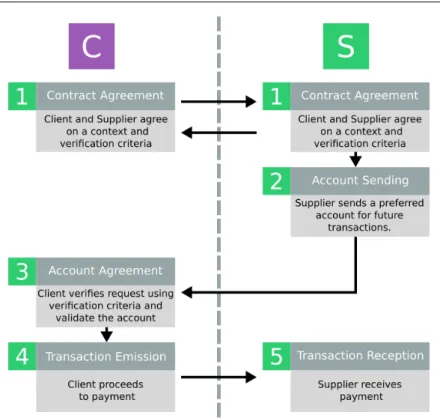
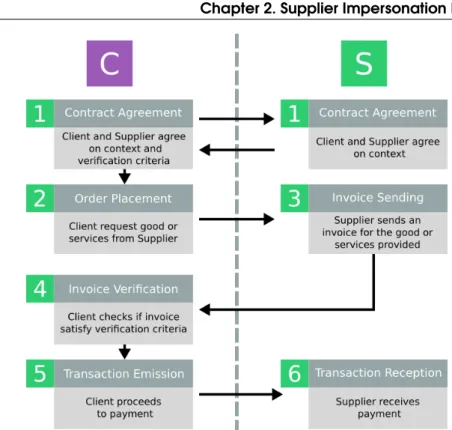
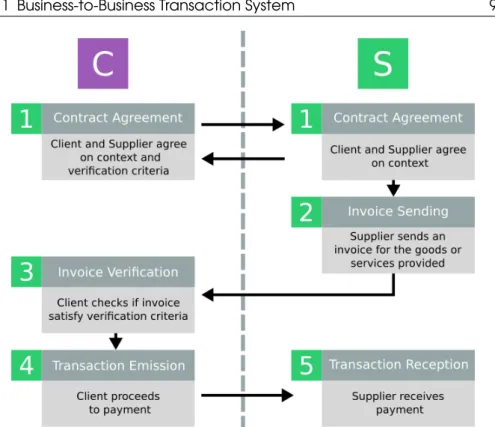
tion protocols, might be as diverse (as described in the study by Lilien & al. [Lil16]) as the companies activity and workflows, and depends on the type of relationships build between client and supplier. Figure 2.2, Figure 2.3 and Figure 2.4 show exam-ples of such transaction protocols.
Preferred Account
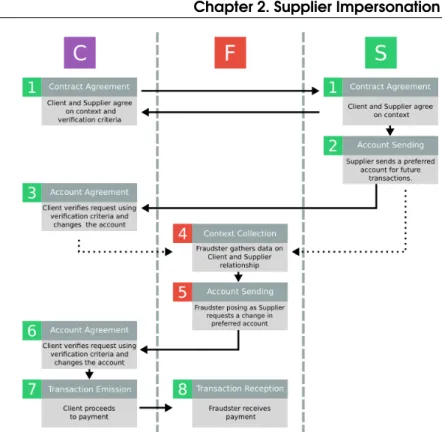
Figure 2.2 shows the steps of a transaction protocol dubbed "Preferred Account". In this scenario, the client C and supplier S agree on a contract defining the conditions of their involvement (Step 1) and then on an account preferred by the supplier (Step 2, Step 3) on which to emit all the following transactions (Step 4, Step 5). This type of transaction protocol is usually found when a client subscribes to a service such as the access to the electrical grid, or the use of a cloud-based storage platform.
Order-Invoice
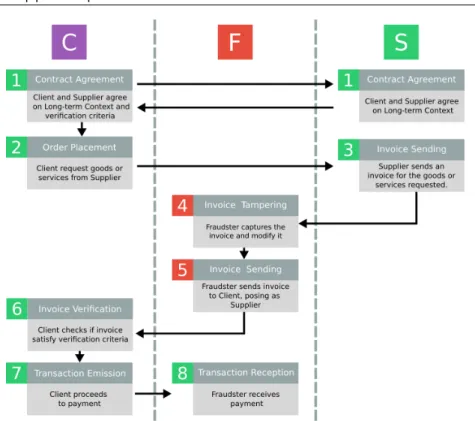
Figure 2.3 shows the transaction protocol dubbed "Order-Invoice". In this scenario, the client C and supplier S first sign a contract defining the conditions of their involve-ment (Step 1) and then conduct transactions only if C issues an order for a good or service (Step 2). Upon receiving such an order, S produces an invoice for the transac-tion, and send it to C (Step 3). Upon reception C verifies if the invoice is valid based on some agreed-upon procedure (Step 4) and then emits the transaction (Step 5, Step 6). This type of transaction protocol is often found in industrial production when or-dering materials for the production of goods.
Simple Invoice
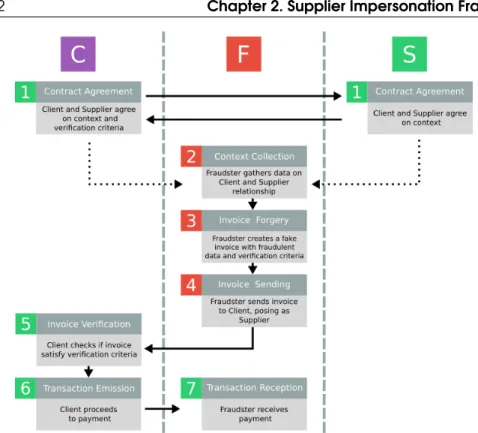
Finally, Figure 2.4 shows the transaction protocol "Simple Invoice". In this scenario, the client C and supplier S define the contract defining the conditions of their involve-ment (Step 1), then S directly sends an invoice to C (Step 2). The same verification procedure and transaction emission step from the previous protocol are then repeated
2.1 Business-to-Business Transaction System 9
Figure 2.4: Example of transaction protocol - Simple Invoice.
(Step 4, Step 5). This type of transaction protocol is the simplest, and is often used when the supplier’s goods or services are required in an irregular fashion.
2.1.3 Payment behavior
In a B2B context, a client can emit multiple payments for transactions involving mul-tiple suppliers. We regroup the transactions emitted by a specific client to a specific supplier in a sequence called payment behavior. This sequence is ordered by the date of transaction, and capture the historical behavior of a company with a specific supplier.
Definition 2.1.4 The payment behavior P of the client C and the supplier S is the set of transactions such that P(C, S) =< t1,t2,t3, ...tT> where∀ti∈ P(C,S),ti.I.C = C, and ti.I.S = S. T is the total number of transactions.
In order to ease the reading of this thesis, each of the component of the issuance record I or the payment record P of a given transaction ti will be designed with a subscript indicating the transaction associated. For example, the client C of transaction tiwill be noted Ctiinstead of ti.I.C = C.
The payment behavior represents the business relationship between a client and a supplier. By sorting the transactions in a payment behavior temporally one can then describe the evolution of their relationship.
2.1.4 Business Context
Every transaction protocol of a B2B environment initially needs to set up conditions specifying the relationship created between a client and a supplier company. This step is required to define their business partnership. Usually, the agreement over the busi-ness context of the transactions takes the form of a contract signed by both the client and the supplier. The business context models this set of conditions over the elements of the payment record.
10 Chapter 2. Supplier Impersonation Fraud
Figure 2.5: Example of attack - Payment Diversion.
These conditions can be diverse as they need to suit the needs of both the company involved in the business relationship. An simple example of such condition can be that the amount of the transaction can not exceed a certain amount a. In this case a condition can be expressed in the form ca: Amtt≤ a ∀ t.
Establishing a business context between a supplier and a client requires the compa-nies involved to agree on a set of explicit or implicit verification procedures concerning the transactions involved. Most of the time these verification protocols are implicit, as the supplier is trusted implicitly: a representative of the supplier is identified by the client as the interlocutor of reference of the business context, and if any discrepancy is detected in the supplier’s behavior the representative is contacted by the client. In these cases, a fraudster only needs to perform a fraud and to pose as a convincing rep-resentative of the supplier in order to fool the client. Sometimes, explicit agreement exists between the client and the supplier in order to enforce the business context, in the form of legislative or cryptographic guarantees. In these case a fraudster have to forge such guarantees in order to perform its fraud.
Definition 2.1.5 The business context bc between a client C and a supplier S is a set of conditions such as bc(C, S) ={c1, c2, .., cN} for any transaction between C and S.
This business context represent the agreement upon by both the supplier and client accept to perform transactions. A business context can contain all the exchange be-tween a client and a supplier, or be negotiated for each good or service provided by the supplier.
2.2 Supplier Impersonation Fraud 11
Figure 2.6: Example of attack - Invoice Interception.
2.2
Supplier Impersonation Fraud
A Supplier Impersonation Fraud (SIF) occurs when a fraudster attempts to imperson-ate a supplier in order to trigger a fraudulent transaction. This attempt can be translimperson-ated in the model previously defined by tampering with the payment record of a transaction. In order to do so, the fraudster has to convincingly impersonate the supplier so that the client will agree on the change or changes proposed by the fraudster. This change will then trigger a modification of the payment record. As for the supplier itself, he has no knowledge of the impersonation taking place. He thus only notices that a tamper-ing has taken place when the expected payments fail to reach it. In the case of some frauds, a fraud attempt is detected only when the client notices a discrepancy between the invoice and the inventory (for example, if the fraudster charged imaginary goods to the client). In other words, if not detected before (e.g., when the payment record was modified), a fraud can be discovered at the time the client emits a transaction if this latter does not satisfy the business context.
2.2.1 Examples of Attack
In order to perform a SIF, a fraudster usually finds a way to compromise a transaction protocol. Figure 2.5, Figure 2.6 and Figure 2.7 describe real-life case of frauds as described by this study by AIG ([AIG19]) and documentation from the FBI ([Inv17]).
Payment Diversion
In Figure 2.5, the fraudster F inserts a fraudulent actions (red numbering) in between the steps 3 and 4 of the legitimate transaction protocol "preferred account". First, he gathers information about the client C and supplier S in order to gain access to data he can use to give credibility to the fraud attempt. More specifically, this investigation focuses on two aspects: the details of the verification procedure performed by C in or-der to assert that a supplier account’s change request is legitimate (credentials, token
12 Chapter 2. Supplier Impersonation Fraud
Figure 2.7: Example of attack - Invoice Forgery.
(logo, name of CEO, etc.). The specifics on how the fraudster gathers this data is left out of scope of this thesis, but we assume that the fraudster has the means to success-fully perform the fraud attempt. It is a realistic assumption, as such frauds have been performed in the past [Inv17]. Once the data is gathered (Step 4), the fraudster then craft a credible request for preferred account change and sends it to C, while pretend-ing to be S (technically by uspretend-ing S credentials or identity in the interaction). With no way to distinguish between the fraudulent request and a legitimate one, C changes the preferred account and thus all subsequent transactions are then emitted on the fraudu-lent bank account. This type of fraud is usually called "payment diversion" [Inv17].
Invoice Interception
Figure 2.6 shows how the transaction protocol of "order-invoice" is compromised. In this scenario, the fraudster F also inserts its fraudulent action in between the steps 3 and 4 of the legitimate transaction mechanism. This time, the fraudster intercepts the invoice sent by the supplier S following the order placed by the client C and then mod-ifies it so that it contains fraudulent information (usually a fraudulent bank account) (Step 4). As for the previous fraud, we assume that the fraudster possesses the means to intercept the invoice without being detected, and to tamper with it without breaking the integrity of the potential verification criteria. It then simply sends the tampered invoice pretending to be acting on the behalf of S. With no means to detect that the invoice has been tampered with, the client C then proceeds with the payment of the invoice on the fraudulent bank account (Step 7, Step 8). This type of fraud is often called "invoice interception" ([Inv17]).
Invoice Forgery
Finally, 2.7 presents a scenario where a fraudster compromises the transaction protocol "simple invoice". Contrarily to the previous fraud scenarios, in this one the fraudulent activities can take place directly after the initial agreement between the client C and the supplier S. In this scenario, the fraudster F first gathers information about C and
2.3 Supplier Fraud Detection in a B2B system 13 S as previously described (Step 2). It then uses the information to craft a fraudulent invoice (Step 3) with all the required validation criteria, that is then sent to the client (Step 4). With no means to detect the forgery even though a verification takes place (Step 5), C emits the payment (Step 6, Step 7). This type of fraud is usually referred to as "invoice forgery"([Inv17]).
2.2.2 Payment Behavior Tampering
In the previous example, the goal of the fraudster is to divert the payment to an ac-count that he owns. Thus, a supplier impersonation fraud is the action of tampering with the bank account of the transaction to divert the payment to a fraudulent account. Other type of frauds can occur, for example the fraudster can also tampers with the amount of transaction. This type of fraud is extensively studied in the context of B2C such as in the work of Bolton & al. ([BH+01]). However, this type of fraud is considered to be less important in our model as the fraudster does not obtain a finan-cial gain from the fraud. Its objective might be to alter the trust of the client towards the supplier, or to provoke problems in the B2B ecosystem. This type of destructive fraud is not considered in this thesis.
We thus propose the following definition for the concept of supplier impersonation fraud:
Definition 2.2.1 A Supplier Impersonation Fraud or SIF takes place when a fraudster F alters the payment record of a transaction t by changing the account Acctof the transaction to an account AccFcontrolled by the fraudster.
As mentioned earlier, other components of the transaction can be tampered with, but such frauds fall outside the scope of this thesis.
2.3
Supplier Fraud Detection in a B2B system
In this section, we give a high-level overview of how Supplier Impersonation Fraud is performed in a B2B context. Based on the definition found in the book by Baesens & al, [BVV15], fraud detection refers to "the ability to recognize or discover fraudulent activites". SIF fraud detection is thus a subset of the broader topic of fraud detection. In our context of Supplier Impersonation Fraud, we consider that "fraudulent activ-ities" corresponds to the tampering of the account of a payment record, as defined in Definition 2.2.1. In the next sections, we describe how Supplier Impersonation Fraud Detection is performed in a the context of a Business-to-Business ecosystem where several companies exchange goods and services for payments.
2.3.1 Fraud Detection System
In order to protect a user from a fraudster, several strategies can be used. Fraud protec-tion consists in designing systems and verificaprotec-tion process that will hinder the fraud-ster in his attempt to perform a fraud. Such system includes biometric verification, strong encryption, and so on. However, as it is often the case for cyber-protection measures, there is no perfect protection and thus this kind of system can be breached. It is then mandatory to implement fraud detection systems. These systems focus on monitoring the critical process of a target and assess if a fraud is occurring. Thus, a SIF detection system’s goal is to detect attempts to tamper with the account of a pay-ment in a specific B2B ecosystem. A more comprehensive description of these type of fraud mitigation is provided in Chapter 3.
14 Chapter 2. Supplier Impersonation Fraud
Figure 2.8: Fraud Detection in B2B system.
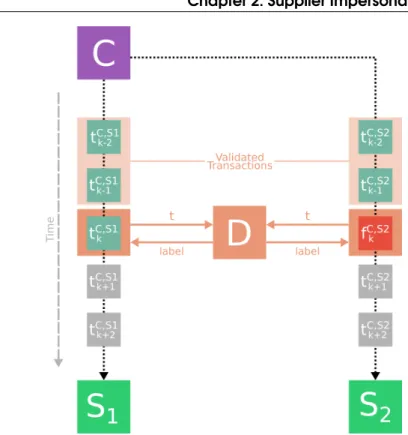
Traditionally, the detection of a fraud can be performed in two ways (as defined in Baesens & al.’s book [BVV15]): an "ex ante" approach, where the model is used to predict which transaction the client is most likely to perform next, and the legitimacy of the next real transaction is asserted by studying the discrepancy between the pre-dicted transaction and the real one. On the other hand, in the "ex post" approach, there is no predicted transaction, and the real transaction is compared to the constructed model to assert its legitimacy. Furthermore, several modes of prediction exists: batch, near-real time and real-time. In batch prediction, a large set of transactions are ana-lyzed at the same time, usually well after they have been issued. In near-real time, a single transaction is analyzed as soon as it has been issued, but there is not strong guarantees on the analysis time (usually between 1 second and 1 minute). In real-time analysis, the time taken to conduct the analysis is of the essence, so strong guarantees are enforced (response time less than 10 ms).
In this thesis, we focus on the design and implementation of an ex ante, near real-time fraud detection system. This type of system is the more common in the survey conducted on general purpose fraud detection systems, as described in the surveys of Chandola & al. ([CBK09]), Abdallah & al.([AMZ16]) and the book of Baesens & al.([BVV15]). We use this model as the basis of our systems focused on SIF detection as they are the ones that are the most similar to the expert system implemented by SiS-id to detect SIF.
Figure 2.8 shows how a SIF detection system performs. First, an analysis of past transactions emitted between a client and a supplier (i.e a payment behavior) takes place, and a model representing legitimate and fraudulent payments is determined. Then, when a new transaction occurs, its characteristic features are compared with the model previously established. Finally, the detection system assigns a label to each of the new transaction reflecting the potential fraudulence of this transaction based on the model.
2.4 Summary 15
2.4
Summary
In this chapter, we first described a B2B transaction in detail by defining the con-cepts of payment record and issuance record. We then described the properties of a B2B transaction system: the transaction protocols that defines the way a client and a supplier company interact, and the payment behavior that represents a sequence of transaction through time. We presented how the transaction protocols could be com-promised by a fraudster, and how this attack is mainly targeted on the account and amount of a transaction. We showed how fraud can be described as a tampering of the payment record of a transaction in order to trigger fraudulent transactions. We then presented the problem of supplier impersonation fraud detection in a B2B system.
State of the Art
In this chapter, we propose a review of the available literature on fraud detection. We first give an overview of the problem of fraud detection, then describe different fields related to Supplier Impersonation Fraud where fraud detection systems are studied. We then describe the two main approaches for fraud detection, namely supervised and unsupervised approaches. We then provide a description of the different techniques from the literature focused on unsupervised fraud detection. Finally, we propose a synthesis focused on the specific issue of Supplier Impersonation Fraud.
3.1
Fraud Detection
Fraud is defined by [Bol+02] as criminal deception; the use of false representations to gain an unjust advantage. [Bol+02] argue that the development of new technolo-gies has provided new openings for fraudulent activities. [BVV15] proposes a more detailed definition of fraud as "an uncommon, well considered, imperceptibly con-cealed, time-evolving and often carefully organized crime which appears in many types of forms". Uncommon means that only a minority of cases in a specific setting will be fraudulent. Imperceptibly concealed reflects the fact that the fraudsters try to blend in and behave as legitimate users. Well considered emphasizes the prepara-tion undergone by the fraudster before performing a fraud. Time-evolving means that fraud techniques evolve through time. Carefully organized means that the fraudsters often construct complex structures in order to hide their actions, and sometimes in-volve accomplices and fake accounts. Finally, many types and forms means that there exist many applications in which fraud is likely to occur. Mitigating fraud is a ma-jor concern for most companies, and usually relies on two complementary strategies ([Bol+02]): Fraud prevention (where security guarantees such as credential signa-tures and reputation systems are implemented in order to prevent a fraud from happen-ing), and Fraud detection (where the interactions between elements of the system are monitored in order to detect if a fraud takes place).
Traditionally, fraud detection has been performed using expert knowledge, such as a team of investigators ([Bro+02]). As it is often the case when trying to automate expert-based approaches, the first computer-based fraud detection systems have taken the form of expert systems. These systems use decision rules derived from the inves-tigator experience (i.e., for credit card fraud). However, the last decade has seen the
18 Chapter 3. State of the Art
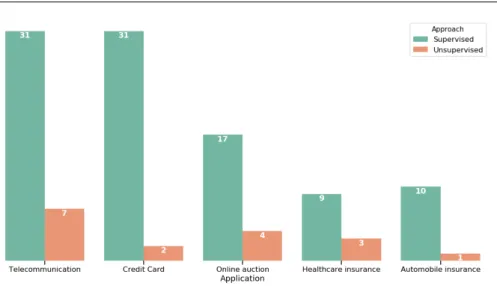
Figure 3.1: Number of fraud-detection related papers from 1994 to 2016 as found in Abdallah et al.’s survey [AMZ16]
appearance of more and more data-driven automated fraud detection systems. In these systems, the knowledge of fraud is not derived from human experience but rather from careful processing and modeling of all available data relevant to the fraud. This knowl-edge is derived from both internal (i.e., transaction logs for credit card fraud) or exter-nal sources (i.e., IP addresses of known fraudsters). The advantage of these systems is that they often offer statistical guarantees in terms of precision, allow detection in a shorter time, and are often less costly to maintain than a set of expert rules ([BVV15]). In the next subsection, we describe several industrial fields where data-driven sys-tems have been successfully applied for fraud detection.
3.1.1 Fraud Detection Applications Overview
Data-driven fraud detection is a topic that has gained traction over the last years, grow-ing steadily from 333 papers containgrow-ing this keyword in 2015 to 759 in 2019, accord-ing to the website Dimensions [Dim20]. Bolton et al. [Bol+02] and Abdallah et al.[AMZ16] both offer reviews of fraud detection systems based on their domain, and the related monetary loss attributed to fraud in these domains. While fraud is an un-derlying threat for all business activities, these specific economic fields seem to be the most closely related to the context in which SIF takes place. These domains are the fol-lowing: credit cards, telecommunication, healthcare, automotive insurance, and online auction. Figure 3.1 indicates the number of research papers related to fraud detection for each domain from 1994 to 2016, as found in [AMZ16]. According to [AMZ16], the most active application field in terms of publication is the field on telecommuni-cation, followed by the credit card application domain, and online auctions. Finally, insurance is divided in two sections: healthcare insurance and automotive insurance. They both have the lowest numbers of related publications. Fraud detection is thus a transverse field spawning numerous research in different domains.
The dynamicity of a fraud domain in terms of research is, however, often more linked to the availability of datasets related to frauds, rather than the research activity in these fields. The distribution of research papers found in Figure 3.1 seems to val-idate this hypothesis as the telecommunication, credit card and online auction fields are traditionally very digitized. Thus, datasets can be created more easily than health-care insurance and automotive insurance where the processes are still developing from paper to virtual transactions.
3.1 Fraud Detection 19 We now describe the types of fraud occurring in these fields, based on the survey performed by Bolton et al. and Abdallah et al. [AMZ16; Bol+02]:
Credit Card Frauds
In the context of credit card fraud, two major kinds of frauds exist: offline credit card fraud where the physical card has been stolen and then used by the fraudster, and card-holders not present fraud where the card information necessary for an online or phone purchase is copied from a card and then used by the fraudster without the knowledge of the card holder. Offline credit card fraud is usually easily thwarted as the issuing banks will lock the stolen card as soon as the card holder reports it missing ([AMZ16; Bol+02]). However, the cardholder not present fraud is much more difficult to detect, as the cardholder has no knowledge of the fraud until suspicious transactions appear in his bank records and inform the bank. During this time the fraudster can perform any number of fraudulent transactions.
Telecommunications Frauds
Telecommunications frauds are more diverse. One of the most prevalent frauds is the subscription fraud where a fraudster subscribes to a telephone service using fake per-sonal information, and with no intention of paying. The superimposed fraud occurs when a fraudster takes over a legitimate account to perform calls. A similar fraud is premium rate fraud, where the fraudster calls to a premium-rate service number us-ing a subscribers account without their knowledge. Other kinds of frauds involves roaming fraud (the fraudster accumulate roaming charges with no intention of pay-ing), prepaid fraud (a fraudster sells a fake prepaid card without service), SIM surfing (a fraudster steals and use a legitimate users SIM card), SIM cloning (a fraudster dupli-cate a users SIM card), SIM box fraud (a fraudster uses a device to make calls appear as local), PBX fraud (a fraudster physically hacks into a legitimate users phone line) and voucher fraud (a fraudster tries multiple time to guess a voucher number for free network access), and are thoroughly described in [AMZ16].
Healthcare Insurance Frauds
In this type of frauds a fraudulent patient or healthcare provider tries to obtain illegit-imate gains by abusing the insurance system. We focus on the frauds performed by the healthcare supplier as they relate closely to the context of SIF: phantom claims, occurring when an healthcare provider presents a bill for a service not provided, dupli-cate claims where an healthcare provider presents the same claims twice, bill padding where unneeded services are billed. These kinds of frauds are similar to the ones a fraudster trying to impersonate a legitimate supplier would perform. Other types of fraud can also be found, such as upcoding (presenting claims whose reimbursement value more than the services provided), unbundling (presenting excessive numbers of claims for different services that should be charged as one service), excessive or un-necessary services, kickbacks (collusion between providers and patients to take com-mission for illegal service), claims in short time (reporting numbers of claims in for same insured in short time), unpaid installments (reporting claims for an insured that has not paid any installments), incorrect dates (reporting claims with incorrect dates that could be prior to or after than the beginning of the insurance period), medication without examination (invoices for medications without the medical check-up or exam-ination), and excessive numbers of small bills (excessive numbers of manual invoice claims whose amounts are smaller than the usual inspection limit). They are also de-scribed in detail in [AMZ16].

![Figure 3.1: Number of fraud-detection related papers from 1994 to 2016 as found in Abdallah et al.’s survey [AMZ16]](https://thumb-eu.123doks.com/thumbv2/123doknet/14745473.756012/31.892.266.755.134.398/figure-number-fraud-detection-related-papers-abdallah-survey.webp)