RESEARCH OUTPUTS / RÉSULTATS DE RECHERCHE
Author(s) - Auteur(s) :
Publication date - Date de publication :
Permanent link - Permalien :
Rights / License - Licence de droit d’auteur :
Bibliothèque Universitaire Moretus Plantin
Institutional Repository - Research Portal
Dépôt Institutionnel - Portail de la Recherche
researchportal.unamur.be
University of Namur
Querying Articulated Sources
Tzitzikas, Yannis; Meghini, Carlo
Published in:Proceedings of the third International Conference on Ontologies, Databases and Applications of Semantics for Large Scale Information Systems, ODBASE'2004
Publication date: 2004
Link to publication
Citation for pulished version (HARVARD):
Tzitzikas, Y & Meghini, C 2004, Querying Articulated Sources. in Proceedings of the third International Conference on Ontologies, Databases and Applications of Semantics for Large Scale Information Systems, ODBASE'2004. vol. 3291, pp. 945-962.
General rights
Copyright and moral rights for the publications made accessible in the public portal are retained by the authors and/or other copyright owners and it is a condition of accessing publications that users recognise and abide by the legal requirements associated with these rights. • Users may download and print one copy of any publication from the public portal for the purpose of private study or research. • You may not further distribute the material or use it for any profit-making activity or commercial gain
• You may freely distribute the URL identifying the publication in the public portal ?
Take down policy
If you believe that this document breaches copyright please contact us providing details, and we will remove access to the work immediately and investigate your claim.
Querying Articulated Sources
Carlo Meghini1and Yannis Tzitzikas21 ISTI – CNR, Pisa, Italy [email protected]
2 Institut d’Informatique, University of Namur, Belgium [email protected]
Abstract. In this study we address the problem of answering queries over information sources storing objects which are indexed by terms ar-ranged in a taxonomy. We examine query languages of different expres-sivity and sources with different kinds of taxonomies. In the simplest kind, the taxonomy includes just term-to-term subsumption links. This case is used as a basis for further developments, in which we consider taxonomies consisting of term-to-queries links. An algorithm for query evaluation is presented for this kind of taxonomies, and it is shown that the addition of negation to the query language leads to intractability. Finally, query-to-query taxonomies are considered.
1
Introduction
In semantic-based retrieval on peer-to-peer (P2P) networks, the language that can be used for indexing the domain objects and for formulating queries, can be either free (e.g natural language) or controlled, i.e. object descriptions and queries may have to conform to a specific vocabulary and syntax. The former case resembles distributed Information Retrieval (IR) and is applicable when the domain objects have a textual content (e.g. [1, 2]). In the latter case, the objects of a peer are indexed according to a specific conceptual model (e.g. relational, object-oriented, logic-based, etc), and content searches are formulated using a specific query language. An approach falling into this category, in which the objects of the domain are indexed in terms of taxonomies and inter-taxonomy
mappings are employed for bridging the inevitable naming, granularity and
con-textual heterogeneities that may exist between the taxonomies of the peers, was proposed in [3]. The difference between the P2P architecture and the classical two-tiered mediator approach (like the one presented in [4]) is that in a P2P sys-tem the mappings between the peers may lead to cyclic dependencies between the query evaluation tasks of the peers. Such cases require special treatment in order to avoid endless query evaluation and to optimize the evaluation of queries. The work presented in [5] gave the foundations of query answering in this kind of systems and presented four algorithms for query evaluation. However, that work considered a very simple form of articulated source, namely one whose articulations relate just terms, and a negation-free query language.
In this paper, we make a step forward, by considering term to query artic-ulations, that is articulations relating queries of one source to terms in another source, and provide an algorithm for handling query evaluation in this context.
The algorithm is then extended to the case of queries including negation, bor-rowing the semantics from datalog, by establishing a mapping from a source to a datalog program. We then consider term to query articulations whose queries include negation, and show that query evaluation becomes a coNP-hard prob-lem. We finally move on to consider query to query articulations, showing that the usage of negation-free DNF queries in articulations make the object retrieval problem intractable.
The next two Sections lay down the basic framework. With Section 4, we move towards more sophisticate scenarios, starting with the addition of negation to the language for querying simple sources. Section 5 deals with term to query articulations, while Section 6 considers query to query articulations. Related work is reported in Section 7. For reasons of space, we have included in the paper only the most important proofs.
2
Simple Sources
Let Obj denote the set of all objects of a domain common to several information sources.
Definition 1 (Simple Source). A simple source S is a pair S = (A, I) where – A, the taxonomy, is a pair (T, ¹) where T, the terminology, is a finite and non-empty set of names, or terms, and ¹ is a reflexive and transitive relation over T, modeling subsumption between terms.
– I, the interpretation, is a total function I : T → 2Obj that associates each
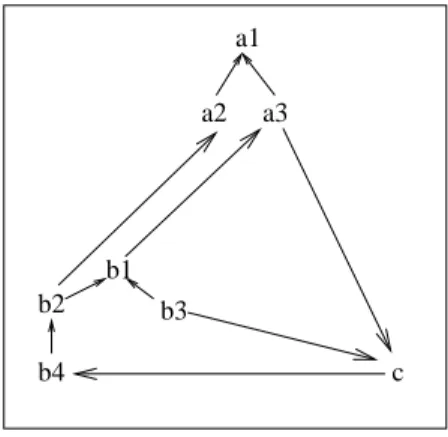
term in the terminology with a set of objects. ¤ Figure 1 presents the taxonomy of a simple source. For readability, only and the transitive reduction of the subsumption relation is given, leaving out reflexive and transitive relationships.
b3 a2 a3 a1 b1 b2 b4 c Fig. 1. A taxonomy
Not all interpretations of a source are the same; those that satisfy the sub-sumption relationships, better reflect the application semantics and are therefore factored out as models, following a common terminology.
Definition 2 (Model). An interpretation I of a terminology T is a model of a taxonomy A = (T, ¹) if t ¹ t0 implies I(t) ⊆ I(t0). Given two interpretations
I, I0 of the same terminology T, I is less than or equal to I0, in symbols I ≤ I0,
if I(t) ⊆ I0(t) for each term t ∈ T. An interpretation J of a terminology T is a
model of a simple source S = (A, I) if it is a model of A and I ≤ J. ¤ To query a simple source, we next introduce a query language allowing negation-free Boolean combinations of terms as queries. These queries are cap-tured in DNF expressions.
Definition 3 (Query). Let T be a terminology. The query language associated to T, LT, is the language defined by the following grammar, where t is a term
of T : q ::= d | q ∨ d, d ::= t | t ∧ d. An instance of q is called a query, while an
instance of d is called a disjunct. ¤
The semantics of the query language maps each query into a set of objects, based on a specific interpretation of the underlying terminology.
Definition 4 (Extension). Given a simple source S = (A, I), where A = (T, ¹ ), and a query q ∈ LT, the extension of q in I, qI, is defined as follows:
1. (q ∨ d)I = qI∪ dI
2. (d ∧ t)I = dI∩ tI
3. tI = I(t). ¤
Since the function ·I is an extension of the interpretation function I, we will
abuse notation by using the latter in place of the former.
Definition 5 (Answer). Given a simple source S = (A, I), the answer of q in
S, ans(q, S), is given by:
ans(q, S) = {o ∈ Obj | o ∈ J(q) for all models J of S}
that is, the set of objects that are in the extension of q in all the models of A
which are greater than I. ¤
We can now state query evaluation.
Proposition 1. For all simple sources S = (A, I), where A = (T, ¹), and queries q ∈ LT, ans(q, S) is given by:
1. ans(q ∨ d, S) = ans(q, S) ∪ ans(d, S), 2. ans(d ∧ t, S) = ans(d, S) ∩ ans(t, S), 3. ans(t, S) = ¯I(t)
where ¯I(t) =S{I(s) | s ¹ t} is the unique minimal model ¯I of the simple source S = (A, I).
Proof: We first show that ¯I is the unique minimal model of the source S. To
this end, it must be proved that (a) ¯I is a model of A; (b) I ≤ ¯I; and (c) ¯I is
the smallest model for which (a) and (b) hold. (a) t ¹ t0 implies {s | s ¹ t} ⊆
{s | s ¹ t0}, hence S{I(s) | s ¹ t} ⊆S{I(s) | s ¹ t0}, i.e. ¯I(t) ⊆ ¯I(t0). Thus ¯I
is a model of (T, ¹). (b) trivially follows from the definition of ¯I and from the
reflexivity of ¹ . To see (c), let I0 be a model of (T, ¹) which is greater than
I. We prove that ¯I ≤ I0. By the definition of ¯I(t), if o ∈ ¯I(t) then o ∈ I(s) for
a term s such that s ¹ t. Then o ∈ I0(t) too because I0 is a model of T . We
conclude that for every o ∈ ¯I(t) it holds o ∈ I0(t), which means that ¯I ≤ I0. As
for the rest of the Proposition, let us start from the last clause. o ∈ ans(t, S) implies o ∈ ¯I(t), since I ≤ ¯I, so o ∈ ans(t, S) implies o ∈ ¯I(t). Conversely, o ∈ ¯I(t) implies, by Proposition 1, that o ∈ J(t), for all models J of A such that I ≤ J, i.e. o ∈ ans(t, S). As for the second clause:
ans(d ∧ t, S) = {o ∈ Obj | o ∈ (d ∧ t)J, ∀ mod.J of S}
= {o ∈ Obj | o ∈ dJ∩ tJ, ∀ mod.J of S}
= {o ∈ Obj | o ∈ dJ, o ∈ J(t), ∀ mod.J of S}
= ans(d, S) ∩ ans(t, S).
The argument for the first clause is analogous. ¤ We call ¯I the model of A generated by I. The procedure δt, presented in
Figure 2, computes the model generated by a given interpretation on a term x implementing the following definition, provably equivalent to the one in the last Proposition:
¯
I(x) = I(x) ∪[{ ¯I(v) | v ¹rx}
where ¹r is the transitive reduction of the subsumption relation ¹, encoded
in the graph GA. ¯I(c) for the taxonomy in Figure 1 is computed by invoking
δt(c, {c}), and yields I(c) ∪ I(a3) ∪ I(b1) ∪ I(b2) ∪ I(b4) ∪ I(b3).
procedure δt(t : term ; A : set of terms);
1. begin 2. R ← I(t)
3. for each edge hu, ti in GA do
4. if u 6∈ A then begin 5. A ← A ∪ {u} 6. R ← R ∪ δt(u, A) 7. end 8. return R 9. end
3
Networks of Articulated Sources
Articulated sources are simple sources whose terms have subsumption ships with the terms of other terminologies. These inter-terminology relation-ships are called articulations, to distinguish them from those within single tax-onomies, which are of an intra-terminology nature. Formally,
Definition 6 (Articulated Source). An articulation ¹ij from a terminology
Ti to a terminology Tj, is any non-empty set of relationships tj ¹ij ti where
ti ∈ Ti and tj ∈ Tj. An articulated source M over k ≥ 1 disjoint terminologies
T1, ..., Tk, is a pair M = (SM, RM), where: SM = (AM, IM) is a simple source
such that AM = (TM, ¹M) and TM is disjoint from T1, ..., Tk; and RM is a set
RM = {aM,1, ..., aM,k}, where for all i ∈ [1, k], aM,i is an articulation from TM
to Ti. ¤
In what follows we will tacitly consider only articulated sources over dis-joint terminologies. An articulated source M with an empty interpretation,
i.e. IM(t) = ∅ for all t ∈ TM, is also called a mediator.
Definition 7 (Network). A network of articulated sources, or simply a
net-work, N is a non-empty set of sources N = {S1, . . . , Sn}, where each source Siis
either simple, or is articulated over the terminologies of the sources in a proper,
non-empty subset of N \ {Si}. ¤
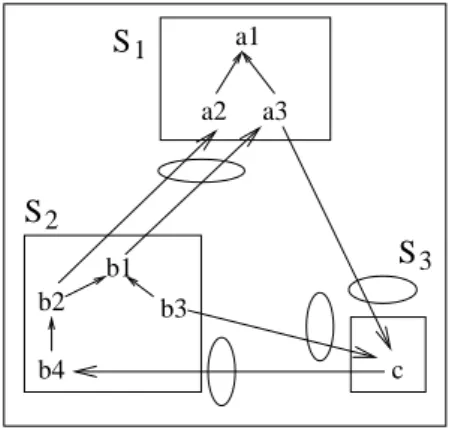
Figure 3 shows a network of 3 articulated sources. Articulations are highlight by a surrounding circle.
One way of interpreting a network is to view it as a simple source which happens to be distributed along several simple sources, each dealing with a specific sub-terminology of the network terminology. The relationship between Figures 1 and 3 evidently suggests this view. The global source can be logically re-constructed by removing the barriers which separate local sources, as if (vir-tually) collecting all the network information in a single repository. The notion of network source, defined next, captures this interpretation of a network. Definition 8 (Network source). The network source SN of a network of
ar-ticulated sources N = {S1, . . . , Sn}, is the simple source SN = (AN, IN), where
AN = (TN, v) and: TN = Sn i=1Ti, IN = Sn i=1Ii, v = ( Sn i=1vi)∗
where vi is the total subsumption of the source Si, given by the union of the
subsumption relation ¹i with all articulations of the source, that is:
vi = ¹i ∪ ai,1 ∪ . . . ∪ ai,n
and A∗ denotes the transitive closure of the binary relation A. A network query
Note that this global simple source does not pre-exist. It emerges in a bottom-up manner by the articulations of the peers. This is one difference that distin-guishes peer-to-peer systems from federated distributed databases.
Following the model developed so far, the answer to a network query q, or network answer, is given by ans(q, SN), which relies on the model of AN
generated by IN, that is, for each term t in TN :
¯
IN(t) =
[
{ IN(t0) | t0v t}.
In order to evaluate a network query, a distributed process is required, which uses the query evaluators on the local simple sources as sub-processes. The topol-ogy of this global process strictly reflects that of the network subsumption re-lation v . For instance, in order to evaluate the query a1 in the network of
Figure 3, the query a1 must be evaluated on source S1, b1 must be evaluated
on source S2, c on source S3, and so on, following articulations backwards, so
as to compute ¯IN(a1). In order to avoid an endless query evaluation, a 2-level
cycle management is required: local query evaluators must take care of the intra-terminology cycles (typically, by using the procedure δt), while the global query
evaluator must properly handle the inter-terminology cycles, i.e.the cycles in the network subsumption relation v which involve at least one articulation. For simple sources, we have studied the problem elsewhere [5].
b3 2
S
1S
3 a2 a3 a1 b1 b2 b4 cS
Fig. 3. A network of articulated sources
4
Adding negation in queries
We now extend the query language by allowing negation. That is, we consider the queries belonging to the language q ::= t | q ∧ q0 | q ∨ q0 | ¬ q. Also these
Definition 9 (Extended Query). Let T be a terminology. An extended query over T is any string derived by the following grammar, where t is a term of T :
q ::= d | q ∨ d where a disjunct d is given by d ::= l | l ∧ d, and l is a literal,
defined as l ::= t | ¬ t. We call the language so defined L¬
T. ¤
The extension of a negative literal in an interpretation I of T is defined, in the obvious way, as follows: I(¬t) = Obj \ I(t), while the notion of an answer remains unchanged, that is o ∈ ans(q, S) iff o is in the extension of q in all models of the source S.
By extending the model in this apparently intuitive way, however, a negative literal in a query is equivalent to the false clause, because there is not enough information in the taxonomy of a source to support a negative fact. In order to derive an intuitive and, at the same time, logically well-grounded evaluation pro-cedure for extended queries, we need an alternative query semantics (i.e. ans). In order to define it, let us consider a logical reformulation of the problem in terms of datalog.
Intuitively, the translation from a simple source to a datalog program should be straightforward: terms are unary predicate symbols, as they are interpreted by sets of objects; consequently, each subsumption relationship is mapped into a rule on the predicate symbols corresponding to the involved terms; and the inter-pretation of each term is mapped into a set of ground facts on the corresponding predicate symbol. In so doing, however, there could be predicate symbols occur-ring both in rule heads and in facts. In datalog terms, these predicate symbols would be both intensional and extensional, and this is not allowed by the data-log syntax. This problem is solved by mapping each term ti into two predicate
symbols: (a) an extensional one, denoted Ci, representing the interpretation of
ti, i.e. I(ti); and (b) an intensional one, denoted Yi, representing ti in the rules
encoding the subsumption relation. The obvious connection between Ciand Yiis
that all facts expressed via the former are also true of the latter, and this is cap-tured by stating a rule (named “extensional” below) of the form Ci(x) → Yi(x)
for each term ti.
Notice that not every subsumption relationship needs to be mapped into a rule: since reflexivity and transitivity are embodied into logical consequence, only the transitive reduction ¹rof the subsumption relation needs to be encoded
into the program.
Definition 10 (Source program). Given a simple source S = (A, I), where
A = (T, ¹), the source program of S is the set of clauses PS given by PS =
T RS∪ ERS∪ FS, where:
– T RS = {Yi(x) : − Yj(x) | tj¹rti} are the terminological rules of PS;
– ERS = {Yi(x) : − Ci(x) | ti∈ T } are the extensional rules of PS;
– FS = {Ci(o) | o ∈ I(ti)} are the facts of PS, stated in terms of constants o
which are one-to-one with the elements of Obj (unique name assumption). ¤
Definition 11 (Query program). Given a query q ∈ LT to a simple source
S = (A, I), where A = (T, ¹), the query program of q is the set of clauses Pq
given by:
{q(x) : − Y1(x), . . . , Yk(x) | t1∧ . . . ∧ tk is a disjunct of q}.
where q is a new predicate symbol. ¤
In order to show the quivalence of the original model with its datalog trans-lation, we state the following:
Proposition 2. For each simple source S = (A, I), where A = (T, ¹), and query q ∈ LT to S, ans(q, S) = {o ∈ Obj | PS∪ Pq|= q(o)}. ¤
Let us consider this mapping in light of the new query language. For a source
S = (A, I), the source program PS remains a pure datalog program, while the
query program Pq of any query q agaist S becomes:
{q(x) : − L1(x), . . . , Lk(x) | t1∧ . . . ∧ tk is a disjunct of q}
where each Lican now be either Yior ¬ Yi.
We can now re-phrase in logical terms the problem with negative literals in queries stated at the beginning of this Section, namely that negative facts cannot be logical consequences of a datalog program, hence a query evaluation proce-dure based on logical consequence, would treat negative literals as false clauses. To circumvent this problem, while retaining an intuitive query-answering be-haviour, the notion of logical consequence is extended so as to allow the infer-ence of negative literals. In datalog, the extension which is typically used is an approximation of CWA, and can be characterized either procedurally, in terms of program stratification, or declaratively, in terms of perfect model. We will adopt the former characterization.
In fact, Pq is a datalog¬ program, and so is the program PS∪ Pq. The latter
program is stratified, by the level mapping l defined as follows:
l(pred) =
½
1 if pred is q 0 otherwise
It follows that PS∪ Pq has a minimal Herbrand model MSq given by ([6]) the
least fixpoint of the transformation T0
Pq∪MPS where MPS is the least Herbrand model of the datalog program PS, and TP0 is the (obvious) extension to datalog¬
of the TP operator, on which the standard semantics of pure datalog is based.
The model MSq is found from MPS in one iteration since only instances of q are added at each iteration, and q does not occur in the body of any rule. The following definition establishes an alternative notion of answer for queries including negation.
Definition 12 (Extended answer). Given an extended query q to a simple source S = (A, I), the extended answer to q in S, denoted ε(q, S), is given by:
We conclude by showing how extended answers can be computed.
Proposition 3. For each simple source S = (A, I), where A = (T, ¹), and query q ∈ L¬ T, ε(q, S) is given by: 1. ε(q ∨ d, S) = ε(q, S) ∪ ε(d, S), 2. ε(l ∧ d, S) = ε(l, S) ∩ ε(d, S), 3. ε(t, S) = ¯I(t), 4. ε(¬t, S) = Obj \ ε(t, S). ¤
From a practical point of view, computing ε(¬t1∧ . . . ∧ ¬tk) requires
com-puting:
Obj \ ( ¯I(ti1) ∪ . . . ∪ ¯I(tik))
which in turn requires knowing Obj, i.e. the whole set of objects of the network. As this knowledge may not be available, or may be too expensive to obtain, one may want to resort to a query language making a restricted usage of negation, for instance by forcing each query disjunct to contain at least one positive term.
5
Term to query articulations
Here we study the more general case where an articulation can contain sub-sumption relationships between terms and queries. We call such articulations
term-to-query (t2q), to be distinguished from the articulations introduced
pre-viously, which we term term-to-term (t2t) articulations. t2t articulations are clearly special cases of t2q articulations.
First, we introduce the basic building block of t2q articulations, that is sub-sumption relationships between queries and terms.
Definition 13 (Extended source). An extended taxonomy is a pair (T, ¹e)
where T is a terminology and ¹e⊆ (LT × LT), reflexive and transitive. An
extended source S is a pair (A, I), where A is an extended taxonomy (T, ¹e) and
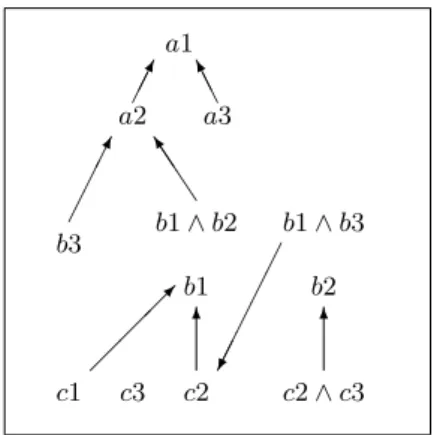
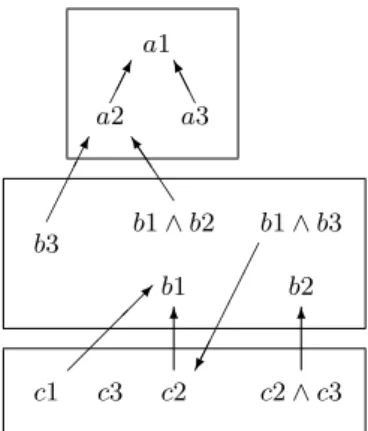
I is an interpretation of T. ¤ Notice that since a term is a query, an extended taxonomy does in fact extend a taxonomy, by allowing subsumption relationships also between disjunctions of conjunctions of terms (i.e., non-term queries) and terms. Figure 4 presents the taxonomy of an extended source.
Next, we introduce the notion of model of an extended source.
Definition 14 (Model). An interpretation I of a terminology T is a model of an extended taxonomy (T, ¹e) if q ¹et implies I(q) ⊆ I(t). An interpretation J
of a terminology T is a model of an extended source S = (A, I) if it is a model
of A and I ≤ J. ¤
The answer to a query q ∈ LT to an extended source S = (A, I), is the same
as that for the 2t2 case, i.e.:
ans(q, S) = {o ∈ Obj | o ∈ J(q) for all models J of S}.
a1 a2¢¢¸ a3A AK b1 ∧ b2 b1 ∧ b3 J J J ] b3 b1 b2 ¢¢ ¢¸ ¢ ¢ ¢ ¢ ¢® c1¡c3 c2 c2 ∧ c3 ¡¡µ 6 6
Fig. 4. An extended taxonomy
Proposition 4. For all extended sources S = (A, I), where A = (T, ¹e), and
queries q ∈ LT, ans(q, S) is given by:
1. ans(q ∨ d, S) = ans(q, S) ∪ ans(d, S), 2. ans(d ∧ t, S) = ans(d, S) ∩ ans(t, S), 3. ans(t, S) = ¯Ie(t)
where ¯Ie(t) = ¯I(t) ∪
S
{ ¯I(q) | q ¹et and for no u ∈ T, q = u} is the unique
minimal model of S. ¤
In order to perform query evaluation on an extended source, our starting point is the method for the t2t case, in which the interpretation ¯I(t) for each
query term t is computed by the procedure δt, which navigates the graph GA.
In order to have the same kind of navigation for an extended source, the graph representing ¹r
e, having either terms or queries as nodes such as the one in
Figure 4, is unsuitable. To see why, let us consider the following equivalent re-writing of ¯Ie(t) ¯ Ie(t) = [ {I(s) | s ¹et} ∪ [
{ ¯I(q) | q ¹et and for no u ∈ T, q = u}.
According to this expression, in order to compute ¯Ie(t) one starts from t and
moves backward to find all terms and queries that are reachable through sub-sumption links; when a node with a term s is found, the extension I(s) must be fetched, and then search proceeds normally; but when a node with a query
q is reached, ¯I(q) must be computed, and this requires to “jump” to the terms
composing q. In order to avoid this problem, we use an hypergraph to represent the taxonomy of an extended source.
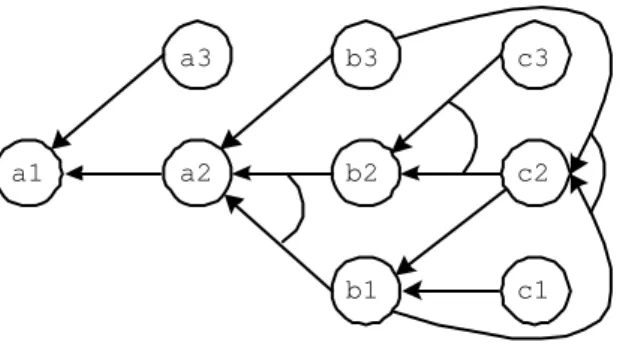
In an hypergraph, an edge can connect a node to an arbitrary subset of nodes, and is therefore called hyperedge. In order to generate the hypergraph represent-ing ¹r
a1 a2 a3 b3 c1 c2 c3 b2 b1
Fig. 5. The hypergraph of the taxonomy in Figure 4
relationship (q1∨ . . . ∨ qk, t) in ¹re, with the k relationships (q1, t), . . . , (qk, t).
Then, the hypergraph HA is constructed from ¹0e by introducing an hyperedge
h{u1, . . . , um}, ti if and only if (u1∧ . . . ∧ um, t) ∈¹0e. Figure 5 shows the
hyper-graph associated to the taxonomy shown in Figure 4. Hyperedges are represented by joint edges.
The procedure δq, presented in Figure 6, computes ¯Ie(t) for a given term t,
by navigating the hypergraph just introduced. To this end, it must be invoked as:
δq(t, {t})
where the second parameter is the set of terms on the path from t to the current term. This set is used to correctly terminate the evaluation in presence of loops in the hypergraph HA. In fact, the management of the termination condition
is one of the two differences between δq and δt. The other difference concerns
the computation of R (line 5 of δq), which in the present case must reflect the
structure of the considered hyperedge, which in turns reflect the fact that we are dealing with t2q articulations. The reason why termination is checked on the basis of the membership of a term in the path from the original term to the current one, is that a term may belongto several queries, thus simply the fact that the term has been already encountered is not sufficient to decide that the
procedure δq(t : term ; A : set of terms);
1. begin 2. R ← I(t)
3. for each hyperdge h{u1, ..., ur}, ti in HA do
4. if {u1, ..., ur} ∩ A = ∅ then
5. R ← R ∪ (δq(u1, A ∪ {u1}) ∩ . . . ∩ δq(ur, A ∪ {ur})
6. return R 7. end
current hyperedge does not contribute to the result, as instead it was the case for δt. Instead, if the current hyperedge h connects the current input term t to
a term x belonging in the current path A, then x is being encountered upon computing ¯Ie(x), therefore the current hyperedge does not give any contribution
to the result. An example of application of δq can be found in the appendix.
Let us now proceed to define t2q articulated sources.
Definition 15 (t2q articulated source). A term-to-query articulation ¹ij
from a terminology Ti to a terminology Tj, is any nonempty set of relationships
qj¹ij ti where ti∈ Ti and qj∈ LTj. A t2q articulated source M over k ≥ 1 dis-joint terminologies T1, ..., Tk, is a pair M = (SM, RM), where: SM = (AM, IM) is
an extended source such that AM = (TM, ¹M) and TM is disjoint from T1, ..., Tk;
and RM is a set RM = {aM,1, ..., aM,k}, where for all i ∈ [1, k], aM,i is a t2q
articulation from TM to Ti. ¤
Networks of t2q articulated sources (or, simply 2tq networks), are defined in the obvious way.
Definition 16 (t2q network). A t2q network of articulated sources, or simply a t2q network, N is a non-empty set of sources N = {S1, . . . , Sn}, where each
source Si is either simple, or is a t2q articulated source over the terminologies
of a proper, non-empty subset of the sources in N \ {Si}. ¤
Figure 7 presents a t2q network consisting of 3 sources.
a1 a2¢¢¸ a3A AK b1 ∧ b2 b1 ∧ b3 J J J ] b3 b1 b2 ¢¢ ¢¸ ¢ ¢ ¢ ¢ ¢® c1¡c3 c2 c2 ∧ c3 ¡¡µ 6 6
Fig. 7. A t2q network with 3 sources
The source corresponding to a t2q network, defined as in the t2t case (Defini-tion 8), is now an extended source, against which queries can be posed. Figure 7 shows a network of t2q articulated sources, following the same conventions as in Figure 3.
5.1 Adding negation to the taxonomy
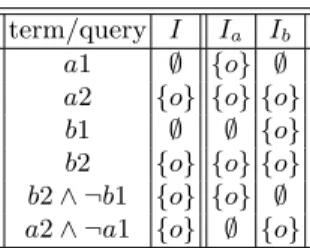
If the queries on the left-hand side of articulations have negation, then the net-work corresponds to a Datalog program with rules that contain negation in their bodies, and it is well known (e.g. see [7]) that such programs may not have a unique minimal model. This is also illustrated by the example shown in Figure 8, in which the interpretation function is also given as term superscript (that is,
I(a2) = I(b2) = {o}, while I(a1) = I(b1) = ∅).
a2 ∧ ¬a1
-a2{o} a1¾ b2 ∧ ¬b1
b1 b2{o}
Fig. 8. A network with no unique minimal model
term/query I Ia Ib
a1 ∅ {o} ∅
a2 {o} {o} {o}
b1 ∅ ∅ {o}
b2 {o} {o} {o} b2 ∧ ¬b1 {o} {o} ∅ a2 ∧ ¬a1 {o} ∅ {o}
Table 1. Models of the network shown in Figure 8
Table 1 shows the interpretation I of the network and two interpretations,
Ia and Ib, which are both models and minimal. This turns out to be a serious
drawback.
Proposition 5. A neg-extended taxonomy is a pair (T, ¹¬
e) where T is a
termi-nology and ¹¬
e⊆ (L¬T × T ), reflexive and transitive. A neg-extended source S is
a pair (A, I), where A is a neg-extended taxonomy (T, ¹¬
e) and I is an
interpre-tation of T. Deciding whether an object o ∈ Obj is in the answer of an extended query q in a neg-extended source S, o ∈ ans(q, S), is a coNP-hard problem. The proof is based on the following polynomial reduction from SAT. Let α be a CNF formula of propositional logic over an alphabet V, that is:
α = n ^ i=1 αi αi= mi _ j=1 lij
where lij is either a positive literal, that is a letter v ∈ V, or a negative literal,
that is ¬u where u ∈ V. We map α into a neg-extended source Sα = (Aα, Iα),
where Aα = (V, ¹α), and an extended query qα as follows: let o be any object
in Obj; then:
– the query qαis given by
_
{v1∧ . . . ∧ vk | ¬v1∨ . . . ∨ ¬vk is a conjunct in α}
If there is no such conjunct ¬v1∨ . . . ∨ ¬vk in α, then let α1 be l1∨ . . . ∨ lk;
we then set qα= l1∧ . . . ∧ lk, where ¬u = u and v = ¬v.
– for each remaining conjunct αi in α,
1. if αi is a letter v, then Iα(v) = {o}
2. if αi is l1∨ . . . ∨ lk for k ≥ 2, where at least one literal is positive, say
w.l.o.g. that l1is the positive literal u, then the subsumption relationship
(l2∧ . . . ∧ lk, u) is in ¹α.
– nothing else is in Iα, qα or ¹α.
For instance, the propositional formula
α = a2 ∧ b2 ∧
(a1 ∨ ¬a2 ∨ b1) ∧ (a1 ∨ b1 ∨ ¬b2) ∧
¬a1 ∧ ¬b1
is mapped into the source shown in Figure 8 and the query a1 ∨ b1. We now show the following
Lemma o ∈ ans(qα, Sα) iff α is unsatisfiable.
In fact, we prove the equivalent form: o 6∈ ans(qα, Sα) iff α is satisfiable.
(→) Suppose α is satisfiable, and let f be a truth assignment over V satisfying it. Let J be the interpretation of the terminology V such that, for each term
t ∈ V,
J(t) =
½
{o} if f (t) = T ∅ otherwise
We have that Iα≤ J, since for each t ∈ V, either Iα(t) is empty, or Iα(t) = {o}.
In the former case, Iα(t) ⊆ J(t) for any J(t). In the latter case, we have that
αj = t for some 1 ≤ j ≤ n, which implies f (t) = T (since f satisfies α)
which implies J(t) = {o} and again Iα(t) ⊆ J(t). Moreover, (q, u) ∈¹α implies
J(q) ⊆ J(u). In proof, (q, u) ∈¹α iff αk = ¬q ∨ u for some 1 ≤ k ≤ n, which
implies f (¬q ∨ u) = T (since f satisfies α) and therefore: either f (¬q) = T and by construction J(q) = ∅, or f (u) = T and by construction J(u) = {o}; in both cases J(q) ⊆ J(u). Hence J is a model of Aα. However, o 6∈ J(qα). In fact, by
construction, for any disjunct d in qα, there exists αj= ¬d for some 1 ≤ j ≤ n.
Since f satisfies α, it follows that f satisfies ¬d so f (d) = F. But then J(d) = ∅ for each conjunct d in qα, which implies J(qα) = ∅. So, o 6∈ J(q) for a model J
(←) Suppose o 6∈ ans(qα, Sα), and let J be a model of Aα such that o 6∈ J(qα).
Let f be the truth assignment over V defined as follows, for each letter t ∈ V,
f (t) =
½
T if o ∈ J(t) F otherwise
By a similar argument to the one developed in the if part of the proof, it can be proved that f satisfies α, and this completes the proof of the Lemma.
From the last Lemma and the NP-completeness of SAT, the coNP-hardness of deciding query answers in neg-extended sources follows. ¤
6
Query to query articulations
Query to query (q2q) articulations establish subsumption relationships between queries, and are the most sophisticate representation scheme for data integra-tion. Query answering in this context requires deciding query containment, a notoriously difficult task from the computational point of view [8].
We will address two different kinds of q2q articulations, leaving negation out of the considered languages, in light of the negative results reported in the previous Section.
A conjunctive articulation has the form q ¹ r where q is a negation-free DNF query, i.e. an expression of the language LT, while r is a conjunction of terms.
A conjunctive taxonomy (T, ¹c) is just a terminology and set of conjunctive
articulations. From a logical point of view, a conjunctive taxonomy is just a notational variant of an extended (i.e., t2q) taxonomy. In fact, it can be shown that an interpretation of a terminology T is a model of a conjunctive taxonomy (T, ¹c) if and only if it is a model of the taxonomy (T, ¹), where ¹ is obtained
from ¹cby replacing each subsumption relationship (q, t1∧ . . . ∧ tm) in ¹c, with
the m relationships (q, t1), . . . , (q, tm). Then all the results reported in Section 5
carry over conjunctive articulations.
A disjunctive articulation has the form q ¹ q0 where both q and q0 are
negation-free DNF queries, i.e. an expression of the language LT. Disjunction
in the right-hand side of sumsumption relationships cannot be reduced, and, as expected, is expressive enough to allow the existence of sources which do not have a unique minimal model. As an example, the source S = (A, I), where
A = ({a, b, c}, {(a, b ∨ c)}) and I = {(b, {1}), (c, {2})} has two minimal models, I1= I ∪ {(a, {1})} and I2= I ∪ {(a, {2})}.
Even though articulations are negation-free, loosing the uniqueness of the minimal model is enough to make query evaluation for this kind of sources computationally difficult.
Proposition 6. A disjunctive taxonomy is a pair (T, ¹d) where T is a
termi-nology and ¹d⊆ (LT× LT), reflexive and transitive. A disjunctive source S is a
pair (A, I), where A is a disjunctive taxonomy (T, ¹d) and I is an interpretation
of T. Deciding whether an object o ∈ Obj is in the answer of an extended query
The proof is similar to that of the previous Proposition. For brevity, we just show the reduction from SAT. Let α be as in the proof of Proposition 5. Let o be any object in Obj; then:
– the query qαis given by
W
{v1∧ . . . ∧ vk|¬v1∨ . . . ∨ ¬vk is a conjunct in α} ∨
W
{¬u1∧ . . . ∧ ¬uk | u1∨ . . . ∨ uk is a conjunct in α}
If there are no such conjuncts ¬v1∨ . . . ∨ ¬vkor ¬u1∧ . . . ∧ ¬ukin α, then let
α1 be l1∨ . . . ∨ lk; we then set qα= l1∧ . . . ∧ lk, where ¬u = u and v = ¬v.
– for each remaining conjunct αi in α,
1. if αi is a letter v, then Iα(v) = {o}
2. if αiis ¬u1∨. . .∨¬uj∨v1∨. . .∨vmwhere j, m ≥ 1 then the subsumption
relationship (u1∧ . . . ∧ uj, v1∨ . . . ∨ vm) is in ¹α.
– nothing else is in Iα, qα or ¹α.
In the present case, the propositional formula
α = a2 ∧ b2 ∧
(a1 ∨ ¬a2 ∨ b1) ∧ (a1 ∨ b1 ∨ ¬b2) ∧
¬a1 ∧ ¬b1
is mapped into the source shown in Figure 9 and the query a1 ∨ b1. It can be shown that:
Lemma o ∈ ans(qα, Sα) iff α is unsatisfiable. ¤
a2{o} - a1 ∨ b1 ¾ b2{o}
a1 b1
Fig. 9. A disjunctive source
7
Related Work
The approach to information retrieval on P2P networks considered in this study, starts to receive noteworthy attention by the researchers, as is believed that the database and knowledge base research has much to contribute to the P2P grand challenge through its wealth of techniques for sophisticated semantics-based data models and query processing techniques (e.g. see [9–11]). Of course, a P2P system might impose a single conceptual model on all participants to enforce uniform, global access, but this will be too restrictive. Alternatively, a limited number
of conceptual models may be allowed, so that traditional information mediation and integration techniques will likely apply (with the restriction that there is no central authority), e.g. see [12, 13]. The case of fully heterogeneous conceptual models makes uniform global access extremely challenging and this is the case that we are interested in.
From a data modeling point of view several approaches for P2P systems have been proposed recently, including relational-based approaches [10], XML-based approaches [14] and RDF-based [13]. In this paper we consider a taxonomy-based conceptual modeling approach. This approach has three main advantages (for more see [3]): (a) it is very easy to create the conceptual model of a source, (b) the integration of information from multiple sources can be done easily, and (c) automatic articulation using data-driven methods (like the one presented in [15]) are possible.
From an architectural point of view, and according to the SIL (Search In-dex Link) model presented in [16], our networks falls into the case of P2P sys-tems which have only forwarding search links. Specifically, our work special-izes content-based queries to taxonomy-based queries. Another distinguishing characteristic, is that in our model a peer does not just forward the received queries to its neighbors, it first translates them. Also note that the relationships stored in the articulations not only determine query translation but also query propagation. Of course, work done on P2P architectures, e.g. [17, 16], could be also exploited in our setting in order to enhance the efficiency of a taxonomy-based P2P system. Our approach has some similiraties with Edutella [12, 13], an RDF-based metadata infrastructure for P2P systems. However, the mediators of Edutella distribute a query to a peer only if the query can be answered com-pletely by the peer. In contrast, in our model the answers of queries are formed collaboratively. Moreover, in Edutella special servers are devoted for registering the schema that each peer supports. In our model we do not make any such assumption.
An approach for supporting object queries appropriate for domains where no accepted naming standards exist (and thus it generalizes the functional-ity provided by systems like Napster and Gnutella) is described in [11]. The mapping tables employed there can express only exact mappings, however the open/closed-world semantics that are given are quite interesting and their ap-plication to our setting is one topic of our research agenda.
8
Conclusions
We have addressed the problem of evaluating queries stated against information sources storing objects indexed according to a taxonomies. Different represen-tation schemes and query languages have been examined, with the objective of tracing the boundaries between cases in which query evaluation is tractable from those in which it is intractable. To this end, we have focused more on the analysis of the problems from a computational point of view than on the aspects related to the peer-to-peer architecture. In spite of this, our model is clearly
con-ceived with these architectures in mind, so the results that have been derived in this paper constitute a necessary foundational step towards the development of peer-to-peer information systems based on taxonomical classification schemata.
References
1. Ling, B., Lu, Z., Ng, W.S., Ooi, B., Tan, K.L., Zhou, A.: “A Content-Based Resource Location Mechanism in PeerIS”. In: Proc. of the 3rd International Con-ference on Web Information Systems Engineering, WISE 2002, Singapore (2002) 2. Koubarakis, M., Tryfonopoulos, C.: “Peer-to-Peer Agent Systems for Textual
In-formation Dissemination: Algorithms and Complexity”. In: Proceedings of the UK Workshop on Multiagent Systems,UKMAS’02, Liverpool, UK (2002)
3. Tzitzikas, Y., Meghini, C., Spyratos, N.: ”Taxonomy-based Conceptual Modeling for Peer-to-Peer Networks”. In: Proceedings of 22th Int. Conf. on Conceptual Modeling, ER’2003, Chicago, Illinois (2003)
4. Tzitzikas, Y., Spyratos, N., Constantopoulos, P.: “Mediators over Taxonomy-based Information Sources”. VLDB Journal (2004) (to appear).
5. Meghini, C., Tzitzikas, Y.: Query evaluation in peer-to-peer networks of taxonomy-based sources. In: Proceedings of CooPIS-2003, the Tenth International Conference on Cooperative Information Systems. LNCS 2888, Springer Verlag (2003) 263–281 6. Ceri, S., Gottlob, G., Tanca, L.: Logic Programming and Databases. Springer
Verlag (1990)
7. Ullman, J.D.: “Principles of Database and Knowledge-Base Systems, Vol. I”. Com-puter Science Press (1988)
8. Lenzerini, M.: Data integration: A theoretical perspective. In: Proceedings of PODS 2002, the twenty-first ACM SIGMOD-SIGACT-SIGART Symposium on Principles of Database Systems, Madison, Winsconsin, USA (2002)
9. Gribble, S., Halevy, A., Ives, Z., Rodrig, M., Suiu, D.: “What can Databases do for Peer-to-Peer?”. In: Proceedings of WebDB01, Santa Barbara, CA (2001) 10. Bernstein, P.A., Giunchiglia, F., Kementsietsidis, A., Mylopoulos, J., Serafini, L.,
Zaihrayeu, I.: “Data Management for Peer-to-Peer Computing: A Vision”. In: Proceedings of WebDB02, Madison, Wisconsin (2002)
11. Kementsietsidis, A., Arenas, M., Miller, R.J.: “Mapping Data in Peer-to-Peer Systems: Semantics and Algorithmic Issues”. In: Int. Conf. on Management of Data, SIGMOD’2003, San Diego, California (2003)
12. Nejdl, W., Wolf, B., Staab, S., Tane, J.: ”EDUTELLA: Searching and Annotating Resources within an RDF-based P2P Network”. In: Semantic Web Workshop 2002, Honolulu, Havaii (2002)
13. Nejdl, W., Wolf, B., Qu, C., Decker, S., Sintek, M., Naeve, A., Nilsson, M., Palmer, M., Risch, T.: ”EDUTELLA: A P2P networking infrastructure based on RDF”. In: WWW’2002. (2002)
14. Halevy, A., Ives, Z., Mork, P., Tatarinov, I.: “Piazza: Data Management Infras-tructure for Semantic Web Applications”. In: Proceedings of WWW’2003. (2003) 15. Tzitzikas, Y., Meghini, C.: “Ostensive Automatic Schema Mapping for Taxonomy-based Peer-to-Peer Systems”. In: Seventh International Workshop on Cooperative Information Agents, CIA-2003, Helsinki, Finland (2003)
16. Cooper, B., Garcia-Molina, H.: “Modeling and Measuring Scalable Peer-to-peer Search Networks”. Technical report, University of Stanford (2002)
17. Yang, B., Garcia-Molina, H.: ”Comparing Hybrid Peer-to-Peer Systems”. In: The VLDB Journal. (2001) 561–570