The Chandelier:
Toward a Digitally Conceived Physical Performance Object
Steven L. Pliam
Bachelor of Arts, University of Minnesota, 1989
Master of Architecture, Virginia Polytechnic Institute, 2000 Submitted to the program in Media Arts and Sciences, School of Architecture and Planning,
in partial fulfillment of the requirements for the degree of Master of Science in Media Arts and Sciences at the Massachusetts Institute of Technology
August 2007
@2007 Massachusetts Institute of Technology. All Rights Reserved.
Author: Steven L. Pliam
Program in Media Arts and Sciences August 10th, 2007 I 7 I I
7
MAUSAVHusErrs I4STITUTE OF TECHNOLOGYSEP
I4
2007
LIBRARIES
Certified by: Tod Machover
Professor of Music and Media
Program in Media Arts and Sciences Thesis Supervisor
Accepted by: Professor Deb Roy
Chair, Departmental Committee on Graduate Studies Program in Media Arts and Sciences
The Chandelier:
Toward a Digitally Conceived Physical Performance Object
Steven L. Pliam
Bachelor of Arts, University of Minnesota, 1989
Master of Architecture, Virginia Polytechnic Institute, 2000
Submitted to the program in Media Arts and Sciences,
School of Architecture and Planning,
in partial fulfillment of the requirements for the degree of
Master of Science in Media Arts and Sciences at the
Massachusetts Institute of Technology
August 2007
@2007
Massachusetts Institute of Technology. All Rights Reserved.
Abstract
In the performing arts, the relationship that is established between what is seen and what is heard must be experienced to fully appreciate and understand the aesthetics of performance. Actual physical objects such as musical
instruments, lights, elements of the set, props, and people provide the visual associations and a tangible reality which can enhance the musical elements in a performance. This thesis proposes that new and artistic physical objects can, in themselves, be designed to perform. It introduces the Chandelier, a kinetic sculpture, a central set piece for a new opera, a new kind of musical instrument, and an object that performs. The piece moves and changes shape through mechanical action and the designed interplay between surfaces and light. It is intended to be interacted with by musicians and players of the opera. This thesis also explores the design process and evolution of the Chandelier with a primary objective of realizing a constructible, physical performance object through an authentic and abstruse digital conception. It is a conception not of a static nature, but incorporates a dynamic sense of changeable form through coordinated elements of light, mechanics, and sculpture.
The Chandelier:
Toward a Digitally Conceived Physical Performance Object
Steven L. Pliam
Bachelor of Arts, University of Minnesota, 1989
Master of Architecture, Virginia Polytechnic Institute, 2000
Submitted to the program in Media Arts and Sciences,
School of Architecture and Planning,
in partial fulfillment of the requirements for the degree of
Master of Science in Media Arts and Sciences at the
Massachusetts Institute of Technology
August 2007
@2007
Massachusetts Institute of Technology. All Rights Reserved.
Thesis Committee
Thesis Reader
Cynthia Breazeal
Associate Professor of Media Arts and Sciences
MIT Program in Media Arts and Sciences
The Chandelier:
Toward a Digitally Conceived Physical Performance Object
Steven L. Pliam
Bachelor of Arts, University of Minnesota, 1989
Master of Architecture, Virginia Polytechnic Institute, 2000
Submitted to the program in Media Arts and Sciences,
School of Architecture and Planning,
in partial fulfillment of the requirements for the degree of
Master of Science in Media Arts and Sciences at the
Massachusetts Institute of Technology
August 2007
@2007
Massachusetts Institute of Technology. All Rights Reserved.
Thesis Committee
Thesis Reader
Joseph A. Paradiso
Associate Professor of Media Arts and Sciences
MIT Program in Media Arts and Sciences
The Chandelier:
Toward a Digitally Conceived Physical Performance Object
Steven L. Pliam
Bachelor of Arts, University of Minnesota, 1989
Master of Architecture, Virginia Polytechnic Institute, 2000
Submitted to the program in Media Arts and Sciences,
School of Architecture and Planning,
in partial fulfillment of the requirements for the degree of
Master of Science in Media Arts and Sciences at the
Massachusetts Institute of Technology
August 2007
@2007
Massachusetts Institute of Technology. All Rights Reserved.
Thesis Committee
Thesis Reader
Alex McDowell
Visiting Artist
MIT Program in Media Arts and Sciences
I
I
TABLE OF CONTENTS
Functionalia Title Page Abstract Thesis Committee Table of Contents Table of Figures Introduction Motivation The ChandelierOrganization of This Thesis
Background and Related Work
Challenging Form Through Digital Modeling
Visual Objects in Connection with Musical Performance Sculptural and Robotic Musical Instruments
er 3 Parameters of Design
3.1 Death and the Powers: An Opera by Tod Machover 3.2 Collaboration
3.2.1 A True Collective Effort
3.2.2 A Dialogue Between Two Designers 3.3 Formal Design Principles
3.3.1 Narrative Ideas Controlling Form 3.3.2 The Influence of Other Art
3.3.3 Design of the Set
3.3.4 The Chandelier as a Musical Instrument
3.3.5 The Chandelier as a Kinetic Sculpture 3.4 Mechanical Design Principles
3.4.1 Forces, Tensions, and Tectonics 3.4.2 Material Considerations
3.4.3 Principles of Movement
3.4.4 Principles of the System to Produce Music
Process of Execution
A Digital Archetype as a Construction Paradigm 4.1.1 Some History of Construction Specification 4.1.2 Software and 3D CAD
Chapter 1 1.1 1.2 1.3 Chapter 2 2.1 2.2 2.3 Chapt 19 20 22 23 25 25 31 38 43 43 47 47 48 50 50 53 56 57 59 61 62 64 65 67 69 69 70 71 Chapter 4 4.1
4.2 The Chandelier as a Digitally Conceived Form 74 4.2.1 Limitations of Conventional Design Media 75 4.2.2 3D Digital Modeling Transformations 76
4.2.3 Conceiving the Inconceivable 78
4.3 Progressive Versions and the Iterative Process 80
4.3.1 First Iteration 81
4.3.2 Second Iteration 81
4.3.3 Third Iteration 83
4.3.4 Fourth Iteration 84
4.3.5 Final Version 85
4.4 Movement and Metamorphosis Through Light 86 4.5 From Digital Archetype to Physical Prototype: The Model 91
4.5.1 Rapid Prototyping 91
4.5.2 Materials for the Model 93
4.5.3 Process and Execution 94
4.6 The Geometry of Constructibility 97
4.6.1 The Math Required for Constructibility: NURBS 98
4.6.2 Rationalizing Geometry 100
4.7 Building a Full Scale Mock-up of the Chandelier 103 4.7.1 Design and Proof of Concept 103
4.7.2 Beyond the Keyboard: An Alternative Interface 104
Chapter 5 Conclusion 109 5.1 Results, Successes, Failures: An Evaluation 109
5.1.1 Development 110
5.1.2 Aesthetics 112 5.1.3 Technology 113
5.1.4 Reaction and Evaluation During Sponsor Week 115
5.2 Future Work 116
5.3 Final Thoughts 120
Bibliography 122
Reader Biography 127 Appendix A: Max/MSP Code for the 3D Sphere Interface 129 Appendix B: Supplementary Sketches 130 Acknowledgements 132
TABLE OF FIGURES
Figure 0.1 Concept Collage of the Chandelier.
Figure 2.1 Chen, Sculpting system using the PHANToM Desktop haptic interface. Figure 2.2 Carlo Sequin, Sculpture Generator I software user interface.
Figure 2.3 Carlo Sequin, Heptoroid. Figure 2.4 Carlo Sequin, Borromean Torus.
Figure 2.5 Carlo Sequin, Snow sculpture: Whirled White Web. Figure 2.6 Brent Collins, Heptoroid 1998.
Figure 2.7 Carlo Sequin, Untitled 3D CAD rendering. Figure 2.8 Eva Hild, Stoneware 2003.
Figure 2.9 Carlo Sequin, Totem 3 Bronze 2004. Figure 2.10 Eva Hild, Sculpture: title unknown. Figure 2.11 George Hart, Whoville, aluminum. Figure 2.12 Arthur Silverman, Attitudes 1996. Figure 2.13 Charles Ginnever, Rashomon 1998.
Figure 2.14 Harriet Brisson, Great Rhombicuboctahedra and Octagonal Prisms. Figure 2.15 Harriet Brisson, Pentahedroid, four-dimensional tetrahedron.
Figure 2.16 3D CAD deconstructions of a hyper-dodecahedron. Figure 2.17 Marc Downie, from Loops art installation.
Figure 2.18 Charles Bestor, Into the Labyrinth, interactive art installation. Figure 2.19 Eric Singer, LEMUR musical robots.
Figure 2.20 Gil Weinberg, Haile, Intelligent robotic percussionist. Figure 2.21 Maywa Denki, Robotic musical performance instruments. Figure 2.22 Bruce Wands, Variations, interactive musical sculpture. Figure 2.23 Trimpin, SHHH: An Installation, Sound sculpture.
Figure 2.24 Trimpin, SHHH: An Installation, Suyama Space, Seattle 2006. Figure 2.25 Daniel Rozin, Wooden Mirror, 2000.
Figure 2.26 Daniel Rozin, Wooden Mirror Museum.
Figure 3.0 Operabots, Animatronic elements developed by the Robotic Life group. Figure 3.1 Digital rendering of an early set design with Chandelier.
Figure 3.2 Digital rendering of set, Chandelier, and floating player.
Figure 3.3 Digital renderings of the later set configurations with Chandelier. Figure 3.4 Chandelier, Early surface and wire digital sketches.
Figure 3.5 Illustration of the set scheme responding to Chandelier. Figure 3.6 Abstracted composition study of the Chandelier.
Figure 3.7 Digital studies of surfaces and light, Chandelier.
Figure 3.8 Digital sketch of 'metamorphosis' concept, Chandelier. Figure 3.9 Set elevation showing scaffolding above.
Figure 3.10 Illustration of the "under construction" aesthetic, Chandelier. Figure 3.11 Digital rendering of the display graphics embedded in the set walls. Figure 3.12 Anthony Gormley, Quantum CloudXVI, 2000.
Figure 3.13 Naum Gabo, Linear Construction II, 1951.
Figure 3.15 Rachel Whiteread, House, Cast 'negative-space' of a house 1993. Figure 3.16 Rachel Whiteread, Twenty-five spaces 1995.
Figure 3.17 Rachel Whiteread, Untitled (Stacks) 1999. Figure 3.18 Louise Nevelson, Sky Cathedral 1958.
Figure 3.19 Constantin Brancugi, Bird in Space series circa 1925. Figure 3.20 Early set design physical models, Laser-cut acrylic. Figure 3.21 Digital rendering detail of set wall.
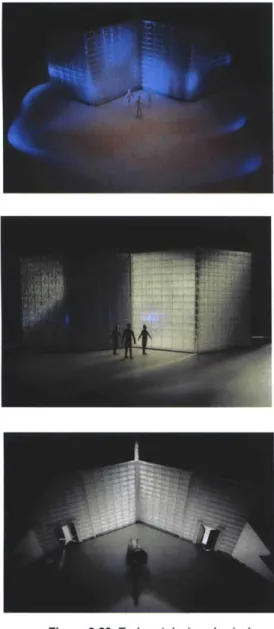
Figure 3.22 Set wall elevation drawing (drawn by Arjuna Imel).
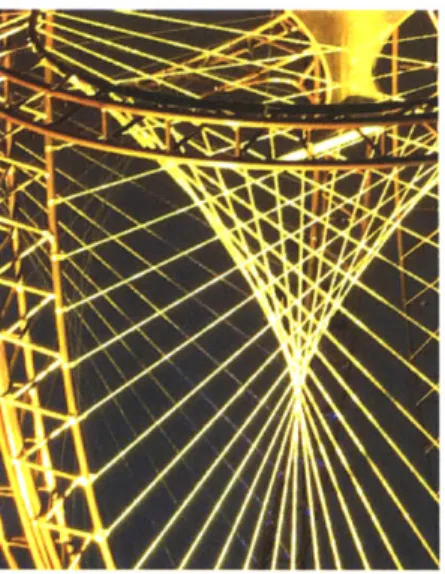
Figure 3.23 Inside the "brain" of Hal 9000 from 2001: A Space Odyssey 1968. Figure 3.24 Chandelier iteration: Showing interference patterns of string surfaces. Figure 3.25 Traditional musical instrument examples.
Figure 3.26 Spot-light studies of the Chandelier. Figure 3.27 Positional changes of the Chandelier.
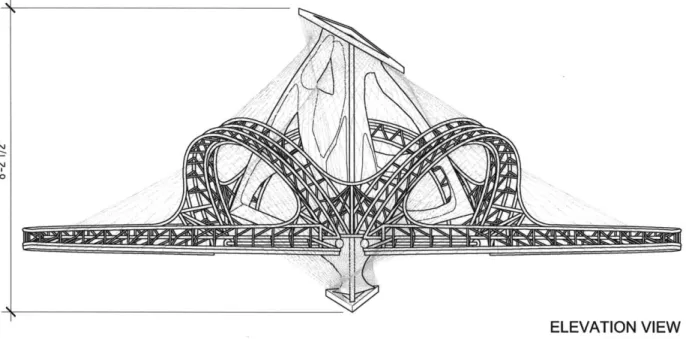
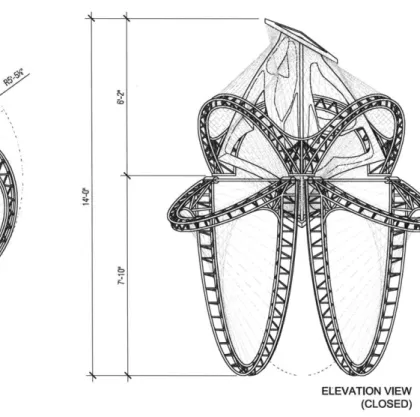
Figure 3.28 Elevation drawing of the "open" position of the Chandelier. Figure 3.29 Plan and elevation drawings of the "closed" Chandelier. Figure 3.30 Close-up of the Chandelier wing.
Figure 3.31 Elevation detail drawing of a wing section.
Figure 4.1 Rhinoceros @ 3D CAD modeling software, graphical user interface. Figure 4.2 Digitally Rendered concept image of the Chandelier.
Figure 4.3 3D solid volume of the interior space envelope of the Chandelier. Figure 4.4 3D interior volume after a series of Boolean operations.
Figure 4.5 Initial concept sketches of the Chandelier by Alex McDowell. Figure 4.6 Sequence showing a Boolean subtraction of the interior volume. Figure 4.7 Illustration of the Boolean operations of the interior volume. Figure 4.8 Digital images of the first iterative version of the Chandelier.
Figure 4.9 The appearance of the worm-like shape in the digital concept model. Figure 4.10 The implicit tetrahedrons appear in the 2nd version concept model. Figure 4.11 Articulation of the string surfaces and support frame.
Figure 4.12 Digital rendering of the full articulation of the frame and strings. Figure 4.13 Digital renderings of the 3rd version concept of the Chandelier. Figure 4.14 Digital renderings of the 4th version concept of the Chandelier.
Figure 4.15 Digital rendering of the final version with support frame and strings. Figure 4.16 Digital renderings of the final Chandelier with illumination scheme. Figure 4.17 Central form lighting sequence of one wing rotating.
Figure 4.18 Central form lighting sequence of two wings rotating.
Figure 4.19 Central form lighting sequence of two spot-lights changing intensity. Figure 4.20 Early physical prototype constructed from laser-cut acrylic and plastic line. Figure 4.21 InVision stereolithography rapid prototype machine.
Figure 4.22 Rapid prototype model of the Chandelier wing section being cleaned. Figure 4.23 Excavated rapid prototype of the wing section.
Figure 4.24 The manual formation of the curved brass frame.
Figure 4.25 Motor drive system and electronics of the physical prototype. Figure 4.26 Physical prototype being illuminated with spot-lights.
Figure 4.27 Physical prototype of the Chandelier under theatrical illumination. Figure 4.28 The central skeleton of the Chandelier exhibiting a transparency effect.
Figure 4.29 Frank 0. Gehry, circa 1990.
Figure 4.30 Examples of some NURBS curves with the basis functions.
Figure 4.31 A third-degree set of polynomials which define the basis functions. Figure 4.32 The central form made up of "developable" surfaces.
Figure 4.33 Full-scale mock-up of the Chandelier at the Media Lab.
Figure 4.34 Various solenoid and motor actuators installed on the Mock-up. Figure 4.35 Mike Fabio's conception of the laser-based human interface. Figure 4.36 Three-laser working prototype of Fabio's interface.
Figure 4.37 3D Connexion Spaceball used for the spherical control interface. Figure 4.38 Max/MSP Program code for the spherical human interface controller. Figure 4.39 Spherical interface controlling the Chandelier mock-up.
Figure 5.1 Sequence images of the Chandelier physical prototype. Figure 5.2 Sequence images of the Chandelier physical prototype. Figure 5.3 Sequence images of the Chandelier physical prototype. Figure 5.4 The physical prototype of the Chandelier and set design. Figure 5.5 Rendering of the complete set with Chandelier and Opera-bots. Appendix A Max/MSP program code for the spherical human interface. Appendix B Supplementary digital concept sketches.
x. x:RO Nsi :sssssss::222::::::::::...:..::n x .xx ~ ~ ~
a
x x~:x -::::vxrs!Ex-::v-v-.
, ,xa!!!!!!3227!-33:
: xChapter 1
Introduction
The scientist does not study Nature because it is useful; he studies it because he delights in it, and he delights in it because it is beautiful. If Nature were not beautiful, it would not be worth knowing, and if Nature were not worth knowing, life would not be worth living.
--Henri Poincard, 1901
It is certain that mathematics generally, and particularly geometry, owes its existence to the need which was felt of learning something about the behavior of real objects. The very word geometry, which, of course, means earth-measuring, proves this. ...geometry [mathematics] must be stripped of its merely logical-formal character by the coordination of real objects of experience with the empty conceptual schemata of axiomatic geometry.
1.1 Motivation
The idea of designing a piece of art, and particularly sculpture, as an authentic conception of the digital domain, that is, a conception that is exclusively derived from computation, has interested me for a long time. I have had first-hand experience working for a world-class, visionary architect who has made a lot of use of digital modeling tools to enable the design and construction of his projects. Frank Gehry is known for his geometrically challenging,
highly sculptural architecture [Dal Co 2003]. However, he has
never really exploited the special capabilities of digital modeling as a design medium. His conceptions have always occurred through the modeling and manipulation of physical materials. In this thesis, my aim is different. The primary interest that drives the evolution of the work in this thesis is the attempt to create a compelling physical performance object which is entirely constructible, but an object which is derived from the exploitation of the digital modeling medium. Of particular interest is to give material reality to a highly dematerialized, abstruse three dimensional digital form.
The medium of three dimensional digital modeling, like so many other digital tools, extends our abilities to conceive and create uniquely compelling ideas for the arts. The medium has a particularly powerful ability to manipulate and produce geometries which are highly complex. I have always had a great interest in geometry and its relationship to architecture and the arts, and have a strong predilection for geometric form in sculpture. A great many
sculptors share the same inclination. It is therefore quite easy to see why I have moved toward the digital modeling medium as a means to artistic design.
If the object of the modern practical musicians is, as they say, to
delight the sense of hearing with the variety of consonances, and if this property of tickling (for it cannot with truth be called delight in any other sense) resides in a simple piece of hollow wood over which are stretched four, six, or more strings of the gut of a dumb beast or of some other material, disposed according to the nature of the harmonic
numbers, or in a given number of natural reeds or of artificial ones made of wood, metal, or some other material, divided by proportioned and suitable measures, with a little air blowing inside of them while they are touched or struck by the clumsy and untutored hand of some base idiot or other, then let this object of delighting with the variety of their harmonies be abandoned to these instruments, for being without sense, movement, intellect, speech, discourse, reason, or soul, they are capable of nothing else. But let men, who have been endowed by nature with all these excellent and noble parts, endeavor to use them not merely to delight, but as imitators of the good ancients, to improve at the same time, for they have the capacity to do this and in doing otherwise they are acting contrary to nature, which is the handmaiden of God.
-- Vincenzo Galilei, Dialogo della musica
antica e della moderna, 1581
According to Jamie James [James 1993], these two very long sentences of sarcasm, by Galilei, led directly to the birth of opera. These words, apparently, incited the noble personages of Florence, at the time, to study and patronize the musical arts as well as to hold them worthy of great esteem. Galilei was a member of the Camerata, a salon of one of the nobles, which began commissioning the first operas. What cannot be missed
in these words is the almost obsessive focus on objects, namely the physical objects of instruments. Though somewhat nebulous, Galilei seems to regard the use of these objects, in terms of movement, intellect, and reason, as essential to the success of performance.
The performing arts have an intrinsic association with the physical environment. Even the concert hall or the dance theater can be thought to constitute the architectural physicality of an artistic performance. Architecture and performance objects, such as stage props or musical instruments, are important physical elements for the execution of an opera, dance performance, or concert music. They are an integral part of the experience. It is clear that a music or video recording of a concert or dance lacks the physical
connection to the actual performance. Only in the presence of these elemental physical actions is it possible for an audience to fully realize the performance experience [Mazzola, G511er 2002].
If this assumption is valid, the possibilities for new and interesting
objects of art that could perform expressive actions which would relate directly to musical or other performance events arise. Such
objects might extend the physical connection that the audience would have with performance art in profound and unprecedented
ways.
1.2 The Chandelier
This thesis introduces the Chandelier, a performance object, a kinetic sculpture, a central set piece for a new opera, and a new kind of musical instrument. It moves and changes shape through mechanical action and designed illumination. It is intended to be interacted with by musicians and players of the opera.
This newly invented performance object became the means through which I could explore the ideas and objectives that motivated the work of this thesis. As an object of sculpture, it embodies several important themes of the opera. As a new kind of musical instrument, it explores new sonic timbres as well as new kinds of mechanisms to produce those timbres. Much of the thinking that went into the design has been concerned with the impact that the chandelier, as a prominent physical presence, would have as a performing object. It is designed to move and
change shape to convey a sense of metamorphosis which will coordinate with narrative and musical ideas consisted in the opera. Another significant aspect of this set piece is that it physically produces musical sounds through electromagnetic excitation and other actuated stimulation of piano-like strings. The result of this design, it is hoped, will contribute significantly to the overall operatic experience through giving physical form to the narrative and musical events within it.
1.3 Organization of This Thesis
This thesis is divided into five chapters:
Chapter 1: Introduction
Chapter 2: Background and Related Work
Describes work, primarily from others, that serves as relevant background. This work is both technical and aesthetic, even artistic, and has significantly informed the work of this thesis as well as influenced the development of the Chandelier.
Chapter 3: Parameters of Design
Describes both the formal and mechanical principles which have guided the process of designing the Chandelier. Describes the aesthetic and collaborative parameters which were a significant part of the design experience.
Chapter 4: Process of Execution
Provides a detailed account of the evolution, constraints, discoveries, and resolutions of the design process and construction of the
Chandelier. Discusses relevant technologies that factored into the process.
Chapter 5: Conclusion
Offers an evaluation argument and concluding thoughts about the aesthetics, technology, and future of the Chandelier project.
Companion URL: <http://web.media.mit.edu/-pliam/res/clier.html> Provides links to several animations which present many of the images and ideas in this thesis.
Chapter 2
Background and Related
M
2.1 Challenging Form Through Digital Modeling
There have been many investigations into the possibilities for creating sculptural form, including free-form
architecture, using three dimensional (3D) digital modeling computation as well as standard Computer Aided Design
(CAD) software. The algorithms or functions that are
available in most professional level 3D CAD modelers offer a very extensive library of modeling tools, operations, and mathematical transformations which can be utilized to generate very interesting and complex three dimensional artistic forms.
Much of the existing work that has been done in attempting to achieve authentically digital, original, and compelling
3D forms is related heavily to the metaphor of physical
sculpting. Much of the research is centered around interactive and intuitive modeling using specialized human and computer interfaces. Galyean et al. developed a modeling system which enables a user to sculpt a solid material represented by voxel data by using virtual digital sculpting tools. A user can design 3D objects with intuitive
methods similar to real sculpting, because a 3D input device controls the sculpting tools [Galyean, Hughes 1991]. However, the problem with voxel-based data is that surfaces and curves are not smooth and the concept becomes the same as a pixel map. Wang et al. developed a volume sculpting tool as well. This was based on a concept of sculpting a solid material which was also voxel-based. As an interface, the method of manipulation feels quite limiting if you compare it to real physical sculpting. That is because the user is still forced to manipulate 3D objects with the antiquated, somewhat sterile input/output devices of the mouse and LCD display
[Wang, Kaufman 1995]. Bill and Lodha et al. used polygonal models to develop a sculpting metaphor. With this way of working, the user is actually able to alter the topology of the
surface; however, they are still working with a tessellated approximation of a smooth surface and are forced to deal with cumbersome connectivity issues [Bill, Lodha 1995]. Noble developed another modeling system which enables the user to deform parametric surfaces with a much more direct, on-surface manipulation. The difficulty here is when the user tries to anticipate and predict the results of their manipulation; but, the system does lead to a very convincing clay modeling metaphor. Perhaps, its greatest limitation is that the user cannot modify the topology of the deformed object with this kind
of space deformation technique [Nobel, Clapworthy 1998]. One of the more successful 3D modeling techniques has been developed by Matsumiya, Takemura, and Yokoya. They have created a new free-form interactive modeling technique based on the metaphor of clay work. This immersive modeling system enables the user to interactively and intuitively design
3D solid objects with curved surfaces by using a finger. Also,
their system defines shape deformation and smooth free-form surfaces with simple mathematical data [Matsumiya, Takemura, Yokoya 2000]. As I will discuss later, minimizing the quantity and complexity of the mathematical data becomes
object. Chen and Sun have developed a virtual haptic sculpting system which emulates sculpting material interactions and behavior to include real-time melting, burning, stamping, painting, and peeling. The system uses an off-the-shelf desktop,
haptic human interface. [Chen, Sun 2002]. Others have
moved closer to relying on interactive graphic displays to give feedback to the user to help him/her sculpt more intuitively artistic forms. The work of Rappoport and Spitz [Rappoport, Spitz 1997] gives much emphasis to the rapid interactive visualization of the model for the user in real-time. Schkolne, Pruett, and Schrdder have directly targeted the needs and interests of artists with their "Surface Drawing" system which allows the user to create very unusual, interesting 3D organic shapes with tangible hand tools. [Schkolne, Pruett, Schr6der 2001].
The research previously discussed, while certainly effective for creating original modeled forms, depends mostly on a direct interface activity which, for the most part, tries to emulate the sculpting metaphor. Therein may lie its greatest limitation with regard to the objective of the research in this thesis. The fundamental interest here is to identify and utilize digital modeling techniques which have the ability to create normally inconceivable, abstruse forms that can nevertheless be constructed. Inevitably, the construction or prototyping of the object will help inform us about the nature of the form.
Given the breadth of available 3D modeling tools which implement mathematical algorithms to allow the user to create geometrically complex and beautiful forms, it is believed
by many artists that this medium provides a means to a new
realm of visual art. Several people have developed techniques and software to model with mathematically based algorithms. Terzopoulos and Qin have developed an interactive sculpting system using a "dynamic" NURBS (Non Uniform Rational B-Spline) model which allows the user to sculpt shapes with
NURBS mathematics. [Terzopoulos, Qin 1994]. Adams and
Figure 2.1 Chen, Sculpting system using the PHANToM Desktop haptic interface.
Figure 2.2 Carlo Sequin, Sculpture Generator I software user interface.
Figure 2.3 Carlo Sequin, Heptoroid.
Figure 2.4 Carlo Sequin, Borromean Torus.
Figure 2.5 Carlo Sequin, Snow sculpture: Whirled White Web.
Figure 2.6 Brent Collins, Heptoroid 1998.
Dutr6 have applied interactive Boolean operations on surface bounded solids which allows for highly complex shapes to be
sculpted with very robust mathematical data. [Adams, Dutr6
2003].
There have been a number of fine art sculptors who have actively pursued the challenge of realizing abstruse, sculptural form that would normally be impossible, or exceedingly difficult, without the use of 3D CAD tools. Carlo H. Sequin, an artist and professor of Arts and Sciences at the University of California, Berkeley, has made a very significant contribution to both the 3D modeling technology as well as the body of this kind of sculptural art [Sequin 2001]. As a scientist, he became very interested in the beauty and complexity of various mathematical models and geometries. Eventually, his increasing interest in computer graphics compelled him to exploit the power of 3D CAD to help him generate physical
Figure 2.7 Carlo Sequin, Untitled 3D CAD rendering.
sculpture that would express the beauty of these complex mathematical models [Sequin 2000]. Brent Collins, who is a sculptor and an academic, has written about how Sequin's techniques and 3D CAD have greatly furthered the evolution
of his art beyond what would have previously been possible. He discusses the development of his sculpture over a period of several decades, as an intuitive art of visual mathematics. He also discusses his collaboration with Sequin which has led to a virtual prototyping system that has allowed the material realization of his works [Collins 1997]. Sequin most recently has taken the creation of abstruse sculpture to a new level in fully integrating 3D CAD processes with rapid prototyping so that sculptors and other visual artists will have a means to a truly three dimensional, physical manifestation of their work
[Sequin 2005]. Other sculptors have followed lines similar to Sequin in producing conceptually difficult works through the medium of 3D CAD. Helaman Ferguson has produced challenging, mathematically inspired, and free-form works
in bronze and stone. Not only are his sculptures conceived digitally to obtain a formally difficult geometric conception, but the physical manifestations of his work constitute a true mastery of the entire craft of digital prototyping on through to fabrication [Ferguson 1994]. A Swedish ceramic artist,
Eva Hild, has created large scale ceramic sculptures based on conceptually challenging ideas derived with 3D CAD [Hild
2007]. George Hart conceives his sculptural works from the 3D CAD medium as well. He claims that the medium has helped
him to realize a "geometric aesthetic" which would otherwise be impossible through conventional media. In a talk given to the Symposium on Computational Geometry in 2001, he proclaimed [Hart 2001]:
I am a full-time sculptor creating works that manifest what I call the geometric aesthetic. This aesthetic celebrates the beauty of geometry and spatial rationality. I seek to produce novel forms which engage the viewer visually and have an underlying coherence based on symmetric three-dimensional mathematical structures. Internal relationships between the components of a sculpture can provide a depth to the work, leading the viewer
Figure 2.8 Eva Hild, Stoneware 2003.
Figure 2.9 Carlo Sequin, Totem
3 Bronze 2004.
Figure 2.10 Eva Hild, Sculpture: title unknown.
Figure 2.11 George Hart, Whoville, aluminum, The form derives from an icosahedron and dodecahedron in a mutually dual position.
Figure 2.12 Arthur Silverman, Attitudes 1996.
Figure 2.13 Charles Ginnever, Rashomon 1998.
Figure 2.14 Harriet Brisson, Great
Rhombicuboctahedra and Octagonal Prisms, This space-filling structure divides
space perfectly in half. It is impossible to differentiate the form from the space between, since the two are identical.
Figure 2.15 Harriet Brisson, Pentahedroid, four-dimensional tetrahedron.
to return again and again, each time seeing deeper into the piece. In addition, the viewer is led to ask questions of a mathematical nature about the patterns he or she finds.
Friedman [Friedman 1998] discusses the unique quality that certain kinds of conceptually abstruse sculptural art will have which allows the viewer to see in new ways. "Hypersculpture," as he refers to it, is a type that represents a given object
from several points of view at once. It is, in this sense, four dimensional sculpture. The 3D CAD medium facilitates the modeling of this extremely complex geometry which can then be concretized in physical form. Friedman highlights the fact that seeing is of basic importance in mathematics just as in art, and certain mathematical forms can be seen as ideas for generating art forms. He introduces the idea of "hyperseeing," which is a more complete all-around way of seeing from multiple viewpoints; and, it is conditioned
by viewing hypersculpture. David Brisson also contributed
sculptural works and criticism that were at the forefront of visualizing higher dimensional art forms. He advocated the notion that through the creation of physical objects and the tangible knowledge that we acquire from them, it is possible to visualize and comprehend very complex geometric ideas. Such ideas could be initially explored within the 3D CAD medium
[Brisson 1992].
I have conducted a study of several hyper-sculptural objects which required 3D CAD techniques to visualize and construct.
One of the more complex constructions was a four dimensional analog to the fifth platonic solid body, the dodecahedron. It is a highly mathematically based entity that contains 120 three dimensional dodecahedron cells which are seamlessly bound together, and completely fill the internal volume which is
defined by the limits of an outer dodecahedron. This polytope (n-dimensional analog to a polyhedron) can be understood as
Figure 2.16 3D CAD deconstructions of a hyper-dodecahedron.
a projection of a four dimensional dodecahedron onto three dimensional space [Pliam 1995].
2.2 Visual Objects in Connection with Musical Performance
Live performance, of any kind, has an intrinsic association with physical events. These events rely on the action of objects, whether they are musical instruments, people, or stage props in an opera. The action of these objects constitutes a translation of the abstract, formal phenomenon of music and choreographic concepts into a tangible, physical manifestation. The audience can make sense of this manifestation through the intellect, and the resulting experience is the aesthetic apprehension of performance. Just as music must be composed, it is often suggested that performance must be designed. Johnston suggests that musical performance constitutes a "design problem" that must be dealt with through the visualization and physicalization of musical events in order to give meaning to a performance [Johnston, Amitani, Edmonds 2007]. What emerges from this notion is the possibility for innovative and meaningful artistic objects that could perform expressive
Figure 2.17 Marc Downie, from Loops art installation.
actions that would relate directly to a choreography or auditory events. Such objects would extend the physical connection that the audience would have with the performance. Mazzola and G611er make a convincing argument for the necessity of physical performance elements, including musicians, singers, and dancers, in giving meaningful interpretation to the abstract symbols of a musical score. They make the claim that an artistic or musical performance is the physical execution of a work of art; and therefore, any visually compelling object which serves to connect the audience with the abstractions of music can be a viable enhancement as well as an integral component of the performance [Mazzola, Go1ler 2002]. Dance choreography, in concept, tries to embody musical, as well as extra-musical, ideas through the coordinated movement of human beings; and it can be argued that the basis of this art form is to extend the physical connection with the music. Bahn [Bahn, Hahn, Trueman 2001] and Friberg [Friberg, Sundberg, Fryden 2000] make strong cases for the physical connection of music with the motion of the body, which becomes a vital and compelling physical constituent of the musical performance. Artistically constructed physical objects may be programmed to behave according to a choreography that provides a similar kind of physical connection to the music or other source material.
Real-time visual art which correlates to other sources in a performance, like music, is nothing new; and much excellent research has been done in this area. Marc Downie has taken the notion of choreography and applied it to real-time graphics that follow and respond to a musical score. There is no doubt that these compelling graphics give a strong visual, even cinematic, component to the musical performance [Downie 2005]. The effort to bring musical activity into the physical realm can be found in related research. Charles Bestor's work with installation art attempts to marry the tangible, spatial qualities of sculpture with the temporal qualities of a corresponding
musical work. His pieces are, in essence, sculptural interpretations of the sonic material which is experienced and activated by the observer as he or she passes through the piece [Bestor 2003]. Poupyrev et al. developed an interactive sculptural piece which can be made to control musical events as well as express them. It takes the form of a horizontal bed that contains a set of transparent plastic rods which illuminate and move vertically according to how the user interacts with it. Yet it is also capable of changing shape and color according to various input material including music, thus behaving like a responsive kinetic sculpture. [Poupyrev, Nashida, Maruyama, Rekimoto, Yamaji 2004]. Similarly, Roosegaarde constructed a large wall sculpture which is made up of a massive two dimensional array of projecting rod elements that respond to a musical input which can either be raw audio or a MIDI score. The piece conveys a powerful, dynamic physical expression of the music. [Roosegaarde 2005].
The relationship between musical instruments and their
performance aesthetics has always been an important one. This is probably true primarily because there exists an inextricable connection between what is being heard, the physical actions of the performer, and how an instrument works to produce
musical sound. Fletcher and Rossing provide much insight about how the physics of musical instruments are actually revealed in their design and construction. The physical
construction then becomes a part of the aesthetic appreciation of how the sound is produced [Fletcher, Rossing 1998]. In the case of more traditional instruments, the visual observation of how a musician physically interacts with the mechanics of the instrument is a significant part of the overall aesthetic experience of a performance and gives a full appreciation of the tangible beauty of the instrument. Roger Scruton, [Scruton
1999] in his chapter on musical performance in his book The
Aesthetics ofMusic, underscores the importance of the physical
tangibility of various acoustic instruments with respect to how
Figure 2.18 Charles Bestor, Into the
Labyrinth, interactive art installation.
they enhance the experience of performance. However, with the development of electronic digital instruments, there has been something of a breakdown in this tangible relationship between the physicality of the act of playing an instrument and the sound that is created. As an example, the familiar piano-type keyboard has been reduced simply to an interface to access electronically generated sounds. In other words, it produces no sound of its own, physically, that the audience can connect to the action of the instrument. Since the actual creation of the sound happens within internal electronics, there is then very little to impart a visual description of how that sound is produced, and hence the quality of the tangible relationship is, in many cases, almost totally lost.
The experience of listening to music without any visual component to convey a physical reality can, of course, be very meaningful and satisfying. Recorded music, for example, certainly does have its benefits. In this form, as well as music that is created electronically, the listener deals with a highly distilled, pure, temporal composition of sonic events and textures. The nature of the musical perception might, in this particular sense, be more direct. As the late pianist and critic, Glenn Gould, points out, one of the greater benefits of recorded music may be in the insights which it gives to those perceptions as they relate more broadly to the past and future.
Recordings deal with concepts through which the past is re-evaluated, and they concern notions about the future which will ultimately question even the validity of evaluation. [Gould 1966]
However, the qualities that may be most unique to these mediated, electronic forms of music relate to the altered roles of the participants involved, including the audience or
listener. In the mid-i 960s, Gould states an extremely prophetic summary about the significance of recorded music:
Electronic Transmission [Recording] has already inspired a new concept of multiple-authorship responsibility in which the specific functions of the composer, the performer, and, indeed the consumer overlap. We need only think for a moment of the manner in which the formerly separate roles of composer and performer are now automatically combined in electronic tape construction or, to give an example more topical than potential, the way in which the home listener is now able to exercise limited technical and, for that matter, critical judgments, courtesy of the modestly resourceful
controls of his hi-fi. It will not, it seems to me, be very much longer before a more self-assertive streak is detected in the listener's participation, before, to give but one example, "do-it-yourself' tape editing is the prerogative of every reasonably conscientious consumer of recorded music (the Hausmusik activity of the future, perhaps!). And I would be most surprised if the consumer involvement were to terminate at that level. In fact, implicit in electronic culture is an acceptance of the idea of multilevel participation in the creative process. [Gould 1964]
There is an interesting implication in Gould's text. The inclination for the listener to assert judgment and exercise the ability to participate in the editing of recorded material may indicate a broader yearning to understand and obtain a deeper apprehension of the music. There is good reason to conclude that this yearning may be an inextricable condition of the experience of music. If the sensory ability of the eyes can be utilized to help satisfy this yearning, then perhaps the modalities of dance, opera, and film have something more to offer us in that experience.
With electronically created and recorded music, the listener only has the aural information from the ears. He or she does
not have any visual indication about how the sounds are being created. There is not any visual affirmation to resonate with the qualitative aspects of the music, such as tempo change, articulation, and dynamics. These qualitative elements of musical expression can be appreciated during a performance, because they have an affinity with music cognition. Hiraga makes the claim that these are among the primary elements of music that influence human emotion, and hence, the experience of the listener [Hiraga, Matsuda 2004]. Bresin calls these same basic elements "expressive cues" which trigger the emotional response of the listeners; and such cues can be affirmed visually through the act of performance by musicians or dancers [Bresin, Friberg 2000]. Hiraga goes on to assert that the audience will actually be assisted in the aesthetic understanding of a performance by a visualization which coordinates with these qualitative musical elements of expression. Any visual cue which aligns with or echoes these expressive elements will enhance the emotional response of the audience. He goes further to say that such visual elements in a performance will actually aid the listener's experience and comprehension of the music [Hiraga, Matsuda 2004]. This enhanced experience through visual alignments with the qualitative aspects of tempo, articulation, and dynamics is not possible through the pure listening experience of a recording or digitally produced, sequenced music. Therefore, it may be reasonable to conclude that live performance and the multimedia forms of film and opera can offer a more
integrated experience of the senses that will lead to greater comprehension. The coordination of different sensory elements in these genres would appear to equate to a greater whole than the sum of its constituents.
One basic problem that the design of the Chandelier has tried to address is the question of how to restore the aesthetic expression that only the action of physical objects can manifest in the performance of digital music, and thereby,
help reestablish a meaningful connection between a physical aesthetic and the musical performance that would correspond with it. With respect to digital audio, sound is generated inside the electronics, so a corresponding choreography of objects
could express those events visually. A new technologically based opera is the perfect context within which to explore such
a choreography. It is not necessarily a goal for the Chandelier, or the entire set for that matter, to restore the sense or presence of a traditional musical instrument. That would essentially be trying to merely emulate a traditional experience. Rather, the
aim here is to conceptualize a choreography of physical objects that would be 'interactive' in the sense that they would respond in real-time to musical/auditory material or other programmatic input in order to establish a tangible connection to it. Even though there would not be a literal recreation of a traditional musical instrument in performance, this could nevertheless serve to expand our notion of what a musical instrument might be through giving a compelling and meaningful physical reality to the material.
There has been much interest and research devoted to giving visual form to music. Much of this work has involved a graphic approach to the interpretation of musical form. As previously discussed, some of the research has attempted to correlate a more three dimensional, sculptural manifestation with such form. The research in this thesis is concerned not so much with graphic interpretations, but rather the action and movement of three dimensional objects, with the goal to develop a new physical means to express and coordinate with related events that are occurring in music, dance, or other action components of a performance piece. The objects then become an integral aspect of that performance.
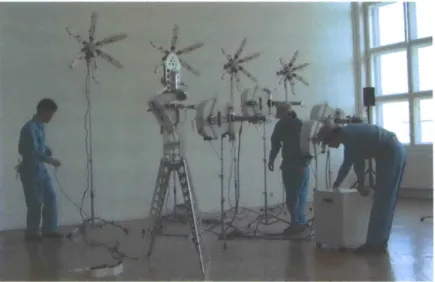
Figure 2.19 Eric Singer, LEMUR musical robots.
Figure 2.20 Gil Weinberg, Haile, Intelligent robotic percussionist.
2.3 Sculptural and Robotic Musical Instruments
Among other set pieces in the Death and the Powers opera, the Chandelier has, as one of its most important functions, the role of a musical instrument. It contains robotic components which operate to help produce the unique sounds that it makes. As it
is also a piece of sculpture, the design has required a tenacious commitment to achieving a balance between the robotic requirements and the artistic intentions of the piece.
There have been numerous contributions to the field of musical robotics. Eric Singer has made a recent, but significant,
contribution with the League of Electronic Musical Urban Robots (LEMUR). Similar to the robotic design elements of the Chandelier, Singer has implemented motors and solenoids to vibrate shakers and automate the plucking of strings in
several of his robotic instruments [Singer, Feddersen 2004]. He has recently created a multiple robotic musical instrument installation at the Beall Center for Art and Technology at the University of California at Irvine. It comprised over thirty new robotic musical instruments. Many of these were driven with simple stepper motors or solenoids and were percussive in nature. There were "BeaterBots, SpinnerBots, SistrumBots, RecoBots," and so on. An interesting aspect of this installation is that much of it could be controlled remotely from over the Internet [Singer, Feddersen, Bowen 2005]. More recently, he has collaborated with Paul Lerhman to create, construct, and perform a completely robotic rendition of George Antheil's famous Dadaist masterpiece, Ballet Mecanique, at the National Gallery in Washington D. C. [Lerhman, Singer 2006]. Gil Weinberg and Scott Driscoll have developed an interactive robotic percussionist which responds intelligently by listening to live human players and analyzing aspects of their playing
in real-time. It will then play along in a collaborative, improvisatory manner that is based on results of the analysis [Weinberg, Driscoll 2007].
Figure 2.21 Maywa Denki, Robotic musical performance instruments. Marimca is an automated xylophone in the form of a flower. The flowers open when they start to play and close when they have finished.
Mecha-Folk is a fully automated folk guitar.
In the sphere of Japanese popular music, the alternative rock group Maywa Denki has made quite an impact with their uniquely engineered musical robotics. They have invented a series of music-producing objects which are artistically ingenious and technologically very innovative. Many of the robotic objects are wearable and coordinate with the musician
to automate sound creation processes. The "Tsukuba Music" was conceived to use electromagnetics and motors which produce sound by physically knocking and vibrating various materials. According to Maywa Denki, the emergence of new technologies for music generation, such as samplers, synthesizers, and computers have separated music from the material, leaving music simply as information that can only be listened to with speakers. "The Tsukuba Music was created to return our attention to music's origins, that music is created from materials" [Evans 2004].
Moving closer to the specific area of interest in this thesis, there have been a few people, though not very many, who have approached the challenge of trying to combine music creation with the invention of an artistic and engaging sculptural form. Bruce Wands [Wands 2005] introduced an interactive musical sculpture which functions as a human interface that enables participants to create their own mix of musical elements
Figure 2.22 Bruce Wands, Variations, interactive musical sculpture installation with surrounding speakers.
which are provided. The user interacts with various sculptural elements which consists of individual modules such as a cube that contains a speaker and a tube with a removable ball that controls what musical material is heard. Many people may interact with the sculpture at the same time, and this allows for a great variety of collaborative musical experiences. Two sculptors, Daniel Rozin and Gerhard Trimpin, have created works which are, at first and primarily, sculptures, but also function as extremely unique musical instruments in their own right. It would be the work of these two artists that probably most closely associates with the intentions and ideals behind the design of the Chandelier. The robotic instrument inventor and sculptor Trimpin [Strouse 2006] moves much closer than others previously mentioned to making a particularly profound connection between physical objects and the natural musical sound that they produce. He is a major exponent and pioneer in the field of robotic musical instruments as well as sonically significant sculpture. His influence on the work of so many musical roboticists goes back for several decades. Originally connected with the seminal composer of the player piano, Conlon Nancarrow, he developed a machine to digitally translate the hole-punched rolls of player piano compositions. His interest in player pianos and the mechanization of musical instruments eventually led to an expansive tree of innovative musical robotic works. Examples of his work, such as Der
Ring and SHHH celebrate the capacity of artistically designed
objects to perform interesting and provocative sonic events. Trimpin has also created monumental sculptural instruments such as the high-profile centerpiece at the Experience
Music Project in Seattle. This is a colossal amalgamation of hundreds of guitars and other conventional instruments which collectively produce a robotically manufactured sound that is truly unique.
Another very special work of sculpture which has, somewhat
Figure 2.23 Trimpin, SHHH: An Installation, Sound sculpture.
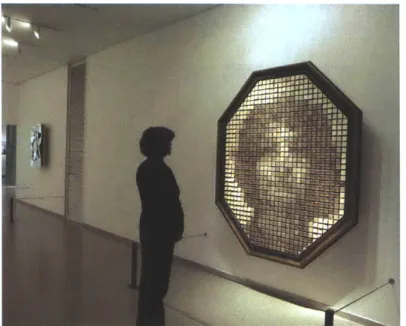
musical quality is Rozin's Wooden Mirror [Rozin 2000]. The piece is a composite of 830 pieces of wood which all fit into an octagon frame. Each piece is capable of rotating independently in order to give a visual distinction with respect to reflected light; the overall effect being that the piece as a whole becomes a pixel field which can reflect images that are fed to it through a semi-hidden camera. It is set up so that whoever or whatever is in front of it will be reflected in the image. As it turns out, the sonic effects of the moving pieces of wood and the hundreds of tiny motors which drive them are quite compelling and provide a pleasing "secondary feedback" that constitutes a kind of musical sonic image. This image echoes the visual reflection of the piece.
U
7EE
Figure 2.26 Daniel Rozin, Wooden Mirror Museum.
Chapter 3
Parameters of Design
3.1 Death and the Powers: An Opera by Tod Machover
The primary context and reason for the inception and development of the Chandelier is the new opera Death and
the Powers, currently being composed by Tod Machover. This
opera will be a bold venture into new ideas and technologies in set design, sound design, robotic musical instruments, and musical composition. The stage and set will represent the interior of the house of the main character, Simon Powers. This interior will eventually start to reveal itself, in subtle ways at first, as a living, breathing, conscious entity. It will gradually become apparent that it is an intelligent, interconnected
"System" which will move, change shape, breath, and vibrate. Several image display surfaces and sound-producing elements will be embedded in the System, and they will show the disparate, fleeting thoughts and memories of Simon's internal world. Machover writes:
The music of Death and the Powers will represent a bold step forward toward a new kind of opera. Innovative vocal techniques will be designed especially for this work. Instrumentation for the
Figure 3.0 Operabots, animatronic elements being developed by Cynthia
Breazeal's Robotic Life group, will coordinate with the Chandelier and the rest of the set to create a robotic
ensemble of performance machines.
opera calls for a small ensemble (ca. 10 players:
5 strings, 3 winds, 1 percussion, 1 keyboard)
located in the pit. Players will perform on specially designed, next generation Hyperinstruments which will represent significant advances over our current ones, in gestural sophistication, beauty of sound, and simplicity of use. Unlike current electronic instruments, these new Hyperinstruments will allow each performer to control his/her precise sound mix and balance, with overall balance of instruments and voices being modulated by the conductor. Another innovative musical feature of the opera will be the first-ever use of sonic animatronics ("sonitronics"), or physical, sculptural elements, such as a robotic "Chandelier" which is both a beautiful, compelling object as well as a subtle, resonant musical
instrument whose string-like surfaces are struck, bowed, tickled and stretched by skilled Hyper-instrumentalists. [Machover 2006]
In addition to composer and creative director Tod Machover, a very diverse, world-class group of people have been involved with the design and production of this operatic odyssey of
science fiction. Robert Pinsky (former United States poet laureate) wrote the libretto based on a story by Randy Weiner. The robotic environment and set pieces are being developed by Cynthia Breazeal and her team at the MIT Media Lab. Hollywood film production
designer Alex McDowell (Charlie and the Chocolate
Factory, The Terminal, Minority Report, Fight Club)
will bring his considerable experience in film design and animatronics to the stage for the first time.
To understand the full context and the raison d'etre of the Chandelier, it is best to know something
about the setting, characters, story, and themes of Death and
the Powers. The basic synopsis of the opera is given by Tod
Machover:
Simon Powers was a great man, a legend who wanted to go beyond the bounds of humanity. He was a successful inventor, businessman, and showman. During his life, he accumulated unimaginable wealth and power. He is the founder of the System, a human organism material experiment which investigated the transduction of human existence into other forms. His work was heralded as revolutionary and genius, but his ideas and experiments also had implications that mainstream
society found objectionable. He has received
thousands of hate letters. To many, he is considered a pariah. Reaching the end of his life, Powers faces the question of his legacy: "When I die, what remains?
What will I leave behind? What can I control? What can I perpetuate?" He is now conducting the last experiment of his life. He is in the process of passing
from one form of existence to another in an effort to project himself into the future. Whether or not he is actually alive is a question. Simon Powers is himself now a System. Powers must rely on his family to complete the experiment. The strains on the family
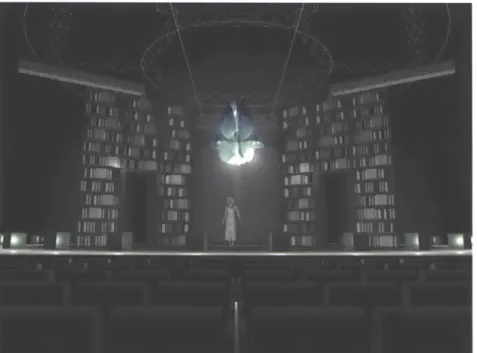
Figure 3.2 Digital rendering of set, Chandelier, and floating player.
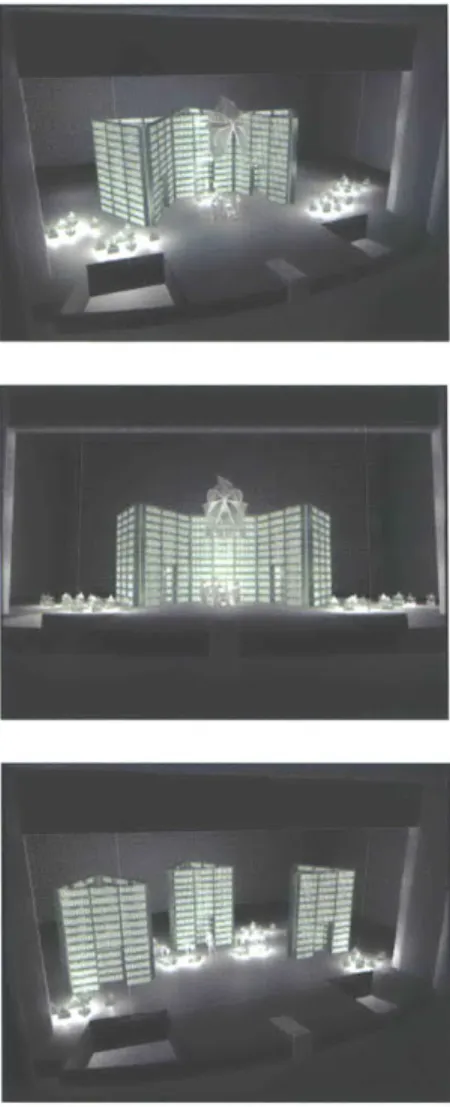
Figure 3.3 Digital renderings of the later set configurations with the final Chandelier design.
come to a head, as Evvy, his third wife, withdraws more and more from the real world in a desire to join Simon in the System. Miranda Powers, Simon's
young daughter by his first wife, is fearful of losing touch with the real world, and tries desperately to keep her father connected to the suffering of others in the world. The family also includes Nicholas, who is Simon's prot6gd, the son he never had. Nicholas is the ultimate product of Simon's manipulation. Nicholas holds the knowledge on how to project Simon to the future. Like a puppet and somehow incomplete himself, he is devoted to completing Simon's final experiment. Simon's transition into The System creates global havoc prompting a visit
by representatives from The United Way, The United
Nations, and The Administration, as well as a parade of the world's miseries- the victims of famine, torture, crime, and disease. This story is framed by a quartet of "rolling, lurching, and gliding" robots who have been commanded in some future time to perform this pageant, and who - in a Prologue and Epilogue - attempt to understand the meaning of death. [Machover 2006].
Figure 3.4 Chandelier, Early surface and wire digital sketches.
The Chandelier is the central set piece of the opera. It represents a tomb-like citadel or digital-mechanical womb in which Simon Powers is transformed and reborn into a pure state of consciousness, an alternate form of existence. Although Simon experiences a carnal death not long after the beginning of the opera, he undergoes a transfiguration into a
digital consciousness and then continues to speak through a more abstract, compelling language of texturally based sound.
However, the Chandelier, though central to the narrative and visual aspects of the opera, constitutes merely a part of the System which encompasses, and is embodied by, the entire set as a whole. In that sense, the Chandelier is not a completely separate piece, but is an integral element of the System.
3.2 Collaboration
In the process of designing the Chandelier and set for Death
and the Powers, many people have come together to participate
in the conceptual ideas, artistic design, production planning, and construction strategies of every aspect of these elements of the opera. Therefore, the success of this process has greatly depended on the open exchange and collaboration of ideas between people with vastly different backgrounds. The end result of the opera production will certainly be a reflection of how effective this collaboration was.
3.2.1 A True Collective Effort
Just as a large group of people have collaborated on the opera as a whole, there has been a smaller group who have taken part in the collaboration over the design and planning of the
Chandelier. The three primary people who have driven the development of the design are Mike Fabio [Fabio 2007], Alex McDowell, and myself. The three of us worked extremely closely together focusing on different aspects of the design. Laird Nolan was also a very important contributor and
facilitator of communications and processes. Fabio and I shared the most intimate, consistent, and on-going collaborative relationship during the entire design period. This accounts for about two years in total. Fabio's primary focus was the electromechanical system which is implemented throughout the Chandelier and is responsible for exciting the long strings of the instrument and producing unique textures of musical sound. I will touch on certain aspects of his work throughout this thesis; however, for a much more rigorous treatment of the sound production system of the Chandelier, I refer you to his thesis which addresses this particular side of the research as its central subject [Fabio 2007]. It is important to note that while my focus, and indeed the primary emphasis of this thesis,
has been the design of the overall form and Fabio's focus the development of the sound producing mechanisms, the two areas have had so much crossover that they were not totally separate processes. Aside from that, Fabio had a great deal of input on the formal considerations of the design just as I have had a commensurate input on the sound creation side of things. Much of our collective research has been concerned with the integrated relationship of the two spheres.
3.2.2 A Dialogue Between Two Designers
In the earliest stages of the conceptual design phase of both the set of Death and the Powers as well as the Chandelier, I began having discussions with the production designer of the opera, Alex McDowell. McDowell has been a design leader in several areas of pop culture ranging from MTV videos to record jacket graphics for over 20 years. Currently, he is fully engaged as a production designer in feature films. He has worked with some of the most highly esteemed film directors
such as Terry Gilliam, David Fincher, Steven Spielberg, and Tim Burton and has completed production design for such films as The Lawnmower Man, The Crow, Fear and Loathing
in Las Vegas, Fight Club, Minority Report, and The Terminal.
In the initial discussions, McDowell and I began to brainstorm about different formal ideas which might tie together various themes in the opera with elements in the set. This was the beginning of a long term dialogue between the two of us which would continue to take place over long distances and changing directions and the evolving design of the opera. The importance of this dialogue cannot be overemphasized. While I produced the actual formal design of the Chandelier, McDowell provided continual guidance and input about many overall design
constraints which related to the larger picture of the set design. As McDowell carries with him, and is responsible for, the most fundamental design ideas of the opera, he needed to contain,