HAL Id: hal-01227693
https://hal.inria.fr/hal-01227693
Submitted on 11 Nov 2015HAL is a multi-disciplinary open access
archive for the deposit and dissemination of sci-entific research documents, whether they are pub-lished or not. The documents may come from teaching and research institutions in France or abroad, or from public or private research centers.
L’archive ouverte pluridisciplinaire HAL, est destinée au dépôt et à la diffusion de documents scientifiques de niveau recherche, publiés ou non, émanant des établissements d’enseignement et de recherche français ou étrangers, des laboratoires publics ou privés.
Franco Barbanera, Mariangiola Dezani-Ciancaglini, Ivan Lanese, Ugo de
’Liguoro
To cite this version:
Franco Barbanera, Mariangiola Dezani-Ciancaglini, Ivan Lanese, Ugo de ’Liguoro. Retractable Con-tracts. Eighth International Workshop on Programming Language Approaches to Concurrency- and Communication-cEntric Software, Apr 2015, London, United Kingdom. �hal-01227693�
To appear in EPTCS.
Franco Barbanera
Dipartimento di Matematica e Informatica, University of Catania, [email protected]
Mariangiola Dezani-Ciancaglini
Dipartimento di Informatica, University of Torino, [email protected]
†
Ivan Lanese
Dipartimento di Informatica - Scienza e Ingegneria, University of Bologna/INRIA, [email protected]
‡
Ugo de’Liguoro
Dipartimento di Informatica, University of Torino, [email protected]
§
In calculi for modelling communication protocols, internal and external choices play dual roles. Two external choices can be viewed naturally as dual too, as they represent an agreement between the communicating parties. If the interaction fails, the past agreements are good candidates as points where to roll back, in order to take a different agreement. We propose a variant of contracts with synchronous rollbacks to agreement points in case of deadlock. The new calculus is equipped with a compliance relation which is shown to be decidable.
1
Introduction
In human as well as automatic negotiations, an interesting feature is the ability of rolling back to some previous point in case of failure, undoing previous choices and possibly trying a different path. Roll-backsare familiar to the users of web browsers, and so are also the troubles that these might cause during “undisciplined” interactions. Clicking the “back” button, or going to some previous point in the chronol-ogy when we are in the middle of a transaction, say the booking of a flight, can be as smart as dangerous. In any case, it is surely a behaviour that service programmers want to discipline. Also the converse has to be treated with care: a server discovering that an auxiliary service becomes available after having started a conversation could take advantage of it using some kind of rollback. However, such a server would be quite unfair if the rollback were completely hidden from the client.
Let us consider an example. A Buyer is looking for a bag (bag) or a belt (belt); she will decide how to pay, either by credit card (card) or by cash (cash), after knowing the price from a Seller. The Buyer behaviour can be described by the process:
Buyer = bag.price.(card ⊕ cash) ⊕ belt.price.(card ⊕ cash)
∗This work was partially supported by Italian MIUR PRIN Project CINA Prot. 2010LHT4KM and COST Action IC1201
BETTY.
†This author was partially supported by the Torino University/Compagnia San Paolo Project SALT.
‡This author was partially supported by the French ANR project REVER n. ANR 11 INSE 007 and COST Action IC1405. §This author was partially supported by the Torino University/Compagnia San Paolo Project SALT.
where dot is sequential composition and ⊕ is internal choice. The Seller does not accept credit card payments for items of low price, like belts, but only for more expensive ones, like bags:
Seller = belt.price.cash + bag.price.(card + cash)
where + is external choice. According to contract theory [6], Buyer is not compliant with Seller, since she can choose to pay the belt by card. Also, there is no obvious way to represent the buyer’s will to be free in her decision about the payment and be compliant with a seller without asking the seller in advance. Nonetheless, when interacting with Seller, the buyer’s decision is actually free at least in the case of purchase of a bag. For exploiting such a possibility the client (but also the server) should be able to tolerate a partial failure of her protocol, and to try a different path.
To this aim we add to (some) choices a possibility of rollback, in case the taken path fails to reach a success configuration. In this setting, choices among outputs are no more purely internal, since the environment may oblige to undo a wrong choice and choose a different alternative. For this reason, we denote choices between outputs which allow rollback as external, hence we use Buyer0below instead of Buyer:
Buyer0= bag.price.(card ⊕ cash) + belt.price.(card ⊕ cash)
We thus explore a model of contract interaction in which synchronous rollback is triggered when client and server fail to reach an agreement.
In defining our model we build over some previous work reported in [2], where we have considered contracts with rollbacks. However, we depart from that model on three main aspects. First, in the present model rollback is used in a disciplined way to tolerate failures in the interaction, thus improving compatibility, while in [2] it is an internal decision of either client or server, which makes compatibility more difficult. Second, we embed checkpoints in the structure of contracts, avoiding explicit checkpoints. Third, we consider a stack of “pasts”, called histories, instead of just one past for each participant, as in [2], thus allowing to undo many past choices looking for a successful alternative.
2
Contracts for retractable interactions
Our contracts can be obtained from the session behaviours of [1] or from the session contracts of [3] just adding external retractable choices between outputs.
Definition 2.1 (Retractable Contracts). Let N (set of names) be some countable set of symbols and N = {a | a ∈ N } (set of conames), with N ∩ N = /0. The set RC of retractable contracts is defined as the set of theclosed expressions generated by the following grammar,
σ , ρ := | 1 success
| ∑i∈Iai.σi (retractable) input
| ∑i∈Iai.σi retractable output
| L
i∈Iai.σi unretractable output
| x variable
| rec x.σ recursion
where I is non-empty and finite, the names and the conames in choices are pairwise distinct and σ is not a variable inrec x.σ .
Note that recursion in RC is guarded and hence contractive in the usual sense. We take an equi-recursive view of recursion by equating rec x.σ with σ [rec x.σ /x]. We use α to range overN ∪ N , with the convention α =
(
a if α = a, a if α = a.
We write α1.σ1+ α2.σ2 for binary input/retractable output and a1.σ1⊕ a2.σ2 for binary unretractable
output. They are both commutative by definition. Also, a.σ may denote both unary retractable output and unary unretractable output. This is not a source of confusion since they have the same semantics. From now on we call just contracts the expressions in RC. They are written by omitting all trailing 1’s.
In order to deal with rollbacks we decorate contracts with histories, which memorise the alternatives in choices which have been discharged. We use ‘◦’ as a placeholder for no-remaining-alternatives. Definition 2.2 (Contracts with histories). Let Histories be the expressions (referred to also as stacks) generated by the grammar:
γγγ ::= [ ] | γγγ : σ
where σ ∈ RC ∪ {◦} and ◦ 6∈ RC. Then the set of contracts with histories is defined by: RCH = {γγγ ≺ σ | γγγ ∈ Histories, σ ∈ RC ∪ {◦} }.
We write just σ1: · · · : σk for the stack (· · · ([ ] : σ1) : · · · ) : σk. With a little abuse of notation we use ‘ : ’ also
to concatenate histories, and to add contracts in front of histories.
We can now discuss the operational semantics of our calculus (Definition 2.3). The reduction rule for the internal choice (⊕) is standard, but for the presence of the γγγ ≺ ·. Whereas, when reducing retractable choices (+), the discharged branches are memorised. When a single action is executed, the history is modified by adding a ‘◦’, intuitively meaning that the only possible branch has been tried and no alternative is left. Rule (rb) recovers the contract on the top of the stack, replacing the current one with it.
Definition 2.3 (LTS of Contracts with Histories).
(+) γγγ ≺ α .σ + σ0−→ γγγ : σα 0≺ σ (⊕) γγγ ≺ a.σ ⊕ σ0−→ γγγ ≺ a.στ (α) γγγ ≺ α.σ−→ γγγ : ◦ ≺ σα (rb) γγγ : σ0≺ σ−→ γγγ ≺ σrb 0
The interaction of a client with a server is modelled by the reduction of their parallel composition, that can be either forward, consisting of CCS style synchronisations and single internal choices, or backward, only when there is no possible forward reduction, and the client is not satisfied, i.e. it is different from 1. Definition 2.4 (LTS of Client/Server Pairs). We define the relation −→ over pairs of contracts with histories by the following rules:
δδδ ≺ ρ−→ δδδα 000≺ ρ0 γγγ ≺ σ −→ γγγα 000≺ σ0 (comm) δ δδ ≺ ρ k γγγ ≺ σ −→ δδδ000≺ ρ0 k γγγ000≺ σ0 δ δδ ≺ ρ−→ δδδ ≺ ρτ 0 (τ) δδδ ≺ ρ k γγγ ≺ σ −→ δδδ ≺ ρ0k γγγ ≺ σ γγ ≺ ργ −→ γγγrb 000≺ ρ0 δ ≺ σδδ −→ δδδrb 000≺ σ0 ρ 6= 1 (rbk) γ γγ ≺ ρ k δδδ ≺ σ −→ γγγ000≺ ρ0k δδδ000≺ σ0
plus the rule symmetric to(τ) w.r.t. k. Moreover, rule (rbk) applies only if neither (comm) nor (τ) do.
We will use−→ and 6−→ with the standard meanings.∗
Notice that, since ‘◦’ cannot synchronise with anything, in case a partner rolls back to a ‘◦’, it is forced to recover an older past (if any).
The following examples show the different behaviours of retractable and unretractable outputs. We decorate arrows with the name of the used reduction rule. As a first example we consider a possible reduction of the process discussed in the Introduction.
Example 2.5. As in the Introduction, let Buyer0= bag.price.(card ⊕ cash) + belt.price.(card ⊕ cash) be a client and Seller = belt.price.cash + bag.price.(card + cash) a server; then
[ ] ≺ Buyer0 k [ ] ≺ Seller
comm
−→ bag.price.(card ⊕ cash) ≺ price.(card ⊕ cash) k bag.price.(card + cash) ≺ price.cash
comm
−→ bag.price.(card ⊕ cash) : ◦ ≺ (card ⊕ cash) k bag.price.(card + cash) : ◦ ≺ cash
τ
−→ bag.price.(card ⊕ cash) : ◦ ≺ card k bag.price.(card + cash) : ◦ ≺ cash
rbk
−→ bag.price.(card ⊕ cash) ≺ ◦ k bag.price.(card + cash) ≺ ◦
rbk
−→ [ ] ≺ bag.price.(card ⊕ cash) k [ ] ≺ bag.price.(card + cash)
comm
−→ ◦ ≺ price.(card ⊕ cash) k ◦ ≺ price.(card + cash)
comm
−→ ◦ : ◦ ≺ (card ⊕ cash) k ◦ : ◦ ≺ (card + cash)
τ
−→ ◦ : ◦ ≺ card k ◦ : ◦ ≺ (card + cash)
comm
−→ ◦ : ◦ : ◦ ≺ 1 k ◦ : ◦ : cash ≺ 1
6−→
Example 2.6. Let ρ = rec x.(b.x ⊕ a.c.x) and σ = rec x.(b.x + a.e.x). The following reduction sequence leads the parallel composition of these contracts to a deadlock.
ρ k σ −→τ [ ] ≺ a.c.ρ k [ ] ≺ rec x.(b.x + a.e.x)
comm
−→ ◦ ≺ c.ρ k b.σ ≺ e.σ
rbk
−→ [ ] ≺ ◦ k [ ] ≺ b.σ 6−→
Example 2.7. Let us now modify the above example by using retractable outputs in the client, so making the two contracts in parallel always reducible. The following reduction shows that there can be an infinite number of rollbacks in a sequence, even if it is not possible to have an infinite reduction containing only rollbacks. Notice how the stack keeps growing indefinitely.
Let ρ = rec x.(b.x + a.c.x) and σ = rec x.(b.x + a.e.x). ρ k σ comm−→ b.ρ ≺ c.ρ k b.σ ≺ e.σ rbk −→ [ ] ≺ b.ρ k [ ] ≺ b.σ comm −→ ◦ ≺ ρ k ◦ ≺ σ comm −→ ◦ : b.ρ ≺ c.ρ k ◦ : b.σ ≺ e.σ rbk −→ ◦ ≺ b.ρ k ◦ ≺ b.σ comm −→ ◦ : ◦ ≺ ρ k ◦ : ◦ ≺ σ .. .
3
Compliance
The compliance relation for standard contracts consists in requiring that, whenever no reduction is possi-ble, all client requests and offers have been satisfied, i.e. the client is in the success state 1. For retractable contracts we can adopt the same definition.
Definition 3.1 (Compliance Relation ).
i) The relation on contracts with histories is defined by: δ
δ
δ ≺ ρ γγγ ≺ σ whenever δδδ ≺ ρ k γγγ ≺ σ−→ δδδ∗ 000≺ ρ0k γγγ000≺ σ06−→ implies ρ0= 1 for any δδδ000, ρ0, γγγ000, σ0. ii) The relation on contracts is defined by:
ρ σ if [ ] ≺ ρ [ ] ≺ σ .
We now provide a formal system characterising compliance on retractable contracts.
The judgments are of the shape Γ B ρ a σ , where Γ is a set of expressions of the form ρ0a σ0. We write B ρ a σ when Γ is empty. The only non standard rule is rule (+, +), which assures compliance of two retractable choices when they contain respectively a name and the corresponding coname followed by compliant contracts. This contrasts with the rules (⊕, +) and (+, ⊕), where all conames in unretractable choices between outputs must have corresponding names in the choices between inputs, followed by compliant contracts.
Definition 3.2 (Formal System for Compliance).
(AX) Γ B 1 a σ (HYP) Γ, ρ a σ B ρ a σ Γ, α .ρ + ρ0a α.σ + σ0 B ρ a σ (+, +) Γ B α.ρ + ρ0a α.σ + σ0 ∀i ∈ I. Γ,L i∈Iai.ρia∑j∈I∪Jaj.σj B ρia σi (⊕, +) Γ B Li∈Iai.ρia∑j∈I∪Jaj.σj
∀i ∈ I. Γ,∑j∈I∪Jaj.σjaLi∈Iai.ρi B ρia σi
(+, ⊕) Γ B ∑j∈I∪Jaj.σjaLi∈Iai.ρi
Notice that rule (+, +) implicitly represents the fact that, in the decision procedure for two contracts made of retractable choices, the possible synchronising branches have to be tried, until either a successful one is found or all fail.
Example 3.3. Let us formally show that, for the Buyer0and Seller of the Introduction, we have Buyer0a Seller.
For the sake of readability, let
Γ0= Buyer0a Seller, price.(card ⊕ cash) a price.(card + cash) and Γ00= Γ0, card ⊕ cash a card + cash
(AX)
Γ00 B 1 a 1
(AX)
Γ00 B 1 a 1
(⊕, +)
Γ0 B card ⊕ cash a card + cash
(+, +)
Buyer0a Seller B price.(card ⊕ cash) a price.(card + cash)
(+, +)
B Buyer0a Seller
Example 3.4. The contracts of Example 2.7 can be formally proved to be compliant by means of the following derivation in our formal system. Actually such a derivation can be looked at as the result of the decision procedure implicitly described by the formal system.
(HYP)
b.ρ + a.c.ρ a b.σ + a.e.σ B ρ a σ
(+, +) B b.ρ + a.c.ρ a b.σ + a.e.σ
In applying the rules we exploit the fact that we consider contracts modulo recursion fold/unfold. We can show that derivability in this formal system is decidable, since it is syntax directed and it does not admit infinite derivations.
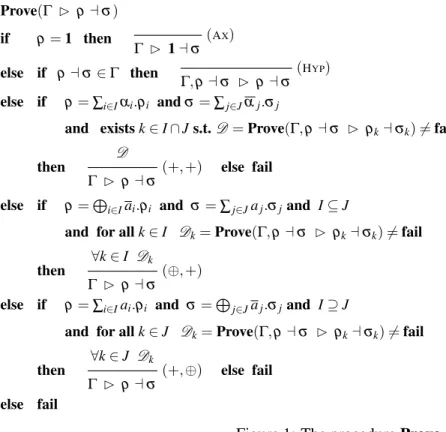
We denote by D a derivation in the system of Definition 3.2. The procedure Prove in Figure 1 clearly implements the formal system, that is it is straightforward to check the following
Fact 3.5.
i) Prove(Γ B ρ a σ ) 6= fail iff Γ B ρ a σ . ii) Prove(Γ B ρ a σ ) = D 6= fail implies D
Γ B ρ a σ Theorem 3.6. Derivability in the formal system is decidable.
Proof. By Fact 3.5, we only need to show that the procedure Prove always terminates. Notice that in all recursive calls Prove(Γ, ρ a σ B ρka σk) inside Prove(Γ B ρ a σ ) the expressions ρk and σk are
subexpressions of ρ and σ respectively (because of unfolding of recursion they can also be ρ and σ ). Since contract expressions generate regular trees, there are only finitely many such subexpressions. This implies that the number of different calls of procedure Prove is always finite.
In the remaining of this section we will show the soundness and the completeness of the formal system using some auxiliary lemmas.
Prove(Γ B ρ a σ )
if ρ = 1 then (AX)
Γ B 1 a σ
else if ρ a σ ∈ Γ then (HYP)
Γ, ρ a σ B ρ a σ
else if ρ = ∑i∈Iαi.ρi and σ = ∑j∈Jαj.σj
and exists k ∈ I ∩ J s.t.D = Prove(Γ,ρ a σ B ρka σk) 6= fail
then D (+, +)
Γ B ρ a σ
else fail
else if ρ =Li∈Iai.ρi and σ = ∑j∈Jaj.σjand I ⊆ J
and for all k ∈ I Dk= Prove(Γ, ρ a σ B ρka σk) 6= fail
then
∀k ∈ I Dk
(⊕, +)
Γ B ρ a σ
else if ρ = ∑i∈Iai.ρi and σ =Lj∈Jaj.σjand I ⊇ J
and for all k ∈ J Dk= Prove(Γ, ρ a σ B ρka σk) 6= fail
then ∀k ∈ J Dk (+, ⊕) Γ B ρ a σ else fail else fail
Figure 1: The procedure Prove.
Soundness It is useful to show that if a configuration is stuck, then both histories are empty. This is a consequence of the fact that the property “the histories of client and server have the same length” is preserved by reductions.
Lemma 3.7. If δδδ ≺ ρ0k γγγ ≺ σ06−→, then δδδ = γγγ = [ ].
Proof. Clearly δδδ ≺ ρ0k γγγ ≺ σ06−→ implies either δδδ = [ ] or γγγ = [ ]. Observe that: • rule (comm) adds one element to both stacks;
• rule (τ) does not modify both stacks;
• rule (rbk) removes one element from both stacks.
Then starting from two stacks containing the same number of elements, the reduction always produces two stacks containing the same number of elements. So δδδ = [ ] implies γγγ = [ ] and vice versa.
Next we state a lemma relating the logical rules of the formal system for compliance to the reduction rules; notice that the formers do not mention stacks in their judgments.
Lemma 3.8. If the following is an instance of rule (+, +), or (⊕, +), or (+, ⊕): Γ, ρ a σ B ρ1a σ1 · · · Γ, ρ a σ B ρna σn
Γ B ρ a σ then for all δδδ , γγγ and for all i = 1, . . . , n there exist δδδi, γγγisuch that
δ δ
δ ≺ ρ k γγγ ≺ σ −→ δδδ∗ i≺ ρik γγγi≺ σi
Proof. By inspection of the deduction and reduction rules. Theorem 3.9 (Soundness). If B ρ a σ , then ρ σ .
Proof. The proof is by contradiction. Assume ρ 6 σ . Then there is a reduction [ ] ≺ ρ k [ ] ≺ σ −→ [ ] ≺ ρ∗ 0k [ ] ≺ σ06−→
with ρ06= 1. Note that both the histories are empty thanks to Lemma 3.7. We proceed by induction on the number n of steps in the reduction.
Let us consider the base case (n = 0). In this case ρ 6= 1 and there is no possible synchronization. RuleAXis not applicable since ρ 6= 1. RuleHYPis not applicable since Γ is empty. The other rules are
not applicable otherwise we would have a possible synchronization.
Let us consider the inductive case. We have a case analysis on the topmost operators in ρ and σ . Let us start with the case where both topmost operators are retractable sums, i.e., ρ = a.ρk+ ρ00 and
σ = a.σk+ σ00. Thus,
[ ] ≺ a.ρk+ ρ00k [ ] ≺ a.σk+ σ00 ∗
−→ [ ] ≺ ρ00k [ ] ≺ σ00−→ [ ] ≺ ρ∗ 0k [ ] ≺ σ06−→ .
By definition ρ006 σ00, and since this requires a reduction of length < n, by inductive hypothesis 6B ρ00a σ00. Also the above reduction begins by:
[ ] ≺ a.ρk+ ρ00k [ ] ≺ a.σk+ σ00−→ ρ00≺ ρk k σ00≺ σk ∗
−→ ρ00≺ ρk0 k σ00≺ σk0−→ [ ] ≺ ρ00k [ ] ≺ σ00 for some ρk0, σk0. This implies, by the conditions on rule (rbk) and by Lemma 3.7:
[ ] ≺ ρkk [ ] ≺ σk ∗
−→ [ ] ≺ ρk0 k [ ] ≺ σk06−→ .
It follows that ρk6 σk, and by inductive hypothesis 6B ρka σk. We now claim that:
6B ρ00a σ00and 6B ρka σk imply 6B a.ρk+ ρ00a a.σk+ σ00
Toward a contradiction let us assume that B a.ρk+ ρ00a a.σk+ σ00; then the only applicable rule is
(+, +), which requires both
a.ρk+ ρ00a a.σk+ σ00 B ρ00a σ00 and a.ρk+ ρ00a a.σk+ σ00 B ρka σk.
Because the only difference between these statements and B ρ00a σ00and B ρ
ka σk is the assumption
a.ρk+ ρ00a a.σk+ σ00, which is used only in ruleHYP, there must be at least one branch of the derivation
tree of B a.ρk+ ρ00a a.σk+ σ00 ending by such a rule. By Lemma 3.8 this implies that [ ] ≺ a.ρk+
ρ00 k [ ] ≺ a.σk+ σ00 ∗
−→ [ ] ≺ a.ρk+ ρ00 k [ ] ≺ a.σk+ σ00 by a reduction never using rule (rbk). By
definition this implies that [ ] ≺ a.ρk+ ρ00 [ ] ≺ a.σk+ σ00, contradicting the hypothesis.
All other cases are similar.
Completeness The following lemma proves that compliance is preserved by the concatenation of his-tories to the left of the current hishis-tories.
Proof. It suffices to show that
δδδ ≺ ρ γγγ ≺ σ implies ρ0: δδδ ≺ ρ γγγ ≺ σ and δδδ ≺ ρ σ0: γγγ ≺ σ which we prove by contraposition.
Suppose that ρ0: δδδ ≺ ρ 6 γγγ ≺ σ ; then
ρ0: δδδ ≺ ρ k γγγ ≺ σ−→ δδδ∗ 0≺ ρ00k γγγ0≺ σ006−→ and ρ006= 1 If ρ0is never used, then δδδ0= ρ0: δδδ00and γγγ0= [ ], so that we get
δ
δδ ≺ ρ k γγγ ≺ σ −→ δδδ∗ 00≺ ρ00k [ ] ≺ σ006−→ Otherwise we have that
ρ0: δδδ ≺ ρ k γγγ ≺ σ−→ ρ∗ 0≺ ρ00k γγγ0≺ σ00−→ [ ] ≺ ρ0k γγγ00≺ σ000
and we assume that−→ is the shortest such reduction. It follows that ρ∗ 006= 1. By the minimality
assump-tion about the length of−→ we know that ρ∗ 0 neither has been restored by some previous application of
rule (rbk), nor pushed back into the stack before. We get
δδδ ≺ ρ k γγγ ≺ σ −→ [ ] ≺ ρ∗ 00k γγγ00≺ σ006−→ In both cases we conclude that δδδ ≺ ρ 6 γγγ ≺ σ as desired.
Similarly we can show that δδδ ≺ ρ 6 σ0: γγγ ≺ σ implies δδδ ≺ ρ 6 γγγ ≺ σ .
The following lemma gives all possible shapes of compliant contracts. It is the key lemma for the proof of completeness.
Lemma 3.11. If ρ σ , then one of the following conditions holds: 1. ρ = 1; 2. ρ = ∑i∈Iαi.ρi, σ = ∑j∈Jαj.σj and∃k ∈ I ∩ J. ρk σk; 3. ρ =L i∈Iai.ρi, σ = ∑j∈Jaj.σj, I⊆ J and ∀k ∈ I. ρk σk; 4. ρ = ∑i∈Iai.ρi, σ = L j∈Jaj.σj, I⊇ J and ∀k ∈ J. ρk σk.
Proof. By contraposition and by cases of the possible shapes of ρ and σ .
Suppose ρ = ∑i∈Iαi.ρi, σ = ∑j∈Jαj.σj, I ∩ J = {k1, . . . , kn} and ρki6
σki for 1 ≤ i ≤ n. Then we get [ ] ≺ ρki k [ ] ≺ σki ∗ −→ δδδi≺ ρi0k γγγi≺ σ 0 i 6−→
for 1 ≤ i ≤ n, where ρi06= 1 and δδδi= γγγi= [ ] by Lemma 3.7. This implies
∑i∈I\{k1}αi.ρi≺ ρk1 k∑j∈J\{k1}αj.σj≺ σk1 ∗ −→∑i∈I\{k1}αi.ρi≺ ρ 0 1k∑j∈J\{k1}αj.σj≺ σ 0 1
by Lemma 3.10. Let I0= I \ J and J0= J \ I. We can reduce [ ] ≺ ρ k [ ] ≺ σ only as follows: [ ] ≺ ρ k [ ] ≺ σ −→ ∑i∈I\{k1}αi.ρi≺ ρk1 k ∑j∈J\{k1}αj.σj≺ σk1 by (comm) ∗ −→ ∑i∈I\{k1}αi.ρi≺ ρ 0 1k ∑j∈J\{k1}αj.σj≺ σ 0 1 −→ [ ] ≺ ∑i∈I\{k1}αi.ρik [ ] ≺ ∑j∈J\{k1}αj.σj by (rbk) .. . ... ∗ −→ ∑i∈I0αi.ρi≺ ρn0 k ∑j∈J0αj.σj≺ σn0 −→ [ ] ≺ ∑i∈I0αi.ρik [ ] ≺ ∑j∈J0αj.σj by (rbk)
and [ ] ≺ ∑i∈I0αi.ρi k [ ] ≺ ∑j∈J0αj.σj is stuck since I0∩ J0= /0.
Suppose ρ =L
i∈Iai.ρiand σ = ∑j∈Jaj.σj. If I 6⊆ J let k ∈ I \ J; then we get
[ ] ≺ ρ k [ ] ≺ σ −→ [ ] ≺ ak.ρkk [ ] ≺ σ by (τ)
6−→
Otherwise I ⊆ J and ρk6 σk for some k ∈ I. By reasoning as above we have
[ ] ≺ ρk k [ ] ≺ σk ∗ −→ [ ] ≺ ρ0k [ ] ≺ σ06−→ and ◦ ≺ ρkk∑j∈J\{k}aj.σj≺ σk ∗ −→ ◦ ≺ ρ0k∑j∈J\{k}aj.σj≺ σ0 which imply [ ] ≺ ρ k [ ] ≺ σ −→ [ ] ≺ ak.ρkk [ ] ≺ σ by (τ) −→ ◦ ≺ ρkk ∑j∈J\{k}aj.σj≺ σk by (comm) ∗ −→ ◦ ≺ ρ0k ∑ j∈J\{k}aj.σj≺ σ0 −→ [ ] ≺ ◦ k [ ] ≺ ∑j∈J\{k}aj.σj by (rbk) 6−→ In both cases we conclude that ρ 6 σ .
The proof for the case ρ = ∑i∈Iai.ρi, σ =Lj∈Jaj.σjis similar.
Theorem 3.12 (Completeness). If ρ σ , then B ρ a σ .
Proof. By Theorem 3.6 each computation of Prove(B ρ a σ ) always terminates. By Lemma 3.11 and Fact 3.5, ρ σ implies that Prove(B ρ a σ ) 6= fail, and hence B ρ a σ .
4
Related work and conclusions
Since the pioneering work by Danos and Krivine [7], reversible concurrent computations have been widely studied. A main point is that understanding which actions can be reversed is not trivial in a con-current setting, since there is no unique “last” action. Since [7], the most common notion of reversibility in concurrency is causal-consistent reversibility: any action can be undone if no other action depending on it has been executed (and not yet undone). The name highlights the relation with causality, which
makes the approach applicable even in settings where there is no unique notion of time, but makes it quite complex.
The first calculus for which a causal-consistent reversible extension has been defined is CCS in [7], using a stack of memories for each thread. Later, causal-consistent reversible extensions have been defined by Phillips and Ulidowski [13] for calculi definable by SOS rules in a general format (without mobility), using keys to bind synchronised actions together, and by Lanese et al. [10] for the higher-order π -calculus, using explicit memory processes to store history information and tags to track causality. A survey of causal-consistent reversibility can be found in [11].
In [9], Lanese et al. enrich the calculus of [10] with a fine-grained rollback primitive, showing the subtleties of defining a rollback operator in a concurrent setting. The first papers exploring reversibility in a context of sessions (see, e.g., [12] for a comparison between session types and contracts) are [14, 15], by Tiezzi and Yoshida. These papers define the semantics for reversible sessions by adapting the approach in [10], but do not consider compliance. Compliance has been first studied in [2]. We already discussed the differences between the present work and [2] in the Introduction.
A main point of our approach is that it exploits the fact that contracts describe sequential interactions (in a concurrent setting) to avoid the complexity of causal-consistent reversibility, allowing for a simpler semantics (compared, e.g., to the one of [9]).
Similarly to our approach, long running transactions with compensations, and in particular interacting transactions [16], allow to undo past agreements. In interacting transactions, however, a new possibility is tried when an exception is raised, not when an agreement cannot be found as in our case. Also, the possible options are sorted: first the normal execution, then the compensation. Finally, compliance of interacting transactions has never been studied. In the field of sessions, the most related works are probably the ones studying exceptions in binary sessions [5] and in multi-party sessions [4]. As for transactions, they aim at dealing with exceptions more than at avoiding to get stuck since an agreement cannot be found.
We plan to investigate whether our approach can be extended to multi-party sessions [8], the rationale being that parallelism is controlled by the global type, hence possibly part of the complexity due to concurrency can be avoided. The sub-behaviour relation induced by our notion of compliance is also worth being thoroughly studied.
Acknowledgments. We are grateful to the anonymous reviewers for their useful remarks.
References
[1] Franco Barbanera & Ugo de’Liguoro (2010): Two Notions of Sub-behaviour for Session-based Client/Server Systems. In: PPDP, ACM Press, pp. 155–164, doi:10.1145/1836089.1836109.
[2] Franco Barbanera, Mariangiola Dezani-Ciancaglini & Ugo de’Liguoro (2014): Compliance for Reversible Client/Server Interactions. In: BEAT, EPTCS 162, pp. 35–42, doi:10.4204/EPTCS.162.5.
[3] Giovanni Bernardi & Matthew Hennessy (2014): Modelling Session Types using Contracts. Math. Struct. in Comp. Science, doi:10.1017/S0960129514000243. To appear.
[4] Sara Capecchi, Elena Giachino & Nobuko Yoshida (2010): Global Escape in Multiparty
Ses-sions. In: FSTTCS, LIPIcs 8, Schloss Dagstuhl - Leibniz-Zentrum fuer Informatik, pp. 338–351,
doi:10.4230/LIPIcs.FSTTCS.2010.338.
[5] Marco Carbone, Kohei Honda & Nobuko Yoshida (2008): Structured Interactional Exceptions in Session Types. In: CONCUR, LNCS 5201, Springer, pp. 402–417, doi:10.1007/978-3-540-85361-9 32.
[6] Giuseppe Castagna, Nils Gesbert & Luca Padovani (2009): A Theory of Contracts for Web Services. ACM Trans. on Prog. Lang. and Sys. 31(5), pp. 19:1–19:61, doi:10.1145/1538917.1538920.
[7] Vincent Danos & Jean Krivine (2004): Reversible Communicating Systems. In: CONCUR, LNCS 3170, Springer, pp. 292–307, doi:10.1007/978-3-540-28644-8 19.
[8] Kohei Honda, Nobuko Yoshida & Marco Carbone (2008): Multiparty Asynchronous Session Types. In: POPL, ACM Press, pp. 273–284, doi:10.1145/1328897.1328472.
[9] Ivan Lanese, Claudio Antares Mezzina, Alan Schmitt & Jean-Bernard Stefani (2011): Controlling Reversibil-ity in Higher-Order Pi. In: CONCUR, LNCS 6901, Springer, pp. 297–311, doi:10.1007/978-3-642-23217-6 20.
[10] Ivan Lanese, Claudio Antares Mezzina & Jean-Bernard Stefani (2010): Reversing Higher-Order Pi. In: CONCUR, LNCS 6269, Springer, pp. 478–493, doi:10.1007/978-3-642-15375-4 33.
[11] Ivan Lanese, Claudio Antares Mezzina & Francesco Tiezzi (2014): Causal-Consistent Reversibility. Bulletin of the EATCS 114.
[12] Cosimo Laneve & Luca Padovani (2008): The Pairing of Contracts and Session Types. In: Concurrency, Graphs and Models, LNCS 5065, pp. 681–700, doi:10.1007/978-3-540-68679-8 42.
[13] Iain C. C. Phillips & Irek Ulidowski (2007): Reversing Algebraic Process Calculi. J. of Logic and Alg. Progr. 73(1-2), pp. 70–96, doi:10.1016/j.jlap.2006.11.002.
[14] Francesco Tiezzi & Nobuko Yoshida (2014): Towards Reversible Sessions. In: PLACES, EPTCS 155, pp. 17–24, doi:10.4204/EPTCS.155.3.
[15] Francesco Tiezzi & Nobuko Yoshida (2015): Reversible session-based pi-calculus. J. Log. Algebr. Meth. Program. 84(5), pp. 684–707, doi:10.1016/j.jlamp.2015.03.004.
[16] Edsko de Vries, Vasileios Koutavas & Matthew Hennessy (2010): Communicating Transactions - (Extended Abstract). In: CONCUR, LNCS 6269, Springer, pp. 569–583, doi:10.1007/978-3-642-15375-4 39.