Bound States of Pseudo-Dirac Dark Matter
by
Arindam Bhattacharya
Submitted to the Department of Physics
in partial fulfillment of the requirements for the degree of
Bachelor of Science in Physics
at the
MASSACHUSETTS INSTITUTE OF TECHNOLOGY
June 2019
Massachusetts Institute of Technology 2019. All rights reserved.
Signature redacted
Author ...
Department of Physics
May 10, 2019
Signature redacted
C ertified by ...
Ryf SlatyerAssociate Professor of Physics
Thesis Supervisor
Signature redacted
A ccepted by ...
MASSACHUSES INSTITUTE
Nergis Mavalvala
OF TECHNOLOGY
Associate Department Head, Department of Physics
JUL
2
4
2019
Bound States of Pseudo-Dirac Dark Matter
by
Arindam Bhattacharya
Submitted to the Department of Physics on May 10, 2019, in partial fulfillment of the
requirements for the degree of Bachelor of Science in Physics
Abstract
We study the bound-state spectrum in a simple model of pseudo-Dirac dark mat-ter, and examine how the rate of bound-state formation through radiative capture compares to Sommerfeld-enhanced annihilation. We use this model as an example to delineate the new features induced by the presence of a mass splitting between the dark matter and a nearly-degenerate partner, compared to the case where only a single dark-matter-like state is present. We provide a simple analytic prescription for estimating the spectrum of bound states in systems containing a mass splitting, which in turn allows characterization of the resonances due to near-zero-energy bound states, and validate this estimate both for pseudo-Dirac dark matter and for the more complex case of wino dark matter. We demonstrate that for pseudo-Dirac dark mat-ter the capture rate into deeply bound states is, to a good approximation, simply related to the Sommerfeld enhancement factor.1
Thesis Supervisor: Tracy R Slatyer Title: Associate Professor of Physics
Acknowledgments
I would like to thank my thesis advisor and research supervisor, Prof. Tracy Slatyer
Contents
1 Introduction
2 Pseudo-Dirac dark matter: general considerations
2.1 T he m odel . . . . 2.2 Eigenvectors and eigenvalues of the potential . . . .
3 The bound-state spectrum
3.1 Numerical calculation of the L
+
S-even spectrum . . . .3.2 Analytic estimates for the L
+
S-even spectrum . . . .3.3 Deriving the energy shifts with first-order perturbation theory
4 Shifts to the resonance positions
5 Application to electroweak bound states
6 The cross section for radiative formation of bound states
7 Conclusion A Figures 13 17 17 19 23 25 26 29 31 33 39 49 53
List of Figures
A-I Dimensionless binding energy CE= E(co,, c)/mxa2 vs e6 for the is (top
left), 2s (top right), 2p (bottom left), and 3p (bottom right) states at
fixed e. Blue,green, and orange lines correspond to e, = 0,0.01,0.1 respectively. The dashed gray lines show the corresponding analytic
estimates (e6, kb(fo, 0) -- E2/2), where Eb is the dimensionless binding
energy. The curves corresponding to a shift in energy of EC/2 match their numerical counterparts well for small c6. Dotted lines indicate
the function e' in all four panels; in the upper two panels, we also plot
min(E2/ ln(e4/e2) 2, IE) for E, = 0.1 (for smaller e4 this constraint is
not relevant for any of the bound states we examine). The expected region of validity for the analytic estimates is above and to the left of these curves. . . . . 54
A-2 Resonance positions for the 1s, 2s, 3s singlet states (left panel) and 2p, 3p triplet states (right panel). The plots show the value of the
di-mensionless E, parameter at which the bound state energy becomes
zero, as a function of E6. The solid lines indicate the solution for C4
obtained by solving Eq. 3.9 for E = 0, while the dots indicate numeri-cal numeri-calculation of the resonance positions from directly evaluating the
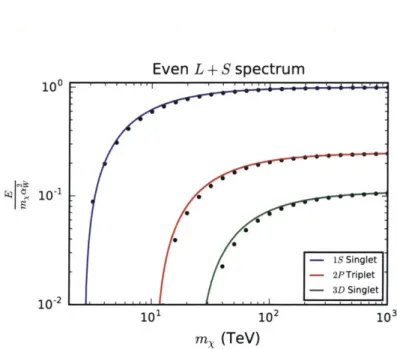
A-3 The wino bound-state energy as a function of the wino mass m.. Here
the overplotted points represent numerical evaluations of the bound state energy, while the solid lines are the analytic estimates of Eq. 5.9. From top to bottom, the blue, red and green lines describe the Is singlet, 2p triplet and 3d singlet bound states, respectively. . . . . 56
A-4 The wino bound-state energy when varying the mass splitting param-eter E5. The overplotted points represent numerical evaluations of the bound state energy, while the solid lines are the analytic estimates
EE(66) = EE(E6 = 0) - (2/3) 6. In the left panel the parameters are
mX = 50 TeV, ew = 0.0479671; in the right panel they are m. = 70
TeV, Ew = 0.0342622. . . . . 57
A-5 The binding energy for the is spin-triplet bound state (i.e. with odd
L
+
S) for wino DM, relative to 2m, +26 (note the binding energiesun-der our usual convention can thus be obtained by subtracting 26 from this curve), as a function of the wino mass m.. Here the black points represent numerical evaluations of the bound state energy, while the solid blue lines are the Coulombic limits with two different couplings,
E = a 2m,/4 and E = a2wm,/4. The effective coupling strength
tran-sitions from a at low DM masses (where the -y exchange dominates) to
aw at high masses (where SU(2) symmetry is restored). . . . . 58 A-6 The bound-state formation cross section, plotted as log10(-vreim c/h),
for e6 = 0 (top row), E6 = 0.01 (middle row) and E6 = 0.1 (bottom row).
We show results for capture into the 2p spin-singlet bound state from the s-wave component of an initial plane wave (left column) and for capture into the is spin-triplet bound state from the p-wave component of the initial state (right column). The white line indicates the locus
of EVEO = E6; the cross section in the region below the line is double the
cross section at zero mass splitting, at velocities far from resonances (see text for details). . . . . 59
A-7 Radiative capture cross section c-y at fixed ec (left panel) and fixed
co (right panel) for an initial s-wave state and 2p bound state, taking
arad = 0.01 and assuming emission of a massless vector (these results
can be rescaled to a massive vector by insertion of a modified phase space factor). In the right panel, colored dashed vertical lines indicate the locus of e, = c /60, with the region on their left corresponding to the adiabatic regime. We observe the enhancement of the cross section for non-zero 6 in the adiabatic regime, in the right panel, and
the 6-dependent shift in the resonance positions, in the left panel. . . 60 A-8 Comparison of the true capture cross section, logo(O-vreim c/h), and an
estimate using the rescaled Sommerfeld enhancement, log1o ((O-rei)cm c/h ),
as a function of loglo(e) and logio(eo). The solid orange lines are the numerical bound-state capture rate, and the dashed black lines are the rescaled Sommerfeld enhancement. The upper row indicates the
s -+ 2p capture, while the lower is for the p -+ Is transition. The
columns are arranged in order of increasing mass splitting es with the values being 0,0.01,0.1 respectively. We find that they have similar behaviour, up to the phase space factor appearing in the bound-state form ation rate. . . . . 61
Chapter 1
Introduction
Dark matter has successfully stood the test of being a consistent paradigm in ex-plaining rotation curves of galaxies, gravitational lensing by galactic clusters [2], and proved crucial for cosmological observations and structure formation in our universe
[3]. First invoked to explain the flattening of galactic rotation curves, dark matter
was postulated to be a form of matter that did not interact with ordinary matter, except through its gravitational attraction. It has been shown to have a seminal role in structure formation in the early universe, and along with the dark energy, it fits very well into the paradigm of the extensively tested ACDM cosmological model of the universe.
The physics of dark matter is interesting given that it is estimated to constitute majority of the matter content of the universe. Most models of dark matter assume it to be 'cold' and collisionless, (i.e.) treat them to be particles moving with non-relativistic velocities at freezeout and with almost no self-interaction. Collisionless cold dark matter, however, may not be adequate to explain all observations; one has to face issues as the core-cusp problem [4, 5, 6], the missing satellite problem [7] and "to big to fail" problem [8]. Some of these problems are being currently addressed
by understanding the role of baryonic matter with dark matter. However, a possible
solution to these problems is to postulate that dark matter is self interacting [9, 10, 11].
If true, determining the exact particle nature of dark matter is an interesting problem
In recent years there has been considerable interest in the possibility that dark matter (DM) could form bound states, which are ubiquitous in the Standard Model of particle physics. Such bound states could be a consequence of weakly-coupled interactions between the DM and a light mediator (e.g. [13, 14, 15, 16]), or alterna-tively a strongly-interacting dark sector (e.g. [17, 18, 19, 20]). For sufficiently heavy dark matter, even interactions through the electroweak gauge bosons are sufficient to support bound states (e.g. [21, 22]).
The presence of bound states could lead to novel signatures across a wide range of observational probes, including colliders [23, 24, 25, 26, 27, 28, 29, 30, 31] and direct-detection experiments (e.g. [14, 32]). In indirect detection, formation of un-stable bound states constitutes an additional annihilation channel for the DM, which in some circumstances can dominate over direct annihilation [33, 34, 35]. With suf-ficiently good experimental energy resolution, the decays of bound states could. be distinguished from direct annihilation; the soft particles radiated in transitions into the bound state, and between bound states in the spectrum, could also lead to observ-able signals [36]. Formation of bound states could modify the cosmological history of DM (e.g. [37, 15], for inclusion of thermal effects see e.g. [38, 39, 40, 41]), and if the bound states are stable, their presence could also have astrophysical effects in the late universe (e.g. [42, 43]). Finally, the presence of bound states is connected to the existence of DM self-interaction, which could have striking effects on the distribution of dark matter at Galactic scales (see [44] for a recent review).
One simple illustrative model for self-interacting DM is where the DM is a member of a multiplet charged under some dark gauge group, with a small breaking of the gauge symmetry conferring a small mass on the corresponding gauge boson. The breaking of the symmetry relating the different components of the multiplet will also generically lead to a mass splitting between those components, with the lightest playing the role of the DM. This scenario is realized in the case of wino or higgsino DM [45], and extensions to the case of higher representations of the electroweak gauge group [46] or simple dark sectors (e.g. [47, 48, 49]) have been studied in the literature. DM annihilation and self-interaction in such models have been studied previously,
taking into account the presence of the mass splittings as well as the long-range interaction [50, 51, 52, 12, 53, 54]. In this work we will often refer to the Sommerfeld enhancement, by which we simply mean the enhancement of short-range annihilation processes due to the long-range potential from vector exchange. However, our current analytic understanding of the bound states in such scenarios is largely limited to the case without mass splittings [55, 21, 56, 22, 57]; where mass splittings are present, previous studies have relied on numerical work.
In this work, we seek to address this gap. We consider a simple low-energy sce-nario containing two nearly-degenerate Majorana fermions interacting through vector exchange. The lighter fermion is the DM, the heavier can be thought of as an ex-cited state of the DM. We calculate numerically how the mass splitting between the states alters the bound state spectrum and capture rate relative to the case with only a single state, and develop a simple analytic understanding of the main effects.
If dark matter is a Majorana fermion, the interaction with the gauge bosons must
be off-diagonal in nature as the DM cannot carry a conserved charge [52, 12]; this setup is naturally realized where the DM is a Dirac fermion charged under the dark gauge symmetry at high energies, and separates into two nearly-degenerate Majorana fermions at low energies due to the symmetry breaking (see e.g. [58] for a detailed discussion). Previous studies of this simple model [52, 12] have considered s-wave annihilation and scattering; we go beyond by considering bound state formation, and including higher partial waves as well.
We demonstrate that we can analytically estimate the shift to the bound state energies in the presence of a mass splitting, and identify regions of parameter space where mass-splitting-induced changes to the capture cross section follow characteristic patterns. We show that the changes to the capture cross section are dominated by the behavior of the initial-state wavefunction, and the resulting cross section is simply related to the Sommerfeld-enhanced direct annihilation rate (for the same partial wave in the initial state) up to a phase-space factor, to a good approximation. We apply our understanding from this simple model to the case of wino dark matter, and demonstrate that our analytic approximations to the bound state energies in the
latter case compare well to previous numerical results [21.
In Chapter 2, we describe the pseudo-Dirac dark matter model, lay out the relevant non-relativistic Hamiltonian for the problem, and discuss its general properties. In Chapter 3, we discuss the general structure of the bound state spectrum, describe our method for numerically obtaining the bound-state energies, provide an analytic estimate for the shift in bound state energies as a function of the mass splitting, and compare analytic and numerical results for the binding energies and the effect on the position of resonances in the scattering rate. In Chapter 5 we apply our analytical insights from this toy model to the case of the wino, as a test case for bound states of electroweakly interacting DM. In Chapter 6 we numerically compute the capture rate in this model, and then characterize and discuss the new features relative to the case with no mass splitting, in particular relating the capture rate to the Sommerfeld enhancement. We summarize our conclusions in Chapter 7.
Chapter 2
Pseudo-Dirac dark matter: general
considerations
2.1
The model
We consider a pseudo-Dirac fermion, charged under a U(1) gauge group in the dark sector, which acquires a Majorana mass term at low energies due to the breaking of the U(1) symmetry by an Abelian dark Higgs. Consequently, the Dirac fermion splits into two non-degenerate Majorana fermion mass eigenstates. We will be solely interested in the low-energy, long-range behavior of the system in the non-relativistic limit, encoded in the potential; consequently, there is considerable freedom in the details of the dark Higgs sector. For example, if the dark Higgs has (dark U(1)) charge 1, a small Majorana mass term can be induced by a dimension-5 operator [58]; if the dark Higgs instead has charge 2, a Yukawa-type coupling yields a Majorana mass when the Higgs acquires a VEV, as in [301 (in this case the small splitting between eigenstates may be due to a small Dirac mass, as the Majorana mass is not suppressed by a high scale). We label the lower and upper mass eigenstates as
X
and X* respectively, and hereby denote the mass eigenvalues as (m, mx + 26).More explicitly, at high energies, writing the Dirac fermion as XI and its Dirac mass as mD, and the gauge boson of the U(1) symmetry as
#,
the Lagrangian can bewritten as:
L = iT4'(0p - igDO1,)XJ - MD"-! + LHiggs + Lgauge-kin, (2.1)
where gD is the dark-sector coupling, and we have omitted the details of the model-dependent Higgs sector. The gauge kinetic term is by default just Lgauge-kin
-F FDF Dv, where F D is the dark field strength associated with the OP field, but
it could also include e.g. kinetic mixing with the Standard Model gauge bosons. Writing T as a Weyl fermion pair
((, yt) (see Ref. [59] for an extended discussion),
turning on a Higgs-sector-induced Majorana mass mM for T yields a mass matrix of the form [58, 30]:
1<
)mM mMm M m D+ h .c. (2.2)
2 MD MM 77
This leads to mass eigenstates that are a 450 rotation of (, T, i.e. x* (,q + ()/V2,
with mass mM MD, and
x
= i(,q - ()/v/2, with mass ImM - mD . This rotationconverts the gauge boson-fermion interaction g9D Ytq5/y9I into the form
[30]:
Lfermion-gauge = -igDO,
((x*) t~ox
-xtUI-x*)
. (2.3)We observe that the interaction between the mass eigenstates via 0, is off-diagonal in nature, i.e. it couples the
x
andx'*
fields. Since Majorana fermions cannot carry conserved charge, this off-diagonal interaction is generic for any system where two Majorana fermions interact through vector exchange.This off-diagonal interaction structure gives rise to two distinct sectors of two-body states comprised of x and x*. Ixx*) states are maintained (converted into the identical state Ix*x)) under the exchange of a vector boson. In contrast, such a vector exchange transforms Ixx) states into
x*x*);
thus the potential mixes the non-degenerate Jxx) andx*x*)
states. Thexx*)
states experience a simple attractive Yukawa potential in the non-relativistic limit, whereas the admixed axx)
+ x*x*)For the purposes of our study, we will be primarily interested in the dynamics of the two-state system spanned by Ixx) and Ix*x*), and the effect of the mass splitting between these states. In the non-relativistic limit, the Schr6dinger equation for this system contains a matrix potential of the following form [60]:
0 V(r) = hccx -mocr/h L r -ha-m cr/h - hcca"b r
26c
2J
where a denotes the dark coupling constant g20/47r, mo is the mass of the dark gauge boson, and r is the inter-particle separation. The first row (and column) corresponds to the two-body Ixx) state and the second row (and column) to the two-body Ix*x*) state. The off-diagonal terms represent the conversion of Jxx) into Jx*x*), and vice versa, via the vector exchange, while the 26 term describes the increased mass of the Ix*x*) state.
As in Ref.
[521,
we scale the coordinate r by , thereby obtaining the following radial equation for the reduced wavefunction 7P(r) in the centre-of-mass frame,l~+) 2 e-f4r
"()= r
wtt dms s2 1(1+1)
with the dimensionless parameters defined as
V ev = -ca mXa I () 26 m. z (2.5) (2.6)
2.2
Eigenvectors and eigenvalues of the potential
Eq. 2.5 cannot be solved analytically in general, since the diagonalizing matrix is
itself position-dependent. However, it is still helpful to examine the eigenvalues and (2.4)
eigenvectors of the potential, which are respectively given by [52, 12]: (,,,2 2 r r= (~) 2 \2,\ ,2- 1 A+ -62,+ 2
+-1-7+,r7(r
r 2 2 r T2 1 1+(2e-r)2 (2.7)The expressions in Eq. 2.7 allow the identification of two interesting regimes, where the eigenvectors are nearly r-independent and the problem is approximately diagonalizable:
* Small r regime: For sufficiently small r, the Yukawa potential dominates the
mass-splitting term, yielding:
(+1) 6 e r
A
++ (r), r(r)r 2 r d + O(r) (2.8)
Li
The eigenvectors of the potential are those of V(r) = - o , and the eigenvalues physically correspond to the repulsive and attractive potential appropriate to same-sign or opposite-sign scattering respectively. This regime corresponds to the restoration of the U(1) symmetry in the ultraviolet.
* Large r limit: Far away from the origin, one observes that
term dominates the now weak Yukawa potential, leading to
the mass splitting
2~ + 2 e --2co1 A+ ~-E+ 2 + E6 + 2+, Tj+ (Tr) ~ ' - 01 + (2.9)
A
+ 1) e-2,E r2 ~E-,2 + 22 + (9( ,rm_(r) ~~
[]
0 (2.10)Thus, we find that the eigenvectors undergo a rotation at a radius where the Yukawa potential and the mass splitting are comparable in size, as also noted in Ref. [52].
+01 r
For bound states where the support of the wavefunction lies primarily within this radius, we can guess that the potential in the small-r regime will be a reasonable approximation when computing the bound-state spectrum, allowing us to ignore the radial variation of the eigenstates/eigenvalues.
Chapter 3
The bound-state spectrum
As discussed previously, there are two types of bound states supported by the dark vector exchange,
|xx*)
states which are supported by a simple Yukawa potential, and states consisting of an admixture of IxX), Ix*x*), which evolve under the potential given in Eq. 2.4. The admixed states consist of pairs of identical fermions, and thus must be in an antisymmetric configuration; this corresponds to requiring the sum of their orbital and spin angular momentum quantum numbers L+
S to be even (seeRef. [61] for a general discussion of the different potentials experienced by even- and odd-L + S states).
These bound states can be produced by radiative capture from scattering states. The dominant contribution to such processes arise from electric-dipole-like transitions with emission of a single particle. These transitions change the angular momentum of the incoming state by 1, if a vector particle is emitted (such as a photon or dark
photon). This restricts the possible types of transitions. For our purposes, we shall assume the scattering state to be xx at large enough interparticle separation (since only x particles are present in the DM halo, unless the mass splitting is small enough to be comparable to the typical DM kinetic energy). The capture is then into bound states in the xx* sector, via the emission of a single dark photon. Since the initial wavefunction must have even L
+
S, the bound state in this case has odd L+
S;for example, the s-wave (L = 0) contribution to the scattering state only receives contributions from spin-singlet states (S = 0), and capture could occur into an np
spin-singlet bound state (L = 1,S = 0) where n > 2. Similarly, to form a spin-triplet
bound state by direct radiative capture, the dominant process is capture into ns states with n > 1, from the p-wave or d-wave components of the initial state.
The presence of bound states in the Jxx)
+
Ix*x*) sector, with energies close to zero, can lead to resonant enhancement to the radiative capture cross section at low velocities. When there is a bound state with near-zero energy present in the spectrum of L + S-even states, the scattering wavefunction for L + S-even states is enhanced at short distances, leading to the resonance peaks in the Sommerfeld enhancement1501 and also enhancing the radiative capture rate into the L + S-odd bound states.
The energies of these bound states, and thus the conditions under which resonances occur, depend both on the force carrier mass mo, and on the mass splitting between states 6.
While analytic solutions do not exist for bound states in an attractive Yukawa potential, they closely resemble bound states in the Hulth6n potential, which is given
by
VH(r) = - 1(3-1)
where aH is the relevant coupling and mH characterizes the range of the potential. The Hulth6n potential has the desired asymptotic behaviour, resembling a Coulomb potential in the low-r limit and decreasing exponentially in the large-r limit, similar to the Yukawa potential. Exact solutions for the s-wave states and approximate ones for the higher-i states are known for this potential [62, 21]. Thus, one can approximate the binding energies for the lxx*) states - relative to the sum of the free-particle masses, 2m, +
3
- by the corresponding Hulthen-potential results:K2
En = " (3.2)
my
1 (Hmx - n2mH) (33)
2 n
Here n is the principal quantum number of the bound state. To accurately approxi-mate the Yukawa potential by its Hulthen counterpart, a normalization condition has
to be imposed upon mH, which we shall take to be mH = m#, as argued for in
[631.
With this choice, we can simply replace the coupling aH by a.
The bound states in the L
+
S-even|xx)
+fx*X*)
sector are less amenable to analytic approximation due to the presence of the mass splitting in the potential(Eq. 2.4). However, their presence is crucial in setting the resonance positions. We
will thus seek to study the energy spectrum of these states both analytically and numerically.
A note on binding energy conventions: Hereafter we will always state binding
energies E relative to 2m , in order to have a common mass scale, even when the bound state has x* constituents. We will also quote the binding energies as positive values. In other words, we choose E so that the mass of the bound state is 2rrX - E.
Under this convention, Eq. 3.2 gives an estimate for the binding energies of L + S-odd states as:
E ~ 1 - 2 (3.4)
4n2 amX
We can define a dimensionless binding-energy parameter 6E E/(a2mx); the
approximate L + S-odd bound-state spectrum then becomes:
7r2 2 C2
CE n2 - n2 2 (3.5)
3.1
Numerical calculation of the L+S-even spectrum
We are interested in solving the eigenvalue problem
Hk 1) = -E li) (3.6)
where E > 0 is the binding energy (as defined above) and H is the Hamiltonian
corresponding to the potential in Eq. 2.4. Inserting a complete set of states 1j), we obtain that
where Hj = (iIH1j) and ci = (i|10). A complete set of states would exactly solve this
problem, but we can determine the eigenvalues E, to any desired accuracy by using a sufficiently large finite number of states ji) [21].
Following [21], we use the bound-state wavefunctions of the Coulomb potential with strength a as our basis set; that is, the potential for the basis states is - in ther
scaled coordinates. This is motivated from the fact that in the limit E6 = EO = 0, the
matrix potential decouples into an attractive and repulsive Coulomb potential. More explicitly, the requisite basis is constituted by
[ J
and[j,
where 4nim is the0 Onim
Couloumbic bound-state wavefunction characterized by the quantum numbers n, 1, m. We simplify our work further by observing that for a bound state characterized by angular momentum 1, it suffices to use only the Coulomb bound states having the same quantum number 1. Note that throughout, we have also fixed m = 0, since it
is easily seen that the binding energies will be degenerate in quantum number m. In order to get convergence on the eigenvalues, we used 30 such states. As a numerical check, we ensured that the Couloumbic binding energies were recovered in the limit
64 = 66 = 0. As a further check, we ensured convergence by examining that the
binding energies were similar when the number of basis states was changed to 40, 50 and 60 respectively.
3.2
Analytic estimates for the L + S-even spectrum
As discussed previously, the bound-state wavefunction should largely have support at small r, where the potential is large compared to the mass splitting. In this
small-r small-regime, the mixing between the eigenstates is suppsmall-ressed, as discussed in Section
2.2. Accordingly, we can associate the bound state entirely with the eigenstate that experiences an attractive potential, and read off the potential for that eigenstate from the eigenvalue A_ in Eq. 2.8, with the replacement of -6 with the dimensionless
binding-energy parameter EE (= E/&2m"):
I(1) C 2 e-kr
A eE + - - 0(r). (3.8)
r 2 r
We see that to lowest order, the effect of switching on the mass splitting in this case is to simply shift the binding energy parameter 6
E by E2/2. Explicitly, suppose
the Yukawa potential with the same e but no mass splitting has a spectrum of bound states with energies c' . Then the spectrum of bound states in the case with a mass splitting will (to the degree that this approximation is valid) satisfy EE + E 2 EE
In terms of the physical bound-state energies, we can write this result as:
E(E-, 5) = E(eo, 0) - 6. (3.9)
We expect this approximation to break down once the radius of the bound state becomes comparable to the crossover radius where the mass splitting term is compa-rable to the Yukawa potential. We can estimate the typical momentum of a particle in the bound state as p - dm E; rescaling the radial coordinate as previously, we
obtain an estimate for the dimensionless radius of the bound state:
rB amx(m E)-1/2
- (a2mX/E)1/2 = 1/V/E-. (3.10)
The crossover radius rc, in the dimensionless rescaled units, is defined by e =
e-r /rC. If e6
>>
E4, then we have rc ~ 1/e., as the exponent in the Yukawapoten-tial is negligible at r = r0 in this case. The validity condition rB <. rc translates in this case to EE > E'. In the opposite case, where e6
<
e0, the crossover will be induced by the exponential suppression, and we expect rc - 1/E4. We can get a somewhatbetter estimate by substituting rc ~ 1/$ where it appears outside the exponent, in the defining equation e = e-'rc/rc. Thus we obtain rc ~ (1/64) ln(ee/o).
Thus in general this approximation should be valid when:
E
iE/ln(E
4 /62) 2, E2 < E0,EE - e= > 4 (3-11)
' 2
For the intermediate region where E6 ~ EO, both limits become EE
>
C-. Thus we canestimate the validity constraint over the full region as:
4 E
ma E(2/min ,c/n(EO/E2)2])
(3.12)
EE
>
max WE, min E E1 n0 E EWe have confirmed numerically that this is a reasonable approximation (within a few
tens of percent) to EE 2 -/r
We show the results of the analytic approximation, together with the numerically computed binding energies, in Fig. A-1. We display results for the 1s, 2s, 2p and 3p states, as a function of E6 at several fixed values of E0. To employ Eq. 3.9, we compute
E(Eo, 0) numerically in each case (this term can also be estimated analytically using
results for the Hulth6n potential, as we will discuss below). We see that indeed the approximation quite accurately captures the shift in the bound state energies, with the expected breakdown of the approximation once the binding energies become sufficiently small. We overplot dotted lines corresponding to the validity criteria
CE 6
6j and EE > min [E, E, In(E /2
];
the approximation is expected to be validin the region well above both lines. These estimates seem adequate to characterize roughly where there is a 0(i) divergence between the true and predicted bound-state energies.
For sufficiently shallow bound states, where this approximation will eventually break down, it may be possible to make further progress using the universal char-acterization of the near-threshold bound-state properties in terms of the scattering length (which approaches infinity for zero-energy bound states)
164,
32]. We leave3.3
Deriving the energy shifts with first-order
per-turbation theory
The constant offset in the bound-state energies due to the mass splitting (e.g. Eq. 3.9) can also be obtained from first-order perturbation theory; this approach makes it easy to see how this result generalizes beyond the pseudo-Dirac case. Suppose we can write the non-relativistic Hamiltonian in the form
H = Ho + AH (3.13)
where HO is the Hamiltonian in the zero mass-splitting case, and AH is the constant offset matrix induced by mass splitting. In the pseudo-Dirac case,
AH = 26
.
(3.14)(0 1)
If we treat AH as a perturbation, then using first-order perturbation theory we
find that the correction to the bound-state energy is given by
AE= (4b A H |Q) (3.15)
where 1) is the bound-state wavefunction in the absence of the mass
I2 (r)
splitting.
If it is the case that (1) Ho admits approximately r-independent eigenvectors
7, so that we can write
|K)
= 0(r)7 where 4'(r) is a canonically normalized scalarwavefunction and r is a r-independent vector with Ir = 1, and (2) AH is independent of r, fixed solely by the mass splitting, then we can write:
AE = rtAH2 J d3ro*(r)V)(r) = rtA Hr/. (3.16)
state overlaps with the mass splitting matrix. If the bound state is completely con-stituted of one of the two-body states in the spectrum, its energy is offset by exactly the mass splitting of that state from 2mg, as one would expect. Where there are only
two possible two-particle states (for even L + S) and the mass splitting is 26, the first-order shift is given simply by IC12 x 26, where C is the second component of q.
For the dark U(1) (pseudo-Dirac) case with even L
+
S,2 e-fo I I
Ho = -V2 _ __= (3.17)
giving us that C = 1/2 and the binding energy is given approximately by:
E = Eo - 6 (3.18)
which we previously obtained directly from the eigenvalues (Eq. 3.9).
This alternative derivation has the advantage of being easily applicable to general Hamiltonians of similar form; it manifestly demonstrates that the prefactor in the constant energy offset is determined purely by the fraction of the bound state in the heavier two-particle states of the system. Note however that this derivation has to be appropriately modified when the mass splitting matrix has degenerate eigenvalues.
This approach also clarifies the expected range of validity of the approximation; in the pseudo-Dirac case, it is valid up to O(62) ~ O(d) terms, and so we expect the corrections to the binding energy from these next-order terms to become large when
4
EE ~ E6, as previously discussed. This argument further suggests that in the pseudo-Dirac case the constant-energy-shift approximation may still be valid regardless of EO,
provided only that EE > E, since for this HO the eigenvectors are r-independent for arbitrary E0 so long as E6 = 0.
Chapter 4
Shifts to the resonance positions
The simple behavior of the bound-state energies in the presence of the mass splitting gives us some analytic control over the positions of the resonances in the Sommerfeld enhancement, corresponding to zero-energy bound states, although (from the argu-ments in the previous subsection) we expect our approximation to eventually fail in the zero-binding-energy limit. We can test this by computing the values of CO for which EE(60, 66) = 0, calculated fully numerically as a function of E3, with the values
obtained by solving for EE(EO, E6) = 0 using Eq. 3.9. In the latter case, we determine
eE(EO, 0) numerically as a function of co, and solve for EE(64, 0) = E12 as a function
of E6. For the bound states Is, 2s, 2p, 3s, 3p, we find reasonable agreement of the res-onance positions with the semi-analytic prediction, at least for small Es, as is shown in Fig. A-2.
From Fig. A-2 we can also infer that the shift in the resonance value of CO is roughly linear in c6. This behavior was already found for s-wave resonances in Ref. [52]. We can see why this occurs analytically from the estimate for the binding energies of the Hulthen potential given in Eq. 3.2. Choosing aH = oz as previously, and writing EH = mH/amx, we can write the Hulth~n spectrum in the form:
(w- n2 H )2
EE (EH, 0) ~ 4n2 (4.1)
Hulthen potential with EH = qEO for some constant q (usually taken to be q =
7r2/6), so EE(c, 0) ~ (1 - n2 )2 /4n 2. Then using Eq. 3.9, the resonance condi-tion EE(E, E6) = 0 becomes:
CO = ( -
v2)
(4.2)n2q
This yields the expected linear scaling with Es. The slope of the scaling relation depends on the normalization factor q in a trivial way; q = 7r2/6 works well for the
1 = 0 case studied in Ref. f52], but for higher partial waves, we find that slightly
modified values of q may be preferred. (Furthermore, for higher partial waves Eq. 3.2 is not exact, even for the Hulthen potential.) Nonetheless, this argument is sufficient to demonstrate that the approximately linear shift in the resonance positions with increasing E6 is expected to hold true for all 1, and to a first approximation depends only on E6 and the principal quantum number of the relevant bound state.
Chapter 5
Application to electroweak bound
states
The basic principles laid out in the previous section are not specific to the model we consider. As another example where they may be applicable, consider the case of
SU(2)L triplet wino dark matter. The DM is a Majorana fermion, denoted
x
0, andthe lightest member of the multiplet; the rest of the multiplet forms a charged Dirac fermion which we will denote x-, the chargino. The gauge group is SU(2)L X U(1)Y,
and interactions involving the DM and the chargino are mediated by the massive gauge bosons W* and Z, as well as the photon. The presence of charged gauge bosons allows capture into bound states via a new channel wherein W, could itself emit a photon [21].
As in the simple pseudo-Dirac model, the relevant potentials differ for L
+
S-even and L + S-odd states. The neutral bound states supported by the latter potential are again relatively simple, since the two-state system with L + S-odd has no x0x0component, and so consists only of x+x~ bound states supported by Z and -y ex-change (as studied in e.g. Ref. [65]). The DM-chargino mass splitting thus plays no interesting role for this sector.
Veven L+S(r) 0 e-mWr v2 W r --awe-mWrvWr 26- a w cos 2 Owe-mZr r r
Let us scale the coordinate r by rn, yielding the dimensionless analog of Eq. 2.5
for the wino case, which is
Veven L+S (r) 0 Lr r 2 sin2 0, Cos w-~ 66 r
where we have defined
mw 6 w = mXaw mz 6z = mxyw 26 66 = a2 2xa
Note that the binding energies are now expressed as multiples of m a2w E E/(a2wm.). We can again evaluate the eigenvalues of the potential matrix:
sin2 0 _ cos2 Owe-czr
sin2 Ow cos2 0we-6 zr 2
r r
Again, we will be interested in the behavior of the potential over the support of the bound state, i.e. r < 1/
i-E.
In the regime where CE > 62w 2, E4, then within thisradius, the Yukawa terms may be replaced by Coulombic terms, and furthermore these is given by (5.1) (5.2) (5.3) A (r)
=-
1 -2 6 + (4 r (5.4) I C 4(Coulombic terms dominate over the c' term. In this case, the eigenvalues become: 1 (2 sin 20 cos2O OW A (r2 6 r -r) (2 2(2 1 2 2 2( r sin2 ow r cos2 Ow 2 r 1(21)2 2 ,), -- + 3 2 r 2r 9 r 2r
Thus we find a pair of attractive and repulsive potentials, with the attractive one being stronger, with offsets due to the mass splitting similar to what we observed in our toy model:
2 2) 3 (r) ~ -1 E2
A+(r)
~ - + -r 3 (5.5)In the limit of zero mass splitting (or small r), these potentials correspond to full
restoration of the SU(2)L symmetry [21]. Since the repulsive potential cannot ac-commodate bound states, the effect of the mass splitting is simply to shift the bound state energies supported by the attractive potential to EE(E6) e- E(E6 = 0) - (213)q,
or in terms of the energies without rescaling,
4
E() ~-1 E(e = 0) - --6.
3 (5.6)
We can also apply the perturbation-theory approach here, in the limit where cw,
6Z approach zero and so the potential can
in the pseudo-Dirac case, we have AH (in rescaled coordinates) in the form:
be diagonalized in a r-independent way. As
0 0
. We can rewrite the Hamiltonian
0 26 1 0 - (5.7) 1 1 r/ 3 = V2 4 6 + g (/22 r
so that the binding energies are approximately given by
E = EO - - x 26 (5.8)
3
as in Eq. 5.6.
These arguments only hold in full when the potential is essentially Coulombic over the support of the bound states. If the masses of the W and Z bosons are large enough, relative to the DM mass, to significantly perturb the bound state energies, that must also be taken into account. An ad hoc estimate for this effect can be obtained by replacing the Coulombic bound-state energies with those for the Hulth6n
potential, with mH -+ (7r2/6)mw and aH -+ ozw. Combining this prescription with
the shift due to the mass splitting, we obtain the estimate:
2 1 nmW7r 2 2 462 r2,2EW 2 _2, 2 n
E ~ mXaw
(
- E = 1 ( - 7r - 6 (5.9)n 12awmx 3 n2 12 3
In Fig. A-3, we compare the numerically computed bound-state energies for even
L + S to this estimate, and find remarkably good agreement across a broad wino
mass range. Throughout, we fixed mw = 80.38 GeV, mz = 91.19 GeV, 6 = 0.17
GeV, and aw = 0.0335. For our numerical computation we use 30 basis states as
previously, but with the coupling for the basis wavefunctions set to 2aw, as discussed in Ref.
121].
The choice of normalisation of aH is such that we obtain the correct Coulombic behaviour in the limit where the mass of the gauge bosons and the mass splitting goes to zero; for obtaining similar estimates for different eigenvalues in the Coulombic limit, one would need a different normalisation.As a further check, we examined the behavior of the estimate,
EE(E6) = EE(0) - 22 (5.10)
(holding all other parameters fixed) by numerically computing the bound-state en-ergies as a function of the mass splitting 26, and comparing them to this analytic estimate, for the even-L + S spectrum. We tested the 2s singlet and 2p triplet cases,
and again found reasonable agreement for this simple estimate, as shown in Fig. A-4. Thus, this approach works well even for a more complicated gauge structure such as the wino
/
SU(2) triplet DM. The approximation of a constant mass-splittingdepen-dent shift to the bound state energies is a generic feature, as demonstrated by the argument from first-order perturbation theory.
The analysis for the L + S-odd case is again simpler; we need only recall that since binding energies are defined relative to 2mw, the potential for the odd-L + S case contains a constant offset of 26 due to the higher mass of its constituents. In the regime where the potential is largely Coulombic, and the mass of the Z boson can be neglected, the binding energies defined relative to the sum of the constituent masses, 2m, + 26, follow the usual Coulomb form E, = a~wm/4n2. Thus under our
convention, where the total mass of the state is 2m, - E, the binding energies E can
be approximated in this case as:
a2m 1
E= 2 26 CE= 2E (5.11)
4n 2
,
42In the limit where the Z boson mass is large relative to awmx, the Coulombic inter-action will dominate the potential, and the bound states will have a similar pattern,
Chapter 6
The cross section for radiative
formation of bound states
Having derived and understood the bound state spectrum, we now return to the simple pseudo-Dirac model to explore the impact of turning on the mass splitting on the cross section for radiative bound-state formation. There is a subtlety here: using only the ingredients of our model described thus far, the relevant process is emission of a dark photon with mass mo, which in the low-velocity limit requires that the binding energy E exceed mo, i.e. mo is parametrically of size a or smaller. However, to the degree that we wish to use this model as a testbed for other scenarios with mass splittings between DM states, it is useful to consider the possibility that some lighter (or even massless) particle could couple to the x or x* states and be radiated to allow formation of a bound state. For example, a similar behavior occurs naturally in the case of wino or higgsino DM: while the DM itself does not couple to the photon, only to the weak gauge bosons (and possibly the Higgs), it has nearly-degenerate heavier charged partners that play a similar role to the X* in our present scenario, and these partners can emit massless photons to allow for bound-state formation. In this way, the presence of a light particle can be crucial for bound-state formation, even if it does not dominate the potential experienced by the DM particles.
In what follows, in order to build intuition for these expanded cases, we will leave open the possibility that a light vector is emitted, with a mass and coupling to the DM
that do not match those of the dark photon that dominates the potential; equivalently, when we study how the squared matrix element for this process is modified by the presence of a mass splitting, we will also show results for regimes where the phase-space factor would vanish if the particle being emitted is a dark photon with mass
mo. However, we will work under the assumption that the particle emitted is a vector
rather than a scalar, and thus the selection rules are the same as they would be for dark photon emission; violating this assumption would modify the matrix element, not just the phase-space factor (see Ref. [66] for a discussion of bound-state formation through scalar emission).
As in Ref. [21], we define the matrix element Mf for radiative capture in the dipole approximation as:
M = -Jd3r fd scat(r) C Vr'Ibound(r) (6.1)
where e describes the polarization of the emitted light vector, A = m,/ 2 is the reduced mass of the incoming DM particles, and C is the matrix that couples the Ixx*) sector to the xx) +
x*x*)
sector. If we expand the previous basis to include Ixx*), writing the state a xx) +x'lx*x*)
+ -y xx*) asp
,then C takes the form:0 0 1
C= 0 0 1 (6.2)
1 1 0
The factor of 1/V12 is needed to account for the fact that the Ixx*) state could equivalently be described as Ix*x) [61].
The bound states relevant for the single-dipole-vector capture process (which is expected to dominate the overall rate), lie in the L + S-odd Ixx*) sector, since the initial state is L + S-even and the dipole photon radiation gives AL + i1, AS = 0.
We solved for the scattering wavefunctions numerically, using the L
+
S-even potential and employing the method of variable phase, as elucidated in detail inRef. [21]. This numerical approach was chosen for its superior stability at large r, compared to solving the Schr6dinger equation via brute force using the NDSolve function in Mathematica. For an initial state consisting of two identical fermions,1 the matrix element in Eq. 6.1 can be translated to a physical cross section as:
o-ri=aradk
U'Vrel j
rak dQ IA 1.(6.3)
7r
Here Vrel is the relative velocity between the particles, arad describes the coupling of the emitted light vector to the DM (which may or may not be equal to the coupling a that controls the potential), and the energy of the emitted particle is denoted k and given by:
k Escat - (2mx - E) (6.4)
= n a2(c2 + E) (6.5)
for a massless or near-massless particle, where Escat is the total (mass+kinetic) energy of the initial state, and E is the binding energy of the final-state bound state. (Recall that EE contains a contribution of -e2/2, as in Eq. 3.5, since the bound state is composed of
x
and X*.) If the emitted particle has a non-zero mass mrad, its energyshould be modified to:
Ek =k 2 + mrnd scat
+
mad (2m - E) 2 2Escat ma a2 (C2 + ma2E (Escat - (2m - E)) / - + __ 2Escat 2Escat~~O m2a 22+E ad X mOZ (EV + CE +
4Cd
(6.6)where Erad = mrad/(a2 m). Consequently the emitted particle's momentum k is
'Note that as discussed in Ref. [211, the presence of identical fermions in the initial state means this cross section is larger than that for non-identical initial-state particles by a factor of 2 when the initial state has L + S even, and is zero for L + S odd.
modified to:
k = E2- mad m V - CE 2 rad /4)2 rad(
As in [21], we can simplify Eq. 6.3 further by writing
R=A AE - m (6.8)
for capture into the bound state characterized by the quantum numbers {n, 1, m}, and we perform the angular integral separately. Using considerations of spherical symmetry, Eq. 6.3 then simplifies to
8arad k|A 12
O-Vrel = (6.9)
3
Again, this cross section is valid under the assumption that the initial state contains two identical fermions and has L + S even; in a situation where the initial state contains two distinguishable particles, this cross section should be divided by two (and need not be zero for L + S odd). Note this is the cross section for an initial state of fixed spin, rather than a spin-averaged cross section (performing the spin average would introduce another factor of 1/4 or 3/4, for L-even and L-odd initial states respectively).
We numerically evaluated this cross section for a scan over (E,, E6, EO), using the
phase-space factor for a massless vector to examine the maximum amount of param-eter space (our results can trivially be rescaled to a different phase-space factor using
Eq. 6.9). We chose to examine the region where there is a large Sommerfeld
enhance-ment, and the Born approximation for the scattering cross-sections is insufficient, i.e. where the dimensionless parameters are less than unity [52]). Contour plots for the dimensionless cross section Uvreim2c/h2, broken down by the initial and final
quan-tum numbers, are shown in Fig. A-6. Throughout, we have set arad= a = 0.01 in
our numerical evaluations.
difference between the capture from s-wave and p-wave initial states, which is manifest even for q, = 0. For a s-wave initial state, we expect (in the absence of a long-range
potential) UVrel Oc Vre1, while for the p-wave contribution we expect UVreI Oc V e1. This behavior is observed in the limit where cv < co, the upper left corners of the contour plots. However, in the opposite limit where c,
>>
EO (lower right corner of the contourplots), we recover Coulombic behavior where the potential is effectively long-range. In this regime, as we will discuss in more detail below, all partial waves contribute with the same 1/v scaling. Thus in the q = 0 case we expect (and observe) UVrel to
rise with decreasing velocity for both s- and p-wave initial states, before flattening out for the s-wave case, and being suppressed at low velocity for the p-wave case.
Upon turning on a mass splitting, we find that:
* In the case of non-zero 6, in the region of parameter space where cc ,< j , the cross section is doubled relative to the case with zero mass splitting. This is most clearly illustrated by comparing the first and second rows of Fig. A-6, and in the second row, observing the cross section at fixed ev as e, is varied across
the boundary EO ~ E/
This behaviour has been noted previously in the context of the Sommerfeld enhancement, and can be explained by a transition between "adiabatic" and "non-adiabatic" regimes [12, 67], with regard to the rotation of the eigenvectors with radial distance from the origin. The argument is that if the diagonalizing matrix varies sufficiently slowly with respect to r, then a large-r asymptotic state consisting purely of Jxx) (the lower-energy state at large r) will smoothly transition to a small-r state that is dominated by the eigenvector experiencing an attractive potential (the lower-energy state at small r). In contrast, in the case with Ej = 0, there is no evolution of the diagonalizing matrix with r,
and the small-r wavefunction has the same contributions from the repulsed and attracted eigenvectors as the large-r state - in this model, those contributions are equal. Since only the attracted eigenvector yields a significant contribution to bound-state formation, the probability of bound-state formation is reduced
by a factor of 2 in the Coulombic case relative to the adiabatic case.
The adiabatic regime is characterized by the criterion [12]:
6
;
(6.10)
In the wino case, we expect similar behavior in the same regime, except that the cross section will be enhanced by a factor of 3 (rather than 2) relative to the case with no mass splitting. The argument is almost identical to that of the dark U(1) case, and the factor is 3 in this case since the large-r asymptotic state has only a 1/3 overlap with the attracted eigenvector [211. This factor-of-3 enhancement is observed in the numerical results of Ref. [21].
* As the mass splitting turns on, the resonances in the cross section for capture are enhanced, and the resonance positions undergo a shift relative to the Coulombic case, according to Eq. 4.2, when the kinetic energy becomes negligible compared to the mass splitting, as illustrated in Fig. A-7. This behavior is due to a mod-ification to the initial-state wavefunction, with similar effects being observed in studies of the Sommerfeld enhancement
[52];
thus the resonance positions are determined by bound states in the L + S-even sector, even though the bound state being formed in this case has L + S odd. Because the resonance positions now also depend on the importance of the mass splitting term compared to the kinetic energy, it is possible for a particular choice of(EO,
Es) to lie on a resonanceat one velocity but not at a lower velocity, leading to non-monotonicity in the capture rate even for a s-wave initial state (similar behavior is again observed in the multi-state Sommerfeld case [52]). This behavior is demonstrated in the right panel of Fig. A-7.
The two generic behaviors described above (adiabatic enhancement and shifting of the resonance structure) originate from the properties of the initial-state wave-function, and are thus also seen in the calculation of the Sommerfeld enhancement to short-distance annihilation processes (which is set by the initial-state wavefunction