
Publisher’s version / Version de l'éditeur:
Proceedings. Sensors, 2010 IEEE, pp. 1152-1155, 2011
READ THESE TERMS AND CONDITIONS CAREFULLY BEFORE USING THIS WEBSITE. https://nrc-publications.canada.ca/eng/copyright
Vous avez des questions? Nous pouvons vous aider. Pour communiquer directement avec un auteur, consultez la première page de la revue dans laquelle son article a été publié afin de trouver ses coordonnées. Si vous n’arrivez pas à les repérer, communiquez avec nous à [email protected].
Questions? Contact the NRC Publications Archive team at
[email protected]. If you wish to email the authors directly, please see the first page of the publication for their contact information.
NRC Publications Archive
Archives des publications du CNRC
This publication could be one of several versions: author’s original, accepted manuscript or the publisher’s version. / La version de cette publication peut être l’une des suivantes : la version prépublication de l’auteur, la version acceptée du manuscrit ou la version de l’éditeur.
For the publisher’s version, please access the DOI link below./ Pour consulter la version de l’éditeur, utilisez le lien DOI ci-dessous.
https://doi.org/10.1109/ICSENS.2010.5690698
Access and use of this website and the material on it are subject to the Terms and Conditions set forth at
Wavelength Interrogation of a Tilted Fiber Bragg Grating Sensor Using
Space-to-Wavelength Mapping of An Arrayed Waveguide Grating with
Closed-Loop Piezo-Electrical Control
Guo, Honglei; Xiao, Gaozhi; Jianping, Yao; Shao, Liyang; Mrad, Nezih
https://publications-cnrc.canada.ca/fra/droits
L’accès à ce site Web et l’utilisation de son contenu sont assujettis aux conditions présentées dans le site LISEZ CES CONDITIONS ATTENTIVEMENT AVANT D’UTILISER CE SITE WEB.
NRC Publications Record / Notice d'Archives des publications de CNRC:
https://nrc-publications.canada.ca/eng/view/object/?id=5254be79-973f-48bd-986a-7df927c878bc https://publications-cnrc.canada.ca/fra/voir/objet/?id=5254be79-973f-48bd-986a-7df927c878bc
Wavelength Interrogation of a Tilted Fiber Bragg
Grating Sensor Using Space-to-Wavelength Mapping
of An Arrayed Waveguide Grating with Closed-Loop
Piezo-Electrical Control
Honglei Guo
Microwave Photonics Research Laboratory, School of Information Technology and Engineering
University of Ottawa Ottawa, Canada
Gaozhi Xiao
Institute for Microstructural Science National Research Council Canada
Ottawa, Canada
Jianping Yao
Microwave Photonics Research Laboratory, School of Information Technology and Engineering
University of Ottawa Ottawa, Canada Liyang Shao Department of Electronics Carleton University Ottawa, Caanda Nezih Mrad
Air Vehicles Research Section, Defence R&D Canada Department of National Defence Canada
Ottawa, Canada
Abstract—In this paper, we report a novel wavelength
interrogation technique to measure the relative wavelength spacing between two individual resonances of a tilted fiber Bragg grating (TFBG) sensor applied as a refractometer. The TFBG refractometer is sensitive to the refractive index changes in its surrounding medium and reflects the perturbation on its transmission wavelength changes. The presented technique is based on an arrayed waveguide grating (AWG) with its space-to-wavelength mapping capability. The spatial position of the input beam is controlled by a closed-loop piezoelectric motor. The absolute transmission wavelength of target resonance is obtained by introducing the actual spatial position of the input beam, provided by a position feedback encoder, to the pre-calibrated space-to-wavelength mapping relationship. Therefore, the wavelength spacing of the two target resonances is obtained as well as the measurement of refractive index. Initial results show that the proposed AWG-based wavelength interrogator has a multi-channel measurement capability and the potential to be packaged into a portable, light weight and cost-effective device.
I. INTRODUCTION
The measurement of refractive index, usually implemented with an instrument of refractometer, is of great importance in many areas, such as biomedical application, new drug
development, food quality control, and industrial control process. Abbe refractometer is traditionally used for this purpose [1]. Though it has a high accuracy of 10-5 in refractive index measurement, it does not meet the requirements in all the applications, which is restricted by the size, power requirements, and its use of a prism. Miniaturized size and capability of being applied in small areas (often immersion in liquids and gases of interest) are the two critical features required by the development of refractormeters. Fiber optic refractive index sensors have been developed to fulfill the purpose, including etched fiber Bragg grating (FBG) sensor [2], long period fiber grating (LPG) sensor [3] and tilted fiber Bragg grating (TFBG) sensor [4]. Etched fiber optic sensor has critical safety condition in the fabrication and is of low mechanical strength. LPG sensor is popular since it has a simple fabrication process. However, LPG sensor has limitations in (1) achieving high sensitivity over a large range of refractive index measurement and (2) minimizing errors induced by the cross sensitivity, such as from temperature and bending. Of these approaches, TFBG sensor has competitive features to overcome these limitations and recently attracts most attention used as a refractometer.
TFBG sensor is one kind of short-period grating with the grating planes slanted or blazed with respect to the fiber axis [5]. Due to the tilt of the grating, the coupling efficiency between the forward-propagating and backward-propagating This work was supported in part by the Canadian Institute for Photonics
Innovations, National Research Council Canada and Department of National Defence Canada.
light is significantly enhanced [6]. As a result, TFBG transmission spectrum has many resonances of discrete wavelengths below the Bragg resonance, corresponding to the light modes counter-propagating in the fiber cladding. Since these cladding modes have evanescent fields with tails beyond the cladding outer boundary into the surrounding medium, the effective indices are dependent on the surrounding medium. Therefore, the refractive index change in the surrounding medium has an impact on the effective refractive indices, which is further reflected in the transmission spectrum of a TFBG sensor. Comparing with LPG sensor, TFBG sensor is more compact and less sensitive to bending due to the exclusive effect on all the lower order cladding modes [7]. Furthermore, a single TFBG sensor can achieve the discrimination of refractive index and temperature. In the transmission spectrum of a TFBG sensor, the Bragg wavelength is insensitive to the surrounding medium since it is the core mode which dominates the Bragg wavelength and core mode is only dependent on the refractive index in the fiber core region. Moreover, both cladding mode and core mode are sensitive to temperature and the impact induced by temperature to these modes are nearly the same. Thus, by measuring the relative wavelength spacing between two resonances (usually one higher order cladding mode and the Bragg resonance), refractive index changes can be monitored disregarding the temperature changes [6]. However, one of the key field application challenges of TFBG sensors is the interrogation technique. Due to its multiple resonances and the requirement of real time monitoring, it is hard to develop an interrogation scheme with miniaturized size, high resolution, light weight and multi-channel measurement capability.
In the past few years, arrayed waveguide gratings (AWG), which is originally designed for wavelength division multiplexed (WDM) optical communication networks [8], has shown a great potential for addressing this challenge. Sano et al. [9] describes a technique involving the ratio of the light intensities from two adjacent AWG channels. Based on this technique, several approaches [10-12] have been demonstrated to improve the interrogation performance. According to Sano et al. [9] analysis, the measurement range is dependent on the free space range (FSR) of the AWG and the measurement resolution is determined by the AWG channel transmission bandwidth and spacing. In this case, a compromise between the measurement range and the resolution is made by applying an AWG with fixed wavelengths. Since the measurement range does not rely on the FSR in a tunable AWG, this compromise could be addressed by applying a tunable AWG. Xiao et al. [13] and Guo et al. [14-15] used a tunable AWG to implement the interrogation based on temperature controlling and mechanics controlling, respectively.
In this paper, we demonstrate the wavelength interrogation of a TFBG refractometer using our recently developed AWG based interrogator [15]. In the comparison with previously reported TFBG sensor interrogators, our proposed technique has features of (1) broad interrogation range, (2) high resolution, (3) multi-channel measurement capability, (4) fast speed, and (5) cost-effective solution.
II. PRINCIPLE
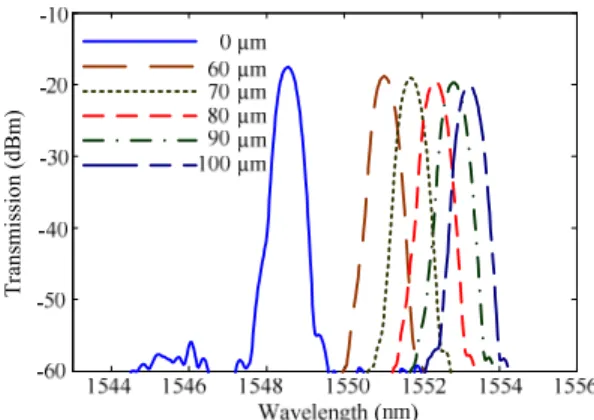
In this work presented here, our developed wavelength interrogator is described in detail in [15]. Basically, in an AWG, the space-to-wavelength mapping refers to the relationship between the input beam spatial position and the transmission wavelength of a designated AWG channel. As well documented in [8, 15], the transmission wavelength of a designated AWG channel has a linear relationship with the input beam spatial position. The tunability is determined by the material and structure of the AWG. Fig. 1 shows the spectrum and wavelength shift of a designated AWG channel with respect to the input beam spatial position.
T ra n sm is si on ( d B m )
Fig. 1. Spectrum profiles of one designated AWG channel when changing the input beam position.
By involving the space-to-wavelength mapping, the overall interrogation range is determined by the travel range of the input beam and the specific space-to-wavelength coefficient. In our experiment, the wavelength tunability is first measured with respect to the position of the input light beam. A spectral scanning of 4.78 nm is achieved by changing the input light position of 100µm. Thus, the coefficient is 47.8 pm/µm for this perticular AWG channel. According to the AWG principle [16], all the AWG channel should have the same wavelength tunability. Therefore, the coefficient for all the AWG channel is defined as 47.8 pm/µm in this experiment. The total tavel range of the input beam has a maximum value of 1 mm, which makes the overall interrogation range up to 47.8 nm. However, only portion of this maximum value is enough for the measurement of refractive index using a TFBG sensor according to its sensing principle as described above.
In our design, the real-time position of the input beam is obtained by a position encoder which is integrated into a closed-loop piezoelectric motor. Therefore, the position can be accurately measured. By employing the calibrated space-to-wavelength mapping relationship, the space-to-wavelength can be achieved by subsituting the position into the linear relationship.
III. EXPERIMENTAL RESULTS
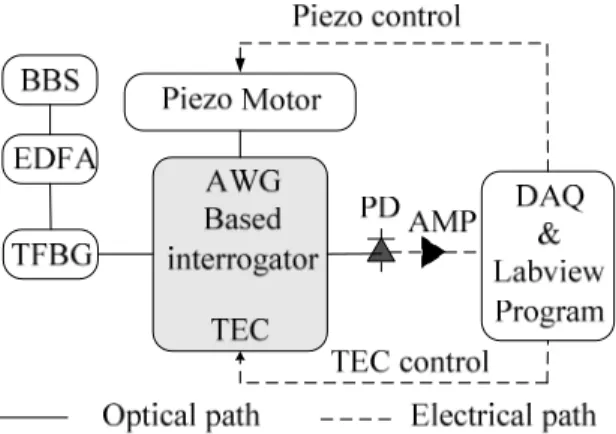
Fig. 2 shows the experimental setup. A broadband source (BBS) is used as the light source. Its output light is amplified by an erbium-doped fiber amplifier (EDFA), and then directly sent to a TFBG sensor. The output fiber tail of the sensor is mounted on top of a closed-loop piezo motor, fixed and protected by a fiber sleeve. A positioning stage is used to achieve the pre-alignment between the fiber and the AWG.
When the piezo motor moves horizontally, it drives the fiber tail to scan along the input coupler of the AWG. The absolute position of the scanning fiber tail is provided by a position encoder embedded in the piezo motor. With the real-time position feedback, an actuator signal is properly set to drive the piezo motor to move a specific step. This is regarded as the closed-loop (servo) control. Since the transmission wavelength of an AWG is temperature dependent, the AWG needs a temperature compensation device for accurate measurement. In our experimental setup, a thermal electrical cooler (TEC) is attached to the base of the AWG for this purpose. The output light power of the AWG is detected by a PD array and amplified by an operational amplifier (AMP). All the controls, data acquisition and processing are implemented by a Labview program.
Fig. 2. Experimental setup of the proposed wavelength interrogator based on space-to-wavelength mapping using a closed-loop piezo motor.
The transmission spectrum of a TFBG sensor obtained by our developed interrogator is shown in Fig. 3.
Fig. 3. Measured transmission spectrum of the TFBG sensor.
The TFBG sensor used in this paper is written in a hydrogen-loaded Corning SMF-28 optical fiber using a pulsed KrF excimer laser. The tilted angle of the grating planes is achieved by rotating the phase mask of 6º with respect to the optical fiber with a rotation stage. As described above, a relative wavelength spacing is measured to reflect the refractive index changes. In our experiment, both the Bragg resonance (1551.506 nm) and a cladding mode resonance (1536.008 nm) are selected. Higher order cladding mode resonances are located further away from the Bragg resonance. Since these modes are more sensitive to the
refractive index of the surrounding medium, they are of great interests in measuring the refractive index. However, it is also facing a challenge of the wavelength interrogation. The wavelength spacing is 15.498 nm measured when the TFBG sensor is present in the air.
For refractive index measurement, water-sugar solutions with different weight concentrations are used to provide a wide range of refractive indices. The weight concentration starts from 10% to 40% with steps of 5%. The refractive indices are measured using an Abbe refractometer. The results show that the refractive indices vary from 1.35 to 1.40 with steps of 0.0083, corresponding to the weight concentration varying from 10% to 40% with steps of 5%. The TFBG sensor is immersed in the solutions and transmission wavelength of target resonances are obtained with the principle described in detail in [15]. The corresponding wavelength spacing is then obtained and shown in Fig. 4.
Wav e length s pac ing ( n m)
Fig. 4. Experimental wavelength spacing measured by the proposed interrogator between the cladding mode resonance and the Bragg resonance as a function of the refractive index of water-sugar solutions.
Fig. 4 shows the measured wavelength spacing with our proposed and developed interrogator. Comparing this result with the one measured by an OSA, the deviations are within ± 0.01 nm. Therefore, agreement has been achieved between the results measured by our interrogator and an OSA, and our interrogator is approved to have the capability to measure the transmission wavelengths of a TFBG sensor, which is then used for refractive index measurement purpose.
Initial results show that (1) the interrogation range is determined by the wavelength tunability, which has a maximum value of 47.8 nm in our design with this particular AWG, given that the travel range of the piezo motor is 1 mm and the space-to-wavelength mapping coefficient is 47.8 pm/µm. This range is broad enough for most TFBG sensor applications; (2) the spectrum resolution is determined by the spatial tuning step of the closed-loop piezo motor, which is 4.78 nm in this experiment by setting the spatial tuning step of 0.1 µm. Higher resolution could be reached by a smaller spatial tuning step; (3) the multi-channel measurement capability is determined by the characteristics of the AWG. All the AWG channels have the same wavelength tunability. If each AWG channel is used for monitoring a single TFBG sensor, a total of 32 TFBG sensors could be simultaneously monitored in our present design with this perticular AWG; (4) the interrogation speed is determined by the travel speed of the piezo motor. The present piezo motor has a maximum speed of 500 mm/s, which makes the interogation speed up to 1 kHz;
(5) Since a commercial standard AWG is used in this experiment, there is no need to design and fabricate an AWG chip with new structures, which significantly decreases the total cost.
IV. CONCLUSION
We have successfully achieved the wavelength interrogation of a TFBG sensor in the refractive index measurement with our proposed and developed interrogator based on an AWG. By using a closed-loop control mechanism, the input beam position was obtained. The space-to-wavelength mapping was tested and used to convert the positions into the transmission wavelength of target resonances in the TFBG transmission spectrum. Since each AWG channel was capable to monitor one TFBG sensor in our design, a multichannel measurement capability could be achieved by using multiple AWG output channels. Besides that our interrogator had a potential to reach advanced performance, another important advantage of our AWG-based interrogator was cost-effective, since the AWG used in our design was a standard commercial product, which implied obvious cost effects. Furthermore, our interrogator was miniaturized in size and light in weight, which could be packaged into a palm-size device.
REFERENCES
[1] T. Kuwana, Physical Methods in Modern Chemical Analysis, vol. 2, Academic, 1980, pp. 337-400.
[2] A. N. Chryssis, S. M. Lee, S. B. Lee, S. S. Saini, and M. Dagenais, “High sensitivity evanescent field fiber Bragg grating sensor,” IEEE Photon. Technol. Lett., vol. 17, pp. 1253-1255, 2005.
[3] H. J. Patrick, “Analysis of the response of long period fiber gratings to external index of refraction,” IEEE/OSA J. Lightwave Technol., vol. 16, pp. 1606-1612, 1998.
[4] G. Laffont, and P. Ferdinand, “Tilted short-period fiber-Bragg-grating induced coupling to cladding modes for accurate refractometry, ” Meas. Sci. Technol., vol. 12, pp. 765-770, 2001.
[5] T. Erdogan, and J. E. Sipe, “Tilted fiber phase gratings,” J. Opt. Soc. Am. A., vol. 13, pp. 296-312, 1996.
[6] C. F. Chan, C. Chen, A. Jafari, A. Laronche, D. J. Thomson, and J. Albert, “Optical fiber refractometer using narrowband cladding-mode resonsnace shifts,” Appl. Opt., vol. 46, pp. 1142-1149, 2007.
[7] S. Baek, Y. Jeong, and B. Lee, “Characteristics of short-period blazed fiber Bragg gratings for use as macro-bending sensors,” Appl. Opt., vol. 41, pp. 631-636, 2002.
[8] M. K. Smith, and C. V. Dan, “PHASAR-based WDM-devices: Principles, design and applications,” J. Sel. Top. Quantum Electron., vol. 2, pp. 236-250, 1996.
[9] Y. Sano, and T. Yoshino, “Fast optical wavelength interrogator employing arrayed waveguide grating for distributed fiber Bragg grating sensors,” J. Lightw. Technol., vol. 21, pp. 132-139, 2003. [10] D. C. C. C. Norman, D. J. Webb, and R. D. Pechstede, “Extended range
interrogation of wavelength division multiplexed fiber Bragg grating sensors using arrayed waveguide grating,” Electron. Lett., vol. 39, pp. 1714-1715, 2003.
[11] P. Niewczas, A. J. Willshire, L. Dziuda, and J. R. McDonald, “Performance Analysis of the Fiber Bragg Grating Interrogation System Based on an Arrayed Waveguide Grating,” Trans. Instrum. Meas. vol. 53, pp. 1192-1196, 2003.
[12] P. Cheben, E. Post, S. Janz, J. Albert, A. Laronche, J. H. Schmid, D. X. Xu, B. Jamontagne, J. Lapointe, A. Delage, and A. Densmore, “Tilted fiber Bragg grating sensor interrogation system using a high-resolution silicon-on-insulator arrayed waveguide grating,” Opt. Lett., vol. 33, pp. 2647-2649, 2008.
[13] G. Z. Xiao, P. Zhao, F. G. Sun, Z. G. Lu, Z. Zhang, and C. P. Grover, “Interrogating fiber Bragg grating sensors by thermally scanning an arrayed waveguide grating based demultiplexer,” Opt. Lett., vol. 29, pp. 2222-2224, 2004.
[14] H. Guo, Y. T. Dai, G. Z. Xiao, N. Mrad, and J. P. Yao, “Interrogation of a long-period grating using a mechanically scannable arrayed waveguide grating and a sampled chirped fiber Bragg grating,” Opt. Lett., vol. 33, pp. 1635-1637, 2008.
[15] H. Guo, G. Xiao, N. Mrad, J. Albert, and J. P. Yao, “Wavelength interrogator based on closed-loop piezo-electrically scanned space-to-wavelength mapping of an arrayed waveguide grating,” IEEE/OSA Lightwave Technol., accepted, June, 2010.
[16] K. Okamoto, “Recent progress of integrated optics planar lightwave circuits,” Opt. Quantum Electron., vol. 31, pp. 107-129, 1999.
![[PDF] Supports de cours sur les Bases du langage XML | Cours informatique](data:image/gif;base64,R0lGODlhAQABAIAAAP///wAAACH5BAEAAAAALAAAAAABAAEAAAICRAEAOw==)