Publisher’s version / Version de l'éditeur:
Bioengineered Bugs, 2, 2, pp. 71-79, 2011-01-01
READ THESE TERMS AND CONDITIONS CAREFULLY BEFORE USING THIS WEBSITE.
https://nrc-publications.canada.ca/eng/copyright
Vous avez des questions? Nous pouvons vous aider. Pour communiquer directement avec un auteur, consultez la première page de la revue dans laquelle son article a été publié afin de trouver ses coordonnées. Si vous n’arrivez pas à les repérer, communiquez avec nous à [email protected].
Questions? Contact the NRC Publications Archive team at
[email protected]. If you wish to email the authors directly, please see the first page of the publication for their contact information.
NRC Publications Archive
Archives des publications du CNRC
This publication could be one of several versions: author’s original, accepted manuscript or the publisher’s version. / La version de cette publication peut être l’une des suivantes : la version prépublication de l’auteur, la version acceptée du manuscrit ou la version de l’éditeur.
For the publisher’s version, please access the DOI link below./ Pour consulter la version de l’éditeur, utilisez le lien DOI ci-dessous.
https://doi.org/10.4161/bbug.2.2.15009
Access and use of this website and the material on it are subject to the Terms and Conditions set forth at
Introducing a new bioengineered bug: Methylobacterium extorquens
tuned as a microbial bioplastic factory
Höfer, Philipp; Vermette, Patrick; Groleau, Denis
https://publications-cnrc.canada.ca/fra/droits
L’accès à ce site Web et l’utilisation de son contenu sont assujettis aux conditions présentées dans le site
LISEZ CES CONDITIONS ATTENTIVEMENT AVANT D’UTILISER CE SITE WEB.
NRC Publications Record / Notice d'Archives des publications de CNRC:
https://nrc-publications.canada.ca/eng/view/object/?id=edbf619e-4a8c-41e7-bad0-51bbf04a78a1 https://publications-cnrc.canada.ca/fra/voir/objet/?id=edbf619e-4a8c-41e7-bad0-51bbf04a78a1Bioengineered Bugs 2:2, 71-79; March/April 2011; © 2011 Landes Bioscience
EXPERT COMMENTARY EXPERT COMMENTARY
Key words: Methylobacterium extorquens,
methanol, unsaturated fatty acids, genetic engineering, funtionalized poly-hydroxyalkanoates, reductase-dependent β-oxidation, isomerase-dependent β- oxidation, acyl-CoA desaturase, Scopus
Abbreviations: 2KG,
2-ketogluta-rate; 3HA, 3-hydroxyalkanoate; 3HB, 3-hydroxybutyrate; 3HHx, 3-hydroxy-hexanoate; 3HHx=, 3-hydroxyhex-5- enoate; 3HO, 3-hydroxyoctano-ate; 3HO=, 3-hydroxyoct-7-eno3-hydroxyoctano-ate; 3HP, 3-hydroxypentanoate; 3HV, 3-hydroxyvalerate; AC, acetyl-CoA; C6=, 5-hexenoic acid; C8=, 7-octenoic acid; C11=, 10-undecenoic acid; Cn, carbon number n (length of molecule or position of double bond); GWP, global warming potential; KOH, potassium hydroxide; LCL, long-chain-length; MCL, medium-chain-length; PHA, poly-hydroxyalkanoate; PhaC, PHA synthase; PHB, polyhydroxybutyrate; PHBV, poly(3-hydroxybutyrate-co-3-hydroxyval-erate); PPC, propionyl-CoA; SCL, short-chain-length; SC, succinyl-CoA
Submitted: 11/29/10 Revised: 01/30/11 Accepted: 01/31/11
DOI: 10.4161/bbug.2.2.15009 *Correspondence to: Denis Groleau; Email: [email protected]
D
iscussion on and use of metha-nol as chemical feedstock and as alternative fuel has gained momentum during the past years. Consequently, microorganism and product design based on “methylotrophism” is in vogue as reflected by increasing research and development activities in methanol-related areas. A recent example of micro-organism and product development is the use of recombinant Methylobacteriumextorquens ATCC 55366 strains in the
production of second generation bio-polyesters. Feeding n-alkenoic acids in addition to methanol yielded function-alized polyhydroxyalkanoates (PHAs) and uncovered how M. extorquens copes with fatty acids. While some parts of the degradation pathway remain unclear, possible metabolic routes are suggested that may explain the significant loss of double bonds prior to polymerization of PHA precursors and occurrence of odd-numbered monomers derived from even-numbered n-alkenoic acids. In addition, microbial discoloration upon fatty acid feeding is discussed and future direc-tions for further genetic modification of
M. extorquens are provided.
The Rationale for Engineering Methanol-Utilizing Bacteria
Methylotrophic bacteria offer obvious potential for transforming environmen-tally damaging substances (e.g., gar-bage) into useful materials. Garbage and low value biomasses can be con-verted into methane and methanol via
Introducing a new bioengineered bug
Methylobacterium extorquens tuned as a microbial bioplastic factory
Philipp Höfer,1 Patrick Vermette2 and Denis Groleau3,*1Oswaldo Cruz Foundation (FIOCRUZ); Bio-Manguinhos; Rio de Janeiro, Brazil; 2Laboratoire de Bioingénierie et de Biophysique de l’Université de Sherbrooke; Department of Chemical and Biotechnological Engineering; Université de Sherbrooke; Sherbrooke, Québec, Canada; 3Microbial and Enzymatic Technology Group; Bioprocess Centre; Biotechnology Research Institute; National Research Council Canada; Montréal, Québec, Canada
a thermochemical route, and these two one-carbon and non-food substances become available thereafter as main sub-strates for methylotrophic microorgan-isms. Methane is one of the two most important greenhouse gases and has been suggested to have a larger global warming potential (GWP) than carbon dioxide,1 whereas methanol, its alcohol
derivative, is poisonous for many living organisms, including human beings, as it is rapidly metabolized to formic acid via methanal (formaldehyde), causing severe metabolic disturbances.2 However,
it is less their potential usefulness as environmental “cleaning agents” that makes methylotrophs attractive than their potential for utilizing inexpensive and, especially, non-food substrates as raw materials in industrial microbiol-ogy. The disadvantages associated with the conversion of food substrates (sugars) into biofuels have recently stimulated the search for alternative ways to obtain biofuels and various bioproducts (chemi-cal feedstocks, bioplastics, other bioma-terials, etc.). The preferred sources of methane and methanol would be those derived from non-food biomasses such as garbage, lignocellulosics and low value carbon streams including improper cere-als and food wastes. Methane can be eas-ily obtained from biomass via anaerobic digestion.3 Additionally, the conversion
process can be enhanced by recycling car-bon dioxide.4 These obvious advantages
have resulted in the recent promotion of a “methanol economy” as an alternative route to deal with the inevitable future
work on methylotrophic yeasts such as
Hansenula polymorpha and Pichia pastoris
and on methane-oxidizing bacteria, in this instance, mostly in an environmen-tal context. The Group possesses also all of the necessary expertise and equipment to scale-up and optimize fermentation processes employing methanol-utilizing microorganisms up to the 1,500 L-scale together with primary recovery and exten-sive product purification expertise and equipment. Genomic Potential of Methylobacterium extorquens to Function as a Microbial Bioplastic Factory of a Special Kind
We have chosen M. extorquens ATCC 55366 to produce second generation, i.e., functionalized biomaterials.10,11
Selective gene screening gave us reason to believe that this methylotroph expresses the required enzymatic machinery to deal with medium-chain-length fatty acids (MCL-FAs) comprising C-C double bonds The Microbial and Enzymatic Techn-
ology group of Canada’s Biotechnology Research Institute (NRC-BRI) has been carrying out fundamental but mostly applied research on methylotrophic microorganisms since 1988. The Group recognized early on that the World can-not rely only on sugars derived from essen-tially food sources to support the growth of modern industrial biotechnology. C1 substrates such as methanol and meth-ane offer great potential as carbon sources since they can easily be obtained from various wastes and from low value agricul-tural streams, with the additional advan-tage of being non-food sources of carbon. To a large degree, methanol and methane are as advantageous as CO2 as a carbon source for producing biofuels and various bioproducts. Most of the group’s research has focused on the characterization and use of the proprietary Methylobacterium
extorquens ATCC 55366 strain for
pro-ducing experimental bioproducts such as PHB, pigments, functionalized PHAs and various recombinant proteins. The Group has also performed significant shortage of fossil fuels.5 The rising
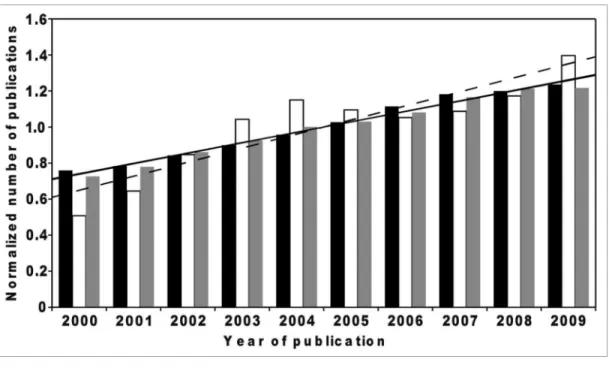
inter-est in methanol coincides with increasing activities in corresponding research areas (Fig. 1), suggesting that methanol will play an important role in the future, for instance, as a carbon substrate in micro-bial fermentations.
Starting from methanol, several amino acids, various proteins, the bioplastic poly-hydroxybutyrate (PHB) and, very recently, chiral (R)-3-hydroxybutyric acid were successfully produced in methylotrophs.6,7
Important advances have been made in understanding methylotrophic metabo-lism.8 Research into metabolic activities
of Methylobacterium extorquens regarding C1 compounds and, last but not least, the recent success in sequencing the genome of three M. extorquens strains have helped to understand how these microorganisms cope with methanol and what they are capable of producing from it.9 To extend
production capabilities, metabolic engi-neering approaches have been successfully performed and these have led to product diversification as elegantly reviewed in ref-erence 6.
Figure 1. Increase in publications dealing with methanol or glucose (reference carbon substrate). The scientiic publication database Scopus (Elsevier,
Amsterdam, The Netherlands) was used to analyze documents that were published between 2000 and 2009 and stated methanol or glucose as one of their keywords. Publications from the following research areas were considered: Biochemistry, Genetics and Molecular Biology; Agricultural and Biological Sciences; Environmental Science; Multidisciplinary; Chemical Engineering. For each year, the respective publication number for methanol (white columns), glucose (gray columns) and the number of publications from the entire scientiic community (black columns) was divided by the cor-responding average number of the entire time period (2000–2009). Trend lines indicate the increase of publications over time. While increases of total publications and those dealing with glucose were nearly identical (overlapping solid lines), the number of documents referring to methanol as one of the keywords showed an above-average increase (dashed line).
substrate specificity and subunit compo-sition.16 Class I PHA synthases, found in
M. extorquens and R. eutropha (Table 1),
incorporate SCL-3HAs into polyhydroxy-alkanoates. P. putida KT2440 possesses two PhaC of type II, which polymer-ize MCL- and LCL-3-hydroxyacyl-CoA molecules (C > 14). Class III and IV PHA synthases have 3-hydroxyacyl-CoA specificities equal to class I PhaC; how-ever, they are part of a dual enzyme com-plex. Although classified according to the length of their substrates, some PHA syn-thases show a rather broad substrate speci-ficity, therefore, being able to incorporate SCL, MCL- and LCL-3HAs.
Since the PHA synthases of M.
extorquens were grouped as type I PHA
synthases, we expected that only genetic manipulation would enable our wild-type strain to yield biopolyesters other than SCL-PHAs. The genetic manipula-tions were performed by inserting a gene encoding for a broad substrate specific-ity PHA synthase into a recently devel-oped, inducible and tightly regulated gene expression system.17,18 As indicated
above, we were seeking special polyhy-droxyalkanoates that are modifiable and easily processable owing to the elongated side chains with terminal double bonds (Fig. 2). Such PHAs are called function-alized PHAs. Functionfunction-alized PHAs have gained much interest during the past two decades since they may qualify for unique applications and functions, particularly express all enzymes that participate in the
conventional β-oxidation cycle associated with CoA-activated fatty acids. Moreover, two enzymes are present (3-hydroxyacyl-CoA epimerase and 3-ketoacyl-(3-hydroxyacyl-CoA reductase) that convert β-oxidation prod-ucts into PHA precursors (3-hydroxy-acyl-CoA) (for a scheme see ref. 13). The assumably minor expression level of the fatty acid degradation machinery, derived from the lower number of the correspond-ing genes in M. extorquens, did not concern us because we were seeking modest levels of MCL-3HA monomeric units within the sought after polyhydroxyalkanoates.
Tuning the Bacterium
Methylobacterium extorquens for the Production of Functionalized
Polyhydroxyalkanoates
Methylobacterium extorquens is a
“natural-born” bioplastic factory. It was shown to produce high molecular weight polyhy-droxybutyrate and poly(3-hydroxybutyr-ate-co-3-hydroxyvalerate (PHBV) under nitrogen-limiting conditions.14,15 While
these SCL-PHAs can be produced at com-paratively low cost, they have been criti-cized for their poor thermo-mechanical properties which limit their application spectra. The enzymes that polymerize 3-hydroxyacyl-CoA molecules to PHAs are called PHA synthases (or polymerases, PhaC). They are divided into four classes according to their primary structure, that may be used to produce
functional-ized biopolyesters, potentially broadening its product repertoire to C4+ compounds. The Integrated Microbial Genomes (IMG) system of the DOE Joint Genome Institute (IGI) (www.jgi.doe.gov/) was used to screen three M. extorquens strains (AM1, DM4 and PA1) for their poten-tial to allocate medium-chain-length 3-hydroxyacyl-CoA molecules that may be polymerized to polyhydroxyalkanoates (PHAs). The results were checked against two very prominent bioplastic producers,
Pseudomonas putida KT2440 and Ralstonia eutropha H16, using IMG’s genome
com-parison tools based on enzymatic function ID analysis (Table 1). While R. eutropha (recently renamed as Cupriavidus necator) produces the same type of short-chain-length PHAs (SCL-PHAs, 4 ≤ C ≤ 5) that are also found in wild-type M. extorquens, pseudomonads process sugars and/or medium-chain-length fatty acids to corre-sponding medium-chain-length and long-chain-length PHAs (MCL-PHAs, 6 ≤ C ≤ 14 and LCL-PHAs, C > 14). R. eutropha H16 and a genetically modified PHA-deficient mutant strain were reported to incorporate medium-chain-length 3-hydroxyalkanoates (MCL-3HAs) into PHAs,12 suggesting that R. eutropha is also
capable of channeling MCL-FAs toward PHA polymerization despite its preference for accumulating SCL-PHAs from sugar.
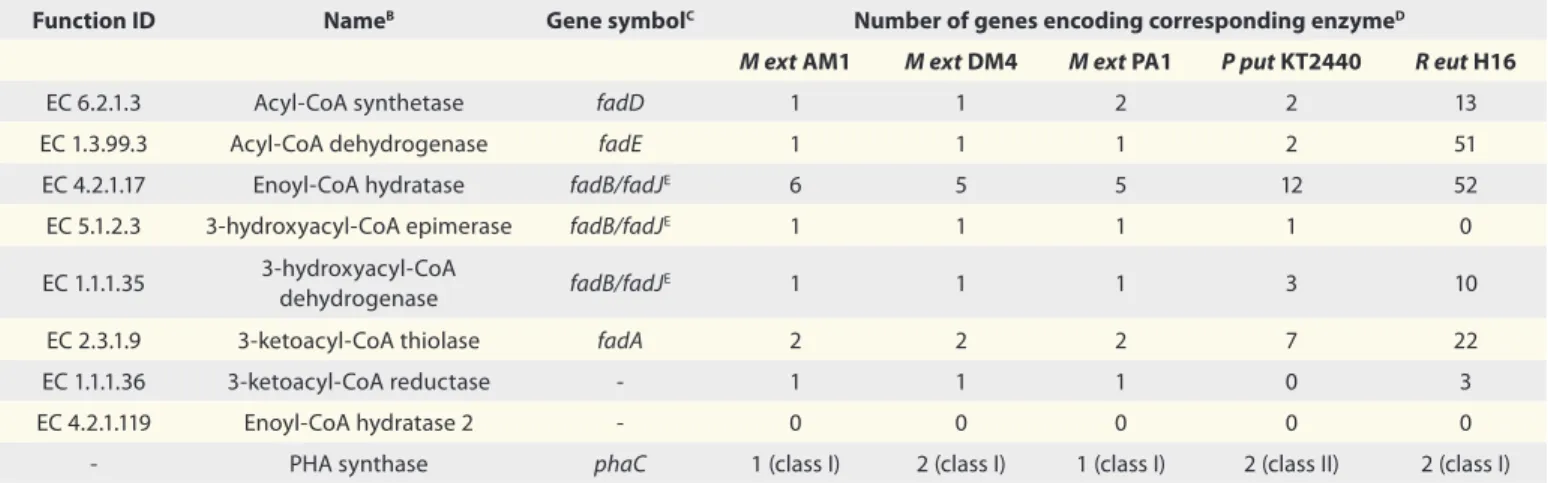
Table 1 shows that the three sequenced M.
extorquens strains (AM1, DM4 and PA1)
Table 1. Abundance of genes in M. extorquens that potentially participate in β-oxidation-driven fatty acid metabolism toward PHA polymerizationA Function ID NameB Gene symbolC Number of genes encoding corresponding enzymeD
M ext AM1 M ext DM4 M ext PA1 P put KT2440 R eut H16
EC 6.2.1.3 Acyl-CoA synthetase fadD 1 1 2 2 13
EC 1.3.99.3 Acyl-CoA dehydrogenase fadE 1 1 1 2 51
EC 4.2.1.17 Enoyl-CoA hydratase fadB/fadJE 6 5 5 12 52
EC 5.1.2.3 3-hydroxyacyl-CoA epimerase fadB/fadJE 1 1 1 1 0
EC 1.1.1.35 3-hydroxyacyl-CoA
dehydrogenase fadB/fadJ
E 1 1 1 3 10
EC 2.3.1.9 3-ketoacyl-CoA thiolase fadA 2 2 2 7 22
EC 1.1.1.36 3-ketoacyl-CoA reductase - 1 1 1 0 3
EC 4.2.1.119 Enoyl-CoA hydratase 2 - 0 0 0 0 0
- PHA synthase phaC 1 (class I) 2 (class I) 1 (class I) 2 (class II) 2 (class I) M ext, Methylobacterium extorquens; P put, Pseudomonas putida; R eut, Ralstonia eutropha. AData were obtained from The Integrated Microbial Genomes (IMG) system (http://img.jgi.doe.gov/). BCommonly used name. CThese gene symbols are commonly used when relating to β-oxidation-driven fatty acid metabolism toward 3-hydroxyacyl-CoA allocation for subsequent polymerization. They are not necessarily related to the function IDs listed above. DIncluding putative enzymes. EPutative fatty acid oxidation complex subunit alpha listed as fadJ in M ext AM1 and DM4 and fadB in P put KT2440.
(shake flask experiments),10 or 5-hexenoic
acid (bioreactor studies).11 This was
unex-pected because medium-chain-length fatty acids are supposed to undergo a C2 reduction during the β-oxidation cycle, i.e., thereby shortened molecules remain odd- or even-numbered depending on the molecule of origin.
The apparent hydration of C-C double bonds that resulted in a partial loss of functionality and the occurrence of C5 resulting from even-numbered co-sub-strates prompted us to have a closer look at the multi-carbon fatty acid metabolism in
M. extorquens ATCC 55366.
Alternative β-Oxidation Pathways for Unsaturated Fatty Acids
Alternative pathways for the degradation of unsaturated long-chain-length fatty acids (LCL-FAs) are known for eukary-otes,22,23 and for prokaryotes.24 These
pathways are briefly presented below (for a scheme see ref. 25).
Isomerase-Dependent β-Oxidation
When fatty acids possess C-C double bonds at odd-numbered positions, their coenzyme A-activated derivatives run through the β-oxidation cycle until the double bonds hinder further processing. During the final step of the β-oxidation cycle, 3-ketoacyl-CoA is cleaved between C2 and C3 by thiolysis, thereby, shifting the double bonds closer to the coenzyme A tail. Once double bonds reach position yielded PHA copolymers with less than 10
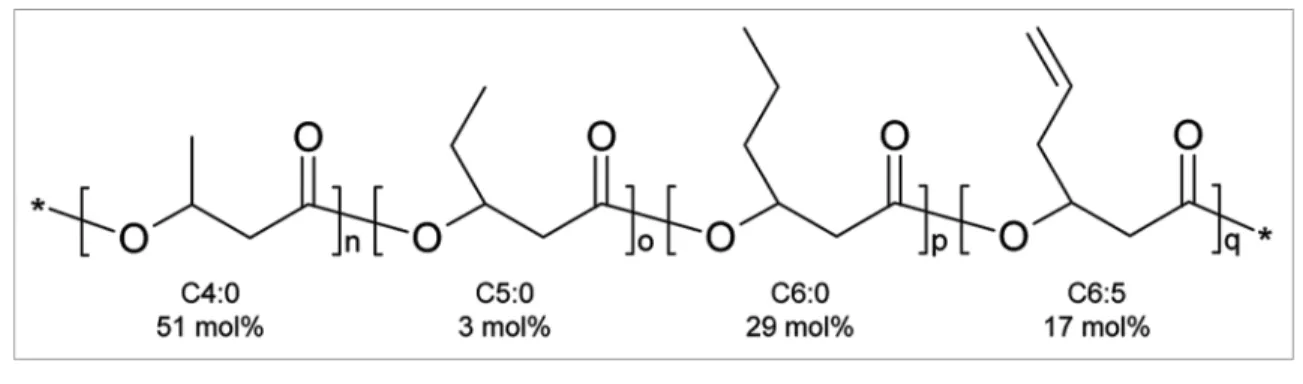
mol% of MCL monomeric units, which exhibited both saturated and unsaturated side chains. Strain M. ex-phaC1 proved to be less efficient at incorporating function-ality in the form of terminal C-C double bonds in the side chains resulting from the co-substrates. Furthermore, we observed that M. extorquens favored C6= and C8= over C11= and that the addition of C8= yielded unexpected C5 monomers within the PHA copolymer. This was surpris-ing because it is commonly accepted that the chemical structure of the substrate is reflected in the monomeric composi-tion of PHA copolymers when fatty acids are fed. In the situation found with our recombinant M. extorquens strains, the chemical structure of the fatty acids was only partially reflected in the monomeric composition of the PHAs obtained. Aside from 3-hydroxybutyrate (3HB) originat-ing from methanol assimilation, within the resulting polymers we anticipated to find 3-hydroxyhex-5-enoate (3HHx=) derived from 5-hexenoic acid (C6=), and 3-hydroxyhex-5-enoate (3HHx=) and 3-hydroxyoct-7-enoate (3HO=) derived from 7-octenoic acid (C8=). A significant portion of the n-alkenoic acid deriva-tives (in some cases more than 50%) had lost their C-C double bonds prior to polymerization, leading to incorpora-tion of both 3-hydroxyalkenoates and their saturated analogs into PHA (Fig.
2). Moreover, 3-hydroxyvalerate (3HV=
3-hydroxypentanoate, 3HP) was found in PHAs after feeding either 7-octenoic acid in the area of regenerative medicine.19
To date, PHAs of higher value have been mostly obtained from recombinant
Escherichia coli, Cupriavidus necator and
wild-type Pseudomonas species, which grow on sugars and/or alkanoic acids. In addition to contributing to the establish-ment of a new cell factory for special-ized bioplastics, we have learned how M.
extorquens behaves in the presence of
MCL-FAs. Knowing that M. extorquens is inca-pable of growing on multicarbon substrates (C > 4), research has focused so far on metabolic behavior and fluxes resulting from C1–C4 components.8,20,21 In this
article, we discuss the metabolic insights we have obtained from exposing wild-type and recombinant M. extorquens ATCC 55366 strains to some MCL alkenoic acids (C > 5).10,11
The Metabolism of Unsaturated n-Alkenoic Acids in M. extorquens
Yields an Interesting Array of Intermediates
As expected, only our genetically modi-fied M. extorquens ATCC 55366 strains harboring either the phaC1 or phaC2 gene of Pseudomonas fluorescens GK13 (M.
ex-phaC1 and M. ex-phaC2, respectively)
were able to produce blends of short-chain-length PHAs (SCL-PHAs, 4 ≤ C ≤ 5) and short-chain-length/medium-chain-length PHAs (SCL/MCL-PHAs, 4 ≤ C ≤ 8) bearing terminal double bonds.10 Co-feeding methanol +
5-hex-enoic acid (C6=) or 7-oct5-hex-enoic acid (C8=)
Figure 2. Poly(3-hydroxybutyrate-co-3-hydroxyvalerate-co-3-hydroxyhexanoate-co-3-hydroxyhex-5-enoate) after co-feeding of methanol and
5-hexenoic acid to M. extorquens (M. ex-phaC2 strain) in a bioreactor. This functionalized terpolyester has distinct properties.11 It is amenable, in theory, to (bio-) chemical modiications and exhibits desirable thermal properties similar to those found in corresponding (saturated) inert analogs. Moreover, it is biodegradable and believed to be biocompatible. The combination of these assets makes this copolymer an interesting candidate for applications in regenerative medicine. For example, it could become the hydrophobic core of a composite material that promotes revascularization. By keeping the medium-chain-length 3-hydroxyalkanoate content below 50 mol%, the melting temperature can be kept above 121°C at which temperatures materi-als are conveniently autoclaved. Examples for activating functionalized PHAs for some medical applications are reviewed in reference 19.
have been observed to the same extent as 3-hydroxyhexanoate.
A more plausible explanation for the random vinyl hydrogenation, how-ever, may be found in the action of an acyl-CoA desaturase whose gene may be expressed in some M. extorquens strains (Table 2). This enzyme is also called Δ9-desaturase or stearoyl-CoA 9-desatu-rase according to the catalyzed reaction, where stearoyl-CoA (C18) is desaturated at the 9th position from the carboxyl end
in the presence of two molecules of ferro-cytochrome b5, oxygen and two protons. Interestingly, acyl-CoA desaturases that execute Δ9 and, specifically, Δ5 desatura-tion of saturated fatty acids were reported to be present in Lyngbya majuscula. While desaturation of CoA-activated hexanoic acid to 5-hexenoyl-CoA was found to occur, evidence for dehydrogenation of C8 to 7-octenoyl-CoA was missing.28
As this desaturation reaction is revers-ible, it is speculated that the C-C double bond loss of C6= and, to a minor extent of C8=, in M. extorquens was performed by the action of an acyl-CoA desaturase, possibly driven by the need of protons for the recycling of NAD(P)H + H+.
Table 2 summarizes the potential of M.
extorquens, P. putida KT2440 and R. eut-ropha H16 for alternative alkenoic acid
metabolism.
Our findings match results obtained from PHA production studies with
Pseudomonas oleovorans where the
frac-tion of saturated 3-hydroxyalkanoate shortened to 2E-butenoyl-CoA (C4) and,
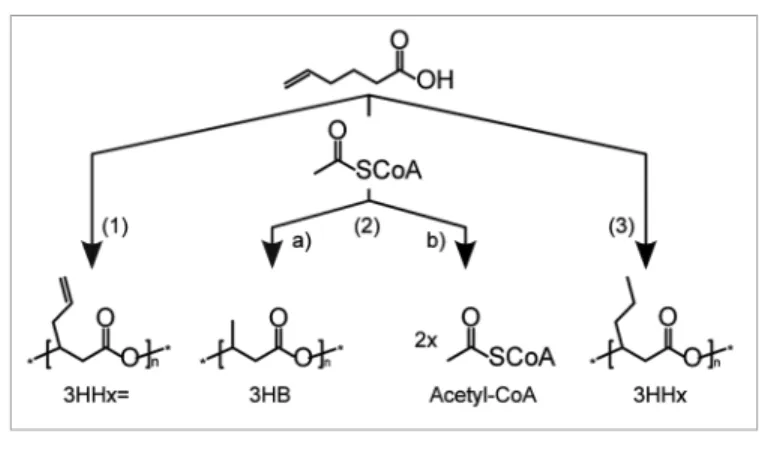
consequently, hydratized to 3-hydroxybu-tyrate or split into two molecules of ace-tyl-CoA (route 2 in Fig. 3). It is possible that some n-alkenoic acid molecules are metabolized following this route in M.
extorquens; however, this does not explain
the accumulation of saturated 3-hydroxy-hexanote. In contrast, the reductase-dependent pathway could explain the apparent saturation of alkanoic PHA precursors, provided that a hypothetical Δ3,5, Δ2,4-dienoyl-CoA isomerase could
deal with stereo-unspecific terminal C-C double bonds (Fig. 4). This hypothesis is contradicted by the fact that evidence for this pathway is missing in prokaryotes.27
Indeed, genes encoding for enzymes of this metabolic route (Δ3, Δ2-enoyl-CoA
isomerase, Δ3,5, Δ2,4-dienoyl-CoA
isomer-ase and 2,4-dienoyl-CoA reductisomer-ase) have not been reported for Methylobacterium
extorquens (Table 2). Enoyl-CoA
isom-erase and/or dienoyl-CoA isomisom-erase/ reductase functions have been postulated for some prokaryotes (img.jgi.doe.gov/) but it is doubtful that our ATCC 55366 strain possesses all of the enzymes that are required for the reductase-dependent β-oxidation pathway. Nevertheless, a hint toward the NADPH-dependent β-oxidation hypothesis is that double bond elimination reactions seem to be dependent on a vinyl function at posi-tion C5. Otherwise, 3-hydroxyoctanoate monomers (originating from 3HO= with vinyl function at position C7) should C3, unsaturated acyl-CoA molecules are
temporarily diverted from the β-oxidation cycle and isomerized to equivalents bear-ing a double bond at position C2 in the E (trans) configuration. The isomerization is catalyzed by a Δ3,Δ2-enoyl-CoA
isom-erase, from which this “classical” alterna-tive pathway obtained its name. Resulting 2E-enoyl-CoA molecules subsequently become candidates to the β-oxidation cycle.
Reductase-Dependent β-Oxidation
Another pathway that seems to be reserved for mitochondrial fatty acid degradation in eukaryotes involves sub-sequent isomerase actions and NADPH-mediated double bond reduction.25,26
During this reductase-dependent (also called NADPH-dependent) β-oxidation, 5Z-located double bonds [Z (cis) con-figuration at position C5] are translo-cated and finally hydrogenated, leaving β-oxidizable 2E-enoyl-CoA molecules behind. This pathway has been assumed to be present in Escherichia coli because 3E,5Z-dienoyl-CoA intermediates that are significant for this pathway were found to accumulate when cells were grown on oleic acid.27 However, activity
of a native Δ3,5, Δ2,4-dienoyl-CoA
isomer-ase, one of the key enzymes in this path-way, was missing.
Question: Does Methylobacterium
extorquens Possess a Eukaryotic Degradation Machinery for Unsaturated Fatty Acids?
None of the alternative prokaryotic β-oxidation pathways (for a scheme see refs. 24 and 27) seem to be appli-cable to the overall situation found in
M. extorquens. Apart from dealing with
MCL-FAs with terminal double bonds instead of LCL-FAs with double bonds in E or Z configuration, double bonds at position C5 are ultimately shifted to the C3 position due to thiolase activity between C2 and C3 (isomerase-dependent pathway). This step is necessary to pro-vide the Δ3, Δ2-enoyl-CoA isomerase with
an intermediate that can be channeled toward the β-oxidation cycle (2E-enoyl-CoA). C8= and C6= molecules would be
Figure 3. Possible routes for 5-hexenoic acid metabolism: (1) conventional β-oxidation and
hydratization to 3-hydroxyhex-5-enoate (3HHx=); (2) thiolysis (resulting in 1x acetyl-CoA) followed by isomerization and (a) hydratization to 3-hydroxybutyrate (3HB) or (b) further β-oxidation cycle reactions to 2x acetyl-CoA; (3) alternative (possibly reductase-dependent) β-oxidation and hydra-tization to 3-hydroxyhexanote (3HHx) or, more likely, saturation of 5-hexenoyl-CoA followed by conventional β-oxidation and hydratization to 3HHx.
between the PHB cycle and the glyox-ylate-regenerating ethylmalonyl-CoA pathway that was recently postulated in
M. extorquens.32 It is rational to suggest
that accumulation of acetyl-CoA mol-ecules, acetyl-CoA being one of the final products of every β-oxidation cycle, leads to coupling of acetyl-CoA with propio-nyl-CoA provided by the ethylmalonyl-CoA pathway. The fact that 7-octenoic acid yields more acetyl-CoA than 5-hex-enoic acid explains why 3HV was more abundant when the longer co-substrate was fed. This observation was made for both the recombinant and the wild-type
M. extorquens strains. The formation of
3-ketovaleryl-CoA may also explain how fatty acid metabolism may contribute
Increased β-Oxidation Activity May Stimulate the Production of 3-hydroxyvalerate and Sup-press Amino Acid Biosynthesis
The incorporation of 3-hydroxyvalerate (C5) into PHA polymers usually requires the presence of odd-numbered precursors.
M. extorquens produced PHBV when fed
valeric acid in addition to methanol.14
Co-feeding propanol or propionate (C3) was also shown to yield PHBV,30
indicat-ing the presence of a C2 chain elongation reaction. This chain elongation may be explained by the condensation of acetyl-CoA and propionyl-acetyl-CoA to give 3-ketova-leryl-CoA via action of a β-ketothiolase,31
which is an important enzyme shared units originating from even-numbered
and unsaturated 7-octenoic acid was higher than 50 mol%.29 In contrast,
metabolism of 10-undecenoic acid yielded very little amounts of saturated analogs to odd-numbered 3-hydroxyalkenoate monomeric units, which exhibit an even-numbered position of the C-C double bond, thus, not offering equivalent vinyl function at position C5 upon repeated C2 chain reduction. Fermentations using the M. ex-phaC2 strain and methanol + 5-hexenoic acid revealed that the yield of 3HHx= based on C6= was rather low.11 The variety of pathways present in
M. extorquens for dealing with this
car-boxylic acid may explain this observation (Fig. 3).
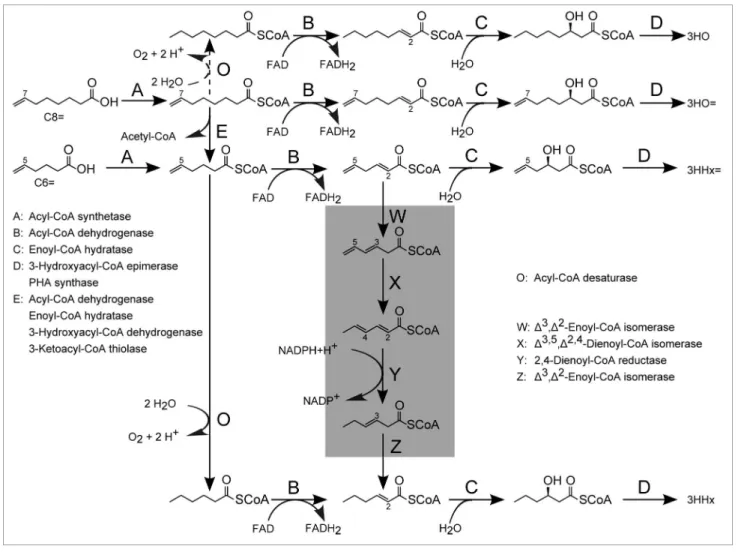
Figure 4. Hypothetical assimilation of 7-octenoic acid (C8=) and 5-hexenoic acid (C6=) to produce medium-chain-length 3-hydroxyalkanoate units in
recombinant M. extorquens. The highlighted route depicts the reductase-dependent β-oxidation pathway that is found in eukaryotic mitochondria for the degradation of (poly-)unsaturated long-chain-length fatty acids. Genomic screening revealed, however, that the C-C double bond loss is more likely a result of the reverse action of an acyl-CoA desaturase that reduces double bonds preferably at position C5 prior to β-oxidation processing (step O). Conversions catalyzed during steps B, C and E are part of the conventional β-oxidation cycle. 2E-enoyl-CoA (product of conversion B) is most likely hydratized to S-3-hydroxyacyl-CoA and then converted into R-3-hydroxyacyl-CoA prior to PHA polymerization (step D).
neglected, arguably because multicar-bon metabolism (C > 4) plays a minor role in methylotrophs. Nevertheless,
M. extorquens possesses a metabolic
machinery and the corresponding tool-box that is required for biosynthesis of fine materials beyond PHB and pro-teins. Certainly, M. extorquens as a future microbial bioplastic factory needs fur-ther genetic tuning to advance to the “first division” of functionalized PHA producers. The major challenge lies in replacing the two independently work-ing PHA polymerases (synthases) with a single one. Abolishing the native PHA synthase (with its limited substrate speci-ficity) sounds easier to achieve than it is because, in contrast to other facultative PHA accumulators, growth-associated biopolyester catabolism and deregula-tion is vital in the C1-driven metabo-lism of M. extorquens (Fig. 5).35 Our
first attempts to engineer a recombinant
phaCwild-type knock-out mutant expressing the heterologous phaC2P. fluorescens gene failed due to poor growth on methanol.10 The
chemically induced recombinant PhaC synthase with a broad substrate specific-ity appeared to be unable to replace the function of the native PhaC synthase dur-ing growth on C1 compounds which is keeping the vital PHB cycle intact. This problem could be tackled by expressing a different PHA synthase with a higher activity or including more heterologous
phaC copies in the expression vector.
Both approaches should result in re-estab-lishing the required flux of metabolites through the PHB cycle.
The second step will be to increase the yield of 3-hydroxyalkenoate mono-meric units per mole of alkenoic acid fed. The key to this challenge lies in decoupling of β-oxidation events from C1 metabolism. Cracking the medium and discoloration of M. extorquens
in shake flask cultivations. While it is dis-putable whether carboxylic acids may impact on pigment biosynthesis pathways, extracellular events that result in the loss of pigmentation seem to be more plausi-ble. The solubility of fatty acids in aque-ous solutions depends on their length.24
Accordingly, 10-undecenoic acid (C11=) was the least soluble among the n-alke-noic acids fed to M. extorquens. This was visually confirmed by two observations. First, shake flask cultures without manual pH adjustment appeared as oil-in-water emulsions. Second, centrifugation of such cultures led to the formation of a colorless precipitate floating on top of the supernatant fluid. We hypothesize that undissolved fatty acids extracted cell wall-associated carotenoids, which later became discolored due to unknown reactions occurring extracellularly. The absence of pigmentation did not influence the ability of M. extorquens to grow, ruling out that biomass levels may have been too low to see the pigmentation. It also confirms past observations to the effect that the pink pigmentation is not vital in this methylo-trophic bacterium.34 M. extorquens did not
seem to have any use for 10-undecenoic acid; only trace amounts of 3HV were detected from cultivations using the wild-type strain, while the recombinant strains produced only PHB as PHA. Increasing C11= solubility by neutralization with KOH impacted negatively on biomass formation.
Transforming Observations on Cell Metabolism into Genetic
Engineering Applications
Our observations with genetically engi-neered M. extorquens strains illuminated metabolic pathways that used to be to hampering microbial growth since a
negative relationship between 5-hexenoic acid supply and biomass formation was observed.11 Under balanced growth
condi-tions on C1 compounds, propionyl-CoA is metabolized to succinyl-CoA via meth-ylmalonyl-CoA which subsequently enters the tricarboxylic acid cycle (TCA cycle). Succinyl-CoA is a direct precursor of suc-cinate which is one of the central metabo-lites in M. extorquens (Fig. 5). Reduced TCA cycle activities, owing to decreased levels of succinyl-CoA, would ultimately lead to decreased amino acid formation originating from 2-ketoglutarate. This metabolic imbalance would, consequently, hinder protein biosynthesis which is indis-pensable for routine cell maintenance and reproduction.
PHBV was also produced when the
M. ex-phaC2 strain was cultivated solely
on methanol.11 Despite the absence of
7-octenoic or 5-hexenoic acid, small amounts of 3-hydroxyvalerate were incor-porated into the polymeric chains. To the best of our knowledge, copolymer produc-tion based on methanol alone by wild-type M. extorquens has not been reported to date. It is suggested that the introduc-tion of the pAll-phaC2 plasmid triggered a metabolic imbalance, which may also explain elongated lag phases and reduced biomass formation compared to the situa-tion with the wild-type strain. A reducsitua-tion in growth rate for M. extorquens AM1 was recently linked to plasmid-induced cobalt limitation.33
Fatty Acid Supply Impacts on Microbial Pigmentation
M. extorquens produces pigments of a
strong pink color. We observed an appar-ent coherence between the length of the n-alkenoic acid present in the growth
Table 2. Enzymes that may directly and indirectly participate in reducing C-C double bonds in fatty acids derivatives at position C5A Function ID NameB Number of genes encoding corresponding enzymeC
M ext AM1 M ext DM4 M ext PA1 P put KT2440 R eut H16
EC 1.14.19.1 Acyl-CoA desaturase 0 1 1 0 1
EC 5.3.3.8 Δ3, Δ2-Enoyl-CoA isomerase 0 0 0 1 0
EC 5.3.3.- Δ3,5, Δ2,4-Dienoyl-CoA isomerase 0 0 0 0 0
EC 1.3.1.34 2,4-Dienoyl-CoA reductase 0 0 0 1 1
M ext, Methylobacterium extorquens; P put, Pseudomonas putida; R eut, Ralstonia eutropha. AData were obtained from The Integrated Microbial Genomes (IMG) system (http://img.jgi.doe.gov/). BCommonly used name. CIncluding putative enzymes.
reactions; however, it would surely be enlightening to explain the “mysterious” double bond hydrogenation that is remi-niscent of the (poly-)unsaturated long-chain-length fatty acid handling observed in mitochondria.
References
1. Boucher O, Friedlingstein P, Collins B, Shine KP. The indirect global warming potential and global temperature change potential due to methane oxi-dation. Environ Res Lett 2009; 4:044007; DOI: 10.1088/1748-9326/4/4/044007.
2. Barceloux DG, Bond GR, Krenzelok EP, Cooper H, Vale JA. American academy of clinical toxicology practice guidelines on the treatment of methanol poisoning. J Toxicol Clin Toxicol 2002; 40:415-46; PMID: 12216995; DOI: 10.1081/CLT-120006745. 3. Lee B, Sakamoto Y, Hirabayashi D, Suzuki K, Hibino
T. Direct oxidation of methane to methanol over pro-ton conductor/metal mixed catalysts. J Catal 2010; 271:195-200; DOI: 10.1016/j.jcat.2010.01.011. 4. Olah GA, Goeppert A, Prakash GKS. Chemical
recy-cling of carbon dioxide to methanol and dimethyl ether: from greenhouse gas to renewable, environ-mentally carbon neutral fuels and synthetic hydro-carbons. J Org Chem 2009; 74:487-98; PMID: 19063591; DOI: 10.1021/jo801260f.
5. Olah GA, Goeppert A, Prakash GS. Beyond oil and gas: The methanol economy. Ed 2. Weinheim:Wiley-VCH Verlag 2009; DOI:10.1002/9783527627806. 6. Schrader J, Schilling M, Holtmann D, Sell D,
Filho MV, Marx A, et al. Methanol-based industrial biotechnology: current status and future perspec-tives of methylotrophic bacteria. Trends Biotechnol 2009; 27:107-15; PMID: 19111927; 10.1016/j. tibtech.2008.10.009.
7. Hölscher T, Breuer U, Adrian L, Harms H, Maskow T. Production of the chiral compound (R)-3-hydroxybutyrate by a genetically engineered
Methylotrophic bacterium. Appl Environ Microbiol
2010; 76:5585-91; PMID: 20581197; DOI: 10.1128/ AEM.01065-10.
8. Chistoserdova L, Kalyuzhnaya MG, Lidstrom ME. The expanding world of methylotrophic metabolism. Ann Rev Microbiol 2009; 63:477-99; PMID: 19514844; DOI: 10.1146/annurev. micro.091208.073600.
9. Vuilleumier S, Chistoserdova L, Lee MC, Bringel F, Lajus A, Zhou Y, et al. Methylobacterium genome sequences: a reference blueprint to investigate microbial metabolism of C1 compounds from natural and industrial sources. PLoS ONE 2009; 4:e5584; PMID: 19440302; DOI: 10.1371/journal. pone.0005584.
10. Höfer P, Choi YJ, Osborne MJ, Miguez CB, Vermette P, Groleau D. Production of functional-ized polyhydroxyalkanoates by genetically modi-fied Methylobacterium extorquens strains. Microb Cell Fact 2010; 9:70; PMID: 20846434; DOI: 10.1186/1475-2859-9-70.
11. Höfer P, Vermette P, Groleau D. Production and characterization of polyhydroxyalkanoates by recom-binant Methylobacterium extorquens: Combining desirable thermal properties with functionality. Biochem Eng J 2011; Ahead of Print; DOI: 10.1016/j. bej.2011.01.003.
12. Green PR, Kemper J, Schechtman L, Guo L, Satkowski M, Fiedler S, et al. Formation of short chain length/medium chain length polyhydroxy-alkanoate copolymers by fatty acid β-oxidation inhibited Ralstonia eutropha. Biomacromolecules 2002; 3:208-13; PMID: 11866575; DOI: 10.1021/ bm015620m.
Finally, elucidation of alternative deg-radation pathways for unsaturated fatty acids is the third step. This would be less interesting from a material process-ing point of view as it is not necessary to have a vinyl function on every medium-chain-length 3-hydroxyalkanoate side chain to perform interesting modification conventional β-oxidation cycle would
force all of the alkenoic acid derivatives to be channeled toward the production of PHAs (for an example see ref. 13). Furthermore, oversupply of acetyl-CoA would be prevented, which is believed to destabilize the metabolic network of
M. extorquens (Fig. 5).
Figure 5. Extended metabolic network in recombinant M. extorquens. The central
metabo-lism comprises four cycles (TCA, serine, ethylmalonyl-CoA and PHB) which are interconnected by shared enzymatic activities (the overlapping circle areas are coherent with the number of enzymes shared). C1 from methanol is incorporated into the serine cycle via methylenetetrahy-drofolate. In wild-type M. extorquens, PHB is constantly produced and degraded through the PHB cycle. The recombinant strains contain a second PHA synthase with broader substrate speciicity. Therefore, monomer precursors other than 3HB and 3HV, resulting from β-oxidation of fatty acids, may be used to form PHAs. In the presence of fatty acids, the β-oxidation cycle is assumed to be indirectly linked to the central metabolism by accumulating acetyl-CoA molecules (AC), which subsequently react with propionyl-CoA (PPC) to ultimately form 3-hydroxyvalerate. Thereby re-duced propionyl-CoA availability may result in deceleration of the central metabolism, leading to decreased production of some amino acids that originate from 2-ketoglutarate in the TCA cycle. In conclusion, the incorporation of a second PHA synthase seems to induce a metabolic imbal-ance by shifting activities from biomass synthesis to PHA production. Further genetic engineering approaches to enhance the production of functionalized PHAs include (indicated by X in the lux scheme): knocking out the native PHA synthase to reduce the probability of producing polymer blends and interrupting the β-oxidation cycle to prevent accumulation or overproduction of acetyl-CoA.
30. Korotkova NA, Doronina NV, Trotsenko YA. Biosynthesis of the copolymer of 3-hydroxybutyr-ate and 3-hydroxyvaler3-hydroxybutyr-ate in Methylobacterium
extorquens: Metabolism of propanol, propionate,
pentanol and valerate. Mikrobiologiya (engl. transl.) 1999; 68:296-303.
31. Shozui F, Matsumoto K, Nakai T, Yamada M, Taguchi S. Biosynthesis of novel terpolymers poly(lactate-co-3-hydroxybutyrate-co-3-hydroxyval-erate)s in lactate-overproducing mutant Escherichia
coli JW0885 by feeding propionate as a precursor
of 3-hydroxyvalerate. Appl Microbiol Biotechnol 2010; 85:949-54; PMID: 19582448; DOI: 10.1007/ s00253-009-2100-y.
32. Peyraud R, Kiefer P, Christen P, Massou S, Portais JC, Vorholt JA. Demonstration of the ethylmalonyl-CoA pathway by using 13C metabolomics. Proc
Natl Acad Sci USA 2009; 106:4846-51; PMID: 19261854; DOI: 10.1073/pnas.0810932106. 33. Kiefer P, Buchhaupt M, Christen P, Kaup B,
Schrader J, Vorholt JA. Metabolite profiling uncov-ers plasmid-induced cobalt limitation under meth-ylotrophic growth conditions. PLoS ONE 2009; 4:e7831; PMID: 19915676; DOI: 10.1371/journal. pone.0007831.
34. Van Dien SJ, Marx CJ, O’Brien BN, Lidstrom ME. Genetic characterization of the carotenoid biosyn-thetic pathway in Methylobacterium extorquens AM1 and isolation of a colorless mutant. Appl Environ Microbiol 2003; 69:7563-6; PMID: 14660416; DOI: 10.1128/AEM.69.12.7563-6.2003.
35. Korotkova N, Lidstrom ME. Connection between poly-β-hydroxybutyrate biosynthesis and growth on C1 and C2 compounds in the methylotroph
Methylobacterium extorquens AM1. J Bacteriol 2001;
183:1038-46; PMID: 11208803; DOI: 10.1128/ JB.183.3.1038-46.2001.
22. Ntamack AG, Karpichev IV, Gould SJ, Small GM, Schulz H. Oleate β-oxidation in yeast involves thioesterase but not Yor180c protein that is not a dienoyl-CoA isomerase. Biochim Biophys Acta 2009; 1791:371-8; PMID: 19830908; DOI: 10.1016/j. bbalip.2009.01.026.
23. Goepfert S, Hiltunen JK, Poirier Y. Identification and functional characterization of a monofunctional peroxisomal enoyl-coA hydratase 2 that participates in the degradation of even cis-unsaturated fatty acids in Arabidopsis thaliana. J Biol Chem 2006; 281:35894-903; PMID: 16982622; DOI: 10.1074/ jbc.M606383200.
24. Sousa D, Smidt H, Alves M, Stams A. Ecophysiology of syntrophic communities that degrade saturat-ed and unsaturatsaturat-ed long-chain fatty acids. FEMS Microbiol Ecol 2009; 68:257-72; PMID: 19490126; DOI: 10.1111/j.1574-6941.2009.00680.x.
25. Luo MJ, Smeland TE, Shoukry K, Schulz H. Δ3,5,
Δ2,4-dienoyl-CoA isomerase from rat liver
mito-chondria. Purification and characterization of a new enzyme involved in the β-oxidation of unsaturated fatty acids. J Biol Chem 1994; 269:2384-8; PMID: 8300563.
26. Smeland TE, Nada M, Cuebas D, Schulz H. NADPH-dependent β-oxidation of unsaturated fatty acids with double bonds extending from odd-num-bered carbon atoms. Proc Natl Acad Sci USA 1992; 89:6673-7; PMID: 1495956.
27. Ren Y, Aguirre J, Ntamack AG, Chu C, Schulz H. An alternative pathway of oleate β-oxidation in
Escherichia coli involving the hydrolysis of a dead end
intermediate by a thioesterase. J Biol Chem 2004; 279:11042-50; PMID: 19063591; DOI: 10.1021/ jo801260f.
28. Edwards DJ, Marquez BL, Nogle LM, McPhail K, Goeger DE, Roberts MA, et al. Structure and biosynthesis of the jamaicamides, new mixed polyketide-peptide neurotoxins from the marine cya-nobacterium Lyngbya majuscule. Chem Biol 2004; 11:817-33; PMID: 15217615; DOI:10.1016/j.chem-biol.2004.03.030.
29. Kim Y, Lenz R, Fuller R. Poly-3-hydroxyalkanoates containing unsaturated repeating units pro-duced by Pseudomonas oleovorans. J Polym Sci A Polym Chem 1995; 33:1367-74; DOI: 10.1002/ pola.1995.080330819.
13. Ren Q, Sierro N, Kellerhals M, Kessler B, Witholt B. Properties of engineered poly-3-hydroxyalkanoates produced in recombinant Escherichia coli strains. Appl Environ Microbiol 2000; 66:1311-20; PMID: 10742205; DOI: 10.1128/AEM.66.4.1311-20.2000. 14. Bourque D, Ouellette B, Andre G, Groleau D.
Production of poly-β-hydroxybutyrate from methanol: characterization of a new isolate of
Methylobacterium extorquens. Appl Microbiol
Biotechnol 1992; 37:7-12; DOI: 10.1007/ BF00174194.
15. Bourque D, Pomerleau Y, Groleau D. High cell den-sity production of poly-β-hydroxybutyrate (PHB) from methanol by Methylobacterium extorquens: production of high-molecular-mass PHB. Appl Microbiol Biotechnol 1995; 44:367-76; DOI: 10.1007/BF00169931.
16. Rehm BHA. Polyester synthases: Natural catalysts for plastics. Biochem J 2003; 376:15-33; PMID: 12954080; DOI: 10.1042/BJ20031254.
17. Choi YJ, Morel L, Bourque D, Mullick A, Massie B, Miguez CB. Bestowing inducibility on the cloned methanol dehydrogenase promoter (PmxaF) of
Methylobacterium extorquens by applying regulatory
elements of Pseudomonas putida F1. Appl Environ Microbiol 2006; 72:7723-9; PMID: 17041156; DOI: 10.1128/AEM.02002-06.
18. Choi YJ, Bourque D, Morel L, Groleau D, Miguez CB. Multicopy integration and expression of heter-ologous genes in Methylobacterium extorquens ATCC 55366. Appl Environ Microbiol 2006; 72:753-9; PMID: 16391115; DOI: 10.1128/AEM.72.1.753-9.2006.
19. Hoefer P. Activation of polyhydroxyalkano-ates: Functionalization and modification. Front Biosci 2010; 15:93-121; PMID: 20036809; DOI: 10.2741/3609.
20. Van Dien SJ, Okubo Y, Hough MT, Korotkova N Taitano T, Lidstrom ME. Reconstruction of C3 and C4 metabolism in Methylobacterium extorquens AM1 using transposon mutagenesis. Microbiology 2003; 149:601-9; PMID: 12634329; DOI: 10.1099/ mic.0.25955-0.
21. Šmejkalová H, Erb TJ, Fuchs G. Methanol assimi-lation in Methylobacterium extorquens AM1: Demonstration of all enzymes and their regula-tion. PLoS ONE 2010; 5:e13001; PMID:20957036; DOI:10.1371/journal.pone.0013001.