HAL Id: hal-01713649
https://hal.archives-ouvertes.fr/hal-01713649
Submitted on 20 Feb 2018HAL is a multi-disciplinary open access
archive for the deposit and dissemination of sci-entific research documents, whether they are pub-lished or not. The documents may come from teaching and research institutions in France or abroad, or from public or private research centers.
L’archive ouverte pluridisciplinaire HAL, est destinée au dépôt et à la diffusion de documents scientifiques de niveau recherche, publiés ou non, émanant des établissements d’enseignement et de recherche français ou étrangers, des laboratoires publics ou privés.
Evolution of polygenic debris flows on a sand dune
(Russell crater, Mars)
G. Jouannic, J. Gargani, F. Costard, C. Marmo, N. Mangold, Frédéric
Schmidt, G. Ori
To cite this version:
G. Jouannic, J. Gargani, F. Costard, C. Marmo, N. Mangold, et al.. Evolution of polygenic debris flows on a sand dune (Russell crater, Mars). European Planetary Science Congress 2010, Sep 2010, Rome, Italy. �hal-01713649�
Evolution of polygenic debris flows on a sand dune
(Russell crater, Mars)
G. Jouannic (1, 2), J. Gargani (1), F. Costard (1), C. Marmo (1), N. Mangold (3), F. Schmidt (1), G.G. Ori (2)
(1) IDES, Université Paris-Sud 11; CNRS/INSU UMR 8148, Orsay, France ([email protected]), (2) International Research School of Planetary Sciences, Università “G. d’Annunzio”, Italy (3) LPG, CNRS/Université de Nantes, UMR 6112, Nantes, France
Abstract
Recent work has shown that gullies are among the most youthful features on Mars [1] and have been taken as evidence for significant amounts of liquid water in the recent past. Recent studies show that the gullies located on the Russell Crater dune are not only extremely youthful but also appear to be still active [2]. Here we report of a polygenic evolution of debris flow dunes with two phases:
1/ debris flows on hill slopes in recent Martian times (less than 10 My) could be formed by (i) runoff and debris flows with liquid water from groundwater aquifers [1]; [3], (ii) snow-melt ([4]; [5], (iii) various CO2-driven mechanisms ([6]; [7]; [8]) or (iv) melting
of near-surface ground ice (< 1m meter) at high obliquity [9];
2/ defrosting activity at present time with formation of relatively small sinuous hand branching channels.
1. Methods
Using an assemblage of 26 HiRISE images over a 31 months period (November 2006 - May 2009), it's possible to follow the morphological evolution (and possible change) of the Russell dune through time. The high resolution of HiRISE images (25 - 50 cm/pxl) allows detailed morphic observations on the dune. The image analysis has been conducted to be sure that apparent changes are not artifacts due to solar incidence modification.
2. Morphology and process
2.1 Past debris flows activity
A total of about 300 long and narrow gullies are observed on the western SW flank of the Russell megadune over a total area of 20 km large. Gullies are strongly parallel over 2.5 km and all follow the direction of the slope as expected for gravity-process. Geomorphic features like channel sinuosity indices higher than 1.05 and connections of the channels show that gullies over dunes involve flows with a significant proportion of liquid [10].
The occurrence of levees on each side of the channels implies that these flows are typical of a particular kind of flow with yield strengths similar to terrestrial debris flows [10].
Several gully termini that show evidence for multiple flow events (or pulses) have been observed on several leveed lobate termini of gully channels. Each subsequent flow event eroded a deeper and wider channel into the earlier ones. Most recent flows stopped further upstream on the hillslope than olders.
2.2 Present seasonal frost activity
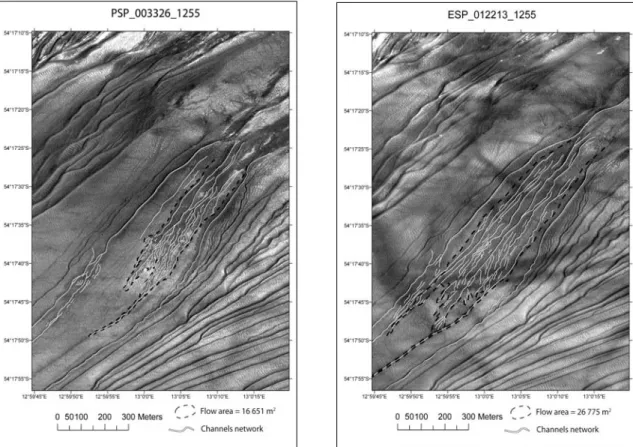
Present seasonal frost activity was observed in early spring from LS 198°-221° in the Martian Year 29. The defrosting area has a low albedo compared to pristine material on the rest of the dune. This area grew by more than 10.000 m² between two Martian years. The growth of the defrosting area occurs at early spring in the southern hemisphere.
This defrosting activity generates a sinuous (sinuosity indices is ~1.1) and branching morphology of new channels with incisions into the dune surface implying a flowing material causing the erosion. Moreover, using hyperspectral CRISM data, CO2
defrosting activity during winter has been identified on the SW flank of the Russell dune which generates dark flow features at the top of the dune [12].
EPSC Abstracts
Vol. 5, EPSC2010-169, 2010
European Planetary Science Congress 2010 c
Figure 1: Increasing of the defrosting area (+ 10 124 m2) associated with creation of new braided and sinuous channels between PSP_003326_1255 (left image) in the first year and ESP_012213_1255 (right image) in the second year
3. Discussion
Two distinct gullies morphologies were identified on the Russell dune:
(1) Past debris flows (less than 10 My) long and narrow gullies possibly with low sinuosity;
(2) Present activity of dunes due to seasonal defrosting with morphologies similar to slush flows or terrestrial pyroclastic flows (high sinuosity and branching). This seasonal activation of gullies involving volatiles (or fluid) can be explained with:
(a) transient melting of small amounts of H2O-ice
triggering slurry flows consisting of sand mixed with liquid water [2];
(b) out gassing of CO2 gas due to sublimation
below a snowpack [13] and leading to avalanching of a snow and debris mixture, generating additional vapor lubricating the flow, which then behaves like a fluid [7].
Acknowledgements
This work is supported by “Programme National de Planétologie”, CNRS-INSU, France. Thanks to the HiRISE and CRISM teams for sharing the data.
References
[1] Malin, M. C., Edgett, K. S. (2000), Science, 288 [2] Reiss, D., et al. (2010), Geophy. Res. Let., 37.
[3] Heldmann, J. L. and Mellon, M. T. (2004), Icarus, 168. [4] Christensen, P. R., (2003), Nature, 422.
[5] Dickson J. L. et al. (2007), Icarus, 188.
[6] Musselwhite, D. S. et al. (2001), Geophys. Res. Lett., 28 (7).
[7] Hoffman, N. (2002), Astrobiology, 2.
[8] Ishii, T. and Sasaki, S. (2004), Lunar Planet. Sci. Conf. XXXV, abstract 1556.
[9] Costard, F. et al. (2002), Science, 295.
[10] Mangold, N. et al. (2003), J. Geophys. Res., 108 (E4). [11] Védie, E. et al. (2008), Geophys. Res. Lett., 35. [12] Gardin, E. et al. (2010), J. Geophys. Res., in press.[13] Kieffer, H. H. Et al (2006), Nature, 442.