HAL Id: hal-00298846
https://hal.archives-ouvertes.fr/hal-00298846
Submitted on 13 Jun 2007HAL is a multi-disciplinary open access
archive for the deposit and dissemination of sci-entific research documents, whether they are pub-lished or not. The documents may come from teaching and research institutions in France or abroad, or from public or private research centers.
L’archive ouverte pluridisciplinaire HAL, est destinée au dépôt et à la diffusion de documents scientifiques de niveau recherche, publiés ou non, émanant des établissements d’enseignement et de recherche français ou étrangers, des laboratoires publics ou privés.
Institutional design and regime effectiveness in
transboundary river management ? the Elbe water
quality regime
I. Dombrowsky
To cite this version:
I. Dombrowsky. Institutional design and regime effectiveness in transboundary river management ? the Elbe water quality regime. Hydrology and Earth System Sciences Discussions, European Geosciences Union, 2007, 4 (3), pp.1625-1661. �hal-00298846�
HESSD
4, 1625–1661, 2007 Institutional design and regime effectiveness – Elbe I. Dombrowsky Title Page Abstract Introduction Conclusions References Tables Figures ◭ ◮ ◭ ◮ Back CloseFull Screen / Esc
Printer-friendly Version Interactive Discussion
EGU
Hydrol. Earth Syst. Sci. Discuss., 4, 1625–1661, 2007 www.hydrol-earth-syst-sci-discuss.net/4/1625/2007/ © Author(s) 2007. This work is licensed
under a Creative Commons License.
Hydrology and Earth System Sciences Discussions
Papers published in Hydrology and Earth System Sciences Discussions are under open-access review for the journal Hydrology and Earth System Sciences
Institutional design and regime
effectiveness in transboundary river
management – the Elbe water quality
regime
I. Dombrowsky
UFZ, Helmholtz Centre for Environmental Research, Leipzig, Germany Received: 4 May 2007 – Accepted: 14 May 2007 – Published: 13 June 2007 Correspondence to: I. Dombrowsky ([email protected])
HESSD
4, 1625–1661, 2007 Institutional design and regime effectiveness – Elbe I. Dombrowsky Title Page Abstract Introduction Conclusions References Tables Figures ◭ ◮ ◭ ◮ Back CloseFull Screen / Esc
Printer-friendly Version Interactive Discussion
EGU
Abstract
The literature on transboundary river management suggests that institutions play an important role in bringing cooperation about. However, the knowledge on how they should be designed in order to do so remains limited. One way to learn more about adequate institutional design is to assess the effectiveness of existing regimes, and to
5
trace the causal relationships leading to the respective outcomes. In order to gain fur-ther insights into the relationship of institutional design and regime effectiveness, this paper presents a study on the water quality regime of the International Commission for the Protection of the Elbe (ICPE). The analysis is based on a review of pertinent documents and ten qualitative interviews with Czech and German Commission
mem-10
bers and NGO representatives. Particular emphasis has been put on determining the ICPE’s specific contribution and the no-regime counterfactual as well as on the per-ceived expedience of the institutional arrangements.
The study shows that overall due to external as well as internal institutional factors the ICPE proved relatively successful, and as such it also provides insights into how
15
institutions matter: The commission served as platform for joint problem solving by identifying priorities for action. These international obligations increased the power of national administrations and their access to funds. At the same time, the Commission’s reporting to the public served as an enforcement mechanism. However, the ICPE’s contribution towards achieving the various goals varied significantly between the
differ-20
ent areas of activity. It was high where the main responsibility for action was with the public authorities, such as in the area of wastewater treatment and the establishment of an international alarm plan and model. It was practically non existent in the reduction of non-point pollution from agriculture, where the success depended on the behavior of individual private actors (farmers). From a methodological point of view, the paper
25
shows opportunities and limits of a combined quantitative and qualitative approach in determining regime effectiveness.
HESSD
4, 1625–1661, 2007 Institutional design and regime effectiveness – Elbe I. Dombrowsky Title Page Abstract Introduction Conclusions References Tables Figures ◭ ◮ ◭ ◮ Back CloseFull Screen / Esc
Printer-friendly Version Interactive Discussion
EGU
1 The problem
In recent years, a discourse on conflict and cooperation in the management of interna-tional transboundary rivers has emerged (Gleick, 1993; Rogers, 1993; Barrett, 1994; Waterbury, 1994; Bernauer, 1997; Wolf, 1998; Marty, 2001; Zeitoun and Warner, 2006). In this context Wolf et al. (2003) suggest that institutions are an important explanatory
5
variable for cooperation. But they do not tell us how institutions should be designed in order to bring cooperation about. While some progress has been made on expli-cating the conditions under which the formation of international water institutions or regimes can be expected (Durth, 1996; Marty, 2001; Lindemann, 2006; Dombrowsky, 2007), little is known about adequate institutional design (Bernauer, 1997). One way to
10
learn more about adequate institutional design is to assess the effectiveness of the re-spective international regime and to trace the underlying causal effects (e.g. Underdal, 1992; Bernauer, 1995; Helm and Sprinz, 2000).
In general, studies on the effectiveness of international water regimes are rare (Bernauer, 2002). An exception in this context is the 1987 Rhine Action Program of
15
the International Commission for the Protection of the Rhine (ICPR) which has been hailed as a success story of international river cooperation (Bernauer and Moser, 1996; Durth, 1996; Gurtner-Zimmermann, 1998; Holtrup, 1999; Verweij, 2000). However, even in the case of the Rhine the relationship of institutional design and outcome is not entirely clear. For instance, Bernauer and Moser (1996) point at the fact that much
20
of the success can be attributed to national level activities. And Gurtner-Zimmermann (1998), who explicitly studied the effectiveness of the Rhine Action Program, did not relate the outcome to the institutional set up. This indicates that further research on the relationship of institutional design and regime effectiveness is warranted, even for the Rhine, but in particular beyond this river basin.
25
In order to gain further insights into the relationship of institutional design and regime effectiveness, this paper presents a study of the water quality regime of the Interna-tional Commission for the Protection of the Elbe (ICPE). The Elbe has been selected,
HESSD
4, 1625–1661, 2007 Institutional design and regime effectiveness – Elbe I. Dombrowsky Title Page Abstract Introduction Conclusions References Tables Figures ◭ ◮ ◭ ◮ Back CloseFull Screen / Esc
Printer-friendly Version Interactive Discussion
EGU
as the Elbe regime draws heavily on the Rhine model (Holtrup, 1999). However, it can be argued that cooperation takes place under less favorable conditions in the sense that two riparian countries of unequal economic strength cooperate. As such, the Elbe can be considered as a test case whether it was possible to transfer the Rhine model to more asymmetric conditions. Also, the literature on the ICPE remains sparse, and
5
to the knowledge of the author a rigorous study of the effectiveness of the ICPE water quality regime has so far not been carried out. The study looks at the period 1990– 2004/5, before the substantive implementation of the European Union Water Frame-work Directive (WFD) in the Elbe Basin and the reform of ICPE, in order to assess the effects of voluntary cooperation mechanisms (for an assessment of the effects of the
10
WFD on international cooperation in the Rhine and Elbe Basins, see M ¨ollenkamp in the same volume).
Against this background, this study seeks to contribute to the literature on trans-boundary water management by asking for the expedience of the transtrans-boundary in-stitutional arrangements in the Elbe basin based on an effectiveness analysis and the
15
tracing of the causal relationships that led to the respective outcomes. Section 2 will introduce into the underlying theory and methodology. Section 3 will introduce into the Elbe water quality regime. Section 4 will analyze the effectiveness of the Elbe water quality regime. Section 5 will explain the outcome and Sect. 6 will draw conclusions.
2 Theory and methodology
20
2.1 Measuring and explaining regime effectiveness
One way to determine whether the institutional design of an international regime proves to be adequate is to assess its effectiveness. In this context, institutions can be under-stood as the formal and informal “rules of the game” (e.g. North, 1990). The term international regime refers to the “implicit and explicit principles, norms, rules, and
25
HESSD
4, 1625–1661, 2007 Institutional design and regime effectiveness – Elbe I. Dombrowsky Title Page Abstract Introduction Conclusions References Tables Figures ◭ ◮ ◭ ◮ Back CloseFull Screen / Esc
Printer-friendly Version Interactive Discussion
EGU
area of international relations” (Krasner, 1983). Thus, a regime is constituted by insti-tutions.1
Generally spoken, a regime can be understood to be effective if it solves the prob-lems it addresses (Haas, Keohane, and Levy, 1993; Young and Levy, 1999). Therefore, in order to assess effectiveness, a first step would be to determine whether the goals
5
of the regime have been met (measuring the outcome) (Underdal, 1992). In the case of transboundary water, this could be done by measuring whether certain water qual-ity targets have been met. However, often it may be difficult to measure the outcome of a regime, for instance because there may be a time lag between certain activities and changes in the environment. In this case, a first approximation towards measuring
10
effectiveness is to measure compliance (e.g. Chayes and Chayes, 1993), i.e. whether the respective actors adhere to the rules they set up and delivered the promised action (measuring output) (Underdal, 1992). However, compliance is not a sufficient condition for effectiveness, as a high level of compliance may not necessarily translate into a high level of effectiveness. As Downs et al. (1996) point out, often it may be easy for
15
states to comply as the respective international agreements do not ask them to make substantial contributions towards the cooperation problem.
Conversely, even if the respective goals have been met and the underlying problems been solved, still the question is whether a causal link exists between the international regime and the respective outcome. The reason is that other (external) factors, such
20
as measures taken at the national or sub-national level regardless of the international regime in place or changes in production may have contributed towards the achieve-ment of the respective environachieve-mental goals. Therefore, we may distinguish institutional design and external factors in explaining regime outcomes.
Against this background, the so called Oslo-Potsdam solution towards measuring
25
1
Furthermore, an analytical distinction is usually drawn between institutions and organiza-tions, where organizations refer to the “players of the game” pursuing a common goal (North, 1990). This notwithstanding, also organizations are constituted by rules. While they are consti-tuted by rules, as a whole they are more than institutions.
HESSD
4, 1625–1661, 2007 Institutional design and regime effectiveness – Elbe I. Dombrowsky Title Page Abstract Introduction Conclusions References Tables Figures ◭ ◮ ◭ ◮ Back CloseFull Screen / Esc
Printer-friendly Version Interactive Discussion
EGU
effectiveness identifies two benchmarks against which the actual performance (AP) of an international regime can be measured, first the collective optimum (CO) and second the no regime counter-factual (NR) as illustrated in Fig. 1 (Underdal, 1992; Helm and Sprinz, 2000; Hovi, Sprinz, and Underdal, 2003).
The collective optimum (CO) may again be defined in different ways (Young and
5
Levy, 1999). It could be argued that the collective optimum is achieved if the respective goals are met. Furthermore, from an economic perspective, the collective optimum would be achieved if the net gains of cooperation were maximized (cost efficiency) or if certain goals were met at least costs (cost effectiveness). One could also ask if the goals are achieved in a fair manner (Bernauer, 1995; Young and Levy, 1999).
10
From a methodological point of view, it will usually be more demanding to determine whether the respective goals are met in an efficient and fair manner than just asking for goal achievement. In this study, we will assume that the goals set by the actors involved represent the “collective optimum”, and for methodological reasons (especially the monetarization of the benefits of an improved state of the environment) we will
15
abstain from a cost-benefit analysis.
The no regime-counterfactual (NR) is the hypothetical state of the world that would have occurred if no regime had been put in place. In the language of game theory, it can be understood as the non-cooperative solution to an international cooperation problem that would follow from the uncoordinated choices of each actor’s best reply
20
to the strategies of the other actors (the so called Nash solution). Measuring the no regime counter-factual is particularly challenging. One way is to trace in depth the causal effects that led to actual performance. Another may be to build scenarios, start-ing with the state of the world that existed before the regime and askstart-ing for the conse-quences that would have flown from the previous “rules of the game”. A third strategy
25
would be to study a large number of comparable cases with and without a regime in place. However, in the case of transboundary water management the latter strategy is likely to fail due to the fact that we deal with many explanatory variables and relatively few comparable cases. Therefore, in this study we will mainly follow the first strategy by
HESSD
4, 1625–1661, 2007 Institutional design and regime effectiveness – Elbe I. Dombrowsky Title Page Abstract Introduction Conclusions References Tables Figures ◭ ◮ ◭ ◮ Back CloseFull Screen / Esc
Printer-friendly Version Interactive Discussion
EGU
tracing the causal relationships and by asking how the international regime contributed towards actual performance. Based on these relationships values for the no-regime counterfactual will be assessed.
On the basis of actual performance (AP), the no-regime counterfactual (NR) and the collective optimum (CO), the effectiveness score E with 0≤E≤1 can be defined as
5
indicated in Fig. 1. It allows bringing the regime’s actual contribution over and above what would have happened in the absence of the regime (AP-NR) into relationship with its best possible contribution (CO-NR). A value of E close to 0 indicates a low level of effectiveness, whereas values of E close to 1 indicate a high level of effectiveness. One advantage of E is that it allows for the comparison of different international regimes.
10
2.2 Data bases and approach
The analysis is based on two sources of information, first relevant documents by the ICPE, and second expert interviews. The ICPE does not only publish its action pro-grams, but also regular progress reports on its implementation as well as other en-vironmental and geographical background data. This information was reviewed and
15
evaluated.
In addition, expert interviews were carried out. The interviews were of a semi-structured nature on the basis of a standardized questionnaire. The interview part-ners were first asked to score the level of overall goal achievement and to explain their scores. In a second step, they were requested to score the achievement of objectives
20
in the different areas of activity, and to outline how the ICPE had contributed towards achieving the objectives in order to assess the no-regime counterfactual. In a third step, they were asked to assess the expedience of the institutional design. As such, the information provided allows approaching the question of institutional design from two angles, from the point of view of regime effectiveness and through a direct
evalua-25
tion of the institutional design.
In order to get “insider” views from the two riparian states, interviews were conducted with three representatives of each the Czech and the German ICPE delegation: heads
HESSD
4, 1625–1661, 2007 Institutional design and regime effectiveness – Elbe I. Dombrowsky Title Page Abstract Introduction Conclusions References Tables Figures ◭ ◮ ◭ ◮ Back CloseFull Screen / Esc
Printer-friendly Version Interactive Discussion
EGU
of delegation or working groups and members of the working groups on Action Pro-grams and on Ecology, the main working groups in charge of the action proPro-grams. In addition, a representative of the ICPE Secretariat was interviewed. The secretariat can be considered as a “neutral” insider with in depth information on the progress achieved. In addition to these insider perspectives, two German and one Czech NGO
representa-5
tives were interviewed in order to gain an outsider view, as they had not been involved in the definition of the activities prior to 2004. In the Czech Republic it was only possi-ble to identify one NGO representative dealing with transboundary waters. The person did not feel to be in a position to come up with scores given that she had only recently got involved in the topic. The interviews were fully transcribed and a content analysis
10
was carried out.
Thus, the study combined qualitative and quantitative methods. While a higher num-ber of interviewees would have been desirable for the statistical analysis, the numnum-ber was consciously restricted in order to be able to carry out in-depth interviews which inter alia allowed for explanations of the scores provided. Also, it appears that the
15
number of individuals who are acquainted with the various components of the Action Programs remains limited and in that sense it is questionable whether a higher number of participants had significantly changed the picture.
3 The Elbe water quality regime
The Elbe River is shared by four countries Germany, the Czech Republic, Austria and
20
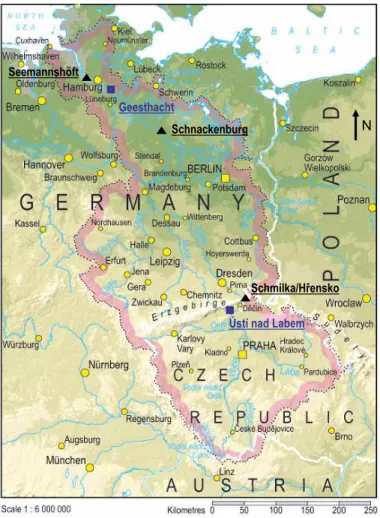
Poland; however, more than 99% of the basin area of 148 268 square kilometers (km2) is located in Germany and the Czech Republic, with shares of 65.5% and 33.7% re-spectively (IKSE, 2005a) (see Fig. 2). Within Germany, the river basin extends over ten of the sixteen German States (L ¨ander).
Historically, the first issue given rise to transboundary cooperation in the Elbe river
25
basin was navigation and maintenance of the river bed, with a first treaty in 1811 (Mc-Caffrey, 2003). After the Second World War, water-related cooperation between West
HESSD
4, 1625–1661, 2007 Institutional design and regime effectiveness – Elbe I. Dombrowsky Title Page Abstract Introduction Conclusions References Tables Figures ◭ ◮ ◭ ◮ Back CloseFull Screen / Esc
Printer-friendly Version Interactive Discussion
EGU
Germany on the one side, and the German Democratic Republic and the Czechoslo-vak Socialist Republic on the other, was largely inhibited by the cold war (Durth, 1996). At the same time, rising pollution problems increased the tension between the ripar-ian states. By the end of 1980s, the Elbe was one of the most heavily polluted rivers in Europe (IKSE, 1991b). The situation of non-cooperation changed rapidly after the
5
fall of the Berlin wall, and as early as in October 1990, Czechoslovakia, the freshly reunited German Federal Republic and the European Community founded the Interna-tional Commission for the Protection of the Elbe (ICPE).2
The convention aims at the prevention of the pollution of the Elbe and its drainage area, and at a reduction of the pollution of the North Sea. It is explicitly not concerned
10
with fisheries and navigation. The geographical scope of the ICPE extends over the drainage basin in the Czech Republic and Germany. The detailed objectives of the ICPE are:
1. to enable use to be made of the river, in particular the obtaining of supplies of drinking water from bank-filtered waters and the agricultural use of the waters
15
and sediments;
2. to achieve as natural an ecosystem as possible with a healthy diversity of species; 3. to reduce substantially the pollution of the North Sea from the Elbe area.
In order to achieve these objectives, the ICPE prepared two action programs, the First Action Program (fast-track program) 1992–1995 (IKSE, 1991a) and the Elbe Action
20
2
Convention between the Federal Republic of Germany and the Czech and Slovak Federal Republic and the European Economic Community on the International Commission for the Pro-tection of the Elbe, Magdeburg, 8 October 1990. Since the rescission of the Slovak Republic in 1994, the members of ICPE were the Czech Republic, Germany, and the European Com-munity. With the accession of the Czech Republic to the European Union in May 2005, the European Union withdrew from the treaty. Austria and Poland only have observer status. They are however fully involved in ongoing efforts to implement the WFD in the basin.
HESSD
4, 1625–1661, 2007 Institutional design and regime effectiveness – Elbe I. Dombrowsky Title Page Abstract Introduction Conclusions References Tables Figures ◭ ◮ ◭ ◮ Back CloseFull Screen / Esc
Printer-friendly Version Interactive Discussion
EGU
Program 1996–2010 (IKSE, 1995b). The First Action Program foresaw the construc-tion of 139 sewerage treatment plants in the basin and the reducconstruc-tion of the concentra-tions of 15 industrial priority substances by 30%. The 1995 Elbe Action Program drew up a comprehensive program of measures in seven areas of activity: (1) municipal wastewater treatment, (2) industrial wastewater treatment, (3) reduction of agricultural
5
non-point pollution, (4) reduction of pollution from contaminated sites and landfills, (5) improvement of fish migration, (6) establishment of protected areas and improvement of morphology, and (7) the prevention of accidental pollution. In addition, in 2003 the ICPE concluded an Action Plan on Flood Control (IKSE, 2003a).
The organizational structure of the ICPE consists of:
10
– the Commission (3 delegations of up to 5 members each plus experts) and its
President;
– a Coordination Group;
– the Secretariat at Magdeburg for the preparation, implementation and support of
the commission’s work; and
15
– different, changing Working Groups and Sub-Working Groups, consisting of
dele-gates or experts appointed by each delegation.
The decisions by IPCE are taken by unanimity. They are recommendations to the member states and not legally binding (Epiney and Felder, 2002: 82; Reinhardt and Caßor-Pfeiffer, 2006: 17). Each party bears the costs of representation and
investiga-20
tions in its territory. The contributions to the costs of the secretariat are allocated as follows: Germany pays 65%, the Czech Republic 32.5% and the EU 2.5%. In order to monitor progress, the commission provides the parties with regular progress reports. No formal provisions are made on enforcement and dispute settlement.
HESSD
4, 1625–1661, 2007 Institutional design and regime effectiveness – Elbe I. Dombrowsky Title Page Abstract Introduction Conclusions References Tables Figures ◭ ◮ ◭ ◮ Back CloseFull Screen / Esc
Printer-friendly Version Interactive Discussion
EGU
4 Measuring the effectiveness of the Elbe qater quality regime
4.1 Achievement of overall goals
4.1.1 Achievement of ICPE target values
In order to monitor the achievement of its goals, the ICPE has developed desirable target values for a list of priority substances. They are not legally binding on
mem-5
ber states, and apparently there is no temporal commitment by the member states to achieve these targets. They are used as orientation to evaluate the status quo and, as suggested by an interviewee, were themselves the results of a bargaining process and represented compromise values.
The target values are being measured at the three gauging stations:
10
Schmilka/Hensko at the Czech-German border, Schnackenburg at the previous German-German border and Seemannsh ¨oft in the delta area (see Fig. 2). No tar-get values were specified for Goal 3, the protection of the North Sea. Depending on the use, goal achievement is being measured for selected substances in the water or the sediment phase as indicated in Table 1 (IKSE, 1998: 7, Annex 2). It summarizes
15
the goal achievement for the year 2004 and lists problematic substances (IKSE, 2005b: 25 and Annex 1).
With respect to Goal 1a, the use of Elbe water for drinking water production, fish-eries and irrigation, the level of achievement is relatively high, as 18 out of 26 priority substances were met at all three gauging stations. In addition, three of the eight
sub-20
stances above target, namely total Nitrogen, total Phosphorus and Hexachlorbenzene, were close to target. Furthermore, Mercury, AOX and EDTA were only significantly above target at Seemannsh ¨oft which appears to be a recent development. With re-spect to Goal 1b, the use of Elbe sediments in agriculture, the level of achievement is low as only two of twelve substances were met at all three measuring stations. Also
25
with respect to Goal 2, the protection of aquatic ecosystems, only a minority of tar-get values, both in the water and the sediment phase, were met at all three gauging
HESSD
4, 1625–1661, 2007 Institutional design and regime effectiveness – Elbe I. Dombrowsky Title Page Abstract Introduction Conclusions References Tables Figures ◭ ◮ ◭ ◮ Back CloseFull Screen / Esc
Printer-friendly Version Interactive Discussion
EGU
stations. (In the water phase, two of the sixteen substances above target, namely chemical oxygen demand and nitrogen, were close to target.)
Thus, overall, it can be argued that based on the ICPE indicators, the level of goal achievement is relatively high with respect to Goal 1a, but further efforts will be needed to improve the quality of sediments for their use in agriculture (Goal 1b) and to achieve
5
a water and sediment quality that is satisfactory for the maintenance of aquatic ecosys-tems (Goal 2).
4.1.2 Expert scores
Given the difficulty to capture complex goals by chemical indicators, in a second step, the interview participants were asked to evaluate the achievement of the three goals
10
on a scale of 0 to 10 and to explain their rating. Table 1 lists the average scores given in the interviews and the main explanations provided.
Overall, Goal 1a received the highest scores with an average of 7.3 and Goal 2 the lowest with an average of 6.3. The average score for Goal 3 was 6.5. With respect to the scores, two main observations can be made. First, the scores differed significantly
15
among the experts. The reason can at least partly be found in the explanations which reflect that the participants had at least sometimes different perceptions of what needed to happen in order to meet the different goals.
Second, given the differences in the achievement of ICPE target values between Goal 1a and Goal 2 discussed in Sect. 4.1.1, it is interesting to note that the
aver-20
age scores for Goals 1a and 2 are not far apart from each other with averages of 7.3 and 6.3 respectively. The participants were obviously more optimistic with respect to the level of achievement of Goal 2 as one would have expected on the basis of the objective measurement. A possible explanation is that overall the state of the ecosys-tems in particular at the Middle Elbe is being considered as quite satisfactory, despite
25
a mediocre sediment quality. Another explanation is that the commission members did not want to score their achievements too badly, however, also one NGO representative gave a score of 7. It is also noteworthy that none of the participants actually referred
HESSD
4, 1625–1661, 2007 Institutional design and regime effectiveness – Elbe I. Dombrowsky Title Page Abstract Introduction Conclusions References Tables Figures ◭ ◮ ◭ ◮ Back CloseFull Screen / Esc
Printer-friendly Version Interactive Discussion
EGU
to the ICPE target values in their evaluations.
Based on the two assessments, it can be concluded that the level of achievement is fairly high with respect to human uses of the river water, however, that the water and sediment quality still needs to be improved to allow for the reuse of sediments and to protect ecosystems and the North Sea. There is, however, some discrepancy between
5
the indicator-based and the experts’ evaluation of the state of the Elbe ecosystems in the sense that experts were more optimistic with respect to the state of the aquatic ecosystems than one would have expected on the basis of the chemical analysis.
While overall the level of goal achievement may be considered as medium to high, this does not yet explain whether the ICPE has actually contributed towards achieving
10
these goals. Therefore, in Sect. 4.2 the compliance with measures will be analyzed. 4.2 Compliance with action program measures
In order to determine compliance with planned activities, it was analyzed whether the measures provided for in the First Action Program and the Elbe Action Program had actually been carried out. This analysis was based on the respective ICPE progress
15
reports (IKSE, 1995a; IKSE, 1998; IKSE, 2000; IKSE, 2003b; IKSE, 2005b). The findings are summarized in Table 2.
In most areas of activity, the member states show high to very high levels of com-pliance. The only exceptions are fish migration and the delineation of protected areas and the improvement of the river morphology where the 2004 level of compliance can
20
be considered as low to medium. However, it should be noted that activities in these areas are still ongoing until 2010.
Thus, overall the level of compliance can be considered as high. However, this does not yet explain whether this actually contributed towards achieving the overall goals. Therefore, in Sect. 4.3 the actual performance and the no-regime counter-factual will
25
HESSD
4, 1625–1661, 2007 Institutional design and regime effectiveness – Elbe I. Dombrowsky Title Page Abstract Introduction Conclusions References Tables Figures ◭ ◮ ◭ ◮ Back CloseFull Screen / Esc
Printer-friendly Version Interactive Discussion
EGU
4.3 The effectiveness of the Elbe Action Program
In order to assess the current level of effectiveness of the Elbe Action Program (1996– 2010), an attempt was made to come up with numerical values for the actual per-formance (AP) and the no regime counter-factual (NR) in each area of activity; the effectiveness scores were then calculated.
5
4.3.1 Actual performance
In order to determine actual performance, the participants were asked to score the level of objective achievement in the different areas of activity. The average scores and the main explanations provided are shown in Table 3.
Average scores are high (above 8) with respect to the reduction of pollution from
10
municipal wastewater and the prevention of accidental pollution. This was somewhat expected given the high level of compliance in these areas. But also for most other areas, namely abatement of industrial pollution, delineation of protected areas, im-provement of fish migration and abatement of pollution from contaminated sites the average scores are fairly high, notwithstanding lower levels of compliance in some of
15
them. The only area where the level of achievement is being considered as very low is the abatement of agricultural non-point pollution – despite high levels of compliance.
Similar to the scores for the overall goals, the evaluations differed among the par-ticipants, although not as much as with respect to overall goal achievement. When analyzing the explanations provided, it becomes clear that the participants again used
20
different reference points for their evaluation. A potential explanation is that the Elbe Action Program only specifies planned activities in each area of activity but does not explicitly state objectives. Hence, when asked to score the achievement of objectives in the various areas some participants referred to the planned measures and others to the perceived overall objectives in the sector.
25
Despite the relatively low number of experts interviewed, for the sake of illustration, in the following the average scores will be used to reflect the actual performance (APP)
HESSD
4, 1625–1661, 2007 Institutional design and regime effectiveness – Elbe I. Dombrowsky Title Page Abstract Introduction Conclusions References Tables Figures ◭ ◮ ◭ ◮ Back CloseFull Screen / Esc
Printer-friendly Version Interactive Discussion
EGU
of the Elbe Action Program on a scale from 0 to 10.
4.3.2 Specific ICPE contribution and no-regime counterfactual
In order to assess what would have happened if the ICPE had not been in place, the participants were asked to identify what the specific ICPE contribution had been in the different areas of activity. The findings are summarized in Table 4 and discussed below
5
for the different areas of activity as these explanations are important to understand how the ICPE works and how the institutional arrangements come into play.
In the area of the reduction of pollution from municipal wastewater, the main activities were the construction and extension of a list of priority wastewater treatment plants in the Elbe basin. It was argued that by defining an international list of priority action, the
10
ICPE facilitated access to EU and national funds in a situation where different economic sectors competed for structural funds and other financial resources. Furthermore, the regular publication of progress reports by the ICPE created pressure on the respective administrations to report progress and thus to monitor implementation closely.
In order to reduce the discharge of priority substances from industries, lists of the
15
emissions of major emitting industries were regularly published. Furthermore, minimal requirements were defined for the treatment of wastewater in different branches of in-dustry. According to the interviewees, the main contribution by the ICPE was the joint publication of the lists of major emitting industries. The idea was to point out the “bad guys”, but to do it jointly, not one state against the other. Furthermore, the monitoring
20
created pressure on administrations to identify and deal with the main dischargers in order to be able to report progress. It is, however, unclear to what extent the ICPE publications had direct impact on these companies. Also, the effect of the definition of minimal requirements remains uncertain. In Germany, these standards applied any-way. Apparently they had some effect on the legislative process in the Czech Republic.
25
In order to reduce the discharge of nutrients and pesticides from non-point sources in agriculture, the member states compiled recommendations for good practice and for different types of measures. However, they did not commit themselves in the action
HESSD
4, 1625–1661, 2007 Institutional design and regime effectiveness – Elbe I. Dombrowsky Title Page Abstract Introduction Conclusions References Tables Figures ◭ ◮ ◭ ◮ Back CloseFull Screen / Esc
Printer-friendly Version Interactive Discussion
EGU
program to carry out specific activities on the ground. As such, the ICPE’s impact remained negligible or minimal. The interviewees argued that the ICPE (and national governments) had no instruments to influence or control farmers. This notwithstanding, it was argued that it had been correct to include the abatement of agricultural non-point pollution in the Elbe Action Program and that the ICPE had contributed towards
5
putting the topic on the agenda. Those who gave a higher score believed that some improvements had taken place, albeit due to other programs or measures.
The main ICPE activity with respect to the reduction of pollution from contaminated sites and landfills was to identify relevant sites and to monitor planned and ongoing rehabilitation measures. The participants concurred that this was no primary activity
10
area of the ICPE and that its contribution was minimal and limited to prioritize action, but it did not initiate any new activities.
In order to improve fish migration, the ICPE identified several measures in Germany and the Czech Republic until 2010. The first priorities were to realize fish passes at Geesthacht in Germany and at the weir Stekov at ´Ust´ı n.L. in the Czech Republic.
15
While these and a few others have been realized, other measures in tributaries still need to be addressed. Overall, the ICPE contribution is seen as intermediate. While several respondents believed that the ICPE contributed towards the realization of the fish pass in Geesthacht, another interviewee argued that it was mainly promoted by the ARGE Elbe, the working group of the German L ¨ander on the Elbe. The completion of
20
Geesthacht did, however, increase the pressure on the Czech Republic to move ahead with its program, and according to one interviewee the first fish pass in the Czech Republic was built with “direct and indirect” support by the ICPE.
The ICPE also identified the potential for the creation of a number of protected ar-eas as well as several mar-easures to improve the morphology of the river and its
tribu-25
taries in the two countries. The accounting for these measures in the ICPE progress reports remains a bit opaque. While major protected areas such as the UNESCO biotope reserve “River Landscape Elbe” which extends over 400 river kilometers and the Czech national park Bohemian Switzerland were realized, other activities still need
HESSD
4, 1625–1661, 2007 Institutional design and regime effectiveness – Elbe I. Dombrowsky Title Page Abstract Introduction Conclusions References Tables Figures ◭ ◮ ◭ ◮ Back CloseFull Screen / Esc
Printer-friendly Version Interactive Discussion
EGU
to be addressed. Also, there is not much progress on morphology. According to the interviewees, activities were mainly driven by the states, but compiled and coordinated by the ICPE (such as the preparation of maps). They argued that the ICPE was the only institutions taking a basin-wide perspective, thus “putting local egoism into larger perspective”. Again this is believed to have accelerated the process. It was pointed out
5
that in the Czech Republic, the opportunities were limited and it remained difficult to attribute activities to the ICPE or other forces.
In order to prevent accidental pollution, the ICPE developed an international warn-ing and alarm plan and model, developed recommendations on accident prevention at company level and in flood-prone areas and published a list of potentially hazardous
10
plants. In general the interviewees agreed that this is an original activity area of trans-boundary water cooperation and that the contribution of the ICPE was high. However, some respondents pointed out the fact that there might still be a certain gap between theory and practice. A cyanide accident at a company in the Czech Republic in Jan-uary 2006 demonstrated problems in the application of the respective instruments by
15
the company and within the Czech administration. On the other hand, there was a successful prevention of an oil spill in the Czech Republic in March 2006.
On the basis of this analysis, the author carried out a qualitative assessment of the level of ICPE contribution in the different areas of activity and came up with quantitative estimates on a scale of 0 to 10 for the no-regime counterfactual (NRI D) in each area as
20
indicated in Table 4. While the author arguably became an “expert” during the course of interviews which allowed her to come up with these quantifications, they have mainly been derived for illustration purposes and their role should not be over-estimated. 4.3.3 Effectiveness scores
For the sake of illustration, the effectiveness scores Ei for the different areas of activity
25
within the 1995 Elbe Action Program were calculated as of the year 2005 using the average scores by the participants as actual performance (APP) and the author’s es-timated no-regime counterfactual (NRI D) as a basis. In order to determine an overall
HESSD
4, 1625–1661, 2007 Institutional design and regime effectiveness – Elbe I. Dombrowsky Title Page Abstract Introduction Conclusions References Tables Figures ◭ ◮ ◭ ◮ Back CloseFull Screen / Esc
Printer-friendly Version Interactive Discussion
EGU
effectiveness score Eaveragethe arithmetic average was built on the basis of the individ-ual effectiveness scores.3
Table 5 shows that the values of Ei differ significantly among the different areas of activity, ranging between values of 0 and 0.82. The effectiveness was high for the de-velopment of the international alarm plan and model (E=0.82) and the construction of
5
municipal wastewater treatment plants (E=0.70). The areas of the reduction of indus-trial pollution (E=0.44), the improvement of fish patency (E=0.42) and the set up of protected areas (E=0.36) show intermediate levels of effectiveness. The effectiveness of the ICPE was very low (E=0) in the agricultural sector. The overall average effec-tiveness score of 0.42 indicates that the ICPE regime had some impact, but that the
10
outcome can by no means only be attributed to the ICPE. The interviewees argued that the ICPE mainly “speeded up” processes that would have happened at the na-tional and sub-nana-tional levels anyway, albeit at slower speed. This applies in particular to the Czech Republic, where the process would have been significantly slower in the absence of the ICPE and where the ICPE contributed significantly towards
undertak-15
ing active measures. But also the water administrations in the East German L ¨ander benefited from the ICPE process.
However, still the question is how the differences in effectiveness can be explained. A frequent explanation is that it is easy for international water protection commissions to address point sources of pollution, but more difficult to address non-point sources of
20
pollution (e.g. Gurtner-Zimmermann, 1998). But the question is why this is so. Also, the activities of the ICPE went beyond point and non-point sources of pollution. At a more general level, it can instead be argued that the effectiveness of the ICPE was par-ticularly high, when the main actors responsible for implementation were located within
3
Alternatively, given that the interviewees themselves emphasized that the different areas of activity played different roles, a weighted average could be considered too. Given that at least some of the areas with lower effectiveness scores, such as the rehabilitation of contaminated sites and landfills, were not a priority area of activity, a weighted average would increase the effectiveness score.
HESSD
4, 1625–1661, 2007 Institutional design and regime effectiveness – Elbe I. Dombrowsky Title Page Abstract Introduction Conclusions References Tables Figures ◭ ◮ ◭ ◮ Back CloseFull Screen / Esc
Printer-friendly Version Interactive Discussion
EGU
the public sector, such as in the case of the construction of municipal wastewater treat-ment plants or the developtreat-ment of the international alarm plan and model, and when specific visible infrastructure measures or projects were involved. In contrast, it ap-pears that the effectiveness was relatively low where the behavior of non-state actors needed to be influenced. This applies in particular to the agricultural sector, a
gen-5
eral problem of international river protection commissions in Europe (see for instance Gurtner-Zimmermann, 1998 for the Rhine). In contrast, industry appears to repre-sent an intermediary case, where public administration has some influence through standard-setting and the publication of data on emissions. In the areas of improvement of fish patency and the set up of protected areas the ICPE also promoted “visible”
10
projects, but it can be assumed that the ICPE was somewhat less influential in these areas, as the decision-making process on these measures tends to involve more stake-holders and to be more complex than in the area of municipal wastewater treatment.
While the precise numbers remain somewhat questionable, overall the effectiveness analysis on the basis of the Oslo-Potsdam solution reveals very clearly that (1) the level
15
of influence of the ICPE and its contribution was lower than one would maybe have assumed on the basis of the analysis of overall goal achievement alone, and (2) – and even more importantly – that the effectiveness varied significantly among the different areas of activities. While this was implicit in the qualitative analysis of ICPE’s specific contribution, the effectiveness score allowed bringing ICPE’s actual contribution
(AP-20
NR) into relationship with its assumed best possible contribution (CO-NR).
5 Explaining the outcome of the Elbe water quality regime
In the following, an attempt will be made to explain the outcome described in Sect. 4. This section builds upon the material presented in Sect. 4 and additional information obtained in the interviews, including the experts’ evaluation of the expedience of the
25
HESSD
4, 1625–1661, 2007 Institutional design and regime effectiveness – Elbe I. Dombrowsky Title Page Abstract Introduction Conclusions References Tables Figures ◭ ◮ ◭ ◮ Back CloseFull Screen / Esc
Printer-friendly Version Interactive Discussion
EGU
5.1 ICPE approach and role of the institutional set up
The general working mechanism of the ICPE can be summarized as follows:
1. The ICPE provided a platform for the identification of priority action from a “basin” perspective (given that Austria and Poland did not participate, only about 99% of entire basin area was considered). In doing so, a step-by-step approach was
5
pursued which started with the main priorities (hot spots), and sought to refine the targets once the primary objectives had been achieved. The prioritization process was carried out by the ICPE working groups where representatives and experts of the respective governments met. This ensured that the recommendations were developed by those who were responsible for their implementation. The
secre-10
tariat supported the working groups in the preparation of documents. As such, the secretariat played an important editorial function, and in this process it had also the opportunity to insert ideas into the process. Furthermore, the work of the working groups was backed up by high level political commitment towards the international objectives. This was important for the working groups in order to be
15
able to move forward.
2. The national administrations used the international obligations to promote their interests within the administration and to increase their access to funds, both na-tional and different EU funds. Typically, for these funds different sectors compete, and the international obligations helped the parties to increase their share.
20
3. The fact that the ICPE regularly published progress reports created pressure on the national administration to follow up in order to be able to report on progress. As such, the progress reports not only provided a monitoring, but arguably also an enforcement mechanism.
Hence, the work approach and the institutional structure have to be seen as closely
25
HESSD
4, 1625–1661, 2007 Institutional design and regime effectiveness – Elbe I. Dombrowsky Title Page Abstract Introduction Conclusions References Tables Figures ◭ ◮ ◭ ◮ Back CloseFull Screen / Esc
Printer-friendly Version Interactive Discussion
EGU
the test”. Upon the question what could have been improved with respect to the in-stitutional set up two aspects were mentioned. First, some argued that some working groups such as the ones on Monography and Law and Procedures had not necessarily been needed. The main activity of the working group on Law had been to prepare the observer status for Poland and Austria. Furthermore, the working group on Research
5
was by and large limited to work in Germany. Thus, the structure could have been leaner and as such more efficient.
Second, there appears to have been an issue with the so called coordination group. It consisted of the President and the chairpersons of the various working groups. It usually met once a year in between plenary sessions. While some thought that this
10
was actually needed, others argued that it only existed on paper. Instead, according to this fraction, a group was lacking that coordinated the activities of the different working groups at a working level. In the absence of such a group, this gap was by and large filled by the working group on Action Programs. However, this also led to some tensions with other working groups as they did not want to be coordinated by a peer group, but
15
to report directly to the Commission. Some argued that the working group on Action Programs did not necessarily have a steering function, but it had the last say, as it took up the results of the other working groups in order to present them in a way that could be sold to the public.
In terms of the functions of the ICPE it is interesting to note that while there was
20
no explicit enforcement in the form of a sanctioning mechanism in place, it can be ar-gued that the reporting mechanism effectively served as an enforcement mechanism. The fact that publicly available progress reports were regularly published increased the pressure on the national administrations to be able to report on progress. The inter-viewees believed that at least at the international level a sanctioning mechanism had
25
not been necessary and could even have been counter-productive as it could have undermined the building of trust between the two countries – this is of interest, given that from a game-theoretic perspective, a sanctioning mechanism is necessary to sus-tain cooperation in Prisoner’s Dilemma-like situations (e.g. Dombrowsky, 2007). This
HESSD
4, 1625–1661, 2007 Institutional design and regime effectiveness – Elbe I. Dombrowsky Title Page Abstract Introduction Conclusions References Tables Figures ◭ ◮ ◭ ◮ Back CloseFull Screen / Esc
Printer-friendly Version Interactive Discussion
EGU
notwithstanding, the national administration might have sometimes wished to have had stronger enforcement mechanisms at the national level, in particular vis- `a-vis industry and agriculture.
At the level of informal institutions, apparently a conscious attempt was made to build good relationships and trust. In general the working atmosphere was considered as
5
good to excellent, and in particular at the working group level even friendships emerged over time. Two factors were mentioned that promoted the building of trust. First, both a Czech and a German representative mentioned that an attempt was made by the Ger-man side not to dominate the process. The Czech representative remarked that “the German colleagues very sensitively and in harmony with our effort agreed on the steps
10
how to increase” (Czech interview partner 2). The German representative emphasized that demonstrating that the other side is not put down played a role (German interview partner 1). Second, NGOs were only granted observer status in 2004 in the context of the implementation of the EU Water Framework Directive. Two German interview partners argued that the fact that NGOs did not participate from the beginning had also
15
contributed towards building trust among the representatives of the two countries. Thus, apart from the fact that the efficiency of the institutional arrangements could maybe have been slightly increased, in general it can be argued that the ICPE work approach and institutional structure was adequate and allowed the ICPE to promote ongoing and planned national activities effectively, at least with respect to point sources
20
of pollution and large visible projects. 5.2 Additional explanatory variables
5.2.1 Upstream and downstream had incentives to cooperate
In an upstream-downstream setting the question is whether the upstream country has any incentive to cooperate (e.g. Dombrowsky, 2007 and M ¨ollenkamp in this volume).
25
In the case of the Elbe, it can be argued that both the Czech Republic as the upstream country and Germany as the downstream country had sufficient incentives to
cooper-HESSD
4, 1625–1661, 2007 Institutional design and regime effectiveness – Elbe I. Dombrowsky Title Page Abstract Introduction Conclusions References Tables Figures ◭ ◮ ◭ ◮ Back CloseFull Screen / Esc
Printer-friendly Version Interactive Discussion
EGU
ate, and that this was an important precondition for achieving the outcome that has been reached. In the interviews, the following reasons were mentioned for the Czech cooperation: an interest in broader good relationships and access to Western markets from which environmental matters could not be excluded; the perceived international pressure to improve the quality of the Elbe water; and after 1994 the aspired EU
ac-5
cession. Thus the Czech aspiration for greater integration towards the West can be seen as a main motivation to cooperate on environmental matters. Or to put it the other way around, water quality was not to stay in the way of broader good relations. Furthermore, in 1994 the Czech Republic started official negotiations with the Euro-pean Union on its accession, and in May 2005 it formally joined the EU. Thus, from
10
1994 on it was clear that activities in the framework of the ICPE would also contribute towards the fulfilling the EU requirements in the water sector. While according to the Czech interviewees EU accession did not play a role from the beginning, it did so at least since 1994.
While German interviewees presumed that there was also internal pressure to
im-15
prove the water quality, the Czech representatives had not really perceived a public demand. However, they all emphasized that there had been a tradition of river basin planning in the Czech Republic, and thus it was the logical next step to extend the river basin approach to the international level. Hence, going beyond direct incentives, ideas or convictions apparently also played a role, at least at the level of the Czech
20
delegation members. In addition, German interviewees argued that the Czech com-mission members were also able to use the international obligations to promote their own administration’s interests internally and to increase their standing within the admin-istration. Overall, one German interview partner concluded that “the Czech Republic cooperated because it was in its own interest, not because it wanted to do something
25
good for Germany. Otherwise there would have been more calls for financial contribu-tions” (German interview partner 2).
Germany of course had an inherent interest in cooperation as it benefited from pol-lution control upstream, but it also contributed its part: “Hamburg of course also did
HESSD
4, 1625–1661, 2007 Institutional design and regime effectiveness – Elbe I. Dombrowsky Title Page Abstract Introduction Conclusions References Tables Figures ◭ ◮ ◭ ◮ Back CloseFull Screen / Esc
Printer-friendly Version Interactive Discussion
EGU
what it demanded to be done upstream” (German interview partner 2). Furthermore, it was argued that German defection would have undermined its credibility. In addition, as one Czech interviewee mentioned, the goal to protect the North Sea provided direct incentives for Germany. Internal pressure within Germany to clean up the river was not explicitly mentioned as an argument, but it can be expected to have played a role
5
too. There was also a commitment to the polluter-pays principle, and Germany was, of course, also obliged to fulfill EU regulations.
5.2.2 Cooperation took place under favorable framework conditions
The second external explanation why the countries were relatively successful is that cooperation took place under favorable framework conditions. First, the interviewees
10
emphasized that once the cooperation was possible after the fall of the Iron Curtain, there was real enthusiasm and the political will to move quickly. The high political will to address the problems was reflected by the fact that the ICPE treaty was negotiated within nine months, and signed five days after the German reunification. As such, the fall of the Berlin wall provided a “window of opportunity”.
15
Second, the partial breakdown of the industrial production in the former German Democratic Republic, and partly also in the Czech Republic, contributed significantly towards the improvement of the quality of the Elbe water. This is an important external factor explaining the relatively high level of goal achievement for goal 1a.
Third, an important prerequisite for the implementation of measures was the
avail-20
ability of funds. In this context also different types of EU funds played a role. One interview partner argued: “Both countries were able to use the ICPE to direct EU funds into the water sector. In the absence of such EU funds, cooperation might be difficult to achieve” (German interview partner 2).
Fourth, given that the middle stretch of the Elbe is much less regulated than other
25
European rivers, in this river section the achievement of comparatively healthy eco-systems was much less challenging than for instance in the Czech Republic or on the Rhine.
HESSD
4, 1625–1661, 2007 Institutional design and regime effectiveness – Elbe I. Dombrowsky Title Page Abstract Introduction Conclusions References Tables Figures ◭ ◮ ◭ ◮ Back CloseFull Screen / Esc
Printer-friendly Version Interactive Discussion
EGU
Fifth, a Czech interview partner also pointed at the fact that the officials and experts working with each other all had a high and balanced level of professionalism. Thus, overall the technical capacity was high on both sides, which facilitated the dialogue. 5.2.3 Factors inhibiting cooperation
Upon the question which factors inhibited success, the limited ability to control industry
5
and agriculture and complexities at the national level were mentioned (see above). In other contexts it was mentioned that there were also sometimes cultural differ-ences, e.g. to address conflicts directly or to deal with information flows, but this was also perceived as a generation problem. Furthermore, the absence of a common work-ing language was perceived by some as a problem. Others thought that they had
man-10
aged quite well with evenly poor English, and apparently the situation is changing as younger people join the process. The fact that all staff members of the secretariat need to be bilingual was perceived as very helpful in facilitating communication.
Overall, it can be concluded that despite a certain language barrier there were no major factors inhibiting international cooperation. Instead, factors hampering
effec-15
tiveness lie in the limited ability to of the commission members to influence complex domestic policy processes.
6 Conclusions
In order to learn more about the design of adequate institutions for transboundary water management, this paper analyzed the role of institutional design for the outcomes of
20
the water quality and ecology-related work of the International Commission for the Protection of the Elbe.
The study pursued a mixed methodological approach using qualitative and quan-titative elements. In general, it can be argued that the quanquan-titative approach of the Oslo-Potsdam solution for measuring effectiveness provided analytical clarity and
HESSD
4, 1625–1661, 2007 Institutional design and regime effectiveness – Elbe I. Dombrowsky Title Page Abstract Introduction Conclusions References Tables Figures ◭ ◮ ◭ ◮ Back CloseFull Screen / Esc
Printer-friendly Version Interactive Discussion
EGU
tributed towards showing the different levels of effectiveness in the different areas of activity. At the same time, the qualitative approach contributed towards a better un-derstanding of the causal relationships. The disadvantage of this combined approach was that the number of interviews remained comparatively small so that the numbers generated are indicative only.
5
Overall, the paper shows that the countries were relatively successful in achieving their overall goals. While the ICPE generally showed a high level of compliance, a main finding is that the ICPE’s contribution towards achieving the goals varied significantly among the different areas of activity. It was high where the main responsibility for action was with the public authorities, such as in the area of wastewater treatment and the
10
establishment of an international alarm plan and model. It was practically zero in the reduction of non-point pollution from agriculture, where the success depended on the behavior of individual private actors (farmers). It was intermediate where multiple par-ties were involved in the decision-making process, such as in the area of fish migration or the establishment of protected areas.
15
The commission supported the countries’ activities by serving as a platform for the identification of priority action from a basin perspective. The resulting international obligations increased the power of involved national administrations and their access to funds. At the same time, the Commission’s reporting to the public served as an enforcement mechanism. As such, the ICPE speeded up implementation, in particular
20
in the Czech Republic. At the informal level, cooperation was fostered by the fact that the stronger party made a conscious effort not to dominate the process.
The relatively positive outcome was also supported by favorable framework condi-tions in the sense that not only downstream, but because of broader economic inter-ests, also upstream had an interest to cooperate. Furthermore, the fall of the Berlin
25
wall generated a high level of political will to improve the situation. In addition, both countries benefited from access to external EU funds.
Overall, it can be argued that the Rhine model of transboundary cooperation was successfully replicated in the Elbe basin. However, against the initial assumption that
HESSD
4, 1625–1661, 2007 Institutional design and regime effectiveness – Elbe I. Dombrowsky Title Page Abstract Introduction Conclusions References Tables Figures ◭ ◮ ◭ ◮ Back CloseFull Screen / Esc
Printer-friendly Version Interactive Discussion
EGU
the Elbe allows for testing the hypotheses generated for the International Commission of the Protection of the Rhine under more asymmetric conditions, in this case, the rela-tive weakness of the Czech Republic as upstream party and its desire towards greater integration towards Western Europe apparently increased its incentive to cooperate so that the asymmetry rather promoted than inhibited cooperation.
5
The question is under which conditions the ICPE model may be transferable. This is certainly the case when local or national measures are to be prioritized at a basin scale, in particular when the protection of downstream lakes or regional seas plays a role. Furthermore, the approach is most powerful when the responsibility for such activities is with actors in the public sector. In that sense, the transferability of the
10
approach may remain limited. But still, the idea of a platform for problem-solving and the apparent attempts to build trust might be of wider applicability.
Acknowledgements. Research leading up to this paper has been carried out in the framework
of the German-Israeli-Palestinian research project “From conflict to collective action: Institu-tional change and management options to govern transboundary watercourses” co-funded by
15
the German and the Israeli Ministries of Science (BMBF/MOST). I thank my interview partners for their time and insights. Furthermore, I would like to thank S. Barles and S. M ¨ollenkamp for valuable comments.
References
Barrett, S.: Conflict and Cooperation in Managing International Water Resources, Policy
Re-20
search Working Paper 1303, The World Bank, Washington, DC, 1994.
Bernauer, T.: The Effect of International Environmental Institutions: How We Might Learn More, International Organization, 49, 2, 351–377, 1995.
Bernauer, T.: Managing International Rivers, in Global Governance: Drawing Insights from the Environmental Experience, edited by: Young, O. R., The MIT Press, Cambridge, MA,
25
155–195, 1997
Bernauer, T.: Explaining Success and Failure in International River Management, Aquatic Sci-ences, 64, 1–19, 2002.
HESSD
4, 1625–1661, 2007 Institutional design and regime effectiveness – Elbe I. Dombrowsky Title Page Abstract Introduction Conclusions References Tables Figures ◭ ◮ ◭ ◮ Back CloseFull Screen / Esc
Printer-friendly Version Interactive Discussion
EGU
Bernauer, T. and Moser, P.: Reducing Pollution of the Rhine River: The Influence of Interna-tional Cooperation, Journal of Environment & Development, 5, 4, 389-415, 1996.
Chayes, A. and Chayes, A.: On Compliance, International Organization, 47, 2, 175–205, 1993. Dombrowsky, I.: Conflict, Cooperation and Institutions in International Water Management. An
Economic Analysis Edward Elgar, Cheltenham UK and Northampton, MA, USA, 2007.
5
Downs, G., Rocke, D. M., and Barsoom, P.: Is the Good News about Compliance Good News about Cooperation?, International Organization, 50, 3, 379–406, 1996.
Durth, R.: Grenz ¨uberschreitende Umweltprobleme und regionale Integration. Zur Politischen ¨
Okonomie von Oberlauf-Unterlauf-Problemen an internationalen Fl ¨ussen Nomos, Baden-Baden, 1996.
10
Epiney, A. and Felder, A.: ¨Uberpr ¨ufung internationaler wasserwirtschaftlicher ¨Ubereinkommen im Hinblick auf die Implementierung der Wasserrahmenrichtlinie, UBA Texte 17/02, Umwelt-bundesamt, Berlin, 2002.
Gleick, P. H.: Water and Conflict: Fresh Water Resources and International Security, Interna-tional Security, 18, 79–112, 1993.
15
Gurtner-Zimmermann, A.: The effectiveness of the Rhine Action Program: methodology and results of an evaluation of the impacts of international cooperation, International Environ-mental Affairs, 10, 241–266, 1998.
Haas, P. M., Keohane, R. O., and Levy, M. A.: Institutions for the Earth. Sources of Effective International Environmental Protection The MIT Press, Cambridge, MA, 1993.
20
Helm, C. and Sprinz, D.: Measuring the Effectiveness of International Environmental Regimes, Journal of Conflict Resolution, 44, 5, 630–652, 2000.
Holtrup, P.: Der Schutz grenz ¨uberschreitender Fl ¨usse in Europa - zur Effektivit ¨at internationaler Umweltregime, Programmgruppe Technologieforschung Kenn-Nr. J ¨ul-3642 D 5 (Diss. Uni-versit ¨at Bonn), Forschungszentrum J ¨ulich, J ¨ulich, 1999.
25
Hovi, J., Sprinz, D., and Underdal, A.: The Oslo-Potsdam Solution to Measuring Regime Ef-fectiveness: Critique, Response, and the Road Ahead, Global Environmental Politics, 3, 3, 74–96, 2003.
IKSE: Erstes Aktionsprogramm (Sofortprogramm) zur Reduzierung der Schadstofffrachten in der Elbe und ihrem Einzugsgebiet, Internationale Kommission zum Schutz der Elbe,
Magde-30
burg, 1991a.
IKSE: Gew ¨asserg ¨utebericht Elbe 1989 von der Quelle bis zur M ¨undung, Internationale Kom-mission zum Schutz der Elbe, Hamburg, Magdeburg, 1991b.
HESSD
4, 1625–1661, 2007 Institutional design and regime effectiveness – Elbe I. Dombrowsky Title Page Abstract Introduction Conclusions References Tables Figures ◭ ◮ ◭ ◮ Back CloseFull Screen / Esc
Printer-friendly Version Interactive Discussion
EGU
IKSE: Abschlußbericht ¨uber den Stand der Durchf ¨uhrung der im “Ersten Aktionsprogramm (So-fortprogramm) zur Reduzierung der Schadstofffrachten in der Elbe und ihrem Einzugsge-biet” enthaltenen Maßnahmen, Internationale Kommission zum Schutz der Elbe, Magde-burg, 1995a.
IKSE: Aktionsprogramm Elbe, Internationale Kommission zum Schutz der Elbe, Magdeburg,
5
1995b.
IKSE: Erster Bericht ¨uber die Erf ¨ullung des ”Aktionsprogramm Elbe”, Internationale Kommis-sion zum Schutz der Elbe, Magdeburg, 1998.
IKSE: Zweiter Bericht ¨uber die Erf ¨ullung des ”Aktionsprogramm Elbe” im Zeitraum 1998 und 1999, Internationale Kommission zum Schutz der Elbe, Magdeburg, 2000.
10
IKSE: Aktionsplan Hochwasserschutz Elbe, Internationale Kommission zum Schutz der Elbe, Magdeburg, 2003a.
IKSE: Dritter Bericht ¨uber die Erf ¨ullung des ”Aktionsprogramm Elbe” im Zeitraum 2000 bis 2002, Internationale Kommission zum Schutz der Elbe, Magdeburg, 2003b.
IKSE: Die Elbe und ihr Einzugsgebiet. Ein geographisch-hydrologischer und
wasser-15
wirtschaftlicher ¨Uberblick, Internationale Kommission zum Schutz der Elbe, Magdeburg, 2005a.
IKSE: Vierter Bericht ¨uber die Erf ¨ullung des ”Aktionsprogramm Elbe” im Zeitraum 2003 bis 2004, Internationale Kommission zum Schutz der Elbe, Magdeburg, 2005b.
Krasner, S. D.: Structural Causes and Regime Consequences: Regimes as Intervening
Vari-20
ables, in International Regimes, edited by: Krasner, S. D., Cornell University Press, Ithaca, 1–22, 1983.
Lindemann, S.: Water Regime Formation in Europe: A Research Framework with Lessons from the Rhine and Elbe River Basins, FFU-rep 04-2006. Paper prepared for the German-Israeli-Palestinian research project: “From conflict to collective action: Institutional change and
25
management options to govern transboundary watercourses”, Forschungsstelle f ¨ur Umwelt-politik Freie Universit ¨at Berlin, Berlin, 2006.
Marty, F.: The Management of International Rivers - Problems, Politics and Institutions Peter Lang, Frankfurt, 2001.
McCaffrey, S.: The Law of International Watercourses. Non-Navigational Uses, Paperback
Edi-30
tion, Oxford University Press, Oxford, 2003.
North, D. C.: Institutions, Institutional Change and Economic Performance Cambridge Univer-sity Press, Cambridge, 1990.