Suggestions for Implementing Intercultural
Communicative Competence in Business
English Classes
Case study: Higher School of Commerce.
People’s Democratic Republic of Algeria
Ministry of Higher Education and Scientific Research
University of Mostaganem
FACULTY OF FOREIGN LANGUAGES
DEPARTMENT OF ENGLISHMaster in
English Language and Communication
Submitted by: MELLAH Assia
Supervisor: Mrs Bekri Leila Examiner: Dr SARNOU Hanane
Chairperson: Mrs Kharroubi Mounira
I
Dedication
To you, dear mother and father, I dedicate this work.
I also dedicate it to my brothers and sister.
Acknowledgment
First, my utmost gratitude and praise to Allah for helping and guiding me to
realize this extended essay.
I would like to express my special thanks to my supervisor
BEKRI Leila
For her endless help, guidance, support and devotion of her precious time for
the fulfilment of this research work.
Deepest gratitude is also expressed to the members of the jury, who accepted to
devote some of their valuable time to read, evaluate and comment on this work.
I am also extremely grateful to all the respectful teachers in the English
Department at the University of Mostaganem.
Enormous thanks to dear friend Hallou Ines for her help and encouragement.
Finally, I would like to acknowledge all the people who directly or indirectly have supported, helped and encouraged me. To all of them, I express my genuine thanks.
ABSTRACT
Nowadays, the language teachers focus more on English communication that helps for the growth of international business. The teachers train the future business managers to understand appropriate business etiquette, customs, and values needed to conduct business within an international context. This study aims to describe the importance of intercultural communicative competence in the business English courses precisely at the Higher School of Commerce departments, yet, the business English teachers neglect cultural aspects that shape business communication. Additionally, it evaluates the possibility of improving the learners' intercultural communicative competence skills and cultural awareness through the different learning styles and provides them with the basic skills to communicate efficiently across cultures. Regarding the data collection, the learners' questionnaire is contributed to understand the learners' opinions and expectations about the importance of English. It also aims at discovering the learners’ awareness about ICC and explores their styles of learning. Moreover, the teacher uses different materials to teach business English and presents business situations as texts to read. The HSC English teacher drives his/her courses with grammar activities and does not focus on oral expressions that promote the learners to develop their performance and communication skills. As a result, these courses are not highly effective and do not meet the learners’ needs and objectives. The findings are collected from the research tool revealed that thrusting and strengthening the intercultural communicative competence is possible through the use of authentic materials. Therefore, the business English teacher needs to focus on oral expressions and activities that raise the learners’ communication skills. Likewise, the researcher affords some recommendations, for the business English teachers that help them to improve the students’ cultural awareness and intercultural communication skills among business situations.
Keywords: Intercultural communicative competence, business English, cultural awareness,
communication skills, learning styles, authentic materials.
Table of Contents
Dedication……….……….I Acknowledgments……….……...II Abstract……….………….III Table of Contents……….………IV List of Abbreviations……….……….VI List of Figures………VII General Introduction……….………..……VIIIChapter One: Literature Review
Introduction………01
1.1. English for Specific Purposes………...01
1.2. English for Academic Purposes………...03
1.3.Business English………03
1.3.1. Business English Classes……….…...04
1.3.2. Business English Learners……….….…05
1.3.3. Business English Communicative Competence………..05
1.4. Communicative Competence……….…06
1.4.1. Intercultural Competence………....06
1.4.2. Intercultural Business Communication………..…07
1.4.3. Cultural Factors Affecting Business Communication………08
1.4.4. Implementing Intercultural Communication in Business English Classrooms………09
1.5. Content and Language Integrated Learning (CLIL) Teaching Method……….10
1.6. Conclusion………...12
Chapter Two: Research Methodology and Data Analysis.
2. Introduction………...13
2.1. Context………..…….….14
2.1.1. The HSC Students’ Profile……….….….14
2.1.2. The Target Needs………14
2.1.3. Departments and Training………14
2.1.4. The Sample of Study………15
2.1.4.1. Description of the HSC Learners’ Questionnaire………...15
2.1.4.2. Analysis of the Learners’ Questionnaire……….…...17
2.1.4.3. Analysis of the Syllabus……….……24
2.2. Conclusion………..……26
Chapter Three: Findings and Recommendations
3. Introduction………..273.1. Discussion of the Main Results………;……….27
3.2. Recommendations and Solutions………..……29
3.2.1. Methods for Intercultural Business Communication Classroom Training……….29
3.2.2. Authentic Materials……….33
3.3. Limitations of the Study………34
General Conclusion……….X List of References………XI Appendix………..XIV
List of Abbreviations
HSC: Higher School of Commerce.
ICC: Intercultural Communicative Competence. ESP: English for Specific Purposes.
EAP: English for Academic Purposes.
CLIL: Content and Language Integrated Learning. CV: Curriculum Vitae.
VI
List of Figures
Figure 2.1: The Participants’ gender………...17
Figure 2.2: The Participants’ age ……….…………...18
Figure 2.3: The Students’ level………....18
Figure 2.4: The Learners’ attitudes towards the English language……….…...19
Figure 2.5: The Competency of the English language teachers……….………...19
Figure 2.6: The English courses that the HSC learners study in their specialties……...20
Figure 2.7: The Learners’ awareness about business techniques in professional life…...20
Figure 2.8: The Importance of cultural awareness in the professional career……….21
Figure 2.9: The Learners’ attitudes toward cultural differences………...22
Figure 2.10: The Students’ reflection of the cultural diversities on communication……...22
Figure 2.11: The Students’ cultural diversity in group work………...23
Figure 2.12: The Influence of cultural awareness for professional communication……....23
Figure 2.13: The Learners’ characteristics toward the cultural awareness………...24
General
GENERAL INTRODUCTION
As this modern business world becomes global, we face new challenges with cultural diversity that impact on all forms of communication. Intercultural communication plays an essential role in global business which presents fundamental concepts for communicating between cultures and a framework to understand them, including our own.
Algeria's future growth depends on the developments of its business and economy. Therefore, effective communication across cultures is central to the growth and success of business companies. However, the Algerians business managers find difficulties to negotiate and communicate with business foreigners because of the differences with regards to cultural aspects such as traditions, religions, the way of thinking and customs. In international business meetings, these cultural differences between the business professionals lead to misunderstandings, stereotyping and misinterpreting.
The term ICC refers to the knowledge of different cultures and applying this understanding to communicate with other people from other cultures. To use this concept, the learners need to be aware of the term ICC while the teacher can be more flexible in the class to help them communicate across cultures in various business contexts. The needs for raising the business learners' intercultural awareness and communication skills motivate us to look for alternatives that allow the learners and the business English teachers to be familiar with ICC without neglecting the learning styles. However, and despite the importance of business English in today’s globalisation world, the need for ESP teaching in our universities is highly recommended; hence, English for specific purposes plays a prominent role in incorporating all the business English learners' needs and support them to raise their intercultural awareness and communication skills. Additionally, ESP is an umbrella term that concentrates on teaching English to a particular group of learners for specialised purposes, whether for academic or occupational purposes. It trains the students to understand and improve their speaking skills and cover all their needs, wants and their objectives for their future employment.
In the business English context, raising the ICC awareness is the concern of many researchers and business learners, the deeper they are aware of intercultural competence the higher they communicate successfully across cultures.
The present study uses one questionnaire addressed to the students at the Higher School of Commerce in Tipaza to find out if they are aware about the importance of the English language and the role of the intercultural communicative awareness to interact with people across cultures in business contexts and try to find answers to the main question in which this research is built, How could the ESP teacher implement ICC in business English classes
and raise the learners' cultural awareness with different learning styles?
This study is conducted to answer the following questions:
Why do the HSC learners have problems with intercultural communicative awareness?
To which extent is ICC important in business English classes?
The hypotheses that we prospect as answers to the questions mentioned before are as proposed:
The HSC learners are not provided with intercultural contexts in the business English classes.
They are not connected with any other cultures.
The learners need to understand business etiquette.
The students need to raise their business communication skills.
This study is divided into two principal parts, a descriptive section and empirical section. The first section introduces the literature review, where the second section combines two chapters: one is devoted to the research methodology and data analysis, whereas the last chapter deals with the discussion of the results and highlights some suggestions and recommendations for the teachers to implement ICC in business English classes.
Chapter One
Literature Review
1. Introduction
With the growth of nowadays globalization, international business becomes more interdependent with its economic and technology; where the success of international managers is the ability to understand appropriate business etiquette, customs, values and skills needed to manage and communicate in business affairs among nations successfully. However, despite the importance of business English in today’s globalization world and the need of an effective communicator managers; English for specific purposes plays a great role in covering all the pre-experienced learners or experienced learners specific needs in business English classes that provide a real opportunity to practice English language and show the need of intercultural awareness which is important in real life business situations; where the ESP teacher possibly can incorporate intercultural awareness in business communication and shows its importance in the business working situations and settings; such as job interviews, writing reports or emails, dealing with customers…etc., and help the learners meet the demands of the business environment where the communication can make all the difference between success and failure, yet, despite the need of English in today’s business meetings learners are unable to convey their thoughts and they are struggling to communicate using English successfully.
1.1. English for Specific Purposes
English for specific purposes for Hutchinson et Al. (1987:19) is “an approach to language teaching in which all decisions as to content and method are based on the learner’s reason of learning”. Which means ESP is concerned with the needs and objectives of the learners for a better designing course and methods followed for an effective teaching in the classroom and meet all learners’ goals. Therefore, Day and Krzanowski, 2011, point out that English for specific purposes is teaching and learning of the language to a specific group of individuals that have a purpose. In general, this purpose is professional, that is, learners are taught a set of skills that they currently need in their work or will need in their professional career.
“ English for specific purposes (ESP) is an umbrella term that refers to the teaching of English to students who are learning the language for a particular work or study-related reason.” Indicated by Tomlinson (2003; p.307). The author shows that ESP covers all the needs, wants and lacks that the learners have to learn the English language and it concerns with concentrating on the use of the language to the learning activities. Moreover, Anthony
(1997:9-10) argued that “some people described ESP as simply being the teaching of English for any purpose that could be specified. Others, however, were more precise describing it as the teaching of English used in academic studies or the teaching of English for vocational or professional purposes.” That is to say that ESP presents classes that concentrate on developing the language skills and abilities needed to the language learners for better success in their future jobs. On the other hand, Mackay and Mountford (1978: 3) define ESP as the ‘specific language’ that takes place in specific context by certain users or participants who in most cases are adult learners (Qtd in Haddam, 2015).
In other words, ESP designed to meet learners’ specific needs whether for academic or professional objectives; it covers the what, how, why and when the learners want to study English language. ESP is neither a product nor a method, rather it is an approach to language teaching and its aim is to find out the reason for why a particular group of learners want to learn English (Hutchinson and Waters, 1987). In the same position of what is ESP and its needs, Hutchinson and waters (1987) choose to answer by tracing back the historical developments; ‘The English needed by a particular group of learners could be identified by analysing the linguistic characteristics of their specialist area of work or study’. ‘Tell me what you need English for and I will tell you the English that you need’ (P. 8).
The study of language aims for a successful communicative tool and language is the study of language communication and function. ESP has its particular communicative environment, used by particular social group, with a higher professional language, it is an impressive integration of operation skills and professional knowledge. ESP teaching pays a great attention to the students as they are the centre in the classroom, to observe and to focus on the students’ thoughts, ideas, wants and needs.
To conclude from all of these definitions, ESP can be considered as its focus on teaching English specifically to facilitate learners’ study or research through the medium of English (Flowerdew & Peacock, 2011, P8; Hyland & Hamp-Lyons, 2002, P. 1). That is to say, ESP concerns with teaching a specific content and skills of English to a specific group of learners in order to help them improve their abilities to communicate effectively whether in academic or occupational situations.
1.2. English for Academic Purposes
As a branch of ESP, English for academic purposes (EAP) focuses on teaching English language for academic contexts, which is used in universities, colleges, schools…etc. For academic reasons such as; communication skills using formal language, writing a correct sentences….etc. Dudley-Evans and ST John (1998) write “EAP refers to any English teaching that relates to a study purpose “(p.34).
English for academic purposes, then, is a precise language that’s required for successful integration into an academic group, awning areas of grammar, punctuation, syntax, vocabulary and appropriate discourse. In short, EAP is the written or spoken forms that are most useful to student when seeking to finish academic assignments, enhance academic skills, understand academic theories and negotiate academic rules.
Anthony (2018, P. 13) shows that EAP has a great impact among ESP branches; ‘Perhaps the most influential branch of ESP is English for academic purposes (EAP), which focuses on ESP in academic settings’. Thus, Belcher (2019, pp. 2-3) explained; “ There are, and no doubt will be, as many types of ESP as there are specific learner needs and target communities that learners wish to thrive in. Perhaps the best known of these (especially among language educators who are themselves most often situated in academia) is EAP, or English for academic purposes, tailored to the needs of learners at various, usually higher, educational levels. …….What Hyland (2006) has recently observed of EAP is arguably also an apt descriptor of ESP in general: its motivation to help those especially disadvantaged by their lack of language needed for the situations they find themselves in, hope to enter, or eventually rise above.” From what mentioned above, English for specific purposes is teaching specific learners in higher level of education for academic purposes that help in enhancing their academic language level for various needs in their occupational professions.
1.3. Business English
In her article, Maia KUTATELADZE mentioned that, “Business English can be variably defined depending on the scope the researcher is examining. The term is broad and it represents every linguistic aspect used in business activities, in oral or in written form; these are vocabulary used in business, trade, finance an international relations, typical business
communication skills such as presentation, negotiations, meetings, correspondence or report writing. Due to its specific character it is considered to be “a part of English for Specific Purposes and can be considered a specialism within English language learning and teaching” (Business English)”. That is to say that Business English is wide term used to describe the type of English that professional people use to do business; it is an important part of English for specific purposes and it is a specific English that’s used for specific business learning needs and teaching.
Business English is a specific type of English that is used in business contexts and situations; such as, International trade, Commerce, Finance, Insurance, Banking, Maritime English, and Aviation….etc. Business English involves expectations of clarity, specific vocabulary, and grammar structures and it focuses on the English language which is necessary to communicate effectively in an increasingly global business environment. This how Ellis and Johnson (1994) define BE as a variety with a specific linguistic structures and Specific communication needs. It is a mixture between specific content which is related to particular jobs and general content that refer to the competence needed for effective communication in business setting. Also, Donna (2000) stated that teaching business English is teaching English for workplace. Therefore the goal of business English is to meet students’ needs with their professional needs. Also, Donna (2000) asserts that business English helps the teacher to find student’s instant needs for English, and business English value the importance of the needs of the learners in getting a job as much as addressing their professional needs in that job.
To conclude, Business English as a part of ESP concerned with the objectives of the learners and their needs who can be adults experiencing the business workplace situations, pre-experienced schools or university learners who specialized in the field of business. And that’s how business English is needed for effective communication among the business workers from different cultural background and improve their communicative skills for a successful interaction in their future career and companies.
1.3.1. Business English Classes
Business English classes in Higher School of Commerce or the business classes that train the pre-experienced learners who are speaking and writing the English as a second language; where the main goal of business English course is to rise the students’ speaking and writing skills, how to handle job interviews. However, the English teachers of higher school of
Commerce focus on business vocabularies, grammatical rules, key words pronunciations, and some writing and speaking skills that will lead to a professional English language needed in real life business situations or workplace.
1.3.2. The Business English Learners
The business English learners are adults and non-native learners who experienced working towards their objectives; they know their lacks, needs, and what they want to achieve in learning business English for their future careers. In the Higher School of Commerce (Tipaza), the learners are academic learners who will be future professionals, they are neither highly motivated nor aware of the language that it must be used during business situations because they find that English classes do not serve their needs and its courses don’t have anything to do with business. The language practitioners classify the business English learners into two categories; (a) the job-experienced language learners who work in companies or other business instructions such as managers, office staff and other professionals, and (b) the pre-experienced (low or non-pre-experienced) language learners from universities, colleges or trade and commerce high schools who study business courses (Ellis, 2000). The HSC students are academic learners (pre-experienced) who are future business workers.
1.3.3. Business English and Communicative Competence
Business communication is how a person communicates in business work situations; it is a specific branch of the general communication that is concerned with business activities. In the opinion of Prof. W.H “The exchange of ideas, news, and views in connection with the business among the related parties is called Business Communication”. The term business communication according to Prof. J. Haste, is a communication that happened between two or more businessmen for administering and arranging business in an efficient way.
In the other hand, competence is a sort of skills, knowledge and experiences needed to be a high professional performer, says Liam Fitzpatrick, senior consultant at Quiller consultants. These competencies are adapted to fit the learners or the workers needs in business situations such as communication and intercultural competence.
1.4. Communicative Competence
Communicative competence is the ability to use the language knowledge appropriately in order to successfully communicate with other people for successful relationships and social acceptance. For Cooley & Roach, 1984, it denotes to the knowledge of valuable and appropriate communication patterns and the ability to use that knowledge in different contexts. Wiemann (1977) maintained that the qualified communicators achieve their own interpersonal goals while helping their interactional partners to follow their goals. In other words, the professional communicators are the ones who are aware of the need to be both effective and appropriate to meet others’ expectations (Spitzberg & Cupach, 2011).
There are four communicative areas that provide communicative competence. Linguistic competence is the understanding and use of the vocabularies related to business, language conventions (grammar, punctuation and spelling), syntax (e. g, sentence structure). The strategic competence, is knowing how to perceive and fixing the communication breakdowns, using some techniques to overcome language gaps, and knowing how to use the language that is related to the context; achieve conversational fluency and modify the text for the audience and the purpose needed. As another competence, sociolinguistic competence is having awareness of social rules of the language such as; formality, politeness, directions, cultural characteristics (e. g, idioms, background knowledge and expressions). Discourse competence on the other hand, is concerned with the comprehension of how ides are related through cohesive and changing devices.
1.4.1. Intercultural Competence
Intercultural or cross-cultural competence is becoming more important in nowadays global business workplace communication, where the employees interact with the co- workers or customers. The term intercultural communicative competence is the ability to understand cultures including one’s own and according to this understanding we can communicate effectively with others from different culture diversities. Byram (1998) defined intercultural communicative competence as: “the ability to communicate effectively and appropriately in intercultural situations based on one’s intercultural knowledge, skills, and attitudes”.
In this case, the effective intercultural communication needs different components such as; empathy, which means someone’s ability to understand others’ feelings and their way of thinking. Respect is also another component that is the appreciation feelings of others’ way of thinking and behaviours; on the other hand, the willingness in accepting others’ way of behaving and their way of living and understanding that they are different from our own; is called tolerance. Moreover, Sensitivity is the awareness of other peoples’ behaviours. And as the last component, flexibility is to be able to adapt or change from others’ way of thinking and add theses understanding to our own culture.
Becoming intercultural communicator means that the speaker is skilled in the main five aspects that compound the successful and proficient intercultural speaker. According to Byram, (1998: 96) the aspects of intercultural competence are the following:
1. Savoir ètre (intercultural attitudes): It involves the openness and the curiosity to know
about the other cultures and believe in one’s own.
2. Savoir (knowledge): Is the knowledge of other social groups and identities function. 3. Savoir comprende (skills of interpreting and relating): is the ability to comprehend
other cultures and explain, compare and find a relationship or relate this culture to our own.
4. Savoir apprendre/ faire (skills of discovery and interaction): the ability to obtain new
knowledge of a cultural practices and manage knowledge, attitudes, skills in the real-time communication and interaction.
5. Savoir s’engager (critical cultural awareness): is the ability to evaluate critically
documents or products from others’ culture.
1.4.2. Intercultural Business Communication:
From what has already been mentioned before, we understand that intercultural business communication is the ability to communicate with people from other culture that is different from our own in business workplace. (Chaney and Martin, 2007:2) define Intercultural Business Communication as: “Communication within and between businesses that involves people from more than one culture”. There are various types of business communication that
can be spoken and written such as; making presentations, negotiating, taking parts in meeting, reports writing and business letters writing.
With the growth of nowadays technology, people from different cultures and languages are using networks for their personal wants or company business that leads to turn the attention to the academic domain.
Additionally, the universities and colleagues start implementing intercultural business communication in teaching business English. For Planken ET. Al. (2008: 308) teaching or learning intercultural business communication is “a recognition of the cultural factors influencing behaviour in business encounters around the globe”. However, the business English teacher may face problems or challenges to achieve some goals such as; promote second language acquisition, develop cross-cultural awareness and motivate the students to develop their professional identities as competitive who will perform in the intercultural business meetings.
1.4.3. Cultural Factors Affecting Business Communication:
The English for specific teacher faces a real challenge in learning and teaching cultural aspects which play a great role in business workplace. Culture can be defined as a set of characteristics that shape the way of thinking and a life style in a group of individuals who belong to the same social aspects such as; beliefs, behaviours, religion, skills, values and attitudes. On the other hand, the cultural factors are elements that influence the business communication in real life situations.
As one of the first factors, religion which the international businessmen or managers should know; they have to be aware of the various religious beliefs of different countries and respect them fully. For example, the most world religions notice holidays that include feasting and gift giving events such as the Christmas season in Western cultures, or Ramadan in Muslim cultures. Business etiquettes as another factor, are a set of behaviours and way of non-verbal communication in treating the co-workers and employees and show respect; the international managers or workers in business should have the knowledge that these etiquettes are different from a country to another. As example that illustrates business etiquette, when managing business with a person from China, the rules of business etiquette are controlled by face giving and taking. Such as giving introductions, we have to remember that the surname comes first and the given name last.
The introduction is conducted by a bow which is uncommon in many other cultures (Chaney & Martin, 2011). It was noted that out of concern for their business partners; many times, a handshake is combined with a bow so that each culture shows the other proper respect.
On the other hand, stereotypes and prejudices are another common factors shared between cultures, stereotyping is when someone takes an opinion about the whole culture of someone else without understanding his/her way of thinking and behaviours; it can be about gender, religion, age, ethnicity, etc. And that leads to prejudices and judgmental attitudes. Degree of formality (Formal/ Informal), the average of both formality and informality, which guarantees members from separated cultures that they are behaving correctly and they will not be misunderstood or look disrespectful, however, the degree of formality is changing from culture to another where managers use some formal attitudes that are not formal in other culture and to avoid such a case business workers have to be aware of these degrees; for example, in the Anglo-American world, focus on form, may make business people uncomfortable and they are somewhat suspicious of it, given names rather than family names are used in business and casual dress may be acceptable, achievement is regarded more important than age. Moreover, men may remove their jackets while working. By contrast, Japanese never use given names in business but rather family names to show respect and age is treated with respect, and men rarely remove jackets while working. As the last factor, taste where culture plays a role in structuring the orientations of tastes and colours of different people. It is important for the workers and international businessmen to understand and appreciate these tastes and customs of the people from other cultures.
1.4.4. Implementing Intercultural Communication in Business English Classrooms
The successful communication requires an effective transfer of knowledge and communication. As the connection of nowadays economies, communicating cross cultures becomes more important. With the increasing of the competitive business environment, organizations and companies have to develop their values they represent for successful business affairs and that leads to increase the values of their workers and employees. Moreover, the successful intercultural workers involves a well formation in business higher schools; the teachers of business English implement intercultural competence in business classes for a high professional managers who can handle business meetings and well performance in business presentations and communicate effectively. Intercultural competence will form the students who are aware of other cultures or at least have the curiosity to know about other cultures to succeed in their
business works. Therefore, implementing ICC in business English classes and teach its aspects, the students will become intercultural speakers and professional communicators. ICC provides the students with authentic knowledge of social customs practices; help the students to minimize as possible the stereotyping and prejudices; become more open-minded and prepared to communicate in a way more efficient in diverse workplace.
1.5. Content and Language Integrated Learning (CLIL) Teaching Method
Content and Language Integrated Learning is a common method of teaching in Europe. Luprichova (2012) declares that the CLIL method is an effective method of developing the learners’ communicative competences and their ability to use the language in different cultural environments. She says that CLIL is a “two in one” method, which can improve motivation towards foreign language learning as well as the attitude towards other subjects. Which means that CLIL develops the learners' intercultural awareness and language knowledge, also raise their competences for various academic subjects.
According to Pokrivčáková (2008), CLIL embraces all sectors of education including academic, artistic, technical and functional subjects within the means of a foreign language, but also encourages to promote intercultural communicative competences of the learners. Coyle et al (2010) see that CLIL is flexible and dynamic because it registers the 4 models as an approach to teaching that combines content, communication, cognition and culture. Moreover, to accomplish a persuasive CLIL we need to centre the five dimensions which are a progression in knowledge, skills and understanding of content, engagement in higher-order cognitive processing, interaction in the communicative context, development of appropriate communication skills, and acquisition of a deepening intercultural awareness.
CLIL provides the learners with productive, naturalistic environment that strengthens language acquisition and learning, thus leads to form the learners with professional abilities (Lyster 2007, Krashen 1985, Lightbown and Spada 2006). CLIL also reforms content teaching by promoting cognitive development and the learners’ flexibility through it constructivist approach, and by understanding language as a fundamental tool in learning (Lyster 2007, Gajo 2007, Coyle et al 2009 and 2010, and Dalton-puffer 2008). CLIL leads to raise the students’ intercultural awareness and equips them for internationalisation (Coyle et al (2009)).
The centre characteristics of CLIL methodology used to teach intercultural business communication according to Mehisto et al. (2008, p.29), are as follow:
Multiple focus
Promoting language learning in content classes.
Maintaining content learning in language classes.
Combining several subjects related to business cross-cultural environments
Organizing learning through cross-cultural themes and project Create a safe learning environment
Building the students’ confidence to use the language comfortably and ask questions freely.
Managing the way to authentic learning materials and environments. Authenticity
Allow the students to request for the language help they need.
Using modern materials from the media and other sources. Active learning
The students have to participate, communicate with each other more than the teacher.
Allowing the teachers to act as facilitators.
The teacher uses tasks and activities that allow the students to share their knowledge and discuss opinions.
Oblige the students to evaluate their improvement in accomplishing learning outcomes.
Scaffolding
Raising the student’s current knowledge, skills, attitudes, interests and experiences.
Respond to a flexible and dynamic learning styles.
learners’ motivation to learn and participate, raise the learners’ skills, abilities and attitudes, and increase their intercultural awareness.
1.6. Conclusion
To conclude, teaching and implementing intercultural competence in business English classes must be a main part as it is the key for successful business communication. Teaching intercultural business communication will form future business workers who are prepared to face cultural diversities in their work and be aware how to handle different situations, the teacher may face many challenges or barriers in teaching ICC but it still not possible to implement it for achieving an environment of workers who are skilled with business etiquettes, behaviours, knowledge and attitude and break down barriers and pave the way of mutual understanding and respect.
Chapter Two
2. Introduction
Chapter one rests on an overview of the intercultural competence and its importance on business communication. English for specific purposes provides a real opportunity to practice English and shows the need for intercultural awareness which is necessary for real-life business situations. The second chapter focuses on the methodological aspect of the study. Our study aims at investigating the cultural and communication skills teaching at the higher school of commerce classrooms, and see whether the business learners are aware of intercultural importance in their future career. We have chosen the questionnaire as a data collection tool. The former is useful to get reliable numerical data, and it helps at gathering valid opinions and information about the case study under investigation.
2.1 Context
2.1.1. The HSC Students’ Profile
In 2014, higher school of commerce number of the students was 577. We have chosen sixteen (16) participants from different departments in the master specialities because they are more aware of their needs and objectives. They are adult learners and from both genders. Moreover, the HSC provides students after graduation with a specialized configuration of many disciplines in commercial and financial sciences. We find among these disciplines; internal audit, external auditing, and accounting audit.
2.1.2. The Target Needs
The HSC learners are conscious about business and commercial concepts such as banks, companies’ management, marketing, accounting, finance etc. but they are not highly proficient when using these concepts in real-life career conditions, or when communicating and negotiating using the formal and professional business English language. They need effective training in Business English concepts and communication skills regarding the need for intercultural communication awareness.
2.1.3 Departments and Training
The Higher School of Commerce welcomes the students with different necessary training courses in economics, management, commercial, and financial sciences. It is made up of four departments managed by the head of thedepartment who control the course's contribution by
the school, which means they review the programs to deliver them to the teachers who perform them in the classrooms. These departments are Accounting and Audit, Department of Finance, Management Department, and the Marketing and Communication Department.
Moreover, HSC Kolea attends various basic training courses in Economics, Management and Commercial and Financial Sciences, where six Master programs dealing with Accounting and Finance, Finance Business, Management, Marketing and communication, Finance and Banking, and Management control.
On the other hand, the HSC of Kolea delivers a specific training for the corporate managers who deal with all kinds of projects, situations and production function of the business. The corporate management of the company refers to the managers and executives while they are primary leaders of the company. The training is internal audit, accounting, general management, Training in IFRS (International Financial Reporting Standards) and SCF (Supply Chain Finance) standards. These training courses are provided regarding the request of companies that work in collaboration with the university.
2.1.4. The Sample of study
When doing a study, the researchers must know how to choose sample groups that should remain as objective as possible. A sample group is a group of participants who take part in the investigation, and we may call the participants ‘informants’. In our case study, the sample is the HSC students chosen randomly from different departments. The questionnaire designed to investigates our study issue and gather data needed from the 16 participants to find solutions and allow to express their opinions towards the roles of the English classes, and whether these classes meet their needs, objectives.
2.1.4.1. Description of the HSC Learners’ Questionnaire
In this research, we adopted the questionnaire as the main instrument for collecting data. Brown (2001, p. 6) defines the questionnaires as " any written instruments that present respondents with a series of questions or statements to which they are to react either by written out their answers or selecting from among existing answers" (quoted in Dorney, 2003, p. 3). The questionnaires are generally used by beginners as they are considered to be easier to design and deliver to the participants.
sections. The first one contains 03 general questions about the participants’ profile (age, gender, educational level). The second section consists of 04 questions that investigate the learners’ background in English. Whereas, the last section includes 07 questions survey the learners’ attitudes towards the courses’ effectiveness in terms of professional objectives.
The objective behind this questionnaire is to find out detailed information about the learners’ needs and whether they are aware of the importance of English and the intercultural awareness in their fields to achieve effective and professional communication in any English- speaking country. Therefore, each question has an objective behind, and they are explained as follow:
Part 01: The Learners’ profile.
Question one is about the participants’ gender; it aims to know whether males or females are more interested inEnglish classes.
Question two aims at knowing the age of the students to be sure that our data are relevant.
Question three educational level, the aim of this is to know whether the participants in our questionnaire are third-year or Master Students to confirm that our participants know their objectives and needs.
Part 02: The Learners’ English background
The first question is designed to know whether HSC students give importance to the English classes and whether they see their roles in developing their communication skills.
By asking the second question we want to know the teaching qualities and competencies of the HSC English teachers.
In the third question, we want to know the types of lessons that the English teachers present in the class and their relations to business.
In the question fourth, we aim to view if the students learn business techniques from English courses and if they meet their needs and future professional objectives or not.
Part 03: The learners’ attitudes towards the courses’ effectiveness in terms of professional objectives.
The first question is about the definition of culture to see whether the learners have good knowledge about it and whether they are aware ofthe differences in cultures.
The purpose of asking the second question is to see whether our participants are English intercultural communicators.
Gender
Male 44% Female
56%
The third question is asked to know the learners’ attitudes towards other culture.
The aim of asking the fourth questions is to see whether the business learners are flexible and open-minded towards others’ cultural behaviours.
The fifth question consists of realizing the learners’ motivation to work with people from other culture.
Question six is designed to realize the importance of cultural awareness for professional communication.
Our purpose in the last question is to determine whether the HSC students are characterized to be future intercultural business communicators.
2.1.4.2. Analysis of the Learners’ Questionnaire Part 01
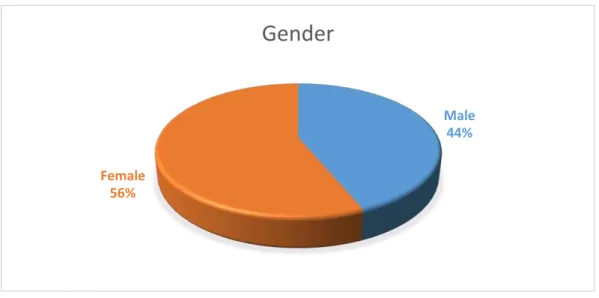
Question 01: about the students’ gender.
Figure 1: The participants’ gender.
The figure shows that the majority of the participants are females and 44% ofparticipants are males.
35% 29% 36%
The students' level.
3rd year 1st year Master 2nd year Master
Age
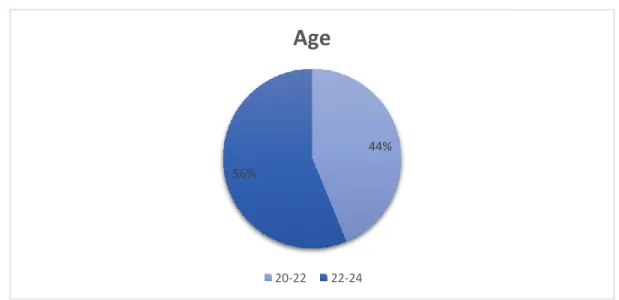
44% 56% 20-22 22-24Figure 2: The participants’ age.
The results in figure 02 show that the majority of the students are more than 22years old; this would imply that most of them are aware of their objectives.
Question03: about the students’ educational level.
Figure 3: The students’ level.
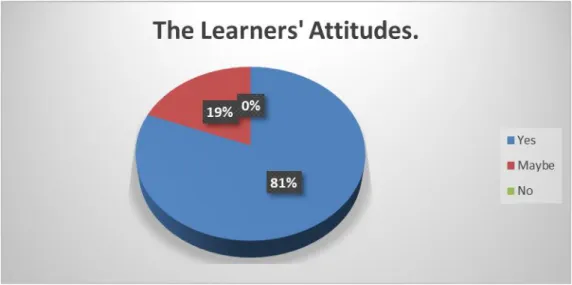
Figure 03 presents that most of the participants are Master students, 36% of them are second-year Master students, and 35% of them are second-year Master students. The rest belong to thethird year level.
Part 02
The Teachers' Competency
Not competent 31% Competent 50% Somehow competent 19%Figure 4: The learners’ attitudes towards the English language.
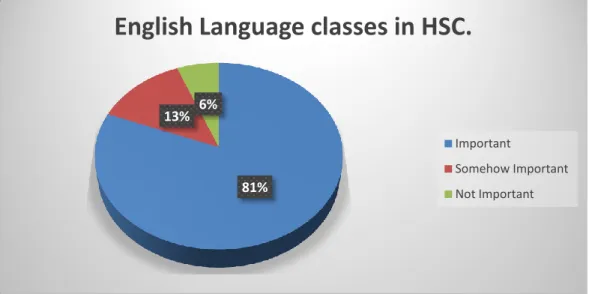
From this figure, it is clear that most of the learners consider that English in their specialities is essential, which illustrates the needs of the learners to master the English language.
Question 05: How do you view your English teacher?
Figure 5: The competency of the English language teachers.
The majority of the learners’ state that their English language teachers are competent and meet their needs and objectives whenjust afew of them declare that their teacher needs more competency in the English businessconcepts to help them achieve their needs.
Question 06: what are the types of English lessons you deal with in class?
81%
13% 6%
English Language classes in HSC.
Important
Somehow Important Not Important
Yes 44% No
56%
The Learners’ awareness.
Yes No
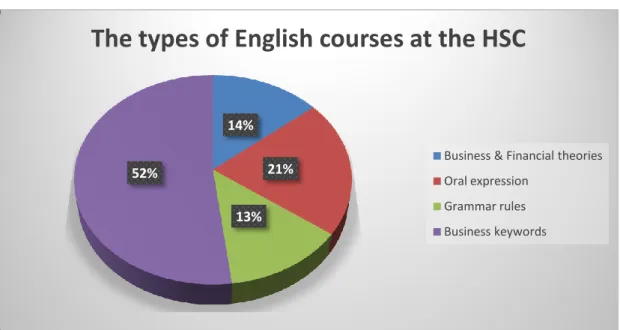
Figure 6: The English courses that the HSC learners study in their specialities.
As the figure shows, most of the students’ state that the lessons they study during their English classes deal with the Business English keywords and their pronunciation, oral presentations about various business topics. Few of them state that they study business rules and financial theories and grammar rules which are a pillar in communication.
Question 07: Did you learn any techniques to deal with business work situations in the
future?
Figure 7: The learners’ awareness about business techniques in professional life.
The figure shows that the less number of the students are self-knowledgeable about dealing with future business situations such as meetings, dealing with clients and businessmen from
14% 21% 13% 52%
The types of English courses at the HSC
Business & Financial theories Oral expression
Grammar rules Business keywords
The
Importance
of cultural awareness in
business communication.
25%
56% 19%
Yes To some extent No
other countries while most of them state that they learn only financial aspects and how they deal with companies’ projects in the English classes.
Part 03
Question 08: How would you define the term ‘culture’?
Most of the learners agree on the definition of culture as follow:
Culture is a set of skills, beliefs, practices and values that reign in society.
It’s a knowledge, language, way of thinking, and style of living.
Culture is an identity, customs and traditions.
Question 09: You are a future working in a business field, do you see yourself as a professional
worker who can deal and communicate using theEnglish language with any customer from any other country or culture?
Figure 8: The Importance of cultural awareness in the professional career.
As shown in the figure, most of the students see themselves as future professional managers who can deal with customers and clients from any other cultures. Few of them cannot handle these situations.
Figure 9: The learners’ attitudes toward cultural differences.
Figure (09) shows that most of the students respect the differences between their culture and others’ ones, while 19% are confused.
Question 11: how would you react if someone from other culture behaves in a way that is not
allowed in your culture?
Figure 10: The Students’ reflection of the cultural diversities on communication.
Figure (10) shows that the half of the students would try to explain what these different behaviours mean in their own culture. However, fifty per cent (50%) of the remaining students declare that they do not care or have any problem with them.
Question 12: If you are asked to work with people from different cultures in a group, would
you accept this group work or you will work with people who have the same culture as yours? Why?
50% 50%
0%
The Students' reaction about other cultural
behaviours.
I have no problem I try to explain I get angry
The
Cultural
awareness affecting the
Professional communication.
6% 0%
94%
Yes To some extent No
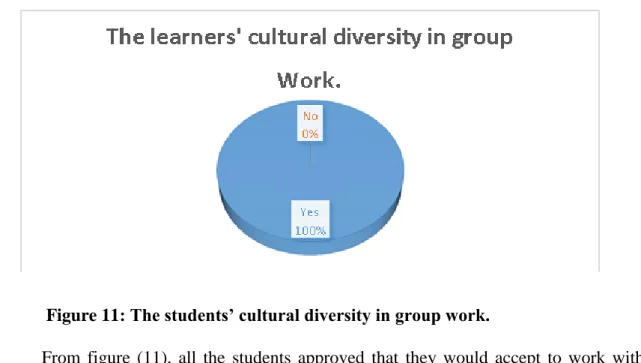
Figure 11: The students’ cultural diversity in group work.
From figure (11), all the students approved that they would accept to work with people from other cultures because they would like to learn new cultural concepts and values with new experiences.
Question 13: would you like to know more about other cultures to help you communicate
successfully in your future career?
Figure 12: The Influence of cultural awareness for professional communication.
Figure (12), shows that the majority of the students would like to know about other cultures where they see the influence of cultural awareness for better and successful professional communication.
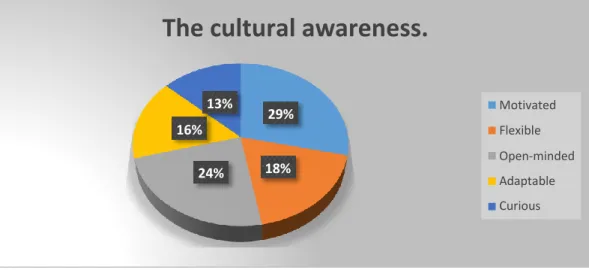
Figure 13: The Learners’ characteristics toward the cultural awareness.
As figure (13) illustrates, the students feel enthusiastic to know about other cultures. Whereas, they may be flexible, adaptable and curious to some extent.
2.1.4.3. Analysis of the Syllabus
In The Master Specialities, Marketing and Communication and Business Finance, the students learn business English that includes financial theories and marketing instructions in modules such as International marketing and advanced financial accounting. The business English teachers use simple English language to be understandable for all of the students. They teach business concepts, keywords and their pronunciation. The business English classes in the higher school of commerce in Kolea have nothing to do with rising the communication skills and intercultural awareness of the learners whenthey focus only on teaching the financial and commercial theories.
However, in the other Master specialities Accounting and Finance, Money, Finance and Banks, Management Control, and Organization and Management of the companies; the teachers of the English module try to meet the learners’ business needs and objectives, they give courses that bring the students awareness to all the other master departments’ specialities. The English teachers do not follow a specific program from the departments they simply design their program, and each teacher has his methods and courses that he/ she follows in teaching English. From the investigations, we found out one of the teacher’s programs in the Management of the companies’ speciality of the second semester, which
18% 16%
24%
29% 13%
The cultural awareness.
Motivated Flexible Open-minded Adaptable Curious
consists of three main objectives which are text reading and vocabulary, communication skills and grammar to achieve in six chapters or unites as follow:
1. Trade and international trade: in this unit the English teacher divides the course into
two sessions he/ she gives articles or texts to read about international trade and follow with questions of comprehension and discuss the main topic with highlighting the business key words and give their definitions. In grammar activities, the teacher gives Models of Obligations and permission, Yes/ No questions, Word questions, Negative questions and question tags , in the other hand, in communication skills the teacher ask his students to prepare a dialogue about business telephoning between a seller and his clients.
2. Business ownership: in this chapter the teacher give detailed information about the
basic forms of business ownership and discuss it with the students underling the main keywords; in this course the teacher focuses on meeting as communication skills objective in giving opinions between the managers and customers, as a grammar tasks the teacher emphasis on Verb+ ing tasks in the classroom.
3. Economic system: The teacher gives a full definition about economic system to his
learners and specifies the types of economic system and the market economy, the objectives behind the communication skills is rising the students’ performance in presentations and give a plan to work on for a good and useful language starting from Greetings to Plan, Topic and Aims at the end of the presentations and show them a good visual aids. In this unit the teacher focuses on prepositions (At/ In or On), expressions with Above/ Below, Over/ Under, Opposite, Next to/ Beside, Nearby.
4. Managements: In this chapter the teacher presents basics functions of managements
and the manager levels, dealing with complaints and apologies is the main objective to meet in the communication skills section. On the other hand, in grammar section the English teacher give simple activities about Like and Would Like expressions.
5. People at work: the following course the teacher will train his students for job
applications, selection procedures and writing emails, CV and Cover letter. While he/ she give instructions for a good job interviews in communication skills; therefore, in grammar section the teacher concentrates on Past simple, Present/ Past perfect, short answers and past actions.
6. Accounting: The teacher gives an overview about accounting and its types and follow
it with terms and definitions task, dealing with Numbers and Years in words.
To conclude, it is clear that the English classes are not highly emphasised in implementing intercultural communication in business English classes.
2.2. Conclusion
In this chapter, we have concluded that the HSC trainings deal with commercial and business concepts and theories. The questionnaire results and data collection reveal that all the leaners need to rise their English communication skills to be proficient in any intercultural business communication situation.
Chapter Three
Introduction
As we have seen in the first chapter which presents a literature review about the impact of intercultural communicative competence in business English classes, therefore, the last chapter is the summary of our study which aims at discussing the main results of the HSC students’ questionnaire and suggest solutions and recommendations for implementing intercultural communicative competence in business English classes and training methods to train the future business professionals in cross-cultural situations.
3.1. Discussion of the Main Results of the Questionnaire
Our sample includes the learners of different levels, specialities and different groups; both males and females studying in the HSC in Tipaza.
From the analysis of the questionnaire, we assume that the majority of the students are conscious that studying English is required and highly needed for their future careers. The findings show that the business English classes are essential in their specialities to meet their necessities where their teachers give courses about business and financial theories. However, few of them view that their business English teachers present lectures that do not follow their objectives or encourage them to raise their communication skills to interact successfully as future managers.
Therefore, the demand for an expert business English training including grammar rules, oral expressions and presentations is highly recommended to improve the HSC students English language competency. Additionally, the learners see that mastering grammar and vocabulary is a sufficient way to communicate effectively. Indeed, the results show that the majority of the learners think that knowing the language enables them to be proficient in communicating through business meetings.
From the results, it is confirmed that the learners have a minimal knowledge about the meaning of culture and how cultural diversities that are shared between specific groups of people shape their identities. In fact, the results reveal that the HSC learners never heard before about cultural awareness and intercultural communication nor are they skilled with business techniques and etiquette to deal among business situations; besides, their statements explain that they are self-knowledgeable in the way that they deal with clients which is clearly that they need to master more professional business qualifications and concepts. This leads to
conclude that ICC is not highlighted in our context of study. However, the findings display that all the learners are motivated to work with people from other cultures, which means they can work in collaboration and they argue that this would help them to increase their proficiency in business communication, where they may discover other cultural aspects in any business context. From these findings, we understand the needs to focus on the cultural awareness and show its impact on communication abilities.
The outcomes confirm that most of the learners respect people from other cultures. They show positive attitudes towards any behaviour in cross-cultural communication and respect these diversities. While the others see that it is not necessary to care about other culture and understand it or give judgments. This means that the students do not think that the ignorance of other cultural aspects may create difficulties in communication and may lead to some misunderstanding between the interlocutors. So emphasizing the learners’ communication and ICC skills is a requirement.
Moreover, the majority of the HSC students believe that studying culture is necessary for their specialties because it improves their communication skills. Therefore the teachers need to design lectures that raise the students’ cultural awareness and implement intercultural communicative competence in the business English lectures. During this case, the educators are free to choose varieties of methods and materials such as authentic materials that fit the different learning styles to meet the learners' wants and objectives.
The analyses prove that the learners perceive differently other cultures and may be motivated, flexible, open-minded, adaptable and curious. From these findings, we understand that the HSC learners are ready to be skilled in intercultural awareness and be professional intercultural business speakers and managers. Moreover, each learner relies on a particular style in class and this can be challenging to the teachers since they need to vary the materials, activities, learning experiences and even the teaching methodology to fit the learners’ needs and interests related to business.
Finally, the discussion about the learners’ questionnaire helps consider how to implement the Intercultural communicative competence skills in business English classes while taking into account the learning styles pushing and materials that facilitate teaching ICC in accordance with the various students’ needs in the classroom.
3.2. Recommendations and Solutions
Teaching Intercultural communicative competence demands continuing efforts. The teacher should know that teaching or implementing ICC in business English courses does not mean explaining the knowledge of others' culture; it is teaching concrete skills of interaction with people of different cultures in business environments. Furthermore, to train future intercultural speakers or mediators, the teacher should create a safe atmosphere where the students can ask any questions without fear of judgment.
Moreover, the teacher has to combine between formal and informal intercultural competence education to overcome discrimination toward the learners that results from a lack of proper knowledge about a particular culture, where formal education involves specific structured education foundation system at a general or vocational education school, it's a high degree of planning, responsibility for developing the learners' intercultural awareness; whereas, informal education is a lifelong rule where every individual acquires attitudes, skills and knowledge from family and others in one's social context. However, the teacher needs to be flexible and change the teaching methods frequently to complete the learners’ necessities for their future career.
3.2.1. Methods for Intercultural Business Communication Classroom Training
To implement intercultural communicative competence in business English the following recommendations are suggested:
In teaching ICC we should highlight some factors that the business English or ESP teachers must consider when choosing methods for their sessions to train the business learners which are:
The desired outcomes ( acquisition of knowledge, developing skills or modify attitudes)
The participants/ learners ( their needs, lacks, wants and objectives, preferences and learning styles, culture and business)
The students need to enhance their performance and communication skills in English so that they can get a chance to practice the language professionally in situations in which they may find themselves. Therefore, the course should target a variety of creative activities to practice and develop the four skills (Reading, Writing, Listening and speaking) in their specific fields.
Once the teacher has considered the issues, set the objectives of the course and classify the learners' needs and goals for learning business English and raising cultural awareness, he/ she can start with Intercultural business communication trainings. Another suggestion is Fowler and Blohm’s typology (2004: 37-84) which is a combination of cognitive and active methods that might help the teacher to highlight the cultural awareness among business situations.
In cognitive methods, the focus is on knowledge acquisition which includes activities that encourage the learners to increase their knowledge of culture as a subject. Here, the teacher offers lectures that deliver information associated with business concepts, clarifies ideas and introduces new topics, etc. As materials used in this method, the teacher uses computer-based materials such as CDs, DVDs, online programme and web sites, which support the learners to receive conceptual information, improve skills and adjust attitudes. Moreover, the teacher should give case studies of companies’ model as real situations and the students must work on both evaluating the situational problems and obtaining possible solutions. Likewise, some cases are based on real-world issues to help the students have the opportunity to deal with typical intercultural contexts and enhance their skills and attitudes towards the knowledge of different business etiquette, or various management styles used in companies from other cultures.
Furthermore, the teacher must explain to the learners the influence of intercultural awareness in their future business career with showing videos on a specific country including economy, business etiquette, and business relationships. These video resources should illustrate communication, negotiation and management in action. The video should offer a combination of do’s and don’ts, front stage culture that show that the managers are aware of how others understand them and what they expect, and this culture directs them how to behave. It develops what individuals do and say in social or business settings and how they dress and style themselves, the customer details they carry around, and their behaviour, some cultural priorities, and business practices. After watching the video, the teacher needs to guide the students to write a paper to classify major cultural variables that influence business. Then, they can reuse cultural concepts to business practices.