HAL Id: hal-00316617
https://hal.archives-ouvertes.fr/hal-00316617
Submitted on 1 Jan 1999
HAL is a multi-disciplinary open access
archive for the deposit and dissemination of sci-entific research documents, whether they are pub-lished or not. The documents may come from teaching and research institutions in France or abroad, or from public or private research centers.
L’archive ouverte pluridisciplinaire HAL, est destinée au dépôt et à la diffusion de documents scientifiques de niveau recherche, publiés ou non, émanant des établissements d’enseignement et de recherche français ou étrangers, des laboratoires publics ou privés.
boundaries Part II: Pacific and Atlantic Oceans
J. Soares, I. Wainer, N. C. Wells
To cite this version:
J. Soares, I. Wainer, N. C. Wells. Reflection of equatorial Kelvin waves at eastern ocean boundaries Part II: Pacific and Atlantic Oceans. Annales Geophysicae, European Geosciences Union, 1999, 17 (6), pp.827-837. �hal-00316617�
Re¯ection of equatorial Kelvin waves at eastern ocean boundaries
Part II: Paci®c and Atlantic Oceans
J. Soares1, I. Wainer2, N. C. Wells3
1Dept. de CieÃncias AtmosfeÂricas, Rua do MataÄo 1226, Universidade de SaÄo Paulo, SP, Brazil, 05508-900 2Dept. de Oceanogra®a FõÂsica, PracËa do Oceanogra®co 191, Universidade de SaÄo Paulo, SP, Brazil, 05508-900 3Southampton Oceanography Centre, European Way, Southampton, SO14 3ZH, UK
Received: 19 September 1997 / Revised: 26 August 1998 / Accepted: 19 October 1998 Abstract. The eect of viscosity, non linearities,
inci-dent wave period and realistic eastern coastline geom-etry on energy ¯uxes are investigated using a shallow water model with a spatial resolution of 1/4 degree in both meridional and zonal directions. Equatorial and mid-latitude responses are considered. It is found that (1) the in¯uence of the coastline geometry and the incident wave period is more important for the westward energy ¯ux than for the poleward ¯ux, and (2) the eect of the inclination of the eastern ocean boundary on the poleward energy ¯ux, for the Paci®c and Atlantic Oceans, decline as the period of the incident wave increases. Furthermore, the model simulations suggest that the poleward energy ¯uxes from meridional bound-aries give plausible results for motions of seasonal and annual periods. For comparatively shorter periods, a realistic coastline geometry has to be included for more accurate results. It is recommended that any numerical model involving the re¯ection of baroclinic Rossby waves (of intraseasonal, seasonal or annual periods) on the eastern Paci®c or Atlantic Oceans, should consider the eect of the coastline geometry in order to improve the accuracy of the results.
Key words. Oceanography: general (climate and interannual variability; equatorial oceanography). Oceanography: physical (eastern boundary currents).
1 Introduction
Equatorial Kelvin waves are thought to occur over a wide range of frequencies. Sea level records from El NinÄo years reveal that sustained periods of high sea level
were composed of several wave periods, which were interannually modulated (Madden and Julian, 1971, 1972; Ripa and Haynes, 1981; En®eld, 1989; McPhaden and Taft, 1988; Miller et al., 1988; Glantz et al., 1990; Weickman, 1991; Delcroix et al., 1991; among others). Upon impingement with the eastern boundary, the incoming baroclinic equatorial Kelvin wave excites westward-propagating Rossby waves and poleward-propagating coastal Kelvin waves (Moore, 1968; Moore and Philander, 1977; McCreary, 1976).
The low-frequency response of sea level on the eastern ocean boundaries can be subdivided for linear purposes into two independent constituents (1) the remotely forced part, i.e., that which is the result of an equatorial Kelvin wave incident on the boundary, and (2) the locally forced part. The latter is due to the longshore component of the wind (Bigg and Gill, 1986). Observational and theoretical studies, however, have indicated that the remotely forced part dominates the sea level variability along the eastern coasts of North and South America, related to the interannual frequen-cy, as in the ENSO phenomenon (En®eld and Allen, 1980; Chelton and Davis, 1982; Pares-Sierra and O'Brien, 1989; Johnson and O'Brien, 1990; Spillane et al., 1986).
In the Atlantic ocean, observations suggest that the upwelling event in the Gulf of Guinea is not associated with either the local winds or the local ocean circulation (Houghton, 1976). A possible explanation is that a strong upwelling signal, generated by increased west-ward wind stress in the western Atlantic, can travel as an equatorial Kelvin wave (Moore et al., 1978; Adamec and O'Brien, 1978; Servain et al., 1982; Busalacchi and Picaut, 1983; Picaut, 1983; McCreary et al., 1984; Katz, 1987; Verstraete, 1992). This interpretation is analogous to the theories of El NinÄo in the Paci®c ocean.
The nature of the response at an eastern boundary to an incident baroclinic Kelvin wave depends on the latitude, h, and on the wave period. For low frequencies a critical latitude, hc exists such that for jhj < hc the
response consists of oshore-propagating Rossby Correspondence to: J. Soares
waves, whereas for jhj > hcthe waves are trapped by the
coastal. The magnitude of the critical latitude decreases as the wave period decreases and as the coastline inclination (c), from meridional orientation, increases. (Grimshaw and Allen, 1988; Clarke and Shi, 1991).
Soares et al. (1998) using a viscous baroclinic shallow water model, have investigated the eects of viscosity, non-linearity, angle of coastline inclination and incident wave period on the baroclinic equatorial Kelvin waves at eastern ocean boundaries. They have found, by energy ¯ux considerations, that the impact of viscosity is greater than the eect of non-linearities. A systematic decrease of coastal Kelvin wave energy as the wave period increases (and hcincreases), predicted by inviscid
theories (as in Clarke and Shi, 1991) was not veri®ed in their work, because of the role of energy dissipation in their model. The dissipation was found to be dependent not only on the presence of the coastal Kelvin waves in the domain, but also on the period of these coastal waves. The in¯uence of the angle of coastline inclination and of the incident wave period was found to be more important for the westward energy ¯ux than for the poleward ¯ux.
The main aim of this study is to investigate the behavior of the low-frequency baroclinic equatorial Kelvin waves when they reach the Paci®c and Atlantic Ocean eastern coasts. Three dierent Kelvin wave periods are considered: intraseasonal, seasonal and annual. Some of the questions we address are: how far from the equator can the baroclinic disturbances prop-agate? How important is the coastline geometry on the propagation of the coastally trapped Kelvin waves and on the generation of the re¯ected Rossby waves? How important is the viscous eects on the studied waves? Are there dierences between propagation in the Northern and Southern Hemispheres of the Paci®c and Atlantic Oceans?
2 Numerical model
Non linear, 1/2 layer, shallow-water equations are used as the basis of the numerical model. The model is described in detail in Soares (1994) and Soares et al. (1998). Spherical coordinates with k (longitude) increas-ing eastward and h (latitude) increasincreas-ing northward are used in the model because of its large latitudinal extent. A regular 1/4 degree resolution is used in both zonal and meridional directions (Dk = Dh = 1/4°). Linear and nonlinear experiments are performed using a time step (Dt) of 4 and 2 h, respectively. A Laplacian coecient of 103m2s)1 is employed in the numerical experiments
described in this work. The coecient value, 103m2s)1,
has been commonly used in baroclinic shallow-water numerical models. Numerically, this coecient helps to smooth the very high wave number numerical noise. Physically, AH helps to form a viscous boundary layer
required to ®t the observations with the theory. The eects of viscosity on linear free baroclinic Kelvin waves in shallow-water models have been discussed by Davey et al. (1983) and Hsieh et al. (1983).
A modi®cation of Orlanski's (1976) radiative boun-dary condition (Miller and Thorpe, 1981) was used in all open boundaries: north, south and west. With the present scheme perturbations generated inside the domain are able to cross the arti®cial boundaries without distortion and without aecting the interior solution. On the solid boundaries the free-slip condition is used.
3 Experiments
The free wave solutions generated by the re¯ection of a baroclinic Kelvin wave at the eastern Paci®c and Atlantic Ocean boundaries is investigated using the numerical model, outlined already with one layer of initial thickness, H0= 200 m. A pulse of ®nite width is
used as surrogate to the baroclinic equatorial Kelvin wave. The maximum amplitude of the initial disturbance is taken as 30 m. From the hydrostatic balance, a 30 m de-pression of the interface, implies a 10 cm surface ele-vation (considering q2= 1060 and q1= 1025 Kg m)3).
The wave meridional structure is assumed to be a Gaussian function of latitude centered on the equator. The linear phase speed is assumed to be 2.45 ms)1. Only
half a wavelength of the initial disturbance is used in the experiments.
The eastern Paci®c and Atlantic coastlines (Fig. 1) use the contour of 200 m depth line in the boundary calculations instead of the actual coastline, because it is a better approximation of the vertical coast assumed in theory. The initial layer thickness is considered to be 200 m.
To estimate re¯ection properties it is convenient to consider the energy ¯ux. Outwards along the boundary the energy ¯ux is due to poleward coastal Kelvin waves. Depending on the hemisphere in consideration the poleward energy ¯ux (tP) can be northward (tN) or
southward (tS). The net energy ¯ux toward the
boun-dary (t) is given by the dierence between the energy ¯uxes due to the incoming equatorial Kelvin wave (tE)
and due to the re¯ected Rossby waves (tW). Therefore,
tEÿ tW tNÿ tSÿ tD; where tDis the energy dissipation.
It was assumed that the energy ¯ux is positive to the north and east directions.
Three dierent wave period (as in Soares et al., 1998) are considered: intraseasonal (T = 60 days), seasonal (T = 180 days) and annual (T = 360 days).
In all the experiments, the numerical model is integrated for a time long enough to allow for the coastal Kelvin wave, generated by the equatorial wave to leave the domain.
3.1 Energy ¯ux considerations
The ¯uxes are numerically calculated considering a region longitudinally bounded by an eastern ocean boundary (k = kcoast) and a longitude away from the
coast (k = )k0) and latitudinally bounded by h = h0
northwards). This work assumes that the energy ¯ux due to Kelvin wave can be separated from the one due to Rossby waves. However, in the non linear frame it is not necessarily true.
Poleward energy ¯ux. The poleward energy ¯ux (tP),
across a given latitude +h0is given by:
tp linear X kkcoast kÿk0 g0h H0v r cos h0 Dk 1 tp non-linear X kkcoast kÿk0 g0h qV r cos h0Dk 2
where the overbar denotes time average; h(k, h, t) is the interface displacement of the upper layer to the mean depth H0(k, h); u(k, h, t) and v(k, h, t) are the horizontal
components of the depth averaged velocity vector v(k, h, t) in the k (east-east) and h (north-south) directions, respectively. Reduced gravity is g¢ = g(q2)q1)/q2, where
g = 9.8 m/s is the acceleration of gravity; q2e q1are the
density of the upper and lower layers, respectively. The radius of the Earth is taken to be a constant, r = 6.37 ´ 106m; V(k, h, t) = uHi + vHj = Ui + Vj
and q = (u2+ v2)/2 (kinetic energy per unit of area).
Net energy ¯ux in the east-west direction. The net energy ¯ux (t), toward the boundary across a given longitude )k0, can be given by:
t linear tE linearÿ tW linear
X
hh0 hÿh0
g0hH0u rDh 3
t non-linear tE non-linearÿ tW non-linear
hhX0
hÿh0
g0h qU rDh 4
The direct determination of t = tE)tW, however, is
computationally expensive because the propagation speed of the westward Rossby waves is a strong function of the latitude varying from ~0.8 m/s at the equator to zero at the poles. It could take years of numerical integration for all the Rossby waves, gener-ated at the eastern boundary, to reach the western side of the domain. To save computer time, ®rst tE is
calculated and then tW is inferred by energy
conserva-tion consideraconserva-tions. The energy input in the experiment is only due to the baroclinic equatorial Kelvin wave. Consequently before the re¯ection of this wave at the eastern coast, the eastward energy ¯ux through a given longitude of the numerical domain corresponds to the value of tE. It can be assumed that the re¯ected Rossby
wave energy (tW), for one hemisphere, is given by
tW/2 = tE/2)tP)tD/2.
Energy dissipation. The dissipation of energy (tD), up
to a given latitude +h0, can be calculated as:
Fig. 1a±d. Model geometry. Paci®c Ocean eastern coastline used for the a intraseasonal experiment and b for the seasonal and annual experiments; Atlantic Ocean eastern coastline used for the c intraseasonal experiment and d seasonal and annual experiments
tD linear ÿkkXcoast kÿk0 X hh hÿ0 AHH0 ur2u vr2vr2cos h Dh Dk 5 tD non-linear ÿkkXcoast kÿk0 X hh h0 AHH ur2u vr2vr2cos h Dh Dk 6 where H(k, h, t) is the total depth (H = H0+ h) and Ñ2
is the Laplacian operator in spherical coordinates. Equations (1), (2), (5) and (6) consider only the Northern Hemisphere. Changing h = +h0for h = )h0
in those expressions gives the Southern Hemisphere ¯uxes. The energy input is always considered for both Hemispheres and the poleward, westward and energy dissipations are always calculated for the Hemisphere in consideration.
3.2 Model Paci®c Ocean results
3.2.1 Intraseasonal variability. In the linear and non linear experiments described in this section the latitudi-nal model basin extents from ±20° to 20° and has a maximum longitudinal extent of 70°. The eastern Paci®c boundary approximation used in the intraseasonal experiments can be seen in Fig. 1a.
A baroclinic equatorial Kelvin wave of 60-day period is used as an initial condition of the numerical model for the intraseasonal linear and non linear cases. The numerical model is integrated for 90 days.
The linear northward energy ¯ux (tN) and the
Northern Hemisphere dissipation of energy (tD) were
numerically calculated using Eqs. (1) and (5) respective-ly; tS(southward energy ¯ux) and tD(dissipation) for the
Southern Hemisphere were obtained using the same equations but with h = )h0.
The nondimensional energy ¯ux coecients (in %) rP(c, T), rW(c, T) and rD(c, T) shown in Fig. 2, are,
respectively, the ratios of the poleward (northward or southward depending on the hemisphere) coastal Kelvin wave, of re¯ected Rossby wave and of the dissipation of energy ¯uxes to the incoming equatorial Kelvin wave energy ¯ux (i.e., rP= tP/tE, rW= tW/tE and rD= tD/
tE). The coecients are calculated at latitudinal intervals
of 2° and integrated in time for 90 days.
To investigate the eect of the nonlinear terms on low frequency wave re¯ection at the Paci®c boundary, the non linear model is run using the same parameters and the same initial condition as used for the linear case. The non linear poleward coastal Kelvin wave energy ¯ux (tP) and the dissipation of energy (tD) are estimated,
for both-hemispheres, using Eqs. (2) and (6).
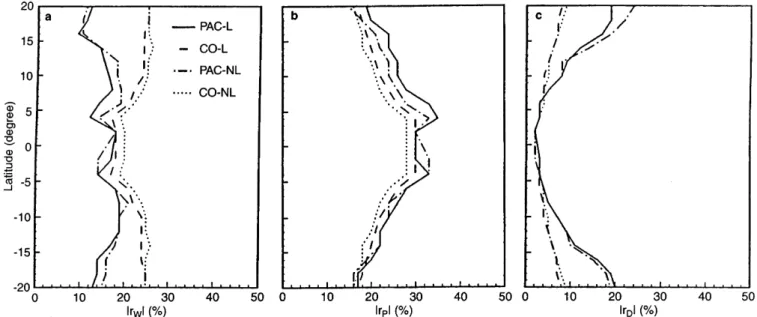
Figure 2a shows the westward energy ¯uxes cal-culated using (1) the Paci®c coastline and the linear mod-el (PAC-L); (2) meridional coastline and the linear model (C0-L); (3) Paci®c coastline and the non linear model (PAC-NL) and (4) meridional coastline and the non linear model (C0-NL).
Figure 2 shows the westward ¯ux (Fig. 2a), poleward ¯ux (Fig. 2b) and dissipation coecient (Fig. 2c). It can be seen that the changes in energy ¯uxes and in energy dissipation induced by the coastline geometry are notably more important than those induced by the nonlinearities.
For the cases investigated, and within the con®nes of this model, the linear and nonlinear poleward energy
Fig. 2a±c. Energy ¯ux coecients (%) at dierent latitudes (degree). a rW, b rPand c rD. Solid line: linear experiment with Paci®c coastline
(PAC-L). Dashed line: linear experiment with meridional coastline
(C0-L). Center-dashed line: non linear experiment with Paci®c coastline (PAC-NL). Dotted line: non linear experiment with meridional coastline (C0-NL). Wave period: 60 days
¯uxes do not present considerable dierences; the smallest values are given when the coastline is meri-dional in the nonlinear model and the largest for the Paci®c coastline in the linear model.
For an inclined boundary, it would be expected from inviscid theory, that the poleward propagation of coastal waves would be enhanced compared with the meridional boundary. However, as discussed in Soares et al. (1998), the dissipation induced by the inclined boundary is larger than that induced by the meridional one (see Fig. 2c). Hence, for the Paci®c coastline the expected rise in poleward energy ¯ux induced by the inclined boundary, is oset by dissipation.
The Paci®c northward energy ¯ux is a somewhat larger than the southward energy ¯ux whereas the westward energy ¯ux is smaller in the Northern Hemi-sphere than in the Southern HemiHemi-sphere (Fig. 2). This is consistent with the northern Paci®c boundary being more nonmeridional (see Soares et al., 1998). The Paci®c energy dissipation is roughly similar in both hemi-spheres. Its westward energy ¯ux presents a considerable latitudinal variation because of the changing coastline angle. This allows more than one critical latitude (in agreement with Grimshaw and Allen, 1988; Clarke and Shi, 1991; Clarke, 1992).
Furthermore, in Fig. 2a we note that the Paci®c coastline is less re¯ective than the meridional boundary. This is expected because inclined boundaries favor trapped motion more than meridional ones.
Since the energy ¯uxes discussed are aected more by the coastline geometry than by the nonlinearities, hereafter only the linear cases are investigated.
3.2.2 Seasonal variability. To simulate the seasonal variability in the eastern Paci®c ocean an equatorial Kelvin wave of 180 days period is used as an initial condition of the numerical model. The modelled region
in this experiment is from 45°S to 45°N and has a maximum longitudinal extent of 140° (see Fig. 1b for the boundary geometry).
The nondimensional energy ¯ux and the energy dissipation coecients generated at the Paci®c coastline (PAC) are shown in Fig. 3 together with the energy ¯uxes generated at a meridional boundary (C0). The coecients were calculated at every 5° of latitude and integrated over 6 months. The asymmetry between the Paci®c Northern and Southern Hemispheres is small. Poleward of ~20° of latitude, the dissipation of energy is larger than the energy ¯uxes.
In agreement with the intraseasonal period experi-ment, the Paci®c boundary is less re¯ective than the meridional boundary (Fig. 3a). The Paci®c poleward energy ¯ux (Fig. 3b) is slightly smaller than that generated at the meridional boundary because of the larger dissipation of energy occurring in the Paci®c (Fig. 3c) and, thus, preventing the increase of poleward energy ¯ux induced by the coastline geometry.
3.2.3 Annual variability. An equatorial Kelvin wave of 360 days period is used as an initial condition of the linear numerical model experiment. Following the previous case, the poleward energy ¯ux and the dissipation of energy were numerically calculated for every 5° of latitude and integrated over 8 months. Since only half a wavelength is used as initial condition, it takes around 7 months of the integration period for all the poleward energy to leave the numerical domain.
The nondimensional energy ¯uxes and the nondi-mensional energy dissipation (PAC) are displayed in Fig. 4 together with the ¯uxes generated at the meri-dional boundary (C0).
In the northern Paci®c, the westward energy ¯ux diers substantially from that generated at the meridion-al boundary (Fig. 4a). Inviscid theory suggests that
Fig. 3a±c. Linear energy ¯ux coecients (%) at dierent latitudes (degree). a rW, b rPand c rD. Solid line: Paci®c coastline (PAC). Dotted line:
trapped motion is expected to be favored given that the northern Paci®c coastline is less re¯ective than the meridional boundary, or than the southern Paci®c coastline. However, from Fig. 4b, this is not the case. What happens is that the dissipation of energy (which increases as the boundary departs from the meridional direction; see Fig. 4c), restrains the increase in the northward energy ¯ux induced by the coastline geometry. The annual northward and southward energy ¯uxes, at the Paci®c Ocean, are symmetric in relation to the equator (Fig. 4b). Above 20°N, the dissipation of energy is dominant over the energy ¯uxes. In the Southern Hemisphere, however, the coastline geometry facilitates the boundary re¯ection and, poleward of 20°S, the westward energy ¯ux is larger than the dissipation of energy. In the south Paci®c, the energy ¯uxes and the
energy dissipation are not substantially dierent from those generated in the meridional boundary experiment. This is because the southern Paci®c coastline does not depart signi®cantly from the north-south direction. 3.2.4 Discussion. Figure 5 summarizes the energy ¯uxes and the energy dissipation coecients obtained for the Paci®c Ocean at intraseasonal (T60), seasonal (T180) and annual (T360) periods. The intraseasonal coe-cients were calculated only up to 20° of latitude and therefore a direct comparison between the intraseasonal coecients and the lower frequency coecients should be made with prudence.
The energy ¯uxes are strongly dependent on the energy dissipated in the domain, as shown by Soares Fig. 4a±c. Linear energy ¯ux coecient (%) at dierent latitudes (degree). a rW, b rPand c rD. Solid line: Paci®c coastline (PAC). Dotted line:
meridional boundary (C0). Wave period: 360 days
Fig. 5a±c. Linear energy ¯ux coecients (%) at dierent latitudes (degree) for dierent incident wave periods. a rW, b rPand c rD. Paci®c
et al. (1998). In the Southern Hemisphere, the dissipa-tion of energy is smaller in the annual experiment than in the seasonal one (Fig. 5c). This is explained by the critical latitude values being higher for the annual experiment. Therefore, the increase in dissipation due to the increase of wave period is shown to be less important than the energy dissipated by the presence of coastal Kelvin waves. In the Northern Hemisphere, however, the energy dissipated in the annual case is larger than that for the seasonal case. This is, probably, due to the combination of both factors, the presence of the coastal Kelvin waves in the domain and the increase in the wave period.
The intraseasonal (T60) values of rW(Fig. 5a) and rD
(Fig. 5c) are, respectively, larger and smaller than those obtained by the lower frequency experiments.
The westward energy ¯ux, in the Southern Hemi-sphere, is larger for the annual period experiment (T360) than for the seasonal period (T180) case. In the Northern Hemisphere (where the boundary is more nonmeridional) the comparatively larger presence of coastal Kelvin waves, in the annual period experiment, induces stronger dissipative eects (see Fig. 5c) inhibi-ting the re¯ection processes. As a result, less energy of annual period is leaked oshore (Fig. 5a). According to inviscid studies (Clarke and Shi, 1983; Clarke, 1992) the poleward energy ¯ux decreases and the westward energy ¯ux increases as the incident Kelvin wave period is increased. However, calculations for the intraseasonal, seasonal and annual frequencies all indicate that the coastally trapped energy ¯ux, poleward of 15°, does not depend signi®cantly on the period of the incident wave (Fig. 5b).
In contrast to inviscid theory, there is symmetry between the northward and southward energy ¯uxes for all frequencies. The symmetry of rPcan be accounted for
the larger dissipative eects in the Northern Hemisphere
which compensates for the increase of the northward energy ¯ux generated by the coastline geometry, and hence results in similar rPvalues for both hemispheres.
The hemispherical asymmetry of both, westward energy ¯ux and energy dissipation, is greater for the annual experiment. This result is in agreement with Clarke (1992) who found that the energy ¯ux asymmetry in the eastern Paci®c increases as the wave period increases. 3.3 Model Atlantic Ocean results
The experiments carried out for the eastern Paci®c Ocean coastline are now repeated for the eastern Atlantic Ocean coastline. The methodology employed is similar to that utilized in the previous experiment.
The Atlantic coastline geometry can be seen in Fig. 1c (intraseasonal period) and 1d (seasonal and annual periods).
3.3.1 Intraseasonal variability. The intraseasonal nondi-mensional linear and non linear energy ¯ux coecients, rP(c, T), rW(c, T) and rD(c, T) generated at both,
Atlantic boundary and meridional boundary, are shown in Fig. 6 at dierent latitudes. The coecients are calculated at latitudinal intervals of 2° and integrated over 90 days. The energy coecients are calculated using the: (1) Atlantic coastline and the linear model (ATL-L); (2) meridional coastline and the linear model (C0-L); (3) Atlantic coastline and the non linear model (ATL-NL) and (4) meridional boundary and the non linear model (C0-NL).
In agreement with the earlier experiments, the energy ¯ux changes induced by the coastline geometry are signi®cantly more important than those induced by nonlinearities (Fig. 6).
Fig. 6a±c. Energy ¯ux coecient (%) at dierent latitudes (degree). a rW, b rPand c rD. Solid line: linear experiment with Atlantic coastline
(ATL-L). Dashed line: linear experiment with meridional coastline
(C0-L). Center-dashed line: non linear experiment with Atlantic coastline (ATL-NL). Dotted line: non linear experiment with meridional coastline (C0-NL). Wave period: 60 days
Near the Gulf of Guinea, the re¯ected energy ¯ux and the dissipated energy, both exhibit a rapid increase whereas the poleward energy ¯ux shows a rapid decrease. The rise in the rDvalue is due to the energy
dissipated along the zonal boundary (see Fig. 6b). The larger amount of dissipation reduces the northward energy ¯ux.
The Atlantic coastline is shown by Fig. 6a to be less re¯ective than the meridional one. This result is theoretically expected (Soares et al., 1998) given that the critical latitudes for the nonmeridional boundaries are lower than those generated at the meridional coastlines.
For all the cases examined in Fig. 6b, north of 5°N, the northward energy ¯uxes are similar, and hence, poleward of 5°N, the Northern Atlantic coastline acts as a meridional boundary. In the Southern Hemisphere, the poleward energy generated in the Atlantic coastline is larger than that generated at the meridional boun-dary. In agreement with the earlier experiments the energy dissipation induced by the nonmeridional boun-dary (Atlantic coastline) is larger than that induced by the meridional one (Fig. 6c). The increase in dissipation reduces the expected rise in the poleward energy ¯ux induced by the geometry of the coastline.
3.3.2 Seasonal variability. To compare the energy ¯ux changes induced by the coastline geometry, the Atlantic energy ¯ux coecients (ATL) are shown in Fig. 7 with the corresponding ¯uxes generated at the meridional boundary (C0). The coecients are calculated at every 5° of latitude and integrated over 6 months. The asymmetry between the Northern and Southern Hemi-spheres is found to be negligible for all the seasonal energy ¯uxes investigated here. It indicates that the geometrical eects of the Gulf of the Guinea are not very important for seasonal period motions.
As for the intraseasonal period experiment, the Atlantic boundary is less re¯ective than the meridional boundary (see Fig. 7a). According to Fig. 7b, with respect to the seasonal poleward energy ¯ux the whole eastern Atlantic boundary can be roughly regarded as a meridional boundary. Again, the comparatively larger energy dissipated at the Atlantic boundary (Fig. 7c) obstructs the expected increase of poleward energy ¯ux induced by the coastline geometry.
3.3.3 Annual variability. To compare the coastline in¯uences on the energy ¯uxes and on the energy dissipation, the nondimensional coecients generated by the Atlantic coastline (ATL) and by a meridional boundary (C0) are displayed together in Fig. 8. In common with the seasonal experiment, all the annual energy coecients, generated at the Atlantic eastern coast, are approximately symmetric with respect to the equator.
The annual poleward energy ¯uxes induced by both, meridional and Atlantic boundaries, are very similar. As expected, the energy dissipated (Fig. 8c) and the re¯ect-ed ¯ux (Fig. 8a) are, respectively, larger and smaller at the Atlantic boundary compared with the meridional boundary.
3.3.4 Discussion. The intraseasonal, seasonal and annual energy ¯uxes and energy dissipation coecients are summarized in Fig. 9. In agreement with Fig. 5 the westward energy ¯ux is larger for the intraseasonal period than for longer periods (Fig. 9a). This is because of the lower values of energy dissipated, in the domain, at the intraseasonal period (Fig. 9c).
As the wave period increases, from seasonal to annual, the re¯ected energy increases (Fig. 9a) and the dissipation of energy decreases (Fig. 9c) because of the
Fig. 7a±c. Linear energy ¯ux coecient (%) at dierent latitudes (degree). a rW, b rPand c rD. Solid line: Atlantic coastline (ATL). Dotted line:
increase of the critical latitude with the lengthening of the wave period. As the critical latitude increases, there is more energy in the westward Rossby waves and, consequently, smaller amount of energy dissipated in the domain.
It is found that the seasonal and the annual poleward energy ¯uxes are very similar (Fig. 9b). Both ¯uxes are also comparable to the poleward energy ¯ux generated at the meridional boundary (see Figs. 7b, 8b). Despite the re¯ected energy being smaller for the seasonal case than for the annual experiment, the seasonal energy dissipated in the domain is larger, resulting in similar values of the poleward energy ¯uxes for both periods.
The in¯uence of the Atlantic coastline geometry, therefore, on the seasonal and annual coastally trapped
energy ¯ux can be considered to be small. This result is striking because of the particular geometry of the eastern Atlantic, which has an approximately zonal coast near 5°N (Gulf of the Guinea). Du Penhoat et al. (1983) have also shown that the eect of the coast of the Gulf of Guinea is small on very low frequency waves (seasonal and annual periods).
The largest asymmetry between the Northern and Southern Hemisphere energy ¯uxes has been found in the intraseasonal experiment. At intraseasonal periods the eects of the Atlantic coastline geometry are to cause an enhancement of the poleward energy ¯ux and a reduction in Rossby waves generation, between 20°S and 5°N. The ¯ow produced by the coastal Kelvin wave along of the approximately zonal boundary of the Gulf of Guinea also contributes to this result.
Fig. 8a±c. Linear energy ¯ux coecient (%) at dierent latitudes (degree). a rW, b rPand c rD. Solid line: Atlantic coastline (ATL). Dotted line:
meridional boundary (C0). Wave period: 360 days
Fig. 9a±c. Linear energy ¯ux coecient (%) at dierent latitudes (degree) for dierent incident wave periods. a rW, b rP and c rD. Atlantic
4 Conclusions
The eect of the coastline geometry and the incident wave period (intraseasonal, seasonal and annual peri-ods), was found to be more important for the westward energy ¯ux than for the poleward ¯ux. To simulate accurately the re¯ected Rossby waves on the Paci®c and Atlantic boundaries, the eastern ocean coastline geometry should be included in the numerical models.
The eect of the inclination of the eastern boundary on the poleward energy ¯ux, for the Paci®c and Atlantic oceans, diminishes as the period of the incident wave increases. For motions of seasonal and annual periods, the in¯uence of the coastline inclination, on both oceans, can be considered negligible.
For incident waves of intraseasonal period, however, there is a poleward energy ¯ux asymmetry between the Northern and Southern Hemispheres. For the Northern Atlantic, poleward of 5°N, the eastern boundary can be considered as a meridional one whereas for the Southern Atlantic the eastern coastline geometry should be incorporated to obtain accurate poleward propagation of intraseasonal period. In the Paci®c Ocean, the northward energy ¯ux was found to be somewhat larger than the northward ¯ux generated at a meridional boundary. In the Southern Hemisphere, the dierence between the poleward ¯uxes, of intraseasonal period, generated at the meridional and the Paci®c coastlines, however, are considered negligible.
Acknowledgements. J. Soares wishes to thank the Conselho Nacional de Desenvolvimento Cienti®co e Tecnologico, CNPQ (Brasilia, Brazil) for the ®nancial support through scholarship 260102/89.0. Part of this work was supported by grant FAPESP 93/1387-0 and CNPQ 300223/93-5 RN.
Topical Editor D. J. Webb thanks G. Bigg and another reference for their help in evaluating this paper.
References
Adamec, D., and J. J. O'Brien, The seasonal upwelling in the Gulf of Guinea due to remote forcing, J. Phys. Oceanogr., 8, 1050± 1060, 1978.
Bigg, G. R., and A. E. Gill, The annual cycle of sea level in the eastern tropical Paci®c, J. Phys. Oceanogr., 16, 1055±1061, 1986.
Busalacchi, A. J., and J. Picaut, Seasonal variability from a model of the tropical Atlantic ocean, J. Phys. Oceanogr., 13, 1564± 1588, 1983.
Chelton, D. B., and R. E. Davis, Monthly mean sea level variability along the west coast of North America, J. Phys. Oceanogr., 12, 757±784, 1982.
Clarke, A. J., Low-frequency re¯ection from a nonmeridional eastern ocean boundary and the use of coastal sea level to monitor eastern Paci®c equatorial Kelvin waves, J. Phys. Oceanogr., 22, 163±183, 1992.
Clarke, A. J., and C. Shi, Critical frequencies at ocean boundaries, J. Geophys. Res., 96, 10 731±10 738, 1991.
Davey, M. K., W. W. Hsieh, and R. C. Wajsowicz, The free Kelvin wave with lateral and vertical viscosity, J. Phys. Oceanogr., 13, 2182±2190, 1983.
Delcroix, T., J. Picaut, and G. Eldin, Equatorial Kelvin and Rossby waves evidenced in the Paci®c ocean through Geosat sea level
and surface current anomalies, J. Geophys. Res., 96, 3249±3262, 1991.
Du Penhoat, Y., M. A. Cane, and R. J. Patton, Re¯ections of low frequency equatorial waves on partial boundaries, 237±258, in Hydrodynamics of the equatorial ocean, Elsevier Oceanography Series, Elsveier, Amsterdam, 1983.
En®eld, D. B., El NinÄo, past and present, Rev. Geophys., 27, 159± 187, 1989.
En®eld, D. B., and J. S. Allen, On the structure and dynamics of monthly mean sea level anomalies along the Paci®c coast of North and South America, J. Phys. Oceanogr., 10, 557±588, 1980. Glantz, M. H., R. W. Katz, and N. Nicholls, Teleconnections linking
worldwise climate anomalies, Cambridge University Press, Cambridge, UK, 1990.
Grimshaw, R., and J. S. Allen, Low-frequency baroclinic waves o coastal boundaries, J. Phys. Oceanogr., 18, 1124±1143, 1988. Hsieh, W. W., M. K. Davey, and R. C. Wajsowicz, The free Kelvin
wave in ®nite-dierence numerical models, J. Phys. Oceanogr., 13, 1383±1397, 1983.
Houghton, R. W., Circulations and hydrographic structure of the Ghana continental shelf during the 1974 upwelling, J. Phys. Oceanogr., 6, 909±924, 1976.
Johnson, M. I., and J. J. O'Brien, The northeast Paci®c Ocean response to the 1982±1983 El NinÄo, J. Geophys. Res., 95, 7155± 7166, 1990.
Katz, E. J., Equatorial Kelvin waves in the Atlantic, J. Geophys. Res., 92, 1894±1898, 1987.
Madden, R. A., and P. R. Julian, Detection of a 40±50 day oscillation in the zonal wind in the tropical Paci®c, J. Atmos. Sci., 28, 702±708, 1971.
Madden, R. A., and P. R. Julian, Description of global scale circulation cells in the tropics with a 40±50 day period, J. Atmos. Sci., 29, 1109±1123, 1972.
McCreary, J. P., Eastern tropical ocean response to changing wind systems, J. Phys. Oceanogr., 6, 632±645, 1976.
McCreary, J. P, J. Picaut, and D. W. Moore, Eects of remote annual forcing in the eastern tropical Atlantic ocean, J. Mar. Res., 42, 45±81, 1984.
McPhaden, M. J., and B. Taft, Dynamics of seasonal and intraseasonal variability in the eastern equatorial Paci®c, J. Phys. Oceanogr., 18, 1713±1732, 1988.
Miller, M. J., and A. J. Thorpe, Radiation conditions for the lateral boundaries of limited-area numerical models, Q. J. R. Meteorol. Soc., 107, 615±628, 1981.
Miller, L., R. Cheney, and B. Douglas, GEOSAT altimeter observations of Kelvin waves and the 1986±87 El NinÄo, Science, 239, 52±54, 1988.
Moore, D., Planetary-gravity waves in an equatorial ocean. PhD Thesis, Harvard University, Cambridge, Massachusetts, USA, 1968.
Moore, D., and S. G. H. Philander, Modelling of the tropical ocean circulation, in The Sea, vol 6, pp. 319±361, Wiley, New York, 1977.
Moore, D., P. Hisard, J. McCreary, J. Merle, J. O'Brien, J. Picaut, J.-M. Verstraete, and C. Wunsch, Equatorial adjustment in the eastern Atlantic, Geophys. Res. Lett., 5, 637±640, 1978. Orlanski, I., A simple boundary condition for unbounded
hyper-bolic ¯ows, J. Comp. Phys., 21, 251±269, 1976.
Pares-Sierra, A., and J. J. O'Brien, The seasonal and interannual variability of the California current system: a numerical model, J. Geophys. Res., 94, 3159±3180, 1989.
Picaut, J., Propagation of the upwelling in the eastern equatorial Atlantic, J. Phys. Oceanogr., 13, 18±37, 1983.
Ripa, P., and S. Hayes, Evidence for equatorially trapped waves at the Galapagos Islands, J. Geophys. Res., 86, 6509±6516, 1981. Servain, J., J. Picaut, and J. Merle, Evidence of remote forcing in
the equatorial Atlantic ocean, J. Phys. Oceanogr., 12, 457±463, 1982.
Soares, J., On the re¯ection of the equatorial waves at eastern ocean boundaries. PhD Thesis, Oceanography Department, University of Southampton, 1994.
Soares, J., I. Wainer, and N. C. Wells, Re¯ection of equatorial Kelvin waves at eastern ocean boundaries. Part I: Hypothetical boundaries, Anna. Geophysicae, (in press) 1998.
Spillane, M. C., D. B. En®eld, and J. S. Allen, Intraseasonal oscillations in sea level along the west coast of the Americas, J. Phys. Oceanogr., 17, 313±325, 1986.
Verstraete, J. M, The seasonal upwellings in the Gulf of Guinea, Progr. Oceanogr, 29, 1±60, 1992.
Weickman, K. M., El Nino/Southern Oscillation and Madden-Julian (30±60 days) oscillations during 1981±1982, J. Geophys. Res., 96, 3187±3195, 1991.