Nonlinear Macro Element Model of Bridge Bent with
Lead Rubber Bearings
Abdelkader Benyoucef
12, Leblouba Moussa
3, Youcef Mehani
4, Benazouz Chikh
5and
Ali Zerzour
61 National Earthquake Engineering Research Center, 01 Rue Kaddour Rahim, BP 252, Hussein-Dey, Algiers 16040, Algeria, Email: [email protected].
2 National School of Built and Ground Works Engineering, Rue SidiGaridi, BP 32, Vieux Kouba, Algiers 16051, Algeria, Email: [email protected].
3 Department of Civil and Environmental Engineering, University of Sharjah,P.O.Box 27272, Sharjah, United Arab Emirates, Email: [email protected].
4 National Earthquake Engineering Research Center, 01 Rue Kaddour Rahim, BP 252, Hussein-Dey, Algiers 16040, Algeria, Email: [email protected].
5 National Earthquake Engineering Research Center, 01 Rue Kaddour Rahim, BP 252, Hussein-Dey, Algiers 16040, Algeria, Email: [email protected].
6 Department of Civil Engineering, Houari Boumedien University of Science and Technolgy, USTHB, BP 32 El Alia, Bab Ezzouar, Algiers 16111, Algeria, [email protected].
RÉSUMÉ. Les modèles macro-éléments non linéaires ont été développés pour simuler le comportement des appuis parasismiques. Cependant, ces modèles négligent certains aspects du comportement des isolateurs sismiques. Dans cet article, un modèle de macro éléments pour les appuis parasismique avec un barreau de plomb a été développé. Le modèle proposé comprend des effets de charge axiale et tient compte de grandes déplacements. La non-linéarité du modèle est représentée par le modèle d'hystérésis de Bouc-Wen. La réponse obtenue en utilisant le modèle numérique s'avère être en bon accord avec le comportement observé dans les résultats d'essai sur des appuis parasismiques avec barreau de plomb. La deuxième partie de cet article est d'appliquer le modèle proposé sur un pont à pile marteau avec isolation sismique sismique. Une augmentation de la charge axiale a été effectuée pour étudier l'influence de la charge axiale sur la réponse cyclique de la du pont. Le comportement du pont est caractérisé par une boucle d'hystérésis dont l'inclinaison et la surface dépendent de l'amplitude de la charge axiale. La rigidité post élastique diminue avec l'augmentation des charges axiales. Cependant, la dissipation d'énergie de l'isolateur, représentée par la surface de la boucle d'hystérésis, a augmenté de façon significative avec l'augmentation de la charge axiale.
ABSTRACT. Nonlinear macro-element models have been developed to simulate the behavior of single isolation bearings. However, these models neglect certain aspects of bearing response behavior. In this paper a macro-element model for lead rubber bearings is developed. The proposed model includes axial load effects and accounts for large deformations. The nonlinearity in the model is modelled via the Bouc-Wen model of hysteresis. Response obtained using the numerical model is shown to be in good agreement with observed behavior in test results on single lead-rubber bearings. The second part of this paper is to apply the proposed model on a reinforced concrete Bridge Bent with seismic isolation. Increasing axial load was performed to investigate the influence of the axial load on the cyclic response of the Bridge Bent.The behavior of the Bridge Bent is characterized by a hysteresis loop nature whose inclination and area are dependent on the amplitude of the axial load. The post elastic stiffness decreased with the increase of axial loads. However, the energy dissipation of the isolator, represented by the encompassed areas of loops, increased significantly with increased axial load.
MOTS-CLÉS: Appuis parasismique, macro élément, charge axial, Bouc-Wen, Pile marteau.
KEYWORDS: Lead-Rubber, Macro-element, Axial Load, Large deformations, Bouc-Wen, Bridge Bent.
rugc17 - AMPHI 4 - Lundi 22 mai 2017 - 12:10/12:30 (20min)
505
sciencesconf.org:rugc17:133926
35èmes Rencontres de l’AUGC, ECN/UN, Nantes, 22 au 24 mai 2017 2
1. Introduction
Several factors are often considered in the selection and design of seismic isolation devices. The selection of the appropriate seismic isolator is based on some requirements ranging from the lateral and vertical stiffnesses, cost benefits to the durability. The design of isolation systems takes into consideration the stability of individual isolators and that of the structure as one block.
Studies and tests performed on single elastomeric bearings [KOH 87] demonstrated that bearing devices show a general reduction of stiffness with increasing axial loads. Rubber bearings have also been shown to soften in the vertical direction at large deformations [RYAN 2005].
Based on the fact that most isolation bearings are inherently nonlinear, especially Lead-Rubber Bearing (LRB) due to the yielding of lead core, a nonlinear extension of the linear two-spring model [KOH 87] was proposed by Ryan et al. [RYAN 2005], this model includes a linear vertical spring to account for the axial load effects, and as an option a model for lead strength degradation was incorporated to the Coupled Nonlinear Variable Strength Model [RYAN 2005]. However, this model addresses only small rotations and the determination of its nominal parameters are based on judgment.
The objectives of this paper is to develop a macro-element model for LRB that includes the effect of axial loads and accounts for large deformations. This model can be easily incorporated into available structural analysis software. Another objective was to analyze the nonlinear behavior of Bridge Bent using a simplified approach based on the notion of macro-element. This analysis also aims to verify the effectiveness of the proposed analytical model and to identify the sensitivity of the model's response to the combined horizontal and vertical loadings.
2. Macro-Element Formulation
The proposed macro-element model of the LRB is shown in Figure 1 (a). The total potential energy of the model with reference to Figure 1(a) is expressed as follows:
∏
where and are the horizontal and vertical top displacements, respectively, they depend on the bearing
height, , and the spring deformations:
( ) ( ) ( )2-a]
( ( )) ( ) ( )2-b]
Assuming linear material behavior, the nominal shear stiffness of the bearing (shear spring) is [KELLY 97]:
Similarly the nominal vertical stiffness of the bearing (vertical spring) is [KELLY 97]:
where = shear modulus; = cross-sectional area; = total thickness of the rubber layers; ( )= modified area, and = instantaneous compression modulus of the rubber-steel composite bearing. The rotational stiffness , where ( ) is the Euler buckling load [KELLY 97]. Here ( ) is the bending stiffness of a multilayer bearing [KELLY 97], and = conventional moment of inertia.
Imposing the stationary of Π with respect to s,v and θ yield the following equilibrium equations:
( ) ( )
( ) ( ) [( ) ( ) ( )] [( ) ( ) ( )]
rugc17 - AMPHI 4 - Lundi 22 mai 2017 - 12:10/12:30 (20min)
506
sciencesconf.org:rugc17:133926
Nonlinear Model of Bridge Bent with Lead Rubber Bearings 3
The system of governing equations includes additionally to the equilibrium equations the kinematic equations (Eq. 2), and it can be recast in a root-finding form:
{ } ( ( ) ( ) ( ) ( ) [( ) ( ) ( )] [( ) ( ) ( )] [( ) ( ) ( )] [ ( ( )) ( ) ( )] )
Figure 1. (a) Proposed Macro-element model of LRB (left) and (b) Macroelement model of the Bridge Bent (right)
The above system represents a system of five nonlinear equations in five unknowns: , and , it can be solved by Newton’s method, i.e., find to satisfy ( ) .
To consider a different constitutive model for the shear spring, the term in Eq. 6 has to be replaced by a general force ( ). The force ( ) mobilized in the shear spring may be expressed in the Bouc-Wen [BOUC 71, WEN 76] fashion as a linear part and a hysteretic part:
( )
where = yield strength of the lead core; = a hysteretic dimensionless controlling the nonlinear lateral behavior of the bearing. The latter is governed by the following differential equation with respect to time [BOUC 71, WEN 76]:
̇ ̇( | | [ ( ̇ ) ])
In Eq. 8, and are the parameters that control the shape of the hysteretic loop; is the yield deformation of the shear spring, can be estimated as 1 cm for LRB isolators [RYAN 2005]. The variable ̇ can be discretized by the Backward-Euler scheme to cancel the time variable then the Newton scheme of the form
( ) ( ) to solve a general nonlinear equation ( ) may be used to solve for The
reader is referred to [HAUKAAS 2004] for the complete numerical solution procedure to obtain ( ) and the algorithmically consistent tangent ( ) needed in the Jacobian matrix, which in turn is needed to apply the Newton method to solve Eq. 6.
3. Verification with Experimental Results
To verify the accuracy of the proposed macro-element model in predicting the global LRB cyclic behavior; its predictions are compared with experimental results. Two types of LRB isolators are considered in the comparison, LRBnz and LRBcn; details about the properties of the devices can be found in [SKINNER 93] for LRBnz and [FENG 2000] for LRBcn.
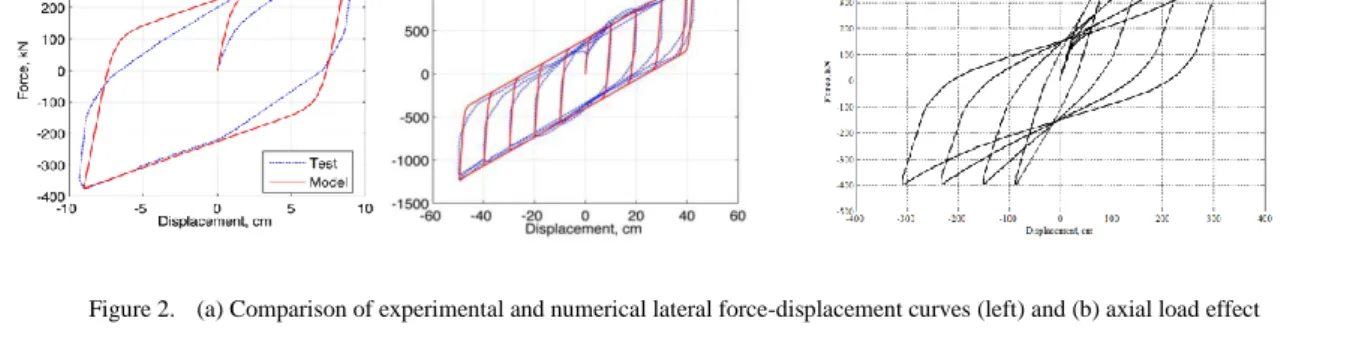
The macro-element model is used to simulate LRBnz and LRBcn. In both numerical models the parameters of the Bouc-Wen [BOUC 71, WEN 76] model of hysteresis were chosen as: and . Figure 2 (a) compares the experimental and numerical lateral force-displacement curves. The numerical model reproduces correctly the behavior of the LRBnz and the LRBcn, verifying the ability of the proposed macro-element model to simulate the behavior of LRB bearings.
rugc17 - AMPHI 4 - Lundi 22 mai 2017 - 12:10/12:30 (20min)
507
sciencesconf.org:rugc17:133926
35èmes Rencontres de l’AUGC, ECN/UN, Nantes, 22 au 24 mai 2017 4
Figure 2. (a) Comparison of experimental and numerical lateral force-displacement curves (left) and (b) axial load effect 4. Axial Load Effect
The Bridge Bent is subjected to two types of forces applied simultaneously: 1) a lateral sinusoidal force controlled and a constant initial axial load P = 1584.26 kN applied at the top of the bridge Bent. The behavior of the Bridge Bent is characterized by a hysteresis loop nature whose inclination and area are dependent on the amplitude of the axial load. As can be seen in Figure 2 (b) the force-displacement curves for the Bridge follows typical nonlinear hysteresis behavior. The post elastic stiffness decreased with the increase of axial loads, as shown in Figure 2 (b). As well, the energy dissipation of the isolator, represented by the encompassed areas of loops, increased significantly with increased axial load. Similar results were obtained by Koh et al [KOH 87]. This explains the isolation system is less rigid and more effective in dissipating energy for larger axial loads. The force-displacement hysteresis curves exhibited hardening behavior at large amplitude levels, which is attributed to the shape of the isolators; when subjected to large deformations, thus contributing to the overall strength of the isolator.
5. Conclusion
A nonlinear macro-element model for Lead-Rubber Bearings has been developed. The model includes axial load effects, large displacements and large rotations. The nonlinearity in shear stiffness of the bearing is included using the Bouc-Wen model of hysteresis. The model has been shown to be capable to predict correctly the observed behavior in test results. The macro-element model can be incorporated easily in available open source software. The study of the general case of the macro-element model of the Bridge Bent with the isolation system subjected to horizontal cyclic load combined with different cases of increasing axial load is achieved, all of which can lead to better understanding the effect of the axial loads on the overall behavior of the Bridge Bent with the isolation system. In general, the macro-element modeling approach presented in this work has proved to be efficient and provides, despite its simplicity, a flexible platform for the non-linear analysis of Bridge Bent.
6. Bibliography
[BOUC 71] Bouc R., « Modèle mathématique d'hystérésis: application aux systèmes à un degré de liberté » , Acustica, Vol. 21, 1971, p. 16.
[FENG 2000] Feng D., Miyama T., Masuda K., Liu W., Zhou F., Zheng B., and Li Z., «A new analytical model for the lead rubber bearing», in: 12th World Conference on Earthquake Engineering. NZ, 2000.
[HAUKAAS 2004] Terje Haukaas and Armen Der Kiureghian, Finite Element Reliability and Sensitivity Methods for Performance-Based Earthquake Engineering, PEER 2003/14, 2004.
[KELLY 97] Kelly J. M., Earthquake-Resistant Design with Rubber,Springer-Verlag, London, 1997.
[KOH 87] Koh C. G., and Kelly J. M., « Effects of axial load on elastomeric bearings», UCB/EERC-86/12, 1987.
[RYAN 2005] Ryan K. L., Kelly J. M., and Chopra A. K., Nonlinear model for lead–rubber bearings including axial-load effects, J. Eng. Mech-ASCE Vol. 131, 2005, p. 1270.
[SKINNER 93] Skinner R. I., Robinson W. H., and McVerry G. H., An Introduction to Seismic Isolation, John Wiley. NY, 1993.
[WEN 76] Wen YK., « Method for random vibration of hysteretic systems. Journal of the engineering mechanics division »,
J. Eng. Mech-ASCE, Vol. 102, 1976, p.249.