HAL Id: hal-00443990
https://hal.archives-ouvertes.fr/hal-00443990
Submitted on 5 Jan 2010
HAL is a multi-disciplinary open access
archive for the deposit and dissemination of
sci-entific research documents, whether they are
pub-lished or not. The documents may come from
teaching and research institutions in France or
abroad, or from public or private research centers.
L’archive ouverte pluridisciplinaire HAL, est
destinée au dépôt et à la diffusion de documents
scientifiques de niveau recherche, publiés ou non,
émanant des établissements d’enseignement et de
recherche français ou étrangers, des laboratoires
publics ou privés.
Magnetic frustration in an iron based Cairo pentagonal
lattice
Eric Ressouche, Virginie Simonet, Benjamin Canals, Marin Gospodinov,
Vassil Skumryev
To cite this version:
Eric Ressouche, Virginie Simonet, Benjamin Canals, Marin Gospodinov, Vassil Skumryev. Magnetic
frustration in an iron based Cairo pentagonal lattice. Physical Review Letters, American Physical
Society, 2009, 103, pp.267204. �10.1103/PhysRevLett.103.267204�. �hal-00443990�
E. Ressouche,1, ∗ V. Simonet,2 B. Canals,2 M. Gospodinov,3 and V. Skumryev4
1CEA/Grenoble, INAC/SPSMS-MDN, 17 rue des Martyrs, 38054 Grenoble Cedex 9, France 2Institut N´eel, CNRS & Universit´e Joseph Fourier, BP166, 38042 Grenoble Cedex 9, France
3Institute of Solid State Physics, Bulgarian Academy of Sciences, 1184 Sofia, Bulgaria 4Instituci´o Catalana de Recerca i Estudis Avanats (ICREA) and Departament de F´ısica,
Universitat Aut`onoma de Barcelona, 08193 Bellaterra, Spain (Dated: January 5, 2010)
The Fe3+
lattice in the Bi2Fe4O9compound is found to materialize the first analogue of a magnetic
pentagonal lattice. Due to its odd number of bonds per elemental brick, this lattice, subject to first neighbor antiferromagnetic interactions, is prone to geometric frustration. The Bi2Fe4O9 magnetic
properties have been investigated by macroscopic magnetic measurements and neutron diffraction. The observed non-collinear magnetic arrangement is related to the one stabilized on a perfect tiling as obtained from a mean field analysis with direct space magnetic configurations calculations. The peculiarity of this structure arises from the complex connectivity of the pentagonal lattice, a novel feature compared to the well-known case of triangle-based lattices.
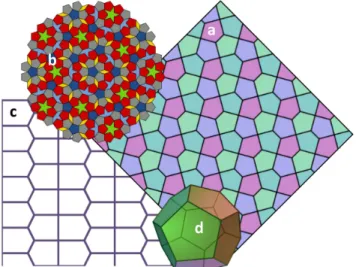
The pentagon, a 5-edges polygon, is an old issue in mathematical recreation. It forms the faces of the do-decahedron, one of the platonic solids whose shape is re-produced in biological viruses and in some metallic clus-ters [1]. The main peculiarity of this polygon is that, contrary to triangles, squares or hexagons, it is impossi-ble to tile a plane with congruent regular pentagons, the tilings must involve additional shapes to fill the gaps [2], like in the Penrose lattice (Fig. 1). It exists however several possibilities of tessellation of a plane with non-regularpentagons, a famous one being the Cairo tessel-lation whose name was given because it appears in the streets of Cairo and in many Islamic decorations (Fig. 1).
FIG. 1: (color online) Pentagonal lattices. (a) Cairo pen-tagonal tiling, (b) Penrose penpen-tagonal tiling, (c) penpen-tagonal lattice studied in refs. 6, 7, 8, (d) dodecahedron.
Such a lattice could attract interest in the field of ge-ometric frustrated magnetism. Indeed, frustration usu-ally arises when all pairs of magnetic interactions are not simultaneously satisfied in a system due to the
lat-tice topology, resulting in unusual physical properties [3]. Today, most of the studied systems are mainly based on triangles (or tetrahedra in three dimensions), and can be made perfect from both structural (regular polygons) and magnetic (equal first neighbor magnetic interactions) points of view. This is not the case with pentagonal lat-tices that must involve only non-regular pentagons to fill the space. The experimental realization of such a model system is thus a unique opportunity that could bring new interesting features in this field of magnetic frus-tration. In this letter we show that the Fe3+ lattice in
Bi2Fe4O9 materializes the first analogue of a magnetic
pentagonal lattice, and we interpret its peculiar non-collinear magnetic arrangement with respect to magnetic frustration.
Bi2Fe4O9 is a common by-product in the synthesis of
the multiferroic compound BiFeO3, and has been claimed
recently to display itself multiferroic properties [4]. This was the initial motivation of our study: this finding re-quires a precise determination of the symmetries in the magnetic ordered phase, since ferroelectricity can only arise in polar space groups. Such a precise determination has never been carried out on single crystals of Bi2Fe4O9,
and only powder neutron diffraction measurements have been reported [5] with no definitive conclusions due to the complexity of this orthorhombic structure. Actu-ally, there are two different sites of four iron atoms in Bi2Fe4O9: Fe1 occupies a tetrahedral position and Fe2
an octahedral one. In the structure, columns of edge-sharing Fe2 octahedra form chains along the c axis, and
these chains are linked together by corner-sharing Fe1
tetrahedra and Bi atoms (Fig. 2). As a result, the lattice formed by the different Fe3+ magnetic atoms is quite
re-markable. From a simple examination of the structure, five main magnetic superexchange interactions, J1to J5,
can be identified (Fig. 2). The structure can be simply viewed as layers perpendicular to the c axis: the mag-netic coupling of these layers along the c direction
in-2
FIG. 2: (color online) The Bi2Fe4O9 compound (space group Pbam; a = 7.965(4), b = 8.448(5), c = 6.007(3) ˚A at 300 K).
(left): View of the unit cell with the environment of the two Fe ions. Bi atoms are purple, Fe yellow and O red. Projection of the structure on the (a, c) plane (middle) and on the (a, b) plane (right). The atoms labels are in blue. Black lines materialize the magnetic exchange interactions.
volves only Fe2 atoms in the octahedron columns and is
achieved through two interactions, J1between the atoms
within the unit cell and J2between the atoms of adjacent
cells. Within a layer, each Fe1 interacts with its nearest
neighbour Fe1 via J4 and with two nearest neighbour
Fe2 pair (located above and below the mean plane) via
J3 and J5. The projection of this layer along c forms
a pentagonal lattice with three slightly different bonds per pentagon (Fig. 2). This geometry is equivalent to a distorted Cairo lattice, the perfect one involving convex equilateral pentagons with equal-length sides, but with different associated angles (Fig. 1).
What should be expected from such a geometry and what is actually observed ? Up to now, no experimental studies and very few theoretical calculations are available in the literature [6, 7, 8]. They only concern a very partic-ular pentagonal tiling, derived from the hexagonal lattice (see lattice c of Fig.1). Calculations within the antiferro-magnetic Ising model on this lattice yields a disordered ground state with a finite entropy per spin [6, 8], whereas in the Heisenberg model the classical ground state of the perfect pentagonal lattice has not yet been solved [7]. Single crystals of Bi2Fe4O9 were grown by the high
temperature solution growth method using a flux of Bi2O3 [9]. The temperature and magnetic field
depen-dences of the magnetization along the principal crystallo-graphic axes were measured using a SQUID magnetome-ter (Quantum Design) in the temperature range 2-380 K and in fields up to 5.5 T. The reported data, measured on the very same crystal used for the neutron diffraction study (2.5 x 2 x 1.5 mm3), were corrected for the
demag-netizing field effect. The DC susceptibility between 300 K and 800 K was measured on a home made Faraday-type magnetic balance in a magnetic field of 0.7 T, using an as-sembly of several randomly oriented single crystals. The reported susceptibility was corrected from diamagnetism using the Pascal’s constants χdia= -198 10−6 emu/mol.
Above room temperature, the magnetic susceptibility of
Bi2Fe4O9is found to obey a Curie-Weiss law with an
ex-trapolated paramagnetic temperature θp≈ - 1670 K and
an effective magnetic moment µeff = 6.3(3) µB per iron
atom (see Fig. 3). This later value is compatible with the 5.9 µB expected for Fe3+ ions (J=S=5/2). When
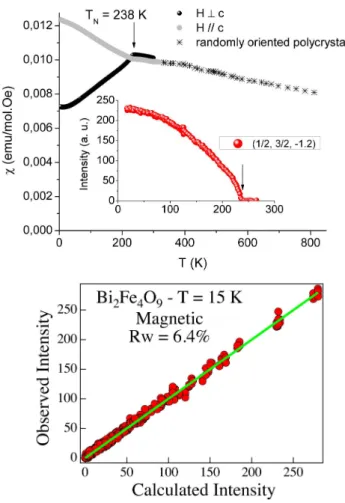
decreasing the temperature, an evident drop in the (a,b) plane susceptibility and a well pronounced increase of the caxis susceptibility are observed at TN = 238(2) K,
in-dicating a transition toward a magnetic long range order. This N´eel temperature is in agreement with the results on single crystal reported in ref. 10 but some 20 K lower that the one reported in refs. 4, 5, 11 for sintered sam-ples. The observed ratio between the N´eel temperature and the paramagnetic one, θp/TN ≈ 7, suggests, as
ex-pected from the geometry, a large degree of frustration. Further insights concerning the magnetic arrangement below TN were obtained using neutron diffraction. The
neutron diffraction experiments were performed on the two CEA-CRG diffractometers D23 and D15 at the Insti-tut Laue-Langevin (Grenoble, France) using wavelengths of respectively λ = 1.280 ˚A and 1.173˚A . Complete data collections have been made at two different temperatures T = 15 K and T = 300 K. The experimental data were corrected from absorption using the CCSL library [12]. The structural and magnetic arrangements were refined using the least-square programs MXD [13] and FULL-PROF [14], including extinction corrections [15].
When decreasing the temperature, new reflections, characteristic of an antiferromagnetic order, appear around TN = 244(2) K. They can be indexed with a
propagation vector k = (1/2, 1/2, 1/2), that is a doubling of the magnetic cell compared to the nuclear one in the three directions. The temperature variation of a mag-netic Bragg peak is presented in Fig. 3. The magmag-netic structure was solved from the 654 magnetic Bragg peaks collected at T= 15 K taking into account the presence of two magnetic domains [9]. There are four Fe1 atoms
re-FIG. 3: (color online) Linear magnetic susceptibility of Bi2Fe4O9as a function of temperature measured in magnetic
fields of 0.1 T and 0.7 T below and above 300 K respectively. Inset: Temperature variation of the (1/2, 3/2, −1/2) magnetic Bragg peak in zero field from neutron diffraction.
(Bottom) Graphical representation of the magnetic structure refinement at T = 15 K in Bi2Fe4O9: observed versus
calcu-lated intensities.
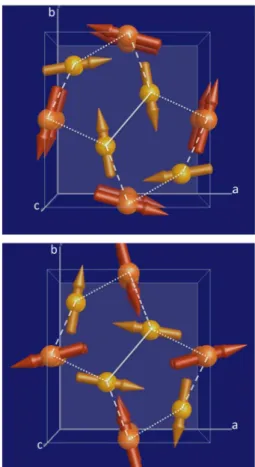
ported in Table I. The best refinement led to a residual factor Rw = 6.4%, with two nearly equally populated do-mains (42/58%). The magnetic moment parameters for the first domain are reported in Table I. The correspond-ing pictures of the magnetic arrangements are presented in Fig. 4. The moments on all the atoms are found re-stricted in the (a, b) plane. On each site, the four atoms are gathered into two pairs, antiferromagnetically cou-pled in the case of Fe1and ferromagnetically coupled for
Fe2. The magnetic moments of each pair are oriented
at 90◦, that is perpendicular to the moments of the
other pair on the same site. The phase between the two sublattices Fe1and Fe2is 155◦. The moment amplitudes
on the two sites Fe1 and Fe2 are slightly different, and
both much smaller than the expected value for a Fe3+
ion (5µB). A spin transfer process from the iron to the
neighbouring oxygen ions [16] could explain this reduc-tion. x y z µ θ φ Fe11 0.3540 0.3361 0.5 3.52(1) 100.1(1) 90 Fe12 0.6460 0.6639 0.5 3.52(1) θ11 + 180 90 Fe1 3 0.1460 0.8361 0.5 3.52(1) θ1 1 - 90 90 Fe14 0.8540 0.1639 0.5 3.52(1) θ11 + 90 90 Fe21 0 0.5 0.2582 3.73(1) -105.4(1) 90 Fe22 0 0.5 0.7418 3.73(1) θ21 90 Fe23 0.5 0 0.7418 3.73(1) θ12 +90 90 Fe24 0.5 0 0.2582 3.73(1) θ21 + 90 90
TABLE I: Coordinates of the Fe3+
ions in Bi2Fe4O9 and
spherical components of their magnetic moments in the first magnetic domain. The magnetic moments are defined in spherical coordinates by (µ, θ, φ). In cartesian coordinates (X,Y,Z) where X is along a, Y along b and Z along c, the mag-netic moment components are : MX = µ cosθ sinφ, MY =
µ sinθ sinφ, MZ= µ cosφ.
As it can be seen on Fig. 4, this non-collinear mag-netic structure forms imbricated rectangles of spins. This is quite unusual in such an orthorhombic system, where all the directions are non-equivalent and where there is no fourfold axis. This peculiarity certainly has an ori-gin in the frustration of the magnetic interactions. One should also notice that for this structure the magnetic space group is centrosymmetric, that is non polar. This result is a priori not compatible with ferroelectricity, and this shed some doubts on the claimed ferroelectricity ob-served in polycrystalline Bi2Fe4O9 [4].
To check the relevance of the Cairo pentagon lattice model and the role of geometric frustration on the ob-served magnetic structure of Bi2Fe4O9, we have
under-taken a two step theoretical approach based on a lo-calized spin model. Calculations have been made both for an ideal Cairo lattice (including the perfect case J3 = J4 = J5), and in the real geometry. The angles
between magnetic moments in a system is imposed by the set of magnetic interactions. In a first step, an exact Fourier space analysis at zero temperature is performed, assuming a single-k like ordering, which allows to find the periodicity of the magnetic structure [17]. Once the pe-riodicity is known, an energy minimization in real space gives the respective orientation of the magnetic moments within the magnetic unit cell. For these calculations, the five exchange interaction parameters J1to J5already
de-scribed have been considered, using a Heisenberg Hamil-tonian H = −1
2
P
i,jJkS~i· ~Sj. All the moments were
assumed to be of equal amplitudes.
In the Cairo pentagonal lattice, a large set of Ji values
yield the observed (1/2, 1/2, 1/2) propagation vector. The doubling of the magnetic cell along c alone requires however J2to be negative and J1positive or slightly
4
FIG. 4: (color online) Magnetic structure. First and second magnetic domains. (Yellow): Fe1 sites. (Orange): Fe2 sites.
The second domain is deduced from the first one by apply-ing the symmetry operation (x + 1/2, ¯y + 1/2, ¯z) lost by the magnetic structure, taking into account the translational part that shifts atoms from one cell to a neighbouring one.
the magnetic configuration is always made of antiparal-lel Fe1 pairs of moments and parallel Fe2 ones. On a
same site, the pairs of moments are perpendicular to each other. This is exactly what is observed experimen-tally. The only parameter that could vary as a function of the particular values of the Ji’s is the phase angle
be-tween the two sites Fe1 and Fe2. The ∼ 155◦ observed
value requires J3, J4, J5 to be all negative, with a ratio
J3/J5=2.15 for |J4|≥ |J3|. The observed magnetic
struc-ture of Bi2Fe4O9 and in particular the 90◦ phase angle
between pairs of atoms at the same site, is thus recovered by this model with some realistic set of the five super-exchange interactions Ji. In the Bi2Fe4O9real geometry,
the Fe3+lattice differs from the Cairo pentagonal one by
the presence of two stacked Fe2 atoms, instead of a
sin-gle atom, at two vertices in each pentagon. Performing the calculations in the real geometry yield very similar results than those of the ideal case. The perpendicular ferromagnetic and antiferromagnetic Fe1and Fe2pairs is
a robust recovered feature. The only difference between both lattices is the domain of existence of this phase that extends to lower |J3| and |J5| with respect to |J4| in the
real case. The Bi2Fe4O9real lattice is therefore
topolog-ically equivalent to the Cairo one after renormalization of the J3 and J5 interactions with respect to the J4 one.
To summarize, we have found that the compound Bi2Fe4O9 displays a very original non-collinear magnetic
structure, made of four Fe1 moments and four Fe2 ones
forming interpenetrating patterns of four-fold spin rota-tions. This magnetic arrangement is very peculiar for a pentagonal lattice with nearest neighbour interactions only and is not a mere propagation of the magnetic ar-rangement minimizing the energy in each individual pen-tagon, contrary to the case of triangles based lattices. It actually results from two ingredients, a high geometrical frustration and an additional complex connectivity (two kinds of sites with different coordinations). This first materialisation of a pentagonal Cairo lattice opens new perspectives in the field of magnetic frustration.
Work at Sofia was supported by the Bulgarian Science Foundation under Grants No. TK-X-1712/2007. The authors are grateful to Michael Mikhov for the high tem-perature susceptibility results and to Luc Valentin for the help with the tilings.
[1] X. J. Kong, Y. P. Ren, L. S. Long, Z. Zheng, R. B. Huang, and L. S. Zheng, J. Am. Chem. Soc. 129, 7016 (2007). [2] J. Kepler, Harmonices Mundi (J. Planck for G. Tampach,
Linz, Austria, 1619).
[3] R. Moessner, A. P. Ramirez, Physics Today, 59 (2), 24 (2006).
[4] A. K. Singh, S. D. Kaushik, B. Kumar, P. K. Mishra, A. Venimadhav, V. Siruguri, S. Patnaik, Appl. Phys. Lett., 92, 132910 (2008).
[5] N. Shamir, E. Gurewitz, Acta Crystallogr. Sect. A34, 662 (1978).
[6] M. H. Waldor, W. F. Wolff, J. Zittartz, Phys. Lett. 106A, 261 (1984); Z. Phys. B: Condens. Matter 59, 43 (1985).
[7] U. Bhaumik, I. Bose, Phys. Rev. B 58, 73 (1998). [8] R. Moessner, S. L. Sondhi, Phys. Rev. B 63, 224401
(2001).
[9] E. Ressouche et al., in preparation.
[10] D. M. Gianchinta, G. C. Papaefthymiou, W. M. Davis, H. C. Zur Loye, J. of Solid State Chem. 99, 120 (1992). [11] A. G. Tutov, I. E. Mylnikova, N. N. Parfenova, V. A.
Bokov, S. A. Kizhaev, Sov. Phys. Solid State 6, 963 (1964).
[12] J. Brown, J. Matthewman, Cambridge Crystallography Subroutine Library, Report No. RAL93-009 (1993). [13] P. Wolfers, J. Appl. Crystallogr. 23, 554 (1990). [14] J. Rodriguez-Carvajal, Physica B 192, 55 (1993). [15] P.J. Becker, P. Coppens, Acta Crystallogr. Sect. A30,
129 (1974).
[16] V. C. Rackhecha, N. S. Sayta Murthy, J. Phys. C.:Solid State Phys. 11, 4389 (1978).