International Immunology, Vd 6, No 1, pp 21-30
Influence of surrogate L chain on
D
H
JH-reading frame 2 suppression in mouse
precursor B cells
Dirk Haasner, Antonius Rolink, and Fritz Melchers
Basel Institute for Immunology, Grenzacherstrasse 487, 4005 Basel, Switzerland
Key words: DHJH rearrangement, reading frame, surrogate L chain
Abstract
DHJH rearrangements start In progenitor and precursor B cells and occur In three reading frames (rf). A strong bias for rf I has been noticed in murlne and chicken antibodies, while the
representation of rf II has been found suppressed both In peripheral as well as In precursor B cells. H chain gene loci DHJH rearranged In rf II are potentially capable of expressing a truncated DnJHC, protein on the cell surface. Mice Incapable of expressing this protein on the surface have previously been shown to have all reading frames represented In near equal frequency, suggesting that membrane-bound DHJHC, protein Is Involved In the suppression of rf II. In this paper we show that suppression of rf II Is not yet established In c-ktt* CD43+ IL-7/stromal cell-reactive pre-B I cells of fetal liver at day 15 of gestation, but becomes established when such precursor cell populations are expanded In vitro on stromal cells In the presence of IL-7. H chain gene loci using the DQJJ segment for rearrangements (which contains a stop codon in rf II, thus being unable to make DHJHC, protein) do not show rf II suppression under these conditions. The same type of fetal liver-derived pro B-l cells from X5 deficient mice also do not show rf II suppression after In vttro expansion. Bone marrow-derived pre B-l cells from normal mice assayed ex vivo and expanded In
vivo show rf II suppression, while the corresponding pre-B I cells from X5T mice do not.
Collectively these experiments suggest that surrogate L chain Is involved In rf II suppression. This may happen by Inhibition of proliferation of pre-B cells expressing a complex of DHJHC, protein and surrogate L chain.
Introduction
The Ig heavy (H) chain gene bcus on chromosome 12 of the mouse consists of probably >100 VH gene segments, 15 DH gene segments, and four JH gene segments (1-3). Of the 15 DH segments, two are DFL segments ( D ^ g , and 0^^^), 12 are Dsp segments (Dsp^-DSPspjn plus D ^ x ) , and one is a D Q ^ segment.
During differentiation of progenitors (pro-B cells) to precursors of the B lineage pathway (pre-B I cells; for nomenclature see 4), DH segments are first rearranged to JH segments (5). The intervening sequences between the rearranged DH and JH are frequently deleted as circular DNA. As long as DH segments at the 5' side and JH segements at the 3' side remain in the rearranged H chain gene locus, secondary rearrangements are possible. Such secondary DHJH rearrangements were shown by studies of circular excision products in which pre-existing DHJH joints were found (6). Secondary DHJH rearrangements have also been implicated from analyses of DHJH joints in clones of pro- and pre-B I ceils of fetal liver and bone marrow early in development (7).
DHJH rearrangements can occur in three reading frames (rf) (8,9). The DH segments carry promoter-like elements upstream of the coding sequences and an ATG start codon (at position - 63 for all D ^ segments, -108 for Da segments, and - 1 2 0 for the DQSJ segment) which is 'in frame' with JH when the DHJH rearragement occurred in rf II. The protein product of such a rf II rearranged locus, a truncated H chain consisting of DH JH, and C,, has been detected in one cell line (10). Since the DQSJ segment carries a stop codon 48 nucleotides after the start, only Dgp- and D^-, but not D^-containing DHJH rearranged H chain bci can express the rf II rearranged locus as a truncated /xH chain. Pre-B cells express the proteins X5 and V p ^ , which can be found on the surface as a surrogate light (L) chain (11,12), reviewed in (13). One Abelson virus-transformed cell line has been found to express the truncated DHJHC,, protein together with surrogate L chain on the surface (14).
DHJH joints in rf I are over-represented. Short stretches of sequence homotogy in the DH and JH segments might help to
Correspondence to: D Haasner
afign the recombining DNA strands and this is likely to contribute to the rf I over-representation (3,8,9,15-17). When D - J recombination reactions are measured with extrachromosomal substrates transfected into murine pre-B cell lines in vitro, i.e. when DHJH rearrangements can occur without cellular selection, a rearrangement using a four nucleotide overlap (as in DHJH rf I) occurs at 55% (18). A similar preference for rf I rearrangements is observed in pre-B cells from fetal liver which do not express high levels of the enzyme terminal deoxynucteotidyl transferase (TdT) (19,20), and, therefore, do most often not insert non-temptated (N) nucteotides into the DHJH joints (7,9,15,16,21,22). The insertion of N nucteotides appears to correlate with the level of TdT expression (23,24) which is high in bone marrow-derived pre-B cells. N-region insertion reduces the preference for overlap-mediated joints (18). A preference for rf I has also been found in chicken (25).
A different mechanism, apparently independent of TdT expression, is the insertion of so called P nucteotides, which consist of short palindrome (P) sequences specific to the joining ends of the gene segments (26). P nucteotides are present at the coding joint when exonuctease activity is low (16) and have been frequently observed in sequences derived from fetal liver (9,15,16,22).
White the preference for DHJH joints in rf I appears to be the consequence of a molecular selection of DNA strands during rearrangement, the suppression of rf II is thought to arise through cellular countersetection against those pre-B cells which expess the truncated DHJHC, protein on their surface (4,27,28). Further evidence comes from /iMT mice which can neither express DHJHC, protein nor ^H chains on their surface due to disruption of the transmembrane portion-encoding exon. In the non-functional, targeted aDeles of splenic B cells of heterozygous /tMT mice, rf II DHJH joints are normally represented and not suppressed (27).
The surrogate L chain can form a disutfide-bonded complex with DHJHC, protein as well as with /*H chains (14, 29). Membrane deposition on pre-B cells of D H J ^ protein and /JH chains may well be dependent on this association with surrogate L chain, just as membrane deposition of IgM on mature B cells is dependent on the association of /iH chains with normal L chains. If this were so, then pre-B cells of mice with a defective X5 gene (X5T mice; (30)) should be unable to deposit DHJHC, proteins in membranes, which would also abofish the suppression of pre-B cells with H chain loci DHJH rearranged in rf II.
In this paper we analyze the structures of DHJH joints in pre-B cells obtained from fetal liver and bone marrow of normal as well as X5T mice to determine their rf distribution. B220" c-W0* pro-B cells and B220+ c-kit* CD43+ pre-B I cells are clonabte ex wvo with high efficiency and proliferate for long periods of time in vitro on stromal cells in the presence of IL-7 (7,31). Although a defective X5 gene leads to the depletion of later stages of B cell development (pre-B II cells, immature B cells) and to a delayed appearance of slg+ ceDs in the periphery (30), the defect does not impair the generation of normal numbers of pro-B and pre-B I cells (32). In this paper we, therefore, also analyze the structures of DHJH joints of pre-B I cell lines and clones obtained from fetal Bver and bone marrow of normal and X5T mice. All DSP segments and one of the two DH_ segments (i.e. D H ^ ) , but not Dp,,,^ and D ^ are detected by a polymerase chain reaction (PCR) with an oigonucteotide primer which hybridizes in the 5' regions of afl these D segments. A second ofigonucteotide primer is employed to detect
Q52-H j
Collectively our results present evidence for the involvement of
surrogate L chain in the selection of rfs of DHJH joints in pre-B cefls, which appears to function by a suppression of proliferation of
pre-B I cells with rf II DHJH rearranged H chain gene loci.
Methods
Mice
(C57BL/6 ( x ) DBA/2)F1 (BDF,) mice were obtained from Institut fur Bictogisch-Medizinische Forschung AG (FulRnsdorf, Switzerland). Homozygous X5T mice (30) were bred at the Institute's animal facilities. Cells f a FACS sorting and pre-B cell culture were prepared from different lymphopoietic organs at different developmental stages (fetal Bver, newborn and adult liver, spleen, and bone marrow) as described (7).
FACS staining and sort
Cell staining procedures and antibodies employed in the staining reaction have been described previously (7,31). Cells expressing B220, c-kit, S7(CD43), BP1, or combinations thereof were sorted using the FACS-Star Plus (Beckton-Dickinson, Mountain View, CA).
Cell culture
Cell suspensions were plated under limiting dilution conditions on a feeder layer of 3300 rad irradiated stromal cells (PA-6 cefls, (37)) in serum free medium containing murine rlL-7 at a concentration of 100-200 U/ml. The culture conditions for the growth of these non-transformed pre-B cells have been described previously (31). Pre-B cell clones were expanded to - 5 X 1 06 cells before they were harvested for the preparation of DNA.
DNA Preparation
Cells (5X10⁵) were harvested, washed in PBS, and lysed by boiling for 5' in 500 /il PBS. Proteinase K (Boehringer, Mannheim, Germany; 20 ^g/ml final) was added, the lysate digested at 55°C for 3 h and boiled again to destroy Proteinase K activity.
The solution was extracted once with phenol:chloroform:isoamyt-alcohol (25:24:1) and once with chtorc»form:isoamylphenol:chloroform:isoamyt-alcohol (24:1). DNA was precipitated with 1 volume isopropanol/0.1 volume NaAcetate, pH 5.2, centrifuged, the pellet washed with 1 volume 70% Ethanol, and air dried. The DNA pellet was dissolved in 500 /J 10 mM Tris, pH 8.3. Afiquots of 5 /d of this preparation (containing the DNA of 5000 cells) were subsequently used for PCR amplification.
PCR Amplification and Cloning
The PCR conditions and oSgonucteotide primers to amplify D H - JH rearrangements have been previously described by Gu etal. (27). The upstream primer binds 5' of aD Dg. segments and DpLiai. The downstream primer binds 3' of JH4, thereby generating PCR products of different lengths according to the JH segment used for rearrangement (7). A Perkin-Elmer Cetus DNA Thermal Cycler and CetusTaq Polymerase (Perkin-Elmer Cetus, NorwaJk, CT) were used for PCR amplification. D H - JH1 rearrangements generate products
of 1700 bp, D H - J H 2 1450 bp, D H - J H 3 1100 bp, and D H - J H 4
600 bp respectively.
A different 5' primer was used to amplify D ^ rearrangements in conjunction with the 3' JH primer. The primer sequence is 5'-GCC TCA GAA TTC CTG TGG TCT CTG ACT GGT-3'; it contains an EcoRI cloning site. PCR product lengths are 2200 bp for
germline, 1500 bp for DQ- JH1 , 1170 bp for DQ-JH2, 790 bp for DQ- J H 3 , and 230 bp for DQ-JH4 respectively.
The PCR products and the M13mp19 vector (New England Biolabs, Beverly, MA) were digested with two different restriction enzymes (New England Biolabs) according to the enzyme manufacturer's conditions (forced cloning), and size fractionated on a low melting point agarose gel (Ultra Pure LMP Agarose; BRL, Bethesda, MD). Bands of interest and the linearized vector were cut out under UV illumination, the agarose remelted, ligatJon reagents and T4 DNA Ligase (Pharmacia, Uppsala, Sweden) mixed into the agarose, and Itgation carried out directly (39). Ligated vector was heat shock transfected into competent Escherichia cdi JM 105 bacteria and plated out on YT plates. Recombinant plaques were identified by plaque hybridization with a radioactive JH4 digonudeotide probe (AGGAACCTCAGTCACCGGATCCGT) (all procedures according to (39)). Single-stranded M13 DNA was sequenced using a Sequenase 2.0 sequencing kit (United States Bkxhemicals, Cleveland, OH) and an IBI sequencing gel apparatus (Eastman Kodak, Rochester, NY).
Results
Structures of DHJH joints in FACS-sorted pre-B cells from fetal
liver and bone marrow of normal and X5T mice
Cell suspensions from fetal liver or bone marrow of normal BDF, and surrogate L chain deficient X5T mice were sorted for B220+
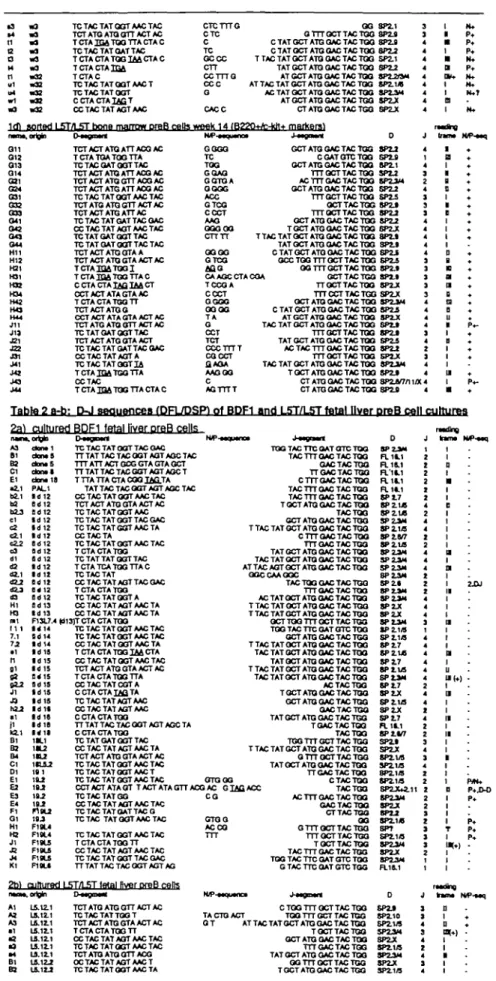
c-kit+ or B220+ CD43+ pre-B cells as described (7), and DNA was prepared from these cells for DHJH joint sequencing. Table 1 shows 36 sequences of normal fetal liver cells (day 15, B220+
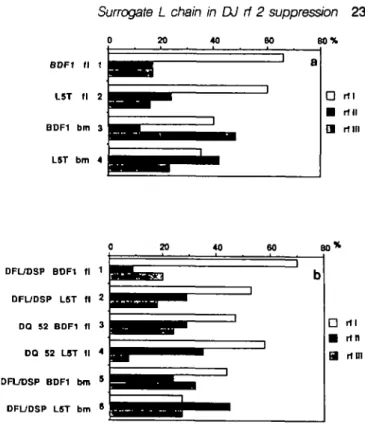
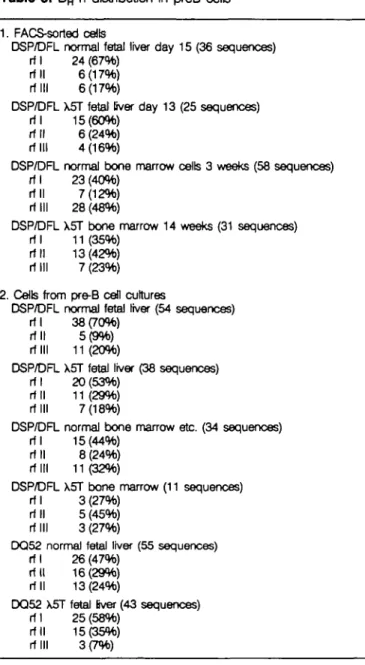
c-kjt+), 25 sequences of X5T fetal liver cells (day 13, B220+ c-kit+), 58 sequences of normal bone marrow cells (3 weeks of age, B220+ c-kit* or S7+ BP1+) and 31 sequences of X5T bone marrow (14 weeks of age, B220+ c-kit+). Pre-B cells from fetal liver of normal (day 15) as well as X5T (day 13) mice only rarely displayed N or P nudeotides (Table 1a and b), whereas bone marrow-derived pre-B cells (normal: w3, X5T w14) displayed high junctional diversity due to added nudeotides (Table 1c and d). Table 3 summarizes the sequendng data and was used to generate Fig. 1(a and b). In the fetal liver of both normal and X5T mice, most DHJH joints were in rf I (60-67%) (Fig. 1a, 1 + 2). This is presumed to be the consequence of a preferred alignment of short stretches of sequence homology in the DH and JH segments. In these cells, DHJH joints in rf II and rf III were present in approximately equal amounts (18-23%). This distribution of frequenctes of rf I versus rf II versus rf III DHJH joints closely resembles the distribution found in a system where recombinants of the DHJH type were generated on extrachromosomal substrates transfected into murine pre-B cells of fetal Bver origin in vitro, i.e. without selection h vivo (18). In addition, the results in Fig. 1(a) also show that rf II is not suppressed in fetal liver pre-B cells ex vivo. It suggests that no selection of H chain alletes and/or cells carrying those alleles has taken place at that early stage of B cell development.
In bone marrow of normal and of X5T mice, rf I and rf III DHJH joints are present at similar frequencies, i.e. rf I is not over-represented, and most of these joints carry N region sequences inserted by TdT. Hence this result agrees with Gerstein and Lieber's findings (18) with extrachromosomal rearrangement substrates that the constraint to align short homologous sequences of DH and JH is diminished by TdT and N-region insertion. Although D Q ^ - J H
0 20 40 60 8 0 % BDF1 L5T BDF1 L5T 11 1 fl 2 bm 3 bm 4 1 1 a D rtl • rtll H mil DFUDSP BDF1 tl 1 OFUDSP LST tl 2 DQ 52 BDF1 tl 3 DO 52 LST tl * DFUDSP BDF1 bm 5 DFUDSP LST bm •
Fig. 1. Presence or absence of rf II suppression in different populations
of pre-B cells from normal and X5T mice. The figure shows the rf usage in FACS-sorted pre-B cells (a) and cultured pre-B ceBs (b). Values are given as percent of total sequences analyzed. The numbers of total sequences are given in Table 2 Panel (a) includes Di^JHrearrangemerrts using Dp(_16 ,
or all Dgp segments in cells of BDF1 fetal liver (1), X5T fetal Bver (2), BDF, bone marrow (3), and X5T bone marrow (4). Panel (b) includes D H JH
rearrangements using D^1 6 , or all Dsp segments in cultured cells
obtained from BDF, fetal Bver (1), X5T fetal fiver (2), BDF, bone marrow (5), and X5T bone marrow (6), and D ^ rearrangements using the DQ52 segment in cultured cells obtained from BDF, fetal liver (3) and X5T fetal liver (4). Details for sequencing of D H JH joints are given in Methods.
joints are not analyzed here, we expect that they show a similar pattern of rf usage (see Note added in proof).
Most important for the possible role of surrogate L chain in the rf selection process is the finding that rf II is represented in bone marrow cells of X5T mice in frequencies nearly equal to those for rf I and rf III, while it is suppressed in bone marrow cells of normal mice (P=0.003) (Fig. 1a, 3 + 4). These results indicate that the inability of pre B cells to express the surrogate L chain Vpnj^/XS abolishes the mechanism(s) which suppresses rf II representation
in DHJH joints.
Structures of D ^ joints in pre-B cell lines and clones proliferating in vitro
Pre-B cells from fetal liver and bone marrow of normal and X5T mice were cloned by limiting daution and expanded by proliferation on stromal cells in the presence of IL-7 to - 1 06 cells (i.e. for at least 20 divisions) as described (31). DNA was prepared and DHJH joints sequenced. Again, DMJH joints of fetal liver-derived lines and clones only rarely contained P or N nudeotides while those of bone marrow frequently did (Table 2a-d). The rf I D ^ H joints were found to be strongly over-represented in all lines and clones except in Da/Dgp - JH joints of bone marrow from normal and X5T mice (Fig. 1b, 5 + 6). While D Q ^ - JH joints in rf III were unexpectedly
Tabtel a-b: D-J sequences (DFL/DSP1 of BDF1 and L5T/L5T sorted fetal liver preb cells
1 al sorted BOF1 fetal Byer DT»B cells day 15 (B?2(U/c-tat+ mnrkBrs) ram. origin 0 npmin HP
CC TAC TAT AOT TAC TAT AOT TAC CCTACTATAOTAACTAC
QATOOTTACTA TC TAC TAT GOT AAC T TCTATQATOOTT TCTACTATOOTAACT COT ACT ATA OTA AC CCTACTATAOTTACQ CCTACTATAOTTACGAC CCTACTATAOTAACTAC TCTATGATOOTTAC CCTACTATA TCTATOATOOTTACTAC TC TAC TAT GOT AAC TAC TCTACTATQATTACQA CCTACTATAOTAACTAC TCTACTATOOTAACTAC TCTACTATQATTACQ TCTATQATOQTTACTAC TCTATQATGOTTACTAC TCTACTATQQB4CTAC TCTACTA TOO 144 CTA T C T A j n i T O O T T A C T A C TC TAC TAT GOT AAC TA CCTACTATAOTAACTAC C C T A C T A I A f l J M C T A C TCTAIQATOQTTACTAC TCTACTA TCTATQATOOTTACTAC TCTACTATQATTACQ TCTACTATQQT CCTACTATAQTAACT TCTACTATQGTTATQAC TCTAB34TOOTTAC TCTACTATOOTAACTAC TCTACTATQOTAACTAC OACTACTTTOACTACTOQ SP2.1WX TTTQACTACTOQ SPZX T QCT ATO QAC TAC TOO S P U TTQCTTACTQO 3 P 1 1 TTOCTTACTQO S P U OOTTTQCTTACTOQ SPZI CTQQTTTQCTTACTOO SP1X CTATQQACTACTQQ 3P2.11 TATQCTATQQACTACTOQ EP2.11 TATOCTATQQACTACTQQ SP2JC TTTQACTACTOQ S P U TOQTACTTCAATQTCTQQ SP2.11/X TACTATACTATQOACTACTQQ S P U TOO S P U TTACTATQCTATOQACTACTOO S P U OCCTOQTTTQCTTACTOO SPZX TAC TTT QAC TAC TOO S P U CTTACTQQ S P U TOQTTTQCTTACTQQ S P U OCCTGGTTTQCTTACTGO S P U TTACTATGCTATOQACTACTQQ S P U TTTQCTTACTOQ S P U CTACTOQ S P U TQCTATQQACTACTaa SPZI TACTTTQACTACTOO SPtX TTQCTTACTOQ 8P2J( CTACTTTQACTACTQQ S P U CTOQ S P U CTQQTTTOCTTACTGa S P U OCCTOQTTTQCTTACTQQ S P U CTOQTTTQCTTACTQO S P U TTOCTTACTOO SP2J( OCTATOQACTACTQQ S P U M AT TAC TAT GCT ATO QAC TAC TOO S P U
TACTATOCTATOQACTACTaQ 3 P M TAT OCTATQ QAC TAC TGO S P U
1b) sortfld LST/L5T fetallvnr omB cots dnv 13 (BggO+As-tdt+ markets) Oil •21 D2I Da D24 on cm D41 oa E l l E23 E24 EJ1 EXI ES4 E41 E43 F11 F1I F H F22 F H F33
TC TAC TAT GOT AAC TAC CCTACTATAOTAACTAC T CTA CTA TOO 144 CTA C TC TAT OAT QQT TACT TCTACTATQATTACQ AC TCT ACT ATO OTA ACT TC TAC TAT GOT AAC TAC CC TAC TAT AOT AAC TA TCTACTATOOTAACTAC TCTATOATOOTTACTAC TC TAC TAT GOT TAC
T C T A C T A T O A T T A C
TCTACTATQATTA TC TAC TAT GOT AAC TA TC TAT OAT GOT TAC T TCT ACT ATQ OTA ACT TC TAC TAT OAT TAC QAC TCTACTATQQTAA T CTA CTATQA TTA COA C TCT ATQ ATQ OTT AC TCTACTA TOO TC TAC TAT OAT TAC TC TAC TAT OAT TAC Q TCT ACT ATO OTT ACS AC TC TAC TAT OAT TAC QAC
j — g m r t n TOQTAtTTCGATOTCTOQ S P U
TTTQACTACTGO 8PZX AC TAC TOO S P U TT OAC TAC TOO S P U AC TACTTTQACTACTOO S P U TTTQCTTACTQQ S P U OCC TOO TTT OUT TAC TOO SPZI TOCTATOOACTACTOO S P U TAT OCT ATO QAC TAC TOO S P U AC TAC TOO S P U TTTQACTACTOQ EP2JM TTTQACTACTGO SP2J
TOCTTACTQQ SP21 T OCT ATO QAC TAC TOO SP2.1 TTOCTTACTQO S P U AT TAC TAT OCT ATQ OAC TAC TOO S P U TAT OCT ATO QAC TAC TOO SP2J TAC TAT OCT ATO QAC TAC TOO S P U T OCT ATQ QAC TAC TOO 8P12 CTOOTTrOCTTACTGO S P U TTTOACTACTQQ S P U TAC TOO S P U CCTQOTTTGCTTACTOQ S P U T TAC TAT OCT ATO QAC TAC TOO SP2JH
TAT OCT ATQ QAC TAC TOO S P U
Iram KP-Mq M 1 I I I I • I I
Table 1 c-d: D-J gequencos (DFUDSFl of BDF1 and L5T/L5T sorted bone marrow DreB cells
mrtnd RDF1 bong mafrnw nmfl r nr R7WBP1 t n a IW-aaq 0 1 o l •1 •3 •4 bt b3 b4 d <a 41 <a d4 fi D 9>
e
h i£
k2 n a • u a l n3 »4 •1 n3 rO •4 ol o l 04 01 P2 n (2 n M 11 •a • 3 • 3 •a •a •a • 3 •a •a •a aa • 3 ad aa «3 aa aa H 3 «3 •a •a aO aa afl • 3 • 3 aa aa aa aa aa • 3 aa aa w3 ar3 aa aaTTT ATT ACT ACO ATO OTA QCT A QA TCTACTATOOTAACTAC OOAT TCTACTQTQQTAA GO TCTATOATOQTI fl4T T CTA CTA TOO 144 CTA C C TCTACTA COO T CTA CTA TGO 144 CTA C OTA TCTAIQATOOTTACTAC QAOO TCTACTATQA CCCC CCTACTATAOTAACTAC OAAAO TC TAC TAT 0 0 QAQ CC TAC TAT AST TAC TA TAOTIQA TC TAC TAT GOT AAC TAC O T CTA CTA TOO 144 CT QAOQ TCTACTATOO OCT TC TAC TAT OAT TAC QAC O TCTACTATOOTAACTAC OCO CC TAC TAT AOT TAC TAT AGO TAC QAC QTAA TCTACTATOQT C C CTA CTA I 4 Q TTA CTA 1 4 0 OTA COA C TC TAC TAT OAT TAC OAC
CCTACTATOOTT C CTA CTA I 4 Q 1 4 4 CTA C C CTA CTA I A f i 144 CTA C T CTA CTA TOO 144 CT T CTA CTA TOO IAA CT T CTA CTA TJB4 TTA COA C CCTACTATAOTAACTAC T CTA CTA TOO 1 4 4 CTA C
OAQOQ AOQAQ OTTC TTCOT TA OQOQQ QAQGOA QAQQO TCTACTATQQI44 AACC CTAACTQQQAC TCT OCT CCTACTATAQTAACCAC ACC CC TAC TAT AOT AAC T
TCT ACT ATO OTA AC CCC CCTACTAIAQ CCCCT CCTACTAIAflTTACTA TA C CTA CTA 140.144 CTA C QA CCTACTATAOTAACTAC OQOAQO C C T A C T A I 4 Q I 4 4 C T A C OTGOOOTTTTT T CTA CTA TOO 1 4 4 C CCTOQO T CTA JBA TOO TTA C CCCC TCTACTATOGTAAC CCTT C CTA CTA I 4 f l TTA CTA JAfl TTA CO TCTACTAIQ4CT T TCTACTATOATTAC TTQT TCTACTATOOTAACT
CCTACTATAOTTACGAC QAGG
OAT TAC TAT OCT ATO OAC TAC TOO FLtS.1 AT TAC TAT QCT ATO QAC TAC TGO 8PZ1« OAT TAC TAT OCT ATO QAC TAC TOO SPZ1
CT ATO QAC TAC TOO S P U CTOQ TAC TTCQAT QTC TOO SPZI
QAC TAC TOO S P U M TT QAC TAC TOO SPZ1
CTACTOQ S P U OCC TOO TTT OCT TAC TOO S P U OOTTTQCTTACTOO 8P2JC T TAC TAT OCT ATO QAC TAC TOO S P U M
OCT ATO QAC TAC TOO SPZX AC TAT OCT ATO OAC TAC TOO SPZ.1 OCT ATO OAC TAC TOO SPZI TTTQCTTACTGa SPZS aaTTTOCTTACTOO S P Z I TAT OCT ATO QAC TAC TGO SPZI QAO AT OCT ATO QAC TAC TGO SPZJU3*CS2 OAT TAC TAT QCT ATO QAC TAC TOO S P U
GOT AC TAC TTT QAC TAC TGO S P Z X t Z I I CTACTOO SPZ2 TTOCTTACTOQ S P U TOO TTT OCT TAC TOO SPZX C TAT QCT ATO QAC TAC TOO SPZX CT ATO QAC TAC TOO SPZI AC TOO TAC TTCQAT QTC TOO S P U , TOO TAC TTC OAT OTC TOO S P U TAC TOO TAC TTC OAT OTO TOO SPZX TOO TAC TTCQAT QTC TOO SPZI QAOO TT QAC TAC TOG SPZ1+C62
CO S P U T OAC TAC TOO SPZX OQ TTT QCT TAC TOO SPZX GTTTQCTTACTQO S P U
CTOQ SPZX/Z11 TOCTTACTQQ SPZX
OAC TAC TOO SPZX TAT QCT ATO QAC TAC TOO SPZX TAC TAT OCT ATQ QAC TAC TOO SPZX TTOCTTACTOO SPZI COAT QTC TOG SPZ» AC TAC TTT QAC TAC TOO SPZS
T QAC TAC TOO SPZXtZt TAT GCT ATO OAC TAC TOO S P U
AC TAC TTT QAC TAC TOO S P U CC TOO ITT QCT TAC TOO SPZI
TTQCTTACTOQ E P U d 1 a V-• u • 1 n i ¥• 1 ID ay* i I vn on i i H* Pt p+ P t Ht H, H» Ht K* p+ H* H* P* K. N* Pv H* a H* n H* I H* a N» m P» IWf Ht B P* I t Ht a H* a P* n P+ Bra u i i i p»
Table 1 (cont.) •3 >4 n a a H n U1 O4 wi • 3 • 0 • 3 • 3 • 3 • 3 • 3 •32 «32 •32 w33 •32
TC TAC TAT OGT AAC TAC TCT ATO ATO OTT ACT AC T CTA JJB4 TOO TTA CTA C TCTAC TAT OAT TAC T CTA CTA TOG 14A CTA C T C T A C T A I B i TCTAC
TC TAC TAT OOT AAC T TCTAC TAT OOT CCTACTAIAG.T CCTAC TAT AOT AAC
CTCTTTO OO 8P2.1 CTC OTTTQCTTACTOO 8PZS C CTATOCTATOOACTACTOO SP2J TC CTATOCTATOQACTACTQQ BP2J OCCC TTACTATOCTATOOACTACTOQ SP2.1 CTT TATCCTATOOACTACTOO 8PZ2 CCTTTO ATGCTATOaACTACTOa SPL2W4 CCC AT TAC TAT OCT ATO GAC TAC TOO SP2.UB O ACTATQCTATaOACTACTOa SP2JSM ATOCTATQQACTACTQa SP2J CACC CTATOGACTACTGQ 8P2J< QQQO TC TOO GQAO G O T O * OQOG ACC OTCQ CCCT AAO GOG 0 0 CTTTT
1 tS\ sorted L5T7L5T bone marrow pmR rete week 14 tBg2Q+/n-kit+ a n a t : 013 014 Oil G24 031 032 an O41 042 043 O44 H11 H12 H21 H31 K B H34 H4J H43 H44 J11 J11 J21 J22 J31 J41 J42 J43
TCT ACT ATQ ATT ACO AC TCTATOATOOTTA TCTAC OAT OOT TAC TCT ACT ATO ATT ACO AC TCT ACT ATQ OTT ACO AC TCT ACT ATO ATT ACO AC TC TAC TAT OOT AAC TAC TCT ATO ATQ OTT ACT AC TCT ACT ATO ATT AC TC TAC TAT OAT TAC OAC CC TAC TAT AQT AAC TAC TC TAT OAT OOT TAC TC TAT OAT OOT TAC TAC TCT ACT ATO OTA A TCT ACT ATO OTA ACT AC T CTA IQA. TOO I TCTAJBATOOTTAC C CTA CTA I A f l I S A CT CCTACTATAGTAAC T CTA CTA TOO TT TCTACTATOO CCT ACT ATA OTA ACT AC TCT ATO ATO OTT ACT AC TCTATOATOOTTAC TCT ACT ATO OTA ACT TC TAC TAT OAT TAC OAC CCTACTATAOTA TCTAC TAT GOT I A T CTA JflA. TOO TTA CCTAC
T CTA 3QA TOO TTA CTA C
GCTATOOACTACToa S P U C GAT OTC TOO S P U OCT ATO OAC TAC TOO SP2.1 TTT OCT TAC TOO SP2J AC TTT OAC TAC TOO SP2JM OCTATOOACTACTOQ S P U
TTTOCTTACTOO SPTS OCTTACTOO S P U TTTOCTTACTOO S P U OCT ATO GAC TAC TOO S P U T OCT ATO OAC TAC TOO EP2J( TTACTATOCTATOOACTACTOQ S P U TAT OCT ATO OAC TAC TOO S P U GO GO CTATOCTATOOACTACTOO S P U OTCO OCC TOO TTT OCT TAC TOO S P U AQ.0 OO TTT OCT TAC TOO S P U CAAOCCTACOA OCTTACTCO S P U TCCOA TTOCTTACTOO SP2J( CCCT TTTCCTTACTGQ SP2JC OQOQ OCT ATO OAC TAC TOO SP2JM
oaaa CTATOCTATOOACTACTOO S P U
TA AT GCT ATO OAC TAC TOO 8P2J( O TAC TAT OCT ATO QAC TAC TOG S P U CCT TCT CCCTTTT COCCT QAOA AAO 0 0 C AQTTTT TTTOCTTACTOO S P U TAT GCT ATG OAC TAC TOO SPZ5 AC TAC TTT OAC TAC TOO S P U TTTOCTTACTOO S P I X TAC TAT OCT ATO OAC TAC TOO S P U M
T OCT ATG GAC TAC TOO S P U CT ATG OAC TAC TOO 8PZV7/11/X CTATOOACTACTOO B P U • 1 a i p* p* p* p» H» KIP-Mq
Table 2 a-b: D-J sequences (DFUDSP1 of BDF1 and L5T7L5T fetal liver preB cell cultures
2a) culluiBd BDF1 fetal river preB cells A3 Bl B3 C1 El •2.1 bS.1 bJJ e l C2 C2.1 oj_2 o3 d1 a dj,i d j j d U d3 H I H3 011 111 7.1 7.2 • 1 n gi •a gi.2 JI J3 I t U a l 11 Bl B2 B4 C1 D1 El E2 E3 E4 F1 O1 Hi H2 JI a J4 K1 2bl don* 1 d n l donaS done! don. 11 PAL1 10 12 fld 12 I d 12 I d 12 Id12 fld12 fld 12 fld 12 I d 12 Id1t 0 0 11 fld 12 fld 12 fld 13 I d 13 Fl 317.4 I d 14 I d " I d 14 ld1S I d 15 1015 fldis fldis Id15 I d 15 Id 11 • d i e 1 1 1 ! 1SL2 1»U 1HA2 Ifi 1 I U I U 1L2 1 U 19.3 F1BL4 F19L4 F19I5 Figu Figts Figu niltiirfK nun*, origin A1 A3 A3 •1 « • ] • 4 Bl B3 L5.1Z1 LS.12.1 L4.12.1 L5.1I.1 L5.12.1 15.1M L9.12.1 LB.12J LS.1U
TCTAC TAT OOT TAC OAC TOO TAC TTC OAT OTC TOO TTTATTACTACOOTAOTAOCTAC TAC TTT OAC TAC TOO TTTATTACTOCGGTAOrrAOCT OAC TAC TOO TTTATTACTACaOTAOTAOCT TTOACTACTOO TTTATTACTACOOIAfl.TA CTTTOACTACTOO TATTACTACOOTAaTAOCTAC TAC TTT OAC TAC TOO CCTAC TAT OOT AAC TAC TAC TTT OAC TAC TOO TCT ACT ATO OTA ACT AC T OCT ATO OAC TAC TOO TCTAC TAT OOT AAC TACTOO TCTAC TAT OOT TAC GAC OCT ATO OAC TAC TOO TCTAC TAT GOT AAC TA T TAC TAT OCT ATO OAC TAC TOO CCTACTA CTTTQACTACTOO TCTAC TAT GOT AAC TAC TTTOACTACTOO TCTACTATOO TAT OCT ATO OAC TAC TOO TC TAT TAT DOT TAC TAC TAT OCT ATO OAC TAC TOO TCTATCATOOTTAC AT TAC AOT OCT ATO OAC TAC TOO TCTACTAT OQCCAAOOC
CCTAC TAT AOT TAC OAC TAC TOO OAC TAC TOO TCTACTATOO TTTOACTACTOO TCTACTATOOTA AC TAT OCT ATO OAC TAC TOO CCTAC TAT AOT AAC TA T TAC TAT OCT ATO OAC TAC TOO CCTAC TAT AOT AAC TA T TAC TAT OCT ATO OAC TAC TOO (d13)TCTACTATOO OCT TOO TTT GCT TAC TOO TCTAC TAT OOT AAC TAC TOO TAC TTC OAT OTC TOO TCTAC TAT GOT AAC TAC OCT ATO QAC TAC TOO CCTAC TAT GOT AAC TA T TAC TAT OCT ATO OAC TAC TOO T CTA CTA TOO IAA CTA TAC TAT OCT ATO OAC TAC TOO CCTAC TAT OGT AAC TAC TAT OCT ATO OAC TAC TOO TCT ACT ATO OTA ACT AC T TAC TAT GCT ATO OAC TAC TOO TCTACTATOOTTA TAC TAT GCT ATO OAC TAC TOO CCTACTATCOTA ACTACTOO CCTACTAIAflTA T OCT ATO GAC TAC TOO TCTAC TAT AOT AAC GCT ATO OAC TAC TOO CCTAC TAT AOT AAC OACTACTOO CCTACTATOO TAT OCT ATO GAC TAC TOO TT TAT TAC TAC GOT ACT AGO TA T OAC TAC TOO CCTACTATOO TACTOO TCTATOATOOTTAC TOO TTT OCT TAC TOO CCTAC TAT ACT AAC TA T TAC TAT OCT ATO GAC TAC TOG TCT ACT ATO OTA ACT AC OTTT OCTTACTOO TCTAC TAT OOT AAC TAC TAT OCT ATO OAC TAC TOO TCTAC TAT OOT AAC T TTGACTACTOO TCTAC TAT GOT AAC TAC OTOOO CTACTOO CCT ACT ATA OT TACT ATA OTT ACO AC GIAG.ACC TAC TOO TCTACTATOO C O AC TTT GAC TAC TOO CCTAC TAT AOT AAC TAC QAC TAC TOO TCTAC TAT OAT TAC O CTTACTOO TCTAC TAT OOT AAC TAC OTO 0 OO ACCO OTTTOCTTACTOO TCTAC TAT GOT AAC TAC TTT TTTOCTTACTOO T CTA CTA TOO TT T OCT TAC TOO CCTAC TAT AOT AAC TAC TAC TTT OAC TAC TOO TCTAC TAT OOT TAC OAC TOO TAC TTC OAT OTC TOO TT TAT TAC TAC GOT AOT AO 0 TAC TTC OAT GTC TOO
HlP-wquanca
C TOG TTT OCTTAC TOO TACTOACT TOO TTT QCT TAC TOO Q T AT TAC TAT OCT ATO GAC TAC TOO T OCTTAC TOO OCT ATO OAC TAC TOO
TTTOACTACTGG TAT OCT ATO GAC TAC TOO OO TTT OCT TAC TOO T OCT ATO GAC TAC TOO TCT ATO ATO GTT ACT AC
TCTAC TATTOQT TCT ACT ATO GTA ACT AC TCTACTATGGTT CC TAC TAT AOT AAC TAC TC TAC TAT OGT AAC TAC TCT ATO ATO OTT ACO OC TAC TAT AOT AAC T TC TAC TAT OOT AAC TA
a m a m a m Rill a m SP2.7 SP2.1S SP2.UB SP2JM 5P11O SP2.V7 SP2.IA SP2JM S P U M S P U M S P U M S P U S P U M S P U M 8PZX SP2JC S P U M SP2.1S S P M / 9 SP2.7 SP2.L6 SP17 SPZ.U3 EPUM SP2.7 SP2J SPMi SP2JC SP17 M i l SPI.I/7 S P U SP2JC SPI.U5 SP2.US SP2.1S SP2.1S SP2JU2.11 S P U M SP2JI S P U SP2.1A BP7 EP2.1/9 S P U M SP2Jt S P U M a m D J S P U 3 SP2.10 3 SP2.US 4 S P U M 3 8P2JC 4 SP2.US 1 SPZ3M 4 SP2JC 1 SP2.1I9 4 2 I 2 n 2 1 2 • 2 1 2 1 4 B -2 1 4 1 4 1 2 1 2 1 4 n . 4 1 4 a t i 2 1 2SU 2 I I 4 1 4 1 4 1 3 n i i 4 1 4 1 4 a 4 1 4 U 4 l l | > ) -2 1 4 a 4 1 1 1 < n i i Z I I s i 4 1 i I i i i i 2 0 P«JW> 2 1 P . 2 1 3 1 I 1 P» 1 T P« 1 1 P+ 1 " • ( • ) ' 2 1 1 1 1 rMdlng •now W »*q a i . a • t0(+) • i i i i
Table 2 (cont.) B3 B4 bl D2 C1 C2 <3 C4 01 d 02 D3 41 •1 • 1 •4 Fl F2 F4 0 0 01 gi g3 HI H2 ki ta M LS.1Z2 IS.1Z1 LS.1Z2 LS.1ZJ IS.1Z1 LS.12J LA12J IS.1Z3 LS.1U LS.IZJ L5.12.4 LS.1Z4 LS.114 LS.1ZS LS.1U LS.1ZI LS.1Z7 LS.117 15.1Z7 IS. 11.7 LS.U.7 LS.1M LS.1ZJ L5.1U IS.12J IS.1Z9 LS.1U L1ZSJ LS.1ZJ LB.1Z* Table 2 c-d: 2c) nam 1 1 11.1 17.1 17.1 17.4 11.1 I U U.1 14.1 I U •1 C3 •1 di 11
8!.
11.4 B.1 10.1 103 10.4 Z 2 (.1 hi Id |1 n 41 • 1 n2 11.1 LI • 1 a ! ram A1 A4 Bl Bl Bl 01 D1 ES a F1 GITC TAC TAT OAT TAC OAC TCTA CTA TOO TA CCTACT TCT ACT ATO ATT TOO TC TAT OAT OOT TAC TAC TC TAC TAT QOT AAC TAC TCTACTATOATTA TCT ACT ATO ATT ACO TCT
C CTA CTA TAfilAA CTA C TCTA CTA TOO I 4 4 C T TT TAT TAC TAC GOT AOT AGC TAC TC TAC TAT OOT AAC TAC TC TAT OAT OOT TAC TAC CC TAC TAT AOT AAC TAC TCTAC TAT QOT AAC TAC T C T A m s T G O T T A C T CC TAC TAT AOT AAC TAC CC TAC TAT AOT AAC T TCT ACT ATQ OTA ACT TCT ACT ATO ATT ACQ A TC TAC TAT OAT TAC QAC C C T A C T A I A f i l M C T A C TCT ACT ATO ATT ACO AC T TTA TTA CTA COO I A f l l A f l CTA C TC TAC TAT QAT TAC QAC TCT ATO ATO OTT AC TCT ATO ATO OTT ACT AC TCTAC TAT QAT TAC TC TAC TAT QAT TAC QAC
T OT C OO OT OIflA.T GG CCT C
AC TAC TTT QAC TAC TOG CTTCGATOTCTGO TT QAC TAC TOO OCC TOO TTT QCT TAC TOO TAC TTT QAC TAC TOG TOO TAC TTC QAT OTC TOG T QCT ATO GAC TAC TOG TTTOCTTACTOO TOG QAC TAC TOG T QAC TAC TOO TOO TAC TTC OAT GTC TOO TAT QCT ATO QAC TAC TOO
TAC TTT GAC TAC TOO TTT QAC TAC TOO TAT QCT ATO QAC TAC TOG
T OCT TAC TOG TAC TTT OAC TAC TOO C TAT OCT ATO QAC TAC TOO
OCT TAC TOG OCT ATO OAC TAC TOO TAT OCT ATO QAC TAC TOO TAC TAT OCT ATO GAC TAC TOG AT TAC TAT OCT ATO QAC TAC TOO OCT ATO QAC TAC TOO
OCT ATO OAC TAC TOO C TOO TTT OCT TAC TOG
C TOO TTT QCT TAC TOO TTT OAC TAC TOO
TT QAC TAC TOO
EPZ2 2 1 SPZ10 SP2J/7 SPZ2 SPZS SPZ1» S P Z I S P Z I SPZUS SPZX SPZUS i FL1B.1 SPZUS SPZJM SPZX 1 SPZUS d SPZI SPZX SPZX ' SPZUS 1 SPZI SPZI EPZX d SPZI d R i l l ' SPZI SPZi 3 SPZS 1 SPZI : SPZ2 1
nritiimd RDF1 n f m i n m Unnd Bvftf ftnlmm. honfl mflrrnw nnd 'nftlllT hnnfi mnrmw nmR mRs ••origin bto447 h w d 7 hotH tnrdti awdli Iwd2t tn>4a a^MMd 7 •MMnd n • M M n d n BoZL1(a3) Bn2L4(w2) BaCLIfa]) taUld) D-mV*mt
TT TAT TAC TAC OOT AOT AOC TAC TTT ATT ACT ACO 0
TC TAT OAT GOT TAC TCT ACT ATQ QTT TCTAC TAT QAT TCT ATO ATO OTT AC TCTA
CCTACTATAnTAA TCTAC
TCT ACT ATO ATT ACO TC TAT OAT OOT TAC C CTA CTA I A f l I M CTA C CC TAC TAT CO TCT ACT ATO ATT ACO AC BnZLI 0 (W2) TC TAC TAT QOT AAC T BnH.12 O2) CC TAC TAT AGT AAC TAC b a a b a a b a a b a a b a a tmw ln»i taw 4 BtfUM BnSUtaej BmSL4 f«S) BnfiLC(aS) BafiLt (W5) B a S U t - 5 ) 808 W J bm»13 tnaiS bull
CCT ACT ATC OTA ACT AC TTTATTACTACQQTAnTAOCT CC TAC TAT COT
TCT ACT ATQ OTT AC TCTACTATOATTA AIBATOQTTAC fW>4«|iN<io QQQGG C T CCCTC
T TAC TAT OCT ATO QAC TAC TOO C TAT OCT ATO QAC TAC TOO
CTATO GACTACTOO T TAC TAT OCT ATO QAC TAC TOO CCA CTC C AT TAC TAT OCT ATO OAC TAC TOO TACGIQA. QCT ATQ QAC TAC TOG OCAT AT TAC TAT OCT ATO QAC TAC TOO AOOGQ
CCTTTG
TAOG
C TAT QCT ATO OAC TAC TOO AT OCT ATO GAC TAC TOG TAT QCT ATO GAC TAC TGG TAC TAT OCT ATO OAC TAC TOO
CTACTOO A GTC CAT TGC CAO AOC CTA A TT OCT TAC TO GOACGACOCAC AC TAC TOO CC C TOOA CCQTTO QTQQ TCT 0 TACCCCCC CC TAC TAT AOT TAC TAT AGT QAC OAC TC TAC TAT OAT TAC QAC CC TAC TAT AOT AAC TAC TTT ATT ACT AOO OTA T CTA CTA TOO 3 M CTA C C CTA CTA I A f l TTACGA TCTAC TATOOT AACT TC TAC TAT COT AAC TAC
GT0QOQ CCOAQAQ TTTTC T AATTTC TTTOCTTACTOO OQ TTT OCT TAC TOO TTT QAC TAC TOO TcrrcTOO AC TTT QAC TAC TOO C TAT GCT ATO QAC TAC TOO C TAT OCT ATO QAC TAC TOO TAT GCT ATO OCC TAC TOO
TOG TTT OCT TAC TOO OCT ATO QAC TAC TOO TOO TTT OCT TAC TOO
OO TTT QCT TAC TOO OCC TOG TTT OCT TAC TOO
TOO TTT OCT TAC TOO C TAT OCT ATO OAC TAC TOO
OCC TOO TTT OCT TAC TOO OCTACTATAGTTACTATAaTTACQAC GTAOQAQ AT TAC TAT QCT ATO QAC CC TAC TAT AGT TAC TAT AOT TAC OAC CTTCA OTTTOCTTACTOO CC TAC TAT AOT AAC TA
T CTA CTA TOG I U CTA C CCTA CTATCOIAfl
n TftllTf*f1 ^ T ^ ^ T hnna r m i m w nraR rplte toriga PU3-3 PU-3 pu-n PLS-M PU-20 L5-12 L5-J.4 LS-17 LS-X7 LS-1.10 LS-2O2 Iflble 2 e-f: n a n A1 A2 •1 •3 •3 •4 Bl EC K> B4 • 1 bl 01 d c3 04 C1 C2 C3 C4 41 0 1 03 •1 •> HI D w g w n l
CC TAC TAT AOT AAC TAC TTTATTACTACGGT TCT ACT ATO OTA ACT AC TTT ATT ACT ACQ OT
CTA I A f l OTA OOAC CCTACTAIAfl
CT ACT ATA CC TAC TAT AOT AAC TA TT TAT TAC TAC OOT AGT AOC TAC TCT ACT ATO OTA AC CCTA CTA TGG D-J sequences (DQ52) ot TCGQ OGQ QGA 0 I 4 Q A A 0 T AQO AAC GTC CC GOOOOT GAGAOOT
T TAC TAT OCT ATO QAC TAC TOO C TTT QAC TAC TOO TTTOACTACTOO
i iagmm
QCT ATO GAC TAC TOG T TAC TAT OCT ATO OAC TAC TOO GCT TAC TOG C TOO TTT OCT TAC TOO T OCC TOO TTT OCT TAC TOO GCT TAC TOO C TOO TAC TTC QAT OTC TOO T TAC TAT GCT ATO OAC TAC TOG OAT TAC TAT OCT ATO OAC TAC TOO C TTT OAC TAC TOO AC TAC TTT OAC TAC TOO
0 « R.1L1 ' R.1S.1 ' SPZ&M ' EPZ1M ' S P Z I d SPZJM d SPU ' FL18.1 d SPZ2 ' SPZ2 d SPZV4 ' EPZX ! 8PZ7 1 SPZ2 1 S P l U i 1 SPZX 1 SPZ7 : R16.1 SPZ7 I SPZ1M ' S P Z I 4 SPZ3M d SPZt 3 SPZ2 ' SPZX 1 FU8.1 1 SPZS 1 SPZi 3 3P11« SPZUS GPZt SPt« SPZX SPZUS 8PZ7 D SPZX H.18.1 SPZ1/S Fue.1 EPZ11 SPZ11 SPZIO SPZX FL1S.1 SPZ1/B SPZS/74 ID(+) 1 1 • : i i i i i • i i ! a a i i i i i 1 B 1 1 • 1 • I V • P. UMop P* a p» i 0 i p* i P + cell culti m d h g 1 < • ^ 1 4 n i i i a < • 4 a < 11W , • 1 • < 1 4 • 1 1 4 1 < 0 < a < i 4 a < U 4 • i i [ 1 4 I • A a i n > i i i t i i i i i i a : a itmdini b a n H 1 1 1 0 DySnp 1 • I n ) n • i i i i i n 1 la»
BDF1 and L5T/L5T fetal liver DreB cell cultures OJltUTPd BPP1 f f f l l Bvnr nmR mite IDO^Pl
i,oifca F1ZI F1Z1 F 1 Z I F 1 Z I F1Z1 F 1 U F U U F U U P U U F U U F1JL1 F1S.1 F U U F U U F U U F U U F141.1 F14L1 FMLI F14I1 F14L1 F l U F 1 U F 1 U F 1 U F1»J m^aim
CTAAC TOO QAC CTAACT QQOA CI4ACTQOG CTAAC TOGO CTAACT CTAAC TOO OAC CTAACT GOO ACC C I U C T O G O A C CTAACT OOGA CTAACT OQO AC CIAACTQOGAC
CIMCT
CTAAC TOO QAC CI44CTQOO C I M C T O O O A C CTAAC CTAAC TOGO CTAAC TOO QAC CTAAC TOO CTAAC TOG OAC CTAAC TOO OAC
AA C I M C T O O CTAAC TOO QAC CTA ACT OQO AC CTAAC TOG QAC
Hf-uqmca GA G GO 0 0 T T C T ATT CT 0 0 QOGQ OQ CT TAC TOO TAC TTT QAC TAC TOG C TAT OCT ATO OAC TAC TOO CTATO GACTACTOO AC TOO TAT GCT ATO QAC TAC TOG
TOO TTT OCT TAC TOO T QAC TAC TOO OG TTT OCT TAC TOO C TOO TTT OCT TAC TOG C TAT OCT ATO OAC TAC TOO AT TAC TAT QCT ATO QAC TAC TOG TAT QCT ATO OAC TAC TOO AT TAC TAT QCT ATO GAC TAC TOG AT TAC TAT OCT ATO GAC TAC TOO CTATOCTATOOACTACTOO
OCT TAC TOO TAC TTT OAC TAC TOO TAC TTC OAT GTC TOO TOO TTT OCT TAC TOO AT OCT ATO OAC TAC TOO TAC TTT OAC TAC TOO AT TAC TAT OCT ATO OAC TAC TGG
GCT ATO OAC TAC TOO AT TAC TAT OCT ATO OAC TAC TOO TTTOACTACTOO 0 DQ.O-. DQ.O-DQ.O* DO. O . 00,04-DQ.O+ DQ.O- DO.O- DQ.O-DQ.O* DQ.O-DQ.O. DO, O» DQ.O* DQ.O- 0Q.O-DQ.O» oaoD Q O -0 -0 , O+ raactng J t a n a H 1 1 I P < m « i t i < i > n 2 U i fl • o 4 n 4 S 4 1 4 a 4 m 4 1 1 1 2 1 1 1 3 1 4 1 2 t 4 U 4 1 4 11 2 1
res
P--0. H> I D-0 , D-0 p» p* >* + + p*Table 2 (cont.) E1 E l E4 n a a n F4 a n a a M 01 HI H4 ¥1 «2 hi M J1 JJ »1 u2 Id Fia.i F1B.1 F1B.1 F1B.1 F1B.1 F1B.1 W l IU 1KJ 1SU 1«U 1 U 1«J 1BJ iau iau niu FHL4 F19U F1IL4 Fl«.4 F1JU IU IU IU IU IU 1U IU IU CTAACT 0 0 0 AC CTAAC TOGO CTAAC TOO OAC CTAACTO CTAACT GQQA CTAACTOOOAC CTAAC TOO GAC CTAACTOQO CTAAC TOO OAC C I M C T 0 0 CTAACTOOOAC C1MCTO0QAC CTAAC TOO CIMCTOOOA CTAAC TOO OAC CTAACTOQQAC CTAACTOOO CTAACT CTAACTOOOAC C I M C T O O O A C CTAACT QQQACC CTAACTOOO A CTAACTOOOAC CIMCTOO CTAACTOO CTAACT OQQ CTAACT C I M C T O O Q A C CTAACT 0 0 0 CTAACT Q OACTACTOO D a OOTACTTCOATOTCTOO D a O-TACTGG DQ.O. ACC ATTACTATOCTATQOACTACTOQ DQ.ACTATOCTATOQACTACTOa D a TAQQAOQ OCTATGOACTACTGO D a O-T AC O-TGO DO, &, 0 0 TTTOACTACTOO CO,
O-TATOCTATQOACTACTOa 0Q.O. ACTACTGO DQ.O. TTACTATOCTATOOACTACTOO DO. OTACTO AC TAC TTTOACTACTOO CO, T ACTACTTTOACTACTOO D a O-OAC TAC TTTO-OACTACTOO DQ.O-TrTQACTACTOO DO. C» TAC TTTOACTACTOO DQ.O» O AC TOO TAC TTC OAT OTC TOO DO.O-T C DO.O-TAC DO.O-TOG DO.O-TAC DO.O-TDO.O-TC OADO.O-T aDO.O-TC DO.O-TOO DQ.O-QAA OCTATO OACTACTOO DO. O OOOA QOACTACTOO DO.O-OACTACTOO DQ.O-AAOO TOACTACTQO CO, 0-0 0-0 0-0 0-0 OCT ATO OAC TAC TOO DUO-AC TDUO-AC TOO DO.O. TOO TAC TTC OAT OTC TOO DQ.O» TOO TAC TTC OAT GTC TOO
DQ.O-ACTACTTTOACTACTGQ DO.O-OGOO TQACTACTOQ CO.TACTTTOACTACTGO D a ACTACTTTOACTACTGO D a
O-2fl cultured L5XHST total Bvflf omB cells fDQ5?1
Pi ki kJ U K2 K4 n a u L1 L2 L3 w3 HI m O1 a3 01 cs CO CM P1 ri R1 P2 B4 •1 15.1M L6.11.1 LS.U.1 L5.12.1 15.1U L5.1U LS.12J LS.1U IA12J L5.1U L6.12J U . U J LS.12J LS.12J LS.1U LS.12J LS.UJ LS.11J LS.12J LO.U-4 LJL1Z.4 L5.11.4 U.12.4 LS.U.4 LS.1U U.1U LS.1U LS.11S L6.U.7 L5.U.7 LS.12.7 IS.12.7 III17 IS.U.7 15.12.7 L5.12J LS.12J IS.1U LS.12J L5.12J 15. I U L5.1JJ CTAACTOOOAC CTAACTOOOAC CTAACTOOOAC CTAACT OOOA CTAAACTOaO CTAACTGOO CTAACTOOQA CTAACTOO CTAACT OOOA CTAACTOOOAC CTAACT QQQ CTAACTOOO CTAA CTAACTOOQA CTAACTQQOAC CTAACTO CTAACTOQO CTAACTOOOAC CTAACT CTAACTOOQAC CTAACT aaa CTAACTOOQAC CTAACTOQO C I M C T O O Q A C CTAACTOOOAC CIAACTO CTAACT CTAACTOOQAC CTQACTOOOAC CTAACTO CTAACTOOOAC CTAACTOOQ CTAACTOO O CTAACT CTAACT GOO AC CTAAC CTAACT
CTAAC TOO OAC CTAACTOQQAC CTAAC TOO OAC CTAACTOOOAC CTAACT CTA OQOO o TO AT T C aaa CCT aaoa CCCC OTTQ QCT C J i i g m w D J TTTOACTACTOO DO.O> 2 aCTATQQACTACTGO DO. O-TACTATOCTATaaACTACTOO CO. O C TAT OCT ATO OAC TAC TOG DO. O-CTACTOO oao-QAC TAC TOO D a O-T OCO-T AO-TO OAC O-TAC O-TOO 00, O* C TAT OCT ATO OAC TAC TOO CO. T TAC TAT OCT ATO OAC TAC TOO CO. O-TOO TAC TTC OAT GTC TOG DQ.O.
ACTACTTTOACTACTOO
DaO-TAC TTC OAT OTC TOO CO, 0» T TAC TAT OCT ATO OAC TAC TOO CO. O . TO OAC TAC TOO D a O» OCT ATO QAC TAC TGO D A O-C TAT OO-CT ATO OAO-C TAO-C TOO DQ.0-TTTQACTACTOO CO.O-TTT OAC TAC TOO DO. O»
ACTOO oao<
TOO TAC TTC OAT OTC TOO D a O > TAC TOO TAC TTC OAT OTC TOO DQ.O-OCTATOOACTACTOO oa.o-T oa.o-TAC oa.o-TAoa.o-T OCoa.o-T Aoa.o-TQ OAC oa.o-TAC oa.o-TOG CO. O-T OCO-T AO-TO QAC O-TAC O-TOO DttO-TACTTTQACTACTaO DO.O. AC TAC TTT QAC TAC TOO CQ.O-AC TAT OCT ATO OCQ.O-AC TCQ.O-AC TOO DO. O.
T OCT ATQ OAC TAC TOO DQ,O-TTOACTACTOO Dtt 0» CTTTOACTACTOO CC OCTACTQO D a O -AC T-AC TTT O-AC T-AC TOO CQ.O-T CQ.O-TAC CQ.O-TACQ.O-T OCCQ.O-T ACQ.O-TQ QAC CQ.O-TAC CQ.O-TOO DO.O-AT OCT DO.O-ATO OAC TAC TOO CO. 0» C TAT OCT ATO QAC TAC TGG DO, O-OAC TAC TGO
DQ.O-AT OCT DQ.O-ATO Q A C TAC TOG DQ.O» TTT Q A C TAC TGO DO. O»
TGO TAC TTC OAT OTC TOO Dtt 0 . TAC TTT OAC TAC TGO CO. O» TAC TAT OCT ATO OAC TAC TOO D a O-AC TAT OCT ATO OO-AC TO-AC TOO D a Of CTATaCTATOOACTACTOQ DO. O. P* P. P* P . Table* 1 and 2
DJ sequences are shown as follows, name, origin indicates the name and cellular origin of the sequence D-segment shows the nucleotides assigned to DH- In case of overlaps, nucleotides that could be encoded by either DH or JH segment are added to the D-segment. Stop codons are underlined.
N/P sequence shows added N or P nucleotides, J-segment the nucteotides assigned to JH. D and J are the names of the segments used for
rearrangement. 0 + indicates overlaps between D and J. When a rearrangement m rf III is functional ( + ), i.e. contains no stop codon, or a rearrangement in rf I or II contains a stop codon, this is indicated together with the rf I +1, D-D, or 2. DJ indicate DH to DH fusion; N + , P + , N7P +, or - indicate
the presence or absence of added nucleotides at the junction.
infrequent in fetal liver-derived pre B cells of X5T mice, rf III pints were present in expected frequencies (-20 -35%) in all other joints of all other cell populations (Fig. 1). We conclude from these findings that the proliferative expansion of pre-B cells in tissue culture does not alter the frequencies of representation of rf I and rf III within the H chain gene loci of these cells (compare Fig. 1a and b).
Similarly, the representation of rf II did not change significantly upon in vitro expansion of pre-B cells from fetal liver of X5T or from bone marrow of normal and X5T mice, although rf II suppression appeared less pronounced in D^/Dsp- JH joints of normal pre-B cell lines from bone marrow (Fig. 1b, 5 + 6)
Most important for the possible rote of the surrogate L chain in
the rf selection process are the following findings: (i) rf II is suppressed in fetal liver D ^ / D S P - J H joints of pre-B cell clones and lines from normal, but not from X5T mice upon proliferative expansion in vitro (P= 0.038) (Fig.1b, 1 + 2) and (ii) rf II is nor suppressed in DQSJ-JH joints of the same lines from the same mice (Fig. 1b, 3 + 4). Therefore, we conclude that proliferarjve expansion in vitro can establish suppression of rf II in cell populations which do not show such rf II suppression when they are isolated ex vivo. The findings also indicate that the usage of D Q ^ (containing a stop codon) does not allow this establishment of rf II suppression in vitro and suggest that a DH^HC, protein might be operative in the rf II suppression.
Table 3. DH rf distribution in preB cells
1. FACS-sorted cells
DSP/DFL normal fetal liver day 15 (36 sequences) rf I 24 (67%)
rf II 6(17%) rf III 6(17%)
DSP/DFL X5T fetal fiver day 13 (25 sequences) rf I 15(60%)
rf II 6 (24%) r-r in 4(16%)
DSP/DFL normal bone marrow cells 3 weeks (58 sequences) rf I 23 (40%)
rf II 7(12%) rf III 28 (48%)
DSP/DFL X5T bone marrow 14 weeks (31 sequences) rf I 11 (35%)
rf II 13(42%) rf III 7 (23%) 2. Cells from pre-B cell cultures
DSP/DFL normal fetal liver (54 sequences) rf I 38 (70%)
rf II 5 (9%) rf III 11(20%)
DSP/DFL X5T fetal liver (38 sequences) rf I 20 (53%)
rf II 11 (29%) rf III 7(18%)
DSP/DFL normal bone marrow etc. (34 sequences) rf I 15(44%)
rf II 8 (24%) rf III 11(32%)
DSP/DFL X5T bone marrow (11 sequences) rf I 3 (27%)
rf II 5 (45%) rf III 3 (27%)
DQ52 normal fetal liver (55 sequences) rf I 26 (47%)
rf II 16(29%) rf II 13(24%)
DQ52 X5T fetal fiver (43 sequences) rf I 25 (58%)
rf II 15(35%) rf III 3 (7%)
All results taken together imply that a membrane-bound Ig-like complex of truncated DHJHC, protein and surrogate L chain suppresses the representation of H chain gene loci which are
rearranged in rf II.
Discussion
We found that N sequences in DHJH joints are very frequent within precursor B cells from bone marrow, but very infrequent within similar cells from fetal fiver. This confirms findings of other laboratories (9,15,16,21,22). Furthermore, it was found that H chain gene loci which are DHJH rearranged in rf II (8) are suppressed in pre-B cells of normal mice (3,27) We have concentrated our analyses on pre-B cells which are in the process of, or have completed DH to JH rearrangements but which have not yet begun VH to DHJH rearrangements. These cells, which we call pre-B I cells (4), express CD45R, CD43, and c-kit, are clonable and will proliferate for long
periods of time in vitro on stromal cells in the presence of IL-7 (31). When transplanted into SCID hosts, they repopulate B lineage compartments for long periods of time (31). Our results suggest, as do also the results of others (3,6,22,27,33), that at least part of the suppression of rf II is established at the early pre-B I stage of B cell development, i.e. during and directly after DHJH rearrangement It does not rule out that later stages of B cell development continue to favor rf kearranged H chain loci over those rearranged in rf II or III.
The two different oligonucteotjde primers (D^/Dsp and D Q ^ used in the PCR reaction bind upstream of 14 out of 15 functional D segments. The frequencies of representation of DH and JH segments in the analyzed sequences do not necessarily reflect their representation in the pre-B cells which we have analyzed, since different primers were used in the PCR reactions for D Q ^ and DPL/DSP, since it is unknown whether the 5' regions of all D^ and Dsp segments act with equal efficiency as acceptor sites for the primer used, and since the different lengths of D - J , , D - J2, D - J3, and D - J4 joints are likely to influence the efficiency of both PCR and cloning. In summary, however, rf II suppression is observed in Da- and Dsp-containing H chain gene loci joined to either JH1, 2, 3, or 4.
The situations in which suppression of rf II is not observed shed light on the mechanism by which this suppression is mediated in pre-B cells.
(i) DQSJ-JH joints in normal mice. Since DQSJ-JH joints cannot be translated into a DHJHC, protein due to a stop codon, this result suggests that the DHJHC, protein is involved in suppression.
(ii) The non-functional DHJH rearranged alleles of splenic B cells from fiMT mice (27). This suggests that the D ^ C , , protein has to be inserted into (surface) membranes.
(m) Pre-B cells from fetal Fiver of normal mice ex vivo. This suggests that early fetal liver cells have not had sufficient time to proliferate as DHJH rearranged cells, and that they rearrange DH to JH preferentially in rf I due to short sequence homologies in D and J segments (9). The frequencies of rf I versus rf II versus rf III in earty fetal liver cells resemble those of similar joints generated in fetal liver-derived pre-B cells with an extrachromosomal substrate for such rearrangements (18).
By contrast, pre-B cell clones from earty fetal liver of normal mice, expanded in vitro by proliferation f a ~20 divisions, show rf II suppression. This suggests that pre-B cells establish rf II suppression by proliferation and that fetal liver derived cells can do so in vitro. (iv) Pre-B cells from X5T mice. This suggests that the surrogate L chain Vpnt/yS may form a disutfide-bonded, Ig-like complex with DHJHC, protein and insert this complex into the (surface) membranes in normal mice.
Ligands fitting the comptementarity-determining regions (CDFQ-like structures (CDRs of variable regions of Ig H and L chains) of this complex (13), possibly provided by stromal cells, may signal these pre-B cells to stop proliferation while pre-B ceBs not expressing this complex on the surface (i.e. with H chain gene loci DHJH rearranged in rf I a III or pre-B cells of /iMT or X5T mice) continue to expand and thus overgrow those with rf II.
(v) Pre-B cells from bone marrow of normal mice, expanded by proliferation in vitro. These cells show some, but much less pronounced suppression of rf II, especially when compared with pre-B cells from bone marrow of normal mice anafyzed ex vivo and when compared with pre-B cells from fetal liver of normal mice expanded in vitro. This result needs to be analyzed in greater detail
with many more sequences to see how N-regbn insertion could influence the structures of DHJH joints. It might be that this N-regon
insertion leads to insertion of amino aads in the DH to JH joining
site, i.e. within CDR3 which might interfere with the signaling function of the DHJHC,,—surrogate L chain complex leading to rf II suppression in pre-B cells.
In principle our results, as well as those of other investigations (3,9,15), cannot formally rule out the alternative possibility that pre-13 cells with rf I and III rearranged H chain loci are selectively expanded while those with rf II are not, but are also not inhibited or deleted. While the suppression of rf II can be explained by the expression and suppressive function of a membrane-bound DHJHC^ - surrogate L chain complex on pre-B cells we have at
present no good mechanistic explanation for a possible expansion of pre-B cells with ill and rflll DHJH rearranged H chain loci.
If DHJHC,, protein is indeed involved in suppression of pre-B I cells with rf II DHJH rearranged H chain loci, then at least 1 5 - 2 0 %
of all pre-B I cells in fetal liver and bone marrow of X5T mice should express D ^ C , protein. We have begun to analyze these pre-B cells f a DHJHC,, protein expression, but the levels of expression
appear to be so low that immunofluorescence analyses and western blotting of protein have not yet detected DHJHC, protein with
certainty.
Although rearrangement in three rfs can in principle lead to a more diverse repertoire of antigen-binding variable regions, it is surprising that the repertoire of B cells appears to be biased towards only one of these three rfs, i.e. rf I. First, sequence homobgies in D and J favor rearrangements in rf I at the molecular level, stop codons in 50% of the D segments disfavor expression of H chains in rf III Furthermore, the results of the paper extend previous findings that rf II is suppressed and that this may be achieved by a DHJHC, - surrogate L chain complex. In fetal repertoires the lack
of N region insertion further restricts the variability in CDR III. It remains to be a matter of debate (34) why the immune system would in such a way suppress its potential for generating variable regions of antibody molecules. It has been proposed that these invariant receptors could recognize self antigens in their environment and that this recognition may be important for the original expansion of precursor B and B cells to fill up the B cell compartment (35,36), reviewed and discussed in (28).
Acknowledgements
The able technical assistance of Andrea Groenewegen and Marc Dessing is gratefully acknowledged We thank Drs Jan Andersson, Klaus Karjalainen, and Jim Kaufman for critical reading of the manuscript. The Base) Institute tor Immunology was founded and is supported by F Hoffmann-LaRoche Ltd, Basel, Switzerland Abbreviations CDR H L X5T mice fiMT mce N P PCR rf TdT
complementarity determining region heavy
light
homozygous X5 knockout mce jiH membrane exon knockout mice non-tem plated
palindrome
potymerase chain reaction reading frame
terminal deoxynucleotjdyl transferase
References
1 Kurosawa, Y. and Tonegawa, S. (1982) Organization, structure and assembly of immunoglobulin heavy chain diversity DNA segments. J. Exp. Med. 155:201.
2 Ichihara, Y., Hayashida, H., Miyazawa, S., and Kurosawa, Y. (1983) Only DFL16, DSP2 and DQ52 gene families exist in mouse immunoglobulin heavy chain diversity gene loci, of which DFL16 and DSP2 originate from the same primordial DH gene. Eur. J. Immunol. 19:1849.
3 Chang, Y., Paige, C. J., and Wu, G. E. (1982) Enumeration and characterization of DJH structures in mouse fetal Hver. EMBO J. 11-1891.
4 Rolink, A. and Mefchers, F (1993) Generation and regeneration of cells of the B-lymphocyte lineage. Curr. Opin. Immunol. 5:207. 5 Tonegawa, S. (1983) Somatic generation of antibody diversity. Nature
302:575.
6 Shimizu, T. and Yamagishi, H. (1992) Biased reading frames of preexisting DH - JH coding joints and preferential nucleotide insertions at VH - DJH signal joints of excision products of immunoglobulin heavy chain gene rearrangements. EMBO J. 11:4869.
7 Rolink, A., Haasner, D., Nishikawa, S. I., and Metehers, F. (1993) Changes in frequencies of clonable pre-B cells dunng Me in different lymphoid organs of mice. Blood 81:2290.
8 Kaartinen, M. and Makela, O (1985) Reading of D genes in variable frames as a source of antibody diversity. Immunol. Today 6:324. 9 Gu, H., Forster, I, and Rajewsky, K., Sequence homotogies,
re-sequence insertion and JH gene utilization in VHDJH joining: implications for the pining mechanism and the ontogenetjc timing of Ly1 B-cell and B-CLL progenitor generation. EMBO J. 9:2133. 10 Reth, M. G. and Att, F. W. (1984) Novel immunoglobulin heavy chains
are produced from DJH gene segment rearrangements in lymphotd cells. rVafure312 41B.
11 Sakaguchi, N. and Metehers, F. (1986) X5, a new light chain-related locus selectively expressed in pre-B lymphocytes. Nature 324:579. 12 Kudo, A. and Metehers, F. (1987) A second gene, Vpre-B in the X5 locus of the mouse which appears to be selectively expressed in pre-B lymphocytes. EMpre-BO J. 6:2267.
13 Melcbers, F., Karasuyama, H., Haasner, D., Bauer, S., Kudo, A., Sakaguchi, N., Jameson, B., and Rolink, A. (1993) The surrogate fight chain in B-cell development Immunol. Today 14:60.
14 Tsubata, T.,Tsubata, R., and Reth, M. (1991) Cell surface expression of the short immunoglobulin p chain (D/i-protein) in murine pre-B cells is differently regulated from that of the intact n chain. Eur. J. Immunol. 211359.
15 Feeney, A. (1990) Lack of N regions in fetal and neonatal mouse immunoglobuin V - D - J junctjonal sequences. J. Exp Med. 172:1377. 16 Bangs, L. A., Sanz, I. E., and Teale, J. M. (1991) Comparison of D, JH and junctional diversity in the fetal, adult and aged B cell repertoires. J. Immunol. 146.1996.
17 Decker, D. J., Boyle, N. E , Koziol, J. A., and Klinman, N. R. (1991) The expression of the Ig H chain repertoire in developing bone marrow B lineage cells. J. Immunol. 146:350.
18 Gerstein, R. M and Lieber, M. R. (1993) Extent to which homotogy can constrain junctional diversity in V(D)J recombination. Nature 363:625.
19 Gregoire, K. E., Goldschneider, I., Barton, R. W., and Bollum, F. J. (1989) Ontogeny of terminal deoxynucteotidyt-transferase positive cells in lymphohernopotetic tissues of rat and mouse. J. Immunol. 123:1347. 20 Opstelten, G., Deenen, G. J., Rozing, J., and Hunt, S. V. (1986)
B-lymphocyte associated antigens on terminal deoxynucleotidyl transferase-positive celts and pre-B cells in bone marrow of the rat J. Immunol. 13776.
21 Holmberg, D., Anderson, A., Carisson, L., and Forsgren, S. (1989) Establishment and functional implications of B cell connectivity. Immunol. Rev. 110:89
22 Meek, K. (1990) Analysis of junctional diversity during B lymphocyte development Science 250:820.
23 Desiderio, S. V., Yancopoubs, G. D., Paskind, M., Thomas, E., Boss, M. A , Landau, N , Att, F. W., and Baltimore, D. (1984) Insertion of N regions into heavy chain genes is correlated with expression of terminal deoxynucleotidyl transferase in B cells. Nature 311:752. 24 Landau, N. R., Schatz, D. G., Rosa, M., and Baltimore, D. (1987)
Increased frequency of N region insertion in a murine pre-B cell line infected with a terminal deoxynucleotidyl transferase retroviral expression vector. Mol. Cell. Bid. 7:3237.
25 Reynaud, C. -A., Dahan, A., Anquez, V., and WeB, J. -C. (1989) Somatic hyperconversion diversifies the single VH gene of the chicken with a high incidence in the D region. Cell 59:171.
26 LafaBe, J. J., DeCtoux, A., Bonnevile, M., Takagake, Y., and Tonegawa, S. (1990) Juncfjonal sequences of T eel receptor yd genes: impfcations for yS T cell Ineages and for a novel intermediate of V(D)J joining. Cell 59:859.
27 Gu, H., Khamura, D., and Rajewsky, K. (1991) B cell development regulated by gene rearrangement arrest of maturation by membrane-bound Dp protein and selection of DH element reading frames. Cell 65:47.
28 Rofink, A. and Melchers, F. (1992) Molecular and oeOular origins of B lymphocyte diversity. Cell 66:1081.
29 Karasuyama, H., Kudo, A., and Melchers, F. (1990) The proteins encoded by the Vpre-B and X5 pre-B cell-specific genes can associate with each other and with /i heavy chains. J. Exp. Mad. 172:969. 30 KHamura, D., Kudo, A., Schaal, S., Multer, W., Melchers, F., and
Rajewsky, K. (1992) A critical role of X5 protein in B cell development Cell 69:823.
31 Rolink, A., Kudo, A., Karasuyama, H., Kikuchi, Y., and Melchers, F. (1991) Long term proliferating early pre-B cell Bnes and clones with the potential to develop to surface Ig-positive, mitogen reactive B cells in vitro and in vivo. EMBO J. 10:327.
32 Rolink, A., Karasuyama, H., Grawunder, U., Haasner, D., Kudo, A., and Melchers, F. (1993) B cell development in mice with a defective X5 gene. Eur. J. Immunol. 23:1284.
33 Feeney, A. J., Comparison of junctional diversity in the neonatal and adult immunoglobulin repertoires. Int. Rev. Immunol. 8:113. 34 Conn, M. and Langman, R. E. (1990) The protecton: The unit of humoral
immunity selected by evolution. Immunol. Rev. 115:7.
35 Vakil, M. and Kearney, J. F. (1986) Functional characterization of monoclonal autc-antj-idiotype antibodies isolated from the earty B ceil repertoire of Balb/c mice. Eur. J. Immunol. 16:1151.
36 Vakil, M., Sauter, H., Paige, C , and Kearney, J. F. (1986) In vivo suppression of perinatal multispecific B cells results in a distortion of the adult B cell repertoire. Eur. J. Immunol. 16:1159.
37 Kodama, H., Amagai, Y., Koyama, H., and Kasai, S. (1982) Hormonal responsiveness of a preadipose cell line derived from newborn mouse carvaria. J. Cell. Physiol. 112:83.
38 Sambrook, J., Fritsch, E. F., and Maniatis, T. (1989) Molecular Cloning: A Laboratory Manual, 2 edn. Cold Spring Habor Laboratory Press, Cold Spring Harbor, NY.
Note added In proof
We have recently sequenced D Q S J - JH joints of sorted cells from bone
marrow of normal and X5T mice. They show the expected rf distribution normal mice (28 sequences): rf I, 12 (43%); rf II, 7 (25%); rf III, 9 (32%); X5T mice (31 sequences): rf I, 11 (35%); rf II. 11 (35%); rf III, 9 (25%).