Publisher’s version / Version de l'éditeur:
ACI Materials Journal, 91, 2, pp. 173-177, 1994-03
READ THESE TERMS AND CONDITIONS CAREFULLY BEFORE USING THIS WEBSITE. https://nrc-publications.canada.ca/eng/copyright
Vous avez des questions? Nous pouvons vous aider. Pour communiquer directement avec un auteur, consultez la première page de la revue dans laquelle son article a été publié afin de trouver ses coordonnées. Si vous n’arrivez pas à les repérer, communiquez avec nous à [email protected].
Questions? Contact the NRC Publications Archive team at
[email protected]. If you wish to email the authors directly, please see the first page of the publication for their contact information.
NRC Publications Archive
Archives des publications du CNRC
This publication could be one of several versions: author’s original, accepted manuscript or the publisher’s version. / La version de cette publication peut être l’une des suivantes : la version prépublication de l’auteur, la version acceptée du manuscrit ou la version de l’éditeur.
Access and use of this website and the material on it are subject to the Terms and Conditions set forth at
Alkali contribution from limestone aggregate to pore solution of old
concrete
Grattan-Bellew, P. E.
https://publications-cnrc.canada.ca/fra/droits
L’accès à ce site Web et l’utilisation de son contenu sont assujettis aux conditions présentées dans le site
LISEZ CES CONDITIONS ATTENTIVEMENT AVANT D’UTILISER CE SITE WEB.
NRC Publications Record / Notice d'Archives des publications de CNRC:
https://nrc-publications.canada.ca/eng/view/object/?id=8f8668ca-1f01-4240-baa8-62900a211dee https://publications-cnrc.canada.ca/fra/voir/objet/?id=8f8668ca-1f01-4240-baa8-62900a211deeT e c hnique s t o a sse ss t he role of va rious c om pone nt s in re t a rding
a ging of rigid, fa c e d t he rm a l insula t ing foa m s
N R C C - 3 6 0 6 6
B o m b e r g , M . T . ; K u m a r a n , M . K . ; A s c o u g h , M . R . ;
C r e a z z o , J . A . ; Z a n e , J . K . ; S y r o p , A . H .
M a r c h 1 9 9 4
A version of this document is published in / Une version de ce document se trouve dans:
Journal of Cellular Plastics, 30, (2), World Congress : Polyurethane '93 93), pp.
106-124, March-94, DOI:
10.1177/0021955X9403000201http://www.nrc-cnrc.gc.ca/irc
The material in this document is covered by the provisions of the Copyright Act, by Canadian laws, policies, regulations and international agreements. Such provisions serve to identify the information source and, in specific instances, to prohibit reproduction of materials without written permission. For more information visit http://laws.justice.gc.ca/en/showtdm/cs/C-42
Les renseignements dans ce document sont protégés par la Loi sur le droit d'auteur, par les lois, les politiques et les règlements du Canada et des accords internationaux. Ces dispositions permettent d'identifier la source de l'information et, dans certains cas, d'interdire la copie de documents sans permission écrite. Pour obtenir de plus amples renseignements : http://lois.justice.gc.ca/fr/showtdm/cs/C-42
ACI MATERIALS JOURNAL
TECHNICAL PAPER
Title no. 91-M17
Alkali Contribution from Limestone Aggregate to Pore
Solution of Old Concrete
by
P. E.
Grattan-Bellew
Laboratory tests showed that the alkali contents of the pore solutions in con-crete cores taken from the Saunders Generating Station, Cornwall, Ontario, Canada, were higher than the estimated original value. The structure was built 30 years ago, using a marginally expansive, alkali-silica-reactive, argillaceous limestone. The excess alkali in the pore solution could possibly Juzve been derived from the clay minerals in the limestone aggregate. This hypothesis was tested by making pastes of pulverized limestone, calcium hy-droxide, and water, and storing them at 38 C for 90 days. Samples were re-moved periodically, and the amount of alkali in the calcium hydroxide so-lution was detennined. The results of the determinations indicate that the amount of leachable alkali would probably be sufficient to account for the enhanced -alkali contents in the pore solution in concrete cOres from the structure.
Keywords: aggregates; 。ャォ。ャゥセウゥャゥ」。@ reactions; calcium hydroxides; clays; illite; lime-stone.
The extent of cracking and deterioration of concrete, made with alkali-silica-reactive aggregates, depends on the alkali content of the pore solution in the concrete. The alkalies in the pore solution are usually derived mainly from the ce-mentitious ingredients of the concrete, but in some instances, external sources of alkali, such as deicing salts, ground water, or internal sources such as aggregates containing soluble al-kalies, may contribute significant quantities to the pore solu-tion.
Laboratory tests in the 1950s showed that alkalies from some sands could contribute to the total alkalinity of the pore solution in mortar samples.' Woolf showed that, with certain aggregates, low-alkali cements were not effective in pre-venting expansion of mortar bars due to alkali-silica reac-tion.z Stark subsequently showed that, when aggregates con-taining acid volcanic rocks from New Mexico were used as aggregate, low-alkali cement was not effective in preventing long-term expansion of mortar bars.' The lack of effective-ness of low-alkali cement in preventing expansion was pre-sumably due to leaching of alkalies from the aggregate into the pore solution. More recently, andesite, used as aggregate in Japan, was shown to contribute alkali to the pore solution of concrete.• Grattan-Bellew and Beaudoin' observed that al-kali ions were readily extracted from phlogopite mica, by
ACI Materials Journal
I
March-April 1994cation exchange with calcium, in a calcium hydroxide solu-tion. Greater expansion was observed in concrete prisms, made with a reactive aggregate and containing phlogopite, than those without. Despite the results of the research just ref-erenced, there has been little documentation that certain ag-gregates may contribute significant amounts of alkalies to the pore solution in concrete.
Clay minerals, illite, and chlorite occur in the acid-insol-uble fraction of impure siliceous limestones of the Lower Or-dovician Age in Eastern Ontario, Canada. Illite has a mica structure similar to phiogopite, and the purpose of this in-vestigation is to determine if illite, separated from argilla-ceous limestone aggregate, could contribute alkali to a syn-thetic pore solution.
RESEARCH SIGNIFICANCE
Usually, in determining the safe alkali content of the pore solution in concrete made with an aggregate exhibiting al-kali-silica reactivity, only the alkalies derived from the ce-mentitious components are considered. The exception to this is when some aggregates composed of volcanic aggregates are used, which are known to contribute alkalies to the pore so-lution. The research reported here shows that alkalies derived from impure limestones, containing illite, may also contribute alkalies to the pore solution by cation exchange with calcium from pore solution. This observation is of considerable im-portance, if even a marginally alkali-reactive limestone is used for the construction of large dams, or other hydraulic structures in which the concrete is exposed to a moist envi-ronment. Under these conditions, due to the alkali derived from the limestone aggregate, the use of a low-alkali cement may not be sufficient to prevent the deterioration of the con-crete.
ACI Materials jッオイョ。セ@ V. 91, No.2, m。イ」ィセaーイゥャャYYTN@
Received. July 22, 1992, and reviewed under Institute publication policies. cッーケイゥセエ@
e
1994, American Concrete Institute. All rights reserved. including the making of copies unless permission is obtained from the copyright proprietors. Peninent discussion will be published in the January-February 1995 ACI Materials Journal. if received by Oct 1,1994.173
,,.
セ@·1P. E. Gralton·Bellew is a senior research officer in the Materials Laboratory of the In· stitutefor Research in Construction ofthe National Research Council of Canada. His main research interest is the durability of concrete, with particular emphasis on alkali· aggregate reactivity.
ORIGIN AND PETROLOGY OF LIMESTONE AGGREGATE
Source of limestone
The limestone used in this investigation is of the Lower Ordovician Age. It is from the Leray group, which is part of the Black River Fonnation. The aggregate used in these tests was extracted from the lower lift of the Old Ontario Hydro Quarry (now closed), situated near Cornwall, Ontario. This quarry, opened in 1955, was used to supply both coarse ag-gregate and manufactured fine agag-gregate for the construction of the Saunders Generating Station, near Cornwall. The fine aggregate consisted of crusher fines, alone, or mixed with quartz sand.
Petrography of limestone
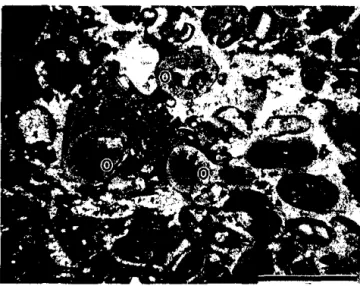
The rock consists predominantly of fossiliferous medium to fine-grained oolitic limestone. A characteristic micrograph of a thin section is shown in Fig. 1. The acid-insoluble frac-tion of the limestone, determined using the standard proce-dure, • was found to vary from
.6
to 19 percent. The limestone sample used in this investigation contains an 18.5 percent insoluble residue. X-ray diffraction analysis of the acid-insoluble residue showed that it consisted predominantly of illite, with a minor amount of chlorite, albite feldspar, and quartz.Extractable alkalies in mica and clay minerals
Dlite has essentially the same structure as micas, biotite, and phlogopite. 7 Sodium and potassium ions are weakly
bonded in inter-layer positions, in minerals, with the mica structure. In a previous investigation,' it was found that the
Fig. 1-0ptica/ micrograph of thin section of oolitic lime-stone, in aggregate in concrete from Saunders Generating Station, used for alkali extraction experiments. Oolites (0) occur in matrix of dark-colored micrite, and lighter colored sparitic calcite. Limestone also contains fossil debris. Scale bar is 1 mm
174
rate of extraction of alkali ions from phlogopite was much slower at 23 C (73.4 F) than at 38 C (100 F); for this reason, the extraction was done at 38 C (100 F). Analysis of illite shows that it typically contains a 0.2 percent Na,O and a 6.0 percent KzO; hence, the total amount of alkali that could be extracted by cation exchange with calcium in the pore solu-tion of concrete is small. However, as concrete contains about 75 percent aggregates, if only a fraction of the alkali is sol-uble, it could contribute significantly to the alkalinity of the pore solution, if aggregates containing significant amount of illite or mica are used.
METHODOLOGY
Determination of amount of alkalies extracted from limestone by cation exchange in paste with calcium hydroxide
Approximately 100 g (0.22 !b) of argillaceous limestone was pulverized to pass a 75-J.lm (No. 200) sieve. The pulver-ized limestone was made into a paste with calcium hydroxide. The paste contained 10 g (0.02 !b) of limestone, 3 g (6.6 x !Q-3 !b) of calcium hydroxide, and 8 ml (0.27 oz) of water. The paste was packed and sealed into 2-ml (0.12-oz) plastic vials, and stored in an oven at 38 C (100 F). Samples were removed from the oven after I, 7, 28, and 90 days, and the amount of water-soluble alkali in the paste was determined. The paste was ground into a slurry with a small amount of deionized water and transferred to a 500-ml (0.13-gal) beaker. About 200
m1
(0.05 gal) of water was added to the slurry. The water with the slurry was boiled for 10 min. The beaker with the slurry was then allowed to stand overnight at 23 C (73.4 F). The slurry was filtered off and the filtrate transferred to a 500-ml (0.13-gal) flask, which was filled to the mark with deionized water. The concentrations of sodium and potassium in the filtrate were determined by atomic absorption spec-troscopy. The sodium and potassium contents of a paste of cal-cium hydroxide alone were also determined by following the procedure just mentioned, but using a paste of pure calcium hydroxide. The alkali contents of the limestone pastes were corrected for the amount contributed by the calcium hy-droxide.Determination of amounts of total, and water-sol-uble, sodium and potassium In limestone
The total alkali contents of the limestone samples were de-termined by chemical analysis. To determine the water-sol-· uble alkali, a 10-g (0.35-oz) sample of the pulverized lime-. stone was boiled in deionized water for 10 min, left to stand
overnight, filtered, and made up to 11. The amount of sodium and potassium in the filtrate was determined by atomic ab-sorption spectruscopy.
Determination of alkali 」ッョセョエ@ of concrete cores taken from Saunders Generating Station
The water-soluble alkali contents of a number of cores taken from the structure were determined by pulverizing a few hundred g of concrete core to pass a 2.5-mm (No. 8) sieve. This was reduced to about 30 g (1.1 oz) by the cone and quarter method. The 30 g was further pulverized to pass a 75-J.lffi (No. 200) sieve. Ten g of the< 75-J.Lm material was boiled in deionized water for 10 min, followed by soaking overnight
Table 1 - Chemical analysis of limestone
· .aggregate sample reclaimed from Saunders
Generating Station. concrete
Element Percent Oxide Si02 10.46 AhOJ 2.68 Fe203 1.21 Ti02 0.13 MnO O.o3 CaD 43.25 MgO 2.20 Na20 0.24 K,Q 0.92 Na20 equivalent 0.85 P20s 0.04 LOI 36.55 Total 97.70
Table 2 - Estimates of water-soluble alkalies In
pulverized limestone aggregate
Nat Kt Na20 Atomic absorption 0.8 セァャュャ@ < 2 セァャュャ@ results Calculated alkalies/2000 kg 0.16 kg 0.3 kgt 0.216 kg limestone aggregate* (kglm3 of concrete)
*Concrete contruns 2000 kg of aggregate/ml (3370 lbJydJ). tEstimated vaJue assuming 1.5 JJ.g k•/rn1 solution.
Na20
K.O equivalent
0.36 kgt 0.45 kg
at room temperatore. It was then filtered off and the filtrate made up to I l. The amount of sodium and potassium in the solution was determined by atomic absorption spectroscopy. The alkali content of the concrete was calculated from the atomic absorption measurements.
RESULTS
Alkalies extracted from pastes of limestone and
calcium hydroxide
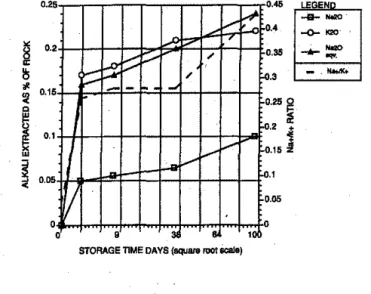
The percentages of sodium and potassium, expressed as oxides, and the calculated total alkali, or NazO equivalent (per-cent NazO
+
0.658 x percent KzO) extracted from the lime-stone, with time, are shown in Fig. 2. The rate of extraction of alkali was much faster in the ftrst day (rate= 160 x JQ-3 days·'i2) than in the subsequent 90 days (rate = 8.6 x J0-3 days-112). This is similar to what was observed previously with phlogopite.s The ratio of Na•:K+ in the alkali extracted be-tween I and 28 days remains fairly constant at about 0.27, roughly the same ratio as shown in the analysis of the lime-stone (0.24). However, by 95 days, the Na+:K+ ratio had in-creased to 0.43. The amount of sodium extracted at between I and 28 days is about one-third the amount of potassium ex-tracted in the same time. This was to be expected, due to the higher potassium content of the illite. Semiquantitative elec-tron probe microanalysis of illite from the insoluble residue of the limestone showed that potassium was the dominant in-terlayer cation. No calcium was found despite the illite being encapsulated in calcium carbonate in the limestone. X-rayACI Materials Journal
I
March-April 19940.25
I--"
b"
-::::-;..--"
f-
セ@
-
セ@ / セ@ 0.215
.,.
セ@ 0.15... ...
;.aI---"
1
01セ@
005lj
0 0'
•
•
1STORAGE TIME DAYS (aqu818 root scale)
0
...
0 .4 0 .35;o.
3 0;o.
0 '0. OS o. 0 LEG.ENn...
-o- ""-+-:::.0
-
...
Fig. 2-Amount of alknli extracted from limestone aggregate
in calcium hydroxide-aggregate paste as weight percentage
of aggregate. Amounts of NazO
andKzO extracted, and
cal-culated NazO equivalent, are shown separately. Na•:K+
ra-tios in solutions are also shown
diffraction analysis of the illite, before and after storage in calcium hydroxide pastes at 38 C, followed by boiling in water, showed that no change had occurred in the d-spacing of the (001) basal reflection. This indicates that the structure of illite was intact after the extraction process.
Alkali content of limestone aggregate and
con-crete cores
The total, or acid-soluble alkali, content of the sample of limestone from Saunders Generating Station is shown in the analysis in Table I. The amounts of water-soluble Na• and K+ determined by atomic absorption spectruscopy are 0.81!g/ml and< 2-l!g/ml solutions, respectively. The amount of potas-sium is at the limit of detection. For the purpose of estimating the possible contribution of water-soluble alkali to the pore solution of the concrete, the amount of potassium extracted was arbitrarily assumed to be 1.51!g/ml. The mean alkali con-tent of the pore solution, in 15 cores from Saunders Gener-ating Station expressed as .Na20 equivalent alkali, is 4.15
±
0.96 kg!m3 (7
±
1.6 lb/yd3).DISCUSSION
The amounts of Na20, KzO, and NazO equivalent alkali, which could be contributed by the aggretgate per m3 of con-crete, were calculated from the information that the concrete contained 2000 kg of limestone/m3 (337llb/yd3), and that the solution used for atomic absorption spectroscopy contained 10 gil (1.3 ozigal). The results are shown in Table 2. The max-imum amount of water-soluble alkali present in the aggre-gate, per m3 of concrete, is 0.45 kg (0.76 lb/yd3) (Table 2). Assuming that all this amount would go into the pore solu-tion in the long term, it would increase the total alkali
tent from an estimated 2.6 to 3.05 kglm' (4.4 to 5.llb/yd').
This small increase would not be expected to have a major
impact on the reactivity of the aggregate in the concrete. The rate of alkali extraction from limestone aggregate by cation exchange with calcium in the pore solution of a
con-crete structure, at ambient temperature, is expected to be much
lower than that found under the experimental conditions used in this investigation. Furthermore, the surface area of even the fine aggregate is much less than that of the material,
passing a WUMセュ@ (No. 200) sieve, used in the extraction
ex-periments; this would reduce the rate of extraction of the al-kalies. Nonetheless, over the long term, e.g., 20to 30 years,
a significant aroount of alkali would likely be extracted from
the aggregates and contribute to the pore solution of the
con-crete.
The mean ratio ofNa•:K+ in the alkaline pore solution of the concrete cores is 0.56, and that of the solution extracted from the limestone calcium hydroxide pastes between 1 and 33 days is 0.27. The latter ratio is similar to the ratio of 0.24 found in the limestone (Table 1). The higher Na•:K+ ratio (0.43) found in the solution extracted from the pastes at 95
days may be due to the prolonged exposure at 38 C (100 F)
(Fig. 2). The increased aroount of sodium extracted under these experimental conditions might not occur in concrete at arobient temperatures. Three chemical analyses of the orig-inal cements used in the construction show that the mean Na•:
K +ratio was 0.54
±
0.02. Thus, despite the large increase inthe alkali content of the concrete, the Na+:K+ ratio appears to be the same as in the original cement. Assuming that the extra alkali found in the pore solution of the cores is derived from the aggregate, an explanation must be found for why the ratio ofNa•:K +in the alkali extracted in calcium hydroxide pastes is considerably lower than that found in the alkaline pore
so-lution in the cores from the structure. In the concrete, part of
the potassium and sodium would be tied up in the gel formed by alkali-silica reaction.* Examination of 65 gel analyses re-ported in the literature, showed that the mean Na•:K+ ratio
was 0.1.8 Analysis of gel from concrete from the Saunders
Generating Station also showed much higher concentrations of potassium in the gel. This would result in higher Na•:K +
ratios in the pore solution. In the calcium
hydroxide-lime-stone pastes, 28 percent of the total Na+ and 22 percent of the toal K + were extracted. It is not known why somewhat less potassium was extracted, but it may be related to the larger
size of the K+ ion (13.3 nm), compared to 9.7 nm for Na• and
9.9 nm for Ca+2.
The following simplified calculations were done to obtain an estimate of the amount of alkali that could be contributed to the pore solution of the concrete by the aggregates, based on the amount extracted from the aggregate in the laboratory experiments. The total amount of alkali (NazO equivalent) ex-tracted in the calcium hydroxide pastes is 0.25 percent by weight of aggregate (Fig. 2); this includes the water-soluble
alkali. If it is assumed that 25 percent of this amount would
go into the pore solution of the concrete, the alkali content
would be increased by 0.06 percent by weight of aggregate.
The concrete contains 2000 kg ( 4409Ib/yd') aggregates; thus,
"'Thomas, M.D. A .. personal communication, March, 1992.
176
the additional alkali would be 2000 x 0.06 percent = 1.2 kglmf
(2 lb/yd'). The exact alkali content of the concrete when' placed would have varied, but assuming a mean alkali tent of I percent for the cement, and a maximum cement con-tent of 260 kglm•' ( 438Ib/yd') of concrete, a maximum
prob-able value of 2.6 kglm3 (4.4lb/yd') is obtained. Adding the
extimated amount of alkali contributed by the aggregate, 1.2 kg, to the original alkali content of 2.6 kg, gives an estimate
for the calculated alkali content of 3.8 kglm3 ( 6.4lb/yd3). This
is in the range of alkali contents measured in the cores, for
which the mean alkali content is 4.15
±
0.96 kglm' (7±
1.6lb/yd').
An alternative source of alkali in the concrete may have been the fly ash, which was used in some structural concrete. The alkali content of the fly ash was not recorded, but
typi-cally it varies from 1 to 8 percent. However, the amount used
was probably too small to have much effect on the total al-kali content of the mass concrete. There is also a possibility that evaporation at the exposed surfaces of the concrete might draw the pore solution to them, resulting in higher alkali con-centrations near exposed surfaces. However, this could not ac-count for the elevated alkali concentrations found throughout the structure. As there is no other likely source of alkalies in the structure, it is concluded that the increased alkali con-centration found in the pore solution in the cores is probably due to alkalies derived from the limestone coarse and fine ag-gregates.
IMPLICATIONS FOR OTHER LARGE STRUCTURES
Expansion and cracking of the concrete, due to alkali-silica reaction, occurred in the Saunders Generating Station. As the limestone is only marginally reactive, it is unlikely that con-crete deterioration due to alkali -silica reaction would have occurred if the alkali content of the pore solution had re-mained at the initial value, estimated to be, at most, of 2.6 kg NazO equivalentim' (4.4Ib/yd'). Expansion of concrete prisms containing limestone used in this evaluation, made using a modified version of CSA A23.2-14A, in which the cement content of the concrete was increased to 410 kg/m' ( 691
lb/yd'), and the alkali content of the concrete was augmented to 5.12 kg alkalilm' (8.6 lb/yd'), exceeded the 0.04 percent CSA limit after 1.5 years, and bad cracked.•
Measurements made in this laboratory have shown that the alkali contents in concrete cores from a number of dams,
con-taining a variety of aggregates, appear to be higher than the
estimated initial values. These observations suggest that al-kali contribution to the pore solution from the aggregates, in large concrete structures, may not be uncommon. Alkalies can only be derived from the aggregates that contain minerals
with alkali ions that
are
available for cation exchange incal-cium hydroxide solution. Typical minerals and rocks, poten-tially susceptible to cation exchange, if used as aggregates in concrete, include some micas and clay minerals, feldspars, and volcanic glass.
It is strongly recommended that the potential of aggregates
to contribute alkalies to the pore solution of concrete should be determined when reactive or marginally reactive
, ァ。セウ@ will be used in concrete, in dams or other large struc-tutes, exposed to moist conditions, where the use of a low-al-kali cement is planned to prevent or minimize concrete deterioration.
ACKNOWLEDGMENTS
The. author gratefully acknowledges a contract. from the Ontario Hydro Civil Engineering and Architecture Department, under which this work was carried out. He is also indebted to E. G. Quinn and B. Acheson for determi-nation of the amount of alkali in the rock and concrete samples. Thanks are also due to one of the anonymous reviewers for constructive criticism, which
lead to significant improvement in this manuscript.
REFERENCES
1. Hansen, W. C., "Release of Alkalies by Sands and Admixtures in
Port-land Cement Mortars," Bulletin No. 236, ASTM, Feb. 1959, pp. 35-38.
2. Woolf, D. 0., "Reaction of Aggregate with Low-Alkali Cement." Public
Roads, V. 27, No.3, 1952, pp. 50-56.
3. Stark, D., "Alkali Silica Reactivity.in the Rocky Mountain Region,"
Proceedings 4th International Conference on the Effects of Alkalies in
Ce-ACI Materials Journal
I March-April 1994
ment and Concrete, Purdue University pオ「ャセ」。エゥッョ@ セッセ@ CE-MAT-1-78, June
1978, pp. 235-243. , ' '
4. Kawamura, M.; Koike, M.; and Nakano, K., ᄋセ・ャ・。ウ・@ of Alkalies from
Reactive Andesitic Aggregates and· Fly Ashes into Pore Solution," .Pro·
ceedings of 8th International Conference on Alkali-Aggregate Reaction, K.
Okada and M. Kawamura. eds., Society of Materials Science, Kyoto, July
1989, pp. 271-278.
5. Grattan-Bellew, P. E., and Beaudoin, J. J ., "Effect of Phlogophite Mica on Alkali-Aggregate Expansion in Concrete," Cement & Concrete Research,
V. 10, 1980, pp. WXYセWYWN@ ,
· 6. "Standard Test Method for Insoluble Residue in Carbonate Aggregates. (AS1MD 3042-86)," 1990ASTM Annual BookofASTM Standards, V. 4.02, AS1M, pp. 670-673.
7. Deer, W. A.; Howie, R. A.; andZussman, J., "RockFonning Minerals,"
V. 3 Sheet Silicates, John Wiley and Sons lnc., New York, 270 pp.
8. Prin, D., and Brouxel M., "Alkali-Agregate Reaction in Northern
France:. A Review." Proceedings of9th International Conference onAlklai· Aggregate Reaction in Concrete, Published by The Concrete Society,
Framewood Road, Wexham, Slough SL3 6PJ, uNk[セョ、ッョL@ July 1993, V.
2., pp. 790-798.
9. CSA aRSNRセQTa@ "Potential Expansivity ッヲc・ュ・ョエセaァァイ・ァ。エ・@ cッュ「ゥセ@
nations (Concrete Prism Method)," A23.1-M90,
CAN/CSA-aRSNRセmYPL@ Concrete Materials and Methods of Concrete Construction, Methods of Test for Concrete. Canadian Standards Association, 178 Rex-dale Boulevard, RexRex-dale, Ontario M9W 1R3, 273 pp.
177
i I