Aircraft Remanufacturing Process Improvement Analysis by
Michael J. Cuppernull
B.S., Civil Environmental Engineering Clarkson University 1979
Submitted to the Systems Design and Management Program in Partial Fulfillment of the Requirements of the Degree of Master of Science in System Design and Management
at the
Massachusetts Institute of technology February 2000
0 1999 Michael J. Cuppernull All Rights Reserved
The author hereby grants to MIT permission to reproduce and distribute publicly paper and electronic copies of this thesis document in whole or in rnart.
Signature of.Author...
Signature of A uthor ... ,r... / ... ... Systems Desigif and Management Fellow
December 13, 1999 C ertified by... .
Accepted by...
Senior Lecturer, Aeronautics and Astronautics
i ftomas A. Kochan
LFM / SDM Co-Director George M. -Bunker Professor of Management A ccepted by... . ...
Paul Lagace LFM / SDM Co-Director Professor of Aeronautics & Astronautics and Engineering Systems
MASSACHUSETTS INSTITUTE OF TECHNOLOGY
Remanufacturing Process Improvement Analysis by
Michael J. Cuppernull
Submitted to the Systems Design and Management Program on December 13, 1999 in Partial Fulfillment of the Requirements of the Degree of Master of Science in Engineering and Management
Abstract
Due to the high cost of replacement, the U.S. Department of Defense carries out remanufacturing programs to extend the life of the major systems as an alternative to new procurement. The development of such a program is an exercise in defining value in a complex decision making environment. This process offers opportunities to develop insight into the relationship between organizational decision making and the resulting definition of value. An analysis of the decision making process is developed to show the definition of a efficient, or "lean" manufacturing program is one that considers both economic efficiency and the needs and influence of the multiple organizations involved and integrates them in a manner that creates value or minimizes waste for the customer. A systematic decision making or planning approach is proposed and utilized that combines sequential decision tree analysis with elements of strategic planning to quickly differentiate important but predictable issues from strategically significant issues that warrant more detailed analysis. This allows the focus of limited resources as are typically available early in the planning process on important questions whose outcome is not obvious. As this analysis is developed a more detailed set of questions can be examined in a similar manner.
An analysis of past remanufacturing programs and the issues they encountered is developed to identify a range of alternate approaches. The involved organizations needs, decision making authority, and influences are defined to identify the important programmatic issues in the context of the organizations involved. Multiple remanufacturing alternatives are analyzed to define a economically and politically efficient combination of public and private industrial facilities. An assessment of the affected decision making organizations expected reaction to the proposed approach is developed to predict its likelihood of acceptance.
Thesis Supervisor: Joyce Warmkessel
Acknowledgements
This thesis would not have been possible without the support of my family, friends, coworkers, Sikorsky Aircraft, my SDM classmates and the MIT faculty associated with the SDM program. I would like to provide specific thanks to a few people who have made an exceptional difference in my ability to complete the program and this thesis. First I would like to thank my wife Jane and children Catherine, Patrick, Ryan, and Michael for their support and perseverance, and love throughout the last several years. I will be grateful to be able to turn more of my attention back to you in the New Year. I would also like to thank Doug Halley and Ken Rosen who encouraged me to pursue the SDM program and supported me throughout it.
From the SDM program I would like to thank all those who have contributed to getting the program off the ground and truly doing something new in the education field. I especially would like to acknowledge the contributions of Tom Magnanti and Tom Kochan whose vision for crossing the borders of engineering and management education is at the root of the program.
Finally, I would most especially like to thank and acknowledge the contributions of my thesis advisor, Joyce Warmkessel, who has provided consistently insightful and always useful guidance on the direction and content of my thesis.
Biographical Note
The author is currently a program manager at Sikorsky Aircraft, United Technologies Corporation for the U.S. Army BLACK HAWK modernization program. His current responsibilities include developing a program to overhaul and upgrade the Army UH-60 BLACK HAWK helicopter fleet, the largest helicopter fleet in U.S. inventory. In past assignments at Sikorsky he worked on a variety of projects in the Advanced Design and Business Development group for all branches of the U.S. Military and a variety and foreign customers. Prior to Sikorsky he worked for the Boeing Commercial Airplane Company in Seattle primarily on the 737-300 CFM56 engine integration.
The author graduated from Clarkson University with a B.S. in Civil and Environmental Engineering in 1979 and is currently pursuing a Masters of Science in the Systems Design and Management Program at MIT.
Table of Contents
Chapter 1 -Introduction ... 8
Im pact of Aging System s...8
Rem anufacturing Rationale ... 9
UH-60 BLACK HAW K ... 10
Scope of UH-60 Rem anufacturing Program ... 10
Organizational Decision Making ... 10
Study Approach ... 12
Chapter 2 Sikorsky UH-60 BLACK HAWK Program ... 14
Sikorsky History ... 14
Current M arket Conditions ... 15
Arm y Aviation ... 16
UH-60 Program ... 16
UH-60L M odel...17
Arm y Aviation M odernization Plan... 18
Construction of M ajor Components... 19
Future Plans / Rem anufacturing Integration ... 20
Chapter 3 Analysis of Remanufacturing Requirements ... 21
Program Goals ... 21
Related Trends and Opportunities ... 26
Technical Requirem ents... 27
Chapter 4 O rganizational Interests and Influences...29
Organizational Decision M aking ... 29
Government Agencies and Decision Making Responsibilities...30
Congress...30
Material Developer (Program Management Office -PMO)...35
Corpus Christi Arm y Depot (CCAD)... 37
Prim e Contractor (Sikorsky)... 39
Chapter 5 O rganizational Decision M aking... 45
Organizational Decision M aking Analysis ... 45
Impact on End User N eeds... 46
Organizational Decision M aking Analysis Approach ... 46
BLACK HAW K Rem anufacturing Analysis...48
Need for Program ... 50
Funding Alternatives...51
Sole Source Acquisition... 52
DoD Support for Sikorsky and Depot Long Term Goals ... 53
Technical Requirements, Configuration, Development and Test, and Logistics Plan Definition...54
Rem anufacturing Analysis...55
Chapter 6 Analysis of Remanufacturing Alternatives ... 58
Introduction...58
Other Rem anufacturing Program Approaches...61
BLACK HAW K Rem anufacturing Alternatives ... 63
User Value Im pact ... 65
M anufacturing Task Allocation Decision Analysis... 67
Decision Variables ... 68
Plant Capacity ... 68
Political and Financial Considerations...72
Final Assem bly, Hanger Operations, Delivery ... 73
Labor Costs ... 76
Increasing User Value -Cost Reduction To Meet Additional Requirements...77
CCAD H-60 O CM /RECAP Plan...79
Organizational A lignm ent... 81
Reduction of Sikorsky Costs... 82
Schedule ... 84
Public-Private Partnership ... 85
Shipping Im pact ... 86
Facility Strengths and W eaknesses... 88
V irtual Prim e V endor ... 90
Recom m endation ... 90
Strategic Organizational Interests ... 91
Chapter 7 Sum m ary ... 95
Bibliography ... 97
A ppendix...99
SH -60R Rem anufacture Program ... 99
List Of Figures
Figure 1 DoD Weapons Systems Operating and Support Cost Vicious Circle ... 9
Figure 2 Sikorsky Major Medium Lift Production Quantities...15
Figure 3 Remanufacturing Savings versus New Production ... 23
Figure 4 Remanufacturing Value Defined In Terms of Impact on User Operations...24
Figure 5 Induction Time Impact on Aircraft Availability...25
Figure 6 UH-60L+ Requirements Growth Summary ... 28
Figure 7 Sikorsky Strategic Manufacturing Task Analysis ... 43
Figure 8 Organizational Decision Making Analysis Approach...48
Figure 9 Initial Remanufacturing Decision Tree ... 49
Figure 10 Major Decision Alignment with Impacted Organizations Interests ... 57
Figure 11 Other Programs Remanufacturing Task Allocation Summary...62
Figure 12 Remanufacturing Facilities Alternatives and Their Capabilities...64
Figure 13 Aircraft Flow Alternatives... 66
Figure 14 Plant C apacity... 69
Figure 15 Baseline UH-60L+ Flow and Facility Choices ... 71
Figure 16 UH-60L+ Plant Capacity Summary ... 74
Figure 17 UH-60L+ Plant Capacity Impact -Weighted Average ... 75
Figure 18 Labor Cost Com parison... 77
Figure 19 Cost versus Requirements Alternatives...78
Figure 20 Benefits of Combined OMA and APA Account Funding...81
Figure 21 Impact of Lower Cost Disassembly Labor vs Target ... 83
Figure 22 Shipping Decision Tree and Resulting Issues ... 88
Figure 23 Manufacturing Allocation Trade Summary...91
Chapter
1
-
Introduction
Due to the high cost of new aircraft procurement, the U.S. Department of Defense carries out remanufacturing programs designed to extend the life of the aircraft for up to thirty years as an alternative to new aircraft production. The larger remanufacturing programs can last over a decade and cost billions of dollars. The United States Army has begun planning such a program to extend the life of its 1600 aircraft UH-60 BLACK HAWK helicopter fleet, the largest fleet of helicopters in the Department of Defense inventory.
The development of the remanufacturing plan for such a program is an exercise in defining value in a complex decision making environment. This process offers opportunities to develop insight into the relationship between organizational decision making and the definition of value.
Impact of Aging Systems
Figure 1 shows the cost impact of aging systems, which feeds on itself to the detriment of the DoD budget. The older a system gets, the higher the operating and support costs to maintain it, this prevents the money from being used to replace the system, increasing the average age, which compounds the problem.
Aging Weapons System Impact
Increased Decreased System Procurement Age Budget Increased Operating And Support CostsFigure 1 DoD Weapons Systems Operating and Support Cost Vicious Circle
Remanufacturing Rationale
The Department of Defense attempts to break the aging chain by resetting the clock through remanufacturing programs. These programs restore the system to a nearly new condition sometimes referred to as zero timing the aircraft or system. This has generally been regarded as a cost-effective approach, particularly where the system still meets the users needs, no significant technology advance is available, or the service simply has higher priorities.
UH-60 BLACK HAWK
The UH-60 BLACK HAWK fleet entered service in the Army in 1978 and the Army currently doesn't plan to begin replacing the aircraft until 2025. With approximately a twenty-year production program for the eventual replacement, the last BLACK HAWK can expect to be flying until almost 2050. Sikorsky, the manufacturer of the BLACK HAWK, has primarily been a producer of medium lift military helicopters like the H-60 for over forty years. The BLACK HAWK is the largest medium lift helicopter fleet in the world today and its remanufacture is one of Sikorsky's larger business opportunities.
Scope of UH-60 Remanufacturing Program
The cost and schedule of the program provides the rationale for developing an efficient remanufacturing process. The remanufacturing program is likely to last 20 years and requires billions of dollars due to the fleet size and the limitations of annual funding availability. The duration of the induction period for remanufacturing is also critical because the longer the induction time, the more aircraft required to support the necessary annual flow which results in fewer aircraft available to the Army for operations.
Organizational Decision Making
Recognizing the complexity of the governmental decision making process which
inevitably must balance technical, cost, and political considerations this thesis attempts to develop a approach for defining decisions in terms of the affected organizations interests,
priorities, and influence. This thesis attempts to show the definition of a efficient, or "lean" manufacturing program is one that considers both the traditional economic analysis and the needs of the multiple organizations involved and integrates them in a manner that creates value or minimizes waste for the customer. The remanufacturing case study offers the opportunity to develop such a definition by analyzing several
potential combinations of public and private remanufacturing alternatives and considering the interests and influence of Congress, the Departments of Defense, and other agencies involved in formulating a program plan to meet the end users needs.
Oster refers to the concept of "bounded rationality" which simply stated means that decision makers do the best they can with the inevitable limits of information availability and their own information processing capabilities. The problems associated with bounded rationality become more severe as the size and complexity of the organization(s) involved grows. This happens in complex environments, such as the Department of Defense, primarily because participants in the planning process have different objectives and larger
organizations inevitably have more participants. (Oster, S.M. Modern Competitive Analysis)
Considering the decision making environment, the objective of the thesis is to develop a approach that results in a plan that is both economically efficient and has a high
probability of being accepted by those organizations with the power to alter it. This minimization of both the program costs and the possibility of major redirection combines to provide a lean program development approach.
Study Approach
Steiner identifies a five-step investment decision approach that has been generally
followed in the development of the economic alternatives in this thesis. The first step is to identify the objectives, the second is to examine alternatives, the third is to predict the consequences of each alternative, the fourth is to identify the method of evaluation, and the fifth, finally is to make the decision. (Steiner, H.M. Engineering Economic
Principles)
The program objectives are identified in terms of the system end user or operators needs. To create value for the end user or customer of a system, the system or proposed
improvements are considered from the point of view of eliminating or minimizing waste from the users operations. This thesis shows the requirements for the remanufactured BLACK HAWK helicopter can be traced to eliminating or minimizing inefficiencies in the end users maintenance and flying operations.
The involved organizations, there needs, decision making authority, and influences are identified to frame the strategic issues requiring resolution. To address this political perspective a systematic decision making or strategic planning process was developed.
This process for assessing the impact of major decisions on the affected organizations is utilized to develop a program approach that both meets the major needs of most
organizations and provides a high likelihood of being adapted. This approach combines sequential decision tree analysis with elements of strategic planning. By aligning common interests where possible and analyzing the influence and authority of parties with conflicting interests we can predict what decisions will be rather straight forward
and what decisions require attention. This allows focus on areas that warrant more detailed analysis.
Multiple remanufacturing alternatives are considered with the objective of minimizing the costs to the customer and the number of aircraft out of service and utilizing the existing expertise of the involved organizations. A recommended approach defines a cost-effective mix of the Original Equipment Manufacture's facilities and the existing Army aviation depot that can be combined through a public-private partnership.
Chapter 2 Sikorsky UH-60 BLACK HAWK Program
Sikorsky History
Sikorsky began producing helicopters in 1942 and grew into the medium lift military utility transports that have made up the majority of its production volume for over forty years as shown below. Sikorsky's strategy for some time has been to focus on the medium lift (20,000 pound gross weight) military aircraft because it has been the most profitable segment of the helicopter business. Size or gross weight generally segments the civil and military markets with most civil helicopters falling below 10,000 pounds and most military helicopters above 20,000 pounds. Smaller commercial helicopters have
fewer barriers to entry and are difficult to command a price that assures a high margin over the necessarily long life cycle of the product. The military market usually requires winning a significant up front competition but then offers a stable production
environment for many years, often over a decade which has been the case for the UH-60 (or S-70 commercial designation) BLACK HAWK and the Navy variant the SEA
HAWK. Larger "heavy lift" military helicopters provide solid long-term business as well but generally in much smaller quantities. This has the result of making the medium lift market the "knee of the curve" between high volume but unprofitable small commercial helicopters and high margin but small volume heavy lift helicopters. A brief summary of Sikorsky's production history is shown in the chart below.
2500 Q 2000. U a 1500 n t 1000. t Y 500. 0. 1942 1945 1946 1950 1955 1960 1974 R-4 R-6 S-51 S-55 S-58 S-61 S-70
Figure 2 Sikorsky Major Medium Lift Production Quantities vs 1st Flight or 1' Production date (not all data available for all models, not all Sikorsky models included)
Current Market Conditions
While the international market has considerable opportunities for growth particularly in the former Soviet Union and in Mainland China, the U.S. Department of Defense market has shrunk since the end of the Cold War. With the exception of the MV-22 tiltrotor DoD has few new start programs and is currently focusing on major remanufacturing programs to extend the life of current airframes for another twenty to thirty years. There are no plans that indicate any significant opportunities for substitute forms of transportation or a reduction in the dependency of the U.S. Military on vertical lift transportation given long term issues such as difficult terrain, land mines, shipboard
operations, and military search and rescue and medical evacuation requirements. Because of this trend Sikorsky has recognized that the key to retaining its leadership position in the military medium lift marketplace is the remanufacture of the current aircraft fleet over the next two decades to retain its critical technical and manufacturing skills.
Army Aviation
The U.S. Army operates the world's largest fleet of helicopters outside of Russia. Their current fleet consists of over 4,000 helicopters. The largest single type of helicopters within the fleet is the UH-60 BLACK HAWK of which they currently have over 1500 with requirements for an additional 300 or more aircraft. The BLACK HAWK has been used in almost all operations the United States Army has been involved with since the early 1980's including Grenada, Panama, Somalia, Dessert Storm, Yugoslavia, and recently East Timor.
UH-60 Program
In 1972 the Army awarded the Utility Tactical Transport Aircraft System (UTTAS) contract to Sikorsky to design and test a new troop transport helicopter to replace the UH-1 "Huey" fleet. Sikorsky built three flying prototypes and a ground test article. The aircraft was designated the S-70 by Sikorsky (its commercial designation) and the YUH-60A by the Army. The YUH-YUH-60A had its first flight on October 17, 1974. Two
competition against the Boeing prototype the YUH-61A Sikorsky was awarded the production contract in 1976 and made the first production deliveries in 1978.
UTTAS requirements for increased speed, payload, ballistic tolerance, crashworthiness, and reliability versus the UH- 1 resulted in the Army concluding that 15 UH-60 BLACK HAWK aircraft were more combat effective than 23 UH-1 Huey's. The Army
subsequently reduced the basic aircraft company (squadron) size from twenty three to fifteen aircraft when the H-60 was fielded.
Over the past twenty years, through a series of multi-year contracts, Sikorsky has
delivered over 1500 BLACK HAWKs to the Army. Sikorsky has also delivered a variety of derivatives for all the other branches of the Department of Defense (DoD), the Coast Guard, Customs Service, Drug Enforcement Agency, and over twenty-five foreign countries. The President of the United States flies on a specially designed variant called the VH-60.
UH-60L Model
From 1978 until 1989 Sikorsky delivered over 900 UH-60A models. In 1989 the UH-60L replaced the UH-60A as the standard production configuration of the BLACK HAWK. The UH-60L contained an upgraded engine the T700-GE-701 C with 24% more power and an upgraded transmission that increased the allowable torque transmitted to the rotor system. It also added a Infrared Suppression system called the Hover Infrared
smaller changes. The changes resulted in a increase in maximum payload from about 1500 pounds at 4000 foot altitude on a 95 degree Fahrenheit day, the Army "hot and high" design conditions and an increase in maximum speed of about 12 knots. The increased effectiveness of the UH-60L configuration has been widely noted in the Army and the front line aviation companies have for some time demanded the more powerful UH-60L variant.
Army Aviation Modernization Plan
The Army Aviation Modernization Plan (AAMP) is published every year and provides a twenty five year look ahead at the future of Army aviation's major assets. The AAMP shows the Army plans to operate the H-60 fleet at it current size until 2025. This is due to both funding constraints and a general belief that the H-60 is still a effective troop transport and general utility aircraft for the Army mission. Assuming a twenty-year production run for the eventual replacement, currently called the Future Utility Rotorcraft (FUR), the last H-60 will be flying in the Army in at least 2045. Recognizing this fact and that the age of the oldest H-60s are already over twenty years old the Army has developed a modernization strategy that involves remanufacturing the UH-60A fleet into a modernized version of the UH-60L called the UH-60L+.
The effectiveness increase of the 60L and the age and condition of the older UH-60As has formed the basis for the first part of a two step modernization program the remanufacturing of the UH-60A fleet into the UH-60L+ configuration. The second step a
more technically ambitious alternative called the UH-60X involves replacing the rotating dynamic components on the H-60 with a similar but more powerful set from the Sikorsky commercial S-92 program and developing a new engine to double the payload of the original UH-60A model. This configuration is paced by the development of the engine and not scheduled to enter production until the 2008 timeframe.
Construction of Major Components
The BLACK HAWK is airframe is built from traditional aluminum skin and stringer construction. The airframe is developed in a sequential assembly process combining ever larger sub-assemblies into four major components the nose section, cabin, tailcone, and tail. These major assemblies are then joined to manufacture a complete airframe. The major assemblies are "stuffed" with wiring and components in a manor that balances the ease of access for the component, the amount of work done at any one station, and the need to add high value components late in the manufacturing sequence to minimize the
inventory costs.
The longest lead items on the aircraft are titanium forging found primarily in the main rotor. The main rotor is made of a titanium spar wrapped in a honeycomb nomex-graphite leading and trailing edge. The main rotor head is made from a forged titanium hub that holds four elastomeric bearings that react the blade motions. The titanium-forged parts have lead times between 18 and 24 months depending on the market conditions for
titanium. Sikorsky typically buys the forging and performs all the machining operations itself.
The fuselage assembly sequence not counting the long lead items built up in back shops is typically 60 to 65 days from the start of sub-assemblies to the completed aircraft rolling into the hanger. Shop scheduling is based on an aircraft roll rate, which currently runs about 4 days per aircraft but has been as low as 2.5 days per aircraft in the past.
Production is controlled by a Master Requirements Planning (MRP) system that utilizes the aircraft Bill of Material (BOM) and preset lead times to issue orders that schedule parts production and procurement to support planned delivery dates. The MRP system is able to command, defer, expedite and cancel orders to coordinate changes in planned work.
Future Plans / Remanufacturing Integration
The Army plans to procure newly built UH-60s for another decade to fill its outstanding requirements of over 300 additional aircraft at its current production rates. The Army has stated it plans to switch the line from the current UH-60L configuration to the UH-60L+ so it will be buying both new built and remanufactured aircraft in the future. This will require the integration of the new and retrofit processes and some review of issues such as tooling floor space capacity. Generally the capacity issues should be localized because the facility produced over one hundred aircraft per year during peak production.
Chapter 3 Analysis of Remanufacturing Requirements
"Hassle free cost effective mission capability ... not disconnected objects and
services" Womack
Introduction
The first step towards defining a program that creates value for the customer is to define what the end user, the aviator, and the overall Army's needs are for the remanufacturing program. This definition of value, developed in this chapter, provides a reference point to judge the contributions of various organizations and alternate approaches to meeting the
users needs. The reduction in the size of the Army and its civilian workforce has created the need to minimize non-value added activities such as maintenance associated with older aircraft. This has created the need for a remanufacturing program and provides a basis for identifying value in terms of the users operations.
Program Goals
The Army's major objective's for the BLACK HAWK remanufacturing program can be summarized into a few major areas. The Army plans to extend the life of the fleet until at least the year 2025 and to upgrade its operational capabilities of the older UH-60A fleet by increasing the payload-range capability and providing modern digital electronics.
The user of the aircraft also desires increased reliability, usually measured in terms of the percent time the aircraft is characterized as mission capable, and a robust product support system that provides cost-effective training, spare parts and repairs, and mission kits for world wide operations. Additionally the Army desires to simplify their maintenance
practices and logistical support requirements by standardizing the fleet on single configuration, the UH-60L+. By eliminating the older UH-60A version through
remanufacturing they can eliminate or reduce non-value added activities such as carrying redundant inventories of similar but unique parts for the 60A and 60L configurations.
Standardizing the fleet will prevent the block obsolescence of the older, less capably 900 aircraft UH-60A aircraft that would eventually require replacement, a more expensive option. From a programmatic perspective the Army desires to develop a simple business model where they contract with a single prime vendor who inducts the older UH-60A into the program and "recapitalizes" it into a UH-60L+ for significantly less than the cost of a new aircraft. Figure 3 shows the normalized estimated costs of remanufacturing verses new production. This savings provides a "lean" approach to meeting the users needs if defined in terms of reducing the operating and support cost vicious cycle in a cost effective manner.
Remanufacturing Versus New
Production Costs
1.4 1.2 Normalized H-60 Unit 0.8 Recurring Cost 0.6 0.4 0.2 0 New Production Savings vs Replacement RemanufacturingFigure 3 Remanufacturing Savings versus New Production
The older UH-60A fleet does not meet the Army operational readiness or availability requirement of 80% and it costs approximately $500 per flight hour more than the newer UH-60L that meets the readiness requirement. The UH-60A also lifts about 1500 pounds less payload than the UH-60L. The differences are indicative of an aging system that must be upgraded or will become obsolete with time as the UH-1 has. Remanufacturing will also standardize the fleet that will reduce redundant part stockpiles, training, manuals, and support equipment for similar but not identical versions of the BLACK HAWK.
Remanufacturing Meets User's Needs By
Making User's Operations More Lean
- Eliminates Older System that Costs More to Do Less
- Eliminates, Minimizes, or Simplifies Non-Value Added User Activities
- Maintenance
- Stock Piling Multiple Component Types
- Redundant Training, Manuals, and Support Equipment
- Increases Productivity, Minimizing Aircraft Required
- Higher Speed, Payload, and Reliability
- Digital Communication/Navigation allows Faster, More Precise Battlefield Reaction
Figure 4 Remanufacturing Value Defined In Terms of Impact on User Operations
Figure 4 shows that a working definition of value or lean relative to the remanufacturing plan may be thought of as how lean does it make the end user of the system. The parts of the remanufacturing program that eliminate significant waste from the user's experience
will have the most value. It can also be seen that the more efficient or lean the proposed
program the more performance improvement and related productivity enhancement will
be affordable.
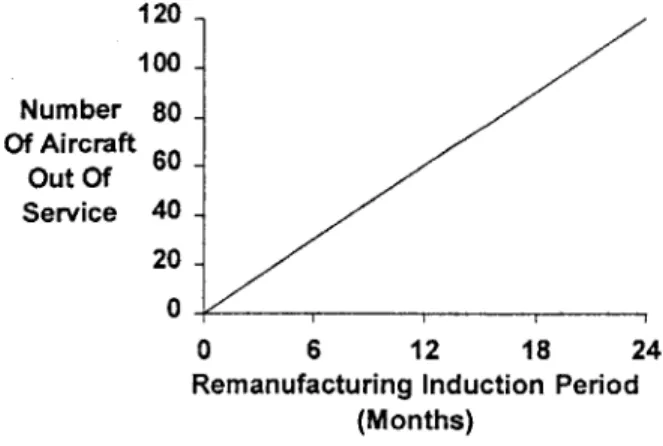
The remanufacturing program must not exacerbate problems it is intended to fix such as aircraft not being available due to maintenance requirements. To establish a efficient or lean program the time out of service for remanufacturing must be minimized. Figure 5
shows the impact of induction time on aircraft out of service. To support a steady state flow of 60 aircraft per year coming out of remanufacturing the number of aircraft inducted in the program at any one-time increases with the duration of the induction or remanufacturing period. The Army currently has only bought about 1500 of the 1800 H-60 BLACK HAWKs required to support ten active divisions and reserve requirements due to affordability constraints. A nominal induction time of one year will remove about 5% of the currently available fleet from service, increasing the shortfall in lift the fleet provides the entire Army to over 20% of the stated requirement. This can be minimized with a short induction time and continued procurement of new aircraft to fill the gap created by the remanufacturing program. A key component of value will be to minimize induction time or the time period the aircraft is unavailable for operations.
Induction Time vs Number Of
Aircraft Out Of Service
120 -100 -Number 80 -Of Aircraft 60 -Out Of Service 40 20 -0 0 6 12 18 24
Remanufacturing Induction Period (Months)
This model of defining acquisition program value in terms reducing waste or
inefficiencies of user operations is consistent with the recognition by the Army that they are really in the defense business not the procurement business.
Related Trends and Opportunities
Because of reductions in DoD civilian personnel since the end of the Cold War and the emphasis on moving to commercial practices, the military services have had to rely more on private industry to execute services traditionally performed by the government. The Army for instance may turn over much of the airworthiness qualification assessment to Sikorsky for the UH-60L+ making it more similar to the Federal Aviation Administration process. Another major issue facing the Army and DoD is the use of more extensive contractor logistics support. This has been driven by two complementary factors, the reduction in civilian personnel and the belief that the civilian sector can provide
significant savings primarily through what is referred to as velocity management of parts removed from aircraft. This concept, while not the subject of this paper, is based on the same principles as the lean manufacturing movement and provides a opportunity for significant reduction in operating and support costs and further integration of the goods, the aircraft, and the services, the support for modem aircraft and weapons systems.
Technical Requirements
The UH-60X Operational Requirements Document (ORD) defines the technical
requirements for the future upgraded BLACK HAWK fleet. This document is published by the user and routed throughout the Army for comment and approval and is the
coordinating mechanism for future new and modified aircraft systems. It is through the ORD approval process that the customers of Army aviation, that is the ground
components of the Army such as infantry and artillery, assure that their future needs will be met. Their primary concern is that the lift capability of aviation systems is sufficient to move the vehicles and weapon systems they plan to operate in the future. The weight growth of these systems over the last twenty years is the underlying rationale for the UH-60X ORD. In addition to the ORD there are many more detailed requirements in the current UH-60L systems specification. The ORD and systems specification combine to form the basis for the UH-60L+ requirement definition. A summary of the more
important new requirements that will impact the remanufacturing process is defined in the table below.
Chapter 4 Organizational Interests and Influences
Organizational Decision Making
Governmental decision making processes must balance conflicting technical, cost, and political considerations which are not easily reducible to a common denominator such as
dollars. To understand and frame such decisions we must define the decisions to be made, who the decision makers are, what organizations interests and priorities or needs are affected, and what influence these organizations have over the decisions. To develop a efficient or "lean" manufacturing program one must align the needs of the multiple organizations involved and integrates them in a manner that creates value for the customer. The alignment of these organizations into a system that meets the customers needs should increase the probability that each organization's needs will in turn be met. This is achieved by aligning their interests with others in a manner they believe has the best chance of meeting the customers needs relative to any alternatives. This thesis postulates a definition of the long term interests of the various organizations involved, develops a recommended remanufacturing plan, then analyses the expected outcome of that plan in terms of how well if fulfilled the users needs as well as those of the other organizations involved.
Government Agencies and Decision Making Responsibilities
To analyze the alternate approaches and their likely acceptance by the decision-making organizations involved a description of each organization relative to the remanufacturing program is developed below. A description of the decision making power, interests, authority and influence, and restraints is developed for each major organization involved. The central issue is how to allocate manufacturing functions and the economic benefits that come with them. The program must minimize cost and schedule while observing
legal procurement constraints and the political perspectives of the problem.
Congress
Decision Making Responsibilities " Funding of Defense Department * Procurement Laws and Regulations
" Depot 60/40 Funding Law (Insuring Government Depots maintain 60% of overhaul and maintenance work)
" Where funding is spent
The primary decision Congress makes is the global funding level of the Department of Defense as well as approval of the funding of individual programs including the remanufacturing of the BLACK HAWK fleet. Congress is also responsible for passing
procurement laws and regulations that govern the authority to obligate or spend money with in the department. Of particular interest in this case study is the Depot 60/40 Funding Law which insures the Government maintenance depots maintain 60% of the Operations and Maintenance, Army (OMA) account which is used to maintain weapon systems. There have been significant efforts in the past in Congress to overturn this law without success. The law has the effect of allowing the depots to operate in a sole-source environment for extended periods of time.
Interests
Presumably the general interest of the majority of congress is to extend the life of the BLACK HAWK fleet life and increase its capabilities for a minimal expenditure of dollars. This is consistent with many other fleet overhaul and upgrade programs Congress has supported. The individual members however would like to insure whatever DoD funding can feasibly be spent in their own districts is spent there. The members with depots in their districts have formed a coalition called the depot caucus whose objectives are to maintain the depot funding law and see as much work as possible enter the depots. The members that support the Army aviation deport at Corpus Christi, Texas have been very successful over the years ensuring sufficient work goes into the facility to maintain employment levels.
Influence and Authority
Congress holds the ultimate power to choose to fund or not fund any particular DoD program. With regard to a remanufacturing program they can exert influence over the program through the type of money that is used to fund the program. If a remanufacturing program is funded with Operations and Maintenance, Army (OMA) account then the control of the money flows to the depot who can choose to do much of the work
themselves if they are capable. If the program is funded through the Army Procurement, Aircraft (APA) account then control of the funding is given to the material developer, in this case the Utility Program Management Office (PMO Utility) at AMCOM who decides
how and where to spend the money.
Restraints
Congress receives a funding request from the service including a recommended type of funding. Generally the services will have developed detailed procurement strategies to support their funding requests that have gone through numerous review cycles prior to submittal to Congress. Budget requests or programs also come with interested parties that have significant ties to Congress to support them as they are constructed. Therefore
Congress often may have conflicting interests among individual members that may offset each other and limit their ability alter the services request.
Department of Defense and Department of the Army Leadership
Decision Making Responsibilities
" Need for Refurbishment of the Army UH-60 fleet
" Gross Remanufacturing Funding Level -Reflection of Program's Relative Priority
" Maintaining long term industrial base
The Department of Defense provides defense planning guidance to the individual services that defines each services roles and missions and establishes annual budget levels. The leadership of the Army to create and prioritize individual program plans refines these global objectives and budget constraints. The utility helicopter function in the Army has been performed for over twenty years by the BLACK HAWK and a Service Life
Extension Program (SLEP) including an upgrade of lift capabilities and electronic systems has been widely supported.
Interests
Like Congress DoD is interested in extending the life of the fleet while expending the minimal dollars possible. This general dictum of good financial stewardship is required to retain political support for DoD programs in Congress. DoD and the Army leadership answer to and are also acutely sensitive of the interests of key congressional groups like
the depot caucus. Army aviation is currently studying the long-term work load and capitalization requirements of the Corpus Christi Army Depot (CCAD). The Army's interest in assuring robust fleet maintenance and repair capability appears to align with their interest in maintaining congressional support for the Army. The Congress, Defense Department, and Army all have a long-term interest in maintaining the industrial base as well, this can broadly be interpreted to include both the contractor base and the organic
depot base.
Influence and Authority
The DoD and the Army leadership have significant formal authority in their ability to define priorities and control resources. Their link to Congress in the budgeting process also increases their influence. With regard to the remanufacturing program the key influence is the ability to accept or reject particular program plans based on their perception of value or cost-effectiveness and what will be politically palatable with Congress.
Restraints
Most of the major organizations involved, primarily the contractor and the Army depot have the ability to speak directly to Congress to influence the money spent and the specificity of the program direction that comes with the money.
Material Developer (Program Management Office -PMO)
Decision Making Responsibilities
" Integration of User Requirements and Funding Constraints
* Acquisition Strategy (i.e. Competitive vs Sole Source, What Development is required, Major Program Milestones, Schedule, etc.)
" Contract Management With Prime Contractor
* Management Of Other Interested Government Organizations * Fielding and Supportability of Upgraded Configuration
The Utility Helicopter Program Management Office (PMO) which is part of the Aviation and Missile Command (AMCOM) at Redstone Arsenal in Huntsville, Alabama is
responsible for developing and executing the BLACK HAWK remanufacturing program plan for the Government. This requires the integration of many key issues into an
executable plan. The basic conflict that must be resolved is the alignment of the user's requirements and the program funding constraints. The program management office is responsible for developing the acquisition strategy including defining the need for competition, deciding what development is required and appropriate, and what the program schedule and major milestones should be in accordance with procurement regulations. The PMO is responsible for negotiating and managing a contract with the prime contractor and any other contractors he chooses to use directly. The PMO is also
the focal point for the operator or user, the Army and DoD leadership, and is responsible for the fielding and supportability of the upgraded configuration.
Interests
The PMO's primary interests are in developing an affordable, low risk program to meet the users needs. The PMO must be able to balance political support, technical risk, and cost and schedule issues to assure a program plan will remain viable over the long life cycle that is typical of DoD aviation programs. The BLACK HAWK PMO is well aware of the Depot's interest in participating in the modernization program and the support that exists for the Depot in Congress. The PMO and the Army are also interested in preserving their industrial base which they have spent billions developing over many decades to meet their unique requirements.
Influence and Authority
The PMO is delegated by law the authority to obligate any procurement (APA) funding used for the remanufacturing program. The PMO is also the primary architect of the
decision whether the program should be competed or let as sole source. Given the
probable use of procurement funding, the PMO is the primary arbitrator of if and how the Depot should be involved in the remanufacturing process.
Restraints
As discussed above the primary constraint on the PMO is the political power of the other parties interested in participating in the remanufacturing program. Both the contractor and the Depot are able to turn to their supporters in DoD and Congress and potentially
influence the direction of the remanufacturing program.
Corpus Christi Army Depot (CCAD)
Description
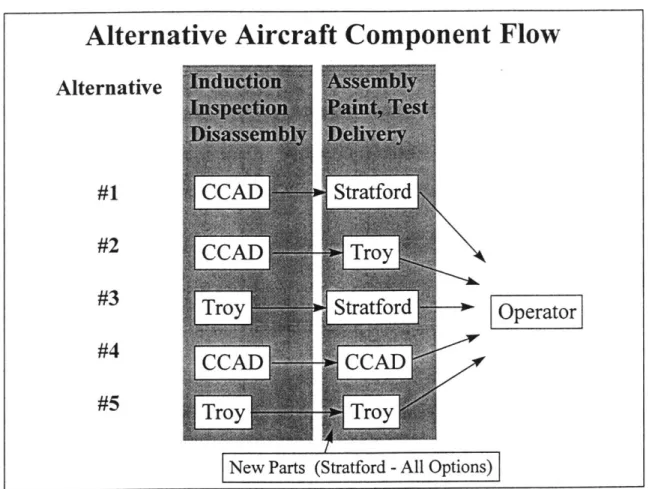
The Army Depot at Corpus Christi, Texas is the only Depot level repair facility for helicopters within the Army. They perform standard overhauls called phase inspections, and major component overhauls on multi-aircraft common equipment such as engines, Auxiliary Power Units (APU), and electronics. The Depot also performs repairs of damaged aircraft and major components. The Depot does not have the capability by charter and in most cases the expertise to manufacture new aircraft components. They can however perform all of the disassembly required and many if not all of the assembly steps normally done during initial manufacturing. These areas of the remanufacturing process will be examined in greater detail and their allocation to one facility or another will be the major manufacturing decisions that determine how "lean" the remanufacturing process becomes.
Decision Making Responsibilities
0 Overhaul and repair of fielded aircraft decisions
The Depot becomes involved in the decision making process due to the required integration of scheduled overhaul work on existing aircraft in the field with the
remanufacturing process. Many parts and components they overhaul for fielded aircraft will be required to support the remanufacture line as well.
Interests
The primary interest of the Depot is to remain the long-term primary supplier of overhaul and repair services to the Army and other aviation customers. To do this they need to assure their workload remains sufficient to make efficient use of their facilities and expertise. Because of the size and duration of the BLACK HAWK remanufacturing program the Depot will be highly interested in participating and seeing their resources be as fully utilized as possible.
Influence and Authority
Assuming the remanufacturing program is paid for primarily with Army Procurement, Aircraft (APA) funding, and remains in the control of the PMO, the Depot will not have much formal authority in the decision making process of what steps of remanufacture are performed at what location. The preliminary program plans call for the prime contractor be given authority to define the process by performing a study as part of the RTD&E
program as to how to best utilize the Depot. While the depot's authority would appear to be limited, its influence through the political process, its facilities, and its overhaul expertise are significant.
Restraints
The Depot is restrained by both its core competencies to perform overhaul but not new manufacturing work and its limited authority in the financial decision making process with the Army.
Prime Contractor (Sikorsky)
Decision Making Responsibilities
" Transformation of Requirements into a Configuration and Manufacturing Plan " Proposed Price Of Remanufactured Aircraft
" Allocation of manufacturing functions to potential facilities
The prime contractor for the remanufacturing program is tasked with the transformation of requirements into a configuration and with developing a manufacturing plan to produce the recommended configuration with the cost constraints identified by the material developer or PMO.
Sikorsky has developed a baseline configuration that meets the requirements defined in the performance specification. It is also tasked with developing studies to further improve the performance where cost-effective improvements can be demonstrated. One method of
making the additional changes affordable will be to perform certain manufacturing operations at facilities with lower labor rates than the main Sikorsky plant in Stratford, Connecticut. The Government depot or the Sikorsky plant in Troy, Alabama as well as other Government and private sites are potential sites.
Interests
Sikorsky's primary interest is to remain the Army's long term supplier of medium lift helicopters and related services. The key issues relating to the remanufacturing plan are what areas of manufacturing expertise should be retained and performed in house. Because of the duration of the remanufacturing program, anticipated to be fifteen to twenty years, the opportunity to decide which manufacturing technologies or processes to retain at Sikorsky is of strategic importance. With few major new start programs and demand in general in a lull since the cold war the opportunity to retain manufacturing
skills is significant.
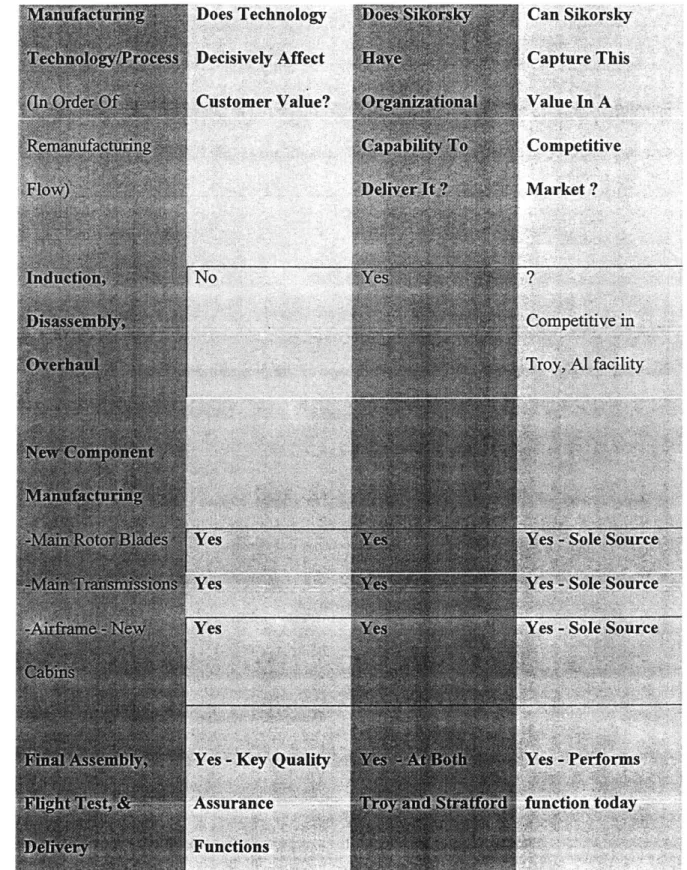
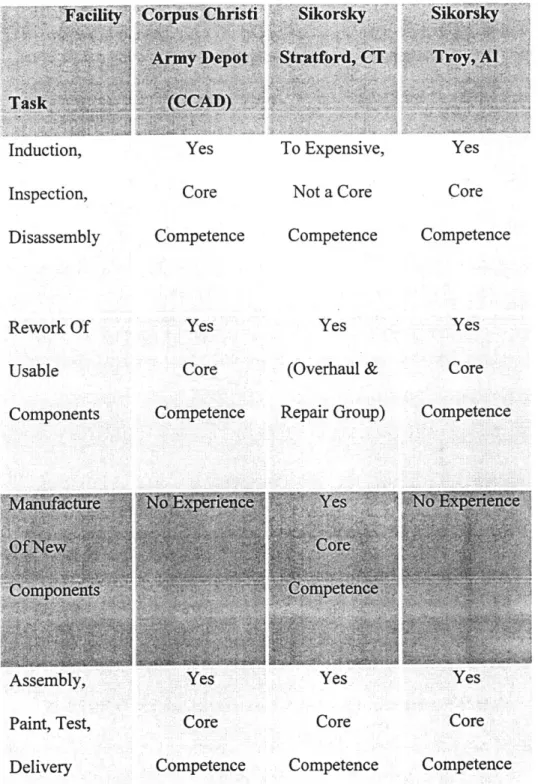
The following table provides a strategic overview of the top level manufacturing technologies or processes required to perform the remanufacturing program. The three strategic questions form a framework for defining what roles in the remanufacturing process Sikorsky should attempt to perform themselves and which they may consider
letting others perform for them. Where the answer to all three questions is yes there is a compelling case for Sikorsky to retain those capabilities as core competencies.
Induction, Disassembly, Overhaul
Many service companies routinely do the process of inducting aircraft, disassembly, and overhaul of components today. This is especially true for an old aircraft that has been in Army service worldwide for twenty years. The Army lets many maintenance support contracts and while the work requires qualified mechanics and a quality assurance system it is not considered particularly difficult and has few significant barriers to entry. The work by nature conforms to a standard leaving little other than price and schedule as a basis for competition. Sikorsky can and has competed successfully in the after market services business but does not have a consistent record of winning such competitions and could not compete from the Stratford plant for such work due to high labor rates and overhead.
New Component Manufacturing
Sikorsky being an OEM has the technical capabilities to make all the new components required to support remanufacturing except electronics which it has the ability to procure and integrate. The new components provide decisive value because they are necessary to meet the performance requirements shown in figure 6. The new blades and transmissions allow the aircraft to meet the speed, payload, range, and maneuver requirements. The new cabin allows the life to be extended until at least 2025 as required. Sikorsky has the
ability to do the work in that it is similar to current production requirements. Sikorsky is also the sole source supplier of many of these components and should remain so through out the remanufacturing program.
Final Assembly, Flight Test, & Delivery
Final assembly, flight test, and delivery are critical skills relative to Sikorsky's long term objective of remaining a preeminent supplier of rotorcraft. The key function they provide relative to customer value is quality assurance. As discussed in chapter two Sikorsky has a fifty-year history of rotorcraft manufacturing and has always performed these functions. The capability exists at both the Stratford and Troy facilities but in much more limited fashion at Troy. While not as unique as rotating component manufacturing which is high precision work, the final assembly, test, and delivery skills are competitive at the current Sikorsky pricing structure.
The conclusion from the analysis in figure 7 is that the induction, disassembly, and overhaul work is a lower skill job compared to new component manufacturing and final assembly. Sikorsky would have a difficult time competing at this given their overhead structure required to be a Original Equipment Manufacture (OEM). The up front work is the appropriate task to be done at Troy or allocated to a supplier from the Sikorsky long term viewpoint.
Influence and Authority
Sikorsky has opportunities to influence the shape of the program due to its technical expertise, existing manufacturing facilities, and DoD market knowledge. Sikorsky's formal authority is limited to that which the PMO gives it but through a the development program depot study it is provided a opportunity to makes its views known on most subjects including the allocation of remanufacturing functions.
Restraints
The prime contractor's ability to influence the major manufacturing decisions is
constrained by his own pricing structure and the Governments need to insure it has gotten the best value for its money by holding open competition where possible.
Chapter
5
Organizational Decision Making
Organizational Decision Making Analysis
The objective of this thesis is to show that an efficient or lean program is one that
considers the needs of the multiple organizations involved in a complex decision making environments required to develop a program plan that creates value for the end user of the system.
To define such a program that integrates the needs of the organizations identified in chapter four an analytical approach must be developed to relate the key issues to all the interested organizations.
The focus of the effort is to identify the areas where the organization interests align and conflict and to provide visibility into the likely outcome of the areas of conflict. The definition of a program can be thought of as a series of related decisions by the decision making organization which may be influenced by other affected parties or organizations. The objective is to plan a program on a series of likely future decisions to minimize the risk of unnecessary rework that can be considered a form of waste.
Impact on End User Needs
The second issue to consider is the relationship between the major program decisions and the definition of value creation for the end user of the system. The user goals, as stated chapter 3, include extending the life of the systems, upgrading its performance, and minimizing the maintenance costs and downtime. Time and money spent on maintenance and extra aircraft used to make up for performance shortfalls can be considered waste. The other form of waste is spending unnecessary resources, primarily time and money, procuring a system or related services required for it to perform its intended mission. Procurement and support costs can always be expended to fulfill other unmet user needs therefore unnecessary expenditures are non-value added to the user and to be minimized. It is from this perspective that major programmatic decision should be considered as
serving the needs of the user.
Organizational Decision Making Analysis Approach
A systematic approach for assessing the impact of major decisions on the affected organizations can be utilized to develop a program plan that both meets the major needs of most organizations and provides a high likelihood of being adapted. By aligning common interests where possible and analyzing the influence and authority of parties with conflicting interests we can predict what decisions will be rather straight forward and what decisions require more in depth analysis to predict their likely outcome.
The first step is to sequentially define the major decisions to be made. Next these decisions can be sorted into those where the impacted parties interests align and those where there is a conflict. Where there is a conflict these decisions can be considered from the strategic point of view as to what party has the greater authority and influence to predict a likely outcome. The areas of conflict where the parties have roughly equivalent authority and influence should be subjected too more detailed analysis to improve the predictive nature of this approach.
This approach to decision making combine's classic sequential decision tree analysis with elements of strategic planning. It allows for the identification of both the broad
perspective of all the major decisions required and a method of quickly focusing on difficult decisions that require more analysis.
This process may be thought of as an approach to lean decision making or strategic planning due to the focus it provides. The early stages of program planning or development typically begin with small staffs, often initially an individual who often make critical decisions on limited information that are costly to correct later on. There is usually a multitude of apparent issues, data, and conflicting interests requiring attention. Some but not all require immediate attention and warrant the time and cost associated with detailed analysis.
This approach, summarized in figure 8, provides a framework to judge the major BLACK HAWK remanufacturing decisions in terms of the needs of the interested organizations. This will identify what areas or decisions are readily predictable and which require further study.
Systematic Decision Making or
Strategic Planning Approach
1) Develop Sequential Decision Tree Of Key Issues
2) Identify the Decision Maker and Interested Parties for Each Decision
3) Segregate The Decisions Into Those In Which the Affected Parties
Interests Align And Those Where They Conflict
4) Where Conflicts Exist Determine Which Party Has the Most Authority and Influence
5) Focus On Decisions Where The Conflictings Parties Influence Is Equal
-Perform More In Depth Analysis of These Areas as Required
Figure 8 Organizational Decision Making Analysis Approach
BLACK HAWK Remanufacturing Analysis
If we review the major decisions associated with the remanufacturing program from the viewpoint of the affected organizations and their interest as well as their impact on user value we can gain insight into the probable course of events and identify areas warranting further study.
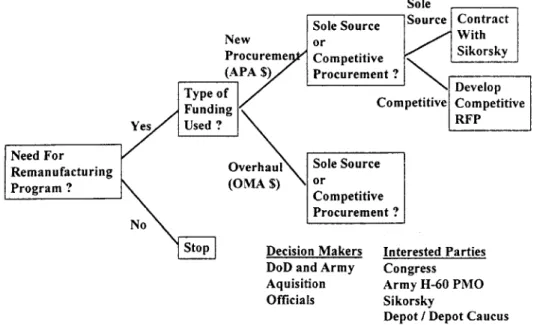
There are three initial, high level decisions that will be made by DoD and Army
decision authority for the remainder of the program. These are formally acknowledging the need for the program by funding it, determining what type of funding will be used which indicates who will manage and control the program, and declaring whether the program will be competitive or sole source procurement. A decision tree showing the sequence and potential outcomes of these decisions is shown in figure 9 and the rationale for the likely outcomes is discussed in the following sections.
Initial BLACK HAWK Remanufacturing Decision Tree
Sole
Sole Source Source Contract
New or Wrsk
Procureme Competitive (AProcurement?
Typeof Diouaeentest Develop
Funding Competitive Competitive
OcaUsed
? RFP
Deo Is
Deo Cuu OtheeCo tra tor r Remanufacturing Overhaul Sole Source
Program ? (OMA $) or
Competitive Procurement ? < o Stop Decision Makers
Interested Parties
DoD and Army Congress
Aquisition Army H-60 PMO Officials Sikorsky
Depot / Depot Caucus Other Contractors
Need for Program
The first important decision is the need to remanufacture the H-60 fleet at all. The decision-making organization is primarily the Army and DoD and Congress were they to disagree with DoD recommendations. As the program goals identified in chapter 3, the remanufacturing program is significantly less expensive than procuring new aircraft, provides significant reductions in operating costs, and allows the aircraft to remain in service for another twenty five years. These attributes align with the primary interests of The Army, DoD, and Congress. They are interested in continued cost-effective
fulfillment of the utility transportation mission role provided by the BLACK HAWK today and if convinced this is the best approach to that goal will support it. They have demonstrated their support for controlling the operating and support costs of aviation and weapon systems by approving other life extension and upgrade programs in the past. They also have a interest in preserving the industrial base that provides such systems. Sikorsky, the depot, and the depot caucus in Congress all have obvious economic
interests that align with the need for such a program. The users needs have been identified and will be met by standardizing the fleet, improving its mission capability, and reducing the maintenance burden as discussed earlier. The interests of all the relevant parties align on the need for the program and no further analysis is warranted.
Funding Alternatives
The next decision is the type account or "color" of money used to fund the program that impacts who within the Army controls the money. The ultimate decision authority here is Congress who will likely endorse the recommendation they get from DoD. The
Department of Defense will most likely concur with historic precedent and recommend using procurement or Army Procurement, Aircraft (APA) funding to retain control of a program of this size in the traditional program management office chain of command that has the most organizational expertise. This approach also allows for the support of the private industrial base, another DoD interest. The program management office (PMO) in the Army and the prime contractor who typically works for the PMO would clearly support this approach. The government depot and the depot caucus would prefer the program be funded with the Operations and Maintenance, Army (OMA) as a smaller
overhaul program typically might be so they would control the funding and manage the program. They have many of the basic manufacturing skills and a significant workforce to try and keep employed.
The BLACK HAWK remanufacturing program begins with a Research, Development, Test, and Engineering (RDT&E) phase to define and qualify the new configuration that will be managed by the PMO. The organizational infrastructure, personnel expertise, and planning during the RDT&E program will carry over to the remanufacturing phase of the program. There is no similar RDT&E expertise in the depot, which creates little