HAL Id: hal-01337523
https://hal.inria.fr/hal-01337523
Submitted on 27 Jun 2016
HAL is a multi-disciplinary open access
archive for the deposit and dissemination of sci-entific research documents, whether they are pub-lished or not. The documents may come from teaching and research institutions in France or abroad, or from public or private research centers.
L’archive ouverte pluridisciplinaire HAL, est destinée au dépôt et à la diffusion de documents scientifiques de niveau recherche, publiés ou non, émanant des établissements d’enseignement et de recherche français ou étrangers, des laboratoires publics ou privés.
A Look at Basics of Distributed Computing *
Michel Raynal
To cite this version:
Michel Raynal. A Look at Basics of Distributed Computing *. EEE ICDCS 2016 - 36th International Conference on Distributed Computing Systems, Jun 2016, Nara, Japan. �hal-01337523�
A Look at Basics of Distributed Computing
∗ Michel RaynalInstitut Universitaire de France
IRISA, Universit´e de Rennes, 35042 Rennes Cedex, France
Department of Computing, HK Polytechnic University (PolyU), Hong Kong [email protected]
Tech Report 2038 (15 pages), June 2016 IRISA, University of Rennes 1 (France)
Abstract
This paper presents concepts and basics of distributed computing which are important (at least from the author’s point of view), and should be known and mastered by Master students and engi-neers. Those include: (a) a characterization of distributed computing (which is too much often con-fused with parallel computing); (b) the notion of a synchronous system and its associated notions of a local algorithm and message adversaries; (c) the notion of an asynchronous shared memory system and its associated notions of universality and progress conditions; and (d) the notion of an asynchronous message-passing system with its associated broadcast and agreement abstractions, its impossibility results, and approaches to circumvent them. Hence, the paper can be seen as a guided tour to key elements that constitute basics of distributed computing.
Keywords: Asynchronous distributed computing, Consensus number, Locality of a computation,
Process crash failure, Read/wite system, Synchronous communication, Wait-freedom.
∗This paper is an invited “tutorial” paper presented at IEEE ICDCS 2016. (IEEE proceedings pages 2-11). It is dedicated
1
By Way of an Introduction: Two Citations
For me, the first challenge for computing science is to discover how to maintain order in a finite, but very large, discrete universe that is intricately intertwined. And a second, but not less important challenge is how to mould what you have achieved in solving the first problem, into a teachable discipline: it does not suffice to hone your own intellect (that will join you in your grave), you must teach others how to hone theirs. The more you concentrate on these two challenges, the clearer you will see that they are only two sides of the same coin: teaching yourself is discovering what is teachable.
E. W. Dijkstra, My hopes of computing science (EWD 709) (1979) Teaching is not an accumulation of facts.
L. Lamport, Teaching concurrency, ACM SIGACT News, 40(1):58-62 (2009)
2
What is the Essence of Distributed Computing
2.1 Distributed computing is about mastering uncertainty
Distributed computing1arises when one has to solve a problem in terms of distributed entities (usually called processors, nodes, processes, actors, agents, sensors, peers, etc.) such that each entity has only a partial knowledge of the many parameters involved in the problem that has to be solved [56]. Hence, in one way or another, in any distributed computing problem, there are several computing entities, and each of them has to locally take a decision or compute a result, whose scope is global.
The geographical scattering of the computing entities, the (a)synchrony of their communication, their mobility, the fact that each entity initially knows only its own local inputs, the possibility of failures, etc., create uncertainty on the system state, in the sense that no computing entity can have an exact view of the current global state. This uncertainty, created by the environment, constitutes an adversary that the programmer cannot control but has to cope with.
Although distributed algorithms are often made up of a few lines, their behavior can be difficult to understand and their properties hard to state, prove, and implement. Hence, distributed computing is not only a fundamental topic of Informatics2, but also a challenging topic where simplicity, elegance, and beauty are first-class citizens [20, 56].
2.2 The notion of a (distributed) task
The most fundamental notion of sequential computing is the notion of an algorithm implementing a mathematical function (left part of Figure 1). This gave rise to the notion of computability theory [68], and complexity theory [27], which are the foundations on which relies sequential computing.
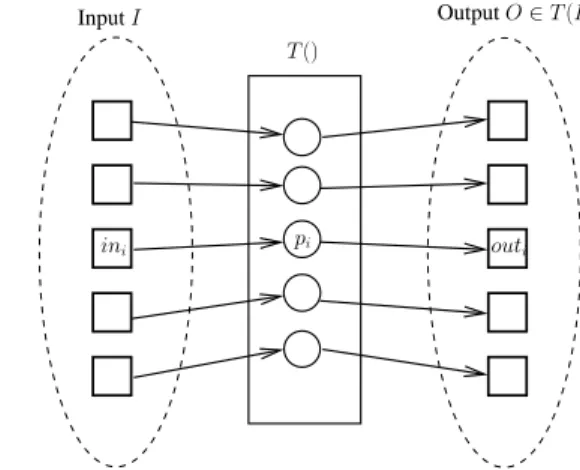
Differently, the basic unit of distributed computing is the notion of a task,which was formalized in several papers (e.g, see [34, 35]). A task is made up ofn processes p1, ...,pn(computing entities), such
that each process has its own input (letinidenote the input ofpi) and must compute its own output (let
outi denote the output ofpi). LetI = [in1, · · · , inn] be an input vector (let us notice that a process
knows only its local input, it does not know the whole input vector). LetO = [out1, · · · , outn] be
an output vector (similarly, even if a process is required to cooperate with the other processes, it will compute only its local outputouti, and not the whole output vector). A taskT is defined by a set I of
input vectors, a setO of output vectors, and a mapping T from I to O, such that, given any input vector 1Parts of this section are inspired from the position paper [58].
2
As nicely stated by E.W. Dijkstra (1930-2002): “Computer science is no more about computers than astronomy is about telescopes”. Hence, to prevent ambiguities, I use the word informatics in place of computer science. On a pleasant side, there is no more “computer science” than “washing machine science”.
pi
ini outi
Input I Output O∈ T (I)
T()
f() out= f (in) in
A taskT()(distributed computing) A functionf()(sequential computing)
Figure 1: Function vs. task
I ∈ I, the output vector O (cooperatively computed by processes) is such that O ∈ T (I) (right part of Figure 1). The casen = 1 corresponds to sequential computing.
2.3 Distributed computing vs. parallel computing
This difference lies in the fact that a task is distributed by its very definition. This means that the processes, each with its own inputs, are geographically distributed and, due to this imposed distribution, need to communicate to compute their outputs. The geographical distribution of the computing entities is a not a design choice, it is an input of the problem which gives its name to distributed computing.
Differently, in parallel computing, the inputs are, by essence, centralized. When considering the left part of Figure 1, a functionf (), and an input parameter x, parallel computing addresses concepts, methods, and strategies which allow to benefit from parallelism (multiple processing entities) when one has to implementf (x) [7, 51]. The input x is given, and (if any) its initial scattering on distinct processors is not a priori imposed, but is a design choice aiming at obtaining efficient implementations off ().
Any problem that can be solved by a parallel algorithm, could be solved (usually very inefficiently) by a sequential algorithm. Hence, the essence of parallel computing consists in mastering efficiency. Differently, the essence of distributed computing is not on looking for efficiency but on coordination in the presence of “adversaries” such as asynchrony, failures, locality, mobility, heterogeneity, limited bandwidth, etc.
Given a parallel application, it is of course possible that, due to a design choice, inputs are scattered on the processors by the application designer, and consequently distributed computing problems may appear at the implementation level of a parallel application.
2.4 The hardness of distributed computing
From a computability point of view, if the system is reliable, a distributed problem, abstracted as a task T , can be solved in a centralized way. Each process pi sends its inputini to a given predetermined
process, which computesT (I), and sends back to each process pjits outputoutj.
This is no longer possible if the presence of failures. Let us consider one of the less severe types of failures, namely process crash failures in an asynchronous system. One of the most fundamental impossibility result of distributed computing is the celebrated FLP result due to Fischer, Lynch, and Paterson [23]. This result states that it is impossible to design a deterministic algorithm solving the
basic consensus problem in an asynchronous distributed system in which even a single process may crash, be the underlying communication medium a message-passing network of a read/write shared memory (consensus is defined in Section 4.2). Roughly speaking, in a distributed setting, the local outputs depends on both the local inputs and the environment, while in a parallel setting, the outputs depends only on the inputs.
Hence, it appears that, in distributed computing, “there are many problems which are not com-putable, but these limits to computability reflect the difficulty of making decisions in the face of ambigu-ity, and have little to do with the inherent computational power of individual participants” [34]. As we can see, the essence of distributed computing is fundamentally different from the efficiency issues (task graph, scheduling, etc.) which motivated parallelism and constitutes its foundations [57].
3
Synchronous System, Locality, and Message Adversaries
3.1 Synchronous system model
Graph representation From a structural point of view, the system is represented by an undirected
connected graphG = (V, E), such |V | = n.
Each vertex represents a computing entitypi,1 ≤ i ≤ n, which is a reliable sequential process
(Tur-ing machine enriched with the two communication operations send() and receive()). “Reliable” means that each process executes its local algorithm, without crashing or committing more severe failures (i.e., it never behaves arbitrarily).
Each edge ofG represents a bidirectional reliable channel, on which the processes it connects can send or receive messages. “Reliable” means that there is neither loss, duplication, nor alteration of messages.
Synchrony assumption Synchrony is an abstraction that encapsulates and hides specific timing
as-sumptions, so that algorithms can be written at a high abstraction level [45, 52, 54]. More precisely, assuming that the processes wake up simultaneously, each processpiwith its own input valueini, they
collectively execute a sequence of rounds, where a roundr is made up of three sequential pases: • A send phase during which each process sends a message to a subset of its neighbors. • A receive phase during which each process receives the messages sent by its neighbors.
• A local computation phase during which a process modifies its local state according to the mes-sages it received during the current round.
The fundamental synchrony property lies in the fact that a message sent during a round r is received during the very same round r. Hence, when a process progresses from round r to round r + 1, it knows that all the messages sent during roundr are received, and all processes are progressing to round r + 1. Said differently, the processes advance in a lock-step manner, according to the round number, whose management is provided for free by the computation model. This model is sometimes called the LOCAL model.
3.2 Local algorithm
Let us assume that, at the first round, each processpi sends to its neighbors the pairhi, inii at the first
round, and then, at every round, it sends to its neighbors all the pairs it has learned during the previous rounds. As all processes start simultaneously, are reliable, and proceed synchronously, it follows that, afterx ≥ 1 rounds, each process pi knows the pairshj, inji of all the processes in its x-neighborhood
(i.e., at distance at mostx from it). Hence, after D rounds (where D is the diameter of the communi-cation graph),pi knows all the pairsh, inji, and can consequently compute any function on the input
Definition A distributed synchronous algorithm is local if its time complexity (measured as the num-ber of rounds it has to execute in the worst case) is smaller than the graph diameter [43] (as an example a number of rounds polylogarithmic in the number or vertices, or even a constant). Hence, a fundamen-tal issue of fault-free distributed synchronous computing consists in “classifying problems as locally computable [...] or not” [43].
An example As an example, let us consider the coloring of the vertices of a graph (i.e., any vertex
must be assigned a color, such that any two neighbors have different colors and the number of colors is “small” or even minimal). A very elegant distributed synchronous algorithm, which colors the processes of a ring with at most three colors, is presented in [17]. This algorithm requireslog∗n + 3 rounds3,
which is asymptotically time optimal according to theΩ(log∗n) lower bound established in [43].
The interested reader will find developments on locality in synchronous systems in many papers (e.g., [24, 39, 50]) and in the survey [66].
3.3 Message adversaries in synchronous systems
Historical perspective4Message adversaries have been introduced by Santoro and Widmayer in [63] to
model and understand what they call dynamic transmission failures. The terms ubiquitous failures [64], mobile failure [46], and transient link failure [65], have also been used to capture similar network be-haviors.
Aim The aim of this approach is to consider message losses as normal link behaviors (as long as messages are not corrupted). The notion of a message adversary is of a different nature than the notion of the fair link assumption. A fair link assumption is an assumption on each link taken separately, while the message adversary notion considers the network as a whole; its aim is not to build a reliable network but to allow the statement of connectivity requirements that must be met for a problem to be solved. Message adversaries allow us to consider topology changes not as anomalous network behaviors, but as an essential part of the deep nature of the system.
It follows that message adversaries allows to capture in a single concept both messages losses and the dynamicity (modification) of the communication network [13].
Definition A message adversary is a daemon which, at each round, can suppress messages (hence,
these messages are never received). The adversary is not prevented from having a read access to the local states of the processes at the beginning of each round.
Let us associate a directed graphGrwith each roundr, whose vertices are the processes, and there is
an edge frompitopjif the message sent at roundr by pitopjis not suppressed by the adversary. There
is a priori no relation on the consecutive graphsGr,Gr+1, etc. Among the possible daemon behavior,
it can defineGr+1from the local states of the processes at the end of roundr. Let SMP
n[adv : AD]
denote the synchronous system whose communication is under the control of an adversary denoted AD. SMPn[adv : ∅] denotes the synchronous system in which the adversary has no power (it can
suppress no message), whileSMPn[adv : ∞] denotes the synchronous system in which the adversary
can suppress all the messages at every round. It is easy to see that, from a message adversary and computability point of view,SMPn[adv : ∅] is the most powerful synchronous system model, while
SMPn[adv : ∞] is the weakest. More generally, the more constrained the message adversary AD, the
more powerful the synchronous system. 3
Assumingn > 1, log∗
2n is the number of times the function “log2” must be applied inlog2(log2(log2...(log2n)...)) to
obtain the value1. Let us remember that log∗(approx. number of atoms in the universe) ≃ 5.
4
The spanning TREE message adversary Let TREE be the message adversary defined by the fol-lowing constraint: at every roundr, the communication graph Gr is an undirected spanning tree, i.e.,
the adversary cannot suppress the two messages –one in each direction– sent on the edges ofGr. Let
SMPn[adv : TREE] denote the corresponding synchronous system. As already indicated, for any r
andr′ 6= r, GrandGr′
are not required to be related, they can be composed of totally different sets of links.
Let us assume that each process pi has an initial inputvi. It is shown in [38] that,SMPn[adv :
TREE] allows the processes to compute any computable function on their inputs, i.e., functions on the vector[v1, . . . , vn].
Solving this problem amounts to ensure that each inputvi attains each process pj despite the fact
the spanning tree can change arbitrarily from a round to the next one. This follows from the following observation. At any roundr, the set of processes can be partitioned into two subsets: the set yesiwhich
contains the processes that have receivedvi, and the setnoiwhich contains the processes that have not
yet receivedvi. As Gr is an undirected spanning tree (the tree is undirected because no message is
suppressed on each of its edges), it follows that there is an edge ofGrthat connects a process of the set
yesito a process that belongs to the setnoi. So during roundr, there at least one process of the set noi
which receives a copy ofvi, and will consequently belong to the setyesi of the next round. It follows
that at most(n − 1) rounds are necessary for vito attain all the processes.
The TOUR message adversary Let us assume that the underlying communication graph is complete
(any pair of processes is connected by a channel). The message adversary denoted TOUR (for tour-nament) has been introduced in [1]. At any round, this adversary can suppress one message on each channel but not both: for any pair of processes(pi, pj), either the message from pitopj, or the message
frompj topi, or none of them can be suppressed.
LetA ≃T B mean that any task that can be computed in the model A, can be computed in the model
B, and vice versa. Moreover, let ARWn,n−1[fd : ∅] be the standard asynchronous wait-free read/write model (processes communicate by read/write registers only, and any number of processes may crash, see Section 4).
The following model equivalence is shown in [1]: SMPn[adv : TOUR] ≃T ARWn,n−1[fd : ∅].
This is an important result as it establishes a very strong relation linking message-passing synchronous systems where no process crashes but messages can be lost according to the adversary TOUR, with the basic asynchronous wait-free read/write model.
More relations linking asynchronous wait-free read/write systems, or asynchronous message-passing systems, both enriched with appropriate failure detectors [15], with synchronous systems weakened with message adversaries are described in [61].
4
Asynchronous Shared Memory System, and Universality
4.1 Asynchronous processes with register-based communication
Base t-resilient and wait-free read/write models These models are defined by a set of n asyn-chronous sequential processes,p1, ...,pn, which communicate through atomic read/write registers. The
t-resilient model assumes that up to t processes may crash. We denote it ASMn,t[∅]. The wait-free
model isASMn,n−1[∅] ((n − 1)-resilient model). Hence, the wait-free model allows all processes,
ex-cept one, to crash in an execution. Moreover, there is a strict hierarchy fromASMn,n−1[∅] (the weakest
4.2 Universality in the wait-free model
The fundamental issue The fundamental issue of the wait-free model (ASMn,n−1[∅]) lies in the
following question [32]: given atomic read/write registers and objects of some typeT , is it possible to implement objects of some typeT′?
Universal object and universal construction Let ASMn,n−1[T ] denote ASMn,n−1[∅] enriched
with objects of typeT , and let SeqSpec be the set of objects that can be defined by a sequential specifi-cation (e.g., stacks, queues, sets, graphs).
An object typeT is SeqSpec-universal (in short universal) if any object of SeqSpec can be built inASMn,n−1[T ], (i.e., with atomic registers and objects of type T and despite asynchrony and any
number of process crashes). An algorithm implementing such a generic construction is called a universal construction [32]. Examples of universal constructions can be found in textbooks such as [5, 55, 67].
Consensus object A consensus object provides the processes with a single operation, denoted propose(),
that a process can invoke only once (hence it is a one-shot object).
This operation allows each process to propose a value and obtain (we say “decide”) a value, such that the following properties are satisfied.
• Validity. If a process decides v, this decided value was proposed by a process. • Agreement. No two processes decide different values.
• Integrity. A process decides at most once.
• Termination. If a process do not crash, it decides a value.
Validity relates the outputs to the inputs. Agreement states there is a single output. Termination states that at least the processes that do not crash must decide.
As cooperating processes have to agree in one way or another (otherwise the problem is only a control flow problem, as found in parallel computing), a lot of distributed computing problems rely on the consensus problem, or a variant of it.
Good news and bad news Two main results of distributed computing in the wait-free model are the
following.
• The first result is that the consensus object is universal [32]. This means that any any object of SeqSpec can be built in ASMn,n−1[C], where C denote the consensus object type.
• The second result is the impossibility to implement consensus from atomic registers only, i.e., in ASMn,n−1[∅] [23, 32, 44]. Roughly speaking, this impossibility means that, contrarily to
sequential computing, read/write registers are not powerful enough to solve some problems in the presence of asynchrony and failures.
Herlihy’s hierarchy (consensus hierarchy) Fortunately, read/write registers are not the only type
of objects that can be implemented in hardware. Numerous objects with atomic operations (such as test&set(), swap(), fetch&add(), compare&swap(), LL/SC(), etc.) are offered by multi-processors machines (multicore) to solve synchronization issues. (In the following we use the same name for an object type and its operation).
Let the consensus number of an object typeT be the greatest integer n such that this object allows consensus to be implemented inASMn,n−1[T ]. if there is no such a greatest integer, the consensus
number ofT is +∞.
The consensus number notion was introduced by Herlihy [32], who also introduced the following infinite hierarchy.
• The consensus number of atomic read/write registers is 1.
• The consensus number of the object types Test&Set, Fetch&Add, queue, stack, (and many others) is2. Etc. There are objects with consensus number n ∈ [3.. + ∞).
• The consensus number of the object types Compare&Swap, LL&SC, sticky bit (and others) is +∞.
It follows from this hierarchy that, if one want to cope with process crashes when building a reliable application on top of a multicore architecture composed ofn cores, one has has to consider a multicore providing an object type whose consensus numberx is such that x ≥ n.
Generalizing universality Basically, the previous notion of universality is on a single object. A more
general notion of ak-universal construction has been introduced by in [26]. A k-universal construction is an algorithm that can be used to simultaneously implement k objects (instead of just one object), with the guarantee that at least one of the k constructed objects progresses forever. While Herlihy’s universal construction relies on atomic registers and consensus objects, ak-universal construction relies on atomic registers andk-simultaneous consensus objects [2], which are equivalent to k-set agreement objects [16] inASMn,n−1[∅]. The k-set agreement is a weakening of consensus, which differs only in
the Agreement property, namely, at mostk different values can be decided by the processes (k = 1 for consensus).
An even more general notion of universality was introduced in [62], where is presented ak-universal construction which satisfies the following four desired properties:
• Among the k objects that are constructed, at least ℓ objects (and not just one) are guaranteed to progress forever.
• Any process that does not crash executes an infinite number of operations on each object that progresses forever (wait-freedom progress condition).
• The construction is contention-aware, which means that it uses only read/write registers in the absence of contention.
• The construction is generous with respect to the obstruction-freedom progress condition, which means that each process is able to complete any one of its pending operations on thek objects if all the other processes hold still long enough.
This construction is called a(k, ℓ)-universal construction. It uses a natural extension of k-simultaneous consensus objects, called(k, ℓ)-simultaneous consensus objects. These objects are shown to be universal (i.e., necessary and sufficient) for such a construction.
4.3 Weaker progress conditions, and abortable objects
Progress conditions weaker than wait-freedom The termination property stating that any invocation
of an object operation issued by a process that does not crash, terminates, despite the behavior of the other processes (asynchrony and failures) is called wait-freedom. Unfortunately, in some cases, the design of a wait-free implementation of a concurrent object can be costly.
Hence, conditions weaker than wait-freedom have been proposed for the implementation of concur-rent objects. They are the following ones.
• Non-blocking. If several processes invoke concurrently operations on an object, and at least one of these processes does not crash, at least one process returns from its invocation [36].
• Obstruction Freedom. If a process executes in isolation for a long enough period and does not crash, it returns from its operation invocation [33].
“In isolation” means that, the other processes (which can be engaged in operations on the object) stop executing during the “long enough period”. As the system is asynchronous, “long enough period” means a duration “during which a process can execute its operation”.
let us observe that “non-blocking” is what is called “deadlock-freedom” in a failure-free context. Moreover, obstruction-freedom is a weaker property than non-blocking. Let us also notice that, as wait-freedom, non-blocking and obstruction-freedom implementations cannot use lock. This is due to the fact that, once an object is locked by a processp, it remains locked forever if p crashes before releasing the lock.
Example: obstruction-freekset agreement An an example, let us consider thek-set agreement in the
wait-free modelASMn,n−1[∅]. As consensus, this problem is impossible to solve in this model when
k ≤ n − 1. Hence, a way to solve it, is to weaken its termination property, requiring only that a process returns from its invocation if the obstruction-freedom property is satisfied (i.e., a process has enough time to execute its operation without being bothered by the other processes). An algorithm solving k-set agreement in an anonymous version of the wait-free modelASMn,n−1[∅] is presented in [9]. This
algorithm uses(n − k + 1) multi-writer multi-reader atomic register, which is optimal.
Abortable objects Another way to obtain more efficient implementations of an object is to relax the
semantics of its operations as follows. The invocation of object operations executed in concurrency-free patterns must always terminate (if the invoking process does not crash). Otherwise they can abort (in which case, they do not modify the state of the object). Such objects are called abortable objects [11, 31, 55, 60].
It is also possible to combine abortable objects with the non-blocking progress property (see [55] for more details).
5
Asynchronous Message-passing System, Impossibility Results
5.1 Asynchronous system model
Definition LetAMPn,t[∅] denote the n-process asynchronous message-passing computation model.
In such a model, each process is sequential and asynchronous and up tot processes may crash in an execution. Moreover, each pair of processes is connected by an asynchronous reliable bi-directional channel. “Reliable”means that no message can be lost, duplicated, created from thin air, or modified. “Asynchronous” means that message transfer delays are arbitrary, may vary with time, but are finite. This is the classic model used in textbooks (e.g., [5, 10, 45, 53, 56]).
Reliable broadcast inAMPn,t[∅] One of the very most basic problems encountered inAMPn,t[∅]
consists in implementing a reliable broadcast communication abstraction. Namely, to broadcast a mes-sagem a process p needs to sent m to all the processes. If p crashes during these sendings, only a subset of the non-crashed processes receive the message, and consequently the broadcast is unreliable.
A reliable broadcast ensures that all the correct processes (i.e., the processes that do not crash) deliver the same set of messages S, and this set includes –at least– all the messages they broadcast. This means that, if a process crashes, each of its messages is delivered by all or none of the correct processes. Moreover, a process that crashes deliver a subset ofS (the set messages delivered by the correct processes). This communication abstraction was cleanly defined in [30]. The reader will find in the monograph [53] distributed algorithms implementing this abstraction in various message-passing models prone to both process crashes and channel failures.
From message-passing to read/write registers Another of the most basic problems of asynchronous
It is shown in [4] thatt < n/2 is a necessary and sufficient condition to simulate a read/write register inAMPn,t[∅], hence (from a notation point of view) such a register can be implemented only in the
restricted message-passing modelAMPn,t[t < n/2].
An algorithm (named ABD in the literature, according to the names of its authors) that implement a register inAMPn,t[t < n/2] is described in [4]. This algorithm is based on majority quorums. The
fact that these quorums include a majority of correct processes, associated with the rule “a reader has to write the value it returns” allows read operations to always obtain correct values. If each message is assumed to take∆ time units, a write operation require 2∆ time units, and a read operation requires 4∆ time units. A very recent algorithm, described in [49], improves the time duration of the read operation, which requires2∆ time units in “good circumstances” and up to 4∆ time units only in “bad” circumstances.
Universality inAMPn,t[∅] The notion of universality introduced in Section 4.2 translates as follows
inAMPn,t[t < n/2] (the requirement n < n/2 is due to the fact that registers appear in the definition
of the universality notion): How to duplicate a state machine?
This problem was posed first by Lamport in the context of fault-free message-passing systems [41]. In the context of AMPn,t[t < n/2], it amounts to build a reliable broadcast abstraction such that all
processes receive in the same order all the operations on the object that is built. In this way, they can apply the same sequence of operations to their local copies, which ensures their mutual consistency. Such a broadcast abstraction is called Total Order Reliable (TO-reliable) broadcast.
It appears that the construction of TO-reliable broadcast relies on consensus, namely, the processes have to agree on the order in which operations must be applied to their local copies, and this is a typical agreement problem. As consensus is impossible to solve inAMPn,1[∅] (i.e., even a single process may
crash) [23]), TO-reliable broadcast is impossible to implement inAMPn,t[t > 0].
5.2 A fundamental dilemma: symmetry breaking
When considering the basic distributed computingAMPn,t[∅], A fundamental dilemma is the
follow-ing.
• On the one side, all processes are equal in the sense that any subset including up to t of them may crash, and it is not known in advance which processes will crash in a given run.
• On the other side, solving some problem requires that, during some period of time, some pro-cess(es) be “more equal” than the others. Such processes are usually called leaders.
This means that symmetry breaking in the presence asynchrony and failures is a fundamental issue in distributed computing. (This was known in some societies as “Primus inter pares”.)
5.3 Circumventing impossibility results
Possible approaches Several approaches have been proposed to address impossibility results in the
modelAMPn,t[t > 0]. We focus here only on the consensus problem in AMPn,t[t < n/2]. Four
main approaches have been investigated.
• Enrich the system with randomization, and weaken accordingly the termination property [6]. This allows the non-determinism created by the environment (asynchrony and failures) to be solved [57].
• Restrict the asynchrony of the system [21, 22].
• Restrict the space of the input vectors which can be proposed by the processes [48]. This approach established a strong connection relating error-correcting codes and agreement problems [25].
• Introduce failure detectors, i.e., devices that provide each process with information on failures. According to the problem to be solved and the quality of this information, several classes of failures detectors can be designed [15]. Actually, failure detectors can be seen as objects that abstract underlying synchrony assumptions.
The weakest failure detector to solve consensus This failure detector was introduced in [14], where
it is calledΩ. “Weakest means” that given any information on process failures, which allows consensus to be solved, it is possible to buildΩ.
This failure detector Ω provides each process pi with a read-only local variable leaderi, which
always contains a process identity, and satisfies the following “eventual leadership” property: There is a timeτ , after which the variables leaderiof all the processes that do not crash contain forever the same
valueid, and this identity is the identity of a correct process.
It is important to notice that, during an arbitrary long, but finite, period, each local variableleaderi
can behave arbitrarily. Moreover, the time instantτ is never explicitly known by the processes. Algo-rithms implementing Ω in AMPn,t[∅] with various underlying synchrony assumptions are presented
in [53].Ω can be seen as a formal definition of the leader service used in Paxos [42].
The correct information on failures provided byΩ is eventual, and consists in a single identity, which is not the one of a faulty process. No information on the state (correct or faulty) of other processes is needed to solve consensus. As we can see,Ω solves the dilemma stated previously.
Indulgent algorithms The class of eventual failure detectors (henceΩ) has the following noteworthy
feature. An algorithm based on such a failure detector always terminates (and produces a correct result), if the failure detector it relies on behaves as described by its specification. If the implementation of the failure detector never satisfies its specification, the algorithm may not terminate, but if it terminates, it always produces a correct result. Such algorithms are said to be indulgent with respect to their failure detectors [28, 29].
5.4 Process adversaries in asynchronous systems
The notion of a process adversary originated in [37], and was later generalized and formalized in [19]. A computability-oriented survey can be found in [40]. This notion generalizes the notion of at-resilient algorithm.5
Definition A process adversaryA is a set of sets of processes. Given such a set A, and a problem P ,
the aim is to design an algorithm that (a) never violates the safety property ofP , and (b) terminates in all the executions in which the set of non-faulty processes is a set inA.
As an example, Let us considers a system with four processes denoted p1, ..., p4. The set A =
{{p1, p2},{p1, p4},{p1, p3, p4}} defines an adversary. An algorithm A-resiliently solves a problem if
it terminates in all the executions where the set of non-faulty processes is exactly either {p1, p2} or
{p1, p4} or {p1, p3, p4}. This means that an A-resilient algorithm is not required to terminate in an
execution in which the set of non-faulty processes is exactly the set{p3, p4} or the set {p1, p2, p3}.
The main interest of this notion is the fact that it allows the express termination conditions where process crashes are not uniform. It modifies the computation model, in the sense that not all processes are seen as equal, and do not fail in an independent way.
An example: core and survivors sets A core C is a minimal set of processes such that, in any execution, some process in C does not fail. A survivor set S is a minimal set of processes such that there is a execution in which the set of non-faulty processes is exactlyS. Let us observe that cores and survivor sets are dual notions (any of them can be obtained from the other one).
As an example let us consider a system of 4 processesp1,p2, p3andp4where two cores are defined,
namely {p1, p2} and {p3, p4}. The corresponding survivor sets are {p1, p3}, {p1, p4}, {p2, p3} and
{p2, p4}. (Borrowing the quorum terminology and considering cores as quorums, the corresponding
survivor sets are their anti-quorums). Cores and survivor sets are assumed to be initially known by alll the processes.
6
Conclusion
The aim of this invited talk was to present some ideas and concepts which belongs to the basics of distributed computing. Due to time and page limitations, important ideas and concepts have not been addressed here (where the term “important” must be understood as subjective and engaging only the author).
Much more concepts belong to the basics of distributed computing, and still deserve work to be fully understood and mastered. I cite only three of them: anonymous/homonymous systems (e.g., [3, 8]); Byzantine failures in agreement problems (e.g., [47]); and dynamic systems (e.g., [12]).
Acknowledgments
This work has been partially supported by the French ANR project DISPLEXITY, devoted to com-putability and complexity in distributed computing, and the Franco-German DFG-ANR Project 40300781 DISCMAT, devoted to connections between mathematics and distributed computing.
I would like thank my friends Achour Most´efaoui and Sergio Rajsbaum with whom, since a very long time, I had a lot of fascinating discussions on the nature of distributed computing and the design of distributed algorithms. I also want to thank all my PhD students –and Post-Doc– for their trust in what we were doing and their great interest in distributed computing. Last but not least, I thank the organizers of ICDCS 2016 for their kind invitation, and more particularly Toshimitsu Masuzawa from Osaka University.
To conclude, I am pleased to remember that one of my very first papers published in an international conference was at the very first issue of the IEEE ICDCS series of conferences in 1979. (This paper was on the specification of communication systems [18].)
References
[1] Afek Y. and Gafni E., A simple characterization of asynchronous computations. Theoretical Computer Science, 561: 88-95 (2015)
[2] Afek Y., Gafni E., Rajsbaum S. Raynal M., and Travers C. Thek-simultaneous consensus problem. Distributed
Com-puting, 22(3):185-196, 2010
[3] Arevalo S., Fernandez A., Imbs D., Jimenez E., and Raynal M., Failure detectors in homonymous distributed systems (with an application to consensus). Journal of Parallel and Distributed Systems. 83:83-95 (2015)
[4] Attiya H., Bar-Noy A. and Dolev D., Sharing memory robustly in message-passing systems. Journal of the ACM, 42(1):121-132 (1995)
[5] Attiya H. and Welch J.L., Distributed computing: fundamentals, simulations and advanced topics, (2nd Edition), p. 414. Wiley-Interscience (2004) ISBN 0-471-45324-2
[6] Ben-Or M., Another advantage of free choice: completely asynchronous agreement protocols. Proc. 2nd ACM Sympo-sium on Principles of Distributed Computing (PODC’83), ACM Press, pp. 27-30 (1983)
[7] Blazewicz J., Pesch E., Trystram D., and Zhang G., New perspectives in scheduling theory. Journal of Scheduling, 18(4):333-334 (2015)
[8] Bonnet F. and Raynal M., Anonymous asynchronous systems: the case of failure detectors. Distributed Computing, 26(3):141-158 (2013)
[9] Bouzid Z., Raynal M., and Sutra P., Anonymous obstruction-free(n, k)-set agreement with (n−k+1) atomic read/write
registers. Proc. 19th Int’l Conference On Principles Of Distributed Systems (OPODIS’15), 17 pages, Leibniz Int’l Proceedings in Informatics (LIPIcs), (2015)
[10] Cachin, C., Guerraoui R., and Rodrigues L., Introduction to reliable and secure distributed programming, p. 367, Springer (2012) ISBN 978-3-642-15259-7
[11] Capdevielle C., Johnen C., Milani A. Solo-fast universal constructions for deterministic abortable objects. Proc. 28th Int’l Symposium on Distributed Computing (DISC14), Springer LNCS 8784, pp. 288302 (2014)
[12] Casteigts P., Flocchini P., Godard E., Santoro N., and Yamashita M., Expressivity of time-varying graphs. Proc. 19th Int’l Symposium on Fundamentals of Computation Theory (FST’13), Springer LNCS 8070, pp. 95-106, 2013.
[13] Casteigts A., Flocchini P., Quattrociocchi W., and Santoro N., Time-varying graphs and dynamic networks. Int’l Journal of Parallel, Emergent and Distributed Systems, 27(5):387408, 2012.
[14] Chandra T., Hadzilacos V. and Toueg S., The weakest failure detector for solving consensus. Journal of the ACM, 43(4):685-722, 1996.
[15] Chandra T. and Toueg S., Unreliable Failure Detectors for Reliable Distributed Systems. Journal of the ACM, 43(2):225-267 (1996)
[16] Chaudhuri S., More choices allow more faults: set consensus problems in totally asynchronous systems. Information and Computation, 105(1):132-158, 1993.
[17] Cole R. and Vishkin U., Deterministic coin tossing with applications to optimal parallel list ranking. Information and Control, 70(1):32-53 (1986)
[18] Darondeau Ph., Le Guernic P., and Raynal M., Abstract specification of communication systems. Proc. First IEEE Int’l Conference on Distributed Computing Systems (ICDCS’79), IEEEE Press, pp. 339-346, 1979
[19] Delporte-Gallet C., Fauconnier H., Guerraoui R. and Tielmann A. The disagreement power of an adversary. Distributed Computing, 24(3-4):137147 (2011)
[20] Dijkstra E.W., Some beautiful arguments using mathematical induction. Algorithmica, 13(1):1-8, 1980.
[21] Dolev D., Dwork C., and Stockmeyer L., On the minimal synchronism needed for distributed consensus. Journal of the ACM, 34(1):77-97 (1987)
[22] Dwork C., Lynch N., and Stockmeyer L., Consensus in the presence of partial synchrony. Journal of the ACM, 35(2), 288-323 (1988)
[23] Fischer M.J., Lynch N.A., and Paterson M.S., Impossibility of distributed consensus with one faulty process. Journal of the ACM, 32(2), 374-382 (1985)
[24] Fraigniaud P., Korman A., and Peleg D., Towards a complexity theory for local distributed computing. Journal of the ACM, 60(5), Article 35, 16 pages, 2013.
[25] Friedman R., A. Mostefaoui, S. Rajsbaum, and Raynal M., Distributed agreement problems and their connection with error-correcting codes. IEEE Transactions on Computers, 56(7):865-875 (2007)
[26] Gafni E. and Guerraoui R., Generalizing universality. Proc. 22nd Int’l Conference on Concurrency Theory (CON-CUR’11), Springer, LNCS 6901, pp. 17-27, 2011.
[27] Garey M.R. and Johnson D.S., Computers and intractability: a guide to the theory of NP-completeness. W.H. Freeman, New York, 340 pages, 1979.
[28] Guerraoui R. and Lynch N., A general characterization of indulgence. ACM Transactions on Autonomous and Adaptive Systems (TAAS), 3(4): Article 20 (2008)
[29] Guerraoui R. and Raynal M., The Information structure of indulgent consensus. IEEE Transactions on Computers, 53(4):453-466 (2004)
[30] Hadzilacos V. Toueg S., A Modular approach to fault-tolerant broadcasts and related problems. Tech Report 94-1425, 83 pages, Cornell University (1994)
[31] Hadzilacos V. and Toueg S., On deterministic abortable objects. Proc. 32nd ACM symposium on Principles of Distributed Computing (PODC’13), ACM Press, pp. 4-12 (2013)
[32] Herlihy M.P., Wait-free synchronization. Transactions on Programming Languages and Systems, 13(1):124-149 (1991) [33] Herlihy M.P., Luchangco V., and Moir M., Obstruction-free synchronization: double-ended queues as an example. Proc. 23th International IEEE Conference on Distributed Computing systems (ICDCS 2003), pp. 522-529, IEEE Press (2003) [34] Herlihy M.P., Rajsbaum S., and Raynal M., Power and limits of distributed computing shared memory models,
Theoret-ical Computer Science, 509:3-24 (2013)
[35] Herlihy M. and Shavit N., The topological structure of asynchronous computability. Journal of the ACM, 46(6):858-923 (1999)
[36] Herlihy M.P. and Wing J.M, Linearizability: a correctness condition for concurrent objects. ACM Transactions Pro-gramming Languages Systems, 12(3):463-492 (1990)
[37] Junqueira F. and Marzullo K., A framework for the design of dependent-failure algorithms. Concurrency and Computa-tion: Practice and Experience, 19(17):2255-2269 (2007)
[38] Kuhn F., Lynch N.A., and Oshman R., Distributed computation in dynamic networks. Proc. 42nd ACM Symposium on Theory of Computing (STOC’10), ACM press, pp. 513-522, 2010.
[39] Kuhn F., Moscibroda T., and Wattenhofer R., What cannot be computed locally! Proc. 23rd ACM Symposium on Principles of Distributed Computing (PODC’04), ACM Press, pp. 300-309 (2004)
[40] Kuznetsov P., Understanding non-uniform failure models. Bulletin of EATCS, 106(12):54-77 (2012)
[41] Lamport L., Time, clocks, and the ordering of events in a distributed system. Communications of the ACM, 21(7):558– 565, 1978.
[42] Lamport L., The part-time parliament. ACM Transactions on Computer Systems, 16(2):133-169 (1998) [43] Linial N., Locality in distributed graph algorithms. SIAM Journal on Computing, 21(1):193-201 (1992)
[44] Loui M. and Abu-Amara H., Memory requirements for agreement among unreliable asynchronous processes. Advances in Computing Research, Vol. 4:163-183. JAI Press (1987)
[45] Lynch N.A., Distributed algorithms, p. 872. Morgan Kaufmann (1996)
[46] Moses Y. and Rajsbaum S., A layered analysis of consensus. SIAM Journal of Computing, 31:989-1021 (2002) [47] Most´efaoui A., Moumen H. and Raynal M., Signature-free asynchronous binary Byzantine consensus witht < n/3,
O(n2) messages, and O(1) expected time. Journal of ACM, 62(4), Article 31, 21 pages (2015)
[48] Most´efaoui A., Rajsbaum S., and Raynal M., Conditions on input vectors for consensus solvability in asynchronous distributed systems. Journal of the ACM, 50(6):922-954 (2003)
[49] Most´efaoui A. and Raynal M., Two-bit messages are sufficient to implement atomic read/write registers in crash-prone systems. Proc. 35th ACM Symposium on Principles of Distributed Computing (PODC’16), ACM Press, 2016.
[50] Naor M. and Stockmeyer L., What can be computed locally? SIAM Journal on Computing, 24(6):1259-1277 (1995) [51] Padua D. (Ed.), Encyclopedia of parallel computing, p. 2180. Springer (2011) ISBN 978-0-387-09765-7
[52] Peleg D., Distributed computing, a locally sensitive approach. SIAM Monographs on Discrete Mathematics and Appli-cations, 343 pages (2000) ISBN 0-89871-464-8
[53] Raynal M., Communication and agreement abstractions for fault-tolerant asynchronous distributed systems, 251 pages, Morgan & Claypool Pub. (2010) ISBN 978-1-60845-293-4
[54] Raynal M., Fault-tolerant agreement in synchronous distributed systems, 167 pages, Morgan & Claypool (2010) ISBN 978-1-608-45525-6
[55] Raynal M., Concurrent programming: algorithms, principles, and foundations, 530 pages, Springer (2013) ISBN 978-3-642-32026-2
[56] Raynal M., Distributed algorithms for message-passing systems, 515 pages, Springer (2013) ISBN: 978-3-642-38122-5 [57] Raynal M., What can be computed in a distributed system? From Programs to Systems, Springer LNCS 8415, pp.
209-224 (2014)
[58] Raynal M., Parallel computing vs distributed computing: a great confusion? Proc. 1st European EUROPAR Workshop on Parallel and Distributed Computing Education (Euro-EDUPAR), Springer LNCS 9523, pp. 41-53 (2015)
[59] Raynal M., Messages adversaries. Encyclopedia of Algorithms, Springer, 6 pages, (2015) DOI 10.1007/978-3-642-27848-8 609-1
[60] Raynal M., Concurrent systems: hybrid object implementations and abortable objects. Proc. 21th Int’l European Parallel Computing Conference (EUROPAR’15), Springer LNCS 9233, pp. 3-15 (2015)
[61] Raynal M. and Stainer J., Synchrony weakened by message adversaries vs asynchrony restricted by failure detectors. Proc. 32nd ACM Symposium on Principles of Distributed Computing (PODC ’13), ACM Press, pp. 166-175, 2013. [62] Raynal M., Stainer J., and Taubenfeld G., Distributed universality. Algorithmica (2015) DOI
10.1007/s00453-015-0053-3
[63] Santoro N. and Widmayer P., Time is not a healer. Proc. 6th Annual Symposium on Theoretical Aspects of Computer Science (STACS’89), Springer LNCS 349, pp. 304-316, 1989.
[64] Santoro N. and Widmayer P., Agreement in synchronous networks with ubiquitous faults. Theoretical Computer Science, 384(2-3): 232-249, 2007.
[65] Schmid U., Weiss B., and Keidar I., Impossibility results and lower bounds for consensus under link failures. SIAM Journal of Computing, 38(5):1912-1951 (2009)
[66] Suomela J., Survey of local algorithms. ACM Computing Surveys, 45(2), Article 24, 40 pages, (2013)
[67] Taubenfeld G., Synchronization algorithms and concurrent programming, 423 pages, Pearson Education/Prentice Hall (2006). ISBN 0-131-97259-6
[68] Turing A.M., On computable numbers with an application to the Entscheidungsproblem. Proc. of the London Mathe-matical Society, 42:230-265, 1936.