®
DEVVi
HD28
9<^
Conflict
Management
and Commitment:
Effectson
Relationship
Quality
inConventional
DistributionChannels
Sandy
D. JapAssistant ProfessorofMarketing, Sloan School of
f^anagement
StijnM. J. van Osselaer
Doctoral Studentatthe Universityof Florida
Barton A. Weitz
J.C.
Penney
Eminent Scholarin Retailing andChairman
ofthe Marketing Department, College of BusinessAdministration, University ofFloridaOctober
1996
SloanWP
#3921The
authors thank
ErinAnderson and
William
Ross
for their efforts in collectingthe
data
and
FlorianZettelmeyer
and
members
ofMIT's marketing
department seminar
for usefulcomments.
©
Massachusetts
InstituteofTechnology
Sloan
School
of
Management
Massachusetts
Institute
of
Technology
50
Memorial
Drive
Conflict
Management
and
Commitment:
Effectson
RelationstiipQuality
inConventional
Distribution
Channels
Sandy
D. Jap StijnM.
J.van
OsselaerBarton A.
Weitz
W.P. #3921
October
1996
Sandy
Jap isassistant professor,Sloan
School
ofManagement,
Massachusetts
Institute ofTechnology.
Stijnvan
Osselaeris a doctoral studentand
BartWeitz
is theJ.C.Penney
Eminent
Scholarin Retailingand
chairman
ofthemarketing department,College
of
Business
Administration, University ofFlorida.The
authors thank ErinAnderson
and William Ross
for their efforts in collectingthedataand
FlorianZettelmeyerand
members
ofMIT's
marketingdepartment seminar
for usefulCONFLICT
MANAGEMENT
AND COMMITMENT:
EFFECTS
ON
RELATIONSHIP
QUALITY
IN
CONVENTIONAL
DISTRIBUTION
CHANNELS
Sandy
D.
JapStijn
M.
J.van
OsselaerBarton
A.Weitz
~
Working
Paper
—
Please
do
notquote
or citewithout
permission.October
3,1996
*
Sandy
Jap is assistant professor,Sloan
School of
Management,
Massachusetts
Instituteof
Technology.
Stijnvan
Osselaer is a doctoral studentand
BartWeitz
is the J. C.Penney Eminent
Scholar in Retailing
and
chairman
of
themarketing
department.College
of
Business Administration, Universityof
Florida.The
authorsthank
ErinAnderson
and William
Ross
fortheir efforts in collecting the data
and
FlorianZettelmeyer and
members
of
MIT's
marketing
department seminar
forusefulcomments.
CONFLICT
MANAGEMENT
AND COMMITMENT:
EFFECTS
ON
RELATIONSHIP
QUALITY
IN
CONVENTIONAL
DISTRIBUTION
CHANNELS
ABSTRACT
This study
examines
the effectsof
five conflictmanagement
styles (avoidance,accommodation,
competition,
compromise,
and
collaboration)on
the qualityof
insurance underwriter-agent relationships.The
moderating
roleof
themutual
commitment
of
the channelmembers
isexplored.
The
survey resuhsof 368
relationships indicate that collaborationand
accommodation
enhances
relationship quality, while competitiveand avoidance
styles adversely affect relationshipquality.
However,
asmutual
commitment between
the firms increases,accommodation
has alesspositive effect
on
relationship quality, while all other styles tend toenhance
relationship quality. Finally, relationship quality isshown
toenhance mutual
commitment between
channelmembers.
mXRODUCTION
Effective channel
management
focuseson
theperformance
of
two
critical tasks: (I)coordinating thechannel functions
performed by
unitswithin a firmand independent
organizationsin the channel
and
(2)managing
the conflict that arisesbetween
unitsand
organizationsperforming
channel functions(Stem
and El-Ansary
1992, p. 267-8.)Channel
conflict is definedas the perception
by
one
channelmember
that its goal attainment isimpeded by
another channelmember
(Gaski 1984). Conflictand
theneed
tomanage
conflict, thesecond
critical channelmanagement
task, is inherent in distribution channelsdue
to the functional interdependencies thatarise in coordinating channel activities, the first critical channel
management
task(Mallen
1963,Lusch
1976).Consider
the following example:A
major
customer approaches
its insurance agent withan
unsatisfiedneed
for a policy covering potential liabilitiesfrom
hurricanes.The
agent asks theinsurance
company
that underwrites the majorityof
its business toquote
on
such
a policy.The
insurance
company
has limited experiencewith
hurricane risksand
refuses to offer this typeof
coverage.
The
agentresponds
by
threatening to switch allof
thecustomer's
business to anotherunderwriter. Thissituation represents a
breakdown
in the coordinationbetween
the underwritingfunction
performed
by
the insurancecompany
and
thecustomer
relationshipmanagement
functions
performed
by
the agent. Conflict arisesbecause
the agent perceives itsprimary
insurance provider as thwarting its goal
of
satisfying themajor customer's needs
and
maintaininga strong relationship
with
the customer. Similarly, the insurancecompany
feels the agent iscreating a situation in
which
the underwritingcompany
willbe
unable to realize its profitTo
resolve this conflict, the insurancecompany
could ignore the problem, focuson
itsgoals
and
threaten to shift its resourcesand
attention tocompeting
agents in the territory, grantthe agent's request,
compromise
with the agentby
offering the policy but reducing the agent'scommission
soeach
of
the partiesassumes
some
of
the cost for satisfying thisunusual
request, orexplore the opportunity for a novel,
win-win
solutionsuch
as tying a "loss-leader" hurricaneinsurancepolicy containingacceptable
terms with
additional coverage.Conflict situations
such
as thisoccur
on
a routine basisbetween
insurance underwritersand
their agents.Over
time, the underwriting firmmay
develop
a consistent response or style tomanaging
conflictwith
this agenton
an ongoing
basis.The
objectiveof
this research is toexamine
the effectivenessof
the various conflictmanagement
styles illustratedabove
in arelationship
marketing
context.In
doing
so, this research differsfrom
pastwork
in several importantways.
First,we
examine
conflictmanagement
styles inthe contextof
a critical relationshipmarketing
construct~
mutual
commitment
(Morgan
&
Hunt
1994).Due
to its important role in channelmanagement,
the study
of
channel conflict hasbeen
apopular
research topic (Barclay 1991,Dant
&
Schul1992,
Gaski
1984).However, most
of
this research hasexamined
theimpact
of
influence tacticsor bases
of
socialpower
on
channelmember
satisfaction.Our
focusison
theimpact
of
the classicconflict
management
styles (avoidance,accommodation,
competition,compromise,
and
collaboration)
on
overall relationship quality, asopposed
to thenatureof
the conflict itself, or theantecedents that
precede
theuse
of
one
styleover
another.Second,
we
draw on
the conflictmanagement
stylefi"amework developed by
Thomas
(1976), aframework
more
widely used
inmanagement
thanMarch
and
Simon
(1958), aframework
used
in a channel contextby Dant
&
between
independent
channelmembers
asopposed
tomore
formallygoverned
relationshipssuch
as franchise relationships (cf,
Dant
&. Schul 1992).The
next section outlines the conceptualframework
for the research including definitionsof
the constructsand
the articulationand
support for hypotheses.Then
themethodology
and
results
of
a surveyof 368
independent insurance sales agents are presented.We
conclude
with a discussionof
thefindings, implications formanagement
and
directions forfiitureresearch.CONCEPTUAL
FRAMEWORK
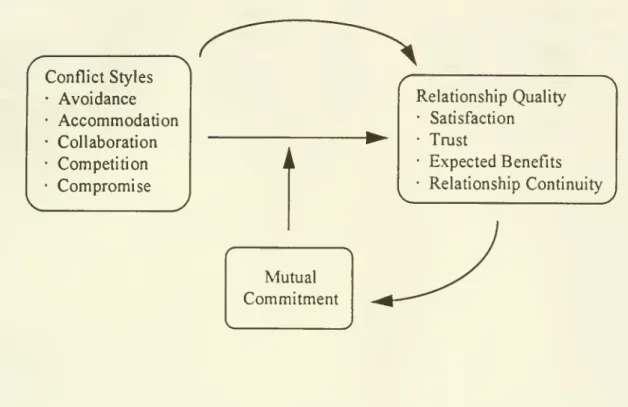
Figure 1 illustrates the conceptual
framework
underpinning
this research.The
utilizationof
specific conflictmanagement
stylesby one
channelmember
affects the perceived qualityof
therelationship. Additionally, the nature
of
these effects aremoderated
by
thedegree
towhich
thechannel
members
are mutuallycommitted
to the relationship.The
qualityof
the relationships hasa positive
impact
on
mutual commitment.
Thisfeedback
of
relationship quality tocommitment
captures
some
of
thedynamic
aspectsof
thedevelopment of
a channel relationship.Channel
members
utilizingthe appropriate conflictmanagement
styles forthe levelof mutual
commitment
in the relationship increase the quality
of
the relationship which, in turn increases the levelof
commitment which
reinforcesor discourages theuseof
specificconflictmanagement
styles.We
begin the discussionof
the conceptualframework
withan
overview
of
conflictmanagement
stylesand
a conceptualizationof
relationship quality.Then
we
discuss thehypotheses concerning
the direct effectsof
conflictmanagement
styleson
relationship qualityand
Conflict
Management
StylesConflict
management
has a rich research tradition in themanagement
and
socialpsychology
literature.A
number of
researchershave
proposed taxonomies
of
behaviors thatparties
engage
inwhen
involved in conflictual situations (seeWall
&
Callister1995
for areview).Although
much
of
the research in this areaexamines
interpersonal conflict, the literaturerepresents auseful starting point for investigating interorganizational conflict
management.
Initially, researchers conceptualized
approaches
for conflictmanagement
as positionsalong a unidimensional
continuum
rangingfrom
cooperationand
competition(Deutsch
1949).Thisunidimensional
view
of
conflictmanagement
approaches evolved
into a representationwhich
arrayed conflict
management
styles alongtwo
dimensions, assertivenessand
cooperativeness(Thomas
1976). Assertive behavior in conflict situations focuseson
concern
for one'sown
outcomes,
while cooperative behavior focuseson
concern
forthe other party'soutcomes.
Using
these
two
dimensions,Thomas
and
his colleagues identified the five conflictmanagement
stylesexamined
in this research: avoidance,accommodation,
competition,compromise,
and
collaboration.
The
characteristicsof
these fivestyles aresummarized
inTable
1.Avoidance.
The
avoidance
styleisan
unassertiveand uncooperative
approach.A
channelmember
engages
in this conflictmanagement
stylebecause
itdoes
notwant
to introduce tensionsor unpleasantnessin the relationship. This style involves
minimal
communication
and
exchange of
information
between
the parties. Thus, theuse
of
anavoidance
stylecan
result in a lackof
clarityand
directionwhich
increases the levelof
conflict,and
has a negative effecton
the relationship(BuUis 1983).
On
the other hand,avoidance
may
be
productiveby minimizing
the attentionand
effort directed
toward
unimportant
issues(Thomas
1976)
or serving as a defense against aAccommodation.
The
accommodation
style is an unassertive, but cooperative approach.When
a channelmember
usesaccommodation
to deal with a conflictual situation, it is primarilyconcerned with
satisfying the other firm'sneeds
or concerns.Hence,
accommodation
focusesconsideration
of
the other party's positionand emphasizes
not offending the other party.Due
tothe
emphasis
on
satisfying theneeds of
the other party, theamount of
informationexchanged
islimited
and one-way,
flowingfrom
theother partyto theaccommodating
channelmember.
Competition.
A
competitive conflictmanagement
approach
is assertiveand
uncooperative, focusing
on
imposing
one's positionon
the other party.Although
one
might
view
a competitive style to conflict
management
as beingsynonymous
with conflict itself, the focuson
competition as a
management
style is the pressure tomake
the other party change.The
competitive
approach can be
usefulwhen
a quick, decisive action isneeded
(as inan emergency);
however,
thisapproach
typically reduces the options for resolving conflictsand
requiresconsiderable
energy
(Thomas
1976).Due
to the lackof concern
for the other parties needs, theamount of
informationexchanged
is limitedand
one-way
flowingfrom
thecompeting
channelmember
to the other party.Compromise.
A
compromise
approach
involves amoderate
degree
of both
assertivenessand
cooperation.A
channelmember
engaging
in acompromise
approach
willexchange
concessions
and
try to findan
intermediate position that is acceptable toboth
parties. Thus, theuse of
this style involves amoderate
amount
of
two-way
informationexchange
between
theparties.
Collaboration.
A
collaborativeapproach
consistsof
a high levelof both
assertivenessand
cooperation.
When
a channelmember
utilizes collaboration, itengages
in proactive,mutual
issues,
and
works
through
differences. Thisapproach
focuseson
identifying mutually beneficialahematives
formanaging
conflict situationsthrough
a high levelof
two-way
informationexchange. In general, the use
of
thisapproach
results in a productiveoutcome
illustrating thebeneficial aspects
of
conflict.However,
thisapproach can be
dysfunctionalwhen
a collaboratingchannel
member
shares sensitive informationabout
theirconcerns
and
preferencesand
the otherchannel
member
usesthisinformation opportunistically(Dant
&
Schul 1992; Pruitt 198
1;Thomas
1976). In addition, this conflict
management
style, like the competitive approach, requiressubstantial effort
(Thomas
1976).'These
conflictmanagement
styleshave
been used
to studyhow
people
do
and
shouldrespond
to specific conflict situations orhow
people
typicallyrespond
to conflict situations in aspecific relationship or across relationships. In this research,
we
view
these conflictmanagement
styles as a typical
approach
for dealingwith
conflict in a specific relationship. It is notunreasonable to
assume
that firmsand
specificboundary
spanners involved in a relationshipdevelop
consistentapproaches
for dealingwith situations thatdevelop
in long-term relationships.In this
manner,
conflictmanagement
stylesbecome
partof
thenorms
governing
the relationshipsbetween
independent
channelmembers
(John
and
Heide
1992).Mutual
Commitment
Our
conceptualframework
in Figure 1 indicates that theimpact
of
the five conflictmanagement
stylesdiscussed previously ismoderated by mutual
commitment,
thedegree
towhich
both
parties arecommitted
to the relationship.Commitment
ismore
than a simple positiveevaluation.
The
essenceof
commitment
is sacrificeand
stability.Commitment
entails adesire todevelop
a stable relationshipand
a willingness tomake
short-term sacrifices to maintain theThere
is agrowing
consensus
in the channels literature thatcommitment
is a central construct inrelational exchange,
enhancing
outcomes
and
contributing to relationship stabilityover
the longrun.
Relationship Quality
The
outcome
construct in theframework
shown
in Figure 1 is relationship quality.There
is
no
consensus
on what
relationship quality is.Researchers
have
pointed to the manifestationof
several distinct,
though
related constructs: trust,commitment,
conflict, satisfaction,disengagement,
willingness to invest,and
expectationsof
continuity (Crosby,Evans
&
Cowles
1990;
Dwyer,
Schurr,&
Oh
1987;Kumar,
Scheer
&
Steenkamp
1995).A
usefulway
for organizing these constructs into a higher orderconcept
of
relationship quality is toview
relationship quality as consisting
of
evaluationsof
thepresent relationshipand
fliture expectationsof
the relationship.Evaluation
of
present
relationship. Satisfactionand
trust are attitudinal constructscapturing the evaluation
of
the present relationship. Satisfaction is thedegree
towhich
therelationship
exceeds
the expectationsof
the channelmember.
Trust involves the followingtwo
elements
(Andaleeb
1992;Anderson
&
Narus
1990;Deutsch
1958;Ganesan
1993;Lindskold
1978;
Zucker
1986): (1) the perceptionof
the other party'shonesty and
reliability~
thedegree
to
which
the other channelmember
is open, fairand
sincere(Dwyer, Schurr
&
Oh
1987;Scheer
&
Stem
1992) and
(2) perceptionof
the other party'sbenevolence
—
thedegree
towhich
the otherchannelmember
isconcerned about
thechannelmember's
welfare.Future
expectation.Expected
benefitsand
relationship continuity are constructs relatedto the future
of
the relationship. Socialexchange
theory points to the roleof
anticipated benefitsin determining the long-run survival
of
the relationship. Ifthe partiesdo
not perceive that theywill receive
worthwhile
benefits fi"om being in the relationship, they are likely to exit (Blau 1964;Thibaut
&
Kelley 1959). Expectationsof
continuity are the channelmember's
perceptionsof
itsintentions to continue transacting with the other party into the future
(Anderson
&
Weitz
1989;Noordewier,
John
&
Nevin
1990).Hence,
we
view
relationship quality asa higherorderconcept
involvingtrust, satisfaction,and
expectationsof
benefitsand
relationship continuity. Conflict is not included inour
conceptualization
of
relationship qualitybecause
conflictcan be
either fiinctional or dysfijnctionalto the relationship
(Deutsch
1969).Figure 1
proposes
thatcommitment
is aconsequence of
a highquality relationship.When
channel
members
favorably evaluate the present natureof
the relationshipand
its future potential,theywill
work
at maintainingthe relationshipover
the long-term.They
have
a strong incentive tosacrifice inthe short-termto preserve long-termbenefits.
Hence,
we
expect that high relationshipquality should
enhance mutual
commitment between
channelmembers.
HI
; Relationship qualityincreasesmutual
commitment between
channelmembers.
Conflict
Management,
Mutual
Commitment,
and
Relationship
Quality
As
suggested
inFigure 1,we
conceptualize theutilizationof
the five conflictmanagement
stylesas
having
direct effectson
relationship qualityand
effects that aremoderated by
the levelof
mutual
commitment
in the relationship. In the remaining portionof
this section,we
develop
and
support
hypotheses concerning
these relationships.Avoidance.
The
useof
anavoidance
conflictmanagement
style signals a lackof
concern
for
both
channelmembers' outcomes
and
the relationship in generalbecause
itdoes
not offer theopportunity to
exchange
information. In mutuallycommitted
relationships, informationexchange
committed
relationships, informationexchange
may
signalan
attempt todevelop
a higher qualityrelationship.
These
possibilitiesdo
notoccur
when
an
avoidance
style is used.Although
we
acknowledge
thatavoidance
may
be
usefulon
an
incidental basis to inhibit the escalationof
disagreements
over minor
issues,we
predict that its regular use frustrates the abilityof both
parties to satisfy their
needs
and
is likely tohave
detrimental effectson
relationship quality,regardless
of
the levelof mutual
commitment.
H2:
The
useof an avoidance
conflictmanagement
styleis negatively related to relationship quality, regardlessof
thechannelmembers'
levelof commitment.
Accommodation.
When
utilizingan
accommodating
style, the channelmember
signals aconcern
fortheother party's welfare but limits the sharingof
sensitive informationand minimizes
risks (Pruitt 1981). In relationships characterized
by low
mutual
commitment,
the concessionsoffered
when
usingan
accommodation
styleencourages
the other channelmember
to reciprocateleading tothe escalation
of
trustand
satisfaction(Osgood
1962).However, accommodation
is unlikely tobe
a useful long-term conflictapproach
in amutually
committed
relationship. Consistentaccommodation
does
not require thesame
levelof
information sharingas
compromise
and
collaboration styles.An
accommodating
stylealso signalsan
unwillingness toassume
the riskof
sharing sensitive information (Pruitt 1981). Thisundermines
trustand
communicates
a lackof involvement
with the conflict issues in therelationship. Additionally,
an
accommodating
style indicates that the channelmember
is notinterested in
expending
on
the relationship the effort associatedwith
theuse
of
more
assertiveconflict
management
styles. Thus,we
hypothesize that:H3:
The
use
of an
accommodating
conflictmanagement
style ismore
positively related to relationship quality as thedegree
of mutual
commitment
decreases.Competition.
Channel
members
who
use a competitive style formanaging
conflictdemonstrate
aconcern
for their individualoutcomes
over
jointoutcomes.
Thisapproach
fostersdistrust, conflict,
and
ultimatelyundermines
relationship quality regardlessof
the levelof
channelmember
commitment
to the relationship.H4:
The
useof
a competitive conflictmanagement
style is negatively related to relationship quality, regardlessof
the channelmembers'
levelof
commitment.
Compromise
and
Collaboration.The
remainingtwo
conflictmanagement
styles,compromise
and
collaboration, involveengaging
inboth
assertiveand
cooperative behaviorsand
atwo-way
flow
of
information.The
critical differencebetween
these styles is theamount
of
information
exchanged.
When
acompromise
style is used, the informationexchanged
involves the objectivesof
thetwo
channelmembers.
Using
this information, the channelmembers
resolvethe conflict
by compromising,
or splitting the difference.When
a collaborative style is used, the informationexchanged
ismuch
more
extensiveand
may
involve proprietary positions (e.g.,Dant
&
Schul 1992; Pruitt 1981,Thomas
1976). This disclosure enables the channelmembers
to identify novel,win-win
solutions.However,
theexchange of
this proprietary informationmakes
the parties vulnerableto opportunisticbehavior
(Thomas
1976). Since acompromise
involves theexchange
of
non-proprietary information to reach a mutually satisfactory resolution,we
hypothesize:
H5:
The
use of
acompromise
conflictmanagement
style is positively related to relationship quality regardlessof
the channelmembers'
levelof
commitment.
We
propose
that the effectsof
a collaborative conflictmanagement
styleon
relationship qualitymay
differdepending
on
the levelof
themutual
commitment.
When
both
parties are mutuallycommitted
tothe relationship, they aremotivated
to maintain the relationship's existenceover
thelong
runand
striveformutual
benefit.The
members
aremotivated
to resistjeopardizingthe relationship
by
opportunistic useof
proprietary information learnedabout
the other channelmember.
Thus,
a collaborative style increases relationship quality incommitted
relationshipsbecause
the benefitsof
identifying novel solutionsoutweigh
the risksof
opportunistic useof
proprietary information.
In
uncommitted
relationships, the parties' are short-term orientedand
motivation tomaintainthe relationship is minimal. Relationshiptermination is easily accomplished.
As
aresult,members
may
be
more
willing to act opportunisticallytoward
the other party in order to gain ashort-term advantage.
Because
of
this,we
expect that a collaborativeapproach
to conflictmanagement
may
have
detrimental effectson
relationship quality inuncommitted
relationships.Such
an approach
involves the sharingof
candid information that couldbe used
tominimize
one
party's position at the
expense
of
the other.Even
iftheinformation is notused
opportunisticallyby
the other party,an
awareness of
the potential vulnerability is likely to decrease satisfactionof
thecollaborating party.
H6:
The
use
of
a collaborative conflictmanagement
style ismore
positively related to relationship quality as thedegree
of mutual
commitment between
the channel
members
increases.The
following section describes themethodology
used
to test the previously statedhypotheses.
The
sectionbegins with a descriptionof
the research contextand
sample.Then
themeasure
development and
model
estimation are describedin detail.METHOD
Data
CollectionResearch
setting.The
insurance industry distribution channelwas
the setting for testsof
the hypotheses.
By
selectingmajor
firmswho
employ
awide
rangeof
relationships with theiragents,
we
were
able tominimize
inter-industry heterogeneityand
provide a setting inwhich
both
insurance firms
and
agentshave
awide
rangeof
alternative partnersand
low
barriers to exitingthe relationship. Thus,
mutual
commitment
is not easily created. This assured us thatwe
would
have
considerable variation interms
of commitment,
conflictmanagement
approaches,and
relationship quality.
Procedure.
Two
major
insurance firms participated in the study in return forcustomized
summaries of
their agent relationships.One
firmcovered
the property/casualtymarket,
both
individualand commercial,
while the other offered primarily life insuranceand
employee
benefitprograms.
The two
insurersrandomly
selected a cross sectionof
their agentsand
identifiedthemost
knowledgeable person
in their organizationabout
the relationship with theagent. This
employee
was
typically the field salesmanager
responsible for the territory inwhich
the agent
was
located.A
questionnaireconcerning
a specific(named)
agentwas
sent to thekey
informantworking
for the insurancecompany.
Each
survey contained aform
letterfrom
the insurancecompany
requestingparticipationand
assuring confidentiality.A
cover
letterfrom
the researcherswas
also included that: (1) explained that thepurpose
of
the studywas
to gain a betterunderstanding
of
agent-insurer relations, (2) assured therespondent
thatthe disaggregateanswers
would
be
kept confidential,and
(3)promised
a generalsummary
of
the findings.Response
rateswere
71%
forone
insurerand
55%
forthesecond
insurer. This represented a finalsample
sizeof
368
responses.Sample
characteristics.The
reported relationshipswere
heterogeneous, providing uswith
considerable variationwith
respect to the constructsof
interest.On
average, the agencieshad
represented the insurer for 22.4 years (sd=21.2)and
sold $1.7 million(sd=$2.4M)
in policieson
an annual basis.The
datawere
also informativeof
the varietyof
alternatives thateach
firmfaced. In
each
territory, therewere
approximately
5.7 (sd=7.4) alternative agencieswho
were
capable
of
representing the insurer.Each
agency
alsohad
5.8 (sd=4.9) alternative insurerswho
could offercompetitive
products
and
services.Respondent
characteristics.Respondents had
worked
with the agenciesapproximately
5.1 (sd=4.7) years
on
average.85%
were
territorymanagers
who
were
veryknowledgeable
about
the specific agency.Both
are positive indicatorsof
the informant'scompetency
withrespect to providing
knowledgeable
responsestoour
questionnaire.The
lengthof
the relationshipbetween
the agenciesand
the insurancecompanies and
theboundary
spanners representing thefirms suggeststhat typical stylesor
norms
formanaging
conflicthad
timeto develop.Measure Development
All
of
the constructs in the surveywere measured
with multiple-item Likertmeasures
and
were
based
on
scales thathave
been
previouslyused
in past research orwere
created for thepurpose
of
this study. Allof
the scaleswere
adapted
to the study setting,based
on
personalinterviews
with
insurance representativesand
selected agents.These
interviews also served tosimplify, clarify
and
streamline the survey.Table 2
contains themeans,
standard deviations,and
correlation matrixforthe constructs.
Mutual
commitment.
The
mutualityof
commitment between
the insurerand
theagency
was
assessedby
two
scales thattapped
the insurer'scommitment
and
its perceptionof
theagency's
commitment
to the relationship.Both
scaleswere
adapted from
thecommitment
itemsdeveloped
by Anderson
&
Weitz
(1992),which
used
a 7-point Likert scale(l=Strongly
Disagree,7=Strongly
Agree).The
insurer'scommitment
scale included itemssuch
as,"We
are quite willing tomake
sacrifices to help out thisagency from
time to time,"and
"We
have
a strong senseof
loyalty to this agency,"
whereas
the perceivedagency
commitment
scalewould
be, "Thisagency
is quite willing to
make
sacrificesto help us outfi^om timeto time,"and
"Thisagency
has a strongsense
of
loyalty to us "The
measure of mutual
commitment
used
to test thehypotheses
was
theaverage
of
theinsurancecompany's commitment
and
itsperceptionof
the agent'scommitment.
Conflict
management
styles.The
five conflictmanagement
styleswere
adapted
from
the"MODE"
instrumentdeveloped
by Kilmann
&
Thomas
(1977). In order to insure thatwe
sampled
fi"om awide
varietyof
conflict situations, respondentswere
instructed to"Consider
situations in
which
your
company's
wishes
differfrom
thoseof
this agency. Indicate thedegree
to
which
each
statement describesyour
company's
typical response." In thismanner,
we
hoped
to
minimize
the possibilitythat respondentswould
tend to report high conflict situations onlyand
maximize
the possibilityof
informants using a varietyof
conflictmanagement
styles.The
responses
were
made
on
aseven
pointLikert scale(l=Does
Not
Describe,7=
Does
Describe).Avoidance
was
measured
by
itemssuch
as,"We
do what
is necessary to avoid uselesstensions."
Accommodation
was
representedby
itemssuch
as, "Inapproaching
negotiations,we
try to
be
considerateof
this agency's wishes."Competition
items included statementssuch
as,"We
make some
effort togetour way."
A
compromise
stylewas
measured by
itemssuch
as,"We
try to find a position that is intermediate
between
their positionand our
position." Finally,a
collaborative style
was
representedby
itemssuch
as,"We
attempt toimmediately
work
through
our
differences."Relationship
quality. Relationship qualitywas
comprised
of
four dimensions: trust,satisfaction,
expected
benefits,and
continuity expectations. Trustwas
measured
with itemsdesigned to tap honesty,
"We
trust thisagency
to deal fairiy with us,"and
benevolence, "Thisagency
caresabout
how
wellour
company
does
financially." Satisfactionwas
comprised of
itemssuch
as,"We
arevery satisfiedwith
the relationshipwe
have
withthis agency."Expected
benefitswas
atwo
itemmeasure,
including, "Thisagency
is likely to generate substantial benefits toour
company
over
the next three years." Continuity expectationswas
also atwo
itemmeasure,
suchas,
"We
expect tobe
working
withthisagency
forsome
time."Measurement
properties.Confirmatory
factor analysis techniqueswere
used
to assessmeasurement
issues via full-informationmaximum-likelihood
estimation techniques inLISREL
8.03
(Joreskog
&
Sorbom
1993).As
perour
conceptualization, relationship qualitywas
estimated as asecond
order construct consistingof
four first order factors: satisfaction, trust,expected
benefitsand
continuity expectations. First-order factormodels
were
estimated for allother constructs:
company
and
agentcommitment
and
the fivemodes
of
conflictmanagement.
The
overall fit indices~
chi-square,comparative
fit index (Bentler1990)
for themodels
arereported in
Table
3.The
comparative
fit indicesof
allof
themeasurement
models approach
orexceed
the .90recommended
level,demonstrating adequate
fitof
themodels
to the data.The
appendix
lists the scale itemsand
reliabilities. All firstand second
order factorloadings
were
significant ata=.05,
demonstrating
convergent
validity. Discriminant validitybetween
the constructsof each
measurement
model
was
stringently assessed via the testrecommended
by
Fomell
«&Larcker
(1981). Allof
themeasurement
models demonstrated
evidence
of
discriminant validitybetween
constructs.Chronbach
alpha reliabilities for thesubscales
and
first orderfactorsranged
fi'om .74 to .92.Model
Estimation
The
hypotheses
were
tested using the followingtwo
regression equations:Y
= Po+
PiXl+
p2Xz +
p3X3+
P4X4+P5X5+
p6X6+ P7X7+
PsXg+
P9X9 +PioX.oZ
=Oo+
ttiY
In the first equation,
Y
denotes
relationship quality,X|
is avoidance,X2
isaccommodation, X3
iscompetition,
X4
iscompromise, and
X5
is collaboration.Xe-Xio denote
the interactionsbetween
the five
modes
of
conflictmanagement
(avoidance,accommodation,
competition,compromise,
and
collaboration, respectively)and mutual
commitment.
In thesecond
equation,Z
denotesmutual
commitment,
and
Y
is relationship quality.The as
and
|3s arethe regressioncoefficients.The
models
were
simultaneously estimated using three-stage least squares.^Following
Chronbach
(1987), Jaccard, Turrisi &.Wan
(1990),and Lastovicka
&
Thamodaran
(1991), factor scoreswere
used
in the regression analysisand
all predictorswere
mean
centered toreduce
potential collinearity
between
variables.We
also ran the regression with adummy
variable to detect systematic differencesbetween
firmsand found
that therewere no
significant differences.Hence,
thefinal regressionwas
conducted
on
thecombined
datafrom
thetwo
firms.RESULTS
The
regression results are listed inTable
4. Relationship qualitywas
positively related(Pi=1.09,
p<.0001)
tomutual
commitment,
supporting hypothesis 1.Avoidance
had
a significantnegative effect (Pi=-.ll,
p<.04)
on
relationship qualityand
a significant positive interaction effect(^6=14,
p<.004).Thus,
there is partial support for hypothesis 2.Accommodation
exerted asignificant positive effect
(P2=
67,p<.0001)
on
relationship quality, while the interactionof
accommodation
and
commitment
had
a significant negative effect (P7=--37,p<.0001)
on
relationship quality, supporting hypothesis 3.
Competition
exerted a significant negative effect(P3=-.22,
p<.001)
on
relationship quality, while the interactionof
competitionand
commitment
was
positiveand
significant (P8=.14, p<.05). Thus, there is only partial support forhypothesis 4.The
use of
acompromise
conflictmanagement
stylewas
not significantly related to relationshipquality (P4=-.02, p<.76).
The
interactionbetween
acompromise
styleand mutual
commitment
was
positiveand
significant (Pg^.lS, p<.02). Thus, there isno
support for hypothesis 5.Collaboration
was
positively related to relationship quality(35=25,
p<.0004).The
interactionbetween
collaborationand mutual
commitment
was
also positively related to relationship quality,but marginally significant (3io=.13, p<.07). Thus, thereis only partial support forhypothesis 6.
In
sum,
the results indicate that collaborationand
accommodation
positively affectsrelationship quality, while competition
and avoidance
adversely affects relationship qualityand
compromising
hasno
effect.However,
asmutual
commitment between
the channelmembers
increases,
accommodation
is negatively related to relationship quality, while all othermodes
~
avoidance, collaboration, competition,and
compromise
~
enhance
relationship quality.DISCUSSION
The
results suggest that the five conflictmanagement
approaches
exert differential effectson
relationship quality as a functionof
the levelof mutual
commitment between
channelmembers.
Commitment
has longbeen
akey
construct in socialexchange
theory (Blau 1964,Thibaut
&
Kelley
1959) and
intraorganizational research(Becker
1960,Meyer
&
Allen 1984),and
is widelyacknowledged
in themarketing
channels literature as a construct central to all relationalexchanges
(Morgan
&.Hunt
1994) and an
important construct resulting in valuableoutcomes.
In this study,we
extendour
understandingof
commitment
by
investigating its role as a context variable thatmoderates
theimpact
of
various conflictmanagement
approaches
on
relationship quality.An
avoidance
styleof managing
conflictwas shown
to adversely affect relationshipquality.
Such
an approach
involvesminimal communication and exchange of
informationbetween
the parties
and
isunassertiveand uncooperative
in nature.The
regularuse of
this style frustratesboth
partiesfrom
effectivelymeeting
their needs.We
were
suprised to find that the negative effectsof avoidance
were
inhibited asmutual
commitment
between
the channelmembers
increases. This
seems
to illustrate the paradoxical natureof
anavoidance
style;avoidance can
result in ambiguity that leads to greater conflict (Bullis 1983), yet it
may
alsobe
productive inminimizing
the attentionand
efforttoward unimportant
issues(Thomas
1976)
or serving as adefense against a negative confrontation
(Raush
et al 1974, p. 65). It couldbe
thatwhen
thechannel
members
are mutuallycommitted,
avoidance
of
some
conflict situations (particularlythose involving
minor
issues) is beneficial for the relationshipand
contributes to long-termstability.
We
alsofound
that an unassertive, cooperativeapproach
to conflictmanagement
~
accommodation
~
also exerts differential effectson
relationship quality as a fianctionof
the levelof mutual
commitment
that existsbetween
the channelmembers.
Accommodation
is anon-threatening
way
tocommunicate
a sincere interest inthe other partyand perhaps
too, a desire tobetter
develop
the relationship.Hence,
when
channelmembers
are notcommitted
to therelationship,
accommodation
isan
incrementalapproach
thatdemonstrates
concern
and
interestand
lays a foundation forenhanced
trustand
commitment.
Incommitted
relationships,accommodation
signals apreoccupation
with satisfying the other partyover
concern
formutual
benefit
and
a lackof
willingness to take the riskof exposure
toopportunism and
exert the effortassociated
with
amore
collaborativeapproach.Channel
members
who
consistentlyaccommodate
in the face
of
conflictarelikelyto detrimentally affect relationship qualityover
the long-run.A
competitiveapproach
to conflictmanagement
isone
inwhich
the focusof
the style isthe pressure to
make
the other party change.Such
an
approach
in anoncommitted
relationshipwas
showoi to adversely affect relationship quality,because
itcommunicates
aconcern
forindividual
over
jointoutcomes.
This fosters distrustand
conflictand
undermines
relationshipquality
over
time.However,
the results suggestthatconflictmay
nothave such
adverseeffectson
relationship quality
when
the channelmembers
arecommitted.
When
the channelmembers
arecommitted,
there is a focuson
stabilityand
sacrificeand
adesire to maintain the relationshipover
the long term.
Hence,
there issome
assurance that the parties will not act opportunisticallytoward each
other.When
one
party uses a competitiveapproach and
attempts tomake
the other partychange
their position, itmay
notbe viewed
as threatening behavior, but rather a frankstatement
of
the resolution options facing the dyad. In thismanner,
relationship quality ispreserved instead
of
undermined.
A
compromise
approach
was
conceptualized as a middle-of-the-roadapproach
to conflict.Channel
members
willexchange
concessionsand
try to findan
intermediate positionbetween
theparties.
Such
a strategy alsoseems
to yield middle-of-the-road results.Compromise
did notexert
any
effecton
relationship quality innoncommitted
relationships. Incommitted
relationships,it appears to
have
somewhat
of
a positive effecton
relationship quality.Perhaps such an
approach
is seenmore
positively asan
attempt towork
cooperativelytoward
jointoutcomes
thanin
noncommitted
relationships.Finally,
we
found
that a collaborativeapproach
~
an
active attempt tomanage
conflict in away
that jointlymaximizes
theoutcomes
of both
parties~
can significantlyimprove
overall relationship quality, regardlessof
the levelof mutual commitment.
Such
anapproach
is evidentlyuseful for
communicating
to the other party amutual
versus individual orientation, generatingnew
ideas,showing
respect,and
gaining supportforthe solution.By
investigating theimpact
of
various conflictmanagement
approaches
across a varietyof
conflict situations
and
relationship types,we
are able tomake some
key
contributions to theliterature. First,
we
addresshow
systems
of
individuals—
firms—
respond
to conflict. In the interpersonalliterature, therehasbeen
a call for betterunderstandingof system-wide
styles,which
comprise
more
than just thesum
of
its parts. Pastwork
on
conflictapproaches
in themanagement
and marketing
literatures has typically takenan
interpersonal perspective (seeWall
&
Callister1995
for areview;Day, Michaels
&
Perdue
1988).Second,
we
investigatetheimpact
of
various conflictmanagement
approaches
in situationsin
which
the channelmembers
have
some
latitude inhow
theymight
deal with the conflictepisode. Past
work
hasexamined
the conflictmanagement
choice in asymmetrical relationshipcontexts (i.e., franchising),
and
hasbeen concerned with
the roleof
power
and
its effects (Blalock1989;
Dant&Schul
1992).Third,
by
taking the relationship contextinto account,we
advance our
understandingof
itseffects
on
conflictmanagement
outcomes.
Dant
&
Schul(1992)
investigate theimpact
of
situational characteristics
on
a channelmember's
choiceof
conflictmanagement
approach, butdo
not address the
impact
of
theapproach
on
relationshipoutcomes.
Research
on
relationshipcontext effects
on
conflictapproaches
in themanagement
literature hasbeen
limited; pastwork
has
focused
on
power
imbalances (Blalock 1989), interdependence(Thompson
1967),and
distributive contexts(Walton,
Dutton
&
Cafferty 1969).Finally,
we
are able todemonstrate
that general conflictmanagement
approaches can
differentially
develop
and
diminishrelationship qualitybetween
firms as a functionof
their levelof
mutual
commitment.
The
controlmode
~
mutual
commitment
—
plays a role in setting thecontext
of
the relationshipand
hence,frames
perceptionsand
interpretationsof
various conflictmanagement
behaviorsthat are critical in thedevelopment of
relationship quality perceptions.Implications
forManagement
The
five conflict stylesrepresent a repertoireof
approaches
thatcan be used
repetitively inconflicts. Clearly, the results suggest that firms should avoid using
one
stylewithout
regard toother possible
approaches
in their relationships with channelmembers,
because
some
approaches
are
more
or less usefiil for developing relationship quality across different typesof
relationships.If a firm
predominately
usesan
accommodating
approach
to conflictmanagement
—
primarilyconcerned v^th
satisfying theneeds
orconcerns
of
the other channelmember
-- then the firmignores the reality that
such an
approach
ismore
appropriate innoncommitted
relationshipsand
has adverse effects in
committed
relationships.Regular
patternsof
behaviorbecome
rituals,and
such
rigiditymay
work
against successful conflictmanagement.
By
better understanding theimpact
of
these five conflictmanagement
modes
across various relationship types, a channelmember
isless likely tomake
negative attributionsand
more
likely to betterunderstand
the otherparty
when
it switches styles.By
investigating themoderating
roleof mutual
commitment
as a context variable ininterfirm relationships,
we
found
that the positive effectsof
collaborationand
compromise
on
relationship quality
can be
enhanced, while the negative effectsof
competitionand avoidance
areminimized
and used
in amore
beneficialmanner
indeveloping
relationship quality. Thus, itappears
that incommitted
relationships, channelmember
actions are less likely tobe
interpretednegatively
and
more
likely tobe viewed
positively.Limitations
The
useof
a survey in understanding conflictmanagement
may
have
led toan
underreporting
of
theamount
of avoidance
actuallyused
in conflict situations(Gayle-Hacket
1989).
When
asked
to reporton
conflict, respondents typically recalland
reportabout
conflictsthat are noticed
and
important,and
may
noteven
consider the times that theyavoided
non-important conflict situations.
Second,
itmay
be
that channelmembers
tend to use asequence of
conflictapproaches
rather than
one
approach.For
example, their first response to conflictmay
be
to avoid, thenmove
on
to competitioninan
attempt towin
their position,and
finallymove
on
to collaboration.Such
strategieswould
notbe
reflected in the survey instrumentused
here. Instead, theone
strategy
most
salient in therespondent'smemory
is theone
that ismost
likelytobe
reported on.Directions for
Future Research
Past
work
inmarketing
channels has investigated conflictmanagement
approaches
inasymmetrical relationships
~
relationships inwhich power
is theprimary
governance
mode.
We
extend
thefield'sunderstandingof
this areaby
focusingon
theuseof
commitment
as theprimary
governance
mode
and
we
demonstrate
differential effectson
relationship quality.However,
thiswork
represents a first step inunderstandingconflictmanagement
innondominating
relationships.An
obvious
next stepwould
be
to extendour
model
to take intoaccount
the reactionsof
theother party. Clearly relationship
phenomena
involvetwo
partieswho
directly affectand respond
to
each
otherover
time.Another
avenue
of
researchwould
involve better understandingof
the "meta-strategies"that firms
may
use inmanaging
conflict.For example,
itmay
be
that themanagement
styles aremore
effectivewhen
used
in asequence
than usingone dominant
style.More
work
isneeded
thatilluminates the conditions
under
which
varioussequences
aremore
or less effectiveand
theirprecise effects
on
key
relationshipoutcomes.
Successful conflict
management
is acomplex
phenomenon
that is yet tobe
fullyunderstood
by
researchers inmarketing
or inmanagement.
In this study,we
have attempted
toadvance
the quest for understanding interorganizational conflictby
examining
variousmanagement
approaches
in lightof
thegovernance
mode
used
by
the channelmembers.
Our
results suggest that the
approaches have
differential effectson
overall relationship quality as afunction
of
the levelof
commitment
that existsbetween
the firms.Mutual commitment
as agovernance
mode
is a critical decision in that it requiresmuch
effort, time,and energy
todevelop
and
sustainover
time.By
understanding the differential effectsof
conflictmanagement
approaches such
as collaboration, competition,accommodation,
avoidance,and compromise,
firmsgain insight into
how
theymight
bettermanage
thesecriticallyvaluablerelationships.ENDNOTES
There
isa parallelbetween
some
of
theconflictmanagement
stylesproposed
by
Thomas
(1976) and
the stylesproposed by
March
and
Simon
(1958) examined
in a channel contextby
Dam
and
Schul(1992) and Lambert, Boughton, and
Banville(1986).Thomas'
stylesof
competition,
compromise, and
collaboration share aspectsof
theMarch
and
Simon
stylesof
persuasion, bargaining,
and
problem
solving.The
analysiswas
alsoconducted
usingtwo-stage
leastsquaresand
the resultswere
similar.FIGURE
1CONCEPTUAL
FRAMEWORK
ConflictStyles •Avoidance
•Accommodation
• Collaboration •Competition
•Compromise
Mutual
Commitment
Relationship Quality • Satisfaction • Trust •Expected
Benefits • Relationship ContinuityI
indicates a
moderated
relationshipindicatesadirect relationship
Characteristic
TABLE
1DESCRIPTION OF
CONFLICT
MANAGEMENT
STYLES
TABLE
2
MEANS,
STANDARD
DEVIATIONS,
AND
CORRELATION
MATRIX
Mean
StdDev
10 li 1.Commitment
2. Perception ofAgent'sCommitment
3. Collaboration 4. Competition 5. Accommodation 6. Avoidance 7. Compromise 8.Trust 9. Satisfaction 10. ExpectedBenefits 11. Continuity E.xpectations 4.90 4.73 5.17 5.00 5.03 4.86 4.64 4.80 4.20 4.66 1.30 1.22 .92 .85 .94 1.13 .89 .82 1.62 1.48 1 .76 1 .41 .36 1 -.01 -.01 .20 1 .59 .46 .56 .16 1 .30 .20 .40 .11 .58 1 .43 .33 .52 .02 .63 .44 I .62 .78 .32 -.02 .41 .71 .79 .32 -.10 .42 .74 .66 .33 -.06 .40 .22 .29 .55 .66 1 .19 .24 1 .23 .31 .69 1 5.25 1.56 .83 .70 .30 -.01 .50 .21 .35 .53 .64 .69 1Correlationsinboldare notsignificantata=0.05
TABLE
3MEASUREMENT
MODEL
SUMMARIES
Measurement
Model
Chi-Sguare(df)
QFl
Relationship Quality 404.7
(73) 93~~
Company/
AgentCommitment
555.1(103) 92Conflict
Management Modes
576.97(160)gg