,G'
DeweVi
D28
M414
MIT LIBRARIES
39080009327666
Coalition,
Cryptography,
and
Stability:Mechanisms
for
Coalition
Formation
in
Task
Oriented
Domains
by
Gilad ZIotkin
Jeffrey S.
Rosenschein
CCS
WP
#168, Sloan SchoolWP
#3703-94
July1994
Coalition,
Cryptography,
and
Stability:
Mechanisms
for
Coalition
Formation
in
Task
Oriented
Domains
Gilad Zlotkin
Center
forCoordination
Science
Sloan School
of
Management,
MIT
1
Amherst
Street,E40-179
Cambridge,
MA
02139
USA
[email protected]
Jeffrey S.
Rosenschein
Computer
Science
Department
Hebrew
University
Givat
Ram,
Jerusalem
Israel [email protected]
July
12,1994
To
appear in the Proceedings ofthe National Conference on Artificial Intelligence,Seat-tle, Washington, July
1994-Preliminary version of this paper appeared in the Proceedings ofthe
AAAI
Spring Sym-posium on Software Agents, Stanford University, California,March
1994, PP-87-94-m
2
8
19951
Introduction
In multi-agent domains, agents can often benefit by coordinating their actions with one
another; in
some
domains, this coordination is actually required. In two-agent encounters, the situation is relativelysimple: either the agents reach an agreement (i.e., coordinate their actions), or they do not.With more
than two agents, however, the situationbecomes more
complicated, since agreement
may
be reached by sub-groups.The
process of agent coordination, and of reaching agreement, has been the focus ofmuch
research in Distributed Artificial Intelligence (DAI).The
general term used for thisprocess is "negotiation" (usually in the 2-agent case) [1, 6, 8, 9, 17, 21, 11], and "reaching consensus" (in the n-agent case) [2, 3]. Both approaches, though dealing with different
numbers
of agents, share one underlying assumption: the agreement, if it is reached, will include all relevantmembers
ofthe encounter. Thus, even in the n-agent case where avotingprocedure might enableconsensus to be reached, theentiregroup willbe
bound
bythe group decision. Sub-groups cannotmake
sub-agreements that exclude othermembers
of the group. Interesting variations on these approaches, which nonetheless remain bilateral in essence, are the Contract Net [16], which allows bilateral agreement in n-agent environments, andbilateral negotiation
among
two sub-groups discussed in [7].In
some
domains, however, itmay
be possible for beneficial agreements to be reachedamong
sub-groups of agents,who
might be individually motivated to work together to theexclusion of others outside the group. Voting procedures are not applicable here, because the full coalition
may
not be able to satisfy all itsmembers,
who
are free to createmore
satisfying sub-coalitions. This paper considers thismore
general case of n-agent coalitionformation (recent pieces of
work
on similar topics are [5, 15]). Building on our previouswork [21], which dealt only with bilateral negotiation mechanisms,
we
here analyze thekinds of n-agent coordination
mechanisms
that can be used in specific classes of domains.2
Coalitions
2.1
An
Example
—
The
Tileworld
Consider the following simple
example
in a multi-agent version of the Tileworld [10] (see Figure 1).A
single hole in the grid is represented by a framed letter (such as [a]).Each
agent's position is
marked
by itsname
(such as Ai). Tiles are represented by black squares()
inside the grid squares.Agents can
move
from one grid square to another horizontally or vertically (unless thesquare is occupied by a
hole—
multiple agents can be in thesame
grid square at thesame
time).
When
a tile is pushed into any grid square that is part of a hole, the square is filledand becomes
navigable as if it were a regular grid square.The
domain
is static except forchanges brought about by the agents.
I
—
,
Agent
I's goal is to fill hole [^, while agents 2 and 3 need to fill holes[bj and [c]
TOD;
utility is the difFerencp between ikecmX
j?f -achieving your goal alone, and the cost of your part of the deal. Therefore, tl^ere "is an upperbound
on theamount
of utility thateach agent can get
—
no agent can getmore
utility than his stand-alone cost.As
we
shall seebelow, however, our
model
never attempts to violate this upperbound
on utility.3.1
Subadditive
Task
Oriented
Domains
In
some
domains, by combining sets of taskswe
may
reduce (and can never increase) the total cost, ascompared
with thesum
of the costs of achieving the sets separately.The
Postmen Domain,
for example, has this property, which is called subadditivity. IfX
and
Y
are two sets of addresses, andwe
need to visit all ofthem
{X U
Y), then in the worstcase
we
will be able to do the minimal cycle visiting theX
addresses, then do the minimalcycle visiting the
Y
addresses. This might be our best plan if the addresses are disjoint and decoupled (the topology of the graph is against us). In that case, the cost of visiting all theaddresses is equal to visiting one set plus the cost of visiting theother set. However, in
some
caseswe
may
be able to do better, and visitsome
addresses on theway
to others.Definition 3
TOD
< T,A,c >
will be calledsubadditive
iffor all finite sets of tasksX,
Y
C
T, we havec{X
U
K)
<
c{X)+
c{Y).3.2
Coalitions
in
Subadditive
Task
Oriented
Domains
In a
TOD,
agroup ofagents (a coalition) can coordinate by redistributingtheir tasksamong
themselves. In a subadditive
TOD,
theway
to minimize total cost is to aggregate asmany
tasks as possible into one execution batch (since the cost ofthe union of tasks is always less than thesum
of the costs). Therefore, themaximum
utility that a group can derive in a subadditiveTOD
is the difference between thesum
of stand-alone costs and the cost of the overall union of tasks. This difference will be defined to be the value of the coalition.Definition 4 Given an encounter {Ti,...,Tn) in a subadditive
TOD
< T,A,c
>, we willdefine the coalition
game
induced by this encounter to be (N,v), such thatN
=
{1,2, .. . ,n},and
V5 C
N, v{S)=
E.6S
c(r.)-
c(U.^sT,).3.3
Superadditive
Coalition
Games
It seemsintuitively reasonable that agents in acoalition
game
should not suffer bycoordinat-ing their actions with a larger group. In other words, ifyou take two disjoint coalitions, the
utility they can derive together should not be less than the
sum
oftheir separateutilities (atthe worst, they could "coordinate" by ignoring each other). This property (which, however, is not always present) is called superadditivity.
Definition 5
A
coalitiongame
with transferable xdility innormal
characteristicform
{N,v)is superadditive iffor any disjoint coalitions
S,V
C
N,S
D
V =
ib, then v{S)+
v{V)<
Theorem
1Any
encounter (Tj,. .. ,r„) in a subadditive
TOD
induces asuperadditive
coali-tion
game
{N,v).Proof. Proofs can be found in [22]. o
4
Mechanisms
for
Subadditive
TODs
We
would like to setup
rules of interaction such that communities of self-interested agentswill form beneficial coalitions. There are several attributes of the rules of interaction that
might be important to the designers of these self-interested agents (as discussed further in [12]):
1. Efficiency:
The
agents should not squander resourceswhen
theycome
to an agreement;there should not be wasted utility
when
an agreement is reached. Since the coalitiongame
is superadditive itmeans
that thesum
of utilities of the agents should be equal to v{N). 2. Stability: Since the coalitiongame
is superadditive, the full coalition can always satisfythe efficiency condition, and therefore
we
willassume
that the full coalition will be formed.The
stability condition then relates to the payoff vector (ui,...,u„) that assigns to each agent i a utilityof u,. There are three levels of stability (rationality) conditions: individual,group, and coalition rationality. Individual Rationality
means
that that no individual agentwould like to opt out of the full coalition; i.e.,
m
>
v{{i])=
0.Group
Rationality (ParetoOptimality)
means
that the group as a whole would not prefer any other payoff vector overthis vector; i.e., Er=i ".
-
^(")- This condition is equivalent to the efficiency condition above. Coalition Rationalitymeans
that no group of agents should have an incentive todeviate from the full coalition and create a sub-coalition; i.e., for each subset of agents
SCN,Z,esUi>v{S).
3. Simplicity: It will be desirable for the overall interaction environment to
make
lowcomputational
demands
on the agents, and to require littlecommunication
overhead.4. Distribution: Preferably, the interaction rules will not require a central decision maker,
for all the obvious reasons.
We
do not want our distributed system to have a performancebottleneck, nor collapse due to the single failure of a special node.
5.
Symmetry:
Two
symmetricagents shouldbe assigned thesame
utilitybythemechanism
(two agents are symmetricwhen
they contribute exactly thesame
value to all possible coalitions).We
will develop amechanism
for subadditiveTODs
such that agents agree on theall-or-nothing deal, in which each agent has
some
probability of executing all the tasks.The
question that
we
will try to answernow
is"What
should be the division of utilitiesamong
all agents in the full coalition?"
Coalition rationality isthe strongest stabilitycondition, andimplies individual rationality
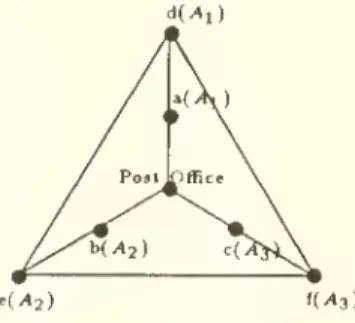
d(/i,)
'(.A2) l(A3)
Figure 2:
Example
of an Unstable EncounterConsider theencounter froma three-agent
Postmen
Domain
that can beseen in Figure 2.The
Post Office is in the center.The
length of each arch is 1.The
encounter is (Ti=
{a,d},T2=
{6,e},T3=
{c,f}).^Each
agent can deliver his letters with a cost of4.The
cost of delivering the union of the letters of any two agents is 5. Therefore, the valueof any twoagents' coalition is (2 * 4)
-
5=
3.The
cost of delivering all the letters is 8. Therefore, the value of the full coalition is (3 * 4)-
8=
4.We
would like to find a payoff vector {111,112-,U3)that satisfies the following conditions:
(1)
V^G
{1,2,3}u,>v{{i})
=
0;(2) Vi
^
J6
{1,2,3} u.+
u,>
v{{z,j})=
3;(3) U1
+
U2+
U3>
i;({l,2,3})=
4.Since the full coalition is also the
maximal
valued configuration, condition (3) is satisfied byequality (i.e.,Ui+U2+"3
=
4). Ifwe
add up
alltheinequalities,we
willhaveuj+ua+us
>
=
4:^, which cannot besatisfied. Thismeans
that in anydivision ofthe value ofthefull coalitionamong
the agents there will be at least two agents that will prefer to opt out ofthe coalitionand form a sub-coalition! For example,
assume
that the full coalition is formed with payoffvector (1,1,2). Agents 1 and 2 can get
more
by forming a coalition (i.e., by excluding agent 3 from the coalition).The new
payoff vector can then be (l|,li,0). This coalition andpayoff vector is also not stable, since
now
agent 3 cantempt
agent 2 (for example) to forma coalition with 3 by promising 2
more
utility.The new
payoff vector can then be (0,2,1).However,
now
agent 1 can convince the two agents that they all can do better by formingthe full coalition again.
The new
payoff vector can then be (|,2|, l|). This coalition is alsonot stable. .
.
-AH payoffs that satisfy the coalition rationality conditions are called the core of the gamein the game theory literature. See, for example, [4].
Agent 1 has to deliver letters to addresses a and d, agent 2 has to deliver letters to addresses 6 and e,
4.1
Shapley
Value
The
Shapley Value [14, 18] for agent i is a weighted average of all the utilities that icon-tributes to all possible coalitions.
The
weight of each coalition is the probability that thiscoalition will be formed in a
random
process that starts with the one-agent coalition, and in which this coalition grows by one agent at a time such that each agent that joins thecoalition is credited with his contribution to the coalition.
The
Shapley Value is actually the expected utility that each agent will have from such arandom
process (assuming anycoalition and permutation is equally likely).
Definition 6 Given a superadditive coalition
game
with transferable utility in normal char-acteristicform
{N,v), the Shapley Value is defined to be: u,=
YlscNiiSn>
''
v{S
U
{z})-v{S).
The
Shapley Value satisfies the efficiency, symmetry, and individual rationality condi-tions [14, 4]. However, it does not necessarily satisfy the coalition rationality condition.Theorem
2 The Shapley Value is also: u,=
c{T,)-
E5cAf,;g5^""'^L?'''^'' ^'c(-^)- ^cl"?)
=
c{SU
{i})—
c{S), i.e., the additional cost that agent i adds to a coalition S.Agent I's Shapley Value is the difference between the cost of its goal and its weighted average cost contribution to allpossible coalitions.
The
cost that agent i can contribute to acoalition is
bounded
by c{T,). Therefore, the average contribution is alsobounded
by c{T,), which alsomeans
that the Shapley Value is positive (i.e., satisfies the individual rationality contribution)and
bounded
by c{T,) (which is also themaximal
utility that an agent canget according to our model).
Thus
(aswe
promised above in Section 3), ourmodel
neverattempts to transfer to an agent
more
utility than he can get by simply having his tasksperformed by others.
4.2
Mechanisms
for
Subadditive
TODs
We
can define a Shapley Value-basedmechanism
for subadditiveTODs
that forms thefull coalition and divides the value of the full coalition using the Shapley Value.
The
mechanism
simply chooses the following (all-or-nothing)mixed
deal, (pi, . ..,p„), such thatTheorem
3 The above all-or-nothing dealis well-defined, (i.e., ^i^
N:Q
<
Pi<\\
E"=iPi=
4.3
Evaluation
of
the
Mechanism
The
abovemechanism
gives each agent its Shapley Value.The
mechanism
is thus symmetric and efficient (i.e., satisfying group rationality), and also satisfies the criterion of individual rationality. However, as was seen inExample
2, nomechanism
can guarantee coalitionratio-nality. Besides failing to guarantee coalition rationality, the
mechanism
also does not satisfy the simplicity condition. It requires agents to calculate the Shapley Value, a computationthat has exponential computational complexity.
The
computational complexity of amechanism
should bemeasured
relative to thecom-plexity of the agent's standalone planning problem. This relative
measurement
would thensignify the computational overhead of the mechanism.
Each
agent in a Task OrientedDo-main
needs to calculate the cost of his set oftasks, i.e., to find the best plan to achievethem.Calculation ofthe value ofa coalition is linear in the
number
ofagents in the coalition.'*The
calculation of the Shapley Value requires an evaluation ofthe value of all (2") possible coali-tions. In Section 6 below
we
willshow
that there exists another Shapley-basedmechanism
that has linear computational complexity.
5
Concave
TODs
Definition 7 [Concavity]:^
TOD
<
T,A,c>
will be calledconcave
iffor allfinite setsoftasks
X
C
r,Z
CT,
we havec{Y
U
Z)-
c{Y)<
c{X
U
Z)-
c{X).All concave
TODs
are also subadditive. It turns out that general subadditive TaskOri-ented
Domains
can be restricted,becoming
concave Task Oriented Domains. For example,the
Postmen
Domain
is subadditive,when
the graphs over which agents travel canassume
any topology.By
restricting legal topologies to trees, thePostmen
Domain
becomes
concave.Definition 8
A
coalitiongame
with transferable utility innormal
characteristicform
{N,v)is convex iffor any coalitions 5, V, v(S)
+
viV)<
v(SU
V) 4-v{S
D
V).In convex coalition games, the incentive for an agent to join a coalition grows as the
coalition grows.
Theorem
4Any
encounter (Ti, . ..
,T^) in a concave
TOD
induces a convex coalitiongame
{N,v).
Theorem
5[Shapley
(1971)] [13]: In convex coalition games, the Shapley Value always satisfies the criterion ofcoalition rationality.In concave
TODs,
the Shapley-basedmechanism
introduced above is fully stable, i.e., satisfies individual, group, and coalition rationality.The cost ofaset of tasks needs to be calculated only a linear numberoftimes. ^The definition is from [21].
6
The
Random
Permutation
Mechanism
The
Shapley Value is equal to the expected contribution of an agent to the full coalition, assuming that all possibleorders of agents joining and forming the full coalition are equallylikely. This leads us to a
much
simplermechanism
called theRandom
PermutationMech-anism: agents choose a
random
permutation and form the full coalition, one agent afteranother, according to the chosen permutation. Each agent (i) gets utility {wi) that is equal
to its contribution to the coalition, at the time hejoined it. This is done by agreeing on the
all-or-nothing deal, (pi,. . . ,Pn), such that p,
=
'''JC*"'.Theorem
6 // each permutation has an equal chance of being chosen, then theRandom
PermutationMechanism
gives each agent an expected utility that is equal to its ShapleyValue.
The
Shapley-basedRandom
PermutationMechanism
does not explicitly calculate theShapleyValue, but instead calculates thecost ofonly n sets oftasks. Therefore, it has linear
computational complexity.
The
problem of coalition formation is reduced to the problem of reaching consensus on arandom
permutation.6.1
Consensus
on Permutation
No
agent would like to be the first one that starts the formation of the full coalition (since this agent by definition gets zero utility). If thedomain
is concave (and therefore thecoali-tion
game
is convex), each agent has an incentive to join the coalition as late as possible.To
ensure stability,we
need to find a consensusmechanism
that is resistant to anycoali-tion manipulation.
No
coalition should be able, by coordination, to influence the resultingpermutation such that the
members
of the coalition will be the last ones to join the full coalition. For example, thismeans
that no coalition of n-
1 agents could force the singleagent that is out of the coalition to go first.
We
will use the simple cryptographicmechanism
that allows an agent to encrypt ames-sage using a private key, to send the encrypted message, and then to send the key such
that the message can be unencrypted. Using these tools, each agent chooses a
random
per-mutation and a key, encrypts the permutation using the key, and broadcasts the encrypted message to all other agents. After he has received all encrypted messages, the agent broad-casts the key.Each
agent unencrypts all messages using the associated keys.The
consensus permutation is the combination ofall permutations.Each
agentcanmake
sure that each permutation hasan equal chanceofbeing chosenevenifhe assumes that the rest of the agents are all coordinating their permutations against
him
(i.e., trying tomake
him
be the first). All he needs to do is to choose arandom
permutation. Since his permutation will also becombined
into the final permutation, everything will beshuffled in a
way
that no one can predict.7
Conclusions
We
have considered the kinds of n-agent coordinationmechanisms
that can be used in TaskOriented
Domains (TODs),
when
any sub-group ofagentsmay
engage in task exchange tothe exclusion of others.
We
presented a simple,efficient, symmetric,and
individual rational Shapley Value-basedcoalition formation
mechanism
that uses cryptographic techniques for subadditiveTODs.
When
thedomain
is also concave, themechanism
also satisfies coalition rationality.Future research will consider non-subadditive
TODs.
It will also consider issues ofin-centive compatibility in multi-agent coalition formation, investigating
mechanisms
that can beemployed
when
agents have partial information about the goals of other groupmembers
and can deceive one another about this private information.
References
[1] S. Conry, R. Meyer, and V. Lesser. Multistage negotiation in distributed planning. In
A.
Bond
and
L. Gasser, editors. Readings in Distributed Artificial Intelligence, pages 367-384.Morgan Kaufmann
Publishers, Inc., San Mateo, 1988.[2] E. Ephrati
and
J. S. Rosenschein.The
ClarkeTax
as a consensusmechanism
among
automated
agents. In Proceedings ofthe Ninth National Conference on Artificial Intel-ligence,Anaheim,
California, July 1991.[3] E. Ephrati and J. S. Rosenschein. Distributed consensus
mechanisms
for self-interestedheterogeneous agents. In First International Conference on Intelligent
and
CooperativeInformation Systems, pages 71-79, Rotterdam,
May
1993.[4]
James
P.Kahan
andAmnon
Rapoport. Theories of Coalition Formation. LawrenceErlbaum
Associates, London, 1984.[5] Steven Paul Ketchpel. Coalition formation
among
autonomous
agents. In Pre-Proceedings of the Fifth EuropeanWorkshop
on ModelingAutonomous
Agents in aMulti-Agent World, Neuchatel, Switzerland, August 1993.
[6] S. Kraus and J. Wilkenfeld. Negotiations over time in a multi agent environment:
Preliminary report. In Proceedings of the Twelfth International Joint Conference on Artificial Intelligence, pages 56-61, Sydney,
August
1991.[7] S. Kraus, J. Wilkenfeld, and G. Zlotkin. Multiagent negotiation under timeconstraints. Artificial Intelligence, 1995. to appear.
A
preliminary version appeared inCS-TR-2975,
University of Maryland.
[8]
Thomas
Kreifelts and Frank von Martial.A
negotiationframework
forautonomous
agents. In Proceedings of the Second EuropeanWorkshop
on ModelingAutonomous
Agents
and
Multi-Agent Worlds, pages 169-182, Saint-Quentin en Yvelines, France,August 1990.
[9] Kazuhiro
Kuwabara
and Victor R. Lesser. Extended protocol formultistage negotiation.In Proceedings ofthe Ninth
Workshop
on Distributed Artificial Intelligence, pages 129-161, Rosario, Washington, September 1989.10]
Martha
E. Pollack andMarc
Ringuette. Introducing the Tileworld: Experimentally evaluating agent architectures. In Proceedings of the National Conference on Artificial Intelligence, pages 183-189, Boston, Massachusetts, August 1990.11] J. S. Rosenschein and G. Zlotkin. Rules of Encounter: Designing Conventions for
Automated
Negotiationamong
Computers.MIT
Press, Cambridge, 1994.12] Jeffrey S. Rosenschein. Consenting agents: Negotiation
mechanisms
for multi-agent systems. In Proceedings ofthe International Joint Conference on Artificial Intelligence,pages 792-799,
Chambery,
France, August 1993.13] L. S. Shapley. Cores of convex games. International Journal of
Game
Theory, 1:11-26, 1971.14] Lloyd S. Shapley.
A
value for n-Person games. In Alvin E. Roth, editor, The ShapleyValue, chapter 2, pages 31-40.
Cambridge
University Press, Cambridge, 1988.15]
On
Shechory and Sarit Kraus. Coalition formationamong
autonomous
agents:Strate-gies
and
complexity. In Pre- Proceedings of the Fifth EuropeanWorkshop
on ModelingAutonomous
Agents in a Multi-Agent World, Neuchatel, Switzerland, August 1993.16] Reid G. Smith.
A
Framework
for Problem Solving in a Distributed Processing Environ-ment.PhD
thesis, Stanford University, 1978.17] K. P. Sycara. Resolvinggoal conflicts via negotiation. In Proceedings ofthe Seventh
Na-tional Conference on Artificial Intelligence, pages 245-250, St. Paul, Minnesota, August 1988.
18] H. P. Young. Individual contribution and just compensation. In Alvin E. Roth, editor, The Shapley Value, chapter 17, pages 267-278.
Cambridge
University Press, Cambridge,1988.
19] G. Zlotkin and J. S. Rosenschein. Negotiation and task sharing
among
autonomous
agents in cooperative domains. In Proceedings ofthe Eleventh International JointCon-ference on Artificial Intelligence, pages 912-917, Detroit, Michigan, August 1989.
20] G. Zlotkin
and
J. S. Rosenschein. Cooperation and conflict resolution via negotiationamong
autonomous
agents in noncooperative domains.IEEE
Transactions on Systems,Man, and
Cybernetics, 21(6):1317-1324,December
1991.[211 G. Zlotkin and J. S. Rosenschein.
A
domain
theory for task oriented negotiation In
Proceedings of the International Joint Conference on Artificial Intelligence, pages
416-422,
Chambery,
France, August 1993.[921
G
Zlotkinand
J. S. Rosenschein. One, two,many:
Coalitionsin multi-agent systems.
In Pre-Proceedings of the Fifth European
Workshop
on ModelingAutonomous
Agents
in a Multi-Agent World, Neuchatel, Switzerland,
August
1993.MITLIBRARIES
39080 00932 7666
14
Date
Due_______=
MOV. ^'
iou=