HAL Id: hal-01695077
https://hal.univ-reims.fr/hal-01695077
Submitted on 9 Feb 2018
HAL is a multi-disciplinary open access
archive for the deposit and dissemination of
sci-entific research documents, whether they are
pub-lished or not. The documents may come from
teaching and research institutions in France or
abroad, or from public or private research centers.
L’archive ouverte pluridisciplinaire HAL, est
destinée au dépôt et à la diffusion de documents
scientifiques de niveau recherche, publiés ou non,
émanant des établissements d’enseignement et de
recherche français ou étrangers, des laboratoires
publics ou privés.
Intrinsic quality analysis of binary partition trees
Jimmy Francky Randrianasoa, Camille Kurtz, Pierre Gançarski, Eric
Desjardin, Nicolas Passat
To cite this version:
Jimmy Francky Randrianasoa, Camille Kurtz, Pierre Gançarski, Eric Desjardin, Nicolas Passat.
In-trinsic quality analysis of binary partition trees. International Conference on Pattern Recognition and
Artificial Intelligence (ICPRAI), 2018, Montréal, Canada. pp.114-119. �hal-01695077�
Intrinsic Quality Analysis of Binary Partition Trees
Jimmy Francky Randrianasoa
1, Camille Kurtz
2, Pierre Ganc¸arski
1, ´
Eric Desjardin
3, Nicolas Passat
31 Universit´e de Strasbourg, CNRS, ICube, France 2 Universit´e Paris-Descartes, LIPADE, France 3 Universit´e de Reims Champagne-Ardenne, CReSTIC, France
Abstract—The binary partition tree (BPT) is a well-known hierarchical data-structure, frequently involved image segmenta-tion procedures. The efficiency of segmentasegmenta-tion based on BPTs depends on the segmentation process (“how to use a BPT?”), but also on the quality of the data-structure (“how to build a BPT?”). In this article, we propose a scheme for BPT quality analysis, with the purpose of answering the latter question. It relies on the observation of the very structure of a BPT, with respect to a given ground-truth example. Our hypothesis is that such intrinsic scheme can bring relevant clues about the ability of a BPT to provide correct segmentation results. Experiments carried out on satellite images illustrate the relevance of this scheme.
Index Terms—Binary partition tree, supervised quality evalu-ation, image segmentevalu-ation, mathematical morphology.
I. INTRODUCTION
The Binary Partition Tree (BPT) [1] is a hierarchical data-structure that can be used for image modelling. It is a binary tree that can represent the image content at different levels of detail. By contrast to other hierarchical models (see, e.g., [2]–[7]) mostly built from the only information contained in the image, the BPT construction relies both on the information embedded in the image, and on external information, namely a prior knowledge related to the structures of interest.
When BPTs are involved in segmentation procedures, the quality of the result then depends on the way to handle the BPT (for defining an optimal partition of the image support), but also the way to build this BPT. This construction step is crucial. Indeed, a badly constructed BPT will not allow for a good segmentation result, by providing an non-adapted search space. In other words, when considering BPT-based image segmentation, a good segmentation algorithm has to be applied on a good image tree data-structure.
Many articles have been devoted to BPT-based segmenta-tion, especially for remote sensing [8]–[16]. In this context, various metrics were investigated (spectral, spatial, geometric, etc.) for embedding a prior knowledge. Their design strongly influences the resulting hierarchical structures and thus the quality of the subsequent segmentation results. But, surpris-ingly, there exist very few works devoted to evaluate the capacity of a BPT to provide relevant segmentation results.
It is fundamental to distinguish segmentation evaluation, which has been widely investigated (e.g., in [17]–[22]), and BPT evaluation. Indeed, the latter is the evaluation of a search space of putative segmentation results; the purpose is then to
This work was partially supported by the French Agence Nationale de la Recherche under grants ANR-12-MONU-0001, ANR-15-CE23-0009 and ANR-17-CE23-0015.
help the user to choose a right BPT, not to use it the right way. To the best of our knowledge, the only framework for assessing the quality of a hierarchy of partitions for segmentation purpose was proposed in [23]. It consists of selecting, in the tree, a set of segments matching an ideal partition that is forced to be in the hierarchy; its selection is expressed as a linear fractional combinatorial optimisation problem. Such approach requires a full ground-truth partition of the image whereas only partial segments representing some objects of interest may be available for some particular applications.
Our purpose is to evaluate the quality of a BPT or, equiva-lently, its construction process. In this paper, we aim to show that reliable clues for such a quality analysis can be obtained by directly investigating the BPT structure with respect to partial ground-truth (GT) examples. Indeed, our hypothesis is that a BPT provides —by its inner structure and its spatial embedding in the image support— some information about its relevance and its ability to extract specific objects of interest. This article is organised as follows. In Section II, we first remind some background notions related to the BPT. Then, in Section III, we present an example-based subtree extraction for reducing the data-space to consider for each GT example. In Section IV, a pre-processing is presented, in order to estimate the relevance of the intrinsic quality analysis. Combinatorial and quantitative analyses are then proposed, in Section V, for intrinsic BPT quality evaluation. In Section VI, experiments on remote sensing images are described.
II. BINARYPARTITIONTREE
An image I is defined on a set of points Ω. These points are spatially organized; this is modelled by a neighbourhood relationship, i.e. an adjacency (irreflexive, symmetric) relation a on Ω. A BPT associated to the graph (Ω, a) is a tree T = (N , &), i.e. a directed, connected, acyclic graph (& reflects the construction link between nodes). The set N is partitioned into three subsets: R = {NΩ} such that NΩ = Ω; B ⊂ 2Ω; and L = {Nx}x∈Ω such that ∀x ∈ Ω, Nx= {x}. The nodes of these subsets satisfy the following properties:
∀N ∈ R ∪ B, d+(N ) = 2 (1) ∀N ∈ L, d+(N ) = 0 (2) ∀N ∈ B ∪ L, d−(N ) = 1 (3) ∀N ∈ R, d−(N ) = 0 (4) ∀N ∈ R ∪ B, N = [ N &N0 N0 (5)
(a) (b)
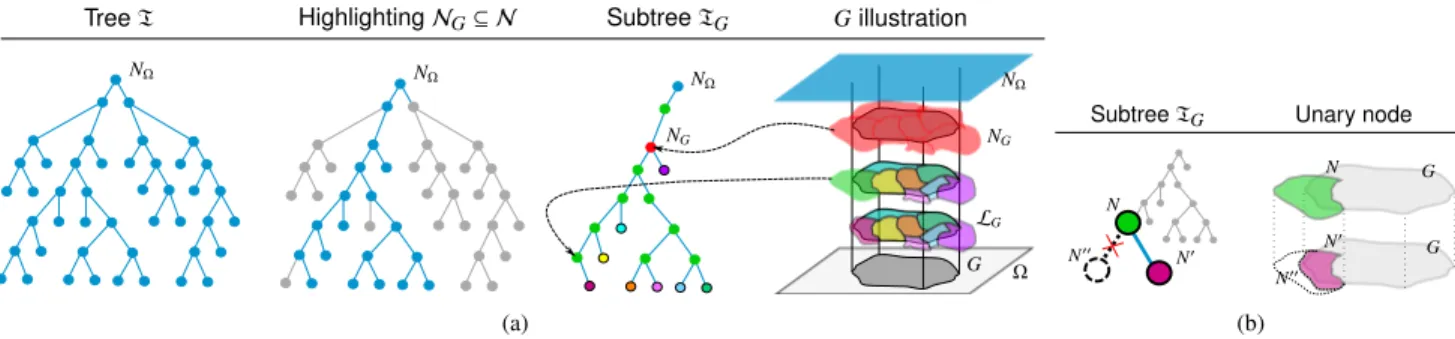
Fig. 1. (a) Illustration of subtree extraction where T is the whole tree, NΩis its root, LGis the set of leaves intersecting the GT example G. TGis the
subtree of interest, and NGis its actual root. (b) Example of a unary node N where N & N0and N ∩ G = N0∩ G, while N0⊂ N . The only other node
N00⊂ N such that N & N00does not intersect G.
where d+(N ) = |{N0 ∈ N , N & N0}| and d−(N ) = |{N0 ∈ N , N0 & N }|. A BPT T of (Ω, a) provides a family N of subsets of Ω. These subsets are hierarchically organised from the whole set Ω, to the singleton sets {x}, x ∈ Ω, with respect to the inclusion relation. This hierarchical organisation is characterised by the fact that an element N of N is associated, via &, to exactly two elements N1, N2 of N that form a binary partition of N . In other words, we have N = N1∪ N2, N1∩ N2= ∅ and N1, N26= ∅. The elements of N are the nodes of T, the node Ω is the root of T, the singleton nodes of L are the leaves of T.
III. EXAMPLE-BASED SUBTREE EXTRACTION
Our purpose is to evaluate how well a BPT T is adapted to provide nodes matching with a segment representing a GT example G. Some nodes of N do not intersect G; in such case, they are useless for the analysis with respect to G. Then, we focus only on the nodes N ∈ N such that N ∩ G 6= ∅. Their subset is computed, in a bottom-up fashion, by first selecting all the leaves L ∈ L that intersect G, and then preserving iteratively all the parent nodes connected to any such leaves by the & relation, until the root NΩ (Fig. 1(a)).
The obtained subset of nodes NG ⊆ N induces a subtree TGof T, of root NΩand of leaves LG= {L ∈ L | L∩G 6= ∅}. This subtree may not be binary. Indeed, there may exist nodes N ∈ NG that have one child N0∈ NG (i.e., N & N0). (This happens when the only other node N00 ⊂ N such that N & N00 does not intersect G.) Such nodes N are called unary nodes (Fig. 1(b)), by contrast with the other binary nodes that do have two children nodes in NG.
The intersection of a unary node N with G is the same as for its only child N0: if N & N0, we have N ∩ G = N0∩ G, while N0 ⊂ N . Then, a unary node increases the amount of false positive (FP) material with respect to G, compared to its descendents. In particular, this is true in the upper part of the tree TG, between the root NΩand the first binary node NG of TG. Indeed, there exists, within NG, a sequence of successive nodes NΩ= N0& N1& . . . & Nk= NG (k ≥ 0) such that all Ni (0 ≤ i < k) are unary. We can relevantly remove from TG all these nodes Ni and only preserve, as pseudo-root, the first binary node NG (red node in Fig. 1(a)). By construction, NG is the smallest node of N that includes G.
Fig. 2. A unary node (impure) and sets of pure and impure leaves.
The final subtree (still noted TG) contains all the nodes of interest of T, with respect to the GT example G. Its combinatorial analysis then allows us to obtain information about the quality of the BPT T.
IV. RELEVANCE OF THE INTRINSIC QUALITY ANALYSIS
A BPT T is built in a bottom-up fashion. The construction process starts from the set of leaves L and progressively creates new nodes by iteratively merging pairs of adjacent nodes. These pairs are chosen with respect to a given metric, and the inclusion relation between two nodes and their merged union practically defines the & relation.
The initial set of leaves is often chosen as L = {Nx}x∈Ω, i.e. each leaf corresponds to exactly one point of the image. For practical reasons, L can sometimes be defined as a set of larger nodes (e.g., flat zones or superpixels). This partition is generally non-correlated to the node-merging strategy. Nev-ertheless, it has an important impact on the relevance of the proposed evaluation framework. In particular, two properties of this initial partition are crucial.
a) Granularity: The granularity γ is defined as the ratio between the size of G (number of points) and the size of LG (number of leaves). It is defined as
γ = |LG|
|G| (6)
and lies in ]0, 1]. The higher the granularity, the most relevant the intrinsic quality analysis carried out on TG. Indeed, for γ = 1, the number of leaves that intersect G is equal to the number of points of G. Then, each leaf contains exactly one point of G, and the ability of the BPT to allow for a segmentation that correctly fits G highly depends on the way to merge the nodes. By contrast, if γ = 1/|G|, then one leaf
(a) (b)
Fig. 3. (a) Comparison between the amount of points in the root NGof TGand the amount of points that could be theoretically obtained from the initial
partition of the leaves LG. (b) The set Lpof pure leaves and the set Npof pure nodes, maximal with respect to the & relation. The white regions represent
|G| − (P
L∈Lp|L|) (on the left), and |G| − (
P
N ∈Np|N |) (on the right).
already includes G, and the way of further building TG has no influence on the segmentation of G.
b) Discordance: The discordance δ is defined as the relative quantitative error on the size of G induced by LG. It is defined as δ = 1 |G| X L∈LG,L6⊆G min{|L \ G|, |L ∩ G|} (7)
and lies in [0, 1[. The lowest the discordance, the most relevant the intrinsic quality analysis carried out on TG.Indeed, δ = 0 means that the initial partition provides a set of leaves that perfectly fits G. Then, the quality of the BPT directly depends on the ability to merge these nodes. By contrast, δ ≈ 1 means that many leaves of L partially intersect both G and the remainder of Ω. Then, the ability to finally obtain a “good” segmentation of G is low and weakly depends on the ability to merge the nodes when building T.
For G sufficiently large, a high value of granularity implies a low value of discordance. However, the counterpart is not true: a low value of discordance can be obtained for a low value of granularity. Note that when the initial partition is composed of leaves that are points of the image, we have γ = 1 and δ = 0. In such case, the quality of the BPT only depends on the node merging process.
V. INTRINSIC QUALITY ANALYSIS
A. Combinatorial analysis
The subtree TG is composed of n nodes (including 1 root and l leaves) and n−1 edges &. Observing the status of these nodes provides us with quality clues of the BPT.
A node N ∈ NG is pure (resp. impure) if N ⊆ G (resp. N 6⊆ G). The classification of the leaves of LG into pure / impure can be done by observing their support, compared to G (Fig. 2). We set lp (resp. li) the number of pure (resp. impure) leaves, respectively (we have lp+ li= l). The purity / impurity of the other nodes can then be computed iteratively: if N ∈ NG is a unary node, then it is impure; if N ∈ NG is a binary node, with N & N0, N00, it is pure if N0 and N00 are pure, otherwise it is impure.
A “good” BPT construction should preserve as much as possible the purity of nodes; avoid to merge pure and impure nodes; and avoid to increase the size of impure nodes. Thus:
• the merging in T leading to a unary node in TG is a bad operation, as it creates from impure —and sometimes pure— nodes, an impure node with a greater amount of points out of G;
• the merging in T leading to a binary node from two pure nodes in TG is a good operation, as it allows one to converge towards G;
• the merging in T leading to a binary node from two impure nodes in TG is a good operation, as it neither deteriorates pure areas, nor increases the amount of points out of G;
• the merging in T leading to a binary node from a pure and an impure node in TGis a bad operation, as it makes the result diverging from G.
It is possible to count the number of each kind of nodes: ui, bpp, bii and bpi, for the unary nodes, and binary nodes built from pure-pure, impure-impure, pure-impure couples. We have ui + bpp + bii + bpi+ lp+ li = n, and a good BPT should minimise uiand bpi, while maximising bpp and bii. In particular, a “perfect” BPT should satisfy:
ui= 0 (8)
bpp = lp− 1 (9) bii = li− 1 (10)
bpi = 1 (11)
(except when li= 0, where bpp should be equal to l − 1, and all others to 0).
From this classification of nodes, and the combinatorial analysis of their population, it is then possible to build a wide range of structural measures that quantify the difference of quality between BPTs. Examples of such measures will be proposed in Section VI.
B. Quantitative analysis
A quantitative assessment of the quality of the BPT can also be carried out by observing the lowest set including G and the greatest set included in G which can be built from TG.
Let us first focus on the lowest set including G. By construction, it is the root of TG, namely NG. The interesting information carried by NG is the amount of points outside of G (Fig. 3(a)). More precisely, this amount |NG| − |G| has to be compared to the amount that could be theoretically
obtained from the initial partition of the leaves LG, namely (P
L∈LG|L|) − |G|. Computing the difference, or the ratio,
between these two values allows us to assess the quantitative error related to the existence of unary nodes in TG, i.e. the addition of non-relevant zones to the expected exhaustive segmentation of G. The lower this value, the better the ability of the BPT to take advantage of the adequacy of the initial partition to the GT segment. Second, let us focus on the greatest set included in G (Fig. 3(b)). It is defined as the union of all the pure nodes of NG whose parents are impure; we note this set Np. The first interesting value is the amount of points of G outside this pure set: |G| − (P
N ∈Np|N |).
It can be compared to the amount of G outside the best theoretical pure subset that could be obtained from the leaves, i.e. |G| − (P
L∈Lp|L|), where Lp = {L ∈ L | L ⊆ G}.
The lower this value, the better the ability of the BPT to take advantage of the potential adequacy of the initial partition to the GT segment. The second interesting value of interest is the size of Np, i.e. number of nodes required to form the best segmentation lower than G. The lower this value, the better the ability of the BPT to avoid over-segmentation.
Of course, these two values have to be considered jointly. Indeed, a low value of |Np| is not meaningful if the union of the nodes of Np is highly degraded with respect to the initial partition. Similarly, an optimal union of the nodes of Npis meaningless if these nodes are numerous (i.e., could not be merged together by the BPT, and were instead fused into impure greater nodes).
VI. EXPERIMENTAL STUDY
In this section, our aim is to emphasise in which extent our intrinsic analysis framework can be used for the quality eval-uation of BPTs. In particular, it may be seen as a companion tool for the extrinsic analysis framework proposed in [24]. A. Experimental protocol
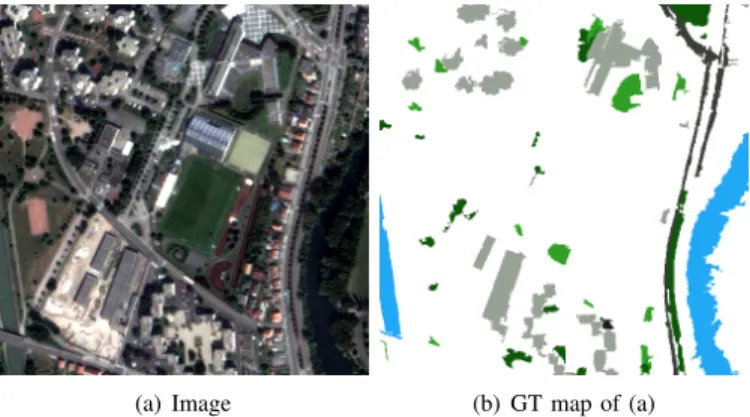
Our experiments use a crop (5002 pixels) of Fig. 4(a). We consider 3 types of BPTs: BP Tstd, BP Tndvi and BP Tndwi, each one built using a metric based on the radiometric inten-sity, the Normalized Difference Vegetation (NDVI) and Water Indices (NDWI), respectively. In order to show the influence of the initial partition L on the intrinsic evaluation analysis, 4 BPTs are built for each type, by using various initial partitions: L1is composed of all pixels from the image support (250 000 regions); L2 is composed of 18 750 regions; L3 is composed of 12 500 regions; and L4 is composed of 6 250 regions.
When γ and δ are satisfactory, we use our framework to estimate the ability of these BPTs to generate potential nodes well matching a set LG of 13 GT examples from each we extract a subtree TG. Examples of GT examples are illustrated in Fig. 5.
To obtain values normalised in [0, 1], we define two scores cb1= (bpp+ bii)/(ui+ bpp+ bii+ bpi) (12) cb2= bpp/(bpp+ bpi) (13)
(a) Image (b) GT map of (a)
Fig. 4. (a) Satellite image at a spatial resolution of 60 cm. (b) GT map with reference segments belonging to 5 (coloured) semantic classes.
(a) G1 (b) (c) G9 (d) (e) G11 (f) (g)
G12
(h)
Fig. 5. Examples of 4 GT segments, with their binary masks (a, c, e, g) and the image around them ((b) G1, (d) G9, (f) G11, (h) G12).
The closer these values from 1 (resp. 0), the more (resp. less) acceptable the BPTs. In particular, for a GT example, we assume that a BPT provides an acceptable matching region if these scores are higher than 0.5.
We used the definitions proposed in Section V-B for the quantitative analysis. For a better readability, we set
qt1= |NG\ G| − |( [ L∈LG L) \ G| = |NG\ [ L∈LG L| (14) qt2= |NG\ G|/|( [ L∈LG L) \ G| (15)
We also simplify some notations by using νp = (P
N ∈Np|N |)
and λp = (P
L∈Lp|L|). Thus, we can define
qt3= (|G| − νp) − (|G| − λp) = λp− νp (16)
qt4= |Np| (17)
B. Results and discussion
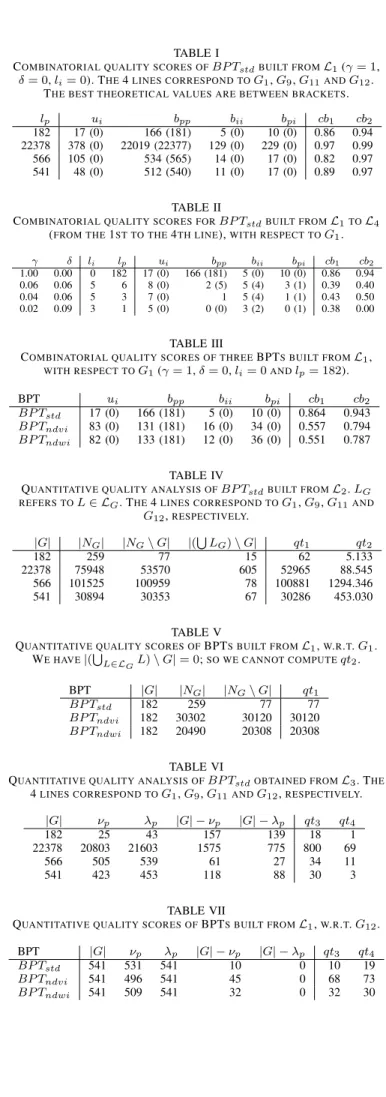
Table I presents the combinatorial scores obtained from BP Tstd, built from the initial partition L1. By construction of L1, the values of γ and δ are optimal. We can notice that the scores are generally around 0.9 and above 0.5, namely our point of reference. This suggests that the intrinsic structure of BP Tstd can provide acceptable segmentation results for the GT examples G1, G9, G11 and G12. We can observe that the cb1and the cb2scores are high. Indeed, the values of ui, bpp, bii and bpi are not far from the values that correspond to a perfect BPT (see Eqs. (8–11)).
Table II presents some statistical information about various BP Tstd built using L1, L2, L3 and L4 as initial partitions,
with respect to the GT segment G1. The values of cb1and cb2 for the first and the third lines suggest that the BPTs built by using L1 is able to provide acceptable matching regions for the GT example G1 while the other BPTs are not. The low scores of the BPTs built by using L2, L3and L4are correlated with the non-optimal values of γ that are far from 1.
From another point of view, the values in Table III show the differences between the various BPTs: one of them induces a lower amount of unary nodes (BP Tstd) compared to the others (BP Tndvi, BP Tndwi). This suggests that the hierarchical structure of the BP Tstd, for the GT example G1, is likely to better provide acceptable segment matching.
For a first quantitative analysis, Table IV gives information about the absolute (qt1) and relative (qt2) amount of false positives, induced by the construction of the BPT. The lower these values, the better the ability of the BPT to use at best the potential adequacy of the initial partition to the GT segment. Here, the BP Tstd built from the initial partition L2 only provides interesting prediction for the GT example G1, where the estimated false positives (qt1= 62) are less than the half of the size of the GT example. In the other cases, we observe a high difference between the size of the chosen root of the subtree and the size of the GT segment. In the context of urban imaging, the excessive size of these roots can be explained by the presence of disturbing objects (e.g., shadows, spots on the roof) that make small pieces of regions more similar to other far located objects than to their neighbours. Those kinds of segments tend to not fuse rapidly with their neighbours and often persist until the end of the BPT construction.
In Table V, we observe that, for BP Tstd, the size |NG| of the selected root is close to that of |G| for the GT segment G1. The values of qt1 for this GT then suggest that the numbers of points representing potential false positives when segmenting are not high compared to the values for BP Tndvi and BP Tndwi. This result shows that the use of the metric based on radiometric intensities is more relevant for this study. This is probably due to the fact that the studied image contains urban objects, with a corresponding GT map mainly composed of built areas. Then, the metrics based on NDVI and NDWI are weakly adapted for the detection of such kinds of objects. A second quantitative analysis aims to estimate the amount of false negative points induced by the construction process. Table VI presents quantitative information about the subtrees extracted from the BP Tstd built from an initial partition L3. The score qt3 estimates the increase of false negative points during the construction process of the tree, while qt4shows the relevance of each subtree by showing the number of maximal pure nodes well merged in the hierarchical structure.
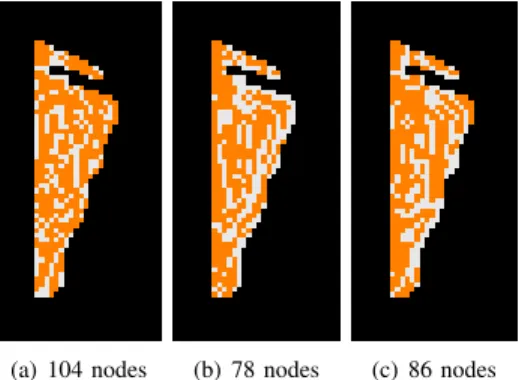
For the GT example G12(Fig. 5(d)), the values of |G| − νp are visually illustrated in Fig. 6, showing in orange the set of subregions that are already well-formed in the extracted subtree. We notice both from Table VII and Fig. 6 that the hierarchical structure of the subtrees extracted from the three types of BPTs are interesting since they generate matching subregions with fair size. The values of qt4 in Table VII suggest that the BP Tndvi and the BP Tndwi may not be
TABLE I
COMBINATORIAL QUALITY SCORES OFBP TstdBUILT FROML1(γ = 1,
δ = 0, li= 0). THE4LINES CORRESPOND TOG1, G9, G11ANDG12.
THE BEST THEORETICAL VALUES ARE BETWEEN BRACKETS.
lp ui bpp bii bpi cb1 cb2 182 17 (0) 166 (181) 5 (0) 10 (0) 0.86 0.94 22378 378 (0) 22019 (22377) 129 (0) 229 (0) 0.97 0.99 566 105 (0) 534 (565) 14 (0) 17 (0) 0.82 0.97 541 48 (0) 512 (540) 11 (0) 17 (0) 0.89 0.97 TABLE II
COMBINATORIAL QUALITY SCORES FORBP TstdBUILT FROML1TOL4
(FROM THE1ST TO THE4TH LINE),WITH RESPECT TOG1.
γ δ li lp ui bpp bii bpi cb1 cb2 1.00 0.00 0 182 17 (0) 166 (181) 5 (0) 10 (0) 0.86 0.94 0.06 0.06 5 6 8 (0) 2 (5) 5 (4) 3 (1) 0.39 0.40 0.04 0.06 5 3 7 (0) 1 5 (4) 1 (1) 0.43 0.50 0.02 0.09 3 1 5 (0) 0 (0) 3 (2) 0 (1) 0.38 0.00 TABLE III
COMBINATORIAL QUALITY SCORES OF THREEBPTS BUILT FROML1,
WITH RESPECT TOG1(γ = 1, δ = 0, li= 0ANDlp= 182).
BPT ui bpp bii bpi cb1 cb2
BP Tstd 17 (0) 166 (181) 5 (0) 10 (0) 0.864 0.943
BP Tndvi 83 (0) 131 (181) 16 (0) 34 (0) 0.557 0.794
BP Tndwi 82 (0) 133 (181) 12 (0) 36 (0) 0.551 0.787
TABLE IV
QUANTITATIVE QUALITY ANALYSIS OFBP TstdBUILT FROML2. LG
REFERS TOL ∈ LG. THE4LINES CORRESPOND TOG1, G9, G11AND G12,RESPECTIVELY. |G| |NG| |NG\ G| |(S LG) \ G| qt1 qt2 182 259 77 15 62 5.133 22378 75948 53570 605 52965 88.545 566 101525 100959 78 100881 1294.346 541 30894 30353 67 30286 453.030 TABLE V
QUANTITATIVE QUALITY SCORES OFBPTS BUILT FROML1,W.R.T. G1.
WE HAVE|(S L∈LGL) \ G| = 0;SO WE CANNOT COMPUTEqt2. BPT |G| |NG| |NG\ G| qt1 BP Tstd 182 259 77 77 BP Tndvi 182 30302 30120 30120 BP Tndwi 182 20490 20308 20308 TABLE VI
QUANTITATIVE QUALITY ANALYSIS OFBP TstdOBTAINED FROML3. THE 4LINES CORRESPOND TOG1, G9, G11ANDG12,RESPECTIVELY.
|G| νp λp |G| − νp |G| − λp qt3 qt4 182 25 43 157 139 18 1 22378 20803 21603 1575 775 800 69 566 505 539 61 27 34 11 541 423 453 118 88 30 3 TABLE VII
QUANTITATIVE QUALITY SCORES OFBPTS BUILT FROML1,W.R.T. G12.
BPT |G| νp λp |G| − νp |G| − λp qt3 qt4
BP Tstd 541 531 541 10 0 10 19
BP Tndvi 541 496 541 45 0 68 73
(a) 104 nodes (b) 78 nodes (c) 86 nodes
Fig. 6. Maximal pure nodes of the subtrees, in orange, with respect to the GT example G12, extracted from the BPTs obtained by using the initial partitions
L1: (a) for BP Tstd; (b) for BP Tndvi; (c) for BP Tndwi.
relevant for the GT segment G12. Indeed, the values of qt4 are high, while the amount qt3 of false negative points is acceptable although the set of maximal pure nodes almost matches with the GT example G12 (see Fig. 6). For a case where the value of qt3 may be the best for a BPT, its high value of qt4predicts a high risk of potential bad node fusions.
VII. CONCLUSION
In this paper, we proposed a scheme for BPT quality anal-ysis, by observing the intrinsic information contained in the hierarchical data-structure. With respect to a set of user-defined GT segments, it may help to better understand the potential results that we can obtain from the BPTs. Experiments, on examples of combinatorial and quantitative analysis on remote sensing images, illustrate how the intrinsic information of a BPT can lead to the estimation of its potential usefulness for further segmentation process. It is important to notice that the relevance of this analysis highly depends on the initial partition used during the construction of the BPT (see Section IV). When such partitions are correctly chosen, the proposed framework then provides us with relevant intrinsic information about the quality of BPTs, and can then be used as a fair prospective or retrospective evaluation tool.
As a perspective of this work, extending the proposed strategy to multiple GT examples will be interesting since the evaluation will be done for a partial partition containing (non-)connected segments of reference. In [24], we proposed a scheme for extrinsic analysis of the quality of the BPTs allow-ing the user to use various metrics of quality. Couplallow-ing these two —intrinsic and extrinsic— schemes will be relevant since it will give access to a more complete evaluation of the quality of the BPTs in the context of image segmentation. Adapting the proposed method to other kinds of hierarchies will also be investigated, opening the gate to other applications.
REFERENCES
[1] P. Salembier and L. Garrido, “Binary partition tree as an efficient representation for image processing, segmentation, and information retrieval,” IEEE Trans. Image Proc., vol. 9, pp. 561–576, 2000. [2] L. Najman and M. Schmitt, “Geodesic saliency of watershed contours
and hierarchical segmentation,” IEEE Trans. Patt. Anal. Mach. Intell., vol. 18, pp. 1163–1173, 1996.
[3] P. Salembier, A. Oliveras, and L. Garrido, “Anti-extensive connected operators for image and sequence processing,” IEEE Trans. Image Proc., vol. 7, pp. 555–570, 1998.
[4] P. Monasse and F. Guichard, “Scale-space from a level lines tree,” J. Vis. Comm. Image Rep., vol. 11, pp. 224–236, 2000.
[5] B. Perret, S. Lef`evre, C. Collet, and E. Slezak, “Hyperconnections and hierarchical representations for grayscale and multiband image processing,” IEEE Trans. Image Proc., vol. 21, pp. 14–27, 2012. [6] C. Kurtz, B. Naegel, and N. Passat, “Connected filtering based on
multivalued component-trees,” IEEE Trans. Image Proc., vol. 23, pp. 5152–5164, 2014.
[7] E. Carlinet and T. G´eraud, “MToS: A tree of shapes for multivariate images,” IEEE Trans. Image Proc., vol. 24, pp. 5330–5342, 2015. [8] J. A. Benediktsson, L. Bruzzone, J. Chanussot, M. Dalla Mura, P.
Salem-bier, and S. Valero, “Hierarchical analysis of remote sensing data: Morphological attribute profiles and binary partition trees,” in ISMM, Procs., 2011, pp. 306–319.
[9] A. Alonso-Gonz´alez, C. L´opez-Mart´ınez, and P. Salembier, “Filtering and segmentation of polarimetric SAR data based on binary partition trees,” IEEE Trans. Geosc. Rem. Sens., vol. 50, pp. 593–605, 2012. [10] C. Kurtz, N. Passat, P. Ganc¸arski, and A. Puissant, “Extraction of
com-plex patterns from multiresolution remote sensing images: A hierarchical top-down methodology,” Patt. Rec., vol. 45, pp. 685–706, 2012. [11] M. A. Veganzones, G. Tochon, M. Dalla Mura, A. J. Plaza, and
J. Chanussot, “Hyperspectral image segmentation using a new spectral unmixing-based binary partition tree representation,” IEEE Trans. Image Proc., vol. 23, pp. 3574–3589, 2014.
[12] A. Alonso-Gonz´alez, C. L´opez-Mart´ınez, and P. Salembier, “PolSAR time series processing with binary partition trees,” IEEE Trans. Geosc. Rem. Sens., vol. 52, pp. 3553–3567, 2014.
[13] P. Salembier, “Study of binary partition tree pruning techniques for polarimetric SAR images,” in ISMM, Procs., 2015, pp. 51–62. [14] S. Valero, P. Salembier, and J. Chanussot, “Object recognition in
hyperspectral images using binary partition tree representation,” Patt. Rec. Lett., vol. 56, pp. 45–51, 2015.
[15] E. Maggiori, Y. Tarabalka, and G. Charpiat, “Optimizing partition trees for multi-object segmentation with shape prior,” in BMVC, Procs., 2015. [16] ——, “Improved partition trees for multi-class segmentation of remote
sensing images,” in IGARSS, Procs., 2015, pp. 1016–1019.
[17] H. Vojodi and A. M. E. Moghadam, “A supervised evaluation method based on region shape descriptor for image segmentation algorithm,” in AISP, Procs., 2012, pp. 18–22.
[18] J. Pont-Tuset and F. Marques, “Measures and meta-measures for the supervised evaluation of image segmentation,” in CVPR, Procs., 2013, pp. 2131–2138.
[19] H. Li, J. Cai, T. Nguyen, and J. Zheng, “A benchmark for semantic image segmentation,” in ICME, Procs., 2013, pp. 1–6.
[20] A. Troya-Galvis, P. Ganc¸arski, N. Passat, and L. Berti- ´Equille, “Unsu-pervised quantification of under- and over-segmentation for object-based remote sensing image analysis,” IEEE J. Sel. Top. App. Earth Obs. Rem. Sens., vol. 8, pp. 1936–1945, 2015.
[21] J. Pont-Tuset, P. Arbelaez, J. Barron, F. Marques, and J. Malik, “Multiscale combinatorial grouping for image segmentation and object proposal generation,” IEEE Trans. Patt. Anal. Mach. Intell., vol. 39, pp. 128–140, 2017.
[22] J. Pont-Tuset and F. Marques, “Supervised evaluation of image segmen-tation and object proposal techniques,” IEEE Trans. Patt. Anal. Mach. Intell., vol. 38, pp. 1465–1478, 2016.
[23] ——, “Supervised assessment of segmentation hierarchies,” in ECCV, Procs., 2012, pp. 814–827.
[24] J. F. Randrianasoa, C. Kurtz, ´E. Desjardin, P. Ganc¸arski, and N. Passat, “Supervised evaluation of the quality of binary partition trees based on uncertain semantic ground-truth for image segmentation purpose,” in ICIP, Procs., 2017, pp. 3874–3878.