
Representation and Analyses of Web Content and Processing
173
0
0
Texte intégral
(2) i. HABILITATION À DIRIGER DES RECHERCHES présentée par. Nabil LAYAÏDA pour obtenir le diplôme d’Habilitation à Diriger Des Recherches de l’Université de Grenoble (Spécialité: Informatique). Representation and Analyses of Web Content and Processing. Date de soutenance : 23 Avril 2013 Composition du jury :. Président Rapporteurs. DR. Jérôme Euzenat Prof. Rachid Guerraoui Prof. Sophie Tison DR. Giuseppe Castagna Examinateurs Prof. Hassan Aït-Kaci Prof. Mohand-Saïd Hacid Prof. Véronique Benzaken DR. Vincent Quint. Travaux de recherche effectués au sein de l’équipe-projet WAM conjointe à Inria Grenoble – Rhône-Alpes et au Laboratoire d’Informatique de Grenoble (LIG)..
(3)
(4) Contents Contents. iii. 1 Introduction 1.1 Objectives . . . . . . . . . . . . . . . . . . . . . . . . . . . . . . 1.2 Overview of the research area . . . . . . . . . . . . . . . . . . . 1.3 Document Organization . . . . . . . . . . . . . . . . . . . . . . 2 Research summary 2.1 Separation principle . . . . . . . . . . . . . 2.2 Document dimensions . . . . . . . . . . . . 2.3 Time-based documents and runtime support 2.4 Document Adaptation . . . . . . . . . . . . 2.5 Transformation-based authoring . . . . . . . 2.6 Types and paths analysis . . . . . . . . . . 2.7 Managing evolution . . . . . . . . . . . . . . 2.8 Functions, polymorphism and subtyping . . 2.9 Research Summary . . . . . . . . . . . . . .. 1 1 2 4. . . . . . . . . .. . . . . . . . . .. . . . . . . . . .. . . . . . . . . .. . . . . . . . . .. . . . . . . . . .. . . . . . . . . .. . . . . . . . . .. . . . . . . . . .. 7 8 9 12 16 19 21 22 23 24. 3 Curriculum 3.1 Supervised PhD students . . . . . . . . . . . . . 3.2 Projects and Funding . . . . . . . . . . . . . . . 3.3 Administrative responsibilities . . . . . . . . . . . 3.4 Conference organization and program committees 3.5 Technology transfer, standards and software . . . 3.6 Teaching . . . . . . . . . . . . . . . . . . . . . . . 3.7 Author bibliography . . . . . . . . . . . . . . . .. . . . . . . .. . . . . . . .. . . . . . . .. . . . . . . .. . . . . . . .. . . . . . . .. . . . . . . .. . . . . . . .. 27 27 28 30 32 33 35 36. 4 A Logic for Finite Trees 4.1 Introduction . . . . . . . . . . . . 4.2 Trees with Focus . . . . . . . . . 4.3 The Logic . . . . . . . . . . . . . 4.4 Satisfiability-Testing Algorithm . 4.5 Implementation Techniques . . . 4.6 Examples and Experiments . . . 4.7 Augmented IDE . . . . . . . . . 4.8 Dead-Code Analysis for XQuery. . . . . . . . .. . . . . . . . .. . . . . . . . .. . . . . . . . .. . . . . . . . .. . . . . . . . .. . . . . . . . .. . . . . . . . .. 43 43 47 48 55 66 69 75 77. iii. . . . . . . . .. . . . . . . . .. . . . . . . . .. . . . . . . . .. . . . . . . . .. . . . . . . . .. . . . . . . . . .. . . . . . . . .. . . . . . . . . .. . . . . . . . .. . . . . . . . ..
(5) iv. CONTENTS 4.9 Conclusion . . . . . . . . . . . . . . . . . . . . . . . . . . . . . 4.10 XPath and Regular Tree Languages . . . . . . . . . . . . . . .. 82 82. 5 Impact of XML Schema Evolution 5.1 Introduction . . . . . . . . . . . . . . . . . . . . . . . . . . . 5.2 Analysis Framework . . . . . . . . . . . . . . . . . . . . . . 5.3 Logical Setting . . . . . . . . . . . . . . . . . . . . . . . . . 5.4 Analysis Predicates . . . . . . . . . . . . . . . . . . . . . . . 5.5 Impact of Standard Schema Evolution on Valid Documents 5.6 Impact of Schema Evolution on Queries . . . . . . . . . . . 5.7 System Implementation . . . . . . . . . . . . . . . . . . . . 5.8 Related Work . . . . . . . . . . . . . . . . . . . . . . . . . . 5.9 Conclusion . . . . . . . . . . . . . . . . . . . . . . . . . . .. . . . . . . . . .. . . . . . . . . .. 93 93 95 99 106 111 118 120 121 122. 6 Functions, Polymorphism and Subtyping 6.1 Introduction . . . . . . . . . . . . . . . . . . 6.2 Semantic Subtyping Framework . . . . . . . 6.3 Tree logic framework . . . . . . . . . . . . . 6.4 Logical Encoding . . . . . . . . . . . . . . . 6.5 Polymorphism: Supporting Type Variables 6.6 Practical Experiments . . . . . . . . . . . . 6.7 Related Work . . . . . . . . . . . . . . . . . 6.8 Conclusion . . . . . . . . . . . . . . . . . .. . . . . . . . .. . . . . . . . .. . . . . . . . .. . . . . . . . .. . . . . . . . .. . . . . . . . .. . . . . . . . .. . . . . . . . .. . . . . . . . .. . . . . . . . .. . . . . . . . .. 123 123 126 129 130 133 140 143 144. 7 Conclusion & perspectives 7.1 Contributions summary . . . . . . . . . . . 7.2 Perspectives . . . . . . . . . . . . . . . . . . 7.3 Motivations: social and economic challenges 7.4 Objectives in terms of technology . . . . . . 7.5 Scientific goals and research directions . . .. . . . . .. . . . . .. . . . . .. . . . . .. . . . . .. . . . . .. . . . . .. . . . . .. . . . . .. . . . . .. . . . . .. 147 147 150 150 150 151. Bibliography. 157.
(6) One Introduction 1.1. Objectives. The goal of my research work is the design and implementation of a new generation of web applications where content is made richer and long lasting and processing made simpler, more flexible, safer and more effective. Designing models consists of defining document domain specific languages capable of describing and representing a wide variety of electronic documents together with their processing. By variety, I mean document classes ranging from traditional documents such as books, technical manuals, scientific articles, web applications, multimedia presentations up to active and interactive documents combining video, audio, 3D objects, RSS feeds, blogs, forms. Such documents can be active and reactive to user and program inputs and may potentially live in a complex distributed computing environment made of remote application servers and databases. Today, this variety keeps increasing as the result of innovations made both by new generations of web applications and also by the multiplication of distribution channels such as mobile devices, set top boxes, interactive television, tablets, etc. One of the main requirements for document representation is independence from the manipulating software and the underlying hardware architecture, for obvious reasons related to their sustainability. It must also satisfy long-term access constraints and storage and need to have high readability to facilitate their use and repurposing in future applications. These constraints are so crucial that document representation is implicitly expected to be rather descriptive, rich enough to cover a wider range of document classes while being sufficiently flexible to accommodate future uses that are unknown at design time. Similar requirements are expected for document processing. Document manipulation programs are characterized by a set of "typical" tasks, which consist in updating, transmitting, displaying, transforming, adapting, repurposing, or publishing documents on a given infrastructure. One of the peculiarities of these tasks is the predominance of tree and graphical structure manipulation, either to update the content or its displayed form. Languages such as XSLT or XQuery have been designed to serve as domain specific languages for such manipulations. They have been both equipped with tree querying mechanisms which allow selecting, extracting and combining tree fragments using regular path expressions, via XPath. Additionally, content models are often described 1.
(7) 2. CHAPTER 1. INTRODUCTION. using regular tree constraints (XML Schemas) [Bray et al., 2004] that each document instance either read or produced must adhere to. Regularity was introduced in content representation and processing to provide more abstract representations and powerful processing. However, a lack of appropriate supporting tools often resulted in complex programs that are difficult to maintain and make evolve, vulnerable to errors and resource hungry, both in terms of memory and speed. Today, web content and applications are becoming the main interface to performing all kinds of daily tasks such as stating and paying government taxes, booking plane or train tickets, planning holidays, shopping, managing bank accounts, etc. As a consequence, it is becoming increasingly important to study their foundations, enhance their capabilities, facilitate their design, verify their correctness, optimize them automatically and make them more flexible and adaptive. The present work aims at contributing to these objectives and to a new generation of content models and programming languages. Since standards are key success factor in this research area, I do actively contribute to web standards either by proposing new ones such as for SMIL [Layaïda & Ossenbruggen, 2001] or by enhancing existing ones such as XML and XQuery[Boag et al., 2006]. 1.2. Overview of the research area. The hypermedia research area has experienced considerable mutations over the last twenty years. Just before the web was born, it was easier to identify the scientific community, its main conferences such as ACM Hypertext, Electronic Publishing, ECHT, and the overall scientific topics. Starting from the early 1990s, and the exponential growth and impact brought by the web success, addressed topics became much broader in scope and progressively encompassed other areas of research. Today the World Wide Web Conference scientific topics include human machine interfaces, knowledge representation, machine learning, networking, information retrieval, databases, programming languages, social networks, etc. Even some fundamental subjects related to logical reasoning, foundations of databases and language theory are being revisited for the web development. To better understand current scientific trends and challenges, one needs to examine closely the initial design goals of the World Wide Web project, which was initiated and developed by Tim Berners-Lee and Robert Cailliau at CERN. Beyond the development of a global hypertext system, simpler design principles compared to those prevailing in the literature at that time were made the priority. More precisely, systems such as Dexter [Halasz & Schwartz, 1994], NoteCards, Intermedia or Hyper-G [Conklin, 1987; Kappe et al., 1993; Akscyn et al., 1988], reference models in the community, were considered by the web inventors to be too centralized and too closed [Berners-Lee et al., 1992]. As a matter of fact, the rule in hypertext was monolithic design based on a single integrated application built on top of a centrally managed and uniform storage system. These systems favored a disciplined use of content by enforcing a.
(8) 1.2. OVERVIEW OF THE RESEARCH AREA. 3. stricter consistency of hyperlinks relating pieces of information, stronger syntactic rules for content description and publication (entities created in theses system are uniquely identified by universal names issued by a central authority). In contrast, the web architecture was designed to be highly decentralized, open and based on a number of shared, application independent principles. Resources and links between them can be created and added freely without any guarantees on resource availability, or on document and link consistency. These principles have resulted in the development of three key components that are the cornerstones of the web: • A universal resource naming and addressing scheme for locating and retrieving hypertext documents, images, emails, indexes, files, etc.: the so-called universal resource identifiers or URIs. • A hypertext document format: HTML, the hypertext markup language. HTML is a text based format with presentation oriented markup or tagging simple enough to be used by novice users. • A network communication protocol: the hypertext transport protocol HTTP which is a stateless TCP/IP based protocol for retrieving remote resources. The notion of sharing described by Berners-Lee corresponds to the notion of standard as practiced by organizations such as ISO, IETF and later by the W3C created specifically for the web. Standards where usually intended to achieve technically, by means of consensus or vote, the technical conditions of interoperability between systems for mature technology. In contrast, web formats, protocols and languages were designed in a very prospective manner meant to guide future developments and to “realize the full potential of the web”. This is particularly exemplified by the Semantic Web activity, database oriented programming languages such as XQuery [Boag et al., 2006] or mobile web initiatives launched well ahead of industry demand. Interestingly, content, one of the main building blocks of the web did have only a limited success in its development. Putting aside the fierce browser war and patent disputes, some initiatives such XHTML and CDF (Compound documents Formats) faced strong challenges and were later simply discontinued, despite user demand for richer content. XHTML was an attempt to reinforce syntactic correctness by reformulating HTML in XML while the CDF initiative was more ambitious. It targeted the design of a more advanced document model which accounts for the different content facets by promoting the integration of several specialized languages developed independently, namely HTML, SVG, SMIL and XForms. The idea in combining such formats is to answer the growing needs and user demands for richer Web applications and content. The idea was also to ensure that content and the skills required to produce it remain uniform on all platforms, ubiquitous, accessible to all, and cost effective. However, unlike HTML, most of these languages are XML-based and.
(9) 4. CHAPTER 1. INTRODUCTION. each one comes with its own schema that can be regarded as functional grammar that pertains to a specific area of functionality: for example, SVG enables vector graphics; XForms addresses form input collection and submission; SMIL describes temporal synchronization. Most existing web applications today, if represented using CDF, would use at least a combination of two or more of these languages. One of the major scientific challenges was to find appropriate means to produce new languages, by composition of separately defined ones. While the difficulty may seem simple since syntactic, there is no clear method today to achieve such a goal easily. At semantic level, it is even more challenging. Defining a uniform presentational model which accounts for such a rich content while supporting advanced and consistent styles and exposing appropriate APIs for content manipulating programs is today beyond reach. From an architectural point of view, most of existing web applications can easily fit the typical three-tier architecture (user interface, application and storage). However, a closer look at how the different tiers are designed reveals serious problems and a major «impedance mismatch» problem [Lämmel & Meijer, 2007]. First, a web page is no longer guaranteed to display or to behave uniformly on the already fairly large variety of platforms. The complexity and burden to manage such complexity has been progressively transferred to the UI designers, which are required to implement specific functions for each one of them. Second, the application tier where content and data are processed and stored is facing a triple collision of, hard to reconcile, data models: documents structures (trees), programming languages (often object-oriented) and databases (often relational). Most of the issues raised above are today subcontracted to low-level programming such as JavaScripting or to a jungle of frameworks. This comes at the cost of severely compromising accessibility, maintainability, reliability, security, and performance and contributes greatly to web fragmentation. In summary, the web has badly accommodated an inadequate infrastructure, mainly obtained by ad hoc extensions. This reveals the weakest component in its initial design: content. As a result, appropriate abstractions are still needed to make it richer, more reliable, secure, efficient and flexible. In the recent period, there are clear signs of a renewed interest and increasing activity both in content representation as witnessed by HTML5 and in web programming through XQuery3 [Engovatov & Robie, 2010]. 1.3. Document Organization. After this introduction, this document is organized as follows: Chapter 2, presents a brief introduction to electronic documents, the separation principle together with the main document dimensions. Then I summarize the research topics I addressed and the contributions I made since I was hired as a researcher at Inria. For each of these contributions, I give references to relevant publications describing in more details the results and, when applicable, I indicate the names of collaborators involved in the research work together with those of supervised PhD students..
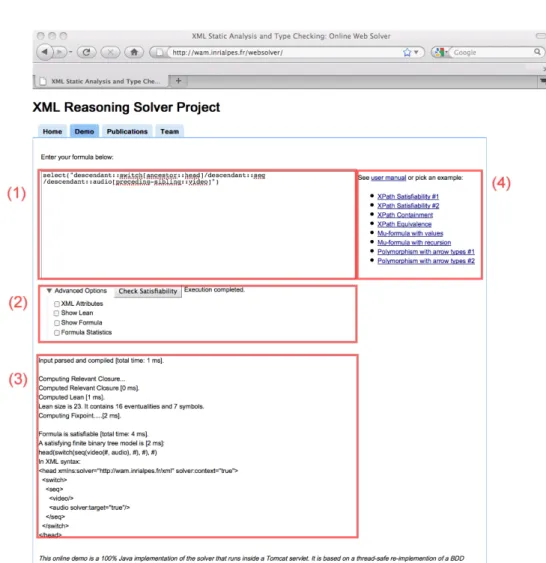
(10) 1.3. DOCUMENT ORGANIZATION. 5. In Chapter 3, I give a curriculum summarizing the theses I supervised, the projects and contracts that funded my research work, administrative responsibilities, community involvement, technology transfer, standardization and software development. My teaching activities as well as the complete list of my scientific publications are given in the last part of this chapter. In the remaining part of the document, I present in detail only a sample of my most recent research work related to XML reasoning. This work is described through a selection of three extended articles focusing on XML static analyses, XML schema evolution management in programs and finally, a more advanced XML logic featuring functions and parametric subtyping. Chapter 4 introduces a logic for reasoning over finite trees, a sound and complete decision procedure for checking the satisfiability of a formula of the logic as well as its effective implementation. The logic is a variant of the µcalculus adapted for finite trees and equipped with backward modalities and nominals. Specifically, the logic is an alternation-free modal µ-calculus with converse, where formulas are cycle-free, and which is interpreted over finite ordered trees. The time complexity of the satisfiability-testing algorithm is optimal: 2O(n) in terms of formula size n. I present crucial implementation techniques like the use of symbolic techniques (BDD) and heuristics used to make the algorithm as fast as possible in practice. Our implementation is available online, and can be used to solve logical formulas of practically significant size. In Chapter 5, the problem of XML Schema evolution is studied. In the ever-changing context of the web, XML schemas continuously change in order to cope with the natural evolution of the entities they describe. Schema changes have important consequences. First, existing documents valid with respect to the original schema are no longer guaranteed to fulfill the constraints described by the evolved schema. Second, the evolution also impacts programs manipulating documents whose structure is described by the original schema. I propose a unifying framework for determining the effects of XML Schema evolution both on the validity of documents and on queries. The system is very powerful in analyzing various scenarios in which forward/backward compatibility of schemas is broken, and in which the result of a query may not be anymore what was expected. Specifically, the system offers a predicate language which allows one to formulate properties related to schema evolution. The system then relies on exact reasoning techniques introduced in the previous Chapter. The system was tested with real-world use cases, in particular with the main standard document formats used on the web, as defined by W3C. The system identifies precisely compatibility relations between document formats. In case these relations do not hold, the system can identify queries that must be reformulated in order to produce the expected results across successive schema versions. Chapter 6 considers a type algebra equipped with recursive, product, function, intersection, union, and complement types together with type variables and implicit universal quantification over them. In particular, I focus on the.
(11) 6. CHAPTER 1. INTRODUCTION. subtyping relation recently defined by Castagna and Xu [Castagna & Xu, 2011] over such type expressions and show how this relation can be decided in 2O(n) , answering an open question. The novelty, originality and strength of the proposed solution reside in introducing a logical modeling for the semantic subtyping framework. The semantic subtyping is modeled in a tree logic and satisfiability-testing algorithm is used in order to decide subtyping. I report on practical experiments made with a full implementation of the system. This provides a powerful polymorphic type system aiming at maintaining full static type-safety of functional programs that manipulate trees, even with higherorder functions, which is particularly useful in the context of XML. Chapter 7 concludes this work and draws some perspectives for the future..
(12) Two Research summary In order to define the vocabulary used in this document, I first define what I mean by document. The word comes from the Latin documentum which has a root from docere, which means teaching. A document is an object carrying meaning used to transmit knowledge. A document is often not dissociated from the media on which it is conveyed or exchanged, the medium such as paper or a computer file, giving it a form of continuity or stability over time. The information carried on this medium is usually encoded as a variety of more or less complex symbols such as characters, glyphs, figures, diagrams, tables, annotations, etc. Because of the physical connotation attached to the medium and symbols, the amount of information contained in a document is often considered as finite or at least clearly delimited. Traditionally, a document is created by an author or a group of authors and consumed by readers. This separation of roles is however less clear today. Collaborative platforms such as wikis allow a group of users to concurrently author and read documents collectively. More generally, the acceleration of the virtualization in the Web era has profoundly modified not only editorial chains but also the precise meaning attributed to the word document. In the sequel, the term can sometimes mean a video enriched with textual annotations and images, it can also mean real-time flow of information news, tweets, blogs, dynamically generated documents from user profiles, etc. The first generation of electronic document management systems were designed to reproduce the classical document preparation tasks on computer systems such as copy/pasting, formatting and typesetting, correcting, annotating and archiving. The final goal of the entire chain was often publishing on paper, web sites or other media such as portable document format (pdf) files or CD Rom. Today, a large amount of documents are dynamic and some have a very short lifecycle such as tweets. In addition, some documents containing timebased media such animated graphics, audio and video are consumed only on electronic devices. As a result, the concept of document becomes difficult to identify because one can no longer refer to specific characteristics such as the basic elements that compose it, or its stability over time (its persistent nature). Today, document addresses on the web can refer to, in an indistinguishable manner, stable, slow evolving or dynamically generated content obtained via complex web services invocations such as REST [Fielding, 2000]. Similarly, documents do frequently embed programs that perform all kinds of tasks such 7.
(13) 8. CHAPTER 2. RESEARCH SUMMARY. as modifying the content in a context sensitive manner depending on the user location, language and other parameters. The boundary between content and computations is becoming fuzzy and the various attempts to establish standardized interfaces between them (such as DOM) did so far have only little success. Such interactions are often bypassed by low-level script manipulations violating a key principle of electronic documents: the separation principle. 2.1. Separation principle. One of the fundamental principles of electronic documents, which emerged in the late 60s, is the separation principle. This principle consists in describing separately the structure and content of a document (headings, chapters, sections, paragraphs, links, etc.) from its presentation or physical form (on the screen, on paper, and so on). This principle has been introduced to meet several needs: • Ensure that documents are long lasting: a more direct access to content and document organization allows easier maintenance and conversion against possible technology changes. • Facilitate publishing on various media or in different forms or variants of the same document when needed. • Facilitate exchange, update and repurposing of documents between users and applications. Often documents are the result of successive updates made by users and applications from different organizations. The separation principle is put into practice by syntactic techniques, which allows highlighting the structure of a document: it is the tagging or marking process. Tagging, which appeared for electronic documents in the late 70s, consists of placing marks around textual elements. It comes in three distinct flavors: 1. The presentational mark up which corresponds to codes which produce a visual effect on the display or paper: for example making some text fragment render in bold, italic or in particular font, etc. 2. Procedural mark up, whose primitive elements are presentation functions. These functions are enriched, in a procedural programming environment, by a stack of more complex routines or macros that produce complex presentation constructions: troff, TEX, LATEX are examples of such marking. 3. Descriptive mark up describes what the marked text is meant to represent rather than how to display or process it by means of labels or tags. Labels are text marks carrying a description, whose only reading is supposed to suggest what the marked item represents: chapter, title, section, paragraph, appendix, etc..
(14) 2.2. DOCUMENT DIMENSIONS. 9. Descriptive markup is used as the primary technique to ensure the separation principle. It is indeed possible to obtain formatted documents, i.e. having a publishable form, by enriching a document marked up descriptively via styles attachment or by conversion (transformation) to a presentational format. A typical example of such operation are CSS attachment to XML content or the conversion of documents from the DocBook DTD [Walsh & Muellner, 1999] to XSL-FO [Berglund, 2006] for printing or to HTML for browser display. Descriptive markup was the main motivation behind the introduction of metalanguages such as GML [Goldfarb, 1996], SGML [ISO-SGML, 1986] and later XML [Bray et al., 2004]. Such meta-language oriented documents formats are often called structured documents. One of the objectives pursued in my research work is to enforce as much as possible the separation principle in order to make content processing more powerful. To that end, my approach consists in designing independent yet combinable languages to describe the document layout, its temporal behavior or synchronization, its network of hyperlinks together with clean programming interfaces giving well-defined access to content and its various facets. The ultimate goal is to achieve a universal content representation that accounts for all of its dimensions while remaining adaptive enough (by transformation) to accommodate its various uses. 2.2. Document dimensions. Structured document models are based on an abstract representation that reflects the internal structure of the documents [ISO/IEC, 1997]. In general, the document structure description is organized around four dimensions [André et al., 1989; Layaïda, 1997], if we except interfaces with programs: • The logical dimension allows to link "syntactically" document elements (or objects) by means of composition or order relations. For example, a chapter may contain sections and an author description can be characterized by a family name followed by one or more given names: first given, the second given, etc. These links are inherently hierarchical and ordered. • The spatial dimension allows to describe style information (such as fonts and colors for text) and geometrical arrangement of elements on screen or paper. It allows also allocating channels and rendering attributes for other types of content such as audio, video and animations. • The temporal dimension allows to describe the temporal organization of objects in the document overs time and synchronization relations between them. Each document element is characterized by a time interval during which it is displayed or heard. • The hypermedia dimension (hypertext when restricted to text documents) often describes non-hierarchical and more semantic relationships between documents or parts of documents. Such relations describe links,.
(15) 10. CHAPTER 2. RESEARCH SUMMARY indexes, cross-references, notes, table of contents, etc. They represent the main support for navigation within and between documents.. Each of these dimensions led to a family of dedicated languages. First, at a higher level, SGML, XML DTD [Bray et al., 2004], XML Schemas, Schematron [ISO, 2006a], RelaxNG [Clark & Murata, 2001] or NVDL [ISO, 2006b] have been defined to serve as meta-languages intended to describe the syntax for other languages (for example those describing the different dimensions including programs such as transformations). Most of the languages used to describe the logical dimension such as DocBook [Walsh & Muellner, 1999] or ATA [ATA, 1997] use these XML meta-languages. Both SMIL for the temporal dimension and SVG [Schmitz & Cohen, 2001] for vector graphics use XML also. However, several exceptions exist. Notably, CSS and DSSSL [ISO/IEC, 1996], for the spatial dimension, do have their own syntax while interestingly XSL-FO [Berglund, 2006], serving similar purposes, does not, as does XQuery for programs compared to XSLT. Languages such as XPath, used for queries, XLink and XPointer (both XPath-based describe the hypermedia dimension) are compact languages involving only short expressions and for that reason do not use XML. Overall, syntax used in document representation and processing is not always uniform but the XML syntax remains widely predominant. Figure 2.1 gives an overview of W3C languages and protocols. On top of the http protocol and URIs, XML is considered as one the main metalanguages for the other web languages.. Figure 2.1: W3C languages and protocols stack. A traditional (static) electronic document is only equipped with the first two dimensions. A hypermedia document (often called hypertext when content is restricted to text) is a static document to which the hypermedia dimension is added. When the temporal dimension is involved, it is often referred to as a multimedia document. Languages for expressing the formatted version of a document on the web, which is displayed to the user, form a particularly important family of languages. They represent a presentation vocabulary common to all documents.
(16) 2.2. DOCUMENT DIMENSIONS. 11. and applications on the web and their support is natively supported once and for all within browsers. As a result, they play a key role and are crucial in the web infrastructure. They represent also the visible part of the web accessible to users and indexed by crawlers of search engines. In general, document-processing programs are often complex and costly to design. In order to make such programs more reusable, they are designed to operate on document models (grammars) instead of specific instances. Typical examples are XML transformations that produce Web pages from XML documents. When such transformations are designed to work on schemas, all conforming instances can benefit from this processing. Similarly, if pages graphical forms need to be updated, only the style or transformation attached to the model is modified, and updating pages is simply obtained by reapplying this new style/transformation to all documents. For such generic processing to work, transformations and style sheets need to rely solely on the type information contained in the document elements. Type information is mainly carried by tag names and the structural properties (composition and order) of the different elements in the grammar. In practice, there are two types of language on the web: User-oriented Languages: Languages like HTML which are intended for display. They are often tolerant to syntactic rules such as incorrect hierarchical nesting of elements and incorrect use of opening and closing tags: well-formedness. Most of the browsers do not require syntactic correctness to display the document. This tolerance originates back to the first days of the web where HTML parsers were designed to accommodate the maximum syntax error as the web pages were produced primarily using text editors. Web application designers continue to rely on such browser tolerance and do consider that well-formedness and validity are too cumbersome. Such tolerance has greatly contributed to slowing the adoption of XML in browsers as evidenced by the latest HTML5 where more syntactic rigor is still questioned. The large amount of incorrect documents, HTML-producing applications combined with the successive HTML versions standardized during the last two decades make HTML parsing quite challenging. The HTML parser represents one of the most complex and sensitive pieces of software in browsers and crawlers alike on the web. Machine-oriented languages: These are the languages based on the XML syntax that require that documents are be both well formed and valid. Languages such as BPEL [Jordan & Evdemon, 2007] WSDL [Christensen et al., 2001] or UDDI [Clement et al., 2004] for web services [Gudgin et al., 2007], DocBook [Walsh & Muellner, 1999] documents and formats such as XSL-FO [Berglund, 2006] being mainly manipulated by the programs, incorrect documents may result in errors serious enough to compromise the entire processing outcome. In the remainder, documents are considered to belong to this second category. Syntactic correctness is important as it represents the main vehicle for introducing generic processing but also relations in the document structures..
(17) 12. CHAPTER 2. RESEARCH SUMMARY. At a more abstract level, documents can be considered as entities composed of a finite set of basic pieces of information linked by relationships of different sorts (compositional for the logical dimension, spatial, temporal and hypermedia). These basic pieces are also equipped with properties such types, geometric sizes and durations giving them an existence along each of these dimensions. Documents are themselves organized into classes using models. Models, properties and relationships allow describing a fairly wide range of documents in use today. 2.3. Time-based documents and runtime support. Publications: ACM Multimedia 1998 [Jourdan et al., 1998], DDEP 2000 [Villard et al., 2000]. Students: Loay Sabry-Ismaïl and Lionel Villard, PhD Thesis. The first years of my research work were dedicated to extending Madeus 1 [Layaïda, 1997], designed during my PhD, to generic document models. The result of this work is called Madeus 2. Madeus 2 refers to a document model and an authoring and presentation system at the same time. The motivation behind the design of Madeus 2 [Villard, 2002; Villard et al., 2000] was to equip user defined XML document models with all of their dimensions and to provide a strong integration between these dimensions. As a first step toward that goal, was the definition of a generic presentation vocabulary for all XML classes where the temporal dimension plays a central role. Then, the general approach I followed consists of producing the presentation by relying on XML types to generate, by transformations, the other dimensions. One of the major distinctive characteristics of Madeus 2 [Villard, 2002], compared to systems proposed in the literature, is a generalized use of constraints. These constraints are introduced via relations, as a means to describe the entire presentation of a document. For example, the spatial positioning is specified using geometric relationships such as «right of», «left of», «centered with», etc. Temporal synchronization is also performed by means of relations such as «during», «before», «after», «strongly synchronized», etc. These various relations are derived from schema information, conveyed by the element names (their type). However, the coexistence of relations of different dimensions yields complex structures that are often intricate and differ in shape from the logical organization. For example, geometric box nesting used in layout models does not necessarily match nesting used for temporal synchronization nor schema ones. As a result, the authoring process consists of first describing content elements independently of their use in the document. Then, they are inserted into the presentation by reference. This promotes content reuse within the same document without resorting to duplication. In Madeus, relations are added either to named elements (via their identifiers) or generically when they are derived from the type. A downside of using constraints is the possible introduction of inconsistencies. Madeus 2 implements inconsistency detection algorithms to enforce constraint satisfiablility in documents. In addition, values for the spatial and.
(18) 2.3. TIME-BASED DOCUMENTS AND RUNTIME SUPPORT. 13. temporal positioning such as durations and positions on the screen are automatically calculated by constraint solvers [Villard et al., 2000]. Relations allow to capture more semantic presentational interdependencies within the document and relieves authors from specifying low-level details such as values. The work on Madeus 2 served as the basis for the SMIL language, incremental transformations and automatic adaptations described hereafter. 2.3.1. The SMIL language. Publications: W3C recommendations SMIL 1 [Hoschka et al., 1998], SMIL 2.0 [Layaïda & Ossenbruggen, 2001; Ayars et al., 2001], SMIL 2.1 [Layaïda, 2005; Bulterman et al., 2005], SMIL DOM Note [Schmitz et al., 1999] and CCBR 1998 [Layaïda & Karmouch, 1998]. The goal behind the design of SMIL (Synchronized Multimedia Integration Language) was to promote a universal standard language for temporal synchronization on the web. The main idea was to extend presentation languages such as HTML with synchronization features using markup. A first version was defined in 1998 and the language evolved in successive versions by incorporating more and more features. A typical SMIL presentation contains references (URIs) to media objects but does not include multimedia objects themselves. The core of the language is the temporal model but SMIL describes also other time-dependent features such as animation and a simple form of content adaptation to terminals (choice of content based on language, flow, resolution, etc.). SMIL hypermedia links are also timed and provide time sensitive access to different portions of a presentation. A peculiarity of the language is that it does not describe the encoding format for media objects for transport protocols, but focuses on the other aspects of a multimedia presentation: their synchronization. Synchronization in SMIL is structured by a nested set of temporal containers delimited by XML tags. Instead of using a single fixed time reference, SMIL timing is made relative using these containers. Time containers allow for displaying elements in parallel (<par> tag), in sequence (<seq> tag) or in a mutually exclusive manner (<excl> tag). If the objects of a container are parallel, specific attributes allow the description of finer synchronization constraints such as lip-syncing a video with an audio. In addition, the temporal model can also describe the user interaction and combining scheduling with interactivity. These interactions are introduced by "events" that can trigger cascades of other events such as the start or stop of other elements in a presentation. In addition, SMIL animations can combine tightly, via interpolations, vector graphics constructs such as geometric paths with timing to yield complex continuous visual effects. The language syntax was designed specifically to integrate well with other host XML languages such as SVG and XHTML via namespaces. Overall, proposed timing constructs and synchronization schemes are actually much richer and can describe even more complex scenarios with relative ease (declarative). In addition, the SMIL language has been designed to be extensible and has several flavors [Layaïda & Ossenbruggen, 2001]: basic,.
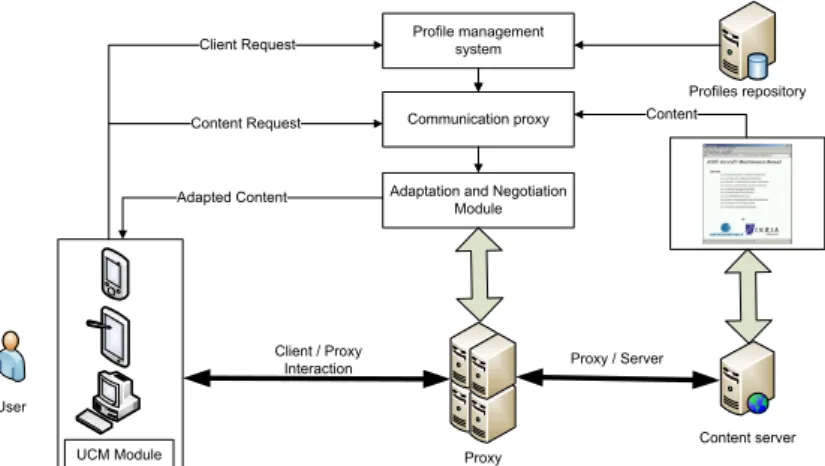
(19) 14. CHAPTER 2. RESEARCH SUMMARY. tiny, mobile, advanced mobile and full together with a scalability framework. A full description of the language is beyond the scope of this document and a gentle introduction to SMIL can be found in [Bulterman, 2001]. I played a key role in SMIL. I was one of the initial founders of the technical group and a main contributor. In particular, I contributed to the definition of the language requirements and edited the technical specification of the recommendation. I have also contributed to reference implementations, a prerequisite for specifications to reach the recommendation status. Today, SMIL is used in mobile telephony as the main format for MMS [3GPP, 2009] (Multimedia Messaging) and for interactive streaming services PSS [3GPP, 2011]. It is also used as a central component in the DAISY language, which is a standard for people with disabilities. It is deployed in a large number of industrial applications such as advertising, high-definition camcorders, audio books, etc. At ISO, SMIL was introduced to serve as a textual scene description for MPEG4 (XMT) [Kim et al., 2000]. Recently, other team members have also studied and implemented SMIL Timesheets [Cazenave et al., 2011]. This proposed standard offers a generic mechanism to add SMIL timing to XML. The work shows explicitly how SMIL Timesheets can be combined with HTML 5 [Hickson, 2011], CSS [Etemad, 2010] and SVG [Dahlström et al., 2011; Schmitz & Cohen, 2001] in a multimedia document. 2.3.2. Synchronized Presentations Scheduling. Publications: TSI 2002 [Hagimont & Layaïda, 2002], MTAP 2002 [Layaïda et al., 2002], SMC 2001 [Layaïda et al., 2001] and [Fargier et al., 1998]. Student: Loay Sabry-Ismaïl, PhD thesis. If we focus on the temporal dimension, a document presentation is the process of rendering media objects over time according to the temporal scenario specified at authoring stage. The various objects are displayed according to values specified explicitly or calculated from temporal relations. Since content is generally stored in a distributed environment, such as remote audio and video servers, this operation is subject to limited and time varying resources (bandwidth, CPU, etc.). These constraints often result in some temporal deviations and uncertainty. Some objects behave in an indeterministic manner and their durations do not necessarily match the specified values. Remote access latencies of audio and video streams, layers of buffering, congestion are common examples of delay sources. These delays can propagate in the scenario, via temporal relations, affecting the presentation global synchronization and its quality. It is then necessary to ensure that timing constraints are met as much as possible despite these uncertainties. There are two approaches for dealing with presentation indeterminism. In the first approach, most commonly used, each time the presentation gets out of synchronization, some actions are taken immediately to bring the scenario back to the predefined case. Usually this operation is achieved at the cost of either blocking some of the objects, skipping the content of some objects or delaying some others. In other words, the author.
(20) 2.3. TIME-BASED DOCUMENTS AND RUNTIME SUPPORT. 15. specifications are violated. In the second case, one attempts first to determine if these delays can be taken into account while maintaining or at least remaining close to the scenario specified by the author. The later method requires some means to adjust the scenario according to the author’s intent. The general idea I explored belongs to the second method. It consists of taking advantage of the flexibility of temporal scenarios to build synchronization algorithms that incur the least de-synchronizations in the scheduling operation. First, I have investigated reasoning techniques for analyzing temporal constraints under uncertainty [Fargier et al., 1998]. Second, I proposed the use of intelligent schedulers, which allows rendering of a multimedia presentation while handling the indeterministic behavior of objects. These schedulers monitor the evolution of a scenario in response to different events of a presentation (start event, termination, notification of delays). The elements of a multimedia presentation are modeled with two basic constructs: controllable and incontrollable temporal intervals. These two constructs distinguish interval durations that can be adjusted by the scheduler from those corresponding to external uncertainties. The overall presentation scheduling is then captured by a directed acyclic graph where nodes represent instants or events and arcs represent temporal intervals differentiated according to their type. The flexibility of controllable objects in the graph is then used to compensate for unpredictable delays of incontrollable objects according to the graph topology. When a solution becomes impossible to find, the scheduler minimizes the impact of desynchronization in space (number of violated requirements) and time (desynchronization period). This work was conducted in collaboration with Verimag Laboratory [Altisen et al., 1999]. Furthermore, Gregor Gößler devoted a detailed study of this problem in his master’s thesis [Gößler, 1998] by exploring automata-centric methods. More recent studies continue to improve on these results in particular in the framework of controller synthesis [Abdeddaim et al., 2009]. As a complement to client-side synchronization, I studied end-to-end system methods to improve the overall quality of service of a presentation. In particular, I explored code mobility as a means to dynamically adapt remote content to fit client timing constraints and resources. Mobile code has been also used to extend the functionality of a remote content server on behalf of a scheduler. For example, such code can adjust audio and video data prior to their transmission to the client application. A proxy-site is also an interesting peer to achieve this task since typical mobile-oriented infrastructures are often split in two levels of performance. The first level corresponds to fast content and application servers interconnected with reliable backbone connections and the second level is composed of performance varying devices with wireless connectivity. The experimental results we have obtained show that it is possible to gracefully adjust content access to client computational power and to available bandwidth. We have also shown that such infrastructure can be used to adapt statically encoded streaming content and personalize parameters such as size, resolution, number of colors, etc. In addition, the code deployed remotely is.
(21) 16. CHAPTER 2. RESEARCH SUMMARY. often very negligible in size compared to video and audio payloads. The overall interoperability can also be improved as it becomes possible to adapt on the fly formats and protocols to client supported ones [Hagimont & Layaïda, 2002].. 2.4. Document Adaptation. The means of accessing the web have greatly evolved in recent years by the introduction of both various types of terminals and communication media channels. This period has witnessed an impressive growth in wireless broadband networks deployment that became an integral part of the Internet. Both mobile phone networks such as third generation networks and WiFi are now part of the web infrastructure. At the same time, more and more devices became connected such as cellular phones, tablets, television sets, game consoles and all sorts of embedded devices. All are multimedia, in the sense that they are used to access multiple media, including rich web content and continuous media such as video and music. This double evolution in content and access methods raises the question of the adequacy between content and the means for accessing it. With this variety, one needs to ensure an access in good conditions to the same multimedia resources, from different devices, using different software, and across networks with different characteristics. Yet the vast majority of content deployed on the web was designed for desktop PCs, which have generally more resources than other terminals. This is the problem of content adaptation that we address in this work. The pragmatic approach to adaptation consists in developing content variants targeted to particular devices, possibly in a specifically tuned format or representation. This is typically the approach used by many content publishers: a website for each terminal. It is also similar to choices made in the past by telecom operators such as WAP [OMA, 2001a]: the WML format [OMA, 2001b], optimized for small screen terminals with low bandwidth connectivity. But these approaches contradict the web philosophy of building a universal information space accessible to all. The risk they introduce is web fragmentation that would lead to a web for mobile phones containing only the information produced for these devices, a web for TVs, a web for PDAs, etc. This brings strong user restrictions for each type of device: they have access to only part of the information. This also leads to high costs for content producers seeking a wide audience: they must produce several times the same information in different formats for different types of devices. In practice, designers produce a very limited set of such adapted content: usually, one for desktop PCs and a second one for mobile terminals. The reason behind this is that they are more comfortable with specific designs tied to particular screen sizes and terminal characteristics. When they create content, they do generally engage in a cyclic process where they specify and check the result directly on a specific terminal. With such a process, it becomes hard to address correctly a richer set of terminals. Furthermore, multimedia documents.
(22) 2.4. DOCUMENT ADAPTATION. 17. formats are now defined as progressively richer sets of sub-languages with increasing features. This will likely make any adaptive design more complex if not impossible without automatic processing. The work I have carried out consists in developing automatic adaptation methods for multimedia content together with supporting architectural frameworks. More precisely, I proposed two adaptation approaches; one based on structural transformations operating on a more advanced web architecture, the other based on presentation "semantics". 2.4.1. Adaptation by structural transformations. Publications: TSI 2005 [Layaïda et al., 2005], MDM 2004 [Lemlouma & Layaïda, 2004], SAINT 2003 [Lemlouma & Layaïda, 2003a], ELPUB 2003 [Lemlouma & Layaïda, 2003b], MMM 2001 [Lemlouma & Layaïda, 2001]. Student: Tayeb Lemlouma, PhD thesis. The first approach we considered promotes the use of as "universal" as possible formats. In this approach, each document is authored only once and stored in a single form. When a client accesses the document, an adapted version that takes into account the specific client "context" is generated, by transformation, from this single source. The context includes the hardware and software characteristics of the client device, its network capabilities, but also user abilities/disabilities and preferences. First, we have defined a general architecture of automatic content adaptation (see Figure 2.2) called NAC. Then, we studied how to modularize web languages to create progressively richer sets of sub-languages with increasing features. At a syntactic level, modularization consists in describing languages in a more flexible way by combining XML elements and attributes into functional groups. Each group is used to describe a particular aspect of the document, such as layout, synchronization, transitions, animations, etc. A group can in turn be organized as a set of modules that correspond to functionality levels from the most basic to the more advanced. This creates dependencies between modules. A language for a given device or conforming to a certain profile is described as a consistent collection of modules. This collection defines an XML language corresponding to the target of the adaptation transformation. When a web document is accessed, a negotiation phase between the client and the server is engaged to identify this target language. Since documents are also encoded using a particular profile (called document profile), adapting falls back to transforming such content to the negotiated one. Transformations have been modularized in NAC so that they are capable of transcoding between any pair of SMIL language profiles. To facilitate this negotiation phase, a general schema, called UPS (Universal Profiling Schema) was defined for describing machine capabilities (terminals, servers or proxies), users preferences together with network characteristics. UPS is built on top of CC/PP [Klyne et al., 2004] and uses RDF [Lassila & Swick, 1999]. This schema also covers content item descriptions such as.
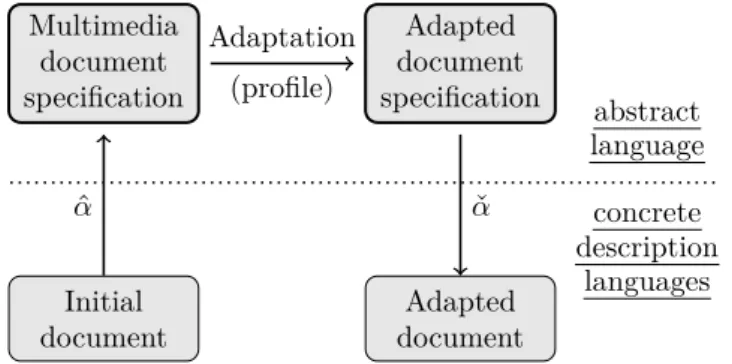
(23) 18. CHAPTER 2. RESEARCH SUMMARY. Client Request. Profile management system. Content Request. Communication proxy. Profiles repository. Adapted Content. Content. Adaptation and Negotiation Module. Client / Proxy Interaction. Proxy / Server. User Content server UCM Module. Proxy. Figure 2.2: Automatic Content Adaptation Architecture. basic media elements (audio, video, etc.) and allows for specifying equivalence relations between objects. Equivalence relations include also media conversion operations, such as image transcoding between different formats and modalities such as text to speech. The results of this work have been contributed to CC/PP [Klyne et al., 2004] and Device Independent Authoring [Smith, 2010] W3C working groups. Today, web content servers offer very limited support for negotiated content. The HTTP protocol supports only some basic negotiation based on language, media types and character encoding [Holtman & Mutz, 1998]. But usually content structure is served as is to all clients. With increasing diversity on the web, we foresee that the current infrastructure will evolve toward more content-centered adaptation. The transformations explored in this work are merely syntactic and sometimes lead to insufficient quality adaptations. To enhance this quality, I explored a more “semantic” approach. 2.4.2. Semantic adaptation. Publications: MTAP 2011 [Laborie et al., 2011], IJCAI 2003 [Euzenat et al., 2003]. Student: Sébastien Laborie PhD thesis, in collaboration with Jérôme Euzenat. In the second line of work on adaptation, I proposed a semantic framework in which a multimedia document is interpreted as a set of potential presentations [Euzenat et al., 2003]. The framework defines adaptation as the search for a document compliant with the device constraints, which is as close as possible to the presentations specified originally by an author. It does it in a very general way, independent from the concrete multimedia document languages and independent from the main multimedia document dimensions, i.e., temporal, spatial and hypermedia. In [Laborie et al., 2011], we show how this approach can be used for adapting the structure of multimedia documents in concrete multimedia description languages without having to anticipate the type of constraints imposed by the devices..
(24) 2.5. TRANSFORMATION-BASED AUTHORING. 19. For that purpose, we define a relational structure that captures the spatiotemporal and hypermedia dimensions of multimedia documents. We have developed an adaptation algorithm, which transforms in a minimal way such a structure according to device constraints. Multimedia Adaptation Adapted document document (profile) specification specification. α ˆ Initial document. α ˇ Adapted document. abstract language concrete description languages. Figure 2.3: Multimedia document adaptation strategy: a document in a concrete language is first (ˆ α) expressed as an abstract specification on which adaptation is performed; then, the result is transformed back in the initial format (ˇ α). In order to capture document dependencies semantically, we rely on an abstract relation graph. From this initial relation graph and a given profile, we compute adapted relation graph solutions, which are, close to the initial one and such that all of their relations satisfy the profile. In particular, we consider all possible relation graphs that satisfy a given profile and for each of them we select those that are at minimal distance from the initial relation graph. The distance between two relation graphs depends on a proximity measure between relations beared by the same arc in both graphs. We consider that the proximity between two relations relies on the conceptual neighborhood between these relations and is measured by the shortest path distance in the corresponding neighborhood graph. The resulting semantic adaption is a three-step process: (1) abstracting the original content format, followed by (2) adapting that abstract representation to the device profile, and (3) producing an adapted version in the same format as the input document (see Figure 2.3). This approach has many advantages. First, it allows for defining a device independent format in the form of some abstract relations between multimedia document objects; as new format appears, it can be used by only defining rules for extracting the abstract format from the concrete one (ˆ α) and vice-versa (ˇ α). 2.5. Transformation-based authoring. Publications: WWW 2002 [Villard & Layaïda, 2002], DDEP 2000 [Villard et al., 2000]. Student: Lionel Villard, PhD thesis..
(25) 20. CHAPTER 2. RESEARCH SUMMARY. One of the main obstacles in using structured multimedia document models is the lack of adequate XML authoring methods and tools. It is necessary to have the ability to produce content easily but also to design transformations capable of generating its displayed form, i.e. the presentation. These transformations are crucial since they are also used on content servers to produce such presentations at access time. However, XML transformations are very often associated with a “batch” type of design methods, execution and testing. As a result, the transformation creation process is a tedious one in which programers update, enrich, then empirically verify for correctness by applying some test content. This kind of design method has several disadvantages: • The heaviness of the design process: any change in the transformation leads to a new cycle, • The difficulty of identifying the sources of errors and to assess the effect of a change on the transformation result, • The cost of document presentation production at authoring: a small modification of the source content requires reapplying the whole transformation. A typical operation that does not accommodate these drawbacks is interactive transformation-based content authoring. One of the key aspects for the success of such frameworks is related to performance. In order to be usable, they must be fast enough and context driven to meet the needs of WYSIWG editing. In particular, it is critical that modifications of the source document or the transformations are reflected promptly to the user. Therefore, making transformation programs incremental becomes a major issue. Incremental changes allow controlling the scope of the document changes so that they do not require a global re-evaluation of the entire transformation, a costly operation. In order to design such incremental methods, we have studied how to turn the popular XSLT transformation language to become incremental. The general idea consists of examining transformations in order to isolate, for each modification type (content and transformation instructions), the document portions that need to be re-evaluated. More precisely, we perform some static analysis of XPath expressions, corresponding to patterns in XSLT, to identify these portions. This analysis determines accurately the list of instructions to be re-evaluated (called re-evaluation rules in our work). When a source node matches the path expression, then the list of associated instructions becomes likely to be re-executed. This analysis is facilitated by the pure nature of the XSLT language, which is side effect free. We built an incremental XSLT evaluator, which was used as a core engine for DocBook [Walsh & Muellner, 1999] and ATA [ATA, 1997] authoring tools. For example, the ATA tool was used to showcase the editing of aircraft technical documentation (Lionel Villard’s thesis was carried out in partnership with Airbus [Villard, 2002]). The lessons learned from this work show that obtaining efficient incremental transformations depends on how transformations are written. For example,.
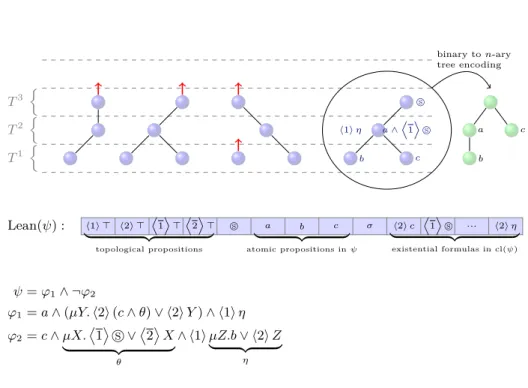
(26) 2.6. TYPES AND PATHS ANALYSIS. 21. limiting recursion and wildcard steps in path expressions can greatly enhance performance. Another optimization is also related to path expressions. In order to identify the list of instructions to re-evaluate, a pattern matching is performed on the entire re-evaluation rule set. To avoid such an overhead, one needs to establish statically the containment relations between all paths contained in these rules. A pattern p1 is contained in another pattern p2 when all nodes that match pattern p2 match pattern p1. So, in order to find the list of instructions to re-evaluate, a successful pattern matching against p1 makes pattern matching against p2 useless. In general terms, more precise path expressions analysis will lead to more accurate selections, and subsequently diminish useless re-evaluations and enhance performance. For that purpose, a more systematic and finer grained analysis of path expressions combined with schemas becomes necessary. 2.6. Types and paths analysis. Publications: PLDI 2007 [Genevès et al., 2007a], TOIS 2006 [Genevès & Layaïda, 2006b], DKE 2007 [Genevès & Layaïda, 2007], IJCAI 2011 [Bárcenas et al., 2011], WWW 2012 [Genevès et al., 2012], Extreme Markup 2003 [VionDury & Layaïda, 2003]. Students: Pierre Genevès and Everardo Bárcenas Patiño, PhD thesis. In the previous sections, we have emphasized the central role played by transformations in XML processing. They are widely used to produce presentations in content servers and to achieve all sorts of tasks. XML applications most commonly use schemas for performing validation (also called dynamic type-checking). Validation consists in using a schema validator that analyzes a particular XML document in order to ensure that the document actually complies with the schema. However, XML documents are often generated dynamically. Typically, programs that manipulate XML first access data (possibly conforming to an available schema) using XPath expressions, and then combine the results and output XML documents expected to conform to a given schema. In addition, in the current web architectures increasingly dominated by web services, content often undergoes several transformations before producing a result. In addition, XML applications do frequently involve large volumes of content. For example, in technical documentation, a single maintenance manual for the A320 Airbus studied in [Villard, 2002] weights several hundred of megabytes. Consequently, it becomes crucial to analyze the XML transformations in order to make them safe and efficient. One of the key safety properties is to guarantee that transformations produce valid documents against their schema [Akpotsui, 1993; Akpotsui & Quint, 1992]. This is called static type-checking and consists in ensuring at compiletime that invalid documents can never arise as outputs of XML processing code. A static type checker analyzes a program, possibly in conjunction with schemas that describe its input and output (depending whether such schemas are available). This problem is known to be difficult. The static analysis of the complete XPath language alone is undecidable. The variety and wide.
(27) 22. CHAPTER 2. RESEARCH SUMMARY. use of XPath in XML applications nevertheless raise some important research questions: what is the largest XPath fragment with decidable static analysis? Which fragments can be effectively decided in practice? How to determine if an XPath expression is satisfiable on any of the XML trees defined by a given schema? Does the result of an XPath expression over a valid document always conform to another schema? Is there an algorithm able to answer these questions in an efficient way so that it can be used in practice? One source of difficulty in such questions is that it involves a possibly infinite quantification over a set of trees. XML types denote such sets. Furthermore, a variety of factors contribute to its complexity such as the operators allowed in XPath queries and the combination of them (recursion, bidirectional navigation in trees, qualifiers, etc). On the other hand, schema languages have been extensively studied and are now well understood as subsets of regular tree languages [Murata et al., 2005]. However, although many attempts have been made for better understanding static type-checking techniques, in particular through the design of domain specific languages [Hosoya & Pierce, 2003; Benzaken et al., 2003], dealing with XPath effectively remained unsuccessful. We started from the idea that two issues need to be answered in order to solve such decision problems in XML. First, it was essential to identify an appropriate formal framework with sufficient expressive power to capture both regular tree languages and navigation introduced by XPath. Then we had to find appropriate techniques to solve the satisfiability problem in that framework. satisfiability allows determining whether a given property holds or not. Then, it would be interesting to obtain an XML document that exemplifies it. Such properties include the XPath containment, emptiness, equivalence and coverage of XPath queries (in the presence or absence of regular types of trees). A first important result was achieved through the design of a finite tree logic adapted to XML, and its decision procedure. The logic is expressive enough to capture regular tree types along with multi-directional navigation in finite trees. It is decidable in single exponential time (specifically in 2O(n) steps where n is the size of the input formula defined as its number of atomic propositions and eventualities). This improves the best-known computational complexity for finite trees. Another contribution is that we showed how to linearly compile queries and regular tree types (including DTDs and XML Schemas) in the logic. This offers a uniform notation for both constructs and facilitates reasoning on them. The logic enjoys the nice property of being closed under boolean operations which allows for reducing many problems to satisfiability. It supports the full navigational features of XPath and covers the largest fragment considered in the literature [Marx, 2004]. From the algorithmic point of view, the decision procedure proved entirely feasible using symbolic techniques borrowed from verification: BDD (Binary Decision Diagrams). 2.7. Managing evolution. Publications: ICFP 2009 [Genevès et al., 2009], TOIT 2011 [Genevès et al., 2011], WWW 2010 [Layaïda & Genevès, 2010], ICSE 2011 [Genevès & Layaïda,.
(28) 2.8. FUNCTIONS, POLYMORPHISM AND SUBTYPING. 23. 2011]. Collaboration: Vincent Quint and Pierre Genevès. In this work, we consider the problem of XML Schema evolution. In the ever-changing context of the web, XML schemas continuously change in order to cope with the natural evolution of entities they describe. Schema changes have important consequences. First, existing documents valid with respect to the original schema are no longer guaranteed to fulfill the constraints described by the evolved schema. Second, the evolution also impacts programs manipulating documents whose structure is described by the original schema. We propose a unifying framework for determining the effects of XML Schema evolution both on the validity of documents and on queries. The system is very powerful in analyzing various scenarios in which forward/backward compatibility of schemas is broken, and in which the result of a query may not be anymore what was expected. Specifically, the system offers a predicate language, which allows one to formulate properties related to schema evolution such as compatibility. The system then relies on exact reasoning techniques to perform a fine-grained analysis of programs and schema changes. This yields either a formal proof of the property or a counter-example that can be used for debugging purposes. The system has been fully implemented and tested with real-world use cases, in particular with the main standard document formats used on the web, as defined by W3C. The system identifies precisely compatibility relations between document formats. In case these relations do not hold, the system can identify queries that must be reformulated in order to produce the expected results across successive schema versions. The longterm goal of this work is to find methods and techniques to reformulate XML transformations automatically when schemas evolve. 2.8. Functions, polymorphism and subtyping. Publications: ICFP 2011 [Gesbert et al., 2011]. Collaboration: Pierre Genevès and Nils Gesbert (Postdoc). The growing popularity of programming languages such as XQuery leads to new needs. The first of these needs is the ability to support modularity in larger applications. As applications become more and more distributed, a more adequate support for web services interactions is also necessary. These new needs require polymorphic type systems for XML programming languages. For example, in XQuery [Boag et al., 2006] which is a typed functional language, the support for higher-order functions, currently absent from the language, appears as a requirement in the forthcoming third version [Engovatov & Robie, 2010]. Higher-order functions and parametric polymorphism are two of the most powerful constructs in functional programming languages such as ML, Caml or Haskell. In these languages, functions are considered as values like any other values such as integers, lists, etc. In addition, they can be passed as parameters or returned as results. In XML, it is attractive to reach such powerful type systems where types can denote not only data types such as schemas but also computations. To.
(29) 24. CHAPTER 2. RESEARCH SUMMARY. that end, function types need first to be supported in the manner of [Benzaken et al., 2003; Castagna & Xu, 2011]. In addition, if functions can be made parametric using type variables (parametric types), they become more generic since they can operate on a large number of specific types. Such functions are also important to promote code reuse. We have studied parametric polymorphism for type systems aiming at maintaining full static type-safety of functional programs that manipulate linked structures such as trees, potentially with higher-order functions. We consider a type algebra equipped with recursive, product, function (arrow), intersection, union, and complement types. We first have shown how the subtyping relation between such type expressions can be decided through a logical approach. Our main result solves an open problem: we prove the decidability of the subtyping relation when this type algebra is extended with type variables. This provides a powerful polymorphic type system (using ML-style prenex polymorphism, where variables are implicitly universally quantified at top level), for which defining the subtyping relation is not obvious, as pointed out in [Castagna & Xu, 2011], and for which no candidate definition of subtyping had been proved decidable before. The novelty, originality and strength of our solution reside in introducing a logical modeling for the semantic subtyping framework. Specifically, we model semantic subtyping in the finite tree logic presented earlier and rely on a slightly modified satisfiability solver in order to decide subtyping in practice. We obtain an EXPTIME (2O(n) ) complexity bound as well as an efficient implementation in practice.. 2.9. Research Summary. The guiding motivation of my work is to promote declarative and typed representation of content in documents and web applications. The overall goal is to ease the design of web applications and make them richer, safer and more efficient. During the last few years, I focused first on enriching content representation to support a wider and more integrated set of features: temporal synchronization, spatial positioning, logical organization and hypermedia links. The central idea of my work consists in defining the various document dimensions or facets with well-defined languages. Then the idea is to make them combinable, by composition, within general document models such as Madeus or more generally XML-defined languages. When possible, my work promotes standard and universal languages. My work on temporal synchronization resulted in a W3C recommended language called SMIL. This language has been used in mobile infrastructure for Multimedia Messaging and integrated in other languages such as SVG. By making the different content facets more explicit, declarative languages make possible advanced content processing such as intelligent scheduling, incremental manipulations, automatic adaptation and personalization, verification of content manipulations in programs, code optimizations, etc. Furthermore, dedicated languages such as XQuery are becoming more mature and offer.
Figure

+7


Documents relatifs
In our case, for example, profiling the experts of a W3C working group can be achieved by crossing their activity in collaborative work (from our original
This tutorial would show that developments in the areas of the hidden Web, Semantic Web, XML and DSMLs have influenced the current state of the Web by
WordNet: An Electronic Lexical
MapReduce: A programming model (inspired by standard functional programming operators) to facilitate the development and execution of distributed tasks.. Published by Google Labs
Follow random teleport links with probability 1.0 from dead-ends. Adjust
Like Rhapsody and Amazon, web services and web databases with structured I/O channels are called by web components?. 3 User Interface Component and
The current paper contributes to this honourable goal by exposing a method for the development of complex web services which embodies a number of quality
Figure 4: The proposed schema for mapping the XML document to relational tables... - The Element entity is supplemented with two
