HAL Id: hal-01575293
https://hal.archives-ouvertes.fr/hal-01575293
Submitted on 18 Aug 2017
HAL is a multi-disciplinary open access
archive for the deposit and dissemination of
sci-entific research documents, whether they are
pub-lished or not. The documents may come from
teaching and research institutions in France or
abroad, or from public or private research centers.
L’archive ouverte pluridisciplinaire HAL, est
destinée au dépôt et à la diffusion de documents
scientifiques de niveau recherche, publiés ou non,
émanant des établissements d’enseignement et de
recherche français ou étrangers, des laboratoires
publics ou privés.
Recovery of nonlinearly degraded sparse signals through
rational optimization
Marc Castella, Jean-Christophe Pesquet
To cite this version:
Marc Castella, Jean-Christophe Pesquet. Recovery of nonlinearly degraded sparse signals through
rational optimization. SPARS 2017 - 6th Signal Processing with Adaptive Sparse Structured
Repre-sentations workshop, Jun 2017, Lisbonne, Portugal. pp.1-2. �hal-01575293�
ORIGINAL VERSION APPEARED IN PROC. SPARS 2017, JUNE. 2015, LISBON, PORTUGAL 1
Recovery of Nonlinearly Degraded Sparse Signals through
Rational Optimization
Marc Castella
SAMOVAR, T´el´ecom SudParis, CNRS, Universit´e Paris-Saclay,
9 rue Charles Fourier, 91011 Evry Cedex, France Email: [email protected]
Jean-Christophe Pesquet
Center for Visual Computing, CentraleSupelec, Universit´e Paris-Saclay,
Grande Voie des Vignes, 92295, Chˆatenay-Malabry, France Email: [email protected]
Abstract—We show the benefit which can be drawn from recent global
rational optimization methods for the minimization of a regularized criterion. The regularization term is a rational Geman-MacClure like potential, approximating the ℓ0 norm and the fit term is a least-squares
criterion suited to a wide class of nonlinear degradation models. I. INTRODUCTION
Over the last decade, much attention has been paid to inverse problems involving sparse signals. A popular approach consists in formulating such problems under a variational form where one minimizes the sum of a data fidelity term and a regularization term incorporating prior information. For sparse signals, the regularization term may involve the ℓ0 norm, or an approximation of it [1]. This
generally results in difficult optimization problems with many local minima and weak global convergence guaranties [2]–[5]. In this work, we consider rational optimization algorithms offering global optimality guaranties. In addition, our method allows us to address the challenging case of a nonlinear model [6]–[8].
II. MODEL AND CRITERION
Consider a sparse vector with unknown nonnegative samples
x := (x1, . . . , xT)⊤, only a few of which are nonzero. We aim
at recovering it from measurements y := (y1, . . . , yT)⊤related to
x through a linear transformation (typically, a convolution) followed
by some nonlinear effects:
y = ϕ(Hx) + n , (1) where n := (n1, . . . , nT)⊤is a realization of a random noise vector,
and ϕ :RT→ RT is a rational nonlinear function with components [ϕ(u)]k= ϕ(uk) depending on the kthentry ukonly. H∈ RT×T is
a given convolution matrix, which is assumed Toeplitz banded under suitable vanishing boundary conditions. To estimate x, we minimize a penalized criterion having the following form:
(∀x ∈ RT+) J (x) = ∥y − ϕ(Hx)∥ 2 + λ T ∑ t=1 xt δ + xt , (2) where λ and δ are positive regularization and smoothing parameters. The last term is a Geman-McClure like potential as in [9]. We assume that an upper-bound B on the values (xt)Tt=1 is available and the
minimization is thus performed over a compact set defined and rep-resented by K ={x ∈ RT| xt(B− xt)≥ 0, t = 1, . . . , T }. Then,
the optimization problem consists in findingJ⋆:= infx∈KJ (x) . III. RATIONAL MINIMIZATION
GivenJ in (2), the previous minimization is a rational problem. The methodology in [10, 11] builds for different orders k a hierarchi-cal sequence of semi-definite programming (SDP) relaxationsPk⋆for
which the following optimality result holds:P⋆
k↑ J⋆as k→ +∞.
By using SPD solvers to solve Pk⋆, one can hence theoretically
obtain the global optimum [9]. Due to the maximum tractable size of state of the art SDP solvers, this approach is however limited to small/medium size problems having small degree, even when restricting the hierarchy to a finite and small order k. To overcome this difficulty, we exploit the problem structure in the sum of rational terms in (2). Using the sparse Toeplitz banded shape of H, it can be noticed that: J (x) = T ∑ t=1 [ yt− ϕ ( L ∑ i=1 hixt−i+1 )]2 | {z } depends on xkfor k∈ Jt + λ xt δ + xt | {z } depends on xtonly ,
where Jt = {min{1, t − L − 1}, . . . , t} and Jt+T = {t} for
any t ∈ {1, . . . , T }. These index subsets satisfy the so-called “Running Intersection Property” [12]. As a consequence, it is possible to introduce a much smaller SDP relaxation Pk⋆s instead of P
⋆ k.
The fundamental idea is that the SDP relaxations involve variables representing monomials in (x1, . . . , xT). Using the above split form,
many monomials can be discarded, the most striking case being when
J is fully separable.
IV. EXPERIMENTS
We have generated 100 Monte-Carlo realizations of vector x containing T = 200 sparse samples, exactly 20 of which are nonzero. The nonzero sample values were randomly drawn in [23; 1]. We have generated y according to (1) with the nonlinearity ϕ(uk) = 0.3+uuk
k and with additive i.i.d. zero-mean Gaussian noise with standard deviation σ = 0.15. The banded Toeplitz matrix H has been set in accordance with two choices of FIR filters of length 3 (denoted
h(a)and h(b)). We considered the estimate x⋆s
3 given by the optimal
point of the SDP relaxationP3⋆s of order k = 3.
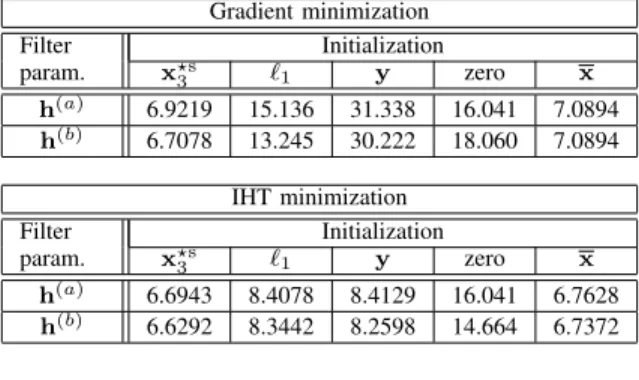
For comparison, we have implemented a proximal gradient algo-rithm based on Iterative Hard Thresholding (IHT) [3] extended to the the nonlinear model. Also, we tested a convex relaxation based on a a linearized reconstruction with ℓ1penalization. The local optimization
algorithms have been started with different initializations and Table I indicates the existence of local minima.
On Figure 1, we have plotted the valueP3⋆s reached by the SDP
relaxation (which is a lower bound on J⋆), the objective value
J (x⋆s
3) and the objective value reached using IHT using two different
initializations. Clearly, our method provides a point close to a global minimizer and is very useful in providing a good initialization point for local optimization algorithms.
Finally, the estimation error has been quantified by ∥ˆx − x∥ for a given estimate ˆx. The average error and objective values are
ORIGINAL VERSION APPEARED IN PROC. SPARS 2017, JUNE. 2015, LISBON, PORTUGAL 2
TABLE I
FINAL VALUES OF THE OBJECTIVEJ (x)FOR THE GRADIENT ANDIHT LOCAL OPTIMIZATIONS(AVERAGE OVER100 MONTE-CARLO
REALIZATIONS) Gradient minimization Filter param. Initialization x⋆s3 ℓ1 y zero x h(a) 6.9219 15.136 31.338 16.041 7.0894 h(b) 6.7078 13.245 30.222 18.060 7.0894 IHT minimization Filter param. Initialization x⋆s 3 ℓ1 y zero x h(a) 6.6943 8.4078 8.4129 16.041 6.7628 h(b) 6.6292 8.3442 8.2598 14.664 6.7372 Monte-Carlo realization 0 20 40 60 80 100 5.5 6 6.5 7 7.5 8 8.5 9 9.5 10 Objective value x3* IHT init. x3* IHT init. l1 Lower-bound
Fig. 1. Objective values provided by the different algorithms and lower-bound (using filter h(a)).
TABLE II
FINAL VALUES OF THE OBJECTIVEJ (x)AND ESTIMATION ERROR GIVEN BY THE PROPOSED METHOD ANDIHTWITH DIFFERENT INITIALIZATIONS
(AVERAGE OVER1000 MONTE-CARLO REALIZATIONS). Objective Error Filter param. h(a) h(b) h(a) h(b)
Proposed method 6.9219 6.7078 1.3278 1.5408 Proposed method + IHT 6.6943 6.6292 1.3374 1.5393 linear + ℓ1+IHT 8.4078 8.3442 1.5575 1.6833
REFERENCES
[1] E. Soubies, L. Blanc-F´eraud, and G. Aubert, “A continuous exact ℓ0
penalty (CEL0) for least squares regularized problem,” SIAM J. Imaging
Sci., vol. 8, no. 3, pp. 1607–1639, 2015.
[2] M. Nikolova, “Description of the minimizers of least squares regularized with ℓ0 norm. Uniqueness of the global minimizer,” SIAM J. Imaging
Sci., vol. 6, no. 2, pp. 904–937, 2013.
[3] T. Blumensath and M. E. Davies, “Iterative thresholding for sparse approximations,” J. Fourier Anal. Appl., vol. 14, no. 5-6, pp. 629–654, 2008.
[4] A. Patrascu and I. Necoara, “Random coordinate descent methods for ℓ0
regularized convex optimization,” IEEE Trans. Automat. Contr., vol. 60, no. 7, pp. 1811–1824, Jul. 2015.
[5] C. Soussen, J. Idier, J. Duan, and D. Brie, “Homotopy based algorithms for l0-regularized least-squares,” IEEE Trans. Signal Process., vol. 63, no. 13, pp. 3301–3316, 2015.
[6] M. Shetzen, The Volterra and Wiener Theories of Nonlinear Systems. New York: Wiley and sons, 1980.
[7] N. Dobigeon, J.-Y. Tourneret, C. Richard, J. C. M. Bermudez, S. McLaughlin, and A. O. Hero, “Nonlinear unmixing of hyperspectral images: models and algorithms,” IEEE Signal Process. Mag., vol. 31, no. 1, pp. 82–94, Jan. 2014.
[8] Y. Deville and L. T. Duarte, “An overview of blind source separation methods for linear-quadratic and post-nonlinear mixtures,” in Proc. of
the 12th Int. Conf. LVA/ICA, ser. LNCS, vol. 9237. Liberec, Czech Republic: Springer, 2015, pp. 155–167.
[9] M. Castella and J.-C. Pesquet, “Optimization of a Geman-McClure like criterion for sparse signal deconvolution,” in Proc. IEEE Int. Workshop
on Computational Advances in Multi-Sensor Adaptive Processing (CAM-SAP), Cancun, Mexico, Dec. 2015, pp. 317–320.
[10] J.-B. Lasserre, “Global optimization with polynomials and the problem of moments,” SIAM J. Optim., vol. 11, no. 3, pp. 796–817, 2001. [11] ——, Moments, Positive Polynomials and Their Applications, ser.
Opti-mization Series. Imperial College Press, 2010, vol. 1.
[12] F. Bugarin, D. Henrion, and J.-B. Lasserre, “Minimizing the sum of many rational functions,” Mathematical Programming Computations, vol. 8, no. 1, pp. 83–111, 2015.