HAL Id: tel-00997721
https://tel.archives-ouvertes.fr/tel-00997721
Submitted on 28 May 2014
HAL is a multi-disciplinary open access
archive for the deposit and dissemination of
sci-entific research documents, whether they are
pub-lished or not. The documents may come from
teaching and research institutions in France or
abroad, or from public or private research centers.
L’archive ouverte pluridisciplinaire HAL, est
destinée au dépôt et à la diffusion de documents
scientifiques de niveau recherche, publiés ou non,
émanant des établissements d’enseignement et de
recherche français ou étrangers, des laboratoires
publics ou privés.
Multi-operator greedy routing based on open routers
Daniel Philip Venmani
To cite this version:
Daniel Philip Venmani. Multi-operator greedy routing based on open routers. Other [cs.OH]. Institut
National des Télécommunications, 2014. English. �NNT : 2014TELE0003�. �tel-00997721�
Multi-Operator Greedy Routing
Based on Open Routers
Thèse
présentée pour l’obtention du grade de
DOCTEUR EN INFORMATIQUE ET RESEAUX
de
L’Université Pierre et Marie Curie
par
VENMANI Daniel Philip
acceptée sur proposition du jury:
Prof. Dias De Amorim Marcelo, Président, Université Pierre et Marie Curie, France Prof. Kaldoun Al Agha, Rapporteur, Université Paris-Sud, France
Prof. Raouf Boutaba, Rapporteur, Université de Waterloo, Canada Prof. Philippe Godlewski, Examinateur, Telecom ParisTech, France Dr. Laurent Ciavaglia, Examinateur, Alcatel-Lucent Bell Labs, France
Dr. Olivier Festor, Examinateur, INRIA Nancy—Grand Est, France Dr. Yvon Gourhant, Encadrant, Orange Labs, France
Prof. Djamal Zeghlache, Directeur de thèse, Telecom SudParis, Institut Mines-télécom, France
Ecole Doctorale d’Informatique, Télécommunications et Electronique de Paris (EDITE de Paris)
Soutenue en Février 2014
Multi-Operator Greedy Routing
Based on Open Routers
Dissertation
submitted in partial fulfillment of the requirements for the degree of
DOCTOR OF PHILOSOPHY
of
Pierre and Marie CURIE University
Carried out by
VENMANI Daniel Philip
accepted by the jury committee composed of:
Prof. Dias De Amorim Marcelo, President, Université Pierre et Marie Curie, France Prof. Kaldoun Al Agha, Rapporteur, Université Paris-Sud, France
Prof. Raouf Boutaba, Rapporteur, Université de Waterloo, Canada Prof. Philippe Godlewski, Examiner, Telecom ParisTech, France Dr. Laurent Ciavaglia, External Examiner, Alcatel-Lucent Bell Labs, France
Dr. Olivier Festor, External Examiner, INRIA Nancy—Grand Est, France Dr. Yvon Gourhant, Advisor, Orange Labs, France
Prof. Djamal Zeghlache, Thesis Director, Telecom SudParis, Institut Mines-télécom, France
Ecole Doctorale d’Informatique, Télécommunications et Electronique de Paris (EDITE de Paris)
Defended on February 2014
To my Mother
(1950-1994)
To my Brother
(1974-2013)
Epigraph
நாளள எ்ு் ந் ளையி் இ்ளல நா் யாு் தேவ் ளை ப ா்ளைைதள! எ்றா் ூட த ாராு ந் ா எ்ளற்ு் தோ்ைாு உ்ளைைதள !Special Mention
Ibrahim Houmed, R&D Program Manager, Orange Labs
Yvon Gourhant, R&D Program Manager, Orange Labs
Marion Duprez, R&D Program Manager, Orange Labs
…for trusting me; for giving me the opportunity to do what ) like the most to do; for giving me a career break-through.
Acknowledgements
Life is too short to acknowledge all those creative, beautiful and unpretentious minds, who make our journey worthwhile. Here, I get an opportunity to offer my gratitude to all those personalities, who really made a personal difference to me with their presence. Just saying 'thank-you' is far too little; I can't imagine my accomplishments without their support.
To begin with, foremost, the first person to be acknowledged naturally is my advisor, Dr. Yvon Gourhant, who always maintained a rather pleasant ambiance with me and greatly inspired me to produce excellent research results by getting the best out of me. I will never forget my first interaction with him in the fall of 2010 when as an aspiring young doctoral candidate who had just arrived at Orange Labs, Lannion, I walked into his office and solicited him to describe to me some of the research he was involved with. I had never heard much of the technical details of mobile backhaul until that moment of my life and, truth be told, I did not understand much of what he explained that evening of what seemed to me – at that time – a very obscure field of telecommunications. There were memorable moments like this one that made the everyday life of a student pursuing Doctor of Philosophy, a rather amazing experience. To him, I owe all the knowledge that I have gained during the course of this research.
Walking on my way back home after this meeting, the words of the great artist Pablo Picasso kept ringing in my head: I am always doing that I cannot do, in order that I may learn how to do
it. I decided to embrace this philosophy and began my research hoping that this was the best
way for me to gain the most knowledge; that turned out to be – in retrospect –a very wise choice. After three exciting years, having analyzed millions of experimental data points, having run thousands of simulations, having derived countless equations, and having learned much more than that I could have ever hoped for (all of these happened between 10pm and 4 am every night), I ultimately experienced a personal adventure of the greatest magnitude. During this unique process, my understanding on the mobile backhaul and for the field of telecommunications in general has grown exponentially, the collaboration with other researchers allowed me to produce some very interesting scientific results (15 international publications), and Yvon turned out to be a great advisor and one of the few people on the planet that no person could ever possibly dislike. He has been very pleasant to work with, in experiment upon experiment, always having time to listen and investigate any research issue I might have been struggling with. In short- I wrote, he improved! So, thank you Yvon, thank you for believing all the way and for carrying me to every hill and every valley. You lifted me up the whole way and I will always be grateful for everything you have done and for the all the credible works that have been done.
While Yvon monitored my progress at close proximity, I must not forget to thank my professor, Prof. Djamal Zeghlache, who served as a distant supervisor. I would like to first thank him for accepting to be my academic supervisor despite his busy schedules. I would also like to thank him for supporting me at all the technical obstacles during my research and thank him the most for placing his un-ending support and confidence in me and for his views and appreciations for my research ideas. His support by providing valuable advice and start up ideas from his vast experience was an aiding factor in advancing this thesis with a much faster pace.
Sincere thanks to Prof. Kaldoun Al Agha, Rapporteur, Université Paris-Sud, France, Prof. Raouf Boutaba, Rapporteur, University of Waterloo, Canada, for having to spend one of the most invaluable resources, Time, for reviewing this dissertation thesis and offering valuable comments. I also wish to thank the professors and the members of my qualifying oral exam and defense committees, Prof. Dias De Amorim Marcelo, Président, Université Pierre et Marie Curie, France, Prof. Philippe Godlewski, Telecom ParisTech, France, Dr. Laurent Ciavaglia, Examinateur, Alcatel-Lucent Bell Labs, France, Dr. Olivier Festor, Examinateur, INRIA Nancy— Grand Est, France and all the anonymous reviewers of the international conferences I submitted and published my articles. They all transferred some part of their wisdom to me one way or another through suggestions, questions that intrigued as well as through constructive criticism. Aside from those people who were directly related to my research, a number of other people influenced my life directly, leading to obtain my Ph.D. Sometimes I'm lost at what my purpose is and am left wondering, why any of this matters. It is on those occasions, family comes - those who loved and cared for me the most, unconditionally. It's the starting boom of a chain reaction. My father, a retired mathematics professor today, who had spent several hours every evening with me personally, during the early years of my life, to teach me Probability, Statistics, Algebra. My brothers - the reason why I am doing this, those who kept insisting me that when I put work in and get things done, it doesn't go unnoticed; it could contribute to my best ever success and that I keep believing in all these years of sacrifices; not to forget to mention my last brother who passed away during the course of my doctoral research, who bought me my first laptop computer with his very own yearly savings. My two most lovely sister-in-laws, my niece- the little princess of our family, my nephews and last but not the least, my dearest friends from India, who replaced my physical presence in my home, for all their affection and constant support, and most of all, patience and understanding towards me, for tolerating my impossibilities.
Orange Labs, my employer, for sponsoring all my professional trips, thus gave me the opportunity to attend some of the best conferences in the world. I would like to thank Mme.Sylvie Gillot, for her continuous support in the administrative tasks at Orange Labs, Lannion, from the beginning until the end of this dissertation thesis.
Abstract
New Approaches for Network-wide Redundancy Elimination for Improving Effective Network Capacity
Revolutionary mobile technologies, such as high-speed packet access 3G (HSPA+) and LTE, have significantly increased mobile data rate over the radio link. While most of the world looks at this revolution as a blessing to their day-to-day life, a little-known fact is that these improvements over the radio access link results in demanding tremendous improvements in bandwidth on the backhaul network. (aving said this, today s )nternet Service Providers )SPs and Mobile Network Operators (MNOs) are intemperately impacted as a result of this excessive smartphone usage. The operational costs (OPEX) associated with traditional backhaul methods are rising faster than the revenue generated by the new data services. Building a mobile backhaul network is very different from building a commercial data network. A mobile backhaul network requires (i) QoS-based traffic with strict requirements on delay and jitter (ii) high availability/reliability. While most ISPs and MNOs have promised advantages of redundancy and resilience to guarantee high availability, there is still the specter of failure in today s networks. The problems of network failures in today s networks can be quickly but clearly ascertained. The underlying observation is that ISPs and MNOs are still exposed to rapid fluctuations and/or unpredicted breakdowns in traffic; it goes without saying that even the largest operators can be affected. But what if, these operators could now put in place designs and mechanisms to improve network survivability to avoid such occurrences? What if mobile network operators can come up with low-cost backhaul solutions together with ensuring the required availability and reliability in the networks?
With this problem statement in-hand, the overarching theme of this dissertation is within the following scopes: (i) to provide low-cost backhaul solutions; the motivation here being able to build networks without over-provisioning and then to bring-in new resources (link capacity/bandwidth) on occasions of unexpected traffic surges as well as on network failure conditions for particularly ensuring premium services (ii) to provide uninterrupted communications even at times of network failure conditions, but without redundancy. Here a slightly greater emphasis is laid on tackling the last-mile link failures. The scope of this dissertation is therefore to propose, design and model novel network architectures for improving effective network survivability and network capacity, at the same time by eliminating network-wide redundancy, adopted within the context of mobile backhaul networks.
Motivated by this, we study the problem of how to share the available resources of a backhaul network among its competitors, with whom a Service Level Agreement (SLA) has been concluded. Thus, we present a systematic study of our proposed solutions focusing on a variety of empirical resource sharing heuristics and optimization frameworks. With this background, our work extends towards a novel fault restoration framework which can cost-effectively provide protection and restoration for the operators, enabling them with a parameterized objective function to choose desired paths based on traffic patterns of their end-customers. We then illustrate the survivability of backhaul networks with reduced amount of physical redundancy, by effectively managing geographically distributed backhaul network equipments which belong to different MNOs using logically-centralized physically-distributed controllers, while meeting strict constraints on network availability and reliability.
Keywords: Network architecture, Network design, Network resilience, Network algorithms &
Résumé
De nouvelles approches efficaces pour améliorer la capacité du réseau sans liens de redondance Les évolutions technologies mobiles majeures, tels que les réseaux mobiles 3G, HSPA+ et LTE, ont augmenté de façon significative la capacité des données véhiculées sur liaison radio. Alors que les avantages de ces évolutions sont évidents { l usage, un fait moins connu est que ces améliorations portant principalement sur l accès radio nécessitent aussi des avancées technologiques dans le réseau de collecte (backhaul) pour supporter cette augmentation de bande passante. Les fournisseurs d accès )nternet FA) et les opérateurs de réseau mobile doivent relever un réel défi pour accompagner l usage des smartphones. Les coûts opérationnels associés aux méthodes traditionnelles de backhaul augmentent plus vite que les revenus générés par les nouveaux services de données. Ceci est particulièrement vrai lorsque le réseau backhaul doit lui-même être construit sur des liens radio. Un tel réseau de backhaul mobile nécessite (i) une gestion de qualité de service (QoS) liée au trafic avec des exigences strictes en matière de délai et de gigue, (ii) une haute disponibilité / fiabilité. Alors que la plupart des FAI et des opérateurs de réseau mobile font état des avantages de mécanismes de redondance et de résilience pour garantir une haute disponibilité, force est de constater que les réseaux actuels sont encore exposés à des indisponibilités. Bien que les causes de ces indisponibilités soient claires, les fluctuations rapides et / ou des pannes imprévues du trafic continuent d affecter les plus grands opérateurs. Mais ces opérateurs ne pourraient-ils pas mettre en place des modèles et des mécanismes pour améliorer la survie des réseaux pour éviter de telles situations ? Les opérateurs de réseaux mobiles peuvent-ils mettre en place ensemble des solutions à faible coût qui assureraient la disponibilité et la fiabilité des réseaux ?
Compte tenu de ce constat, cette thèse vise à : (i) fournir des solutions de backhaul à faible coût ; l objectif est de construire des réseaux sans fil en ajoutant de nouvelles ressources { la demande plutôt que par sur-dimensionnements, en réponse à un trafic inattendu surgit ou à une défaillance du réseau, afin d assurer une qualité supérieure { certains services (ii) fournir des communications sans interruption, y compris en cas de défaillance du réseau, mais sans redondance. Un léger focus porte sur l occurrence de ce problème sur le lien appelé «dernier kilomètre» (last mile). Cette thèse conçoit une nouvelle architecture de réseaux backhaul mobiles et propose une modélisation pour améliorer la survie et la capacité de ces réseaux de manière efficace, sans reposer sur des mécanismes coûteux de redondance passive.
Avec ces motivations, nous étudions le problème de partage de ressources d'un réseau de backhaul entre opérateurs concurrents, pour lesquelles un accord de niveau de service (SLA) a été conclu. Ainsi, nous présentons une étude systématique de solutions proposées portant sur une variété d heuristiques de partage empiriques et d'optimisation des ressources. Dans ce contexte, nous poursuivons par une étude sur un mécanisme de recouvrement après panne qui assure efficacement et à faible coût la protection et la restauration de ressources, permettant aux opérateurs via une fonction basée sur la programmation par contraintes de choisir et établir de nouveaux chemins en fonction des modèles de trafic des clients finaux. Nous illustrons la capacité de survie des réseaux backhaul disposant d un faible degré de redondance matérielle, par la gestion efficace d équipements de réseau de backhaul répartis géographiquement et appartenant { différents opérateurs, en s appuyant sur des contrôleurs logiquement centralisés mais physiquement distribués, en respectant des contraintes strictes sur la disponibilité et la fiabilité du réseau.
Mots-clés: Architecture de réseaux backhaul mobiles, Partage de ressources d'un réseau de
backhaul, Mécanisme de recouvrement après panne, Optimisation des ressources, Software Defined Networking (SDN)/OpenFlow.
TABLE OF CONTENTS
Epigraph ... i Special Mention ... ii Acknowledgements ...iii Abstract ... iv Résumé ... v TABLE OF CONTENTS ... viLIST OF FIGURES ... vii
Chapter 1 ... 1
Prologue ... 1
1.1. Opening Comments ... 2
1.2. Thesis Layout ... 3
1.3. Research Contributions ... 5
1.3.1. Part II: Theory and Modeling ... 5
1.3.1.1. Chapter 3 ... 5
1.3.1.2. Chapter 4 ... 7
1.3.2. Part III: Optimization Techniques for Network Survivability ... 8
1.3.2.1. Chapter 5 ... 9
1.3.2.2. Chapter 6 ... 10
1.3.2.3. Chapter 7 ... 11
1.3.2.4. Chapter 8 ... 12
1.3.3. Part IV: Proof-of-Concept Experiments for Validation and Verification of OpenFlow Deployment in Mobile Backhaul Networks ... 13
1.3.3.1. Chapter 9 ... 14
1.3.4. Part V: Substitution Networks based on Software Defined Networking ... 15
1.3.4.1. Chapter 10 ... 15
1.3.5. Part V: Chapter 11: Research and Deployment challenges and Concluding Discussions of the Dissertation ... 16
1.4. Pilot: Can I Share my Unused Resources with my Competitors? ... 17
1.4.1. History of the Future: The Internet and the Mobile Internet ... 17
1.4.2. Problems of the Present: Apples and Oranges ... 17
1.4.3. The Challenge to Re-design: Quick Glimpse on Fundamentals ... 18
1.5. Scope of this Dissertation: Problem Definitions ... 19
1.5.1. Can I Share my Unused Resources with my Competitors? ... 19
1.5.2. Service Differentiation among Multiple Operators ... 20
1.5.3. Network Management as a tool for Service Differentiation between Operators ... 21
1.6. Bringing-in Software Defined Networking (SDN) as a means for Service Differentiation between Multiple Operators ... 22
1.7. Overall Final Remarks ... 25
Chapter 2 ... 27
State of the Art Techniques for Mobile Network Sharing... 27
2.1. Introduction to Network Sharing: When Technology and Business must go Hand-in-Hand. ... 28
2.1.1. The Context and the Problem... 28
2.2. Resource Sharing in Mobile Networks ... 30
2.2.1. Scoping the Network-Sharing Solution ... 30
2.3. Network Sharing - Within the Context of Emerging Countries ... 32
2.3.1. Compensating the Network Quality ... 32
2.3.2. What can Africa learn from Developed Economies of Network Sharing Experience? ... 34
2.4. Fundamental Limits and Regulatory Framework ... 35
2.4.1. Regulatory Interests in Infrastructure Sharing ... 35
2.4.2. Impact on Competition ... 37
2.4.3. Existing Standardizations on Network Sharing ... 40
2.5. Risks Involved in Resource Sharing ... 40
2.6. Wireless Network Virtualization ... 42
2.7. Concluding Remarks and Discussions on State of the Art Techniques in Mobile Network Sharing ... 43
2.8. Summary of our Findings ... 45
Chapter 3 ... 49
Reliability and Availability Analysis of a Novel Shared Backhaul Architecture ... 49
3.1. Motivation towards this Shared Design... 50
3.1.1. Organization of Part I ... 51
3.2. 3RIS for 4G: A Novel Design and its Reliability Analysis: Part I ... 51
3.3. System Modeling ... 52
3.3.1. Formal Definitions ... 52
3.3.2. Statistical Analysis based on Real Measurement Model ... 54
3.3.3. State Space Analytical Model for Infrastructure Sharing ... 57
3.4. Proposed Architectural Design ... 61
3.5. Give and Take: Characterization of Availability of Multi-State Wireless Backhaul Networks: Part II ... 64
3.5.1. Organization of Part II ... 65
3.5.2. Evaluating Approach ... 65
3.6. Multi-State System Availability Analysis ... 66
3.6.1.1. Formal Definitions ... 66
3.6.2. Multi-State Wireless Backhaul Networks Availability Analysis with Sharing between Different MNOs ... 68
3.7. Illustrative Numerical Evaluation ... 72
3.7.2. MSS Average Availability of the Wireless Backhaul when Shared ... 73
3.8. Concluding Discussions ... 73
Chapter 4 ... 75 Analytical Modeling for Recovery and Re-routing within the Shared Backhaul
Architecture ... 75
4.1. Introductory Statements ... 76
4.1.1. Concept Visualization ... 76 4.1.2. Organization of the Chapter ... 76
4.2. Current Objectives and Contributions ... 77
4.2.1. Significance of our Results ... 77
4.3. Analytical Modeling ... 78
4.3.1. Formal Definition ... 78 4.3.2. Analytical Model for 1:1 Path Protected Connection ... 78
4.4. Analytical Model for Link-Bandwidth Sharing ... 79 4.5. Towards A Probabilistic Model for Fault Restoration through Link-Bandwidth
Sharing ... 81
4.5.1. General Problem Statement ... 81 4.5.2. Assumptions and Conditions ... 83 4.5.3. Network Model ... 84 4.5.4. Probabilistic Modeling for Fault Restoration ... 84
4.6. Illustrative Numerical Evaluation ... 87 4.7. Concluding Discussions ... 89
Chapter 5 ...93 OpenRoutes:Multi-operator Cooperative Routing for the Survivability of Backhaul Networks ...93
5.1. Introductory Statements ... 94
5.1.1. Concept Visualization ... 94 5.1.2. Current Objectives and Contributions and Organization of the Chapter ... 96
5.2. Modeling OpenRoutes Restoration Scheme ... 98
5.2.1. Overall System Model ... 98 5.2.2. On Path Computation Model ... 98 5.2.3. On Bandwidth Computation Model ... 100 5.2.4. Relaxing Reachability and Restricting Shareability ... 101
5.3. ILP Formulation based Optimization for Alternative Disjoint Paths with Optimal Capacity ... 103 5.4. Heuristics Algorithms for the best Alternative Backup Path with Optimal
Capacity ... 105
5.4.1. Least Length Shortest Paths (LLSP) ... 107 5.4.2. Least Delay Shortest Path (LDSP) ... 107 5.4.3. Ant Colony Optimization (ACO) for Optimal Capacity Path Computation ... 108
5.5. OpenRoutes Restoration Scheme ... 112 5.6. Performance Evaluation and Discussions ... 114
5.6.1. Experimental Set-up and Computational Considerations ... 114 5.6.1.1. Efficiency of the Three Heuristics Individually on Different Traffic Conditions- With
and Without Operator Sharing ... 115 5.6.2. Efficiency of the Algorithms with Operator Sharing Only - on Different Topologies ... 120 5.6.3. Influence of Topologies ... 120 5.6.4. Influence of Sharing ... 122
5.7. Concluding Discussions ... 124
Chapter 6 ... 125 Divide and Share:Multi-operator Greedy Routing Based on Sharing with Constraints .. 125
6.1. Introductory Statements ... 126
6.1.1. Problem Formulation ... 126 6.1.2. Motivation and Concept Visualization ... 126 6.1.3. Current Contributions and Significance of our Results ... 128
6.2. Issues Affecting Availability in Shared Backup Bandwidth Allocation ... 129 6.3. Divide and Share Optimization ... 130
6.3.1. General Problem Statement ... 130 6.3.2. ILP based Optimization for Link Bandwidth Allocation through Sharing ... 133 6.3.3. Heuristics based Approach for Link Bandwidth Allocation through Sharing ... 135 6.3.3.1. Algorithm for Link Bandwidth Allocation through Sharing ... 135 6.3.3.2. Description of the Algorithm ... 137 6.3.3.3. Competitive Differentiation ... 139
6.4. Illustrative Numerical Evaluation ... 139
6.4.1. Experimental Set-up and Computational Considerations ... 139 6.4.2. Performance Comparison between ILP and Heuristics. ... 141
6.5. Concluding Discussions ... 143
Chapter 7 ... 145 X-Control:A Quasi-Distributed Fault Restoration Mechanism Using Logically
Centralized Controllers ... 145
7.1. Introductory Statements ... 146
7.1.1. Concept Visualization ... 146 7.1.2. Motivation ... 146
7.2. Towards A Quasi-Distributed Fault Restoration ... 147
7.2.1. Cross-Controller Network Design: When Controllers Talk! ... 148
7.3. On Characterizing Topology Changes ... 150
7.3.1. On Modeling Network Convergence ... 151
7.4. On Optimizing Quasi-Distributed Fault Restoration Using ILP Based
7.5. On Greedy Heuristics Based On Convex Combination ... 154 7.6. Illustrative Numerical Evaluations ... 155
7.6.1. Optimal Locations for Logically-centralized Physically-distributed Controllers ... 155
7.7. Concluding Discussions ... 158
Chapter 8...161 Stitch-n-Sync:Discreetly Disclosing Topology Information Using Logically Centralized Controllers ...161
8.1. Introductory Statements ... 162
8.1.1. Current contributions and Organization of the Chapter ... 162
8.2. Towards A Multi-Topology Shared Architecture ... 163
8.2.1. Discreetly Disclosing Topology Information: Stitch n Sync! ... 163 8.2.2. Challenges Posed by Sharing between Multiple Operators/ Domains ... 164
8.3. On Maximizing Network Survivability ... 165
8.3.1. On Modeling Inter-Domain Synchronization (IDS) ... 166
8.4. On Optimizing Quasi-Distributed Topology Sharing Using ILP Based
Formulations ... 167 8.5. Illustrative Numerical Evaluations ... 169
8.5.1. Efficiency of Logically-centralized Physically-Distributed Approach - With and
without controller Collaboration ... 170
8.6. Related Works ... 174 8.7. Concluding Discussions ... 175
Chapter 9... 179 Can SDN/OpenFlow be Adapted for Mobile Backhaul Networks?... 179
9.1. Introductory Statements ... 180 9.2. Background and Concept Visualization ... 181
9.2.1. OpenFlow Architecture in brief ... 182
9.3. Resource Sharing Strategies: Illustrative Examples ...191 9.4. Performance Evaluation ... 194
9.4.1. Quantitative analysis on Virtualization Capabilities ... 194 9.4.2. Quantitative analysis on Network Management Capabilities ... 195 9.4.2.1. Experimental Setup... 196 9.4.3. Performance Metrics and Analysis ... 196 9.4.3.1. Throughput Analysis ... 196 9.4.3.2. Delay Analysis ... 197 9.4.3.3. Network Utilization Efficiency ... 198 9.4.3.4. Normalized Received Traffic ... 199
9.5. Concluding Discussions ... 199
Chapter 10 ... 203 Substitution Networks Based on SDN- A Radical View ... 203
10.1. Introductory Statements ... 204 10.2. Problem Characterization: Background and Existing Solutions... 205 10.3. Approaching the Problem through Substitution Networks (SNs) ... 207
10.3.1. Inspirations for Substitution Networks (SNs) ... 207 10.3.2. Substitution Networks (SNs) in Wireless Backhaul Networks ... 208 10.3.3. Shortcomings of Substitution Networks (SNs) that Hinder a Wide Adoption into
Wireless Backhaul Networks ... 209 10.3.4. Towards a Centralized Approach for Substitution Networks (SNs) ... 210
10.4. Concept Visualization ... 211
10.4.1. The Application of the Approach to the Problem: OpenFlow ... 211 10.4.2. Substitution Networks (SNs) based on Software Defined Networking (SDN) ... 213
10.5. Experimental Evaluations ... 215
10.5.1. Design and Implementation ... 215 10.5.2. Evaluation and Results ... 219
10.6. Discussions and Conclusions ... 221
Chapter 11 ... 223 Concluding Discussions- Recovery without Redundancy is possible! ... 223
LIST OF FIGURES
Figure 1: An illustration of mobile backhaul network topology. ... 19 Figure 2: Infrastructure sharing scoping model and dimensions ... 31 Figure 3: Number of mobile operators present by country, Africa [Source: Analysis Mason, 2013], Countries colored red, orange and yellow all face intense competition. ... 33 Figure 4: Unavailability results of the MW scenarios as a function of the number of hop ... 54 Figure 5: Cost Enhancement Coefficient as a function of unavailability results of the MW
scenarios ... 55 Figure 6: Percentage increment in cost as a function of unavailability results of the MW scenarios
... 56
Figure 7: State diagram for availability analysis of a parallel redundant system ... 59 Figure 8: State diagram for reliability analysis of a parallel redundant system ... 59 Figure 9: Last mile chain topology with redundant links ... 63 Figure 10: Resiliency design flow using infrastructure sharing ... 64 Figure 11: An illustrative example network topology portraying resiliency design flow using infrastructure sharing within the country Kenya. ... 64 Figure 12: Multi-state system reliability analysis diagram for wireless backhaul network with infrastructure sharing... 69 Figure 13: Multi-state system availability analysis diagram for wireless backhaul network with infrastructure sharing... 69 Figure 14: Estimation of state probabilities of wireless backhaul network with infrastructure sharing ... 72 Figure 15: Estimation of Instantaneous availability for wireless backhaul network with
infrastructure sharing... 73 Figure 16: An illustrative example network topology portraying resiliency design flow using infrastructure sharing within the country Kenya. ... 82 Figure 17: Recovery from link congestion through backhaul sharing. ... 82 Figure 18: Traffic flow design with infrastructure sharing under faulty conditions with arrow on the bottom indicating traffic from the recipient and arrows on the top indicates the traffic of the donor. ... 83 Figure 19: Backhaul link-bandwidth allocation through sharing. ... 83 Figure 20: # of connections provisioned using both schemes. ... 88 Figure 21: Blocking Probability values for both schemes. ... 88 Figure 22: End-to-end delay measurement for both schemes. ... 89 Figure 23: An illustrative figure describing reachability and shareability when the host node of one MNO tries to reach another MNO node when a failure occurs. Here, A indicates the host node, trying to re-route disrupted traffic. ... 103 Figure 24: Illustration of Maximum satisfaction Ratio (MSR) for ILP and three heuristics
individually for different traffic conditions- (a) without MNOs sharing, (b) with sharing, (c) three heuristics combined with sharing (on Sprint U.S. topology). ... 116 Figure 25: Illustration of Network Resource Utilization (NRU) for ILP and three heuristics individually for different traffic conditions- (a) without MNOs sharing, (b) with sharing, (c) three heuristics combined with sharing (on Sprint U.S. topology). ... 118 Figure 26: Illustration of End-to-end Throughput (EET) for ILP and three heuristics individually for different traffic conditions- (a) without MNOs sharing, (b) with sharing, (c) three heuristics combined with sharing (on Sprint U.S. topology). ... 119 Figure 27: Illustration of blocking probability for various topologies when all the three heuristics (LLSP+LDSP+ACO) are combined for (a) (no resource sharing) (b) (50% resource sharing). ... 121 Figure 28: Illustration of blocking probability (a) for (no resource sharing) (b) for (50% resource sharing) on a Full-mesh topology. ... 123 Figure 29: Traffic flow design with infrastructure sharing under faulty conditions with arrow on the bottom indicating traffic from the recipient and arrows on the top indicates the traffic of the donor. ... 132
Figure 30: Backhaul link bandwidth allocation through sharing. ... 132 Figure 31: Illustration of 14-Node NSFNET topology. ... 141 Figure 32: Illustration of Resource Overhead versus Number of Nodes. ... 141 Figure 33: Illustration of Blocking probablility versus Number of Nodes. ... 142 Figure 34: Illustration of Cost versus Number of Nodes. ... 143 Figure 35: An illustrative example outlining Quasi-Distributed Fault Restoration Mechanism for the U.S. Two MNOs share their resource (links/bandwidth capacity) by discreetly sharing their topology information using cross-controllers, making a resilient topology, thus avoiding the need for redundancy in the already existing topology. Multiple stand-by controllers can takeover in case of failure of the controller itself. ... 149 Figure 36: An illustration of convex combination technique for controller placement. Given three faulty locations in a plane as shown, the point is a convex combination of the three faulty locations, while is not. ... 155 Figure 37: Topology (A) and topology (B) used in the simulations. ... 156 Figure 38: An illustration of restoration latency due to optimal controller placements for A and B for various disconnected node-pairs. ... 157 Figure 39: An illustration of multiple controller placements for A and B. ... 158 Figure 40: An illustrative example outlining Quasi-Distributed Topology Information Sharing framework for the U.S. Two MNOs share their resource (links/bandwidth capacity) by discreetly sharing their topology information using cross-controllers, making a resilient topology, thus avoiding the need for redundancy in the already existing topology. Multiple stand-by controllers can takeover in case of failure of the controller itself. Best viewed in Color. ... 164 Figure : An illustration of merging or stitching two different MNO topologies a and b into one single topology (c), in which controllers were placed in order to reduce the cost of over-provisioning in already existing networks with special mention on overlapping links and nodes at five different locations (d). ... 169 Figure 42: An illustration of Blocking Probability. ... 172 Figure 43: An illustration of Average Link utilization. ... 173 Figure 44: An illustration of Overall Network Throughput. ... 174 Figure 45: Illustration of architectural Flow diagram of Software Defined Networking (SDN). . 181 Figure 46: Access Network sharing between operators using Virtualization (Thanks to OpenFlow FlowVisor) ... 185 Figure 47: Illustration of recovery from link congestion through backhaul sharing. ... 191 Figure 48: Backhaul Network sharing strategies between operators using Virtualization based on traffic needs. ... 193 Figure 49: Performance comparison for Throughput. ... 197 Figure 50: Performance comparison for Delay. ... 198 Figure 51: Performance comparison for Network Utilization. ... 198 Figure 52: Performance comparison for Received Throughput. ... 199 Figure 53: Figure illustrating backup path protection in wireless microwave backhaul in 3G/4G.
... 206
Figure 54: Architectural design illustrating the elimination of back-up path. ... 208 Figure 55: Architectural design illustrating the integration of Substitution Node. ... 209 Figure 56: Figure illustrating OpenFlow Fields that are used to match against flow table entries to match different actions to be performed by the switch upon receiving a packet. This header represents OpenFlow version 1.0.0... 212 Figure 57: Flow diagram of Open Flow packets. ... 213 Figure 58: Architectural design illustrating Substitution Networks based on SDN. ... 215 Figure 59: Average latency to install flows on an OpenFlow switch. ... 220 Figure 60: Packet Loss Rate on a link before and after introducing SN. ... 221 Figure 61: An illustrative example network topology portraying resilience design flow using infrastructure sharing within the country France. Two MNOs: one at the top (north), another in south (with circles) are joined by just another additional link (green colour thick link), making a
resilient ring topology. ... 226 Figure 62: Traffic re-route resulting from backhaul network sharing due to a link/node failure in the backhaul between several mobile network operators. ... 227
Résumé Etendu
Dans les réseaux de communication sans fil d'aujourd'hui, les faisceaux hertziens sont fréquemment considérés pour construire des réseaux de collecte de réseaux mobiles cellulaires, offrant plus de flexibilité que des lignes louées et des fibres optiques, notamment en Europe et en Afrique. Mais, leur inconvénient réside généralement sur la probabilité de défaillance ou de congestion. Diverses techniques ont été proposées afin de les protéger contre les défaillances potentielles (pannes de liens et défaillances matériels). Du point de vue de l'utilisateur final, il existe plusieurs scénarios:
Dans le meilleur cas, le trafic réseau des utilisateurs finaux est parfaitement réacheminé { travers d autres liens, avec un minimum de perturbations ou pas en service.
Dans d'autres cas, en particulier lorsque plusieurs pannes se produisent simultanément, les utilisateurs finaux peuvent rencontrer des problèmes. Ils peuvent être incapables d'accéder au réseau, ils peuvent rencontrer des problèmes de qualité comme des communications voix de mauvaise qualité ou des débits Internet réduits, les appels peuvent être interrompus ou pas établis. Il est important de noter que ces problèmes peuvent aussi affecter les utilisateurs finaux sur les localités voisines en raison de la surcharge de trafic lié au réacheminement.
Dans un univers de plus en plus dépendant des communications mobiles, toute interruption de service est préjudiciable aux utilisateurs finaux. De plus, il faut considérer la conséquence de défaillances du réseau de collecte pour les fournisseurs de services et opérateurs réseaux. C est un problème difficile à résoudre dans un réseau dynamique, avec des flux «élastiques», et la mobilité.
Ainsi, lorsqu une faute intervient sur le réseau de collecte, qu'il s'agisse d'une simple faute sur un seul lien ou d une défaillance dans un équipement, ou bien de plusieurs fautes/défaillances simultanées, les exploitants du réseau travaillent sans relâche pour rétablir rapidement le service de façon à minimiser l'impact sur les utilisateurs finaux. Bien que la redondance peut prémunir les clients contre les effets de pannes, c est une solution coûteuse car elle nécessite d allouer en permanence des ressources supplémentaires (cartes, liens, équipements, et capacité des liens), qui double quasiment le coût, pour pouvoir établir un chemin de secours à tout moment. Même si les chemins de secours peuvent être aussi utilisés durant le fonctionnement en l absence de panne, cela peut ne pas être la solution la plus optimale car les liens de secours ne peuvent être chargés complètement.
Dans ce contexte, en se limitant aux réseaux de collecte des opérateurs de réseaux mobiles, nous résumons les problèmes suivants :
Problème 1: Comment assurer la disponibilité sur le «dernier mile» d un réseau de collecte qui
nest généralement pas redondé pour des raisons d économie impact limité aux clients derrière ce lien) ?
Problème 2: Comment améliorer la disponibilité de l'architecture de collecte des opérateurs de
réseaux mobiles à moindre coût (sans redondance) ?
Problème 3: Comment éviter la congestion dans le réseau de collecte en cas de
panne/défaillance ?
Lobjetif de cette thèse est de répondre à ces questions relatives à la lutte contre les défaillances du réseau de collecte, sans sur-provisionnement. Ainsi, dans cette thèse, nous décrivons les architectures et des algorithmes qui permettent de réaliser cet objectif. Comme pour tout travail scientifique, cette thèse a soulevé plus de questions qu'elle n'en a résolus, dont certaines sont illustrées dans la dernière partie de ce chapitre. Ce chapitre donne un aperçu en français des différentes contributions de cette thèse.
Tout d abord, nous étudions le problème de partage de ressources d'un réseau de collecte entre opérateurs concurrents, pour lequel un accord de niveau de service (SLA – Service Level Agreement-) a été conclu. Ainsi, nous présentons de manière empirique les solutions proposées portant sur une variété d heuristiques de partage et d'optimisation des ressources. Dans ce contexte, nous poursuivons par une étude d un mécanisme de recouvrement après panne qui assure efficacement et à faible coût la protection de ressources, permettant aux opérateurs via une fonction basée sur la programmation par contraintes de choisir et d établir de nouveaux chemins en fonction des modèles de trafic des clients finaux. Nous illustrons la capacité de résilience des réseaux de collecte disposant d un faible degré de redondance matérielle, par la gestion efficace d équipements répartis géographiquement et appartenant { différents opérateurs, en s appuyant sur des contrôleurs logiquement centralisés mais physiquement distribués, en respectant des contraintes strictes sur la disponibilité et la fiabilité du réseau. Ceci est représenté dans les figures A, B et C.
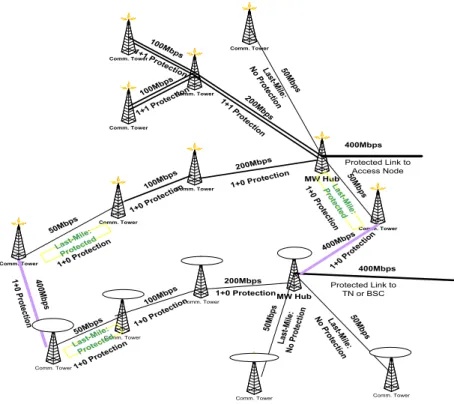
Sur la figure A, deux opérateurs se partagent les liens de raccordement. La topologie de l'opérateur A est représentée en haut de la figure. Celle avec des cercles est la topologie d'un autre opérateur B qui accepte de partager les liens de son réseau. Lorsque les liens situés aux derniers miles sont reliés par un simple lien supplémentaire, nous observons que la topologie en anneau
résultante offre plus de protection que la topologie initiale, y compris sur le « dernier mile ». Il est donc évident que notre système de protection permet d'améliorer la disponibilité puisque le trafic sur le chemin principal défaillant basculera rapidement sur le chemin de sauvegarde utilisant les ressources de l autre opérateur. Notre travail s applique aux opérateurs Tier I, Tier II, les FAI et les grands opérateurs de réseaux de collecte répartis géographiquement, où le contrôle permanent et évolutif de l ensemble du réseau composé d'un grand nombre d'équipements hétérogènes devient inévitable.
Comm. Tower Comm. Tower Comm. Tower Comm. Tower Comm. Tower Comm. Tower MW Hub Protected Link to Access Node 200Mbps 400Mbps 200Mb ps Comm. Tower Comm. Tower 50Mb ps 100Mb ps 100Mb ps 50 Mb p s 50 Mb ps 1+1 Pr otecti on 1+ 1 Pr ote cti on 1+1 Pr ote ction 1+1 Pr otecti on 1+1 Protection La st-Mile: No Pr otecti on 100Mb ps La s t-Mi le: N o Pr ote cti on La s t-Mi le: N o Pr ote cti on
Figure A. Dernier mile d une topologie en chaîne avec des liens redondants.
Comm. Tower Comm. Tower Comm. Tower Comm. Tower Comm. Tower MW Hub Protected Link to TN or BSC 400Mbps 1+0 Pr ote ctio n 50Mb ps Comm. Tower Comm. Tower Comm. Tower Comm. Tower Comm. Tower Comm. Tower MW Hub Protected Link to Access Node 200Mbps 400Mbps 20 0Mb ps Comm. Tower Comm. Tower 50Mb ps 100Mb ps 100Mb ps 50Mb ps 50Mb ps 1+1 Pr otecti on 1+ 1 Pr ote cti on 1+1 Pr ote ction La st-Mile: Prote cted 100Mb ps La st-Mi le: N o Pr ote cti on 50Mb ps 1+0 Prote ction La st-Mi le: N o Pr ote cti on Las t-Mi le: No Pr ote cti on 50Mb ps La st-Mile: Prote cted La st-Mi le: Pr ote cte d 1+0 Pr otecti on 1+0 Protection 1+0 Pr otecti on 1+0 Protection 1+0 Pr otecti on 1+0 Pr otecti on 100Mb ps 200Mbps 1+ 0 Pr ote cti on 40 0Mb ps 400Mb ps
Figure C. Une topologie indicative par exemple décrivant le schéma de résilience basé sur le partage d'infrastructure dans le pays France. Deux opérateurs de téléphonie mobile: un en haut (nord), l'autre dans le
sud (avec des cercles) sont interconnectés par des liens supplémentaires (couleur verte de lien d'épaisseur), représentant un "élastique" et formant une topologie en anneau.
OPERATOR A
OPERATOR B OPERATOR A
OPERATOR B
Figure D. nouvel itinéraire de trafic résultant du partage de réseau d accès en raison d'une défaillance lien / nœud dans le backhaul entre plusieurs opérateurs de réseaux mobiles.
Avec cette première contribution, la thèse adresse les points suivants :
Définir l'objectif du partage d'infrastructure adapté au contexte des réseaux mobiles et surtout des réseaux de collecte mobile via une approche de réseaux ouverts ; élaborer
un protocole de routage efficace ('greedy') multi chemins qui alloue des ressources
appartenant à différents opérateurs.
Optimiser et évaluer la performance des nouvelles architectures pour la résilience («survivability») des réseaux de collecte mobile, les approches axées sur mesure pour assurer un fonctionnement robuste des systèmes en réseau dans des conditions exceptionnelles, telles que les catastrophes naturelles / artificielles.
Modéliser et développer des algorithmes de routage à la demande via les nouvelles approches (e.g., Software Defined Networking –SDN-) pour réduire la complexité de la gestion du réseau, et rendre les réseaux plus robustes, plus flexibles, et moins complexes. Faire la preuve de concept des algorithmes pour démontrer la faisabilité pratique entre
modélisation et implémentation.
Dans ce contexte, cette thèse a abordé les points suivants : Partie II: Théorie et Modélisation
• Proposition d'une nouvelle architecture pour augmenter la fiabilité et réduire les coûts de construction de réseaux de collecte terrestres. Ce nouveau concept que nous avons appelé 3RIS (Résilience, Reliability –fiabilité-, redondance par Infrastructure Sharing –partage d infrastructure-) fournit une solution pour améliorer la fiabilité sans investissements supplémentaires, basé sur la partage du réseau de collecte avec un autre opérateur. Nous avons évalué nos résultats par un système parallèle 2 - chemin simple en utilisant le modèle de chaînes de Markov.
State 1:
Both UP
State 3:
Both
DOWN
State 2:
One UP
and One
DOWN
2
State 1:
Both UP
State 3:
Both
DOWN
State 2:
One UP
and One
DOWN
2
Absorbing State
Figure F. State diagram pour l'analyse de la fiabilité d'un système parallèle redondant.
Ces propositions ont été publiées dans les conférences suivantes:
Venmani Daniel Philip, Yvon Gourhant and Djamal Zeghlache, Preliminary analysis of 4G-LTE mobile network sharing for improving resiliency and operator differentiation , in Proc. of 1st International Conference on e-Technologies and Networks for
Development )CeND ; also published in Communications in Computer and
Information Science (CCIS) Series of Springer-Verlag LNCS 2011, Volume 171, Part 5, pp: 73-93.
Venmani Daniel Philip, Yvon Gourhant and Djamal Zeghlache, R)S for G: A new approach for increasing availability and reducing costs for LTE networks , in Proc. of 14th IEEE International Conference on Advanced Communication Technology
)CACT , Phoenix Park, PyeongChang, South Korea, February .
• Proposition d'une approche taillée sur mesure, qui adopte le concept Système Multi-State (MSS), basé sur le modèle de chaînes de Markov, pour assurer un fonctionnement robuste des systèmes en réseau dans des conditions inattendues telles que les catastrophes naturelles / artificielles. Les valeurs utilisées pour le calcul sont basées sur des valeurs réelles de coupure du réseau à partir d'un type Tier-I MNO (qui doit rester anonyme pour des raisons de confidentialité).
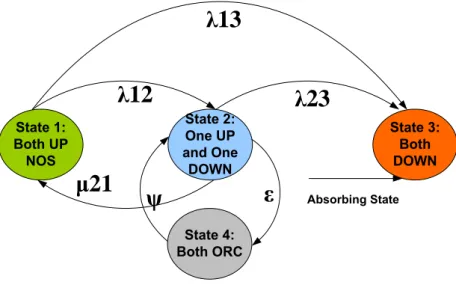
State 1: Both UP NOS State 4: Both ORC State 3: Both DOWN State 2: One UP and One DOWN
12
21
ψ
ε
Absorbing State13
23
Figure G. Multi-state system reliability analysis diagram pour le réseau de liens sans fil avec partage d infrastructure. State 1: Both UP NOS State 4: Both ORC State 3: Both DOWN State 2: One UP and One DOWN
12
21
ψ
ε
13
23
31
32
Figure (. Multi-state system availability analysis diagram for pour le réseau de liens sans fil avec partage d infrastructures.
Ces propositions ont été publiées dans la conférence suivante:
Venmani Daniel Philip, Yvon Gourhant and Djamal Zeghlache, Give and Take: Characterization of availability of multi-state wireless backhaul Networks , in Proc. of 76th IEEE International Conference on Vehicular Technology Conference (VTC- Fall , Quebec, Canada, September 2012.
• )llustre un mécanisme flexible de re-routage pour cette architecture, où les chemins de secours peuvent utiliser des liens disjoints physiquement de l'autre operateur. Grâce à ce travail, nous
avons pu affirmer que le problème d'interrompre simultanément le chemin principal et le chemin de secours des différents opérateurs de réseaux mobiles n'est donc pas du tout probable. Suite à cela, nous avons développé un modèle analytique sur les chemins de secours et le re-routage basé sur la théorie des probabilités qui permet de comprendre comment le trafic utilisateur est re-routé vers un composant de réseau, lorsque les opérateurs partagent la bande passante de leurs liens respectifs. Nous l appelons ROFL.
S2
A1
A2
B1
B2
C2
C1
D2
D1
E1
E2
S1
S2
A1
A2
B1
B2
C2
C1
D2
D1
E1
E2
S1
(i) (ii)i) flux de trafic avec le partage d'infrastructure dans des conditions normales.
ii) Une situation où il y a une panne et / ou une congestion du réseau entre le dernier-mile et moyen-mille au sein du réseau de transmission.
Figure K. Evitement de la congestion de lien à travers le partage de réseau de collecte.
Ces propositions ont été publiées dans la conférence suivante:
Venmani Daniel Philip, Yvon Gourhant and Djamal Zeghlache, ROFL: Restoration of failures through link-bandwidth sharing, )n Proc. of nd )nternational Workshop on
Rural Communications RuralComm co-located with 54th IEEE International
Conference on Global Communications GLOBECOM , Anaheim, U.S.A, December
2012.
Partie III : Techniques d'optimisation
• Ensuite, nous avons développé » OpenRoutes , une illustration simple et systématique d un modèle qui illustre une approche totalement différente pour calculer les chemins disjoints alternatifs avec une capacité optimale, dans un réseau de liaisons sans fil, basé sur le partage entre opérateurs de téléphonie mobile, sans affecter les flux de trafic existants. L'objectif de notre approche a été formulé en utilisant ILP (Integer Linear Programming), sur la base de nos définitions du modèle. Étant donné que ces formulations ILP sont très complexes à résoudre pour de grands réseaux, nous en avons tiré trois algorithmes basés sur des heuristiques simples mais efficaces. Ces propositions ont été publiées dans les conférences suivantes:
Venmani Daniel Philip, Yvon Gourhant and Djamal Zeghlache, OpenRoutes: Multi-operator cooperative routing over maximally disjoint paths for the survivability of wireless backhaul, )n Proc. of th )EEE/)F)P )nternational Workshop on Design of
Reliable Communication Networks DRCN , Budapest, (ungary, February .
Venmani Daniel Philip, Yvon Gourhant and Djamal Zeghlache, OpenRoutes: Augmenting Survivability with Reduced Redundancy- A Topology based Analysis, )n Proc. of 19th ACM Annual International Symposium on Mobile Computing and
Networking MobiCom , Miami, Florida (Poster) (In Press), October 2013.
• La suite des travaux consistent { optimiser les ressources quand un MNO décide de partager ses principales ressources avec un autre opérateur mobile pour servir de ressources de secours, sans mettre en péril sa propre qualité de service (QoS). Nous avons développé une méthodologie systématique pour définir efficacement de manière optimale les limites de capacité à offrir pour offrir une expérience de haute qualité (QoE), c'est à dire définir le seuil supérieur et la limite inférieure d utilisation des ressources par un autre réseau de collecte ORM pour chaque connexion passant par un lien défaillant.
S2
A2 A1 B1 C1 D2 E2
S1 D1 E1
Figure L. flux de trafic avec le partage d'infrastructure dans des conditions défectueuses, matérialisées par la flèche en dessous des liens indiquant le sens vers le destinataire et les flèches sur le dessus indiquant le sens
vers la source.
A1
B1
C1
denotes the shared bandwidth utilized on the link by MNO B that serves as the
backup resource (Bij) for the flow W
Total link
bandwidth(
λ
ij)
denotes the shared bandwidth utilized on the link by MNO A that serves as the
primary resource (Pij) for the flow S
Figure M. Allocation de bande passante à travers le partage.
Ces propositions ont été publiées dans la conférence suivante:
Venmani Daniel Philip, Yvon Gourhant and Djamal Zeghlache, Divide and Share: A New approach for optimizing backup resource allocation in LTE mobile networks backhaul, in Proc. of th )EEE/)F)P )nternational Conference on Network and Service
Management CNSM , in cooperation with ACM S)GCOMM, Las Vegas, U.S.A, (Short
• La prochaine étape fut d'adapter nos solutions à une architecture SDN (Software Defined Networking). Suite à cela, nous avons défini un paradigme architectural «multi-topologie-partagée» pour la conception d'un réseau de communication en adaptant l'approche logique centralisée et très précisément vers une approche quasi-distribuée. Plus encore, notre approche exploite l'approche émergente SDN / OpenFlow [ 1 ] sur la maximisation de la capacité de survie du réseau grâce à la coopération bilatérale entre plusieurs opérateurs de réseaux mobiles, décrite par un scénario portant sur une étude de cas réaliste.
+
A
B
(a) (b)=
4
5
3
2
1
X1
X
Y
Y1
(c) (d)Figure N. Illustration de la fusion ou «couture » entre deux topologies différentes MNO (a) et (b) en une seule topologie (c), où les contrôleurs ont été placés afin de réduire le coût de sur-dimensionnement des réseaux
existants avec des liens et des nœuds de chevauchement à cinq endroits différents (d). Ces propositions ont été publiées dans la conférence suivante:
Venmani Daniel Philip, Yvon Gourhant and Djamal Zeghlache, Stitch-n-Sync: Discreetly Disclosing Topology Information Using Logically Centralized Controllers , in Proc. of rd )nternational Workshop on Capacity Sharing CSWS co-located with the st )EEE )nternational Conference on Network Protocols )CNP , Gottingen, Germany, (In Press), October 2013.
• Dans ce cadre, nous avons défini un nouveau paradigme architectural en adaptant l'approche logique centralisée et plus particulièrement vers une approche quasi-distribuée. Pour des raisons
qui apparaitront plus clairement plus tard, nous appelons le régime résultant X -Control. Ces propositions ont été publiées dans la conférence suivante:
Venmani Daniel Philip, Yvon Gourhant and Djamal Zeghlache, X-Control: A Quasi-Distributed Fault Restoration Mechanism Using Logically Centralized Controllers, in
Proc. of 38th Annual IEEE Conference on Local Computer Networks LCN , Sydney,
Australia, (Short Paper) (In Press), October 2013.
Partie IV: Evaluation de la performance de SDN / OpenFlow
• Cette partie de la thèse traite de la faisabilité du partage de réseau de collecte mobile via une approche de réseau ouvert, basé sur OpenFlow. Nous évaluons la faisabilité pratique de nos concepts architecturaux proposés et adaptées dans le cadre de Software Defined Networking (SDN) / OpenFlow. En démontrant la possibilité d'adapter le mécanisme OpenFlow existant à l'architecture de réseau de collecte mobile, nous cherchons à définir l impact du degré de partage dans différents scénarios, où le verrou principal réside dans la définition des politiques flexibles et extensibles qui peuvent être modifiés dynamiquement. Ces propositions ont été publiées dans les conférences suivantes:
Venmani Daniel Philip, Yvon Gourhant and Djamal Zeghlache, OpenFlow as an architecture for e-Node B virtualization, in Proc. of rd )CST )nternational Conference on e-Infrastructure and e-Services for Developing Countries AFR)COMM ; also published in Springer-Verlag LNICST, 2011, pp: 49-63.
Venmani Daniel Philip, Yvon Gourhant and Djamal Zeghlache, Demystifying Link Congestion in 4G-LTE Backhaul using OpenFlow, in Proc. of th )EEE/ )F)P
)nternational Conference on New Technologies, Mobility and Security NTMS .
Partie V: Réseaux de Substitution
• Dans le même contexte, nous avons proposé une solution tenant compte des réseaux de substitution (SN) comme un moyen pour l établissement de chemin de secours pour surmonter la surcharge du réseau temporaire. Notre approche considère la technologie Software Defined Networking (SDN) en raison de sa flexibilité pour intégrer diverses générations futures d équipements ainsi que de son approche centralisée reposant sur la séparation entre le plan de contrôle et de plan de transfert. Nous avons démontré la possibilité d'ajuster la bande passante sur un ensemble de liens et équipements de manière dynamique en fonction des besoins de trafic des différents utilisateurs finaux, ce qui garantit la qualité de service (QoS) requise.
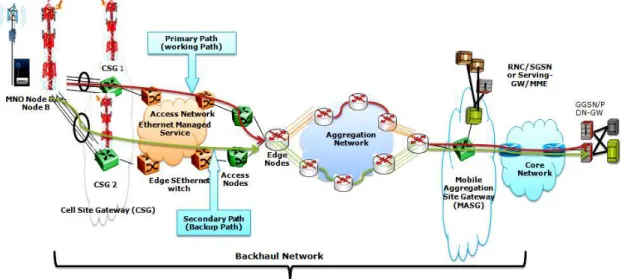
Figure O. illustrant la protection de chemin de sauvegarde en backhaul micro-ondes sans fil en 3G/4G.
Figure P. conception architecturale illustrant l'élimination de chemin de back-up.
Ces propositions ont été publiées dans la conférence suivante:
Venmani Daniel Philip, Yvon Gourhant, Laurent Reynard, Prosper Chemouil and Djamal Zeghlache,, Substitution Networks based on Software Defined Networking, )n Proc. of 4th ICST International Conference on Ad (oc Networks AdhocNets , Paris, France, September 2012.
Figure R. Temps de latence moyen pour installer les flux sur un switch OpenFlow.
Figure S. Packet Loss Rate sur un lien avant et après l'introduction de nœud de substitution.
Le défi du déploiement de nouvelles architectures
Comme indiqué dans cette thèse, le déploiement de stratégies de collecte à faible coût, notamment celles fondées sur les technologies émergentes telles que Software Defined Networking (SDN)/OpenFlow, peut à première vue ne pas correspondre aux exigences qui seront
difficiles à traiter avec une approche commune pour réacheminer les transports, en particulier compte tenu de l'environnement de multi-opérateur.
D'une part, les exigences de collecte ont été constantes entre les deux stratégies (MPLS-TP et IP/MPLS) décrites dans les premiers chapitres (Chapitre 1). Cette convergence des exigences est dûe au fait que quel que soit le point de départ, tous les opérateurs ont le même objectif final qui est un réseau LTE basé pour le haut débit mobile.
D'autre part, SDN, basé sur une gestion séparant le plan de contrôle du plan de transfert, et d autre part la virtualisation présente une nouvelle dimension pour l'amélioration et le développement. Le transfert des résultats et des concepts de recherche de topologies réelles impose des contraintes et des exigences supplémentaires indéniablement. Dans ce contexte, dans cette section, nous présentons un aperçu des défis de recherche et les difficultés que les opérateurs pourraient rencontrer en intégrant la technologie SDN dans les réseaux de collecte mobile.
D un point de vue général, l'approche basée sur SDN/OpenFlow lève certainement des défis, notamment la stabilité et des problèmes d évolutivité, compte tenu de l'approche centralisée. Le passage à l'échelle du contrôleur centralisé a été le sujet de récentes propositions [26] - [28] . Dans un environnement de communication mobile, nous constatons que les éléments de réseau tels que le Node B ou e-Node B eux-mêmes peuvent être un point de panne unique ainsi qu un goulot d'étranglement plus que le contrôleur lui-même. L'utilisation de OpenFlow, où les flux peuvent être identifiés par une correspondance avec une chaîne de caractère et que le routage est basé sur une fonction de hachage (comme ECMP), réduit la charge du plan de contrôle (détaillées au chapitre 10), mais permet au contrôleur de gérer efficacement le trafic. En outre, nous considérons que SDN présente un contrôle central et une visibilité de la topologie complète. Lorsque l'on considère les réseaux mobiles, la divulgation de la topologie du réseau nest pas souhaitée par les opérateurs, afin de préserver la confidentialité. Cependant, l'une de nos contributions, au chapitre 8, ouvre la première étape vers la visibilité de la topologie d'un point de vue théorique.
Bien que fondé sur la destination, le plus court chemin peut être calculé de manière distribuée (chapitre 7), SDN est basé sur la meilleure façon de répondre à acheminer les données. Cela signifie qu'il y a beaucoup plus d informations dans le chemin de données OpenFlow au-delà de celles utilisées pour le transfert standard (filtres, marquage, politique de routage, QoS politique, etc.). Et il y a beaucoup d utilisations plus souhaitables pour les réseaux que le simple transfert basé sur la destination. Nous voyons cela comme une solution minimaliste, renforcer le potentiel des services Internet, ainsi que les réseaux mobiles qui restent résolument situés au bord.