Université de Montréal
Describing and Understanding Team Integration in New Product Development: A Case Study
Par
Maxim Lamirande
Faculté de l’Aménagement
Mémoire présenté en vue d’obtention du grade de Maître ès Sciences Appliquées (M.Sc.A) en Aménagement, option design et complexité
Avril 2020
Université de Montréal Faculté de l’Aménagement
Ce mémoire intitulé
Describing and Understanding Team Integration in New Product Development: A Case Study
Présenté par
Maxim Lamirande
A été évalué par un jury composé des personnes suivantes
Denyse Roy Présidente - rapporteuse Mithra Zahedi Directrice de recherche Rabah Bousbaci Membre du jury
Résumé
Étant donné que les problèmes en développement de produits sont de plus en plus complexes et difficiles à résoudre, le rôle des designers est en changement continu. Ils sont de plus en plus impliqués dans les équipes multi-disciplinaires dès le début d’un projet. Des compagnies adoptent une approche de travail d’équipe qui réunit plusieurs bases de connaissances (disciplines, expertises) différentes dans un seul groupe. Tandis que ces groupes donnent accès à plusieurs bases de connaissances différentes, les membres de l’équipe doivent surmonter le défi de communiquer, négocier et développer une compréhension
partagée des objectifs à travers leurs raisonnements différents et parfois opposés.
En tant que designer junior, ces dynamiques peuvent intimider, puis faire le pont entre les points de vue différents peut paraître difficile. Afin d’améliorer l’intégration dans une équipe, une réflexion sur les dynamiques mêmes est nécessaire, mais il semble y avoir peu de moyens pour bien expliquer les interactions. Cette recherche se penche donc sur la question de comment décrire et mieux comprendre l’intégration dans une équipe en tant que designer nouvellement impliqué dans un projet et une équipe multi-disciplinaire.
Afin d’y répondre, cette recherche créé d’abord un cadre théorique centré sur l’implication d’un designer dans le processus, la gestion de la complexité, le travail en équipe, puis l’intégration efficace à travers le développement d’une compréhension partagée. Une étude de cas qualitative est menée par une approche nommée Research-through-Design (recherche par le design dans le contexte d’un projet) qui permet de jouer le double rôle de chercheur et designer. La collecte de données se fait surtout par journal de bord et observations participantes afin de documenter les actions et réflexions d’un designer qui s’implique dans une équipe multi-disciplinaire menant des projets de développement de nouveaux produits.
D’après les données recueillies, cette recherche tente décrire et mieux comprendre le cas en utilisant les catégorisations empiriques des facteurs qui influencent le développement d’une compréhension partagée proposées par Kleinsmann, Valkenburg et Buijs (2007). Grâce à ce cadre d’analyse, la description et réflexion sur l’intégration dans l’équipe furent un succès. Toutefois, cette recherche propose quelques précisions au cadre d’analyse ayant pour but d’y améliorer et faciliter l’observation, la description et la réflexion sur les dynamiques d’équipe pour des futurs designers juniors. Cette recherche espère donc proposer un appui aux designers pour développer leurs compétences à mieux travailler en équipes multi-disciplinaires.
Mots clés: Design de produit, Intégration, compréhension partagée, travail d’équipe, recherche par le
Abstract
As new product development continues to change, designers appear increasingly involved in multi-disciplinary teams from the outset of project inception. This is due to the progressively challenging, multifaceted, and complex problems design must resolve. After all, no single individual possesses the knowledge to create most new products. Companies depend on the teamwork of individuals with different knowledge bases who come together as a single design group. In breaking down silos and creating these integrated teams, overall effectiveness is threatened by their ability to communicate, negotiate, and develop a shared understanding of their goals and means of achieving them.
As a junior designer, team dynamics can be intimidating. Bridging different and sometimes conflicting individual views is challenging. Tougher still is reflecting on and describing dynamics as they happen in practice. Without the ability to explain dynamics, identifying and improving team integration seems nearly impossible. As such, this research aims to address these constraints by finding a way to describe and better understand team integration in action.
To accomplish this, a theoretical framework is developed to explore designer involvement, managing complexity, teamwork, and effective team integration. From this, a qualitative case study is conducted to reflect on teamwork in action using a Research-through-Design approach. This places design practice in the centre of research and allows the researcher to also play the role of a newly integrated designer. It relies extensively on journal entries and participative observations in order to create a story of designer involvement in new product development.
In interpreting the data through an empirical categorisation of factors that are said to influence the development of a shared understanding (Kleinsmann, Valkenburg, & Buijs, 2007), a working
description and reflection of team integration was achieved. In addition, this research proposes some amendments that aim to improve the framework and enable other junior designers to better observe, describe, and reflect on team dynamics in the future. This research therefore hopes to contribute by supporting designers in improving their ability to work effectively within multi-disciplinary new product development teams.
Keywords: Product Design, Team integration, Teamwork, Team Dynamics, Research-through-Design,
Table of Content
Résumé iii
Abstract v
Table of Content vii
Table of Figures ix
Acknowledgments xi
List of Abbreviations xiii
Introduction
1Chapter One: Theoretical Framework
31.1 Designers’ Role Within a Team 3
1.2 The Value of Integrated Design in New product Development: Managing Complexity
4
1.3 Working as a Team 7
1.4 Working Towards Effective Integration, or Designing Collaboratively
9
1.5 Reflecting on the Theoretical Framework 15
Chapter Two: Methodology
162.1 The Use of Qualitative Inquiry 16
2.2 The Use of Case Study 17
2.3 Research Embedded in the Practice of Design 18
2.4 Methods 20 2.4.1 Documentation 2.4.2 Archival Records 2.4.3 Interviews 2.4.4 Direct Observations 2.4.5 Participant Observations 2.4.6 Artefacts
2.5 Recommendations for Data Collection 22
2.6 Methodology Design of This Research 23
Chapter Three: Field Study
283.1 The Context 28
3.2 The Story 31
3.2.1 Week 1 3.2.2 Week 2
3.2.3 Week 3 3.2.4 Week 4 3.2.5 Week 5 3.2.6 Week 6 3.2.7 Week 7 3.2.8 Week 8 3.2.9 Week 9 3.2.10 Week 10
Chapter Four: Data Interpretation and Limitations
48 4.1 Data Interpretation Through the ‘Factors and Levels’ to theDevelopment of Shared Understanding
48 4.2 Describing and Understanding Team Integration 53
4.2.1 Actor Level 4.2.2 Project Level 4.2.3 Company Level
4.2.4 Reflections on the Use of Kleinsmann et al. (2007) Model 4.3 Describing and Understanding Team Integration Through the
Theoretical Framework
60
4.4 Limitations 62
4.4.1 Limitations on the Case Study 4.4.2 Limitations on the Results 4.4.3 Limitations on the Analysis
Conclusion
64References
66Annexes
70Annex 1: MITACS Funding 85
Annex 2: CPER Ethics Committee Approval 86
Annex 3: Interview Structure 87
Annex 4: Participant Consent Form (CPER Ethics Disclaimer) 88
Annex 5: Designer Information Sheet 90
Table of Figures and Tables
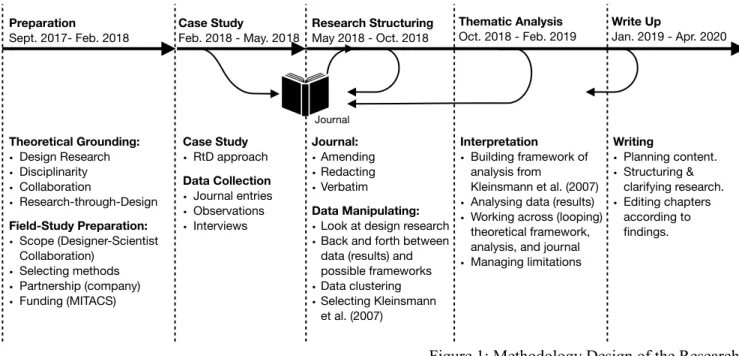
Figure 1 Methodology Design of the Research
Lamirande (2019)
26
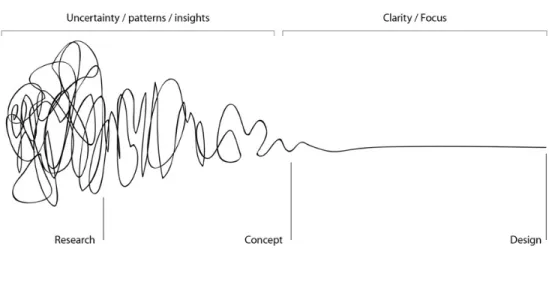
Figure 2 Newman’s Design Squiggle
Newman (2002)
30
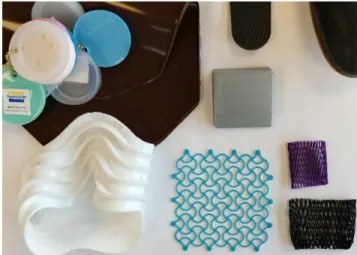
Figure 3 Example of Materials
Lamirande (2019)
33
Figure 4 Example of Generative Design
www.plm.automation.siemens.com (retrieved 2019)
34
Figure 5 Proposed Designer Process
Lamirande (2018)
45
Figure 6 Example of Journal Entries 1
Lamirande (2019)
92
Figure 7 Example of Journal Entries 2
Lamirande (2019)
93
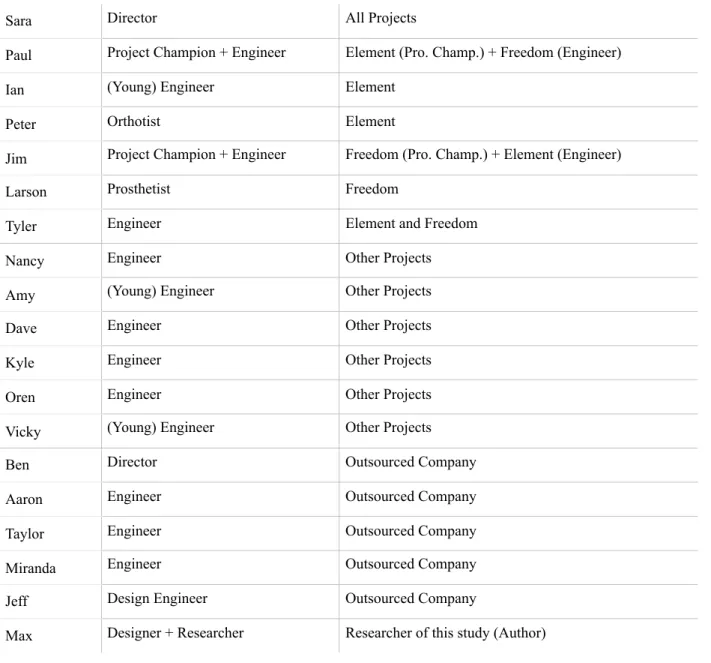
Table 1 (Main) Actors in the Case Study
Lamirande (2019)
29
Table 2 Factors to the Development of Shared Understanding by Instance
Kleinsmann et al. (2007) and Lamirande (2019)
Acknowledgments
I would like to first thank Mithra Zahedi, my thesis director, for her continued invaluable support and guidance both professionally and personally.
Second, I would like to thank my partners in the GRAD research group who have helped with writing articles, preparing for conferences, applying for scholarships, inviting me to rewarding research
activities abroad, and their insights on our research topics. Thank you, Tatjana Leblanc, Marie-Josèphe Vallée, Virginie Tessier, Clémentine Schelings, Noëmie Candau, and Myriam D. Jutras.
Third, I would like to thank Denyse Roy and Rabah Bousbaci for their revisions and guidance in correcting this thesis.
Fourth, I would like to recognise the funding bodies and institutions that allowed me to focus more wholeheartedly on my research. Thank you to MITACS Globalink, to Université de Montréal and La bourse Hydro-Québec de la ESP, to the GRAD research group, to the Faculté de l’aménagement, to the Design et Complexité program, and to the LOJIQ travel scholarship fund.
Finally, I would like to thank my friends and family from the Faculté de l’Aménagement and outside academia for their superb distractions throughout the sometimes-daunting task of writing a master’s thesis! Thank you, Daniel, Tara, Jean-Benoit, Gaëtan, Kaisa, Estelle, Will, Kaitlyn, Val, Malex, Audrey, Myriam, Maïa, Mike, and Mom.
List of Abbreviations
CAD Computer-Aided Design
CPER Comité pluridisciplinaire d’éthique de la recherche GRAD Groupe de Recherche en Aménagement et Design
MITACS The Mathematics of Information Technology and Complex Systems
MITACS is a national, not-for-profit organisation that has designed and delivered research and training programs in Canada.
NPD New Product Development
POP (model) Proof Of Principle (model)
RtD Research-through-Design
R&D Research and Development
If we ask ‘What is the design?’ at any time in that process my response would be following Durkheim , that it exists only in a collective sense. Its state is not in the 1 possession of any one individual to describe or completely define, although participants have their own individual views, their own images and thoughts, their own sketches, lists, diagrams, analyses, precedents, pieces of hardware, and spread-sheets which they construe as the design.
Bucciarelli, 1988, p. 161 2
Durkheim, E. (1950). Les règles de la méthode sociologique (11 ed.). Paris: PUF.
Introduction
This research is interested by designers working in a team with other professionals within a new product development setting. The inquiry is curious about teamwork and team integration, and focuses on these topics as a way to better describe and understand them as they manifest in design practice. This is motivated by experiences as a practicing junior designer trying to integrate and work effectively within a new design team. These experiences brought about challenges to bridging the often different expertises and perspectives that each team member embodied in the project. While this was easily sensed throughout the design process, it was difficult to describe or reflect on team dynamics. Research on this topic is valuable to design practice as teamwork has become an increasingly popular approach to problem solving (Cross, Rebele, & Grant, 2016). There is a widely accepted view that problems in current new product development are increasingly complex (Dong, 2005). According to Kleinsmann, Buijs, & Valkenburg (2010), this complexity has to do with the fast occurring changes, and increasingly integrated needs at large: For instance, users want simple yet multipurpose objects, sophisticated technology yet a high product turnover, and both intuitive yet personalised functionalities. Industries that operate in new product development have reported on the positive impact of integrating multiple disciplines into a same team, and specifically involving (industrial and product) designers at the outset of a projects’ inception (Gemser & Leender, 2001; Heskett, 2017). Working with others allows access to a variety of views, opinions, and knowledge-bases which team members can access through communication and negotiation (Stumpf & McDonnell, 2002). While this approach presents good opportunities, breaking down the disciplinary silos and working together in a single team is also risky and complicated (Schön, 1983). Views can differ and negotiations within the team can incur inefficiencies or even create hostile situations (Bucciarelli, 1994). To overcome these challenges, teams should adopt integrative practices like collaborative design and develop and maintain a shared
understanding to enable effective teamwork (Chiocchio et al., 2011). Still, effective team integration and collaborative design are threatened by a broad variety of factors that are sometimes difficult to dissimulate. As this research tried to find ways to describe team integration, research on the enablers and barriers to shared understanding emerged: The article Why do(n't) actors in collaborative design understand each other? An empirical study towards a better understanding of collaborative design by
Kleinsmann, Valkenburg, and Buijs (2007) provides an empirical categorisation of factors that affect the development of shared understanding. Their findings became a central component to the strategies and methods to understanding, coding and interpreting research data.
To inquire about team integration in new product development, this research reports on a case study involving the addition of a designer in a multi-disciplinary research and development team. Reporting 3
on the case study through qualitative methods and a Research-through-Design approach created a chronological account of designer involvement and allowed for a dual role of designer and researcher to be used in reporting on team interactions, exchanges, and dynamics during a period of time. To achieve the goal of this research inquiry, the data collected was analysed and interpreted through factors from Kleinsmann et al. (2007). The chapters that follow provide a detailed account of (i) the theoretical framework used to form research boundaries, (ii) the methodology used to collect data, and the methodology design of this research, (iii) the results reported through a restorying approach (Creswell, 2007) similar to Bucciarelli (1994), and (iv) the data interpretation and analysis done through the theoretical framework broadly, and the factors from Kleinsmann et al. (2007) specifically. As a contribution to knowledge, this research will attempt, through the use of an empirical
categorisation as analytical framework, to better describe and understand team integration as it happens in practice.
The term ‘multi-disciplinary’ is used generally to explain that the team is formed of individuals from different 3
disciplines (i.e. engineering, industrial design, or others). This specification is done to avoid debate about the distinctions between multi-disciplinary, inter-disciplinary and trans-disciplinary. For further details, see De
Chapter One: Theoretical Framework
The framework is formed of four sections: an exploration of (i) the designers’ role within a product development team, (ii) the value of ‘integrated design’ in new product development for managing today’s increasingly complex challenges, (iii) the importance and intricacies of working as a team, and (iv) working towards effective integration, or designing collaboratively.
1.1 Designers’ Role Within a Team
This section looks into changes in new product development and their impact on the role of designers in teams. First, an understanding of design is needed: “To design is to devise courses of action aimed at changing existing situations into preferred ones” (Simon, 1969). According to Nigel Cross (2001), design maintains and improves the world we live in. Designing is a goal-oriented problem-solving activity (Archer, 1965), and creates precise characteristics for the blurry and multidimensional contexts (social, cultural, environmental, …) that surround a project (Boutinet, 1993). Next, it’s noticed that these endeavours to improve the world we live in have - within the product design process - “shifted from an individual and rather unorganised activity to a systematic one performed in a multi-disciplinary team” (Hoegl et al. 2004 in Kleinsmann et al. 2007, p. 59). Team-based design practices are of interest in product development: Cross and Cross (1995, p. 143) express how “teamwork is of considerable importance in normal professional design, and is becoming of greater importance in product design as it becomes a more integrated activity”. According to Kleinsmann and Valkenburg (2007, p. 59), “well-performed integrated product design processes may result in reduction in time to the market, higher-quality products that fit the market needs and the possibility of developing products with different functionalities”.
Beyond the process, involving industrial and product designers specifically is said to be especially useful. Gemser & Leenders (2001) found that whether companies invested considerably or little to nothing in industrial design, it had an above all favourable impact on the firm, the products, customer satisfaction, and “can enhance a company's competitive position” (p. 30). According to Johnson (2016, p. 20) this is because “designers, [and] especially product designers, are typically experts in
using design to solve problems big and small, industrial designers are increasingly recognised as valuable assets to project development from inception (Heskett, 2017). Designers can aid in integrating knowledge from the outset of a project through their abilities to conceptualise and solve problems which helps companies in new product development gain a competitive advantage over others.
Kleinsmann and Valkenburg (2007, p. 59) call this integrated product design. The idea of integration is explained in Design Integrations (Poggepohl & Sato, 2009) as breaking down functional silos and working across units. More recently, Cross (Rob), Rebele & Grant (2016, p. 74) equally pointed out that companies have become increasingly cross-functional: “silos are breaking down, connectivity is increasing, and teamwork is seen as a key to organisational success”. In the same respect, Chiocchio et al. (2011, p. 79) explain that Integrated Design “is a [multi-disciplinary] participatory process bringing together specialists and key stakeholders […] in order to collectively resolve multifaceted, ill-defined, and intertwined design […] problems”. This allows for a holistic view amongst team members which “should build adaptability and flexibility into the design solutions” (Charnley et al., 2011, p. 172).
1.2 The Value of Integrated Design in New Product Development: Managing
Complexity
The previous section denoted a shift towards more integrated design activities, wherein knowledge and expertise from different team members is combined from the beginning of problem inception. This section explores the need for integrated design approaches in new product development, namely due to more challenging design problems and their increased complexity.
Complexity can be defined according to Cambridge Dictionary (2019) as “the state of having many parts and being difficult to understand or find an answer to”. In this way, new product
development is increasingly complex, clouded, and intricate (Dong, 2005; Stempfle and Badke-Schaub, 2002; Luck, 2019). New product development is also likened to innovative product development, which is especially complex in light of fast occurring changes and the more integrated needs of society at large (Hey et al., 2007; Alves et al., 2007). According to Valkenburg and Sluijs (2012, p. 5),
“innovative developments transcend existing boundaries, […] whether or not to innovate is not the issue. The challenge lies in whether we can innovate fast enough”. New, or innovative product development must combine and manage complexity, ill-defined situations, and difficult to resolve
problems as an integrated activity. This is apparent in the design of the telephone as explained by Bucciarelli (1994) and more recently by Kleinsmann & Valkenburg (2010, pp. 20-21):
In the last 15 years, the product had changed in many ways. The switch from a shared house phone to a personal phone has had a significant impact on both the product appearance as well as product use. People do not use their personal phone only for calling, but also for taking pictures, making movies, playing games, listening to music and as an agenda. This has changed the consumer attitudes towards a phone. What once was a rather functional product has become a product that expresses one’s personality. Therefore, customers required their phone to be modern, easy to use, and of good quality. In the meantime, they did not want the phone to be expensive, as they would like to buy a new one every 2 years. These customer needs reflect increasing customer demands and increasing product complexity, requiring a far-reaching
integration of the different knowledge domains of the actors from different disciplines during collaborative new product development.
Here, Kleinsmann and Valkenburg explain that consumer needs are shaping the way objects are
designed. By demanding simple yet multipurpose objects, rather high technology and quality turnovers, and needs that exceed usefulness to reflect personal preferences, new product development addresses an increasing number of complex and multifaceted parts of a single object. The authors suggest
integrating knowledge from different disciplines and collaboration between people. In the same respect, Bucciarelli (1994) wrote in a section called Do you know how your telephone works? about the
different needs and facets of using, making and understanding a telephone:
Does anyone know how their telephone works? How about the designer of the device? Surely, he or she must know. I followed this line of thought for a while, but again, I found my footing less sure than I had anticipated. Indeed, from my own observations, I can claim fairly confidently that there is no single individual alone who knows how all the ingredients that constitute a telephone system work together to keep each of our phones functioning. There is no one ‘maker’. Instead, inside each firm, there are different interests, perspectives, and responsibilities - corporate planning, engineering,
research, production, marketing, servicing, managing - and consequently different ways in which the telephone ‘works’ (Bucciarelli, 1994, p. 3).
Bucciarelli points out that designing a telephone (almost 25 years ago), like many other products, concerns multiple complex, multifaceted, and fast changing problems. Valkenburg and Sluijs (2012) explain how problems are not only affected by economical, technological, user, and societal shifts, but also by the dizzyingly fast moving advancements and changes in each. These challenges can be
referred to as Wicked Problems (Rittel & Webber, 1973). By wicked, they mean ill-defined and elusive problems that are often vicious and tricky. They explain that wicked problems are not simple or tame, and should not be treated as such. To understand wicked problems, ten distinguishing characteristics are proposed (Rittel & Webber, 1973):
1. There is no definitive formulation of a wicked problem. 2. Wicked problems have no stopping rule.
3. Solutions to wicked problems are not true-or-false, but good-or-bad.
4. There is no immediate and no ultimate test of a solution to a wicked problem. 5. Every solution to a wicked problem is a one-shot operation; because there is no
opportunity to learn but trial-and-error, every attempt counts significantly. 6. Wicked problems do not have enumerable (or an exhaustively describable) set of
potential solutions, nor is there a well-described set of permissible operations that may be incorporated into the plan.
7. Every wicked problem is essentially unique.
8. Every wicked problem can be considered to be a symptom of another problem. 9. The existence of a discrepancy representing a wicked problem can be explained in
numerous ways. The choice of explanation determines the nature of the problem’s resolution.
10. The planner has no right to be wrong.
Rittel & Webber (1973, p. 156) point out that “the information needed to understand [a wicked] problem depends upon one’s idea for solving it”, and there is no finite set of rules and procedures to determine the ‘correct’ explanation or combination of solutions, which are often dysfunctional and incompatible with one another anyway. These characteristics resonate in many ways with challenges found in new product development: each are difficult to formulate, unique, and have an innumerable set of solutions. They are also most often consequences from previous problems, and symptoms of further issues. The authors insist, “composed of members drawn from different functions, NPD [New Product Development] teams must integrate deep expertise in multiple areas to conceptualise, develop, and commercialise innovative products” (p. 124). Managing high degrees of uncertainty, ny, and
ill-defined, even wicked problems calls for an integrated design process (Emondson & Nembhard, 2009).
1.3 Working as a Team
It is said that no single individual can effectively solve the multifaceted and complex design problems of today alone; Arias et al. (2000, p. 86) explained that “complex design problems require more knowledge than any single person possesses”. Given the complexities, Détienne (2006, p. 2) proposes “that solving these problems often requires that multiple competencies be put together which happens between co-designers from various disciplines”. Integrated design develops between multiple
professionals from different backgrounds, disciplines, and practices (Chiocchio et al., 2011). In this way, Bucciarelli (1994, p. 23) explains that design is a social process: “Executive mandate, scientific law, marketplace needs - all are ingredients of the design process, but more fundamental are the norms and practices of the subculture of the firm”. The subculture embodies different social dynamics, like shared and unshared values, interests, and rationales between team members. Working as a team is seen as a good way to overcome complex problems, but is challenged by the differences between team members. According to Zahedi (2011, p. V), “in complex design projects, problems typically arise when the design process is undertaken by multi-disciplinary groups of experts as well as non-experts because they do not share a common vision about the user’s needs, do not have identical goals related to the task, and do not have a common language to have productive dialogues as the design process progresses”. Zahedi brings to light some threats to effective team-based design driven by the different perspectives each person holds. Team members have different abilities to offer the project which
reveals underlying factors to integration namely, according to Cross & Cross (1995), cognitive and social aspects of working as a team.
First, cognitive aspects can be understood as the matter of acquiring and understanding knowledge through thought, which is said to differ from one team member to the next (Cambridge, 2019). In design, a persons’ cognition can be referred to as their frame(s), which according to Hey et al. (2007, p. 81) is “shaped by an individual’s unique combination of prior experiences and cultural backgrounds”. According to Dong et al. (2013, p. 13) “framing is a moment-by-moment perception of specific units of information partially influenced by the manner of presentation of information”. Framing, in new
product development, can be seen as the way through which each person uses their existing knowledge, experiences and beliefs to perceive or understand a problem, task or piece of information. This notion is also illustrated by Bucciarelli as object worlds: In his book Designing Engineers, Bucciarelli (1994, p. 162) explains that object worlds are “worlds of technical specialisations, with their own dialects, systems of symbols, metaphors and models, instruments and craft sensitivities”. For each person, these object worlds, or frames are furnished with methods, techniques, values, and perceptions that connect the “real” world to past experiences and knowledge.
Second, social aspects of working as a team can be understood as the matter of working with one another, where communication and negotiation are critical components to becoming more integrated. Gao & Kvan (2004, p. 123) in characterising good teamwork, explain that “communication is essential for designers to exchange and develop their ideas with colleagues and clients”. Equally, Cardoso et al. (2016, p. 1) state that “communication is regarded as a key factor in design projects’ success or
failure”. Communication is a matter of sending, receiving, and reciprocating information which, in design research, can be mediated through verbal communication as well as different forms of representation. Verbal communications are rich and ongoing externalisations of team members’ thinking and reasoning (Wiltschnig et al., 2013, p. 524). Simply, they are the words and sentences we share with one another, and use to talk to each other. However, this is complicated because, as Zahedi (2011) highlighted, each person speaks a different language to a certain degree. This doesn’t mean French or English, but rather as Bucciarelli (2002, p. 222) proposes, language rooted in different scientific paradigms that have specific “conventions and customs, often curious norms and forms of expression as well as tokens and grammar, jargon and idiom”. It is said that different disciplines hold
different specialised languages, and that discrepancies can happen even within professionals from the same discipline (Schön, 1983; Bucciarelli, 2002). Other forms of representation are communicated through artefacts like sketches, prototypes and mock-ups (Luck, 2019) and human-computer
interactions (Button, 2000; Arias et al. 2000). These forms of communication embody, track or make visible aspects of the design and often represent the outcomes of design communication and
negotiations (Oak, 2011). In light of communicative challenges to integrating different people into a single team, effective integrated designing is said to be underlined by the development of a common ground. Team members negotiate their frames to integrate the knowledge they collectively hold and create shared goals, objectives, and means of achieving them (Détienne, 2006). According to
Valkenburg & Dorst (1998, p. 249), “for team designing to be effective we rely on team members to support each other [which lies] in synchronising their thoughts and activities."
Thus, working as an integrated team in new product development allows team members to access and collectively hold shared knowledge, shared goals, and a shared means of achieving them. However, integration is challenged by the potentially conflicting frames each person holds, which is further influenced by team members’ abilities to communicate and negotiate with one another.
1.4 Working Towards Effective Integration, or Designing Collaboratively
Teamwork is denoted by potentially conflicting frames which on the one hand threaten team integration but on the other hand provide a possible means to observing and researching it in practice; According to Stumpf & McDonnell (2002, pp. 8-9), “the notion that individuals may hold conflicting frames neatly explains problematic team designing. It can hence be used as a normative measure to talk about when designing goes right and when it goes wrong”. Under this premise, teamwork can be described and understood through the integration of team members’ frames.
When talking about team integration, design research refers to (i) ‘cognitive synchronisation’, (ii) ‘shared frames’, (iii) and ‘shared understanding’. According to Kim & Maher (2008), research has proven that cognitive synchronisation is essential to designing as a team, and is largely an
argumentation process. Team members unify in the way they perceive the project, and think within it. Cognitive synchronisation provides order to a multi-disciplinary teams’ overall design strategy which, if respected, allows them to work effectively (Macmillan et al., 2001). Similarly, shared frames are
“discursively constructed during collaborative negotiation processes, include input of all team
members, and thus encapsulate the knowledge shared by the team” (Kleinsmann et al., 2012, p. 487). This calls back to ‘individual frames’, which help construct shared frames. It was noted that individual frames evolve over time and shift based on peoples’ experiences and new knowledge. These frames are elusive and often implicit. Indeed, the same is said about shared frames, wherein teammates need to review, reconstruct, or make explicit shared frames for every interaction (meeting, discussion, negotiation) (Dong, 2005). For effective integration to happen, team members should be constantly aware of the knowledge available to the project and continually nurture these shared frames to maintain an integrated view of overall problems, solutions, objectives, and processes (Hey et al., 2007). Unifying different people and their respective views, frames, understandings, and perceptions is also described as shared understanding which, according to Kleinsmann & Valkenburg (2008, p. 371) allows team
members “to be able to integrate and explore their knowledge and to achieve the larger common objective: the new product to be designed”. Lahti et al. (2004) value shared understanding for bridging design elements from each team member and for creating a shared design context. In creating a shared understanding, Arias et al. (2000, p. 84) propose that new insights, new ideas, and new artefacts emerge from bringing often controversial points together.
Shared understanding is a valuable part of effective integration. In fact, Dong (2005) correlates effectiveness and shared understanding, while Macmillan et al. (2001) refer to the following authors (Cross and Cross, 1995; Blessing, 1996; Minneman, 1991; Brereton et al., 1996) to advocate for its value in successful collaborative design: “researchers that have studied group design activity generally agree that shared understanding between the design team members can aid the decision making process and is the key to successful collaboration” (p. 170). Shared understanding is embedded in research about collaborative design which according to Mattesich and Monsey (1992, p. 39) is the most integrated form of teamwork:
Cooperation is characterised by informal relationships that exist without any commonly
defined mission, structure or planning effort. Information is shared as needed, and authority is retained by each organisation so there is virtually no risk. Resources are separate as are rewards.
Coordination is characterised by more formal relationships and understanding of
compatible missions. Some planning and division of roles are required, and communication channels are established. Authority still rests with the individual
organisations, but there is some increased risk to all participants. Resources are available to participants and rewards are mutually acknowledged.
Collaboration connotes a more durable and pervasive relationship. Collaborations bring
previously separated organisations into a new structure with full commitment to a common mission. Such relationships require comprehensive planning and well defined communication channels operating on many levels. Authority is determined by the collaborative structure. Risk is much greater because each member of the collaboration contributes its own resources and reputation. Resources are pooled or jointly secured, and the products are shared.
Unlike collaboration, other forms of teamwork like cooperation and coordination are less integrated activities. Team members are more independent and work most often on their own, connecting at times but without strong relationships. They seem to maintain their own values and authorities which leave them rather unaccountable for others’ issues. The distinction is important since these terms are often used interchangeably, which complicates and confuses the research landscape (Mattesich & Monsey, 1992). According to Kvan (2000 p. 410), “collaborative success can therefore be said to be achieved when we have accomplished something in a group which could not be accomplished by an individual”. Moreover, Chiu (2002), explains that “collaboration implies a durable relationship and a strong
commitment to a common goal” (p. 188), as well as a “deeper, more personal synergistic process, [which] involves negotiation, agreement, and compromise in order to achieve success” (p. 205). Still, while collaboration infers well-integrated teams, processes, goals, and design outcomes, research highlights some caveats to its effectiveness. According Mattesich and Monsey (1992), greater
integration presupposes higher risks to participants. Lahti et al. (2004, p. 352) point out that “collaboration may be time consuming and sometimes requires extensive efforts of community building; hence some researchers claim that it is only suited for very particular problems requiring close coupling of the design process and its participants”. As well, Kokotovich & Dorst (2016, p. 14) observed that collaboration can adversely lead participants to conventional views of the problem, rather
than innovative ones. Nevertheless, collaboration channels members into new organisational structures with shared objectives, operations, responsibilities, and outcomes. It weaves members’ interests, expertise, responsibilities, and objectives to suggest a strong integrated relationship. According to Chiocchio et al. (2011, p. 79), “collaboration is a key mechanism to integrated design teams’ effectiveness”.
Within research on the effectiveness of collaborative design, Kleinsmann et al. (2007) provide a categorisation of factors that influence the development of shared understanding. They are drawn from empirical analyses on collaborative new product development in teams with multiple professionals and expertises. The factors are said to affect the development of shared understanding as both enablers or barriers —either positive or negative influences— and can happen on three organisational levels: the actor-level, the project-level, and the company-level.
The Actor-level is about collaborations or other interactions between actors. Four factors affecting this level are identified (p. 66):
1. The ability of an actor to make a transformation of knowledge. This factor concerns the knowledge exchange between two different disciplines. Since actors of different disciplines use different knowledge, a transformation of knowledge is always needed. The actors need to transform both the content of the knowledge and the representation of the knowledge.
2. The similarity in language used between the actors. The major issues concerning the similarity in language are the different jargon that the actors use (both in words as well as in drawings) and the different native languages that the actors use.
3. The applicable experience of the actors. Actors use their experience while they are designing. This influences their actions. The enablers within this factor deal with the experience that actors have with the regular tasks within the design project. They use their experience from earlier projects to do their current design task. The barriers deal with the innovative aspects of the design project because the actors lack experience upon these aspects. […]
4. The empathy of actors about the interest of a task. This factor deals with the understanding of the content and interest of one’s task. In addition, it is about to what extend an actor is able to interrelate his tasks to other (interrelated) tasks. The barriers within this factor deal with:
• Actors do not fulfil a task that is required because they are not aware of the interest of the task or they underestimate a task.
• Actors perform a task and do not inform other actors, since they do not know that the information is important for the other actor.
In order to prevent these two situations it helps when an actor has a clear understanding of the design process. By knowing the design process, an actor will see the task dependencies he has with other actors. This will provide him with a better understanding about the interest of his design task.
The Project-level is about managing the project. It takes into account actions such as planning, structuring, informing, and budgeting. Five factors (pp. 66-67) affecting this level are identified:
Finally, the company-level is about the way companies organise their product development projects and resources (human, material, and financial). Two factors (p. 67) affecting this level are identified :
1. The efficiency of information processing. The most important barriers concerning the efficiency of information processing are: (1) the information arrives too late for the receiver, so he can not continue his task; (2) the status of the document is not known by the receiver; (3) the status of the documents are not sufficient; (4) the information is put in a database that the receiver cannot open; (5) the information flow is disturbed because an actor has no time to process it; (6) it is unclear what information is needed, etc. Enablers concerning the efficiency of information processing are: (1) the early involvement of another sub team, (2) the active approach of one sub team towards another sub team, (3) the efficient data management system, (4) the active use of the minutes of meeting.
2. The quality of project documentation. Problems with the quality of the documents are caused by, for example: ongoing changes in the documents, incomplete documents, new appointments about how to set up the document, for the actors it is unclear how to deal with certain documents or the interest is insecure, etc. Despite these quality problems, the engineers actively use the documents, such as minutes of meeting and action lists, in order to structure the complexity of the design project. 3. The division of labour. Problems with the division of labour often occur at the beginning and at the
end of a design project, because people have to work on other design projects. [The authors’ field study brought them to say that] Another aspect concerning the division of labour was that some actors had too much work during the project. Therefore they focused too much on one aspect of their task. In order to overcome capacity problems, suppliers were involved in the design processes of both cases. 4. The rigour of project planning. [Design projects with a tight schedule can lead to efficient
decision-making, but] the risk of [a] tight schedule is that fewer alternatives than normal [are] generated and some decisions [are] taken on the base of little information.
5. The controllability of product quality. Quality problems concern the quality of the parts and the controllability of the quality of the parts. Also, the testing of both software and parts has been difficult in both design projects. Another problem that concerns product quality was validity of the quality procedures.
1. The organisation of resources. From our study, it appeared that the organisation of resources has been difficult at the beginning and at the end of the design project. At the start of the project the resources needed to be allocated to the project. At the end of the design project, there have been also some issues concerning the organisation of resources, because many engineers went to new design projects.
Kleinsmann et al.’s (2007) categorisations provide an examination of the factors at play in the development of shared understanding. The actor-level factors resonate with those discussed in the theoretical framework such as language, experience, and translating knowledge across disciplines and individual frames.The project and company levels also align with team integration and collaborative design in the way they channel members into new organisational structures with shared operations, responsibilities, and outcomes. Still, as their research relies on two case studies within specific contexts, they recommend further investigations and refinement to their proposed categorisations through more case studies about collaborative design, and shared understanding in a new product development setting.
The theoretical landscape proposes further recommendations and characteristics to designing that encourage team integration / effective collaboration. Namely, Rosen (2006) proposes 10 cultural elements that should appear in any good collaborative design setting, namely trust, sharing, goals, innovation, environment, collaborative chaos, constructive confrontation, communication, community, and values. Many of these aspects have already emerged in the theoretical framework, but trust and community have been less addressed, and deserve more attention. The notion of ‘trust’ resonates with observations from Leblanc & Gagnon (2016) and Mattesich & Monsey (1992) about collaborative design; there is a noticeable connection between trust and the idea that well integrated collaborators share in the risks and benefits of a project. Indeed, Chiocchio et al. (2011, p. 81) correlate the
effectiveness of integrated teams with the trust between them, wherein “people are relying on someone with specialised training and knowledge, while lacking the expertise and information to understand their actions”. The ideas behind trust and community also align with Bergema et al.’s (2015) notion of ‘click’. They support ‘trust’ as an important aspect of reliable social relations and team climate and suggest that “the click between team members can heavily influence the collaboration” (Bergema et al.,
2. The allocation of tasks and responsibilities. Problems with the allocation of tasks and responsibilities occurred if engineers could not connect their task to the other tasks. If this was the case, the engineers were not willing to be involved in aspects outside the scope of their own task. They only wanted to be involved in a particular task when this was formally arranged. This was because for the engineers it was difficult to foresee the consequence of getting involved in a task outside their direct scope. System engineers, or product architects, are responsible for integrating the tasks of all different actors. Therefore, a solution for this problem would be a well functioning system-engineering group (or product architecture group).
2015, p. 5). Contextually, the authors infer that strong and positive interpersonal relationships between team members enables effective collaboration. They suggest ‘click’ fosters a willingness to help each other, thus reinforcing a sense of community.
1.5 Reflecting on the Theoretical Framework
The theoretical framework revealed that complex problems in new product development require more knowledge that any single person possesses, and that it seems working as team is a promising way to solve them. Through effective teamwork, team members can transcend disciplines, cultural
backgrounds and expertise to create a greater body of available knowledge and a more holistic view of the problem by accessing each persons’ respective frames. However, doing so effectively involves some significant challenges that require team members to communicate, negotiate, and integrate. Collaborative design is said to best embody these needs as team members are called upon to develop a shared understanding. In this way, each person views the problems and solutions similarly, provides and accesses each others' knowledge, and shares in the goals, objectives, and means of achieving them. To do so effectively, some notable factors in designing as a team are said to influence the development of a shared understanding. These factors may serve as a framework to better describing and
understanding effective team integration as it happens in practice. These findings have brought about questions that will hopefully aid in exploring team integration in a new product setting, namely:
• Can the factors outlined in the theoretical framework provide a means to describing and
further understanding team integration?
• Do certain factors play larger roles in developing shared understanding?
• Are there other factors outside of those described that noticeably (empirically) influence
development?
The following chapter explains the methodology of the research and methods used for collecting data to help answer these questions.
Chapter Two: Methodology
This research is motivated by an inquiry about describing and understanding team integration in new product development. The research objectives are to:
• Explore and document involvement as a junior designer in a new product development setting and multi-disciplinary team;
• Analyse and report on team integration;
• Understand factors to team integration during the design process.
This research went through an iterative process and back and forth between theory and practice to identify a suitable means of interpretation. Accordingly, the framework of analysis was refined while working through the collected data, after completing in-field research. Nevertheless, the inquiry
remained guided by the intent to research through the practice of design, and began with a topic similar to team integration in multi-disciplinary teams, namely designer and scientist collaborations in new product development. An invitation to work within a new product development company was accepted and designer involvement was studied over a few months. As the project advanced, it became clearer that the context of designer and scientist more suitably served as a case study on teamwork broadly. The sections that follow will explain the use of qualitative inquiry and case study, the value of research embedded in the practice of design, the methods used to gather data, and some recommendations regarding its collection. Finally, the methodology design of this research is presented, including the proposed framework of analysis.
2.1 The Use of Qualitative Inquiry
Qualitative inquiry is used to understand and make sense of situations and experiences while also investigating the deeper meanings behind them. It is used as a form of inquiry to provide structure to explore a given subject when research is partial or incomplete (Creswell, 2007). Unlike quantitative inquiry used in validating or weighting existing theories, qualitative research explores and attempts to uncover, characterise, and understand social behaviour (Van der Maren, 1996). Additionally, it was later found that by using qualitative data from the field in the form of anecdotes and stories that research by Kleinsmann et al. (2007) could be used as a means of analysis.
2.2 The Use of Case Study
While it is clear that this research is qualitative, selecting the best approach according to Creswell’s Five Qualitative Approaches to Inquiry (2007) - narrative, ethnographic, phenomenological, grounded theory and case study - seems less obvious. Mainly, while each approach is said to be suited to a
research focus, type of problem, unit of analysis, data collection, and data analysis strategy, researching through the action of designing and reporting on designer’s involvement points towards narrative, ethnographic and case study. In fact, Creswell (2007) and Yin (2014) explain how either approach is equally suitable, namely since they all share in the unit of analysis of an individual and their lived experience. Still, this research chooses case study for three reasons:
1. Yin (2014, p. 97) proposes the use of case study to “investigate a contemporary phenomenon within its real-life context”, and according to Creswell (2007, p. 73), case study is used to “understand an issue or problem within a bounded system”. Bounded systems are a setting or context within which a culture-sharing group performs their actions.
2. Creswell (2007, p. 76) explains how case study is best suited to “illustrate an issue [and] compile a detailed description of the setting of the case”. For Yin (2014, p. 16), “you would do case study research because you want to understand a real-world case […] likely to involve important contextual conditions pertinent to your case”.
3. Other design researchers, such as Bucciarelli (1988, 1994 & 2002), Cross (1992), Valkenburg (1998), and Dong (2005) engage with case study in their research based on similar inquiries like shared understanding, design in action, and team dynamics. Their contributions point towards the value of case study for the present research inquiry.
Considering the research context, intentions, theme, and precedent in design research, a qualitative form of inquiry using a case study approach is selected. To collect data, this research is inspired by Bucciarelli (1994) and Valkenburg (1998) who, in one way, presented their qualitative data through storying, or restorying. Restorying is a narrative approach that emphasises learning new content through personal understanding and story sharing with others (Slabon et al., 2014). This approach creates a chronological account of a field study through some main / key concepts; according to Creswell (2007, p. 56), “this framework may consist of gathering stories, analysing them for key
elements of the story (e.g., time, place, plot, and scene), and then rewriting the stories to place them within a chronological sequence (Ollerenshaw & Creswell, 2000)”. Restorying can be useful to create a causal narrative that explains the development of an idea, issue, or solution (Cortazzi, 1994).
2.3 Research Embedded in the Practice of Design
Looking into team dynamics through the practice of design aligns with views like Findeli (2004) who states that design research needs to happen in the action of designing. In this way, knowledge is created through the real interactions between people. Godin and Zahedi (2014, p. 4) state that “research in design is not concerned with the ‘true’, but with the ‘real’”. This proposes a relativist argument that separates design research from more formal concepts and modes in scientific research like positivism. Positivism, which creates theory from visible or verifiable facts sometimes fails to create knowledge in design since, as Kolko (2010, p. 15) explains, some design activities are made visible through artefacts (the object being designed), but some aspects of design are insular, “less obviously understood, or even completely hidden from view”. This echoes Jones’ (1970, p. 46) black box theory that argues “the most valuable part of the design process goes on inside the designer’s head and partly out of reach of his conscious control”. In both design research and practice, it is uncertain how people’s actions and thinking directly lead to the final designs.
To report on the practice of design, some research methods have been developed, namely constructive design methods, action-research, and Research-through-Design (RtD). These different practice-based design research approaches share in the idea that design knowledge can happen through the action of designing and equally share in an overarching principle that puts design practice in the middle of the research. First, Rendell (2013, p. 117) explains how in constructive design methods, “instead of posing research questions and then finding answers, in much design research the process operates through generative modes, producing works at the outset that may then be reflected upon later”. According to Koskinen et al. (2011) constructive design research is described as an umbrella-term for action-research and RtD which all allow for more flexible and experimental methodologies centred around constructing things like artefacts, spaces, and systems as a key means of building knowledge. Second, according to Jonas (2007), action-research proposes building theory based on observations of making and remaking, which Zimmerman et al. (2010, p. 311) sums up as a “sequence of iteratively planning, acting,
and reflections on design practice. These reflections are used to plan and test new scenarios that are again observed and reflected upon, evolving theory through recursive acts of designing. Third, Research-through-Design (RtD), according to Findeli (2004) likens the design aspect of creation to research, and can be considered the closest thing to actual design practice. In this way, Jonas (2007, p. 34) also proposes that RtD “denotes a genuinely designerly process of knowledge generation”. In RtD, the researcher detaches from positivist thinking and fully embraces a constructivist approach: “When designers work as facilitators rather than detached observers, the last remnants of the idea that
researchers ought to be detached, impartial observers — “flies on the wall” — disappear. What comes about is the idea that design is supposed to be an exploration people do together, and the design process should reflect that” (Koskinen, 2011, p. 84). The researcher participates in the design process, playing the dual role of designer and researcher. Godin and Zahedi (2014) refer to the researcher as designer/ researcher. In RtD, the role of researcher and designer are exclusive, but embodied by the same person. The researcher is the designer, is the researcher.
RtD allows knowledge to emerge from different parts of design activity, namely through the actions of individuals and the artefacts they create throughout the design process. RtD weaves these two aspects (action and artefact) together. In one way, artefacts are the tangible outcomes of design actions, like sketches, plans or final prototypes and designed objects. But, these artefacts are also relevant to RtD research as carriers of knowledge (Frayling, 1993) who can embody the rationales, objectives and values of the people involved, or as Zimmerman et al. (2007, p. 42) explains, “codify their own
understanding of a particular situation and provide a concrete framing of the problem and a description of a proposed, preferred state”. Bucciarelli (2002, p. 228) adds to the idea of artefacts in design to say that “it is important to realise that the object of design is not a real object”. Artefacts, in a team setting, represent the negotiations and communications —or the trade-off of different object-worlds / frames— between team members. Bucciarelli (2002, p. 231) highlights that they “provide a milieu for inquisition and exploration of the whole and its interfaces within, as well serving to illustrate hard technical
features or function when deployed by participants from different object worlds”. In this way, artefacts enable team dynamics and design actions, support negotiations as a physical placeholder for design objectives, and as Bowers (2012) explains, help reveal the heterogenous thoughts at play. Based on these explanations, the RtD approach was selected as it aligns with the exploratory inquiry of the present research.
2.4 Methods
To report on qualitative inquiries, Creswell (2007) and Yin (2014) propose the use of multiple data collection methods to gain a broad and multifaceted view of the context. Yin (2014) proposes six forms of data collection: documentation, archival records, interviews, direct observations, participant
observations, and artefacts, which are each explained below:
2.4.1 Documentation
Documentation can take many forms such as journals, checklists, e-mail correspondences, studies, administrative documents, and searches (internet or otherwise) done during or prior to field research. Yin (2014) underlines that these should be ‘stable’ and ‘exact’ with ‘broad coverage’, meaning they should be continually available, easy to read, and well organised by date, event, and setting.
Documentation is especially helpful to corroborate information and record evidence of statements, discussions, or theories.
2.4.2 Archival Records
Archival records refer to documents like public use files or budget reports. They may be quantitative, and are often published. Yin (2014, p. 106) explains how “most archival records were produced for a specific purpose and a specific audience other than the case study investigation, and these conditions must be fully appreciated in interpreting the usefulness and accuracy of the records”.
2.4.3 Interviews
According to Yin (2014), interviews are a guided conversation with a consistent line of inquiry but are often fluid without a rigid structure. This allows the researcher to hold a conversation with the
participant and adapt questions in order to target other topics during the interview. This also helps the researcher refine their questions from one interview to the next. Questions should be reviewed to ensure objectivity and impartiality, either by another researcher or a board of ethics. Researchers should take notes in a journal and consider audio recording for accurate referencing. Yin (2014) highlights three forms of interview: in-depth, focused and survey-like. In-depth interviews look into participants’ insights, sometimes over multiple sessions . Focused interviews are less exploratory and usually used 4
Multiple interviews with the same person can make them a ‘key informant’. While this can be very useful, 4
to corroborate a hypothesis. While they remain open-conversations, the questions likely follow a protocol and provide qualitative answers, like in-depth interviews. Survey-like interviews use focused, rigid questions to yield quantitative results (example: ‘yes or no answers’, or ‘on a scale of 1 to 10’).
2.4.4 Direct Observations
Case studies should take place in field, or “in the natural setting of the ‘case’” (Yin, 2014, p. 109). The researcher observes participants during meetings, activities, or while performing their tasks to record information about the topic of the study. The researcher is a fly on the wall, they do not interfere or interact with participants. A direct observer may, for example, sit in the corner during a meeting, making sure not to influence the situation in any way. This lets the researcher document participants in action without biasing data. Sometimes, observational instruments like grids, tables or checklists are developed to “assess the occurrence of certain behaviours during certain periods of time” (Yin, 2014, p. 109). Audio and video recordings, and journal entries can be used to document direct observations.
2.4.5 Participant Observations
Similar to direct observations, participant observations immerse the researcher in the field to study participants in their setting. In addition, the researcher can assume “a variety of roles in the case study situation and may actively participate in the events being studied” (Yin, 2014, p. 111). Unlike the fly on the wall, the researcher contributes actively to the situation, impacting the dynamics, and likely
influencing outcomes. While this can be considered to bias results and research credibility (Becker, 1958), Yin (2014, p. 112) explains how interventions by the researcher (or in this case, the designer) “can produce a greater variety of situations for the purposes of collecting data.” and can be invaluable in some case studies. Documenting participant observations is the same as direct observations.
2.4.6 Artefacts
Yin (2014, p. 113) explains artefacts as “a physical or cultural artefact: a technological device, a tool or instrument, a work of art, or some other physical evidence”. Artefacts vary in shape and size depending on the context and object of study: from a knife in a kitchen, to a water cooler in an office. Artefacts can already exist in the environment or be created during the case study. According to Bucciarelli (2002), the artefacts developed during a design process –such as mock-ups, sketches and prototypes– serve many essential functions: they physically represent the design process and illustrate design negotiations between team members.
2.5 Recommendations for Data Collection
The use of Research-through-Design as a design research inquiry can help further understand team integration in action. However, the constructive approach comes with some caveats to data collection. A main criticism in RtD, as Godin & Zahedi (2014) point out, is in reproducibility, or “that which can be regularly reproduced by anyone who carries out the appropriate experiment in the way
prescribed” (Popper, 1959, p. 23). Zimmerman et al. (2007, p. 499) explains that “[t]here can be no expectations that two designers given the same problem, or even given the same problem framing, will produce identical or even similar artefacts”. To overcome criticisms on its theoretical grounding, RtD, uses Action-Research’s practice of data recoverability, instead of reproducibility. According to McNiff (2013, p. 18) recoverability means the designer/researcher must make sure that “the process is
recoverable by anyone interested in subjecting the research to critical scrutiny”. Godin and Zahedi (2014, p. 6) help RtD researchers by proposing Pedgley’s recommendations for recoverability:
Owain Pedgley (2007) provides a list of best practice that could help ensure
recoverability of the project. These best practices should then be used in RtD (all from Pedgley, 2007, p. 473): Chronology: “Describe work in the same sequence that it occurred, ideally as bullet-points”; Clarity: “Keep entries intelligible, insightful and honest”; Focus: “Keep entries succinct: they should not be a crafted essay”; Record
images: “Record still and moving images of developing and completed physical
models”; Out of hours: “Account for instances of ‘out of hours’ designing in the next day’s diary”; Diary admin: “Ensure that all diary sheets are numbered and dated”;
Modelling admin: “Ensure that all modelling outputs are numbered and dated to aid
cross-referencing (e.g. ‘LB1:22’ refers to log book 1, page 22)”.
Godin & Zahedi (2014) also present Pedgley’s (2007) recommendations for good documentation, namely (i) solo effort, (ii) endurance, (iii) subject delimitation, and (iv) mobility. First, solo effort recognises that much of the documenting will undoubtedly be done alone. After all, while the research happens in practice and involves everyone in the product development team, the research inquiry is independently managed by the researcher. As such, the designer / researcher has the lone task of data collection. On that note, Pedgley’s second recommendation, endurance, incites the stamina and attention needed to report on the whole field study, sometimes lasting months or years. Reporting /
journal entries should happen at least daily, should report on as much as possible, and should annex documents and artefacts like sketches or presentations. Using multiple sources and reporting on as much as possible is important to recoverability, but there are obvious limitations which Pedgley amends in the third recommendation: subject delimitation. To prevent data overflow, Pedgley proposes that a focused area of inquiry or research subject be defined. Finally, documenting should be mobile, since “the design process does not necessarily stop when the designer / researcher leaves the
studio” (Pedgley, 2007 in Godin & Zahedi, 2014, p. 10). In fact, this follows in the recommendation to record out-of-hours, during social events or after-work activities. This also aligns with the notion of ‘click’ (Bergema et al., 2015), wherein team integration is influenced by social camaraderie and activities.
2.6 Methodology Design of This Research
As the methodological section leads to understand, this research uses a qualitative case study approach and Research-through-Design (RtD) to conduct the inquiry and collect data. Using this methodological combination has the benefit of looking into the lived experiences and social dynamics of team members by playing the role of both researcher and designer (team participant) in a new product development team. To prepare and conduct the case study, the following 8 guidelines are presented : 5
1. The project should centre around an industrial product with multiple functionalities and contain innovative aspects (i.e. novel design, uses, or functionalities). In addition, the team should comprise willing team members from different knowledge bases (i.e. disciplines) with different responsibilities who carry out interdependent tasks. These conditions align with the in-field research plan as presented to MITACS for funding (annex 1), and to the Ethics Committee for approval (annex 2). They equally answer to the research recommendations from Kleinsmann et al.’s (2007) paper which, as presented later on, serves as an important reference for this study. 2. As it has been pointed out that the role of designer has shifted to the early phases of product
inception and development, the research will start at or near the beginning of a project.
Although some of these guidelines were not clearly addressed and documented before starting the field study, it seems 5