Jacques DEFOURNY, Michel SIMON & Sophie ADAM
THE CO-OPERATIVE MOVEMENT IN BELGIUM:
PERSPECTIVES AND PROSPECTS
Editions LUC PIRE
Brussels
GENERAL INTRODUCTION ... 4
PART ONE: TRADITIONAL CO-OPERATIVES ... 9
CHAPTER I:FINANCIAL SECTOR CO-OPERATIVES ... 11
Transformation of the international and Belgian financial landscapes ... 11
Financial co-operatives in an evolving environment ... 13
From savings and loans guilds to Cera Holding ... 15
The birth of the Cera Holding co-operative ... 16
A social and financial mission ... 18
From FNCC to the ARCO group ... 20
Restructuring: the late 1990s ... 20
The merger with Dexia ... 23
Co-operative identity and socialisation of benefits ... 24
From the PS group to the P&V group... 25
Recent changes and the current structure ... 25
Partnerships ... 27
The socialisation of earnings and Fondation P&V ... 27
Convergence ... 28
CHAPTER II:TRADITIONAL CO-OPERATIVES IN OTHER SECTORS ... 31
Consumer co-operatives ... 31
Pharmaceutical distribution co-operatives ... 32
The co-operative movement and the agricultural sector ... 34
Other sectors ... 37
CHAPTER III:THE NATIONAL COUNCIL FOR CO-OPERATION ... 41
PART II: THE CO-OPERATIVES OF THE NEW SOCIAL ECONOMY ... 46
CHAPTER IV:FROM THE "NEW CO-OPERATIVES" OF THE 1970S AND 1980S TO THE SOCIAL ECONOMY ... 47
The co-operative revival ... 47
The social economy as a link ... 50
Conditions for the emergence and growth of the social economy ... 53
CHAPTER V:THE SUPPORT AND REPRESENTATIVE ORGANISATIONS OF THE NEW SOCIAL ECONOMY ... 56
Federative Organisations ... 57
The intersectorial federations ... 57
Sector-based networks ... 59
Support organisations without a representative mission ... 62
The social economy consultancy agencies of the Walloon Region ... 62
The regional social economy incubators and social economy consultancy firms in the Flemish Region ... 64
Financing structures ... 66
Ethical investment and solidarity-based savings accounts ... 66
Alternative credit ... 68
CHAPTER VI:ANEW WAVE OF CO-OPERATION ... 72
Social purpose companies ... 72
Integration through work, and the co-operative sector ... 76
Work-integration enterprises (enterprises d'insertion) in Wallonia and Brussels ... 77
Work-integration enterprises (invoegbedrijven) in Flanders ... 79
A pioneering role in new sectors ... 82
The RESsources network ... 83
Recycling and re-use centres in Flanders... 84
Toward more partnerships with the private and public sectors ... 85
Activity co-operatives ... 86
CONCLUSION: BELGIAN CO-OPERATIVES AND THEIR EUROPEAN COUNTERPARTS ... 89
APPENDICES ... 100
APPENDIX 1:SUMMARY TABLE OF BELGIAN LEGAL FORMS ... 100
APPENDIX 2:CO-OPERATIVE IDENTITY ACCORDING TO THE ICA ... 101
APPENDIX 3:SOME TYPOLOGIES FOR CLASSIFYING CO-OPERATIVES ... 103
APPENDIX 4:THE FORMS TAKEN BY THE CO-OPERATIVE REVIVAL IN EUROPE,NORTH AMERICA AND JAPAN 105 APPENDIX 5:TOWARDS A STATUTE FOR A EUROPEAN CO-OPERATIVE SOCIETY ... 108
G
ENERALI
NTRODUCTIONThese early years of the twenty-first century marked by relentless globalisation appear to be a good time to take stock of the co-operative movement. This movement constitutes a social and economic phenomenon that has not stopped growing for over 150 years, and is a unique manifestation of utopian ideas practised the world over. However, the aim of this work is not to demonstrate the international scope of the co-operative experience, but rather to up-date what we know about Belgian co-operatives by examining their traditional as well as their innovative forms1. On the one hand, this will involve providing a snapshot of contemporary
Belgian co-operatives, while on the other hand examining the most important recent developments in co-operatives in particular those of the last two decades since these have been affected by profound changes in particular industries.
The co-operative is firmly embedded in the contemporary economic landscape. However, the co-operative idea is by no means new2. Its origins go back to the first half of the nineteenth
century. In the multiplication of utopian ideas that marked this period, which was characterised by a rather brutish form of liberalism, there was an upsurge in experiments designed to translate social ideas into action. One of these experiments constituted a milestone, and is still considered the takeoff point for the co-operative movement. This was the creation in 1844 of the Rochdale Society of Equitable Pioneers by a group of English weavers. The success of their experiment ensured the spread of the co-operative idea. The statutes of the Rochdale Society, which established the main principles of co-operation, have endured through the years. The distinguishing features of these principles are that: profits are returned to members in proportion to the number of transactions that each carries out with the co-operative; capital is paid out only in the form of limited interest; the principle of "one member, one vote" is employed in decision-making structures; the co-operative is managed independently; and membership and resignation are voluntary. The International Co-operative Alliance (ICA), which unites co-operative movements the world over, has reformulated these principles regularly, though the kernel of co-operative thinking has ultimately remained close to the original principles3. The International Labour Office, too, recognized the co-operative
ideal, defining in 1966 the co-operative as "an association of persons who have voluntarily
1 For a general survey in English of the co-operative movement at the global level, see for example BIRCHALL,J. (1997); for a survey in French see DEFOURNY,J. (ed.) (1988a).
2 On the co-operative society, see DEBOECK,K.andNICAISE,P.(1995),pp. 9-16; JANSSEN,A.and POLLÉNUS,J. -P. (1997), pp. 10, 11, 49, 50; MATHIS,A.andMATTHEEUWS,C.(1995), pp. 37-42, 49-51.
joined together to attain a common goal, through creating a democratically run company, by providing an equitable share of the capital required and by accepting a fair share of the risks and benefits of the company, in whose operations members participate actively"4.
Due to the growth of co-operatives, Belgium found it necessary to provide them with a legal framework, and a law on co-operatives was adopted in 1873. However, in contrast to what happened in most other European countries, the fundamental principles of co-operation were forgotten during the creation of the legal system for co-operatives or, more exactly,
compliance with them was simply considered optional. A dominant characteristic of this new form of commercial company was the flexibility of its constitution, structure and operation. The simplified and inexpensive co-operative legal form attracted entrepreneurs to whom the co-operative ideal was theretofore foreign. From this point forward, there would be two kinds of co-operatives within the highly flexible system of co-operatives. They would co-exist, and both would be called co-operatives. On the one hand, there were co-operatives that
implemented the co-operative principles inherited from the Rochdale Society of Equitable Pioneers. On the other hand, there were co-operatives that did not share the co-operative ideal, but rather appropriated the co-operative status simply because it was convenient. Thus, it is possible to speak of "real" and "fake" co-operatives, at least when they are examined in the light of co-operative ideals and principles. In order to allow "real" co-operatives (by far in the minority) to distinguish themselves and establish their identity, a National Council for Co-operation was formed in 1955. This Council is responsible for granting a seal of approval to operatives that genuinely accept operative principles and also for promoting co-operative ideals.
In the 1980s, there was literally an explosion of new co-operatives. The principal explanation for their emergence continued to be the flexibility in the legal definition of the co-operative, while other forms of commercial enterprise, for example, limited companies and private companies with limited liability, saw their rules grow more rigid. The upshot was a weakening in the image of co-operatives, which were henceforth perceived as vehicles for sidestepping certain constraints that other types of companies had to face. In 1991, lawmakers reacted to this state of affairs by passing a law that re-structured the co-operative system. Two types of co-operatives then emerged, viz. the "co-operative society with limited liability", and the "co-operative society with unlimited joint and several liability". While the co-operatives kept the traditional features (such as variability in social capital and in the number of partners)
that harked back to the 1873 law, they now had new responsibilities and restrictions, modelled on those of the limited company form. In addition, operatives wishing to pursue the co-operative ideal could seek recognition as "participatory co-co-operatives". In 1995, a law was adopted to redress certain shortcomings of the 1991 law. This new law also introduced the "social purpose company" certification, thereby rendering the "participatory co-operative" classification obsolete. The "social purpose company" designation, which we will discuss again later, is used primarily by co-operatives.
Chronologically, there were two main stages in the creation of co-operatives in Belgium5. The
first co-operatives, described today as "traditional", appeared towards the end of the nineteenth and early twentieth century. They arose primarily in the consumer sector and in the savings and credit, insurance, pharmaceutical distribution, agriculture and print media sectors. These traditional co-operatives organized themselves into large networks within the "pillars"6
that characterise Belgian society. On the one hand, there was the socialist co-operative movement, that formed the Belgian Federation of Co-operatives (Febecoop). On the other hand, there were co-operatives linked to the Christian Workers' Movement (Mouvement Ouvrier Chrétien – MOC / Algemeen Christelijk Werknemersverbond – ACW), that formed what is today called the "ARCO group" (formerly the National Federation of Christian Co-operatives). A third large network, which arose among the Flemish agricultural class, grouped together all co-operatives associated with the Boerendond, the Flemish agricultural movement. Meanwhile, in Wallonia, several networks of more modest size coexisted for a long time. Co-operative pharmacies were grouped together within an organization called the Office of Belgian Co-operative Pharmacies, though its members often belonged to other networks as well. A movement for co-operatives that were independent of political organizations, and were affiliated with the SC Fédérale de Belgique, was formed in 1891. This movement has now disappeared, though there are still, of course, co-operatives that are independent of the "pillars" mentioned above.
Beginning in the late 1970s, there was a veritable revival of the co-operative movement. Against the backdrop of economic crisis, a wave of new co-operatives arose both in Belgium and in most other industrialized countries. Striving to create and preserve jobs, their numbers
the typologies in Appendix 3.
5 A complete historical analysis would identify more stages of development. The somewhat simplified outline that we have presented here is based on the most widely used contemporary framework, and is appropriate for the structure of the present work.
6 "Pillarisation" is the process by which groups of citizens organise themselves along religious and political lines.
increased not only in the traditional sectors, but also in new sectors where co-operatives were not yet established. Following on the heels of these workers' co-operatives – or created at the same time as them – other types of organizations surfaced. They shared many of the ideals of the co-operative movement, and heralded the arrival of what would be called the "new social economy". Most of them took the form of non-profit organizations (NPOs), often focusing on social and professional integration of disadvantaged persons through work, or on the development of new activities, for example in fields linked to environmental protection or proximity services.
Compared to traditional co-operatives, those of the new social economy seem thus far to have played a rather modest role. Nonetheless, this role is very interesting since it casts these co-operatives in an innovative and topical light and when the co-operative model is employed to address socially relevant issues, such as the environment, or work-integration of poorly qualified people, it is in fact dealing with very modern challenges. At the same time, this role attests to a revitalization of the co-operative form insofar as co-operation is no longer built on homogeneous membership, or concerned exclusively with providing services to members. It is, rather, built on heterogeneous membership, and oriented towards people, for example the unemployed, persons with disabilities, and even members of the community as a whole, who may or may not be members of the co-operative. It is this feature, the fact that it fixes its sights on contemporary problems, that differentiates it from the somewhat antiquated image usually associated with co-operatives. Within the new social economy, many organizations – among, for example, work-integration enterprises and social purpose companies (a type of certification created especially for the social economy) – are in fact co-operatives. Solidarité des Alternatives Wallonnes (SAW) and various other networks of social economy organizations represent these operatives that have been generated by the "new co-operative" movement or by the new social economy of the 1990s.
In this volume the contemporary panorama of Belgian co-operatives will be presented in two main parts corresponding with the two chronological stages identified above. In Part One, we examine "traditional" co-operatives, whose origins go back to the late nineteenth and early twentieth century. After discussing, by way of introduction, the evolution of traditional co-operatives in the era of globalisation, we turn our attention, in Chapter I, to co-co-operatives in the financial sector, that have been particularly affected by the economic transformations of recent years. In Chapter II, we introduce the traditional co-operatives active in the other sectors, such as consumer co-operatives, pharmaceutical distribution co-operatives and
agricultural co-operatives. Part One concludes with a chapter devoted to the National Council for Co-operation.
In Part Two, co-operatives and other organizations that make up the new social economy are examined. Chapter IV is dedicated to the co-operative renewal of the 1970s and 1980s, and to the emergence of the concept of the "new social economy", which progressively supplanted that of the "new co-operatives". In Chapter V, we examine the support and the representative structures of the social economy. Finally, in Chapter VI, we conclude that we are witnessing today the emergence of a new co-operative wave. The ways through which this renewal expresses itself are varied, and include social purpose companies, co-operatives active in the field of work-integration or in sectors where they play a pioneering role, and "activities co-operatives".
P
ARTO
NE:
T
RADITIONAL CO-
OPERATIVESWhat remains of the "traditional co-operatives", that is, those that arose in the late nineteenth or early twentiethcentury? In their early days, these co-operatives were found primarily in a few leading industries in the primary and tertiary sectors, such as distribution of current consumption goods (food and non-food), savings and credit, insurance, pharmaceutical distribution and agriculture. They aimed to address individual needs directly, in the areas of consumption, savings, insurance and health care. Today, some of these co-operatives have disappeared completely, some have changed outwardly, while others have grown and keep expanding.
The evolution of traditional co-operatives must be understood in terms of the global social and economic environment, whose profound transformation over the last few decades has, not surprisingly, had a major impact on co-operatives. This context is primarily characterized by the contemporary phenomenon of economic globalisation, which has been sustained by rapid technical advances in the areas of information and communication; by the opening up of markets and increased liberalization in the circulation of goods, services and capital; by consolidation of large, integrated economic zones, and by the decline of the State as an economic producer and regulator. Globalisation has resulted in the rapid growth of competition, and in very high concentration of companies and capital.
Co-operatives have been unable to avoid these global economic trends. They too, have been affected by competitive pressures and the drift toward greater concentration. Given these challenging circumstances, co-operatives have had to take a hard look at their ability to cope with the competition. They have examined the relevance of the co-operative form in dealing with pressures induced by economic and technological transformations. The need to survive and to meet future challenges has led co-operatives to question themselves, sometimes thoroughly, and various strategic decisions have been implemented7.
In addition to changes in the competitive environment, other factors have influenced the evolution of co-operatives. In a general way, co-operatives – or at least the larger, traditional co-operatives – have experienced great difficulty in maintaining the spirit of co-operation. When a large organization has an enrolment of several thousand members, the implementation of democratic practices can prove to be difficult. In addition, while all
members of a co-operative gain from its activities, very few get involved in ensuring that their co-operative runs smoothly. Most members simply reap the benefits without helping to bear the costs. Very weak education in the principles and in the practice of co-operation has combined with the dominant economic ideologies to obscure the specific character of co-operatives. Members, when conducting business with their co-operative, do not really recognize the nature of their relationship with it. Admittedly, since co-operative areas of activity appear to be indistinguishable from those of their competitors, it is difficult for co-operatives to demonstrate their values, or to point out how they can make a difference. Co-operatives have been forced increasingly to confront capitalist competition on its own terms, while values such as democracy, solidarity and loyalty – the foundation of the co-operative movement – have gradually been eroded.
In the past, members of co-operatives found it easy to differentiate between their associations and conventional enterprises, because co-operative goods and services were different, and because members were treated as individuals. Nowadays, such differences are barely discernible, and co-operative practices are no longer a distinguishing characteristic. Furthermore, to the extent that management is based on abilities that are practically identical to those required by conventional enterprises, managers – hired primarily for their skills in specific areas, and not for their co-operative spirit – adopt methods that are lacking in the qualities that once made co-operatives so unique8.
In conclusion, traditional co-operatives are now obliged to face an increasingly competitive environment, while the application of co-operative rules grows weaker. Over the last decade, some co-operatives have undergone major changes, influenced by a number of factors, prominent among which are their mergers with enterprises that were not co-operatives. A survey of Belgian co-operatives must nevertheless begin with these enterprises, most of which have existed throughout the twentiethcentury.
Chapter I: Financial sector co-operatives
Changes in the financial sector provide a clear illustration of the new economic environment with which co-operatives must contend. On a global level, this sector too has experienced a wave of liberalization, de-regulation and privatisation since the early 1980s. These trends have been amplified over the last ten years by accelerated internationalisation and concentration of the financial system, heightened competition, and intensification of technological progress in the fields of information and communication. New international players combined with only slight differences among financial products and services have heightened competition. As a corollary, there have been price adjustments that have reduced profit margins and obliged financial institutions to optimise their productive efficiency. As the twentieth century ended, these changes accelerated the restructuring and globalisation of the financial sector at the international level. The Belgian landscape, too, has known deep changes. In order to better understand the evolution of the large Belgian co-operatives in the financial sector, we thus have to first examine these changes.
Transformation of the international and Belgian financial landscapes
Various strategies characterize the changing face of the banking sector. One of these, implemented over the last decade, has consisted in establishing a complementarity between banking and insurance in order to diversify their services and create synergy among their commercial networks. This was achieved, on the one hand, through the "insuro-finance" approach, in which insurance companies offered financial products and, on the other hand, through the "banco-insurance" approach, in which banks offered insurance products. In addition, banks and insurance companies concluded numerous partnership agreements, and sometimes these agreements ended up as joint ventures.
Another strategy introduced by financial institutions was the extension of their markets beyond the domestic scene, either by acquiring networks abroad, or by establishing transnational commercial relationships. Yet another strategy employed was concentration, both in banking and in insurance. The last years of the century were striking in this regard insofar as numerous mergers and acquisitions took place, and increasingly powerful financial holding companies were created in Europe and elsewhere. This increase in concentration is
still underway. Through concentration and restructuring, financial holding companies aimed to attain the dimensions that would optimise their market positions9.
In Belgium, it is easy to see the extent to which the financial environment has been changed. The banks have replaced nearly all of their logos, which had existed for decades, and now that banking and insurance are linked, many insurance companies have replaced their logos as well. A quick review of the principal mergers and take-overs that have taken place in the Belgian banking industry over the last few years will allow us to more fully appreciate the changes that have occurred, and the new dynamic into which operative banks and co-operative insurance companies have been thrust.
There have been numerous take-overs. In 1996, Crédit communal concluded a co-operation agreement with Crédit local de France. In late 1999, it absorbed the latter organization, and in 2000, changed its name to Dexia Banque Belgique. In 1997, the BACOB bank, which in the previous year had invested capital in the privatised Crédit agricole group, became the majority shareholder in Paribas Belgique, which in 1998 was renamed Banque Artesia. In 1999, a restructuring of the ARCO group (Christian co-operative movement) gave rise to the Artesia Banking Corporation (to which we will return later). In 2000, BACOB absorbed Gesbanque and Banque Drèze. In late 1997, the Dutch company ING took control of the Belgian bank, BBL. In 1998, BBL took over Caisse privée de banque. Also noteworthy in the area of acquisitions were the following: Banque Dewaay, taken over by Crédit commercial de France, which in turn was absorbed by HSBC in1997; the takeover of Europabank by Achmea, a Dutch banking and insurance group including CB Direct in 1998; the takeover of the Bank van Limburg and of the Bankunie by the Dutch insurance group, Nuts Ohra in 1998; the takeover of Crédit Lyonnais Belgium by Deutsche Bank, whose name was adopted for the new company in 1998; the merger involving Anhyp and Ippa – both of which already belonged to the French insurance company, AXA – to form AXA Banque Belgique in 2000; the takeover of Crédit professionnel by Crédit mutuel du Nord in 2000; and the takeover of Nagelmackers by the Dutch group, Delta Lloyd in 2001.
Apart from these acquisitions, there were three major mergers involving Belgian banks. The first, in 1998, involving Kredietbank, Banque CERA and the insurance company, ABB, gave rise to KBC Bankverzekeringsholding NV, a banking and insurance group. This holding company owns all of KBC Insurance NV (ABB and Fidelitas) and of KBC Bank (a merger of Kredietbank and Banque CERA), which in turn owns CBC Banque (a merger of Crédit
général and the French-speaking section of CERA). We will return to this merger, since Banque CERA, like BACOB, was an important co-operative bank. In 1999, a second amalgamation occurred in which CGER and Générale de Banque, both of which had been taken over in 1998 by Fortis (a Dutch-Belgian group), merged to create Fortis Banque. But the transformation of the Belgian financial landscape was not yet complete, because in 2001 two financial groups, Dexia and Artesia Banking Corporation, decided to carry out Belgium's third major bank merger. Once this merger is completed, the BACOB bank emblem, owned outright by Artesia BC, should disappear and be replaced by the Dexia emblem. We will look at this merger again since it involves the co-operative group, ARCO, owner of Artesia BC. The union of Dexia and Artesia – which are, respectively, the third and fourth largest Belgian financial groups – affects the ranking of the country's leading financial organizations, since the new group becomes the second largest financial institution in Belgium, behind Fortis Banque but ahead of KBC. Thus, in less than five years, the Belgian financial scene has been completely transformed.
Financial co-operatives in an evolving environment
Co-operative banks could not avoid confronting globalisation of the economy in general and of the financial industry in particular. They have had to resign themselves to following the international trend toward concentration and financial globalisation. This implied that, to a certain extent, they were relinquishing their identity, whose central features included delivery of proximity services and the acknowledgement of local community characteristics. Stated differently, co-operative banks were drawn into the same merger and acquisition game as typical capitalist financial institutions10.
Before examining the impact of globalisation on co-operative banks, let us look at their situation worldwide at the end of the twentieth century. The overall importance of co-operative banks was very substantial. In 199611, the assets they administered worldwide
accounted for nearly 20 percent of the total assets of the thousand largest banks in the world. The thirty largest co-operative banks – nineteen of which were European – managed assets totalling over 5,500 billion dollars. There were over one million co-operative bank members (co-operators) in eight European countries12.
10PARODI,M.(2000),pp. 35, 36.
11 Since 1996, some co-operative banks are no longer in operation, or have changed their legal status. 12CÔTÉ,D.,VÉZINA,M.andTREMBLAY,B.(2000),pp. 18, 20.
The co-operatives working in the savings, credit and insurance sectors changed significantly13. The strategic choices that co-operative financial institutions made over the
final quarter of the twentieth century resulted in an expanded geographic and client base, a greater number of occupations and skills associated with the financial sector, and a greater range of goods and services. They became multi-purpose banks. To deal with the double challenge of the expansion of their client base and providing a greater range of goods and services, the various co-operative structures developed a vast network of branches. For example, by opening up their membership base, and by expanding their range of goods and services, co-operative movements of the Raiffeisen type (such as the Banque CERA, which we will discuss later), whose origins were in agriculture, now became generalist financial institutions. Co-operative banks, such as BACOB, whose goal was to finance the co-operative movement itself, followed the same path. Also, the volume of business they conducted with those who were not members of their co-operative grew significantly as a result of greater openness towards new types of clients. Due to this greater openness, the concept of "client" took precedence over the concept of "member". Branches controlled by co-operative groups, but that were ordinary limited companies, also appeared.
In recent years, the changes in financial markets created such pressures that the relevance of the co-operative form of banking has been questioned. Financial co-operatives, driven by the necessity to survive and to face up to future challenges, have questioned themselves, and have made various choices. Some co-operatives have maintained their legal status; some have chosen to abandon this particular legal form and become limited companies instead; some have chosen to restructure or to participate in mergers; and others have simply disappeared. In order to survive, financial co-operatives have had to adopt many practices of their competitors. This has alienated them from their co-operative identity. Thus, the central concerns of co-operative banks came to include issues such as growing financial concentration; integration with other groups that were not co-operatives; the creation of divisions over which members had very little control; diversification; constant increases in productivity, profitability and the ability to compete; improvement in goods and services; and international expansion. This entirely changed context raises questions about the future of the co-operative model. When a financial co-operative group buys out a conventional bank or creates a branch in the form of a limited company, it may run the risk of corrupting the co-operative spirit. When a bank is bought out, are there methods that can be employed to ensure
its integration into an organizational culture of the co-operative type involving democratic management and the primacy of people over capital? When co-operatives grow through acquisition, or merge with conventional groups, there is a risk of eclipsing the co-operative approach in the sense of erasing its distinctive characteristics. The situation in Belgium and other European countries reveals that co-operative banks are inevitably swayed by the ethos of conventional financial institutions.
The co-operative banks could not allow themselves to fall behind while Belgian financial institutions were undergoing major change. In 1996, of the world's thirty largest co-operative banks, BACOB ranked seventeenth and CERA nineteenth. Five years later, the former had become a limited company, and was involved in a new merger venture with Dexia, while the latter had integrated its banking activities within the KBC group. Thus, Belgian co-operative banks did not lag behind in the transformation of the financial landscape. In fact, in Belgium today there is not a single banking institution remaining with the legal status of co-operative. However, there are still banks that – directly or indirectly – are partially controlled by co-operative shareholders.
That said, we may be witnessing the beginnings of a co-operative revival. While the classic forms of co-operative banking in Belgium are experiencing a sharp decline, we are also seeing the emergence of co-operatives that practice alternative financing methods. We will explore this trend in the Part Two. However, we should emphasise that the impact of these alternative co-operative banks cannot possibly be compared with that of the older, more established type of co-operative bank.
To more fully comprehend the impact of these developments in Belgium, we will now examine, in turn, each of the three leading co-operative financial institutions: CERA, which no longer exists as a banking institution, but still operates as a co-operative, with
fundamentally renewed activities; the ARCO group, with Artesia Banking Corporation (recently merged with Dexia); and the P&V group, with the Nagelmackers bank (recently bought out by Delta Lloyd).
From savings and loans guilds to Cera Holding14
From its beginnings, the CERA co-operative bank maintained close ties with the Belgian Boerenbond, an organisation created in 1890 in Flemish Catholic circles to organise the agricultural population, and provide it with support. The first savings and loans guild was
PARODI,M.(2000),pp. 45-48; PALOMO,R.andCARRASCO,I.(2001).
14 Cera Holding, Rapports annuels 1998, 1999 and 2000. For a study on the former Banque CERA, see LISEIN NORMAN,M. (1995).
founded in 1892. Supported by the Boerenbond, the guilds grew rapidly. The Banque CERA developed from these many independent local (co-operative) banks, on a model propagated in Europe by a German, F.W. Raiffeisen. These local co-operatives made available to the group the share capital provided by their individual members. In the 1930s, the guilds became "Rural Co-operative Banks", a designation that was replaced in 1986 by "CERA"15.
In the late 1980s, CERA, following in the footsteps of Raiffeisen-type co-operative movements, decided to become a fully-fledged bank, targeting a broader public, including enterprises. From then, CERA opened its doors to clients from all social strata, and widened its range of products and services, though farmers and horticulturists always remained its priority target groups.
By the early 1990s, the CERA co-operative bank was the fourth largest bank in Belgium in terms of equity capital. It accounted for more than four thousand jobs, and had more than one thousand branches, 400,000 members and 1.3 million clients. Aside from the head office in Leuven, there were 396 local co-operatives in 1990, and these in turn had branch offices. Many of these local co-operatives were amalgamated as a cost-cutting measure, so that the number of co-operatives was reduced; there were 208 of them (including the head office) by 1998.
The birth of the Cera Holding co-operative
The year 1998 was a turning point for the CERA group. In order to cope with the changing European financial markets and to remain in a position to meet future challenges, the CERA group decided to merge with ABB-assurances and the Almanij-Kredietbank group. This merger gave rise to the major banking and insurance group Almanij/KBC-CBC. The resulting holding company (KBC Bankverzekeringsholding NV) owns all of KBC Insurance (ABB and Fidelitas) and KBC Bank (a merger between the Kredietbank and Banque CERA), which in turn controls CBC Banque (a merger between Crédit Général and the francophone section of Banque CERA). In 1997, CERA had taken control of Banque Indosuez Belgique, and in 1999, KBC acquired a controlling interest in Antwerpse Diamantbank (ADB).
What happened to the CERA group co-operatives during the merger process? The 207 local co-operatives merged with the CERA head office to form a new co-operative that, by transferring its banking activities to KBC Bank, became a de facto holding company. This new co-operative is called Cera Holding, and consolidates the shares of members of the former Banque CERA. The asset base of Cera Holding consists largely of a major interest in
Almanij NV, the holding company ("fund of funds") for the entire group (see Diagram 1). In 2001, its subsidiary Cera Ancora became "Almancora", a publicly traded company. Thanks to Cera Holding's contribution of supplementary Almanij shares, Almancora now owns about 28 percent of Almanij.
Diagram 1 : Cera Holding within the Almanij/KBC-CBC Group Structure
Stock exchange Almancora CVA Cera Holding CVBA Other stable share-holders MRBB CVBA Stock exchange About 12% About 88%
About 28% About 9% About
16% About 17% About 30% Almancora Management Company NV Almancora Foundation VZW 100% 450,000 members Cera Foundation VZW
Cera Management Company NV About 99% About 10% About 90% Almanij NV Almafin NV Gevaert NV Kredietbank Luxemburguese NV KBC Bankverzekerings-holding NV
About 68% About 60% About 79% 100%
KCB Bank NV KBC Insurance NV
CBC Banque NV
100% 100%
A social and financial mission
When Cera Holding was created, it was called upon to carry out dual missions – one financial, the other social. The first mission consists in managing the financial wealth generated by the transfer of Banque CERA's banking activities to KBC. This wealth consists principally of Cera Holding's major interest in Almanij SA, the holding (fund of funds) of the banking and insurance group, KBC. The objective is to play, thanks to this interest, an important role within Almanij SA, and thus to ensure the stability and continuity of KBC Bancassurance Holding. The active participation of Cera Holding in the strategy and management of the group involves, amongst other things, administrative mandates within the various companies. On the other hand, Cera Holding is striving to revive the co-operative ideal by drawing on its historical legacy, and by devising new and concrete ways to convey co-operative values. For example, members receive (besides dividends from their capital shares and other economic benefits) a "social dividend" or a social contribution from their co-operative through projects that the co-operative supports by way of the Cera Foundation. Under the name "Cera Foundation", Cera Holding has developed an important patronage program whereby the co-operative donates almost 5 million euro annually to projects in five major areas. The projects are selected on the basis of their potential to meet the real needs of people and society. They involve the medico-social sector; poverty; agriculture, horticulture and the environment; education, training and entrepreneurship; and art and culture. Cera Holding also supports projects of the Belgian Raiffeisenstichting (BRS) – a non-profit organisation whose goal is to promote, in co-operation with NGOs, development assistance based on co-operative principles – particularly in the fields of savings, credit and insurance.
Thus, the vast financial resources that Cera Holding "socialises" and the number and variety of projects that it supports through partnership agreements make it one of the leading private patrons in the country. Also, the structure of the former local co-operatives belonging to the CERA group, which was traditionally decentralised and participatory, was maintained in a new and original way, insofar as all members have the right to review Cera's support for these projects, and may even actively partake, through their representatives, in these new vehicles of co-operative solidarity (see Diagram 2). The representative structure is as follows: the Regional Consultative Committees represent co-operative members at the regional level in forty–five "regions"; committee members meet three times a year to discuss the activities of Cera Holding, evaluate regional projects or introduce new projects. Four representatives from each Regional Consultative Committee serve on the National Consultative Committee, which
in turn elects fourteen members to the Board of Directors of Cera Management Company (the administrator of Cera Holding and its social component, the Cera Foundation). Lastly, the chair of the Board of Directors is chosen from these membership representatives. Through these representation mechanisms, Cera Holding seeks to strengthen the role played by the membership, and to maintain strong contacts at all levels, from the grassroots to the top.
Diagram 2 : Participatory Mechanisms of Cera Holding Members
Members
Regional Consultative Committees National Consultative Committees 2 memb. executive board 14 members 3 experts Cera Foundation VZWCera Management Company NV
2 acting managing directors 14 members 3 experts Cera Holding CVBA About 10% 90% 2 acting managing
directors (ASG) 5 members
Almancora Foundation VZW Almancora Management Company (ASG) NV 2 acting managing dirs. 5 members 4 indépendents Almancora CVA
Almanij NV Stock exchange
Ancora VZW 4 indépendents About 9% About 88% About 28% About 12%
From FNCC to the ARCO group16
The National Federation of Christian Co-operatives (FNCC), a co-operative society created in 1935, represented the co-operatives of the Christian workers' movement until the late 1980s17.
The FNCC was a founding member of the Christian Workers' Movement– as was the National Alliance of Christian Mutual Societies (Alliance Nationale des Mutualités Chrétiennes – ANMC / Landsbond der Christelijke Mutualiteiten - LCM) and the Confederation of Christian Trade Unions (Confédération des Syndicats Chrétiens – CSC / Algemeen Christelijk Vakverbond - ACV). In 1989, it confederated twenty-eight regional co-operatives, representing 430,000 members. Wherever socialist institutions controlled the PS group (and later the P&V) in fine, a vast number of private individuals (qua members) formed – and continue to form – the foundation of the Christian co-operative movement. The capital formed by the shares of all co-operators in the twenty-eight regional co-operatives was itself invested, via the FNCC, in the various co-operatives of the movement. In the case of savings and credit, by the end of the 1980s FNCC owned 26 percent of the COB-BAC (Belgian Workers’ Co-operation) bank. In the insurance sector, FNCC owned 82 percent of Les Assurances Populaires / De Volksverzekering (LAP-DVV).
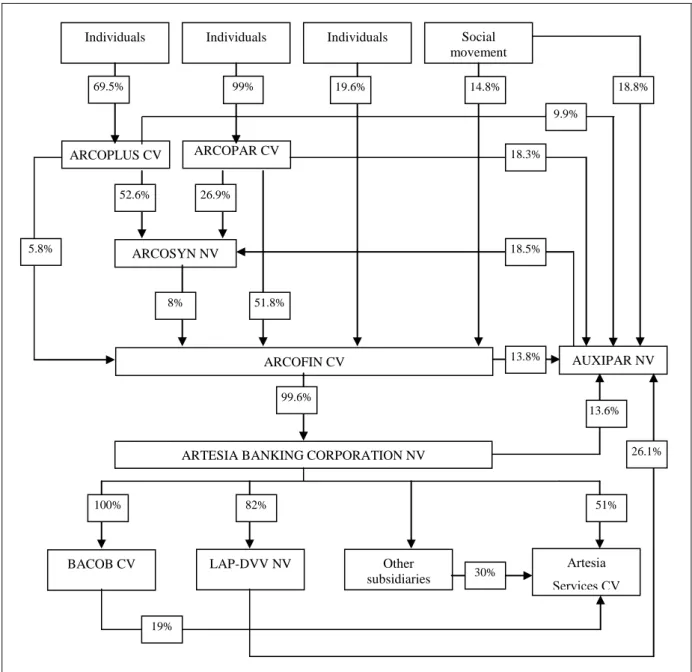
In 1990 and 1991, the FNCC was completely restructured and became the "ARCO group", a name designating a body made up, on the one hand, of finance companies in charge of raising capital and, on the other hand, of holding companies. There were two main objectives underlying this major reorganisation: (1) resolving problems linked to the highly dispersed ownership of equity, and (2) making the group more attractive in order to mobilise new funds and to meet the growing capital requirements of its subsidiaries. As a first step, the twenty-eight regional co-operatives merged, giving rise to a new finance co-operative named Arcopar. The second step involved establishing a clear distinction between financial and other types of services. This was achieved through the creation of two holdings. Thus, investments in COB-BAC and LAP-DVV were redirected toward the co-operative, Arcofin, while the investments in other commercial or service concerns (in particular EPC, a company active in the pharmaceutical distribution sector) were consolidated in the limited company, Auxipar. Restructuring: the late 1990s
16 The ARCO group, Annual Reports 1998-1999 and 1999-2000; information provided by the ARCO group. For an overview of the Christian co-operative movement in the late 1980s, see ANSION,G.andMARTOU,F.(1988), pp. 133-138; SAIVE,M.-A.and TROISFONTAINE,C.(1987), pp. 4-10.
During the wave of change that hit the world of banking in the late 1990s, the ARCO group was transformed. In 1997, BACOB (COB-BAC's new name) acquired Paribas Belgique, which was transformed into Banque Artesia the following year. In 1999, the ARCO group organisations formed Artesia Banking Corporation, a limited company that was completely integrated in terms of financial services. Artesia Banking Corporation included BACOB (a retail bank), LAP-DVV, Artesia (a patrimonial, merchant bank), and support services and specialised subsidiaries (see Diagram 3). Thus, Artesia BC presented itself as a financial services group, represented in numerous countries through its subsidiaries and interests. On 31 December 2000, it had some 7,500 employees; its balance sheet totalled 75.478 billion euro, and its consolidated earnings were 224.643 million euro.
Diagram 3 : The ARCO Group Structure – Year-End 1999
Individuals Individuals Individuals Social movement ARCOPLUS CV ARCOPAR CV ARCOSYN NV ARCOFIN CV AUXIPAR NV 69.5% 99% 19.6% 14.8% 52.6% 26.9% 8% 51.8% 18.8% 9.9% 18.3% 18.5% 13.8% 5.8%
ARTESIA BANKING CORPORATION NV
BACOB CV LAP-DVV NV Other
subsidiaries Artesia Services CV 99.6% 13.6% 100% 82% 51% 30% 19% 26.1%
On 1 January 2001, the BACOB bank, a co-operative formed in 1925, became a limited company wholly controlled by Artesia BC. It now has responsibility for the retail banking and social sector activities. At the end of the year 2000, it had about 2,400 employees and operated through seventy–eight regional branches, 479 local branches and a network of specialised representatives18. For a long time, BACOB has been very active as a banking
partner for businesses in the non-market sector (hospitals, convalescent homes, schools, institutions for persons with disabilities, social housing organisations, and social and cultural organisations). A more recent yet equally noteworthy development demonstrates BACOB's social awareness: it is the clear leader in the Belgian market for ethical funds19.
By early 2000, Artesia BC had an 82 per cent equity interest in LAP-DVV 20. The insurance
company, which was formed in 1929 (at a time when limited company status was compulsory for insurance companies), developed a strategy based on using a variety of channels to distribute its products. Its main channel of distribution is now its group of special advisors, dispersed among its four hundred branches. In addition, since 1995, LAP-DVV has been developing a bank/insurance component in collaboration with BACOB. Moreover, the company has a synergistic relationship with other related banks. LAP-DVV is also active in direct insurance through its subsidiary, the limited company, Corona. Lastly, following the buying of Belstar and Luxstar, LAP-DVV started up a fourth channel of distribution, namely, brokerage. By the end of the year 2000, LAP-DVV had 980 employees, in addition to around four hundred independent agents and about one hundred personnel at Corona, Belstar and Luxstar.
Arcofin, the ARCO group's holding company specialising in financial services, was practically the only shareholder in Artesia Banking Corporation, the fourth largest financial group in Belgium. After its merger in late 1999 with BACOB Holding, Arcofin held a 99.6 percent interest in Artesia Banking Corporation and a 13.8 percent interest in Auxipar (the ARCO group's holding company specialising in market activities). Arcofin's businesses were divided into three categories: Artesia BC and the banking sector subsidiaries; LAP-DVV and the insurance sector subsidiaries; and Auxipar, together with its subsidiaries in the market sector and public utility sector, made up of water, energy and the environment.
18 On 31 December 2000, the BACOB's balance sheet total was 11.5374 billion euro. 19 By the end of the year 2000, the bank was managing 625 million euro in ethical funds.
The merger with Dexia
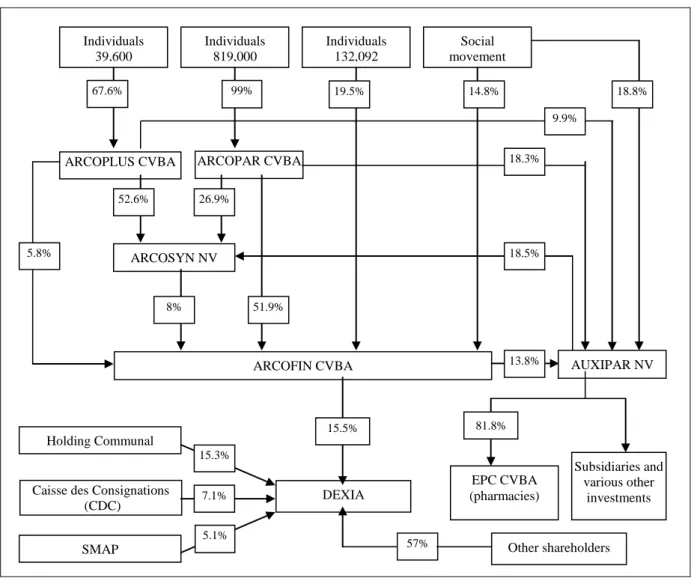
In 2001, the ARCO group underwent another important change, insofar as Artesia Banking Corporation merged with the Franco-Belgian group Dexia. Dexia bought Arcofin's share in Artesia BC for 3.3 billion euro. To finance this acquisition, Dexia issued 178.9 million new shares, all of which went to Arcofin, thereby allowing it to obtain a 15.5 percent interest in Dexia, and to secure a position similar to that of Holding Communal (see Diagram 4).
Diagram 4 : The ARCO Group Structure - 2002
With a common market capitalisation of 18 billion euro, the new group became not only the second largest financial group in Belgium, but also figures among the top 20 European bank/insurance groups. Collaboration between the two groups should lead to their total integration within five years. Restructuring of the network of branches is expected to begin in
20 In 2000, AP's collection of premiums amounted to 1.2696 billion euro. The balance sheet total on 31 December 2000 was 4.3 billion euro and the earnings amounted to 33.9 million euro.
Individuals 39,600 Individuals 819,000 Individuals 132,092 Social movement
ARCOPLUS CVBA ARCOPAR CVBA
ARCOSYN NV
ARCOFIN CVBA AUXIPAR NV
Holding Communal
Caisse des Consignations (CDC) SMAP DEXIA Other shareholders 67.6% 99% 19.5% 14.8% 52.6% 26.9% 8% 51.9% 15.5% 15.3% 7.1% 5.1% 57% 18.8% 9.9% 18.3% 18.5% 13.8% 5.8% Subsidiaries and various other investments EPC CVBA (pharmacies) 81.8%
2002, and will be based on a study of the optimal level of concentration. Upon completion, the Dexia and BACOB networks will be fully integrated, with the Dexia logo replacing that of BACOB.
Co-operative identity and socialisation of benefits
During the 1990s, the number of Arcopar members practically doubled to a figure of over 800,000 today21. To sign up new co-operators and encourage existing ones to stay, Arcopar
has developed a strategy of "stimulating co-operative vitality". In concrete terms, this means that co-operators' shares yield an attractive return, linked, inter alia, to the fact that Arcopar is an accredited co-operative, and accreditation by the National Council for Co-operation provides an advantageous fiscal framework. In addition, the companies in the group (BACOB, LAP-DVV) provide those who hold a "share account" with an array of co-operative, commercial and financial benefits, and benefits in the area of tourism. With regard to the network of EPC pharmacy co-operatives in which Auxipar is the main shareholder, the co-operative spirit has always been expressed through the return of part of the earnings to the members, prorated on the basis of their transactions with the co-operative rather (than on the basis of the amount of their capital shares).
But there is an even more concrete expression of the spirit of co-operation in the ARCO group through the significant socialisation of benefits. Firstly, the ARCO group is highly involved in financing the Christian Workers' Movement and its numerous activities. Since the creation of this vast federative structure, it has paid the MOC and the ACW the equivalent of several hundreds of thousands of euro every year. Secondly, as we will see further on, the group supports the non-market sector and the new social economy by way of two NPOs – Syneco (in the francophone part of the country) and Procura (in the Flemish part) – which are developing consulting and promotional activities. Finally, since 1998 it has maintained a special sponsorship policy for the social sector: every year, ARCO and BACOB, with the collaboration of Arcopar co-operators, donate 500,000 euro to ten associations active in a pselected sector. For the year 2000, the beneficiaries of this support were associations that re-integrated very needy individuals into the community.
From the PS group to the P&V group22
The socialist co-operative movement is involved in the financial world through a group which, for a long time, was named after its leading enterprise, the Prévoyance sociale (PS), a co-operative created in 1907. In contrast to the two other major co-operative groups discussed above, the socialist co-operative group is more prevalent in the country's French-speaking region than in its Flemish-speaking part23. In its insurance activities, the PS group brought
together a variety of companies, including PS Assurances, a co-operative which handled all types of insurance and whose capital was owned by a large number of institutions of the socialist movement, such as trade unions, mutual societies, and co-operatives. The PS group also controlled Codep, the socialist movement co-operative savings bank, providing an array of classical banking services24.
In 1993, the PS changed its name to P&V (Prévoyance & Voorzorg). The P&V group then comprised three main interests: insurance, banking (Codep) and pharmaceuticals (the pharmaceutical group Multipharma, to which we will return later).
Recent changes and the current structure
In its banking activities, the P&V group expanded externally by buying out Banque Nagelmackers in 1994. Banque Nagelmackers then merged with Codep, the group's co-operative bank, and in so doing created an organisation accounting for over 650 jobs. The new group created by way of this merger, Banque Nagelmackers 1747, then became a limited company. Strictly speaking, it thus no longer belonged to the co-operative banking sector, though two thirds of its capital was controlled by the P&V group. In 2001, Delta Lloyd, a financial holding group of Dutch origin, and a wholly owned subsidiary of the British insurance company, CGNU, bought out Nagelmackers. (CGNU was the product of the merging of Commercial Union, General Accident and Norwich Union). Consequently, the P&V group is no longer operating in the banking sector.
In its insurance activities, the P&V group was significantly restructured twice during the 1990s in order that it might provide better client services, through the decentralisation of its
22 CIRIEC (2000), pp. 25, 26; P&V Assurances, Annual Reports 1999 and 2000. For an overview of the socialist co-operative movement in the late 1980s, see ANSION,G.andMARTOU,F.(1988),pp. 124, 138-140; SAIVE,M.-A.and TROISFONTAINE,C.(1987), pp. 3-9.
23 This explains why we have chosen to use the acronyms for the French legal forms in the diagram about the P&V group, while we used the acronyms for the Dutch legal forms in the diagrams about the two other groups. However, it has to be underlined that the three groups are present both in the French-speaking and in the Flemish-speaking part of the country.
24 For a detailed history of the socialist co-operative movement, see SERWY, V. (1942 to 1952); WITTE, E. and DE PRETER, R. (1989).
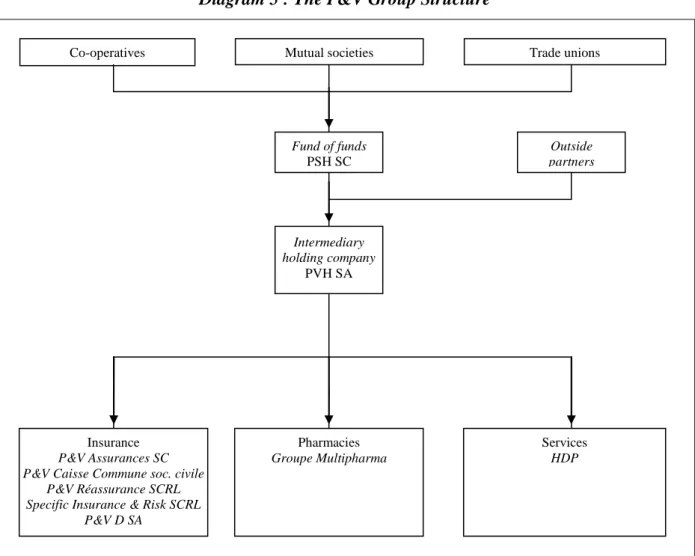
operations. Today, insurance constitutes the P&V group's principal area of activity (see Diagram 5). It provides these services through: (1) an insurance company that serves private individuals and businesses (P&V Assurances SC); (2) a mutual association covering work accidents (P&V Caisse commune); and (3) a reinsurance company (P&V Réassurance SCRL). It also has a co-operative broking firm, Specific Insurance & Risk, that was created to exploit the portfolio potential of the P&V group, and of certain types of insurance not handled by P&V.
Diagram 5 : The P&V Group Structure
On 31 December 2000, the insurance branches of the P&V group as a whole, had a staff of almost 1,100. About 560 of these employees worked at the head office (P&V Assurances, P&V Caisse commune and Specific Insurance & Risk), and nearly 430 worked at P&V D. Its insurance products are sold primarily through a network of ninety–two outlets (eighty–one local agencies and eleven dependent sub-branches of these agencies), operating under a single
Co-operatives Mutual societies Trade unions
Fund of funds PSH SC Outside partners Intermediary holding company PVH SA Insurance P&V Assurances SC P&V Caisse Commune soc. civile
P&V Réassurance SCRL Specific Insurance & Risk SCRL
P&V D SA
Pharmacies
Groupe Multipharma
Services
distribution limited company, P&V D. In addition to this "general public" network, the distribution of P&V products also relies on exclusive independent agents, brokers, and specific distribution channels. These channels are intended for public authorities and various institutions (the "P&V Institutions" department), and for SMEs and SMIs (the "P&V Business" department). For the fiscal year 2000, the premiums issued by P&V Assurances amounted to some 250 million euro, with net earnings of slightly more than 20 million euro.
Partnerships
In the current context of the globalisation of markets, and faced with the mergers and acquisitions that have affected the insurance sector in recent years, it became difficult for P&V Assurances to maintain its independence and defend its co-operative identity as long as it remained isolated. To address this problem, P&V Assurances decided to expand its collaborative and synergistic activities. In this regard, several important initiatives were launched in 2000. Thus, in addition to collaboration with a major vehicle importer (Etablissements D'Ieteren), it formed an alliance with Les Assurances Populaires / De Volksverzekering (LAP-DVV), an insurer associated with the Christian co-operative movement. This co-operation has two components: firstly, a economic interest grouping named Rainbow ICT Service, a data processing centre used by both insurers; and secondly, a co-operative, SEPIA, managed jointly by P&V Assurances and LAP-DVV, and whose mandate is to manage sectoral non-compulsory pension schemes.
In Europe, P&V Assurances is part of Euresa, an organisation created in 1991 that includes seven major co-operative insurance companies and mutual societies from six European countries (Belgium, France, Italy, Germany, Denmark and Sweden). Euresa's goal is to strengthen the co-operative and mutual insurance sector. The seven member companies are involved in all areas of insurance, service more than 20 million policyholders and have about 24,000 employees. Their cumulative receipts amount to over 18 billion euro.
The socialisation of earnings and Fondation P&V
Previously, a significant proportion of the PS group profits came back to the community through social initiatives. However, in the early 1990s, the company decided that it no longer wished to manage these enterprises, such as spa centres and social institutions for youth, which accounted for over one thousand jobs. The need to focus on restructuring the group, as well as the cost of managing the social initiatives, and the fact that they had an operating deficit, led to a gradual transfer of management responsibility for these enterprises. Yet, the group wanted to maintain its policy of socialisation of profits. Consequently, while one part of
the operating surplus is employed to guarantee agreements made with policyholders, to assure the future of the company and to develop new products and services, a second part is distributed to "life insurance" and "work accident" policyholders in the form of profit-sharing, and a third part is devoted to social and humanitarian activities and to supporting initiatives in the public interest. Thus, as a co-operative, P&V develops a policy of partnership or patronage to support initiatives that are in line with its own values. It gets involved in this way in various fields such as support for campaigns on health, road safety, and environmental protection, as well as educational projects, the financing of medical research, and aid to developing countries.
In addition, in 1997, P&V created a fund in association with the King Baudouin Foundation. Until 2000, this fund sponsored various projects to combat the exclusion of youth, such as the creation of a "Youth Parliament". In 2000, with the results of these experiments showing promise, P&V decided to rethink its strategy – this time within a more European perspective. Its collaboration with the King Baudouin Foundation gave way to an independent foundation, the Fondation P&V, which became part of the European Centre of Social Economy Foundations. Other foundations participate in this entity, namely Fondazione Cesar (Italy), Fondation Macif (France) and Fundació Agrupació Mútua (Spain). Fondation P&V, which was created as an NPO, has an annual budget of around 250,000 euro. The P&V group is also a structural partner in two NGOs that it supports financially. These are Fonds de coopération au développement (FCD) in the French-speaking part of the country, and Fonds Ontwikkelingssamenwerking (FOS) in the Flemish-speaking part. It is also involved in developing the social economy, insofar as it has shares in co-operatives such as Euclides, Carolidaire, Kanaal 127, De Werkhoek and Trividend, and it supports organisations such as the Cogep co-operative in Seraing and the association Sociale Economie Oostende.
Lastly, as a major component of the socialist co-operative movement, the P&V group contributes significantly to funding the NPO, Febecoop, which represents the entire movement.
Convergence
Large Belgian co-operatives active for nearly a century in the banking and insurance sectors were obliged to face the rapid internationalisation and concentration that was occurring in their industries, and they adopted similar strategies. They introduced major structural changes, adopted cascading structures that grew broader and more complex in order to increase the financial leverage associated with the capital inflow from other partners, forged new business
alliances, created new subsidiaries and even merged with other companies. Of course, such changes meant that the structures and operating methods of these co-operatives grew to resemble those of other types of businesses. Consequently, maintaining co-operative identity became an issue, either explicitly or implicitly. For decades, the increasing size of the co-operatives, and the intensifying technicality of their activities, had already made it difficult to imbue them with the co-operative spirit, especially when it came to involving their members in real decision making. The new structural changes simply accentuated the difficult challenge ahead. In particular, the multiplication of non-co-operative companies within groups that have become extremely heterogeneous now represents an ongoing issue, and the danger that the co-operative sector could loose its distinctive characteristics is always present.
When we compare the adaptations of the three major groups we have just examined, the similarities are quite striking in this regard as well. Firstly, members no longer get involved, except at the level of holding co-operative societies, and these holding co-operatives now only partially and indirectly control the commercial companies engaged in the productive activities in the strict sense. In other words, the objective that had driven the creation of co-operatives – in the present case, the introduction of banking and insurance services intended for, and controlled by members – has largely disappeared, giving way to a new relationship between members and the operative. The operative now serves as an intermediary for co-operators' capital investments. It also collects and partially redistributes to co-operators returns on investment in their group.
Since this type of service, at least in its common form, can obviously be provided by any kind of investment company, it follows that the potential attachment of members to their co-operatives and to specific practices must depend on other factors. In addition to an attractive return, co-operatives try to provide their members with related benefits that reinforce their ties with the co-operative. However, it also possible for companies that are not co-operatives to provide their most loyal clients with these kinds of benefits. That being the case, the distinctiveness of co-operatives is increasingly found, rather, in the socialisation of part of the earnings. This socialisation was always present in one form or another. Nowadays, however, it takes a distinctive form, especially through sponsorship activities organised by new institutions, such as foundations, or via the establishment of organisations serving the social economy or the non-market sector. These practises remain very close to essential elements of the co-operative ideal which, although it does not dispute the need to show surpluses, aims for non-capitalist appropriation of these surpluses. Of course, today there is a growing number of large private groups with sponsorship funds or foundations that are supposed to convey their
sense of "social responsibility". However, it is difficult to deny the essentially instrumental nature of these foundations, which form an integral part of communication strategies designed to maximise return on capital. Image concerns are not totally absent in co-operatives either, but the resolve to limit the privileges of capital, combined with a more socially useful employment of profits, has always been central to co-operative thinking.
Lastly, even though principles such as "one member, one vote" no longer have much relevance to co-operatives with hundreds of thousands of members, the idea of involving at least part of the membership in a operative's overall plan is still relevant. To many co-operators in the ARCO group or the PS group, their co-operative – and their personal affiliation with it – are inseparable from the social movement to which they belong and for which their co-operative serves as one of the principle financial bases. Similarly, participation by Cera Holding members in the entire support policy developed for social projects, constitutes a renewed form of member involvement. Mobilising members around a project with collective utility – and frequently a local focus – gives it a significance that had gradually been lost due to the size of the co-operative or to the growing specialisation in skills required to manage operative activities. In this respect, there can be no doubt that co-operatives continue to follow one path, among many, in their long search for economic democracy.