The BIM Impact on Stakeholder Management in Airport
Construction Projects
by
Taís SCHERER
THESIS PRESENTED TO ÉCOLE DE TECHNOLOGIE SUPÉRIEURE IN
PARTIAL FULFILLMENT FOR A MASTER´S DEGREE WITH THESIS IN
CONSTRUCTION ENGINEERING
M.A.Sc.
MONTREAL, JANUARY 3, 2019
ÉCOLE DE TECHNOLOGIE SUPÉRIEURE UNIVERSITÉ DU QUÉBEC
This Creative Commons license allows readers to download this work and share it with others as long as the author is credited. The content of this work can’t be modified in any way or used commercially.
BOARD OF EXAMINERS
THIS THESIS HAS BEEN EVALUATED BY THE FOLLOWING BOARD OF EXAMINERS
Mr. Daniel Forgues, Thesis Supervisor
Département de génie de la construction at École de technologie supérieure
Mrs. Christine Papineau, President of the Board of Examiners
Département de génie de la construction at École de technologie supérieure
Mrs. Maude Brunet, External Evaluator HEC Montréal
THIS THESIS WAS PRESENTED AND DEFENDED
IN THE PRESENCE OF A BOARD OF EXAMINERS AND PUBLIC DECEMBER 18, 2018
ACKNOWLEDGMENT
This study is a result of a great restlessness lived on my professional experience about what could be done to improve the efficiency of construction projects regarding the management of stakeholders since any construction project exists just to attend the needs of people. I hope my efforts may contribute with the searching for improvement on construction industry.
Foremost, I would like to thank my research supervisor, M. Daniel Forgues that kindly accepted to guide me in this route to academic and professional development. Your patience and guidance significantly contributed to achieve my goals. I would also like to thank the GRIDD collaborators who helped me all along the way, especially with my idiom challenges. A special thanks to the Jean Lesage International Airport engineering department that accepted to share their experience with me, contributing to the improvement of the construction industry knowledge. Thanks to all participants who gave their time and generously shared their experience with me. Their enthusiasm to the discussions and the richness of their contributions reassure the importance of the chosen path. Particularly thanks to M. Raphaël Cayer, who provided all support needed making possible to run the research.
At last, I would like to thank my family and friends who supported me in my journey, providing me strength when needed and always trusting on my potential. A very special thanks to my husband Marcelo P. Nunes who makes all this dream come true.
L’impact du BIM sur la gestion des parties prenantes impliquées dans les projets de construction aéroportuaires
Tais SCHERER
RÉSUMÉ
Les aéroports sont complexes et dynamiques et représentent un environnement impliquant de multiples acteurs, ce qui demande un effort important de la part des parties prenantes du projet lors de la mise en œuvre d’une intervention d’infrastructure. Développer des stratégies pour gérer les parties prenantes au sein des activités du projet est fondamental pour atteindre les objectifs du projet, en particulier en ce qui concerne le processus de prise de décision qui, dans les aéroports, devrait être aussi dynamique que possible en raison des nombreuses interférences qu'un projet peut avoir dans leurs opérations. C’est là que les nouvelles technologies, telles que la modélisation des données du bâtiment (BIM), jouent un rôle stratégique, en contribuant au projet en fournissant des informations de bonne qualité qui aident les décideurs. L’hypothèse de cette étude est que, avec des informations de meilleure qualité, le processus de communication sera amélioré, ce qui permettra de gérer efficacement les parties prenantes pendant le projet. Afin de vérifier cet impact sur la gestion des parties prenantes lors de la gestion de projets avec BIM, une étude de cas a été choisie et une série d'entretiens semi-structurés ont été réalisés avec les principales parties prenantes de l'aéroport, internes et externes au projet. Les résultats des entretiens ont été combinés à des concepts basés sur des recherches antérieures sur l'industrie aéroportuaire, l'industrie de la construction et la gestion de projet, axées sur la gestion des parties prenantes, pour aboutir aux résultats de cette étude. Le résultat final suggère une amélioration de la gestion des parties prenantes obtenue par: une amélioration significative de la compréhension du projet, car le BIM pourrait créer un langage commun qui aligne la perception de toutes les parties prenantes sur le projet; la création d'un environnement collaboratif permettant d'établir des relations de confiance entre les acteurs impliqués dans le projet; la création d'un sentiment d'appartenance à un projet, favorisé par la création d'une communauté de projets aéroportuaires; un engagement accru grâce à l'environnement de collaboration, au sens de la communauté et grâce à une meilleure compréhension du projet. Ces résultats ont été validés par deux spécialistes du domaine des aéroports. Les recherches futures pourraient englober les aspects du comportement organisationnel et individuel et de la résistance au changement, afin de tirer pleinement parti des technologies BIM en ce qui concerne la gestion des parties prenantes.
The BIM Impact on Stakeholder Management in Airport Construction Projects
Tais SCHERER
ABSTRACT
Airports are complex and dynamic, a multiple stakeholder environment which demands a great effort from the project actors when running an infrastructure intervention. Developing strategies to manage stakeholders within the project activities is fundamental to achieve project goals, especially concerning to the decision-making process, which in airports should be as assertive as possible due to the numerous interferences a project can have on their operations. This is where new technologies like Building Information Modeling (BIM) assume its strategic role, contributing to the project providing good quality information that helps the decision makers. The assumption of this study is that, with better-quality information, the communication process will be improved, helping to efficiently manage stakeholders during the project. To verify this impact on stakeholder management when running projects with BIM, a case study was chosen, and a series of semi-structured interviews were made with the main airport stakeholders, internal and external to the project. The findings from the interviews were combined with concepts from previous research on the airport industry, construction industry and project management, focused on stakeholder management, to come up with the results of this study. The final result suggests an improvement of stakeholder management achieved by: a significant improvement on understanding, since BIM might create a common language that align all stakeholders’ perception about the project; a creating of a collaborative environment that allows trustful relationships be built; a creating of a sense of project ownership, promoted by a creating of an airport project community; an improved engagement due to the better understanding, the collaborative environment, the community sense. These findings were validated with two specialists in airports domain. Future research could embrace the aspect of organizational and individual behavior and resistance to change impacting to achieve the full benefits of BIM technologies concerning stakeholders’ management.
TABLE OF CONTENTS
INTRODUCTION ...1
CHAPTER 1 LITERATURE REVIEW ...5
1.1 Airport industry ...6
1.1.1 The airport economic impacts ... 6
1.1.2 The airport engineering projects ... 8
1.1.2.1 Airport Planning... 8
1.1.2.2 Information within airport engineering projects ... 10
1.1.3 The airport project stakeholders ... 11
1.1.4 The airport complexity ... 12
1.2 Project Management ...13
1.2.1 The concept of stakeholder management in project management ... 14
1.2.2 The human dimension within stakeholder management ... 17
1.2.2.1 Conflict in project environment ... 17
1.2.2.2 Adding trust to stakeholder management ... 19
1.2.2.3 The importance of relationships ... 20
1.2.3 Stakeholder engagement as element to project success ... 23
1.2.4 Efficiency of project process ... 24
1.2.5 Stakeholder management in the construction industry ... 25
1.3 Construction industry ...27
1.3.1 The construction industry’ performance ... 27
1.3.2 Decision-making process ... 29
1.3.3 BIM solutions for communication issues ... 31
1.3.4 The needed changes ... 34
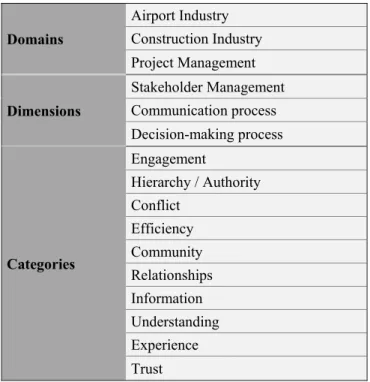
1.3.5 Discussion ... 37 CHAPTER 2 METHODOLOGY ...41 2.1 Research design ...41 2.1.1 Conceptual Framework ... 42 2.1.1.1 The domains ... 43 2.1.1.2 The dimensions ... 44 2.1.1.3 The categories ... 45
2.1.2 The framework validation ... 47
2.2 The semi-structured interviews ...48
2.3 Sampling ...50
2.4 Data collection ...51
2.4.1 Coding ... 51
CHAPTER 3 DATA ANALYSIS ...55
3.1 Dimension 1 – Stakeholder Management ...55
3.1.1 The challenges to engage stakeholders ... 56
3.1.2 The strategy to engage stakeholders ... 62
3.2 Dimension 2 – Communication Process ...73
3.2.1 The relevance of quality information on the communication process. ... 74
3.2.2 The 3D visualisation impacts on the communication process ... 82
3.2.3 Dimension 2 discussion ... 91
3.3 Dimension 3 – Decision-making Process ...93
3.3.1 The challenges engaging stakeholders on the decision-making process .. 94
3.3.2 The 3D visualization impacts engaging stakeholder on the decision-making process ... 100
3.3.3 Dimension 3 discussion ... 109
3.4 The overall BIM impact on stakeholders’ management ...110
3.4.1 The final debate ... 112
3.4.2 How stakeholders would like to be involved on the project ... 120
3.4.3 Final debate discussion ... 121
3.5 Validation ...122
3.5.1 Sampling ... 122
3.5.2 Framework ... 127
CHAPTER 4 DISCUSSION ...133
4.1 Dimension 1 – Stakeholder Management ...133
4.2 Dimension 2 – Communication Process ...135
4.3 Dimension 3 – Decision-making Process ...136
4.4 The 3D visualisation impacts on stakeholder management ...137
CONCLUSION 141 Rival Explanations and Limitations ...142
Recommendations for further research ...143
APPENDIX I SEMI-STRUCTURED INTERVIEW PROTOCOL (English first version) 147 APPENDIX II SEMI-STRUCTURED INTERVIEW PROTOCOL (English final version) ...149
APPENDIX III SEMI-STRUCTURED INTERVIEW PROTOCOL (French final version) ...151
APPENDIX IV VALIDATION PROTOCOL...153
APPENDIX V CATEGORIES THEORETICAL REFERENCES ...157 BIBLIOGRAPHY 165
LIST OF TABLES
Page
Table 1.1 Stakeholder definition ...15
Table 2.1 Framework ...42
Table 2.2 Categories theoretical references ...46
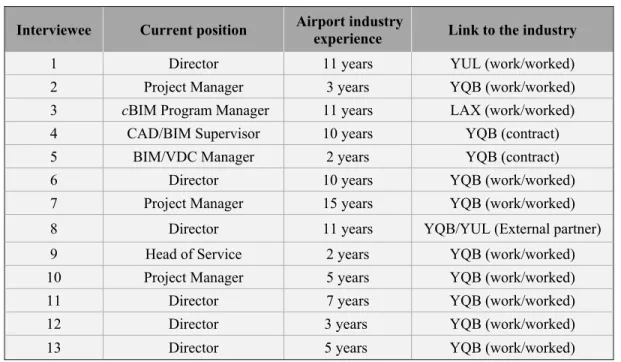
Table 2.3 Interviewee profile ...50
Table 2.4 Interviewees’ participation ...51
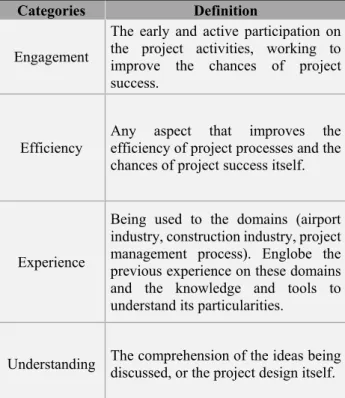
Table 2.5 List of categories, their definitions and examples from the interviews ...53
Table 3.1 Summary of the main challenges ...56
Table 3.2 Evidences for the challenges to engage stakeholders ...61
Table 3.3 The resume of the main strategies ...62
Table 3.4 Evidences for the strategy to manage stakeholders ...69
Table 3.5 The relevant aspects of quality information to the communication process ...74
Table 3.6 Evidences for the relevance of quality information ...80
Table 3.7 The 3D visualization impacts to the communication process ...82
Table 3.8 Evidences for the 3D impacts on the communication process ...90
Table 3.9 The challenges to engage stakeholders on the decision-making process ...94
Table 3.10 Evidences for the challenges to engage stakeholders ...99
Table 3.11 The 3D visualization impacts to engage stakeholders ...100
Table 3.12 Evidences for the 3D visualization impacts on engaging stakeholders ...107
Table 3.13 The most relevant impacts of 3D visualization to stakeholder management ...112
Table 3.14 Evidences for the overall BIM impact on stakeholder engagement ...118
Table 3.16 Evidences per interviewee ... 122 Table 3.17 Categories presented by each interviewee profile ... 124
LIST OF FIGURES
Page
Figure 1.1 Airport economic effects ...7
Figure 2.1 Case study content ...43
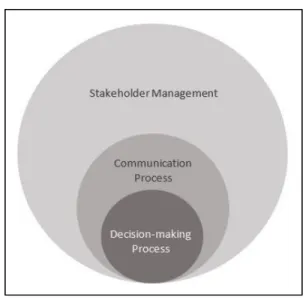
Figure 2.2 The dimensions ...44
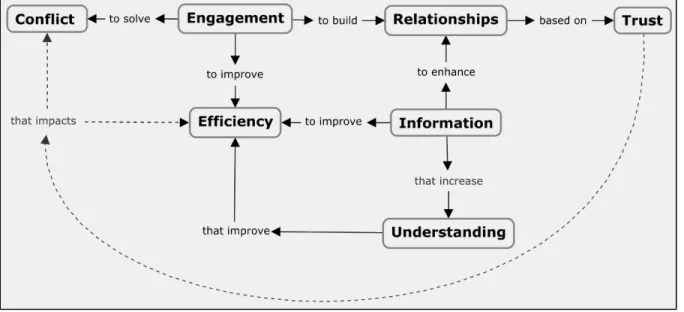
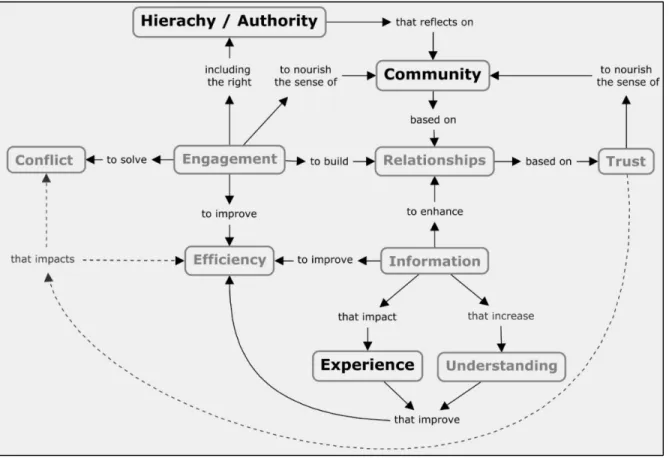
Figure 2.3 Categories from literature and their connections ...45
Figure 2.4 The dimensions interrelations ...49
Figure 2.5 Final coding ...52
Figure 3.1 Relationships between the categories emphasized on Dimension 1 ...55
Figure 3.2 Categories emphasized on Dimension 1’ answers ...72
Figure 3.3 Relationships between the categories emphasized on Dimension 2 ...73
Figure 3.4 Categories emphasized on Dimension 2’ answers ...92
Figure 3.5 Relationships between the categories emphasized on Dimension 3 ...93
Figure 3.6 Categories emphasized on Dimension 3’ answers ...110
Figure 3.7 Relationships between the categories emphasized on the final debate ....111
Figure 3.8 Categories emphasized on the final debate answers ...122
Figure 3.9 Total occurrences for each category ...125
Figure 3.10 Most cited categories for each interviewee profile ...126
INTRODUCTION
Airports deal with countless elements that impact on their efficiency. This industry changes constantly and it must be able to adjust itself quickly and efficiently to respond to those demands. To do so, it is mandatory to combine the airport client requirements, regulatory laws and financial goals all together to get the best response to every distinct situation. Amongst all these issues could arise different interests between the large number of stakeholders involved into the decision-making process regarding operational activities.
In airport projects, the concept of stakeholders may be understood as everyone that uses the infrastructure, i.e. passengers, services offered, governmental authorities, air companies, even the public in general, the city where the airport is located, or the country. With such huge different kinds of stakeholders, it is not difficult to realize that this type of venture is affected by many conflicting situations, which make the relations between the stakeholders and project team, as each other, so important. Thus, stakeholder management might be considered strategic to aim project objectives, engaging all different individuals, groups or institutions impacted by the project activities or with the power to impact them.
When dealing with large and complex endeavors as airport engineering projects, the communication problems amongst stakeholders are one of the main causes for the performance issues of those projects (Azouz et al., 2014; Egan & Williams, 1998). Collaboration on projects requires stakeholder engagement, which is based on the communication process and its information quality (Egan & Williams, 1998). Poor data flowing through project actors leads to a distrusted environment and all effort made by the project team in engaging stakeholders might fail (Pryke & Smyth, 2006). To maintain the commitment, all main stakeholders should be confident in the project decisions (Bourne, 2005). Inserted in the airport environment, the project is susceptible to many interferences and under the influence of several actors with different motivations. The negative impacts of an airport engineering project may represent significant financial losses for the entire related community, which adds yet another complicating element in this already complex context.
To deal with engineering project performance issues, new technologies had been developed, improving the quality of construction and its process and modifying the way projects are managed, like Building Information Modeling - BIM. The new work environment that comes with BIM demands skills and behavior that goes beyond the abilities project teams traditionally used to run projects successfully. Concepts like trust, engagement and sharing have been added, creating a positive atmosphere where the collaborative work can arise (Crotty, 2013), promoting the working culture of high performance (Kumaraswamy & Rahman, 2012) needed by airport projects.
The good quality and trustworthy information generated by BIM technologies improve communication flow, which, in airports, means that decision-making process might run quickly and assertively as demanded. All the conflicts generated by misunderstanding technical documents may be reduced and stakeholders should be able to communicate with each other in an efficient manner. This virtuous circle helps to improve construction projects productivity and predictability (Crotty, 2013), conditions required by airport construction projects due to their complex and uncertainty nature.
Thus, an engineering project inserted in this panorama shows a fertile field to observe the influence of BIM technologies implementation on the effectiveness of the stakeholders’ management. Our assumption is that, by refining the way technical teams produce and manage information, moving from document-centric to information-centric management, communication between internal and external stakeholders will gradually improve, producing a positive effect on stakeholder management.
Thus, considering the airport engineering project context, this study aims to assess how the use of BIM technologies, here translated into 3D visualization1, can impact the efficiency in managing stakeholders.
1 For the purpose of simplification and considering that the sample profiles include airport stakeholders that may not have the knowledge of BIM and its technologies, this study decided to use the term “3D visualization” as a format for any information in opposition to those traditional forms of presenting engineering project
The objectives of this research are:
• to establish the relationship between the improvement on the quality of information flow that BIM can add to projects and its impact on the stakeholders’ project engagement;
• to expand the comprehension about how stakeholder engagement is affected by project information quality;
• to enlarge the knowledge about the effects of BIM in the decision-making process, highlighting its impact on project efficiency.
A single case study will be used to investigate the impact of BIM technologies in stakeholders’ management: the terminal area enlargement of the Québec City International Airport, where the whole project was run using BIM technologies.
This report is organized in five main parts. Based on the referenced authors, Chapter 1 starts studying and critiquing structured knowledge upon three different technical domains: Airport Industry, Project Management, and Construction Industry. The literature review aims to highlight the connections between these three domains, especially those concerning to stakeholders. Chapter 2 details the methodology used to answer the research question based mainly on long interviews. After that, Chapter 3 describes how the data gathered on the interviews was analyzed. Chapter 4 follows linking the analysis results to the concepts extracted on the literature review. At last, the Conclusion summarizes this study and suggests topics for further research.
information, as 2D drawings, spreadsheets, Gantt graphics, specification texts. Doing so were included on the term “3D visualization” for example, the virtual model, virtual reality, 3D/4D, etc.
CHAPTER 1 LITERATURE REVIEW
Airports are, by nature, complex, dynamic and involve multiple stakeholders in their operational activities. Any situation that interfere in their operations have to be cautiously analyzed before producing its effects. Then, a very systematic planning is required to run engineering projects in an operational airport infrastructure, and a strict activity control to assure that the planning is being precisely executed. As the project is running, it might face many conflicting situations where the decision-making process will demand a difficult negotiation due to its multiple stakeholders with divergent interest. Besides, the complex documentation generated by engineering projects and the constant difficult technical documentation understanding by the main stakeholders, could bring extra elements to the project team deal with.
This intricate reality faced by engineering projects in airports could be overcome by establishing a collaborative project environment and improving the quality of technical documents produced, increasing the stakeholders overall understanding and trusting in project information, improving the engagement to the project objectives and the decision-making process as well. The implementation of BIM technologies can provide a better-quality data, which increase the overall communication process by allowing to build the trustworthy relationships needed for an assertive decision-making process, fundamental for running engineering projects in airports.
This chapter presents a literature review that establish the links between these three domains that compound airport engineering projects: airport industry, project management and construction industry. The aim is to identity elements from these three domains that could be aligning to improve airport stakeholders’ management strategies focusing on the project success. The first part presents the contextualization of the airport environment, its business model and what are the elements involved when running engineering projects. The second part presents the theoretical overview of stakeholder management, especially on the construction
industry, emphasizing the human aspects that reflect on the decision-making process. The third part highlights difficulties faced by the construction industry, especially on the decision-making process, and the impact of BIM technologies on the stakeholders’ management.
1.1 Airport industry
The aim of this section is aligning the understanding of the context within which airports operate and the consequences of its complex nature when running engineering projects. It starts with the economic impact airports have on the region they are located. The next subsection is about engineering projects, the challenges to planning any engineering intervention to the airport and aspects related to the needed data to run such projects. The third subsection is dedicated to the multiple stakeholders’ environment that airports encounter, followed by the complexity of its systems.
1.1.1 The airport economic impacts
Aviation and airports have a wide ranging of impacts. “The ability to move people and goods across the globe in a matter of hours is fundamental to the global economy” (Airports Commission, 2013, p.18). Considering the number of flights and the number of people working on its facilities, the activity of an airport might have an important impact on the region it is located (Bosi, 2015a). In this sense, airports can also work as a growth pole in the regional economy (Hakfoort, Poot, & Rietveld, 2001). Figure 1.1 below shows how the airport activity can impact its economic environment.
Figure 1.1 Airport economic effects Taken from Airports Commission (2013, p.93)
The Figure 1.1 organizes the economic impacts that any airport might have in three dimensions: users and workers, business, and economic environment. Each dimension is influenced in its own way, but all of them will receive some impact concerning to any decision on the airport environment. These impacts and their consequences will dictate the competitiveness of each airport on the domestic and international market (Airports Commission, 2013).
By stimulating business, creating employment, promoting tourism and trade, airports might support economically their regions. More than that, they also play a wider role supporting the national and/or international networks (Kleinschmidt, Goonetilleke, Fookes, & Yarlagadda, 2010), which make “decisions on airport location and capacity […] the most important strategic choices a country or city can make, influencing the economic, environmental and social development of cities and regions” (Airports Commission, 2013, p.06).
Besides their economic influence on the market they are inserted into, airports are also impacted by the industry changes (Airports Commission, 2013). For example, the new entrance of “low-cost carriers in the market forces airports to increase the efficiency of the existing
infrastructure in order to preserve competitiveness and to maintain their sales” (Pabedinskaitė & Akstinaitė, 2014, p.399). Also, the demands of more airport services as well as for faster and efficient processing of aircraft, passengers and baggage has been increased by the deregulation/liberalization of the airline industry worldwide (Oum, Yu, & Fu, 2003).
As complicated business they are, airports combine different elements and activities to serve passengers and flight airlines (Pabedinskaitė & Akstinaitė, 2014) through organizations with their business particularities concerned to commercial, logistical, security and safety aspects (Fernandes & Pacheco, 2010). This diverse and heterogeneous industry presents “high degree of quality differentiation, different ownership and regulatory structures, different mixes of services and operating characteristics, as well as external constraints such as location and environmental factors” (Oum et al., 2003, p.285), elements that make each airport unique in its specificities.
Despite the uniqueness of each business model and infrastructure available, the services provided by an airport can be divided into airside and landside operations, being airside related to operations involving the aircraft, and the landside, the passenger and cargo (Oum et al., 2003). These two sides of operations are fully integrated and connected in one single flow of activities (Pabedinskaitė & Akstinaitė, 2014). Furthermore, these activities demand the support of a large number of other organizations, which also have their own operations (Park, 1999).
1.1.2 The airport engineering projects
Considering the importance that airports assume to the areas they are located in, this section focuses on the challenges faced by airport authorities and project teams when running any intervention to the airport infrastructure. The challenges related to planning the intervention are discussed and aspects related to the data used in this process.
1.1.2.1 Airport Planning
It is a common sense that the construction and operation of an airport have significant impacts in the area where it is located (Pitfield, 1981). This “decisions on airport location and capacity
are among the most important strategic choices a country or city can make. These choices influence the economic, environmental and social development of cities and regions more than many other planning choices” (Airports Commission, 2013, p.18). Despite the positive impacts an airport can bring to the region where it is located, they also have some negative consequences as aircraft noises, landscape alteration that can affect natural habitats, stress to the local transport network, air pollution (Airports Commission, 2013) to say just a few. These wider impacts demand the involvement of a large number and diverse profiles of stakeholders in order to achieve a better solution with lowers negative impacts.
Even if airport operators have been integrating a variety of stakeholders in the airport planning and making processes, this increased involvement has not led to improved decision-making with respect to future development (Wijnen, Walker, & Kwakkel, 2008) simply because “airport decision makers and stakeholders exhibit various – and in many cases conflicting – objectives and priorities regarding the assessment of the airport performance” (Zografos & Madas, 2006, p.16).
These conflicting interests might exist on airport planning because it is hard to achieve a “balance between investments, expenditure, resource consumption, design flexibility and compliance to international and local technical references and regulations, while providing a quality experience for passengers, operators, airlines and service companies” (Bosi, 2015a, p.83). The input for new interventions on an airport is more often related to new technologies (as a development of a new aircraft design) than to the end of a facility life cycle, starting with the commercial, operational or management needs, or simply imposed by a new legislation or trends, as environmental challenges, for instance (Pastor & Benavides, 2011).
Besides, depending on the intervention, it can take years to be completed (Pitfield, 1981). Thus, planning an airport intervention is a long-term endeavor that has to deal with the risk of becoming obsolete before delivering due to new conditions or even stakeholders needs and objectives misunderstandings (Wijnen et al., 2008). “Moreover, the infrastructure conceived must be valid for the current and the future air traffic demand which fluctuates around the predicted number of passengers and airplanes movements” (Pastor & Benavides, 2011, p. 50).
Because all of that, “airport strategic planning should be a continual, repetitive process” (Wijnen et al., 2008, p.21) due to is multiple stakeholders environment and complex systems.
1.1.2.2 Information within airport engineering projects
Airport design is so complex that it demands a proper integration of the many disciplinary areas involved being delivered successfully (Bosi, 2015a). Its process is sequential and requires a collaborative platform based on multiclient and interoperable communication process, reflecting the inputs of designers, constructors and key suppliers (Pastor & Benavides, 2011). In this sense, project participants are responsible for the project information creation and management and as also sharing this information with other project participants, stakeholders and airport management (Bosi, 2015b).
Often, the data used on airport planning is inconsistent and not integrated, because it is generated by different experts, from different organizations, using diverse aspects of airport operations, being the cause to the dispersion of that data, information and knowledge within the airport operator and its stakeholders (Wijnen et al., 2008). This data dispersion persists because still there is not a collaborative organization provided by an interaction between project team members (Pastor & Benavides, 2011). “Expensive design errors showed the need to push design towards more integrated processes based on information sharing within the Design Team, Airport Owner, Authorities, etc.” (Bosi, 2015a, p.137)
This disruption in the multidisciplinary integration is one of the most common and important design management errors, and is based on the inefficiency of communication, lack of information and document output errors (Bosi, 2015a). However, “there are still a lot of resistance and barriers to be overcome in order to ensure an efficient and effective communication in airport projects” (Pastor & Benavides, 2011, p.18). Some of them are procedural, referring basically to the lack of that integration. But also, there are some technical and cultural barriers. Being temporary-based organization, the project team does not have the continuity of its relationships affecting the collaboration among its members (Pastor & Benavides, 2011).
To overcome the challenges to be faced when planning airport interventions, planners need to improve their understanding of the system and its problems, as airport decision-makers need to understand how their business decisions affect their goals (Wijnen et al., 2008). To achieve such output, the information used in the design process, and the communication process itself, need to be improved, having the organization working with its stakeholders, sharing information effectively to gain understanding of each other’s perspectives and objectives. “Only when there is a mutual understanding is it possible to look for solutions that are satisfactory to all parties involved” (Wijnen et al., 2008, p.18).
1.1.3 The airport project stakeholders
The ultimately airport project goal is to meet customer and owners’ expectations, which involves numerous actors both from inside and outside of the organization, who play different roles (Wijnen et al., 2008). However, the challenge is to build a common understanding within all involved in the project to align the decision-making in technical solutions. The late involvement of the airport stakeholders on the decision-making process might affect the future airport operation (Pastor & Benavides, 2011). Thus, having them involved and working together on solving problems is crucial to improve understanding about the airport systems, its problems and potential solutions (Wijnen et al., 2008).
Although its significance to the process, to get all the relevant stakeholders involved on the airport planning process is another big challenge (Wijnen et al., 2008). Being airport stakeholders those interested in the airport operation, such as private interests (the airport owner, shareholders, the airlines); government bodies (customs and security); customers (passengers and visitors); and agencies (such as IATA2) (Popovic, Kraal, & Kirk, 2010), they have divergent objectives concerning the airport development.
Satisfying simultaneously conflicting interests from diverse stakeholders is a complex task (Harrison, Popovic, Kraal, & Kleinschmidt, 2012) simply because they diverge about what
would be a good airport performance from its operation perspective (Kleinschmidt et al., 2010). Also, there would always be conflicts among the various airport stakeholders due to disagreements about results, assumptions, and the methodologies used to plan and design an airport intervention, or because they are not involved in the process, or because they cannot understand each other (Wijnen et al., 2008).
Besides involving airport stakeholders on the project decision-making process, it is also fundamental to imply professionals from many different disciplines to deal with such diverse technical issues as those present on airport projects. It requires “a multi-disciplinary approach that involves engineers, mathematicians, management professionals, architects, product designers, and IT specialists forming a collaborative team to work with airport operators” (Kleinschmidt et al., 2010, p.02).
Then, airport construction project is an endeavour that to be successful should count with the participation of many professionals from inside and outside the airport organization. Considering their active involvement to the project activities, the stakeholders might be assumed as internal and external do the project, despite their connection to the airport organization. Internal stakeholders are those that actively participate on the project activities, as firms responsible for the design and construction, as airport employees responsible for the project requirements and approvals. The external stakeholders are, for instance, the government agencies that control the respect to regulations, or commercial companies that intend to close new deals when the project is delivered, or even airport employees that are not involved on controlling the meeting of project requirements or the contract execution, participating just as external observers.
1.1.4 The airport complexity
Airports are complex systems (Harrison et al., 2012; Kleinschmidt et al., 2010; Park, 1999; Pastor & Benavides, 2011; Popovic et al., 2010; Wijnen et al., 2008; Wu & Mengersen, 2013; Zografos & Madas, 2006). Complex systems are systems with interdependent parts, where an individual behavior interfere on another. To study complex systems, one have to consider how its relationships affect the behavior of the whole (Bar-Yam, 2003).
The airport complexity arises from the various components which make up the airport – various systems, procedures, stakeholders, artifacts necessary for the operation of an airport, all of which have different requirements (Popovic et al., 2010). Theses components strongly interact and “the behavior of any one component depends on (and affects) the behavior of other components in a nonlinear manner” (Kleinschmidt et al., 2010, p.04).
Then, in order to planning, designing and operating an airport, decision-makers must face complex decision-making problems highly complicated because they involve many processes3, entities processed4 through the system, and a number of different elements5, which are added to the large number of stakeholders with different, sometimes conflicting, objectives concerned to the airport performance (Zografos & Madas, 2006). Also, “the context in which airports operate is subject to changes in terms of aviation demand, technological developments, demography, and regulations; the uncertainties associated with these changes need to be taken into account as well” (Wijnen et al., 2008, p.13). All these airport systems changes need to be considered in an integrated way because their effects can impact airport performance and affect stakeholders objectives in different ways (Wijnen et al., 2008).
1.2 Project Management
The objective of this section is to bound the stakeholder management theory studied on this research underlining its influence on the project success. It starts by establishing the concept of stakeholder used on this study and the human aspects of conflict, trust and relationship. Then, the influence of stakeholders’ engagement to the project success is pointed out, as it influences on the project efficiency. This section ends addressing aspects related to the stakeholder management in construction industry.
3 E. g., strategic planning, operations management. 4 I. e., passengers, baggage, cargo, aircraft.
1.2.1 The concept of stakeholder management in project management
The Project Management Institute – PMI (2017, p.04) defines project as “a temporary endeavor undertaken to create a unique product, service, or result,” being a solution for a social or organizational problem, a policy or a strategy, or part of a program. With specified duration, cost and performance, projects lead to uncertainty and complexity, which requires balancing all relations between the project and its parts, other projects, even with the organization. This uncertainty adds complexity to project environment and dealing with this is what defines successful project management (Bourne, 2005).
However, the concept of project as a temporary organization means that it has its own culture and structure (Project Management Institute (PMI), 2017), demanding building effective project teams and trust between the team and the project stakeholders (Grabher, 2002). This additional effort conceived stakeholder management as engagement management, where understanding the group of key stakeholders and how to manage this relationship throughout the project is the focus. “Managing a project is about managing uncertainty and managing the resulting resistance of many stakeholder groups due to their anxiety about the consequences of the change” (Bourne, 2005, p.17).
Bourne (2005) argues that a project only can exist with the consent of its stakeholder community and the relationships with all kinds of stakeholders are essential for project success, as they can benefit from or adversely be affected by its activities. Because they can cause different impacts on project activities, identifying who are the key stakeholders is strategic to project success but it is not an easy task (Bourne, 2005). There is more than one definition about whom stakeholders are, some of them including economic or social aspects, for instance. Table 1.1 below summarizes the stakeholders’ definitions encountered on this study.
Table 1.1 Stakeholder definition
Author Definition
Freeman & McVea, 2001, p.05
“… defining stakeholders as any group or individual who is affected by or can affect the achievement of an organization’s objectives.”
Newcombe, 2003, p.842
“Project stakeholders are groups or individuals who have a stake in, or expectation of, the project’s performance and include clients, project managers, designers, subcontractors, suppliers, funding bodies, users and the community at large.”
Bourne & Walker, 2005, p.650
“... stakeholder is someone affected by a project and having a moral (and perhaps a non-negotiable) right to influence its outcome. This view is very broad and its consequences unmanageable because there are so many ways in which a project can impact a very wide range of people.”
Carroll & Buchholtz, 2006, p.23
“Stakeholders as individuals or groups with which business interacts who have a 'stake', or vested interest, in the firm.”
Olander, 2007, p.279
“A project stakeholder can be defined as a person or group of people who has a vested interest in the success of a project and the environment within which the project operates. Vested interest is defined as having possession of one or more of the stakeholder attributes of power, legitimacy or urgency. There are essentially two categories of stakeholder: internal stakeholders, who are those actively involved in project execution; and external stakeholders, who are those affected by the project.”
Walker, Bourne, & Rowlinson, 2007, p.73
“Stakeholders are individuals or groups who have an interest or some aspect of rights or ownership in the project, and can contribute to, or be impacted by, either the work or the outcomes of the project.”
Rowlinson & Cheung, 2008, p.613
“External stakeholder management can involve a range of official, formal and informal groups (e.g. industry, government, non-government, public, private and education).”
Ward & Chapman, 2008, p.564
“Internal stakeholders are: project owners in the sense they have overall managerial responsibility and power, usually linked to a financial stake; and organizations, teams or individuals who have a contractual relationship with the project owner. Other stakeholders are ‘external’ stakeholders who may be positive or negative about a project, and who may seek to influence the project through political lobbying, regulation, campaigning or direct action. External stakeholders might include local communities, local government, potential users, regulators, environment groups and the media.”
PMI, 2017, p.505
“Broader definitions of stakeholders are being developed that expand the traditional categories of employees, suppliers, and shareholders to include groups such as regulators, lobby groups, environmentalists, financial organizations, the media, and those who simply believe they are stakeholders—they perceive that they will be affected by the work or outcomes of the project.”
Some definitions for who are stakeholders might be very broad. On the other hand, some are relatively narrow (Ward & Chapman, 2008). Despite existing different aspects that can be related to the stakeholder definition, based on Table 1.1 it can by said that some are present in the majority of the stakeholders can be categorized in external or internal, depending on their relation to the project itself. Also, it is stated that a stakeholder might be someone that has an
impact or is impacted by the project activities or has an expectation on project objectives. The group of stakeholders does not involve just the project team or the clients but has a wider perception that can also involve the whole community where the project is located (Newcombe, 2003). Just including stakeholder management in the project activities is insufficient, it is also fundamental to consider the values that a wider spectrum of stakeholders might have over the project success (Widén, Olander, & Atkin, 2014).
In practical terms, project management is carried out to meet the needs and expectations of stakeholders towards the objective of a specific project (Project Management Institute (PMI), 2017; Walker, Bourne, & Rowlinson, 2007). Recently, there has been an increasingly growing concern in the business world: with whom we do our business, for whom, for what purpose? It has become clear that it is not enough anymore to analyze numbers and trends to run successful projects. Because it interferes significantly in the success or failure of the project, it is urgent to understand the human nature of the stakeholders, given them “names and faces” and not just analyzing their roles in order to create options and strategies for stakeholder management (Freeman & McVea, 2001).
Stakeholders might be considered as a project asset as they can contribute with knowledge, insight and support project execution (Bourne & Walker, 2005). Although the right time to involve them is critical (Ward & Chapman, 2008), early involvement might improve the overall understanding of both sides, internal and external stakeholders (Shindler & Cheek, 1999). As stakeholders’ impact is dynamic and changes during the project execution, this involvement should be seen as a continuous strategy (Olander, 2007). Their influence also might change due to the different levels of power and interest they have over the project activities (Chinyio & Akintoye, 2008). Thus, this interaction between stakeholders and project team is important to clearly identify their objectives and understand their needs (Orndoff, 2005).
The complexity of stakeholders influence is largely impacted by their project perception (Olander & Landin, 2008). Paying attention to the expectations and needs of key stakeholders exert a significant impact on their perception of project success. “A project that does not meet
expectations of influential stakeholders is not likely to be regarded as successful, even if it remains within the original time, budget and scope” (Walker et al., 2007, p.70). Thus, the project should benefit all stakeholders meeting their needs and expectations through trustee relationships built by combining their interest with the project interest to ensure its survival (Newcombe, 2003).
Successful stakeholder management strategies integrate the perspectives of all stakeholders. However, it is known that a win-win situation is not constantly present, and all stakeholders will not benefit all the time. The strategy should distribute both benefits and harms between different groups of stakeholders, developing strategies to ensure the long-term support of all the stakeholders (Freeman & McVea, 2001).
1.2.2 The human dimension within stakeholder management
The objective of this subsection is to point out the challenges faced by the project team on managing stakeholders concerning to their individual characteristics and the relational aspects between them. It begins by pointing out some aspects related to conflicts between all actors involved in the project, generated basically by the different interests. To solve these conflicting situations, trust is added to the relationships among all actors involved, internal and external stakeholders. The subsection finalizes highlighting the importance of this relationship to the project execution.
1.2.2.1 Conflict in project environment
Whenever you have a group working together, this interpersonal context might generate conflict and because conflict is so intimately present in organizational groups, it can impact the overall team’s performance (Alper, Tjosvold, & Law, 2000). Conflict can occur on projects when decisions are made without taking into account the consequences it will have on different stakeholders (Olander & Landin, 2008). Frequently, conflicts are the result of different stakeholders having long-term versus short-term objectives (Newcombe, 2003), different points of view that lead to conflict (Rowlinson & Cheung, 2008).
Because different stakeholders have conflicting range of needs and wishes (Bourne & Walker, 2005) which lead to conflicting expectations (Newcombe, 2003) that sometimes are concurrent and divergent (Chinyio & Akintoye, 2008), “the stakeholder management process can thus be defined as having the aim of maintaining the desired implementation of the project and avoiding unnecessary conflict and controversy with stakeholders” (Olander & Landin, 2008, p.557).
Broadly defined as perceived incompatibility or discrepant views between stakeholders, conflict can be both destructive or beneficial to groups and organizations (Jehn & Bendersky, 2003), depending on the type of conflict (Kozlowski & Bell, 2003). Furthermore, the way team members manage their conflict can affect both, their ability to efficiently deal with conflicts, as their performance as a group (Alper et al., 2000). To be effective, a conflict management should include mutual respect and willingness to compromise, promoting cooperation and harmony within the group (Lepine, Piccolo, Jackson, Mathieu, & Saul, 2008).
Jehn and Bendersky (2003) pointed out three main types of conflict: relationships, task and processes. Those different types of conflict will impact the conflict-performance relationship in different ways, which experience will impact members’ perceptions attitudes, emotions, and behaviors, influencing their interactions. Relationships conflicts are related to interpersonal incompatibility among group members. Task conflict is related to the task being performed, its content, differences in point of view, ideas and opinions. Process conflicts are generated by issues around those responsible for the tasks that need to be done (Jehn & Bendersky, 2003). “Relationship conflict, the perception of personal animosities and incompatibility, may be described as the shadow of task conflict” (Simons & Peterson, 2000, p.03) and it is always negative, whenever it occurs during the lifecycle of the group or project, because it has a negative impact on the member morale. Relationship conflict also interferes with task-related effort, complicating consensus building and losing focus on the decision process because members attention is on reducing threats and not on building cohesion (Jehn & Bendersky, 2003). The relationship conflict might affect the group satisfaction, impacting negatively on the decisions quality and as the commitment to the group (Simons & Peterson, 2000).
On the other hand, by encouraging greater cognitive understanding of the issue being discussed, task conflict can generate better decisions and a better acceptance of the group decisions (Simons & Peterson, 2000). Also, through increased debate and discussion of alternative viewpoints, task conflict can be beneficial to performance and creativity, despite being hard to build satisfaction and consensus. “Disagreements related to the task can improve group decision-making, strategic planning, top management team success, and general task performance” (Jehn & Bendersky, 2003, p.208).
The relation between task conflict and relationship conflict is moderated by trust. When intragroup trust is established, organizations can benefit from task conflict and minimize the danger of relationships conflict. While “task conflict is usually associated with effective decisions, and relationship conflict is associated with poor decisions, the intragroup trust moderates the relationship between task conflict and relationship conflict” (Simons & Peterson, 2000, p. 01). Also, intragroup trust might prevent task conflict from escalating into relationship conflict (Simons & Peterson, 2000). “Teams with conflict efficacy believe that they can work together effectively resulting in team productivity” (Alper et al., 2000, p.628). Furthermore, trust has a significant impact over conflicting situations, especially interpersonal trust that plays an important variable when managing conflict in teams (Kozlowski & Bell, 2003).
1.2.2.2 Adding trust to stakeholder management
The term trust is applicable to a variety of contexts and levels of analysis (Costa, 2003), and there is no agreement amongst all different trust definition (Smyth & Edkins, 2007) but the idea that trust arises from all the relationships experienced, pointing out that each one of them are different. However, it is known that to manage trust as competency, two steps should be achieved: if one of the parties is ready to trust, even unknowing the other party’s intent (which means, with willingness to be vulnerable) and the reaction of the second party about taking advantage of trust given or be trusting as well (Smyth, 2012). Thus, “trust is not only a psychological state based on expectations and on perceived motives and intentions of others, but also a manifestation of behavior towards these others” (Costa, 2003, p.608).
In a business-to-business relationships concept, “the primary obstacle to trust development is a lack of willingness to be vulnerable towards another party, arising from fear that other will not look after your best interests and will selfishly pursue opportunistic behavior” (Smyth, 2012, p.101). Moreover, trust can also be understood as “an issue of competence, with people trusting those that they believe can solve problems and deliver desired outcomes” (Costa, 2003, p.559).
The generation of trust is important on long-term relationships, precondition for successful learning and innovation, particularly when complex tasks are involved (Grabher, 2002). When developed on early project phases, trust will create harmony within stakeholder group that will continue into the other project phases. Trust can be linked with respect in relationship development (Davis & Walker, 2007), but also to satisfaction and commitment (Costa, 2003). Moreover, by enabling cooperation (Tyler, 2003), trust has also a positive effect to task performance (Costa, 2003).
It is the transparency between the project team and project stakeholders that might develop trustworthy relationships, increasing the willingness to collaborate and to engage on the project activities (Goleman, 1998). Transparency is an ability to maintain integrity and to behave authentically and congruently with someone’s values. Project teams who presents such competency are seen more trustworthy and can build a productive and emotional environment which presents trust, group identity, emotional capability, group efficacy and networks (Druskat & Druskat, 2012).
1.2.2.3 The importance of relationships
Projects experience a high degree of change requiring active engagement and participation with project stakeholders (Freeman & McVea, 2001). Often the client, user, and developer exchange information in a dynamic co-creative process that leads to more stakeholder involvement and higher satisfaction. Regular interactions with the stakeholder community throughout the project mitigate risk, build trust, and support adjustments earlier in the project cycle, thus reducing costs and increasing the likelihood of success for the project (Project Management Institute (PMI), 2017).
As stated by Pryke and Smyth (2006), the conceptual approaches to the management of project development are summed up as the traditional (techniques and tools), the functional (strategic), the information processing (input-output model). However, with the purpose of integrating the dynamics of relationships that permeate all project life-cycle, they added another dimension for those conceptual approaches: the relationship, which means a paradigm of project and client satisfaction (Pryke & Smyth, 2006).
Considering relationships as strategic for managing projects, Pryke & Smyth (2006, p.09) go further arguing that “people are certainly one key focus because the human relations between them are important in the effective and efficient delivery of a project or projects”. For instance, they state that, as the same time people are wonderfully creative in create complex tools and systems, they behave in difficult and unpredictable ways because of their characteristics. Their behavior is realized through their continuous interactions, which means, their relationships. Thus, from their perspective, this approach should be recognized as the basis of strategy for managing projects because the project success depends on it (Pryke & Smyth, 2006).
The traditional approach to project management reveals an artificial internal separation between organization departments, where the decisions are guided by professional norms and expertise, rather than the client requirements (Pryke & Smyth, 2006). To deal with this dysfunctional way to operate, a relationship dimension must be added, offering opportunities to companies to become more efficient and gather competitive advantages (Pryke & Smyth, 2006). Besides, the traditional project management refers stakeholders as separated groups, categorized by their projects’ roles and without interaction between them. Taking into account this perspective, the new approach of relationship considers the relations between stakeholders as strategic (Cova & Salle, 2012).
People and teams are assets to the organization. They add value through their relationships, being more effective when working together. In a corporate and project environment, relationships are human, organizational and information systems contexts in which personal relations occur. Relationships can be managed, and their quality is a key element in the success of a project, as both behavior and attitude can affect project performance (Pryke & Smyth,
2006). Without constructive relationships between customer, team and other stakeholders the different challenges that every new project present will be difficult to overcome (Druskat & Druskat, 2012).
Project manager, despite being the leader of the project team, may have no formal power over stakeholders and must rely on his/her ability to cultivate relationships and use influence strategies to achieve project objectives (Bourne, 2005). Then, the project manager “create[s] an environment in which quickly building relationships and trust with a diverse group of people is fundamental to job success” and “it is particularly useful when actions and decisions involve others” (Druskat & Druskat, 2012, p.79). It would be the trust and confidence existent within these relationships that is used to evaluate its strength (Smyth & Edkins, 2007).
It is communication that support the bridge between various project stakeholders (Project Management Institute (PMI), 2017). Communication is a vital component of building and maintaining relationships by stakeholders’ support and engagement (Bourne, 2005). “Stakeholders are very varied and act differently throughout the project cycle phases” (Cova & Salle, 2012, p.131), being diverse the voices of internal and external stakeholders, which demand various paths. “Stakeholders want their voice to be heard, so their interests are expressed, understood and taken into account” (Smyth, 2008, p.637). Whether this does not result in fewer conflicts can open a communication channel to negotiate outcomes acceptable for all stakeholders (Smyth, 2008).
Based on Smyth (2008, p.639), the relationship management can be linked to several tenets, including:
• Developing close relationships and understanding of the client and stakeholder expectations (needs and desires), observing ethical terms and nurturing relationships;
• Developing services to match realistic expectations (value added and added value), paying attention to attempt to both, internal and external stakeholders expectations;
• Delivering services focusing on creating stakeholders’ satisfaction;
• Improving the long-term maintenance of relationships to engender loyalty, repeat business and/or increased referral business, which concerns internal stakeholders;
• Maintaining and increase market reputation, which concerns external stakeholders. All those tenets from relationship approach to manage projects bring stakeholders and their engagement to its focus.
1.2.3 Stakeholder engagement as element to project success
Stakeholders who are excluded from the decision-making process might not have their needs incorporated on the project outcomes, which may make them focus more on the negative aspects than benefiting from the positive impacts of the project (Innes & Booher, 2004). Moreover, stakeholders know when their voices are not heard, which increase frustration and can invoke greater reactions in order to be heard, understood and considered, mobilizing power in their favor (Smyth, 2008). Failing to properly engage the project stakeholders might have significant impact over the project outcomes.
Thus, the primary goal when paying attention to stakeholders is to avoid or resolve the conflicts presents on, or oppositions to, the project (Mathur, Price, & Austin, 2008). However, finding out when it is the best moment to engage stakeholders is not an easy task, especially because their influence is not static but dynamic (Chinyio & Akintoye, 2008). “Too early and there may be a lack of interest, too late and the opportunities from engaging the stakeholder may be lost” (Widén et al., 2014, p.06). Then it is necessary a combination of approaches to engage stakeholders, keeping track of their fluid interest to continuously determine their precise positions at each project phase (Chinyio & Akintoye, 2008).
Besides avoiding negative impacts over the project activities, “meaningful stakeholder engagement can be seen to enhance inclusive decision-making, promote equity, enhance local decision-making and build social capital” (Mathur et al., 2008, p.601). To achieve such level of engagement, stakeholders should be willing to participate without any fear, having their opinion respected and included on the project outcomes (Senecah, 2004). Such a collaborative process should be gaining promoting access to all involved, transferring power to make decisions to those stakeholders who will be affected by the decision made and allow that diverse points of view are being explored (Healey, 1996).
1.2.4 Efficiency of project process
Achieving efficiency through project planning process includes, but is not limited to, identifying the right stakeholders, understanding their power and influence over the project and formulating strategies to maximize stakeholders’ positive influence and minimize the negative ones. However, “project managers usually have very little formal power over stakeholders outside the project organization” (Bourne, 2005, p.43) to influence their decisions. The influence over stakeholders who are not under the project manager’s authority needs trusting relationships that “require constant reinforcement of ethical behavior and trustworthiness. Balancing the needs and expectations of a diverse group of stakeholders and managing any conflicts could raise issues of ethics and trust for the project manager” (Bourne, 2005, p.43). To resolve conflicts amongst different stakeholders’ interests, the guidance of ethics is particularly effective (Carroll & Buchholtz, 2014).
Managing the needs and expectations of project stakeholders within an environment of uncertainty and ambiguity is one of the ways to positively influence the project success. There is no predictability on temporary knowledge organization, such a project organization, and success can be understood as the ability to manage within a complex and chaotic environment. The project's success or failure depends on the project manager capability to manage the stakeholders’ expectations and perceptions of project’s success. When projects fail, stakeholders are impacted negatively, as the organization performance as well, because project objectives are part of its strategy (Bourne, 2005).
Project success is based on team work, where professionals from diverse background align their work force to achieve project goals. The effectiveness of a team can be based on three main elements: coordination, cooperation and communication (Chiocchio, Grenier, A. O'Neill, Savaria, & Douglas Willms, 2012; Gully, Incalcaterra, Joshi, & Beaubien, 2002; Kozlowski & Bell, 2003). When interdependences between activities are high, as in projects, the performance of the team is strongly related to those three elements (Gully et al., 2002). Cooperation and coordination are enabled by communication, while cooperation is frequently related as opposite of conflict and generally associated with team effectiveness (Kozlowski &
Bell, 2003). These three components, joined together with synchronicity of the team actions, are the key process that influences team performance (Chiocchio et al., 2012).
Also related to the project performance, the poor quality and untrustworthy information flowing throughout the project communication process leads to a risk perception by the stakeholders that might be biased, which can contribute by itself, to a negative response to it. “Access to adequate and appropriate information is essential to empower stakeholders and enable them to contribute effectively to the risk management process” (Loosemore, 2012, p.201). With more efficient information provided by the project team, it would be easier for the community to accept project propositions (Loosemore, 2012), increasing their engagement and support to the project.
1.2.5 Stakeholder management in the construction industry
“Construction projects affect, and are affected by, a vast number of stakeholders” (Olander, 2007, p.280). In the past, the major contractors were responsible for the great majority of work, but today, they simply coordinate subcontractors, this means, manage stakeholders. It is a return to the past, when the constructions were made by smaller contractors and their relationship between organizations was based on a trust network. This large number of separate trades and the complexity of the interface among them demand very high levels of skills to organize and coordinate (Crotty, 2013) this multiple stakeholder environment where construction projects are inserted.
The definition of stakeholder management for the construction industry is evolving to integrate issues such as uncertainty, risk, ethics, empowerment and sustainability. Those are key concepts in construction project management today (Atkin & Skitmore, 2008) where stakeholders with different backgrounds, expectations and objectives have to find a common language to share values and collaborate to attain a common goal (Thomson, Austin, Devine-Wright, & Mills, 2003).
Construction projects have “clear objectives - high definition of output, and clearly defined processes to achieve them, demonstrated by a high level of structured role definition and the
application of knowledge based on previous experience” (Bourne, 2005, p.21). It is the responsibility of the construction project manager to respond to the needs and expectations of project stakeholders concerning how the decisions-making process is carried out (Olander, 2007), and by the same time, integrating “the work of many specialist team members and maintain procedures for measurement and control throughout the project” (Bourne, 2005, p.22).
Construction project stakeholders can be divided in internal (those directly involved in the decision-making process) and external (those affected by the project activities). “In construction, there has traditionally been strong emphasis on the internal stakeholder relationship” (Atkin & Skitmore, 2008, p.549) and much of this emphasis derives from the important need for understanding how to manage such a complex workflow, as the construction industry is formed by fragmented teams (Latham, 1994) and is multi-disciplinary in nature. The ultimate goal of this internal stakeholder group is to get all actors involved improving the project final product quality (Arditi & Gunaydin, 1998).
The social dynamics of a typical project team are complex and subtle, and its member’s attitude is almost always positive. Respect and status in modern project teams must be earned and every member knows that their success depends on the performance of others. They know that they need to collaborate to succeed. The key challenge is the creation of a complex, dynamic organization, which must become capable of managing safely big amounts of money in its very beginnings (Crotty, 2013).
At the same time, from the construction stakeholders' perspective, the industry should involve them on earlier project phases, construction project teams need to involve external stakeholders to ensure that their needs are expressed by the proposed design (Schade, Olofsson, & Schreyer, 2011), since an undesirable perception by stakeholders of this attempting can obstruct a construction project, leading to conflicts and controversies about project implementation (Olander & Landin, 2005).
The success of stakeholder management depends mainly on how well the project team presents positive and negative impacts to external stakeholders. The aim is minimizing the negative
impacts, and maximizing the positive ones for all stakeholders, focusing on their acceptance. To achieve such outcome, a transparent relationship should be built where the alternative solutions are clearly shown, establishing the basis of the needed trust between the project team and the project external stakeholders (Olander & Landin, 2008). By clearly defining all positive and negative impacts about the proposed alternatives, showing that all alternatives were investigated, build the trustworthy relationships, especially with those negatively affected by the project activities (Olander & Landin, 2005).
Stakeholder management in all project phases should be based on transparency and trust, building the relationships that are fundamental to the project success concerning long-term issues, as presented on infrastructure projects. The aim of this strategy is to inform stakeholders and obtain their feedback about meeting their needs and expectations as inputs for collaborative project development. The dissemination of construction projects information to the external stakeholders aims to create a problem-solving channel when the project affects the community where it is located (El-Gohary, Osman, & El-Diraby, 2006).
1.3 Construction industry
The aim of this section is to highlight some aspects related to information that can impact the industry’s project success. It starts by stating elements that can interfere on the performance of the industry, especially the decision-making process. Then, it presents an alternative for these issues and the required changes on the industry environment to achieve such improvements.
1.3.1 The construction industry’ performance
In the last 50 years, after the Second World War, the industry started to standardize, reducing the use of craft-based working and replacing it for low-skilled but very specialized workers. The main contractor became a manager of many sub-contractors and now these specialties really do the work. The architect became focused on the design, with the design for craft work disappearing and manufacture and assembly becoming predominates (Crotty, 2013). This increased specialization and the large number of specialist firms involved on projects worsened the already complex construction industry (Fellows & Liu, 2012).Thus, the critical factors of