HAL Id: hal-02822998
https://hal.inrae.fr/hal-02822998
Submitted on 6 Jun 2020
HAL is a multi-disciplinary open access
archive for the deposit and dissemination of sci-entific research documents, whether they are pub-lished or not. The documents may come from teaching and research institutions in France or abroad, or from public or private research centers.
L’archive ouverte pluridisciplinaire HAL, est destinée au dépôt et à la diffusion de documents scientifiques de niveau recherche, publiés ou non, émanant des établissements d’enseignement et de recherche français ou étrangers, des laboratoires publics ou privés.
IP - Traceability and grains traders: ADM, Bunge,
Cargill, Dreyfus
Raul Green, Séverine Hervé, . Laboratoire Sur Les Organisations Industrielles
Dans l’Agro-Alimentaire
To cite this version:
Raul Green, Séverine Hervé, . Laboratoire Sur Les Organisations Industrielles Dans l’Agro-Alimentaire. IP - Traceability and grains traders: ADM, Bunge, Cargill, Dreyfus. 2006. �hal-02822998�
IP - Traceability and grains traders : ADM, Bunge, Cargill,
Dreyfus
Raúl Green
Séverine Hervé
Décembre 2006Cahier n°
2006-03INRA-LORIA
Laboratoire d'Organisation Industrielle Agro-alimentaire
Laboratoire d'Organisation Industrielle Agro-Alimentaire
65 Bd Brandebourg 94205 IVRY Cedex (33) 1 49 59 69 87
http://www.ivry.inra.fr/loria/ mailto:[email protected]
IP - Traceability and grains traders : ADM, Bunge, Cargill,
Dreyfus
1Raúl Green
2Séverine Hervé
3 Décembre 2006 Cahier n° 2006-03Résumé: Ces dernières années, le commerce international de céréales et oléoprotéagineux, ainsi que leur première transformation, a connu un important processus de réorganisation. Résultat de ce processus, le commerce mondiale et la première transformation d'oléo protéagineux est actuellement concentré autour de quatre grandes multinationales, appelles ABCD : Archel Danields Midland (ADM), Bunge, Cargill et Louis Dreyfus. Ces entreprises sont localisées tant dans les pays d'exportation que dans les principaux pays importateurs. Comme conséquence des problèmes associés à la qualité sanitaire des aliments, ces entreprises ont investi dans de systèmes de traçabilité, d'assurance - qualité, et dans de systèmes de type IP.
Abstract: In recent years, the cereals and oilseeds world trade, as well as the first processing industry, has been characterized by an increasing degree of reorganization. World grain trade is currently focused on the quartet called ABCD: Archel Danields Midland (ADM), Bunge, Cargill and Louis Dreyfus. These multinational companies are located in production and consumption areas. In addition to the important role that these stakeholders play in the world grain trade management, they are the clear leaders in the first processing sectors. The problems associated with feed or food safety incidents, have sparked a rising concern for traceability. These events have brought to light the need for quality and food safety insurance programs. Indeed, companies like "ABCD" have decided to create IP systems to meet consumer demands.
Mots clés : Commerce International, sécurité des aliments, traçabilité, multinational, OGM
Key Words : World trade, food safety, traceability, multinational, GMO
Classification JEL: F1
1 Co-extra (GM and Non-GM supply chain : their CO-EXiestence and TRAceability) – Sixth EU Framework Programme – Priority 5 – Food Quality and
Safety.
2 INRA-LORIA. E .mail. [email protected] 3
INRA-LORIA. E.mail. [email protected]
La version électronique du cahier est disponible à l’adresse :
2
Introduction
The food industry in recent years has been characterized by an increasing degree of reorganization. Many sectors have been subject to some kind of restructuring, such as international trade, food-industry or retailing. This process is carried out in the current trend towards increasing concentration and globalisation in the food industry, which is likely to exert an increasing influence on all economic activities.
Confirming the general tendency defined previously, in the last decade a reorganization of the sector stakeholders in the international trade of cereals and oilseeds has been undertaken. World grain trade is currently focused on the quartet called ABCD: Archel Danields Midland (ADM), Bunge, Cargill and Louis Dreyfus. These multinational companies are located in production and consumption areas, operating principally in the following countries: United States, Brazil, Argentina and Europe. Recently, they have spread to new consumption areas, including Asia (especially in China and India) and Eastern Europe.
In addition to the important role that these stakeholders play in the world grain trade management, they are the clear leaders in the first processing sectors (crushing and refining). Because of the fluctuating market conditions of grain trade, and consequently, a high risk level, most traders have simultaneously developed a first processing activity.
Moreover of the increasing practice of concentration, multinational companies have been operating strategic changes in their business activities. This forms part of a dual challenge. On the one hand, they have to create a competitive advantage developing high value-added activities, improve their sales department and optimize their production and logistics systems (specially the transport infrastructures in South America). On the other hand, not only do they have to fulfil their customers requirements for quality and traceability (European and Japanese distributors and food processors), but they also have to face changes in the importing countries legislation (European regulation about traceability).
Likewise, consumers, customers, and government demands are increasing the need for traceability. At the same time, the rapid development of new technologies is requiring greater integration of the food production chain. The problems associated with feed or food safety incidents, which occurred during the 1990s, have sparked a rising concern for traceability. These events have brought to light the need for quality and food safety insurance programs. However, this challenge has received a swift response from industry. Indeed, companies like “ABCD” have decided to create IP systems to meet consumer demands.
This paper examines the “ABCD” companies’ strategies, focusing the attention on the framework of traceability and Identity Preserved (IP) systems required to fulfil customer’s needs and the European regulation.
3
The purpose of this paper is to gather useful information to helpthe understanding of the articulation between the lawful requirements and the market practices for these four companies, and not to examine an exhaustive analysis of the ABCD´s strategy. This explains why our paper is structured as follows. In the first section, we set up a synthesis of the main reorganization operations which occurred during the last decade and lead to the current world grain trade organization around “ABCD”. Then, we establish an “identity card” of these four traders as well as identifying their strategies. Our results show that these strategies can be rather similar to main activities, but can also appear very specific to the other ones. In the final section of this paper, some interesting implications around the linkages between companies strategies and traceability and IP systems are discussed.
It is noteworthy to mention that this work was mainly carried out with indirect information sources. Consequently, depending on the data published by the companies, the wealth of this information is relatively unequal.
4
I. Historical evolution of the world grain’s trade market:
toward the concentration of the stakeholders
The food industry has experienced for several decades a process of permanent reorganization. This has been observed in various sectors, like world trade, food industry or retail trade. This process concerns both large companies of this sector, as small and medium-sized businesses. Concerning cereals world trade, the last decade was marked by an important change in the stakeholders’ organization with the gradual fade out of several giant players during the last years. We will begin by a presentation of these failed enterprises before the description of the market winners.
1. Ferruzzi’s group: the world trade’s shooting star (1993)
The Ferruzzi group was created in 1948 by Serafino Ferruzzi, to carry out trade operations of cereals inside the Italian market. It entered the sugar sector in 1968, by purchasing three Italian companies involved in this activity. From the 1980’s, thanks to European assistances, the group widened its sugar activities in France, thanks to the acquisition of the group Eridania’s shares ( a sugar subsidiary of the Ferruzzi group in
Italy) in the French sugar group Beghin Say. Ferruzzi realized in 1987 a large
expansion, thanks to the purchase of two great American groups: the Central Soya group, as well as the starch branch of the CPC Company. By external growth, the group was also controlling 40% of the petro-chemical Italian Montedison company. The international growth of Ferruzzi’s activities was the result of the orientation of Raul Gardini, who entered the direction of the group in 1980.
Towards the end of the 1990’s, the Ferruzzi group was one of the largest soya world trade companies. It has also an influential place in the industrial sectors of glucids (starch and sugar), of lipids (oils, thanks to the acquisition of Lesieur in France and big investments in Spain), and of proteins (oil cakes and others soya derivatives). Its activities were based on three products: sugar, soya, and corn. The company was very active in Italy, France, United States, Spain, Argentina and Brazil. In spite of its leadership, the cost of the group’s external growth operations got it into debt. This situation had already been mentioned in the financial press at the beginning of the 1990’s.
In 1990, the bankruptcy of the group Enimont (which had repurchased the petrochemical group Montedison), increased the financial standing of the group and Raúl Gardini is thorough at the departure in 1991. This is followed–up to get fall of the activities of soya trade to Chicago Stock Exchange, as well as several financial problems with these activities in Argentina and in Brazil. In 1993, the Ferruzzi group couldn’t leave any more this financial standing and gone broke. The situation has dramatic consequences, since Gabriele Cagliari, the old- president of the ENI and ex-leader of Montedison, like Raul Gardini will commit suicide in 1993.
The group was finally dismantled; the activities of Eridania - Béghin Say – were divided into four groups corresponding to its four branches: sugar, starch, oilseeds and
5
animal nutrition.The choice of the scission has been done to offer a better visibility to the investors, while creating value for the shareholders by reducing the inherent rebate in a holding.In France, the scission of Eridania Beghin Say was an opportunity for the American groups to place itself in fortress: Cargill purchased Cerestar and Bunge purchased Cereol, producer of Lesieur oil. Thus Bunge-Cereol became the first world oilseeds processor. Finally, in U.S, ADM purchased the American operations of Central Soja, Ferruzzi's processing subsidiary1.
2. The failure of Continental Grain’s grain merchandising
business and its acquisition by Cargill (1999)
• Continental Grain
Created in 1813 in Arlon, Belgium, by Simon Fribourg, Continental Grain expanded on the international market one century later. In 1921, it opened its operations in the United States, establishing ‘Continental Grain’ in Chicago and then in New York. In 1928, Continental Grain bought a grain elevator in St. Louis, Missouri, the first of a group of seven that it went purchasing until 1935.
Continental excelled in very large volume bulk export trading but had not diversified enough into value-added processing to compete effectively in a market environment where export volumes have been sharply reduced between 1995 and 1999. Continental's storage capacity declined significantly over the 1990’s while Cargill, ADM, and Peavey expanded. Their capital could be more productively employed in their other agricultural and financial businesses.
In 1999, after considerable problems with its world trade subdivision, Continental Grain decided to sell its Grain Merchandising Business division, included the whole of its world trade activities to Cargill. So, Continental grains changed its name and became ContiGroup.
1
Vincenzo Benini ‘Storia del Gruppo Ferruzzi’, Tesi di Laurea, Università degli Studi di Bologna, 1999.
Luigi Locatelli ‘La saga dei Ferruzzi: Una vicenda che inquieta ancora l’Italia’,
http://www.specchioeconomico.com/2004luglio_agosto/sama.html.
6 • Cargill
Cargill expected this acquisition to contribute to its ability to compete effectively in a rapidly changing market environment. The acquisition will contribute to more effective knowledge acquisition and transfer from an expanded global presence. In addition, it will have a broader base of grain origination facilities in the countries where grain is produced.
Further, Cargill expected that it will be more able to reduce costs, not just by having fewer people, but by dedicating some facilities to specialized products and getting more efficiency in operations (shorter barge turnaround times, longer runs in elevator handling, etc.).
Cargill's joint venture with Monsanto (in 1999)2, to market value-added grains and oilseeds specialties for the feed and processing industries, will require greater capacity to handle segregated grain flows throughout the domestic and export marketing system. Continental has had a significant presence in the identity-preserved grain market with half its international feed customers converted to high corn oil. They also plan to offer the farmers better services such as risk management, production advice, and financing.
In 1999, Cargill has grain merchandising offices and facilities in 43 countries. In the U.S., Cargill has 243 grain facilities; the industry leader ADM through ownership or joint ventures has 669 facilities, according to Milling and Baking News.
2
According to: http://www.agribusinessaccountability.org/bin/view.fpl/1198/cms_category/1684.html;
and http://www.foodcircles.missouri.edu/cargill.pdf#search=%22cargill%20%2B%20monsanto%22.
ContiGroup Companies Inc. (CGC) in 2006
• With the sale of its Grain Merchandising Business division, ContiGroup turns its principal focus to meat proteins. Then, in 2000, ContiGroup sells its Animal Nutrition Division business.
• Employs more than 10,000 people worldwide--plus an additional 16,000 in joint-venture operations.
• Has offices and facilities in 9 countries.
• Operates 13 state-of-the-art poultry plants across the southeastern United States. • Supplies fresh and further-processed poultry to restaurant chains, frozen food makers, and other retail companies throughout the world.
• Ranks as the sixth largest vertically integrated poultry processor in the U.S.
• Is a major producer of animal feed, wheat flour, and poultry in Latin America and the Far East.
• The company is also a leader in aquaculture and flour milling, and one of the largest animal feed and poultry producers in China.
7 • The acquisition
The Cargill’s purchase of Continental Grain's grain merchandising business joint the two largest grain and oilseed exporters of the world, with important storage capacity in the US.
Table 1 : Storage capacity of the ten largest U.S. Grain Elevator, Milling and Processing Companies in 1981 and
19993
Company Total Capacity
1981(mil. bu.) Company
Total capacity, 1999 (mil. bu.)
Cargill 148 ADM 611
Far-Mar-Co 122 Cargill 463
Continental Grain 110 ConAgra/Peavey 198
Union Equity Co-op 67 Farmland Grain Div. 178
Pillsbury 54 Bunge 170
Central Soya 51 Continental Grain 169
Bunge 47 Cenex Harvest States Coop. 146
The Andersons 43 Riceland Foods 102
Lincoln Grain 39 The Andersons 80
Indian Grain 39 General Mills 72
Sources: Structural Change and Performance of the U.S. Grain Marketing Industry; Milling and Baking News Grain and Milling Annual, 1999, pp. 21-22
A major combination of two leading competitors in the U.S. and world grain merchandising industry certainly will prompt market power concerns by policy makers, the Secretary of Agriculture, etc., which will involve data submission to the relevant antitrust agencies. The review (and subsequent challenge or approval) has been done by the U.S. Department of Justice and similar agencies in other parts of the world where both companies extensively did business.
Cargill Inc. was the largest private food industry company in the Forbes magazine 1998 listing of private companies in the U.S., and Continental Grain Company was n° 5 on the list (Table2).
Table 2 : Cargill and Continental Grain Statistics, 1998 Cargill Continental
Revenue (billion $) 51.4 15.0 Net profits (million $) 468 100 (est.) Employees (thousands) 80.6 17.5
Source: Forbes magazine, 1998.
3
According to the table 1, only three of the largest grain companies in 1981 have shown up on the 1999 list. Three farmer cooperatives (ConAgra/Peavey, Farmland Grain Div., Cenex Harvest States Coop.) were in 1999 part of the top 10, versus two in 1981. Some regional cooperatives had grain merchandising joint ventures with other corporations. These datas include very large livestock production, feed company and financial operations for Continental Grain, and extensive livestock production and meat processing, feed, poultry, steel, shipping and other business subdivisions for Cargill.
8
Only the Continental grain storage, transportation, export and trading operations, with offices and facilities in 30 countries (in North and South America, Europe, the Middle East, Africa and Asia) are involved in the acquisition, with customers over 100 countries.
In the U.S., Cargill indicates that these assets include 83 grain handling facilities, which will add 73 new locations to their current 243, and 10 facilities where Continental and Cargill elevators currently coexist close to each other.
Cargill and Continental are significant in other parts of the world grain economy as well. For example, a Cargill Argentina press release indicates the combined operations would account, in 1999, for about 25 percent of Argentine corn wheat and soybean exports.
They are significant competitors in most areas of world grain production, along with such trading companies and merchandisers such as Peavey, ADM, Bunge, Louis Dreyfus, Zen Noh, Cenex Harvest States, Tradigrain, Farmland, AGP, Nidera, Mitsui, Marubeni, Mitsui, Mitsubishi, Kanematsu, Glencore, Oriac, Itochu, CAM, and Seaboard.
Cargill estimated that Cargill and Continental Grain accounted for 35 percent of U.S. grain and oilseed exports in 1999. Industry sources, using Department of Commerce (Pier Import Export Reporting Service) data from May, 1997 to October, 1998, calculate that Cargill and Continental Grain accounted for 14.5 and 13.1 percent, respectively, of export shipments of wheat, corn, soybeans, sorghum, barley and oats. The Secretary of Agriculture estimated that the combined Cargill-Continental Grain operations accounted for 42 percent of corn export volume, 31 percent of soybeans, and 19 percent of wheat exports in fiscal 19984.
3. André-SA’s bankruptcy (2001)
Founded in 1877, the Swiss company André & Co SA is an international agricultural raw material trader. The Andre group is one of the three giants of the agricultural trade with Cargill and ADM. The head office that accounted for 1/3 of the total turn over of the world group (a little more than one billion Euros) announced in 2001 its discontinuance of business. The losses would exceed 200 millions dollars.
What are the reasons of this bankruptcy? In 1999, the Andre group prepared its fall with losses reaching more than 285 million Swiss franks in the year. Classified a long time among the first fifteen Swiss companies, the family company had just lost a hundred million dollars in Spain, 55 million in South America, 178 million in Italy and recovered painfully from the scandals to Russia.
4
M. Hayenga and R. Wisner ‘Cargill's Acquisition of Continental Grain's Grain Merchandising
9
The Andre group sought to solve its financial problems while investing in Iran, a difficult market, which four contracts will be signed with. The first, signed in April 1999, is a financial arrangement of 55 million dollars to produce bottles P.E.T. The second contract, five months later, is much more important.It is a question of set up in Switzerland a joint venture, called PetroFinco, with the National Petrochemical Company. The business is estimated at 1,3 billion dollar per year, until 2013. The third agreement envisages the supply of machines for 75 million dollars to the
customers of the Export Development Bank of Iran.The last one, signed in January
2000 with the Iranian Ministry of Trade, relates to a credit of 300 millions dollars per year, extensible to 500 millions, over five years. Sales by advance of 100 millions dollars had been concluded besides at the time of the signature. All the projects were to be guaranteed by Export Guarantee Found of Iran, partner of Finco in the contract. In all, over the first five years, it is not less than 14,22 billion Swiss franks that André plans to gather for his Iranian projects. Two years after, in 2001, the assessment is very simple: the Andre group is unable to honour its contracts and the group fails. Following the bankruptcy, the "grain" department was dismantled and several structures of trade were born. In particular, the Hong-kong’s trader Noble and the Ameropa Company took again a part of the activities treated before by the Andre group, notably the wheat trade.Noble Group Limited (NOBL)5, world supplier of raw materials of industrial use and resources of transport registered with Singapore Stock Exchange, bought the international trade part of raw materials agricultural in André & Co SA, of Switzerland. Noble acquired mainly the Asian activities of André and Co. Noble will become purchaser of the companies realising a nominal sum. Within the framework of the agreement with André, Noble issued a payable guarantee of approximately 64 $US millions at the creditor banks of the sixteen companies (the André companies in Asia) in order to support their basic current activities.
The André companies in Asia are especially occupied to provide goods like cereals and soya flour. Present in Singapore, in Australia, in Japan, in Indonesia, in Thailand, in India, in Pakistan, in Myanmar, in Vietnam and in Republic popular of China, the
sixteen companies employed approximately 250 people. During only the accounting
period 2000, the whole of these companies generated a total sales turnover of more than one billion dollars. The André companies of Asia will be gathered under the mark Noble Grain. And Bunge acquired in 2001, La Plata Cereal in Argentina6.
4. ADM’s stake in Alfred C. Toepfer (1983, 1999 and 2002)
and Glencore Grain Holding (1998), and Soules Caf (2005)
Another important operation of reorganization, with strong implications for world
trade organization, was the evolution of the relationship between ADM and Toefper. Since 1919, the year when this Dutch company founded, Alfred C. Toepfer has been trading grains, oilseeds, and feedstuffs. Today the Toepfer group consists of the
5
According to : http://www.rawmart.com/s/jsp/index.jsp and
http://www.prnewswire.co.uk/cgi/news/release?id= 6540. 6
10
headquarters in Hamburg and 42 worldwide subsidiaries and offices, with approximately 1,600 employees achieving a sales volume of more than 40 million tons annually. Alfred C. Toepfer International (ACTI), founded in 1979, started with an equity of approximately 55.5 million €. Today, the equity amounts to more than 230 million €.
In 1979, InTrade7, a holding company of 12 agricultural cooperatives from all around the world was formed to acquire ACTI, and the administration of the shares in ACTI. Since 1983, ADM has been acquiring interests in Toepfer International. The cooperation among the shareholders of Toepfer International (ACTI) was improved further in 1999. ADM acquired shares in InTrade and vice versa.
In 2002, the European Commission authorized Archer Daniels Midland Company to acquire joint control of 60% in InTrade and increased its ownership to 80% in ACTI. The Commission's investigation showed that in the markets where the companies' activities overlap, a significant number of competitors exist. In particular this is the case in the crude seed oil and oilseed meal markets. Therefore the operation will not create or strengthen a dominant position.
Toepfer International and its shareholders ADM and InTrade cover the entire spectrum of the agricultural business from originating and processing in the producing countries to the delivery to the processor or consumer throughout the world. At the same time, Toepfer shareholders are major buyers of the commodities traded by Toepfer.
ADM and ACTI have overlapping activities in international trading and wholesaling of crude seed oil used by oil processing companies and of oilseed meal, a major component of feedstuff. But the combined market shares remain low and only exceed 15 percent in the markets for the sale of physical quantities of crude seed oil and oilseed meal (Feb /2002 - The European Commission).
ADM's trading group in Europe is Alfred C. Toepfer International (ACTI) who are the link between agricultural production, the processing operations of ADM and global markets. ACTI surpasses traditional functions of a trading company by building relationships with customers that focus on meeting their specific needs : multiple insurance coverage, tailored marketing products, grain marketing advisory services, a full line up of financial-related services, market news and analysis.
7
InTrade is the holding company for a number of significant agricultural cooperatives in the EU and the USA. InTrade has a presence in all major agricultural markets around the world. The member cooperatives achieve a sales level of US$ 40 - 50 billion in 1999. They are the essential partners the farmers need when it comes to purchasing as well as selling. The member companies of the InTrade group have at their disposal silos, flour and oilseed mills, compound feed plants, transport capacities and elevators for handling products. InTrade: Cenex Harvest States – Invivo – Deutsche Raiffeisen Warenzentrale - Dansk Landbrugs Grovvareselskab – Iris Agricultural Wholesale Society- RWA Raiffeisen Ware Austria AG - Svenska Lantmännen.
According to: Commission of the European Communities ‘Archer Danields Midland/Alfred C.
11
In 1998, ADM purchased Glencore Grain Holding with facilities in Paraguay and Brazil. ADM has also announced that it would purchase 58 owned or rented grain elevators in Brazil and Paraguay, two of them are port terminals, from a firm called Glencore Grain.
On the 22th December of 2005, the European Commission has cleared under the EU Merger Regulation the proposed joint acquisition of Soulès, a distributor of non-grain feed ingredients active in France, by InVivo8, a French union of cooperatives, and Alfred C. Toepfer International, an international trading company of agricultural commodities. After examining the operation, the Commission concluded that the transaction would not significantly impede effective competition in the European Economic Area (EEA) or any substantial part of it.
8
Union InVivo is an Union of cooperatives arising from the merger of UNCAA (l'Union des coopératives agricoles d'agrofournitures) and SIGMA (l'Union nationale de coopératives agricoles de collecte céréalière) on December 4, 2001. With 337 member cooperatives, Union InVivo is the leading European purchasing, sales and service entreprise in agriculture. The operation of Union InVivo is based on results and complementarity. By bringing together technical, logistical, industrial and commercial skills within the same, new company, Union InVivo confirms its vocation and its willingness to generate a lasting economic power for the farmers.
12
II.The head quartet (ABCD):
Trading and processing (crushing and refining) are highly concentrated in the world market: Bunge, ADM, Cargill and Dreyfus are the four current leaders. The presence of these all big four companies in both Europe, North and South America allows them to balance their global presence to profit from whatever differences in price, demand, subsidy, tax breaks, labour or environmental standards existing between regions.
1.
Archer Daniels Midland Company (ADM)
1.1 History:
Archer-Daniels-Midland Company (ADM) is one of the world's leading processors and distributors of agricultural products for food and animal feed, with additional activities in transportation and storage of such products. Its main operations are the processing of soybeans, corn, and wheat, the three largest crops in the United States. ADM also processes cocoa beans, milo, oats, barley, and peanuts.
1900’s-1920’s: ADM has its origins in the Daniels Linseed Company, which opened a flax processing plant in the American Mid West in 1902. In 1923 the company purchased the Midland Linseed Products Company and then incorporated as the Archer-Daniels-Midland Company, and soon moved into the operation of grain elevators and flourmills. During the 1920’s, ADM started crushing soybeans and became a leader with the rapid development of soybeans in the USA.
1930’s-1940’s: The company underwent a period of expansion between 1930 and 1945. During this time, the company also discovered how to extract lecithin from soybean oil with solvent. The immediate postwar years from 1946 to 1949 showed dramatic growth: sales increased 287 percent, and net income increased 346 percent. 1950’s-1960’s: By the early 1950’s the company had expanded outside the US, including joint ventures in Peru, Mexico, the Netherlands and Belgium. In 1965, ADM decided to develop soybeans and textured vegetable protein, by locating plants in Europe and South America during 1970’s and 1980’s. Textured vegetable protein was widely used in foodstuffs, and soybean oil became later the number one food and cooking oil in use. During the 1960’s, ADM started to operate in the transportation sector and the construction of grain export terminals in Louisana.
1970’s-1980’s: In 1972, ADM formed the American River Transportation. ADM continued its international growth, with the purchase of soybeans plants in Holland and Brazil and the creation of a new division business in Taiwan. At the end of the 1970’s, during the Arab oil embargo, ADM started to develop his ethanol production. During the 1980’s, ADM continued its expansion in Europe through the purchase of new plants in Germany and Holland. In 1983, ADM acquired interest in Alfred. C. Toepfer (German grain trader).
13
1990s and Beyond: During the second half of the 1990s, ADM experienced significant growth, with revenues increasing, but net earnings declined throughout this period. ADM blamed two coinciding phenomena for the declining results of the late 1990s : the Asian economic crisis, which later spread to Russia and Latin America, and record crop harvests. Archer-Daniels-Midland growth in the second half of the 1990s was pushed by the building of new plants, expanding existing ones, and making numerous acquisitions.
In 1994, ADM entered the vitamin E market, and the company is now the world’s largest manufacturer of natural vitamin E. In the same year, ADM purchased Central Soya’s animal feed operations. This acquisition consisted of commercial feed and premix operations in North America, Latin America and the Pacific region. In late 1995, ADM Animal Health and Nutrition was formed to provide producers with formulation products, to take advantage of the premix capacity of ADM’s global network.
In 1997, ADM entered the chocolate and cocoa industry, by acquiring these branch activities from W.R. Grace & Co. for $470 million. After this operation, the company quickly added six additional cocoa-processing plants, and organized the branch under its new ADM Cocoa Division. Later on, by purchasing two others facilities, Grace's cocoa holdings and purchasing ED&F Man's five cocoa processing plants (for $223 million), ADM becomes the world's largest cocoa processor. Its processing capacity now exceeds 450,000 metric tonnes, and together with second-place Callubaut-Berry and third-place Cargill, the three processors control 40 percent of the world's cocoa processing capacity.
During the 1990’s, ADM continued its expansion in Asia (Singapour and China through crushing plants), and in Brazil and Paraguay, through the purchase of Glencore’s grain holding, including approximately 33 grain elevators and a fertilizer processing plant.
At the end of the 1990’s, ADM met with legal difficulties; at the center of the collusion were two top ADM executives of the company's Corn Processing division. In late 1996, following guilty pleas by its partners in price fixing (including Ajinomoto Co. and Kyowa Hakko Kogyo, both of Japan), Archer-Daniels-Midland pleaded guilty to two counts of fixing prices for lysine, and for citric acid.
At the end of the 20th century, Archer-Daniels-Midland faced the challenge of overcoming the huge amounts of negative publicity that had resulted from the various price-fixing probes and suits. It appeared that it would take years before the aura of
scandal would be removed from the ADM name9.
9
14
1.2 Main products and divisions:
1.2.1 Subdivisions
ADM is involved in the business of procuring, transporting, storing, processing and merchandising agricultural commodities and products. The company is one of the world’s largest processor of oilseeds, corn and wheat, and also processes milo, oats, barley and peanuts. ADM subdivides its activities in four mains markets as shown in the figure 1.
These four mains markets are the result of the two mains ADM’s processing activities: corn processing and oilseeds processing.
Figure 1 : Subdivisions of ADM’s business activities
15
1.2.2. Corn and Oilseeds processing
• Corn processing
With 14 processing plants in US, 5 Join Ventures plants in Eastern Europe and one in Mexico, ADM is the world’s largest corn processor. The corn processing consists in dividing the starch, the germ and the feed into several products like high fructose syrup, amino acids, sorbitol, fuel alcohol, meal and oil, as shown in Figure 2.
The ADM’s corn processing strategy consists of expanding the ethanol dry-milling capacity including cost-effective coal cogeneration, and increasing corn wet milling returns with new product options as opportunities are addressed in food, fuel and industrial markets.
Figure 2 : Corn processing
Source: according to data http://www.admworld.com
Corn syrup, High Fructose Corn Syrup Crystalline dextrose, fructose
Xanthan gum, Citric acid, lactic acid, yeast Sorbitol
Propylene glycerol, ethylene glycol Lysine, Threonine , Riboflavine
Fuel Alcohol Industrial Starches Ethyl lactate
PHA (biodegradable plastic) Additional products Corn Gluten meal Corn Gluten feed Corn oil
Corn germ meal
Starch
CORN
Feed
Corn Germ
16 • Oilseeds processing
With 118 facilities worldwide (includes 23 of them in Joints Ventures), ADM’s oilseeds processing has a leading position.
The core products of this processing are the protein meal and vegetable oil (Figure 3). ADM is an integrated supplier of the seven main vegetable oils (soya, canola, sunflower, palm, corn, cotton, peanut), and is recognized for its innovation in technical process and products (NovaLipid, low transfat solutions). Now, it is working in biodiesel which will consist of an additional market for vegetable oil, potentially adding to crush margin values. Biodiesel capacity expansion adds flexibility, enhancing potential profit.
In 2005, the geographical distribution of its crush capacity is balanced between North America (36%), China (36%), Europe (18%) and South America (10%).
The ADM’s global oilseeds strategy consists of expanding biodiesel in Western Europe, North America and Asia which is growing with market opportunities in China, expanding activities in South America and global vegetable oil refining and packaging business.
Figure 3 : Oilseeds processing
Source: http://www.admworld.com
Protein meal
Soya flour, Soya concentrates Soya Isolates
Isoflavones
Salade oils
Vitamin E, Sterols Lecithin
Biodiesel, Industrial oils Glycerin Propylene Glycol , Ethylen glycol Meal Oilseeds Oil Shortening
17 1.2.3 Products
• Food ingredients
Using the staple crops of agriculture as building blocks (humble soybean, kernel of corn, grain of wheat, cocoa bean), ADM has evolved towards a top-grade supplier, with nearly 1,000 quality food ingredients. Here's a quick overview of some of the products: acidulants, sweeteners, emulsifiers, texturants, stabilizers, nutrition ingredients, flours, protein products, oils and fats, cocoa products...
• Feed ingredients
ADM is a global leader in animal feeds, and offers a vast number of products for livestock, poultry, pet and specialty species. They leverage their core businesses of corn processing, oilseed crushing, wheat milling, and commodity merchandising as the foundation for a dependable supply of animal nutrition ingredients. Here's a quick overview of some of the products : Amino acids, corn processing co-products, feed additive drugs, milling co-products, vegetable protein products, vitamin and minerals, whole grains...
• Fuels and industrials
ADM is working with the abundant and renewable products of agriculture to develop nature-based alternatives to the world’s finite stores of fossil fuels. Today, ADM is recognized as a leader in the production of cleaner-burning fuel ethanol. In addition, ADM is a leading producer of consistently reliable, high performing and naturally derived products for a diverse group of industries.
• Human nutrition
The nutrition field continues to rank among the fastest-growing market segments in the worldwide food industry. ADM has developed processing of main food crops, to identify and extract compounds that have proven health benefits : natural-source vitamin E, tocopherol antioxidants, plant sterols, soya isoflavones, soya proteins in almost every imaginable form, soluble fiber, and oils to help control body weight and reduce trans fats for heart health.
• Agricultural services
- Agricultural transportation: The export and distribution centers in North America, South America, Europe and the Far East enables the ADM network to reach the world’s major agricultural markets. ADM and its subsidiaries own and operate more than 20,500 railcars, 2.300 tractor-trailers, 2.100 barges, 30 towboats and 29 line boats. ADM’s multi-faceted fleet offers a capacity of transporting products over rivers, rails, oceans and land on a global scale.
- Grain trading: ADM’s Grain Trading Group (ACTI) is the link between agricultural production, the processing operations of ADM and global destination markets. Unlike other trading entities, ADM supplies customers at both ends of the
18
supply pipeline of the broadest array of grain marketing alternatives, while maintaining the most competitive pricing.
1.3 Financial summary
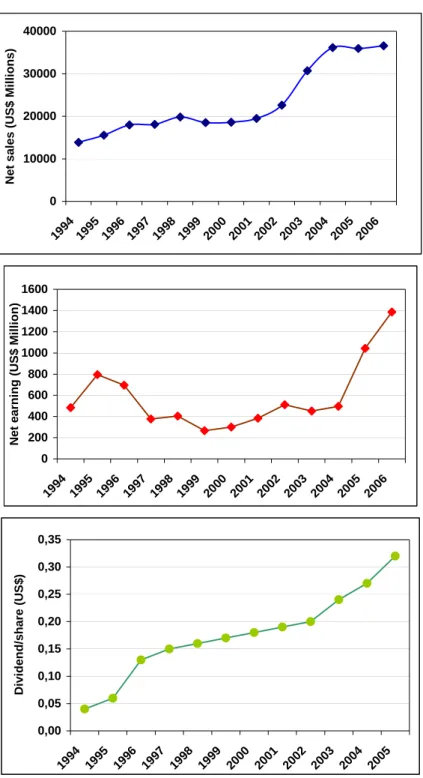
In 2005, ADM employed over 26,000 people, owned more than 250 processing plants and its net sales reached $36.6 billion for the fiscal year ended June 30, 200610. We can observe on the figure 4 the evolution of the net sales, net earnings and dividends by share between 1994 and 2006. During this period, ADM posted an average growth of 10% of its net sales, according to three phases: the first one between 1994 and 1998, with an average growth of 10% per year, the second one between 1998 and 2001 with a stagnation, and the third phase, after 2001, with the recovery of the growth (17% per year). Concerning the net earnings, considerable fluctuations can be observed year after year, but we can notice a significant growth since 2003.
10 According to: http://www.admworld.com/eufr/pressroom/newspopup.asp?id=407&name=Jansen_Named_PresidentG rain_Group
19
Figure 4 : Evolution of ADM’s Net sales, Net earnings and Dividend/share between 1994 and 2006
0 10000 20000 30000 40000 199 4 199 5 19961997 199 8 199 9 200 0 2001 2002 200 3 200 4 200 5 200 6 Net sal es (US $ M il li ons) 0 200 400 600 800 1000 1200 1400 1600 1994 1995 1996 1997 1998 1999 2000 2001 2002 2003 200 4 2005 2006 N e t e a rnin g ( U S$ Million) 0,00 0,05 0,10 0,15 0,20 0,25 0,30 0,35 1994 1995 1996 1997 1998 1999 2000 2001 2002 2003 2004 2005 Di vi dend/ share (US $ )
Source: according to data from http://www.admworld.com
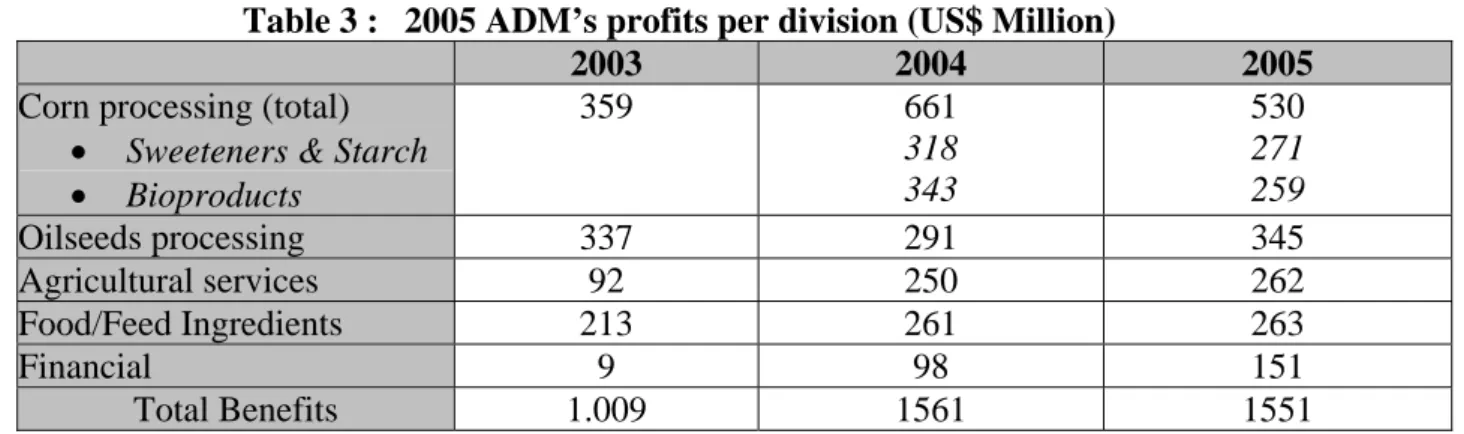
Through the table 3 and the figure 5, we can observe the evolution of the profits distribution between different divisions of ADM since 2003. Two important changes have to be mentioned: on the one hand, the considerable growth of the share of the «Agricultural Services » division between 2003 (9%) and 2004 (16%); on the other hand, the growth of the “Financial” division share between 2003 (1%) and 2004 (6%), and 2005 (10%).
20
Table 3 : 2005 ADM’s profits per division (US$ Million)
2003 2004 2005
Corn processing (total) • Sweeteners & Starch • Bioproducts 359 661 318 343 530 271 259 Oilseeds processing 337 291 345 Agricultural services 92 250 262 Food/Feed Ingredients 213 261 263 Financial 9 98 151 Total Benefits 1.009 1561 1551 Source: http://www.admworld.com
Figure 5 : ADM’s Distribution of profits per division in 2005
Source: http://www.admworld.com
1.4 Corporate strategies:
1.4.1 ADM’s strategy
ADM is the second world’s largest company after Cargill in the global market of oilseed seeds and products. ADM is very large and efficient, and is a truly integrated operation, owning all the chains along the production process. In common with other companies, ADM has been moving into value-added areas such as refining and bottling, and the production of lecithin, soya protein and vitamine E. Since the 1970’s, ADM has a strategy of overseas expansion through join ventures, plants with local companies, purchases in Europe, Central and Latin America, Africa and Asia.
Moreover, the company constantly attempts to maintain higher crush volume in order to achieve the lowest production costs. Consequently, ADM has moved up through the processing chain by being more involved in refining, and entered many new
21
product areas such as soya protein and vitamin E. Finally, we can notice that ADM has fewer but larger plants than many of its competitors, and most of them are located near the raw material source in order to reduce the costs and have a better competitive advantage.
ADM’s operations are strategically located to maximize operational efficiency. ADM operates a network of more than 350 grain elevators, in the United States, South America, Canada and other major global agricultural regions. The strong point of ADM’s processing and elevator system is a group of modern export terminals. These terminal facilities handle and coordinate the worldwide export of agricultural commodities and processed products.
1.4.2 Locations
In 2005, ADM employed 26,000 people in its 260 processing plants (including those owned, leased, or operated in joint ventures) in the United States and 121 overseas. The main worldwide locations are described below:
USA: Headquartered in Decatur, Illinois, ADM has manufacturing, sales or distribution facilities in 40 states, along with a network of country elevators. ADM is the leader in crushing industry with an operational capacity of 60.000 tons per day (2003), which represents more than 30% of the total crushing capacity in the U.S. While ADM production plants operate in other parts of the world, facilities for the entire ADM product line from amino acids to sweeteners, from nutraceuticals to chocolate and more, can be found in the U.S.
Canada: ADM's alliance with Agricore United in Canada enhances the efficiency of the processing facilities there, as Agricore United is one of Canada’s leading agribusinesses. Agricore United’s operations include grain merchandising services, crop input marketing and distribution, livestock production services, and farm business communications.
Mercosur: In Argentina, ADM is present in the grain trade sector but not in the crushing industry. In 2002, ADM Argentina handled 11% of Argentina's wheat exports, 9% of the corn exports and 17% of the grain sorghum exports. ADM notes that its merchandising network is enhanced by its partnership with leading North American and European agricultural cooperatives in A.C. Toepfer International. Toepfer handles 20% of Argentina's wheat exports and 15% of the corn exports. In Brazil, ADM has 6 processing plants (2003), which crushes more than 12,500 tons/day (8,8% of the total crushing capacity in Brazil after Bunge and Cargill).
Other places in Latin America ADM has wheat milling and premix manufacturing facilities in Central America, along with soybean crushing plants, a network of elevators, and Atlantic coast export facilities as well as cocoa processing in South America. With its storage capacity in South America, ADM is one of the continent's largest operators in soybeans and grains. ADM produces sweeteners, starch, and wheat flour in facilities all over Mexico. In addition, the company is involved in numerous joint ventures in the category of corn flour.
22
Europe: ADM has several oilseed crushing facilities distributed throughout Europe. In the UK, the company owns flourmills and meat and dairy alternative production plants. In addition, it has a strong market position in biodiesel production in Germany and is one of the leaders in cocoa production in Europe. ADM has also a fermentation plant in Ireland as well as sales offices in the principal markets. ADM's merchandising network is enhanced by its partnership (since 1983) with A.C. Toepfer International.
Asia and Pacific Rim: ADM has facilities for cocoa bean processing, feed premixes, wheat milling, vegetable oil (palm oil) refining and packaging, corn processing and more throughout Asia and the Pacific Rim. In addition, a number of ADM sales offices are located in this region.
Africa: ADM's presence in Africa is currently limited to a cocoa bean processing facility in Ivory Coast. More growth is expected within this region in the near future11.
1.4.3 ADM’s strategy in France
ADM increased its market-share in the French grain trade market since January 2006 through its joint venture, called Soules Caf SAS, between Union Invivo (50%) and ACTI (50%).
Union In vivo is a French union of 311 cooperatives, active as a purchasing, sales and services company in agriculture, operating in areas such as seeds, agricultural supplies, storage, trading, animal nutrition and health. Union Invivo is the result of the merger in 2001 between two cooperatives, Union des cooperatives agricoles d'agrofournitures (UNCAA) and Union nationale de coopératives agricoles de collecte céréalière (SIGMA). Union InVivo is a main grain elevator, with ten sites and a crushing capacity of 1,2 million tons. To facilitate its exports, the company owns interests in French port’s elevators and has a subsidiary in logistic (MAGEFI Transports).
Soulès Caf is a French company active in the import and distribution (exclusively in France) of feedstuffs rich in protein, mostly soybean meal. This company works with the French distributor Carrefour for the supplying of the Carrefour’s quality industries with Non-GM Brazil soymeal12.
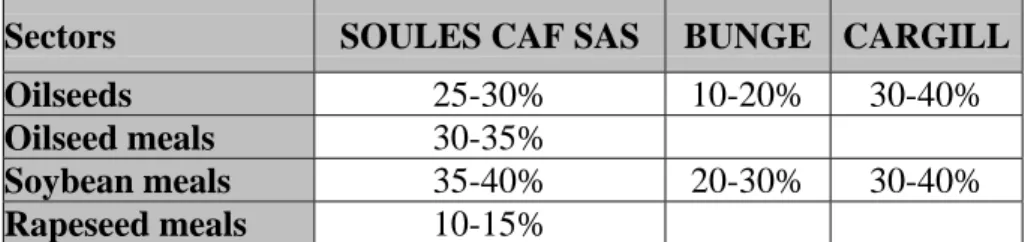
The table 4 describes the potential market-share of Soules Caf SAS in different sectors in relation to the leaders on the French market, Bunge and Cargill.
11
According to: http://www.admworld.com/asen/about/
12
According to: http://www.invivo-group.com/04_actu/comm55.htm; http://www.invivo-group.com/ and Office for Official Publications of the European Communities L-2985 Luxembourg - Regulation (EC) No 139/2004 Merger Procedure ‘Case No COMP/M.4042 - Toepfer / INVIVO / Soulès, in http://ec.europa.eu/comm/competition/mergers/cases/decisions/m4042_20051222_20310_en.pdf#searc h=%22soules%20caf%20adm%20toepfer%22
23
Table 4 : Potential market share of SOULES CAF SAS and its competitors in France (2006)
Sectors SOULES CAF SAS BUNGE CARGILL
Oilseeds 25-30% 10-20% 30-40%
Oilseed meals 30-35%
Soybean meals 35-40% 20-30% 30-40%
Rapeseed meals 10-15%
Source: Regulation (EC) No 139/2004 Merger Procedure 22/12/2005 Case No COMP/M.4042 – Toepfer / InVivo / Soulès
24 2. Bunge
2.1 History :
Founded in 1818, Bunge is a leading agribusiness and food company with integrated operations that circle the globe stretching from the farm field in the producing countries to the retail shelf around the world. Bunge's 23,500 employees at over 450 facilities in 32 countries are dedicated to the global agribusiness and food production chain.
From the origins to the 1930’s: In 1818, a German trader created the BUNGE & Co Company in Amsterdam. For thirty years, the company built its property with tropical product’s trade (wood, cotton, rubber...), from the Dutch colonies predominantly. Grain trade and the growth of Latin America’s market: Quickly, the company became a main actor in Anvers, and began the grain’s trade from Russia and America (US, Canada, Brazil and Argentina mainly). The prosperity of Bunge & Co and the profit from the grain trade allowed increasing considerably business activities.
In 1880, the company settled in Argentina through the founding of a commercial branch; in 1884 Bunge entered into partnership with a german trader Georges Born and they created together a world grain trade company: Bunge & Born. This company would operate at two levels: the sale of Argentinean supply on the world trade market with the collaboration of Bunge in Anvers, and the inputs’ sale on the domestic market to increase the Argentinean grain production.
Between 1880 to 1900, Bunge & Born developed its activities in Africa and in Asia, through the development of ivory and rubber’s trade, and the growth of rubber’s production in South East Asia, in Malaysia and Indonesia.
The majority of its capital was used to built a trade network and develop the agricultural and industrial activities. The rest was indented for business activities in agricultural production.
In 1918, one century after its founding, Bunge began to trade commodities in North America, the world’s largest agricultural market. The company set up Bunge North American Grain Corporation in 1923, to take advantage of the difference in seasons between northern and southern hemispheres. Bunge North America became Bunge Corporation in 1943, as the company continued its efforts to expand beyond trading to add grain production and value-added processing capabilities.
In Latin America, until the half of the 1930’s, Bunge & Born built up a land’s heritage in Argentina, and developed his downstream industrial activities from grain trade: founding of a flour mill in Argentina, in Brazil and in Uruguay.
25
Then, the company decided to diversify its activities in different sectors: cotton (grain, fibers and oil) and other oilseeds like sunflower, flax and peanut. So, in the 1930’s, the company had founded its industrial empire in Latin America, through the diversification of its business and trade’s activities on the Latin America’s market. The company in the 1930’s: Located in about twenty countries around the world, the company controlled a few dozen financial, commercial and industrial firms and employed thousands of people. During the 1930’s crisis, Bunge profited from the prices’ fall of the transportation’s infrastructures, and bought elevators, barges and reinforced its position in the U.S.
The industrial rise during the 1930’s and the 1940’s: During the 1930’s, Bunge took advantage of the will of the Argentinean and Brazilian’s states to develop their industry (milling, crushing, chemistry, textile industry) with a view to establish processing plants on the domestic markets. Bunge founded a subsidiary in Uruguay in 1936.
At the end of the 1930’s, the growth of the cottonseeds crushing market allowed the company to develop his textile industry in Argentina. In Brazil, the company got more and more involved in the fertilizer market, and ultimately became South America's leader in the category.
From Porto Alegre, in 1945, the company dispatched its first export shipment of Brazilian soybeans. Bunge recognized the crucial role of logistics, and created Fertimport in 1947, a Brazilian company that managed raw materiel shipments.
1940’s -1990’s: Over the next 15 years after the founding of Bunge Corporation (1943), Bunge continued to pick up grain elevators across the United States, in the process growing into one of America's top grain handling and exporting firms. Bunge made an even greater commitment to its export business in the 1960’s when it began to focus on the Mississippi River. And in 1961, Bunge opened its first export grain-handling elevator in the region. This elevator, the largest of its kind at the time, connected Bunge’s domestic grain business to world market. In 1967, Bunge added to the facility its first soybean processing plant.
During the 1970’s and 1980’s, Bunge grew along the food production chain by acquiring and building grain origination, soya processing and food products businesses in North and South America. At that moment, Brazil became more attractive than Argentina for foreign investments, so the soya’s market (farming and crushing) increased during the 1960’s and the 1980’s.
During the 1980’s, the American began to consume more ready-to-eat food. Bunge acquired, in 1987, U.S-based Carlin Food Corp., adding a range of bakery products for sale to retail and wholesale outlets, as well as to food processors and foodservice companies.
1990’s and Beyond: The company started business as a commodity trader, and over the following hundred years or so increased in scope and scale, while remaining privately owned, to encompass activities such as agribusiness, paints, chemicals and
26
information technology. The management of Bunge & Born initiated a major restructuring of the business in the 1990s13. In 1992, a decision was taken to radically alter the company, and to focus on food business in the Americas. As a result, most of the other activities have been disposed of between 1992 and 1995.
In 1995, Bunge Agribusiness Limited was founded. The year 1997 marks the beginning of a major expansion’s period for Bunge in South America. The company acquired IAP, Brazilian fertilizer manufacturer, and CEVAL, the largest soya processor in Brazil and a leader in Argentina. Over the next seven years, further acquisitions and organic growth made of Bunge the largest fertilizer producer and soya processor in South America.
By 1998, however, Bunge decided to sell off its last consumer product businesses in Argentina, Australia, and Venezuela in order to concentrate on agribusiness areas as grain and oilseed origination, oilseed processing, export trading, feed, food ingredients, and fertilizers and phosphate-based nutrients.
In 1999, Bunge moved its global headquarters in New-York to be closer to world financial markets, and Bunge Agribusiness became Bunge limited.
In 2000, Bunge created a new international marketing group to trade bulk commodities and generate value through the integration of logistics and financial functions. The company opened a marketing office in China, and in less than three years, Bunge became the largest importer of soya complex commodities in this nation. In 2001, Bunge entered the New-York Stock Exchange issuing 17.6 million shares at $16 each. Bunge acquired La Plata Cereal, from André & Cie S.A., the Swiss agribusiness company and became the leading agribusiness company in Argentina. The join effort between Bunge’s Brazilian and North American operations centralized research on improved food products.
In 2002, Bunge acquired Cereol SA in France, and became the world’s largest soya processor and supplier of bottle oils to consumers. The acquisition made of Bunge a leader in Europe and marked the return of the company to the old continent14.
In 2003, Bunge entered into partnership with Dupont, creating an $800 million specialty food ingredients joint venture named Solae L.L.C. The business, based in St. Louis, intended to be involved in the global production and distribution of specialty food ingredients, particularly Soya proteins and lecithins. Dupont, contributing its protein technologies food ingredients business, garnered a 72 percent stake in Solae, while Bunge received $260 million in cash and a 28 percent minority interest in the new company in exchange for its soybean ingredients business. Furthermore, the deal
13
One of the managers Bunge recruited, Alberto Weisser, joined the company in 1993 as chief financial officer, became Bunge's chairman and chief executive officer. He was named as Bunge director in 1995, CEO in 1999, and ultimately rose to the chairmanship in 2001. Weisser was also instrumental in Bunge hiring other executives from outside the grain trade business.
According to : http://www.fundinguniverse.com/company-histories/Bunge-Ltd-Company-History.html 14
27
required from Dupont and Bunge to use biotechnology to jointly develop and commercialize new strains of soybeans and other products for the farming industry. Bunge continues to focus on growing markets with an Indian oils and fat business: India is now a key area of growth in edible oil consumption.
2.2 Main products and divisions:
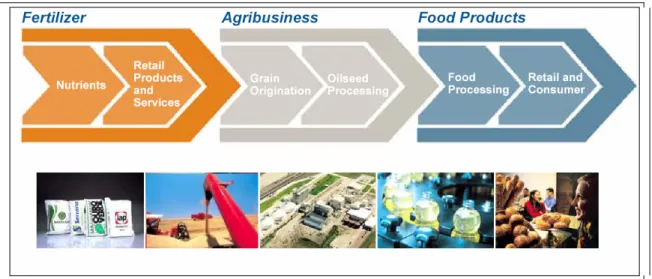
Bunge sells products and services at numerous points along the food production chain, from farm to retail shelf. Each activity complements the next one, creating a logical progression (figure 6) in which they transform bulk commodities into a host of value-added products, while creating multifaceted, mutually beneficial relationships with customers.
Figure 6 : Bunge’s value through integration
Source: According to http://www.bunge.com
Bunge manufactures fertilizers and crop nutrients for farmers, from whom they buy grains and oilseeds. They ship these commodities in bulk to customers around the world, or process them into refined products, such as meals and oils. They sell meal to animal feed and livestock producers (also provide feed nutrients by their fertilizer business), and oil to food processors. They use oil in their own production processes to make a variety of shortenings and edible oils for foodservice and consumer markets. Additionally, Bunge mill wheat and corn for food processors and bakers, and create non-food products, including biodiesel, which are derived from their primary commodities.
• Fertilizer
Bunge is the largest fertilizer manufacturer in South America. Their operations are concentrated in Brazil, but they also sell fertilizers in Argentina. In 2000, Bunge purchased the company Manah, and became the largest fertilizer business in Latin
28
America. Together with its established unit Serrana, Bunge, now, has a 28% share of the fertilizer market in Brazil.
Bunge produces and sells a full line of fertilizers, fertilizer services and animal feed nutrients. It markets some of Brazil’s most well-known and trusted brands, including Serrana, Manah, IAP and OuroVerde. Their forty facilities are located in and around the country’s primary agricultural areas to be close to their customers.
Its retail operations produce, distribute and sell blended NPK (nitrogen, phosphate and potassium) fertilizer formulas, mixed nutrients and liquid fertilizer products directly to farmers and retailers. They also produce a range of raw and intermediate materials used in fertilizer production.
It precision agriculture unit incorporates GPS mapping techniques and a team of agronomists to create specialized fertilizer solutions for farmers. This service helps farmers to maximize yields and reduce the total amount of fertilizers needed per crop by tailoring nutrition to the hectare.
Through a partnership with DuPont, Bunge sells a range of crop chemicals and production agriculture products.
• Agribusiness
In the agribusiness division, Bunge purchases, processes, stores, transports and sells agricultural commodities, principally oilseed products. Profitability is mainly affected by the relative prices of oilseed products which are, in turn, influenced by global supply and demand for agricultural commodities and industry oilseed processing capacity utilization, and prices volatility of these products. Profitability is also affected by energy costs, as the company uses a substantial amount of energy in the operation of his facilities, and by the availability and cost of transportation and logistics services, including truck, barge and rail services. Availability of agricultural commodities is affected by weather conditions, governmental trade policies and agricultural growing patterns, including substitution by farmers of other agricultural commodities for soybeans and other oilseeds.
Grain and oilseeds: Bunge buys grains and oilseeds from farmers, and stores, blends and sells them to commodity customers. It handles soybeans, rapeseed, sunseed, canola, wheat, sorghum, corn and other products, and it manages an origination network of approximately 275 country elevators in North America, South America and Europe. The location of these facilities is chosen in order to maximize farmers’ efficiency and to provide an easy distribution to end customers.
Bunge sells products over 90 countries. Its ability to originate crops across hemispheres and continents ensures a year-round supply for customers. It also offers product variety and the flexibility to ship around delays in public ports and transport networks.
29
The control of products from origination to destination ensures quality and consistency, and allows Bunge to supply customers also with segregated and identity-preserved products, such as GMO-free soya.
In addition to fulfilling product needs, Bunge creates financial solutions, including trade structured finance and risk management, to help commodity customers to control expenses and risks.
Oilseed processing: Bunge processes oilseeds (soybeans, canola, rapeseed, sunseed) into meal, oil and other byproducts.
Its processing facilities, approximately 50, are located in North America, South America, Europe and Asia. Their strategic locations offer an outstanding coverage of the domestic markets and an efficient access to the export trade. Bunge is a major supplier of the Caribbean, Asia, North Africa and the Middle East.
Bunge produces and sells a host of oilmeal products, with varying protein, fat and fiber content. They also produce a range of bulk edible oil products for sale to food processors and foodservice customers. Their oil products include crude, refined and emulsified oils, and liquid and solid shortenings. The other sold products include soybean hull pellets, which they sell as an animal feed additive, and biodiesel in Europe.
Shipment and transport: Bunge manages successfully - in terms of efficiency, customer services and risk management - a 150-ships fleet by integrating this timecharter fleet with the port and inland logistics network.
• Food products
Bunge’s Food Products division is a major supplier of edible oils and shortenings to food processors and foodservice customers, and is a leading supplier of consumer
30
edible oils and related products in select markets. Their operations are located in the United States, Canada, Brazil, India and numerous European countries.
In the food products division, which consists of edible oil products and milling products segments, their operations are affected by competition, changes in eating habits and changes in general economic conditions in their main markets: Europe, the United States and Brazil, as well as the prices of raw materials such as crude vegetable oils and grains.
North America: Bunge supplies food processors and foodservice customers in the United States and Canada with a full line of bulk and packaged premium shortenings, oils and related products.
Brazil: Bunge supplies Brazilian consumers, food processors and foodservice providers with a wide variety of products, from edible oils to soya beverages. For food processors and foodservice customers, Bunge manufactures edible oils, shortenings, margarines and mayonnaise. For consumers, Bunge produces margarines, bottled oils, mayonnaise and other products.
India: In India, Bunge supplies the retail oil and commercial bakery markets. Bunge owns Dalda. It also creates specialized shortening and oil products for commercial bakeries and operates a bakery product development and customer training center. Europe: Bunge is a leading seller of bottled oils to consumers, and bulk and packaged oils to food processors and foodservice customers. Their primary products, by country, are the following (table 5).
Table 5 : Which Bunge’s products in witch European country? Germany Private label bulk and bottled oil
Austria Bulk oil
Hungary Retail bottled oils: Vénusz and Floriol
Poland Private label; retail bottled oil: Kujawski; retail margarine Romania Retail bottled oils: Floriol and Unisol
Bulgaria Bulk; retail bottled oils: Kaliakra Russia and Ukraine Retail bottled oil: Oleina and Ideal
France Retail bottled oil: Lesieur
Italy Private label bottled oil
Source: According to http://www.bunge.com
• Milling:
Bunge mills wheat and corn in North America and Brazil. They supply food processors, foodservice customers and others with a range of nutritious and functional food products.
North America: From facilities in the U.S. and Canada, they supply “prime” products, including corn grits, flour, bran and meal, to many of the continent’s largest brewers, snack food and cereal companies. The corn dry milling process also creates
31
hominy feed, a popular animal feed additive, and bulk corn oil, a cholesterol-free food ingredient. Bunge creates a variety of bulgur wheat products for cereal manufacturers and other food processors in the U.S. and Mexico.
South America: In Brazil, Bunge is a significant producer of wheat-based products for food processors, foodservice customers and specialty bakeries. They market some of the country’s most trusted brands. Specifically, Bunge produces and sells industrial wheat flours and flour and mixes for commercial bakeries. Bunge operates wheat mills in Brazil's largest population centers.
2.3 Financial summary
With its corporate headquarters located in New York, Bunge Ltd. is a global agribusiness and food company divided into three segments.
The agribusiness division, which accounts for 42 percent of the company's operating profit in 2004, is comprised of three business lines: grain origination, oilseed processing, and international marketing. Bunge is a leading global soybean exporter. The fertilizer division, which accounts for 44 percent of the company's operating profit in 2004, supplies the South American market, primarily Brazil, where Bunge is the only integrated fertilizer producer.
The food products division accounts for 14 percent of the company's operating profit in 2004. It takes advantage of the raw materials-soybeans, crude vegetable oils, wheat, and corn-available through the company's agribusiness operation, to engage in four business lines: edible oil products, wheat milling and bakery products, soya ingredients, and corn products.
In 2005, Bunge’s main problems stemmed from a weak operating environment in Brazil. Farm economics deteriorated because of drought, lower soybean prices and a steadily appreciating Brazilian real.
The figure 7 and the table 6 show the constant growth of net sales and net earnings since 2000, with an increase of approximately 60% of the net sales between 2002 and 2003, and the same growth of net earnings between 2003 and 2004.
Table 6 : Annual Bunge’s growth per year of net sales and net earnings between 2001 and 2005
2001-2002 2002-2003 2004-2005
Net sales and other operating income 21% 60% 14%
Net earnings 90% 18% 56%
32
Figure 7 : Evolution of Bunge’s Net sales and Net earnings and Dividend/share between 2000 and 2005
0 5000 10000 15000 20000 25000 30000 2000 2001 2002 2003 2004 2005 N e t s a le s ( M il lio n s U S $ ) 12 134 255 300 469 530 0 100 200 300 400 500 600 N e t ea rn ings (Mil li ons U S $ ) 2000 2001 2002 2003 2004 2005
33 0,095 0,385 0,42 0,48 0 0,1 0,2 0,3 0,4 0,5 D ivi d e nds/s har e (U S $ ) 2001 2002 2003 2004 Source: http://www.bunge.com
The profits’ distribution per division in 2005 is illustrated through the figure 8.
Figure 8 : Bunge’s operating profits by division in 2004