HAL Id: hal-01140919
https://hal.archives-ouvertes.fr/hal-01140919
Submitted on 9 Apr 2015HAL is a multi-disciplinary open access archive for the deposit and dissemination of sci-entific research documents, whether they are pub-lished or not. The documents may come from teaching and research institutions in France or abroad, or from public or private research centers.
L’archive ouverte pluridisciplinaire HAL, est destinée au dépôt et à la diffusion de documents scientifiques de niveau recherche, publiés ou non, émanant des établissements d’enseignement et de recherche français ou étrangers, des laboratoires publics ou privés.
Food waste and promotions
Guillaume Le Borgne, Lucie Sirieix, Sandrine Costa
To cite this version:
Guillaume Le Borgne, Lucie Sirieix, Sandrine Costa. Food waste and promotions. [University works] auto-saisine. 2014, 10 p. �hal-01140919�
WORKING-PAPER – UMR MOISA
_______________________________
WORKING PAPER MOISA 2014-5
Food waste and promotions
WORKING-PAPER – UMR MOISA
_______________________________
Food waste and promotions
Guillaume Le Borgne1, Lucie Sirieix1, Sandrine Costa2
1
Montpellier SupAgro, UMR 1110 MOISA, F-34000 Montpellier, France
2
INRA, UMR 1110 MOISA, F-34000 Montpellier, France
Abstract
This research builds a conceptual framework to analyze the links between promotions and food waste, based on the results of a qualitative study on 20 French consumers. More precisely, we study how promotions may increase food waste, but also how this wastage may change consumer’s perception of promotions.
Keywords
Food waste, offers, skepticism, consumer, households
Gaspillage alimentaire et promotions
Résumé
Cet article propose un cadre conceptuel pour l’analyse des liens entre les promotions et le gaspillage alimentaire, basé sur les résultats d’une enquête qualitative menée auprès de 20 consommateurs européens. Plus précisément, nous étudions comment les promotions sur les produits alimentaires sont susceptibles d’augmenter le gaspillage alimentaire des ménages, mais également comment cet éventuel gâchis peut influer sur la perception des promotions par le consommateur.
Mots-clés
Gaspillage alimentaire, promotions, scepticisme, consommateur, ménages
Code JEL : M310
Source
Introduction
Promotional offers on food products are often cited as a major factor of waste for households (Brook Lynhurst, 2007; WRAP, 2007). These offers would tend to disturb consumer’s efforts tempting to plan and manage his food purchases in relation to his needs and stocks.
Many researches have been led on the consequences of promotional offers, on quantities purchased or more generally on purchase behavior. It has already been shown that promotions generate an increase in quantities purchased by consumers (Blattberg and Neslin 1989), and also an increase in consumption rate of certain products (see for instance Ailawadi 1998). Studies have also identified the expected benefits of promotions from the consumer’s point of view (Chandon et al. 2000). However, to our knowledge, no research has yet studied the link(s) between promotions and food waste.
The scientific studies on consumer food waste have shown that food purchase behavior is one of the predictors of food waste, where food purchase behavior includes the purchase of unintended items and the checking of food inventories before shopping (Stefan et al. 2013, Stine 2012), as well as making a list before shopping (Stefan et al. 2013). Evans (2011) shows how time constraints contribute to explain why consumers do not make shopping lists and more generally purchase food routinely. However, none of these studies elicits the links between promotions and food waste.
We propose here a framework which analyses the links between promotions and food waste. More precisely, we study how promotions may increase food waste, but also how the fact of wasting food may change consumer’s perception of promotions. The conceptual framework we propose is based on the results of a qualitative study on 20 French consumers.
This paper presents in the first part, the conceptual model of binary relationships between promotions and food waste; in the second part, the interview guide and consumers sample; in a third part it analyses the results of interviews. More specifically, these results highlight how food waste might be a consequence of negative experiences following purchase with promotions, how food waste is perceived by consumers and which are the possible negative consequences for consumers, and finally show that food waste might increase consumer’s skepticism and resistance to promotions. Conclusion finally proposes recommendations for brand managers and retailers, and for social marketing.
PART 1: A CONCEPTUAL MODEL OF BINARY RELATIONSHIPS BETWEEN PROMOTIONS AND FOOD WASTE
Several studies focus on sales promotions adopting the consumer perspective. Some focus on the expected benefits and cost of promotions. Chandon et al. (2000) propose a framework of the hedonic and utilitarian consumer benefits of sales promotions but do not explore the negative promotional effects. With their model, Raghubir et al. (2004) suggest that there are three routes through which promotions work: the economic utility they provide, the information they convey and, the feelings (both positive and negative) they arouse. Another set of studies focus on the consequences of promotion purchase in terms of consumption incidence and quantity (Chandon and Wansink 2002).
However, none of these studies deals with the gap which may appear between the expected benefits of sales promotions and the actual consumption experiences including the negative ones. Further these negative experiences might lead the consumer to throw away and waste. Moreover, some papers have highlighted that consumers do have a waste aversion (Arkes 1996), or an aversion to unused utility (Bolton and Alba, 2012), and that this aversion on unused utility modifies their buying behavior : consumers prefer buying less at a more expensive price, rather than having more and wasting at a cheaper price (Bolton and Alba 2012). In other words, consumers might anticipate waste during shopping. Consequently, waste might induce consumers to be less sensitive to promotional offers.
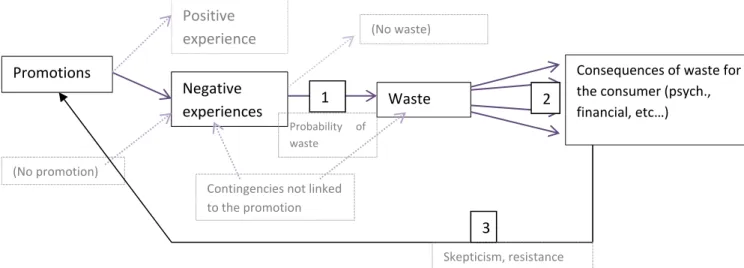
We propose here a conceptual model which analyses the complex relationships between promotions and food waste. This framework takes into account the effect of promotions on food waste, as well the effect of food waste on the attitudes towards promotional offers. This framework includes three steps.
First, food waste might be a consequence of negative experiences following a promotional purchase. We propose, thanks to the content analysis of our interviews, a typology of negative experiences following the purchase of promotional items and highlight those who might lead to waste.
Second, the effect of promotions on food waste, as well as the effect of food waste on the way the consumer perceives promotions do depend on the consequences of food waste for the consumers. These consequences might be perceived negatively for the consumer, or not. To analyze how consumers perceive food waste consequences, we define the risk of food waste and its different dimensions, based on the conceptualization of consumer perceived risk by Mitchell (1999).
Third, Obermiller and Spangenberg (2000) have highlighted that consumers skepticism might be the result of a negative experience. When consumers do care about food waste and perceive some of its consequences to be negative, they may anticipate the risk of food waste during purchase and become skeptical about promotions. ..
Figure 1 describes this framework, before it is completed thanks to the qualitative study we’ve run. The directional arrows (1), (2) and (3) correspond to the three steps described previously.
FIGURE 1: A CONCEPTUAL MODEL OF RELATIONSHIPS BETWEEN PROMOTION
AND FOOD WASTE
Part 2: INTERVIEW METHODOLOGY
We’ve run a qualitative study based on semi-directive interviews with 20 consumers (in the city of Montpellier, FR), leading to an analysis of content. Respondents have been chosen to diversify several criteria, such as age, gender, occupation, revenues, and family situation. The sample is obviously not representative of the whole diversity of French consumers (for instance, all of them live close to relatively big city), but here the goal is to pick up ideas and elements of speech to strengthen and fill our framework.
After simple and closed questions on consumer’s habits of purchase of food products, our guide of interview has two parts:
In order to identify the possible (and relevant) negative experiences following the purchase of a product in promotion, the first part discusses the benefits and disadvantages people find in promotions on food products: “Do you sometimes buy products in promotion ? For you, what are the advantages of promotional offers? Are there disadvantages? Have you ever experienced drawbacks after a promotion?” The way we asked questions may prompt the respondent to remind particular (negative) experiences after a promotional purchase: “Can you remember a bad experience after the purchase of a product in promotion?” In this first part, the fact of throwing away (all or a part of) the product often emerged in responses. In that case, we asked people to explain the cause of this disposal, the “negative experience” we are looking for (preceding the negative experience of throwing food away).
In the second part, we discuss on food waste in consumer’s household: its occurrence and the consequences of it for him or her. We first discuss the eventuality of wasting food: “Does it sometimes happen that you or your relatives don’t consume all or a part of a food product? Do you have in mind a recent example?” Then, questions about occurrence and consequences according to the type of product: “Are there products which might be thrown away more often than others? Are there products which it is worse to waste?” Finally, we arrived in the core of the second part, discussing on the consequences of wasting food. Often starting from the example the person gave us, we asked: “Then how did you feel? […] Why does it bother you?” Or: “Does it bother you throwing food away? When? Why? What bothers you in wasting food? “ ... The content analysis consists in selecting and extracting the data in relation to the bad experience that may exist facing promotions, on the one hand, and the consequence
Promotions Negative experiences (No promotion) Waste (No waste) Contingencies not linked to the promotion Positive experience Consequences of waste for the consumer (psych., financial, etc…) 1 2 3 Probability of waste Skepticism, resistance
of waste, on the other hand. This analysis is led across the 20 interviews after the transcription of the interviews. It seems that we manage to reach a semantic saturation as regards the types of negative experiences and the consequences of food waste for consumers. In this way, we are able to sort out and gather the data under appropriate chosen terms. Thus, this thematic analysis (Blanchet and Gotman 1992) permits us to establish two complete typologies including types stemming from the synthesis both vertical (one kind of thinking) and horizontal (several consumers).
PART 3: ANALYSIS OF THE RESULTS
As announced formerly, the results are organized in three main parts: the negative possible experiences following a promotional purchase, the perceived and experienced consequences of wasting food, and then the effect of food waste on promotions perception.
a) Negative consequences/experiences following a promotional purchase
We identified seven types of negative experiences, related to: price, quantity, quality/expiry, storage, taste, variety, and uselessness. Except negative experiences related to price, all of them may lead to waste and are particularly interesting for our study.
Negative experiences on price consist in discovering after the purchase that the expected price profit doesn’t “exist”, or that it is not significant. “It was a pseudo-promotion on
biscuits […] it was for sale as a promotion but in reality it was more expensive. I was in a hurry, I didn’t look at the price, and I saw afterwards that I had got cheated.” Interview 4.
This kind of bad experiment has no direct or obvious consequence on waste.
The quantity of a product purchased in promotion is often superior to the usual quantity bought by the consumer (as shown by Blattberg and Neslin, 1989). It can be because of a lower price for each unit, a multi-pack offer or a bigger format. This can lead to a negative experience which may generate waste directly. For instance, having too much, so that you cannot finish up the product before its expiry: “You buy a big quantity and so, throw away
half of the product because it’s opened, and finally, it goes beyond the expiration date”.
Interview 12. Here we also see a problem of storage and preservation. This can also lead to a
lack of variety: “You are obliged to eat the entire can […] and eating the same thing all week
long, this is not fantastic…” Interview 10 linked with waste, even if in this example, the lack
of variety comes from the attempt to avoid waste.
The special offer purchased – mostly in the case of “close-to-expiry-date promotions” - can be on a product whose expiry date is too close to allow the consumer to eat it totally, or even already altered or spoiled (quality/expiry problem). “Once, we bought [discounted disserts]
and we had not seen that they were already outdated. We hadn’t paid attention at that time, and then we threw everything”. Interview 14. It can also be a product that the consumer has
never tried (and he tries it because of the promotion), and finally the consumer does not like the product’s taste: “I bought four of them, and I’ve started to eat the first one and…oh no,
disgusting!” Interview 8. The product purchased can, finally, be useless to the consumer
(who, for instance, cannot cook it), or be far from his needs. “It is true when you see the offer,
As we said, except those on price, all these bad experiences can lead consumers to waste
food. And thus, different feelings and points of view can emerge in the consumer’s mind
facing their waste.
b) The consequences of “wasting food”
Throwing away food which, at some point, was edible is not without consequences for the consumer. In our interviews, we identified five different declared consequences of wasting food: financial, environmental, moral and societal, social, and psychological consequences. These dimensions are not exactly the same as the perceived risk dimensions proposed by Mitchell (1999). We do not consider the physical risk but do consider an environmental one. Indeed, we didn’t find any excerpts concerning the physical consequence of wasting food, whereas there is obviously environmental consequence in wasting food.
The financial consequence (wasting food is a monetary loss for consumers) was very often cited, and seemed to be the main concern for the interviewees: “It is always annoying to
throw away products, especially expensive product such as meat”. Interview 14. “It is a
waste of money”. Interview 16.
Environmental consequences are also taken into account: “I think that, for the Planet, [...] if
you think of transportations and protection stuffs and so on, yes, it is still waste”. Interview
16. Furthermore, ethical, moral and societal concerns were raised: “It annoys me to throw
out anyway because there are people who don’t have enough money to eat.” “Well, it is also a matter of respecting work [of producers]”. Interview 12.
Wasting food also has what we might call a social impact. Indeed, as society nowadays places food waste as one of the main current issues, the image displayed when someone throws food is seriously taken into account: on the one hand, by the one who wastes (he pays attention to the image he gives), on the other hand, by the one who sees it (he can frown it upon and look at the person who wastes with a new point of view). “I had a friend: for two adults and one
child, she cooked pastas for ten people! She ate it for lunch, for diner and perhaps for the next lunch and then, she threw the rest. I made her notice that…but well… […] I think there are many people like that”. Interview 18.
Finally, wasting food has many psychological consequences for the consumer. It can affect him, and his self-esteem: “I feel guilty, I am very affected.” Interview 16. It can be dissonant with the consumer’s self-image, or with his personal values: “Since I’ve worked here [in a
University of Life Science], it [wasting food] has gotten on my nerves, really, it’s raised me many problems”. Interview 16. If a product carries a high sign value, or has been
appropriated by the consumer cooking it himself, throwing this product can have higher psychological consequences: “I don’t mind throwing away pizza I didn’t finish. Not because it
is cheaper, but because it is not a marvelous product, […] it is not something extraordinary I would have cooked.” Interview 12.
Thanks to this qualitative analysis, we highlighted here the different ways of considering the consequences of waste in order to establish later, with a quantitative study, the degree of consumer’s sensibility to each of the six proposed consequences. Some quotes can already show that, depending on the consumer, some dimensions might be more important than others.
The financial consequence of waste can affect the consumer less than the psychological one as we can see here: “(Does it annoy you to throw away?) Oh yes, it is a true frustration. It is
something I do not like. And it is not for the financial aspect, I am not stingy. It is truly for the wasting thing”. Int. 10. On the contrary, the quote: “It is always annoying to throw away, especially expensive products as meat. Eggs, we know that we have to throw them anyway,
milk too, thus, it does not bother us, and we throw it away because the expiry date is passed”.
(Int. 14) shows that the psychological consequence is less important than the financial one, in the consumer point of view. Besides, avoiding any physical risks is often a justification for throwing food away (because it prevents from possibly worse – objective or subjective – consequences) and thus relieves consequences of waste for the consumer.
c) The effect of food waste on the way consumers perceive promotions
After having experienced a waste of a product related to promotion, the consumer may develop a strategy of anticipation while doing his grocery shopping. Indeed, he pays more attention to what he is buying: (If there are offers, do you buy more quantity?) Ah no, no, I
only take what I need or else I throw! Int. 2. In this case, the anticipation is directly related to
the possibility of wasting but in some other situations it is indirect. For instance, the consumer looks after the expiry date keeping in mind the danger of a possible waste: Sometimes there
are offers on expiry dates … In that case, I am really careful so that I am sure I would be able to use it. Int. 17.
A certain form of resistance or skepticism might grow in the consumer mind and have an impact on his attitudes towards promotions: “Sometimes in stores I resist when there are big
packs, for instance the chicories, they sell them by one kilograms pack. So, I never buy it, I buy them one by one, to resist to a possible waste.” Int. 16. The consumer can feel constraint:
“It could be interesting from a financial point of view, but it tends to prompt to consumption,
as people say, because we are obliged to consume the entire can. And, it prevents from varying meals.” Int. 10.
Finally, the following quote is particularly interesting as it sums up the three steps introduced hereabove: “There is often meat not that great […] because the expiry date is reached… It
occurred to me to throw it away. (Waste) I took it because it was on a special offer obviously, it was cheaper but… I will not to do it again… It was when I opened it, it smelled awful and I threw it. (a. Bad experiences of promotions) […] Now, when I look at it, I really pay attention to the expiry date. (c. Anticipation) […] Once you have been had, you become suspicious. […] It hurts the heart because you feel deceived … not respected. (b.
Consequences of waste) Int.3
Conclusion/Discussion
Chandon et al.’s typology of consumer’s expected benefits of sales promotions contains six types: savings, quality, convenience, value expression, entertainment, exploration. Our study allows to extend this “expected benefits framework” to its symmetric “anticipated disadvantages” and/or “experienced disadvantages” of promotions. In our work, we have chosen to highlight the bad experiences which can generate food waste. These bad experiences can be due to quantity, taste, preservation and storage, uselessness, meal variety and expiration date and quality (Table 1) and lead to food waste.
This qualitative study allows us to conceptualize food waste as a perceived risk, and its negative consequences: financial, environmental, social, ethic or societal and, psychological (Table 1). This study then highlights that food waste might increase resistance or skepticism of consumers.
Recommendations
The consequences of food waste, may interest brand managers and retailers since the experience of wasting food (and the consequences we highlighted here) can have an influence on future attitude and behavior of the consumer towards a product, a brand, or a retailer. If the wasted product has been purchased in promotion, consumer’s skepticism can be towards the brand, the retailer, or promotions themselves, and, ultimately, can result in a decrease of the consumer intention to purchase a particular product or brand, or at a particular store. To avoid this, managers should take into account these waste-generating bad experiences. Therefore, they might differentiate themselves from other brands or retailers by helping consumers to avoid bad experiments and food waste thus improving their image. Indeed, we can imagine three benefits: the positive effects on consumers’ confidence on the brand or the store, the opportunity to communicate on their contribution to tackling food waste, and a “value benefit”: a brand which shows interest in reducing waste of his products may also increase the perceived value of these products (and thus the perceived value and sincerity of the promotion), through the idea that “if one asks you (or help you) to take care of something (here: avoid wasting), this must certainly be something rather precious”.
This research also leads to recommendations for social marketers. From the proposed consumers’ perceived consequences of food waste, it should be possible to adapt messages to help consumers to improve their promotional purchases, and more generally their management of food at home. Some campaigns already insist on the financial and ethical consequences of wasting food, but other dimensions deserve to be taken into account.
Limits of this study and further research
This work remains an explorative and qualitative study to prepare quantitative studies on the cause/consequence links we have discussed here. Besides, to go further, an observation in households might be a good way to go beyond the declarative nature of interviews, which is very important in an issue such as food waste, given that it is often subject of denial from interviewees.
The main contribution of our study is to integrate the experience of waste to a framework which allows us to think about the links between food waste and promotional offers, via the negative experiences which can arise from a promotional purchase. In addition, the characterization of consequences of waste will allow us to go further, studying the impact of these consequences on consumers’ attitudes and behavior towards promotions, and more generally towards food consumption and the issue of food waste.
References
Ailawadi, K.L. and Neslin S.A. (1998), “The Effect of Promotion on Consumption: Buying More and Consuming It Faster”, Journal of Marketing Research, 35(3), pp.390–398.
Arkes, H. R. (1996), “The psychology of waste”, Journal of Behavioral Decision Making, Vol. 9, n°3, p. 213‑224.
Blattberg R.C. and Neslin S.A. (1989), “Sales promotion: The long and the short of it”,
Marketing Letters, 1(1), pp.81–97.
Bolton, Lisa E., and Alba, J. (2012), “When less is more: Consumer aversion to unused utility”, Journal of Consumer Psychology, Vol. 22, n°3, p. 369‑383.
Brook Lynhurst (2007), “Food Behavior Consumer Research: Quantitative Phase”. Edited by WRAP. 40p.
Chandon P., Wansink B. and Laurent G. (2000), “A Benefit Congruency Framework of Sales Promotion Effectiveness”, Journal of Marketing, 64 (4), 65–81
Chandon P. and Wansink B. (2002), “When Are Stockpiled Products Consumed Faster? A Convenience-Salience Framework of Postpurchase Consumption Incidence and Quantity”,
Journal of Marketing Research, 39(3), 321–335.
Mitchell V.-W. (1999), “Consumer perceived risk: conceptualizations and models”, European
Journal of Marketing, 33(1/2), pp.163–195.
Obermiller C. et Spangenberg E. (2000), “On the origin and distinctness of skepticism toward advertising”, Marketing Letters, 11, 4, 311-322.
Raghubir P., Inman J., Grande H. (2004), “The Three Faces of Consumer Promotions: Economic, Informative, and Affective”, California Management Revue, 46, 4, 23-42
Bad Experience(s) on sales promotions
Description of the
Experience(s) Excerpts from Interviews
QUANTITY
The consumer buys a product on a special offer on quantity. The excess of the product is linked with:
- the expiry date too close - the wrong evaluation of needs - the lack of consumption capacity
I see something on special offer during three days, I say to myself: “4 yoghurts before Tuesday, I’m going to eat them” [...] And when I bought yoghurts, I didn’t think that I was going to buy fresh products the next day [...] And when I look at my expiry dates, I say to myself: “Damn, the expiry dates are exceeded” because I preferred eating fresh products at once. I knew it, but I thought that I was able to consume faster and I throw it away. Interview 9
I said to myself: “Ah, there is an offer, it is better… I know I don’t have enough time to eat everything before going on holiday, but…”.I knew it would be necessary to throw it out but…I know it’s bad, but… Int.8
TASTE
The consumer buys a promoted product he has never tried, but does not like it.
I bought four of them, and I’ve started to eat the first one and…oh no, disgusting! Int.8
Fresh creams, no brand, which I took for my grandson. They were really very liquid. Special offer, no brand, in shelf only with sales promotion. And it was very liquid… Int.3
PRESERVATION AND STORAGE
The consumer cannot store the product during a long time because of a bad management of his storages.
You buy a big quantity and so, throw away half of the product because it’s opened, and finally, it goes beyond the expiration date. Int.12
USELESSNESS
The consumer buys a promoted product which he finally does not need.
Special offers might have an effect on “invitation to purchase things you don’t need”. Int.10
It is true that when you see the offer and you buy it and finally, you don’t really need it. Int.14
MEALS’ VARIETY
The promoted product prevents the consumer from varying his meals. It causes lassitude and raises balanced diet issues.
So, it could prompt people to eat a less balanced diet, less according to their specific needs. Int.13
You are obliged to eat the entire can. And it prevents from varying meals […] and eating the same thing all week long, this is not fantastic…
Int.10
EXPIRATION DATE AND
QUALITY
The consumer buys a product on special offer which is already or quickly outdated.
It was certainly a product which already had an expiry date and they have changed it. They did it because that, they do it, because… so that it is lost at the end of two days… Int.6
Once, we bought [discounted disserts] and we had not seen that they were already outdated. We hadn’t paid attention at that time, and then we threw everything. I think it was yoghurts. Int.14
(TABLE 1 (above): Summary of the main results of the content analysis – excerpts from interviews Consequences of
Food Waste Description of the Consequences Excerpts from Interviews
FINANCIAL Monetary loss due to waste.
It is always annoying to throw away products, especially expensive product such as meat.
Int.14
It is a waste of money. Int.16
I would rather think of price issue. Thus, for me, it is less important to throw out half of the bottle of milk than a piece of meat […] because it is not the same purchase price. Int.15
ENVIRONMENTAL Negative environmental impact, direct
or not, of waste.
I think that, for the Planet, [...] if you think of transportations and protection stuffs and so on, yes, it is still waste. Int.16
SOCIAL
Social representation given to the others, peers or not with the act of wasting food.
However what shocks me most, it is when somebody peels carrots or potatoes with a knife and not with a peeler. When you see the amount of peels, even if you put it in compost, I think it is waste. Int.18
I had a friend: for two adults and one child, she cooked pastas for ten people! She ate it for lunch, for diner and perhaps for the next lunch and then, she threw the rest. I made her notice that…but well… […] I think there are many people like that.
Int.18
ETHIC/MORAL AND SOCIETAL
Moral awareness about the World issues on food security and Ethic problems related to people in needs, both linked to food waste.
It annoys me to throw out anyway because there are people who don’t have enough money to eat. Thus, I would prefer to give it to someone rather than throw it away.Int.12
I prefer to make a donation to food bank rather than to waste.Int.10
PSYCHOLOGICAL
Wasting food can have psychological consequences:
‐ Decrease of self-esteem ‐ Feeling of having been cheated ‐ Different sensations depending on
the sign value product
‐ Dissonance and non-coherence between the consumer and the image he has of himself.
‐ Dissonance and non-coherence between the consumer and his values. It hurts the heart because you feel deceived … not respected. Int.3 I feel guilty. I am very affected. Int.16
I don’t mind throwing away pizza I didn’t finish. Not because it is cheaper, but because it is not a marvelous product, […] it is not something extraordinary I would have cooked.Int.12
Since I’ve worked here [in a
University of Life Science], it
[wasting food] has gotten on my nerves, really, it’s raised me many problems. Int.16 It is the fact of throwing food away in general that disturbs me.Int.11