HAL Id: insu-02291811
https://hal-insu.archives-ouvertes.fr/insu-02291811
Submitted on 2 Dec 2019HAL is a multi-disciplinary open access archive for the deposit and dissemination of sci-entific research documents, whether they are pub-lished or not. The documents may come from teaching and research institutions in France or abroad, or from public or private research centers.
L’archive ouverte pluridisciplinaire HAL, est destinée au dépôt et à la diffusion de documents scientifiques de niveau recherche, publiés ou non, émanant des établissements d’enseignement et de recherche français ou étrangers, des laboratoires publics ou privés.
Yves Moussallam, Marc-Antoine Longpré, Catherine Mccammon, Alejandra
Gómez-Ulla, Estelle Rose-Koga, Bruno Scaillet, Nial Peters, Emanuela
Gennaro, Raphael Paris, Clive Oppenheimer
To cite this version:
Yves Moussallam, Marc-Antoine Longpré, Catherine Mccammon, Alejandra Gómez-Ulla, Estelle Rose-Koga, et al.. Mantle plumes are oxidised. Earth and Planetary Science Letters, Elsevier, 2019, 527, 115798 (10 p.). �10.1016/j.epsl.2019.115798�. �insu-02291811�
Mantle plumes are oxidised
1
Yves Moussallam1,2, Marc-Antoine Longpré3, Catherine McCammon4, Alejandra
2
Gomez-Ulla1, Estelle F. Rose-Koga1, Bruno Scaillet5, Nial Peters6, Emanuela Gennaro7,
3
Raphael Paris1, Clive Oppenheimer6
4 5
1 Université Clermont Auvergne, CNRS, IRD, OPGC, Laboratoire Magmas et Volcans, F-63000 6
Clermont-Ferrand, France
7
2 Lamont-Doherty Earth Observatory, Columbia University, New York, USA 8
3 School of Earth and Environmental Sciences, Queens College, City University of New York, Queens, 9
NY 11367, USA
10
4 Bayerisches Geoinstitut, University of Bayreuth, D-95440 Bayreuth, Germany 11
5 ISTO, UMR 7327, Université d’Orléans-CNRS-BRGM, 1A rue de la Férollerie, 45071 Orléans cedex 12
2, France
13
6 Department of Geography, University of Cambridge, Downing Place, Cambridge, CB2 3EN, UK 14
7 Istituto Nazionale di Geofisica e Vulcanologia, Sezione di Palermo, Via Ugo La Malfa, 153, 90146 15
Palermo, Italy
16 17
Corresponding author: Yves Moussallam; [email protected] 18
19
Keywords: oxygen fugacity; degassing; XANES; melt inclusions; mantle plumes 20
ABSTRACT
22From oxic atmosphere to metallic core, the Earth’s components are broadly stratified with 23
respect to oxygen fugacity. A simple picture of reducing oxygen fugacity with depth may be 24
disrupted by the accumulation of oxidised crustal material in the deep lower mantle, entrained 25
there as a result of subduction. While hotspot volcanoes are fed by regions of the mantle likely 26
to have incorporated such recycled material, the oxygen fugacity of erupted hotspot basalts had 27
long been considered comparable to slightly more oxidised than that of mid-ocean ridge basalt 28
(MORB) and more reduced than subduction zone basalts. Here we report measurements of the 29
redox state of glassy crystal-hosted melt inclusions from tephra and quenched lava samples 30
from the Canary and Cape Verde Islands, that we can independently show were entrapped prior 31
to extensive sulfur degassing. We find high ferric iron to total iron ratios (Fe3+/∑Fe) of up to 32
0.27–0.30, indicating that mantle plume primary melts are significantly more oxidised than 33
those at mid-ocean ridges and even subduction zone contexts. These results, together with 34
previous investigations from the Erebus, Hawaiian and Icelandic hotspots, confirm that mantle 35
upwelling provides a return flow from the deep Earth for components of oxidised subducted 36
lithosphere and suggest that highly oxidised material accumulates or is generated in the lower 37
mantle. The oxidation state of the Earth’s interior must therefore be highly heterogeneous and 38
potentially locally inversely stratified. 39
I.
INTRODUCTION
4041
Temperature, pressure, volatile content, major element composition and oxygen fugacity (fO2) 42
are the five parameters controlling the occurrence and extent of partial melting in Earth’s 43
mantle, ultimately dictating where magmatic activity occurs on our planet. Of those, variables, 44
oxygen fugacity of the mantle remains the least constrained yet its influence on phase 45
relationship, volatile speciation, element partitioning and mantle physical properties is primary 46
(e.g., Arculus, 1985). In terrestrial rocks, oxygen fugacity varies by over nine orders of 47
magnitude (e.g., Parkinson and Arculus, 1999), but it remains to be seen how much oxygen 48
fugacity varies in the upper mantle, especially in regions where melting occurs and if indeed 49
systematic differences exist between tectonic contexts. 50
51
Our understanding of the oxygen fugacity of the upper mantle feeding volcanoes and their 52
magmatic systems has been largely derived from measurements of the oxidation state 53
(expressed as the Fe3+/∑Fe ratio) of erupted basalts (e.g., Christie et al., 1986; Carmichael, 54
1991; Bezos and Humler, 2005; Rhodes and Vollinger, 2005; Cottrell and Kelley, 2011). 55
Basaltic lavas sampled at hotspot volcanoes (e.g., Mallmann and O’Neill, 2009; Rhodes and 56
Vollinger, 2005; Roeder et al., 2003) have an oxidation state typically more reduced than 57
basaltic lavas from subduction zone volcanoes and comparable to that of global mid-ocean 58
ridge basalt (MORB), implying that the oxygen fugacity of mantle plumes is similar to that of 59
the mantle feeding MORB, i.e., near the fayalite–magnetite–quartz (FMQ) oxygen buffer (e.g., 60
Bezos and Humler, 2005; Birner et al., 2018; Cottrell and Kelley, 2011; O’Neill et al., 2018; 61
Zhang et al., 2018). However, it has become increasingly clear, from both theoretical 62
considerations (e.g., Anderson and Wright, 1972; Burgisser and Scaillet, 2007; Métrich et al., 63
2009; Gaillard et al., 2011, 2015) and observations (e.g., Anderson and Wright, 1972; 64
Carmichael and Ghiorso, 1986; Kelley and Cottrell, 2012; Moussallam et al., 2014, 2016; Helz 65
et al., 2017; Brounce et al., 2017; Longpré et al., 2017), that the oxygen fugacity of mantle 66
melts can be strongly affected by the degassing of volatiles (especially sulfur) during magma 67
ascent to the surface. While this effect can be minor for MORB magmas erupted under high 68
hydrostatic pressure (e.g., Shorttle et al., 2015), it may be significant for shallow submarine 69
and subaerial eruptions of hotspot volcanoes. Investigation of the oxygen fugacity of the upper 70
mantle feeding hotspot volcanoes therefore demands identification and study of un-degassed 71
melts that preserve the oxidation state acquired in equilibrium with the mantle. 72
73
In this work, we examine a series of olivine-hosted melt inclusions, embayments and matrix 74
glasses from tephra and lava ballon samples erupted at the hotspots of the Canary (El Hierro 75
and Lanzarote volcanoes) and Cape Verde (Fogo volcano) Islands whose mantle plume origin 76
from the lower mantle is demonstrated from geophysical observations (French and 77
Romanowicz, 2015). Melt inclusions represent samples of the melt taken at various stages 78
during the degassing process, and previous investigations at these volcanoes have highlighted 79
the presence of volatile-rich melt inclusions entrapped at depths exceeding 10 km (Gómez-80
Ulla, 2018; Longpré et al., 2017) and little affected by sulfur degassing. We report here on 81
measurements of the oxidation state of these melt inclusions obtained by X-ray absorption near-82
edge structure (XANES) spectroscopy at the iron K-edge. 83
84
Throughout the text, melt fO2 is calculated from Fe3+/∑Fe using Equation 7 from Kress and 85
Carmichael (1991) and ΔFMQ refers to the difference in fO2 between the melt and the Fayalite-86
Magnetite-Quartz (FMQ) mineral redox buffer as reported in Frost (1991). 87
II.
SAMPLES AND METHODS
8990
Olivine-hosted melt inclusions, matrix glasses and embayments from rapidly-quenched tephra 91
and lava balloon samples collected from the 1824 Lanzarote, 2011-2012 El Hierro, as well as 92
tephra samples from Fogo volcano were polished on both sides to obtain doubly-exposed 93
wafers with at least a 10 x 10 m obstruction-free area through the inclusion. The analysed 94
melt inclusions vary in minimum size from 36 to 181 µm in diameter (Table S1) and consist 95
of brown-coloured transparent glass of ovoid shape (Fig. S1). 96
97
Two samples from Fogo volcano eruption were used in this study. The first (Fogo05) was 98
collected on the western part of the Bordeira caldera wall at lat 14.936°; long -24.391°; 2190 99
m asl and consists of amalgamated tephra (poorly sorted, coarse-ashto fine-lapilli size) with 100
abundant orthopyroxene (up to 15%) and rare olivine phenocrysts. The second (Fogo11) was 101
collected on the western part of the Bordeira caldera wall at lat 14.937°; long -24.392°; 2340 102
m asl and consists of nearly aphyric (small pyroxenes and very rare olivine) phreatomagmatic 103
tephra (moderately sorted, medium-to-coarse ash size) deposits. Tephra from “Volcan de Tao” 104
(TAO) 1824 eruption at Lanzarote were used in this study (lat 29.03C; long -13.63V). Tephra 105
are highly vesiculated (50–60 vol%), fine to coarse lapilli in size, with olivine phenocrysts 106
ranging from 5 to 10% and trace amounts of clinopyroxene and plagioclase (see details in 107
Gómez-Ulla, 2018). Samples from El Hierro (EH) used in this study came from seawater-108
quenched lava balloons, with shell ≤5 cm thick collected at lat 27.697°; long -17.993°. The 109
lavas contains olivine, clinopyroxenes and Fe-Ti oxides (see details in Longpré et al., 2017). 110
111
2.1 XANES data acquisition
112
All samples were analysed on Beamline I18 at the Diamond Light Source (DLS) using Fe K-113
edge XANES (X-ray absorption near-edge structure spectroscopy). The X-rays were focused 114
with Kirkpatrick-Baez mirrors down to 2 µm (horizontal) × 1.2 µm (vertical) beam size. The 115
beamline utilises a liquid nitrogen-cooled double-crystal monochromator with silicon crystals 116
and the Si (333) reflection was used to increase the energy resolution. Measurements were 117
performed in fluorescence mode, where we used two energy-dispersive Vortex ME-4 silicon 118
drift detectors positioned at 45 degrees to the incident beam (one located directly above the 119
other and pointing towards the sample). The sample was positioned so that the normal to the 120
sample surface was at 45 degrees to the incident X-ray beam. Default analytical conditions for 121
XANES at I18 yield a photon flux of 1010 ph/s by attenuating (using a combination of 122
aluminium foils and slit) a 1012 ph/s primary beam upstream of the ion chamber. The beam can 123
then be further attenuated (using Al foil). For melt inclusions, the incident X-ray beam was 124
additionally filtered with an Al foil of 0.25 mm thickness to remove the effect of beam damage 125
on the sample (see section below). Matrix glasses, which are water-poor, were analysed using 126
an additional 0.1 mm Al foil attenuation. The energy step sizes and dwell times used are given 127
in Table S2. For melt inclusions, two spectra were acquired and co-added for each analysis. 128
All XANES spectra of melt inclusions were examined for contamination from the olivine host. 129
Spectra showing any structure in the edge and post-edge region were rejected (see Fig. S6 in 130
Moussallam et al., 2014 for an example of contaminated spectra). 131
132
2.2 Beam damage
133
The effect of sample exposure to focused beams of X-rays on iron speciation has been 134
investigated in several studies under a range of beam and sample conditions (e.g., Cottrell et 135
al., 2018, 2009; Moussallam et al., 2016, 2014; Shorttle et al., 2015). These works showed that 136
the stronger the photon flux and the more water-rich the sample, the higher the amount of 137
photo-oxidation. Accordingly, we performed a series of tests in order to determine the 138
analytical conditions required to avoid beam damage for our samples. 139
140
We used a hydrated experimental glass of basaltic composition (49.36 wt.% SiO2, 1.47 wt.% 141
TiO2, 14.36 wt.% Al2O3, 8.61 wt.% FeO, 0.16 wt.% MnO, 9.08 wt.% MgO, 11.71 wt.% CaO, 142
3.26 wt.% Na2O, 1.3 wt.% K2O) with a Fe3+/∑Fe = 0.22 (obtained using the Smithsonian basalt 143
glass calibration and Zhang et al., (2018) Fe3+/∑Fe values from Mössbauer spectroscopy and 144
under the beam damage-free analytical conditions described below). This glass was chosen 145
because it contains 5.2 wt.% H2O (as determined by SIMS), which is considerably more than 146
any of the natural glasses analysed subsequently, hence it represents a worst-case scenario in 147
terms of beam damage. We positioned the monochromator at a fixed energy of 7114.3 eV, 148
corresponding to the oxidised peak of the pre-edge doublet. We then opened the shutter and 149
counted the fluoresced X-rays every second for 1000 sec (~17 min) (Fig. 1). This beam damage 150
test was popularised by Shorttle et al., (2015) and further used by Cottrell et al., (2018) and has 151
the advantage over the more classic repeated quick-scan approach (e.g., Moussallam et al., 152
2016, 2014; Wilke et al., 2008) to allow identification of any beam damage occurrence over 153
the first seconds of sample-beam interaction. We found that, under our analytical conditions 154
and using an Al foil of 0.25 mm that attenuates the beam to about 1% of its original flux 155
(calculated based on theoretical absorption, equivalent to ~108 photon/s or ~107 to 108 156
photon/s/µm2), no change in fluoresced intensity was recorded under beam exposure. By 157
contrast, using a 0.10 mm Al foil or no attenuation at all produced significant photo-oxidation 158
of the iron. These results indicate that Fe in our natural samples, measured using a 0.25 mm Al 159
foil, was not oxidised during XANES analyses. Note that conditions at each synchrotron 160
beamline are slightly different, so the conditions under which we observe no resolvable beam 161
damage at I18 are entirely reproducible but not directly transposable to another 162
synchrotron/beamline. In the same way that calibration with glass standards is required before 163
each XANES analytical session, we recommend that a beam damage test and identification of 164
beam damage-free analytical conditions be performed before each XANES analytical session. 165
166
167
Figure 1: Time series of normalised fluoresced intensity (FF) over I0 at 7114.3 eV integrated
168
over 1 s intervals for a hydrated (5.2 wt.% H2O) basaltic glass under three different beam
169
attenuation conditions. A fresh spot was illuminated with a 2.5 x 1.2 µm2 beam for each
170
analysis. While photo-oxidation can clearly be seen with no beam attenuation and with an
171
attenuation down to about 16% of the original beam flux (using a 0.1 mm Al foil), no
photo-172
oxidation can be detected once the beam has been attenuated down to 1% of its original flux
173
(using a 0.25 mm Al foil). Note that in order to improve the signal/noise level during the test
174
with a 0.25 mm Al foil, the detectors were moved closer to the (another time series acquired
175
on another spot without the detector adjustment is shown in Fig. S5).
176 177
2.3 Standards and Mössbauer spectroscopy
178
Glass standards for the XANES analyses were prepared in a controlled atmosphere furnace at 179
the Department of Earth Sciences, University of Cambridge using a controlled CO2-CO gas 180
mixture. For each experiment, 50 mg of sample was placed in a platinum crucible. The sample 181
was then introduced into the furnace and heated at 1400°C and left to equilibrate for two hours. 182
At the end of each experiment, rapid quenching preserved chemical equilibrium as the sample 183
dropped into a container of deionised water. The drop was initiated by short-circuiting the thin 184
platinum wire by passing a current through the thick platinum wires. Six basanite standards of 185
2011-2012 El Hierro magma composition (44.4 wt.% SiO2, 5.0 wt% TiO2, 13.7 wt.% Al2O3, 186
12.5 wt.% FeOt, 0.2 wt.% MnO, 8.1 wt.% MgO, 10.7 wt.% CaO, 3.5 wt.% Na2O, 1.4 wt.% 187
K2O and 0.5 wt.% P2O5) were equilibrated at various fO2 conditions (FMQ–1, FMQ, NNO, 188
NNO+0.5, NNO+1 and NNO+1.5). All experiments were performed twice; first, in order to 189
equilibrate the Pt crucible with Fe at each fO2 (during 24h) and, second, to produce the glass 190
used as standard. All standard glasses were subsequently analysed by electron microprobe. A 191
20-point electron microprobe transect was made across each standard to ensure all samples 192
were homogeneous and that neither iron nor sodium loss had occurred. 193
194
All basanite glass standards were analysed for Fe3+/ΣFe by Mössbauer spectroscopy at the 195
Bayerisches Geoinstitut. Samples were analysed at room temperature using a constant 196
acceleration Mössbauer spectrometer in transmission mode with a nominal 370 MBq 57Co 197
point source in a 12 µm Rh matrix. The active dimensions of the point source were 500 x 500 198
µm. The velocity scale was calibrated relative to α-Fe and line widths of 0.36 mm/s were 199
obtained for the outer lines of α-Fe at room temperature. Fits to Mössbauer spectra were 200
performed using MossA (Prescher et al., 2012) according to the approach used by Zhang et al. 201
(2018) (xVBF model). A linear baseline was added to account for the shadowing effect and all 202
fits used the full transmission integral to account for thickness effects of source and absorber 203
(Rancourt, 1989). Conventional constraints (doublet components with equal widths and areas) 204
were used and Fe3+/ΣFe ratios were determined from the relative areas corrected for recoil-free 205
fraction effects according to Zhang et al. (2018). All Mössbauer spectra are shown in Fig. S2 206
and values are reported in Table S3. 207
208
2.4 XANES spectra processing, Fe3+/∑Fe calibration and data quality
209
As stated above, in order to avoid any beam damage and photo-oxidation of iron under the X-210
ray beam, all analyses of melt inclusions were performed using a highly attenuated beam (1% 211
of initial photon flux). These analytical conditions resulted in acquired spectra of lower quality 212
than typical for XANES analyses at the Fe K-edge (examples of such spectra are shown in Fig. 213
2). Noise in the acquired spectra made typical fitting of the pre-edge region with a combination 214
of a linear function and a damped harmonic oscillator function (DHO), and subsequent centroid 215
determination (e.g., Wilke et al., 2001; Farges, 2001; Berry et al., 2003; Wilke et al., 2004; 216
Cottrell et al., 2009; Moussallam et al., 2014) imprecise. To circumvent this problem, we used 217
the ratio of the pre-edge peak heights, on which we found spectra quality had a lesser effect, to 218
derive Fe3+/∑Fe from natural spectra. In detail, the pre-edge region was still fitted with a 219
combination of a linear function and a damped harmonic oscillator function (DHO) but instead 220
of determining the centroid we measured the relative height of the 1s→3d pre-edge feature 221
absorption multiplet peaks. The peak height ratio was then parameterised against the Fe valence 222
state using our basanite glasses standards (Fig. 3). 223
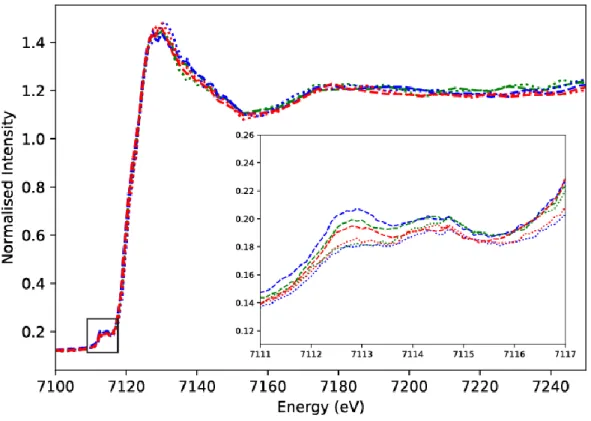
224
Figure 2: Example of edge-step normalised XANES spectra (two co-add) obtained using a 0.25
225
mm Al plate attenuation. Spectra from both more oxidised (dashed lines) and more reduced
226
(dotted lines) melt inclusions are shown for El Hierro (red), Lanzarote (blue) and Fogo (green)
227
volcanoes.
228 229
230
Figure 3: : Calibration line of the peak height ratio determined by XANES compared with the
231
Fe3+/∑Fe ratios determined by Mössbauer spectroscopy in basanite standard glasses (this
232
study) and basaltic standard glasses from the Smithsonian (Mössbauer values from Zhang et
233
al., (2018)). A linear regression through the basanite and basalt standards data (dotted black 234
line) yields an equation of y = 0.37x – 0.09 with an R² of 0.98, a P-value of 1.6x10⁻⁶ and a
235
standard error on the regression of 0.013. Dashed red lines show 95% confidence intervals.
236
Note that the relationship between the peak height ratio and Fe3+/∑Fe is well captured by a
237
linear regression for Fe3+/∑Fe between 0.1 and 0.4 (see supplementary Fig. S6), in agreement
238
with previous studies (e.g., Cottrell et al., 2009).
239 240
In order to estimate the effect of lower quality spectra on the estimation of the peak height ratio 241
we compared the ratio obtained from the processing of two co-added low quality spectra 242
produced with a 0.25 mm Al plate attenuation to the ratio retrieved from normal high quality 243
spectra obtained with 0.1 mm Al plate attenuation for twelve basaltic Smithsonian standards 244
(Fig. S3). The standard deviation between these analyses was used to determine the error on 245
the peak height ratio (1σ = 0.03) which translates to a standard deviation of 0.012 on the 246
measured Fe3+/∑Fe ratio. Note that this is the relative error from XANES analyses, the absolute 247
error in term of Fe3+/∑Fe is given by the standard error on the calibration curve (1σ = 0.013). 248
Matrix glasses were acquired with lower attenuation (0.1 mm Al plate) and hence processed 249
using the more commonly used centroid method (e.g., Cottrell et al., 2009; Moussallam et al., 250
2016, 2014). 251
252
2.5 Major elements and volatile analyses
253
Major and volatile (S, Cl, and F) element concentrations were measured on a Cameca SX-100 254
electron microprobe at the Laboratoire Magmas et Volcans, in Clermont-Ferrand using an 255
accelerating voltage of 15 keV, a beam current of 6 nA for major elements and 40 nA for 256
volatiles with a 10 μm spot diameter. Sodium was analysed first to prevent Na loss. The 257
counting time was 10 s for Na, Ca, Ti, P and Si, 20 s for Mg and Al, 30 s for Mn and finally 40 258
s for Fe and K. The instrument was calibrated on natural and synthetic mineral standards and 259
glasses. The Kilauea basaltic glass VG-A99 (Jarosewich et al., 1979) and a pantellerite glass 260
from Eburru Kenya KE12 (Mosbah et al., 1991), which are all international glass standards, 261
were used as an inter-laboratory check for major element, S and Cl and F concentrations, 262
respectively. 263
264
H2O and CO2 concentrations were determined by FTIR spectroscopy using a Vertex 70 Bruker 265
spectrometer equipped with an infrared microscope (Hyperion) and an MCT detector at the 266
Laboratoire Magmas et Volcans, in Clermont-Ferrand. Absorption spectra were acquired with 267
128 scans in the near-infrared region at a resolution of 4 cm−1. The total amount of water was 268
calculated from the absorbance of the fundamental OH-stretching vibration at about 3535 cm−1 269
while the amount of CO2 was calculated using the “carbonate doublet” (Blank and Brooker, 270
1994) at 1515 and 1430 cm−1. The sample thickness was measured on a Raman microscope 271
and background correction (using a cubic function for CO2 and a linear function for H2O) was 272
performed using PeakFit software (Jandel Scientific) to measure absorption peak heights. We 273
used molar absorptivity values for basanite from Shishkina et al., (2014). Melt inclusions major 274
and volatile compositions are given in Tables S4 and S5. 275
276
2.6 Assessment of post-entrapment modification of melt inclusions.
277
2.6.1 Post-entrapment crystallisation 278
The amount of post-entrapment crystallisation was estimated using the Petrolog3 software 279
(Danyushevsky and Plechov, 2011). Calculations were performed using the olivine-melt model 280
of Danyushevsky, (2001), the density model of Lange and Carmichael, (1990), the model for 281
melt oxidation of Kress and Carmichael, (1988) and the model of Toplis, (2005) for the 282
compositional dependence of the olivine-liquid Fe-Mg exchange coefficient (Kd). Note that 283
calculations in Petrolog3 are performed under anhydrous conditions at 1 atm. Calculations were 284
performed assuming a system closed to oxygen, in which case Fe3+ is treated as an incompatible 285
element. The Fe3+/∑Fe ratios measured by XANES were used to calculate Fe2O3 and FeO 286
contents for each melt inclusion as input for the calculations. 287
288
Fig. 4 compares the measured Fo content of the host olivine to its expected value at equilibrium 289
based on uncorrected melt inclusion composition. Most calculated olivine compositions agree 290
with measured compositions within a few Fo% suggesting a limited amount of post-entrapment 291
crystallisation or Fe-loss by re-equilibration. Another method to estimate if iron has been loss 292
from melt inclusions is to compare measured melt inclusion compositions to liquid lines of 293
descent defined by published bulk rocks and glasses at each hotspot locality (Fig. S7). Using 294
this method, we find that melt inclusions from Lanzarote and to a lesser extent, El Hierro, might 295
have suffered some amount of iron loss. We consider this second method to be less accurate, 296
however, as it assumes a co-genetic link between rock sequences that might be unrelated. 297
298
299
Figure 4: Comparison between measured and equilibrium Fo content of host olivine for melt
300
inclusions from Fogo (blue), El Hierro (green) and Lanzarote (red). Equilibrium Fo contents
301
are calculated by Petrolog3 software (Danyushevsky and Plechov, 2011) using the model
302
of Toplis, (2005) for the compositional dependence of the olivine-liquid Fe-Mg exchange
303
coefficient (Kd).
304 305
Since post-entrapment crystallisation and re-equilibration calculations are highly model 306
dependent and current models of Fe-Mg exchange coefficient are not well calibrated for 307
basanite composition, we choose not to use PEC results from Petrolog3 to “correct” the 308
measured oxidation state of iron in the melt inclusions. We note that the calculated amount of 309
PEC from Petrolog3 is small (from 0 to 3.7%, average of 1.3%, median of 1%) and hence that 310
the measured oxidation states of the melt inclusions are representative of the melt oxidation 311
states at the time of entrapment. Post-entrapment crystallisation corrected compositions are 312 reported in Table S7. 313 314 2.6.2 Volatile diffusion 315
Post-entrapment diffusion of volatiles either through the olivine host (for H) (Hauri, 2002; 316
Massare et al., 2002) or in the vapor bubble (for CO2) (Anderson and Brown, 1993; Steele-317
Macinnis et al., 2011) can modify the original volatile content of melt inclusions. As such, our 318
measurements of H2O and CO2 can be considered as minimum estimates of the original 319
amounts dissolved in the inclusions even though all of our samples are from rapidly quenched 320
tephra and lava ballons. Higher (than measured) original H2O and CO2 contents of the melt 321
inclusions would yield greater calculated entrapment pressures but would make no difference 322
to the conclusions presented here. H diffusion out of a melt inclusion could, however, also have 323
an impact on the oxidation state of the inclusion with a predicted increase of the oxidation state 324
of the melt inclusion with increasing amount of H diffusion (some experiments have shown no 325
effect (Rowe et al., 2007) while others found a complete re-equilibration with the groundmass 326
(Bucholz et al., 2013; Gaetani et al., 2012)). Although this process cannot be ruled out, the 327
opposite correlation between H2O and oxidation state shown by previous datasets as well as 328
ours (see Results section) strongly argues against this process dominating the observed data 329
variability. 330
331 332
2.7 Effect of differentiation
333
Fig. S8 shows an absence of correlation between three proxies of melt differentiation and the 334
oxidation state of the melt, indicating that differentiation is not the dominant factor affecting 335
melt oxidation state in our data set. To assess the potential effect of pre-entrapment 336
crystallization of olivine on Fe3+/∑Fe, we modelled reverse crystallization paths for our melt 337
inclusions along olivine-control lines using PRIMELT3 (Herzberg and Asimow, 2015) until 338
the melts reached equilibrium with Fo90 olivine. The results shown in Fig. 5 and Table S8 339
indicate a modest decrease in Fe3+/∑Fe with reverse crystallization, demonstrating that melts 340
parental to our melt inclusions were already oxidised. 341
342
343
Figure 5: Sensitivity analysis of the effects of post-entrapment crystallisation and
pre-344
entrapment crystallization of olivine on melt Fe3+/∑Fe. Post-entrapment crystallisation
345
estimated using Petrolog3 software (Danyushevsky and Plechov, 2011) assuming a system
346
closed to oxygen, with Fe3+ behaving incompatibly, leads to a decrease in Fe3+/∑Fe in
347
corrected inclusions. The effect of pre-entrapment crystallization of olivine, modelled with
348
PRIMELT3 (Herzberg and Asimow, 2015) until melt–Fo90 olivine equilibrium is reached, is
shown to have modest effects on Fe3+/∑Fe over large MgO ranges, suggesting that primary
350
magmas were oxidised. Note that samples from Lanzarote (red) might have experienced
Fe-351
loss (Fig. S9).
352
III. RESULTS
353Melt inclusions from all three localities have Fe3+/∑Fe ratios of 0.17 to 0.30 (with one sigma 354
error of 0.012). These values are representative of the oxidation state of the melt at the time of 355
entrapment and of their parental primitive magmas (see calculation of the effect of pre-356
entrapment processes in the methods section). The Fe3+/∑Fe ratios of the melt inclusions do 357
not correlate with major element composition (see methods section) but they are strongly 358
correlated with volatile contents (Fig. 6 A to C). More volatile-rich melt inclusions, i.e., those 359
entrapped at greater depths, are systematically more oxidised than their volatile-poor 360
counterparts. This trend is even clearer when comparing our results with reported analyses for 361
the Erebus (Moussallam et al., 2014), Icelandic (Hartley et al., 2017) and Hawaiian 362
(Moussallam et al., 2016; Brounce et al., 2017) hotspots. 363
364
Figure 6: Volatile contents of melt inclusions, embayments and matrix glasses and
365
corresponding volatile saturation pressures, for Fogo, Lanzarote and El Hierro (this study) and 366
for Kīlauea (Moussallam et al., 2016), Mauna Kea (Brounce et al., 2017), Laki (Hartley et al., 367
2017) and Erebus (Moussallam et al., 2014) versus Fe3+/Fe, determined by XANES. A. S 368
concentration (in ppm; determined by electron microprobe). B. H2O concentration (in wt%; 369
determined by Fourier transform infrared spectroscopy). C. CO2 concentration (in ppm; 370
determined by Fourier transform infrared spectroscopy). D. Calculated entrapment pressure 371
(using the model of Iacono-Marziano et al., 2012 and accounting for S in the data of this study), 372
with CO2-H2O saturation curves shown in the supplementary information. Note that 373
entrapment pressure estimates are always a minimum and that samples from Lanzarote might 374
have experienced Fe-loss. 375
IV.
DISCUSSION
376377
4.1 A case for oxidised mantle plumes
378
The most volatile-rich inclusions from El Hierro, Lanzarote and Fogo record Fe3+/Fe ratios 379
ranging from 0.27 to 0.30, corresponding to oxygen fugacities around 1.5 to 2 log units above 380
the FMQ buffer. The only available comparable data, from very-deeply entrapped melt 381
inclusions recording conditions prior to extensive degassing, are from Ross Island, Antarctica 382
where similarly high oxygen fugacities have been found (Moussallam et al., 2014). The finding 383
that all investigated hotspot volcanoes (El Hierro, Lanzarote, Fogo and Erebus), for which 384
deeply-entrapped (> 8 km) melt inclusions are available, are associated with strongly oxidised 385
primitive melts suggests a global relationship. This is corroborated by three other lines of 386
evidence: (i) the observation of increasingly-oxidised MORB approaching hotspots such as 387
Iceland (Shorttle et al., 2015); (ii) the abundance of S6+ in hotspot basalts (Brounce et al., 2017; 388
Jugo et al., 2010); and (iii) the determination of slightly more oxidizing (up to FMQ+1) 389
conditions in the least-degassed melt inclusions and glasses available from other hotspot 390
volcanoes (Hawai’i (Brounce et al., 2017; Moussallam et al., 2016) and Iceland (Hartley et al., 391
2017)). 392
393
The most volatile-rich and deeply-entrapped melt inclusions should record conditions closest 394
to the original mantle melt. From our dataset the effect of crystal fractionation on fO2 appears 395
to be minimal (see methods section). Even the most deeply-entrapped inclusions, however, 396
likely experienced some amount of degassing. The original, pre-degassing, degree of oxidation 397
of the melt can be estimated if we know how volatile-rich, especially how sulfur-rich, that melt 398
was prior to degassing. Previous studies for Lanzarote (Gómez-Ulla, 2018) and El Hierro 399
(Longpré et al., 2017) reported melt inclusions with sulfur contents of up to 3900 and 5000 400
ppm, respectively, while for Hawaii (at Lōʻihi) sulfur contents of up to 3300 ppm have been 401
reported (Hauri, 2002). Extrapolating from our dataset, and in coherence with previous 402
degassing models (Moussallam et al., 2014), such sulfur contents would imply a mantle melt 403
oxygen fugacity about 2.0 log units above the FMQ buffer (Fig. 7), hence a mantle source about 404
two log units more oxidised than that feeding mid-ocean ridges (around FMQ; e.g., Berry et 405
al., 2018; Bezos and Humler, 2005; Birner et al., 2018, 2017; Bryndzia and Wood, 1990; 406
Cottrell and Kelley, 2011; Zhang et al., 2018). These estimates are also significantly more 407
oxidised than those inferred for primitive melts in the mantle wedge feeding arc magmas 408
(around FMQ+1; e.g., Bénard et al., 2018; Brandon and Draper, 1996; Parkinson and Arculus, 409
1999). 410
411
It should be noted that by equating the oxidation state of deep melts to that of their mantle 412
source we are assuming that melts are effectively buffered by their mantle source during partial 413
melting. For MORBs, several lines of evidence support this hypothesis; (i) the lack of 414
correlation between Fe3+/ƩFe of MORB glasses and parameters sensitive to the degree of partial 415
melting (Bézos and Humler, 2005, Cottrell and Kelley, 2011), (ii) the similarity in measured 416
oxidation state of MORB glasses and co-located peridotites (Birner et al., 2018), and (iii) 417
experimental investigations of partial melting showing that the melt Fe3+/ƩFe ratios remain 418
constant over varying degrees of partial melting (Sorbadere et al., 2018). In plume contexts it 419
is currently unknown if this assumption remains valid. The relationship between Fe3+/ƩFe and 420
fO2 in low-degree, volatile- and alkali-rich, partial melts is not well established, and it is 421
conceivable that partial melting in some contexts would operate as an open system favouring 422
the generation of Fe3+-rich melts (Fe3+ being mildly incompatible during partial melting, e.g., 423
Canil et al., 1994; Holloway and Burnham, 1972; Mallmann and O’Neill, 2009; Sorbadere et 424
al., 2018). Given the current lack of evidence of such open-system partial melting processes 425
taking place, we assume here that partial melting in plume contexts operates similarly to partial 426
melting in mid-ocean ridge contexts in terms of oxidation state, and hence that the oxidation 427
state of partial melts pre-degassing is similar to that of their source. 428
429
Figure 7: Sulfur contents of melt inclusions, embayments and matrix glasses from this study
430
and for Kīlauea (Moussallam et al., 2016), Mauna Kea (Brounce et al., 2017), Laki (Hartley et 431
al., 2017) and Erebus (Moussallam et al., 2014) compared with the oxygen fugacity of the melt 432
expressed as the deviation from the fayalite–magnetite–quartz buffer. The pink shaded area 433
represents inferred conditions of the primitive mantle melt feeding hotspots, extrapolated from 434
the data trend to the maximum reported sulfur contents (of around 3000 to 5000 ppm) in melt 435
inclusions from hotspot volcanoes. The light orange arrow shows the expected relationship 436
between sulfur content and melt oxidation state due to sulfur degassing (e.g., Moussallam et 437
al., 2014, 2016). The dashed grey line shows the maximum amount of sulfur that can be 438
dissolved at a given oxidation state in common basaltic melts at 200 MPa (Botcharnikov et al., 439
2011). Note that samples from Lanzarote might have experienced Fe-loss. 440
441
4.2 Recycling of oxidised subducted material
442
Mantle plumes, as the source of hotspot volcanism, might therefore be considerably more 443
oxidised than their surrounding mantle. The simplest explanation for this phenomenon is that 444
these plumes entrain recycled surface-derived material such as subducted oceanic crust. Indeed, 445
isotopic and trace element evidence indicating the presence of recycled oceanic (and sometimes 446
continental) crust in mantle plumes is abundant (Chauvel et al., 1992; Day et al., 2010; Gómez-447
Ulla et al., 2017; Hauri, 1996; Hofmann and White, 1982). In particular, helium, argon, lead 448
and strontium isotopic ratios suggest that in both the Canary (e.g., Day and Hilton, 2011; 449
Hiltona et al., 2000)) and Cape Verde (e.g., Christensen et al., 2001; Doucelance et al., 2003; 450
Millet et al., 2008) hotspots a lower mantle and a HIMU component (interpreted as recycled 451
subducted oceanic crust) must have mixed to explain the isotopic composition of extruded 452
lavas. The observation that oxidised mantle melts in hotspot settings are also S-rich (Fig. 7) 453
might additionally suggest the presence of recycled oceanic crust in their parental mantle since 454
hydrothermally-altered crust is enriched in S (Alt et al., 1993), although multiple lines of 455
evidence suggest that most of the S in the subducting slab might migrate to the mantle wedge, 456
with potentially limited amounts being brought deep into the mantle (Bénard et al., 2018; Jégo 457
and Dasgupta, 2014, 2013; Prouteau and Scaillet, 2013; Tomkins and Evans, 2015). An 458
alternative mechanism to explain the oxidised nature of mantle plumes is the decomposition of 459
subducted Fe2O3 from banded iron formations to Fe3O4 and Fe25O32 at pressures above ∼60 460
and ∼70 GPa, respectively (Bykova et al., 2016). This would generate an oxygen-rich fluid in 461
the lower mantle that could be sampled by ascending plumes. Yet another possibility relies on 462
pressure effects on iron coordination. It has been proposed that pyrite-structured iron oxide 463
(FeO2 – referred to as P-phase) may form under extreme pressure and temperature in the Earth’s 464
interior (Hu et al., 2016). If so, highly oxidised patches containing iron in the 3+ valence state 465
may accumulate in the deep lower mantle (Hu et al., 2017, 2016; Streltsov et al., 2017). Early 466
incorporation of such material into mantle plumes would result in decomposition to Fe2O3 and 467
release of O2 during decompression (reaction 1 in Hu et al., 2016), providing an additional 468
mechanism for generation of oxidised hotspot conditions. The hypothesis we favour, the most 469
simple, is the incorporation of recycled surface-derived material in plumes. 470
471
4.3 Implication for fO2 stratification and partial melting in Earth’s mantle
472
Mantle plumes might therefore play a key role in the deep oxygen – and potentially S – cycles, 473
providing a counterflow to subduction zones, and channelling oxidised material out of the deep 474
Earth. The oxidised nature of mantle plumes might also partly explain their seismic velocity 475
structure. It has been shown that the seismic properties of olivine are highly dependent on iron 476
oxidation state, with olivine containing more Fe3+ showing enhanced anelastic relaxation (Ii et 477
al., 2018). The low-velocity anomalies found beneath hotspot volcanoes (e.g., French and 478
Romanowicz, 2015; Zhao, 2007) might then not only indicate elevated mantle temperatures 479
but also raised mantle oxygen fugacity. 480
481
While the geochemically-layered view of the Earth’s mantle that prevailed in the twentieth 482
century has been progressively dismantled over the past four decades (e.g., White, 2015), our 483
picture of mantle oxidation state has remained mostly one-dimensional, i.e., fO2 decreasing 484
steadily with depth (Frost and McCammon, 2008; Rohrbach and Schmidt, 2011; Woodland 485
and Koch, 2003). Our findings suggest that geochemical, geophysical and redox 486
heterogeneities should be linked in the Earth’s mantle. A heterogeneous mantle in terms of 487
oxidation state implies that processes such as carbon redox melting (the production of 488
carbonated melts from the oxidation of CH4 or native carbon (Taylor and Green, 1988; Foley, 489
2010; Rohrbach and Schmidt, 2011)) should occur over a wide range of depths in distinct 490
regions of the mantle. Following Stagno et al., (2013), for instance, and considering that the 491
mantle domains feeding hotspots are two log units more oxidised than those beneath mid-ocean 492
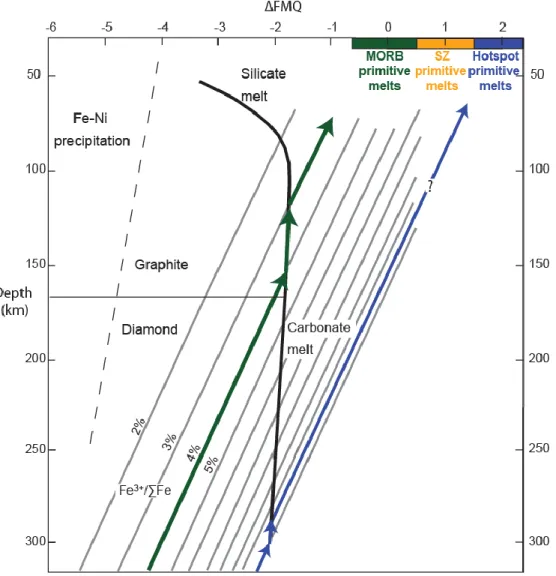
ridges, redox melting associated with hotspots should prevail at much greater depths (Fig. 8), 493
especially if these domains are also more carbon-rich. 494
495
Figure 8: Relationship between depth and oxygen fugacity (expressed as the deviation from
496
the FMQ buffer) for variable Fe3+/∑Fe from Stagno et al., (2013). The stability fields of 497
diamond and graphite are shown and bounded by the carbonate redox melting reaction line 498
(thick black line). The green arrows (from Stagno et al., (2013)) show the expected evolution 499
of an upwelling mantle with Fe3+/ΣFe ratio of 0.04, initiating carbonate melting at ~150 km. 500
The blue arrows show the expected evolution of an upwelling mantle with a Fe3+/ΣFe ratio of 501
0.12, initiating carbonate melting at ~300 km depth. Both scenarios arbitrarily consider mantle 502
sources with 30 ppm carbon (causing a reduction of the bulk rock Fe3+/ΣFe ratio by 1% during 503
redox melting). For greater carbon contents in the mantle sources (likely for hotspot mantle 504
sources), a greater initial Fe3+/ΣFe ratio is required for the oxygen fugacity to remain in the 505
range estimated for MORB and hotspot sources. The relationship between Fe3+/ΣFe ratio and 506
oxygen fugacity for the mantle is calculated from equation 6 of Stagno et al., (2013) and differs 507
from that for the melts (calculated using Kress and Carmichael, (1991)). The boxes for hotspot 508
(this study and Moussallam et al., 2014), subduction zone (SZ) (e.g., Bénard et al., 2018; 509
Brandon and Draper, 1996; Parkinson and Arculus, 1999) and MORB (e.g., Berry et al., 2018; 510
Bezos and Humler, 2005; Christie et al., 1986; Zhang et al., 2018) primitive melts indicate 511
oxidation state only (not depth). 512
513
V.
CONCLUSION
514
We have investigated the redox state of glassy crystal-hosted melt inclusions in lavas of the 515
Canary and Cape Verde Islands by XANES and compared them with similar measurements 516
from Ross Island, Hawaii and Iceland. We showed that, at all five investigated hotspots to date, 517
the apparently reduced state of erupted lavas is primarily acquired from degassing during 518
magma ascent. 519
520
We found that the most deeply entrapped samples, i.e., those preserving mantle equilibrium 521
conditions and found at the Canary, Cape Verde and Erebus hotspots, are highly oxidised. This 522
leads us to infer that globally, present day mantle plumes might be up to two orders of 523
magnitude more oxidised than mantle beneath mid-ocean ridges (that is fO2 two log units above 524
the FMQ buffer) and also more oxidised than the mantle wedge beneath subduction zone 525
volcanoes. What emerges is a novel view of the oxidation state of the mantle, in which large 526
heterogeneities exist both vertically and laterally. 527
We further argue that mantle plumes play a key role in the deep oxygen cycle, providing a 529
counterflow to subduction zones by channelling oxidised material out of the deep Earth. This 530
can help to explain why the mean oxidation state of the upper mantle has changed little since 531
the Archean, despite several billion years of subduction of oxidised material. Our findings also 532
have implications for the interpretation of low seismic velocity anomalies beneath hotspot 533
volcanoes, as these might reflect the presence of more oxidised mantle as well as higher mantle 534
temperatures. The more oxidised conditions imply in turn that carbonate redox melting 535
underneath hotspots should take place at much greater depths than underneath mid-ocean 536
ridges. 537
ACKNOWLEDGEMENTS
538Analytical work was carried out at the Diamond Light Source using beamline I18 (proposal 539
number SP17250-1) with invaluable support received from Konstantin Ignatyev. YM 540
acknowledges support from the CNRS (projet INSU-TelluS-SYSTER). CO is supported by the 541
NERC Centre for Observation and Modelling of Earthquakes, Volcanoes and Tectonics. BS is 542
supported by Labex VOLTAIRE (ANR-10-LABX-100-01). We thank Elizabeth Cottrell and 543
Marc Hirschmann for constructive and beneficial comments on the original manuscript. 544
545
REFERENCES
546Alt, J.C., Shanks, W.C., Jackson, M.C., 1993. Cycling of sulfur in subduction zones: The 547
geochemistry of sulfur in the Mariana Island Arc and back-arc trough. Earth and 548
Planetary Science Letters 119, 477–494. https://doi.org/10.1016/0012-821X(93)90057-549
G 550
Anderson, A.T., Brown, G.G., 1993. CO 2 contents and formation pressures of some Kilauean 551
melt inclusions. American Mineralogist 78, 794–803. 552
Anderson, A.T., Wright, R., 1972. Phenocrysts and glass inclusions and their bearing on 553
oxidation and mixing of basaltic magmas, Kilauea Volcano, Hawaii 57, 188–216. 554
Arculus, R.J., 1985. Oxidation status of the mantle: past and present. Annu. Rev. Earth Planet. 555
Sci. 13, 75–95. https://doi.org/10.1146/annurev.ea.13.050185.000451 556
Bénard, A., Klimm, K., Woodland, A.B., Arculus, R.J., Wilke, M., Botcharnikov, R.E., 557
Shimizu, N., Nebel, O., Rivard, C., Ionov, D.A., 2018. Oxidising agents in sub-arc 558
mantle melts link slab devolatilisation and arc magmas. Nature Communications 9, 559
3500. https://doi.org/10.1038/s41467-018-05804-2 560
Berry, A.J., O’Neill, H.S.C., Jayasuriya, K.D., Campbell, S.J., Foran, G.J., 2003. XANES 561
calibrations for the oxidation state of iron in a silicate glass. American Mineralogist 88, 562
967–977. https://doi.org/10.2138/am-2003-0704 563
Berry, A.J., Stewart, G.A., O’Neill, H.St.C., Mallmann, G., Mosselmans, J.F.W., 2018. A re-564
assessment of the oxidation state of iron in MORB glasses. Earth and Planetary Science 565
Letters 483, 114–123. https://doi.org/10.1016/j.epsl.2017.11.032 566
Bezos, A., Humler, E., 2005. The Fe3 /Sigma Fe ratios of MORB glasses and their implications 567
for mantle melting. Geochimica Et Cosmochimica Acta 69, 711–725. 568
Birner, S.K., Cottrell, E., Warren, J.M., Kelley, K.A., Davis, F.A., 2018. Peridotites and basalts 569
reveal broad congruence between two independent records of mantle fO2 despite local 570
redox heterogeneity. Earth and Planetary Science Letters 494, 172–189. 571
https://doi.org/10.1016/j.epsl.2018.04.035 572
Birner, S.K., Warren, J.M., Cottrell, E., Davis, F.A., Kelley, K.A., Falloon, T.J., 2017. Forearc 573
Peridotites from Tonga Record Heterogeneous Oxidation of the Mantle following 574
Subduction Initiation. J Petrology 58, 1755–1780.
575
https://doi.org/10.1093/petrology/egx072 576
Blank, J.G., Brooker, R.A., 1994. Experimental studies of carbon dioxide in silicate melts; 577
solubility, speciation, and stable carbon isotope behavior. Reviews in Mineralogy and 578
Geochemistry 30, 157–186. 579
Botcharnikov, R.E., Linnen, R.L., Wilke, M., Holtz, F., Jugo, P.J., Berndt, J., 2011. High gold 580
concentrations in sulphide-bearing magma under oxidizing conditions. Nature 581
Geoscience 4, 112–115. https://doi.org/10.1038/ngeo1042 582
Brandon, A.D., Draper, D.S., 1996. Constraints on the origin of the oxidation state of mantle 583
overlying subduction zones: An example from Simcoe, Washington, USA. Geochimica 584
et Cosmochimica Acta 60, 1739–1749. https://doi.org/10.1016/0016-7037(96)00056-7 585
Brounce, M., Stolper, E., Eiler, J., 2017. Redox variations in Mauna Kea lavas, the oxygen 586
fugacity of the Hawaiian plume, and the role of volcanic gases in Earth’s oxygenation. 587
PNAS 114, 8997–9002. https://doi.org/10.1073/pnas.1619527114 588
Bryndzia, L.T., Wood, B.J., 1990. Oxygen thermobarometry of abyssal spinel peridotites; the 589
redox state and C-O-H volatile composition of the Earth’s sub-oceanic upper mantle. 590
Am J Sci 290, 1093–1116. https://doi.org/10.2475/ajs.290.10.1093 591
Bucholz, C.E., Gaetani, G.A., Behn, M.D., Shimizu, N., 2013. Post-entrapment modification 592
of volatiles and oxygen fugacity in olivine-hosted melt inclusions. Earth and Planetary 593
Science Letters 374, 145–155. https://doi.org/10.1016/j.epsl.2013.05.033 594
Burgisser, A., Scaillet, B., 2007. Redox evolution of a degassing magma rising to the surface. 595
Nature 445, 194–197. 596
Bykova, E., Dubrovinsky, L., Dubrovinskaia, N., Bykov, M., McCammon, C., Ovsyannikov, 597
S.V., Liermann, H.-P., Kupenko, I., Chumakov, A.I., Rüffer, R., Hanfland, M., 598
Prakapenka, V., 2016. Structural complexity of simple Fe2O3 at high pressures and 599
temperatures. Nature Communications 7, 10661.
600
https://doi.org/10.1038/ncomms10661 601
Canil, D., O’Neill, H.St.C., Pearson, D.G., Rudnick, R.L., McDonough, W.F., Carswell, D.A., 602
1994. Ferric iron in peridotites and mantle oxidation states. Earth and Planetary Science 603
Letters 123, 205–220. https://doi.org/10.1016/0012-821X(94)90268-2 604
Carmichael, I.S.E., 1991. The redox states of basic and silicic magmas: a reflection of their 605
source regions? Contr. Mineral. and Petrol. 106, 129–141. 606
https://doi.org/10.1007/BF00306429 607
Carmichael, I.S.E., Ghiorso, M.S., 1986. Oxidation-reduction relations in basic magma: a case 608
for homogeneous equilibria. Earth and Planetary Science Letters 78, 200–210. 609
https://doi.org/10.1016/0012-821X(86)90061-0 610
Chauvel, C., Hofmann, A.W., Vidal, P., 1992. himu-em: The French Polynesian connection. 611
Earth and Planetary Science Letters 110, 99–119. https://doi.org/10.1016/0012-612
821X(92)90042-T 613
Christensen, B.P., Holm, P.M., Jambon, A., Wilson, J.R., 2001. Helium, argon and lead 614
isotopic composition of volcanics from Santo Antão and Fogo, Cape Verde Islands. 615
Chemical Geology 178, 127–142. https://doi.org/10.1016/S0009-2541(01)00261-3 616
Christie, D.M., Carmichael, I.S.E., Langmuir, C.H., 1986. Oxidation states of mid-ocean ridge 617
basalt glasses. Earth and Planetary Science Letters 79, 397–411. 618
https://doi.org/10.1016/0012-821X(86)90195-0 619
Cottrell, E., Kelley, K.A., 2011. The oxidation state of Fe in MORB glasses and the oxygen 620
fugacity of the upper mantle. Earth and Planetary Science Letters 305, 270–282. 621
https://doi.org/10.1016/j.epsl.2011.03.014 622
Cottrell, E., Kelley, K.A., Lanzirotti, A., Fischer, R.A., 2009. High-precision determination of 623
iron oxidation state in silicate glasses using XANES. Chemical Geology 268, 167–179. 624
https://doi.org/10.1016/j.chemgeo.2009.08.008 625
Cottrell, E., Lanzirotti, A., Mysen, B., Birner, S., Kelley, K.A., Botcharnikov, R., Davis, F.A., 626
Newville, M., 2018. A Mössbauer-based XANES calibration for hydrous basalt glasses 627
reveals radiation-induced oxidation of Fe. American Mineralogist 103, 489–501. 628
https://doi.org/10.2138/am-2018-6268 629
Danyushevsky, L.V., 2001. The effect of small amounts of H2O on crystallisation of mid-ocean 630
ridge and backarc basin magmas. Journal of Volcanology and Geothermal Research 631
110, 265–280. https://doi.org/10.1016/S0377-0273(01)00213-X 632
Danyushevsky, L.V., Plechov, P., 2011. Petrolog3: Integrated software for modeling 633
crystallization processes. Geochemistry, Geophysics, Geosystems 12, n/a–n/a. 634
https://doi.org/10.1029/2011GC003516 635
Day, J.M.D., Hilton, D.R., 2011. Origin of 3He/4He ratios in HIMU-type basalts constrained 636
from Canary Island lavas. Earth and Planetary Science Letters 305, 226–234. 637
https://doi.org/10.1016/j.epsl.2011.03.006 638
Day, J.M.D., Pearson, D.G., Macpherson, C.G., Lowry, D., Carracedo, J.C., 2010. Evidence 639
for distinct proportions of subducted oceanic crust and lithosphere in HIMU-type 640
mantle beneath El Hierro and La Palma, Canary Islands. Geochimica et Cosmochimica 641
Acta 74, 6565–6589. https://doi.org/10.1016/j.gca.2010.08.021 642
Doucelance, R., Escrig, S., Moreira, M., Gariépy, C., Kurz, M.D., 2003. Pb-Sr-He isotope and 643
trace element geochemistry of the Cape Verde Archipelago. Geochimica et 644
Cosmochimica Acta 67, 3717–3733. https://doi.org/10.1016/S0016-7037(03)00161-3 645
Farges, F., 2001. Crystal chemistry of iron in natural grandidierites: an X-ray absorption fine-646
structure spectroscopy study. Phys Chem Min 28, 619–629. 647
https://doi.org/10.1007/s002690100170 648
French, S.W., Romanowicz, B., 2015. Broad plumes rooted at the base of the Earth’s mantle 649
beneath major hotspots. Nature 525, 95–99. https://doi.org/10.1038/nature14876 650
Frost, B.R., 1991. Introduction to oxygen fugacity and its petrologic importance. Reviews in 651
Mineralogy and Geochemistry 25, 1–9. 652
Frost, D.J., McCammon, C.A., 2008. The Redox State of Earth’s Mantle. Annual Review of 653
Earth and Planetary Sciences 36, 389–420.
654
https://doi.org/10.1146/annurev.earth.36.031207.124322 655
Gaetani, G.A., O’Leary, J.A., Shimizu, N., Bucholz, C.E., Newville, M., 2012. Rapid 656
reequilibration of H2O and oxygen fugacity in olivine-hosted melt inclusions. Geology 657
40, 915–918. https://doi.org/10.1130/G32992.1 658
Gaillard, F., Scaillet, B., Arndt, N.T., 2011. Atmospheric oxygenation caused by a change in 659
volcanic degassing pressure. Nature 478, 229–232.
660
https://doi.org/10.1038/nature10460 661
Gaillard, F., Scaillet, B., Pichavant, M., Iacono-Marziano, G., 2015. The redox geodynamics 662
linking basalts and their mantle sources through space and time. Chemical Geology 663
418, 217–233. https://doi.org/10.1016/j.chemgeo.2015.07.030 664
Gómez-Ulla, A., 2018. Historical eruptions of Lanzarote, Canary Islands: Inference of magma 665
source and melt generation from olivine and its melt inclusions. University of Clermont 666
- Auvergne, Clermont-Ferrand. 667
Gómez-Ulla, A., Sigmarsson, O., Gudfinnsson, G.H., 2017. Trace element systematics of 668
olivine from historical eruptions of Lanzarote, Canary Islands: Constraints on mantle 669
source and melting mode. Chemical Geology 449, 99–111. 670
https://doi.org/10.1016/j.chemgeo.2016.11.021 671
Hartley, M.E., Shorttle, O., Maclennan, J., Moussallam, Y., Edmonds, M., 2017. Olivine-672
hosted melt inclusions as an archive of redox heterogeneity in magmatic systems. Earth 673
and Planetary Science Letters 479, 192–205. https://doi.org/10.1016/j.epsl.2017.09.029 674
Hauri, E., 2002. SIMS analysis of volatiles in silicate glasses, 2: isotopes and abundances in 675
Hawaiian melt inclusions. Chemical Geology 183, 115–141. 676
https://doi.org/10.1016/S0009-2541(01)00374-6 677
Hauri, E.H., 1996. Major-element variability in the Hawaiian mantle plume. Nature 382, 415– 678
419. https://doi.org/10.1038/382415a0 679
Helz, R.T., Cottrell, E., Brounce, M.N., Kelley, K.A., 2017. Olivine-melt relationships and 680
syneruptive redox variations in the 1959 eruption of Kīlauea Volcano as revealed by 681
XANES. Journal of Volcanology and Geothermal Research 333–334, 1–14. 682
https://doi.org/10.1016/j.jvolgeores.2016.12.006 683
Herzberg, C., Asimow, P.D., 2015. PRIMELT3 MEGA.XLSM software for primary magma 684
calculation: Peridotite primary magma MgO contents from the liquidus to the solidus. 685
Geochemistry, Geophysics, Geosystems 16, 563–578.
686
https://doi.org/10.1002/2014GC005631 687
Hiltona, D.R., Macphersona, C.G., Elliottb, T.R., 2000. Helium isotope ratios in mafic 688
phenocrysts and geothermal fluids from La Palma, the Canary Islands (Spain): 689
implications for HIMU mantle sources. Geochimica et Cosmochimica Acta 64, 2119– 690
2132. https://doi.org/10.1016/S0016-7037(00)00358-6 691
Hofmann, A.W., White, W.M., 1982. Mantle plumes from ancient oceanic crust. Earth and 692
Planetary Science Letters 57, 421–436. https://doi.org/10.1016/0012-821X(82)90161-693
3 694
Holloway, J.R., Burnham, C.W., 1972. Melting Relations of Basalt with Equilibrium Water 695
Pressure Less Than Total Pressure. J Petrology 13, 1–29. 696
https://doi.org/10.1093/petrology/13.1.1 697
Hu, Q., Kim, D.Y., Liu, J., Meng, Y., Yang, L., Zhang, D., Mao, W.L., Mao, H., 2017. 698
Dehydrogenation of goethite in Earth’s deep lower mantle. PNAS 114, 1498–1501. 699
https://doi.org/10.1073/pnas.1620644114 700
Hu, Q., Kim, D.Y., Yang, W., Yang, L., Meng, Y., Zhang, L., Mao, H.-K., 2016. FeO2 and 701
FeOOH under deep lower-mantle conditions and Earth’s oxygen–hydrogen cycles. 702
Nature 534, 241–244. https://doi.org/10.1038/nature18018 703
Iacono-Marziano, G., Morizet, Y., Le Trong, E., Gaillard, F., 2012. New experimental data and 704
semi-empirical parameterization of H2O–CO2 solubility in mafic melts. Geochimica et 705
Cosmochimica Acta 97, 1–23. https://doi.org/10.1016/j.gca.2012.08.035 706
Ii, C.J.C., Faul, U.H., David, E.C., Berry, A.J., Jackson, I., 2018. Redox-influenced seismic 707
properties of upper-mantle olivine. Nature 555, 355–358. 708
https://doi.org/10.1038/nature25764 709
Jarosewich, E., Parkes, A.S., Wiggins, L.B., 1979. Microprobe Analyses of Four Natural 710
Glasses and One Mineral: An Interlaboratory Study of Precision and Accuracy. 711
Smithsonian Contributions to the Earth Sciences 22, 53–67. 712
Jégo, S., Dasgupta, R., 2014. The Fate of Sulfur During Fluid-Present Melting of Subducting 713
Basaltic Crust at Variable Oxygen Fugacity. J Petrology 55, 1019–1050. 714
https://doi.org/10.1093/petrology/egu016 715
Jégo, S., Dasgupta, R., 2013. Fluid-present melting of sulfide-bearing ocean-crust: 716
Experimental constraints on the transport of sulfur from subducting slab to mantle 717
wedge. Geochimica et Cosmochimica Acta 110, 106–134. 718
https://doi.org/10.1016/j.gca.2013.02.011 719
Jugo, P.J., Wilke, M., Botcharnikov, R.E., 2010. Sulfur K-edge XANES analysis of natural and 720
synthetic basaltic glasses: Implications for S speciation and S content as function of 721
oxygen fugacity. Geochimica et Cosmochimica Acta 74, 5926–5938. 722
https://doi.org/10.1016/j.gca.2010.07.022 723
Kelley, K.A., Cottrell, E., 2012. The influence of magmatic differentiation on the oxidation 724
state of Fe in a basaltic arc magma. Earth and Planetary Science Letters 329–330, 109– 725
121. https://doi.org/10.1016/j.epsl.2012.02.010 726
Kress, V.C., Carmichael, I.S.E., 1991. The compressibility of silicate liquids containing Fe2O3 727
and the effect of composition, temperature, oxygen fugacity and pressure on their redox 728
states. Contr. Mineral. and Petrol. 108, 82–92. https://doi.org/10.1007/BF00307328 729
Kress, V.C., Carmichael, I.S.E., 1988. Stoichiometry of the iron oxidation reaction in silicate 730
melts. American Mineralogist 73, 1267–1274. 731
Lange, R.L., Carmichael, I.S.E., 1990. Thermodynamic properties of silicate liquids with 732
emphasis on density, thermal expansion and compressibility. Reviews in Mineralogy 733
and Geochemistry 24, 25–64. 734
Longpré, M.-A., Stix, J., Klügel, A., Shimizu, N., 2017. Mantle to surface degassing of carbon- 735
and sulphur-rich alkaline magma at El Hierro, Canary Islands. Earth and Planetary 736
Science Letters 460, 268–280. https://doi.org/10.1016/j.epsl.2016.11.043 737
Mallmann, G., O’Neill, H.S.C., 2009. The Crystal/Melt Partitioning of V during Mantle 738
Melting as a Function of Oxygen Fugacity Compared with some other Elements (Al, P, 739
Ca, Sc, Ti, Cr, Fe, Ga, Y, Zr and Nb). J. Petrology 50, 1765–1794. 740
https://doi.org/10.1093/petrology/egp053 741
Massare, D., Métrich, N., Clocchiatti, R., 2002. High-temperature experiments on silicate melt 742
inclusions in olivine at 1 atm: inference on temperatures of homogenization and H2O 743
concentrations. Chemical Geology, Melt Inclusions at the Millennium: Toward a 744
Deeper Understanding of Magmatic Processes 183, 87–98. 745
https://doi.org/10.1016/S0009-2541(01)00373-4 746
Métrich, N., Berry, A.J., O’Neill, H.St.C., Susini, J., 2009. The oxidation state of sulfur in 747
synthetic and natural glasses determined by X-ray absorption spectroscopy. 748
Geochimica et Cosmochimica Acta 73, 2382–2399.
749
https://doi.org/10.1016/j.gca.2009.01.025 750
Millet, M.-A., Doucelance, R., Schiano, P., David, K., Bosq, C., 2008. Mantle plume 751
heterogeneity versus shallow-level interactions: A case study, the São Nicolau Island, 752
Cape Verde archipelago. Journal of Volcanology and Geothermal Research 176, 265– 753
276. https://doi.org/10.1016/j.jvolgeores.2008.04.003 754
Mosbah, M., Metrich, N., Massiot, P., 1991. PIGME fluorine determination using a nuclear 755
microprobe with application to glass inclusions. Nuclear Instruments and Methods in 756
Physics Research Section B: Beam Interactions with Materials and Atoms 58, 227–231. 757
https://doi.org/10.1016/0168-583X(91)95592-2 758
Moussallam, Y., Edmonds, M., Scaillet, B., Peters, N., Gennaro, E., Sides, I., Oppenheimer, 759
C., 2016. The impact of degassing on the oxidation state of basaltic magmas: A case 760
study of Kīlauea volcano. Earth and Planetary Science Letters 450, 317–325. 761
https://doi.org/10.1016/j.epsl.2016.06.031 762
Moussallam, Y., Oppenheimer, C., Scaillet, B., Gaillard, F., Kyle, P., Peters, N., Hartley, M., 763
Berlo, K., Donovan, A., 2014. Tracking the changing oxidation state of Erebus 764
magmas, from mantle to surface, driven by magma ascent and degassing. Earth and 765
Planetary Science Letters 393, 200–209. https://doi.org/10.1016/j.epsl.2014.02.055 766
O’Neill, H.St.C., Berry, A.J., Mallmann, G., 2018. The oxidation state of iron in Mid-Ocean 767
Ridge Basaltic (MORB) glasses: Implications for their petrogenesis and oxygen 768
fugacities. Earth and Planetary Science Letters 504, 152–162. 769
https://doi.org/10.1016/j.epsl.2018.10.002 770
Parkinson, I.J., Arculus, R.J., 1999. The redox state of subduction zones: insights from arc-771
peridotites. Chemical Geology 160, 409–423. https://doi.org/10.1016/S0009-772
2541(99)00110-2 773