Conversion efficiency, scaling and global
optimization of high harmonic generation
The MIT Faculty has made this article openly available.
Please share
how this access benefits you. Your story matters.
Citation
Falcao-Filho, E.L. et al. “Conversion efficiency, scaling and global
optimization of high harmonic generation.” Lasers and
Electro-Optics, 2009 and 2009 Conference on Quantum Electronics and
Laser Science Conference. CLEO/QELS 2009. 1-2. ©2009 Institute of
Electrical and Electronics Engineers.
Publisher
Institute of Electrical and Electronics Engineers
Version
Final published version
Citable link
http://hdl.handle.net/1721.1/59295
Terms of Use
Article is made available in accordance with the publisher's
policy and may be subject to US copyright law. Please refer to the
publisher's site for terms of use.
Conversion efficiency, scaling and global optimization
of high harmonic generation
Edilson L. Falcão-Filho, V. M. Gkortsas, Ariel Gordon and Franz X. Kärtner
Department of Electrical Engineering and Computer Science and Research Laboratory of Electronics, Massachusetts Institute of Technology, Cambridge, MA 02139
Abstract: Closed form expressions for the high harmonic generation (HHG) conversion efficiency in the plateau and cut-off region are derived showing agreement with previous observations. Application of these results to optimal HHG-based-XUV-sources is discussed.
© 2009 Optical Society of America
OCIS codes: (260.7200) Ultraviolet, extreme; (020.2649) Strong field laser physics
High harmonic generation (HHG) is a promising source for coherent short wavelength radiation in the extreme ultraviolet and soft X-ray (XUV) region with ample application in different areas, such as spectroscopy, metrology, physics, chemistry, material science, and biology. Among the possible applications we can emphasize high resolution imaging, EUV lithography, seeding of X-ray free electron lasers and the possibility of probing the electron dynamics on its natural time scale via attosecond pulses. Much of current research is still focused on determining the optimum drive lasers and media to enable efficient harmonic generation at a given wavelength, especially pushing to the soft-x-ray (keV) region.
Over more than one decade, a considerable effort has been devoted to the theoretical modeling of HHG [1] However due to the computational complexity of the problem, which includes not only the microscopic response of the medium but also macroscopic propagation effects, accurate quantitative simulation of the HHG efficiency can be extremely time-consuming and, considering the numbers of variables involved in the HHG process, a systematic study with several quantities varying simultaneously is prohibitive. Indeed, up to the present date it is not entirely clear how the HHG efficiency scales for different experimental conditions, how far we are from theoretical limits, and how to proceed to construct an HHG source, which operates at the global maximum in efficiency for a particular harmonic or range of harmonics. For example, over the last years, the role of the driving frequency, ω0, to HHG
scaling has received great attention [2,3]. Dependences of HHG efficiency with ω05 and ω06 are being obtained from
numerical simulations using the time dependent Schrödinger equation [2] based on the single-atom response only. Preliminary experimental results [3] are supporting these numerical simulations.
In this work we present the first, to our knowledge, closed form analytical expressions to the HHG conversion efficiencies both for the plateau region and the cutoff region including both laser and material parameters. The formulas were obtained applying the saddle point method to the dipole acceleration of the improved three step model (ITSM) [4]. Single-active-electron (SAE) approximation and 1D propagation effects were also considered.
The final expression for the efficiency at the cutoff frequency, Ωcutoff , is written as:
[
( )]
1 ) 1 ( 1 ) ( ) , ( 2 0236 . 0 4 2 0 ) 1 ( 4 2 2 3 / 16 0 2 2 5 0 cutoff N cutoff cutoff rec p tb E w N E L k g a I κ β β β σ ω η + − − Ω Ω Δ = − , (1)where , Δk is the phase mismatch and Labs is the absorption
length. N is the number of cycles of the driven pulse and β=|a(π /ω)| 2 with |a(t)| 2 denoting the probability to find
the atom on the ground state. Ip is the ionization potential, w(E) is the ionization rate and arec is the recombination
amplitude, as written in Eq. (7) of Ref. [5]. The intra-cycle depletion of the ground state, κ0, is given by
|a(tb cutoff) a(ta cutoff)| 2, where the respective birth and arrival times are tb cutoff ≈1.88/ω0 and ta cutoff ≈5.97/ω0 .
In accordance with Eq.(1), the efficiency at the cutoff region scales with a factor of ω05. A cubic dependence
with ω0 is due to quantum diffusion. An additional factor of ω0 comes from the fact that we are considering the
conversion efficiency into a single harmonic, and the bandwidth it occupies is 2ω0. The fifth ω0 comes from the
energy carried by a cycle of the driving laser field which scales with its duration 2π/ω0 for a given electric field
amplitude. On the other hand, the plateau formula, too length to be shown here, has an additional term related to the derivative of the action, ∂t2S, which is related to the chirp of the attosecond pulses by the short and long trajectories.
This leads to additional energy spreading over the harmonics reduction the power in each by another factor of ω0,
Therefore, in general, the scaling of HHG efficiency with the driving frequency is ω05 at the cutoff and ω06 in the
plateau region for fixed harmonic wavelength in agreement with previous numerical simulations [2]. However, for )] ( 2 1 [ ] [ ) , ( ( ) /(2 ) abs L L L k i e i k L e L k g Δ = Δ ⋅ − − ⋅ abs + Δ ⋅ a2553_1.pdf
JThG6.pdf
JThG6.pdf
© 2009 OSA/CLEO/IQEC 2009 978-1-55752-869-8/09/$25.00 ©2009 IEEEthe complete wavelength scaling others contributions have to be taken into account. For example, keeping constant the geometrical conditions and the number of cycles, any change on the driving wavelength implies a change in the field strength, E0, in order to keep perfect phase matching conditions. The medium characteristics, recombination
amplitude and absorption cross section, also play an important role if cutoff extension is the target. To illustrate the significance of that statement, absorption limited HHG from neon is considered and the optimum drive wavelength for maximum conversion efficiency in the cutoff region is determined using Eq. (1).The result is displayed in Fig. 1(a) as a function of drive wavelength and cutoff energy. A global maximum for Ne efficiency is clearly observed for λ0=1.2μm corresponding to Ωcutoff =451eV. Although, the maximum conversion efficiency shifts for different
λ0, the peak efficiency does not exhibit any strong dependence with the driver wavelength, in contradiction to the
λ0-5..-6 scaling. . The reason for this unexpected behavior is that in the range from 30 to 800 eV for Ne, the
recombination amplitude, arec increases and the absorption cross section, σ decreases. In particular, the absorption
cross section decreases more than two orders of magnitude for that range.
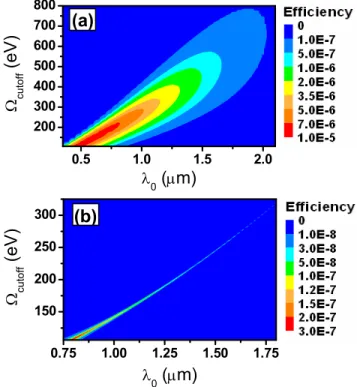
In Fig. 2, the same problem is considered but more constrains are imposed. In Fig. 2(a) the efficiency at cutoff for a 5 mm long gas cell at 1 bar of pressure is shown assuming perfect phase matching. In this case, the maximum value for HHG efficiency is reached for λ0=0.6μm and Ωcutoff =148eV. In Fig. 2(b), the plasma
and neutral atom phase mismatching are included to the problem. In this final case, the maximum value was reached at λ0= 0.8μm and Ωcutoff = 107eV. This
behavior is also reproduced using a Gaussian pulse and computing numerically the full spectrum via the ITSM. In conclusion, we report the first derivation of
closed analytical expressions for the high harmonic generation (HHG) conversion efficiency, both for the plateau region and the cutoff region. Specifically they show the origin of the power scaling with drive wavelength analytically. Moreover, the presented formulas include both laser and material parameters and eliminate most of the computational complexity related to HHG simulations. Based on the derived expressions, the computed HHG conversion efficiencies, without any parameter fitting, are in good agreement with experimental results obtained from different groups under different experimental conditions [6]. These formulas therefore simplify the HHG optimization problem considerably and enable a detailed scaling analysis of the HHG efficiency.
References
[1] M. Lewenstein et al., Phys. Rev. A 49, 2117 (1994); P. Salières et al., Phys. Rev. Lett. 81, 5544 (1998); H. Shon, A. Suda, and K. Midorikawa, Phys. Rev. A 62, 023801 (2000); E. Priori et al., Phys. Rev. A 61, 063801 (2000); G. Tempea and T. Brabec, Appl. Phys. B 70, S197 (2000); M. B. Graade and K. J. Schafer, Phys. Rev. Lett. 89, 213901 (2002); S. Yakovlev et al., Opt. Express 15, 15351 (2007). [2] J. Tate et al., PRL 98, 013901 (2007).
[3] P. Colosimo et al., Nature Physics 4, 386 (2008); C. Vozzi et al., Proceedings of Conference on Ultrafast Phenomena, FRI2.2 (2008). [4] A. Gordon and F. X. Kärtner, Phys. Rev. Lett. 95, 223901 (2005).
[5] A. Gordon et al., Phys. Rev. Lett. 96, 223902 (2006).
[6] E. J. Takahashi et al. , IEEE J. Sel. Top. Quantum Electron. 10, 1315 (2004); I Jong Kim et al., Phys. Rev. Lett. 94, 243901 (2005). Fig.1. Neon HHG efficiency at the cutoff region, using Eq.
(1), as a function of the driven wavelength, λ0, and the cutoff energy, Ωcutoff , |g(Δk,L)|2 = 1 and a 5-cycle-driver-pulse were assumed.
0.5 1.0 1.5 2.0 200 300 400 500 600 700 800 λ0
(
μm)
Ω cu tof f(eV)
(a)
0.75 1.00 1.25 1.50 1.75 150 200 250 300 λ0(
μm)
Ω cu to ff(eV)
(b)
Fig. 2. Neon HHG efficiency at the cutoff region as a function of the driven wavelength, λ0, and the cutoff energy, Ωcutoff. (a) Considered a 5-cycle-driver-pulse, L=5 mm and pressure 1 bar. (b) Same as (a) but also considering the plasma and neutral atom phase mismatching.
a2553_1.pdf