CORRELATION OF SOLVOLYSIS RATES
by
ROBERT BRUCE MOSELY Ph.B. University of Chicago
(1948)
SUBMITTED IN PARTIAL FULFILLMENT OF TE REQUIREMENTS FOR THE DEGREE OF
DOCTOR OF PHILOSOPHY
at the
IMASSACHUSETTS INSTITUTE OF TECHNOLOGY
(1952)
Signature of Author.: ... ,- ...
Certified by....
I
Theas Supervisor
.
-. s
....
Chairman, Dpartment Committee
ACKNO LED GE!E NT S
The advice, suggestions, and encouragement of Prof.
C. Gardner Swain are gratefully acknowledged. The assistance of D. E. Bown, A. J. DiMilo, J. T. McKnight, and other
members of the laboratory was invaluable in some of the kinetic runs. The cooperation of C. W. Adams, Malcolm Demurjian, J. T. Gilmore, and other members of the staff
of Project Whirlwind is greatly appreciated. The carbon-hydrogen analyses reported herein were performed by S. M. Nagy and members of the staff of the Microanalytical
TABLE OF CONTENTS
1
ABSTRACT
.
. .. .. .INTR ODUC TI ON
Classification of Reaction Mechanisms . . .
Previous Correlations of Solvolysis Rates Classifications of Reaction Mechanisms in
Borderline Cases RESULTS AND DISCUSSION
The Present Approach. . . . .
Comparison of the Two Sets of Constants Further Significance of Equation 6 . . Significance of s and s . . . . Significance of n and e . . . Consideration of Other Equations. EXPERIiMENTAL Solvents. . . .
.
..
Other Materials ....
Kinetic Measurements. .
...
Kinetic Runs .....
Reaction Products ....
.Calculation of Rate Constants. . ..
Summary . . . . . .
APPE)IIDIX A
Kinetic Measurements on Trityl Chloride APPENDIX B
Solvolysis of t-Butyl Chloride .
3 6 9 · .
.10
. . 49 . . 54 * · . 56*
. . 57 * . 58*
. . 64 . . 65 .. 70 · . . 75 .127.
130
.131
.132
· 0 .148 APPENDIX CThe Program Used for Whirlwind I APPENDIX D
Some Provisional Constantss...
. 160
·
.
.179
iAUTOBIOGRAPHICAL NOTE. . . . 181
.
This doctoral thesis
has been examined by a committee of the Department of Chemistry
as follows:
A A
John C. Sheehan, Chairman..
..
*.-
X.ove...
-.
...
*
C. Gardner Swain, Research Supervisor. % .... ..--.... .
-Avery
A. Ashdown ...
AveLokhart
B. Rogers...
...Lockhart
B.
Rogers...~...
7...
. .
...
1
Abstract
An equation has been proposed to correlate the rates
of solvolysis of twenty organic compounds in eighteen solvents.
log (k/k ) = sn + se (6)
In this equation, k and ko are the first-order rate constants
for solvolysis in any solvent and in the standard solvent, respectively; n and e represent the nucleophilic and electro-philic character of the solvent, respectively; and s and st measure the susceptibility of the compound to nucleophilic
and electrophilic attack, respectively. The compounds range from methyl bromide to triphenylmethyl fluoride and the
solvents include ethanol - water, methanol - water, acetone
-water, acetic anhydride - acetic acid, and formic acid - acetone
mixtures.
The mean probable error for the 106 rates calculated from equation 6 is a factor of 1.28 and the mean variation in rates for the twenty compounds is a factor of IQ."
No support has been found for the hypothesis that two essentially different types of transition states are involved in solvolyses of organic compounds. Neither is any support apparent in this work for the hypothesis that all compounds which have at least as great a tendency as t-butyl chloride to ionize into a carbonium ion react by way of identical transition states.
all solvolyses occur by way of one type of transition state in which both a nucleophilic and an electrophilic solvent molecule are involved. Only quantitative variations in this
transition state are necessary to account for the experimental facts.
3
INTRODUCTION
Classification
of Reaction Mechanisms.- Many reactions
in organic chemistry are classified as polar displacement
reactions.
They can be expressed stoichiometrically
by
equation
1.
Y: RX--) RY - :X (1)
Y: and :X may be neutral or negatively charged. Two general mechanisms have been written for such processes; one has
been called SN1 (Substitution, Nucleophilic, of the 1- order), unimolecular, solvolytic, or polymolecular.2 In this
mechanism
a preliminary, rate-determining ionization is
thought to be
RX slow)
R-X-R1 -1Y
fas t
Ry
R +.Y: - RY
followed by a fast, product-controlling
step.
It has been
2,3
recognized that solvent molecules or added electrophilic reagents solvate the leaving group, and it has been thought that much of the driving force for the reaction comes from
(1) E. D. Hughes, C. K. Ingold, and C. S. Patel, J. Chem. Soc., 526 (1933); E. D. Hughes, and C. K. Ingold, ibid., 244
(1935); Nature, 132, 933 (1933); E. D. Hughes, Trans.
Faraday Soc., 37 611 (1941); I. Dostrovsky, E. D. Hughes,
and C. K. IngoT, J. Chem. Soc., 173 (1946).
(2) J. Steigman and L. P. Hammett, J. Am. Chem. Soc., 59, 2536 (1937); N. T. Farinacci and L. P. Hammett, J .T.
Chem. Soc., 59, 2542 (1937);
60, 3097 (1938).
(3) L. Bateman, E. D. Hughes, and C. K. Ingold, J. Am. Chem.
Soc.,
60, 3080 (1938).
(4). M. G. Evans and M. Polanyi,
Trans.
Faraday Soc., 34,
11 (1938).this solvation.2 This type of mechanism is thought to occur with tertiary (and some secondary) aliphatic halides, e.g.,
t-butyl chloride, or especially with halides which on ion-ization leave a carbonium ion which can be greatly stabilized by resonance. Examples of these are allyl, benzhydryl, and trityl carbonium ions. The evidence for such a mechanism includes the absence of increase in rate of hydrolysis upon addition of bases or other highly nucleophilic species,5'6 the "mass-law" effect6 and the high degree of racemization
2,7
associated with the hydrolyses of optically active halides. The second mechanism has been called SN2 (Substitution Nucleophilic of the 2-nd order).8 It is usually applied to primary (and sometimes secondary) halides and is characterized by second-order kinetics with highly nucleophilic species,8
and by absence of racemization in the hydrolysis of optically 9
active halides. The SN2 mechanism is thought to involve a direct, synchronous displacement of the leaving group by
the entering group, and a transition state in which five atoms (5) As M. Ward, J. Chem. Soc., 445 (1927).
(6) L. Bateman, M. Church, E. D. Hughes, C. K. Ingold, and N. Taher, J. Chem. Soc., 979 (1940).
(7) E. D. Hughes, C. K. Ingold, and A. D. Scott, J. Chem. Soc., 1201 (1937); W. on E. Doering, and H. Zeiss, Abstracts of Paper, 117th Meeting American Chemical Society, April, 1950, p.7L, W. von E. Doering and A. Streitweiser,Jr., bstracts of Papery, 119 Meeting American Chemical Society, April,1951 p.45M. (8) W. Hanhart and C. K. Ingold, J. Chem. Soc., 997 (1927);
J. Gleave, E. D. Hughes, and C. K. Ingold, ibid., 236 (1935). (9) E. D. Hughes and U. G. Shapiro, J. Chem. Soc., 1192 (1937);
E. D. Hughes, C. K. Ingold, and S. Masterman, ibid, 1196 (1937).
have at :Least partial covalent bonds to the central carbon atom.
On the other hand, there is some evidence that all
these polar displacements may proceed via one type of trans-ition state with only quantitative differences between different compounds. In benzene solution where the solvent is inert,
both trityl chloride and methyl bromide give third-order kinetics. Furthermoreo, the reaction constant in the Hammett equation for correlating the effects of m-and p-substituents on rates and equilibria shows no evidence of
grouping into two classes, as might be expected if the reactions involved two distinct types of rate-determining steps. Also, there is evidence that many, if not all, acid - base catalyzed reactions involve both an electrophilic and a nucleophilic reagent.l2 Lastly, it has recently been proposedl3 that the rates of solvolysis of secondary halides may be discussed more profitably in terms of one intermediate mechanism than of the simultaneous operation of both S 1 and S2 mechanisms.
;-N -N
(10) C. G. Swain, J. Amn. Chem. Soc., 70, 1119 (1948); C. G. Swain and R. Eddy, ibid, 70, 2989( 1948).
(11) L. P. Hammett, "Physical Organic Chemistry" McGraw-Hill Book Co., Inc., New York, N. Y., 1940, Chapter VII. (12) C. G. Swain, J. Am. Chem. Soc., 72, 4578 (1950).
(13) S. Winstein, E. Grunwald, and H. W. Jones, J. Am. Chem.
6
Previous Correlations of Solvolysis Rates.- Solvolyses, or reactions with the (generally hydroxylic) solvent are fairly
typical displacement reactions. In equation 2, R' may be
RX + ROH --
ROR' +
HX
(2)
alkyl, acyl, or hydrogen. By using widely different solvents, major changes in the reactants may be made. In general, the
rates of these reactions are convenient for measurement. The rates of reactions are closely related to the driving forces,
and therefore to the mechanisms. For these reasons, and also since man data are already available in the literature,
the correlation of rates of solvolysis is an attractive and
important problem.
A correlation has been proposed1 4 for hydrolyses in water
-dioxane, water - tetrahydrofuran, water - ethylene glycol
dimethyl ether, or water - diethylene glycol dimethyl ether mixtures. Over limited ranges of water concentration the data were correlated by equation 3, where k is the first
log k = log a + m log e (3)
order rate constant, is the dielectric constant, and a and m are constants. This relation fails both in highly
aqueous mixtures and in highly non-aqueous mixtures.
Further-more, it is clear that it is not applicable to other solvents.
(14) H. ]Bohme and W. Schurhoff, Chem. Ber., 84, 28 (1951).7
For example, solvolysis of many compounds is more rapid in
acetic acid than in ethanol, yet the dielectric constants
are 9.7 and 25.8, respectively.
Other proposals that should be mentioned are those
concerned with correlating the rates of solvolysis of t-butyl chloride in ethanol - water and methanol - water mixtures in
terms of simultaneous bimolecular1 5 '1 6 or termolecular1 7
reactions with water or alcohol. The bimolecular equations could not correctly predict the ratio of alcohol to ether in the product, 8 and the termolecular equation had so many
disposable parameters that its predictions were not significant. An equation similar to the bimolecular equations just
mentioned has been proposed1 9 for the solvolyses of n-butyl bromide in ethanol - water and methanol - water mixtures
which predicts both the rates and product ratios if molarities are used to obtain Henry's Law constants for n-butyl bromide. If mole fractions are used, the equation will fit the rates,
20
but not the products.
(15) A. R. Olson and R. S. Halford,
J. Am. Chem. Soc., 59,
2644 (1937).
(16) P. D. Bartlett, J. m. Chem. Soc., 61 1630 (1939).
(17) S. Winstein,
J. Am. Chem. Soc.,
61, 1635 (1939).
(18) -L. C. Bateman, E. D. Hughes, and C. K. Ingold, J. Chem.
Soc. 881 (1938).
(19) M. L. Bird,
. D. Hughes, and C. K. Ingold,
J. Chem.
Soc., 255 (1943).
(20) E. Grunwald and S. Winstein,
J. Am. Chem. Soc., 70, 846
8
By far the most extensive and successful correlation in the literature is that of Grunwald and Winstein. 2 0 These investigators were able to correlate the rates of sol-volysis of t-butyl chloride, t-butyl bromide, (-methylallyl chloride, pinacolyl p-bromobenzenesulfonate, neopentyl bromide, 2-bromocyclohexyl p-bromobenzenesulfonate, and trans-2-methoxycyclohexyl p-bronmobenzenesulfonate in ethanol - water, methanol - water, acetone - water, and acetic acid - acetic anhydride mixtures, as well as in pure formic acid by means of' equation 4. In this equation, k is the first-order rate
log k/k0 mY · (4)
constant for solvolysis of any compound in any solvent, ko
is the first-order rate constant for solvolysis of that com-pound in a standard solvent (80% ethanol - 20% water), m is a parameter characteristic of the compound, and Y is a parameter characteristic of the solvent. By defining m as unity for a standard compound (t-butyl chloride), Y was
determined for all solvents, and thus m could be calculated for all other compounds.
Since the free energy of activation is proportional to the logarithm of the rate constant, equation 4 implies a linear relation between free energies of activation, where
F* - F* = cY (5)
F* and F o are the free energies of activation in any solvent and in the standard solvent, respectively, and c is a
9
proportionality factor.
Classifications of Reaction Mechanisms in Borderline Cases.-In addition to the S 1 - S 2 classification mentioned above,
-N
a second classification has recently been made. The compounds whose rates were well correlated by equation 4 had been considered to solvolyze by the S1 mechanism. Compounds whose solvolyses had been considered borderline under the S 1 - S 2 classification correlated less well.
-N -N
Compounds usually considered to solvolyze by the SN2 mechanism correlated poorly with equation 4. It was therefore proposed
that this equation be used as a criterion for determining
the sort of mechanism which was followed in the solvolysis of
a compound, and that those compounds whose rates were well correlated be termed Limiting (in mechanism), signifying that no covalent interaction of solvent with carbon existed in te
transition state. Those compounds whose rates were not well correlated were termed Nucleophilic (in mechanism), signifying that to a greater or lesser extent some covalent interaction between carbon and a nucleophilic solvent molecule exists in the transition state.
RESULTS AND DISCUSSION
The Present Approach.- As noted above, equation 4 fails badly when applied to compounds having less tendency to ionize and more tendency to undergo attack by nucleophilic reagents than t-butyl chloride (those compounds considered to solvolyze by the S N2 mechanism or considered borderline under the SN1 -S 2 classification). These compounds included methyl, ethyl,
-N
i-propyl, and benzyl halides and sulfonate esters. It had also been found2 0 to fail when applied to compounds having a greater tendency to ionize. Benzhydryl chloride and
o(-phenyl-ethyl chloride were observed to react in acetone -
water
mixtures at a rate about one tenth of that predicted by equation 4. It has now been found (Table I and Figs. 1 - 2) that
equation 4 does not describe adequately the behavior of triphenylmethyl (trityl) acetate, trityl fluoride, trityl p-nitrophenyl ether, or benzhydryl fluoride. It has also been found that the failure of equation 4 for benzhydryl
chloride is not limited to acetone - water mixtures (Fig 1). The deviations between calculated and observed rates for these trityl and benzhydryl compounds are large, factors of ten to one hundred in several cases. Moreover, the
deviations are quite regular. Observed rates in formic acid,
acetic acid, methanol - water mixtures, and highly aqueous
ethanol - water mixtures are greater than those calculated from equation 4 and m-values obtained from the least-squares
ll
lines through plots of the data. Observed rates in acetone -water mixtures are smaller than those calculated, and those
in highly non-aqueous acetone - water mixtures deviate the most. It will be noted that those solvents which would be
expected to favor ionization most, give consistently faster rates than predicted . Since these benzhydryl and trityl compounds, on ionization, all form carbonium ions with greater resonance stabilization than the t-butyl ion, it appears that the failure of equation 4 for this type of
compound may be quite general. This suggests that in mechanism as well as structure, the compounds which were correlated by
equation 4 may be intermediate.
If both a nucleophilic and electrophilic reagent are necessary for polar displacements, then any correlation of rates of solvolysis which is designed to work over large changes in the structure of both solvent and compound must take these changing nucleophilicities and electrophilicities into account. Different solvents will be able to perform these two tasks with varying efficiencies. For example, acetic acid is more el ectrophilic than nucleophilic; on the other hand, ethanol is more nucleophilic than electrophilic.
Furthermore, different compounds will be affected in different manners by a change in nucleophilic or electro-philic power of the solvent. For example, it may be expected that triphenylmethyl halides will be strongly dependent on
12 TABLE I SOLVOLYSIS RATES AT 25.00 Compound Benzhydryl chloride
Tri phe nylme thyl fluoride Triphenylme thyl acetate Solventa CH COOH 3
83.3% HCOOH
-16.7% CH3COCIH396.7% C30H
C2H5OH 80% C2H5OH 40% C2H5OH 96.7% CH30H 69.5% CH30H 70% H3COCH3 50% CH3COC 3 CH3C00H 80% C 2H50H 60% C2H50H 96.7% CH30H 69.5% CH OH 3secl
7.45 x 10⁻⁶ 0.693 1.47 x 10⁻³ 4.88 x 10 6 2.61 x 10' 4 2.74 x 10 2 3.39 x 10 4 8.28 x 10'3 1.60 x 10⁻⁵ 9.83 x 10'4 1.51 x 10⁻² 5.27 x 10⁴ 1.9 x 10 3 5.6 x 10⁻⁴ 4.2 x 10- 3 1.45 x 10- 5log k
1-5.13
-0.16
-2.83
-5.31
-3.58
-1.56
-3.47
-2.08 -4.80-3.01
-1.82 -3.28 -2.72-3.25
-2.38
-4.8413 TABLE I (cont.) Compound Triphenylme thyl thiocyanate Benzhydryl fluoride Triphenylme thyl p-ni trophenyl ether t-Butyl chloride Solventa 40% C2 5OH 96.7% CH30H 69.5% C30H 80% CH 3coc 3 70% CH COCH 3 3 80% C2H5OH
50% CH
5OH
CH3COOH83.3%
COOH
-16.7% CH3COCH3 80% C2H5OH 40% C2H5OH 69.5% CH30H 50% CH3COCH3 CH COOH 3 83,3% HCOOH -16.7% C3COC 3kl,
1 sec. 3.8 x 10 3 5.2 x 10- 4 2.6 x 10⁻³ 5.5 x 10 4 9.3 x 10 4 2.78 x 10 ' 1.12 x 10⁵ 3.58 x 10⁻⁵ 0.222 4.49 x 10 7.89 x 10'33.04
x103
1.06 x 10' 3 4.17 x 10 ' 32.92 x 10 4
aWhere only part of the solvent is the rest is water.
specified, log k1 -2 .42 -3.28 -2.58 -3.26 -3.03
-6.56
-4.95
-4.45
-0.65
-3.35 -2.10-2.52
-2.97
-2.38
-3 .5314
.. .. . . .. . . .. .~~~~~~~~~~~~~~~: .
:.:.~
-:i :: ::~-'
!
'.{
::';
:'.:.~:~'...''i { i{: i:!: i: }:: i:'':':::~:
' .... .... .. ... ... ....
·.". '
...... "'"~ .. '"'"'" " ~ ~ ' ' ! ' ; ~ ~:'' ' ':"~': ~::: ':::i : 't
:::.~ ~ .... ~:~:-~...::..-:~::..: ~ I- - ' ~ .... !...L~_!.. .~ __ I' -. '~ ... 9,L '.J:Li.,:.._._4.-:--...::
:~:t~:~117:t~~~~i~~i';~:~:::!~!?:.'~:~:l
::.t::.;.
!:. "i:. ~' ~ ,i~
. ,i'
i~
. . , .
~
... ... ...
. . .. . ~ . ... ... : ' ;;: : :-:1: ; ; :.. · ;: .... :.':..:~[": :-.1,;:: ' : i : ' :...: l; i....ii
:! ~::i :~':f :.:.: :: I ... .... ... .::..':::: ~:' ::' : :: · ~::!i~':: ;!.. :': ::.:!:
:.:::!il!-~'!ii:!:! ii~::li'i:ii::'. :ii.[!il: :t.t!ii t-~iii-i. ii ~:i. i! i:;::~ .. i ..!: i.:i !~ i: ?l:--:':"~:: :::'!:::1:.-I: .1::::..:.I:::I:::1:.'::.;f:::l:: '. .. :" '~:::' ii..:::ijii~ihi!iii~'::':::::l::~:
::...
iii~~~~~~it ~ ~::::::
;::.'::.':
::.i:;~:
!'::;;:':::::',:::.:":I..'
:: [:":,::.:L.:,...:[::.;:
1~~~~~~~~~~~~~~~;:.::.:.t!:··:[::..'....
fii~..'.-.
~.. :I::.: .... .... .... ... .. :::::::::::: ::: ::: ::::r;:::I:::.- . :::::
?- ... : : ,I::;' :' ;;;: '.. ; ,: : : ! .... ... .... . .. :.. "l...
: ...: : .... ::::. : :.:::. :: :::.. :::::: :::. ::.... .. .iiiiiiil~~~~~~~~~~~~~~~~~~~~~~~~~~~ill.iii ::i · :ii:::.i ...
~:'·:~:::!: i!!iii
':'.:' .... ... ~:~::' :' ... .. ... " .... .... '~ :.:::: :: ::
~~~~~~~~~~~~~~~ .:':: :i.:' :' : : "'"::':': j ::: :: :.. .{:" ::::: : ;::::::
:. ~ ... . .. ... .... .... ... .... . .... . .. . . .... .... .... ...
.:;::::~::::::;1 : ' ' -::.r:i: :::.ii:ii:::
....
....
..
i:I· :i.'l: :::::::...~~~.:,,..!· .. .... .; .~' .... :: ::. - , ::.: .: :: { I: -: ::... b . .... .::: .::::... .~t .~.~,::..
,,? ?. ~ ~... ~~~~~~~~~~~~~~~~ ~ .. ... .... .... ... ... .... ...i ::,i':.'i :.:[;:~'. :~-; :.I : .: :- .... ... :..:. ...i.: ' :: · :::';.. :.::': ... ::::I:::::::;:::::
~.,,-h;~~~~~~~~~~~~ ~~ ~ ~ ~~~~~~ ~... ~,- ;; - ;i ' ;~ ; ... .... .... ... ~.:i ':. :.. , .... .... : :'.%: l:i ':-7~:' :ix'i;:::i ;::: :..:..!..
.~-_;~:-!!:!l
u~;~
~ ~ ~ ~
.ii, .
:.~ :-.'i ~-~'. :':i.'-::'.'E : :H:{i!:: i !-.'i:,
::
:!:{ ji~iifii~
: i.{:.::, ...I : ..:iil
:: .... : it::{iiiiii iii::;::~ ::i:
... :. ·:: , ...ii i!!!:iii~!
::::t: ... :-::: : : ::::'::: :' .:.:: .. ... .:. .::.. .: .:.. ..
:~ ~z :. ~ -¢ i El i~ ~::*~ ~ i.i':i~ !:.{::i::I::::f!:ii !!!~!!!!~ ::};:.~ ii:i1ij; : ~ iii. i ;1!:::: iiii ::;1!i :.!i::i:ili
~ ~
' ....... ..~~~~~~~~~~~
'~ ~~~~~~...
.. .... ... .. ...~ i~i::
'i. .: : :
.::j::,::
-
::::::"
.... .... . . ... ~. .... ~... .... .... , . ., . . ~ ~. ~...~. ~.~ ~? ~. ~?~~~~ ~ ~~~~~~~~~~~ .... .... ...: . . . . r.: ;i~ : ~.;r: : ::::: ::.):':: ::::l:ii: :::::: :::: .: ';;!:::: 1~:': ~:::: . :;: : :F:Fi~ ;:
~
-:.
:.:...
....
.. ... ... .;:${;:-11 .:;:::::":;;~'~:'::::: . . . :::4a .:::: . ~'4~i ... i ... ~~~~~~~~~~~~~~~~~~~~~~~~~~~~~~00 ... :.... '... ':.'.':.'.:....'.... 6.. .. .. .. .... ... ~~~~~~~~~~~~~~~~% ... ... .t .... ....-!!!i !-:]+~iJ~ i? '~ *~!--'-'~ -~... :. ....:' : "t ~fiiiii~ i :.... ::: ::i:-! . ;i '.. : :;: ': ::: ::"' :::i:: ": ;i~ : ~::l::l: :;."~,t':.:,:;:: :::.: '' :,,., ... -~ . ... IT:.. ~..I ~+,~- .... : .... +...!,.:. ... ~" : ... 1' ... "'...
a -- ... : , . ~. ::: ...
.... .. .::: .. .... .... .... ... : 1 . ... ... .:: .:: :. : :
':~':-~-,4~ - ~ ~ ~ ~ ~ ~ ~ :?~ ~.; ~ ;;,.:::::'::·::': :::::: ::; ::: :m "::':i: :::: ;: ::::'::::;:1:'Ih:: ::i;:.::: ::::! : ::: :::; ' ;, :: ~ :.:l :"~ :
::~, ;; ; : : :- [.: .~; Z: - : 1: : ::.::;: :':: ~: :. :: :': ::: ::::':::: : : :: ':: L : ::: : ', .:: :: .r: .. .:: : .:'...
~i:
~ ~ ~ ~ ~ ~ ~ ~ ~ ~ ~~~~~~~~~~~~~~~~~~...
~ .... .. .... ...::~~~~~~~~~~~~~~~~~~~~~~~~~~~~~~~~~~~~~~~~~~...
.:.. .... ..
:t:::~ '""::"-:: ~ ~ ~~~~ i~- ::-t:.F~ . ~ :ii'- -'!:ri:::: i::. ~iii t':~li:tii ;:: ::::L:::::n !::' iii:iti-i ;f:::i: :i!!!i:. ::. !i 'i!'i ! !ii~:iii:
::'i ilf;iilii :: ::::;':
:~":~'~i-~.:X,~'~'~
~ ~ ~ ~ ~
: L:ts:r:::.:::
,,i
ii::
:.!:i
.~'::
:.-:::..::
~::.-...
~':~.i::~::
:~:~:-~:::
':
~
~:
.:::., - : ~ = -: --~ - ~ : " : . : : - - :: : : ':: {~ : : i ... ...~-'::: .... ...:::: ::':: : ::::':: ' .' :i i. ! ¥' {!' '' : ! :!~~!!,: '.;i..:. ...
L
~
~~~~~~~~~~~~~~~'
:...
...
....
:-ii.'.!:'i:-.-!'e ':!
~.
'. :'-
;~f~~~~~~~~~~~~~~::~+~::';=
-~t::.::'
::
:::: ::,;::4::I::::1:t-::'!,
: .:'~::.'l:
...
,~ '~i:~-.:
~--:. : -
;:h~::i::::::F::'
-
-
: : :::::-
~:
:::"'::]FF
'::"
:: ::.::::':: :::: .... ::::::·.-~'~ ~ '.*~~~~~~~~~~~~~~~~~~~~~~~~~~~~~~. :~ ~:~ ¥ ~.-...-::~ ~" ~--:~ : :-...~~~~~~~~~~~~~~~~~~.i:{:1 ::i~.:::~c ;::i:-~!,1! ::::::::::::::::::::::1:::: ::1:1;:::1:::::: . ... ~::! i::: :::~ !::
iii~iii~-~i~i~fi~i~iii~iiiiI~ ~~i·...
i~~~~~~~~t':ii~~~~~~~~~~~~~~
~.~!~iif~iiiiiiii~:i
Iii::i!-!!.!.:'ii~
::I::::F'i~:r': ". : '!!ii --:'.~::::'ii-....~ .. . . . . ..... ... .... : ; . . ...- .... .... : ;. ;.. -~
~'~
~:-~
:~-.-_~
~-~~~~~~~~~~~:.!
':k t i.::-:
:~:~:
'-::!~f.i!
i!::;
::i
:::::::{:.:::i:~i
::::i
-i !:.:r:::
tr~:':::-'!:~:.!:~.::~{~
'i :~
:':-~:::~
::{::::
i~ i-':
:,~ : -
:": '" ' "='Fig i Plot of log k,/ko vs. Y for two compounds. For
15 .J ' :' : '. :·/.. . ' ...-
I
~ ~~~~~~~~~~~~~~~~~~~~~~~~~~~~~~~~~~~~~~~~~~~~~~~~~~-
I
I ~----t---- : ·V
r-~~~~~~~~_
-- I-'. _ _ _~~~~~~~1 I . _,i ,~ 'I.--
: ! _.
I ! 'i
';.
i
' ... .. . ; ..- ... : i.[ ':....''..'....'-:''*f . . . .. :... ., . .- : _..+ . _... .4..'I-7
T~~~~~~~~~~~~
,'
tQ .... .. ---
- I'----r
---
::
-
'- ' t
--... i : ... · ', .... J ... :- .... ...i.. if··· i._+,~ J .... ... ... ... i:.--[~ .J ... .... ...
' : ---- - : "1 I --- ---'-- :47tY
:~~
I,
/~t:"~
4r· 1 . ,'·i lt i-
,
-.
i
' ' - :I'- H ' III
- ' t . . .... ' I ~ . :. ' " .-i~~~~~~~~~~~~~~~~~~~~~~
...
·~ ~ ~ ~ ~ ~ ~ ~ ~ ~ ~ ~ ~ ~ ~ ~ I . ' J ... .. ... ....':' ,,4.
j,, .... K:. ,L I-:~.._Z. ...K
--i.- .... i : : I i ./. t -I: J"'.i
:· ~ : . :: : ,1· · , . :- , I~~~~~~~~~~~~~~~~I...
|
-..
·
---
:'4-..
...
~-~ : .t , ,,,. , t.. ~ :·" .. il:::i--!-. - 4 " . 'i -.i I: :.: .. .. ' .' i.. .' . :: ::'::.Fg. 2
',ii
:
Plot of log k/k vs. Y for three conpound::'i.tii
' .
...o
:
f
oo
t
n
.
Fo. r: .
:
::
:.
"'~:'
~ ~~~r:: I
·:::::....::.,,,::!
i
. ]i.
.i:
'
.i
.
i
: : i ,.
l::i.:~~~11:~
: ....Ji:~ ~ : !] : ':' .-: : .. .:.·-i ' -:.' j.: i': 'i'! 1::
identificatio:
'F'-
:
:
k
' I'
':
:
:.
' ; :'
1.
:i.::
of.:
~li:'
':
.J
;'
~'.':.
.',t
,,.~ e :-ov·' .":''.
o otnoe .I
...
·.
' :::
..::'
:·
::
~.: 3 .,:::';';:~::4~~~~~~~~~~~~~~~~~~~~~~~~~~~~~~~~~~~~~~~~~~~~~~~~~~~~~~~~~~~~~~~~~~~~~~~~~~~~~~~~~~~~~~~~~~~~~~~~~~~~~~~~~~~~~~~~~~~~~~~~~~~~~~~~~~~~~~~~~~~~~~~~~~~~~~~~~~~~~~~~~~~~~~~
:
:I
'L L .I ~ , : ~;~ - i . ' ~ ' : ? ... : :t: . ... : ; ... : .
i:~:· i i':i-
:~?--T-''~
- = -~,,
--
.i:!
:'.-7-"!-
::.
· ,... ~ · J ~ ~ ~ :: J , . ... · .... , .. .- . . , .. ::: : : : : . : : ...*. m r:: . m ~ :m' II: m m ~:~ II ' ! . ... ' 'I: m :::: : I: :'.' : t :: : : : : :: : : : . ~ ~ ~ :" " '~~~~~~~~~~~~~~~~~~~~~~~~! : ]:"': i ~' ] !'::.'·- :. ::. ' :-..: . :. : ~!..:.:: '· .: 1. :::::: · .::' J' , ~ .. i,,: . ... : . ... ~- " . . ... .I .. : ..: : .::::::t ... ~;·
;.
,"...,'. .L.."..:::....: ::'
.-..
-t:
~~I
..'::- , .. .. '""",."-~ ... :
' , .i: .: '' : :;iiiiliiii :·.
... ,. , ,~~~~~~~~~~~~~~~~~~~~~ ,. _,r. : . ... 1 · :. ; .I .: .i . . : .t
-~~.
:I ' · .... .
:-: : : -'J
;:. ' : ."I
:.
'i:
:'
~:F , I::::...,::::::.:J:I.',r:::
::: -ii:
...
.:':
:
:~~~~~~~~~-,
.
!:
~
J
::'j
.:':;:::j
i::!
!'
:
. ..' ::.
:...,::
: .. ::!i.-~~
:;i·~~~~~~~~~~~~~~_. :- -- ': :.::
i:
~ ~ ~ ~
~
:-:
~
i
-i
' ~-
i:'
,!
;IiI..:
:~~~~~ ~ : : : : ' ': ! I ' ;:
:...
·'
~:
.. .
i· , ". ','
: ...
:- "
:'
! I~: , "4 ;
":
,'
: j' , ,' t':'
:
' " l i:'"::
'.. ',..
:: {: : : : !. : : . :·1- ·· · · ·.[: 1 ': ! ' i1.
::g
~: - :--:
or
....
:
_-_ ...
~_.
... t-:_,_
:~
...
:: ...?
::....~...
,
16
electrophilicity, but only weakly dependent on nucleophilicity.
This is primarily because of their great ability to distribute a positive charge on the central carbon by resonance. On
the other hand, methyl halides will be expected to show
relatively little dependence on electrophilicity and much
greater dependence on nucleophilicity. This is shown by the relatively slow rate exhibited in their reactions with silver
ion,
and the relatively fast rate with phenoxide ion.
We have then, at least four factors which seem likely
to affect the relative rates of solvolysis, and these are
expressed in equation 6. In this equation, k and k have
0
log (k/k
)
)
sn
+
se
(6)
the same significance as in equation 4; n and e are constants representing the nucleophilicity and electrophilicity of
the solvent, respectively; and s and s' are constants repre-senting the susceptibility of the compound to changes in
nucleophilicity and electrophilicity, respectively. Since
the ratio k/ko is unity in the standard solvent (80% ethanol -20% water), n and e are defined as unity for this solvent.
Equation 6 is equivalent to equation 7, where F and
F + F
:
an-+
ae
(7)
F* have the same significance as in equation 5; n and e have the same significance as in equation 6; and a and a'
(21) K. Burke and F. Donnan, J. Chem. Soc., 85, 555 (1904). (22) D. Segaller, J. Chem. Soc., 103, 1154, 1421 (1913);
are proportional to s and s' in equation 6. Equation 7 assigns all changes in free energies of activation with solvent to the four factors mentioned above: mcleophilicity
of the solvent and susceptibility of the compound to nucleo-philic attack, and electronucleo-philicity of the solvent and suscept-ibility to electrophilic attack. The degree of success of
equation 6 in correlating rates is a measure of the validity of equation 7.
Data available from the literature are collected in Table II. Data are included for all compounds for which rates in four or more solvents have been measured at a
single temperature. Data are included for all solvents
in which rates for three or more compounds have been reported. In one solvent, 90% acetone - 10% water, only two compounds
have been reported.
In Tables III and IV the number of solvents in which
data are available, s, s , s/s', r (the mean deviation
of the logarithm of the calculated rates), and the temper-ature at which the date were obtained, are listed for
"
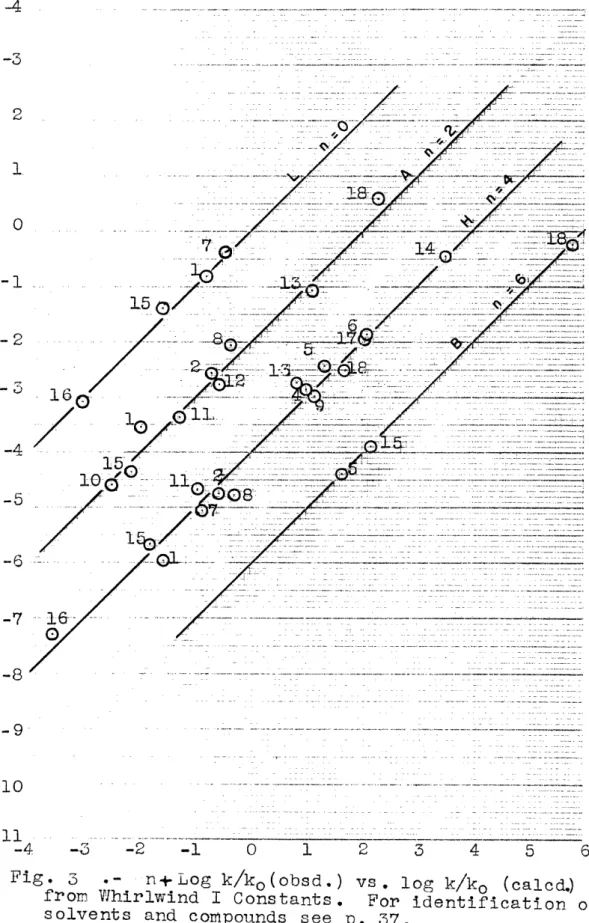
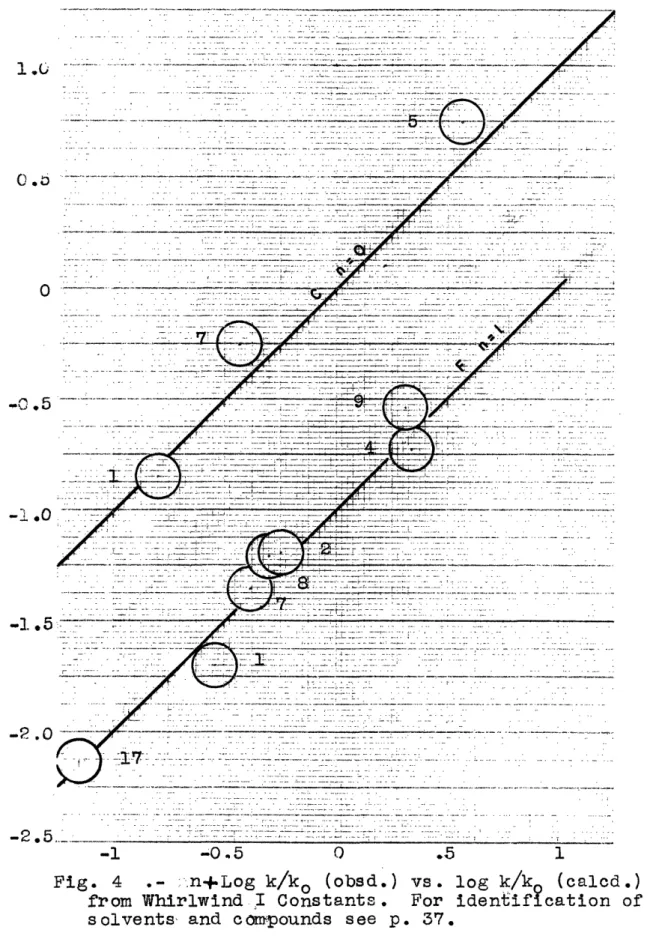
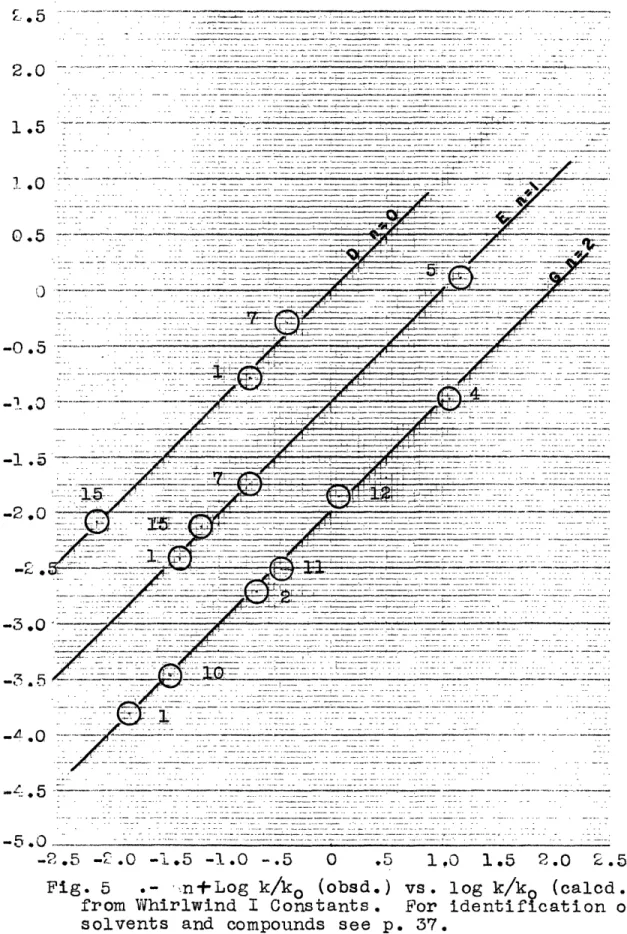
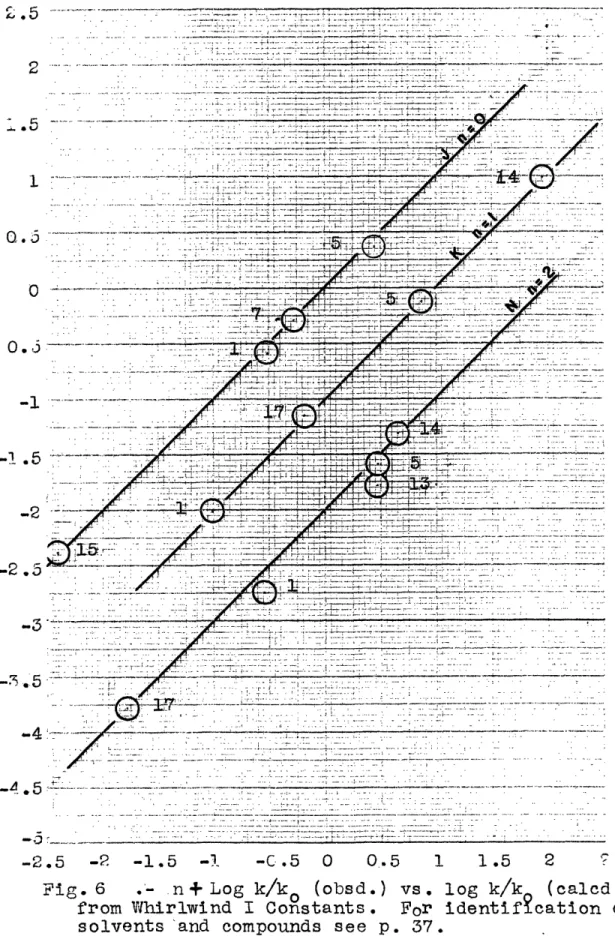
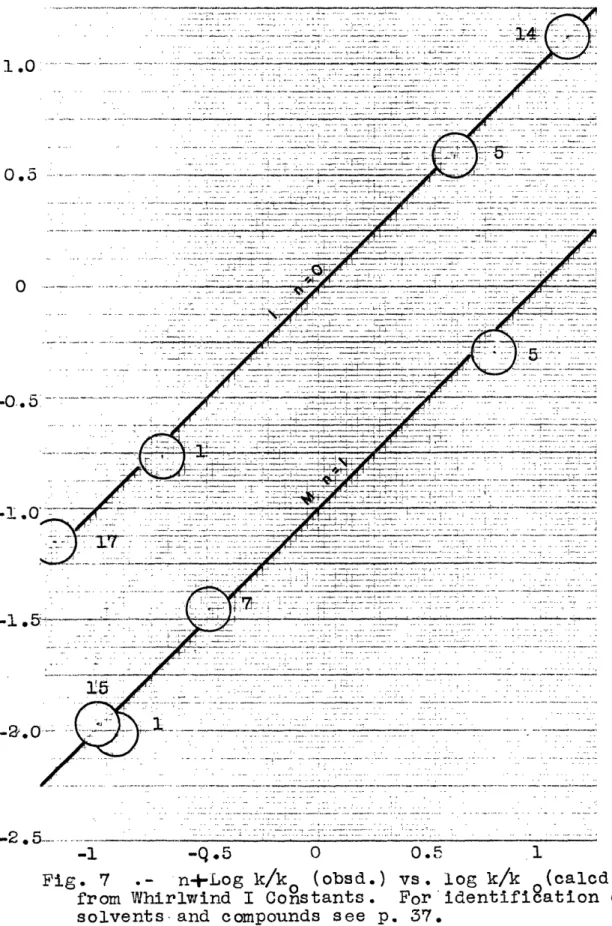
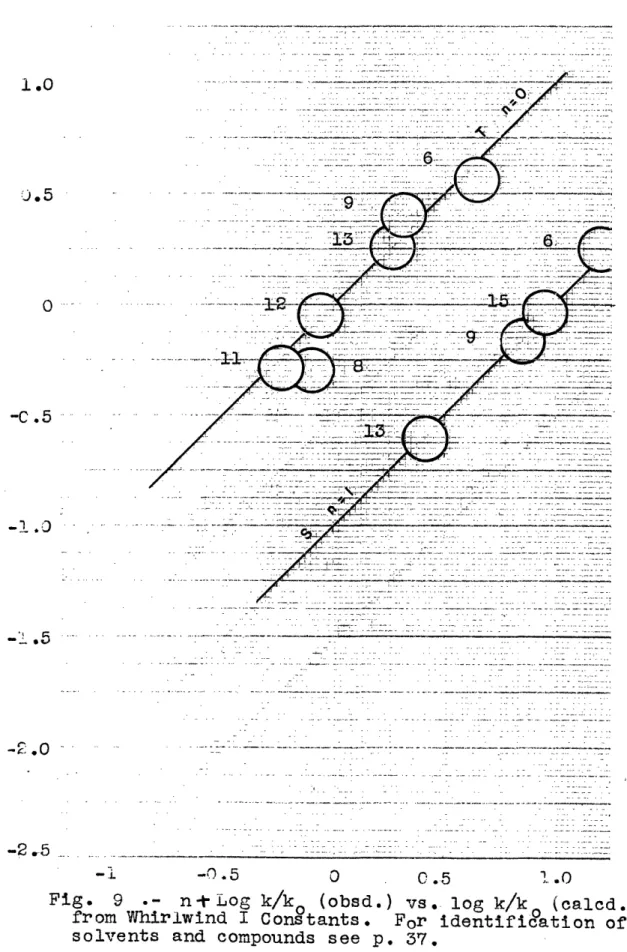
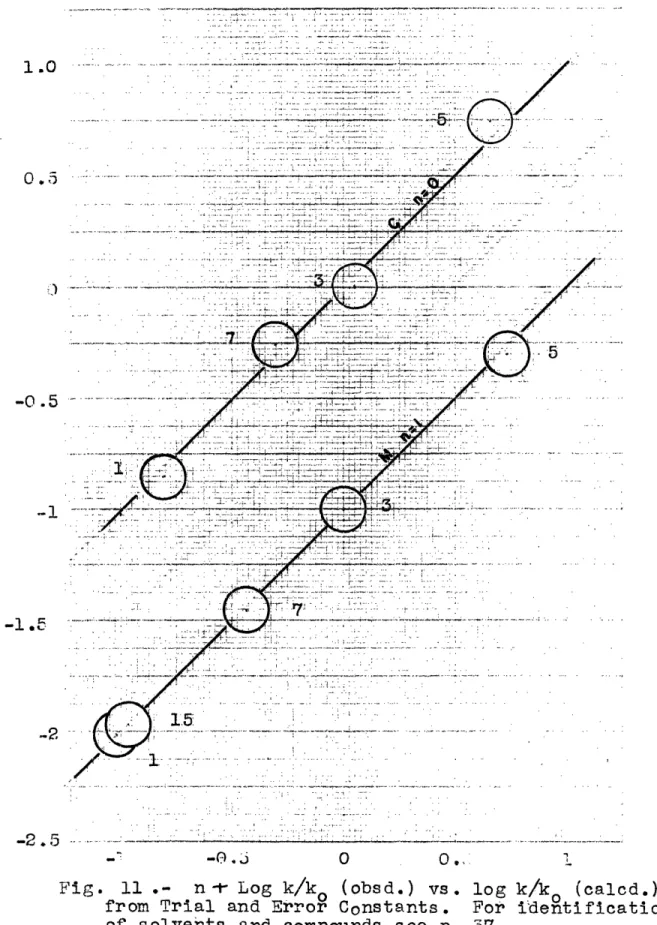
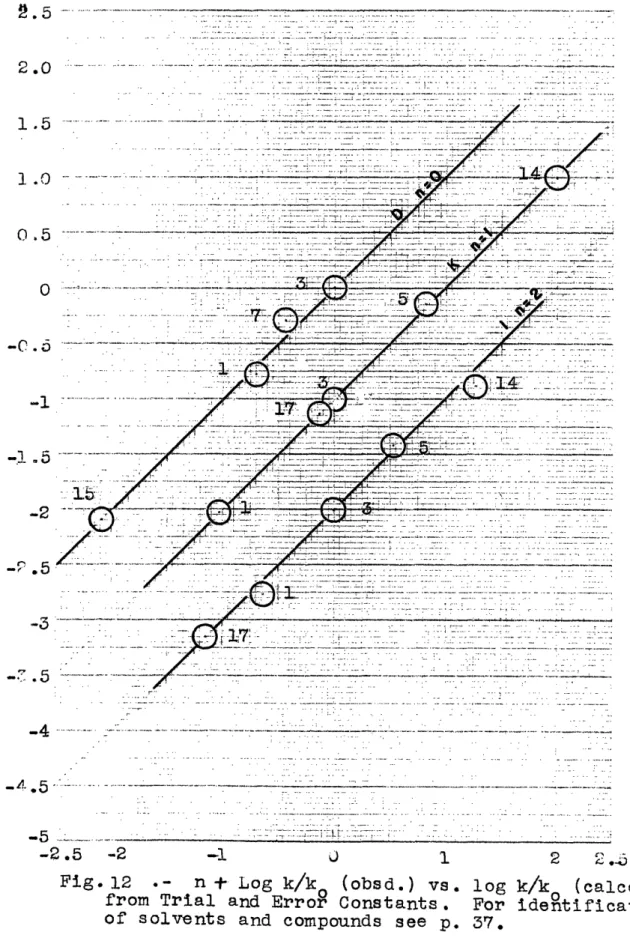
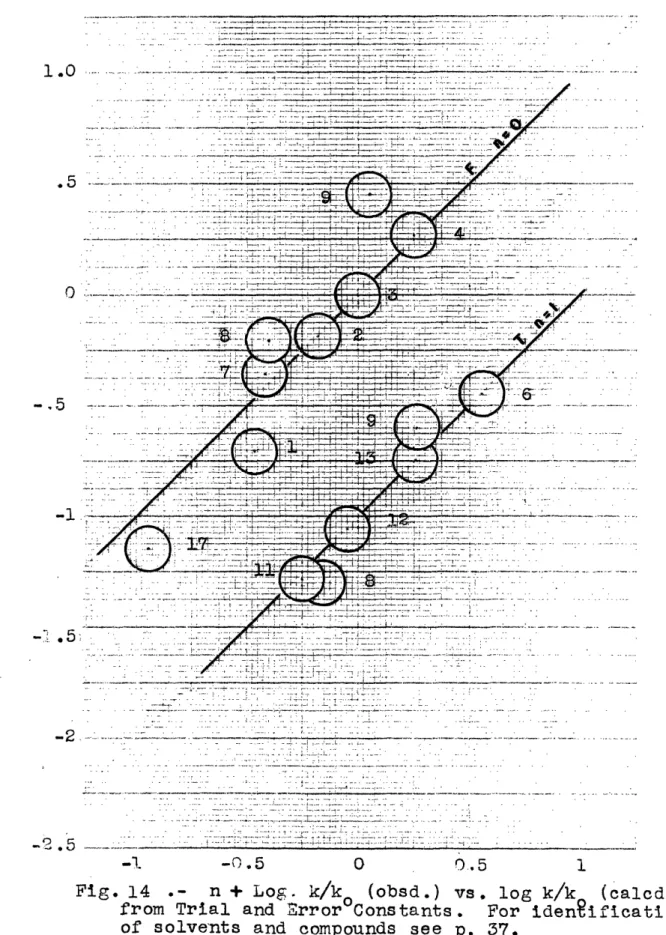
zU compounds. In Tables V and VI values of n and e are tabulated for 18 solvents. In Figs.3-16 the logarithm of the relative rates calculated from equation is plotted against the logarithm of the experimental
relative rates for the 20 compounds. The deviations of calculated log (k/ko) from observed log (k/ko0) are listed
i8
TABLE I I
SOLVOLYSIS RATES FROM TH LITERATURE
Compound
-Phe nyl e thyl chloride Solventa C2H5OH
25
kl
sec .- 1 5.87x10- 7 log k-6.23
Ref. Temp. (C.) 20, 750.0
CH30H 80% C3COCH3 CH COOH 31.
64xl0
4 7.06xlO- 61.
44x10
-63.9x10
' 6-3.79
-5.15
-5.84
-5.41
5 50.0 20, 7 20, 750.0
50.0
2
50.0
t-Butyl bromide C H OH2
5
90% CH50 80% C2H5OH 60% 2H50 90% CH 3COCH 80% CH3C OCH3 70% CH3COCH1 3 35.69x10⁻⁶
7.14x10 53. 63x10
- 43.76x10
- 31.27x10
51.10x10⁻⁴
5.15x10⁻⁴
-5.24
-4.15
-3.44
-2.42
-4.90
-.3.96
-3.29
20,
2925.0
30
25.0
30
25.0
30
25.0
6
25.0
20,
3025.0
6
25.0
Benzyl p-toluene-sulfonate
C2 H5OH80 C2H5oH
CH30
5.33x10-3.24x10-4
1. 67x10-4
-4.27
-3.49
-3.78
-5.58
13
25.0
13
25.0
13
25.0
CH,3COOH 2.61x10¹³
25.0
TABLE II (cont.) Solventa k
sec.
C2H5OH 1.12x10⁻⁷ 80% C2H50H 1.18x10- 6 50 C H OH 8.45x10 62 5
4
H 0 1.16x10⁴ HCOOH 8.6x10log k
1-6.95
-5.93
-5 . 07-3.94
-6.07
Ref. Temp. ( C.)13
50.0
13 50.013
50.0
13 50.0 13 50.0Ethyl
p-toluene -sulfonateEthyl bromide
C2H50H25%
2
CH 25 CH OH 3 CH3COOH C2H5 H 80% C H5OH2 5
50% C225
5OH H20 HCOOHb Triphenylmethyl 50% CH3COCH3 thiocyanate2.46x10-6
9.23x10 6
2.18x10
54 .83x10-
63.83x10l
82.37x10⁷
1.39x10
- 65.25x10
6
1.83x10
5 9 .8x10 1.92x10-5.61
-5.03
-4.66
-5.32
-7.42
-6.63
-5.86
-5.28
-4.74
-7.01
-2 .7213
50.0
13
50.0
13
50.0
13
50.0
13
50.0
35
55.0
30
55.0
13
55.0
13
55.0
31
55.0
38
25.0
Compound Isopropyl bromide 1920 TABLE II (cont.) Com pound Benzyl chloride t-Butyl chloride Solventa C H OH
2 5
80% C H O0 2 5 50% C2H50H CH OH 3 C H OH 2 5 80% C2H5OH 60% 02H50H oo% C25sOH 40% C H OH 2 5 CH OH 396.7% CH30H
69.5% CH30H 80% CH COCH 5o% CH COCH H20kl ' _
sec . r7 3.14xlO2 .22xlO
- 61.22xl0
5
'1.23x0lO
69.70xl0
- 81.73x10-
6 9.24x10 61.27x10⁻⁴
-4 3 .67x101.29x10
8.20xlO
- 71.75x10 6
9.75xl10
51.94x10
- 61.82x10
- 43.3x10
2log kI Ref. Temp.( C)
-6.50
13
50.0
-5.65
13
50.0
-4.91
13
50.0
-5.91
13
50.0
-7.01
20
25.0
-5.76
26
25.0
-5.03
26
25.0
-3.90
26
25.0
-3.44
26
25.0
-2.89
26
25.0
-6.09
20,
15
25.0
-5.76
15
25.0
-4.01
15
25.0
-5.71
26
25.0
-3.74
39
25.0
-1.48
20,
25.0
28
CHCO0H
HCOOH 97 .5%(CH3CO)o0-2.5% CH3COOt
2.13x10⁷
1 .x10x 34.77x10
- 9-6.67
20
25.0
-2.96
20,
25.0
27 -8.32 2025.0
21 TABLE II (cont.) Solventa C2H50H 80% C H 1 50% C2 H5OH H20 HCOOHC 50% CH COCH 3 3 trans-2-Bromo- C2H50H cyclohexyl p-bromo-benzenesulfonate 80% C H OH
2 5
50% C2H5011 CH OHC H 3 0 H CIH COOH 3 trans-2-Ne thoxy- C2H50H cyclohexyl p-bromo-benzene sulf onate80% C2H50H
50 CHOH
CH OH 3 CH C00OH 3 kl -1sec
3.93x10⁷
2.19x10 6
5.66x10
- 6 1.05x10lO3.65x10
-83.65x10
2.67x10⁷
7.02x10-69.12x10
1.28x10- 6 5.28x10- 73. 11x10
' 7 3.25x10⁶ 1.61x101.12xl0-
6 3.46x10- 7log k1 Ref. Temp.('C)
-6.41
13
50.0
-5.66
13
50.0
-5.25
13
50.0
-4.98
13
50.0
-7.44
31
50.0
-5.44
38
50.0
-6.57
13
50.0
-5.15
13
50.0
-4.04
13
50.0
-5.89
13
50.0
-6.28
13,34
50.0
-6.51
13
50.0
-5.49
13
50.0
-4.79
13
-5.95
13
-6.46
13,
34
50.0
50.0
50.0
Triphenylmethyl 50% CH COCHacetate
7.2xlO
4
-3.14
38
25.0
CompoundMethyl
bromide
TABLE II (cont.)
C ompound Solventa
se '
sec .
J.
log kI Ref. Temp. ( C.)Benzhydryl chloride C2 H5OH
80% c
EOH
2 5 90% CH cocH 80% CH3COCH 70% C COCR 3 3 50% CH3 COCH3 5.30x10-54.90xlO4
1 .72x10- 3 4.60xlo-6 7.24x10- 53 .20x10-4
1. 65x10l2-4.28
32
25.0
-3.31
33
25.0
-2.76 3-5.34
-4.14
-3 .4925.0
6 25.06
25.0
6
25.0
-1.78
38
25.0
Isopropyl p-bromo- C H OH benzenesulfonate 2 5 80% C2 OH CH30H CH COOH97.5%(CH
3o)
2 0-2.5% CH3 COO Pinacolyl p-bromo- C 2 OH benzenesulf onate 80% c2 ROH CH3OH CH COOH 3 97.5%(CH CO) 0-2.5% C]iCOO: C13COOH2.64x10
' 4 1 .70x10 - 37.31xlO4
6.94x10
- 51.42x10
6
7.04x10
-51.38x10
- 3 3 .21xlO '2.74x10
- 41.16xlO
5 6.95x10⁻⁷-3.58
20
70.0
-2.77
20
70.0
-3.14
20
70.0
-4.16
20
70.0
-5.85
20
70.0
-4.15
20
70.0
-2.86
20
70.0
-3.49
20
70.0
-3.56
20
70.0
-4.94
20
70.0
-6.16
36
25.0
HCOOH 8.58x10 -4-3.07
36
25.0
'2 3 TABLE II (Cont.) C ompound n-Butyl bromide Solventa C2H50H 90% C2H 50He 80% C H OHe 60% C H OE<e 2 5 60%C Hd He 96.7% CH30Hd'e 69.5% CH3 0 Hd 'e HCOOHd
kl
'-sec.7.8xl07
2 .51x10 - 6 3 .89x10-6 7.24x10O61.70xlo
6
2.42xlO- 6 -5 1 .13xlO 2.82x10- 7 log k1-6.11
-5.60
-5.41
-5.14
-5.77
-5.62
-4.95
-6.55
Ref. Temp.( C.)19
75.1
19
75.1
19
75.1
19 19 1975.1
75.1
75.1
19
75.1
37
75.1
aWhere only part of the solvent is specified, the rest is water b
Extrapolated from a higher temperature using
13
- 19.8 kcal.
CExtrapolated from a higher temperature using
- 20.2 kcal.l 3
dExtrapolated from higher or lower temperatures using
- 22.0 kcal.
Interpolated
from a plot of log k vs.
mole
fraction
water
(26) E. D. Hughes, J. Chem. Soc., 255 (1935).
(27) L. Bateman and E. D. Hughes, J. Chem. Soc.,
935
(1940).
(28) C. G. Swain and S. Ross, J. Am. Chem. Soc., 59, 2644 (1937).
(29) E. DE. Hughes, C. K. Ingold, S. Masterman, and B. J.(30) L. Bateman, K. J. Chem, Soc., (31) I. Dostrovsky, 171 (1946). Cooper, E. D. Hughes, 925 (1940).
and
E. D.
Hughes, and C. K. Ingold, J. Chem. Soc, 166,(32) E. D. Hughes, C. K. Ingold, and N. Taher, J. Chem. Soc.,
949 (1940).
(33) . M. Ward, J. Chem. Soc., 2285 (1927). (34) S. Winstein, E. Grunwald,
Soc., 70, 821 (1948).
and L. Ingraham, J. Am. Chem.
(35) E. Grunwald and S. Winstein, 2051 (1947).
(36) S. Winstein and H. Marshall,
1120 (1952).
(37) L. Bateman and E. D. Hughes,
(38) C. B. Scott, Ph.D. Thesis, M.I.T.,
J. Am. Chem. Soc., 69, J. Am. Chem. Soc., 74,
J. Chem. Soc., 940 (1940). January, 1952.
(39) MI. S. Swain, Ph.D. Thesis, Radcliffe College,
24
-4 - --
---3
.3 . ... ... A '. .. -v 21 ---2 /60 :---:15
-5
/
-6
L
-7-10
-11 -4 -3 -2 - 0 1 2 3 4 5 6Fig. 3 .- nLog k/ko(obsd.) vs. log k/k
o(calcd.)
from Whirlwind I Constants.
For identification
of
25 a 1 0 ... .. 0 ,0 '~~~~ .'.-. ...' 7···- 7- L... .·... ,.. · ·. -. ... .. ... r ~~~~~~~~~~~~~~~~~~~~~~~~~~~~...
...
~::
·-- ' , ... ... · · ---- :- · --- · ·----....
-- . - · .. ... ......
:v-: ·....
:.
-.i-E-': .: : ... ~ _} ' ·-~~·~--::. -~-- ._. ·... ~ ' ·... - ·. .. -- - ·--- ·· -·- - -I':-- :'-" --- "!-1
-0.5
r:0
_. . . ' '~~
.5
"'._. :.. -::: )-~:.'1-··
: ·- ·-- ..I....1L. __... .. : .... ~. - · ·- ...~_ .... ... ... L_... ... ... _..,.~ ... ...,... ._... ' ...-" ...' , .. · ·--. ·... ~... .. ...T
' -'
"~;
.~~.... . . · ... . .... ~· . . . ···--- ·- - .'-' -~'-'. '?-~·-- '~"'1 ... .... ...--. ... · ·---- ·- · - i- · ·--1.... ...-...,...,. ,-.,,, .,,., ... ;.... :_.~,-~:, ... : .. ~~~~ ...· ·-- ·- · ·- ,-~- ---..--t · -: --- ...Fig~~~~~~~~~~~:"'"';.:
. .''.n
Lo
4
:s.'....lo kk
... )
:"L'_
~~~~~..
..--
..
...
...
... ~.
~.
...
~..·.
;.~
..
.I
'
-,-.m~~~~~f
om
Whrwn I Cosat.
~~...
For .dniicto
'o...f~...
solvents, ...and copounds: :_. ... .~~~~.r...-.
...,-.. ... , ~- . . ...--
~~~~~~~~-
~._; '-'- .....: -- -.. ...- .. _ ·-·- -- ·- ... '.. _...-.. '--..+.~ ·-;...-. - · ...~
. . .. ... ... ... .~
... - -·· · .- -..,.~. ... ..-...· .. --...-·:-- . .-·. ... .. ·... . :.. .__// ;.. . :-..-... ....:....~L ... ._1-:;- .. . .. i·--·-- .-. ... . . . ._... -·: ·.-· . .:_. ·- '.. ~.O
~~~~~~~~~~~~~~~~~'-?--'----·
~~~~......
L.L..,.:E
-'_.
"Z.-/'
..
.
~~~~~-...-...,.-.Z..2
...
i
--·--....
~..._. ·__L...
· L ·_· .'·'__·-
._ .. . ....
_ i · ··· · L _· _··rr- ~·~···...__.'-
'··-
' ' '_·
:...
·~· .s.. - --- . _.. · 1 ... ... ''~ ~" -I~ ' :.:... __~~_::`-._. . '-' ': ;....;...;-"...' -'": i:11 .... ,... i ~~. ~~~~~~~~~~~~~~~~~~~.... . .~.~...-.
~...-. : .: ~ iC ~:
_.... ...
, . -.. -/ ...~~~~~~.
. ... ... . ....' . - - '-.~.~._ -2,0 -[--~ ... ·--I.,-..:',:
...
.,:..
\ ~ ~ .. .- ~r /.Z... . . i... ''_:£7;F--'/.7_-·--. ' '-"Z- -': -'..'-L -· ·.- · ·-- - ... .:...... :~lrf :I... I,_1Z_~ r.,~Z;;I._.. ... _...._... ...
· .- ·. · ·-.. .. ·.-
~
-.. ...-.- -..:... --. ..-. ... :... .. ... ..:·-~
~ ~ ~ ~ ~ ~ ~~~~~~~i
~ ~
.'
..·
.
-~~~~~~·
2. ' ' - ' ' · "::''--- '::-::.!-:i-F?-.E_-.---.;.:-..-'. !?..' !7-i'- : ' :7 i? (--:....:-:.: ;, - v
-1 0---r- '0.8- 1 .5
Fig. .-4 ~- 'nLo k/k (obsd.)-·--·- o vs.-·- lo /k cac.
fro
Whrwn
Cosans
idn-fatono
I
F
o
r
05
I-5
"
5
~,.:: ,.~..~..~-; ... . .2.0 2.0 . .... .~~~~~~~~. . :12 ~ "-: ...': ....~. :...~': __:'i.:i"7 : .L~' .i i . : ' :i- ::-. :.~111-: r',T ~ ...i i ;. ~. T:1'_ i._: i ..'. .'
~ ...~ , :,, ,,.', , -·:~~~~-·~~ r_ _:
Q
i
... ·-.. ~. -.... ·--~~~~... "O~~~~~~~~~~~~~~~~~~~~~~~~~~~~~~~~~~~~~~~~~~~~~: ... . . C~~~ . ~... . . ...-.... . : :....-. . -. -..i.: .~-.... ... ... -5.0 ... :' .... . .. . .. ... ... 1 5O " : ... .... . ... .. ..-...-. ... , ... -~.... ..-.... , ... ..:.-.-... .... . ... ... ... ...~. ...-...-_.--.--. ..-.. :.. ... . , ...~ :. Z '._-...2 :. _ ... .,... .... : ...__ _...,..._... _ .. L._._. ...: ... . ,__ ... -,, .-.... ~ ... :.' · ' ... ', : :....!.!.!/:~ i~..:.::iE.:i~:~F~:..::.:.:...:iGh....f.".' .. .. ',. ,.:.f,.:- ,. -" .~~~~~~~~~~... -... ..~ .. .- ... ... ..-... .. - _... ~ ~...,,-, ...,.. ..--. ... , ., ... .5 -. 0 -. 5 -. 0 -.5 ~~~~~~~~ , - ... :... ... .r-.- .... ... .5-- 1.0 1.5 . .Fig. 5 . .n : Log k/k (obsd.) vs. log k/ko (calcd.).... ...
fr om Whirlwind I Constants. For identification of solvents and compounds see p. 37.
. ... '.:..:..L...-'_ _.~. __.--~--..--·-_~ i3 ··~~--·----·"-·--- ,,,~ ·---·--- · _-- ~~...,__. .._...-... ....: ... '. . ...-. r----.:: ::-.':~_- ..-.- -· ·...-- ':: ..,...
:":': "
-' .
'
/
?
:--:Z-:::-!"~+~:i.:-
,.._'--:.
·
:--
_:.-/~:. : :'!'!T_7-
.7.-_i".--2:.,
':'::'-:':':···
· ._ -· _ ·- .. ... ~·-· " _" ...·.-.- .-.-;.. .. .-- ... ..-. .---.---... ... -- .-....... -··---
....
-- --- -.-- .- -.'--·...L'-
,,,.,.2.-
-i''
...-.
-...
~~~~~~~~~~~~~~~~~~~~~~~~~~~'_-0'_
~ 5-_:_._.:-f:.:·.-.-..
LL
..,
-Z
. ·.-···--
...-
-
__
-'"''--~-- ,_,,
-,.o ,
.
.-·----
~
.
L:..
.~, .,..,. e._...- .··. .:.,:.1 -. :... ... ... ... ~~~~~~~~~~~~~~~~~~I ~.... .... ... ~ '~' ~~' .. . ...~~. . ... .. .-... : -. -·, · -1,5 .. . . . . . . . . ... '~' ' ...'~ '-~
"''~ ''.,
,,
.- 1:_.
_::ji
~__:_~-
,,., .. _...
.,,.
-2.
o~~~~~~~~~~~~~~~~t
.
+ITl:._-;
..
:.
._....
,,:~...
'::- -:' .... .:E -:-- -·--- - I- ; . . -l. /.' .L.. ....-.' :..i.i_ ' '~~~~~~~~~~~~~~~~~~-':' :'-J ..-....-. ''.t::-..--.}:{.r:-:L:,--.-:-_ .... -:T---zi -"~:.:.-__-..:: :':_':-:.-_:..'_'. :: -':.· --"'r ,. · :: , ., : .....- ... ..-....--. -.- - ·- - ....·-~~~~.;... ~/-"~ .,.._... ... _. ... ~. '.I~T" ...- "I-'~~~~~~~~~~~~---r...':- ... .... ;... ,... ,.,,..._ ':Z - -:':I.: :' .:ii:I---.... .:::.' : ~~._._r~. __~ _.._.L_.:.1 ...: ...:... -3 .0 "'~~~~~ :.11- -_ '-· ... '- -- · ·- ·- I-....-.-. ... ..-....*. . ... ...-::"'-:-:... . .,...., ii/i:... ..- ..._. .. _... ~ ~~~~l/:......
·
~~~~~~~~~~~~~
-,~__r
.~
, ..r~.~
2.._.r~1 _... :.::-: _,..
_,,... .
"'... .. ' · E-· -- -- ,· --- · -· ...-- :'- _:-- ~ '·-- '--· - -i---:::"-_-. ::'_.:--·-.~:_: ::',l". .. -: - :..:- '' .'._: _--.'' : ... .. . -.... ,_ ~~~~~~~~~~~~~~~~~~~~~~~~~~~~~~~~1...-.. ..-..-... . -..-. ... ... `.".~,: · ... I ... .... :~: ,: ,,.,.,: ... :,.. .,,, ,, ~~~~~"':._1 . 1..,..~~...-._.,--.-__ - ..._..:... ,_ ... , ...-9,5 -,.. -1,5 -1,0 -.5
0
,5
1,0 1.5 2.0
L.5
Fig. 5 .- :-n+og k/k o (obsd.) vs. log k/ko (calcd.) from W~hirlwind I Constants. For identifi cation of
26 a 2¢ · ·~·'%c ... .. .. . ... . .... ; ~.·- z~- · · ·-.- .. ... .. . . . ... . -~ _..-.* ~ ~ ~ ~ ~~~~~~~~~~~~·.- .... L'-- ' ' ... · . -- ....i ....;...~-, ... :... .~~.~...,L._~.L, ,_; '... ' ...4. ... '...
ML~~~
Lt
` .... ,. .~ . .., .... ... . .-. ^C-i·:·-· .... ~. L...'._ ~..z····---'.-+-, t-.~.;...:...? ...-. ... E., .; ~ ... 1.-~..L.._..;...,-~...~.:, . . ... .. ,. .. . ...-2~~~~~~~~~~~~~~~~~~~~~~~~7
*l...~~` ..---- v o--... .. ... ---4~~~~~~~~~~~~~~~~~~~~~~~~~~~~~~~~~~~4
.- ... ;..._ -41 -'-. .l...r. '--L- ~ ...! f.-.--t.:---:.-*--- "'--' --;-'- -: ....--"'-: ....- "':... 4.4~~~~~~~~~~~~~~~~~~~- ---- -- __________ · ______ * . 5...-" . .. . . .. 52.:~
~~~~~~~~.;....
-~~~~~~~~~~~~~~~~~~~~~~~~~~~~~---1 ''----;i-::-: -~- :':-'-: '-- :--"-~~ -: -':"-...i;!i
'
::"~"
i~~~~~~~~~i:'i:~i~~~~~~~~~~i
~~~~~~~~~~~~~~~~...':~-::
... . . . . , ' '.:: -z-- - -'~ . . .. -2.5 -2 -15 -C. .5 0 0..5 1. 1.5 2 7.5Fig. 6 . n + Log k/k0 (obsd. ~--~-' - ) vs . log k/k (calcd .)
~~~~- ~ - -_ '...
from Whirlwind I Constants. For identif.eation of ..
solvents 'and compounds see p 37-.r-'-?-- : '', 4
._ ~_,.~_~ :-:~:: %t-_~~~~~~~~~~~~~~~~~ _':. .. ;t ... ,... ..~ ... ...
...
...
~
;.-
: --:..;..:--~+: .
...
...
.
.
._... .. _
--·.
" '
,.;--
': ...
. ... ~.- -:-'---,?'.---''--'-: . ~ ~~~~~~~~~~~~~~~~~-r---1: , -..-':-:-,: r·: · ·. I. ... .~...._.:.,: .-. .. .--., -,- :----....;~.?... ~ r.-- . ... ... :'--i::~~~~~~~~~~~~~~~~~~1-,-
~-:':~ · ":':'..;'-i... '':¥ : i....,. : .' . ......0 ,.) ...
~~~~~~~~~~l----
..
.~~~~~~~~~~~~~~~~~~~~~~i~~....
:.
:
.
...
:...:::.:::--·-,~_
·.
....
.
,--=:.
-..
i.S
...
:...
..
''~~~~~~~~ -~~~~~~~~~~~~~~~...'' . -:_:... . '"' ... : : :'~._.._.i...: . . . :T-" -3 ': L.. .. . . ~ · ---- ·-- ·- :. -~-r~T_--.--~~~~~~~~~~~~~....
;.--?'~
;...~.·...
...
--·- i ---·- ' - :-:'i. - ,-' '---'·· '+-:-: ..-+': - -- :"- '.'-' ¥ :, · 1 t-:: i--"--- : · ··-,·
'·
i;`!
','
i:F
'-
."::
-;---·-i--..:';-:-:
' ' - :
I:.
'I.
':
-
'-,-
.:-~
· ~~~~~~~~~~~~~~~~~~~~~....:... :+ ~ ...
c::
-"-!:'/---1T_··-:
.,...
..
~~~~~~~~~~~~~~...
,
,:...
....
...
··.-~ . .· -' -`- ... ... " ...:.
... ::::::::::::::::::::::
*IL
..... I--~--··-C·X L^···i···- ···--···---
_^·1--~·-·
.... ~~~~~~~~~~~~~~~~...~ , .,: ... ..-.... ...~ ::_::::i .-...~...:. .-...
.L.,;:.
_
__~
:
-2.5 ....
5- 5 · 11·
2 r·27 .... .. ... ~ ~ ~ ~ ~ 1._.,;~ ,,.,.
'so~~~~~~~~~~~~~~3
10 ~~~~~~~~~~~~~~~~~~~~~~~~~~~~~~~~~-' - ,/... ... . 0 -: - __---__ -----0
~
~~~~~~~~~~~~~~~~~~~~~
.. ... .. . ....'.._.... :~/..
....
:.
-0.5
--~..., . .
....r..-...
...-...;...~...
' . : .~.
...
...
...
j
~~~1~..0..-...-. ...:.~... ._:-.- --IT~~~T
-2 .5----1q·.5
0O
1Fig.
7
n+Log
k/k
0(obsd.) vs. log
k/k
(calod.)
from Whirlwind
I
Constants.
For identification
of
27 a ... .--. ... ._ ._... ... .. 3- - ·--- ·-- · · ·- · ·--- --- --- · ·- ··- · ·---- --·-- r'.--- ·
---'{:.
' ... .-" .--
'·.. ----
i:--···--.'.···:~_..r
.... = ..._-_-i;.-.-"c._A..---_ ... .·-· ...
...
··
... ... -2~ ~~~~~~~~~~~~-...
.t . . -. ~..~ l].-~
...-.~.......
. _ .'. ... ... ~ ..., .. : .... ...~_._,.~__-. ... · · ··3 · · ·--- --- · · - · - · · · ·...--·-·'··-- -. ; . - · ·-···· . . . . . . . ; *.L.. ... _..._·... .. 1.-.. -. -...-... ._. ... ... -... .-~'
-:-·-.---c--_2~'-- ~-- E ...·-·~-:/'::'
I L ·-·----·-- ·-- ··-- -- ·- ·~ ~~~~~~~~~~~~~~~~~~~~~~~~~~~~~~~~~~~~~-- --- -- ··-- -· -·-·---·--- -·-·-- -· ~~~~~~~~~~~~~~~~~~~~~~~~~~~~~~~~~~~~~~~~~~~~~~~~~~~---... -- ---... -··--:- --r-···.-·- -r·-- - ·- -·- ··- --- ... l -- --·--- ·--- - --- '.. l.'...i",...-. i·-· -2 .5 --- ··2 '";'~~~~~~~~~~~~~r .5 C.. 5~~ii{2-_~ihi~r_
1 ' -· -1 'C ...-...·- _~..._ --:.5 2 --i
... ..,... ... ... _ ':`r:-'-~ :---·-- ·__--- _.:-' · ·-. _.-;. ; r.r .... -"--" .I ... _.. ...,..·-_ ..._... ... _ ._.._ g'' .k.o.b. z-:'.:-'..-.-. ... . .f~~~~~~~~~~~~~~~~~~~::-::::-'-_--: .:z-:::'::..?~ ...., "
_..
.,.
-'-'~`..
.. :,-:.. ...
i -...
...-...
... ~,.~.;
---
~-
·----
·.~.;
, ---..
~_-
l--:
ill···---·--r·-
-.5...
5~--....-
.-
:--~::
'
-'
-
-'-
'I ''..'.-:'--,.:-:---''
...
...
.·-
.. i ...~~~~i-
.
-
-...
...
...
... :--
,---r-,
....
.;---r
...
~~~·~-~~- ~~-~--~~~-·----'.
..'"'"-
: ·...-...
-~---
..
.· i· ."·· -.-. ~. i ..-.~. .- .-..' :'... ..-.-....- ..-... " ::' I:~.-:L. . .~Z·-~~ ~
:i j .l-.-._...- -...- --. :~: .'..-"ir':' ._-"E-,:_-::. .. I..;,..i-_i, . ~ ..< : -~_.._:: -!~z-:?_'.:.::- ':i::;z::zrz;'4._%fT-·-·-- ' ··- ·
' .~~~~-;... ¥'-;
._:~~~._·_~·.: ...- ·
= f-·-
· --- ·· ··---2
.i··-·--r-:
·hirlwi
;:o'
-nd:I' Co--sats---:
i-de-nt-ia-:-_--
'"
'----:-:.:--.---=
solvents arid compounds ... s:eei':.1F-)¥':'-'!i~i:X:!F2._¥T¥-~:f2-FT¥¥Ti~i¥:%:- , ... p: s ...37.---:-:-.--_- :i~¥_l?.ii~i! :.:/}!h -E~.-.. -.
-3 :-~T---5.
%.
'...
-~.- -...
_...,-
...
...· ...
...
' ...
' ...
~ . . ... ...
~·
r-
:-·-·
~~.-f--
7_ _
....-
...
---
-·-··--
'--.·
·-
·
-- ~ _ ... :::'- ' .,'.... ...- ... .... ~-!--:r'"-':z:-'z'::--- " ~ .. "----',...'':'. -' ::.-:-r-[:'-_:.'..:.-,~.X:.r..:_:.~~~~~·-·--2. 2 -1. ---- -0.5-- 0 0-.: I;... 1 ..5 2 .ff..._. .
Fig.~~~~~~~~~~~~~~~
:n-i-L
og--~
' -~1,,:;~.-
k/k~.. (obsd_~:_::.)
s.__ lo
cac.
/k
from8~ ~~~~~~~~~~~.
I·-
Co't
Whirlwind~~~~~~~~~~~~~-·---
7-. __-··-.^-·at s
idntfiato
For
. _. -~ ... ..:.. .. ... _of··-
·--
27 b 1.0
....
...
, -...
3.
....
...
0 1 ~~~~.~O · ...-....- _... -I . . .~~~~ ~ ._.. _~~_:~ ~ ~___... ....:_ ._ .: : 1_ . ~ ~ ~~~~ ... _ ._._. ... : , Il_:... __._L .1II1 .. 1. 1 .~:L.1:_... 5.... ... ... .. .. _~:.. L :.. :... .. . .. .... .... I.... ... ' 1. L0
0.5
Fig. 9 n -i Log k/k0 (obsd.) vs. log k/k (calcd.)
from. Whirlwind I Constants. For identification of solvents and compounds see p. 37.
28 ... ... .:- ..~.: _'. :. ... ~~~~~~~~~:.... . :.'...~:. .::._.:.:._.i...' ... :... _~~~~~~~ ...:. ..~~./ . ... ,I..~_ .. _ .'_,.,. .. .. 1:1..,:,,_,, ' [.7.1~ 2_£.!.L'1.2.- ' :- :,,;.,...-....I.c_~. 4 4 ---3 2 0 ... ... . .. . ... ... i-LC _··:·::--·r.
-
L_-ll3
-~~~~~~~~~~~~~~~~~~~~~~~~~~~~~~~~~~~~~-..~ ~-~~
i..
'. .'. ...
....
_..:-
-~:.~-
-:---
- -
-
.
!
...
-7-4~~~. -56ii--~-~Y~
i*YI~UI
-.5+~-
-_ --._j
>:
....
:
-7 -8 . ~ ~~~~~~~~~-._~ r-_.. _..
.1:.~..._....:. _ ._....1.__.__.. :f_ .._..._ 1. ... .:. ... .... . : ... : ._ ::: ·- ' __.'i, ' ~~~~~~~~~~~~~~ ... ...:.....
L.L... .5 -4 -3 -2 -1 0 1 2 3 4 5 Fig. 10 .- Log. k/k (obsd.)-n vs. log k/k (calcd.)from Trial and Er~or Constants. Add 2 to abscissa of Compound B. Fr identific.tion of solvents and compounds see p. 37.
28 a . ,, . ... ... ... :::~:X?!~~~~~~~~~~~~~~~ " ~~~~~~~~~.. ....: ... .. ...
C>,S~
~ ~ ~~~7 I - i09 .... r·.;. .... -- .. .. ;Z ''.:;"/ ... .5 -1·1 ~~~~~~~~~~~~. .... _. ...-. -2.5... -2~~~~~~~fi
.. _:... ' .. ..._,,~
,.' .._ ...""':....,.. " .... ...._ - .. iJ .Fig. 11 .- n Log k/k0 (obsd.) vs. log k/k (calcd.) from Trial and Error Constants. For idegtification of solvehts and compounds see p. 57.
2.0 1
.5
... . ... .. ... ~~~~~... ,1 ~;-';. .:: -':: "--' ..- '.'."'.F ' ~ "LF;- .;'.'~ ]: U' j'Z] " _ _:_1.1I... ... ... .,.; ... ... .. _.; 1.020 ... ... .4.. . I ... ..._.... ... /?:??? i: :? -2 17 .5-4
1·5 .. ....-... ... 5 ..,...~.:...-I. ..- -.:l...~... I , Zt":-- .. '-"~-? ,.-:.--: ..... j... . ,.,. . . ...,....I. :-2.5 -2O
~~~~~~~~~~~~~~~-,
-1 ..~i'~¥''7"
Fig. 12 . fl- Log k/k :- (obsd.) vs. log k/k -:(cald.):
:--from Trial and Error Constants. For idegitifrication of solvents and compounds see p. 37.
-...
. .. ....
...
...:
f..l.. _ ~ . _...: ..1-.. .'I'._._~l. ._]-~-~-:-'~
~:
':~
~~~~...__~...::~~~~~~~~;-_.-
'
:.::::
.__:...
-::~[-~.?:'
:'-'
~~~~~~~~~~.;:-::4 :... ... .r.. ;il" :":-:'::m:_'_' /~~~~~~~~~~~~~~~~~~~II~ ~~~~~~~~r':,_-.-.-.. ~ . ._'--:____. :.''.z_...-.: -...-.~. ._.: -... ... __...'-' :- _.. ___ ... .~--' ..,.,._. ... ... ;.-[ -. V¥:.. ~i '.... ...:. .. ~~ ~ ~~~~_~~~ ~_~:~ :~~... ..; :-7:'~~~~~~~~~~.. T-:1... ..:. ¼ .I..._._.._.t... __._.~-;:-7:": .1. .... _...:i.~.. .: .. ..._~... ...._...I....
-5 ~...,...,.-.. _ .... _
4 '· -~::
-2~~~~~~~~~~~~~~~~~~~~~~~~~~~~~~... - .- .. ; . , . ,2 .. ... ..- '...
Fig~~~~~~~~~~~~~~... Lo / r.-. o .) v. :+ -~:- ... tt.. .-t c... ...