Automatic Symbol Acquisition
through Grounding to Unknowns
by
Mycal Tucker
S.B. Massachusetts Institute of Technology (2015)
Submitted to the Department of Electrical Engineering and Computer
Science
in partial fulfillment of the requirements for the degree of
Master of Engineering in Computer Science and Engineering
at the
MASSACHUSETTS INSTITUTE OF TECHNOLOGY
September 2016
@
Massachusetts Institute of Technology 2016. All rights reserved.
Author
...Signature redacted
D'artment of Electrical Engineering and Computer Science
August 16, 2016
Certified
by..Signature
redacted
Accepted by.
MASSACHUSETTS INSTITUTE OF TECHNOLOGYAUG 14 2017
Nicholas Roy
Professor
Thesis Supervisor
Signature redacted
Dr. Christopher Terman
Chairman, Masters of Engineering Thesis Committee
co
C,
w
DCG-UPUP-Away: Automatic Symbol Acquisition through
Grounding to Unknowns
by
Mycal Tucker
Submitted to the Department of Electrical Engineering and Computer Science on August 16, 2016, in partial fulfillment of the
requirements for the degree of
Master of Engineering in Computer Science and Engineering
Abstract
Research in automatic natural language grounding, in which robots understand how phrases relate to real-world objects or actions, offers a compelling reality in which untrained humans can operate highly sophisticated robots. Current techniques for training robots to understand natural language, however, assume that there is a fixed set of phrases or objects that the robot will encounter during deployment. Instead, the real world is full of confusing jargon and unique objects that are nearly impos-sible to anticipate and therefore train for. This thesis presents a model called the Distributed Correspondence Graph - Unknown Phrase, Unknown Percept - Away (DCG-UPUP-Away) that augments the state of the art Distributed Correspondence Graph by recognizing unknown phrases and objects as unknown, as well as reasoning about objects that are not currently perceived. Furthermore, experimental results in simulation, as well as a trial run on a turtlebot platform, validate the effectiveness of DCG-UPUP-Away in grounding phrases and learning new phrases.
Thesis Supervisor: Nicholas Roy Title: Professor
Acknowledgments
Although there are few names listed in this thesis, countless parties have contributed significantly to this work and my brief experience as a graduate student. Of course,
I must thank Professor Roy who opened up his lab and schedule to accommodate
me. Along those lines, I am profoundly grateful to everyone in the Robust Robotics Group for aiding me in everything from developing a proper problem formulation to finding the best boba tea in Boston. Rohan, in particular, dedicated significant time
in trying to transform my haphazard thoughts into something presentable.
I owe my gratitude to my family and friends as well for supporting me whenever I emerged from lab. Without sporadic Skype calls, weekly dinners, or late nights in
which I tried to explain my ideas through a mouthful of toothpaste, my sanity would departed long ago.
This work was supported in part by the Robotics Consortium of the U.S Army Research Laboratory under the Collaborative Technology Alliance Program.
Contents
1 Introduction 13 1.1 Technical G ap . . . . 14 1.2 Problem Statement . . . . 17 1.3 Contributions . . . . 18 1.4 O utline . . . . 19 2 Background 21 2.1 Grounding with Probabilistic Graphical Models . . . . 232.1.1 Generalized Grounding Graphs . . . . 25
2.1.2 Distributed Correspondence Graphs . . . . 28
2.2 Human-Robot Dialog . . . . 32
2.3 Learning Semantic Meanings . . . . 34
2.4 Grounding Spatial Relations . . . . 35
2.5 Object Hypotheses for Unknown Environments . . . . 37
3 Grounding to Unknowns 39 3.1 Unknown Phrases . . . . 40
3.2 Unknown Percepts . . . . 42
3.2.1 Alternate Approaches to Object Recognition . . . . 45
3.3 Training Unknown Phrase - Unknown Percept Associations . . . . 46
3.4 Technical Changes . . . . 48
3.5 Unsupervised Learning and Concept Acquisition . . . . 51
4 Grounding out of Perception
4.1 Alternate Approaches to Grounding Out-of-World . . . . 4.1.1 Default Out-Of-World Groundings . . . .
4.1.2 Symbolic Representation of Out-Of-World Groundings 4.2 "Hypothesized" Objects Approach . . . .
4.2.1 Modifications to the DCG Model . . . .
4.3 Potential Improvement through Natural Language Feedback .
55 56 56 56 57 59 61
5 Resolving Object Ambiguity through Heuristics 63
5.1 Form of Color Heuristic . . . . 64
5.2 Color Heuristic Features . . . . 64
5.2.1 Color Language Feature . . . . 65
5.2.2 Color Object Feature . . . . 65
6 Evaluation 69 6.1 Experimental Design . . . . 69
6.1.1 Simulated Environment Generation . . . . 70
6.1.2 Natural Language Command Generation . . . . 71
6.1.3 DCG-UPUP-Away Initial Training . . . . 72
6.1.4 DCG-UPUP-Away Evaluation . . . . 73
6.2 Experiment Results and Analysis . . . . 75
6.2.1 Grounding Accuracy across a Series . . . . 76
6.2.2 Symbol Learning across a Series . . . . 77
6.2.3 Improved Accuracy through Symbol Acquisition . . . . 78
6.2.4 Accuracy Using Automatic Object Recognition . . . . 81
6.2.5 Hardware Demonstration . . . . 82
7 Conclusion
7.1 C ontributions . . . . 7.2 Recommendations for Future Work . . . .
87 87
List of Figures
Simplified symbol mappings . . . . Realistic symbol mappings . . . . General probabilistic graphical model . . . Parse tree for "move to the cube" . . . . ..
G3 factor graph for "move to the cube" . .
DCG probabilistic graphical model . . . .
DCG graphical model in plate notation . .
Supervised object classification . . . .
Semi-supervised object classification . . . . DCG-UPUP probabilistic graphical model DCG-UPUP solved for sample commands
DCG-UPUP unsupervised learning . . . .
Automatic snapshots for object recognition
4-1 DCG-UPUP-Away probabilistic graphical model .
Experiment test environments . . . . Highlighted objects in environments . . . . . Turtlebot in simulation . . . . Grounding accuracy rate plot . . . . Known symbols plot . . . . Grounding accuracy vs. known symbols plot
6-7 Grounding accuracy vs. correctly known symbols plot .
2-1 2-2 2-3 2-4 2-5 2-6 2-7 3-1 3-2 3-3 3-4 3-5 3-6 . . . . 22 . . . . 23 . . . . 25 . . . . 26 . . . . 27 . . . . 29 . . . . 30 . . . . 44 . . . . 45 . . . . 50 . . . . 50 . . . . 52 . . . . 53 6-1 6-2 6-3 6-4 6-5 6-6 60 . . . . 71 . . . . 72 . . . . 75 . . . . 76 . . . . 77 . . . . 79 80
6-8 Grounding accuracy with object recognition . . . . 81
6-9 Real-world turtlebot hardware . . . . 82
6-10 Turtlebot hardware evaluation baseline . . . . 83
6-11 Turtlebot hardware evaluation grounding to unknown . . . . 84
Grounding problem partitions . . . . Grounding problem full domains . . . . Grounding problem restricted domains . . . . Grounding problem domains for DCG-UPUP-Away
Common grounding domains . . . .
DCG grounding domains . . . . DCG-UPUP inference equations . . . . DCG-UPUP grounding domains . . . .
DCG-UPUP-Away inference equations . . . .
DCG-UPUP-Away grounding domains . . . .
List of Tables
1.1 1.2 1.3 1.4 2.1 2.2 3.1 3.2 4.1 4.2 15 16 16 17 24 31 . . . . 48 . . . . 49 . . . . 59 . . . . 61Chapter 1
Introduction
Perhaps the defining vision in robotics since its inception as a field has been au-tonomy - how to make a robotic agent act intelligently and robustly without any
guidance from humans. Although this view of autonomy seems to preclude inter-action with humans, in fact it requires it. A truly autonomous robot operating in an environment co-habitated by humans must be able to interact with humans in a natural way; one would not argue that people who talk to other people are not au-tonomous, but someone who must be told how to respond to each individual phrase loses that title. Conversely, ignoring natural language from humans, although techni-cally autonomous behavior, meets autonomy requirements in the same way a rock is autonomous. Therefore, natural language interaction is a necessary requirement for a robot to fulfill the grand promise of autonomous robotics.
Driven by such a vision, considerable work has been done on developing approaches to the "grounding problem." The grounding problem is the association of natural lan-guage to real world actions or objects - i.e. the realization that "chair" refers to the structure of wood and a cushion in a room full of clutter. Probabilistic graphical models in particular have yielded impressive results such as training forklifts to drive to pallets when told "pick up the pallet" [54, 29]. Unfortunately, the models used in such techniques often make two assumptions:
and phrases the robot has been trained to recognize;
2) the solution to the grounding problem will refer to objects in the robot's known environment (either in a map or in the robot's field of view).
If a robot is to operate in the real world, these assumptions will likely be
vio-lated. Simply put, it is nearly impossible to teach a robot all correct groundings before deploying it in the real world. On average, American high school graduates know 12,000 word families while college-educated Americans typically know upwards of 17,000 word families, often including domain-specific terms [11]. Even if a robot were to learn every word in the dictionary, it would also have to recognize every pos-sible object in the world in order to generate the right groundings. Furthermore, a context-dependent lexicon often attaches new meaning to words while specific envi-ronments often contain otherwise rarely-found objects. Compounding theses issues, robots rarely have complete information about their environment ahead of time and
must therefore be able to reason about objects they cannot currently perceive. In this work, a probabilistic graphical model is presented in order to reason in environments in which both assumptions are relaxed. This model is called the Dis-tributed Correspondence Graph -Unknown Phrase, Unknown Percept -Away (DCG-UPUP-Away). A previously successful model, the Distributed Correspondence Graph
(DCG), is adapted to operate over broader domains to include nouns that have never
been encountered in training, objects that have never been perceived before, and hy-pothesized objects that are not currently perceived. After expanding these domains, the same techniques are used to solve for the most likely grounding as in DCG. The proposed model is implemented, trained, and tested on a turtlebot navigating a sim-ulated environment containing a variety of objects.
1.1
Technical Gap
The fundamental problem that DCG-UPUP-Away addresses is the grounding prob-lem. The correct solution to a grounding problem is the interpretation of natural language into real-world objects and actions. For example, in a room with a chair
and a sofa the correct grounding of "drive to the chair" is the execution of a path to the chair. Generally, the natural language phrase is not required to be a command (e.g. "this is a chair"), but in this work only commands will be considered.
First, one must define the domains over which the grounding problem will be solved. In the general formulation of the grounding problem, three variable domains must be considered: F, which represents what symbolic actions or objects may be grounded to, A, which represents what natural language phrases may be grounded, and T, which represents a model of the world in which phrases may be grounded
by combining symbolic objects with the properties of each actual object. Different
grounding models approximate these three domains in order to leverage simplifying assumptions, so it is useful to define partitions that may be combined to generate the
full F, A, and T. These partitions are defined in Table 1.1.
Table 1.1: The 4 partitions for F allow for grounding to known or unknown actions or objects. The A partitions are divisible into sets of sentences using known or unknown nouns. Finally, the T partitions represent perceived and unperceived objects crossed with each object's properties.
symbol domain definition example element
rKA {all known symbolic actions} driveto
rKO {all known symbolic objects} cube
PUA {all unknown symbolic actions} hop
Puo {all unknown symbolic objects} cone
AK {all parseable sentences with known nouns} "drive to the cube"
Au {all parseable sentences with unknown nouns} "drive to the cone"
P {object properties} object pose in SE(3)
Tp {{all perceived objects} x P} cube 1 ft. in front of robot facing north horizontal to ground
Tu {{all unperceived objects} x P} cube 1 ft. behind robot facing north
horizontal to ground
Given these partitions, one may simultaneously formulate the grounding problem as a probability maximization problem in Equation 1.1 and set the domains over which to solve the maximization problem in Table 1.2.
Table 1.2: The full domains for F, A, and T, without making any simplifying assump-tions, are the unions of all their respective partitions.
r =KA U KO U "UA U FUO
A = AK
U Au
T = T U TU
In such a formulation, y* is a vector of individual groundings ycF for the vector of phrases A composed of individual phrases AcA. In other words, the grounding problem must find the groundings -y* that maximizes the probability of being the right groundings given a particular phrase A and a model of the world T.
While Table 1.2 defines the domains for the general grounding problem, cur-rent solutions to the grounding problem restrict A and r to only contain phrases or groundings that are used in training the grounding model. Furthermore, many (but admittedly not all) grounding systems restrict T to only cover the set of perceived objects [54, 29, 19]. These standard language grounding models do not have a prin-cipled way of reasoning about unknown groundings, unknown phrases, or objects not currently perceived and therefore only use the domains rKA U FKO, AK, and Tp (for
known groundings, known phrases, and perceived world, respectively), as shown in
Table 1.3.
Table 1.3: Restricted domain definitions often used in current solutions to the ground-ing problem.
F =KA U rKO
A = AK T =T
Unfortunately, such restricted domains preclude a large number of real-world sce-narios in which phrases or objects are unknown, or phrases refer to objects that are not currently perceived. When models only use the domains from Table 1.3, unknown objects are often completely ignored or categorized as a known type of object (e.g. perceived sofas may be labeled as chairs). Similarly, unknown phrases are either
dis-carded or grounded to the a priori most likely grounding regardless of language [29].
Thus, there is a clear gap between existing grounding models that only succeed un-der special conditions and the promise of a general model that correctly determines what any phrase refers to in any environment. A new language grounding model is presented in this thesis in order to close this gap.
1.2
Problem Statement
This work presents a new model called DCG-UPUP-Away, based on an existing prob-abilistic graphical model, DCG, to reason over larger subsets of the full variable do-mains from Table 1.2. First, phrases may include unknown nouns, as long as the full sentence remains parseable. Second, groundings may include unknown objects. Third, the world model includes perceived objects and hypothesized objects that may exist in the world outside the perceived environment. These expanded domains are shown in Table 1.4.
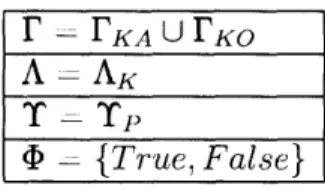
Table 1.4: Domain definitions used for DCG-UPUP-Away.
' = FKA U FKO U PUO
A - AK U Au
T = Tp U Tu
Formal definitions of what it means for phrases or objects to be known or unknown will be presented in Chapter 3, but, intuitively, unknowns are things that have not been seen in training. Similarly, hypothesized objects are more formally presented in Chapter 4 but may be thought of, for now, as imaginary instances of objects that may be anywhere in the world.
The problem statement for this work is fully defined by the grounding probability maximization equation, Equation 1.1, and the domains of the variables in Table 1.4. While formulating the problem may be simple, generating solutions to the problem is anything but. For example, whether or not DCG-UPUP-Away has been trained to
ground the noun "ewer" (a rarely used synonym for pitcher), "ewer" now falls within the domain of A, so DCG-UPUP-Away is expected to correctly ground "ewer" to pitchers. Furthermore, phrases may refer to objects that DCG-UPUP-Away does not even know exist yet: in the same example as before, one may command DCG-UPUP-Away to "pick up the ewer" even if DCG-UPUP-DCG-UPUP-Away does not know what "ewer" means or what pitchers look like and if there is no pitcher in the room.
Such scenarios may be difficult to solve, but they are vitally important to future deployment of autonomous robots. Humans often do not have the time or even ability to train robots to recognize all phrases and objects they may encounter.
1.3
Contributions
This thesis makes 3 main contributions. First, the notions of unknown phrases and un-known percepts are introduced into a language grounding model called
DCG-UPUP-Away. DCG-UPUP-Away may therefore reason in more complex environments than the state of the art. Second, DCG-UPUP-Away automatically acquires new concepts through unsupervised learning, enabled in part by recognition of unknowns. Third, hypothesized objects allow DCG-UPUP-Away to reason about objects it cannot cur-rently perceive.
The effectiveness of DCG-UPUP is evaluated both in a simulation and on a real robotic platform. A large-scale study using natural language commands in a simu-lated environment shows that a robot can correctly ground phrases around 80% of the time while in an environment in which it initially knows fewer than half of the objects present. In addition, a sample trial run on a turtlebot (a simple mobile robot platform) in a laboratory office demonstrates that, with some modifications to object recognition software, DCG-UPUP-Away can be used in the real world.
1.4
Outline
The remainder of this thesis is outlined as follows. Chapter 2 discusses relevant research especially in the field of natural language grounding, but also in human-robot dialog, object hypotheses in unknown environments, and learning techniques in the context of natural language navigation. Chapter 3 presents an intermediate model that builds upon DCG to associate unknown phrases with unknown percepts. Chapter 4 augments that intermediate model by creating hypothetical objects that may be grounded to. Chapter 5 offers a grounding heuristic that allows for more subtle behaviors based on adjectives and object properties. Chapter 6 evaluates the performance of DCG-UPUP-Away in simulation trials and a sample demonstration on real hardware. Chapter 7 concludes with a discussion of the contributions made in this thesis as well as steps for future work.
Chapter 2
Background
The work presented in this thesis builds upon research on the natural language grounding problem. As discussed in the introduction, the grounding problem is for-mulated as determing the most likely physical meaning for a natural language phrase. For example, when given in the context of a room with a cube and a cone, the phrase "the cube" has a high likelihood of referring to the physical cube itself. (Stating that "the cube" grounds to the cube with 100% probability would be a dangerous assump-tion - perhaps "the cube" refers to a cone in a different room, or perhaps the person who said "the cube" incorrectly believes that "cube" is the noun for describing cones. It is therefore safer to reason about the probability distribution over the space of pos-sible groundings.) More generally, phrases other than nouns may also be grounded to their physical meanings (e.g. "skipping" to a hopping sort of run), but such examples are harder to describe.
A useful perspective in viewing the grounding problem is through the lens of
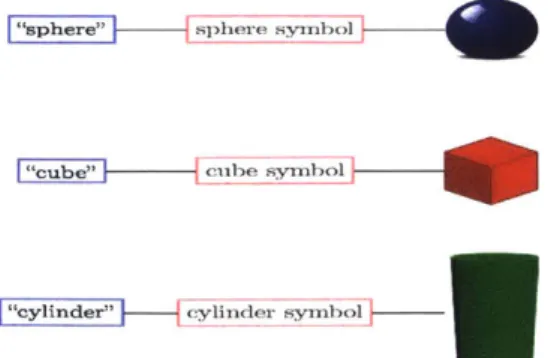
symbols. Symbols represent semantic entities or concepts in the real world. On the natural language side, phrases (e.g. "cube") are associated with symbols (e.g. a canon-ical cube type). On the real-world side, percepts (e.g. an RGB image of a cube) are associated with symbols (e.g. a canonical cube type). Such relations are shown in Figure 2-1. Using such a representation appears to simplify the grounding problem significantly: finding the correct grounding for a given phrase merely involves
trans-"sphere" sphere symbol
"cube" cube symbol
"cylinder" cylinder symbol
Figure 2-1: Mappings among phrases on the left, symbols in the middle, and percepts on the right.
lating from language to symbols and from those symbols to percepts.
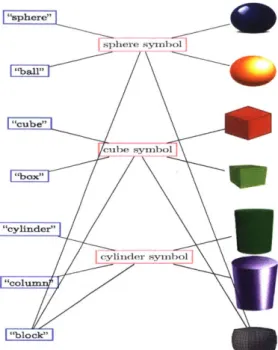
Unfortunately, although such a method may work in theory in a world with one-to-one mappings with symbols, natural language and the real world are too complex for such an approach to work in practice. For example, consider the fact that several words may refer to the same symbol (e.g. "cat" and "feline" both refer to a canonical cat), a single word may refer to multiple symbols (e.g. "dust" refers to a powder of detritus, the act of removing a powder of detritus, or the act of adding a powder like sugar), several percepts may contain the same symbol (e.g. two different photos of a cone), and a single percept may refer to multiple symbols (e.g. a photo containing a cone and a helmet). Thus, Figure 2-1 is better represented with Figure 2-2. Even
within a simplified block world, language and perception ambiguity is unavoidable.
Given the complexity of phrase-symbol-percept mappings, a simple and deter-ministic solution to the grounding problem appears impossible. A probabilistic view, however, elegantly reflects the uncertainty inherent in language. For the remainder of this section, two probabilistic models used to solve the grounding problem will be introduced before discussing related - but less directly relevant - work in natural language robotics.
"sphere" sphere symbol | "cub&" cube symbol "eylinder" c1 d rs~ o "yixidr ymo I "block"
Figure 2-2: A more realistic but complex mapping among phrases on the left, symbols in the middle, and percepts on the right. Note how one-to-one mappings are not guaranteed.
2.1
Grounding with Probabilistic Graphical Models
In any probabilistic view of the grounding problem, the overall equation to be solved remains the probability maximization equation shown in Equation 1.1. The optimal grounding -y* is the set of groundings that maximizes the likelihood of that set of groundings, given language A and a model of the world T. By using probabilistic graphical models, the probability maximization problem may be reformulated as
in-ference on a factor graph, structured according to Equation 1.1.
By introducing a binary correspondence variable 0 that represents whether or
not a phrase is paired with the correct grounding, Equation 1.1 may be rewritten as
follows:
y* = arg max P(=
TrueJA,
-, T),-yerAI
(2.1)
correspon-dence variable is set to True for each phrase in the overall command A.
In previous work, the domains of the vector elements y, A, and T have been restricted to known phrases and groundings [54, 29]. Furthermore, although some works reason about unknown environments, many probabilistic grounding techniques assume fully observable worlds [19, 59]. Thus, the domains of the variables in Equa-tion 2.1 are shown in Table 2.1.
Table 2.1: The domains of variables in common solutions to the grounding problem. Groundings fall within the union of known actions (FKA) and known objects (JKO);
phrases must only use known words (AK); the world model only includes perceived objects (Tp); correspondence variables are binary.
r =P KA U FKO
A =AK
-=
{True,
False}One way of paraphrasing Equation 2.1 is that the optimal grounding -y* is the vector of groundings such that the probability that the language and the groundings correspond, in the world model, is maximized. If the most likely setting of a given
O, is true, then individual phrase Ai and grounding -y, likely correspond; otherwise
they likely do not. Fixing
4i
to be true for all i c[1, JAI] (for each word), and then searching over the most likely settings of 7i therefore achieves the goal of finding the most likely correct groundings for the entire command.If the only assumption one makes is that each word has one grounding, the
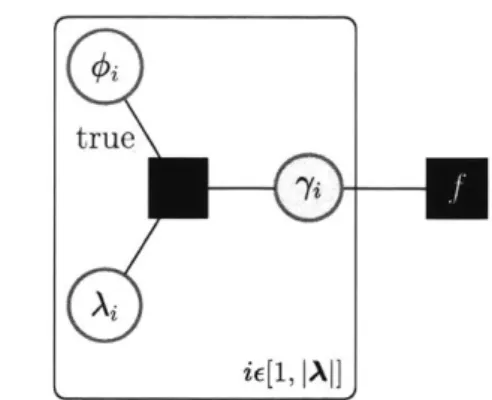
graph-ical model representation of Equation 2.1 for the phrase "move to the cube" is the factor graph shown in Figure 2-3. Every grounding -y is related to every other ground-ing -yj through factor
f.
There are several problems with this graph, however. First, learning the factor function
f
is an extremely difficult problem as it must accept sentences of arbitrarytrue
Figure 2-3: Probabilistic graphical model for the grounding problem without any
assumptions. For each word Ai within a command of JAl words, the correspondence
variable q. is set to true and the most likely grounding -Yi is found.
length. Second, the number of computations required to find the most likely value
of -y grows exponentially as the length of the commands increases linearly because
the grounding of each word depends on the grounding of each other word. It is these
two issues that motivate the development of new models that, by making
assump-tions about conditional independence of groundings, allow for efficient computation
of correct groundings.
2.1.1
Generalized Grounding Graphs
The Generalized Grounding Graph (G
3) is a model that addresses both issues [54].
The main insight in G
3is that the syntactic hierarchy of natural language commands
can be used to generate a sparsely-connected graphical model of Spatial Description
Clauses (SDCs) [31]. SDCs will be described in more detail later, but for now they
may be thought of as 4-element tuples that contain subjects, actions, landmarks, and
relations between the subject and the landmark. The hierarchy of SDCs is revealed
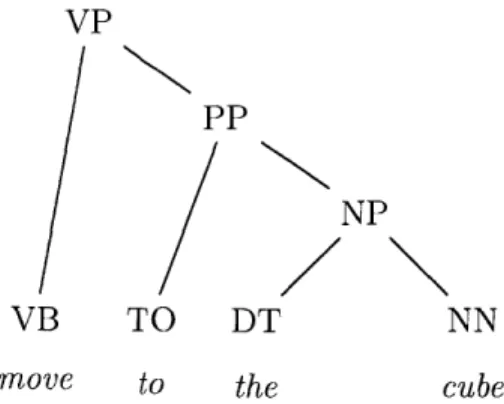
by examining the parse tree of natural language commands. Parse trees show how
words relate and are generated by rules for combining parts of speech into larger
phrases or clauses until an entire sentence is composed. A sample parse tree is shown
in Figure 2-4.
VP
PP
NP
VB TO DT NN
move to the cube
Figure 2-4: Parse tree for the sentence "move to the cube'.'
This parse tree confirms one's intuition about language: in the command "move to the cube," the verb "move" means the same thing whether one is told to move to a cube or a sphere. However, exactly what meaning "move" will take depends on whether one should be moving to or away from an object. Thus, grounding "move" ought to depend on the preposition phrase as a whole, but perhaps not the noun directly. In other words, once one understands where the cube is, one must no longer consider what a cube is. Such reasoning is reflected perfectly in the edge structure of the parse tree: "move" and "cube" are conditionally independent given the preposition phrase (PP). In fact, several other papers have exploited parse tree structure for even more efficiency gains and more complex symbol representations [13].
From this notion of conditional independence, it is possible to merge the original, fully-connected grounding graph in Figure 2-3 with the parse tree to generate an ef-ficient grounding graph in Figure 2-5.
Now, instead of having to simultaneously consider every grounding, computing the optimal grounding for a word only requires local computation about that word and child groundings (dictated by the parse tree). This factored approach is reflected in the final form of the equation solved by G3, shown in Equation 2.3. The domains
for the variables used in Equation 2.3 remain the same as the domains written in Table 2.1 for known phrases, known action and object groundings, binary
correspon-VP VB move
PP
TO DT to the NP0-true
NN cube move)
true
(9 totrue
A b the cubeFigure 2-5: G' factor graph using the parse tree on the left. The gray -Y nodes are
unknown, while the white
#
and A nodes are set to true and phrases, respectively.
dence variables, and a perceived world model.
P(# = TrueA, F, T)
=
P(O = TruejSDCs(A), F, T)
(2.2)(2.3)
=
I(4-, SDCs, rci, T)
The final form of Equation 2.3 states that the probability of a correct grounding
equals the product of a feature function T evaluated for every correspondence variable
0j, spatial description clause SDCj, child groundings ]c, and the world model T (all
normalized by the partition function Z). This locality
-
that the overall probability
can be computed through the product of many functions that only depend on a single
phrase, the SDC for that phrase, and child groundings
-
is precisely what combats
the otherwise exponential growth of naive approaches.
The feature function if, is a log-linear function that associates binary functions of
language (e.g. if a word is present) with binary functions of groundings (e.g. if a box
is present). These binary functions (also called features) are combined in a weighted
sum according to learned weights pi. The exact form of T, therefore, is shown in
I(0, SDC, Tc, T) = exp
(
pff(Oi, SDC, o , T)) (2.4)frF
The training procedure for G3 learns the weights pif for each binary feature
f
from the set of all hand-coded features F. Weights are learned using the Limited-memory Broyden-Fletcher-Goldfarb-Shanno (L-BFGS) by exploiting the convexity of the function T [35]. Thus, the overall T function is merely the exponential of a weighted combination of binary features that return 0 or 1, depending on what phrase or grounding is being used.
2.1.2
Distributed Correspondence Graphs
While G3 formally drastically improves the efficiency of conducting inference on a probabilistic graphical model to solve the grounding problem, such inference on the graph occasionally remains quite slow, especially when phrases refer to groups of ob-jects (e.g. "drive between the cube, the sphere, and the cylinder."). The Distributed Correspondence Graph (DCG) addresses this problem in two ways - by building a
larger, but ultimately more efficient, graphical model and inference procedure and by reasoning over constraints instead of paths and objects [29].
First, the structure of DCG evolves from G3 so that, rather than fixing
#
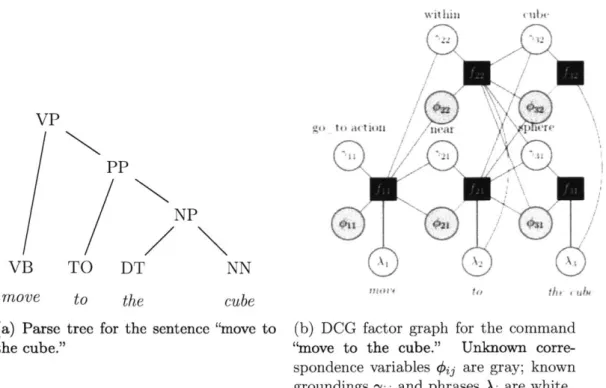
to true and then searching over F to find the most likely groundings, grounding nodes yij may be introduced into the graph, each set to a possible grounding, and then search is conducted over the most likely settings of Oij. The final DCG model shown alongside the same parse tree for the command "move to the cube" is shown in Figure 2-6.Although the graphical model may appear complex, it is actually quite simple. Each parsed phrase appears in a Ai node at the bottom of the graph. Each Ai node is connected to a factor linking the phrase to a correspondence variable Oij and a grounding variable 4j5. Each column represents possible groundings for the phrase; in
PP
NP
TO DT NN
to
the
cube
is( tO It( act 111q)wre
Ito Iio 'I~
(a) Parse tree for the sentence "move to (b) DCG factor graph for the command
the cube." "move to the cube." Unknown corre-spondence variables
#ij
are gray; known groundings yij and phrasesAi
are white. Figure 2-6: DCG graphical model with inter-column structure generated from the parse tree on the leftthis simplified example, the domain of possible actions is restricted to a single go-to action, the domain of preposition groundings is restricted to within or near, and the domain of noun groundings is restricted to cube or sphere. Finally, the edges between columns, going from each factor in one column to each O$j and -yi in the next column, represent the reliance on child groundings. In this case, because the parse tree is binary, each column (except the rightmost one) has exactly one child grounding, so there are only edges between adjacent columns.
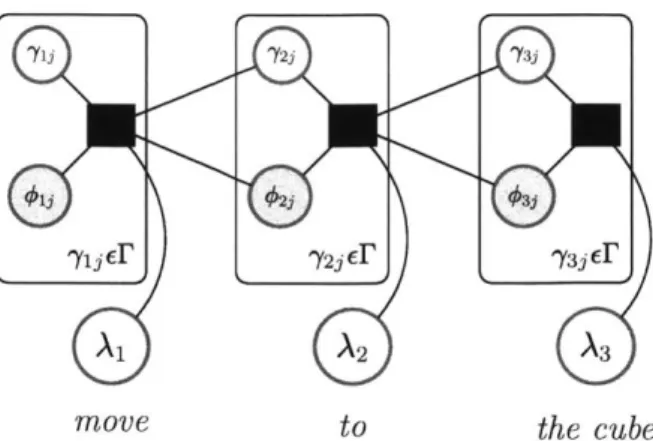
The structure of DCG is further revealed by recreating the original graphical model in plate notation, as in Figure 2-7. The similarities between G3 and DCG are further revealed by the minimal structure. Of particular note, is the domain of each
7yi, as each plate is repeated by letting -yi range over Ir.
Before defining the domains of the variables in the DCG graph, however, it is
VP
VB
move
move to the cube
Figure 2-7: DCG graphical model redrawn in plate notation.
important to explore the second idea in DCG: reasoning over constraints rather than
objects allows for extremely efficient inference when considering sets of objects.
Re-call that the entire reason for G
3is that it breaks the exponential computational costs
of a fully connected grounding graphical model. While G
3achieves this goal most of
the time, it fails when considering sets of objects (e.g when grounding the command
"go between the cube and the sphere"). As the number of related objects grows, the
G
3computational costs increase exponentially.
Therefore, DCG replaces the domains of the grounding variables in G
3(previously
the set of all known actions and objects) with a set of constraints. A constraint is
formally defined as a function of the robot state, a fixed input, and time interval
that returns true if the state matches the input during the specified time interval
and false otherwise. For example, a constraint might specify that the robot must
be within 1 meter of a cube between 5 and 10 seconds from now. Now that DCG
grounds to constraints rather than specific paths or objects, grounding and planning
have been effectively split into two problems: first DCG determines what constraints
are encoded in the language command, then a planner may accept those constraints
and generate a series of actions that satisfy all the constraints. In fact, the idea of
dividing natural language planning into a grounding phase followed by a planning
phase has subsequently appeared in several other papers for robotic navigation or
recipe-following [37, 5, 9].
It is now finally possible to formally define the problem DCG tries to solve and the domains of the variables it uses. Recall that DCG fixes grounding variables and solves for correspondence variables, so Equation 2.1 from G3 may be transformed to
Equation 2.5:
arg max P(0 A, y, T). (2.5)
The equation can be paraphrased as saying that the most likely correspondence variables
4
can be found by finding the correspondence variables that maximize the likelihood of phrases and groundings, given a model of the world. By using the same factorization trick from G3 assuming independence of child groundings, Equation 2.5 may be rewritten as Equation 2.6. where Equation 2.7 is used to emphasize thatDCG uses the same system of learned log-linear feature functions to compute the
most likely correspondence variables.
* arg max p(#i3 Vy, A, F,, T) (2.6)
= arg max I IF (#i3 , y3 , c , T) (2.7) 'OE4ZVAI
Formal definitions of the domains used in DCG for solving these equations are shown in Table 2.2.
Table 2.2: The domains of variables in DCG. Groundings fall within the space of pre-defined relations (e.g. near, within, etc.) crossed with known objects; phrases must only use known words; the world model only includes perceived objects; corre-spondence variables are ternary.
R = {set of hand-coded relations}
F
=- x rKOA AK
T vTe
Note how the domain of groundings has been changed from actions and objects to constraints. Because of this change, the correspondence variables have in turn been transformed from binary to ternary variables that can take on the values of Active, Inactive, or Inverted. Setting #g to active in DCG is much like setting
#i
to true in G3; it means the constraint is correctly grounded. For example, the phrase "nearthe cube" has an active correspondence with the region near a cube. Conversely, the phrase "far from the cube" has an inverted correspondence with the region near the cube because "near" and "far" are antonyms. Finally, correspondence variables are set to inactive if the language has no bearing on a particular constraint (e.g. "near the cube" has no relation to the constraint of being near a sphere as well).
In this work, DCG-UPUP-Away will continue to modify the structure of the DCG graph by expanding the domain of possible phrase to include unknown nouns and the domain of possible groundings to include unknown objects. Furthermore, the world model will be adapted to contain hypothetical objects that may exist outside the robot's field of view. Finally, additional binary features will be introduced to the log-linear model so that DCG-UPUP-Away may reason intelligently within the expanded domains.
2.2
Human-Robot Dialog
While DCG-UPUP-Away builds most directly on G3 and DCG, other work in natural language robotics has guided the work in this thesis. Research into human-robot natural language dialog and question-asking indicates a broad area for future im-provements to DCG-UPUP-Away. Instead of silently executing commands, as is done in traditional language grounding research, a natural extension is having robots that talk back. For example, should a human issue an ambiguous command (e.g. "pick up the bottle" when facing two bottles), a robot might ask for more information rather than silently executing a low-confidence grounding.
Such scenarios are considered in [46]. Ros et al. broadly approach resolving lan-guage ambiguity using two techniques. First, a robot attempts to model the human's perspective on the scene to determine which objects may be visible to the human. This technique relies on insights from child development studies that show how chil-dren employ such reasoning on their own and has been successfully used in other robotics literature
139,
40, 56, 55]. Importantly, this first strategy requires no ad-ditional dialog. The second strategy, however, relies on the robot asking a human for more information. For example, the robot may ask for spatial relations or object features in distinguishing between objects. Choosing exactly which question to ask, of course, requires reasoning about what information best discriminates among po-tential groundings.Deits et al. explore precisely that issue of how to choose which questions to ask in [18]. As in much research in robotic question-asking, a balance must be struck between too many questions and not enough questions while simultaneously deter-mining what sorts of question to ask [22, 48]. The authors in [18] use the entropy of the probability distribution over groundings to estimate the grounding uncertainty. Higher entropy, therefore, leads to more questions. As expected, asking questions leads to a greater grounding accuracy rate for all sorts of questions asked.
While the above-mentioned research largely uses hand-coded templates for gener-ating questions, other work explores the topic of learning how to compose questions automatically. One system, CEDERIC, mimics human learning and uses only two bases cases to ask questions as ranging from confirmations (e.g. "Is this view ok?") to specifications (e.g. "I have several schools to choose between. Which one do you mean?") [20]. Conversely, significant research has been conducted on generating natu-ral language statements instead of questions. Such systems that use inverse semantics have a broad range of applications including directing humans to their destination, explaining what a robot is about to do, and automatic translation [17, 51, 36].
Such research provides a clear path for future improvements upon DCG-UPUP-Away, which offers no dialog. In fact, [18] interfaces nicely with G3 and thus may presumably be easily adapted to operate with DCG or DCG-UPUP-Away.
2.3
Learning Semantic Meanings
Setting aside actual human-robot interaction, a large corpus of research focuses en-tirely on techniques for learning the semantic meanings of language; presumably once a robot learns what language means, grounding such language becomes much easier. Much of the work in this field draws heavily on observations of children, who exhibit prodigious learning rates of 1 new word every 3 days when they are only 4 months old to 12 words a day when they are 8 years old [21, 2]. Furthermore, such learning appears to require minimal structured adult supervision; children quickly convert few experiences into more general knowledge (e.g. children do not need to see thousands, or even hundreds of cats before knowing what a cat is) [8, 15, 43, 27]. This indicates that robots may eventually be able to perform similarly and learn new concepts in a semi-supervised or unsupervised manner.
One common approach for autonomous language learning provides a robot with semantic representations of the world that must be associated with language. Such as-sociations may be formally expressed using predicate logic, but ultimately the problem of language acquisition is reframed as a mapping problem from words to pre-defined semantics [14, 49, 61, 23]. Unfortunately, hand-labeled representations necessarily re-quire intensive human involvement in generating training data [41]. As a result, other work takes the opposite approach and tries to associate words directly to objects or actions without creating formal symbolic representations. For example, using online raw video data and sentences, a system is able to learn shape categories without being told ahead of time that four right angles define rectangular objects [60, 471.
data into semantic units that are in turn associated with language [12, 25, 38]. These models appear particularly impressive. For example, the system developed in [25], called the Transportable Word Intension Generator (TWIG) manages to learn prepo-sitions such as "above" and "below" and deitic pronouns like "I" and "you." This system, like DCG-UPUP-Away, performs best when provided with training examples that include one or fewer unknown words.
Although this work is extremely impressive, its domain is restricted to learning through natural language statements as opposed to commands. For example, a robot may be shown a cone and told "this is a cone," but the robot will not be expected to approach a cone when told "go to the cone." Thus, the robot always remains in a sort of learning mode (or switches between mutually exclusive learning and execution modes) as opposed to DCG-UPUP-Away, which attempts to simultaneously learn and execute language commands.
2.4
Grounding Spatial Relations
Rather than trying to solve the general language grounding problem or teach robots arbitrary statements, some researchers have focused in particular on the language of spatial relations. Spatial relations are ubiquitous in language - not only are they directly applicable to language directions such as "go to the cube to the left of the sphere," but they are often used in more abstract thoughts as well (e.g. "their ideolo-gies fall on opposite sides of the spectrum").
Early research by Jackendoff focuses on explicit categorization of all spatial re-lations by examining prepositional phrases, verbs, and actions [30]. Building upon such work, the fields of linguistics and artificial intelligence have closely examined how spatial relations in language may shed light on internal representations of the world [33, 34, 28]. Only a handful of elementary spatial relations, it is argued, are
needed to completely represent any natural language describing the relative position of two objects. Although such works provide an elegant model for understanding how humans may think about spatial language, they do not directly translate the theory into practical behavior for robotics. In fact, some research indicates that humans use spatial relations differently when addressing other humans as opposed to robots [42].
In order to directly address this gap, others apply the idea of composing simple spatial relations to real-world robots [1]. For example, a mobile industrial robot is given primitive relations (e.g. above, below, left, right, at, near, etc.) and manages to combine the relations to parse more complex statements such as "near the block on the left." Furthermore, the system is able to translate its symbolic understanding of these relations into a potential field representing where, in metric space, an object is likely to be located [52]. Other work combines spatial relations with inverse semantics to allow a robot to describe its environment using to a human in natural language by saying things like "there is an object on the right" [50].
Finally, some research explicitly couples spatial relations to the grounding prob-lem. In fact, the predecessor to the probabilistic graphical models G3
and DCG that motivates this work relies heavily on Spatial Description Clauses (SDCs) [31]. Natu-ral language commands are executed by first parsing the language into a hierarchy of SDCs, and then finding a sequence of actions that best satisfies the SDCs. Each SDC alone is relatively simple: it is composed of a figure (the subject of the sentence), a verb (the action), a landmark (an object), and a spatial relation (a relation between the figure and the landmark). Recently, SDCs, and spatial relations more generally, have been used to adapt DCG or build entirely new graphical models [44, 32]. The modified DCG model, for example, manages to ground abstract concepts like "the row on the left" when used facing collections of scattered blocks on a tabletop [44].
Ultimately, the work on spatial relations in natural language illustrates a different approach to the grounding problem than the approach used here. Although this
thesis explicitly does not investigate phrases with spatial relations, one could clearly incorporate some of the tools from this field to disambiguate between objects and improve the robustness of DCG-UPUP-Away.
2.5
Object Hypotheses for Unknown Environments
Another field of study closely tied to the field of language grounding explores the topic of inferring information about unknown environments using language. For example, if a robot is placed in a room and told to "pick up the ball just outside the door," a robot should be able to easily deduce that a ball is located near the door. A more formal framing of that intuition indicates that grounding systems should reason over a belief distributions over objects rather than a deterministic known map.
Duvallet et al. use such a framework to propose a latent map that is partially observed by language [19]. Thus, in the example of a ball outside the door, the phrase "pick up the ball outside the door" generates a region of high probability near the door and low probability further away. Sampling from this distribution, as well as updating the distribution as more observations are made, yields a useful map to plan in. Similarly, other work generates distributions over maps or exactly placing objects in unknown environments if their locations are uniquely described [57, 59].
In the absence of localizing language, however, these sophisticated techniques provide relatively little information about where an object may be located. There-fore, because this research is restricted to simple phrases that lack spatial relations, DCG-UPUP-Away uses a far simpler technique for hypothesizing objects in unknown locations. Future development, however, could incorporate some of the methods pre-sented for more intelligent reasoning about unperceived objects.
Chapter 3
Grounding to Unknowns
'oxcX yoOV T0UTOU yS t IXp& TVA cXU2h) TOUT&) 7YO )TEPO( E&'(, '6TL 't Il O'0C Lo(6E
LopoLc EL EVO(L
"Indeed I seem to be wiser than him in this little matter in that I don't think I know what I don't know"
-Plato's Apology
The DCG model developed by Howard et al. efficiently grounds some phrases, but it is only capable of reasoning about objects and phrases that the system has already been trained on [29]. For example, if DCG is trained with the phrase "chair" and recognizes chairs in the real world, it can subsequently operate in an environ-ment with chairs. DCG is unable, however, to intelligently reason about new phrases or percepts in the absence of relevant training. In the same scenario as previously described (DCG has been trained with chairs, but only chairs), if a robot is placed in a room full of chairs and a single sofa and is told "drive to the sofa," an empty grounding set is returned. In other words, because DCG cannot reason about the phrase "sofa," it returns that "sofa" does not ground to anything. Given the context, however, any human would be able to deduce that "sofa" refers to the only unknown object in the scene -the sofa.
In this chapter, the DCG model is extended to DCG-UPUP (short for Distributed Correspondence Graph - Unknown Phrase Unknown Percept). The main technical insight is that explicitly recognizing when phrases or percepts are unknown allows for intelligent learned behavior in new scenes. The remainder of this chapter is divided among recognizing when phrases are unknown, recognizing when percepts are un-known, training the model to associate unknown phrases to unknown percepts, and permanently learning new symbols. By the end of chapter, DCG-UPUP will be able to handle exactly the chair-sofa DCG failure case described previously.
3.1
Unknown Phrases
A necessary step in learning to associate unknown phrases with unknown percepts is
first recognizing when a phrase is unknown. For the sake of simplicity, development is limited to recognizing unknown nouns (extensions to verbs will be discussed in the future work section and has been briefly examined in [10]). If DCG-UPUP is able to recognize when a noun is unknown, it will have significant insight into what the noun should ground to (specifically, not an object it already knows). Just like a high-schooler taking a multiple-choice vocabulary quiz when he recognizes all the words except for one, DCG-UPUP can use a learned process of elimination to ground unknown nouns to unknown objects. None of this is possible, however, without first recognizing when nouns are unknown.
Before immediately recognizing unknown nouns, one must define what it means for a phrase to be unknown. In the context of the grounding problem, a natural definition arises based on whether or not the system has been trained on how to ground that noun. Thus, if the system has been trained to ground a phrase to a known type, then that specific phrase is considered known - otherwise the phrase is labeled unknown. The subtlety of requiring known nouns to ground to a known type (as opposed to merely appearing in the training examples anywhere) comes from the necessity of including training examples in which unknown nouns ground to unknown
objects. The nouns used in such examples should not subsequently be classified as known words.
Keeping track of which nouns are known, based on the above definition, is straight-forward. The training procedure for the LLM (the log-linear model used for DCG) is augmented to also generate a set of all the nouns seen in training that were grounded to a known object type. (For now, the requirement that the phrase grounds to a known type may seem odd given that no unknown types have been introduced yet, but that will change in the next section.) The built up set of known phrases, hence-forth referred to as n, therefore is a snapshot at any given moment of exactly which nouns are known and may be thought of as part of the world model T. Note that
K grows over the course of the LLM training, so a phrase that is unknown at the
beginning training may be known by the end.
For the purposes of causing DCG to respond to unknown nouns, the final step in recognizing a noun as unknown is adding a feature to the LLM that returns true when an unknown phrase is used. Using the definition of unknown phrases and the construction of the . set, one may easily see that the fuphrase feature should fire (i.e. return true) precisely when a noun is not found within K. Therefore, when the
feature is first created, it accepts r as an argument that it keeps track of. Later, when training the LLM, fuphrase is queried with a phrase, at which point the feature returns true if the noun is within n and false otherwise. This new feature - fuphrase - is similar to many of the other features already used to train the LLM; from a theoretical standpoint, however, it is the only feature that is self-reflective, in a sense, and requires a model of its own intelligence. The formal definition of fuphrase is shown in Equation 3.1:
fuphrase (ijIyijI A, IC 3IT) 0 (3.1)
3.2
Unknown Percepts
In parallel to detecting when a phrase is unknown, DCG-UPUP must recognize when a percept is unknown. Initially, the raw data used to perceive the world are color images taken by a robot. Generally, though, these data can be anything (e.g. sonar readings as well) as long as it is possible to translate the data into an intermedi-ate stage in which object types and locations are recorded. In this context, a single percept is defined as an instantaneous estimate of the object type and location; it is assumed that it is possible to generate such percepts from raw data. Therefore, recognizing unknown percepts becomes the simpler task of detecting unknown objects rather than reasoning over the raw data directly.
Once again, before attempting to recognize unknown percepts, one must first de-fine what it means for a percept to be "unknown." Just as phrases are dede-fined as unknown if they never appear in training examples, one may similarly say that ob-jects of a type that never appeared in training data are unknown. For example, if an object recognizer has been trained to recognize cubes, spheres, and cylinders, any instance of a cube, sphere, or cylinder would be known but a cone would be unknown.
Of course, such a definition merely translates the problem of deciding whether an
ob-ject is unknown into the problem of deciding how well it matches a known category. There are myriad ways to quantify how well objects match known categories: support vector machines (SVMs) report distances from boundaries while other multi-class de-tectors report probability distributions over known classes [26, 71. Generally, the field of novelty detection - determining when data belong to a new class instead of an existing one - remains an active field of research [6, 45].
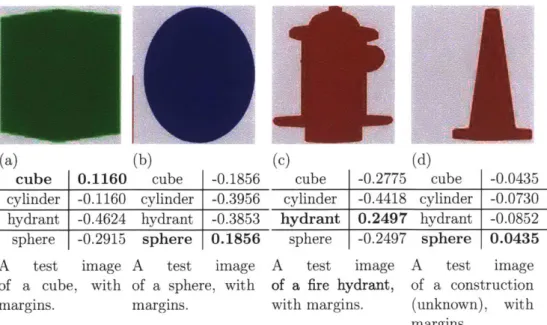
In this particular implementation, an image classifier based on the Histogram of Orientated Gradients (HOG) is used as part of a three-step method [16]. First, an object proposal toolbox from [62] generates tight bounding boxes around objects in an RGB image of the scene. In theory, any classification-agnostic object proposal
software may be used, including [58] or [24]. Second, each bounding box is input into a standard SVM classifier offered by MATLAB that uses HOG features as well as the aspect ratio of the bounding box. Third, given the reported distances from the boundaries in the SVM, if the classifier appears uncertain (as defined later in this section), the object is labeled as "unknown" - otherwise the most likely classification is used.
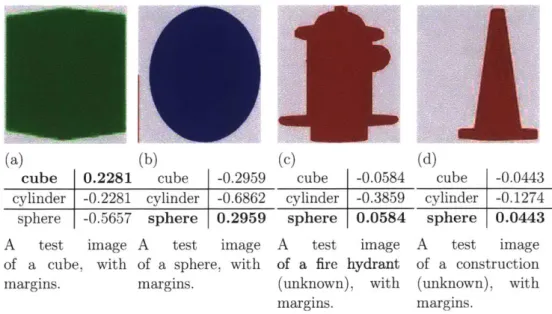
The confidence of the classifier is approximated by examining the difference be-tween the signed margin of the most likely classification and the second most likely classification. Since the SVM is a discriminative model among non-overlapping classes, the first margin is always positive and the second is always negative. (Using mutually exclusive classes is motivated in part by [25] which uses decision trees to represent phrase meanings.) Thus, objects that fall squarely within a category generate large differences while objects near classification borders yield small differences. Comparing this difference to a threshold allows one to say whether or not an object is unknown. As the number of classes grows, however, classification margins necessarily shrink, so some method of normalizing the threshold by the number of categories is required. The general form of the final classification equation used in this thesis is shown in Equation 3.2:
"unknown", if ndiff < ji7L(
X =n-n) exp(.2
XsVm, otherwise
where X is the final classification, n is the number of classification categories, ndiff
is the difference between the margins of the best and second-best classifications, and
Xsvm is the classification that maximizes the margin from the SVM. Finally, by play-ing with intercept mthresh and normalization parameter Zexp until sample cases pass, one may generate the actual equation used for determining the unknown cutoff.
In this research, the best values for mthresh and Zexp were found to be 0.6 and