HAL Id: hal-02388355
https://hal.archives-ouvertes.fr/hal-02388355
Submitted on 1 Dec 2019HAL is a multi-disciplinary open access archive for the deposit and dissemination of sci-entific research documents, whether they are pub-lished or not. The documents may come from teaching and research institutions in France or abroad, or from public or private research centers.
L’archive ouverte pluridisciplinaire HAL, est destinée au dépôt et à la diffusion de documents scientifiques de niveau recherche, publiés ou non, émanant des établissements d’enseignement et de recherche français ou étrangers, des laboratoires publics ou privés.
Fe-facilitated dynamic active-site generation on spinel
CoAl2O4 with self-termination of surface reconstruction
for water oxidation
Tianze Wu, Shengnan Sun, Jiajia Song, Shibo Xi, Yonghua Du, Chen Bo,
Wardhana Aji Sasangka, Hanbin Liao, Chee Lip Gan, Günther Scherer, et al.
To cite this version:
Tianze Wu, Shengnan Sun, Jiajia Song, Shibo Xi, Yonghua Du, et al.. Fe-facilitated dynamic active-site generation on spinel CoAl2O4 with self-termination of surface reconstruction for water oxidation. Nature Catalysis, Nature Publishing Group, 2019, 2 (9), pp.763-772. �10.1038/s41929-019-0325-4�. �hal-02388355�
Fe-facilitated dynamic active site generation on spinel CoAl2O4 with
self-termination of surface reconstruction for water oxidation
Tianze Wu1,2,∆, Shengnan Sun1,2,∆,Jiajia Song1,∆, Shibo Xi3, Yonghua Du3, Chen Bo1, Wardhana Aji Sasangka4, Hanbin Liao1, Chee Lip Gan1,4, Günther G. Scherer5, Lin Zeng6, Haijiang Wang6, Hui Li7, Alexis Grimaud 8,9* and Zhichuan J. Xu1,2,10 *
1
School of Materials Science and Engineering, Nanyang Technological University, 50 Nanyang Avenue, 639798, Singapore.
2
Solar Fuels Laboratory and Energy Research Institute, Nanyang Technological University, 50 Nanyang Avenue, 639798, Singapore.
3
Institute of Chemical and Engineering Sciences A*STAR, 1 Pesek Road, 627833, Singapore. 4
Low Energy Electronic Systems, Singapore-MIT Alliance for Research and Technology, Singapore 138602, Singapore
5
5607 Haegglingen, Switzerland 6
Department of Mechanical and Energy Engineering, Southern University of Science and Technology, Shenzhen, 518055, Guangdong, China
7
Department of Materials Science and Engineering, Southern University of Science and Technology, Shenzhen 518055, Guangdong, China
8
Chimie du Solide et de l’Energie, UMR 8260, Collège de France, 75231 Paris Cedex 05, France.
9
Réseau sur le Stockage Electrochimique de l’Energie (RS2E), CNRS FR 3459,33 rue Saint Leu, 80039, Amiens Cedex, France.
10
Energy Research Institute @ Nanyang Technological University, 50 Nanyang Avenue, Singapore 639798, Singapore.
∆These authors contribute equally to this work.
Abstract
The development of efficient and low-cost electrocatalysts for oxygen evolution reaction is critical for improving the water electrolysis efficiency. Here we report a strategy using Fe substitution to enable the inactive spinel CoAl2O4 to become highly active and superior to the benchmark IrO2. The Fe substitution is revealed to facilitate the surface reconstruction into active Co oxyhydroxides under OER conditions. It also activates the deprotonation on the reconstructed oxyhydroxide to induce negatively charged oxygen as active site, thus significantly enhancing the OER activity of CoAl2O4. Furthermore, it promotes the pre-oxidation of Co and introduces great structural flexibility due to the uplift of the O 2p levels. This results in an accumulation of surface oxygen vacancy along with lattice oxygen oxidation that terminates as Al3+ leaches, preventing further reconstruction. We showcase a promising way to achieve tunable electrochemical reconstruction by optimizing the electronic structure for low-cost and robust spinel oxide OER catalysts.
Hydrogen has been proposed for long as an energy carrier for a sustainable and clean energy
1
infrastructure. However, such a hydrogen energy infrastructure has not been realized yet even so
2
many years have passed since its first proposal. One of the major reasons is the low efficiency and
3
high material cost of water electrolysis, which is a mean to sustainably produce hydrogen fuel from
4
water using the electrical energy generated by sustainable resources like solar panels.
1The low
5
energy efficiency for such system is mainly caused by the sluggish reaction kinetics at the anode side
6
of water electrolyzer,
2i.e. where water is oxidized and the oxygen evolution reaction (OER) occurs.
7
The benchmark anode electrocatalysts are noble metal-based oxides, such as IrO
2and RuO
2,
3-4which,
8
however, aggravates the cost problem for water electrolysis. In recent years, great efforts have been
9
made to explore first-row 3d transition metal oxides as low-cost alternatives for OER.
1, 5Toward that
10
goal, one important progress was made in identifying the active sites for some Co-containing oxides
11
as oxyhydroxides generated under operando condition.
6-10Specifically, many Co-based oxides were
12
reported to undergo surface self-reconstruction of Co sites to Co (III) oxyhydroxides, offering a
13
higher activity
6, 9-10arising from the di-μ-oxo bridged Co-Co sites.
11However, despite revealing the
14
critical role of the surface reconstruction into oxyhydroxides, such reconstruction sometimes
15
compromises a stable OER catalysis due to instable surface chemistry.
12In addition, how to properly
16
facilitate the surface reconstruction is still elusive.
17
Here, we report an approach to promote the surface reconstruction on inactive but low-cost CoAl
2O
418
(see Supplementary Note 1 for more about CoAl
2O
4) and to boost its OER performance by
19
substituting Al with a small amount of Fe. The partially substituted CoFe
0.25Al
1.75O
4outperforms
20
IrO
2. We demonstrate here that a low level of Fe substitution is able to facilitate the surface
21
reconstruction of CoAl
2O
4by activating the pre-oxidation of Co and optimizing the O 2p level of
oxide for greater structural flexibility. More importantly, a distinctive reconstruction behavior with
23
self-termination has been revealed on CoFe
0.25Al
1.75O
4, which enables a stable surface chemistry. In
24
addition, we suggest that, on the reconstructed surface, the Fe substitution facilitates a two-step
25
deprotonation process, which leads to the formation of active oxygen sites at a low overpotential and
26
thus greatly promotes the OER. Finally, the electrolysis application of CoFe
0.25Al
1.75O
4as OER
27
catalyst was demonstrated in membrane electrode assembly (MEA) configuration.
28
29
Results
30
Crystal structure characterization
31
The CoFexAl2-xO4 (x=0~2.0) oxides were synthesized by a sol-gel method. The crystal structures of
32
CoFexAl2-xO4 oxides were characterized by powder X-ray diffraction (XRD). As displayed in Fig. 1a, the
33
diffraction peaks of the as-prepared CoAl2O4 and CoFe2O4 match well with that of the standard cubic spinel
34
(Fd-3m) oxides. CoFexAl2-xO4 oxides with different Fe substitution amount remain in cubic spinel structure.
35
Besides, the diffraction peak exhibits certain shift to lower angle with the increase of Fe substitution amount
36
in the range of 0.25<x<2 (Supplementary Fig. 1). Such peak shift could be ascribed to changes in lattice
37
parameters induced by different ionic radius of Fe and Al cations and suggests a solid solution property.
38
However, when the Co local atomic structure was investigated by EXAFS (Fig. 1b, Supplementary Fig. 2),
39
certain isobestic points, such as at 4.5 Å-1, are remarkable, implying a complex property with Co in different
40
components.26 As further observed in Fourier transform (FT) Co K-edge EXAFS (Fig. 1c), two separated
41
peaks, i.e. Peak II and Peak III, at 2.4~3.1 Å are assigned to the features of CoOh (in octahedral site) and CoTd
42
(in tetrahedral site). At x≤0.25, no obvious changes are observed for peak II and peak III compared to pristine
CoAl2O4, indicating that low-level Fe substitution does not change the occupation of Co. The obvious uplift of
44
these two peaks starts from x=0.5, which could be attributed to the segregation of a component that comprises
45
more octahedrally coordinated Co. This segregated component is inferred as CoFe2O4 which is in inversed
46
spinel structure where Co occupy the octahedral site.27 Such inference is further evidenced by a Co K-edge
47
XANES linear combination fitting (LCF) with CoAl2O4, CoFe2O4 and CoFe0.25Al1.75O4 as standard
48
(Supplementary Fig. 3). The fitting delivers an extremely low R factor, indicating that Co is primarily in
49
CoAl2O4, CoFe2O4 and CoFe0.25Al1.75O4 components throughout the oxides.
50 51
In addition to the complex behavior of Fe-containing components throughout the oxides, the Fe substitution in
52
CoAl2O4 also alters the local atomic structure of Co. As observed in Co K-edge EXAFS (Fig. 1c), the
53
first-shell peak at ~1.5 Å, representative of the metal-oxygen bond, is weakened by Fe substitution, suggesting
54
lower metal-oxygen coordination number and more oxygen vacancy28. Specifically, the EXAFS fitting result
55
(Supplementary Table 1) of the first-shell peak for CoFexAl2-xO4 and CoAl2O4 reveals that Fe substitution
56
reduced the average coordination number by ~0.4 at maximum. Such effect, indicating an increase in oxygen
57
vacancy, is consistent with a decrease in cobalt valence state after Fe substitution which is evidenced by the
58
shift to lower energy of the Co K-edge XANES (Fig. 1d). The nominal Co valence states (Supplementary
59
Table 2) are indicated by the K-edge positions when compared to references CoAl2O4 and Co3O4 (see details
60
in SI). While Fe3+ is more electronegative than Al3+, after Fe substitution, the K-edge energies of Co slightly
61
shift to lower absorption energy compared to CoAl2O4, indicating a decrease in Co valence state. This
62
counterintuitive phenomenon could be rationalized by the creation of oxygen vacancies,5 which is also
63
supported by theoretical calculation (Supplementary Table 3). Indeed, the Fe substitution in CoAl2O4 was
64
found to reduce the formation enthalpy of oxygen vacancy, which indicates easier formation for oxygen
vacancy.
66
67
Fig. 1 | Structural characterizations and OER performances of as-prepared CoFexAl2-xO4 catalysts. a,
68
The powder X-ray diffraction (XRD) patterns of as synthesized CoFexAl2-xO4 (x=0.0~2.0) oxides. b, The Co
69
K-edge EXAFS spectra of CoFexAl2-xO4 (x=0.1~2.0). c, The Fourier transform (FT) k3χ(R) Co K-edge
70
EXAFS of CoFexAl2-xO4 (x=0.1~2.0). The inset is schematics of the compositions in the CoFexAl2-xO4 oxide.
71
d, The normalized Co K-edge XANES spectra of CoFexAl2-xO4 samples and the standard Co3O4 (Sigma
72
Aldrich) as the references. The K-edge position is determined by an integral method29 as described in Methods,
73
and the details about edge positions and nominal valence state of Co and Fe are shown in Supplementary
74
Table 2. e, The cyclic voltammetry curves of CoFexAl2-xO4 (x=0, 0.25, and 2) in O2 saturated 1 M KOH with a
75
scan rate of 10 mV s-1. The inset is the corresponding Tafel plots after oxide surface area normalization,
76
capacitance correction, and iR correction. The error bars represent the standard deviation from three
77
independent measurements. The grey dashed line shows the best IrO2 OER performance reported to date.4 f,
78
The OER current densities (left axis) of CoFexAl2-xO4 at 1.55 V vs. RHE. The composition ratio of
79
CoFe0.25Al1.75O4 component (right axis) in CoFexAl2-xO4 oxides is plotted to show its correlation with the
80
OER activity. g, The cyclic voltammetry curves of CoFexAl2-xO4 (x = 0~ 2) in O2 saturated 1 M KOH with a
81
scan rate of 10 mV s-1 between 0.8 and 1.5 V vs RHE. The upper limit of the potential window is capped to
82
show the pseudocapacitive behavior preceding to OER.
83 84 85
OER activity
86
The spinel CoFexAl2-xO4 oxides were then measured for their electrocatalytic OER performances under
87
alkaline condition (see details in Methods). Supplementary Fig. 4 shows their steady OER cyclic voltammetry
88
(CV) curves. The current density was normalized to the surface area of oxides to present the intrinsic activity,
89
with the surface area of oxides being determined by Brunauer-Emmett-Teller (BET) measurements
90
(Supplementary Fig. 5 and Supplementary Table 4). Ohmic drop iR correction was applied to compensate the
91
potential loss from the resistance of the electrolyte solution. As observed in Supplementary Fig. 4, among these
92
spinel oxides, CoFe0.25Al1.75O4 is the best-performing one. Comparable OER performance is also observed for
93
low-level Fe substituted oxides at x=0.1 and 0.5. In contrast, when further increasing the Fe substitution,
94
significant drop in activity is found as x exceeds 0.5 in CoFexAl2-xO4. Fig. 1e shows the selected OER CV
95
curves for x= 0, 0.25, and 2. Much better OER activity is found for x=0.25 than for x=0 and x=2. As seen in
96
the Tafel plots given in the inset of Fig. 1e, the OER overpotential for CoFe0.25Al1.75O4 (at 10 μA cm-2oxide) is
97
approximately 70 mV lower than that for CoAl2O4 and CoFe2O4 (Supplementary Fig. 6). Such activity contrast
98
indicates a special role of Fe in oxides at the low substitution level. In addition, IrO2 previously benchmarked
99
is also shown in the Tafel plot for comparison.4 As observed, the electrocatalytic activity of the
100
best-performing CoFe0.25Al1.75O4 outperforms the activity of the benchmark IrO2 catalyst. Long-term stability
101
tests (Supplementary Fig. 7) of CoFexAl2-xO4 (x=0, 0.25 and 2) oxides were carried out at constant current
102
density of 10 μA cmox-2
in 1 M KOH for 10 h. All measured samples exhibit negligible potential loss, which
103
indicates a good stability for these spinel catalysts under OER conditions. The best-performing catalyst,
104
CoFe0.25Al1.75O4, was further carried Chronopotentiometry test for 48 hours under 20 μA cmox-2(~3.5 mA
105
cmdisk-2). As shown in the Supplementary Fig. 8 a, b, the CoFe0.25Al1.75O4 still shows negligible activity change
106
after 48-hour test, which demonstrates a superior stability of CoFe0.25Al1.75O4 in alkaline for OER.
108
Composition effect on OER
109
We then investigate the OER promotion at low substitution level and the detrimental effect at higher
110
substitution level. Firstly, the CoFe0.25Al1.75O4 component may primarily contribute to the OER activity
111
according to the observed composition dependence. We then carried out LCF for the Co K-edge XANES using
112
CoFe0.25Al1.75O4 as standard in order to study the composition throughout the substituted oxides
113
(Supplementary Fig. 3 and Supplementary Table 5). As found by the LCF (Fig. 1f, green line), the composition
114
ratio of the CoFe0.25Al1.75O4 component is abundant at low substitution level such as x=0.1 and 0.25 but
115
become negligible as x≥1. This trend correlates well with the OER activities of CoFexAl2-xO4 oxides (Fig. 1f,
116
purple line). Thus, it suggests that the CoFe0.25Al1.75O4 component is primarily responsible for the significant
117
OER enhancement. Besides, the consistent trend is also observed for the pseudocapacitive charge in CV before
118
OER region (Supplementary Fig. 9) which is quantified from CVs (Fig. 1g) by previously reported
119
approaches.30-31 The pseudocapacitive charge is particularly large at low substitution level but significantly
120
decrease at high Fe substitution (x ≥ 1). The pseudocapacitive charge indicates the redox of surface active
121
sites,31 and its consistent trend with OER activities throughout the oxides suggests that the amount of active
122
sites is a dominating factor for OER activity in our case. Thus, the strong correlation between OER activity
123
and the composition ratio should be ascribed to the CoFe0.25Al1.75O4 component, which may govern the
124
formation of active sites.
125 126
Active site identification
127
Attention was then paid on the dynamic changes at metal sites during the electrochemical process. Note that
128
there is nearly no change in the valency of Co and Fe in CoFexAl2-xO4 (Fig.1d, Supplementary Fig. 10, and
129
Supplementary Table 2) and the local atomic structure of Fe site in CoFe0.25Al1.75O4 remains unchanged under
OER ( Supplementary Fig. 11). The pre-oxidation of Co (II) in CoFe0.25Al1.75O4 during the potential sweeps is
131
proposed to play a critical role in evolving active species (the preclusion of the pre-oxidation of Fe (III) to
132
evolve active species is shown in SI). Earlier studies have revealed the importance of pre-oxidation of Co (II)
133
in oxides for OER, where Co (II) is inclined to be oxidized to Co (III) or higher oxidation state, which is
134
believed to be a critical step to generate active oxyhydroxide sites for OER.32-33 To study the pre-oxidation of
135
Co (II) in CoAl2O4 and CoFe0.25Al1.75O4, their cyclic voltammetries (1st and 2nd cycles) are investigated (Fig.
136
2a). For both CoAl2O4 and CoFe0.25Al1.75O4, the 1st cycle display a larger pseudocapacitive charge than 2nd
137
cycle and the CV profiles exhibit negligible changes during subsequent cycles (Supplementary Fig. 12). Such
138
electrochemical behaviors suggest that the surface of catalysts might undergo an irreversible surface
139
reconstruction into, as reported, the oxyhydroxide10, evolving a stable catalytic surface for OER. In addition,
140
we found that the oxyhydroxide formation here displays different pseudocapacitive behaviors depending on
141
the presence or not of Fe. To be specific, the anodic peak in 1st cycle appears at ~1.32 V for CoFe0.25Al1.75O4,
142
while a much more anodic one is observed for CoAl2O4 (~1.41 V), suggesting a promoting effect of Fe on the
143
pre-oxidation of Co (II) and facilitating the subsequent formation of Co oxyhydroxide. For CoFe0.25Al1.75O4,
144
significant differences are observed between the 1st cycle and 2nd cycle in oxidation peak as well as the
145
pseudocapacitive charge, indicating a change in surface chemistry, while no such marked contrast was
146
observed for CoAl2O4. Thus, a more thorough reconstruction may happen on the surface of CoFe0.25Al1.75O4.
147
According to the aforementioned pseudocapacitive behaviors, such reconstruction should be ascribed to the
148
presence of CoFe0.25Al1.75O4 component. Then, as observed in the OER region, the overpotential for triggering
149
the OER by CoFe0.25Al1.75O4 is greatly reduced at 2nd cycle while almost no such difference is detected
150
between 1st and 2nd cycle for CoAl2O4, indicating that the reconstruction process in the presence of Fe is a
151
critical step for OER. In the 2nd and subsequent cycles, reversible redox peaks are observed for CoAl2O4 and
CoFe0.25Al1.75O4 in pseudocapacitive range, suggesting reversible redox reactions on the reconstructed
153
surfaces. For CoAl2O4, the major anodic peak appears at ~1.38 V, which could be assigned to Co (III) / Co (IV)
154
transition as suggested in previous literature34. However, the Co (III) / Co (IV) transition cannot be
155
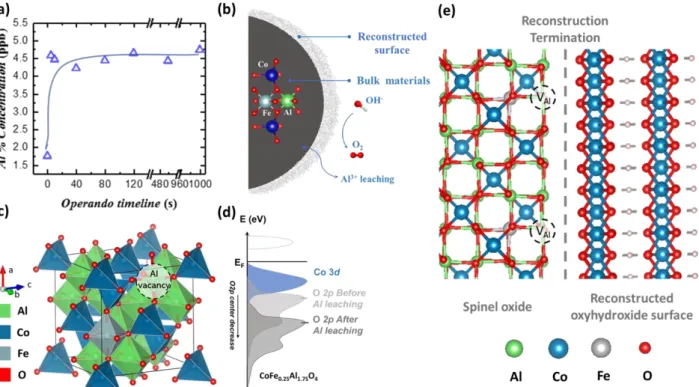
rationalized without an earlier notable Co (II) / Co (III) anodic features (should appear at ~1.2 V vs RHE).
156
Besides, its high intensity also contradicts the fact that only a small portion of Co cation in Co-based oxides
157
could be reached and oxidized into Co (IV)33, 35. Considering that the surface has reconstructed during the 1st
158
cycle, we believe that this anodic peak at ~1.38 V should be primarily attributed to the delayed Co (II) / Co
159
(III) transition. Since the anodic process on oxyhydroxide surface can be viewed as deprotonation process
160
with oxidation of metal cation,36 the delayed Co (II) oxidation for CoAl2O4 suggests a difficult deprotonation
161
process. For CoFe0.25Al1.75O4, an obvious anodic wave is observed at ~ 1.2V which is assigned to Co (II) / Co
162
(III) transition.9, 34 This observation suggests an easier deprotonation process and activated Co (II) oxidation
163
due to the Fe substitution. Such Co (II) / Co (III) redox is followed by a double layer charging response,
164
which may result from the large surface area of the reconstructed surface and suggests a diffusion of a
165
distribution of protons on the surface37. After such anodic redox of Co species, CoFe0.25Al1.75O4 exhibit a much
166
lower overpotential required for triggering OER than that for CoAl2O4 (~70 mV lower as indicated in Fig. 1e).
167
Thus, it is clear that in the presence of Fe, highly active oxyhydroxides would be induced along with the
168
reconstruction of oxide surface. Therefore, the Fe substitution is inferred to activate the Co pre-oxidation at
169
low potential, facilitating both the surface reconstruction and the subsequent evolution of surface active sites.
170
Such inference is further substantiated by in-situ XANES and the active species as identified by in-situ
171
EXAFs.
172 173
174
Fig. 2 | in-situ investigation on pre-OER behaviors of catalysts and schematic illustration of surface
175
reconstruction and deprotonation process. a, The pseudocapacitive behavior in the 1st and 2nd cycles of
176
CoFe0.25Al1.75O4 and CoAl2O4 during the cyclic voltammetry cycling. b,c, The normalized in-situ Co K-edge
177
XANES (left) under the different potentials of 1.05, 1.20, 1.42, and 1.52 V (vs. RHE) with Co3O4 (Sigma
178
Aldrich) as the references, as well as the in-situ Fourier transform (FT) k3χ(R) Co K-edge EXAFs (right)
179
under open circuit (OC) and 1.5 V (vs. RHE): (b) CoAl2O4 and (c) CoFe0.25Al1.75O4. The peak I, II, and III in
180
FT-EXAFS are assigned to M-O, MOh-MOh, and MOh-MTd radial distance, respectively. d, The Co L-edge
181
EELS spectra along with the line pathway as shown in e, scanning transmission electron microscopy (STEM)
182
of CoFe0.25Al1.75O4 after 100 cycles. The mark points denote the scanning distance along with the path way
183
(nm): 0, 10.2, 20.3, 26.4, 30.1, 36.6, 42.7 and 48.3. f, The elemental ratio of O, Co, Fe (left axis) and the
184
white-line ratio of Co L-edge (right axis) along with the line pathway. The white-line ratio is determined by
185
the intensity of L3 and L2 peaks in EELS spectra.38 g,h, The HRTEM images to show the surface regions for
186
(g) as-prepared CoFe0.25Al1.75O4; (h) CoFe0.25Al1.75O4 after 2 cycles i, The reconstruction process from spinel
187
CoFe0.25Al1.75O4 into oxyhydroxide with activated negatively charged oxygen ligand. j, The in-situ Co
188
oxidation state of CoFe0.25Al1.75O4 and CoAl2O4 (i.e. x=0) under the different potentials of 1.05, 1.20, 1.42, and
189
1.52 V (vs. RHE). k,l, The proposed deprotonation mechanism before OER are shown for (k) CoFe0.25Al1.75O4
190
and (l) CoAl2O4.
191 192 193
In Fig. 2b and 2c (right diagram), the in-situ Co K-edge Fourier transform (FT) EXAFS spectra without and
with an applied potential of 1.5 V (vs RHE) are shown for CoFe0.25Al1.75O4 and CoAl2O4 (x=0). At open circuit,
195
the FT-EXAFS profiles for CoFe0.25Al1.75O4 and CoAl2O4 (x=0) are quite similar. The Peak I at ~1.5 Å is
196
referred to an average metal-oxygen bond length. Two separated peaks, i.e. Peak II and Peak III at 2.4 Å and
197
3.1 Å, respectively, are assigned to the radial distance of CoOh (Co in octahedral site) and CoTd (Co in
198
tetrahedral site) to their neighboring metal atoms. Because the Co fraction does not change in CoFexAl2-xO4
199
with the Fe substitution, the ratio of Peak II to Peak III represents the composition ratio of CoOh and CoTd in
200
these oxides. Compared with the profiles collected at open circuit, the Peak II of Co K-edge in both
201
CoFe0.25Al1.75O4 and CoAl2O4 increase with the applied potential of 1.5 V. Such increase of the Peak II
202
indicates an accumulation of Co atoms in edge-sharing octahedral coordination8, which is attributed to the
203
formation of Co oxyhydroxide which is in edge-sharing CoO6 octahedral structure.33 Notably, a much higher
204
ratio of Peak II / Peak III is observed for CoFe0.25Al1.75O4 as compared to that for CoAl2O4, suggesting a
205
consistent conclusion as our observation in 1st cycle of CV that the reconstruction into oxyhydroxide is more
206
thorough for CoFe0.25Al1.75O4. Such reconstruction of Co on the surface for CoFe0.25Al1.75O4 is also evidenced
207
by STEM-EELS (Fig. 2d and 2e) and HRTEM (Fig. 2g and 2h) at the reconstructed surface. Under
208
STEM-EELS, a notable increase of elemental ratio of Co (Co%) at the near surface of CoFe0.25Al1.75O4
209
particles is detected (Supplementary Fig. 13 and Fig. 2f), which would be a result of Co oxyhydroxide
210
formation on surface. The white-line ratio for Co L edge (Fig. 2f) decreases and indicates increased oxidation
211
state39, which could be an effect of irreversible of electrochemical oxidation of Co (II) to form Co (III)
212
oxyhydroxide during the 1st cycle. Under HRTEM, the generated oxyhydroxide can be observed on the
213
reconstructed surface of oxide. Thus, the surface chemistry of CoFe0.25Al1.75O4 is changed by reconstruction
214
from oxide into oxyhydroxide (Fig. 2i). As reported that Co oxyhydroxides evolved as the active species for
215
many Co-based oxide catalysts,7, 9-10, 32 we thus believe that the reconstruction facilitated by Fe substitution is
the most critical step for evolving active surface oxyhydroxide.
217 218
Fig.
219
In the cases of active oxyhydroxides, some studies proposed a so-called active oxygen species,21-22, 40 which is
220
created during the deprotonation (anodic sweep) step, as the ultimate active site. Thus, considering the
221
observed alternation of anodic peak by Fe substitution in 2nd CV cycle, the dynamic valence state of Co during
222
the anodic sweep was then examined by in-situ XANES. Fig. 2b and 2c (left diagram) display the Co K-edge
223
XANES of CoFe0.25Al1.75O4 and CoAl2O4 (x=0) oxides recorded at 1.05, 1.20, 1.42, and 1.52 V (vs. RHE),
224
respectively. The K-edges in XANES of both oxides shift to higher energy, indicating the oxidation of Co. The
225
corresponding nominal valence states of Co in CoFe0.25Al1.75O4 and CoAl2O4 under each applied potential are
226
plotted in Fig. 2j. The valency increment in the pseudocapacitive region could be primarily observed in region
227
I (1.05 – 1.20 V) and region II (1.20 – 1.42 V), and the Co behavior in pre-OER stage can be found in region
228
III (1.42 – 1.52 V). The increase of Co valency could be viewed as deprotonation process on the reconstructed
229
surface of catalysts. As observed, in pseudocapacitive range (region I and region II), the CoFe0.25Al1.75O4
230
exhibits an increase of valency in both region I and region II. Whereas, the valency for CoAl2O4 increases only
231
in region I, suggesting a limited deprotonation process. Its next deprotonation process is only observed at
232
higher potential in the region III. Thus, the Fe substitution is likely to facilitate the deprotonation process at
233
low potential to form active oxygen species on the surface, which accounts for the OER activity enhancement.
234
Here, to illustrate the role of Fe in deprotonation process, we propose two proton/electron transfer processes
235
for evolving active oxygen sites on CoFe0.25Al1.75O4 surface. As shown in the Fig. 2k, the first deprotonation
236
process on CoFe0.25Al1.75O4 should start at the bridged OH linked to both Co and Fe center, which is
237
responsible for the valency increment of Co (II) cation, and such process on bridged OH could be facilitated
by its neighboring Fe3+ center. The first deprotonation process is followed by another deprotonation process at
239
terminal OH linked to Co or Fe center. Similar deprotonation process was also reported for NiFexOOH22.
240
Unlike NiFexOOH where the Fe substitution anodically shifts the Ni oxidation peak22, 36, an opposite behavior
241
was observed here for Fe substituted CoAl2O4. The suppressing effect of Fe on Ni oxidation was explained by
242
the kinetics barrier for the deprotonation of terminal OH linked to Fe center.36 Thus, on the basis of the
243
activated Co oxidation in our study, we believe that the second deprotonation process should be at the terminal
244
OH linked to Co center, and the activated Co oxidation is ascribed to the reduced kinetic barrier for the proton
245
abstraction at Co site. The second process with one proton abstraction is not compensated by the metal
246
oxidation but rather by negatively charged oxygen ligand (O*) that serves as active site. However, for
247
CoAl2O4, during the corresponding pseudocapacitive range, it merely undergoes deprotonation process on
248
bridged OH (Fig. 2l). The following deprotonation for CoAl2O4 on the terminal OH is greatly delayed and
249
OER does not occur till the second deprotonation happens, suggesting this process as a prerequisite for OER.
250
Thus, the critical role of Fe is to facilitates the deprotonation process to generate active oxygen site at lower
251
potential on CoFe0.25Al1.75O4, thereby leading to a lower overpotential for OER. It should be noted that the
252
redox reaction on the reconstructed oxyhydroxide surface would be greatly affected by the reconstruction
253
process in the 1st cycle. As also observed in our pH dependence measurement (Fig. 3a), the redox peak is
254
greatly altered, not simply shifted, by changing the pH of electrolyte. Especially, the redox peak is even muted
255
at pH≤13. Clearly, such alternation is led by a pH-sensitive surface reconstruction, which results in forming
256
surface oxyhydroxide in different state with varied pH. Such pH-sensitive surface reconstruction suggests that
257
it may include certain decoupled proton/electron transfer process such as lattice oxygen oxidation41 which is
258
further demonstrated in the following section.
260
Fig. 3 | Electronic interpretation of the effect of Fe substitution on surface reconstruction. a, Cyclic
261
Voltammetry (CV) of CoFexAl2-xO4 (x=0.0, 0.25 and 2.0) scanned in O2-saturated KOH (pH= 12.5~14) at a
262
scan rate of 10 mV s-1. b, The computational models of CoFexAl2-xO4: (top) x=0, (middle) x=0.25, (Bottom)
263
x=2. c, The computed Co 3d, O 2p density of state (PDOS) of CoFexAl2-xO4 (x=0, 0.25 and 2.0). d, The OER
264
overpotential at 10 μA cm-2
oxide and the O 2p band center relative to Fermi level (-O 2p) for CoFexAl2-xO4
265
(x=0.0, 0.25 and 2.0) e, The schematic band diagrams of CoFexAl2-xO4 (x=0, 0.25 and 2.0). The Co 3d-band in
266
the diagram represents the highest occupied state and the lowest unoccupied state. f, The schematic diagram of
267
a surface reconstruction mechanism for CoFe0.25Al1.75O4.
268 269 270
Interpretation of O 2p
271
As aforementioned, the active oxygen site is generated by the deprotonation on the oxyhydroxide surface and
272
the reconstruction for forming surface oxyhydroxide serves as the prerequisite for efficient OER catalysis. We
have also mentioned that the Fe-facilitating reconstruction is dominated by the CoFe0.25Al1.75O4 component
274
and may involve certain decoupled proton/electron transfer process. The inner driving force for the
275
reconstruction is further studied by density functional theory (DFT) calculation. The electronic density of state
276
(DOS) calculation is adopted to examine the alternation in electronic structure of oxides by Fe substitution.
277
The computational models for CoFexAl2-xO4 (x=0, 0.25, and 2) are shown in Fig. 3b (see modelling and
278
calculation details in SI). The projected density of state (pDOS) of CoFexAl2-xO4 (x=0, 0.25, and 2) oxides and
279
their band center energies are given in Fig. 3c (see more details in Supplementary Table 6). As found for band
280
center energies, the Fe substitution in CoAl2O4 uplifts the O 2p-band center in energy closer to the Fermi level.
281
However, as Al3+ is fully replaced by Fe3+ to form CoFe2O4, it becomes an inverse spinel structure and the O
282
2p-band center greatly moves down in energy. The PDOS results reveal that Fe substitution could either uplift
283
or downshift the O 2p level depending on the substitution level. Moreover, the position of O 2p-band center
284
relative to Fermi level shows consistent trend with the OER activity of CoFexAl2-xO4 oxides (x=0, 0.25 and 2)
285
(Fig. 3d). It is also noteworthy that the OER activity of CoFexAl2-xO4 oxides is greatly affected by their
286
reconstruction process under OER conditions. Thus, the O 2p level is likely an influential factor to the surface
287
reconstruction. Earlier studies have revealed that the O 2p-band level relative to the Fermi level was always
288
associated with some activity-related structural parameters for perovskite oxides.14, 42-44 For example, a linear
289
relationship was established between the O 2p-band level and the oxygen vacancy (VO••) formation energy in
290
some perovskite oxides, in which the low VO•• formation energy could be predicted by high O 2p level close to
291
Fermi level.14, 42 Given that spinel structure contains octahedral MO6 unit as well as that of perovskite oxides,5,
292
45
the uplifted O-2p band center by Fe substitution should also facilitate the VO•• formation in spinel oxides.
293
Consistent results have been revealed above in the structural analysis of substituted oxides where Fe
294
substitution lowers the metal-oxygen coordination number and decrease the Co valence state, suggesting an
increased oxygen vacancy concentration. In addition to the influential role of O 2p level on bulk VO••
296
formation, it is also governing the lattice oxygen oxidation mechanism for oxides.41, 46-47 With the uplifted O
297
2p center closer to Fermi level, the oxygen character in the antibonding state below Fermi level becomes more
298
dominant (Fig. 3e). As an anodic potential is applied, the Fermi level shifts deeper into O 2p state and the
299
holes in oxygen state are created as the O2/H2O redox potential is aligned with the O 2p state energy in the
300
oxide, which leads to the oxidation of lattice oxygen.41, 48 Thus, credited to the uplifted O 2p level, the
301
oxidation of lattice oxygen in CoFe0.25Al1.75O4 should be more favorable than that in CoAl2O4 and CoFe2O4.
302
Note that the lattice oxygen mediated OER mechanism should not dominate the OER here. This is also
303
confirmed by a cycling test of CoFe0.25Al1.75O4 oxides over 100 cycles (shown in Supplementary Fig. 12). The
304
lattice oxygen-mediated OER is always featured with unstable oxide due to cation leaching on catalysts and
305
thus leading to activity increase with cycling.47 For example, Ba0.5Sr0.5Co0.8Fe0.2O3-δ (BSCF) as well-identified
306
oxygen active-perovskite catalysts exhibit ~4-fold current increase over 50 cycles.12 In contrast, the
307
CoFe0.25Al1.75O4 did not exhibit marked OER current variation during CV cycling, suggesting that the
308
reconstructed surface is stable and the involvement of lattice oxygen is not notable during the OER catalysis.
309
This is further evidenced by the electrochemical study on active surface area and HRTEM (Fig. 2g, 2h and
310
Supplementary Fig. 14) of CoFe0.25Al1.75O4 after reconstruction and 100 cycles. The reconstruction in 1st cycle
311
is found merely at limited depth (~5 nm) on the surface of CoFe0.25Al1.75O4 and the reconstructed surface
312
keeps quite stable during subsequent cycling. Please also see detailed discussion in Supplementary Note 2.
313
Thus, the stable surface chemistry after reconstruction excludes the involvement of lattice oxygen in OER
314
catalysis on the reconstructed surface, and also keeps the accuracy of the estimation of the specific activity
315
normalized to BET surface area. However, we believe that the surface reconstruction should start with the
316
lattice oxygen oxidation, which results in the aforementioned pH-sensitive reconstruction (Fig. 3a). According
to early report, high VO•• (oxygen vacancies) concentration (especially VO••on the surface) would grant
318
structural flexibility for surface reconstruction on oxides.6 As a further step, even though the induced VO••
319
grants certain structural flexibility in oxides, these VO•• are actually stabilized in the bulk crystal. In another
320
word, such flexibility has to be triggered by additional perturbation such as the lattice oxygen oxidation. This
321
is also evidenced by our theoretical study and XANES result of CoFe2O4, where CoFe2O4 exhibits the lowest
322
enthalpy for oxygen vacancy formation (Supplementary Table 3) and experimentally possessing the highest
323
oxygen vacancy concentration (Supplementary Table 2) compared to CoAl2O4 and CoFe0.25Al1.75O4. However,
324
neither an obvious reconstruction-related current response in the first cycle nor a redox peak subjected to
325
oxyhydroxide during the second cycle can be observed for CoFe2O4 in CV (Supplementary Fig. 15). Besides,
326
compared to CoAl2O4 and CoFe0.25Al1.75O4, CoFe2O4 shows the weakest pH-dependent OER performance (Fig.
327
3a) and the lowest O 2p band center. Thus, we believe that the lattice oxygen oxidation at the pristine surface
328
to creating more surface VO•• should be a critical trigger for the surface reconstruction. This is further
329
evidenced by the elemental ratio on the surface of CoFe0.25Al1.75O4 after 100 cycles obtained by STEM-EELS
330
(Fig. 2f). The O% greatly decreases along with notable Co enrichment on the reconstructed surface, which
331
implies the critical role of creating surface oxygen vacancy on triggering Co reconstruction. Thus, it is
332
believed that, along with the lattice oxygen oxidation,41 a great structural instability emerges as the oxygen
333
vacancies further accumulate on the oxide surface and induce the surface reconstruction (Fig. 3f) into
334
oxyhydroxides that is more stable in alkaline.19-20 As a result, such dynamic instability in electrochemical
335
process can be electronically indicated by the O 2p level.
336 337 338
339
Fig. 4 | Reconstruction terminating mechanism with Al3+ leaching. a, ICP-MS test of the electrolyte for
340
CoFe0.25Al1.75O4 cycling under operation time of 0~1000s (in 1 M KOH under 20 μA cmox-2). The dissolubility
341
of Al in terms of is far beyond the concentration of Al3+ in our tested electrolytes. b, The
342
schematic of Al3+ leaching along with surface reconstruction of spinel oxide. c, The computational model for
343
CoFe0.25Al1.75O4 after Al3+ leaching. The spinel structure beneath reconstructed surface was confirmed under
344
HRTEM (Supplementary Fig. 14b). d, The schematic band diagrams of CoFe0.25Al1.75O4 with and without Al3+
345
vacancy. e, The schematic of CoFe0.25Al1.75O4 that terminates its surface reconstruction due to the termination
346
of lattice oxygen oxidation.
347 348 349
Also importantly, while many reconstructable catalysts like Ba0.5Sr0.5Co0.8Fe0.2O3-δ exhibit unstable surface
350
chemistry and become notably amorphous after cycling12, CoFe0.25Al1.75O4 is distinguished for its stable
351
surface chemistry after reconstruction as discussed above. The reconstruction triggered by lattice oxygen
352
oxidation was terminated after 1st cycle and the reconstructed surface is highly active and stable in the
353
subsequent cycles. To investigate the mechanism of such reconstruction termination, we carried ICP test on
354
the electrolyte used for CoFe0.25Al1.75O4 cycling. It was found that the leaching of Al cations was notable while
355
Co and Fe cations both exhibited negligible leaching (Supplementary Table 7). Besides, observed under
356
operando timeline, the Al leaching was found quickly finished as the OER happened, and no notable Al
leaching is found thereafter (Fig. 4a), which is consistent with the reconstruction process observed in CV.
358
Hence, we believe that the leaching of Al is closely associated with the reconstruction process. As Al leached
359
with the reconstruction at the very beginning, such leaching would alter the local electronic structures of oxide
360
to prevent further reconstruction (Fig. 4b). We further employed DFT to study the local electronic structure for
361
the lattice with Al vacancy (Fig. 4c). As illustrated in Fig. 4d and Supplementary Fig. 16, the O 2p level
362
decreases in energy as Al vacancy is introduced in the lattice. As a result, the lattice oxygen oxidation would
363
be terminated as O 2p level is low in energy, and the reconstruction thus stops accordingly as no more oxygen
364
vacancies created (Fig. 4e). Such termination mechanism makes CoFe0.25Al1.75O4 a discernable catalyst which
365
shows a stable surface chemistry after reconstruction and is capable to carry efficient and stable OER catalysis
366
on reconstructed surface.
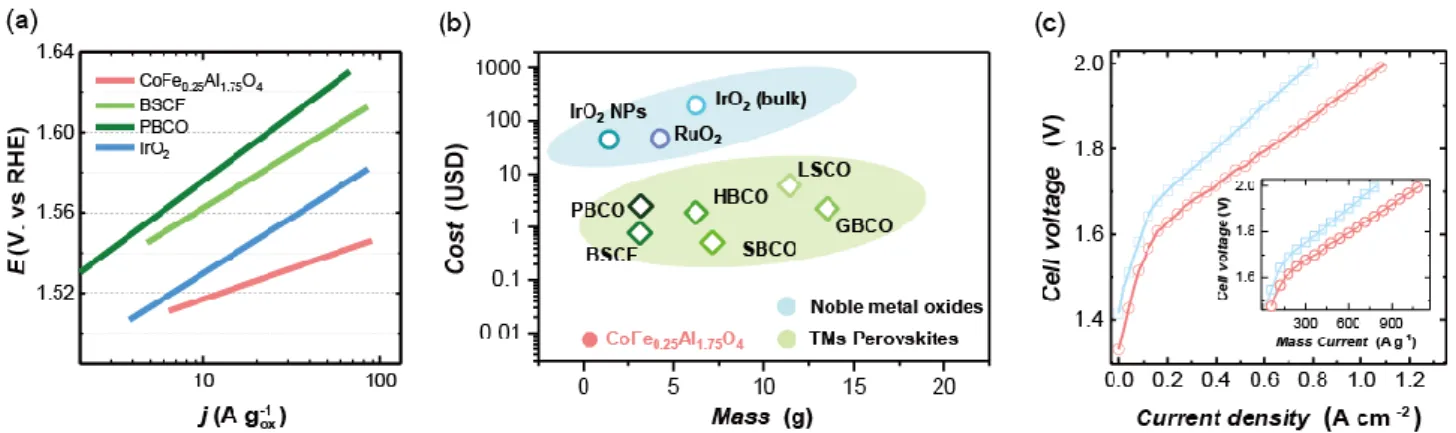
367
368
Fig. 5| Competitive potential in electrolyzers application. a, Mass activity of CoFe0.25Al1.75O4,
369
Ba0.5Sr0.5Co0.8Fe0.2O3-δ (BSCF) 1
, Pr0.5Ba0.5CoO3-δ (PBCO) 44
and IrO2 nanoparticles (NPs) 4
. b, The material mass 370
and cost for delivering a current of 10 A at overpotential of 0.3 V by CoFe0.25Al1.75O4, Ba0.5Sr0.5Co0.8Fe0.2O3
371 (BSCF)1, (Pr0.5Ba0.5)CoO3-δ (PBCO) 44 , (Sm0.5Ba0.5) CoO3-δ (SBCO) 44 , (Gd0.5Ba0.5) CoO3-δ (GBCO) 44 , 372
(Ho0.5Ba0.5)CoO3-δ (HBCO) 44
, IrO2 nanoparticles (NPs)4, IrO2 (bulk, Premetek Co.) 49
and RuO2 50
. The cost is 373
evaluated by the cost of metal elements in oxides. c, The polarization curves of the electrolyzer with 374
CoFe0.25Al1.75O4 (1 mg cm -2
) and IrO2 (Premetek Co., 1 mg cm -2
) as anode catalyst and Pt/C (TKK 47.1 wt% Pt, 1 375
mg cm-2) as cathode catalyst. Inset is the polarization curves of CoFe0.25Al1.75O4 and IrO2 in mass current density.
376
Cell temperature was maintained at 60 oC. The experimental details are shown in Methods. 377
378
With all advantages discussed above, CoFe0.25Al1.75O4 exhibits competitive potential in alkaline electrolyzer
379
applications. Its mass activity (Fig. 5a) outperforms IrO2 and the benchmarked transitional metal oxides (e.g.
380
Ba0.5Sr0.5Co0.8Fe0.2O3-δ 1 and Pr0.5Ba0.5CoO3-δ44). Its cost for given performance is lower than that of noble
metal oxides and other reported transition metal perovskites by orders of magnitude (Fig 5b). CoFe0.25Al1.75O4
382
was further examined in a homemade membrane electrode assembly (MEA) electrolysis cell with an anion
383
exchange membrane as the solid electrolyte (Supplementary Fig. 17). The CoFe0.25Al1.75O4 exhibited a notable
384
higher mass efficiency as well as higher areal activity than IrO2 (Fig. 5c). Its performance in MEA is also
385
better than that reported for Ba0.5Sr0.5Co0.8Fe0.2O3-δ under similar condition (Supplementary Fig. 18).6
386 387
Conclusion
388
In summary, we show a promoted surface reconstruction on CoAl2O4 by Fe substitution. CoFe0.25Al1.75O4 is
389
proven to be a critical component in the CoFexAl2-xO4 (x=0.0~2.0) series as it undergoes surface
390
reconstruction. The surface reconstruction has been investigated by HRTEM, EELS, and XAFS. Evidenced by
391
operando XAFS, Fe activates two deprotonation processes in reconstructed oxyhydroxides, leading to the
392
formation of active oxygen species at a low overpotential. We interpret that the uplift of O 2p level by Fe
393
substitution facilitates the creation of surface oxygen vacancies (VO••) along with the lattice oxygen oxidation
394
under OER condition and grants a greater structural flexibility for reconstruction. The O 2p moves down as
395
Al3+ leaches at the beginning of reconstruction and further terminates the surface reconstruction for a stable
396
surface chemistry. Under this strategy, CoFe0.25Al1.75O4 exhibits outstanding intrinsic activity, mass efficiency,
397
and stability toward OER. Its high performance has been also demonstrated in MEA configuration. On the
398
basis of this work, more alternative strategies would be explored to tune the active sites formation by
399
adjusting its dynamic reconstruction to develop robust and low-cost OER catalysts.
400 401
Methods
402
Materials synthesis and characterization.CoFexAl2-xO4 (x=0, 0.1, 0.25, 0.5, 1, 1.5, 2) powders were prepared by the sol-gel method
403
using citric acid as a chelating agent and urea as combustion agent. Firstly, cobalt acetate (Co(OAc)2·4H2O), Iron(III) nitrate
404
nonahydrate (Fe(NO3)3 · 9H2O), aluminum nitrate (Al(NO3)3·9H2O) in specific molar ratio were dissolved in diluted nitric acid,
405
followed by the addition of citric acid and urea. The mixture was stirred and heated up at 80-100 ºС to generate highly viscous gel. 406
Then, the gel was then transferred to an oven to decompose and dry in the air at 170 ºС for 12 hours. Finally, followed by the 407
calcination at 400 °C for 6 hours, the spinel CoFexAl2-xO4 (x=0, 0.1, 0.25, 0.5, 1, 1.5, 2) oxides were obtained. The High resolution
408
TEM (HRTEM) and STEM-EELS were taken on a JEOL JEM- 2100F microscope at 200KV. The X-ray diffraction (XRD) patterns of 409
bulk CoFexAl2-xO4 were recorded on Bruker D8 diffractometer at a scanning rate of 2° min −1
, using Cu-Kα radiation (λ = 1.5418 Å).
410
The BET (Brunauer-Emitter-Teller) surface area was analyzed on ASAP Tristar II 3020 from single-point BET analysis performed 411
after 12 h outgassing at 170 °C (Supplementary Table 4). 412
413
Electrochemical characterization under three-electrode system. The working electrode was fabricated by drop casting method. The
414
as-prepared catalysts which first mixed with acetylene black (AB) at a mass ration of 5:1, then were dispersed in isopropanol/water 415
(v/v=1:4) solvent followed by the addition of Na+-exchanged Nafion as the binder and ultrasonicated for 20min to form homogeneous 416
ink. The glassy carbon electrode was polished to a mirror finish with 50 nm α-Al2O3 and ultrasonicated in IPA and water to completely
417
clean up. At last, 10 μl of the as-prepared ink was dropped onto a glassy carbon (GC) electrode (0.196 cm2) and dried overnight at
418
room temperature to yield a final loading mass of 255 μgox cm-2.
419
The electrochemical tests were carried out by three-electrode method using CoFexAl2-xO4 as working electrode, platinum plate (1×2
420
cm2) as the counter electrode, Hg/HgO (1M KOH, aqueous, MMO) as the reference in O2-saturated 1.0 M KOH by using Bio-logic SP 421
150 potentiostat. All potentials are converted to RHE scale and iR corrected by the resistance of electrolyte. The conversion between 422
the potentials vs. RHE and vs. MMO was performed by the following equation: E (vs. RHE) = E (vs. MMO) + EMMO (vs. SHE) +
423
0.059 × pH. EMMO (vs. SHE) = 0.098 vs. SHE at 25°C. The Cyclic Voltammetry(CV) was obtained under potentials from 0.875V to
424
1.575V (vs. RHE) at a scan rate of 10mV s-1. Besides, the CV was also conducted for all samples under potentials from 0.695V to 425
1.495V (vs. RHE) to investigate the pseudocapacitive charge preceding the OER region. The chronopotentiometry measurement was 426
performed by holding the specific current density of 10 μA cm-2oxide for 10 hours. Electrochemical impedance spectra(EIS) was
427
recorded at 1.525V (vs. RHE) under 10 mV of amplitude from 100 KHz to 0.01Hz. 428
429
X-ray absorption spectroscopy. X-ray absorption near edge spectroscopy (XANES) and extended X-ray absorption fine structure
430
(EXAFs) were performed under transmission mode at Singapore Synchrotron Light Source, XAFCA beamline. The Co and Fe K-edge 431
position obtained by an integrate method 29 is shown in Supplementary Table 2. The Co nominal valence state is obtained by using 432
as-prepared CoAl2O4 (+2.0, 7717.41 eV) and standard Co3O4 (+2.67, 7719.96 eV) as benchmark. The Fe nominal valence is obtained
433
by using standard Fe3O4 (+2.67, 7121.71 eV) and standard Fe2O3 (+3, 7122.82 eV) as benchmark. Noted that the as-prepared CoAl2O4
434
well match with the standard CoAl2O4, and Co valence state in standard CoAl2O4 is +2. The nominal oxygen vacancy concentration is
435
calculated on the basis of the nominal valence state of Co, Al (III) and Fe. The in-situ XAS measurements were performed in 436
fluorescence-transmission geometry, where the spectra of samples and references were measured in fluorescence mode. The catalysts 437
were sprayed on carbon paper at a loading of 2mg cm-2 as working electrode. The measurement was carried out under the same
438
condition as OER measurement in a homemade cell. The in-situ XANES measurement was applied after one cycle. The in-situ XAFS 439
measurement was taken on the as-prepared catalysts without any additional electrochemical treatment. Acquired XAFS data were 440
processed in ATHENA program and analysed in ARTEMIS program integrated with IFEFFIT software package51. 441
442
Density functional theory calculations. The calculation was carried out by Vienna ab initio Simulation package (VASP) using
443
spin-polarized density functional with the Hubbard model (DFT+U).52-53 The projector augmented wave (PAW) model with 444
Perdew-Burke-Ernzerhof (PBE) function was used to describe the interactions between core and electrons, and the value of the 445
correlation energy (U) was fixed at 3.3, 4.3 eV for the 3d orbits of Co and Fe, respectively.54-55 An energy cutoff of 500 eV was used 446
for the plane-wave expansion of the electronic wave function. The Brillouin zones of all systems were sampled with Gamma-point 447
centered Monkhorst-Pack grids. A 7×7×7 Monkhorst Pack k-point setup were used for bulk geometry optimization, while 9×9×9 for 448
electronic structures calculation. The force and energy convergence criterion were set to 0.02 eV Å-1 and 10-5 eV, respectively. All 449
models are created by comparing the stability of spinel with normal or inversed structure in a unit cell, and the structures at lower 450
energy are selected for study. The CoAl2O4 (Supplementary Table 7) prefer the normal spinel structure with Co2+ located on tetrahedral
451
sites and the Al3+ located on octahedral sites ([Co]Td[Al]Oh[Al]OhO4). The CoFe0.25Fe1.75O4 model was established by replacing two
452
Al3+ atom in CoAl2O4 unit cell with two Fe atoms. The CoFe2O4 (Supplementary Table 8) prefers inverse spinel with Co2+ at
octahedral sites and Fe3+ both at tetrahedral sites and octahedral sites ([Fe]Td[CoFe]OhO4).
454 455
Membrane electrode assembly (MEA) electrolyzer. A homemade MEA electrolysis cell with an anion exchange membrane was
456
employed to evaluate the performance of the as-prepared CoFe0.25Al1.75O4 catalyst. The cell includes two titanium end plates, on
457
which a single serpentine flow field (area: 6.25 cm2, 1.0 mm in width, 0.5 mm in depth, and 1.0 mm in rib) was machined. The 458
titanium end plates were coated with a gold layer (thickness: 200 nm) to reduce the contact resistance. The CoFe0.25Al1.75O4 was first
459
mixed with high surface area carbon (HSAC, Ketjen black EC-600J, carbonization treatment) with a weight ratio of 1:1. The 460
composite powder was then mixed with PTFE suspension (60 wt% PTFE dispersion in water from Chemours), isopropyl alcohol and 461
water to prepare the anode catalyst ink. The PTFE content in the catalyst layer was controlled with 10 wt%. The catalyst ink was 462
ultrasonicated for 30 minutes at room temperature and manually spread onto a corrosion-resistant stainless-steel mesh (SSL mesh, 463
#500). The catalyst loading on the as-prepared electrode was 1 mg cm-2. The cathode Pt electrode was fabricated with the same 464
procedure without the addition of HSAC. A catalyst ink, consisting of commercial Pt/C catalyst (TKK, TEC10EA50E 47.1 wt% Pt, 465
3.22 nm in mean particle size), PTFE suspension, isopropyl alcohol and water, was manually spread onto a carbon paper (Toray 060). 466
The catalyst loading on the electrode was 1 mg cm-2. The PTFE content in the catalyst layer was 10 wt%. The IrO
2 anode was
467
fabricated with commercial IrO2 powder (Premetek Co) by the same procedure as for preparing the CoFe0.25Al1.75O4 electrode. An
468
anion exchange membrane (A901, 11 μm, Tokuyama) was employed as the membrane. To reduce the contact resistance, the membrane 469
sandwiched by the anode electrode and cathode electrode was pressed at a pressure of 1 MPa for 5 minutes at room temperature. 0.1 M 470
KOH was pumped into the electrode channels by a peristaltic pump at a constant flow rate of 2 ml min-1. The cell temperature (60 oC) 471
was maintained by an electric heating plate and measured by a thermocouple placed near the anode and cathode current collectors. The 472
polarization curves were measured with an electrochemical workstation (Solartron 1470E). The water electrolysis was performed 473
under constant current mode, in which the current was increased by 0.125 A (20 mA cm-2) and retained for 5 minutes for each step 474
until the cell voltage was reached 2.0 V. Before the water electrolysis, the as-fabricated MEA was activated by a potentiostatic mode 475
with a scan rate of 0.5 mV s-1 and a terminal voltage of 2.0 V. 476
477 478
Data availability
479
The data related to this study is available from the authors upon reasonable request. 480 481 482
References
483 4841. Suntivich, J., et al., A perovskite oxide optimized for oxygen evolution catalysis from molecular orbital principles.
485
Science 334, 1383-1385 (2011).
486
2. Grimaud, A.; Hong, W. T.; Shao-Horn, Y.; Tarascon, J. M., Anionic redox processes for electrochemical devices. Nat.
487
Mater. 15, 121 (2016).
488
3. Hong, W. T., et al., Toward the rational design of non-precious transition metal oxides for oxygen electrocatalysis.
489
Energy Environ. Sci. 8, 1404-1427 (2015).
490
4. Lee, Y., et al., Synthesis and Activities of Rutile IrO2 and RuO2 Nanoparticles for Oxygen Evolution in Acid and
491
Alkaline Solutions. J. Phys. Chem. Lett. 3, 399-404 (2012).
492
5. Chao, W., et al., Cations in Octahedral Sites: A Descriptor for Oxygen Electrocatalysis on Transition-Metal Spinels.
493
Adv. Mater. 29, 1606800 (2017).
494
6. Fabbri, E., et al., Dynamic surface self-reconstruction is the key of highly active perovskite nano-electrocatalysts for
495
water splitting. Nat. Mater. 16, 925-931 (2017).
7. Hsu, C.-S., et al., Valence- and element-dependent water oxidation behaviors: in situ X-ray diffraction, absorption and
497
electrochemical impedance spectroscopies. Phys. Chem. Chem. Phys. 19, 8681-8693 (2017).
498
8. Risch, M., et al., Structural Changes of Cobalt-Based Perovskites upon Water Oxidation Investigated by EXAFS. J.
499
Phys. Chem. C 117, 8628-8635 (2013).
500
9. Bergmann, A., et al., Reversible amorphization and the catalytically active state of crystalline Co3O4 during oxygen
501
evolution. Nat. Commun. 6, 8625 (2015).
502
10. Wang, H.-Y., et al., In Operando Identification of Geometrical-Site-Dependent Water Oxidation Activity of Spinel
503
Co3O4. J. Am. Chem. Soc. 138, 36-39 (2016).
504
11. Smith, R. D. L., et al., Spectroscopic identification of active sites for the oxygen evolution reaction on iron-cobalt
505
oxides. Nat. Commun. 8, 2022 (2017).
506
12. May, K. J., et al., Influence of Oxygen Evolution during Water Oxidation on the Surface of Perovskite Oxide
507
Catalysts. J. Phys. Chem. Lett. 3, 3264-3270 (2012).
508
13. Tan, Y., et al., Insight the effect of surface Co cations on the electrocatalytic oxygen evolution properties of cobaltite
509
spinels. Electrochim. Acta 121, 183-187 (2014).
510
14. Mefford, J. T., et al., Water electrolysis on La1−xSrxCoO3−δ perovskite electrocatalysts. Nat. Commun. 7, 11053
511
(2016).
512
15. Grimaud, A., et al., Activation of surface oxygen sites on an iridium-based model catalyst for the oxygen evolution
513
reaction. Nat. Energy 2, 16189 (2016).
514
16. González-Flores, D., et al., Heterogeneous Water Oxidation: Surface Activity versus Amorphization Activation in
515
Cobalt Phosphate Catalysts. Angew. Chem. Int. Ed. 54, 2472-2476 (2015).
516
17. Indra, A., et al., Unification of Catalytic Water Oxidation and Oxygen Reduction Reactions: Amorphous Beat
517
Crystalline Cobalt Iron Oxides. J. Am. Chem. Soc. 136, 17530-17536 (2014).
518
18. Liu, W., et al., Amorphous Cobalt–Iron Hydroxide Nanosheet Electrocatalyst for Efficient Electrochemical and
519
Photo-Electrochemical Oxygen Evolution. Adv. Funct. Mater. 27, 1603904 (2017).
520
19. Bajdich, M., et al., Theoretical investigation of the activity of cobalt oxides for the electrochemical oxidation of water.
521
J. Am. Chem. Soc. 135, 13521-13530 (2013).
522
20. Chivot, J., et al., New insight in the behaviour of Co–H2O system at 25–150°C, based on revised Pourbaix diagrams.
523
Corros. Sci. 50, 62-69 (2008).
524
21. Trześniewski, B. J., et al., In Situ Observation of Active Oxygen Species in Fe-Containing Ni-Based Oxygen
525
Evolution Catalysts: The Effect of pH on Electrochemical Activity. J. Am. Chem. Soc. 137, 15112-15121 (2015).
526
22. Yang, C.; Fontaine, O.; Tarascon, J. M.; Grimaud, A., Chemical Recognition of Active Oxygen Species on the
527
Surface of Oxygen Evolution Reaction Electrocatalysts. Angew. Chem. Int. Ed. 56, 8652-8656 (2017).
528
23. Abreu-Sepulveda, M. A., et al., The Influence of Fe Substitution in Lanthanum Calcium Cobalt Oxide on the Oxygen
529
Evolution Reaction in Alkaline Media. J. Electrochem. Soc. 163, F1124-F1132 (2016).
530
24. Duan, Y., et al., Tailoring the Co 3d-O 2p Covalency in LaCoO3 by Fe Substitution To Promote Oxygen Evolution
531
Reaction. Chem. Mater. 29, 10534-10541 (2017).
532
25. Zhu, Y., et al., A High-Performance Electrocatalyst for Oxygen Evolution Reaction: LiCo0. 8Fe0. 2O2. Adv. Mater.
533
27, 7150-7155 (2015).
534
26. Zhu, Y. G., et al., Unleashing the Power and Energy of LiFePO4-Based Redox Flow Lithium Battery with a
535
Bifunctional Redox Mediator. J. Am. Chem. Soc. 139, 6286-6289 (2017).
536
27. Walsh, A.; Yan, Y.; Al-Jassim, M. M.; Wei, S.-H., Electronic, Energetic, and Chemical Effects of Intrinsic Defects and
537
Fe-Doping of CoAl2O4: A DFT+U Study. J. Phys. Chem. C 112, 12044-12050 (2008).
538
28. Terada, Y., et al., In Situ XAFS Analysis of Li(Mn, M)2O4 (M=Cr, Co, Ni) 5V Cathode Materials for Lithium-Ion
539
Secondary Batteries. J. Solid State Chem. 156, 286-291 (2001).