Publisher’s version / Version de l'éditeur:
Lighting design + application : LD + A., 39, 4, pp. 30-32, 34, 36, 2009-04-01
READ THESE TERMS AND CONDITIONS CAREFULLY BEFORE USING THIS WEBSITE.
https://nrc-publications.canada.ca/eng/copyright
Vous avez des questions? Nous pouvons vous aider. Pour communiquer directement avec un auteur, consultez la
première page de la revue dans laquelle son article a été publié afin de trouver ses coordonnées. Si vous n’arrivez pas à les repérer, communiquez avec nous à [email protected].
Questions? Contact the NRC Publications Archive team at
[email protected]. If you wish to email the authors directly, please see the first page of the publication for their contact information.
NRC Publications Archive
Archives des publications du CNRC
This publication could be one of several versions: author’s original, accepted manuscript or the publisher’s version. / La version de cette publication peut être l’une des suivantes : la version prépublication de l’auteur, la version acceptée du manuscrit ou la version de l’éditeur.
Access and use of this website and the material on it are subject to the Terms and Conditions set forth at The role of dimmable lighting in demand-responsive buildings
Newsham, G. R.
https://publications-cnrc.canada.ca/fra/droits
L’accès à ce site Web et l’utilisation de son contenu sont assujettis aux conditions présentées dans le site LISEZ CES CONDITIONS ATTENTIVEMENT AVANT D’UTILISER CE SITE WEB.
NRC Publications Record / Notice d'Archives des publications de CNRC: https://nrc-publications.canada.ca/eng/view/object/?id=e82c45bc-79af-4453-9b44-9c4813885297 https://publications-cnrc.canada.ca/fra/voir/objet/?id=e82c45bc-79af-4453-9b44-9c4813885297
http://irc.nrc-cnrc.gc.ca
T he role of dim m a ble light ing in
de m a nd-re sponsive buildings
N R C C - 5 1 2 1 0
N e w s h a m , G . R .A p r i l 2 0 0 9
A version of this document is published in / Une version de ce document se trouve dans: Lighting design & application (LD+A), 39, (4), pp. 30-32, 34, 36
The material in this document is covered by the provisions of the Copyright Act, by Canadian laws, policies, regulations and international agreements. Such provisions serve to identify the information source and, in specific instances, to prohibit reproduction of materials without
written permission. For more information visit http://laws.justice.gc.ca/en/showtdm/cs/C-42
Les renseignements dans ce document sont protégés par la Loi sur le droit d'auteur, par les lois, les politiques et les règlements du Canada et des accords internationaux. Ces dispositions permettent d'identifier la source de l'information et, dans certains cas, d'interdire la copie de
The Role of Dimmable Lighting in Demand-Responsive Buildings
Guy R. Newsham
National Research Council – Institute for Research in Construction
Background
Many utilities experience a peak demand for electricity on hot summer afternoons, and meeting this demand is becoming increasingly costly in regions of constricted supply growth. Operating the utility power grid under high demand places the system under strain, and failure to meet peak demand has already led to service curtailment in some places. As significant end-users, it will become increasingly important for commercial and industrial buildings to reduce their grid electrical demand during peak periods. Reducing demand in such circumstances is often called “load shedding”. Utilities might offer incentives to facility managers making load available for such actions. The most common load shedding response for buildings involves the HVAC system: chillers and compressors may be switched off, and ventilation fan speeds reduced. This may lead to a slow degradation in the thermal environment and in air quality relative to normal conditions.
Use of lighting is often not considered because most buildings employ simple on-off switches that are not centrally controlled, and non-dimmable ballasts. Even if centrally controlled, the sudden step change may be seen as too noticeable and disturbing to occupants. Dimming control is potentially ideal for load shedding, allowing light levels to change smoothly, which may be undetected by occupants, although there might be other effects (on task performance, for example) that may accrue even if the change in light level is not perceived.
There are other electricity demand issues of relevance. The first is operating (or
“spinning”) reserve. Utilities must maintain operating reserve to respond to a generator failure, or a large departure from forecast demand. Typically, this need must be met within 10 minutes and maintained for another 20-50 minutes, until other backup supplies are available. Operating reserve is normally met on the supply side but, in principle, could also be met on the demand side. Secondly, many utilities are aggressively adding renewable generation to supply portfolios. Renewable supplies may vary on short timescales, and accommodating a large proportion of renewable generation may present problems to utilities in matching supply and demand. In both cases, dimmable lighting, in principle, could be employed to reduce (or add) load when necessary.
To determine the contribution lighting can make to load shedding, one needs to answer the question: “How far and how quickly can lighting be dimmed before people are negatively affected?”
New Research
We conducted two laboratory studies and a field study to answer this question. In the first laboratory study, participants spent a day in a full-scale office laboratory
environment illuminated by direct-indirect luminaires using 3500K T8 fluorescent lamps, completing questionnaires and standard office tasks. The first group (N=31)
experienced typical constant lighting and ventilation conditions. A second group (N=31) were exposed to environmental changes typical of demand-responsive load shedding in the afternoon: workstation illuminance was reduced by 2 % per minute over 30 minutes (via luminaire dimming), and ambient air temperature increased by ~1.5 °C over a 2.5 hour period. Participants in each group were not told that this would occur. There were a small number of negative effects associated with these changes. For example, there was a statistically significant tendency for participants in the second group to notice the change in lighting in the afternoon. However, there were many outcomes that were not affected, including environmental satisfaction and all of the many task performance outcomes (e.g., typing, memory, creativity, anagram solving, vigilance).
A third group (N=31) had personal dimming control over lighting and over the ventilation rate from a nozzle overhead, and they were also exposed to the same simulated
demand response. The principal measure to gauge the participants’ response to the lighting load shed was the point at which they used the controls to increase light levels after the dimming began. Results showed that 20 % of participants intervened by the time that desktop illuminance declined ~35 % from their initial preferred level, and 50 % of participants intervened by the time that desktop illuminance had declined by ~50 %. In the second laboratory study, participants (N=33) in an office laboratory were exposed to a baseline desktop electric lighting level of 400 lux. The electric lighting was dimmed smoothly over 10 seconds. During the dim, and for 30 seconds afterwards, the
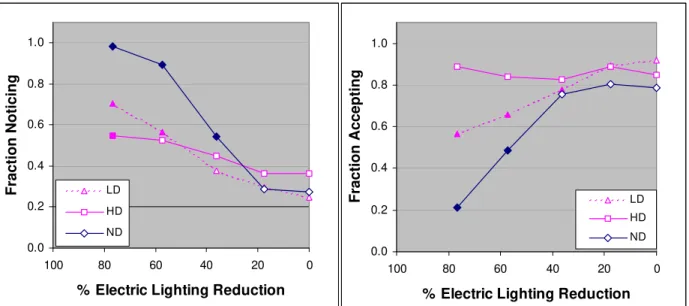
participant performed a computer-based proofreading task. The participants indicated whether they had noticed the change in lighting, and whether the lighting conditions were acceptable. This was repeated over multiple trials, with dimming from 0 to 80 %, and with or without daylight. The level of dimming not noticed by occupants was 20 % with no daylight, 40 % with relatively low prevailing daylight, and 60 % with high
prevailing daylight. The level of dimming that resulted in conditions that were still acceptable was 40 % with no or low daylight, and 80 % with high prevailing daylight (see Figure 1).
We then conducted a field study to explore demand-responsive dimming in real buildings with commercial lighting control systems. The field study incorporated an open-plan office building with 330 recessed dimmable luminaires with 4100K T8
fluorescent lamps, and a college campus with 2300 recessed dimmable luminaires with 3500K T5 fluorescent lamps across several buildings. In the office building we
conducted two afternoon load shed trials, which dimmed lights by up to 35 % over 15-30 minutes. The power reduction achieved was just over 5 kW (23 %, see Figure 2). At the campus site, we conducted three afternoon load shed trials, which dimmed lights by up to 20 % over 1-30 minutes. The power reduction achieved was 7.7-15.2 kW
(14-18%). The demand response potential at the campus was reduced by widespread use of wall switches/dimmers, occupancy sensors and photosensors, such that many luminaires were already off or dimmed when the load shed was scheduled. At both sites, there were no lighting-related complaints during the trials.
Suggested Guidelines
From these studies, one can begin to develop guidelines for demand-responsive dimming that could be included in recommended practice documents or standards for office lighting, and referenced in utility demand response programs. We propose that the principal basis of these guidelines be the results of the second laboratory
experiment. The data on the fraction of people noticing a change in electric lighting over 10 seconds without daylight present, and the fraction accepting such a change, may be used to define two stages of demand response. The data from trials with daylight can then be used to modify these definitions. Further modification with regard to the effect of longer dimming times and not having an expectation of dimming
occurring is provided by the first laboratory experiment. The field study gives
confidence that such strategies will work in real buildings. The fundamental assumption in these guidelines is that, prior to demand response dimming, the electric lighting in the space conformed with typical recommended practice.
• Stage 1, dimming by amounts that are not noticed by the large majority of occupants:
o Rapid response, over as little as 10 seconds, by … 20 % with no daylight
40 % with low1
prevailing daylight 60 % with high prevailing daylight
o Slow response, over 30 minutes or more, and no immediate expectation of dimming occurring, by …
30 % with no daylight
60 % with high prevailing daylight2
• Stage 2, when more dimming is required (e.g. a period of higher grid stress), dimming by amounts that may be noticed by many, but are still acceptable to the large majority of occupants:
o Rapid response, over as little as 10 seconds, by … 40 % with no or low daylight
80% with high prevailing daylight
o Slow response, over 30 minutes or more, and no immediate expectation of dimming occurring, by …
50 % with no daylight
80 % with high prevailing daylight
1
Defined in this study as <1343 lux on the desktop due to daylight at mid-afternoon 2
We did not explicitly test a slow dim rate/daylight combination, so this is a conservative choice identical to the rapid response recommendation.
We emphasize that such demand-responsive dimming is intended to prevail for a few hours at the most, and that light levels should be returned to normal levels thereafter. Demand-responsive dimming should only be enacted to alleviate temporary electricity supply problems that occur infrequently. However, these lower light levels should not become the “new normal”, applied routinely every day as an energy efficiency measure. There is plenty of evidence to suggest that the light levels in current recommended practice are appropriate to ensure long-term occupant satisfaction.
It is clear that dimming lighting can make a substantial contribution to the reduction of peak power demand in office buildings. However, dimming systems are still relatively rare in existing office buildings, and the main barrier to market penetration is first cost. The results of this study add to the value proposition for centrally-controlled dimming systems, beyond the value already offered by task tuning, personal dimming control, daylight harvesting, and associated building cooling savings. Utilities and other bodies that wish to incent dimming systems should take the value of demand response into account when designing incentive programs.
Suggested Future Research
Although dimmable fluorescent lighting systems were used in the studies described here, other dimmable systems such as high-intensity discharge (HID) lamps with electronic ballasts and light-emitting diodes (LEDs) with electronic drivers may offer similar promise in future demand response programs. Future research studies could address the perception of changes in illuminance in spaces with these systems, leading to further useful recommendations for utilities and their customers.
Additional Reading
The design of our second experiment was heavily influenced by prior work on detection of temporal changes in light level conducted at the Lighting Research Center. For example, see:
Akashi Y.; Neches J. 2005. Potential recommendations for illuminance reductions by load shedding. Lighting Research & Technology, 37(2), 133-153. The Demand Response Research Center (http://drrc.lbl.gov/), led by Lawrence Berkeley National Laboratory, is a great source of information on demand response. Although the focus of their work to date has been on HVAC systems, they’ve done some useful work on lighting as well. For example, see:
Rubinstein, F.; Kiliccote, S. 2007. Demand Responsive Lighting: A Scoping Study. LBNL/DRRC Report LBNL-62226. URL: http://drrc.lbl.gov/pubs/62226.pdf (last access: 2007-08-15).
Detailed publications on our demand response studies can be found at:
Acknowledgements
This research was sponsored by the National Research Council Canada (NRC), the Program on Energy Research & Development (administered by Natural Resources Canada), by Public Works & Government Services Canada (PWGSC), and by the Lighting Research Office of the Electric Power Research Institute (EPRI) with the support of the J.H. McClung Lighting Research Foundation. With regard to our field study, we are indebted to Georgian College, Lutron Electronics Co. Inc., e-Lumen International Inc., Canada Revenue Agency, SNC - Lavalin ProFac Inc., Encelium Technologies Inc., and PWGSC.
0.0 0.2 0.4 0.6 0.8 1.0 0 20 40 60 80 100
% Electric Lighting Reduction Fraction Noticing LD HD ND 0.0 0.2 0.4 0.6 0.8 1.0 0 20 40 60 80 100
% Electric Lighting Reduction Fraction Accepting LD
HD ND
Figure 1. Mean fraction of occasions that a change in lighting was noticed (left) or acceptable (right), by size of reduction from baseline, and amount of prevailing daylight. ND=non-daylit; LD=below median prevailing daylight; HD=above median prevailing daylight. Open symbols indicate fractions that did not differ significantly from the no-change case (0% reduction) for that daylight condition, whereas closed symbols indicate a significant difference.
Figure 2. Total power drawn by the lighting system in the office building study zones, and two example interior illuminance measurements, for one load shed trial enacted between 13:05 and 15:20. 0 100 200 300 400 500 600 700 800 900 1000 6:00 7:00 8:00 9:00 10:00 11:00 12:00 13:00 14:00 15:00 16:00 17:00 Time Illuminance, lux 0 5,000 10,000 15,000 20,000 25,000 Lighting Power, W Logger 110, 1st floor Logger 120, 2nd floor Power Draw 5.2 kW (23%)