arXiv:0901.0151v1 [hep-ex] 31 Dec 2008
Search for anomalous top quark couplings with the D0 detector
V.M. Abazov36 , B. Abbott75 , M. Abolins65 , B.S. Acharya29 , M. Adams51 , T. Adams49 , E. Aguilo6 , M. Ahsan59, G.D. Alexeev36, G. Alkhazov40, A. Alton64,a, G. Alverson63, G.A. Alves2, M. Anastasoaie35,
L.S. Ancu35 , T. Andeen53 , B. Andrieu17 , M.S. Anzelc53 , M. Aoki50 , Y. Arnoud14 , M. Arov60 , M. Arthaud18 , A. Askew49,b, B. ˚Asman41, A.C.S. Assis Jesus3, O. Atramentov49, C. Avila8, J. BackusMayes82, F. Badaud13,
L. Bagby50, B. Baldin50, D.V. Bandurin59, P. Banerjee29, S. Banerjee29, E. Barberis63, A.-F. Barfuss15,
P. Bargassa80 , P. Baringer58 , J. Barreto2 , J.F. Bartlett50 , U. Bassler18 , D. Bauer43 , S. Beale6 , A. Bean58 , M. Begalli3, M. Begel73, C. Belanger-Champagne41, L. Bellantoni50, A. Bellavance50, J.A. Benitez65, S.B. Beri27,
G. Bernardi17 , R. Bernhard23 , I. Bertram42 , M. Besan¸con18 , R. Beuselinck43 , V.A. Bezzubov39 , P.C. Bhat50 , V. Bhatnagar27, G. Blazey52, F. Blekman43, S. Blessing49, K. Bloom67, A. Boehnlein50, D. Boline62, T.A. Bolton59,
E.E. Boos38, G. Borissov42, T. Bose77, A. Brandt78, R. Brock65, G. Brooijmans70, A. Bross50, D. Brown19,
X.B. Bu7, N.J. Buchanan49, D. Buchholz53, M. Buehler81, V. Buescher22, V. Bunichev38, S. Burdin42,c,
T.H. Burnett82, C.P. Buszello43, P. Calfayan25, B. Calpas15, S. Calvet16, J. Cammin71, M.A. Carrasco-Lizarraga33,
E. Carrera49, W. Carvalho3, B.C.K. Casey50, H. Castilla-Valdez33, S. Chakrabarti72, D. Chakraborty52,
K.M. Chan55, A. Chandra48, E. Cheu45, D.K. Cho62, S. Choi32, B. Choudhary28, L. Christofek77, T. Christoudias43,
S. Cihangir50 , D. Claes67 , J. Clutter58 , M. Cooke50 , W.E. Cooper50 , M. Corcoran80 , F. Couderc18 , M.-C. Cousinou15, S. Cr´ep´e-Renaudin14, V. Cuplov59, D. Cutts77, M. ´Cwiok30, H. da Motta2, A. Das45,
G. Davies43 , K. De78 , S.J. de Jong35 , E. De La Cruz-Burelo33 , C. De Oliveira Martins3 , K. DeVaughan67 , F. D´eliot18, M. Demarteau50, R. Demina71, D. Denisov50, S.P. Denisov39, S. Desai50, H.T. Diehl50, M. Diesburg50,
A. Dominguez67, T. Dorland82, A. Dubey28, L.V. Dudko38, L. Duflot16, S.R. Dugad29, D. Duggan49, A. Duperrin15,
S. Dutt27 , J. Dyer65 , A. Dyshkant52 , M. Eads67 , D. Edmunds65 , J. Ellison48 , V.D. Elvira50 , Y. Enari77 , S. Eno61 , P. Ermolov38,‡, M. Escalier15, H. Evans54, A. Evdokimov73, V.N. Evdokimov39, A.V. Ferapontov59, T. Ferbel61,71,
F. Fiedler24 , F. Filthaut35 , W. Fisher50 , H.E. Fisk50 , M. Fortner52 , H. Fox42 , S. Fu50 , S. Fuess50 , T. Gadfort70 , C.F. Galea35, C. Garcia71, A. Garcia-Bellido71, V. Gavrilov37, P. Gay13, W. Geist19, W. Geng15,65, C.E. Gerber51,
Y. Gershtein49,b, D. Gillberg6, G. Ginther71, B. G´omez8, A. Goussiou82, P.D. Grannis72, H. Greenlee50,
Z.D. Greenwood60, E.M. Gregores4, G. Grenier20, Ph. Gris13, J.-F. Grivaz16, A. Grohsjean25, S. Gr¨unendahl50,
M.W. Gr¨unewald30, F. Guo72, J. Guo72, G. Gutierrez50, P. Gutierrez75, A. Haas70, N.J. Hadley61, P. Haefner25,
S. Hagopian49 , J. Haley68 , I. Hall65 , R.E. Hall47 , L. Han7 , K. Harder44 , A. Harel71 , J.M. Hauptman57 , J. Hays43 , T. Hebbeker21, D. Hedin52, J.G. Hegeman34, A.P. Heinson48, U. Heintz62, C. Hensel22,d, K. Herner72, G. Hesketh63,
M.D. Hildreth55 , R. Hirosky81 , T. Hoang49 , J.D. Hobbs72 , B. Hoeneisen12 , M. Hohlfeld22 , S. Hossain75 , P. Houben34 , Y. Hu72, Z. Hubacek10, N. Huske17, V. Hynek9, I. Iashvili69, R. Illingworth50, A.S. Ito50, S. Jabeen62, M. Jaffr´e16,
S. Jain75 , K. Jakobs23 , C. Jarvis61 , R. Jesik43 , K. Johns45 , C. Johnson70 , M. Johnson50 , D. Johnston67 , A. Jonckheere50, P. Jonsson43, A. Juste50, E. Kajfasz15, D. Karmanov38, P.A. Kasper50, I. Katsanos70,
V. Kaushik78, R. Kehoe79, S. Kermiche15, N. Khalatyan50, A. Khanov76, A. Kharchilava69, Y.N. Kharzheev36,
D. Khatidze70 , T.J. Kim31 , M.H. Kirby53 , M. Kirsch21 , B. Klima50 , J.M. Kohli27 , J.-P. Konrath23 , A.V. Kozelov39 , J. Kraus65, T. Kuhl24, A. Kumar69, A. Kupco11, T. Kurˇca20, V.A. Kuzmin38, J. Kvita9, F. Lacroix13, D. Lam55,
S. Lammers70 , G. Landsberg77 , P. Lebrun20 , W.M. Lee50 , A. Leflat38 , J. Lellouch17 , J. Li78,‡, L. Li48 , Q.Z. Li50 , S.M. Lietti5, J.K. Lim31, J.G.R. Lima52, D. Lincoln50, J. Linnemann65, V.V. Lipaev39, R. Lipton50, Y. Liu7, Z. Liu6,
A. Lobodenko40, M. Lokajicek11, P. Love42, H.J. Lubatti82, R. Luna-Garcia33,e, A.L. Lyon50, A.K.A. Maciel2,
D. Mackin80, R.J. Madaras46, P. M¨attig26, A. Magerkurth64, P.K. Mal82, H.B. Malbouisson3, S. Malik67,
V.L. Malyshev36, Y. Maravin59, B. Martin14, R. McCarthy72, M.M. Meijer35, A. Melnitchouk66, L. Mendoza8,
P.G. Mercadante5 , M. Merkin38 , K.W. Merritt50 , A. Meyer21 , J. Meyer22,d, J. Mitrevski70 , R.K. Mommsen44 , N.K. Mondal29, R.W. Moore6, T. Moulik58, G.S. Muanza15, M. Mulhearn70, O. Mundal22, L. Mundim3, E. Nagy15,
M. Naimuddin50 , M. Narain77 , H.A. Neal64 , J.P. Negret8 , P. Neustroev40 , H. Nilsen23 , H. Nogima3 , S.F. Novaes5 , T. Nunnemann25, D.C. O’Neil6, G. Obrant40, C. Ochando16, D. Onoprienko59, N. Oshima50, N. Osman43, J. Osta55,
R. Otec10, G.J. Otero y Garz´on1, M. Owen44, M. Padilla48, P. Padley80, M. Pangilinan77, N. Parashar56,
S.-J. Park22,d, S.K. Park31 , J. Parsons70 , R. Partridge77 , N. Parua54 , A. Patwa73 , G. Pawloski80 , B. Penning23 , M. Perfilov38, K. Peters44, Y. Peters26, P. P´etroff16, M. Petteni43, R. Piegaia1, J. Piper65, M.-A. Pleier22,
P.L.M. Podesta-Lerma33,f, V.M. Podstavkov50 , Y. Pogorelov55 , M.-E. Pol2 , P. Polozov37 , B.G. Pope65 ,
A.V. Popov39, C. Potter6, W.L. Prado da Silva3, H.B. Prosper49, S. Protopopescu73, J. Qian64, A. Quadt22,d,
B. Quinn66, A. Rakitine42, M.S. Rangel2, K. Ranjan28, P.N. Ratoff42, P. Renkel79, P. Rich44, M. Rijssenbeek72,
I. Ripp-Baudot19 , F. Rizatdinova76 , S. Robinson43 , R.F. Rodrigues3 , M. Rominsky75 , C. Royon18 , P. Rubinov50 , R. Ruchti55, G. Safronov37, G. Sajot14, A. S´anchez-Hern´andez33, M.P. Sanders17, B. Sanghi50, G. Savage50,
L. Sawyer60 , T. Scanlon43 , D. Schaile25 , R.D. Schamberger72 , Y. Scheglov40 , H. Schellman53 , T. Schliephake26 , S. Schlobohm82, C. Schwanenberger44, R. Schwienhorst65, J. Sekaric49, H. Severini75, E. Shabalina51, M. Shamim59,
V. Shary18, A.A. Shchukin39, R.K. Shivpuri28, V. Siccardi19, V. Simak10, V. Sirotenko50, P. Skubic75, P. Slattery71,
D. Smirnov55 , G.R. Snow67 , J. Snow74 , S. Snyder73 , S. S¨oldner-Rembold44 , L. Sonnenschein17 , A. Sopczak42 , M. Sosebee78, K. Soustruznik9, B. Spurlock78, J. Stark14, V. Stolin37, D.A. Stoyanova39, J. Strandberg64,
S. Strandberg41 , M.A. Strang69 , E. Strauss72 , M. Strauss75 , R. Str¨ohmer25 , D. Strom53 , L. Stutte50 , S. Sumowidagdo49, P. Svoisky35, A. Sznajder3, A. Tanasijczuk1, W. Taylor6, B. Tiller25, F. Tissandier13,
M. Titov18 , V.V. Tokmenin36 , I. Torchiani23 , D. Tsybychev72 , B. Tuchming18 , C. Tully68 , P.M. Tuts70 , R. Unalan65 , L. Uvarov40, S. Uvarov40, S. Uzunyan52, B. Vachon6, P.J. van den Berg34, R. Van Kooten54, W.M. van Leeuwen34,
N. Varelas51, E.W. Varnes45, I.A. Vasilyev39, P. Verdier20, L.S. Vertogradov36, M. Verzocchi50, D. Vilanova18,
F. Villeneuve-Seguier43, P. Vint43, P. Vokac10, M. Voutilainen67,g, R. Wagner68, H.D. Wahl49, M.H.L.S. Wang50,
J. Warchol55, G. Watts82, M. Wayne55, G. Weber24, M. Weber50,h, L. Welty-Rieger54, A. Wenger23,i, N. Wermes22,
M. Wetstein61 , A. White78 , D. Wicke26 , M.R.J. Williams42 , G.W. Wilson58 , S.J. Wimpenny48 , M. Wobisch60 , D.R. Wood63, T.R. Wyatt44, Y. Xie77, C. Xu64, S. Yacoob53, R. Yamada50, W.-C. Yang44, T. Yasuda50,
Y.A. Yatsunenko36 , Z. Ye50 , H. Yin7 , K. Yip73 , H.D. Yoo77 , S.W. Youn53 , J. Yu78 , C. Zeitnitz26 , S. Zelitch81 , T. Zhao82, B. Zhou64, J. Zhu72, M. Zielinski71, D. Zieminska54, L. Zivkovic70, V. Zutshi52, and E.G. Zverev38
(The DØ Collaboration) 1
Universidad de Buenos Aires, Buenos Aires, Argentina 2
LAFEX, Centro Brasileiro de Pesquisas F´ısicas, Rio de Janeiro, Brazil 3Universidade do Estado do Rio de Janeiro, Rio de Janeiro, Brazil
4
Universidade Federal do ABC, Santo Andr´e, Brazil 5
Instituto de F´ısica Te´orica, Universidade Estadual Paulista, S˜ao Paulo, Brazil 6
University of Alberta, Edmonton, Alberta, Canada, Simon Fraser University, Burnaby, British Columbia, Canada, York University, Toronto, Ontario, Canada, and McGill University, Montreal, Quebec, Canada
7University of Science and Technology of China, Hefei, People’s Republic of China 8
Universidad de los Andes, Bogot´a, Colombia 9
Center for Particle Physics, Charles University, Prague, Czech Republic 10Czech Technical University, Prague, Czech Republic
11
Center for Particle Physics, Institute of Physics,
Academy of Sciences of the Czech Republic, Prague, Czech Republic 12
Universidad San Francisco de Quito, Quito, Ecuador 13
LPC, Universit´e Blaise Pascal, CNRS/IN2P3, Clermont, France 14
LPSC, Universit´e Joseph Fourier Grenoble 1, CNRS/IN2P3, Institut National Polytechnique de Grenoble, Grenoble, France 15CPPM, Aix-Marseille Universit´e, CNRS/IN2P3, Marseille, France
16
LAL, Universit´e Paris-Sud, IN2P3/CNRS, Orsay, France 17
LPNHE, IN2P3/CNRS, Universit´es Paris VI and VII, Paris, France 18CEA, Irfu, SPP, Saclay, France
19
IPHC, Universit´e Louis Pasteur, CNRS/IN2P3, Strasbourg, France 20
IPNL, Universit´e Lyon 1, CNRS/IN2P3, Villeurbanne, France and Universit´e de Lyon, Lyon, France 21III. Physikalisches Institut A, RWTH Aachen University, Aachen, Germany
22
Physikalisches Institut, Universit¨at Bonn, Bonn, Germany 23
Physikalisches Institut, Universit¨at Freiburg, Freiburg, Germany 24Institut f¨ur Physik, Universit¨at Mainz, Mainz, Germany 25
Ludwig-Maximilians-Universit¨at M¨unchen, M¨unchen, Germany 26
Fachbereich Physik, University of Wuppertal, Wuppertal, Germany 27Panjab University, Chandigarh, India
28Delhi University, Delhi, India 29
Tata Institute of Fundamental Research, Mumbai, India 30
University College Dublin, Dublin, Ireland
31Korea Detector Laboratory, Korea University, Seoul, Korea 32
33
CINVESTAV, Mexico City, Mexico 34
FOM-Institute NIKHEF and University of Amsterdam/NIKHEF, Amsterdam, The Netherlands 35Radboud University Nijmegen/NIKHEF, Nijmegen, The Netherlands
36
Joint Institute for Nuclear Research, Dubna, Russia 37
Institute for Theoretical and Experimental Physics, Moscow, Russia 38Moscow State University, Moscow, Russia
39
Institute for High Energy Physics, Protvino, Russia 40
Petersburg Nuclear Physics Institute, St. Petersburg, Russia
41Lund University, Lund, Sweden, Royal Institute of Technology and Stockholm University, Stockholm, Sweden, and Uppsala University, Uppsala, Sweden
42
Lancaster University, Lancaster, United Kingdom 43
Imperial College, London, United Kingdom 44University of Manchester, Manchester, United Kingdom
45
University of Arizona, Tucson, Arizona 85721, USA 46
Lawrence Berkeley National Laboratory and University of California, Berkeley, California 94720, USA 47California State University, Fresno, California 93740, USA
48
University of California, Riverside, California 92521, USA 49
Florida State University, Tallahassee, Florida 32306, USA 50Fermi National Accelerator Laboratory, Batavia, Illinois 60510, USA
51
University of Illinois at Chicago, Chicago, Illinois 60607, USA 52
Northern Illinois University, DeKalb, Illinois 60115, USA 53
Northwestern University, Evanston, Illinois 60208, USA 54
Indiana University, Bloomington, Indiana 47405, USA 55
University of Notre Dame, Notre Dame, Indiana 46556, USA 56
Purdue University Calumet, Hammond, Indiana 46323, USA 57Iowa State University, Ames, Iowa 50011, USA 58
University of Kansas, Lawrence, Kansas 66045, USA 59
Kansas State University, Manhattan, Kansas 66506, USA 60Louisiana Tech University, Ruston, Louisiana 71272, USA 61
University of Maryland, College Park, Maryland 20742, USA 62
Boston University, Boston, Massachusetts 02215, USA 63Northeastern University, Boston, Massachusetts 02115, USA
64
University of Michigan, Ann Arbor, Michigan 48109, USA 65
Michigan State University, East Lansing, Michigan 48824, USA 66University of Mississippi, University, Mississippi 38677, USA
67
University of Nebraska, Lincoln, Nebraska 68588, USA 68
Princeton University, Princeton, New Jersey 08544, USA 69State University of New York, Buffalo, New York 14260, USA
70Columbia University, New York, New York 10027, USA 71
University of Rochester, Rochester, New York 14627, USA 72
State University of New York, Stony Brook, New York 11794, USA 73Brookhaven National Laboratory, Upton, New York 11973, USA
74
Langston University, Langston, Oklahoma 73050, USA 75
University of Oklahoma, Norman, Oklahoma 73019, USA 76Oklahoma State University, Stillwater, Oklahoma 74078, USA
77
Brown University, Providence, Rhode Island 02912, USA 78
University of Texas, Arlington, Texas 76019, USA 79Southern Methodist University, Dallas, Texas 75275, USA
80Rice University, Houston, Texas 77005, USA 81
University of Virginia, Charlottesville, Virginia 22901, USA and 82
University of Washington, Seattle, Washington 98195, USA (Dated: December 31, 2008)
Anomalous W tb couplings modify the angular correlations of the top quark decay products and change the single top quark production cross section. We present limits on anomalous top quark couplings by combining information from W boson helicity measurements in top quark decays and anomalous coupling searches in the single top quark final state. We set limits on right-handed vector couplings as well as left-handed and right-handed tensor couplings based on about 1 fb−1 of data collected by the D0 experiment.
PACS numbers: 14.65.Ha; 12.15.Ji; 13.85.Qk
coupling to the Higgs boson of all SM fermions. This makes the top quark and its interactions an ideal place to look for new physics related to electroweak symmetry breaking. The coupling between the top quark and the weak gauge bosons may be altered by physics beyond the SM. In particular the coupling between the top quark and the W boson determines most of the top quark phenomenology and can be sensitively probed at hadron colliders [1]. The effective Lagrangian describing the W tb interaction including operators up to dimension five is [2]:
L = −√g 2¯bγ µV tb(f1LPL+ f1RPR)tWµ− − √g 2¯b iσµνq νVtb MW (f2LPL+ f2RPR)tWµ−+ h.c. , (1)
where MW is the mass of the W boson, qν is its
four-momentum, Vtbis the Cabibbo-Kobayashi-Maskawa
matrix element [3], and PL= (1−γ5)/2 (PR= (1+γ5)/2)
is the left-handed (right-handed) projection operator. In the SM, the W tb coupling is purely left-handed, and the values of the coupling form factors are fL
1 ≈
1, fL
2 = f1R= f2R= 0. We assume real coupling form
factors, implying CP conservation, and a spin-1 2 top
quark which decays predominantly to W b. Indirect constraints on the magnitude of the right-handed vector coupling and tensor couplings exist from measurements of the b → sγ branching fraction [4]. While those limits are tighter than the direct limits presented here, they also include assumptions that are not required here, for example the absence of other sources of new physics coupling to the b quark.
We search for non-SM values of the couplings using ≈ 1 fb−1 of data collected by the D0 experiment [5]
at the Fermilab Tevatron p¯p collider between 2002 and 2006 (Run II). Variations in the coupling form factors would mainly manifest themselves in two distinct ways at D0: by changing the rate and kinematic distri-butions of electroweak single top quark production, and by altering the fractions of W bosons from top quark decays produced in each of the three possible helicity states. In this Letter, we combine information from our measurement of the W boson helicity fractions in t¯t events [6] with information from single top quark production. We have previously set direct limits on anomalous top quark coupling form factors based solely on the single top quark final state [7]. Here we set substantially tighter limits on the effective top quark couplings using the general framework given in Ref. [8]. This is the first such combination of all applicable D0 Run II top quark measurements to limit anomalous top quark coupling form factors.
We follow the approach adopted in Ref. [7] and investigate one pair of coupling form factors at a time out of the full set of form factors (fL
1, f1R, f2L, and
fR
2 . For each pair under investigation we assume that
the other two have the SM values. We consider three
cases, pairing the left-handed vector coupling form factor fL
1 with each of the other three form factors. We refer
to these as (L1, R1), (L1, L2), and (L1, R2). For each
pair of form factors a likelihood distribution is extracted from the W helicity measurement of the decay angle distribution in top quark decays. All top quark pair events with decays to at least one lepton (electron or muon) are included in the W helicity measurement. This likelihood is then combined with the result of the anomalous couplings search in the single top quark final state in a Bayesian statistical analysis, yielding a two-dimensional posterior probability density as a function of both form factors. We extract limits on fR
1, f2L, and
fR
2 by projecting the two-dimensional posterior onto the
corresponding form factor axis.
The W boson helicity measurement, described in Ref. [6], uses events in both the ℓ+jets (t¯t → W+W−b¯b → ℓνq¯q′b¯b) and dilepton (t¯t → W+W−b¯b →
ℓνℓ′ν′b¯b) final states. The measurement variable is θ∗,
the angle between the down-type fermion and top quark momenta in the W boson rest frame. To evaluate this variable, we assign a momentum to the neutrino(s) either via a constrained kinematic fit (in the ℓ+jets channel) or an algebraic solution (in the dilepton channel).
We use the alpgen leading-order Monte Carlo (MC) event generator [9], interfaced to pythia [10], to model t¯t events as well as W +jets and Z+jets background events. We generate both SM V − A and V + A W tb couplings, and reweight events to model a given W boson helicity state. We use the CTEQ6L1 parton distribution functions [11] and set the top quark mass to 172.5 GeV. The response of the D0 detector to the MC events is simulated using geant [12]. We model the background from multijet production where a jet is misidentified as an isolated electron or muon using events from data containing lepton candidates which pass all of the lepton identification requirements except one but otherwise resemble the signal events. We use MC to model other small backgrounds (diboson and single top quark production).
We select events with a multivariate likelihood discriminant that uses both kinematic and b-lifetime information to distinguish t¯t events from background and obtain a sample of 288 ℓ+jets (75 dilepton) events with an expected background contribution of 54 ± 7 (17 ± 4) events.
A binned maximum likelihood fit compares the cos θ∗
distribution of the selected events to the expectations for each W boson helicity state plus background. We vary both the longitudinal and right-handed helicity fractions f0 and f+ in the fit and find the relative likelihood
of any set of helicity fractions being consistent with the data. In the previous W helicity publication, we expressed the likelihood in terms of the helicity fractions and used a prior that was flat in f0 and f+[6]. Here, we
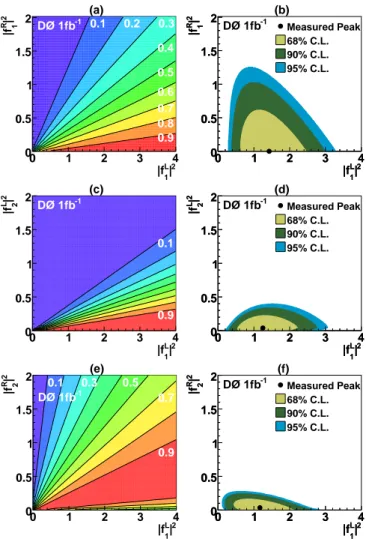
anomalous W tb coupling form factors squared using the relationships given in Ref. [8]. The resulting likelihood distributions are shown in the left column of Fig. 1. They show that the W helicity measurement only constrains ratios of the coupling form factors.
We can constrain both the ratios and the magnitudes of the form factors in the single top analysis. The dominant modes for single top quark production at the Tevatron are the s-channel production and decay of a virtual W boson and the t-channel exchange of a W boson. Evidence for production of single top quarks has been reported by the D0 and CDF collaborations [13, 14]. Both the cross section and the angular correlations of the final state objects are modified in the presence of anomalous couplings. The total cross section for SM single top quark production at a top quark mass of 172.5 GeV is predicted to be 3.15 ± 0.3 pb [15]. For this analysis, we assume that single top quarks are produced exclusively through W boson exchange and that the W tb vertex dominates top quark production and decay.
We look for single top quark production in events with one lepton [electron (pT > 15 GeV) or muon (pT >
18 GeV)] and 6ET > 15 GeV. We select a sample that
is statistically independent of the W helicity analysis by asking for two or three jets with pT > 15 GeV, of
which one should have pT > 25 GeV. We also require
at least one of the jets to be identified as originating from a b hadron by a b-tagging algorithm. Details of the selection criteria and background modeling are given in Ref. [13].
We model the single top quark signal using the comphep-singletop MC event generator [16] where anomalous W tb couplings are considered in both the production and decay of the top quark. The background modeling for the single top analysis utilizes the same samples as the W helicity analysis for W +jets and multijet backgrounds. The t¯t background in the single top quark sample is small and is modeled by simulated SM t¯t events. It is normalized to the theoretical cross section [17].
The selection efficiencies for single top quark signals with different W tb couplings are approximately (1–2)% for events with one b tag and less than 1% for events with two b tags. We select 1152 events, which we expect to contain 56 ± 12 SM single top quark events. We use boosted decision trees [18, 19] to extract single top quark events from the large background.
Systematic uncertainties in the signal and background models are described in detail in Refs. [6] and [13]. We take all systematic uncertainties and their correlations into account. Systematic uncertainties in the W boson helicity measurement arise from finite MC statistics and uncertainties on the top quark mass, jet energy calibration, and MC models of signal and background. Variations in these parameters can change the measurement in two ways: by altering the estimate
of the background in the final sample (i.e., if the final selection efficiency changes) and by modifying the shape of the cosθ⋆ templates. Systematic uncertainties in the
single top analysis arise from the W +jets normalization, the W +jets flavor composition estimate, and the top quark pair background modeling.
Most of the systematic uncertainties are taken to be 100% correlated between the two analyses. Systematic uncertainties that affect only the W helicity analysis are MC statistics and MC background model. Systematic uncertainties arising from the luminosity measurement affect only the single top analysis.
We use a Bayesian statistical analysis [20] to combine the W helicity result with the single top anomalous coupling result. The likelihood result from the W helicity analysis is used as a prior to the single top anomalous coupling analysis.
For any pair of values of the two coupling form factors under consideration, we compare the boosted decision tree output for the data with the sum of backgrounds and the two signals. In the scenario where fL
1 and f2Lare
non-zero, the two amplitudes interfere, which we take into account by using a superposition of three signal samples: one with only left-handed vector couplings; one with only left-handed tensor couplings; and one with both coupling form factors set to one, containing the interference term. We then compute a likelihood as a product over all separate analysis channels. We assume Poisson distri-butions for the observed counts and use multivariate Gaussian distributions to model the uncertainties on the combined signal acceptance and background yields, including correlations. The uncertainties are evaluated through MC integration. We generate an ensemble of 5000 samples, each with a different shift in the various systematic uncertainties, and compute the Bayesian posterior for each sample. The final posterior is then the ensemble average of all individual posteriors.
The two-dimensional posterior probability density is computed as a function of |fL
1| 2
and |fX|2, where fX is
fR
1, f2L, or f2R. These probability distributions are shown
in Fig. 1. In all three scenarios we measure approximately zero for the anomalous coupling form factors and favor the left-handed vector hypothesis over the alternative hypothesis. We compute 95% Confidence Level (C.L.) upper limits on these form factors by integrating out the left-handed vector coupling form factor to get a one-dimensional posterior probability density. The measured values are given in Table I.
In comparison, the limits at 95% C.L. without the W helicity constraints are |fR
1 | 2 < 1.83, |fL 2| 2< 0.52, and |fR 2|
2< 0.24. The kinematic distributions of the fL 1 and
fR
1 single top quark samples are similar enough that the
single top anomalous coupling analysis in this scenario is mainly sensitive to the total cross section. Hence, the W helicity analysis improves the |fR
1|
2limit significantly.
right-tensor coupling limit where most of the sensitivity is provided by the single top anomalous coupling analysis.
2 | 1 L |f 0 1 2 3 4 2| 1 R |f 0 0.5 1 1.5 2 0.1 0.2 0.3 0.4 0.5 0.6 0.7 0.8 0.9 -1 DØ 1fb (a) 2 | 1 L |f 0 1 2 3 4 2| 1 R |f 0 0.5 1 1.5 2 Measured Peak 68% C.L. 90% C.L. 95% C.L. 2 | 1 L |f 0 1 2 3 4 2| 1 R |f 0 0.5 1 1.5 2 -1 DØ 1fb (b) 2 | 1 L |f 0 1 2 3 4 2| 2 L |f 0 0.5 1 1.5 2 0.1 0.9 -1 DØ 1fb (c) 2 | 1 L |f 0 1 2 3 4 2| 2 L |f 0 0.5 1 1.5 2 Measured Peak 68% C.L. 90% C.L. 95% C.L. 2 | 1 L |f 0 1 2 3 4 2| 2 L |f 0 0.5 1 1.5 2 -1 DØ 1fb (d) 2 | 1 L |f 0 1 2 3 4 2| 2 R |f 0 0.5 1 1.5 2 0.1 0.3 0.5 0.7 0.9 -1 DØ 1fb (e) 2 | 1 L |f 0 1 2 3 4 2| 2 R |f 0 0.5 1 1.5 2 Measured Peak 68% C.L. 90% C.L. 95% C.L. 2 | 1 L |f 0 1 2 3 4 2| 2 R |f 0 0.5 1 1.5 2 -1 DØ 1fb (f)
FIG. 1: W helicity prior (a, c, e) and final posterior density (b, d, f) for right- vs left-handed vector coupling (a and b), left-handed tensor vs left-handed vector coupling (c and d), and right-handed tensor vs left-handed vector coupling (e and f). The W helicity prior is normalized to a peak value of one and shown as equally spaced contours between zero and one. The posterior density is shown as contours of equal probability density.
In summary, we have presented the first study of W tb couplings that combines W helicity measurements in top quark decay with anomalous couplings searches in the single top quark final state, thus using all applicable top quark measurements by D0. We find consistency with the SM and set 95% C.L. limits on anomalous W tb couplings. Our limits represent significant improvements over previous results, and rule out a right-handed top quark vector coupling form factor of magnitude one for the first time.
We thank the staffs at Fermilab and collaborating institutions, and acknowledge support from the DOE and NSF (USA); CEA and CNRS/IN2P3 (France); FASI, Rosatom and RFBR (Russia); CNPq, FAPERJ, FAPESP and FUNDUNESP (Brazil); DAE and DST
TABLE I: Measured values with uncertainties and upper limits at the 95% C.L. for W tb couplings in three different scenarios.
Scenario Coupling Coupling limit if fL 1 = 1 (L1, R1) |f L 1| 2= 1.27+0.57 −0.48 |fR 1 | 2 <0.95 |fR 1 | 2 <1.01 (L1, L2) |f L 1| 2= 1.27+0.60 −0.48 |fL 2| 2 <0.32 |fL 2| 2 <0.28 (L1, R2) |f L 1| 2 = 1.04+0.55 −0.49 |fR 2 | 2 <0.23 |fR 2 | 2 <0.23
(India); Colciencias (Colombia); CONACyT (Mexico); KRF and KOSEF (Korea); CONICET and UBACyT (Argentina); FOM (The Netherlands); STFC (United Kingdom); MSMT and GACR (Czech Republic); CRC Program, CFI, NSERC and WestGrid Project (Canada); BMBF and DFG (Germany); SFI (Ireland); The Swedish Research Council (Sweden); CAS and CNSF (China); and the Alexander von Humboldt Foundation (Germany).
[a] Visitor from Augustana College, Sioux Falls, SD, USA. [b] Visitor from Rutgers University, Piscataway, NJ, USA. [c] Visitor from The University of Liverpool, Liverpool, UK. [d] Visitor from II. Physikalisches Institut,
Georg-August-University, G¨ottingen, Germany.
[e] Visitor from Centro de Investigacion en Computacion -IPN, Mexico City, Mexico.
[f] Visitor from ECFM, Universidad Autonoma de Sinaloa, Culiac´an, Mexico.
[g] Visitor from Helsinki Institute of Physics, Helsinki, Finland.
[h] Visitor from Universit¨at Bern, Bern, Switzerland. [i] Visitor from Universit¨at Z¨urich, Z¨urich, Switzerland. [‡] Deceased.
[1] T. Tait and C.-P. Yuan, Phys. Rev. D 63, 14018 (2001). [2] G.L. Kane, G.A. Ladinsky, and C.-P. Yuan, Phys. Rev.
D 45, 124 (1992).
[3] N. Cabibbo, Phys. Rev. Lett. 10, 531 (1963); M. Kobayashi and T. Maskawa, Prog. Theor. Phys. 49, 652 (1973).
[4] F. Larios, M.A. Perez, and C.-P. Yuan, Phys. Lett. B 457, 334 (1999); G. Burdman, M.C. Gonzales-Garcia, and S.F. Novaes, Phys. Rev. D 61, 114016 (2000), and references therein.
[5] V.M. Abazov et al. (D0 Collaboration), Nucl. Instrum. Methods A 565, 463 (2006).
[6] V.M. Abazov et al. (D0 Collaboration), Phys. Rev. Lett. 100, 062004 (2008).
[7] V.M. Abazov et al. (D0 Collaboration), Phys. Rev. Lett. 101, 221801 (2008).
[8] C.R. Chen, F. Larios, and C. P. Yuan, Phys. Lett. B 631, 126 (2005).
[9] M.L. Mangano et al., JHEP 07, 001 (2003). We used alpgenversion 2.05.
[10] T. Sj¨ostrand et al., arXiv:hep-ph/0308153 (2003). We used pythia version 6.323.
[11] J. Pumplin et al., JHEP 07, 012 (2002); D. Stump et al., JHEP 10, 046 (2003).
[12] R. Brun and F. Carminati, CERN Program Library Long Writeup W5013, 1993 (unpublished).
[13] V.M. Abazov et al. (D0 Collaboration), Phys. Rev. Lett. 98, 181802 (2007); V.M. Abazov et al. (D0 Collabo-ration), Phys. Rev. D 78, 12005 (2008).
[14] T. Aaltonen et al. (CDF Collaboration), Phys. Rev. Lett. 101, 252001 (2008).
[15] Z. Sullivan, Phys. Rev. D 70, 114012 (2004).
[16] E. Boos et al., Phys. Atom. Nucl. 69, 1317 (2006); E. Boos et al. (CompHEP Collaboration), Nucl. Instrum.
Methods Phys. Res. A 534, 250 (2004).
[17] N. Kidonakis and R. Vogt, Phys. Rev. D 68, 114014 (2003).
[18] L. Breiman et al., Classification and Regression Trees (Wadsworth, Stamford, 1984).
[19] Y. Freund and R.E. Schapire, in Machine Learning: Proceedings of the Thirteenth International Conference, edited by L. Saitta (Morgan Kaufmann, San Fransisco, 1996) p. 148.