Adapting an Object-Oriented Database for
Disconnected Operation
by
Sidney H. Chang
S.B., Computer Science and Engineering
Massachusetts Institute of Technology (2000)
Submitted to the Department of Electrical Engineering and Computer
Science
in partial fulfillment of the requirements for the degree of
Master of Engineering in Electrical Engineering and Computer Science
at the
MASSACHUSETTS INSTITUTE OF TECHNOLOGY
May 2001
@
Sidney H. Chang, MMI. All rights reserved.
The author hereby grants to MIT permission to reproduce and
BARKER
distribute publicly paper and electronic copies of this thesis
t
in whole or in part. OFTECHNOLOGY
JUL 1 1 2001
LIBRARIES
A uthor ... ...
Department of Electrical Engineering and C mputer
ence
May 23,_ 2001
C ertified by ...
Dorothy Curtis
Research Staff, MIT Laboratory for Computer Science
Th9Wi Sip'ervisor
Accepted by ... .
...
Arthur C. Smith
Chairman, Department Committee on Graduate Students
Adapting an Object-Oriented Database for Disconnected
Operation
by
Sidney H. Chang
Submitted to the Department of Electrical Engineering and Computer Science on May 23, 2001, in partial fulfillment of the
requirements for the degree of
Master of Engineering in Electrical Engineering and Computer Science
Abstract
Wireless computers are often only intermittently connected to the network. Thus disconnected operation is an important aspect of wireless computing. Disconnected operation focuses on providing useful services to a mobile device even while discon-nected from the network. Further, if shared data is in use, discondiscon-nected operation must deal with the management of operations on shared data. If the user of a discon-nected device operates on shared data, the data must be cached before disconnection. Cached data must be reconciled with the original data once the device is reconnected to the network. Even worse, if two users have cached the same data and changed it while disconnected, this causes a conflict and some form of conflict resolution must be made in order to integrate these changes. In this thesis, the Thor object-oriented database system is extended to support disconnected operation. While many schemes have been devised to avoid conflict resolution or provide mechanisms to automati-cally resolve conflicts, the approach to conflict resolution taken here is to develop a framework to facilitate conflict resolution by the application. This study provides interesting information about how applications, such as a shared calendar, can be adapted to fit a disconnected transaction model of the system in order to achieve the proper semantics.
Thesis Supervisor: Dorothy Curtis
Acknowledgments
This thesis was made possible by the help of a variety of people right from its very beginnings back when we were reading papers just to find a thesis topic.
The most important person in making this thesis happen was my advisor, Dorothy. Thanks to Dorothy for being an advisor that I could always talk to and for all of her thoughtful guidance throughout the project.
I would also like to thank John, Liuba, and Steve for their help in developing my thesis topic early on. And also thanks to Liuba for helping out with the performance testing in the end.
Thanks to Yan and Chandra for not only helping me understand the intricacies of Thor but also for making it fun. Thanks to my officemates Nick and Peter who made the days in the office all that much shorter. And thanks to the rest of the members of the NMS group especially Bodhi for making lab an interesting place.
Finally, I'd like to thank Andrew for providing the support and motivation neces-sary for finishing this thesis and also for making the last year at MIT so memorable. And thanks to my parents who have always been there for me throughout my years at MIT.
Contents
1 Introduction 11
1.1 M otivation . . . . 11
1.2 Approach to Conflict Resolution in Thor . . . . 13
1.3 Thesis O utline . . . . 14
2 Background 15 2.1 Disconnected Operation . . . . 15
2.2 Approaches to Conflict Resolution . . . . 20
2.2.1 Conflict Avoidance . . . . 20 2.2.2 Conflict Resolution . . . . 22 2.2.3 Summary of Approaches . . . . 23 2.3 Thor Overview . . . . 23 2.3.1 Thor Architecture . . . . 24 2.3.2 Objects in Thor . . . . 25 2.3.3 FE Transaction Logging . . . . 26 2.3.4 Committing Transactions . . . . 27
2.3.5 Why Use Thor? . . . . 28
3 Design and Implementation 29 3.1 FE Support for Disconnected Operation . . . . 30
3.1.1 Preparing for Disconnect . . . . 30
3.1.2 Operating Disconnected . . . . 32
3.2 Application Support for Disconnected Operation . . . . 44
3.2.1 Preparing for Disconnect . . . . 44
3.2.2 Operating Disconnected . . . . 45
3.2.3 Reconnect . . . . 46
4 Evaluation 47 4.1 Sample Client Program: A Shared Calendar . . . . 47
4.2 Perform ance . . . . 51
5 Related Work 61
List of Figures
2-1 Thor Architecture . . . . 24
3-1 Tentative Transaction Log Example . . . . 34
3-2 Synchronizing Tentative Transaction Log . . . . 43
4-1 Shared Calendar Schema Designs . . . . 49
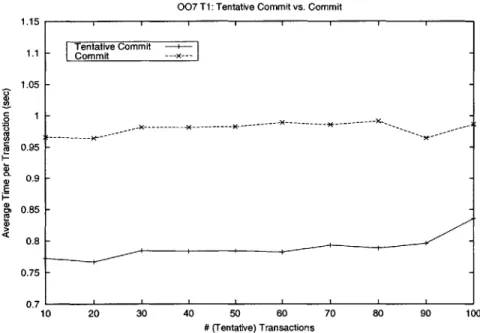
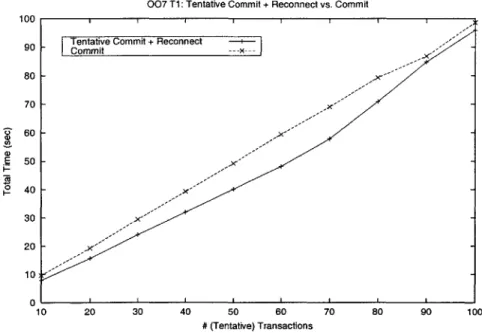
4-2 007 TI: Tentatively Committing While Disconnected Faster than C om m it . . . . 53
4-3 007 T1: No Overhead for Read-only Tentative Transactions . . . . . 55
4-4 007 T2a: Overhead for Oref Updating with No New Objects . . . . 55
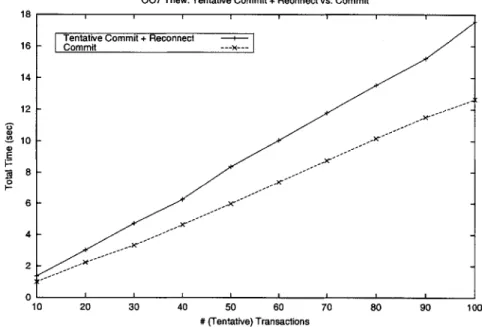
4-5 007 Tinsert: Overhead for Oref Updating with New Objects . . . . . 56
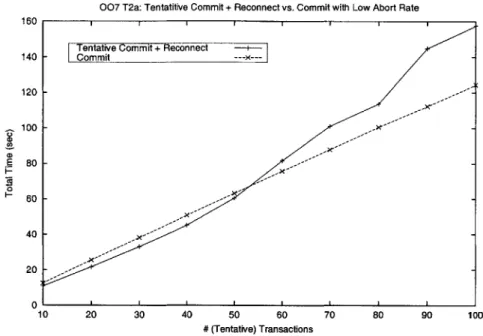
4-6 007 T2a: Overhead for Aborts with Low Contention (5% abort rate) 58 4-7 007 T2a: Overhead for Aborts with High Contention (20% abort rate) 58 4-8 007 T2a: Reconnect Time with Low and Moderate Contention . . . 59
List
of Tables
2.1 Issues in Disconnected Operation . . . . 16
Chapter 1
Introduction
1.1
Motivation
Mobile computing devices such as personal digital assistants, laptops, and cellular phones have become a common part of everyday life. Many of these mobile devices now have wireless capabilities that allow them to communicate with other computers over a wireless network. However, wireless computers will often only be intermittently connected to the network due to expensive wireless networks and concerns over power consumption. As a result, wireless devices must also support disconnected operation or the autonomous operation of a mobile device while disconnected from the network
[18].
Additional support is required for disconnected operation since even while discon-nected, a user may wish to perform operations that would normally require the usage of a network connection. In particular, mobile users may make use of applications that normally access corporate or private databases through a network connection. For example, a travelling salesman may wish to use his laptop to enter a customer's order into a database located in the main office while he is at the customer's site but does not have network access. Another example is a worker commuting to the office who would like to use his hand-held device to enter an appointment into his calendar which is stored in a central database at work.
and modifying data that is centrally stored and normally accessed via a network connection. The data in this central store can be accessed and shared by multiple users. A key issue for shared data in collaborative applications is, multiple users may be accessing and modifying the same data concurrently. Thus a user may read stale data or one user's updates may conflict with another user's updates to the same data. For example, in the case of the travelling salesman, one user may update a customer's record to reflect a recent sale while another user concurrently updates a customer's record to indicate that that customer no longer has a viable credit standing. In the case of the calendar user, the commuter may enter an appointment for himself while his assistant enters another appointment for him for the same time. From these examples it is clear that conflicts can arise for disconnected users who share data with other users but also that these conflicts are defined by application semantics and vary widely from one application to the next.
Concurrent access to shared data is often solved by employing transactions to achieve serializability of operations and consistency of data across multiple users. However, for disconnected operation, the transaction model is challenged since users of mobile devices will be more likely to read stale data when disconnected and update conflicts will be more frequent since periods of disconnection will allow that device's view of data to diverge from others. From a system's perspective, a solution to these problems means either preventing them from happening or providing support for resolving them if they do happen. To prevent stale reads and update conflicts from happening a system must guarantee that all users always read up-to-date copies of the data. This is often achieved with locking or pessimistic schemes where only one user may access a piece of data at a time. But for a mobile setting, this constraint is not acceptable. Requiring that a disconnected device possess a lock on the data in order to update the data either prevents other users from having that data available until the disconnected device reconnects and releases the lock or prevents the user of the disconnected device from performing operations while disconnected. Therefore a system that supports disconnected operation should allow for a non-locking or optimistic scheme that allows any data to be accessed. However, the result of an
optimistic scheme is that the system must then provide support for disconnected devices to resolve update conflicts since stale data may be read and concurrent updates may occur.
Providing support for resolving update conflicts faces a tradeoff between general support for a large set of applications and providing enough functionality for an application to satisfy its goals. Since as previously stated, conflicts are defined by application semantics, system support for conflict resolution is highly influenced by the application. If a system generalizes support for a large set of applications, it often ends up offloading much of the logic to the application. But if a system provides sup-port specific to a particular application it precludes other applications from using the system since another application may need completely different semantics to resolve its conflicts. The ideal solution is to find a balance in the system so that it provides a sufficient set of tools that are general enough to support a large set of applications but also allows applications to resolve their conflicts easily and without interfering with the consistency of the data in the system.
1.2
Approach to Conflict Resolution in Thor
This thesis describes an investigation of the problem of providing support for resolv-ing update conflicts within the context of disconnected operation on mobile devices. It includes the extension of an existing object-oriented database, Thor, to support disconnected operation and the usage of that system as a platform for examining how applications make use of the conflict resolution mechanism provided by the system. Similar to [9], this investigation attempts to extract a set of requirements for
collab-orative applications on mobile devices that use shared data and evaluate the support provided for meeting those requirements.
There are many possible ways for a system to provide some mechanism for manag-ing conflict resolution rangmanag-ing from application specified mechanisms to completely system automated resolution (see Section 2.2). We approach conflict resolution in Thor by defining conflicts independently of application semantics and solely as a
means of maintaining consistency of objects and leave conflict resolution up to the application. The rationale is that, the system's main job is to maintain the con-sistency of the data and it will always be the case that the user will be asked to manually repair some conflict since the system will not be able to handle all conflicts in all cases for all applications. Total elimination of conflicts is, by definition, an unattainable goal in an environment where concurrent updates to the same data are permitted [14]. In addition, this simple approach to conflict resolution will provide the framework necessary for investigating the needs of different applications in re-solving conflicts and for discovering what in addition to the minimum support given, can the system provide to help satisfy these needs.
By implementing disconnected operation in Thor, this thesis aims to provide both
consistency of shared data and flexibility in conflict resolution for a wide variety of applications.
1.3
Thesis Outline
The remainder of this thesis is organized as follows. Section 2 provides background on issues in disconnected operation (including previous work in conflict resolution mechanisms) and an overview of Thor. Section 3 will discuss the design and imple-mentation of the extension to Thor to support disconnected clients. In Section 4, we discuss an evaluation of the system using a sample application and performance tests with object-oriented database (OODB) benchmarks. Section 5 compares this work with some related works and finally, Section 6 concludes with a summary of the thesis and suggestions for future work.
Chapter 2
Background
In this section we present an overview of the issues in supporting disconnected
oper-ation. Then we focus on the issue of synchronizing data upon reconnection and how previous systems have provided support for conflict resolution. This is followed by an overview of the system in which this work is implemented, the Thor object-oriented database system.
2.1
Disconnected Operation
For a system to support disconnected operation there are generally three phases to consider: preparing for disconnection, operating disconnected, and reconnection. Associated with each phase is a set of issues and each issue has a corresponding set of possible approaches. Table 2.1 is derived from Petoura's summary of system-level support for disconnected operation in [18]. It summarizes the phases in disconnected operation and the issues and approaches associated with each.
To prepare for disconnection, the main issue is the prefetching of data into the mobile device since the repository from which the data is normally retrieved will no longer be accessible. Depending on the system, this repository could be a database
server, file system server, another mobile device, etc. And depending on the source
from which data is fetched and the rest of the system's architecture, the unit of prefetch will change - it could be objects, files, pages of data, operations, etc. What
Table 2.1: Phases associated with disconnected operation and their corresponding issues and possible approaches.
and when to prefetch is a design decision which impacts the control of the user over prefetching.
What to prefetch can be based solely on a user's history of usage, application specifications, direct user input, or a combination of some or all of these. A user's history of usage can be used in a similar fashion to standard caching mechanisms for data with temporal locality. Usage of history information can be organized on a per application basis or on a total set of operations. For example, in a database system, an application may have a history of accesses to a particular set of data associated with that application and data associated with that application can be prefetched. On the other hand in a file system, the system can track overall usage of files regardless of which application actually accessed the files and prefetch frequently accessed files over all applications. To achieve spatial locality, application or user input may be necessary in order to prefetch objects that are likely to be accessed together. For example, in a calendar application, the system may be able to tell that a certain set of events are of interest to a user by a history of accesses but only the
Issue Approach
Prepare for Disconnection Prefetch unit Depends on the system
What to prefetch User specified
Based on history of operations Application specified When to prefetch Prior to disconnection
On a periodic basis Operating Disconnected Request for data not prefetched Raise an exception
Queue for future service
What to log Data values
Operations Timestamps When to optimize the log Incrementally
Prior to reconnection How to optimize the log Depends on the system
Reconnection How to integrate log Replay log
How to resolve conflicts Use application semantics System automatically resolves User specified
application would be able to tell that since events from one user's calendar are being accessed, all of the data associated with that user's calendar should be prefetched (not just the recently accessed events). Other considerations in prefetching data include information that can not be collected without direct user input such as what applications the user intends to use while disconnected. Yet another consideration is whether or not certain data will be used concurrently by other users. In certain cases it may be better for a mobile device to not prefetch data that may be used concurrently in order to avoid having to resolve conflicts upon reconnection.
When to prefetch data should complement the strategy for deciding what to prefetch. If data is prefetched in the background on a periodic basis it would not make sense to query the user for what to prefetch each time. It would be more suitable to have an application specify what to prefetch in a configuration file or base prefetching on a user's history of accesses. If data is prefetched just prior to disconnection, then it would be suitable to query the user at that point. Although configuration files and history of access information can also be used at that point, history information would likely fetch data that had been useful to the user only di-rectly prior to disconnection and may not have any relevance to what the user would like to use while disconnected.
While disconnected the main issues are what the user is permitted to do and logging. Since the user contains a local copy of the data while disconnected but the repository of data from which it retrieved its copy can still modify that data while the user is disconnected, the first question to deal with is whether or not the user can modify data that may potentially be modified by someone else. In an optimistic scheme, where users are allowed to modify shared data that may be concurrently accessed by other devices during the device's period of disconnection, some form of conflict resolution is required - this means that upon reconnection, certain operations made while disconnected may fail and these failures have to be handled. Since this project deals specifically with resolving update conflicts upon reconnection, the user is permitted to modify prefetched copies of data while disconnected. Other pessimistic schemes may be devised where a disconnected device will allow only reads of copies
of shared data and no writes or a disconnected device can be granted a lock on a piece of data so that only it will have the right to modify a piece of shared data (in which case the user can modify only shared data for which it has a lock while disconnected). The benefit of these last two schemes is that there will be no need to deal with conflicts upon reconnection. However, for the mobile computing setting, mobile users will want to be able to access data even while disconnected so availability through an optimistic scheme is granted at the price of having to handle conflicts on reconnection.
Another issue in operating disconnected is if a user attempts to access data that has not been cached. The system may either inform the user that the operation can not be processed at the time and abort that operation or the system can queue the operation to be processed upon reconnection. The user or application may also wish to have input into this process because it may be acceptable to abort an operation and continue with other operations in certain cases but may not be acceptable in other cases. For example, the travelling salesman can not proceed with a customer's order without verifying his credit record but a calendar user may be able to continue adding events to his calendar even if one event was not accessible.
To keep track of the operations that a user makes while disconnected, it is nec-essary to maintain a log. The log must keep track of the updates that users make while disconnected. The form in which these updates are recorded can be actual data values, operations, or timestamps. Storing operations gives greater context for the
modifications that occur while disconnected. This information can be very useful in resolving update conflicts that occur upon reconnection. Timestamps consume less space at the disconnected device but may also the cause reconnection process to take a longer amount of time. Storing data values will make restoring states easier if an abort should occur, but it will also consume more space on the disconnected device. The format in which data is stored in the log will also be highly dependent on the rest of the system.
Since the mobile device will have limited resources and quick reintegration of the log upon reconnection is desirable, optimizing the log in terms of when and how is
important. Optimization of the log will depend on the implementation of the log. The log can be optimized incrementally during the disconnect or can be done upon reconnection.
Upon reconnection, the main issues are processing the log and dealing with fail-ures. Processing the log consists of replaying the contents of the log. This process can have different semantics in different systems. The log can be guaranteed to replay in the same order in which it was filled or it can have looser semantics where dependent operations will be in order and others can can be out of order.
The process of replaying the log is often called reintegration or synchronization of the disconnected device's local data with another repository of data. The difficulty that arises is, if in the process of synchronizing the data, a concurrent update to some data in the log has occurred. The problem of synchronizing data between a mobile device and a stationary host is not new. Palm pilot devices are well-known examples of mobile devices that synchronize their data with a desktop computer. However, this work differs from the Palm pilot model because with the Palm pilot the user is synchronizing data only between his own copies of the data meaning that he is the only one really modifying the data. This work investigates support for collaborative applications where multiple users will often access the same data concurrently.
As stated in section 1.1, a common way to handle concurrent accesses to shared data is to use transactions to achieve serializability and consistency of operations on data. Traditional properties of transactions are: atomicity, consistency, isolation, and durability (ACID). These properties need to be redefined, i.e. relaxed, in order to provide transactions in mobile computing. A new transaction model is needed since transactions can no longer commit or abort at the ending boundary without connectivity. There can be scenarios in which a mobile device is granted "ownership" of a piece of data and so it can use normal transactions on that data, however this would prevent other users from being able to access that data. Various transaction models for mobile computing have been studied in [17, 8, 16]. Each is similar in that weak, tentative, or second-class transactions are defined for transactions made on data local to a mobile device while disconnected. They are considered as such
until the device reconnects with the repository of data and synchronizes its tentative transactions to become persistent or permanent transactions.
To deal with conflicts or aborts that occur upon reconnection, there can be several approaches. The systems can automatically try to resolve conflicts. This may be possible for systems where the semantics are simple but for systems where a variety of applications with different semantics can be making use of the system, it may be too difficult for the system to automatically resolve the conflicts in some reasonable manner for every application. Another way to resolve the conflicts is to consult the user upon a failure. However, this may be cumbersome for the user and would require giving the user enough context in order to understand why a failure occurred in order to have an idea of how to resolve it. Conflict resolution can also be left up to the application since it is best aware of its own semantics. However, this can also become difficult for the application programmer. A combination of system, application, and user support can be used to resolve conflicts. The main question is then what is the basic support that a system should provide to the application in resolving conflicts? The next section describes the approach to conflict resolution in several different projects.
2.2
Approaches to Conflict Resolution
Conflict resolution can be approached in different ways. One is to simply avoid it by providing mechanisms for an application to give "hints" to the system for allowing certain concurrent actions or relaxing the ACID semantics of a transaction. Another way is to provide a mechanism for an application to write type-specific procedures for resolving conflicts with a last resort of consulting the user when the resolution
procedure fails.
2.2.1
Conflict Avoidance
Avoiding conflicts means allowing concurrent accesses to data to occur in a manner that still results in serializable and consistent results. One common way to allow for
concurrency is to make use of commutativity properties of data resulting in a more dynamic atomicity [22]. Commutativity is a property of operations on specific types of objects that allows operations to be reordered and arbitrarily interleaved. Consider, for example, an object that is an integer and it has an increment operation. If two concurrent increments occur their ordering does not matter since either ordering of the increments will still result in the same final integer value. Other more advanced means of allowing concurrency include escrow based techniques, recoverability, and fragmenting objects.
Transaction escrow methods [11] are based on a quantity such as the the total number of items in stock, which is normally locked for the duration of a transaction that reads and modifies the quantity. For example, the transaction could include placing an order and decrementing the number of items in stock. Instead of placing the lock on the quantity for the duration of a long-term transaction, the quantity is locked for only a short time to update an escrow log which has the quantity's state after a number of uncommitted transactions. So, in the course of deciding whether or not to complete an operation, the object's current state and also the state in the escrow log is used to make a worst-case decision (worst-case is if all of the uncommitted operations commit). This has the benefit that locks are much shorter and concurrent accesses will not have to wait long for a lock.
Recoverability [2] provides more concurrency than commutativity. An operation
b is recoverable with respect to operation a if the results are the same regardless
of whether or not operation a executes before b. For example, a stack push is not commutable yet it is recoverable. So two noncommutative but recoverable pushes could be allowed to execute concurrently, however if both should commit, they would still need to be in a serializable order but if one should fail, the other can still commit since they are recoverable.
Fragmenting of objects [21] is where objects are broken up among disconnected devices so that a disconnected device can operate autonomously on a fragment of an object. Fragmentable objects require that application semantics can be exploited in order to define split and merge operations that describe how an object can be split
into fragments and then how fragments can be merged back into a single consistent copy. Objects that are fragmentable are often aggregate objects such as stacks, sets, or queues.
2.2.2
Conflict Resolution
Rather than try to accommodate concurrency, other systems have tried to accommo-date the resolution of conflicts after they have occurred. These mechanisms are built into the system and allow for an application to define their resolution procedures based on application semantics. Examples of such systems are Coda, Bayou, and Rover [13, 6, 12].
Coda is specifically designed for file systems. It uses an optimistic concurrency control scheme meaning that any client can update its copy of a piece of data. Coda automatically resolves concurrent updates to directories and also has a mechanism for transparent resolution of file conflicts called application-specific resolvers [14]. While the application-specific resolver works in some cases, in cases where it fails, the user will have to resort to interactive repair.
Bayou also uses an optimistic concurrency control scheme and, rather than sup-porting transactions, propagates updates by pairwise anti-entropy sessions [7]. Bayou
is different from other shared data management systems that support disconnected operation because it caters to the application and has many provisions for letting the application specify as much information as possible to help the system deter-mine how to deal with update conflicts automatically [20]. It has provisions such as dependency checks and merge procs. These can be assigned per object type and are invoked on each update. The dependency check allows the application to specify what integrity constraints must be maintained in the database by an update while the merge proc attempts to handle a failure of the dependency check. However, like the application-specific resolvers in Coda, Bayou's merge procs can also fail in which
case the application or user will be consulted for manual repair.
Rover is very different from Coda or Bayou. It essentially provides a framework for queued remote procedure calls between a disconnected client and a central server.
Client applications cache objects from the servers and queue operations made on those objects while disconnected [12]. Rover provides clients with facilities for con-flict detection and resolution, however unlike Coda or Bayou, the system itself has no notion of problems arising from concurrent updates to the same object. The ap-plication must specify what a conflict is, even in the case of two clients updating the same object. However, Rover's model of passing operations rather than only new data values, allows an application to have the context of a failure and also allows an application to make use of commutativity of objects.
2.2.3
Summary of Approaches
Clearly there are many different mechanisms for conflict prevention and resolution. However, prevention mechanisms work only for specific cases and making use of such mechanisms can be hard. For example, escrow methods are appropriate only for nu-meric values and defining split and merge operations for fragmentable objects may not be immediately obvious for more complex data types. In addition, resolution mechanisms in systems such as Coda, Bayou, and Rover will not be able to handle all conflicts and the user will be asked to manually repair some conflict for some appli-cation. Therefore the rest of this thesis will describe the design and implementation of a system that leaves conflict resolution completely up to the application. By in-vestigating applications using this system we attempt to find basic requirements for system support for conflict resolution for disconnected devices.
2.3
Thor Overview
This study of conflict resolution for disconnected devices makes use of the Thor dis-tributed object-oriented database system. This section gives an overview of the Thor architecture and how applications interact with the system to achieve transactional semantics.
2.3.1
Thor Architecture
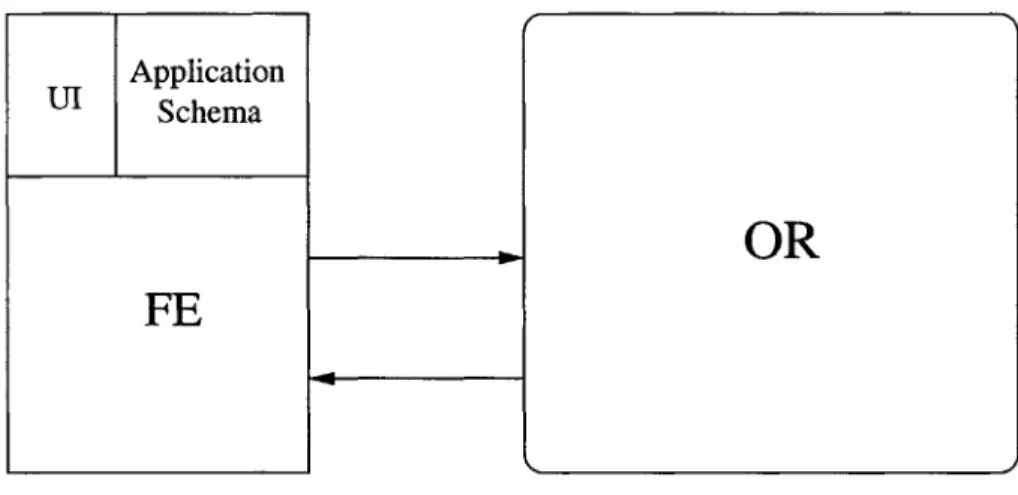
Thor provides a persistent store of objects where each object has a unique identity, set of methods, and state. The system has a client/server architecture servers are repositories of persistent objects. The OR consists of a root object where all persistent objects are reachable by the root object. The OR handles validation of transactions across multiple clients by using an optimistic concurrency control scheme described in [1]. Clients in Thor are made up of a front end (FE), application schema, and user interface. The FE handles caching of objects from the OR and runtime transaction processing. Applications operate on cached objects at the FE inside transactions boundaries and request to commit transactions through the FE at the OR. Figure 2-1 shows the organization of the FE, application schema, user interface, and the OR. All communication between the client and server is between the FE and OR. All
Application Schema
OR
FE
Figure 2-1: Thor has a client/server architecture. The client is made up of the front end (FE), application schema or object definitions, and a user interface. The server is the object repository (OR).
communication between the clients and servers in Thor is between FE's and OR's. The communication is limited to a set of specific messages. Table 2.2 lists the types of messages passed between the FE and OR. The FE will send the OR a root fetch message on startup of the client in order to get a handle on the root of the repository of objects. All other objects in the repository are reachable via this root. During
the course of a transaction the FE may request objects by making fetch requests to the OR. At the end of a transaction the FE can send a commit request to the OR. In addition the FE can also request the OR for the allocation of space for newly created objects. The OR can send to the FE invalidation messages when other FE's have committed changes to objects in the repository. The FE must respond to these messages by invalidating stale objects indicated in the invalidation message.
Table 2.2: Messages sent between the FE and OR are limited to the above. The
FE initiates root object requests, object fetches, transaction commits, and allocation
requests for new objects. The OR initiates invalidation messages.
2.3.2
Objects in Thor
Thor OR's store objects on disk in pages. FE's cache entire pages of objects and pages will remain identical to those at the OR unless a page is compacted at the
FE to free up cache space. A method of hybrid adaptive caching or HAC is used to
compact hot or frequently accessed objects into a page while discarding cold or less frequently accessed objects [5].
Each object is uniquely identified by an identifier known as an oref. An orefs is a 32-bit identifier that uniquely identifies an object. It is also used to locate an object within pages at the OR and FE. 22 bits of the oref are a pid or page id which identifies the object's page and 9 bits of the oref are an oid or object id which identifies an object within a page but does not encode its location. Instead oid's are mapped to
Messages Sent
FE > OR OR - FE
- get root - send root
- fetch object - send data
- commit request - commit reply
- invalidation ack - invalidation
offsets within the page in an offset table stored with each page. This allows for easy movement of objects within a page.
At the OR's objects are known only by their orefs. However, not all objects at the FE are persistent. Objects at the FE are categorized as either persistent or non-persistent. Persistent objects are objects that the OR's are aware of and that are reachable from the persistent root object. Non-persistent objects are objects that are newly created by an application that have not yet been committed at the OR or objects that are temporarily used by the application but do not need to persist across different runs of an application. Persistent objects at the FE are stored in the persistent cache which caches whole pages from the OR. An object in the persistent cache can be reached at the FE via its oref. Non-persistent objects, by contrast, are stored in the volatile heap and do not have orefs until they are committed and assigned oref's by the OR.
For a program to access an object at the FE in the persistent cache, orefs must be mapped to local memory. To speed up this lookup process, objects at the FE are swizzled so that oref's become pointers into the ROT or Resident Object Table. The ROT has handles to persistent objects so that when a reference is made to an object, rather than use its oref, a ROT entry is used to locate an object. The HAC scheme mentioned above uses the ROT to keep track of accesses to objects and also handles cleaning up unused references in the ROT [5]. In addition the ROT is used to maintain handles on non-persistent objects since they do not have orefs. Note that this means that non-persistent objects can not be removed from the ROT until they have been made persistent or there are no references to them. However, persistent objects may be removed from the ROT if their pages are being removed from the cache as long as there are no references to them.
2.3.3
FE Transaction Logging
Transactions are logged as operations are made by an application within transaction boundaries. This logging is used to determine which objects were read, written, and created within a transaction. All transaction logging is done at the FE as applications
operate on objects. Every time an object is read, written, or created it is logged so that the appropriate information is available for when the application requests a commit.
Applications make high level operations on objects as defined in the schema for the application. These high-level operations on objects are reduced to reads, writes, and creations of objects. Each of these is recorded by the FE in order to create the correct information to be sent to the OR in a commit request. While application operations are defined in the schema in Java, the schema are converted to C code which then includes extra code for each objects access that logs the access with the
FE.
2.3.4
Committing Transactions
An application can complete a transaction by making a request to the FE to commit the transaction. The FE processes this request by taking all of the logged information on what objects have been read, written, and modified and creating commit sets -the read object set (ROS), modified object set (MOS), and new object set (NOS). These sets are sent to the OR in the form of a commit request. The ROS and MOS will contain only persistent objects and the NOS will contain only those non-persistent objects created inside the transaction that are reachable from some persistent object. Therefore any object in the NOS must be also be referenced in the MOS of the same transaction. The ROS and MOS must have objects in their unswizzled form, i.e. they should only be identified by their orefs and not ROT entries since the OR understands only orefs. Before a NOS is sent to the OR it must contain orefs. The FE maintains some free pages for new orefs but in the event that there are no free orefs available, the OR is contacted to obtain new orefs.
To handle concurrency, an OR will validate a transaction based on whether or not that transaction contains invalidated objects for the FE from which the request came. The OR maintains per-FE a set of invalidated objects which are objects whose state is no longer valid since the time the FE cached them. Objects become invalidated when one FE successfully commits a transaction. Any objects modified by that transaction
will be invalidated for other FE's that have cached that object since they now have a stale copy of the object. FE's are notified of invalidations and must acknowledge them by invalidating the objects in the persistent cache so that if those objects are ever accessed by the application, their new state will be fetched from the OR.
The OR can either commit or abort the FE's commit request. If the transaction is aborted by the OR, the FE must then roll back any of the changes made by the application. This includes reverting the state of modified objects back to the original state prior to the transaction and removing any newly created objects from the volatile heap. If the transaction is committed by the OR, the FE will move any newly created objects from the volatile heap to the persistent cache.
2.3.5
Why Use Thor?
After having described an overview of the Thor system, the question of why Thor was chosen for this work may arise. There are several reasons for using Thor:
" To achieve consistency in the presence of disconnected operation, it has been
stated that optimistic schemes are more desirable. Thor already provides an optimistic concurrency control scheme.
* To achieve flexibility in conflict resolution, Thor's object-oriented design may provide the flexibility necessary to support a variety of applications.
" A preliminary study of disconnected operation in Thor [10] suggested that
dis-connected operation would fall naturally into the design of Thor. However, this has not yet been substantiated by any implementation.
Chapter 3
Design and Implementation
In the previous chapter, Thor was introduced. However, it did not support discon-nected operation. In this section, the design and implementation of discondiscon-nected operation in Thor is described in detail.
A disconnected client in a database system is unable to communicate with a
server. Hence, the client can not fetch data, make requests to commit transactions, or receive updates (i.e. invalidations in Thor). To prepare for disconnection, the
client can retrieve data that might be useful to a user while disconnected from the server. During the period of disconnection from the server, the client saves enough
information per transaction in a log so that upon reconnection with the server, the server is able to commit or abort each saved transaction and the client is able to resolve aborts or conflicts that may arise. When the client reconnects with the server, it synchronizes its log of saved transactions with the server and updates the state of the cache to reflect the commit or abort of each logged transaction and any updates
received from the server.
The extension of Thor to support disconnected clients has two main aspects: ex-tensions to the application (user interface and the application schema) and exex-tensions to the FE (caching and per transaction processing). The reason for the division is that certain requirements for disconnected operation are heavily based on application semantics. For example, the objects that should be prefetched into a cache before disconnection depend on what operations a user will be likely to invoke while
discon-nected. Another example is the resolution of aborts upon reconnection with the OR. If a saved transaction is aborted after reconnection, the application semantics will dictate how the abort should be dealt with.
The following sections will first describe the design of FE support for disconnected clients that is independent from application semantics and then will describe the design of how application based support for disconnected clients should be organized in applications built on top of Thor (a specific example of an application will be discussed in 4.1).
3.1
FE Support for Disconnected Operation
FE support for disconnected operation can be divided into three phases. The first
is preparation for disconnection which deals mainly with prefetching of objects. The second is operating disconnected which handles a different transaction semantics for disconnected operation (as opposed to when the FE is connected). The third is reconnecting with the OR which includes the handling of pending transactions and the commits and aborts resulting from them.
3.1.1
Preparing for Disconnect
To prepare for disconnection from the OR, the FE will need to prefetch objects into the cache by processing queries specified by the application. No additional FE support is necessary for this since a prefetch query will look to the FE like any other fetch query. However, to the application the prefetch query will be very different than a fetch query since it may require user input or special purpose queries in the application schema. This will be discussed in section 3.2.1.
A desirable trait of a prefetch query is to not only have the requested object
fetched from the OR but also related objects. This is a feature that the FE could implement since the application specifies only a single object that it would like fetched and it is up to the front end to request any additional objects based on locality of objects in the cache. However, this is also already a feature of every normal fetch
since an application requests only a single specific object, but the fetch request to the OR will actually return an entire page of objects. This page will likely "have some locality within it and therefore other objects on the page are likely to be useful to the client" [15]. For the FE to provide a greater control over the locality of objects, it is possible for the FE to infer the locality of references made by the application prior to disconnect from usage information stored in the cache. Previous work has also been done on this in Thor with hybrid adaptive caching (HAC) techniques that store hot objects and discard cold ones based on frequency of access [5]. However, this only gives temporal locality information and requires that the FE has already collected such information based on the operation of the application. For spatial locality information, only the application can specify this information since it is aware of application schema and how objects reference one another in different operations. The usage of this information in prefetch queries will be discussed in section 3.2.1.
In addition to preparing the client for disconnection, the OR must also prepare for a client's disconnection. The OR must keep per-FE information in order to know which object invalidations a client has seen or not seen. Invalidations are used in order to ensure that the client has the correct versions of objects. It is important for the OR to have the correct set of invalidated objects per FE. For example, if the OR incorrectly thinks that an FE has already seen an invalidation message for a particular set of objects when in fact the FE has not, it may allow a transaction based on stale data to succeed. While this was not implemented for the system since the focus was on support for disconnected clients at the FE and application levels, possibilities for its design are discussed here.
There are two options for the OR to save state for an FE once it has disconnected. The FE can maintain a timestamp associated with the last information received from the OR. This gives the OR enough information to know the state of the objects the
FE last saw before disconnecting. The other option is to have the OR assign an id
to the FE before it disconnects and then maintain FE state while it is disconnected including a set of invalidated objects. But the FE may never reconnect so the OR will also have to time out after some finite amount of time and assume that the FE
will never reconnect after that point.
The first option is appealing since the OR does not need to maintain any state and does not have to impose a time limit in which the FE may reconnect. However reconnecting with the FE will take much longer since without an invalidated object set and only a timestamp, each object in the write set of a commit will have to be checked against the timestamp of the version of the object at the OR and the timestamp that the FE disconnected with. And then to prevent having to make this check for every transaction thereafter or until the FE has accessed each object at least once again, the entire FE cache must be flushed after emptying the queue of pending transactions. Alternatively, upon reconnection, the OR could recreate an invalidated object set for the FE based on the timestamp but this would require iterating through the entire object repository at every reconnect.
If we expect that the FE will reconnect often, then the second option is a more viable one since the time limit on reconnect can be set with the expectation that the
FE will reconnect within that time. Even though the OR will use memory to maintain
state for the FE while it is disconnected, it is likely FE's will be disconnecting and reconnecting often enough that it will not run out of memory.
A combination of the two options can be used to allow clients to specify whether
or not they will be reconnecting again soon in the future (where the definition of "'soon" is defined by the time limit imposed at the OR) or not. Then the appropriate method can be picked by the OR for saving the FE's connection state.
3.1.2
Operating Disconnected
Once the client has disconnected from the OR, an application will still attempt to commit transactions as it normally would while connected except the semantics of the transaction change. While disconnected, a commit becomes a tentative commit meaning that the commit could potentially be aborted by the OR upon reconnection.
The first question is then, what do the changed semantics of a commit mean for the state of objects at the FE cache? One option is to change the state of objects in the FE cache to reflect the modifications of a transaction as it is tentatively
com-mitted. Another option is to not change the state of the objects in the FE cache to reflect a tentative commit but rather save only the modified state in a log of modifi-cations. The first option follows naturally from the model taken by connected Thor since transactions in connected Thor will modify the cached objects and then revert the changes if the transaction should abort. It makes accessing objects during a transaction easier but makes handling aborts more difficult. The second option is on the other hand the opposite - it makes looking up objects during a transaction harder but makes handling aborts simpler. In the second option, each modified state of an object is saved in a log rather than directly modifying the version of the object in the cache. This makes aborts easy since nothing in the cache is modified. But during disconnection, the application will likely have more than one transaction. So in order to lookup the current state of an object, the FE can not simply look up the state of the object in the cache but must query the entire log of modifications made while disconnected to see if there is a more current version of the object. Therefore the first option is more viable since aborts are expected to be infrequent and since performance at the FE while disconnected should be comparable to when it is connected.
When an application commits during disconnection, a tentative commit is inter-preted by the FE as logging a tentative transaction in the tentative transaction log. This log saves enough state per transaction made during disconnection in order to replay each transaction once the FE is reconnected with the OR. The application will be given an id upon tentatively committing to identify an operation with a ten-tative commit which can later be used to aid in resolving an abort. The following sections will describe the details of the log and the state maintained for each tentative transaction.
Tentative Transaction Log
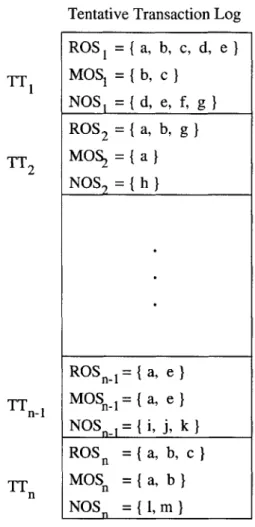
The log is a queue of tentative transactions. When an application makes a commit request, the FE will log a tentative transaction in the tentative transaction log that encapsulates all of the information necessary to process the commit at a later time. Each tentative transaction is numbered from 1 to n where n is the number of tentative
Tentative Transaction Log ROSI = { a, b, c, d, e } TTI MOS ={b, c} NOS1 = { d, e, f, g } ROS2 = { a, b, g } TT2 MOS2 = {a} NOS2 = { h } ROSn-1={ a, e} TT1 -1 M0S1 -1= { a, e } NOSn-1={ i, j, k } ROSn ={a, b, c} TT MOS ={a, b} n NOSn ={1, m}
Figure 3-1: Transactions committed while the client is disconnected are saved in a tentative transaction log. Each tentative transaction in the log consists of a read object set (ROS), modified object set (MOS), and new object set (NOS).
transactions in the log. Figure 3-1 depicts an example tentative transaction log with tentative transactions 1 through n labeled as TT to TT. Tentative transactions are logged in the order in which they are committed by the application so TT was the first transaction to be committed while disconnected and TT, was the last.
Tentative Transaction
The model used in connected Thor has the FE maintain a transaction log per action. This keeps track of objects read, modified, and created during the trans-action. When the application commits the transaction, during connected operation
this transaction log is directly translated to a commit request to the OR. But while disconnected, the transaction log is converted to a tentative transaction which is then saved in the tentative transaction log. A tentative transaction consists of commit sets
and the saved states of modified objects.
Commit sets are sets of object references and data to be sent to the OR in a commit request. There are three commit sets saved in a tentative transaction: the read set (read object set = ROS), write set (modified object set = MOS), and new
set (new object set = NOS). The definition of these sets is simple for a connected FE. The ROS is the set of orefs for persistent objects read by the transaction. The MOS is the set of orefs and new fields of persistent objects that were written by the
transaction and the NOS is the set of orefs and fields of new objects created by the transaction that are reachable by some persistent object.
The definitions of these commit sets change for tentative transactions. In a ten-tative transaction the ROS may consist of both persistent objects and objects that are tentatively persistent. An object is tentatively persistent if it was created by some previous tentative transaction in the log that was tentatively committed but not yet committed at the OR and is logged. This also applies to the MOS in a tentative transaction - it can have both persistent and tentatively persistent objects.
Objects are tentatively persistent since for a given tentative transaction, TT where 1 < k < n, ROSk may contain objects from NOS, where 1 < 1 < k. To
TTk the state of the objects at the FE cache should look as if TT had succeeded
and therefore any objects from NOS, should be considered persistent. But since the objects from NOS, have not actually been committed at the OR, they are considered tentatively persistent. This difference affects the logging of objects which is done on-the-fly as application code reads, modifies, or creates objects.
Figure 3-1, shows examples of ROS, MOS, and NOS sets for tentative transactions. In TT2, the object g is in ROS2 since it is tentatively persistent from TT1. Similarly
in TT,_1, both ROS._1 and MOS._ 1 contain object e which is tentatively persistent
from TIT1.
straightforward. When a newly created object is logged in the transaction log, it is not yet known whether that object is reachable by some persistent object. So the newly created objects logged in the transaction log may contain objects not reachable
by some persistent object. Since the NOS in a transaction is defined as the set of
orefs and fields of new objects created by the transaction that are reachable by some persistent object (or tentatively persistent) , the NOS can not simply be the same set of objects as the newly created objects in the transaction log. The reason for only saving objects reachable by some persistent or tentatively persistent object in the NOS is that it minimizes the space needed in the log and it also minimizes the number of objects sent to the OR in a commit request. If objects not reachable by any persistent object are committed at the OR, they would eventually be garbage collected at some future time. In addition, objects not reachable by a persistent ob-ject can be discarded at the FE to save space after a tentative commit as long as the application did not have any handle on them.
Therefore, when an application tentatively commits, it is necessary to create the
NOS for the tentative transaction by traversing the references of the MOS. By
it-erating through each of the objects in the MOS, references to newly created (or non-persistent) objects can be identified and placed into the NOS. In addition, the references of objects added to the NOS must also be traversed since they may also potentially have references to newly created objects. It is sufficient to only traverse the MOS to create the NOS since an object will be included in the NOS only if it is referenced by a persistent object. Since the objects were newly created, some persis-tent object must have been modified in order to reference the new object. Therefore an object will only be reachable from some persistent object if it is reachable by some reference in an object in the MOS.
Commit sets store objects using only orefs. An oref is an id for an object by which the OR refers to the object. It identifies an object including the page and segment in which it resides in the object store. An object may have references to other objects in its fields. These references can either be in the form of ROT entries (pointers to local memory as described in Section 2.3.2 or in the form of orefs. But commit sets
sent between the FE and OR must have objects with references only in the form of orefs since pointers to local memory will not make sense at the OR. The process of converting orefs to local memory pointers is known as swizzling and reversing the process is known as unswizzling [4]. In a tentative transaction, commit sets must have all of their references to objects unswizzled before they are sent to the OR since the OR will not understand local pointers from the FE.
Unswizzling of objects takes place when a transaction is tentatively committed and the tentative transaction is created from the transaction log. In order to store objects in the commit sets unswizzled, it is necessary to assign orefs to newly created objects since they are not yet known to the OR and do not yet have orefs. Unswiz-zling references is especially important in disconnected operation since unswizUnswiz-zling a reference allows for the entry in the ROT corresponding to that entry to be freed (by decreasing the references to that ROT entry to 0). Free entries in the ROT are needed for allocating new objects and the FE could potentially run out of free ROT entries if none are ever freed during disconnected operation. Freeing ROT entries occupied by references to persistent objects can help to prevent this. A downside to unswizzling references on a tentative commit is that it will slightly degrade performance of the next transaction if the next transaction accesses objects that were just unswizzled since those objects will then be swizzled again which does incur some overhead.
Alternatively, object references could be unswizzled right before the commit sets are sent to the OR during a reconnect. Then references would be stored as swizzled in the tentative transaction log. However this would cause potentially useful ROT entries to be occupied and also would make moving ROT entries hard.
As mentioned, the NOS set can not be directly created from the transaction log since only newly created objects reachable from a persistent object should be included in the NOS. This process can also be used as a point for unswizzling object references since all of the references are traversed at this point.
One complication of unswizzling references to objects is that since newly created objects are assigned temporary orefs, these temporary orefs must be used throughout the tentative transaction log. So for example, TT creates the object a, assigns it a