HAL Id: hal-01590816
https://hal.archives-ouvertes.fr/hal-01590816
Submitted on 20 Sep 2017
HAL is a multi-disciplinary open access
archive for the deposit and dissemination of
sci-entific research documents, whether they are
pub-lished or not. The documents may come from
teaching and research institutions in France or
abroad, or from public or private research centers.
L’archive ouverte pluridisciplinaire HAL, est
destinée au dépôt et à la diffusion de documents
scientifiques de niveau recherche, publiés ou non,
émanant des établissements d’enseignement et de
recherche français ou étrangers, des laboratoires
publics ou privés.
Flame chemiluminescence from CO2- and N2-diluted
laminar CH4 /air premixed flames
Thibault Guiberti, Daniel Durox, Thierry Schuller
To cite this version:
Thibault Guiberti, Daniel Durox, Thierry Schuller. Flame chemiluminescence from CO2- and
N2-diluted laminar CH4 /air premixed flames. Combustion and Flame, Elsevier, 2017, 181, pp.110-122.
�10.1016/j.combustflame.2017.01.032�. �hal-01590816�
Any correspondence concerning this service should be sent to the repository administrator:
[email protected]
To link to this article : DOI: 10.1016/j.combustflame.2017.01.032
URL :
http://dx.doi.org/10.1016/j.combustflame.2017.01.032
This is an author-deposited version published in:
http://oatao.univ-toulouse.fr/
Eprints ID: 18396
O
pen
A
rchive
T
oulouse
A
rchive
O
uverte (
OATAO
)
OATAO is an open access repository that collects the work of Toulouse
researchers and makes it freely available over the web where possible.
To cite this version: Guiberti, Thibault and Durox, Daniel and Schuller,
Thierry Flame chemiluminescence from CO2- and N2-diluted laminar
CH4 /air premixed flames. (2017) Combustion and Flame, vol. 181. pp.
Flame
chemiluminescence
from
CO
2
-
and
N
2
-diluted
laminar
CH
4
/air
premixed
flames
T.F.
Guiberti
a ,b ,∗,
D.
Durox
a,
T.
Schuller
a ,ca Laboratoire EM2C, CNRS, CentraleSupélec, Université Paris Saclay, Grande Voie des Vignes, 92290 Châtenay-Malabry, France
b King Abdullah University of Science and Technology (KAUST), Clean Combustion Research Center (CCRC), Thuwal, 23955-6900, Saudi Arabia c Institut de Mécanique des Fluides de Toulouse (IMFT), Université de Toulouse, CNRS, INPT, UPS, Toulouse, France
Keywords: Chemiluminescence Biogas Laminar flames Premixed flames
a
b
s
t
r
a
c
t
AnexperimentalandnumericalinvestigationofthechemiluminescencesignalsfromOH∗,CH∗,andCO 2∗ isconductedforlaminarpremixedconicalCH4/airflamesdilutedwithCO2 orN2.Experimentsare con-ductedeitheratfixedequivalenceratioorfixedadiabaticflametemperature.AnICCDcamera,equipped withdifferentnarrowbandpassfilters,isusedtorecordflameimagesat307nm(OH∗),430nm(CH∗), and455nm (CO2∗). AspectrometerisalsousedtocorrecttheOH∗and CH∗emissionsfromtheCO2∗ broadbandbackgroundemission.Measuredchemiluminescenceintensitiesarethencomparedtoone di-mensionalfreely-propagating-flamedirectsimulationsaccountingforthechemistryoftheexcited radi-cals.Simulationspredictaccuratelythe OH∗ chemiluminescenceintensity,independentlyofthediluent natureandconcentration.CorrectionfortheCO2∗backgroundhasaweakinfluenceontherecordedOH∗ signal.PredictionsofCH∗emissionsarealsoingoodagreementwithexperimentaldataiftheCO
2∗ back-groundintensityis subtracted fromintensitymeasurements.Measured and calculatedCO2∗ emissions leadtoacceptable resultsusingasimplifiedchemistrymechanismforCO2∗ andanheuristicmodelfor itsemissionintensity.Finally,itisshownthatCO2dilutionmodifieschemiluminescenceintensitycouples andparticularlytheOH∗/CO
2∗intensityratio.TheseratiosregularlydecreasewithCO2 dilution,afeature whichisreproducedbythesimulations.ItisthenshownthattheratioOH∗/CO
2∗iswellsuitedtoinfer theCO2diluentconcentrationindilutedCH4/airflames,amethodwhichappearsnotfeasibleforsensing N2inN2-dilutedCH4/airflames.
1. Introduction
In premixedhydrocarbonflames,the chemiluminescence from OH∗ and CH∗ excited radicals is generally intense. These
emis-sions have thus been extensively used to infer propertiesof the reacting flow such as the heat release rate [1–9] or equivalence ratio [6,10–20] , by examining the OH∗/CH∗ intensity ratio.
How-ever, the OH∗ and CH∗ emission intensities need generally to be
carefully corrected forthe broadband CO2∗ background emission
to achieve accuratemeasurements [6–8,18–22] .Additionally,most ofthedetailedchemistrymechanismscurrentlyusedinnumerical simulations donot account forexcited radicals chemistry dueto the additionalcomputationalcost associatedtothedescriptionof
∗ Corresponding author at: King Abdullah University of Science and Technology
(KAUST), Clean Combustion Research Center (CCRC), Thuwal, 23955-6900, Saudi Arabia.
E-mail addresses: [email protected] , [email protected]
(T.F. Guiberti).
theircomplexkinetics[12] .Simulationswithsimplifiedchemistry mechanisms are however often used to interpret chemilumines-cence measurements with crude approximationson the relation-shipbetweennon-excitedspeciesconcentrationscalculatedbythe solverandtheexcitedradicalspeciesemissionintensitiesthatare measured. Thereis thus a gapbetweenexperiments and simula-tionswithonlyalimitednumberofvalidationsofthe approxima-tionsmade.
In this context, efforts are made to understand and model thecomplexchemistryoftheformationandconsumption ofOH∗ [24–28] ,CH∗[25–27,29–31] ,andCO
2∗[1,21,22,32] excitedradicals.
Comparisons betweenmeasurements and simulations in laminar
[11,16,33] andturbulent[18–20,34] flames show that thedetailed mechanisms developed for the chemistry of these excited radi-cals yield goodresults for lean andrich CH4/air flames. In a
re-cent work, García-Armingol and Ballester [19] analyzed numeri-callyandexperimentally thechemiluminescence ofOH∗,CH∗,and
CO2∗ inpremixedturbulentswirlingflames ofCH4/CO2/H2/CO/air
spectra fromtheseflames in comparisonto CH4/air flames.They
conducted1-DFreely-Propagating-Flame(FPF)simulationsaswell as 0-D Perfectly-Stirred-Reactor (PSR) simulations to account for the changeofturbulentcombustion regimeandexamined effects of a large variety of mixtures and turbulent intensities. In this latter study, differences between measurements and simulations can beinterpreted byeitherimprecisions intheselecteddetailed chemistrymechanismsortheinadequacyofthemodelsused.
Anotherissue withturbulent flames is that the instantaneous flame surface area is generally not known. It is then difficult to compare, quantitatively, the measured chemiluminescence inten-sities to numerical results from 1-D FPF simulations, where the chemiluminescenceintensitiesarecomputedperunitofflame sur-facearea.Thisproblemcanhoweverbe circumventedby examin-ing chemiluminescence intensityratios betweendifferentcouples ofexcited radicals.Thismethodallowsremoving thecontribution oftheflamesurfacearea[11,14,16,18–20] .Inthiscase,species con-centrationscannothoweverbecompareddirectly.
For all these reasons, we decided to examine experimentally andnumericallythechemiluminescenceofOH∗,CH∗,andCO
2∗
ex-cited radicals in lean diluted methane/airpremixedconical lami-nar flames, a configuration where the flame surface area is well defined.Withpropercare,conicallaminarflamesarereadily com-parabletoadiabatic1-DFPFdirectsimulations.Nori and Seitzman [35] studiedeffectsofpreheat temperature,pressure,and aerody-namic strain on the CH∗ chemiluminescence to sense the
equiv-alence ratio of methane and Jet-A flames burning in air. In the present study, focus is made on effects of CO2 andN2 dilutions
inCH4fuelblendsonthechemiluminescenceofpremixedflames.
CO2 andN2 dilutedmethanefuelblends arerelevantfor
com-bustion applicationspoweredbybiogases,whichareproduced by methanization [36] . Biogases are classified as low heat value fu-elsandaremainlycomposedofCH4,CO2,andN2 invariable
pro-portions [37] .There isagrowing interest fortheserenewable re-sources [38,39] , which has led to applied research programs for adapting transport, heat, and power generation technologies to thesenewfuels[40–45] .
Analysis of the chemiluminescence properties of CH4/CO2/N2
fuel blends remain scarce. García-Armingol and Ballester
[19] found that the increase in CO2 content in CH4/CO2
mix-tures reduces the intensity level of the emission spectra in the near UV andvisible ranges, butit does not changethe shape of these spectra. They attributed this effect to the weak influence of CO2 on the chemistry of methane. Their simulations with an
extended version of the GRI 3.0 detailed chemistry mechanism
[46] reproduce well the evolution of the OH∗/CH∗ ratiofor
mix-tures with 25% and 50% (in volume) of CO2 in CH4/CO2 blends.
However, theydidnot consideremissionsfromCO2∗ andfocused
their work on sensing the equivalence ratio. Hossain and Naka-mura[9] studiednumericallytheinfluenceofN2andCO2dilution
onCH∗chemiluminescenceintensityinlaminarcounterflow
diffu-sion flames.They reporteda decreaseof the CH∗ intensitywhen
increasing the diluent concentration, but numerical results were not comparedto experiments.TheOH∗ andCO
2∗ excited radicals
werenotexaminedintheirstudy.
Thepresentstudyhastwomainobjectives.First,itisintended to determine the accuracy of a simplified chemistry mechanism yieldingtheOH∗,CH∗,andCO
2∗chemiluminescenceintensitiesfor
CO2-andN2-diluted lean CH4/airflames. The second objectiveis
toexaminetheevolutionoftheOH∗,CH∗,andCO
2∗
chemilumines-cenceintensitieswhenCO2orN2diluentconcentrationsarevaried
inthefuelblendandinvestigateifthediluent concentrationmay beinferredfromthesedata.
Methodsincludingexperimentalsetup,diagnostics,and numer-icalmodelsaredescribedinSection 2 .Flameimagesarepresented in Section 3.1 together with thewaythey are post-processed for
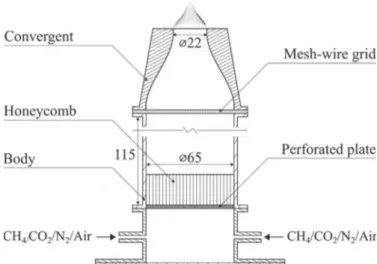
Fig. 1. Schematic of the burner with an example of flame image of a CH 4 /air mix-
ture injected at φ= 0 . 85 , U = 57 . 9 cm.s −1 , and P = 600 W .
the comparisons with numerical simulations. Results for experi-ments andsimulations conductedata fixed equivalenceratioare then presented. The influence of the CO2∗ background emission
overlapping theOH∗ and CH∗ emission bands ischaracterized in Section 3.2 .EffectsofCO2 andN2 dilutiononCO2∗emissionsare
investigatedinSection 3.3 andOH∗ andCH∗ emissionsare
exam-ined inSection 3.4 .Thesedataareusedtoexaminetheevolution of intensityratiosin Section 3.5 .All theanalysis isfinally briefly re-conductedforflamesdilutedatafixedadiabaticflame temper-atureinSection 3.6 .
2. Methods
2.1. Experimentalsetup
The experimental setupshowninFig. 1 comprisesan axisym-metric burner fed by mixtures of methane (CH4), carbon
diox-ide (CO2), andair.Alternatively, CO2 canbe replaced by nitrogen
(N2). The mixture enters the burner through a plenum and
sub-sequently passesthroughasetofgrid/honeycomb/gridbefore en-teringaninjectionnozzlewithacross-sectioncontractionratioof 8.7anda22mmnozzleoutletdiameter.Thissystemyieldsatop hat velocityprofileattheburner outletwithareducedboundary layer thickness(∼1 mm) that allows to stabilizelaminar uncon-fined conicalflames.Thechoice ofa ratherlargeexitdiameterof 22 mm allowsto minimize the influenceofheat lossesfromthe baseoftheflametotheburnerrimandreduceseffectsof aerody-namicstrainandflamecurvature[47] .Conicalflameswithanearly planar frontovera largefractionoftheflamesurface canbe sta-bilized.OneexampleisshowninFig. 1 .Therefore,suitable condi-tions forcomparisonswith 1-D FPFdirect simulations are repro-duced.
The CO2 dilutionin the combustible mixture is expressed by
the molefraction of CO2 in the CH4/CO2 blend and ranges here
from Xfuel
CO2=0 to0.40. When N2 isused instead ofCO2 todilute
theflame,thediluentmixturefractionisvariedbetween0≤XfuelN
2
≤ 0.55. Thesevaluesdo notaccount forthe N2 naturallypresent inair.Themassflow ratesofthedifferentgasesinjected are reg-ulatedbythermalmassflowcontrollers(Bronkhorst,F-series).The mixturecompositionandbulkflowvelocityUattheburneroutlet are known with a relative accuracy better than 3%. Experiments are conductedatafixed thermalpowerP=600W forgas injec-tion at room temperature T0=300 K and atmospheric pressure
Table 1
Ranges of operating conditions explored for dilution at a fixed equivalence ratio φ= 0 . 85 and thermal power P = 600 W , where
U stands for the bulk flow velocity and T ad for the adiabatic flame temperature.
X fuel diluent 0 0.05 0.10 0.15 0.20 0.25 0.30 0.35 0.40 0.45 0.50 0.55 N 2 Tad (K) 2071 2065 2059 2052 2045 2036 2026 2015 2002 1987 1969 × U(cm . s −1) 57.9 58.1 58.4 58.7 59.1 59.5 59.9 60.4 61 61.7 62.6 × CO 2 Tad (K) 2071 2061 2051 2040 2027 2013 1997 1979 × × × × U(cm . s −1) 57.9 58.1 58.4 58.7 59.1 59.5 59.9 60.4 × × × × Table 2
Ranges of operating conditions explored for dilution at a fixed adiabatic flame temperature T ad = 2071 K and thermal power P = 600 W .
X fuel diluent 0 0.05 0.10 0.15 0.20 0.25 0.30 0.35 0.40 0.45 0.50 0.55 N 2 φ 0.850 0.854 0.859 0.864 0.870 0.876 0.884 0.893 0.904 0.918 0.935 0.957 U(cm . s −1) 57.9 57.9 57.9 57.9 57.9 57.9 57.9 57.9 57.9 57.8 57.8 57.7 CO 2 φ 0.850 0.857 0.865 0.874 0.884 0.896 0.911 0.928 0.950 × × × U(cm . s −1) 57.9 57.7 57.5 57.3 57.0 56.7 56.4 56.0 55.4 × × ×
keepingtheequivalenceratioconstantat
φ
=0.85andincreasing progressively the mole fractionof the diluent Xfueldiluent inthe fuel
mixture(Table 1 ).Anothersetofexperimentsisconductedby fix-ing theadiabatic flame temperatureto Tad=2071K and increas-ing Xfuel
diluent (Table 2 ). In this case, the equivalence ratio
φ
isad-justed between the different casesexplored. Therefore,the adia-baticflametemperaturesTad[48] arefirstcalculatedformixtures
withbothdiluents, dilutionratiosofthefuelblend0≤Xfuel
diluent≤
0.55, andequivalence ratios 0.5≤
φ
≤0.96 to build a database. A lookup table is then used to match the equivalence ratioφ
andoperatetheburneratthecorrectadiabaticflametemperature
Tad=2071KforallcasesexploredinTable 2 .Thecrosssymbolsin
Tables 1 and2 designateconditionsleadingtoblow-off.
2.2. Diagnostics
The flame chemiluminescence is investigated with two diag-nostics. Thefirst oneisa 1024×1024-pixelsICCDcamera (Prince-ton instruments,PI-Max3) equippedwitha UVlens(UV-NIKKOR, 105 mm,f/4.5)anddifferentinterferometricfilters.Asetofthree 10 nm bandpass filters isused to collect the chemiluminescence signal fromexcitedOH∗,CH∗,andCO
2∗radicals,respectively
cen-teredat307nm(CVI,F10-307.1-4-50.0M),430nm(CVI, F10-430.0-4-50.0M),and455nm(Optoprim,455BP10).Meanimagesare ob-tainedbyaveraging350individualimages,eachwithanexposure time of 3 ms. The total integration time is therefore1.05 s. The signal-to-noise ratio(SNR) in theseexperiments isalways higher thanSNR=26.
The second optical system is a low resolution inboard spec-trometer (Ocean Optics, PC2000+UV–vis), coupled with a UV ca-pablefiberoptic,thatrecordsthebroadbandflameemission spec-truminthenear-UVandvisibleranges.Thespectral resolutionof this device, which is determined asthe full width at half maxi-mum (FWHM) of aHe:Ne laser lineat 632nm, is2.4nm. Spec-trapresentedinthisstudyarenotcalibratedinrelativeintensities. Therefore, comparisonsbetweenOH∗,CH∗,andCO
2∗ absolute
in-tensitiesarenotpossible.Theexposuretimeisheresetto9sand the spectrometer collects light over the whole flame region. The minimum SNR at 307nm, 430nm, and455 nm arerespectively SNR307=25,SNR430=17,andSNR455=8.
2.3. Numericalmodel
In addition to experiments, direct simulations of 1-D FPF are conducted withan internally developed solver [48] forthe oper-ating conditions shown in Tables 1 and 2 . For this purpose,the detailed chemistrymechanismdueto Lindstedt [49] ,without ac-countingfortheNOxchemistry,isextendedbyincludingreactions
fortheproductionandconsumptionofOH∗[26] (9reactions),CH∗ [26] (10 reactions), andCO2∗ [22] (14 reactions) excited radicals.
This extended mechanism includes 32 species and 174 reactions andcanbe found assupplementary electronic material . The sub-mechanismfor OH∗ includes 1production (CH+O
2⇋OH*+CO) and 8 consumption reactions, that are divided into 1 chemilu-minescence and7 quenchingreactions. The readeris referred to
[26] formoredetails.The excitedradicalCH∗isproducedviatwo
main reactions [26] : C2H+O⇋CH*+CO and C2H+O2⇋CH*+ CO2. Panoutsosetal. [16] madecomparisons ofsimulations with
the GRI 3.0 [46] andLindstedt [49] chemistry mechanisms asso-ciatedwitha rangeofexcited radicalsub-mechanismsandfound that the use of the Lindstedt mechanism coupled with the OH∗
andCH∗ mechanismsdescribed in[26] yields the bestresultsfor
lean CH4/airflames. These mechanismsare selected hereaswell
to investigatethe chemiluminescence of OH∗ andCH∗ indiluted
CH4/airflames.
Two different models are used to simulate the chemistry of CO2∗.Thefirstmodel,designatedasdetailedmodelinthe
follow-ing,includes4mainproductionreactions[22] :
CO+O
(
+M)
⇋CO∗2(
+M)
(1)HCO+O⇋CO∗2+H (2)
H+H+CO2⇋CO∗2+H2 (3)
CH2+O2+⇋CO∗2+H+H (4)
where M designates a third body partner. Kopp et al. [22] also introduced an additional CO2∗ production reaction: CH3CHCO+ OH⇋CO∗
2+C2H5. This reaction cannot be included in our
ex-tended version ofthe Lindstedt mechanism because this mecha-nismdoesnotaccountforCH3CHCO.However,thesensitivity
anal-ysis presented in[22] shows that this reaction has only a weak influenceinthepredictedCO2∗molefraction.
The second model designated here as simplified model uses a different method to simulate the CO2∗ emission. Studies from
Baulchetal.[32] andKoppetal.[22] indicatethatCO2∗ismainly
producedthroughEq. (1) :CO+O
(
+M)
⇋CO∗2(
+M)
.Consequently, the CO2∗ chemiluminescence intensity ICO2 can be expressed as [21] :ICO2=I
0
CO2[CO][O] (5)
where[CO]and[O] standfortheconcentrationsofCOandO re-spectively and the rate I0
CO2 is a function of temperature, I0CO2=
Table 3
Reactions yielding the chemiluminescence of OH ∗, CH ∗, and
CO 2∗. The reaction rate is k = AT βexp (−E/RT) . Units are cal, cm, mole, s, and K. h stands for the Planck constant and ν corre- sponds to light frequency.
Chemiluminescence reaction A β E OH ∗[26] OH ∗→ OH + h ν 1.45E +06 0 0 CH ∗[26] CH ∗→ CH + hν 1.85E +06 0 0 CO 2∗[22] CO ∗2 → CO 2 + hν 1.40E +06 0 0 CO 2∗[21] CO + O → CO 2 + hν 2.50E +06 0 3180
buttheactivation energyEandthe pre-exponentialfactorA take different values to fit their measurements for atmospheric syn-gas/airandmethane/airflames.
Table 3 summarizes the reactions yielding the chemilumines-cence of OH∗, CH∗, andCO
2∗. The light emission intensity is
ex-pressed here by the product of the Planck constant h and the emission frequency
ν
.Row 3inthistablecorresponds tothe de-tailedmodelforthecalculationofCO2∗emission.Row4indicateshow this emission is calculated with the simplified CO2∗ model Eq. (5) withoutaccountingforthedetailedchemistryofCO2∗.This
model reduces the cost of simulations. The three first rows in
Table 3 indicate that theOH∗,CH∗,andCO
2∗ chemiluminescence
intensities are directly proportional to the OH∗, CH∗, and CO 2∗
molefractions. Thisisattributed to thefact that the correspond-ing reaction rates k do not depend on temperature (
β
=E=0). The chemiluminescence intensityof these radicals is then calcu-latedastheproductofthisexcitedradicalmolefractiontimesthe pre-exponentialfactorA.3. Resultsanddiscussion
3.1. Analysisofflameimages
Itisworthstartingtheanalysisbyexaminingflameimages ob-tainedwiththesetupdescribedinSection 2 .Figure 2 showsmean images in false colors obtained with the ICCD camera equipped withtheCVIF10-307.1-4-50.0Mbandpassfiltercenteredat307nm
for increasing concentrations of CO2 in the fuel blend ranging
from Xfuel
CO2=0 to 0.35. The equivalence ratio is kept constant to
φ
=0.85. Because experiments are carried out at a fixed ther-mal power P=600W, theinjection bulk flow velocity increases fromU=57.9cm·s− 1 atXfuelCO2=0toU=60.4cm·s
− 1 atXfuel CO2=
0.35 (see Table 1 ). The flame length measured along the burner axis increases from L=19.3mm at Xfuel
CO2=0 to L=30.4mm at
Xfuel
CO2=0.35.Imagesinthisfigureareallnormalizedbythe
maxi-mumpixelvaluereachedfortheundilutedcaseshownontheleft. ThemaximumOH∗chemiluminescenceintensityrecordedthus
de-creasesforincreasingCO2 concentrations.ExperimentswithN2 as
adiluent,notshownhere,exhibitsimilartrends.DilutionwithCO2
orN2 isknowntoalterflamechemistry[50,51] andlaminar
burn-ing velocity SL [47,52,53] .Flame lengtheningisassociatedhereto
adecreaseofthelaminarburningvelocity.
Foreach image inFig. 2 , theluminosity alongthe flamefront remains roughly constant except close to the flame tip where it decreasesabruptly.Theregionclosetothetipappearslessintense thantheflamebase.Inthisregion,theflamehasahighcurvature leading toa modifiedbalance betweenspeciesandheatdiffusion anda modifiedlaminarburningvelocity [54] .Here,however,the weakerluminosityismainlyattributedtosmallverticaloscillations of theflame tipposition withtime duetoa buoyancyinstability in theburntgasesthatsurroundtheflame [55,56] .Theregion at the flame tip appears thus artificially broadened in the long ex-posure timeimagesandconsequentlyfeaturesonaveragealower localsignalintensity.Thiseffectlimitedtoanarrowregionovera smallfractionoftheflame surfacearea barelychanges theglobal chemiluminescence signalintensityintegratedovertimeandover thewholeflameregion.
Figure 3 showsCO2-diluted flame images when the adiabatic
flametemperatureiskeptconstantatTad=2071Kandthe equiva-lenceratioismodified.Hereagain,theflameheightincreaseswith largerdiluent concentrationsandreachesL=19.3mmatXfuel
CO2=0
andL=23.7mmatXfuel
CO2=0.35.Dilutionhashoweveraweaker
in-fluenceontheflameheightthanexperimentsconductedata con-stant equivalence ratio shownin Fig. 2 . This is attributedto the
Fig. 2. Mean chemiluminescence images of CH 4 /CO 2 /air flames with P = 600 W , φ= 0 . 85 , and varying CO 2 mole fractions in the combustible mixture (see Table (1 )). The
ICCD camera is equipped with a 10 nm bandpass filter centered at 307 nm.
Fig. 3. Mean chemiluminescence images of CH 4 /CO 2 /air flames with P = 600 W , T ad = 2071 K , and varying CO 2 mole fractions in the combustible mixture (see Table (2 )).
Fig. 4. Example of mean (left), Abel transformed (middle), and filtered (right) chemiluminescence images obtained with the bandpass filter centered at 307 nm for P = 600 W , φ= 0 . 85 , and X fuel
CO2= 0 . 15 . -1 -0.5 0 0.5 1 1.5 2 0 0.2 0.4 0.6 0.8 1 300 600 900 1200 1500 1800 2100 Temperature (K)
Normalized intensity (a.u)
T OH* Schlieren x (mm) XCO2fuel = 0.15 ϕ = 0.85
Fig. 5. Computed OH ∗, schlieren intensity ((1/ T 2 )( ∂ T / ∂ x )), and temperature T pro-
files for a flame at P = 600 W , φ= 0 . 85 , and X fuel CO2= 0 . 15 .
increase ofequivalenceratio(see Table 2 ) thatenhancesthe lam-inar burningvelocity SL andcompensates effects ofdilutionto a
certain extent.ThesameremarkcanbemadefortheOH∗
chemi-luminescenceintensity.TheOH∗reductionobservedinFig. 3 when
thediluentconcentrationincreasesisweakerthaninFig. 2 .Results forchemiluminescence intensitiesarecompared onamore quan-titativebasisinthefollowingsections.
Toallow comparisonswith1-D directsimulations, experimen-tal dataneedtoberescaled bytheflamesurface area,whichcan be obtainedbypost-processing themeanchemiluminescence im-ages presented inFigs. 2 and 3 . Foreach operating condition in-vestigated, anAbeltransformationis firstappliedonthe raw im-ages recorded by the ICCD camera equipped with the CVI F10-307.1-4-50.0M bandpass filter to determine the OH∗
chemilumi-nescence signal originating from a central vertical plane passing through the burner axis (Fig. 4 left and middle). A 10×10-pixels medianfilteristhenappliedontheresultingimagestoreducethe noise producedbytheAbeltransformation(Fig. 4 right).A home-madeMatlab® routinethencomputestheflamesurface areafrom
the filteredimages.Inthisstudy,theOH∗ signalisused to
delin-eatetheflamefrontposition,whichisidentifiedasthepositionof maximumOH∗ chemiluminescenceintensity.TheOH∗signaltakes
its highestvaluesinthehottestregionsoftheflameandisoffset withrespecttothebeginningofthepreheatedregionusuallyused to define the flame surface area [16] . Forlaminarburning veloc-ity measurements, the schlieren orshadowgraphy techniques are thereforeoftenpreferredtoinferpreciselytheflamefrontposition
[47,52,57] . Figure 5 showsthe computednormalized OH∗
chemi-luminescenceintensityandthetemperatureprofilefora flameat
P=600W,
φ
=0.85,andXfuelCO2=0.15calculatedwiththecode
de-0 10 20 30 40 50 60 0 2 4 6 8 10 12 0 10 20 30 40 50 60 0 2 4 6 8 10 12 XCO2fuel Diluent is CO2 XN2fuel Diluent is N2 Flame area (cm 2) Flame area (cm 2) ϕ = 0.85 ϕ = 0.85 Tad = 2071 K Tad = 2071 K
Tracer is maximum OH* intensity
Tracer is maximum schlieren intensity (modeled)
Tracer is maximum OH* intensity
Tracer is maximum schlieren intensity (modeled)
Fig. 6. Measured flame surface area for CH 4 /air flames diluted with CO 2 (top) or N 2
(bottom). Results are presented for dilutions at a fixed equivalence ratio φ= 0 . 85 (black) or adiabatic flame temperature T ad = 2071 K (red). The flame front tracer is
the maximum OH ∗chemiluminescence intensity (square symbols) or the simulated
maximum schlieren intensity (circle symbols). (For interpretation of the references to color in this figure legend, the reader is referred to the web version of this arti- cle.)
scribedinSection 2.3 .Asyntheticschlierensignalprofile,defined as(1/T2)(
∂
T/∂
x)[58] withTandxbeingthe temperatureandtheprogressalongacoordinatenormaltotheflamefront,isalso plot-ted.Theoriginx=0inthisfigurecorrespondstothebeginningof thepreheatzone.Themaximumschlierenintensityliesata posi-tionx=0.18mm located 0.45mm upstream the OH∗ peak
inten-sitydetected at x=0.63mm.Simulations show that the distance betweentheschlierenandOH∗peaksisalwayscomprisedbetween
0.41mmand0.54mmfortheoperatingconditionsinvestigatedin
Tables 1 and2 .
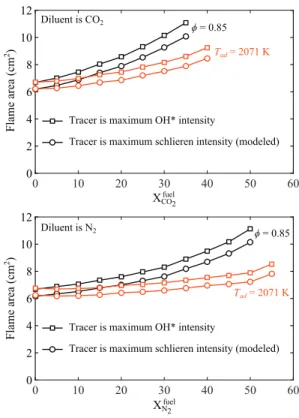
Figure 6 showsthe measured flamesurface area(square sym-bols) deduced fromthe OH∗ signals asa function ofthe diluent
concentrationwithCO2(top)orN2 (bottom)forexperiments
con-ductedatafixedequivalenceratio(black)andatafixedadiabatic flametemperature(red).Knowingthedistanced=0.48±0.6mm betweentheOH∗ peakintensityandschlierenfrontallowstoplot
acorrectedflamesurfacearea(circlesymbols)thatwouldbe mea-sured by a schlieren technique. Comparison between these two quantities shows that calculations with the OH∗ tracer
overesti-mates the flame surface area by about 9± 1% on average com-paredtothat deduced withasynthetic schlierensignal. This dif-ference remains roughly constant and corresponds to a constant offset for all cases explored. In what follows, all chemilumines-cence intensities are normalized by the peak value obtained for the undiluted referencecase Xfuel
diluent=0 at
φ
=0.85. Due to theroughly constant offsetbetweenthe flamesurface areasdeduced fromthe OH∗ andthe syntheticschlieren signals,the OH∗ signal
can,inthisstudy,safelybeusedtodeterminetheflamesurface ar-easneededtonormalizethechemiluminescence data.This proce-dureisappliedtocompareresultsfrom1-D FPFsimulationswith experiments.
Intensity (a.u) Wavelenght (nm) 200 250 300 350 400 450 500 XCO2fuel = 0.15 0 0.25 0.5 0.75 1 OH* CH* CO2* 5 ± m n 0 3 4 455nm±5 5 ± m n 7 0 3 ϕ = 0.85
Fig. 7. Flame spontaneous emission spectrum for P = 600 W , φ= 0 . 85 , and X fuel CO2= 0 . 15 . Vertical dashed lines show the width of the bandpass filters used during the ICCD experiments. 0 10 20 30 40 50 60 0 20 40 60 80 100 Xdiluentfuel Diluent is N2 Diluent is CO2
}
}
OH* CH*ϕ = 0.85
IX* /( IX* + ICO 2 * ) (%)Fig. 8. Chemiluminescence intensities emitted by OH ∗ (circle symbols) within
[278–336 nm] and CH ∗ (square symbols) within [416–449 nm] and normalized by
the total chemiluminescence intensity emitted by both OH ∗and CO
2∗ or CH ∗ and
CO 2∗, respectively. Results are presented as a function of the mole fraction of dilu-
ent, N 2 (black) or CO 2 (red), in the fuel for φ= 0 . 85 . (For interpretation of the ref-
erences to color in this figure legend, the reader is referred to the web version of this article.)
3.2. EffectsofCO2∗emissionbackground
WenowaimatdeterminingeffectsofCO2∗onflameemission
spectrabetween200 and500nm. Figure 7 showsaspontaneous emissionspectrumforaCH4/CO2/airflameat
φ
=0.85andXfuelCO2=
0.15.Thespectrumexhibitstwonarrowpeaksaround309nmand 432 nm that are characteristics of OH∗ and CH∗
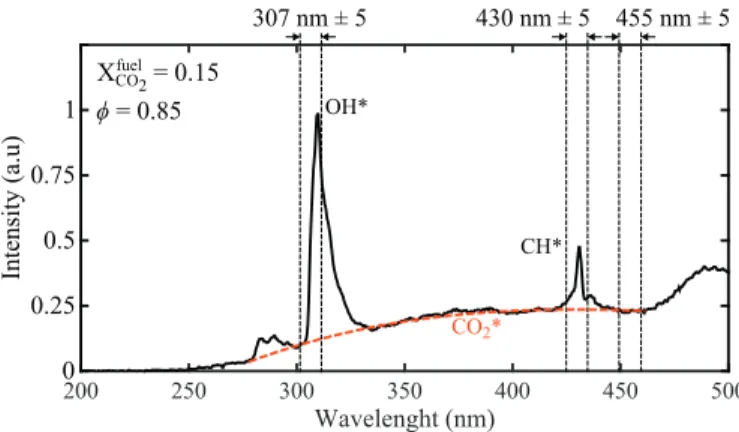
chemilumines-cenceemissions[14] .Onealsoidentifiesthebroadbandcontinuous lightemissionfromCO2∗[21] ,thathasbeenfittedherebythered
dashed linebetween270 and460 nm.Figure 7 showsthat plac-ing theCVIF10-307.1-4-50.0Mnarrowbandpass filtercenteredat 307 nm in front of the ICCD camera does not allow to only se-lecttheOH∗emissionbecausetheCO
2∗backgroundemissionhas
alreadyasizable contributionatthesewavelengths.Thisproblem was alreadyreported in[7,8,18,19] .The samephenomenon is ob-servedat430nmfortheCH∗excitedradicalwithalarger
contri-bution from theCO2∗ background emission intensityto the light
recordedbythespectrometer.Figure 7 alsoshowsthatabandpass filtercenteredat455nmallows toselectonlythe chemilumines-cencefromexcitedCO2∗radicals.
It is worth examining the contribution of the CO2∗
inten-sitybackgroundtoOH∗andCH∗chemiluminescenceintensitiesin
more details. Figure 8 plots the OH∗ intensity, I
OH∗, recorded in
the range [278–336nm]. This wide spectral width takes mostof the OH∗ emission bands intoaccount asshownin Fig. 7 . Results
inFig. 8 are normalizedbythetotalchemiluminescence intensity emitted by both OH∗ and CO
2∗ excited radicals, IOH*+ICO∗ 2, over
thesamespectralrange.Resultsarepresentedasafunctionofthe diluent molefraction inthe fuel for
φ
=0.85.The OH∗ intensityIOH∗ iscomputedasfollows:
IOH*= Z 336
278
[S
(
λ
)
−B(
λ
)
]dλ
(6)where
λ
isthewavelength,Sstandsforthespectrometermeasured intensity(blacksolidline),andBrepresentsthefittedCO2∗chemi-luminescenceintensity(reddashedline)ICO∗ 2: ICO∗ 2= Z336 278 B
(
λ
)
dλ
(7)For N2-diluted flames, Fig. 8 shows that the OH∗
chemilumines-cence intensity corresponds roughly to 60% ofthe total chemilu-minescenceintensitydetected inthespectralrange[278–336nm] that includesboth theOH∗ andCO
2∗ contributions.IncreasingN2
dilution hasonly a weak influence onthe fractionof light emit-ted by OH∗, but the CO
2∗ background intensity cannot be
ne-glected.ForCO2-dilutedflames,thecontributionoftheCO2∗
back-ground intensityincreases with theCO2 concentration and leads
to a dropof IOH∗ with respect to IOH*+ICO
2∗ inFig. 8 . The ratio
ICO2∗/
(
IOH*+ICO2∗
)
reaches46% atXfuelCO2=0.35.ForlargeCO2
dilu-tion concentrationsXfuel
CO2>0.40, which could not be explored in
theseexperimentsduetoblow-off issues,theCO2∗
chemilumines-cenceintensitymightexceedtheOH∗chemiluminescenceintensity
over therange [278–336nm]. Theseconditionswouldcorrespond to a weak OH∗ emission peak around 307 nm flooded within a
continuous CO2∗backgroundemission.Inthiscase, narrow
band-pass filters (FWHM< 10nm) centered aroundthe wavelength of maximum OH∗ emission must be preferred. To illustrate it, the
chemiluminescence intensity recorded withthe CVI F10-307.1-4-50.0Mbandpassfilterallows tocollectmorethan77%ofthelight intensityoriginatingfromOH∗ radicalseven atlarge CO
2
concen-trationsXfuel
CO2=0.35.Thislargevaluealsoprovesthatitisnot
nec-essary to correcttheOH∗ imagescollected with the
F10-307.1-4-50.0M filter that are used to determine the flame surface area. It should also be noted that the values plotted in Fig. 8 cannot be used tocorrectOH∗imagesbecause therangeofwavelengths
used forcomputations doesnot matchthe transmission band of theF10-307.1-4-50.0Mfilter.
The sameanalysis is now carried inFig. 8 for theCH∗
spon-taneous emission band around 430nm integratedover a 33 nm spectralbandwidth.TheCH∗chemiluminescenceintensityI
CH∗,
de-tectableintherange[416–449nm],iscomputedasfollows:
ICH*= Z 449 416 [S
(
λ
)
−B(
λ
)
]dλ
(8) whereICO∗ 2 isnow: ICO∗ 2= Z449 416 B(
λ
)
dλ
(9)Independentlyofthediluentnatureanditsconcentrationinthe mixture,around80%ofthesignalintensitydetectedinthespectral range[416–449nm]originatesfromCO2∗andnotfromCH∗.A
nar-row bandpass filtercenteredaround the CH∗ maximumemission
peak near 430 nm, like the CVI F10-430.0-4-50.0M filter with a FWHMC10nmusedinthisstudy,allowstoreducethe contribu-tionofCO2∗intensitytolessthan65%.Inanycases,itisnecessary
to correct forthe CO2∗ intensity backgroundif theCH∗ intensity
needstobeanalyzedprecisely.ThisisillustratedinFig. 9 .
Figure 9 leftshowsanAbelinvertedimageofthelightrecorded with the ICCDcamera equipped withthe CVIF10-430.0-4-50.0M bandpass filter centered at 430 nm for a CO2-diluted flame at
0.2
0 0.4 0.6 0.8 1
Normalized intensity (a.u)
2 mm
430 nm
CH*
Fig. 9. Left: Abel transformed image of the light detected by the ICCD camera equipped with the CVI F10-430.0-4-50.0M bandpass filter centered at 430 nm for a flame at P = 600 W , φ= 0 . 85 , and X fuel
CO2= 0 . 15 . Only the region near the flame base is presented. Right: Post-processed image obtained after subtraction of the CO 2∗in-
tensity background.
P=600W,
φ
=0.85,andXfuelCO2 =0.15.Onlytheregionclosetothe
flamebaseisshowninthisfigure.Thisimagefeaturesarelatively broadregionwithhighpixelvaluesrevealinglightemissionovera region extending overmorethan 1 mm.Thisis attributedtothe emission of CO2∗ because the CH∗ radical cannot be present so
far downstreaminthe burntgasesfortheseoperatingconditions
[11,16,33,34] .The samesetup wasusedbutwiththeICCDcamera equipped withtheOptoprim 455BP10bandpass filtercentered at 455 nm, i.e. closeto the CH∗ emission range,to record only the
CO2∗ emission intensity. This image is then used to remove the
CO2∗ contributionfrom theimage shownin Fig. 9 left [7,8] . This
is suitable because theCO2∗ emission spectrum remains roughly
flatintherange[420–460nm](Fig. 7 ).Theresultofthiscorrection ispresentedinFig. 9 right.Thisnewimageshowsanarrowregion withhighpixelvalueswelldelineatingthereactionlayerandthere isnosignificantsignalfewtensofmillimetersdownstreamthe re-actionzone.Thesignalshowninthisimagecannowbeattributed totheCH∗emissiononly.
3.3. EffectsofCO2andN2dilutiononCO2∗
Focus is now made on the influence of CO2 and N2 dilution
on thechemiluminescence ofCO2∗.The flame surfaceareas
plot-tedinFig. 6 areusedtonormalizethechemiluminescence intensi-tiesmeasuredwiththeICCDcameraequippedwiththeOptoprim 455BP10bandpassfiltercenteredat455nm.TheCO2∗signal
mea-sured by the spectrometer over the same spectral bandwidth as
theOptoprim455BP10filterisalsocorrectedbytheflamesurface areatoyieldICO∗
2=
R460 450S
(
λ
)
dλ
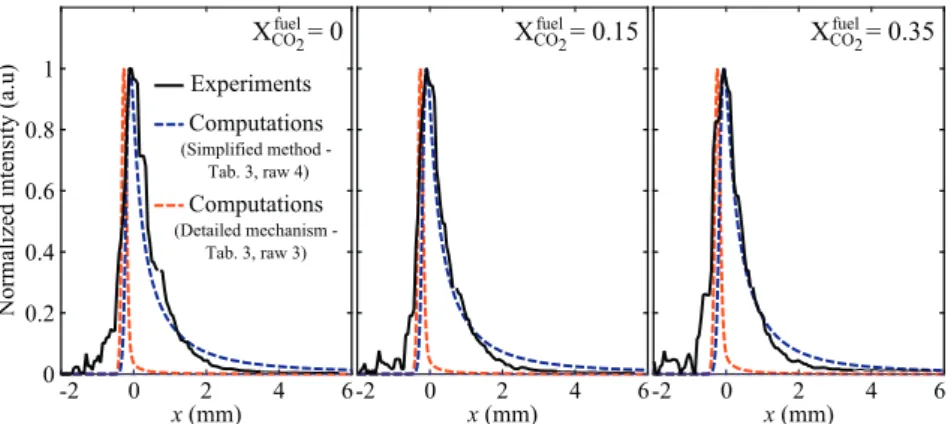
.Itisfirstworthexaminingtheevolutionofthelightintensityin thenormaldirectionto theflamefront.Figure 10 showsthe nor-malizedprofiles ofthe measured CO2∗ chemiluminescence
inten-sity(black solid line)asa function ofthe distancextothe flame front for CO2-diluted flames at P=600W and
φ
=0.85. Results are presented fordifferent diluent concentrations XfuelCO2=0, 0.25,
and0.35.ThelocationofthemaximumCO2∗peakintensityisused
heretodefinetheoriginofthenormalaxisx=0.Negativevalues
x<0correspondtothereactantside.Theseprofilesareprobedat aheight of4 mmabove the burner lipto minimize boththe in-fluenceof heatlossesto theburner andoscillations ofthe flame tipposition.Startingfromthefreshreactants(x<0),onecan no-ticeaverysharpincreaseoftheCO2∗chemiluminescenceintensity
nearxC0.TheCO2∗chemiluminescenceintensitythenslowly
de-creasesinthepost-flameregion(x>0)andvanishesforx>3mm forall diluent concentrations explored. Away fromthe flame tip andflamebase,thesefeaturesarefoundtobeindependentofthe heightabovewhichtheexperimentalprofilesaresampled.
ThebluedashedlinesinFig. 10 showresultsforthenormalized CO2∗ intensityprofilescalculatedwiththesimplifiedCO2∗
chemi-luminescencemodel basedon OandCO molefractions (Table 3 , row4). Thelocation oftheCO2∗ peakintensityisusedto rescale
simulationswithexperimentsatx=0.Themeasuredandthe cal-culated CO2∗ profilesmatchwell forthethreedilutionsexplored.
This simplified CO2∗ chemiluminescence model is able to
accu-ratelyreproducetherateofconsumptionofCO2∗inthepost-flame
region due to both chemiluminescence andquenching reactions. The red dashed lines in Fig. 10 show the computed normalized CO2∗chemiluminescenceintensityprofilescalculatedwiththe
de-tailed chemistry mechanism(Table 3 ,row 3). This modellargely overestimatestheconsumptionrateofCO2∗ inthepostflame
re-gion and consequently fails to capture the CO2∗
chemilumines-cence intensity in this region. This remains true over the whole rangeofdilutionratios examined.Atthisstage, thereisno inter-pretationforthebehavior ofthedetailedmechanismthat failsto capturetheCO2∗emissionintheburntgases.Thesimplifiedmodel
basedon O andCOmole fractions(Table 3 , row4) yields better predictionsofCO2∗relativeconcentrations.
Signalsintegratedoverthewholeflameregionandnormalized by theflame surface area are nowexamined. Figure 11 top plots themeasured CO2∗ chemiluminescence intensityasa function of
the CO2 mole fraction in the fuel when the equivalence ratio is
kept constant and equal to
φ
=0.85. Results are normalized by thevalueobtainedfortheundilutedflamewhenXfuelCO2=0.Hollow 0 0.2 0.4 0.6 0.8 1 -2 0 2 4 6 x (mm) -2 0 2 4 6 x (mm) -2 0 2 4 6 x (mm)
Normalized intensity (a.u)
X
CO2fuel= 0
X
CO2fuel
= 0.15
X
CO2fuel= 0.35
Experiments Computations (Simplified method Tab. 3, raw 4) Computations (Detailed mechanism - Tab. 3, raw 3)
Fig. 10. Normalized profiles of the measured (black solid line) and computed (blue and red dashed lines) CO 2∗chemiluminescence intensity as a function of the distance to
the flame front x for flames at P = 600 W and φ= 0 . 85 . Negative and positive values of x correspond to the reactant and burnt gases sides, respectively. Results are presented for three flames featuring different dilution ratios X fuel
CO2= 0 (left), 0.15 (middle), and 0.35 (right). (For interpretation of the references to color in this figure legend, the reader is referred to the web version of this article.)
0 10 20 30 40 50 60 0 0.2 0.4 0.6 0.8 1 1.2 ϕ = 0.85 XCO2fuel Diluent is CO2 0 10 20 30 40 50 60 0 0.2 0.4 0.6 0.8 1 1.2 XN2fuel ϕ = 0.85 Diluent is N2
Normalized intensity (a.u)
Normalized intensity (a.u)
ICCD experiments Spectrometer experiments
Computations integrated (simplified method - Tab. 3, raw 4) Computations integrated (detailed mechanism - Tab. 3, raw 3) Computations max (detailed mechanism - Tab. 3, raw 3)
ICCD experiments Spectrometer experiments
Computations integrated (simplified method - Tab. 3, raw 4) Computations integrated (detailed mechanism - Tab. 3, raw 3) Computations max (detailed mechanism - Tab. 3, raw 3)
Fig. 11. Measured (symbols) and computed (lines) of CO 2∗chemiluminescence in-
tensity as a function of the diluent mole fraction in the combustible mixture. Dilu- ent is CO 2 (top) or N 2 (bottom).
trianglesymbolsstand forthe chemiluminescenceintensity mea-sured by the ICCD camera equipped with the 10 nm Optoprim 455BP10 bandpass filter centered at 455 nm and averaged over the whole flameregion. These dataare compared withthe CO2∗
emission intensities recorded by the spectrometer (black triangle symbols)andintegratedoverthespectralrange[450–460nm]. Ex-periments withthe ICCD camera andthe spectrometer yield re-sults that collapse on the same curve up to Xfuel
CO2=0.35. It was
also checked that the CO2∗ chemiluminescence intensities
calcu-latedwiththespectrometerdataintegratedoverdifferentspectral ranges producesimilar results(see supplementary electronic ma- terial ). The spectral distribution of thebroadband CO2∗
chemilu-minescenceintensityremains unchangedwithin the rangeof op-eratingconditionscoveredinTables 1 and2 .
InFig. 11 andtheconsecutivefigures,errorbarsarepresented for the chemiluminescence intensities recorded with the spec-trometerandcorrectedforthebroadbandCO2∗background
emis-sion (filled symbols). Values for the chemiluminescence intensi-ties are obtained through the post-processing steps described in
Sections 3.1 and 3.2 andare therefore sensitive to a numberof input parameters suchasthe orderofthepolynomial forthe fit-tedCO2∗backgroundintensity,thesizeofthemedianfilterforthe
determinationoftheflamesurfacearea,andthewavelengthrange chosen for integrationofthe emission spectra.The magnitudeof error bars istherefore determined by assessing the sensitivityof thechemiluminescenceintensitytothesevariousinputparameters whose mostappropriate values are,a priori,notknown. Through the paper, variations of measured OH∗, CH∗, and CO
2∗
chemilu-minescence intensities asa function of thediluent concentration and diluent nature are considered meaningful ifthey exceed ex-perimentaluncertainties,representedbytheseerrorbars.
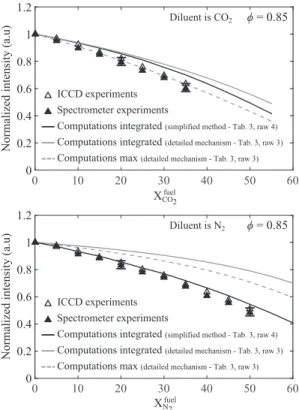
Figure 11 topshowsthat dilutionwithCO2 leads toa smooth
decreaseofthemeasuredCO2∗intensity.Thissignaldropsby40%
when the mole fraction of CO2 in the fuel reaches XfuelCO2=0.35.
Figure 11 bottom shows that experiments made with the ICCD camera andthespectrometer forN2-diluted CH4/airflames again
lead tothesameresultsuptoXfuel
N2 =0.50.TheCO2
∗ emission
in-tensityalsodecreases forincreasing N2concentrationsinthefuel
blend. For the same equivalence ratio
φ
=0.85, the CO2∗inten-sity decaysmoreslowlyforN2-dilutedfuelblends thanwithCO2
dilution.TheCO2∗intensitydropsby40%dropforXfuelN2 =0.45
ap-proximately.
The evolution of the CO2∗ intensity, integratedin the normal
direction andrescaledfora1m2flamesurfacearea,calculatedby
the numerical solver andthe CO2∗ detailed mechanism(Table 3 ,
row 3) is plotted in Fig. 11 top as a function of the CO2
dilu-ent mole fraction (gray solid line). These simulations also repro-duce the decayofthe CO2∗ chemiluminescence intensityas
dilu-tion increases. However, they underestimate the rateof decayof the CO2∗ chemiluminescenceintensityby approximately30%.
An-other attemptwasmadebyplottingasdashedgraylinesthe evo-lutionofthecalculatedpeakCO2∗intensityreachedineachflame.
Agreementbetweenexperimentsandsimulationsslightlyimproves fortheCO2-dilutedflamesinvestigated.Resultswiththesimplified
CO2∗modelsynthesizedinTable 3 ,row4areplottedasthesolid
blackcurve inFig. 11 topwhenthenumericalsignal isintegrated along the normalto the flamefront. Agreement between experi-mentsandsimulationsisacceptable,withrelativedifferences lim-ited to 7%. Results with the simplified CO2∗ model are in better
agreementwithmeasurementsthanthosefoundwiththedetailed mechanism forCO2∗.CalculationsofCO2∗ chemiluminescence
in-tensities usingthevaluesfortheactivationenergyE andthe pre-exponentialfactorAfrom[50] werealsocarriedoutandtheyyield similarresults.Theyarenotreproducedhere.
WhenCO2isreplacedbyN2,Fig. 11 bottomshowsthatthe
sim-plified CO2∗modelyields an accurate predictionofthemeasured
evolution oftheCO2∗ chemiluminescence intensity,whilethe
de-tailed modelforCO2∗failstopredictaccuratelythedropofCO2∗,
independently of the way calculations are post-processed. These testsconfirmthattheCO2∗intensitycanbesimulatedadequately
forN2-andCO2-dilutedCH4 fuelblends providedthat the
simpli-fied CO2∗ in Table 3 row4 is used. All the simulations are thus
conductedwiththismodelintheremainingpartsofthisstudy.
3.4. EffectsofCO2andN2dilutiononOH∗andCH∗
Effects ofdilutionontheOH∗ andCH∗emissionsarenow
ex-amined. ResultsfortheCO2∗excitedradicalarerepeated for
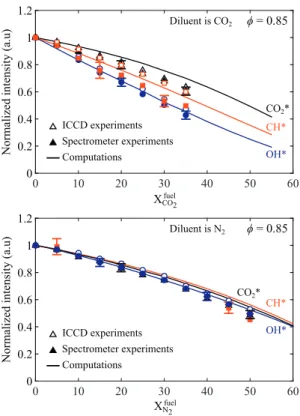
com-parison purposes. Figure 12 top showsthe measured CO2∗ (black
triangles), OH∗(blue circles), andCH∗ (redsquares)intensities as
a functionofthe CO2 molefractioninthe fuelforleanflames at
afixedequivalenceratio
φ
=0.85.Resultsareagainnormalizedby thevalueobtainedfortheundilutedflame.Hollowandsolid sym-bols stand for the chemiluminescence intensities measured with the ICCDcamera andthe spectrometer,respectively.The OH∗ andCH∗intensitylevels measured withtheICCDcameraare not
cor-rected forthe CO2∗ intensitybackground inthisfigure. However,
theintensities deducedfromspectrometermeasurementsare cor-rected for the CO2∗ intensity background. Thisfigure shows that
the emission intensityfromthesethree excited radicals regularly decreases when theCO2 concentration in the fuel increases.The
OH∗chemiluminescenceintensitydropsby57%whenXfuel CO2=0.35.
It is known that increasing the CO2 concentration in the
com-bustible mixture reduces the concentration of CH in the flames
[59] . The production of OH∗ is then penalized because this
ex-cited radical ismainly produced through the formation reaction: CH+O2⇋OH*+CO[16,23] .ResultsforOH∗obtainedby
subtract-ingtheCO2∗background(bluedisks)areonaverageonly4%lower
0 10 20 30 40 50 60 0 0.2 0.4 0.6 0.8 1 1.2 0 10 20 30 40 50 60 0 0.2 0.4 0.6 0.8 1 1.2 ϕ = 0.85 XCO2fuel Diluent is CO2 XN2fuel ϕ = 0.85 Diluent is N2
Normalized intensity (a.u)
Normalized intensity (a.u)
ICCD experiments Spectrometer experiments Computations CO2* CH* OH* ICCD experiments Spectrometer experiments Computations CO2* CH* OH*
Fig. 12. Measured (symbols) and computed (lines) normalized spontaneous emis- sion intensities of OH ∗(blue), CH ∗(red), and CO
2∗(black) as a function of the dilu-
ent mole fraction in the combustible mixture. Hollow and solid symbols stand for ICCD camera and spectrometer measurements, respectively. Experiments are real- ized at a fixed equivalence ratio φ= 0 . 85 . Diluent is CO 2 (top) or N 2 (bottom). (For
interpretation of the references to color in this figure legend, the reader is referred to the web version of this article.)
inFig. 12 top.Asalreadyindicatedintheprevioussection, correc-tion fortheCO2∗ backgroundintensityhasonly aweakinfluence
inthespectralbandwidthofOH∗spontaneousemission.
Conversely, correction for the CO2∗ background has a large
influence on the measured CH∗ emission levels, as shown in Fig. 12 top where data deduced from the spectrometer (filled red squares) liebelowthose obtainedwiththeICCDcamera (red squares)equippedwiththeCVIF10-430.0-4-50.0Mbandpassfilter centeredat430nm.Thisisinagreementwithresultspresentedin
Fig. 8 wherethemajorityofthesignaldetectedbytheICCD cam-eraaround430nmcomesfromCO2∗emission.RemovingtheCO2∗
backgroundintensityreducesthemeasuredCH∗emissionlevelby
10% on average. It is however worth noting that the subtraction oftheCO2∗backgroundintensityleadstolargererrorbarsforthe
deducedCH∗intensitylevelsinFig. 12 top.
Data for lean N2-diluted flames at
φ
=0.85 are presented inFig. 12 bottom.TheOH∗,CH∗,andCO
2∗ measuredintensities
col-lapsehereonthe samecurve.The intensityoftheseexcited rad-icals regularly decreases for increasing N2 mole fractions in the
fuel. A similar effect of N2 dilution was reported in [9] for the
CH∗ chemiluminescence intensity.The OH∗, CH∗,andCO 2∗
emis-sionlevels dropbyapproximately30%and50%whenXfuel N2 =0.35
and Xfuel
N2 =0.50, respectively. For the same molefraction in the
fuelmixture,dilutionwithN2hasasmallereffectontheOH∗and
CH∗chemiluminescenceintensitiesthandilutionwithCO 2.
The black, blue, andred solid lines in Fig. 12 show the com-puted intensitiesfromCO2∗,OH∗,andCH∗,respectively.TheCO2∗
chemiluminescence intensity plotted here is calculated with the simplified model described in Table 3 , row 4. Simulations re-produce well experiments for the OH∗ signal for both CO
2- and
N2-diluted mixtures. Measurementscorrected for the CO2∗
back-groundemissionintensityhoweveronlybarelyreducerelative dif-ferencesthatarelimitedto3%.
InthecaseofCO2-dilutedflames,differencesbetween
measure-mentsandpredictionsaremoreimportantinFig. 12 (top)forthe CH∗ emission intensity, with a mean difference of 7%. However,
thisdifferencebarely exceedsexperimental uncertainties. Simula-tionsyieldabettermatchwithCH∗experimentaldatathatarenot
correctedfor theCO2∗ backgroundemission. Thismaybe due to
therelativelylowratiobetweentheCH∗signalandtheCO 2∗
back-groundintensityleadingtolargeuncertaintiesinthecorrectedCH∗
chemiluminescence intensities (see Figs. 7 and8 ). For N2-diluted
flamesshowninFig. 12 bottom,simulationsreproducewell mea-surementsforthethreeradicalsandoverthewholerangeof dilu-tionexplored.Themeanrelativedifferencebetweenmeasurements andsimulations only reaches2%, 5%, and 6% for OH∗,CO
2∗, and
CH∗,respectively.
For most of the operating conditions, the detailed chemistry mechanismsforOH∗andCH∗,aswell asthesimplifiedmodel to
computetheCO2∗intensity,yieldgoodresults.Itisalsoworth
not-ingthatthesubtractionoftheCO2∗backgroundintensityhasonly
aweak influenceon theintegratedresults showninFig. 12 .This isattributed tothecomparableinfluenceofdilutiononthe three excited radicals emission intensities. Their intensity decreases at about the same proportion when the diluent concentration in-creases,especiallyforN2-dilutedflames.
3.5.AnalysisofOH∗,CH∗,andCO
2∗intensityratios
Inmanyapplications,theflamesurfacearea isnotknownand isdifficulttomeasure.Thisisthecaseforturbulentflameswhere the reaction layer has a 3-D structure and fluctuates withtime. In such cases, it is difficult to normalize the measured chemilu-minescenceintensitiesby theflame surfacearea. Comparison be-tweenmeasuredintensitiesand1-Dsimulations isthenmore dif-ficult. Consequently, chemiluminescence intensity ratios between different couples of excited radicals are often examined because they allow to remove the contribution of the flame surface area
[11,14,16,18–20] .EffectsofCO2andN2dilutionsontheseratiosare
examinedhere.
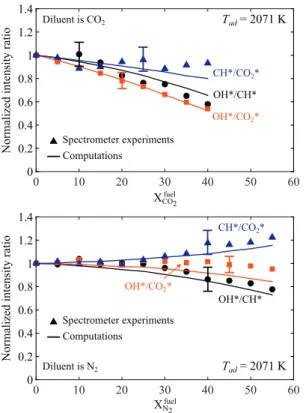
Figure 13 showsthemeasuredOH∗/CH∗(blackcircle),OH∗/CO 2∗
(redsquares), and CH∗/CO
2∗ (blue triangles) intensity ratios asa
functionofthe diluentmolefractioninthe fuel,afterthe contri-butionoftheCO2∗backgroundhasbeenremovedusingthe
spec-trometerexperiments.Resultsare presentedforCO2-diluted(top)
andN2-diluted (bottom)flames andare normalized by thevalue
obtained for the undiluted case. The experimental data feature largererrorbarsthaninthepreviousfiguresduetothecumulative relativeerrorsonthenumeratoranddenominatoroftheintensity ratios.Errorbarsareonlyplottedinthisfigureforthreeoperating conditionstoillustratetheconfidencerange.
When dilution is made with CO2 (Fig. 13 top), these three
intensity ratios decrease when the mole fraction of CO2 in the
fuelincreases.For example,themeasured OH∗/CO
2∗ intensity
ra-tio drops by nearly 30% for Xfuel
CO2=0.35. The decay rate of two
other intensitycouplesOH∗/CH∗ andCH∗/CO
2∗ withCO2 dilution
isthesameandtakesalowervaluethanfortheOH∗/CO
2∗couple.
WhendilutionismadewithN2(Fig. 13 bottom),these
chemilumi-nescenceintensityratiosremainroughly constantwithinthe con-fidence interval when the diluent concentration is increased. All of thesefeatures are also well captured by the simulations both forN2-andCO2-dilutedflames,exceptforlargeN2 concentrations
Xfuel N2 >0.40.
These results indicate that after careful calibration, monitor-ingtheOH∗/CO
2∗chemiluminescenceintensityratiomayallow
0 10 20 30 40 50 60 0 0.2 0.4 0.6 0.8 1 1.2 0 10 20 30 40 50 60 0 0.2 0.4 0.6 0.8 1 1.2 ϕ = 0.85 XCO2fuel Diluent is CO2 XN2fuel ϕ = 0.85 Diluent is N2
Normalized intensity ratio
Normalized intensity ratio
Spectrometer experiments Computations OH*/CH* OH*/CO2* CH*/CO2* Spectrometer experiments Computations OH*/CH* OH*/CO2* CH*/CO2*
Fig. 13. Measured (symbols) and computed (lines) normalized OH ∗/CH ∗ (black),
OH ∗/CO
2∗ (red), and CH ∗/CO 2∗ (blue) intensity ratios as a function of the diluent
mole fraction in the combustible mixture for CH 4 /air/diluent mixtures at a fixed
equivalence ratio φ= 0 . 85 . Diluent is CO 2 (top) or N 2 (bottom). (For interpretation
of the references to color in this figure legend, the reader is referred to the web version of this article.)
However, this technique cannot be used for N2-diluted CH4/air
flames.
3.6. Analysisofdilutioneffectsatafixedadiabaticflametemperature
Sofarthechemiluminescence dataforCH4 fuelblends diluted
with N2 or CO2 was examined at a fixed equivalence ratio
φ
= 0.85. The influence of dilution on the chemiluminescence inten-sitiesfor mixturesdiluted at afixed adiabatic flametemperatureTad=2071K(see Table 2 ) is now examined. Figure 14 top plots the measured CO2∗ (black triangles), OH∗ (blue circles), andCH∗
(red squares) chemiluminescence intensities as a function of the CO2molefractioninthefuelblend.Resultsarenormalizedbythe
value obtainedfortheundilutedflame.Hollowandsolidsymbols standforthechemiluminescenceintensitiesmeasuredbytheICCD cameraandthespectrometer,respectively.
Here again, the OH∗ chemiluminescence intensity decreases
regularly withtheCO2 dilutionratio.The OH∗ intensitydrops by
approximately40%atXfuel
CO2=0.40.TheCH
∗ emissionintensity
re-mains roughly constant even for large CO2 concentrations while
the CO2∗ chemiluminescence intensity slightlyincreases with
di-lution.Forexample,theCO2∗intensityincreasesbyapproximately
10% at Xfuel
CO2=0.40 with respect to the signal measured for the
undilutedflame.ThisweakeffectofdilutionontheCH∗intensity
isduetotheincrease oftheequivalenceratio[16] neededto ob-taina dilutedmixturefeaturing thesameadiabaticflame temper-atureasalessdilutedone. Thisslightincreaseoftheequivalence ratiocompensatestheinfluenceofdilution(seeFig. 12 ).Exceptfor CO2∗andlargediluentconcentrations,thesimulations(solidlines)
reproducewell measurements (symbols)inFig. 14 top.Themean relativedifferencebetweenmeasurementsandsimulationsreaches 6% forOH∗and4%forCH∗.Simulations howeverlargely
overesti-0 10 20 30 40 50 60 0 0.2 0.4 0.6 0.8 1 1.2 1.4 0 10 20 30 40 50 60 0 0.2 0.4 0.6 0.8 1 1.2 1.4 Tad = 2071 K XCO2fuel Diluent is CO2 XN2fuel Diluent is N2
Normalized intensity (a.u)
Normalized intensity (a.u)
ICCD experiments Spectrometer experiments Computations CO2* CH* OH* Tad = 2071 K ICCD experiments Spectrometer experiments Computations CO2* CH* OH*
Fig. 14. Measured (symbols) and computed (lines) normalized chemiluminescence intensities of OH ∗ (blue), CH ∗ (red), and CO
2∗(black) radicals as a function of the
diluent mole fraction in the fuel when dilution is realized at a fixed adiabatic flame temperature T ad = 2071 K . Hollow and solid symbols stand for ICCD camera and
spectrometer measurements, respectively. Diluent is CO 2 (top) or N 2 (bottom). (For
interpretation of the references to color in this figure legend, the reader is referred to the web version of this article.)
matetheincreaseoftheCO2∗ emissionintensity.Becausedilution
has herean opposite effectontheOH∗andCO
2∗intensities,
cor-rectionoftheOH∗chemiluminescenceintensitybytheCO 2∗
back-groundintensitynowhasalargerinfluenceontheresultsthanfor experimentsconductedatafixedequivalenceratio
φ
=0.85.When N2 is used to dilute the flames, the CO2∗ intensity
re-mains roughly constant,theCH∗emission levelslightlyincreases,
andtheOH∗intensitydecreaseswhentheconcentrationofN 2
in-creases.However,effectsofN2 dilutionremainalways weak,with
variations limitedto±15%forlarge diluentconcentrations. Simu-lations better reproduceexperiments than forCO2-diluted flames
witha meanrelative difference reaching 2%,5%, and4% forOH∗,
CO2∗, and CH∗, respectively. The detailed chemistry mechanisms
forOH∗ andCH∗andthe simplifiedmodelforthe CO
2∗ intensity
yield overall good resultswhen dilutionis madeata fixed adia-baticflametemperature.Independentlyoftheexcitedradical con-sidered and the diluent nature, the decay of chemiluminescence intensities observed in Fig. 12 when dilution is made at a con-stant equivalence ratio is attenuated or even canceled-out when the adiabatic flame temperatureis kept constant during dilution (see Fig. 14 ). From that, it is concludedthat the temperature re-duction inducedbydilutionatafixedequivalenceratioisamain contributortothereducedchemiluminescenceintensitiesobserved inFig. 12 .Aroughanalysisofthereactionpathsleadingtothe for-mation ofexcited radicalsalsopoints inthisdirection. For exam-ple, Eq. (5) showsthat decreasingthe temperaturedecreases the reactionrateoftheoverallreactionproducingCO2∗
chemilumines-cence.Similarly,theconcentrationofCOandOgenerallyincreases withtemperature.
Although the influence ofdilutionwith N2 or CO2 on excited